Avaaz: Imperialist Pimps of Militarism, Protectors of the Oligarchy, Trusted Facilitators of War
Part one, section one of an investigative report by Cory Morningstar | Wrong Kind of Green | September 10, 2012
“I wish you a refreshing bath of conscience, I wish that you may be able to try out looking at others eye to eye, I wish that the spring of truth makes life more humane for you.” – Excerpt from the profound message to Avaaz by poet Gabriel Impaglione of Argentina
The Art of Social Engineering | The Art of Social Genocide
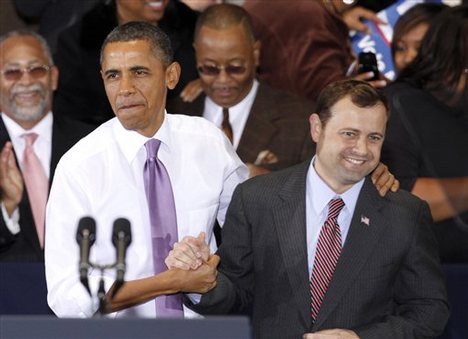
Image: U.S. President Barack Obama with Avaaz co-founder and former U.S. Representative Tom Perriello.
The Ivy League bourgeoisie who sit at the helm of the non-profit industrial complex will one day be known simply as charismatic architects of death. Funded by the ruling class oligarchy, the role they serve for their funders is not unlike that of corporate media. Yet, it appears that global society is paralyzed in a collective hypnosis – rejecting universal social interests, thus rejecting reason, to instead fall in line with the position of the powerful minority that has seized control, a minority that systematically favours corporate interests.
This investigative report examines the key founders of Avaaz, as well as other key sister organizations affiliated with Avaaz who, hand in hand with the Rockefellers, George Soros, Bill Gates and other powerful elites, are meticulously shaping global society by utilizing and building upon strategic psychological marketing, soft power, technology and social media – shaping public consensus, thus acceptance, for the illusory “green economy” and a novel sonata of 21st century colonialism. As we are now living in a world that is beyond dangerous, society must be aware of, be able to critically analyze, and ultimately reject the new onslaught of carefully orchestrated depoliticization, domestication of populace, propaganda and misinformation that is being perpetrated and perpetuated by the corporate elite and the current power structures that support their agenda. The non-profit industrial complex must be understood as a mainspring and the instrument of power, the very support and foundation of imperial domination.
Within part I of this investigative report:
- The Simulacrum
- Modus Operandi: The 21st Century NGO
- 2004: The Soft Power Imperative | 2011: Mission Accomplished
- Introduction: The Non-profit Industrial Complex: Imperialist Pimps of Militarism, Protectors of the Oligarchy, Trusted Facilitators of War
- Historical Amnesia
- Corporate “Green” Pedophilia
- The Commerce of Trust
- The Cat is Out of the Bag
- New York City Occupy Wall Street Embraces Otpor and Bombing for Peace
- The WikiLeaks Connection
- Unidentified “Freedom of Speech”
- 15M – Europe’s Occupy Movement
- The Commerce of Exploitation: Change.org
- Indoctrinated Subservience & Whitism
- Avaaz’s Founder and MoveOn.org Announce the U.S. “Spring”
Part II:
- Bread and Circuses
- Avaaz: The Emperor of the NGO Network
- Did Libya’s Citizens Demand Foreign Intervention?
- The Avaaz Gate-Keepers
- Avaaz Co-Founder and Executive Director: Ricken Patel
- Avaaz Co-founder: Tom Perriello
- Indoctrination of the Youth is Essential
- The Humanitarian Industrial Complex: The Ivory Towers Within the Dark Triad
- The Empire
- Avaaz Co-founder: Tom Pravda
- Avaaz Co-founder: David Madden
- Avaaz Co-founder: Eli Pariser
- Avaaz Co-founder: Jeremy Heimans
Part III:
- Behavioural Change
- May 2010: Avaaz’s Co-Founders Seek a Purpose-Driven Consumer Life | Behavioral Economics
- The Behavioral Economics of Hatred
- Purpose
- Res Publica
- Avaaz Founding Board Member: Ben Brandzel
- Purpose: James Slezak
- MoveOn.org
- GetUp
- The 21st Century Social Movements
- The Non-Profit Industrial Complex Finally Finds “Success”
- Avaaz Co-founder: Andrea Woodhouse
- Avaaz Co-founder: Paul Hilder
- The Avaaz “Core Campaign Team Members”
The Simulacrum
“As regards the ‘foundations’ created for unlimited general purposes and endowed with enormous resources, their unlimited possibilities are so grave a menace, not only as regards to their own activities and influence but also the numbing effect which they have on private citizens and public bodies, that if they could be clearly differentiated from other forms of voluntary altruistic effort, it would be desirable to recommend their abolition.” – Senator Frank Walsh, 1915
In his Sophist, Plato speaks of two kinds of image-making. The first is a faithful reproduction, a precise copy of the original. The second is distorted intentionally in order to make the copy appear correct to viewers. Plato gives the example of Greek statuary, which was crafted larger on top than on bottom so that viewers from the ground would see it correctly, whereas if they could view it in scale, they would realize it was malformed.
This latter representation serves as a visual art metaphor for the non-profit industrial complex. A semblance of entities, united in an ideology encompassing truth, justice and ethics – which is false. This is the simulacrum, distorted in such a way that it appears accurate unless viewed from the proper angle. This report aims to allow you, the reader, to view the matrix from such an angle. By denying the reliable input of our senses while accepting the non-profit industrial complex’s manipulative constructs of language and “reason,” global society has arrived at a grossly distorted copy of ethics and intrinsic worth – a warped simulacrum of thespian complexity, a vast work of superficial depth.
Modus Operandi: The 21st Century NGO
“What a cluster-fuck of disinformation this world has become. The sinister forces of greed and avarice are, through consolidation of wealth and power, more powerful than ever. Humankind has a huge uphill battle to wage.” — Comment at How Avaaz is Sponsoring Fake War Propaganda from Syria
The 21st century NGO is becoming, more and more, a key tool serving the imperialist quest of absolute global dominance and exploitation. Global society has been, and continues to be, manipulated to believe that NGOs are representative of “civil society” (a concept promoted by corporations in the first place). This misplaced trust has allowed the “humanitarian industrial complex” to ascend to the highest position: the missionaries of deity – the deity of the empire.
Modus operandi (plural modi operandi) is a Latin phrase, approximately translated and backronymed as “mode of operation.” The term is used to describe someone’s habits or manner of working, their method of operating or functioning. In English, it is frequently shortened to M.O.
The expression is often used in police work when discussing a crime and addressing the methods employed by the perpetrators. It is also used in criminal profiling, where it can help in finding clues to the offender’s psychology. It largely consists of examining the actions used by the individual(s) to execute the crime, prevent its detection and/or facilitate escape. [Source: Wikipedia]
2004: The Soft Power Imperative | 2011: Mission Accomplished
“Existing soft power initiatives and agencies, particularly those engaged in development and strategic communications, must be reinvigorated through increased funding, human resources and prioritization. Concurrently, the U.S. government must establish goals, objectives and metrics for soft power initiatives. Furthermore, the U.S. government can better maximize the effectiveness of soft power instruments and efforts through increased partnerships with NGOs. By providing humanitarian and development assistance in areas typically inaccessible to government agencies, NGOs are often able to access potential extremist areas before the government can establish or strengthen diplomatic, developmental or military presence, including intelligence.” — Joseph S. Nye, former US assistant secretary of defense, June 2004
The non-profit industrial complex represents a rich portfolio of soft power tools readily available to the ruling elite. Today we witness the near complete metamorphosis of the complex having successfully morphed into the absolute idyllic clearinghouse for the collective and coordinated imperialist agenda shared by a broad spectrum of government institutions, dominated by the financial industrial complex, corporate power and hegemonic rule – all under the guise of a global conscience reflective of “civil society” via self-appointed NGOs.
Joseph S. Nye (quoted above) is a former US assistant secretary of defense, former chairman of the US National Intelligence Council and professor at Harvard University. A world renowned scholar of international relations, Nye co-founded the liberal institutionalist approach to international relations, theorizing that states and other international powers possess more or less “soft power” (a term first coined in the 1980s). In a 2004 article titled The Rising Power of NGO’s, Nye peddled his soft-power theory as the quintessential element that must be employed in order to protect the American public from “terrorists.” Of course, Nye neglected to include the fact that the true “terrorists” are those who hold power within our very own EuroAmerican governments/establishments, waging violence upon sovereign, resource-rich states. It’s an easy sell as it enables one to conveniently deny their assent to (our own) state-sponsored terrorism and continued collective and voluntary servitude as well-behaved, rapturous consumers under the influence of American (non) culture.
If a state can present its power as legitimate in the eyes of others, it will encounter far less resistance to its foreign policies and agendas. Further, if the Western states’ (non) culture and (illusory) ideology are desirable, other states will more willingly acquiesce. This is an area where the NGOs excel. They do so by never referring to their own “leaders” as dictators or fascists, yet more than willing to apply these derogatory terms to leaders targeted for regime change. Simultaneously, while reporting on human rights abuses or environmental violations in states exploited by industrialized capitalism, the NGOs neglect to comment on their own states’ escalating assault on “democracy.” Most important, the non-profit industrial complex certainly does not address the fact that industrialized and globalized capitalism (imposed by hegemonic rule) is the crux of most all suffering and ongoing crisis in the very states they criticize and deem culpable. A continuous subtle undertone of support/belief in their own states’ democracy is achieved simply by never opening a dialogue on the legitimacy of power structures within their own (imperialist) states.
In essence, soft power is “the universalism of a country’s culture and its ability to establish a set of favourable rules and institutions that govern areas of international activity [that] are critical sources of power” or, more simply, the ability to attract and co-opt rather than coerce and rather than using force or money as a means of persuasion. This is where states such as Bolivia (and Libya until its recent annihilation) are very real threats to the American superpower. States such as Bolivia and Libya (past-tense) serve the people to advance themselves to a more enlightened, more democratic existence in a very real sense, while democracy and freedoms in the Americas mean little more than “freedom to shop” and buy as much sweatshop junk as one can(not) afford. If corporate-owned/controlled media and corporate-funded/controlled educational institutes actually educated the American public on intellectual enlightenment and progressive advances in other countries – Americans would truly wonder what the fuck was going on. Rather, we are kept in the dark; doped up by big pharma and stupefied by Big Brother, all while such states and leaders are continually vilified and demonized in the media (both corporate and foundation-funded “progressive”), all while NGOs remain silent on their own accelerating fascist governments. American “exceptionalism” is, undoubtedly, the biggest lie ever told sold.
Introducing the Non-Profit Industrial Complex: Imperialist Pimps of Militarism, Protectors of the Oligarchy, Trusted Facilitators of War

Packaging – Uncle Sam is the best in packaging and selling illusions.
“I am convinced that some NGOs, especially those funded by the U.S.AID, are the fifth column of espionage in Bolivia, not only in Bolivia, but also in all of Latin America.” — Evo Morales, February 2012
In 2001, it was George W. Bush who propelled an illegal invasion of Iraq by way of relentless pounding of repetitive messaging of discovered weapons of mass destruction in Iraq coupled with incessant images of the Twin Towers being destroyed. This psyop (or psychological operation, a new form or warfare) reverberated throughout a mainstream media that obediently fed the lies to the masses. The role of the media was absolutely essential. Yet, in spite of Bush calling for the invasion of Iraq, citizens of the globe, in united cohesion, held the largest mass protests and peace vigils the world had ever witnessed.
Today, however, the push to invade under the guise of humanitarianism is no longer a message from predominantly imperialist governments alone. Rather, there is a new game in town. Flash forward one decade to 2011 and the push for war no longer comes from the lone vacuity of despised war criminals such as George Bush or his charismatic alter-ego, Barack Obama. Rather, the message is now being spoon-fed to global society via the “trusted” NGOs, with Avaaz, Amnesty International and Human Rights Watch at the forefront, as documented prior to and during the attack on and subsequent occupation of Libya, and more recently, the destabilization of Syria. [One of many reports of such malfeasance include “HUMAN RIGHTS” WARRIORS FOR EMPIRE | Amnesty International and Human Rights Watch“, by Glen Ford, Black Agenda Report.]
“While much was made of the United Nations decision to establish a Human Rights Council in 2006, those who’ve witnessed the evolution of this institution are well aware that the UN was designed by (and functions to serve) the interests of modern states and their supplicants, not the Indigenous nations they rule. For those attached to charitable organizations like Human Rights Watch and other pashas of the piety industry, this is a bitter pill to swallow.” — Jay Taber, Obstacles to Peace, 13 July 2012
“The UN Human Rights Council stands as one of the significant obstacles to dynamic political development in the Fourth World. Many individuals and the peoples they represent in the Fourth World have come to believe that the UN Human Rights Council will relieve their pain from the violence of colonialism. It cannot, and it will not.” — Dr. Rudolph Ryser, Chair of the Center for World Indigenous Studies
A decade later, thanks to the non-profit industrial complex awash in an influx of money that flows like the river Nile, partnered with the corporate media complex, it is now “the people” – having been swayed by fabrications, omissions and lies – who lead the demand for invasion of these sovereign states. And, most ironic, it is not the so-called “right” at the vanguard; rather, it is the “progressive left.”
Historical Amnesia
“False reality” requires historical amnesia, lying by omission and the transfer of significance to the insignificant. In this way, political systems promising security and social justice have been replaced by piracy, “austerity” and “perpetual war”: an extremism dedicated to the overthrow of democracy. Applied to an individual, this would identify a psychopath. Why do we accept it? — John Pilger, award–winning journalist, in History is the Enemy as “Brilliant” Psy-ops Become the News, 21 June 2012
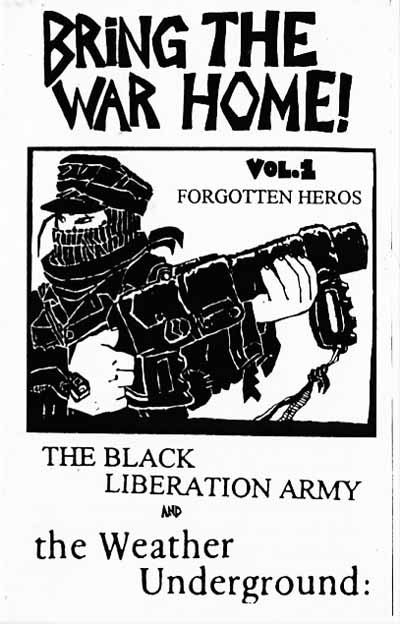

Huey P. Newton, Bobby Seale, Eldridge Cleaver, David Hilliard, Fred Hampton, and Erica Huggins – forgotten heroes indeed. The Black Panthers, who emerged on the scene in 1966, drew much inspiration from the ideologies of Malcolm X. Rejecting pacifism and reformism, under the leadership of Fred Hampton, the Panthers recognized the necessity of militant action and self-defense (“by any means necessary”) against racists and the state. The Panthers were effective in organizing the struggle towards a true revolutionary faction, with the state full-well recognizing the very real potential the Panthers held to gain mass support for their revolutionary movement. The state was terrified at this very real threat. It must be noted that during this same time period, white youth were demonstrating against the Vietnam war while 45% of Blacks fighting in Vietnam proclaimed they would be prepared to take up arms within their own state to secure justice for the American people. Considering that in 1960 almost half of America’s population was under 18 years of age, the ample surplus of youth made the threat of a widespread revolt against the status quo a very real possibility. By 1967, the rise in militancy and “Black Power” drew a very tactical response from very anxious foundations. Rockefeller and Ford created the National Urban Coalition (NUC) with the intent of transforming “Black Power” into “Black capitalism.” This was the vehicle designed/created to crush the building momentum that was confronting/challenging the prevailing system of economic control and oppression. By 1970, as Black capitalism took hold, foundations were funneling over $15 million into “moderate” Black organizations in order to effectively deflect the Black Power movement into non-threatening channels. With Black Power successfully transitioning itself into Black capitalism, American corporations utilized the opportunity to cast themselves in a liberal, progressive light by financing Black Power conferences.
The evidence that the Panthers’ revolutionary movement was a very real threat to the American state is indisputable: the FBI (under J. Edgar Hoover) declared the Panthers the number one threat to the internal security of the US. The state tried to eradicate the Panthers “by any means necessary,” gunning down scores of Panthers in the street.
Martin Luther King, Jr. was also closely affiliated with the Rockefellers via the 1957 founded Southern Christian Leadership Council (SCLC), which received money from the church and the Rockefellers. Although quite radical, elites considered SCLC moderate and “workable” because of its stance on nonviolence (which protects the state), alongside goals of integration rather than revolution. However, by the late 1960′s, Martin Luther King, Jr. had embraced militancy and radical positions espoused by both the Panthers and Malcolm X. As Martin Luther King, Jr.’s refusal to compromise increased, the foundation funding decreased. A respected man of such stature, speaking out, thus educating a vast public of the oppression caused by the capitalist system/racism, was indeed (and remains so today) a great threat to the powers that dominate. Thus, King was assassinated. Today, in united cohesion, the states work ardently with “progressive” (foundation-funded) media and the non-profit industrial complex, in ensuring that the King legacy is continually and relentlessly sanitized, watered down and co-opted to serve the elitist agenda. The pacifist doctrine, fondly funded by hegemonic rule, is continuously pumped through and circulated throughout the gentrified “movement” like fluoride in the city water – a neutral benevolence of slow poison we drink in voluntary servitude. [June 27, 2012: Black On The Old Plantation | Civil Rights Organizations Enslave Themselves to Corporate Funding]
“We do not fight racism with racism. We fight racism with solidarity. We do not fight exploitative capitalism with black capitalism. We fight capitalism with basic socialism. We fight imperialism with proletarian internationalism.” — Bobby Seale, a founder of the Black Panthers
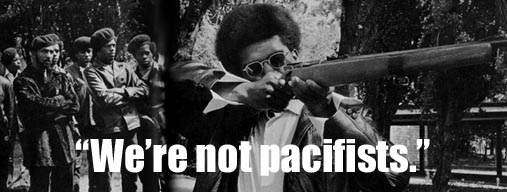
While Huey P. Newton advocated armed struggle, his ideology did not mean that the end product would be a world in which violence reigns. Rather, Newton believed that the oppressed must use guns as the means to a peaceful end of the oppression. He quoted Mao Tse-tung: “We are advocates of the abolition of war, we don’t not want war; but war can only be abolished through war, and in order to get rid of the gun it is necessary to take up the gun.” Within the Panther Party, the gun was not upheld as a means of violence, rather, it was a symbol for empowerment and self-determination. [Huey P. Newton :: Philosophy :: Armed Self-Defense]
In October of 1969, hundreds of youth clad in football helmets marched through an elite shopping district of Chicago. Utilizing lead pipes, they shattered shop windows and demolished parked cars. This was the first demonstration known as the “Days of Rage” – organized by a group who called themselves the Weather Underground. Outraged by the war on Vietnam and the rampant racism in America, the Weather Underground waged a strategic low-level war against the state that continued throughout much of the seventies. The Underground had the state on the run. Members of the Underground bombed state property including the Capitol building (never incurring a single casualty) and even broke Timothy Leary out of prison all while successfully evading one of the largest FBI manhunts ever conducted in US history.
Weather Underground Bombs the Capitol, Pentagon, and State Department (Running time 10:00)
Today, most all the past revolutionary leaders of the Weather Underground, now conformed, apologize for their “tactics,” having been isolated and framed as “violent” by the co-opted left and status quo. [http://youtu.be/S6kPGh0w_-c]
It was during this time of true revolutionary uprising that money and “opportunities” began to siphon into the movements. The art of co-optation had begun with the only weapon (palatable to the public) the oligarchy possessed – money. This money would serve to indulge, thus co-opt, inflated egos scouted from within the left. Co-opting was an absolute necessity for the state to protect the dominant power structures from true systemic change that would effectively transfer power to the people. Examples of revolutionary movements in history, as evidenced in The Weather Underground, the Panthers and others, demonstrate unequivocally that the left became more jingoistic for war only after an influx of money began pouring in from the state and plutocrats via their foundations, which were in many cases set up for this very purpose.
A case in point: Roy Innis of the Congress of Racial Equality/CORE (who advocated “Black control of Black communities” in order to allow for the manifestation of “Black capitalism”) was named a Ford Foundation fellow and became a board member of the Rockefeller/Ford-created NUC/National Urban Coalition. Ford granted CORE Cleveland $175,000 in 1967 to help elect Carl Stokes, who was very much pro Black-capitalism.
Lesser known are the events led by CIA operant Gloria Steinem. The “Black Feminist” movement was created, funded and manipulated by the CIA from the very beginning with Steinem leading the charge. Steinem planted faux “Black feminists” in revolutionary Black Power movements/grassroots organizations in order to instill division and hatred and, ultimately, to dismantle the growing movement. Steinem’s “success” would assist the state’s crushing of the Black Power movement itself. [Read: BLACK FEMINISM, THE CIA AND GLORIA STEINEM]
Throughout the world, there are organizations identifying themselves as the Black Panthers and other true revolutionary movements in existence. However, blinded by the shiny veneer of the big NGOs, few people are aware that such revolutionary movements even exist today. It is the job of the non-profit industrial complex, while waving the pacifist bible in one hand, to deliberately ensure that these groups are not only marginalized, but ignored altogether. Such movements, which have to potential to disrupt (or even dismantle) the power structures that enslave us, must remain invisible or framed in a negative light – if co-opting them is not possible, that is.
And that is something that the Western culture has perfected: co-optation. Forrest Palmer writes: “I am writing a blog post called ‘Malcolm X on a postage stamp.’ It is exactly what you see here [http://www.movements.org/pages/team]. If you know that something is happening at the grassroots and you can’t stop it, the West accepts it, places their handpicked leaders in the forefront who appease the masses into thinking what they are doing is still ‘revolutionary,’ negotiate with the ‘leaders’ ensuring they acquiesce to the state, compromise and either end up with things status quo or so watered down that the compromise doesn’t help the masses at all, but instead helps the state. The best example of a singular event of this: The March on Washington. It went from a black mass rebellion to a benign walk in the park masquerading as a movement. They had all their speeches proofread by the state, including King’s ‘great’ I Have a Dream speech. If the speeches weren’t what the state wanted, they either changed them (John Lewis) or weren’t allowed to speak (James Baldwin).”
“Malcolm predicted that if the civil rights bill wasn’t passed, there would be a march on Washington in 1964. Unlike the 1963 March on Washington, which was peaceful and integrated, the 1964 march Malcolm described would be an all-Black ‘non-violent army’ with one-way tickets.” [Wikipedia, speaking of Malcolm X and his speech The Ballot or the Bullet.]
And so it goes. Malcolm X was assassinated on 21 February 1965. And while our brothers and sisters in Africa, the Middle East and the Global South continue to be grossly exploited or altogether annihilated by the imperialist forces, the movement is ever-so acquiescent. Five hundred dollars a day for lodging at the Rio+20 Summit has never been so easy for those within the champagne circuit. And with a Democratic administration and a Black American president in the White House, the modern civil rights movement and dominant left organizations have never found it so easy to remain silent, with little to no criticism from civil society who, self-appointed, they falsely claim to represent.
“While in the US those puppets have traditionally taken on the form of talking heads on corporate and public television, they are increasingly represented in the form of NGO PR puppets employed in the moral theatrics industry…. As the credibility of politicians and pundits plummets, it is these PR puppets that are increasingly responsible for bolstering public support for militarism in general and militarized humanitarian intervention in particular.” — Jay Taber, Intercontinental Cry; Pious Poseurs, 24 June 2012
Although now seemingly normalized, one must consider it slightly ironic that it is in fact no longer the dominant “progressive left” beating the drums against war. [Exceptions include legitimate grassroots groups such as Peacelink in Italy.] Rather, as in the case of climate change, it is primarily the countries seeking to free themselves from the chains of imperialist enslavement that vocally oppose the escalating destabilization campaigns, inclusive of the most recent, in Syria. On 16 February 2012, the 12 sovereign states who voted against the resolution to condemn Syria at the United Nations included North Korea, China, Russia, Iran and Syria, along with states who primarily compose ALBA; Bolivia, Belarus, Cuba, Ecuador, Venezuela and Nicaragua. And it is not coincidence that most all the leaders of all these same states, who continue the struggle for autonomy, are all similarly vilified and demonized by the corporate-media complex, joined recently by the non-profit industrial complex. It is critical to note that the imperialist powers (inclusive of the UN) do not criticize or demonize or withdraw their support from such leaders on any ethical or moral ground. Denunciation of state leaders and emotive language is merely theatre. Rather, the imperialist states strategically set out to destroy any state leader that is unwilling to be controlled by US interests and foreign policy. A case in point is unwavering support of the Saudi royal family responsible for atrocious human rights violations to which the imperialist countries turn a blind eye.
Demonization is a key psyop, directly sponsored by the US Pentagon and intelligence apparatus to influence and sway public opinion and build consensus in favour of invasion. [Prof. Michel Chossudovsky] A recent example can be extracted from the failed 2011 destabilization campaign against the Morales government in Bolivia led by US-funded NGOs including the “Democracy Centre,” which declared: “But the abuses dealt out by the government against the people of the TIPNIS have knocked ‘Evo the icon’ off his pedestal in a way from which he will never fully recover, in Bolivia and globally.” [Further reading: U.S. Funded Democracy Centre Reveals Its Real Reason for Supporting the TIPNIS Protest in Bolivia: REDD $$$. ¿Por qué se defiende el tipnis?, http://youtu.be/RPiw3cDotHA]
A similar situation (developing nations, rather than the “environmental movement,” taking the lead) has taken place on the issue of climate change. ALBA nations, with Bolivia at the forefront, led while the non-profit industrial complex purposely and grossly undermined the strong positions necessary to mitigate the climate emergency. The climate justice movement was acquiescent and thus kowtowed to the “big greens”; “big greens” such as Avaaz, 350.org and Greenpeace who had partnered with HSBC, Lloyds Bank, nuclear giant EDF, Virgin Group, Shell (via TckTckTck partner, the Corporate Leaders Group on Climate Change) and other corporate giants constituting the “TckTckTck campaign” whereby “the objective was to make it become a movement that consumers, advertisers and the media would use and exploit” (Havas Press Release). There was no justice to be found, only a cohesive hypocrisy amongst the professional left that flourished like a cancer.
Next: Part one, section II.
Avaaz Investigative Report Series [Links]|Further Reading: Part I | Section I | Part I | Section II | Part I | Section III | Part II | Section I | Part II | Section II
Possible new leak at Hanford site, higher radioactivity levels detected
RT | June 22, 2013
A tank containing highly radioactive waste may be leaking into the soil at the Hanford Nuclear Reservation (the US’s most contaminated nuclear site) in Washington state, employees have told media.
State and federal officials are investigating reports that workers detected elevated radioactivity levels under tank AY-102 during a routine inspection on Thursday.
According to technician Mike Geffre, who works for contractor Washington River Protection Solutions, an inspection was made of a pit under the tank. Its water samples had an 800,000-count of radioactivity and a high dose rate, which means that workers must reduce time spent in the area.
“Anything above a 500 count is considered contaminated and would have to be disposed of as nuclear waste,” Geffre explained. “Plus, the amount of material we’ve seen from the leak is very small, which means it’s a very strong radioactive isotope.”
If the waste escapes the tank and gets into the soil, it may reach groundwater and potentially the Columbia River.
“This is really, really bad. They are going to pollute the ground and the groundwater with some of the nastiest stuff, and they don’t have a solution for it,” Tom Carpenter, executive director of the Seattle-based advocacy group Hanford Challenge, a watchdog group that conducts environmental sampling to monitor for radioactive and chemical contamination, told AP.
There are 177 tanks holding up to 56 million gallons of waste, 149 of which are single-shell. Six of those tanks were discovered in February to be leaking at a rate of about 1,000 gallons annually.
AY-102 is one of Hanford’s 28 tanks with two walls, which was installed when single-shell tanks began leaking and some of the most radioactive liquid in those tanks was pumped into the sturdier double-shell tanks. The tanks are now beyond their intended life span.
Two radionuclides comprise much of the radioactivity in Hanford’s tanks: cesium-137 and strontium-90. While both take hundreds of years to decay, exposure to either can increase the risk of cancer.
Officials say that leaking tanks pose no immediate threat to the environment or public health, with the closest communities being several miles away.
“These last few months just seem like one body blow after another,” said Ken Niles of Oregon’s Energy Department. “It’s true this is not an immediate risk, but it’s one more thing to deal with among many at Hanford.”
“The Energy Department has been actively monitoring double-shell tank AY-102 since it was discovered to have a slow leak from the primary tank,” the department said in a statement. “Workers detected an increased level of contamination during a routine removal of water and survey of the leak detection pit.”
Additional testing is expected to take several days, though the state will demand an accelerated plan to deal with all the waste at Hanford, said Washington Governor Jay Inslee, adding that the potential leak “raises very troubling questions.”
An engineering analysis team will conduct additional sampling and video inspection to determine the source of the contamination, Spokeswoman Lori Gamache said.
The Energy Department announced last year that AY-102 was leaking between its two walls, but gave reassurances then that no waste had escaped. However, Seattle’s KING5 television station has reported that the cleanup contractor and the department knew a year earlier that the tank was leaking.
At the height of World War II, the federal government created Hanford as part of a secret project to create the atomic bomb. The site ultimately produced plutonium for the world’s first atomic blast and for one of the two atomic bombs dropped on Japan; it continued production through the Cold War.
These days, it has a reputation as the nation’s most contaminated nuclear site, with a cleanup expected to take several decades. It costs up to US$2 billion annually and has already set taxpayers back US$40 billion, with US$115 billion more expected to be needed.
The biggest challenge thus far has been removing highly radioactive waste from the 177 aging underground tanks and constructing a plant to treat that waste, which will be encased in glass-like logs for permanent disposal. Workers designing and building the unique plant have encountered numerous technical problems, however, as well as delays and rising costs. The plant is unlikely to begin operating before 2019, far beyond the original 2011 deadline.
Related articles
- The first ever double-shell tank to have leaked at Hanford may be in far worse condition than anyone imagined. (familysurvivalprotocol.com)
- Hanford tank with worst radioactive waste may be leaking (komonews.com)
- Worst Hanford tank may be leaking into soil (king5.com)
The Most Contaminated Land in the Middle East
By Gilad Atzmon | June 17, 2013
Ynet reported today that Haifa District Court judge rules that there is no causal link between Kishon River’s pollution and the illness of more than 70 Israeli Navy seal divers, despite expert claims that ‘exposure to one molecule’ could lead to illness.
For more than 25 years, the Israeli elite Navy seals used to dive and train in the Kishon River in the Haifa Bay, apparently, the most polluted river in Israel. Authorities were warned about the lethal concentrations of cancerous substances in the river for years.
The Haifa District Court ruled Monday that there is no causal link between the pollution in the Kishon River and the illness of 70 former Navy commandos.
The divers’ suit was filed against the Haifa Municipality, Haifa Chemicals, oil refineries, and the Haifa Region Association of Towns, claiming they are responsible for the pollution and toxic waste in the river, including arsenic, nickel, chromium, cadmium, lead and benzene.
Seemingly it took 2000 years for the Jews to come back to their so-called ‘promised land’ but just a few years to pollute the rivers and contaminate the land.
The Painted Frog of Palestine

Lake Huleh. (Photo: Wikimedia Commons)
By Jeremy Salt | Palestine Chronicle | June 14 2013
The good news from Palestine is that the ‘painted frog’ of the Huleh valley is not extinct after all. Recently it turned up again after not having been seen for the past half century. Behind the disappearance of the painted frog stands a much bigger story, the fate of the Huleh valley after the conquest of Palestine by the Zionists and behind that story is the reality behind one of the foundation myths of the Zionists, that of a barren, stagnant and empty land awaiting redemption in the hands of the Jewish people.
In the 19th century the Huleh wetlands were one of Palestine’s prize natural assets. They were formed over millennia by three rivers flowing south into the Huleh valley from their headwaters in Syria, the Hasbani, the Banias and the Liddan. The valley stretched for a distance of about 25 kilometers in length and six in width. Its centerpiece was Lake Huleh and its adjoining wetlands, covering an area of about 60 square kilometers, expanding and contracting in tune with the seasons. The lake itself was more than five kilometers long and more than four wide at its broadest point. The river flow continued southwards into Lake Tiberias and then the Jordan River. The fertile land around the lake provided the surrounding villages and beduin cultivators with a good living from cereal crops, maize, rice and honey. The lake and wetlands were a nesting and feeding spot for masses of migratory birds. The life beneath the water was just as rich as on the outside.
Here are descriptions of the Huleh wetlands by the Rev. W.M. Thomson, an American missionary who visited Palestine in the 1850s to follow in the footsteps of the master but still took detailed notes of everything he saw, the food people ate, the clothes they wore, the crops they cultivated, the glassware and soap they produced in their worships as well as the flora, the fauna, the valleys, hills, plains and rivers. (1):
“There lies the Huleh like a vast carpet with patterns of every shade and shape and size, thrown down In Nature’s most bewitching negligence and laced all over with countless streams of liquid light …. The plain is clothed with flocks and herds of black buffalo bathe in the pools. The lake is alive with fowls, the trees with birds and the air with bees.” (‘Unrivalled beauty of the Huleh’, p. 225)
“The soil of this plain is a water deposit like that of the Mississipi Valley about New Orleans and extremely fertile. The whole country around it depends mainly upon the harvests of the Huleh for wheat and barley. Large crops of Indian corn, rice and sesamun (simsum) are also grown by the Arabs of the Huleh, who are all of the Ghawareneh tribe. They are permanent residents although dwelling in tents. All the cultivation is done by them. They also make large quantities of butter from their herds of buffalo and gather honey in abundance from their bees. The Huleh is, in fact, a perpetual pasture field for cattle and flowery paradise for bees. At Mansura and Sheikh Hazeib I saw hundreds of cylindrical hives of basket work, pitched, inside and outside, with a composition of mud and cow dung. They are piled tier above tier, pyramid fashion, and roofed over with thatch or covered with a mat. The bees were very busy and the whole region rang as though a score of hives were swarming at once. Thus this plain still flows with milk and honey and well deserves the report which the Danite spies carried back to their brethren: ‘A place where there is no lack of anything that is in the earth.” (‘Produce of the land of Huleh’, p. 253).
“This Huleh – plain, marsh, lake and surrounding mountains – is the finest hunting ground in Syria and mainly so because it is very rarely visited. Panthers and leopards, bears and wolves, jackals and hyenas and foxes and many other animals are found, great and small, while it is the very paradise of the wild boar and the fleet gazelle. As to waterfowl, it is scarcely an exaggeration to affirm that the lower end of the lake is absolutely covered with them in the winter and spring.” (‘Wild animals of the Huleh’, p. 260).
Dr. Thomson does not mention the painted frogs of Huleh but they must have been there in abundance, breeding in the protection of the rushes, hunted by the pelicans and storks that stopped at the lake on their flights from the north. He noted the presence of the ‘lilies of the valley’ growing amongst the rushes, which in places were so densely entangled with bamboo as to make approaches to the water impenetrable. The Huleh valley was one part of a rich environmental and agricultural mosaic stretching across Palestine. Of course part of it was barren. It still is but one would not say Australia is a barren land because of the Simpson desert or the United States because of the Mojave desert in California. It was not just the fertility of the Huleh valley that took Dr. Thomson’s attention. He was equally fulsome in his praise of the groves of citrus fruits, the extensive fields of wheat and barley grown along the seaboard right down to Gaza and the grapes and olives of the interior. His descriptions are corroborated in numerous other contemporary accounts, which stand as the most effective rebuttal of the central myth of the barren land.
Indeed, the central problem for the Zionists was that all the fertile land was already being cultivated, by people who were not prepared to part with it. Like all native peoples the land for them was an integral part of the cycle of life. That was the way it had always been and not until the Zionists arrived had they had to face life without it. It was the latifundistas living outside Palestine and the middlemen who negotiated the deals who gave the Zionists their foothold. Once the contracts were signed they drove the tenant cultivators away. There was no remorse: where these uprooted people went was none of their business. The British, in charge of this supposedly ‘sacred trust of civilisation’, as the mandate was described in article 22 of the Covenant of the League of Nations, were complicit in this ruthless process, providing an umbrella of armed and pseudo-legal protection.
Through legal purchase the Zionists were never going to get what they wanted. By 1945 they had acquired less than six per cent of Palestine and remained a one-third minority of the population despite the massive immigration of the 1930s. David Ben-Gurion and other Zionist leaders knew that only war would give them what they wanted. They played a crafty game, dumping the British when they were no longer of any use and turning to the United States. Partition was a complete violation of the natural rights of the indigenous people but was welcomed by the Zionists, naturally, as they were being given what they did not possess and had no right to possess. At the same time as pretending to be satisfied with partition, they regarded it only as the first step. It was not just that the Americans had concluded by early 1948 that Palestine could not be partitioned peacefully. The Zionists would never allow it to be partitioned peacefully as this would leave the Palestinians on their land. There could be no Jewish state as long as they stayed, and if there is a regret in the Benny Morris school of historical reflection it is only that the opportunity was lost to get rid of them all.
In the meantime land hunger focused settler eyes on possibilities in the rich, fertile and well watered Huleh valley. Draining what were called the swamps of Huleh would create more room for colonization but for the time being remained beyond their technical and financial means. When it happened it was inscribed as one of the founding myths of Zionists: the redemption of the land, making the desert bloom, and all the rest of it, when in fact the settlers ruined in the Huleh valley what was an ecologically rich wetland with few parallels in the Middle East.
From the beginning control of water was essential to the Zionist project. Weizmann fought hard at the Paris peace conference in 1919 for the Syrian headlands of Palestine’s water to be included in the British mandate and therefore within the borders of the Zionist state Lloyd-George, Balfour and Churchill wanted to establish in the heart of the Middle East while talking endlessly about nothing more than a ‘national homeland’ for the Jewish people. Weizmann’s scheming and lobbying broke against the rock of French strategic interest but seizing and controlling water resources in and around Palestine remained a prime target of the Zionist leadership, with their diversion of these waters creating one of the many crises that preceded the 1967 war.
The Huleh valley stood out from the beginning of Zionist settlement. The first colony in the valley was established in the 1880s but because of the ravages of malaria no further settlements were established for half a century. In the 1930s Steinmatsky’s Palestine Guide (2) noted the drainage of ‘swamps and marshes’ since the First World War, ending the scourge of malaria and restoring ‘fertile tracts of land to cultivation thus increasing the tillable area of Palestine’. Unique amongst Palestine’s network of rivers, lakes and subterranean aquifers, the Huleh wetlands ‘which are now marshy tracts offer untold opportunities for agricultural development. Thorough drainage is the first need to be followed by systematic irrigation. This land has been granted for use under a concession to a group which did not avail itself of the concession. The concession has now passed to a Jewish group which will soon start on the preliminary work.’ (p. xii).
In his collection of essays on land acquisition and development in Palestine, Arthur Ruppin, a German lawyer who settled in Jaffa as the chief land purchasing and development officer for the Palestine Office of the World Zionist Organization, lists the Huleh wetlands as land which might be uncultivable for the Palestinian settled and nomad population but would be cultivable for incoming Jewish colons, given their access to credit and use of modern farm machinery. (3) The fertile land around the lake was either state land from Ottoman times or already owned and cultivated, with only one Zionist settlement having been established up to the outbreak of the Second World War. Ruppin wanted to open up land for settlement by draining the wetlands, which for him were no more than marsh and swamp waiting to be reclaimed.
In a memorandum handed to Sir John Hope Simpson, sent to Palestine in 1930 to investigate immigration, land development and settlement, the three major causes of rising distress amongst the Palestinians, Ruppin attempted to show that ‘if the farming of the fellaheen were to be a little bit intensified – in the coastal zone, Beisan, Huleh and the lower Jordan Valley – the Jews would be able to buy 1,300,000 dunums without displacing the people who have so far [sic.] worked the land. Fifty-five thousand [Jewish] families could be settled on this land.’(4) Hope-Simpson demurred on various grounds, one of them being that the Jewish National Fund (JNF) would not let ‘Arabs’ work on its land and that ‘increasing land purchase will displace the Arabs from many parts of Palestine’. This in fact is what happened as part of a process Hope-Simpson described as the ‘extra territorialisation’ of land once purchased by the JNF and put beyond the purchase or rental by non-Jews forever. Zionist colonists who still used the Palestinians on the land or in workshops and factories were violating the Jewish-only labor ‘principles’ that were the corollary of the ‘principles’ governing land purchase.
At the age of 50 Ruppin and others founded the Brit Shalom movement. It was committed to ‘Jewish-Arab’ friendship but the refusal of the Palestinians to give up their rights and their land eventually forced him to conclude that negotiations would achieve nothing and that if the Zionist project was to succeed, ‘we must increase our strength and our numbers until we reach parity with the Arabs. The life or death of the Zionist movement will depend on this …. Perhaps a bitter truth but it is the truth with a capital T’. Writing in 1936 he expected this point to be reached in five to ten years. (5) Ruppin died in 1943 so was not around when not just parity but numerical superiority was achieved by expelling the bulk of the indigenous Palestinian population in 1948. In the language of the occupier, there were 12 ‘Jewish’ and 23 ‘Arab’ ‘settlements’ in the Huleh valley by 1948. ‘Following the establishment of the State of Israel and during the 1948 War of Independence the Arab inhabitants left the valley, moving to neighboring Arab countries’. (6)
Meron Benvenisti has put the number of villages in the region at 60 but this includes semi-permanent beduin encampments built from rushes or mud bricks. (7) Walid Khalidi has documented how they ‘left’ and what happened to their ‘settlements’. Village after village was depopulated and destroyed before being built over by Zionist settlements. (8) All that remained after the Zionist assault through the Huleh valley was one Beduin settlement,(9) with the Zionist settlers now free to take the land left behind and harvest the crops planted by those they had expelled.
With the Palestinians gone and the state of Israel established over their heads and on their land there were no barriers to the exploitation of the Huleh valley. Beginning in 1951 it was subjected to ‘redevelopment’ that amounted to ecological vandalism on a grand scale by blundering land-hungry settler administrators. The wetlands were drained and turned into arable land, shrinking the lake to perhaps one tenth of its original size. At the time the drainage and irrigation works were seen as a brilliant engineering achievement, of which the most significant benefits were regarded as the creation of thousands of dunums of cultivable land and the eradication of malaria. Yet it was not long before disappointment and an understanding of the damage that had been done set in. As summarized by Zohary and Hambright, while the drained peat soil proved suitable for agriculture, ‘the anticipated exceptional yields were never obtained’. (10)
Furthermore, ‘as the level of groundwater fell, air penetrated into the dried peat, enhancing microbial decomposition of organic matter. Often these processes led to uncontrollable underground fires and the formation of dangerous caverns within the peat. The weathered peat soils turned into infertile black dust. Strong winds sweeping the valley produced dust storms that caused major damage to agricultural crops. Consequently, the ground surface subsided by up to three meters in some regions and inundation of these areas during winter rains restricted cultivation in many areas. An indirect problem associated with the drying of the soils was the proliferation of field mice populations which soared and wreaked havoc on agricultural crops in the valley. Over time, farmers abandoned more and more of the valley where cultivation was no longer profitable, thereby further enhancing the rate at which these soils deteriorated’.
By 1958 this was the state of the valley described in such glowing terms by Dr. Thomson only a century before. A unique wetlands region which had been part of the landscape for thousands of years had been mostly destroyed within the space of nine. Elsewhere in Palestine olive groves, pomegranates and citrus orchards were uprooted as part of a dual process of settlement building and the removal from the land of all traces and symbols of the Palestinian presence. The olive and pomegranate were preeminent symbols of the ‘primitive’ Palestinian village and so had to go along with the houses. (11) Through the vindictive destruction of olive trees by settlers on the West Bank this process continues to the present day.
Along with the shrinking of Lake Huleh and the drying of the land came the destruction of flora and fauna. The lake had been a rich source of aquatic life, with researchers listing ‘260 species of insects, 95 crustaceans, 30 snails and claims, 21 fishes, seven amphibians and reptiles, 131 birds and three mammals’. (12) After the drainage ‘119 animal species were lost to the region of which 37 were totally lost from Israel [sic]. Similarly, many freshwater plant species became extinct and many of the massive flocks of migratory birds that used to land in the valley found alternative feeding sites on their routes between Europe and Asia.’ Only in the 1980s was it decided to take steps to repair the damage, by flooding part of the valley in the hope of renewing something of the original bio-diversity but only a ‘small fragment of an extinct eco-system’ has been revived.’ The painted frog with its mottled back and belly speckled with white spots belongs to an amphibian family thought to have died out 10,000 years ago until spotted in the Huleh wetlands in the 1940s. This ‘living fossil’ was believed to have been one of the species that were ‘lost’ when the wetlands were drained in the 1950s but two years ago a ranger saw one and now it is thought that there is a colony of hundreds.
The Huleh eco-system did not die of natural causes. It did not become ‘extinct’ because of sudden climate change or any of the other natural catastrophes that have killed off species and reshaped the surface of the planet for millennia. It was another casualty of the nakba. The Zionist colons had none of the skills that come with husbanding the land generation after generation over countless centuries. They had to learn and their vandalism in the Huleh valley was born of their ignorance and their haste to settle and cover all traces of where the people they drove out had lived, prayed, studied and farmed and where their ancestors were buried.
Where the painted frog went as the Huleh wetlands were drained only the frog knows. Most probably, it burrowed deeper into what remained of the mud and rushes until it was safe to come out, a period of time that spanned more than 50 years. The parallel with the people is unmistakable: driven towards extinction as a people, they have survived and are waiting for the time when they also will be able to return.
– Jeremy Salt is an associate professor of Middle Eastern history and politics at Bilkent University in Ankara, Turkey. He contributed this article to PalestineChronicle.com.
Notes:
(1) Rev. W. M. Thomson, The Land and the Book (Nelson and Sons: London, 1879).
(2) Steimatsky’s Palestine Guide (Jerusalem: Steinmatsky Publishing Company, n.d. , 1930s?).
(3) Arthur Ruppin, Three Decades of Palestine (Jerusalem: Schocken, 1936), pp. 207-8
(4) Alex Bein., ed., Arthur Ruppin: Memoirs, Diaries, Letters (London: Weidenfeld and Nicolson, 1971)
(5) Ibid., p.320
(6) Tamar Zohary and K.David Hambright, ‘Lake Hula-Lake Agmon’, http://www.jewishvirtuallibrary.org
(7) Meron Benvenisti, Sacred Landscapes. The Buried History of the Holy Land Since 1948 (Berkeley: University of California Press, 2000), p.127.
(8) Walid Khalidi ed., All That Remains. The Palestinian Villages Occupied and Depopulated by Israel in 1948 (Washington: Institute for Palestine Studies, 1992), pp. 428-509 passim for the fate of Palestinian villages on the Huleh plain.
(9) Ibid, p. 131
(10) Zohary and Hambright, op. cit.
(11) Benvenisti, p.216.
(12) Ibid.
Nicaragua: New Plans to Build Canal are Announced
By Kari Paul | The Argentina Independent | June 6, 2013
Rene Nuñez, president of Nicaragua’s national assembly, announced today that a Chinese investment firm will fund construction of a channel through Nicaragua, an alternative trade route to the Panama Canal.
The new channel will link the Pacific Ocean with the Caribbean Sea, and will be built by a “consortium of investors combined into one firm,” Nuñez, who declined to give more information on the group, said.
The government of Nicaragua’s President Daniel Ortega has introduced two bills to streamline the environmental impact study on the new works, so that the channel can be constructed as soon as possible.
“This is a project that is very important to the country, so we are pursuing it with urgency,” Nuñez said.
President Ortega said that the channel will serve as an alternative to the overcrowded Panama Canal, which is currently undergoing a US$5.2bn expansion project. He also stressed that the Nicaragua Canal will bring jobs to the impoverished in Nicaragua and other Central American countries.
Others oppose the canal, saying the government is pursuing it recklessly.
“I don’t know what is the rush, especially with such a sensitive topic,” said congressman Luis Callejas. “There should be a full consultation with the people, I do not understand why they are rushing the decision.”
Originally the channel was planned to go through the San Juan River, but now Ortega announced it would be built further north, through the waters of Lake Nicaragua.
“Lake Nicaragua should be a source of drinking water for Nicaragua and South America,” argued Environmental Affairs Chair Jaime Incer. He said the lake is currently protected as a “potable water reserve” by a law that Ortega himself passed.
The Nicaraguan National Assembly will debate the two bills on the project, taking into account the environmental impact, on Friday.
Featured Video
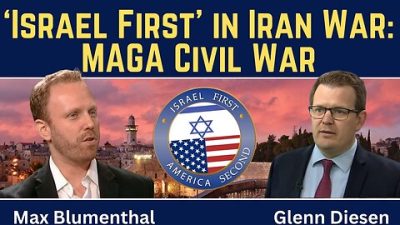
Max Blumenthal: ‘Israel First’ in Iran War Sparks MAGA Civil War
or go to
Aletho News Archives – Video-Images
From the Archives
Wartime internment camps in Australia
National Archives of Australia
World War I
During World War I, for security reasons the Australian Government pursued a comprehensive internment policy against enemy aliens living in Australia.
Initially only those born in countries at war with Australia were classed as enemy aliens, but later this was expanded to include people of enemy nations who were naturalised British subjects, Australian-born descendants of migrants born in enemy nations and others who were thought to pose a threat to Australia’s security.
Australia interned almost 7,000 people during World War I, of whom about 4,500 were enemy aliens and British nationals of German ancestry already resident in Australia.
Records of World War I internment camps
World War II
During World War II, Australian authorities established internment camps for three reasons – to prevent residents from assisting Australia’s enemies, to appease public opinion and to house overseas internees sent to Australia for the duration of the war.
Unlike World War I, the initial aim of internment during the later conflict was to identify and intern those who posed a particular threat to the safety or defence of the country. As the war progressed, however, this policy changed and Japanese residents were interned en masse. In the later years of the war, Germans and Italians were also interned on the basis of nationality, particularly those living in the north of Australia. In all, just over 20 per cent of all Italians resident in Australia were interned. … continue
Blog Roll
 Aletho News
- Diplomats slam US negotiators’ performance in Iran talks
- Trump Refuses Exit Ramp, War with Iran will Continue
- Trump Says US Naval Blockade in Strait of Hormuz Will Begin Shortly
- US, Iran end 21-hour talks without agreement
- US IRAN TALKS: Who Are the Crazy Ones Here? /Lt Col Daniel Davis
- Talks with the US end without a deal over excessive US demands: Iran
- Feeling Better, Getting Worse: How Psychiatric Drugs Create the Illusion They Cure
- ‘Nobody Told Me’: Former Mental Health Patient Calls Out Dangerous Side Effects of Psychiatric Drugs
- Dr. Abu-Sitta: Beirut ‘felt like a day in Shifa Hospital’
- Iran Has Won the War, It Will Be Up to the US to Secure the Peace: Mohammad Marandi
- If Americans Knew
- US-Iran ceasefire negotiations make zero progress – Daily Update
- Pro-Israel ‘Thinktanks’ and Individuals who Influence U.S. Foreign Policy
- Mearsheimer reveals how Israel dictates US policies on Iran, Gaza – video
- After killing 350+, Israel still has a “score to settle” with Lebanon before ceasefire – Daily Update
- Military aid to Israel emerges as the latest political litmus test for Democrats
- The only Palestinian children’s rights organization closes following years-long Israeli campaign against it
- ‘I Can’t Forget the Smell’: Lebanese Reel After Israel Kills Over 300 in Single Day
- DNC Shoots Down Resolutions Calling Out AIPAC and Limiting Arms to Israel
- TCN: Is Israel Blackmailing President Trump?
- Israel killed at least 303 Lebanese yesterday – who were they? Daily Update
- No Tricks Zone
- German Expert: Heat Dome Led To Record Temps In Western USA…Warmer In 1934, 1936
- New Study: No Linear Warming Or Glacier Retreat Along Northern Antarctic Peninsula Since 1980s
- An Inconvenient Tree: Uncovered In Alps… Europe Much Warmer Than Today 6000 Years Ago
- New Study Reports A 60% Slowdown In Greenland’s Ice Loss Rate In The Last Decade
- Low Intensity Tornado Wrecks Major Solar Farm, Creating A Potential Toxic Dump
- New Study Finds Warming Saves Lives…Cold Temperatures 12 Times More Deadly Than Excess Heat
- German Science Blog Accuses PIK Climate Institute Of Hallucinating Climate Tipping Points
- Devastating Assessment Of Comirnaty Vaccine By Former Senior Pfizer Europe Toxicologist
- New Study: CO2 Is ‘Effectively Negligible’ As An Explanatory Climate Change Factor Since 2000
- Former Pfizer Toxicologist Dr. Helmut Sterz Tells Bundestag Hearing Pfizer Vaccine Should Have Never Been Approved
 Aletho News
