French police detain female Iranian academic to silence anti-Israeli genocide voices

Mahdieh Esfandiari has lived in Lyon for eight years. Police have arrested her for pro-Palestine advocacy.
Press TV – April 14, 2025
A female Iranian academic who denounced the Israeli genocidal campaign in the besieged Gaza Strip and expressed her solidarity with Palestinians has been arrested by the police in France.
The Iranian citizen was reportedly detained after publishing messages on a Telegram channel condemning the ongoing genocide in the blockaded Palestinian territory.
The French weekly Le Point identified the woman as Mahdieh Esfandiari, a 35-year-old French language graduate, who has lived in Lyon for eight years.
Her family, worried after losing contact, raised the alarm last month with Iranian authorities, who then contacted their French counterparts, Le Point reported, adding they have yet to hear back.
Iranian Foreign Ministry spokesman Esmaeil Baghaei said on Monday that France was unwilling to give an explanation on her situation.
“We hope that the French government will provide access to this case as soon as possible and clarify the reasons for the arrest of this Iranian citizen,” Baghaei was quoted as saying.
“Consular access has not been authorized” by French authorities, he told a news conference, adding that Iran was following the matter closely.
Her arrest came amid a crackdown in the US and other Western countries targeting scholars, students, and activists who oppose genocide and advocate for peace, both on campuses and in public spaces.
Her Iranian identity has further compounded this repression, as the Western countries escalate warmongering policies and economic sanctions against Iran while silencing dissent.
Pundits say these attacks aim to terrorize and silence the countless advocates who have courageously amplified Palestinian resistance and the call for freedom.
They say repression of freedom of speech will legitimize the Zionist child-killing forces and would undermine the principles of due process.
Somaliland Offers Trump Red Sea Base in Exchange for Recognition
Sputnik – 13.04.2025
Somalia’s breakaway region of Somaliland wants to be recognized as an independent state by US President Donald Trump in exchange for leasing its Berbera port and airstrip to the US, media reported on Saturday.
In March, the Semafor daily newspaper reported that Somalian President Hassan Sheikh Mohamud had offered the US control over ports and airbases located in Somaliland and another breakaway region, Puntland, in an attempt to prevent Washington from recognizing them.
Somaliland, however, plans to strike a deal with Trump, offering the US to lease its airstrip and port, which will ensure smooth military and logistical access to the Gulf of Aden, in exchange for Washington’s recognition of its statehood, The New York Times reported.
The airstrip at the Berbera International Airport was built by the Soviet Union in the 1970s. Stretching for over 2.5 miles, it is the longest airstrip in Africa.
The Associated Press reported in mid-March, citing a US official, that the US was in talks with Somaliland to determine what it could offer in exchange for its recognition. The US is reportedly exploring options for resettling Palestinians from the Gaza Strip.
Somalia ceased to exist as a unified state in 1991 following the fall of dictator Siad Barre. The international community recognizes the federal government of Somalia, which controls Mogadishu and parts of the country.
Israeli Airstrikes Across Gaza Kill, Injure Dozens
IMEMC | April 11, 2025
On Thursday, Israeli forces intensified bombing and shelling across the destroyed, besieged, and starved Gaza Strip, causing dozens of casualties, including women and children.
In Gaza City, a building in the city center was targeted, killing at least five Palestinians and injuring many others. Six more Palestinians lost their lives, and several were wounded when the army struck the Abu Al-Awn family’s home in the Shuja’iyya neighborhood.
Among the injured was a Palestinian infant whose arm had to be amputated following the attack.
In Deir Al-Balah, central Gaza, the army launched missiles at the Abu Al-Ajeen area, killing two Palestinians and wounding several others. Homes in Qizan Najjar, south of Khan Younis, were also shelled by Israeli forces.
Further south, in Khan Younis, a missile targeted the Abu Doqqa family’s home in the Shahayda area, north of Abasan town, killing two Palestinians, including a child.
In another incident, a displaced family sheltering near Nasser Hospital was struck by a missile fired from an Israeli helicopter, killing one Palestinian and injuring others.
Additional strikes in Khan Younis led to the death of a woman and injuries to several residents at the Al-Farra family’s home in the Sheikh Nasser area.
In Mawasi Rafah, the southernmost part of Gaza, a Palestinian was killed when soldiers fired live rounds at displaced residents in the Shakoush area.
On the political front, Israeli Channel 13 reported ongoing indirect discussions regarding a prisoner exchange deal, which include proposals for the release of more than five Israeli captives. Kan News stated that Israeli Prime Minister Benjamin Netanyahu conducted a situation assessment with military officials and negotiation teams about the Egyptian-mediated proposal.
According to reports, the Egyptian plan includes releasing eight captives alive, implementing a 50-day ceasefire, allowing humanitarian aid to enter Gaza, and commencing negotiations for a second phase aimed at ending the war and facilitating an Israeli withdrawal from Gaza.
Sources reveal that the proposal, considered “serious” by Arab media, includes the release of eight or nine Israeli captives, among them an American-Israeli soldier named Aidan Alexander, along with eight bodies. In return, Israel would release 300 Palestinian detainees, including 150 serving life sentences, and 2,200 detainees from Gaza.
The plan also outlines a 70-day extension of the ceasefire in Gaza, during which the second phase of negotiations would proceed. This phase includes facilitating the delivery of fuel and humanitarian aid to Gaza, reopening border crossings, and providing Hamas with detailed information about the status of remaining hostages.
Medical sources cited by Al Jazeera reported that Israeli attacks since dawn on Thursday have claimed the lives of at least 29 Palestinians, with additional casualties being reported amid ongoing strikes. Tedros Adhanom Ghebreyesus, Director-General of the World Health Organization (WHO), expressed alarm over the escalating humanitarian crisis. He warned of worsening health conditions and rising fatalities resulting from Israel’s blockade on aid shipments, emphasizing the urgent need for medical evacuations for over 10,000 individuals in Gaza.
To date, Israeli bombardments have claimed the lives of at least 50,886 Palestinians, including 12,365 women and 17,954 children. Approximately 11,000 individuals remain missing, largely believed to be under the rubble of bombed homes and buildings. The total number of wounded has now surpassed 115,875, primarily affecting children, women, and the elderly.
Zelensky mustn’t govern Russians he despises – Lavrov
RT | April 11, 2025
Vladimir Zelensky’s openly declared hatred for Russians means he must not and will not govern people living in former parts of Ukraine that Kiev seeks to retake, Moscow’s Foreign Minister Sergey Lavrov has stated.
In a late March interview with the French daily Le Figaro, Zelensky expressed his disdain for “Russians who killed so many Ukrainian citizens,” asserting that this “hatred” fuels his leadership.
Lavrov referenced the comments during a press conference at the Foreign Ministry on Friday, underscoring why Moscow has deemed Kiev’s territorial claims unacceptable.
“Who would even hypothetically consider handing over those people to such an individual? Nobody. No way,” he emphasized.
Since the Western-backed coup in Kiev in 2014, five Ukrainian regions plus the city of Sevastopol have voted to break away and join Russia. The Ukrainian government has dismissed these referendums as a “sham.”
Lavrov also reminded journalists of Zelensky’s previous derogatory remarks, including statements made prior to the conflict’s escalation in 2022. In 2021, Zelensky urged Donbass residents who identified as Russian to relocate to Russia. That same year, he referred to politicians targeted by his government with personal sanctions as another “species.”
The minister accused the Ukrainian government of “legislatively eradicating everything related to Russia and the Russian world: the Russian language, Russian-speaking media, the Orthodox Christianity represented by the canonical Ukrainian Orthodox Church, and much more.”
Such discriminatory policies, he argued, justify labeling the Zelensky administration “neo-Nazi” and contribute to ongoing hostilities. Lavrov asserted that US President Donald Trump recognizes Russia’s red lines and considers “the return to the 1991 borders, as Zelensky keeps demanding” impossible.
The Trump administration seeks to mediate a peace deal between Moscow and Kiev, while the UK and France are leading discussions on a proposed “reassurance force” to be deployed in Ukraine if a truce is achieved. Moscow has firmly rejected the idea of NATO troops being stationed in Ukraine.
Prof. John Mearsheimer: Trump, Netanyahu, and Iran.
Judge Napolitano – Judging Freedom | April 10, 2025
Hamas launches legal case in Britain to remove ‘terror’ label
Press TV – April 9, 2025
The Palestinian resistance movement Hamas has filed a legal appeal in the United Kingdom in an unprecedented move, challenging the British government’s decision to designate the group as a “proscribed terrorist organization.”
The case, submitted on Wednesday, seeks to overturn the classification, with Hamas asserting that it is a legitimate movement advocating for Palestinian self-determination and liberation, not a “terrorist entity.”
Mousa Abu Marzouk, a prominent leader of the group and its head of international relations, is spearheading the appeal.
He has vehemently rejected the UK’s characterization of Hamas in those terms, reminding that the group’s goal is to liberate Palestine from Israeli occupation, not to target Western nations.
Marzouk has stressed that the resistance movement’s struggle was against Zionism, a colonial project targeting Palestine, while underlining that the group has never harbored any plans to harm Jewish people.
“We are not fighting against Jews, we are fighting against the Zionist regime, which is an illegitimate entity in Palestine,” he stated.
He also denounced the UK for rendering support for Zionism and the establishment of the Israeli regime in 1948, and regretted that the regime continues the legacy of colonialism in the region.
Drawing comparisons to global liberation struggles, Marzouk likened Hamas to South Africa’s African National Congress (ANC) and Ireland’s Sinn Féin, stressing that like these movements, Hamas represents a legitimate resistance force against foreign occupation.
Legal team: Hamas sole effective force resisting genocide
Hamas’ legal team, led by two British barristers from Riverway Law, a law firm based in South London, underscores that the proscription not only misrepresents the group, but also obstructs freedom of speech and stifles open dialogue.
The lawyers also contend that by labeling Hamas as a “terrorist group,” the British government violates international obligations related to the prevention of genocide and crimes against humanity — which the Israeli regime has been indulging in across the Gaza Strip, where the movement is headquartered.
They assert that Hamas is the sole effective force resisting the ongoing genocide being committed by the Israeli regime in Gaza.
The British government first proscribed Hamas’ military wing, the Ezzedine al-Qassam Brigades, as a “terrorist organization” in 2001.
In 2021, the political wing of Hamas was also added to the proscription list. The Home Office tried to defend its decision, claiming that Hamas operated as a “unified terrorist entity.”
However, Hamas’ lawyers strongly contest this characterization, clarifying that the group functions as a broad-based resistance movement with political and social dimensions.
In his witness statement, Marzouk has provided a personal perspective on the issue of the Israeli regime’s Western-backed occupation of Palestine and aggression towards Palestinians.
He rejected the so-called legitimacy of the regime and reaffirmed Hamas’ commitment to full liberation of Palestine, with the holy occupied city of al-Quds as its capital, and establishment of a sovereign Palestinian state along its borders before 1967, when the regime went on to grab more Palestinian land with more Western support.
The case’s potential
The UK Home Secretary, Yvette Cooper, has 90 days to respond to the petition. If the case is rejected, it will proceed to a tribunal for further legal proceedings.
If successful, it could lead to a reevaluation of Hamas’ designation.
Addressing the issue, observers say the case could have a far-reaching impact on how resistance movements are viewed in the political and legal arenas amid growing international opposition against the Israeli regime’s genocidal, expansionist, and other criminal efforts.
London’s likely reversal of the designation, they further note, could potentially shift the international discourse surrounding Palestinian liberation efforts.
Marzouk, meanwhile, commented on Hamas’ members and their fellow Gaza-based resistance fighters’ historic Operation al-Aqsa Storm against the occupied Palestinian territories. The operation saw the fighters venture deep into the territories, encircle strategic Israeli bases, and ensnare 240 Zionists.
He called the development a military operation targeting the Israeli regime’s Southern Command rather than a deliberate assault on civilians as Tel Aviv and its backers have claimed.
Exposing the UN’s hypocrisy of humanitarian aid and ceasefires
By Ramona Wadi | MEMO | April 10, 2025
UN Secretary General Antonio Guterres told the Security Council this week that, “As aid has dried up, the floodgates of horror have re-opened. Gaza is a killing field – and civilians are in an endless death loop.” With not a single mention of the word genocide in his entire speech, Guterres stated, towards the end, “The world may be running out of words to describe the situation in Gaza, but we will never run away from the truth.”
A correction is needed here. The world is not running out of words to describe the situation in Gaza — “genocide” will do for the moment — and the UN is indeed running away from the truth.
Guterres’s statement is evidence of this, as is over a year of prioritising Israel’s security narrative and purported concern about the hostages, while Israel itself bombs them along with Palestinian civilians in Gaza. “Certain truths are clear since the atrocious 7 October terror attacks by Hamas,” said Guterres.
But he uttered not a single word about Israel bombing the Gaza Strip.
As expected, because the international community follows its own trends rather than the facts on the ground, Guterres maintained the rhetoric of ceasefires and humanitarian aid shamelessly. Ceasefires work, said the UN Secretary General, allowing for the release of hostages and the delivery of humanitarian aid. “That all ended with the shattering of the ceasefire,” he added, without bringing Israel’s culpability into the equation. The ceasefire just “shattered”.
It is the UN’s tactic of portraying the delivery of humanitarian aid as a form of neutrality that has enabled this façade of helplessness for so long. Humanitarian aid is highly politicised, which is one reason why there is always less money for it than there is for arms and ammunition. It is the reason why corrupt power remains at the helm; starving people need nourishment and they are forced to wait for it in the name of human rights. Meanwhile, the politics of liberation, of decolonisation, of autonomy, are not only marginalised but eliminated altogether.
Why? Because international law is forced to revolve around the demands of the oppressor and its accomplices.
Guterres should say something about this. Some truths from the halls of power would clarify why Gaza has been abandoned in the name of humanitarian aid and ceasefires.
In the absence of truth, though, Guterres would have the world believe that all that Gaza needs is linked to the delivery of humanitarian aid, and that the hostages can be released if a ceasefire is maintained. However, humanitarian aid can no longer even gloss over colonial violence; the Gaza Genocide is too visible to ignore. Negotiations for ceasefires take months due to Israel’s insistence on completely wiping out Palestinians from Gaza — more talks give the occupation state more time to finish the job — which make the correlation between ceasefires and the hostages’ release very minimal.
To further his humanitarian paradigm, Guterres reminded Israel of its obligations under international law which, of course, Israel will ignore. Again, however, the travesty of reminding a colonial enterprise – “an occupying power” as Israel is usually described to avoid describing its occupation as colonialism – to be mindful of its humanitarian duties is the way the UN pretends to make international law work.
But how about a reminder from Guterres that the colonised people are entitled to decolonisation under international law, instead of ensuring – against international law – that colonial entities are apparently entitled to commit genocide?
Gulf-backed genocide: How Arab monarchies fuel Israel’s war machine
By Mawadda Iskandar | The Cradle | April 10, 2025
The Persian Gulf states’ silence – and in many cases, complicity – during Israel’s ongoing war on Gaza has not come as a shock. These governments, long detached from the Palestinian struggle, have for years cultivated warm, if discreet, ties with Tel Aviv.
While Bahrain and the UAE made normalization of ties with Tel Aviv official through the US-brokered 2020 Abraham Accords, other states like Saudi Arabia and Qatar have played quieter but equally pivotal roles. Riyadh, often described as the architect behind normalization, and Doha, hiding behind its “mediator” label, have each aided the occupation state in crucial ways.
Though much of this assistance remains behind the scenes, it has been repeatedly acknowledged by US and Israeli officials. During his first term, US President Donald Trump once warned that “Israel would be in big trouble without Saudi Arabia,” while Israeli Prime Minister Benjamin Netanyahu has said that Arab leaders now view Israel “not as their enemy, but their greatest ally,” adding that they “want to see us defeat Hamas.”
Such statements offer a glimpse into the vast, opaque network of regional cooperation propping up the occupation state’s war machine.
Economic complicity
Despite overwhelming popular support throughout the Arab world for Palestine, and growing calls for grassroots boycotts, Persian Gulf–Israeli trade has only surged. The UAE now ranks as Israel’s top Arab trade partner, while Bahrain’s commerce with Tel Aviv spiked by a staggering 950 percent during the first 10 months of the Gaza war.
Even amid war and boycott efforts, “kosher-certified” goods from Arab countries continue to enter Israeli markets. UAE-based brands like Al Barakah Dates and Hunter Foods, along with Saudi Arabia’s Durra (a sugar supplier), have maintained trade channels.
Qatar has exported crude materials for plastics used in Israeli industries. Bahrain went so far as to officially recognize goods produced in illegal West Bank settlements as Israeli in origin.
More insidiously, Persian Gulf investments are directly fueling Israeli settlement expansion. Saudi Arabia, the UAE, and Qatar have funneled money into Avenue Partners, a firm chaired by Trump’s son-in-law Jared Kushner, who remains involved in advising the Trump administration from afar.
That money flows into Phoenix Holdings, which finances key banks involved in settlement construction – Leumi, Hapoalim, and Discount Bank – as well as telecom firms like Cellcom and Partner, and construction companies like Electra and Shapir, all of which operate inside occupied Palestinian territory.
When Yemen’s blockade disrupted shipping lanes for Israeli-linked cargo in the Red Sea, cutting off 70 percent of Tel Aviv’s food imports, it was the Persian Gulf states that rushed to patch the breach. The UAE created an overland logistics corridor from Dubai to Tel Aviv via Saudi Arabia and Jordan, and Bahrain repurposed its ports to serve as alternate shipping hubs for Israeli goods arriving from India and China.
Military ties beneath the surface
From the earliest days of Israel’s onslaught on Gaza, the UAE has doubled down on its strategic military relationship with the occupation state. In 2024, Balkan Insight revealed that a UAE-linked firm, Yugoimport-SDPR, exported $17.1 million worth of weapons to Israel via military aircraft directly involved in bombing Gaza.
But the arms trade is only part of this treacherous picture. The UAE’s state-owned defense giant EDGE holds shares in Israeli military contractors like Rafael and Israel Aerospace Industries (IAI), companies that retrofit Emirati planes into military freighters. Abu Dhabi has also welcomed offices from Israeli weapons manufacturers like Bayt Systems and Third Eye Systems, and proudly hosted 34 Israeli defense firms at IDEX 2025 – a major arms expo used to secure deals with the occupation army.
Though not formally normalized, Saudi Arabia is militarizing its ties with Israel through indirect channels. One method: purchasing Israeli systems like the TOW missile through US-based subsidiaries of Elbit Systems. Another: acquiring surveillance drones from South Africa, which are disassembled and reassembled in the kingdom to mask their Israeli origins.
A recent anti-drone system – suspected to be designed by Israeli firm RADA – was spotted at the Royal Saudi Air Defense base in Tabuk, near King Faisal Air Base.
Meanwhile, Qatar has quietly boosted its military coordination with Tel Aviv. Doha continues to source spare parts for tanks, armored vehicles, and aerial tankers from Israeli suppliers, and its military has participated in joint drills involving Israel and other Persian Gulf states – including exercises in Greece held just over a week ago.
Logistical lifelines to Tel Aviv
Beyond military and economic ties, Persian Gulf states have facilitated the flow of weapons to Israel through logistical support channels. As the US ramped up its “unprecedented airlift” of tens of thousands of missiles, munitions, and Iron Dome components, the Gulf’s airspace and bases became critical.
US arms shipments passed through Saudi Arabia, Bahrain, Jordan, and especially Qatar, where the Al-Udeid Air Base – home to US Central Command – served as a hub for at least 18 documented transfers. Several were routed through Cyprus to avoid direct flight tracking.
In the UAE, Dubai International Airport became a waypoint for Israeli reservists flying in from Asia. Coordinated through the Israeli consulate in Dubai, these flights funneled soldiers into the war in Gaza. Emirati authorities also arranged leisure retreats for Israeli troops between deployments and allowed Jewish organizations in Dubai to send care packages to the occupation military.
Pipeline diplomacy and energy normalization
Earlier this month, as Trump prepared to visit Saudi Arabia seeking investment in US infrastructure, Israeli Energy Minister Eli Cohen unveiled plans for a regional oil pipeline stretching from Ashkelon to Saudi Arabia via Eilat.
The project falls under the India-Middle East-Europe Economic Corridor (IMEC), a US-backed alternative to China’s Belt and Road Initiative (BRI), with links running through the UAE, Jordan, and occupied Palestinian lands.
In a related move, Nasser bin Hamad Al Khalifa – son of the Bahraini king and chair of Bapco Energy – announced the sale of a pipeline stake to BlackRock, the US investment giant notorious for its financial ties to Israeli settlements. This deal cannot be separated from the broader normalization agenda.
Spycraft and surveillance
In one of the clearest signs of deepening security cooperation, Axios revealed a secret 2024 meeting in Bahrain between Israeli army chief Herzi Halevi and senior military officials from Bahrain, Saudi Arabia, the UAE, Jordan, and Egypt.
Overseen by US Central Command, the summit focused on countering Iranian retaliation and disrupting weapons flows to Gaza from resistance forces in Iraq and Yemen – operations that often transit through Persian Gulf-controlled airspace.
Bahrain’s role was particularly overt: Nasser bin Hamad openly declared his country’s commitment to disrupting Iranian response operations in coordination with the US Fifth Fleet stationed in Manama. Analysts now speculate that Tel Aviv could be granted permanent naval access to strategic Gulf waters.
This growing security convergence has also opened the door for Israeli tech to penetrate Persian Gulf infrastructure. Bahrain now relies on Israeli firms for anti-drone systems, satellite surveillance, and cybersecurity. One notable collaboration involves Bahraini company Crescent Technologies and Israeli cyber defense powerhouse CyberArk.
The UAE is pushing the envelope even further. Emirati firms have signed deals with XM Cyber – co-founded by a former Mossad chief – to secure national energy infrastructure. XM Cyber works in tandem with Rafael and other elite Israeli military firms as part of a consortium targeting sensitive Gulf markets, including oil, energy, and data. Meanwhile, Orpak Systems, another Israeli company, has quietly entered Arab oil sectors under nondescript branding to avoid detection.
Despite their public posturing and periodic statements of support for Palestine, the Persian Gulf states have quietly entrenched themselves in Tel Aviv’s war effort. Through investment flows, arms deals, intelligence cooperation, and energy infrastructure, they have become vital enablers of the genocide in Gaza.
This alliance – crafted in backrooms and sealed with economic interests – has allowed Israel to prosecute its war on Gaza with Gulf assistance at every logistical and financial juncture.
Far from being passive actors, these states are now active partners in a conflict that has devastated an entire people.
Hamas says statements and condemnations are no longer acceptable from Arab and Islamic countries
MEMO | April 10, 2025
The Palestinian Islamic Resistance Movement has said that it is “no longer acceptable” for Arab and Islamic countries simply to make “timid statements and condemnations”, at a time when Israel is intensifying its killing in Gaza before the eyes and ears of the world.
“It is also inconceivable that our Palestinian people are being left alone in this fateful confrontation, without real support that rises to the challenge and the magnitude of the crime,” added Hamas in a press statement on Wednesday. The movement pointed out that the Israeli occupation army committed another massacre — described as “one of the most heinous crimes of the genocide” — by bombing a residential area crowded with civilians and displaced persons in the Shujaya district east of Gaza City.
By giving the occupation state its full support, said Hamas, the US is regarded as being complicit as a partner in the aggression against the Palestinians. “This is a stain on the international community, which stands helpless and silent in the face of the most heinous acts of mass murder and genocide. These brutal crimes, committed in full view of the world against innocent, defenceless civilians, with the aim of genocide and sadistic revenge, will not go unpunished, nor will they be forgotten with the passage of time.”
History, said the resistance movement, will hold accountable all of those who remained silent and colluded with the Zionist war criminals. It called on the leaders of Arab and Islamic countries to perform their historical and humanitarian responsibilities and to put every possible pressure on the occupation state and its supporters in Washington to immediately halt the aggression, lift the siege and hold the “war criminals” accountable for their crimes.
Furthermore, Hamas called on countries that still maintain relations with the Zionist occupation state to sever ties and close the embassies of the “Nazi entity” in solidarity with the Palestinian people, who are being subjected to a “brutal Zionist war of annihilation”.
The movement also called on the masses in the Arab and Islamic nations and the free people of the world to continue their support for Gaza, and even escalate and intensify it until the Gaza Genocide ends.
US cares about human rights only to target adversaries: Former State Department analyst
Press TV – April 10, 2025
A former US State Department analyst, who resigned over American complicity in the Gaza genocide, says the US government ignores human rights issues when it comes to weapons sales to allies.
In an article for Quincy Institute for Responsible Statecraft, Annelle Sheline outlined how the US uses human rights as a tool against adversaries while ignoring such issues for friendly governments.
“American leaders have consistently instrumentalized human rights concerns to target perceived adversaries while tossing aside such concerns when they apply to US partners” Sheline wrote.
Sheline also said the US government’s desire for global military primacy and weapon sales overrides concerns for human rights and even US law.
“[US] law stipulates that the United States will not provide security assistance to any country whose government engages in a “consistent pattern of gross violations of internationally recognized human rights.” Yet this law, Section 502B of the Foreign Assistance Act, which Congress passed in 1976, has never been applied.”
Sheline worked for the US State Department’s Bureau of Human Rights, Democracy, and Labor’s Office of Near Eastern Affairs (DRL/NEA) from March 2023 until March 2024, when she resigned in protest over US complicity in the Gaza genocide.
In the article, Sheline described how the Democratic and Republican parties both similarly disregard human rights for military and own foreign policy goals.
“To the extent that a partisan divide exists, it is primarily rhetorical. Democratic administrations usually talk more about human rights than Republican administrations… but neither party has upheld America’s legally binding commitment to not sell to governments that engage in gross violations of human rights.”
Sheline said President Donald Trump’s new foreign policy is not fundamentally different from that of previous administrations.
“President Trump nakedly pursues what he sees as US self-interest, while previous presidents largely preferred to cloak similar decisions in the language of morality and mutual benefit.”
The former State Department analyst also said that the United States has given full support to Israel’s genocide in Gaza.
“The decision by the US government to directly enable Israel’s genocide of Palestinians in Gaza has severely damaged American credibility. Although Israel’s destruction of Gaza represents the most egregious example, the American government has almost never applied laws intended to punish human rights abusers in Israel.”
Sheline believes the US support for Israel is influenced by the pro-Israel lobby, in addition to being driven by foreign policy and military exports concerns.
On the other hand, according to Sheline, the US frequently uses human rights as a tool to apply pressure against governments that it sees as adversaries.
“The US primarily highlights human rights abuses by adversarial governments. As a result, human rights concerns tend to factor only into policies designed to counter perceived US enemies. The US government does not sell weapons to hostile powers, so criticizing these governments does not endanger weapon sales.”
Sheline outlined how US foreign policy shaped its human rights rhetoric in West Asia.
She said Israel’s human rights abuses receive “special dispensation” on the part of the US, which, ironically and in the absence of the lack of an existing relationship with certain governments like Iran, frequently criticizes and imposes sanctions on them for alleged human rights abuses.
“This suggests that human rights concerns did not drive US foreign policy, but rather were used as a means of justifying the policy the administration already wished to pursue.”
Max Blumenthal: Banning Protests Against Israel
Glenn Diesen | April 9, 2025
The editor-in-chief of The Grayzone, Max Blumenthal is an award-winning journalist and the author of several books, including best-selling Republican Gomorrah, Goliath, The Fifty One Day War, and The Management of Savagery. He has produced print articles for an array of publications, many video reports, and several documentaries, including Killing Gaza.
Follow Prof. Glenn Diesen: Substack: https://glenndiesen.substack.com/
AIPAC leader boasts of special ‘access’ to top Trump natsec officials in leaked audio
By Max Blumenthal | The Grayzone | April 9, 2025
During an off-the-record panel, AIPAC’s CEO detailed his organization’s grooming of Trump’s top national security officials, and how his group’s “access” ensures they continue to follow Israel’s agenda.
The Grayzone has obtained audio of an off-the-record session from the 2025 Congressional Summit of AIPAC, the main US lobbying arm of the state of Israel. Recorded by an attendee of the panel discussion, the audio features AIPAC’s new CEO, Elliott Brandt, describing how his organization has cultivated influence with three top national security officials in the Trump administration – Secretary of State Marco Rubio, National Security Director Mike Waltz, and CIA Director John Ratcliffe – and how it believes it can gain “access” to their internal discussions.
Joining Brandt on the panel was Dana Stroul, formerly the highest ranking civilian overseeing Middle East issues in the Biden administration’s Department of Defense. Stroul made it clear that defending Israel’s strategic imperatives from within the US government was a top priority, arguing that Washington should deepen its “mutually beneficial” special relationship with its “strong partner” in Tel Aviv.
Stroul dismissed the bloodbath in Gaza as the result of supposed Hamas tactics which supposedly aim to maximize the amount of children killed by Israel. At the same time, she and her fellow Israel lobbyists fretted about the impact of the post-October 7 war on public support for the self-proclaimed Jewish state. She was particularly troubled by Sen. Bernie Sanders’ attempts to force votes on military aid packages to Israel which, in her view, should never be debated in the open. Another unidentified AIPAC panelist worried that pro-Palestinian academics could eventually influence AI knowledge systems, leading to a dangerous shift in national security policy unless they were decisively suppressed.
The Congressional Summit was permeated with anxiety, as AIPAC leaders told rank-and-file members to hide their badges when they left the Marriott Hotel for fear they would be confronted by anti-genocide protesters. Other than a handful of sessions, such as a keynote address by Israeli PM Benjamin Netanyahu, the conference was strictly off-the-record.
With the cameras off, AIPAC leadership provided unusually candid details of their activities. In one revealing admission, Brandt explained how he and his lobbying organization groomed the future CIA director and other top Trump officials as pro-Israel assets.
AIPAC’s “lifelines” on the Trump national security team
Elliot Brandt was promoted to Executive Director of AIPAC in 2024, making him one of the most powerful lobbyists in Washington. Though he is largely unknown to the American public, Brandt has spent around three decades building relationships on Capitol Hill. This was the key, he suggested, to cultivating the future leaders of America’s national security state as loyal servants of Israel.
Referring to Trump’s Secretary of State Marco Rubio, his National Security Director Mike Waltz, and Elise Stefanik, whose nomination to serve as the US ambassador to the United Nations was suddenly withdrawn to preserve the GOP’s majority in the House of Representatives, Brandt explained to AIPAC members, “Those three people have something in common: they all served in Congress.”
After relying heavily on pro-Israel donors to fuel their campaigns for office, “they all have relationships with key AIPAC leaders from their communities,” said the AIPAC CEO. “So the lines of communication are good should there be something questionable or curious, and we need access on the conversation.”
Brandt’s comments corroborate Representative Thomas Massie’s claim that each member of Congress is expected to answer to an “AIPAC person.”
The AIPAC director’s reference to his organization’s “access” to presumably internal national security discussions contains ominous echoes of past espionage scandals in which AIPAC employees were accused of forking classified information over to Israeli intelligence. In 2004, for example, the FBI arrested a Pentagon researcher named Larry Franklin, who had provided classified documents related to Iran to two AIPAC staffers, Keith Weissman and Steve Rosen, who then delivered the information to Israeli intelligence. That December, the FBI raided AIPAC’s offices and seized a computer belonging to Brandt’s predecessor, Howard Kohr. (In the end, Franklin received a slap on the wrist from the government while Weissman and Rosen were fired by AIPAC.)
In his remarks to the AIPAC Congressional Summit, Brandt also pointed to CIA Director John Ratcliffe as an important point of contact. “You know that one of the first candidates I ever met with as an AIPAC professional in my job when he was a candidate for Congress was a guy named John Ratcliffe,” he recalled. “He was challenging a long time member of Congress in Dallas. I said, this guy looks like he could win the race, and, we go talk to him. He had a good understanding of issues, and a couple of weeks ago, he took the oath as the CIA director, for crying out loud. This is a guy that we had a chance to speak to, so there are, there are a lot – I wouldn’t call them lifelines, but there are lifelines in there.”
Top Pentagon veteran comes out as Israel lobbyist
Dana Stroul works as director of research at the Washington Institute for Near East Policy, a neoconservative think tank that was originally founded as the research arm of AIPAC. Stroul previously served as deputy assistant secretary of defense for the Middle East in the Biden administration’s Pentagon, presiding over policy toward Iran, Syria and virtually every other issue of importance to Israel.
In a closed session at the Marriott hotel, seated before an audience of AIPAC members, Stroul sounded more like a veteran Israel lobbyist than a US national security expert, arguing at length that any and all US military aid packages to Israel provided a net benefit to American empire, while dismissing well-documented Israeli atrocities in the besieged Gaza Strip as the result of “clever” Hamas human shield tactics.
According to an attendee of the AIPAC Congressional Summit, Stroul began her remarks by recalling the frantic hours after she received word of the October 7, 2023 attacks. Personally summoned to work by then-Defense Secretary Lloyd Austin, Stroul described how she rushed her child to the Pentagon’s in-house daycare center so she could get to the work of surging munitions to the Israeli military. She said she worked continuously for the next 48 hours, helping the Pentagon transfer weapons from its own stockpiles to Israeli bases. (The AIPAC attendee was unable to capture audio of these comments by Stroul).
Even as she worked to ensure that Israel had all it needed to transform Gaza into a moonscape, Stroul privately acknowledged that the Israeli military might be committing war crimes, according to a series of emails leaked to Reuters. On October 13, 2023, Stroul fired off an email to top White House, State Department, and Pentagon officials about a phone call she had just held with the International Red Cross Committee’s (ICRC) Middle East director, Fabrizio Carboni. “ICRC is not ready to say this in public, but is raising private alarm that Israel is close to committing war crimes,” Stroul wrote. “Their main line is that it is impossible for one million civilians to move this fast.”
Since recognizing the likelihood of Israeli atrocities, Stroul has apparently kept her conscience clear by blaming Hamas for the over 50,000 civilians Israel has killed in Gaza. “I think if you’re in Iran, or you are the Houthis or any of these other proxy terrorist groups, and frankly, probably the Russians and the Chinese,” she told AIPAC members at the 2025 congressional summit, “you’re looking at the ways in which the international community so quickly moved on from October 7 and what happened to Israel and why Israel is at war, and you’re probably taking away that a great tactic in wars to put as many civilians on the front lines as possible so that they can just get killed. And so, the Hamas tactic had strategic effects, because Israel finds itself isolated on the international stage. And it’s a tactic by Hamas to both terrorize on the global stage, and number two, [for] propaganda and disinformation.“
Stroul went on to suggest that the Israeli military was superior in ways to the US military. “This is a mutually beneficial relationship. This is not just about what the United States gives Israel,” the former Pentagon official declared. “This is a partner that has flipped the script on what can be accomplished with military force in a way the United States military never conceived of doing against Iran and Iran’s proxies across the Middle East. We get as much intelligence from Israel, as we give to Israel. They are using our F-35 more than we are using it…”
In her view, Israel also served as an important proxy of the US by applying violence and taking casualties against its supposed enemies: “One thing that you hear that I think is common on the far right and the far left is that they don’t want young men, American men and women, service members going to war in the Middle East, or anywhere. So the way to not have young Americans on the line anywhere is to actually invest in strong partners who can defend themselves. That’s Israel.”
One month after Stroul delivered her comments to AIPAC, President Donald Trump restarted the US military assault on Yemen’s Ansarullah movement in order to protect Israeli shipping from its blockade of the Red Sea. The war has by now cost US taxpayers at least one billion dollars, but has failed to achieve freedom of navigation.
Like the other AIPAC panelists, Stroul was consumed with anxiety about Israel’s image among the American public. She singled out Sen. Bernie Sanders’ efforts to suspend military aid to Israel as a particular source of concern, though not necessarily because she believed they would be successful.
“What do I worry about? I think everyone who’s a supporter of this relationship needs to be wary of the manner in which sometimes it’s not going to be about – Israel is going to be about congressional versus legislative tussling, but Israel is going to be caught in the crosshairs. And I’m worried about that with these executive holds,” Stroul proclaimed.
I’m worried about it with things like the [Bernie] Sanders joint resolutions of disapproval, even if he doesn’t force a vote this time, we’re not getting through four years without him forcing a vote. And it is not good for Israel and for this relationship to make members constantly have to vote on it, even if they pass. That’s not the point. The point is to not have to debate every time.”
Fear of a pro-Palestine AI system
Asked about his greatest concern, an AIPAC panelist whom The Grayzone has not been able to identify pointed to academia and social media. According to the clearly seasoned Israel lobbyist, Israel was losing “the war of ideas” to a collection of professors and influencers with outsized influence among the future generation of America’s intelligentsia.
“Imagine five years from now, a staff, a congressional staffer, types into AI Claude, GBT, at that one. GBT, 14, whatever says, ‘Is supporting Israel bad for American national security?’ The answer that they get back is going to be informed by the information that’s on the internet today, which is why punching back in the information sphere becomes so important,” the Israel lobbyist urged.
“When you disengage, you leave an open playing field for precisely that sort of information that’s going to inform national security decisions five years from now. And by the way, Congress is not immune, because if a member of Congress, if his or her elector, is increasingly being read that type of information, it will skew how they pressure him or her to vote, or even to throw him or her out of office and pick somebody else. Right?… I mean, it starts in academia, but it doesn’t end there, right?”
AIPAC did not respond to The Grayzone’s request for comment about statements made during the off-the-record panel.
Featured Video
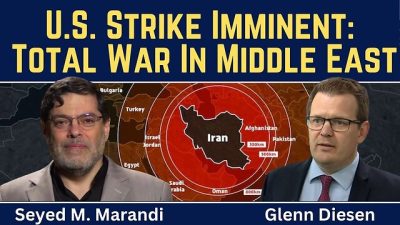
Seyed M. Marandi: Toward Total War in the Middle East
or go to
Aletho News Archives – Video-Images
From the Archives
The Geopolitics behind the War in Yemen (I)
By Mahdi Darius NAZEMROAYA | Strategic Culture Foundation | 30.03.2015
The United States and the Kingdom of Saudi Arabia became very uneasy when the Yemenese or Yemenite movement of the Houthi or Ansarallah (meaning the supporters of God in Arabic) gained control of Yemen’s capital, Sanaa/Sana, in September 2014. The US-supported Yemenite President Abd-Rabbuh Manṣour Al-Hadi was humiliatingly forced to share power with the Houthis and the coalition of northern Yemenese tribes that had helped them enter Sana. Al-Hadi declared that negotiations for a Yemeni national unity government would take place and his allies the US and Saudi Arabia tried to use a new national dialogue and mediated talks to co-opt and pacify the Houthis.
The truth has been turned on its head about the war in Yemen. The war and ousting of President Abd-Rabbuh Manṣour Al-Hadi in Yemen are not the results of «Houthi coup» in Yemen. It is the opposite. Al-Hadi was ousted, because with Saudi and US support he tried to backtrack on the power sharing agreements he had made and return Yemen to authoritarian rule. The ousting of President Al-Hadi by the Houthis and their political allies was an unexpected reaction to the takeover Al-Hadi was planning with Washington and the House of Saudi. … continue
Blog Roll
 Aletho News
- HE SAVED LIVES. NOW HE FACES PRISON.
- Israeli lobby seeks to bind US fate to ‘Israel’: Araghchi
- Pakistan-Iran talks secure LNG shipment to Islamabad through Hormuz
- Black Sea grain crisis puts global wheat supplies under pressure
- IRGC air defenses destroy another US MQ-1 drone over Strait of Hormuz
- Imran Khan’s entire immediate family detained in Pakistan ahead of mass protest demanding his release
- EU nation detains former presidential frontrunner
- Leaked: Britain’s Sham Conviction Of Hashim Thaci
- Seyed M. Marandi: U.S. Strike Imminent – Toward Total War in the Middle East
- Russia Voted Under Fire. Washington Is Loading the Tankers.
- If Americans Knew
- Israeli Attacks in Gaza Kill at Least Seven Palestinians Over Three Days, including Woman and Child
- Trump’s militarization of Washington DC as he pursues Israel’s war against Iran
- Why Israel Fears This Searing New Documentary
- Huckabee aide solicited cash gifts from Israelis
- This isn’t sci-fi, AI is already killing people
- ‘The Most Brutal Thing’: Investigation Reveals Execution of Elderly Woman in Rafah
- Inside Israel’s ‘soft’ ethnic cleansing plan for Gaza through the eyes of its victims
- New online database tracks pro-Israel political donations in the United States
- Israeli president pardons soldier convicted for killing wounded Palestinian
- Singer Ed Sheeran says his ‘heart broken’ by Gaza devastation, addresses Macklemore controversy
- No Tricks Zone
- 2025 Nature Paper Claiming Worsening Global Drought Gets RETRACTED …Heavily Flawed
- New Study: ‘Global Drought Shows No Detectable Recent Acceleration Under Climate Warming’
- Economic Masterminds: German Socialists Suggest Taxing Productivity Gains Stemming From Using AI
- The South China Sea Has Not Been Cooperating With The Climate Change Narrative
- Energy Crisis: Germany Enters Heating Season With Historically Low Gas Reserve Fill Levels
- New Study: The Antarctic Ice Sheet Gained Mass From 2020-2024 Due To Staggering Snow And Ice Accumulation
- Study: Ocean Heating Rates From Thousands Of Years Ago ‘Dwarf’ Modern Ocean Heating Rates
- Climate Extremists Target, Attack Large-Scale Power Grid Infrastructure In Germany!
- New Study: Antarctic Ice Melt Has Contributed Less Than 1 Centimeter To Sea Level Rise In The Last 30 Years
- Fear Of Debate: Alarmist German Climate Scientist Calls On Mainstream Media To Discredit Skeptic Voices
 Aletho News