The Coming War on Iran: What Has Really Been Happening?
By Robert Inlakesh | The Palestine Chronicle | January 13, 2026
The unrest inside Iran was effectively brought to a halt by the authorities, culminating in mass pro-government demonstrations in the millions across the country. Yet, the specter of a US-Israeli regime change operation continues to lie in the wake.
If you have been following the course of the protests/riots inside Iran on social media or in the corporate press, the impression given since the beginning of the year has been that Tehran is on the verge of collapse. Countless false claims were issued regarding the fall of entire cities, the collapse of the Islamic Revolutionary Guard Corps (IRGC), a massacre of peaceful protesters and even that Ayatollah Khamenei was seeking to escape to Moscow.
Evidently, the reality on the ground couldn’t have been more opposite of what the pro-regime change news outlets and social media influence operations have been portraying. Therefore, to understand what is happening, it is important to understand what truly transpired.
The Road to another Regime Change War
Ever since the conclusion of the 12-Day War between Iran and Israel last June, foreign policy hawks have made it abundantly clear that another round of fighting was only a matter of time. In fact, on July 7, 2025, Axios News reported that Israeli officials were already seeking a green-light, from the US President for them to attack Iran again.
Influential pro-Israeli Washington-based think tanks – such as the Foundation for Defense of Democracies (FDD), Washington Institute for Near East Policy (WINEP), and the Atlantic Council – all agreed that another round would be necessary, yet argued in different ways that the next round would have to result in the closure of the conflict for the foreseeable future.
The reasoning behind this was clear: if the next round was to mirror the 12-Day War, then another round would again become an inevitability. This scenario would mean that every 6-12 months, the conflict would go from Cold to Hot, a predicament that would actually heavily favour Iran.
If Tehran manages to keep repeating a similar series of rounds to what we saw in June of 2025, the Israelis will be at an enormous disadvantage. Not only does Israel have a smaller territory in which to operate, making taking out vital infrastructure easier, but it cannot produce weapons and rebuild at the rate Iran can. For example, the air defence munitions it depleted last year have still not been fully replenished, and many of the sites struck in Tel Aviv remain in ruins.
Iran, on the other hand, has been able to mass-produce ballistic missiles and drones. Western publicly released estimates greatly vary, but often indicate that the Iranians have replenished their arsenals, whereas the indications coming from Iran itself appear to suggest that they have superseded what they previously possessed, both in quantity and quality.
The US and Israel, nevertheless, have clearly been threatening to attack Iran once again for months, using varying excuses about why. Israeli PM Benjamin Netanyahu has recently been complaining about Iran’s missile program, which quickly became a talking point of the Trump administration, too.
Yet, the moment to attack Iran clearly hadn’t presented itself. There were simply too many variables, too many unknowns, and too many doubts for them to commit any action. We also saw this when it came to Israeli threats against Hezbollah in Lebanon. Even got to the point late last year that Hezbollah’s Secretary General, Naim Qassem, publicly stated that Israel is just bluffing and that although something may happen in the new year, he essentially told the Israelis to shut up and just attack if they were set on doing so.
Why didn’t Israel attack Lebanon? Perhaps the biggest reason why they didn’t is because of Iran and the fear of how far such a war could go. The Israelis attempted assassinations and ramped up their air attacks as a means of attempting to draw a retaliatory strike from Hezbollah, but this failed. Instead, the option left on the table was full-scale war or no war at all.
Then came the pivot to Iran, at least in terms of public propaganda and ramping up rhetoric.
Riots In Iran as A Prelude to War
On December 28, the Israelis spotted a new opportunity. Protests erupted throughout cities across Iran, as mainly shopkeepers took to the streets in order to express their outrage at government mismanagement amidst the ongoing sanctions-induced economic crisis.
To be clear, these protests were totally organic and genuine; they had the backing of major Unions inside the country, and the Iranian government appeared to be quickly engaging with them in order to reach concessions. There was no violence at these protests initially. Even when suspected agent provocateurs had attempted to chant for regime change, shopkeeper protesters had forced them out of their crowds.
By December 29, former Israeli Prime Minister Naftali Bennett then posted a video on social media, in which he claimed that Israel was standing with the Iranians “rising up” against their government. Bear in mind that when this address was issued, the situation in Iran was in fact relatively calm, and the widespread riots had not yet taken place.
However, on social media, old videos and AI-generated clips were suddenly spread like wildfire, in a clearly coordinated campaign led by the Israelis and their Iranian opposition allies.
Almost out of nowhere, rioters began to spring up in small groups, primarily in the West of Iran. Some of these rioters carried weapons, but most just committed vandalism and burned down cars or shops. At this point, the protests over the economic crisis began to reduce, to be replaced by anti-government protests. Despite the violence and escalating rhetoric, the authorities in Tehran made sure to distinguish between rioters and legitimate protesters, not bringing down full force against them.
Then came the first day of the New Year, when the violence suddenly exploded. Iranian opposition channels began claiming cities had fallen, which never happened; they claimed millions were rising against the government, which also was not the case. On January 1, two Iranian police officers were murdered, and rioters even executed a young man who belonged to the Basij paramilitary force in the country.
The day after saw all the major Unions condemn the violent rioters, as Israel’s official Persian-language account posted AI-generated images depicting Iran’s police forces hosing down peaceful protesters. Again, the riots escalated and more members of the security forces were murdered, as rioters committed arson attacks.
All of this ended up coming to a head on January 8, as the riots escalated dramatically and this led to Iran shutting down the internet across the country as it took the gloves off and sent its IRGC forces in to stabilise the situation.
The largest recorded anti-government protests, as one called for by the Shah’s son from the comfort of California, numbered no more than in the tens of thousands. It is estimated that at their peak, there were around 40,000 that showed up.
The footage that began emerging from the streets of Tehran and elsewhere was nothing short of shocking, mass destruction and arson against public transit, the burning of mosques, attacks on schools, medical clinics, shops, homes and streets left in ruins as dumpsters were overturned and set alight, along with all the vehicles in sight.
In total, Iran claims that over 100 members of its security forces were murdered, 350 Mosques were set ablaze and 150 ambulances were damaged or destroyed. Civilians were also brutally murdered by the rioters, reportedly including a three-year-old child and a nurse who was burned to death; multiple police officers were also burned alive.
Without needing to go any further, there is copious evidence of armed militants firing on security forces and mass violence committed against civilian infrastructure. What started as a totally normal and organic series of protests was hijacked and turned into an Israeli-backed riot campaign. This was not comparable to the likes of the 2022 or 2009 unrest, which were evidently taken advantage of by Iran’s enemies, but had support from a sizable portion of the population nonetheless.
In the end, it appeared that by January 12, when millions of Iranians came to the streets across the country in solidarity with their government and against the rioters, the Israeli-backed operation had failed.
Yet, the US government had begun to ramp up its direct threats of intervention as the riots died down. Leaving the question open as to when the next round of American strikes would occur, following Donald Trump’s decision to bomb Iran last year.
The real question is whether these riots were a desperate and failed regime change attempt in and of themselves, or this was simply a prelude to what’s coming next. If the Israelis were truly betting on these riots equalling regime change, then perhaps the calculation is for the US to attack in order to revive the riots on the ground.
Alternatively, the instability was only for the purpose of setting up a larger attack, which would mean a much larger war could have been planned. In order for the US and Israel to achieve their desired outcome, that being either regime change or a massive blow that will end the war between Israel and Iran for the foreseeable future, they will likely go after Iran’s infrastructure.
In such a scenario, expect the kitchen sink to be thrown at Iran. Armed terrorist militia insurgencies, airstrikes, agents on the ground, and more riot activity. In particular, attacks on the electrical grid, water, oil, agriculture, and everything that makes the economy function. In other words, an attempt to achieve regime change this way, or to simply make war so costly that Iran won’t seek it for some time afterwards. Perhaps the goal could be to weaken Iran to a degree where it would negotiate on US terms, yet this is highly unlikely.
Iran dealt with these threats by issuing its own, doubling down and adopting an ultra-aggressive posture. What comes next could go many ways, so we are left to wait and see.
– Robert Inlakesh is a journalist, writer, and documentary filmmaker. He focuses on the Middle East, specializing in Palestine. He contributed this article to The Palestine Chronicle.
Australian festival boycotted for excluding Palestinian writer
MEMO | January 12, 2026
Dozens of writers and cultural figures have boycotted the Adelaide Festival in Australia after the organisers excluded Palestinian-Australian academic and writer Randa Abdel-Fattah from the Adelaide Writers’ Week programme, scheduled to take place next month.
The festival removed Abdel-Fattah from the list of participants, despite her taking part in the 2023 edition, where she chaired and joined several sessions and discussions.
The Adelaide Festival includes a wide range of cultural events, such as arts, music, theatre and public talks, with Writers’ Week considered one of its most important annual programmes.
On Thursday, the festival’s board issued a statement saying it was “shocked and saddened by the tragic events in Bondi”, adding that it had informed Abdel-Fattah of its decision not to proceed with her planned appearance. The board justified the move by citing what it described as “cultural sensitivity” at this time.
In response, Randa Abdel-Fattah released a separate statement accusing the festival’s management of “blatant and shameful racism against Palestinians”. She said linking her to the Bondi events was “disgraceful” and argued that the decision stripped her of her humanity and turned her into a target for racist fears simply because she is Palestinian and holds openly stated political views.
Abdel-Fattah also criticised Australian arts and cultural institutions more broadly, accusing them of showing “complete contempt and inhumanity towards Palestinians” since 7 October 2023.
She said: “The only Palestinians they will tolerate are silent and invisible ones.”
So far, 47 participants have withdrawn from the festival in support of Abdel-Fattah, with expectations that more may follow.
Palestinian surgeon Ghassan Abu Sittah defeats pro-Israel lawfare in landmark GMC ruling
MEMO | January 12, 2026
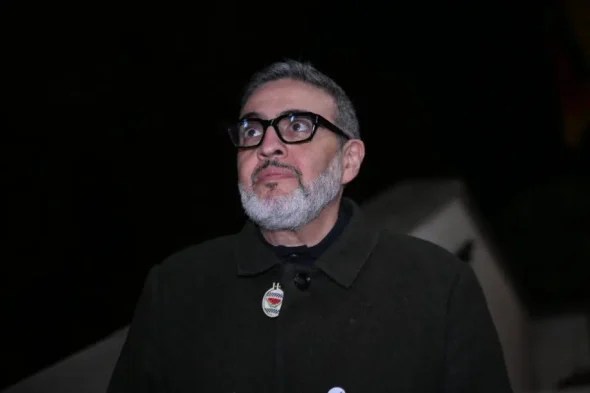
Prominent Palestinian reconstructive surgeon and academic Dr Ghassan Abu Sittah has won a misconduct case brought against him by pro-Israel lobbyists, in what campaigners have described as a major blow to the UK’s Israel lobby and its use of lawfare to silence critics of Israel’s assault on Gaza.
On Friday, the Medical Practitioners Tribunal Service (MPTS) dismissed a two-year-long General Medical Council (GMC) case against Abu Sittah, concluding that there was no evidence that his writing or social media activity supported terrorism, anti-Semitism or violence.
“WE WON”, said Abu Sittah on X following his victory over UK Lawyers for Israel (UKLFI).
“The General Medical Council Tribunal has thrown out the complaint made by UK Lawyers for Israel, accusing me of support of violence and terrorism and antisemitism”.
The case stemmed from complaints lodged in 2023 by UKLFI, a notorious pro-Israel pressure group that has repeatedly targeted activists, academics and professionals who speak out for Palestinian rights.
The complaint centred on an article written by Abu Sittah in the Lebanese newspaper Al Akhbar and two reposts on X, which UKLFI alleged had “impaired his fitness to practise”.
The tribunal found that an “ordinary reader” would not interpret the material as providing material or moral support for terrorism, nor as endorsing violence. It also ruled that there was no intent on Abu Sittah’s part to promote violence or hatred, leaving no basis for a finding of misconduct.
Abu Sittah, a Kuwait-born British Palestinian plastic and reconstructive surgery consultant and rector of the University of Glasgow, said the case was part of a broader strategy of intimidation aimed at silencing pro-Palestinian voices.
“This complaint forms part of a broader lawfare strategy which aims to instrumentalise regulatory processes to intimidate, silence and exhaust those who speak out against injustice in Palestine,” he said. “I do not, and have never, supported violence against civilians. I know too well its consequences.”
Abu Sittah spent 43 days in Gaza during Israel’s initial assault in October 2023, working at Al-Ahli, Al-Shifa and Al-Awda hospitals. He has repeatedly spoken publicly about the mass civilian casualties he treated, including children with catastrophic injuries, and has accused the Israeli military of using white phosphorus and deliberately targeting civilians.
The case was supported by the International Centre of Justice for Palestinians (ICJP), whose director, Tayab Ali, described the ruling as a “complete vindication”.
“For months, Dr Abu Sittah was shamelessly targeted by pro-Israel lobby groups through a sustained campaign of lawfare,” Ali said. “The serious allegations advanced against him have now been entirely rejected.”
The ruling comes amid growing scrutiny of UKLFI’s tactics. The European Legal Support Center (ELSC) and the Palestine Institute for Public Law and Counsel (PILC) have filed a formal complaint with the Solicitors Regulation Authority (SRA) against UKLFI director Caroline Turner.
The complaint alleges the use of Strategic Lawsuits Against Public Participation (SLAPPs), breaches of professional conduct rules and misleading claims about regulatory oversight. It also calls for an investigation into whether UKLFI is effectively operating as an unregulated law firm.
The complaint details eight threatening letters sent by UKLFI between 2022 and 2025, which ELSC says demonstrate a pattern of vexatious and legally baseless intimidation aimed at shutting down Palestine solidarity efforts. Campaigners argue that these tactics have contributed to workers being disciplined or dismissed, events being cancelled and activists being smeared.
Abu Sittah’s victory also fits into a wider pattern of setbacks for pro-Israel efforts to suppress dissent in the UK. In December, a court quashed a summons issued against comedian Reginald D Hunter. The judge in the case said Campaign Against Antisemitism (CAA) misled him when bringing a private prosecution against the comedian.
Satellite images reveal extensive bulldozing of rubble in Beit Hanun amid signs of broader plans
Palestinian Information Center – January 12, 2026
GAZA – An analysis conducted by Al Jazeera of satellite images has revealed that the Israeli occupation army has carried out large-scale operations to remove the rubble of destroyed homes in the city of Beit Hanun, in the northern Gaza Strip, raising fundamental questions about the objectives of these actions and whether they are limited to security considerations or extend to broader plans.
The analysis relied on high-resolution satellite images captured between October 8, 2025, two days before the start of the ceasefire in Gaza, and the most recent images dated January 10 of the current year. These images show the continued bulldozing and removal of rubble in devastated neighborhoods, particularly in the Al-Boura area and along the outskirts of Al-Masriyin and Al-Na’ayma streets in northeastern Beit Hanun.
Geographic measurements indicate that the area from which home rubble was removed, along with land that was leveled, amounts to approximately 408,000 square meters, roughly 100 acres. The number of homes whose rubble was cleared is estimated at around 329, in addition to agricultural structures, rooms, and property belonging to farmers in an area considered one of the city’s agricultural zones.
The images also show bulldozers operating among the destroyed homes undergoing debris removal, within a zone that includes several active and inactive Israeli military positions.
The data suggest that the rubble-removal operations began at the start of Beit Hanun’s urban boundary, adjacent to the security fence separating it from nearby Israeli settlements close to the northern border, including the settlement of Sderot.
These scenes contradict recent statements by the Israeli army reported by the newspaper Yedioth Ahronoth regarding the purpose of “recruiting” civilian tractors belonging to settlers in the Gaza envelope for use inside the Strip, including in Beit Hanun.
According to the newspaper, the army explained that it had borrowed these tractors for a military unit to carry out tasks behind the border aimed at improving visibility by removing dense vegetation, clearing shrubs, and leveling the ground, without mentioning the removal of rubble from hundreds of homes.
The Israeli army also denied that the purpose of these works was to prepare Palestinian land for Israeli agricultural needs.
The use of agricultural equipment belonging to settlers inside the Gaza Strip is considered unprecedented since 2005. The newspaper noted that the Israeli army’s Southern Command had previously expressed reservations about such a step.
Beit Hanun lies at the extreme northern edge of the Gaza Strip within what are known as the “zero zones,” areas under full Israeli military control. The city has suffered unprecedented levels of destruction due to continuous bombardment and bulldozing over two years of war, including during the ceasefire period, and its residents have only been able to return for short, partial periods.
In the same context, Israel has not concealed its settlement intentions in the Gaza Strip. References to Beit Hanun have repeatedly appeared in speeches and slogans by leaders of the far-right within Prime Minister Benjamin Netanyahu’s government.
In January 2024, ministers and Knesset members from the ruling coalition signed what was termed the “Charter of Victory and the Renewal of Settlement in the Gaza Strip and Northern Samaria” during a conference held in Jerusalem, where a map was displayed showing planned settlement points, including a settlement nucleus on the outskirts of Beit Hanun.
In December of the same year, ministers and Knesset members visited a site overlooking the Gaza Strip from the settlement of Sderot and discussed establishing settlements inside it. Meanwhile, Hadar Bar-Hai, director of a settlement group, stated that Beit Hanun and Beit Lahiya are uninhabited areas, affirming that more than 800 Jewish families are ready to settle immediately once permitted.
Last December, Israeli Army Minister Israel Katz made statements about the future of the Gaza Strip, revealing during a conference at the settlement of Beit El a plan to establish military-agricultural “Nahal nuclei” in northern Gaza, asserting that Israel “will never withdraw and will never leave Gaza.”
Katz described these bases as an alternative to the settlements evacuated in 2005, prompting discontent within the US administration, which demanded clarifications, viewing the plan as contradictory to US President Donald Trump’s plan to end the war.
Meanwhile, the Israeli army continues, in parallel, to demolish homes and expand its areas of control within what is known as the “Yellow Line” in the Gaza Strip, including leveling thousands of dunams of land and residential buildings.
The ceasefire agreement ended a genocidal war launched by Israel against Gaza Strip on October 8, 2023, which lasted two years and resulted in more than 71,000 Palestinian martyrs and over 171,000 wounded, in addition to widespread destruction affecting nearly 90% of civilian infrastructure. The United Nations has estimated the cost of reconstruction at approximately $70 billion.
UAE begins ‘hurried evacuation’ from Somali air base: Report
The Cradle | January 12, 2026
The UAE has begun evacuating security personnel and heavy military equipment from Somalia, after officials in Mogadishu reportedly suspended Emirati use of their territory and airspace for military operations, Middle East Eye (MEE) reported on 12 January.
The Somali government informed the Emiratis that “all their military activities in Somalia, including the use of airspace and the landing of cargo military aircraft in Bosaso, Berbera and Mogadishu, had been suspended,” a senior Somali official told MEE, speaking on condition of anonymity.
The official said the UAE now appears to be evacuating its security personnel and military equipment to neighboring Ethiopia.
Citing flight-tracking data and two eyewitnesses, MEE reported that an average of six IL-76 cargo aircraft have arrived and departed the air base in Bosaso – the port city in Somalia’s Puntland – each day over recent days.
One source speaking with the UK news outlet described the flights as “resembling a hurried evacuation.”
“Unlike previous operations, where incoming cargo would be immediately transferred to another aircraft on standby, these planes have been arriving over several days, loaded with heavy military equipment, and departed without delay,” a source at Bosaso air base told MEE, describing the activity as highly unusual.
The UAE has long used Somalia as a rear operational base for its military engagements in both Sudan and Yemen. It had been using Bosaso’s port and airport in recent years to send weapons, mercenaries, and supplies to Sudan’s paramilitary Rapid Support Forces (RSF), which is fighting a civil war against Sudan’s military.
Bosaso is part of a cluster of airfields the UAE has constructed in an effort to dominate the southern end of the Red Sea, the Bab al-Mandab Strait, and the Gulf of Aden.
According to a source in Somalia’s federal government, Mogadishu has revoked the agreement allowing the UAE to use the Bosaso air base and other facilities in the country.
Somali authorities opened an investigation into Emirati activities at Bosaso after the UAE used the air base to help a Yemeni separatist leader escape to the Gulf nation.
The separatist leader, Aidarus al-Zubaidi, is the president of the UAE-backed Southern Transitional Council (STC).
He was wanted by Saudi Arabia amid fighting between the STC and Saudi-backed forces in Yemen that began in December. The UAE was supporting the STC’s bid to take territory from the Saudi-backed Presidential Leadership Council (PLC) in hopes of creating an independent state in southern Yemen.
Zubaidi was supposed to travel to Saudi Arabia for talks to end the violence, but the UAE secretly helped him escape to Abu Dhabi. He first traveled by ship to the breakaway region of Somaliland, then boarded a plane at the Bosaso air base to travel to the UAE.
After helping Zubaidi escape, the Somali government informed the Emiratis that all their military activities in Somalia were suspended.
Saudi Arabia and the UAE are increasingly competing for influence in both Yemen and Somalia.
The UAE is closely aligned with Israel, which has supported Somaliland in its effort to gain formal independence from Somalia.
In contrast, Saudi Arabia has supported Somalia’s unity and established closer relations with officials in Mogadishu.
Saudi officials held an Organisation of Islamic Cooperation conference on Somalia over the weekend and rallied the Arab League and Gulf Cooperation Council (GCC) to issue statements in support of Somalia’s unity after Israel recognized Somaliland.
Israel’s ‘Ceasefire’ In Gaza Turns Out To Be A Ruse
Israel Is Planning To Resume The Full Scale Genocide In Gaza Starting In March
The Dissident | January 11, 2026
Israeli officials are now admitting that the so-called ceasefire in Gaza was a ruse, and they plan to resume the full-scale genocide and ethnic cleansing of Gaza in March.
According to a report in the Times of Israel, “The Israel Defense Forces has drawn up plans to launch renewed intensive military operations in Gaza in March, with an offensive targeting Gaza City aimed at expanding the part of the Strip controlled by Israel”.
The Times of Israel boasted that the ceasefire was a ruse to make it easier to bombard all of Gaza without killing Israeli prisoners of war, quoting the research fellow at the Israel Center for Grand Strategy, Erez Winner saying, “an offensive against Hamas would now be easier for Israel because it no longer has to worry about putting hostages at risk, now that all the living hostages and all but one hostage’s body have been returned.”
This confirmed what many had already speculated, that Israel was never serious about committing to the ceasefire agreed to in October and always planned to resume the genocide in Gaza.
As the former deputy commander of the IDF’s Gaza Division, Amir Avivi admitted to Israel’s Channel 14, Israel only agreed to the ceasefire because, “After two years of fighting, the tools are worn out. We want to refresh the forces, to establish the defense line”.
Furthermore, Israel never actually adhered to the ceasefire or ended the genocide, only slowed it down, with Gaza’s health ministry documenting that, “442 people have been killed and 1,236 injured since October 11 – the date the Gaza truce entered into force.”
Furthermore, Israel never ended the blockade in Gaza, and has planned to ramp it up by the time it resumes the full-scale genocide in March, by blocking 37 aid groups operating in Gaza, including Doctors Without Borders, effective March 1st.
The Israeli human rights organization B’Tselem documented in December that, “only 57% of the 556 aid missions planned by the UN and its partners were carried out, including the delivery of vital aid and equipment, medical evacuations, and infrastructure repairs” adding, “Israel’s genocidal campaign in Gaza did not end with the ‘ceasefire’ declaration. Blocking humanitarian aid, alongside ongoing airstrikes and shootings, is a direct continuation of the assault on Gaza’s population.”
Now Israel plans to resume the genocide and genocidal starvation siege in Gaza in March.
Along with the fact that the Israeli prisoners of war being released will make it easier for Israel to indiscriminately bomb Gaza and the fact that it gives them the chance to “refresh the forces”, there are other calculations from Israel which will make their genocidal ethnic cleansing plan easier by March.
Gila Gamliel, Israel’s Science and Technology Minister, who was previously Israel’s Intelligence Minister admitted that Israel’s ultimate plan is to, “make the Gaza Strip uninhabitable until the population leaves”.
Now Israel has a dumping ground for ethnically cleansed Palestinians after making Gaza “uninhabitable”- Somaliland.
In late December, Israel became the first UN nation to recognize Somaliland, a breakaway separatist region of Somalia, as a state.
This was done in part because – as Israeli journalist Amit Segal boasted – because “Somaliland was supposed to – and may still – absorb Gazans”.
The Israeli paper Ynet noted at the time, “The territory has recently been mentioned as a possible destination for Gazans, with officials there saying they would be willing to absorb ‘one million Gazans’”adding that, “Israeli intelligence officials say the Mossad has been active in Somaliland for years, laying the groundwork for the recognition through long-standing, discreet relationships with senior figures there.”
Dan Diker, the president of the Likud connected Jerusalem Center for Security and Foreign Affairs admitted, “our friends in Somaliland made a very generous offer privately … of their willingness to absorb or to create communities for hundreds of thousands even beyond a million up to a million and half Gazans” adding, “Somaliland, in our understanding, is really the only country, now country, that stepped up to the plate to absorb Gazans”.
According to Somalia’s Defence Minister Ahmed Moalim Fiqi, “Somalia has confirmed information that Israel has a plan to transfer Palestinians and to send them to Somaliland.”
Furthermore, Israel is undoubtedly hoping that by March, it, along with the U.S., will have carried out regime change in Iran, further isolating the Palestinians and cutting off a key ally of resistance groups Hamas, Hezbollah, and Ansar Allah, which would be a bulwark to Israel’s resumption of genocide and ethnic cleansing in Gaza.
Israel, through social media campaigns and apparent Mossad agents on the ground, has been encouraging the current riots unfolding in Iran, hoping they will lead to regime change.
Along with this, they are pushing Trump to support another regime change bombing in Iran in response to a government crackdown on the riots, with Trump repeatedly threatening to “hit them (Iran) very hard” and, saying, “If Iran shoots and violently kills peaceful protesters, which is their custom, the United States of America will come to their rescue. We are locked and loaded and ready to go.”
Through regime change in Iran, Israel hopes to take out one of the last allies of Palestinian resistance, paving the way for its ethnic cleansing plan.
Kiev seeks to ban Russian music from streaming platforms
RT | January 11, 2026
Kiev is seeking to block access to Russian music on international streaming platforms inside Ukraine and prevent performers from the neighboring country from appearing in domestic popularity charts, a senior official overseeing sanctions policy has said.
Ukrainian Sanctions Policy Commissioner Vladislav Vlasiuk announced that Kiev was developing “new solutions” aimed at ensuring that those whom authorities describe as Russian “propagandists” do not feature in monthly or annual rankings on streaming services such as Spotify or YouTube music.
He added that more than 100 Russian performers had already been blacklisted by Ukrainian authorities, and that the list would be expanded. Kiev would then “try to persuade streaming platforms so that this content is not available on the territory of Ukraine,” Vlasiuk noted.
A separate push came from the country’s music industry lobby. In December, Aleksandr Sanchenko, president of the All-Ukrainian Association of Music Events (UAME), said that officials were developing mechanisms for a near-blanket ban of Russian performers inside the country.
He noted that while an option to ban all artists using the Russian language was under consideration, it was ultimately ruled out, as it would impede Ukraine’s Eurointegration push.
He said, however, that his group has launched an open Google form and appealed to music media to help compile a list of Russian artists for possible sanctions.
Sanchenko also said that discussions were underway about creating so-called “white lists” for pro-Ukraine Russian performers, but acknowledged that no such artists have been added so far.
Ukraine has steadily tightened curbs on Russian culture and language since the Western-backed coup in 2014, particularly since the escalation of the conflict with Moscow in 2022, extending restrictions affecting everything from books and films to music played in public spaces and online. Ukrainian officials have argued that Russia-linked cultural products could pose a “threat” to national security and identity.
Russia’s Foreign Ministry spokeswoman Maria Zakharova suggested that the crackdown has transcended “all the bounds of good and evil,” adding that “paranoia is becoming the ‘calling card’ of those who have grabbed power in Kiev.”
Inside Israel’s Support For Reza Pahlavi
Israel Wants The Son Of Iran’s Former Shah In Power After A Regime Change War
The Dissident | January 10, 2026
Recently, Reza Pahlavi, the son of the former U.S./Israeli backs Shah of Iran- who was installed after the U.S. backed a coup against Iran’s democratically elected president Mohammad Mosaddegh in 1953, and overthrown in the Iranian Revolution in 1979- has been encouraging increasingly violent protests with the goal of regime change in Iran.
Pahlavi, who lives in Washington, has been cheering on pro-regime change protests saying in a message to protestors , “I am certain that by making our street presence more targeted, and at the same time cutting off the financial lifelines, we will completely bring the Islamic Republic and its worn-out and fragile repression apparatus to its knees”.
He went on to call for protestors to seize cities in Iran with the eventual goal of regime change, saying, “In this regard, I invite workers and employees in key sectors of the economy – especially transportation, oil, gas, and energy – to begin a nationwide strike. I also ask all of you today and tomorrow, Saturday and Sunday (January 10 and 11), from 6 p.m., to come to the streets with flags, images, and national symbols and claim public spaces as your own. Our goal is no longer merely to come to the streets; the goal is to prepare for seizing the centers of cities and holding them” adding, “I, too, am preparing to return to the homeland so that at the time of our national revolution’s victory, I can be beside you, the great nation of Iran. I believe that day is very near. Long live Iran”.
What is not as well known is that Reza Pahlavi is deeply connected to Israel, and that Israeli intelligence has run propaganda campaigns in an attempt to promote Pahlavi, who they want to prop up after enacting regime change in Iran.
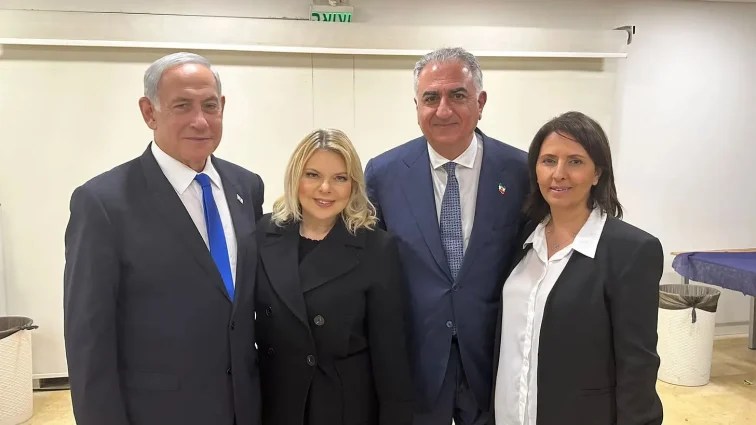
In 2023, Reza Pahlavi made an official visit to Israel, at the behest of its then Intelligence Minister, Gila Gamlie, where he met with Benjamin Netanyahu and Israeli President Isaac Herzog.
During the visit, he called for Iran to move towards Israel and away from supporting Palestinian resistance. As Forward noted, “In April 2023, Pahlavi traveled to Israel, where he met with Prime Minister Benjamin Netanyahu and President Isaac Herzog, and paid a visit to the Western Wall, where he said he prayed ‘for the day when the good people of Iran and Israel can renew our historic friendship.’ He even consulted Israeli water management scientists, whom he dubbed the ‘best experts in the field,’ to help him develop a plan of action for Iran’s water crisis, which has also been a major point of contention for protestors.”
The Likud-connected Jerusalem Centre for Security and Foreign Affairs wrote at the time of the visit, “The main message of his visit was the possibility and urgency of peace between the two ancient nations of Israel and Iran. However, this will not happen unless the Iranian people can succeed in overthrowing the Islamic Republic, the common enemy that cements the relationship between a majority of Iranians and Israel.”
In other words, Israel wants regime change in Iran and to install Reza Pahlavi, so it can continue it’s ethnic cleansing plan in Gaza and the West Bank and further greater Israel expansion, without facing any roadblocks from Iran, and to cut off a supporter of resistance to Israeli expansion.
During the visit, Reza Pahlavi promised to further this Israeli goal if he were installed in power, saying, “The biblical relationship we have with Israel was long before it became a state”.
Following the visit, Israeli intelligence launched a propaganda campaign online, designed to promote Reza Pahlavi and support for him being installed into power in Iran.
The Israeli newspaper Haaretz reported that following the visit, “a large-scale digital influence campaign in Persian was underway, operated out of Israel and funded by a private entity that receives government support,” adding, “The campaign promotes Pahlavi’s public image and amplifies calls for restoring the monarchy. The campaign relies on ‘avatars,’ fake online personas posing as Iranian citizens on social media.”
Haaretz went on to report:
According to five sources with direct knowledge of the project, native Persian speakers were recruited for the operation. Three of the sources confirmed the connection between the project and this specific campaign, and said they witnessed the network advancing pro-Pahlavi messaging.
According to the sources, the campaign included fake accounts on platforms such as X and Instagram and used artificial intelligence tools to help disseminate key narratives, craft its messages, and generate content.
The report added, “While Pahlavi declares that he’s not running for any position, in recent years a social media campaign has been calling for the monarchy’s restoration, with Reza on the throne. According to the sources, part of this effort is based on a network of fake accounts originating in Israel.”
Similarly, before the current unrest in Iran, Israeli intelligence used social media in an attempt to foment violent riots that would lead to regime change in Iran.
The University of Toronto’s Citizen Lab uncovered another social media campaign in Persian operated through Israeli intelligence, which “advanced a narrative of regime change in Iran”.
During the Israel/American bombing of Iran in June of the last year, the Israeli accounts, were, “sharing images and videos of alleged civil unrest and instability in Iran”, “published a series of posts highlighting the alleged economic upheaval in Iran after the first few rounds of bombings” and “told followers to head to ATMs to withdraw money, emphasized that the Islamic Republic was ‘stealing our money to escape with its officials,’ and urged followers to rise up against the regime.”
They also, “urged followers to get on their balconies at 8 p.m. each evening and shout ‘Death to Khamenei’” and “appeared to make another push to trigger unrest by questioning the ceasefire”.
Along with this, the Israeli bot accounts shared “several instances of videos edited and shared to mislead viewers about protest activity occurring in Iran” and shared fake news headline that claimed, “Officials flee the country; High-ranking officials leave Iran one after another”.
After the bombing, the Israeli bot accounts, “pivoted to content related to the country’s ongoing water and energy crisis” in an attempt to, “escalate these tensions by creating and sharing content related to these issues”.
The report noted that the bot network is “still consistently posting about both the water crisis and energy shortage, in a likely attempt to continue to escalate tensions between Iranian citizens and their government.”
During the current protests, which began as peaceful protests around Iran’s mismanagement of the economy, but were taken over by a violent regime change element, Israeli and American officials have openly boasted that there are Mossad agents on the ground, attempting to push the protests in a pro-regime change direction.
Israel’s Heritage Minister Amichai Eliyahu boasted that, “we have some of our people operating there (in Iran) right now”, while a Mossad linked X account claimed that the Mossad was, “with you in the field as well” to Iranian protestors and the former CIA director and Secretary of State Mike Pompeo wrote , “Happy New Year to every Iranian in the streets. Also, to every Mossad agent walking beside them.”
Israel’s puppet, Reza Pahlavi, cheering on regime change riots in Iran, needs to be seen as a part of Israel’s broader plan- enacted after the 2023 visit, to install him after carrying out its longtime goal of regime change.
35,000 ‘Partially or Completely’ Deaf in Gaza Due to Israeli Bombings – Report

The Palestine Chronicle | January 9, 2026
An estimated 35,000 children and adults “have partially or completely” lost their hearing due to bombings during Israel’s two-year genocidal assault on the Gaza Strip, according to a Le Monde report, citing a survey by a local non-profit organization.
“Hearing loss can result from injuries to the head or neck, brain trauma causing ruptured eardrums and damage to the auditory system. But it can also be caused by exposure to sound waves, even if a person was not physically injured,” Dr. Ramadan Hussein, an audiologist working with the Atfaluna Society for the Deaf, reportedly said.
“These hearing disorders are, most often, irreversible,” he stressed.
‘Power of Explosion’
One such child whose hearing was affected by the bombings is a 12-year-old girl by the name of Dana. She was resting in her room in Gaza City when an Israeli missile hit the building just across from hers, the report said.
Dana’s father stressed that the explosion “was extremely violent”, with the door to her room torn off and the windows blown out. Although she survived the blast, Dana lost her hearing.
Specialists at the Atfaluna organization confirmed that Dana is suffering from “a very severe hearing loss”.
They said that “Because of the power of the explosion, the auditory nerve was severely damaged, perhaps even completely destroyed.”
Five-Day-Old Baby
In another case, a baby who was just five days old was thrown and buried under the sand when an Israeli missile struck one meter from his family’s tent in the al-Mawassai area of Khan Yunis, the report said.
His mother, Safa al-Qara, said, “We found him thanks to his feet sticking out. He was in a terrible state; we thought he was going to die.” Four months after his birth, his mother noticed that “something was wrong.”
She said that only movement “got his attention, not sounds.” He was subsequently diagnosed with a zero level of hearing.
The report stated that he urgently requires a hearing aid or cochlear implant to avoid sever developmental delays – an impossible task in the besieged enclave with Israel having blocked the entry of some medical equipment and medicines.
“For nearly a year, not a single hearing aid has entered the Gaza Strip,” Dr. Hussein warned, adding that “even those who already have them will soon be unable to use them, because batteries are also banned.”
Infrastructure Destroyed
In addition to the shortages, laboratories to make custom ear molds and much of the infrastructure needed to treat hearing disorders has been destroyed by Israel’s ground offensive, the report stated. Many specialists in this field have also already left the enclave due to the genocidal war.
Dr. Hussein warned that “Forced displacements, continuous bombings, famine and the lack of medicine affect pregnant women and fetuses and can lead to the birth of children with disabilities, including hearing loss.”
At the same time, with the worsening conditions in displacement camps, malnutrition and the lack of primary care, there is the risk of infections.
Fady Abed, the director of Atfaluna, warned that even minor infections, “like ear infections, can cause permanent hearing loss if not treated in time,” the report stated.
Staggering Death Toll
Starting on October 7, 2023, the Israeli military, with American support, launched a genocidal war against the people of Gaza. This campaign has so far resulted in the deaths of over 71,300 Palestinians, with more than 171,000 wounded. The vast majority of the population has been displaced, and the destruction of infrastructure is unprecedented since World War II. Thousands of people are still missing.
In addition to the military assault, the Israeli blockade has caused a man-made famine, leading to the deaths of hundreds of Palestinians—mostly children—with hundreds of thousands more at risk.
Despite widespread international condemnation, little has been done to hold Israel accountable. The nation is currently under investigation for genocide by the International Court of Justice, while accused war criminals, including Prime Minister Benjamin Netanyahu, are officially wanted by the International Criminal Court.
Syria is Normalizing Ties With Israel, Here’s Why – Analysis
By Robert Inlakesh | The Palestine Chronicle | January 7, 2026
On January 6, 2026, a joint statement was published by the US State Department, affirming that the Israelis and Syrians had established a “joint fusion mechanism”. Despite being labeled an official normalization deal, this mechanism works as a soft normalization arrangement.
As the topic of Syrian normalization is often one that triggers a rather aggressive reaction from all sides, it is important to cut through the propaganda to establish what just happened.
As a product of a direct meeting between Israeli and Syrian officials in Paris, with the participation of the United States, both Damascus and Tel Aviv have agreed to a quasi-normalization deal of sorts.
The joint statement that was published on the US State Department website makes the issue extremely clear: a “joint fusion mechanism”, or “dedicated communication cell”, has now been established. This mechanism includes facilitating Israeli-Syrian cooperation in the following arenas:
- Intelligence sharing
- Diplomatic engagement
- Commercial opportunities
- Military de-escalation
Some supporters of Syrian President, Ahmed al-Shara’a, have been adamant that what was reached and is being pursued is solely to do with security issues and the issue of southern Syria. Today’s joint statement thoroughly debunks any such claims.
At the same time, no formal normalization agreement has yet to be reached. However, if Syria is directly opening up such communications and striving towards “commercial opportunities” with Israel, it may not be sealed with a signed agreement and ceremony that brings Damascus directly into the so-called “Abraham Accords”, but this would be, for all intents and purposes, a normalization agreement.
There is no longer any space in which reasonable people can argue that Syria’s current leadership has not become a US-aligned force that seeks further cooperation with the Israelis. It is a fact that the US runs the show. The reason why this issue has become so taboo to speak about is that there are many who simply do not want to accept this reality.
According to polling data published by the Foreign Policy political journal on December 6, 2025, only 14% of Syrians said that they support the normalization of ties with Israel.
92% of Syrians also answered that Israel’s illegal occupation of territory in the region was a critical threat to their security. Another telling statistic was that a whopping 66% said they had favorable views of the United States.
These statistics are very telling and can help explain a lot about what is happening publicly, as opposed to privately, when it comes to Syrian-Israeli relations.
For a start, the vast majority of the Syrian people are opposed to normalization, meaning that if President Ahmed al-Shara’a were to publicly attend a signing with Israeli PM Benjamin Netanyahu, it would certainly cause a stir.
In other words, in the interests of stability, reaching a normalization agreement with Israel is best kept out of the spotlight. On the Israeli side, this could also work to their benefit. Netanyahu understands that in the event of signing a formal normalization deal, he may enjoy a propaganda victory, but will also have to make small concessions on his ambitions in southern Syria.
By establishing ties with the Syrian leadership, in the absence of an official normalization agreement, it will provide the Israelis with the ability to maintain freedom of action inside Syria. Meanwhile, the loyalists to the Hayat Tahrir al-Sham government in Damascus will be able to deny the deep ties established between both sides and sell it as a deal comparable to the previous disengagement understandings that Israel tore up in December of 2024.
Another takeaway from the polling data is that a large percentage of Syrians view the US favorably, which explains the rather contradictory takes of some Syrians you may be seeing online. A popular view is that siding with the US is actually a smart idea and that Washington will help Syria rehabilitate itself.
Despite the US overtly being Israel’s closest ally and fueling the genocide in Gaza, which most Syrians oppose, many still manage to delude themselves into believing that in the new Syria that has emerged, the US role is unique in how it has behaved historically and continues to behave in every other country on earth. This is simply a case of mass self-deception and is, in some cases, a protective mechanism that enables people to live safely under a totally illogical worldview.
Where Is This Going?
At this current moment, the Israelis view the government of al-Shara’a as weak and are even anticipating its sudden collapse. Tel Aviv and Washington-based think tanks are also becoming more critical of the current regime in Damascus, after previously celebrating its rise to power. This is largely due to the inability of Ahmed al-Shara’a to bring his own forces and allied militias under control.
From the Syrian military parades late last year, it is very clear that a large contingent of fighters on the side of the Syrian leadership are in favor of a clash with the Israelis and were even filmed chanting for Gaza. Although this won’t result in the HTS leadership backing a defensive war, it is meaningful insofar as it applies enormous pressure and sends strong signals.
This deal is also meaningless to the Israelis, beyond what they are able to force the Syrian side to deliver for them. In all likelihood, we should expect the regime in Tel Aviv to treat the new mechanism like it does its ceasefire with Lebanon. By this, it means that the Israelis will demand that their requests be met by Damascus, some of which won’t be possible, while they continue to act with impunity, whenever and wherever they choose.
There are a number of key components to any security deal that may be signed in the near future between both sides, one of which will be the demand that the south of Syria be demilitarized. Damascus will agree to this, but is incapable of actually achieving such an outcome. The Bedouin tribes will not disarm as long as the Druze militias are armed, the villages and local militias of Dara’a will also refuse to give up their weapons, and so on.
In fact, if the Syrian authorities try to disarm their own people, who are under the direct threat of the Israeli occupation forces, it could even cause major destabilizing clashes. All throughout the country, organized militant groups, separatist movements, and local armed factions have refused to disarm.
The best the Syrian authorities have been able to do is to try to integrate many fighters into the ranks of their own security forces, which has already resulted in major issues for them; in one case, the killing of three US service members late last year.
There were even indications that an assassination attempt had just failed in the past week against Ahmed al-Shara’a, right before the latest round of direct talks with the Israelis was announced last Sunday.
Syria is also on the verge of a major conflict erupting to its northeast, with the Kurdish-led Syrian Democratic Forces (SDF), with both the Alawites and Druze minorities now calling for federalism. While foreign powers have influence within these minority communities, they genuinely do not seem able to coexist in the current Syrian State, which is one that not only fails to protect their rights, but whose security forces themselves are filled with fighters who seek to exterminate them.
It is clear that Syria’s civil war is far from over; the only difference is that the Syrian Arab Army (SAA) no longer exists, and Bashar al-Assad has been removed from the picture. Damascus used to be ruled by a leadership backed by Russia and Iran; now it’s ruled by a leadership that is backed by the US and Türkiye.
Ankara does have power in Syria, yet it has become clear that the US currently holds the major cards. So far, the Turkish government has failed to establish red lines and contest Israel inside the country, something that it needs to do in order to wield serious power. The US, UK, and even Israelis are the ones with the major sway at this current time, none of whom care to see Syria succeed for its own people.
All of this is relevant to the new Israeli-Syrian mechanism, as this deal is not one that the HTS leadership entered into from a position of strength. In fact, Damascus is being bullied by the United States and forced to accept realities imposed on it by the Israelis.
For Israel, it is a win-win deal. Either Syria fails to implement its side of the bargain and Zionism can continue to pursue its expansionist agenda; or, Syria succeeds and becomes more stable, plus it is on Tel Aviv’s side against its enemies in Lebanon and Iran.
For the Syrians, it’s a lose-lose deal. If they fail, the Israelis will batter them and they may even find the agreement further destabilizing the country; if they succeed in implementing their side, the Israelis will still act with impunity where they choose and instead of protecting their homeland, the Syrian people of the south will have no means of defending themselves.
Anyone framing this in a positive way is either lying to their audiences, lying to themselves, or both.
– Robert Inlakesh is a journalist, writer, and documentary filmmaker. He focuses on the Middle East, specializing in Palestine.
Somaliland and the ‘Greater Israel’ project
By Robert Inlakesh | Al Mayadeen | January 7, 2026
More than a simple recognition of Somaliland, “Israel” is hatching a scheme alongside its Emirati allies aimed at a regional expansion agenda. For the so-called “Greater Israel” vision to come alive, dominance must be secured not only across West Asia and North Africa, but also throughout the Horn of Africa.
The recent decision by the occupying entity in “Tel Aviv” to recognize Somaliland as a State has triggered outrage across Africa and much of the Islamic World, while drawing condemnations from most Arab capitals, with the notable exception of Abu Dhabi.
For the most part, analysts have pointed to “Israel’s” desire to use Somaliland as a staging ground for aggression against Yemen as a primary motivation behind the move. Some have further noted that officials of the Zionist regime have expressed interest in ethnically cleansing Gaza’s people and forcibly transferring them to Somaliland. While these factors evidently inform Israeli decision-making, they do not exhaust its strategic calculus; yet the conspiracy goes much deeper.
On November 24, 2025, the influential Israeli think-tank Institute for National Security Studies (INSS) released a report detailing both the benefits and drawbacks of recognizing Somaliland. While the report acknowledged multiple strategic incentives for such a move, it ultimately advised against proceeding before the United States had done so.
The INSS had advocated against the move, hedging that such a declaration would further isolate “Israel” within the framework of the so-called “Abraham Accords”, triggering backlash on the international stage regarding the issue of Palestinian statehood.
So what changed since the Israeli think tank report?
Understanding the Israeli thinking here, such a move would not be made if they saw it as a net negative. Instead, the recognition was offered in a very public and brazen manner. In order to make sense, we therefore have to look at the broader picture.
To begin with, the normalization drive [“Abraham Accords”] has clearly stalled, at least in terms of any major developments in this regard. The last country to enter into the fold of the broader Trump administration-led normalization movement was Kazakhstan. For context, Astana already normalized ties with the Zionist regime back in 1992.
Although US President Donald Trump announced Kazakhstan’s declaration as a development of great significance, the move was clearly seen as a weak attempt at keeping the normalization project alive amid the conspicuous absence of Saudi Arabia. In parallel, an increasingly desperate Israeli entity has launched what it calls the “Isaac Accords”, a separate normalization project with Latin American nations that are client regimes of the US.
In other words, the Israelis were not actually in a position where they necessarily viewed recognition of Somaliland as an impediment to their normalization agenda. In fact, through projecting power in the Horn of Africa, they may even see it as an advancement of this project, especially given that some 6 million people who identify as belonging ethnically to Somaliland are Muslims.
Another element of the move is to assert their dominance and to lash out internationally over the wave of recognition, last September, for the state of Palestine.
In addition, the elephant in the room here is that the Israelis are currently pursuing a joint agenda with the United Arab Emirates, particularly in both the Horn of Africa and Northern Africa. This alliance seeks to co-opt sectarian movements, separatist groups, and to weaponize warlords in order to reshape the continent as a whole.
The Emirati and Israeli agendas are one in this regard. They are inseparable and connected on almost every conceivable level, this is to the point that the de facto head of intelligence operations for the UAE has long been a man named Mohammed Dahlan, well known for his alleged involvement with Mossad and the CIA; particularly in Africa.
The UAE’s proxy in Yemen, the Southern Transitional Council (STC), seized the Hadhramaut and al-Mahra provinces from Saudi-backed forces in early December, bringing around 80% of Yemen’s oil resources under their control. The STC’s militants have even been trained by “Israel”. The UAE’s move, which would not have come without Zionist backing, now threatens the stability of the Arabian Peninsula and triggered major backlash from Riyadh.
While “Israel” is reportedly seeking to build up a military presence near the strategically located port of Berbera in Somalia’s Somaliland, the UAE began constructing the Berbera airbase as early as 2017, securing access to it for a period of 25 years. Similarly, the UAE–Israeli alliance has extended to the establishment of a joint military presence on Yemen’s strategically located island of Socotra.
It is speculated that the Emirati-backed STC, in southern Yemen, may launch an offensive aimed at capturing the Ansar Allah-controlled port city of Hodeidah, likely receiving Israeli aerial support. The coastline of Somaliland lies only 300 to 500 kilometers from Ansar Allah-controlled lands, making such an air campaign much more manageable than launching strikes from occupied Palestine.
Furthermore, turning to “Israel’s” agenda in Somalia itself, it is clear that this is a calculated move that targets Türkiye. Ankara maintains enormous influence in Somalia and remains a strong proponent of the “One Somalia” agenda. Therefore, at a time of heightened regional tensions, especially in Syria, where both Turkish and Israeli forces are seeking to carve out zones of influence and establish red lines, “Tel Aviv’s” move appears to be another attempt to land a strategic blow on Ankara.
Together, the Emiratis and Israelis are adamant about combating the Muslim Brotherhood and any Islamic governments or groups that voice their concerns for the Palestinians, which is why they are lobbying Western governments so hard on these issues and running non-stop propaganda campaigns against so-called “radical Islam”.
In reality, the Israeli-UAE-backed militias in Yemen are riddled with al-Qaeda-linked fighters and hardline Takfiri Salafists. The STC’s toughest fighting force, known as the Southern Giants Brigades, is reportedly led by the core of experienced militants who are former al-Qaeda fighters. In Gaza, meanwhile, the UAE and the Zionist Entity are also backing five separate proxy militias with alleged links to ISIS.
The Emiratis and Israelis are huge fans of these Salafist militants, who are totally obedient to them and adopt a mass Takfir doctrine that they use to justify the mass slaughter of Muslims. This was the same exact strategy adopted inside Syria by the Zionists, using Wahhabi extremists to do their bidding, while dividing the Muslim World and paving the way for their expansionist agenda.
If the Zionist Entity is to achieve “Greater Israel”, the common misconception is that they wish to directly occupy the entire region between the River Nile and the Euphrates. According to the Zionist vision, they would rule as an empire instead, whereby they enter into formal alliances with countries broken up into ethno-regimes and sectarian rump States. Divide and conquer.
So, dividing Somalia, in order to help the Emirati proxy-militias secure a southern Yemeni State, is precisely in line with the Zionist agenda. They will attempt to rule these territories through proxy support, using their puppets to destroy the Palestinian cause. In the case of Somaliland, if they are to succeed, they would also certainly attempt to ethnically cleanse the population of Gaza there. In other words, Somaliland recognition isn’t a small, isolated move; it is a piece being strategically positioned on their wider chessboard.
Featured Video

More Iran War fallout: Maritime insurance industry shifts from London to China
or go to
Aletho News Archives – Video-Images
From the Archives
The Biggest Threat to Peace in Middle East
By Dr. Elias Akleh* | Sabbah Report | May 24, 2010
A build up of heightened tension in the Middle East is escalating in the last few weeks. American and Israeli postures towards Lebanon, Syria, and Iran have become more threatening. Listening to speeches of political leaders one hears talks only about war not peace. Iranians and Israelis are continuously training hard for a possible showdown. Both sides are conducting extensive war games every month. This led Syrians to claim that Israel is preparing for a soon-to-come another war. The Jordanians also are warning that current stalemate of the peace process is an indication of a war breaking out this summer. The Russian President and his army chief hinted, a few months ago, that the US and Israel were planning for an attack on Iran.
Indeed Iran is, as it has been for last few years, the target of most of the threats and accusations of supporting terrorism. Escalating incitement against Iran the American Defense Department sent last month (April) to Congress a report on Iran’s military claiming Iran could develop intercontinental ballistic missiles capable of reaching the US by 2015.
Ignoring the fact that N. Korea, India, Pakistan, and Israel are proven to have nuclear weapons while Iran does not, the US Secretary of State Hillary Clinton chose in her speech, to the nuclear Non-Proliferation Treaty review conference at the UN, to focus on Iran’s alleged nuclear ambitions putting the whole world at risk as she put it. According to Clinton Iran’s acquisition of nuclear weapons, rather than Israel’s more than 200 nuclear bombs, is destabilizing the Middle East. She called on the world’s nations to rally around US efforts to hold Iran, not other nuclear countries, to account.
The accusation that Usama Bin Laden is living comfortably in Iran had received a boost after the broadcast of a documentary called “Feathered Cocaine”. This echoed the June 2003 claims of the Italian newspaper Corre de la Sierra that Bin Laden was in Iran according to some intelligence report, and according to Richard Miniter’s book “Shadow War”. … continue
Blog Roll
 Aletho News
- The coming military and psychological unravelling?
- Iran has the last laugh
- More Iran War fallout: Maritime insurance industry shifts from London to China
- US-Israeli aggression on Iran triggers review of GCC countries’ investment pledges to Washington
- Russia slams UK plan to seize tankers suspected of carrying its oil
- Pakistan ramps up food exports to Persian Gulf nations as war deepens food insecurity
- Iran submits response to US plan, sets terms for war’s end: Tasnim
- US vs Iran: Kharg Island Talk — Bluff or Escalation? Ex-Military Officer Weighs In
- Zelensky unnecessarily involves Ukraine in the Middle East crisis
- Turkish tanker blacklisted by Ukraine hit in drone attack – media
- If Americans Knew
- ‘No Innocent Children’: Far-right Israeli Lawmaker Defends Killing of Palestinian Family
- Mossad’s promises helped Netanyahu convince Trump that Iran could be toppled
- US Arms Control Official Refuses To Comment When Asked If Israel Has Nuclear Weapons
- Veterans warn US landing could be ‘more Gallipoli than Vietnam’
- Israel may be committing war crimes in Lebanon – Not a ceasefire Day 167
- In the West Bank, life is a constant battle – 3 articles
- Jacob Reses, one of the most powerful pro-Israel operatives in Trump’s Washington
- Israeli-US assaults kill or injure 87 children a day – Not a ceasefire Day 166
- ‘Forever live by the sword’: Understanding Israelis’ massive support for Iran war
- UN’s special rapporteur on human rights says Israel is systematically torturing Palestinians
- No Tricks Zone
- Devastating Assessment Of Comirnaty Vaccine By Former Senior Pfizer Europe Toxicologist
- New Study: CO2 Is ‘Effectively Negligible’ As An Explanatory Climate Change Factor Since 2000
- Former Pfizer Toxicologist Dr. Helmut Sterz Tells Bundestag Hearing Pfizer Vaccine Should Have Never Been Approved
- Energy Expert: Germany’s Nuclear Phaseout Was A “500 Billion Euro Mistake”
- New Research: South Australia’s Mid-Holocene Sea Surface Temperatures Were 4°C Warmer Than Today
- Storing Green Energy To Last Germany 10 Days Would Require A 60-Million Tonne Battery
- New Studies: UK Sea Levels Were 4 Meters Higher Than Today During The Mid-Holocene
- Destructive Green New Deal: German Energy And Metal Group Warns Of Drastic Crisis
- New Study Documents A 20-Year Pause In Arctic Sea Ice Decline – Driven By Internal Variability
- Wake-up Call: Survey Shows Majority Of Germans Now Favor Postponing Climate Targets!
 Aletho News