What the media forgets to tell you about Israel and Gaza

By Jonathan Cook | October 15, 2023
The missing context for what’s happening in Gaza is that Israel has been working night and day to ethnically cleanse the Palestinian people from their homeland since even before Israel become a state – when it was known as the Zionist movement.
Israel didn’t just cleanse Palestinians in 1948, when it was founded as a Western colonial project, and again under cover of a regional war in 1967. It also worked to ethnically cleanse Palestinians every day between those dates and afterwards. The aim was to move them off their historic lands, and either expel them beyond Israel’s new, expanded borders or concentrate them into small ghettoes inside those borders – as a holding measure until they could be expelled outside the borders.
The ‘settler’ project, as we call it, is a misnomer. It’s really Israel’s ethnic cleansing programme. Israel even has a special word for it in Hebrew: ‘Judaisation’, or making the land Jewish. It is official government policy.
Gaza was the largest of the Palestinian reservations created by Israel’s ethnic cleansing programme, and the most overcrowded. To stop the inhabitants spilling out, Israel built a fence-barrier in the early 1990s to pen them in. Then when policing became too hard from within the prison, Israel pulled back in 2005 to the outer perimeter barrier.
New technology allowed Israel to besiege Gaza remotely by land, sea and air in 2007, limiting the entry of food and vital items like medicine and cement for construction. Automated gun towers shot anyone who came near the fence. The navy patrolled the sea, stopping boats straying more than a kilometre or two off shore. And drones watched 24 hours a day from the sky.
The people of Gaza were sealed in and largely forgotten, except when they lobbed a few rockets over the fence – to international indignation. If they fired too many rockets, Israel bombed them mercilessly and occasionally launched a ground invasion. The rocket threat was increasingly neutralised by a rocket interception system, paid for by the US, called Iron Dome.
Palestinians tried to be more inventive in finding ways to break out of their prison. They built tunnels. But Israel found ways to identify those that ran close to the fence and destroyed them.
Palestinians tried to get attention by protesting en masse at the fence. Israeli snipers were ordered to shoot them in the legs, leading to thousands of amputees.
The ‘deterrence’ seemed to work. Israel could once again sit back and let the Palestinians rot in Gaza. ‘Quiet’ had been restored.
Until, that is, last weekend when Hamas broke out briefly and ran amok, killing civilians and soldiers alike.
So Israel now needs a new policy. It looks like the ethnic cleansing programme is being applied to Gaza anew. The half of the population in the enclave’s north is being herded south, where there are not the resources to cope with them. And even if there were, Israel has cut off food, water and power to everyone in Gaza.
The enclave is quickly becoming a pressure cooker. The pressure is meant to build on Egypt to allow the Palestinians entry into Sinai on ‘humanitarian’ grounds.
Whatever the media are telling you, the ‘conflict’ – that is, Israel’s ethnic cleansing programme – started long before Hamas appeared on the scene. In fact, Hamas emerged very late, as the predictable response to Israel’s violent colonisation project.
And no turning point was reached a week ago. This has all been playing out in slow motion for more than 100 years.
Ignore the fake news. Israel isn’t defending itself. It’s enforcing its right to continue ethnically cleansing Palestinians.
French satellite operator Eutelsat takes Hamas-affiliated channel al-Aqsa TV off air
Press TV – October 15, 2023
France’s broadcasting watchdog has ordered the satellite provider Eutelsat to pull the plug on the Palestinian Arabic-language Al-Aqsa television channel and take the station, which is affiliated with the Palestinian Hamas resistance movement, off the air over allegations that it violated rules on incitement.
Eutelsat, Europe’s leading satellite operator, said the Conseil supérieur de l’audiovisuel (CSA) had asked the firm to stop broadcasting al-Aqsa TV.
The Hamas-run channel denounced the French move on its Telegram channel on Saturday, stating that it had to stop broadcasting from Eutelsat 8 West B satellite due to French pressure.
“In light of the massacres being committed against our people in the Gaza Strip as they are unwearyingly and steadfastly fighting the Operation al-Aqsa Storm, and in line with continued targeting and killing of journalists in Gaza, the French company responsible for Eutelsat satellite made the decision to block the channel’s broadcast,” the television station wrote in its statement.
“The channel was taken off the air in response to pressure from the French government and submission to the occupying Zionist regime,” the statement added.
The channel also condemned its suspension as “a blatant and shocking violation of all standards of freedom,” stating that the move “contradicts the international laws that guarantee freedom of expression and the right to communicate the voice of oppressed people to the whole world.”
Hezbollah: Eutelsat complicit with Israeli enemy in brutal Gaza war
The Lebanese Hezbollah resistance movement censured the decision by satellite provider Eutelsat to take the Hamas-run al-Aqsa TV off the air, stating that the measure dealt a hard blow to Palestinian media.
“In the midst of a ruthless campaign by the Zionist enemy against Palestinian people, the European satellite operator, Eutelsat, opted to cease the broadcast of al-Aqsa television channel. The move was meant to prevent the world public opinion from observing the oppression that Palestinians are exposed to, and ultimately challenging the West’s so-called commitment to media neutrality and freedom of expression,” it said in a statement.
Hezbollah lambasted Eutelsat for “shamelessly collaborating with the Israeli enemy in its ongoing brutal onslaught against defenseless Palestinian civilians.”
The movement views this decision as a “deliberate attempt to conceal the atrocities of Zionist forces, which are increasingly coming to light on the global stage. They also draw a connection to the tragic killing of journalists in Gaza and Lebanon.”
Hezbollah underscored its “unwavering support for al-Aqsa TV as well as all independent media outlets dedicated to exposing the Israeli regime’s crimes and uncovering the truth behind them.”
He was killed while holding the flag of Palestine

By Diana Khwaelid | International Solidarity Movement | October 14, 2023
The martyr Qassim Hakam Qassim, 24, was one of the young people who answered the call to participate in a mass demonstration in solidarity with Gaza in the city of Tulkarm, in the West Bank.
The martyr Qassim, who grew up in the Tulkarm refugee camp and who has 6 siblings, did not neglect the blood of the martyrs who were killed for Palestine and came out to express solidarity with the people of Gaza, holding the flag of Palestine.
Since the beginning of the demonstration, which took place on Friday 13th of October 2023, Qassim tried to place the flag of Palestine close to the Sanaoz Israeli checkpoint, near the apartheid wall, to affirm the existence of the Palestinian people and their right to reclaim the lands occupied and controlled by the Israeli occupation.
Qassim did not survive the bullet of an Israeli sniper who was watching him from the very beginning. He was hit directly in the head area and died instantly.
An atmosphere of anger and sadness prevailed in the Tulkarm refugee camp, for the funeral of the body of the young man. His family and friends took one last look at him.
He was prayed for at the Al-Salam mosque in the camp, as Palestinians chanted angrily, condemning the continuing murders committed by the Israeli occupation forces in the West Bank and Gaza.
Qassim’s message is not gone: other young Palestinians will follow his path. The message and the voice of liberation do not die when the body dies.
Total War – The Economic Backbone of the Occupation
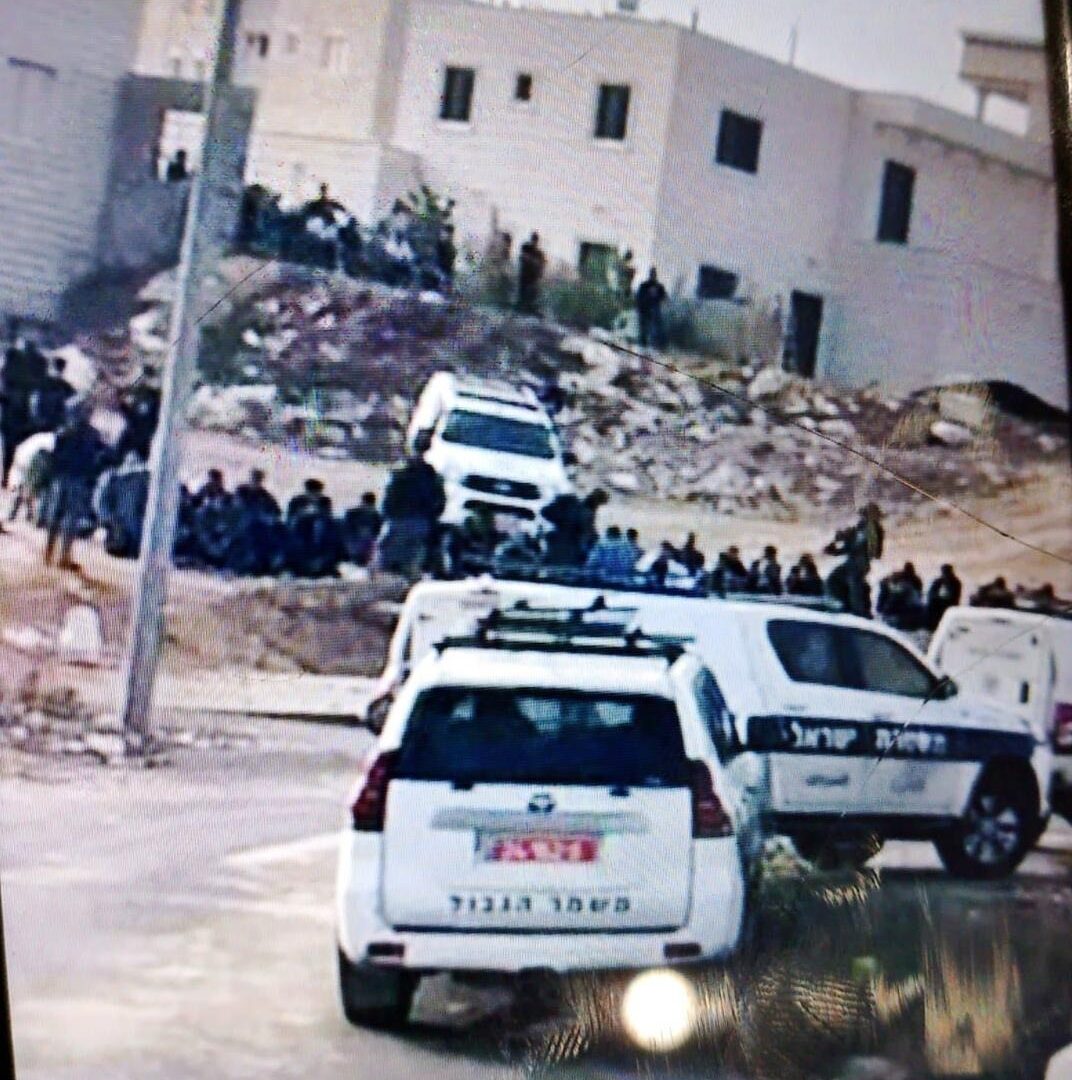
Gazans being held by Israeli police. Photo from one of the workers.
International Solidarity Movement | October 15, 2023
EXPLOITATION AND OCCUPATION
Hundreds of Gazan workers are being given refuge in Palestine, after having been dumped in the West Bank by Israel.
45 of them are in al-Khalil and the ISM spoke to many of them this evening.
These labourers were working in Israeli settlements. When Hamas broke out of Gaza they were rounded up, detained, and at least one of them was beaten and hospitalised. They spent four hours in prison, their phones confiscated and without contact with the outside world. One man says 6500NIS was stolen from him by the police.
Apartments have been provided by charitable individuals and groups are giving them food and bringing them brand-new clothing to replace the belongings they were not allowed to bring from Israel. No help comes from the P.A.
SO WHAT WERE THESE GUYS DOING IN ISRAEL?
After 16 years of blockade, Gaza’s economy has collapsed. Gazans buy Israeli work permits so as to get jobs as labourers in construction or hospitality. These permits, valid for one month, are purchased from specialised companies and cost 3,000 NIS. Gazan workers earn 6000 NIS monthly for 45 hour weeks. Israelis would be paid around 20,000 shekels for doing an equivalent job. These migrant workers have no health insurance or job security. They have to be married, too.
Women migrant workers find jobs in factories or in agriculture. Manual labour is the only option available to people from Gaza. One of the workers we spoke to has a degree in engineering, one qualified as a social worker and another was a teacher.
Visits to their wives and families are possible at weekends, and they try to return at least twice a month. Travel through the Eretz crossing involves a long wait of up to 12 hours, the crossing opens at 4am on a Sunday morning to let them through. Everything is checked, and they can’t take clothes through, so clothing has to be bought (at high expense) in Israel.
The guards at the border can deny entry at will to anyone, whether or not they have a permit. Israeli intelligence often interrogates and threatens the workers, hoping to add them to the network of informers in Gaza.
THE LUCKY ONES
We were told that around 1,500 migrant workers are still detained or missing in Israel. Their families in Gaza were asking for information about them.
We heard that, when Israel declared war, one of the employers of Gazan workers informed the police that the people working for him were terrorists. We saw a video of corpses after the police intervention. The people shot were colleagues of one of the men we spoke to. Here are their names:
Hashim Barawi (killed)
Suliman Al Atar (killed)
Hary Al Masry (location unknown)
Sahel AL Masry
Nabil Al Barrawi (injured)
Talal Warshasha (injured)
The workers intend to use every legal means possible to obtain justice.
NOT WAR BUT EXTERMINATION
The situation these men are in is difficult, but they are distraught about the situation in Gaza and worried about their families. “My son works with the emergency services, Israel bombed his ambulance, the driver was killed and my son is injured.” “My building was bombed, and my wife and kids are now living in a tent.” “I keep phoning my wife, but there is no answer.”
They denounce the lies and hypocrisy of the international community in its support for Israel. Western countries talk about law and democracy, but they respect neither. How can they support this massacre, this lack of humanity?
One of the men sums it up: This is not war, it is extermination.
Despite the atrocious, immoral position of the countries whose passports we hold, only one man didn’t greet us warmly. Hearing we were from European countries, he said he didn’t want to be in the same room as us.
I was totally sincere when I replied that I understood his feelings, that we are in Palestine because of our countries’ responsibility in the destruction of Palestine, because we don’t agree with Europe’s policies and that we would like to do what we can to tell people about what is happening here. If you’ve read this far, please help us in getting the word out and stopping this genocide.
FBI director warns of Hamas copycat threat
RT | October 15, 2023
Americans face a heightened threat from “lone wolf” terrorists inspired to replicate aspects of Hamas’ recent assault on Israel on US soil, FBI Director Christopher Wray told an audience of law enforcement officers at the International Association of Chiefs of Police Annual Conference in San Diego on Saturday.
Claiming there was “no question we’re seeing an increase in reported threats,” Wray warned his law enforcement colleagues, “We’ve got to be on the lookout, especially for lone actors who may take inspiration from recent events to commit violence of their own” – a reference to Hamas’ attack on Israel last Saturday.
“History has been witness to antisemitic and other forms of violent extremism for too long,” the FBI director continued, vowing to “continue confronting those threats.”
The responsibility for that confrontation was also on conference attendees, Wray added, urging them to “stay vigilant” and notify the FBI and other authorities if they saw any “signs that someone may be mobilizing towards violence.”
The FBI chief did not give any specific examples of domestic threats, copycat or otherwise, that had emerged since Hamas’ surprise attack on Israel. Instead, he made a generalized reference to “foreign terrorist organizations, or those inspired by them, or domestic violent extremists motivated by their own racial animus” as a vaguely equivalent menace likely to target individuals because of their (presumably Jewish) faith.
Wray’s FBI was caught earlier this year targeting Christian groups in a sprawling probe that presented traditionalist Catholics as potential domestic terrorists with “antisemitic, anti-immigrant, anti-LGBTQ and white supremacist ideology.”
Saturday’s speech was one of the few public references Wray had made since the Capitol riot of January 6, 2021, to an extremist threat with possible origins outside the US. The FBI director has insisted for years that the primary menace imperiling Americans is “white supremacy.” The concept has become increasingly nebulous under the presidential administration of Joe Biden, expanding to include not only the so-called “radical Catholics” but also parents who speak out at school board meetings, many of whom were investigated by the FBI’s Counterterrorism Division for speaking out against Covid-19 policies, LGBTQ material inserted into their children’s curricula, and other controversial issues following a directive from the Department of Justice deeming them a threat to school officials.
The FBI and Department of Homeland Security have highlighted “claims of government overreach” as a motivating factor for these “domestic violent extremists.”
The “Israel-Has-No-Alternative” Myth
BY SAM HUSSEINI | OCTOBER 13, 2023
Many are claiming that Israel has no choice.
It has to bomb Gaza, there is no alternative.
In fact, Israel has a choice.
A clear choice.
To reflexively react and bomb Gaza amid massive propaganda before assessing the facts is deranged.
One clear fact is that Netanyahu promised security and he failed. Israelis of every political stripe should be fuming at him, as some are. Never mind for the moment that he had warning of the Hamas attacks and almost certainly wanted conflict.
The choice facing Israel is highlighted by this:
In 2004, bombings on commuter trains in Madrid killed over 190 people. The government was immediately voted out and a new government came in, swiftly got Spain out of Iraq and nothing like that has happened in Spain since.
But the lessons of the train bombings is memory holed and even falsified.
NPR’s Dina Temple-Raston reversed what happened, claiming after the Orlando shooting — which was also followed by a flood of lies — that after the bombings in Spain, “the more conservative candidate ended up winning.” (In NPR-speak, “conservative” means more pro-war.) Total propaganda.
The lesson is clear.
Netanyahu isn’t out to protect Israelis.
If he was, he would embrace peace.
You want to stop a group like Hamas from attacking you?
Solve the conflict.
Abide by international law.
Stop bombing people.
Repent for having expelled nonviolent activists.
Withdraw.
Agree to peace.
—
I’ve been suspended by X/twitter, but you can now see my past material there. I’m also now posting on Gab.
Iran warns Israel of regional ‘earthquake’
RT | October 15, 2023
Iranian Foreign Minister Hossein Amir-Abdollahian has urged Israel to end its airstrikes on Gaza, warning that the conflict with Hamas could spread across the region if Israel sends ground forces into the enclave, and the Lebanese militant group Hezbollah enters the fray.
“I know about the scenarios that Hezbollah has put in place,” Amir-Abdollahian said in a briefing with reporters in Beirut on Saturday. “Any step the resistance will take will cause a huge earthquake for Israel.”
According to two diplomatic sources cited by Axios, Iran is trying to prevent the war from spreading, and seeking to help Israeli civilian hostages being held in Gaza – but if the military operation continues and Israel goes ahead with a ground offensive, Iran will have to respond.
“There is still a political opportunity to prevent a widespread crisis in the region,” the minister noted, but “maybe, in the next few hours, it will be too late.”
This week, the top Iranian diplomat visited Iraq, Syria and Lebanon, where he met with Hezbollah leader Sayyed Hassan Nasrallah, as well as senior Lebanese officials, to discuss the “potential outcome” and the “positions that must be taken” in light of the war.
In a meeting with Lebanese Foreign Minister, Abdallah Bou Habib, Amir-Abdollahian accused Israel of “war crimes” against the people of Gaza and repeated his warning that if Israel does not stop, “any possibility is conceivable.” Bou Habib backed his counterpart, saying that Lebanon “has never wanted or sought war” and warning that further escalation “will ignite the region and threaten security and peace in it”.
“We are in solidarity with our Palestinian brothers and call for the end of the siege and the delivery of aid to Gaza,” Bou Habib stressed.
Hezbollah fighters are on full alert along the Lebanon border, and have been exchanging sporadic fire with Israel since last Saturday’s Hamas incursion that left at least 1,300 Israeli civilians and soldiers dead.
The Iran-backed group is considered a major threat to Israel, as it possesses some 150,000 rockets and missiles, including precision-guided missiles that can reach anywhere in Israel, as well as thousands of battle-hardened fighters and various types of military drones.
The top Iranian diplomat also met with a senior political leader of Hamas, Ismail Haniyeh, in Qatar on Saturday evening, but details of the meeting have yet to be disclosed.
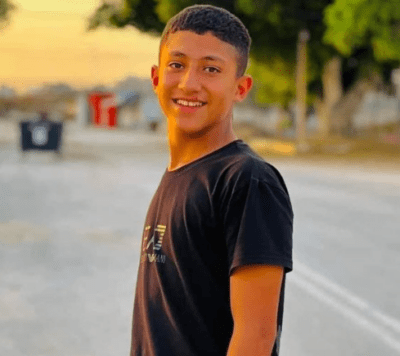
Israeli Army Kills A Palestinian Child In Tulkarem
IMEMC | OCTOBER 14, 2023
On Saturday, Israeli soldiers killed a Palestinian child in Zeita town, north of Tulkarem, in the occupied West Bank’s northwestern part.
The Palestinian Health Ministry has confirmed that the soldiers killed Omar Ahmad Abdul-Rahman Asmar, 15, after shooting him with live fire.
The child was among many wounded Palestinians during protests that took place after several Israeli army vehicles invaded the town.
His death brings the number of Palestinians killed by Israeli army fire in Tulkarem on Friday and Saturday to six, in addition to dozens of injuries.

On Saturday dawn, Israeli soldiers killed Mahmoud Shehada, 27, injured three, including one who suffered serious wounds, and abducted six in Jericho, in the northeastern part of the occupied West Bank.

Also at dawn, Israeli soldiers killed a young Palestinian man, Abdul-Rahman Ribhi Al-Ammouri, in a car near Al-Isawiya town junction, northeast of the occupied Palestinian capital Jerusalem, in the West Bank.
On Saturday dawn, as the Israeli army continued to fire hundreds of missiles and shells at homes and buildings in the Gaza Strip, including a busy marker in the Nusseirat refugee camp in central Gaza.
The Health Ministry has confirmed that the extensive Israeli bombing Saturday has killed 315 Palestinians, including 90 children, and injured 1788, mainly women and children.
It added that 2215 Palestinians, including 724 children and 458 women, have been killed, and 8714 Palestinians, including 2450 children and 1536 women, have been injured as the Israeli onslaught on Gaza entered its eighth day.
On Friday, the soldiers killed fifteen Palestinians, including two children, in several parts of the occupied West Bank Friday.
Day 8: Death toll from Israeli war on Gaza climbs to 2,269, including over 700 children
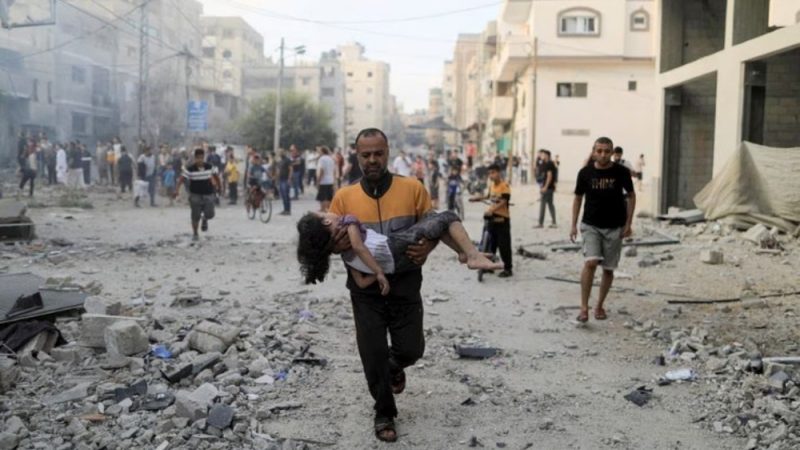
A Palestinian man carries a wounded girl at the site of Israeli strikes, in Khan Younis in the southern Gaza Strip, October 14, 2023. (Photo by Reuters)
Press TV – October 14, 2023
At least 2,269 people, including over 700 Palestinian children, have been killed as the Israeli war on the besieged Gaza rages on.
The Palestinian Ministry of Health in Gaza announced in a statement on Saturday that 2,269 Palestinians lost their lives and another 9,814 were injured ever since the Israeli strikes began on October 7. More than 700 children are among the fatalities.
This comes as more than 420,000 people are displaced within the Gaza Strip. A total of 270,374 out of 423,378 internally displaced people are now in UN shelters and schools.
At least 15 hospitals have been damaged by Israeli shelling and air raids.
The UN agency for Palestinian refugees says its shelters in the enclave “are not safe anymore” and warns that water is running out for the 2.3 million residents of the blockaded territory.
Israeli strike at school in Jabalia kills at least 27 Palestinians
Renewed Israeli airstrikes near a school on Saturday afternoon have killed more than 20 Palestinians.
According the media office of the Gaza-based Interior Ministry, The attack targeted areas adjacent to al-Fakhura School in Jabalia refugee camp in northern Gaza, leaving at least 27 civilians, including children, dead.
The Israeli air raids also resulted in the injury of more than 80 people.
Gaza hospitals given final warning to be evacuated or bombed
Furthermore, a Palestinian doctor said the Israeli military has given them a final notice to leave hospitals in northern Gaza before they start bombing them.
Sohaib al-Hems said staff of al-Awda Hospital in Jabalia and the General Services Hospital in Gaza City are refusing to leave.
“We will die in the hospitals. More than 27 ambulances have been targeted just now, and dozens of medical staff and patients have been killed,” Hems said. “Do not stay silent over what’s happening in Gaza. We will not forgive you.”
UN: Water runs out in Gaza
The United Nations also said more than two million people are risk in Gaza as water runs out.
It has become a matter of “life and death,” Philippe Lazzarini, the commissioner-general of UNRWA, the UN’s Palestinian refugee agency, said.
According the UNRWA, no humanitarian supplies have been allowed into Gaza since last Saturday.
“Fuel needs to be delivered now into Gaza to make water available for 2 million people,” Lazzarini said.
“If not, people will start dying of severe dehydration, among them young children, the elderly and women. Water is now the last remaining lifeline. I appeal for the siege on humanitarian assistance to be lifted now,” he added.
Clean and drinking water is running out, forcing people to use dirty water from wells and increasing risks of waterborne diseases, the UNRWA noted.
Water supply has also been impacted by the total electricity blackout imposed by Israel since October 11.
Israeli strikes hit Gaza evacuation convoys – Hamas
RT | October 14, 2023
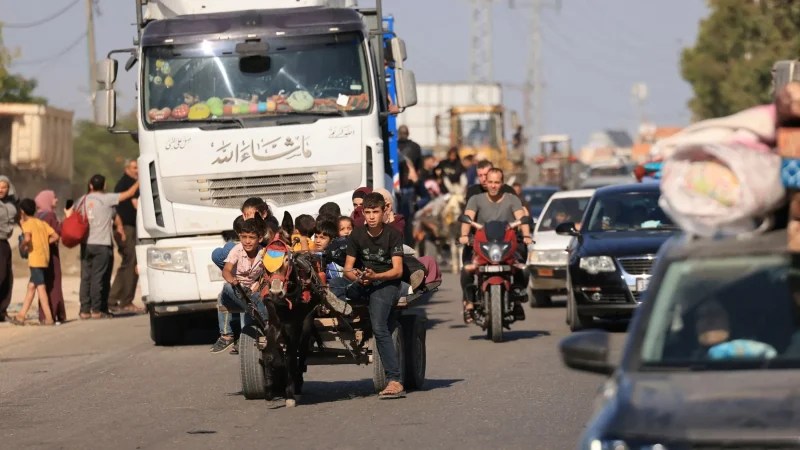
Dozens of people, mostly women and children, have been injured and killed in Israeli airstrikes on evacuation convoys fleeing Gaza City, according to Hamas officials. The IDF has yet to respond to the accusations, after ordering more than 1 million people to leave the northern part of the enclave “to save their lives.”
The UN humanitarian body, OCHA, said several “vehicles of those evacuating the north were hit, killing more than 40 people and injuring 150 others,” citing data from health officials in the Hamas-governed Palestinian enclave.
“These incidents prompted many people to abandon their evacuation efforts and return home,” the UN agency added, as “heavy Israeli bombardments, from the air, sea and land, have continued almost uninterrupted.”
Hamas’ media office claimed on Friday that airstrikes hit civilian cars in three separate locations, allegedly killing 70 people. The Palestinian Health Ministry said that Al-Shifa Medical Complex was treating “dozens of victims” injured “as a result of the Israeli occupation forces targeting citizens who were forced to leave their homes.”
The Israel Defense Forces (IDF) has yet to comment on the allegations, and it is unclear whether militants were among the passengers of the convoys.
Tens of thousands of Palestinians have fled south after Israel issued an order on Thursday night, initially giving Gaza residents 24 hours to evacuate from the north to “save their lives” ahead of an expected ground offensive, according to the UN. Prior to the evacuation order, more than 400,000 Palestinians had already been internally displaced.
The IDF called the evacuation order a “humanitarian step,” claiming that the residents would be able to return to Gaza City after Hamas militants were eradicated. The military did not mention any specific deadline, with a spokesperson acknowledging the evacuation would take “some time.”
Israel has faced widespread criticism from human rights organizations for the forced relocation order, with UN Secretary-General Antonio Guterres urging West Jerusalem to reconsider it, insisting that “even wars have rules” and telling all sides to respect international humanitarian norms.
“Moving more than 1 million people across a densely populated warzone to a place with no food, water, or accommodation when the entire territory is under siege, is extremely dangerous and, in some cases, simply not possible,” Guterres said on X (formerly Twitter) early Saturday morning.
The World Health Organization (WHO) also appealed to Israel to “immediately rescind orders for the evacuation of over 1 million people living north of Wadi Gaza,” saying that a “mass evacuation would be disastrous – for patients, health workers and other civilians left behind or caught in the mass movement.”
“With ongoing airstrikes and closed borders, civilians have no safe place to go,” the WHO said on Friday.
Biden Move to Send Warships to Gaza Coast More Dangerous Than We Thought
By Martin Jay | Strategic Culture Foundation | October 13, 2023
Israeli Prime Minister Benjamin Netanyahu is banking all he has on a single bet: that the U.S. will go the full nine yards in his madcap idea of a regional war between Israel and Iran’s proxies in the region.
For Netanyahu, this was always the plan from the very beginning. But it will take a series of stepping stones to get to this objective. First off is that he has to convince the Biden administration to join the IDF in its war within the Gaza Strip. And even that’s not going to be easy.
He would ideally like Washington directly involved in the conflict with Hamas because he hopes to expand the war to Lebanon and Iran, a former senior security policy analyst at the U.S. Department of Defense, Michael Maloof, told Russia Today recently. Maloof is certainly right but the move by Biden to send an armada of battle ships to the eastern Mediterranean coast is a dangerous move on so many levels. It’s easy to see that Biden wants to show support to Israel and to also show a physical presence in the region for Hezbollah, to make Nasrallah thinks twice about taking advantage of the IDF’s work being cut out in Gaza to launch a surprise attack. The problem with this mindset is that Hezbollah is not easily threatened by such moves and more than likely will be forced to think in a bigger and bolder way about carrying out such an attack with the U.S. ships ready to pound southern Lebanon, than if they were not there. This is definitely an own goal.
But secondly, the temptation by Netanyahu to arrange a false flag attack on the Americans is too great if and when he sees the conflict not going his way.
The other concern to consider is the Americans themselves making a tactical error. Miscalculation in this situation is fever-pitched and the Americans have a history of doing this in the region. One such error would plunge the entire region into the war with Iran which Netanyahu has dreamed of all his life. And there would be no easy “off ramp” for the Americans.
On Monday October 9th, the U.S. ordered the aircraft carrier USS Gerald R. Ford and five guided missile destroyers to the Eastern Mediterranean. According to Maloof, this “meets Netanyahu’s wildest dreams.”
“He wanted the U.S. involved in this conflict,” the former Pentagon official told RT.
Netanyahu “wants to open up the war with Lebanon, by attacking Hezbollah” in pursuit of his ultimate objective, “to bomb Iran’s nuclear facilities,” Maloof added. For that to happen, “he has to have a Gulf of Tonkin moment, if you will.”
Some will remember U.S. President Lyndon Johnson kickstarting the Vietnam war with a neat little piece of fake news by sending ships to the Gulf of Tonkin in 1964. An alleged North Vietnamese attack on two U.S. destroyers was then used as a pretext for direct involvement. In those days all the LBJ government had to do was to simply announce that these ships had been attacked by North Vietnam forces. That’s all it took to justify the Vietnam war starting, a war, like so many U.S. interventions that not only Americans lost but one which redefined U.S. foreign policy for decades to come.
The U.S. has also pledged to help Israel with deliveries of weapons and ammunition, with the Pentagon insisting it has enough to do so and continue supplying Ukraine. Maloof is skeptical of that assertion, however.
And so, all the ingredients are there for the caldron to boil over. If Netanyahu is satisfied that the assault on Gaza is going to plan – a military strategy based on starving the enemy first before sending in second-rate IDF infantry (the worst secret in the Middle East is how poor Israeli infantry is on the battlefield) – then he may decide not to turn to the Americans for the big plan. But if the going gets tougher, he may well open up direct talks with Biden and his advisers about the level of support he could hope to get in a bigger, wider war. It is unlikely Biden will support him though, as the last thing he needs leading up to a re-election bid is a world war in the Middle East and American body bags. And so the natural progression is that Netanyahu’s people will conclude that the only way to draw America in is if it was no choice. The only real way to guarantee this is if those U.S. battleships are supposedly attacked by Hezbollah’s missiles in southern Lebanon.
Getting the Lebanese Shia group to do this might be harder that Netanyahu might reckon. Hezbollah understands only too well the ruse and is careful not to be pulled into a provocation. And there is always the possibility that Hamas itself fires a missile at one of them and this is conveniently seen as an attack from Lebanon. It actually won’t matter where it comes from. The Americans will fake all the forensic audio visuals later on and hand it out to journalists happy to file a good story just as they are lying to U.S. journalists about having enough ammunition to supply any such war, when the whole world and his dog knows that stocks are running very low.
Featured Video

New positive ivermectin evidence
or go to
Aletho News Archives – Video-Images
From the Archives
Fanatical Followers of the Covid Regime: A Jim Jones-Style Cult?
By Professor Roger Watson and Dr. Niall McCrae | The Daily Sceptic | November 15, 2021
As scholars at leading British universities over recent decades, we witnessed the replacement of critical thinking and debate by narrative: facts are discrimination and scientific method is imperialism; truth, instead, is derived from ‘progressive’ values. This educational trend may be a major contributory factor to the ease in which society has been inculcated to the Covid ‘new normal’ of masking, testing, and repeated doses of vaccines for a disease of similar risk to severe influenza.
One doesn’t need much critical reasoning to observe the flawed logic of some vaccination enthusiasts, such as people who respond to experiencing any side effects, however debilitating, by saying “at least I know it’s working”, or, after contracting the disease despite their promised inoculation (over 90% effective, according to initial drug company claims), “I’d have been worse off without the jab.” … continue
Blog Roll
 Aletho News
- EU Council Advances Chat Control 2.0 Scanning Proposal
- Ex-Greek MEP files complaint against Israeli spyware firm over alleged Pegasus surveillance
- Troubling ideas throughout the Torah, Talmud, Mishneh Torah and Tanya
- ‘Grave, alarming’: Iran mission on Trump’s UNGA ‘annihilation’ threats
- Najaf airport to reopen to Iranian flights within 24 hours: Ambassador
- From ‘How Will This End For Iran’ to ‘When America Walks Away’: A tale of two Economist covers
- Tehran blasts ‘baseless’ speculation linking Iran to alleged bomb plot at UK air base
- The Rise And… Rise Of ‘Color Revolutions’
- The Coming GOP Bloodbath?
- Arctic Scare Stories Melt Away
- If Americans Knew
- Netanyahu Asked UAE Leader to Deny Report on Oct. 7 Warning in Secret Visit, Sources Say
- CNN Chief Int’l Correspondent Clarissa Ward on Journalists in Gaza
- Democratic Party Consultants Surround Troy Jackson with Pro-Israel Donors
- Christian Leader Responds To Netanyahu’s Claims Regarding Palestinian Christians
- In Gaza, ‘Whoever Survives the Bombing Won’t Survive the Rubble’
- Israel kills more Palestinians, amid push to resettle Gaza – Daily Update
- Israel forces Gazans to live in constant peril – Daily Update
- Deconstructing Netanyahu’s pants-on-fire UN rant – Daily Update
- Trump betrayed voters with his campaign lies and prioritized a foreign country once he took office
- Netanyahu calls Israel’s war in Gaza ‘opposite of genocide’ in UN speech to near-empty hall
- No Tricks Zone
- New Study: Earth And Venus Surface Warmth Largely Explained By Convection And Lapse Rate, Not CO2 Or Radiation
- 2025 Nature Paper Claiming Worsening Global Drought Gets RETRACTED …Heavily Flawed
- New Study: ‘Global Drought Shows No Detectable Recent Acceleration Under Climate Warming’
- Economic Masterminds: German Socialists Suggest Taxing Productivity Gains Stemming From Using AI
- The South China Sea Has Not Been Cooperating With The Climate Change Narrative
- Energy Crisis: Germany Enters Heating Season With Historically Low Gas Reserve Fill Levels
- New Study: The Antarctic Ice Sheet Gained Mass From 2020-2024 Due To Staggering Snow And Ice Accumulation
- Study: Ocean Heating Rates From Thousands Of Years Ago ‘Dwarf’ Modern Ocean Heating Rates
- Climate Extremists Target, Attack Large-Scale Power Grid Infrastructure In Germany!
- New Study: Antarctic Ice Melt Has Contributed Less Than 1 Centimeter To Sea Level Rise In The Last 30 Years

