Demolition Under Occupation
Al-Haq | September 24, 2020
Dramatic increase in the average of Palestinian structures demolished by Israeli occupation authorities during 2019.
Press TV – October 4, 2020
The spokesman for Yemeni Armed Forces, Brigadier General Yahya Saree, says Israel constantly intervened in the internal affairs of the Arab country during the reign of slain dictator, Ali Abdullah Saleh.
Speaking at a press conference broadcast live from the capital Sana’a on Sunday evening, Saree highlighted that the Yemeni nation is confronting a Saudi-led military aggression, which seeks to accomplish the desired objectives of the Tel Aviv regime.
“Yemen has long been at the main target of US-Israeli plots and the ongoing onslaught clearly proves this. The Armed Forces call upon Yemenis from all walks of life to raise their awareness about the real intentions of foreigners. Our struggle is nothing but a fateful battle for liberation and independence,” he said.
Saree noted that there were secret relations between Saleh’s government and Israel, which dated back to the year 2000, stating that there were even mutual visits between officials from both sides.
The high-ranking Yemeni military official then showed a number of documents indicating that Israeli authorities wished to control not only the strategic Bab-el-Mandeb strait, which connects the Red Sea to the Gulf of Aden, Yemeni islands and the port of Hudaydah, but also wanted to be in charge of Yemen’s economic, cultural, agricultural, security and military sectors.
Saree added that Saleh’s regime started to normalize ties with the Israel many years ago, and reached a high level of communication and coordination with Israel at various arenas in 2007.
“On July 14 of that year, Israeli diplomat Bruce Kashdan arrived in Sana’a according to available documents on an unannounced visit, which lasted 48 hours. During that trip, the Israeli official met with Yemeni military and security top brass who are relatives of Saleh,” Saree underlined.
He added, “The Israeli official left Sana’a International Airport on July 16, 2007. The visit had been arranged by Yemeni officials, and the United Arab Emirates (UAE) played the leading role in it. The Israeli diplomat had earlier visited Yemen on February 2, 2005.”
Saree noted that the visits to Sana’a were not simply aimed at normalization between Yemen and Israel, but sought close trade cooperation, entry of Israeli products into the Yemeni market and their promotion, as well as discussion on the implementation of joint projects.
One of the most important discussions in the field of civil aviation was an agreement that would allow Israeli airliners to cross Yemen’s airspace, Saree pointed out.
The top military official went on to say that an Israeli parliamentary delegation paid a visit to Sana’a in early March 1996, and that the delegates enjoyed a remarkable reception and met with several high-ranking political and security officials.
“On March 30, 2000, Ali Abdullah Saleh confirmed that he had met with Israeli President Ezer Weizman. The Israeli media broke the news of the meeting only ten minutes afterwards, putting the former Yemeni president to shame.
“Before that, specifically on January 31, 1997, Saleh confirmed to an Arab official that there were visits by Israeli officials to Yemen,” Saree commented.
The spokesman for the Yemeni Armed Forces then warned against Israel’s plan to naturalize tens of thousands of Yemeni-born Jews, emphasizing that such scenarios pose a grave threat to Yemen’s national security.
Yemeni people have strongly condemned the UAE and Bahrain over signing contentious US-mediated normalization deals with Israel.
Israeli Prime Minister Benjamin Netanyahu signed the deals with Emirati Foreign Minister Sheikh Abdullah bin Zayed Al Nahyan and Bahrain’s Foreign Minister Abdullatif Al Zayani during an official ceremony hosted by US President Donald Trump at the White House on September 15.
Palestinians, who seek an independent state in the occupied West Bank and Gaza, with East Jerusalem al-Quds as its capital, view the deals as betrayal of their cause.
Palestinian President Mahmoud Abbas protested the normalization deals with Israel, saying they will be fruitless as long as the United States and Israel do not recognize the rights of the Palestinian nation and refuse to resolve the issue of Palestinian refugees.
By Steven Sahiounie | Mideast discourse | October 2, 2020
The waters off Lebanon are the scene of a gathering Armada of French and American naval ships. What appeared at first to be a humanitarian response to the devastating Beirut Port explosion on August 4, is now feared to be the prelude of the next US-NATO humanitarian war.
French President Emmanuel Macron blamed Hezbollah and all of the Lebanese politicians Sunday and warned of a new civil war. “I’m ashamed of the Lebanese political leaders. Ashamed,” Macron repeated.
He accused them of “collective betrayal” while putting their parties and personal greed above the needs of the Lebanese people.
Some political observers now believe that Lebanon may well be going the way of Somalia, as evidenced by the characteristics of a failing state, such as lack of governance, corruption and incompetence, chronic humanitarian problems, and persistent social tensions.
Prime minister-designate Moustapha Adib stepped down September 26, and Lebanon’s Central Bank reserves may soon dry up and the government would no longer be able to subsidize basic goods such as fuel, medicine, and wheat.
Macron has been pressing Lebanese politicians to form a Cabinet made up of technocrats that can work on urgent reforms, and Macron has traveled twice to Beirut since August 4, while making it a personal mission to try to repair the devastated country, which some see as a neo-colonial farce.
Macron criticized the Lebanese system of sectarian politics, “as if competence was linked to religious confession.”
He lambasted Hezbollah demanding to know its characteristics and identity, and he criticized Lebanese political leaders from all parties and dynasties. Each Lebanese faction has found a foreign godfather and has ended up as a pawn in a regional and international chess game. Tens of billions of dollars have reportedly been looted by politicians and deposited in European and American banks.
US-NATO Humanitarian wars
In 1999 NATO updated its ‘Strategic Concept’ to allow members to defend not only other members but also conduct ‘non-Article 5 Response Operations’. It would be under this mechanism that a US-NATO military operation, along with an Arab Gulf coalition, would be used to attack, invade and defeat Hezbollah in Lebanon.
Since 2002, it was agreed that NATO forces could be sent “wherever they are needed,” regardless of the location, and in 2006 the NATO Response Force (NRF) of 25,000 troops has been fully operational.
US President Bill Clinton and NATO waged the humanitarian war on the former Yugoslavia, which broke a larger nation into ‘bite-sized’ pieces.
Critics of the US-NATO bombing of Yugoslavia have argued that certain attacks forming part of the campaign violated international humanitarian law. Noam Chomsky argued that the main objective of the US-NATO war was to force Yugoslavia into the Western economic system since it was the only country in the region that stood alone in defiance of the US world domination.
Hezbollah targeted by US-NATO war machine
Hezbollah’s prominence in the Lebanese government caused foreign donors and investors to stay away, because of US sanctions targeted on anyone with ties to the group, based on their designation as a terrorist group.
Hezbollah’s leader, Sayyed Hassan Nasrallah, said on Tuesday, “We welcomed President Macron when he visited Lebanon and we welcomed the French initiative, but not for him to be judge, jury and executioner, and ruler of Lebanon.”
Nasrallah has headed the group since 1992 as Secretary-General; however, its military wing is considered as a terrorist organization in 21 countries, as well as by the Arab League and the European Union.
Hezbollah’s 1985 manifesto listed its objectives as the expulsion of “the Americans, the French and their allies definitely from Lebanon, putting an end to any colonialist entity on our land”.
In 2008, the Lebanese government unanimously recognized Hezbollah’s existence as an armed organization and guarantees its right to “liberate or recover occupied lands”.
Hezbollah is an armed resistance group, as well as a political party that has seats in Parliament through free and fair elections. Their ally in Parliament is the ‘Amal Movement’, and together they hold the majority of Parliamentary seats. In a democracy, the majority rules and this is why recently Hezbollah and Amal insisted on choosing the Finance minister, which became a conflict point in the view of Macron.
Hezbollah is resisting the Israeli occupation of Shebaa Farms, an area in the far south of Lebanon. Moreover, Hezbollah also is resisting the Israeli occupation of Palestine. At one time, all of the Arab world demanded the rights for the Palestinian people, who have lived under brutal military occupation since 1948, and the UN has ratified resolutions calling for a 2-state solution, where Palestine would be given the land of the 1967 borders, and both Israel and Palestine would live side by side in peace.
In 2017, Ron Prosor, former Israeli ambassador to the UN said Hezbollah was then “10 times as strong now as it was in 2006, and its military infrastructure permeates Lebanon.” He added that Lebanese President Michel Aoun has also “embraced” Hezbollah’s arsenal as “a principal element of Lebanon’s defense.”
Many critics tried to blame Hezbollah for the Beirut Port blast on August 4, but the Lebanese officials and locals admitted that Hezbollah had no access to the Port, or authority over it. Even officials known to be antagonistic of Hezbollah admitted that the blame would not plausibly stick on Hezbollah. The exact cause is not known, but it may have been an accident borne of corruption and ineptitude, or it could be sabotage, according to President Michel Aoun. MP Machnouck, member of the Sunni-led ‘Future Party’ stated he was convinced Israel was responsible.
The elimination of Hezbollah is Israel’s top priority
A former director of Israel’s Counter-Terrorism Bureau, Brig. Gen. Nitzan Nuriel, said that another war between Israel and Hezbollah was “only a question of time.”
Hezbollah is the only force that Israel has faced that has caused the Israeli Defense Forces to retreat without success. Defeating Hezbollah is a top Israeli priority.
Under the Obama Administration’s Middle Eastern policy, Iran became a negotiations partner, while pressuring Israel to conclude a peace agreement with the Palestinians.
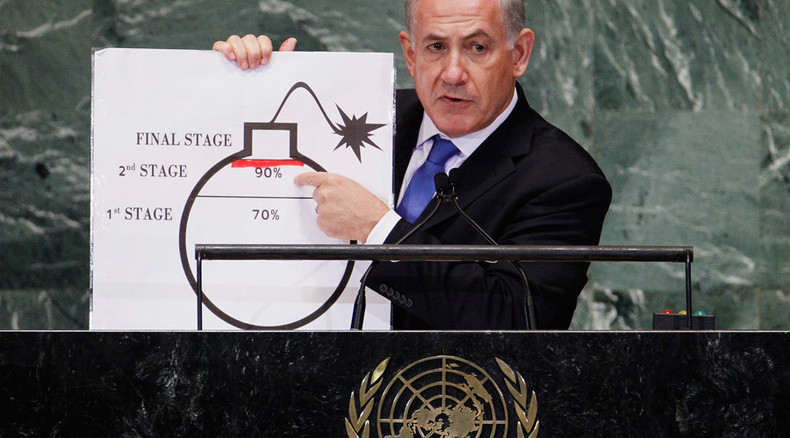
Netanyahu recently gave a virtual speech to the UN Security Council, in which he displayed a detailed map of Beirut, and he predicted the location of where a future explosion would occur, and he blamed Hezbollah for having a weapons factory and warehouse at the location, which was a residential area. During the Netanyahu speech, Nasrallah was also giving a live televised speech in Lebanon and was told what Netanyahu had claimed. He immediately invited all media to go to the location that Netanyahu portrayed in his map, and inspect for themselves if there were any weapons or warehouse present. Later, the media arrived, and live local TV coverage showed that in fact, the location was a cooking gas canister factory. This confirmed the Israeli accusation was false and led experts to assume a direct connection between the Port blast, and the Israeli proposed blast in Netanyahu’s map.
The Israeli occupation of Lebanon
Israel occupied the south of Lebanon for 23 years, during which men, women, and children were imprisoned in Khiam Prison, where they were routinely tortured, abused and many died. Hezbollah aligned with many other Lebanese resistance groups, who resisted the occupation vociferously until Israel gave up and left in 2000. The south of Lebanon is populated by both Shite Muslims and Christians. The steadfastness of Hezbollah is remembered by those Lebanese citizens. However, the North of Lebanon was never occupied and lived free of fear, oppression, and intimidation which may have influenced many Lebanese citizens to either support or reject Hezbollah. As they say, “Your view depends on where your seat is.”
Using ISIS as ground troops by US-NATO
Recently, the Lebanese Army fought fierce battles against Radical Islamic terrorists near Tripoli in the north, in the area of Wadi Khalid.
In 2016, Efraim Inbar, an Israeli scholar, and the director of the Begin-Sadat Center for Strategic Studies wrote, “The continuing existence of ISIS serves a strategic purpose,” and added that ISIS “can be a useful tool in undermining” Iran, Hezbollah, Syria, and Russia and should not be defeated. He wrote, “Stability is not a value in and of itself. It is desirable only if it serves our interests,” and stressed that the West’s “main enemy” is not ISIS; it is Iran.
Saudi Arabia part of the Coalition against Hezbollah
The King of Saudi Arabia rarely gives speeches; however, he made a televised speech in which he accused Hezbollah of the Beirut Port blast, apparently unaware that that accusation has been debunked. This is the same King who summoned Prime Minister Saad Hariri from Lebanon to be kidnapped and forced to resign in Saudi Arabia. It was President Macron who personally negotiated Hariri’s freedom.
It appears that Saudi Arabia will be among the first Arab countries to send support for a US-NATO attack on Lebanon to eliminate Hezbollah.
Steven Sahiounie is an award-winning journalist and political commentator.
Palestine Chronicle | October 4, 2020
Lawmakers at the US House of Representatives introduced a bipartisan bill on Friday that could allow the occupying state of Israel to veto any American arms sales to the Arab countries.
The proposed bill “would require the President to consult with the Israeli government to ensure [qualitative military edge] concerns are settled” in respect to weapons sales to Middle Eastern countries, read a statement by the office of lead sponsor Representative Brad Schneider.
The proposed legislation also asks the US President to inform the Congress of the potential impact of the planned deal on Israel’s military superiority in the region, no later than 60 days after receiving a request to sell arms and military equipment to countries in the Middle East.
Most of the sponsors are members of the Democratic Party, including Jewish lawmakers Schneider, Elaine Luria, Max Rose, Josh Gottheimer, Ted Deutch and Debbie Wasserman Schultz.
The bill came in the aftermath of the UAE-Israel normalization deal on August, under which the UAE would purchase cutting-edge weaponry such as F-35 fighter jets.
RT | October 2, 2020
Israeli security forces have arrested senior Hamas leader Hassan Youssef. The two rival Palestinian groups, Hamas and Fatah, have both condemned the move as being politically-charged and a bid to ruin their reconciliation talks.
Youssef was taken at his home in Ramallah in the occupied West Bank on Friday morning. While Israeli authorities have not provided any official information about the move, local media reported that the Hamas co-founder was detained over alleged “renewed” activity by the group.
After helping to found Hamas in the late 1980s, Youssef was repeatedly arrested by the Israeli authorities and spent years behind bars. Hamas has always maintained he was only involved in its political activities, and not associated with its military wing.His arrest was condemned by both Hamas and its rival, Fatah. Hamas claimed the arrest was a politically-motivated move, designed to destabilize the ongoing reconciliation process between the two groups.
“We hereby affirm that the arrest of Sheikh Hassan Youssef by the occupation will not stop the path of unity for which he worked for the past two months,” Hamas said in a statement.
Fatah has voiced a similar opinion on Youssef’s arrest, with the group’s Secretary-General Jibril Rajoub accusing Tel Aviv of “tampering” with the reconciliation talks and attempting to “influence the achievement of national unity.”
“This arrest is a continuation of the occupation’s approach to arresting dozens of our Palestinian people every day, and a continuation of the continuous aggression against our people for decades,” Rajoub stated.
Al-Manar | September 29, 2020
Hezbollah Media Relations Department has issued a statement in which it invited media outlets to inspect the Beirut site falsely claimed by Zionist PM Benjamin Netanyahu as a missile Depot.
A large number of cameramen and reporters gathered near the alleged site around two hours after Netanyahu’s remarks in the context of the step organized by Hezbollah to refute the Zionist claims in light of the critical political conditions in Lebanon.
Head of Hezbollah Media Relations Department, Hajj Mohammad Afif, stressed that today’s tour aims at proving that Netanyahu’s story is wrong, adding that the Resistance is not concerned with exposing every site claimed by the Zionist enemy as a missile depot.
Netanyahu had alleged that Hezbollah stores missiles at a depot in a residential area in Jinah, adding that it lies near a gas facility and that its explosion will be similar to that of Beirut port.
The Israeli intelligence command has prepared a plan to provoke the Lebanese against Hezbollah by weaponry by unveiling maps of its locations in Lebanon and launching a propaganda that promotes its threat in light of the Beirut Port explosion, Al-Manar English Website reported on August 25, 2020.
Hezbollah Secretary General Sayyed Hasan Nasrallah announced the invitation during his televised speech, highlighting that it would be shortly after Netanyahu’s remarks so that the inspection will be very credible.
The following video shows the iron factory full of the media reporters shortly after Netanyahu’s remarks… continue to Al-Manar for video tour
Press TV | September 29, 2020
Beirut has strongly reacted to the Israeli envoy’s interventionist remarks against Hezbollah at a UN Human Rights Council session, describing the resistance movement as an “inseparable part” of Lebanon and slamming the regime’s history of rights violations in Lebanon and other Arab states.
The Lebanese Ministry of Foreign Affairs and Emigrants issued a statement on Monday in condemnation of the comments by Merav Marks, the legal counselor to the Israeli mission to the UN and international organizations in Geneva, who had attacked the Hezbollah resistance movement for its role in Lebanon during a general debate at the 45th session of the UN Human Rights Council.
The Israeli envoy accused the UN Human Rights Council of not dealing with what she called Hezbollah’s efforts to hamper the mandate of the United Nations Interim Force in Lebanon (UNIFIL) and attempts to manipulate the Lebanese government.
In its statement, the ministry said Lebanon’s Permanent Mission to the UN and other International Organizations in Geneva exercised its “right to respond to the Israeli enemy’s envoy, as has been the case whenever there is an attack on Lebanon and its right to resistance.”
The ministry then described Israel as “an occupation force armed with sophisticated weapons and in possession of a nuclear arsenal, with which it threatens its neighbors.”
Israel” has a history of flagrant human rights violations and international crimes in Lebanon and in other Arab lands that it has occupied. The international community should one day fulfill its duty to prosecute the perpetrators… Today we are marking the 38th anniversary of the Sabra and Shatila massacre, one of the ugliest crimes against humanity in modern history,” the statement pointed out.
“Lebanon stresses its right to resistance to liberate its land and defend its sovereignty,” the ministry said, underlining that Hezbollah resistance movement is “an inseparable part” of Lebanon.
The ministry also lashed out at the Israeli envoy over her remarks regarding last month’s deadly Beirut port explosion, which killed some 200 people, wounded thousands more and ravaged buildings in surrounding residential neighborhoods.
The Israeli envoy had tried to link Hezbollah to the blast, claiming the movement was putting the interests of Iran before that of its own nation, and that the explosion “is a clear demonstration of that.”
The Lebanese Foreign Ministry said in response that “the Occupation (Israeli) force has sought to put itself in the position of the Lebanese judicial authority in the issue of the port blast, in which investigations have not yet been completed.”
“The hypothesis of a foreign plot should not be ruled out, and in this case, this (Israeli) force will be the main suspect,” it added.
The explosion has been followed by other upheavals in the country, including thousands-strong rallies and the resignation of the entire government of former prime minister Hasan Diab.
Hezbollah has called for accountability for the explosion, while strongly urging countrywide unity and integrity.
Wary of Hezbollah’s power in defending Lebanon, the Israeli regime and its allies have been doing all in their power — from sanctions to targeted killings — to undermine the movement’s political and military influence in the Arab country.
The regime has, in recent months, stepped up its violations of Lebanese airspace in spying missions on southern Lebanon, where Hezbollah is mainly based, drawing condemnations from Beirut, Hezbollah and the UN Interim Force in Lebanon (UNIFIL).
The resistance movement was established following the 1982 Israeli invasion and occupation of southern Lebanon. Since then, the movement has grown into a powerful military force, dealing repeated blows to the Israeli military, including during a 33-day war in July 2006.
MEMO | September 28, 2020
The United States is putting pressure on Sudan to accept settling Palestine refugees on its soil, member of the PLO’s Executive Committee, Bassam Al-Salhi, was reported saying by Anadolu yesterday.
“Special sources told me that the ongoing normalisation talks between Washington, Israel and Sudan include Sudan’s possibility to resettle [Palestine] refugees on its soil as part of the deal of the century,” Al-Salhi said, in reference to the US ‘peace deal’ for the region.
He stated that “this is part of the conspiracy against the Palestinian cause,” stressing the issue between Israel and Sudan goes beyond the normalisation of ties.
The PLO official called on Sudan “to reject being dragged into these American-Israeli plans in order to maintain its interests and future.”
Resettling Palestine refugees had been raised dozens of times by Israel and the US mainly in Egypt and other host countries; however, Al-Salhi said, proposing to resettle them in Sudan is new.
Sudan did not issue an immediate comment on the remarks, but the country’s officials have several times denied reports about the possible normalisation of ties with Israel despite several meetings between Sudanese and Israeli officials.
![Abdul Halim Al-Ashqar [Twitter]](https://i1.wp.com/www.middleeastmonitor.com/wp-content/uploads/2019/06/Abdul-Halima-Al-Ashqar-e1559887312769.jpeg?resize=469%2C313&quality=85&strip=all&zoom=1&ssl=1)
MEMO | September 26, 2020
Palestinian professor Abdul-Halim Al-Ashqar, originally from the occupied West Bank city of Nablus, narrates his suffering inside US jails during his 15-year detention.
Speaking to Anadolu Agency, Al-Ashqar, who ran for Palestinian presidential elections in 2005, disclosed that he spent a total of about 15 years inside US prisons over “baseless” accusations related to supporting Hamas.
Al-Ashqar started his career at the Islamic University of Gaza in 1985 and became the head of the Public Relations Office, noting that Israel exerted much efforts to close it over allegations that it was run by Hamas.
Al-Ashqar obtained a Fulbright scholarship in 1989 to complete a PhD in the US. “In the beginning, Israel prevented me from travelling, claiming I was an activist in Palestine and I would go to America to bring them more troubles,” according to Al-Ashqar.
“In the end, they allowed me to travel, but did not stop making troubles for me,” he said, noting that the Israeli occupation authorities were in contact with his university in the US in order to put pressure on him. Due to Israeli pressure, the supervisor of his thesis and dean of the faculty where he was studying, issued him with several warnings.
The professor alleged that the Federal Bureau of Investigation (FBI) asked him to give information about Palestinians he knew before arriving in the US, promising him a US passport and money.
“I refused because I knew no guilty people,” Al-Ashqar explained, “so they filed a complaint against me in 1998 accusing me of supporting Hamas. I refused to stand before a court and therefore they sent me to prison.”
“I went to hunger strike and after 11 days, I was admitted to hospital and force-fed. They promised to help me should I have changed my mind, but I continued my strike which lasted six months. I think it was the longest in US history. However, Hamas was branded by the US as a terrorist group in 1995, but they detained me over claims before that date. I am not Hamas, but an activist who believes in the Palestinian cause and I said this to Americans from the first day.”
In 2000, the professor had a three-year work contract with Howard University, which refused to renew the contract in 2003 over claims of having no valid visa or residence clearance.
Consequently, Al-Ashqar applied for political asylum because, according to him, Israel wanted to punish him, but he faced imprisonment in the US over the same claims. “I stayed in prison for two months and I spent them on hunger strike,” indicating that the US authorities asked him to withdraw his asylum application and leave the country within two months.
As he had no place to go, he remained and a US court sentenced him to 135 months in prison for claims related to perverting the course of justice. However, such charges usually carry between 24 to 40 months, according to US law. He spent around ten years in prison and was released in 2017. Following this, he began to look for a country that would not hand him over to Israel.
“After a short time on my release, the immigration office summoned me. However, I was sick. I was obliged to go. By my arrival, I was immediately sent to prison and spent 18 months there. That was a stark violation of their laws,” Al-Ashqar recounts.
Al-Ashqar claims that the FBI attempted to deport him directly to Israel after he was released in June 2019. “I applied for political asylum. The FBI did not wait, the court deported me in a plane to Israel, but when the plane was in the sky, a senior judge decided to grant me asylum and ordered my return immediately.”
He was then placed under house arrest and had a tracing tag put on his leg. He was obliged not to leave his town of residence without prior permission.
Concluding his interview with Anadolu Agency, he remarked that Turkey would be the best place for him because: “It is the only state where its people and its president still sympathise with the Palestinian people, and its leader is strong enough to defy Israel.”
Palestine Chronicle | September 24, 2020
The Israeli and Italian governments concluded a major arms deal, according to a statement issued Wednesday by the Israeli Defense Ministry.
According to Israeli sources, the deal would allow Israel to sell “Spike anti-tank guided missiles and aircraft simulators in exchange for training helicopters to replace the Israeli Air Force’s aging fleet”.
Intense talks, which led to the agreement, began last February.
The military exchange is estimated at hundreds of millions of dollars and its consequences are expected to last for at least two decades. According to the newly-signed agreement, Italian military contractor Leonardo will provide Israel with 20 years of aircraft maintenance.
“The agreement signed today is another expression of the close security and economic relations between Israel and Italy,” Israeli Defense Ministry Director-General Amir Eshel said in a statement, which was quoted in The Times of Israel.
Israel is currently the eighth leading weapons exporter in the world, and its military hardware, touted as ‘combat-proven’, is coveted by many countries.
or go to
Aletho News Archives – Video-Images
By SASAN FAYAZMANESH | March 17, 2008
It is now nearly three decades since the Unites States adopted the policy of dual containment of Iran and Iraq. While much has been written about the containment of Iraq, there has been very little in-depth analysis of this policy when it comes to Iran. In a book that is going to be released on March 31, 2008, entitled The United States and Iran: Sanctions, Wars and the Policy of Dual Containment (Routledge), I attempt to address this shortcoming by investigating when and why the US policy of containment of Iran came about, how it evolved, and where it stands today.[1] To the extent that Israel has been involved in US policy making, the study will also include the role that Israel has played in the containment of Iran. Also, since the fate of Iran has been inextricably linked to that of Iraq, occasionally the investigation will overlap with the containment of Iraq.
The policy of dual containment of Iran and Iraq originated during the Carter Administration, but it was not until the Clinton Administration that the expression “dual containment” became popular. … continue
 Aletho News If Americans Knew No Tricks Zone
