In first, UK university divests from firms supplying Israel army
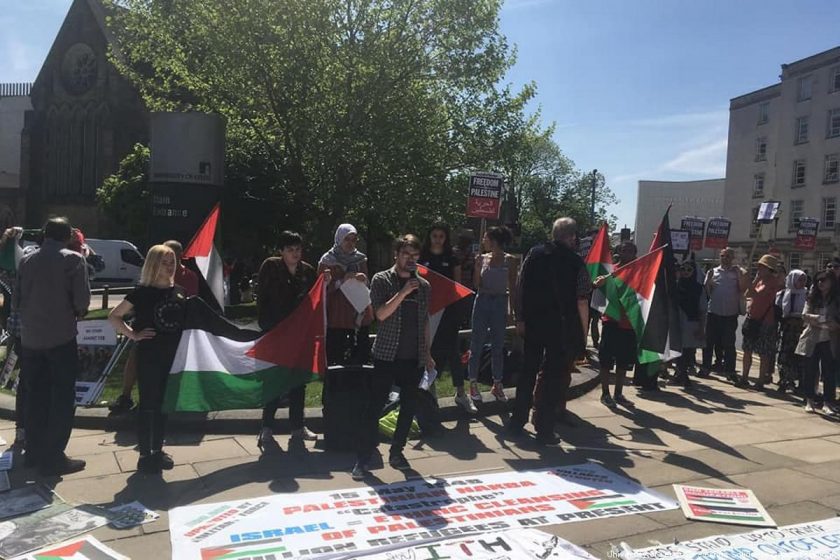
Students hold a protest calling for an end of Israel’s occupation on Gaza at Leeds University, UK on 5 May 2018
MEMO | November 5, 2018
In the first move of its kind, a UK university has divested from companies that supply military equipment to the Israeli army following a student campaign.
The University of Leeds this weekend made the decision to divest from three companies which were found to be complicit in the violation of Palestinian human rights: Airbus, United Technologies and Keyence Corporation. A fourth company – HSBC – is also under review by the university’s investment managers for its provision of loans to Elbit Systems, Caterpillar and BAE Systems, all of which sell weapons and military equipment to the Israeli government.
The move came after it emerged that the University of Leeds had invested £2.4 million ($3.1 million) in these companies this year alone. The sum was revealed by a Freedom of Information request dating back to August, under which the British public can demand access to information held by public authorities.
Students, staff, societies and alumni of the university then published an open letter to the Vice Chancellor calling for the cessation of investment in the four firms. The letter stated that: “In summer 2014, 2,251 Palestinians were killed, including 526 children, by the Israeli Defence Force in the attacks on Gaza […] the artillery used to carry out this destruction were made by Elbit Systems, funded by HSBC. The fighter jets employed by the IDF were maintained by United Technologies. The helicopters which patrol Gaza’s sea border are supplied by Airbus. Further military activity was aided by the equipment provided by Keyence Corporation. The University of Leeds knowingly enables this activity by investing in these companies.”
Our university should not enable military occupation. Our tuition fees should not fund killing. Our education should not be at the expense of a person’s life.
The move has been hailed as a victory for the Boycott, Divestment and Sanctions (BDS) movement. Co-President of the Leeds Palestine Solidarity Group, Evie Russell-Cohen, explained: “It’s clear that the Palestinian call for Boycott, Divestment and Sanctions is being heard in the UK. Students are no longer willing to see their tuition fees funding weapons companies which profit from the killing of Palestinians. This is a massive success, but we hope that it will only be the beginning of a wave change across UK Universities.”
Calls for UK universities to review their investments in companies known to assist the Israeli army have been growing in recent months. In April, activists at the University of Manchester exposed a web of connections between the university and several weapons companies, including Israel Aerospace Industries which produced drones used during Israel’s 2014 assault on the besieged Gaza Strip. The University of Manchester had previously tried to conceal its links to such companies until the Information Commissioner’s Office (ICO) – the body regulating data protection in the UK – found the university to be in contravention of the Freedom of Information Act, the same act which enabled University of Leeds students to force their institution to divest.
Lebanon’s President: Israeli Claims about Missile Sites “Bogus”
Al-Manar | November 5, 2018
Lebanese President Michel Aoun on Monday deprecated the Israeli enemy’s continuous claims about the presence of missile sites in populated areas in Lebanon, especially near Rafic Hariri International Airport.
“These allegations are bogus and they are taking place while the Israeli violation of the Lebanese sovereignty persists,” Aoun said.
The President also addressed Lebanon’s position on the displaced Syrians’ issue and the necessity that they return home. Accordingly, he welcomed the ongoing efforts aiming to reach a solution to the Syrian crisis.
Aoun also warned of dividing Syria, stressing Syrian territorial integrity.
“Lebanon cannot await the political solution to this crisis so that the displaced return to Syria,” he underlined.
Moreover, Aoun renewed calls to work on reaching a permanent and just solution to the Palestinian Cause, underlining the reverberations of cutting the funding of UNRWA and the implicit intentions to settle Palestinians in the host countries.
Irish Lawmakers Call for Arms Embargo on Israel
IMEMC | November 2, 2018
In a letter published in the Irish Times newspaper, Minister of State Finian McGrath and fifty other Irish TDs and Senators have called for an arms embargo to be placed on Israel, and for “an end to the bi-lateral arms trade between Ireland and the apartheid state”.
In addition to independent Minister McGrath, the signatories include members of Sinn Féin, Solidarity-People Before Profit, Labour, the Green Party, Independents 4 Change and other independent members of the Oireachtas, who condemn “the shooting dead of some 205 [Palestinian] protestors, including 40 children, and wounding of more than 5,000 people by live fire [on the Great March of Return] in Gaza since April”.
The letter ends by calling for “the international community, and the Irish government in particular, to take a stand to help end Israel’s decades of colonial occupation, apartheid and war crimes against the Palestinian people.”
Welcoming the statement, Ms. Fatin Al Tamimi, Chairperson of the Ireland-Palestine Solidarity Campaign (IPSC) and a Palestinian-Irish citizen said she “thanks the members of the Oireachtas for this important and principled statement of solidarity, showing once again the strong bonds between the Irish people and the Palestinian people, both of whom have struggled heroically against colonialism and oppression in their homelands.”
لإamimi noted, according to the PNN, that “the IPSC strongly echoes this call for an arms embargo on Israel, a measure that we Palestinians have long been asking for. Weapons sent to Israel are used to kill, maim and oppress my people, while weapons exported from Israel are marketed as being ‘battle tested’ on Palestinians. It is time to end this horrendous trade in death and destruction, which is a bloody stain upon the Irish state.”
Israel expert calls for assassination of Islamic Jihad leader
MEMO | November 1, 2018
Israel should resume its policy of targeted assassinations, aiming first at Secretary General of Islamic Jihad, Ziyad Al-Nakhaleh, Israeli journalist Yoni Ben Menachem said in an article this week
Al-Nakahleh, who is based in Beirut, was elected as a secretary-general of the movement last September. Ben Menachem sees Al-Nakhaleh’s ties with Iran and Hezbollah as a threat to Israel. His assassination, Al-Nakhaleh said, is a step towards “stopping Iranian influence in the region and stopping the Iranian plan to turn the Gaza Strip into an effective front against Israel”.
Mossad can reach Al-Nakhaleh in Beirut, the journalist added, in a similar way to how it targeted Imad Mughniyeh, a Hezbollah leader, in Syria ten years ago.
Linking Al-Nakhaleh to the Commander of the Iranian Revolutionary Guards Corps (IRGC), Qasem Soleimani, Ben Menachem said this allows Iran to spread its influence in the besieged Gaza Strip.
The failure of Mossad to return to the policy of targeted assassination will allow Gaza’s political leaders to believe they have “immunity”.
Father and son activists in Dheisheh camp, seized by occupation forces

Samidoun Palestinian Prisoner Solidarity Network – November 1, 2018
Nidal Abu Aker, a longtime community leader and a journalist in Dheisheh refugee camp, and his son Mohammed Abu Aker, a university student, were seized by Israeli occupation forces who invaded the camp in the early morning hours of Thursday, 1 November. Both are prominent advocates for Palestinian rights and former prisoners who have been repeatedly jailed for their commitment to Palestinian liberation.
Israeli occupation forces invaded the home, pushing, shoving and hitting Abu Aker as he resisted the armed soldiers forcing their way inside the family’s house.
They manhandled Mohammed as they pulled him and his father from their home, raising their weapons in a threat to the Palestinian refugees in nearby apartments.
The Abu Aker family are refugees from Ras Abu Ammar in Palestine ’48; their family has lived in Dheisheh refugee camp since the Nakba. Nidal, 50, is married to Manal Shaheen and the father of three children, Mohammed, Dalia and Karmel. A prominent leader of the Popular Front for the Liberation of Palestine, he is also the host of a program about Palestinian prisoners called “In their cells” on Sawt al-Wihda radio station and a co-founder of the Families of Prisoners Association in the camp.
He has spent 17 years in Israeli prisons, through multiple arrests and under 11 years of administrative detention without charge or trial. In 2015, he engaged in a 40-day hunger strike with five more administrative detainees to demand an end to imprisonment without charge or trial. He was arrested for the first time in 1984, and his mother says that he has spent nearly half of his life in Israeli prisons. He was released from his latest stint in administrative detention without charge or trial in July 2018, after two years of imprisonment.
Mohammed, 25, was released in late 2017 after spending two years and two months in Israeli prison on an array of political charges, including support for and membership in a prohibited organization. All major Palestinian political parties are labeled illegal by the Israeli occupation, and people often face this charge for participating in student, labor or youth organizing, as did Mohammed. A student at Bethlehem University, he is known for his role in organizing the Palestinian student movement on campus.
Dheisheh refugee camp has been a site of intense repression and frequent violent raids by Israeli occupation forces. Youth in the camp have been threatened by Israeli military commanders with phone calls and text messages. Raed al-Salhi, an unarmed Palestinian youth was shot dead by occupation forces in an “arrest raid,” shortly after one occupation soldier had threatened to “shoot [Raed] in front of your mother.”
Hebron: Seven weeks after the murder of Wael Fatah Ja’aberi by Israeli Forces, family still awaits his body for burial.
International Solidarity Movement | October 28, 2018
Hebron, occupied Palestine – On Monday October 22, the family of Wael Fatah Ja’aberi gathered in Ibn Rush square in downtown Hebron to protest the murder of their son and the decision of Israeli forces not to return his body to their family for more than a month. In September, Ja’aberi was killed in a combined settler and soldier ambush. His body has still not been returned to his family, who have erected an information/communication tent in the main square of downtown Hebron in protest.
A week after the Ja’aberi family erected their protest tent downtown, fathers who lost their sons in similar incidents, gathered in the tent and showed their solidarity.

The Ja’aberi family demanded the body of slain Wael, but is waiting in vain for any answer since September 9, 2018 – the day of the brutal incident.
On Monday evening 9/9/2018, Wael Fatah Ja’aberi, a 37 year old father of two children, was shot down close to his home, near the intersection of the Hebron H1/H2 area division, from the entrance of the illegal settlement Givat Ha’avot, by a settler and a soldier.
According to witnesses, Wael and his 9 year old son were walking from their home to a nearby shop, for which they had to pass the road close to a the entrance of the illegal Israeli settlement Givat Ha’avot .
When they approached the location of the entrance, still 20 meters away from it, a settler together with a soldier ambushed and killed the 37 year old father.
His 9 year old son was lucky to escape and could run back home, in shock of the cruelty he went trough. As it seems, the armed settler fired at Wael and his son, after which a soldier, present at the checkpoint, continued the shooting with several live bullets.
Israeli forces left Ja’abari bleeding to death, without giving or allowing him any kind of medical assistance.
No health care was given or allowed. The Israeli ambulance belongs to Ofer, a paramilitary settler of Kyriat Arba – not a medic.
Video recordings of this fatal incident were posted on the internet. (here, here and here)
The Israeli military claimed afterwards, that it was self defense against a stabbing attack, and did not contact the family. This claim is disputed, however, given Israeli forces’ history of planting knives on murdered Palestinians and given the fact that Ja’abari was walking with his 9 year old child. No footage of the many security cameras on that location has ever been released.
Stealing corpses in the aftermath of a unlawful execution, is a standard procedure of the Occupation. Between 2008 and 2018 Israel held back more then 280 corpses.
US sanctions on Hezbollah aim to punish Lebanon: Observers
Press TV – October 28, 2018
The US has imposed new sanctions on Hezbollah, but observers say Lebanon as a whole will be affected by the punitive measures.
Earlier this week, the administration of US President Donald Trump imposed a new round of sanctions on Hezbollah targeting individuals and international organizations that do business with the resistance group.
Economist Louis Hobeika said he thought “it is difficult to punish Hezbollah without punishing all of Lebanon.”
“No area fully belongs to Hezbollah. The southern suburb of Beirut is not confined to Hezbollah, so how will the sanctions apply here?” Hobeika told Arab News in remarks published Saturday.
Political activist Ali Al-Amin, the director of Janoubia news website, said the outcome of the US decision could be “disastrous” for Lebanon.
“Is the purpose of the sanctions to embarrass the Lebanese government and state?” he wondered.
In the May parliamentary elections, Hezbollah and its political allies won more than half of the seats at the legislature in a major victory for the party.
Former Lebanese lawmaker Fares Souaid told Arab News that the new sanctions are part of a series of US bans meant to “turn the party (Hezbollah) into a burden on the Lebanese after Hezbollah has come forward as a security guarantee for Lebanon.”
The US has its Arab allies in the Persian Gulf on board in cranking up pressure on the Lebanese leaders over their association with Hezbollah, and they all take their cue from Israel.
Israeli leaders have threatened that they would view the Lebanese state as part of Hezbollah in a future war with the resistance movement.
In May, the US Treasury Department imposed sanctions on the Hezbollah leadership jointly with members of the so-called Terrorist Financing and Targeting Center (TFTC), which includes Saudi Arabia, Bahrain, Kuwait, Oman, Qatar and the UAE.
Hezbollah was formed following the Israeli regime’s invasion of Lebanon and the ensuing occupation of its southern parts in 1980s, and currently constitutes Lebanon’s de facto military power.
Since then, the movement has helped the national army retake the occupied regions from Tel Aviv and thwart two Israeli acts of aggression in 2000 and 2006.
The movement has also been playing a significant role in the Syrian army’s fight against Takfiri terror groups, including Daesh and Nusra Front, thus preventing the spillover of the war into Lebanon.
Thoughts on One Democratic State
By Nahida Exiled Palestinian | Poetry for Palestine | May 18, 2018
Some activists are worried that my passion for justice and my advocacy for full restoration of Palestinians’ inalienable rights might “alienate” some Jewish supporters. They claim Palestinians desperately need Jewish support.
To them I have this to say:
Palestine has now been under the heel of violent foreign rulers since a full Century. Palestinians have always been eager to get international support, including from Jews. Since a full century, the naturally trustful Palestinians were grateful and delighted to give a platform to whomever showed the slightest interest in their cause. Tragically, this resulted in our authentic Palestinian narrative being gradually silenced. Genocidal atrocities since a century are ongoing. Our will to self-determination is untamed. Our Right to be sovereign inside our own land, is intact. Our historic, cultural and national identity, is as strong as ever. Yet all is more or less silenced.
Today we have the terribly dangerous situation where the authentic Palestinian narrative is so absent, that it has never been truly heard or appreciated in the West.
Every time an uncompromising authentic Palestinian voice steps up assertive and strong, it is quickly muffled and tucked away, as to not offend Jewish supporters or to not scratch their sensitivities.
Unconditionally and almost religiously pro-Palestinian organizations have sought Jewish approval in every event, every talk, ever letter, every petition, every motion and every campaign. This went on for decades. I know it from first hand experience, and also from the many Palestinians who echo this same disturbing experience almost globally.
Whenever an authentic Palestinian voice steps out of the narrow confinement of such censored discourse, they are immediately reprimanded and told in no uncertain terms that they have crossed the lines defined by Jewish “supporters”. When a Palestinian refuses to be terrorized by such Thought Police, he or she faces defamation, blacklisting, ostracism, and even threats.
On the day of signing of Oslo agreement, I remember sitting on the staircase in shock, sobbing for the rest of the day, for I knew what is to come. Yet the pro Palestinian camp with all its Jewish “supporters” in control, embraced the move. Palestinians were deceived into believing that a Palestinian state will come into being within five years. They were led to believe the Palestinian problem is on the verge of being resolved once and for all, and closure was eminent, nothing could have been further from truth. And the genocidal slaughter continued, worse then ever. And it continues today.
For the twenty five years that followed, “israel” used the “peace process” to proceed with it’s undeclared aims of total colonisation of West Bank and Gaza. The number of settlers sky rocketed and settlements have multiplied many folds over, making it impossible for any Palestinian state to exist on a land infested with and totally disconnected by Jewish only settlements and Jewish only roads.
In the present, “israel” has managed to totally conquer Palestine by war and terror. It has created a new reality on the ground, by annexing most of the land of historic Palestine, reducing Palestinian areas into fragmented open prisons where Jewish “israelis” can kill-at-will. “israel” together with its international Jewish support network has reduced and degraded the Palestinian population from a formerly radiant, self-sufficient, productive, cohesive, cooperative affluent society into an aid-dependent, traumatized, unproductive, poverty stricken population. The degradation is even practiced by distributing free narcotics to the Palestinian youth!
Despite having achieved their Jewish Zionist goals of total dominance over land and population, the geo-political circumstances are rapidly changing.
Increasingly, the strategists and think tanks of the Jewish state realise that they have passed the highest moment of success, and that the world community in spite of some coerced puppet governments, is very rapidly turning against the Jewish state. They began to feel the heat, of growing isolation, of world disdain. In this context, the next logical step from the perspective of their think tanks and strategists, is to seek the total finalization of their Zionist project, by seeking legitimacy from the rightful natives, through legalization, and through mass campaigns to gain “the hearts and minds” from world community by any artifice necessary.
Such step would guarantee their permanent presence in Palestine while securing themselves with “peace treaties’. And while the And while the Arab Muslims remain majority in greater region, the Jewish-“isrseli” total hegemony and dominance; financial, economical, militaristic, technological, administrative, educational, would be guaranteed.
Their next strategic move would be to offer a luring “solution” which would lure Palestinian support by nominally less oppression, by feigning “equality” while knowing that in reality their hegemony will remain de-facto, due to the huge economical, technological, industrial, and of course military gap between the two groups. Nothing, absolutely nothing in the Jewish state exhibits a willingness to relinquish any part of their control over all apparatus of power in the region. And it is an irrefutable fact, demonstrated by a century of nefarious “facts on the ground” that the Jewish Zionists who invaded Palestine and their aggravated offspring, will never voluntarily relinquish their weaponry, military, and aggressive violence.
Add to this unsettling scenario the most horrific component of ideological supremacy which would no doubt manifest in an explosion of settler violence against Palestinians who are seen as mere slaves created only to serve Jews.
That horrific deception is a strategic move already has a name. “One Democratic State”, “with Equal Rights to All its Citizens”. Very easy to be deceived by such a lofty romantic title, except that it is a cruel misnomer, a sirens’ song to fool and victimise, one last lethal time.
“It is easier to fool people than to convince them that they have been fooled” as goes the adage sometimes attributed to Mark Twain
Leading Palestinians by the nose, dangling the carrot of “One Democratic State” and promising them of a “bright” joined future with their persecutors, while knowing fair well that the promised crumbs will never come to fruition, exactly as the crumbs of Oslo, due to the fact-on-the-ground dominance coupled with lethal ideological supremacy.
“ODS-Equal Rights”, is not only an act of egregious deception, it is designed to perpetuate wars and genocide, by rewarding sadistic terrorists, thus it is an act of betrayal to humanity.
Oman rejects mediating between Israelis, Palestinians
Press TV – October 27, 2018
Oman says it will not act as a “mediator” between Israelis and Palestinians, playing down an earlier visit by Israeli Prime Minister Benjamin Netanyahu.
The sultanate was only offering ideas to help Israel and Palestinians to come together, Omani Foreign Minister Yousuf bin Alawi bin Abdullah told a security summit in Bahrain’s capital Manama on Saturday.
The remarks came a day after Netanyahu visited Oman in a rare visit, while accompanied by other senior Israeli officials, including the head of the Israeli spy agency Mossad.
“We are not saying road is now easy and paved with flowers, but our priority is to put an end to the conflict and move to a new world,” Reuters cited Abdullah as saying.
Despite apparently trying to sound impartial, Abdullah said Oman relied on the United States and efforts by US President Donald Trump in working towards the “deal of the century.”
The Trump administration has targeted the plan at the situation in the Palestinian territories.
Details are yet to emerge, but reports say it envisages a Palestinian state with limited sovereignty across about half of Israel-occupied West Bank and all the Gaza Strip. The deal also reportedly foresees potential disarming of the Palestinian resistance movement Hamas, and does not find Palestinians entitled to the eastern part of Jerusalem al-Quds as their capital.
This is while Abbas, who visited Oman before Netanyahu for three days, has renounced the plan, saying it has been devised without consulting the Palestinians. He also spurned any intermediary role by the US late last year after Washington recognized Jerusalem al-Quds as Israel’s “capital.”
In June, however, Saudi Arabia, the United Arab Emirates, Egypt, and Jordan assured the US of their support for the plan during visits to those countries by Trump’s senior adviser and son-in-law Jared Kushner, and Jason Greenblatt, the US envoy to the region.
Saudi Arabia’s Foreign Minister Adel al-Jubeir told the Manama gathering on Saturday that the kingdom believed the key to “normalizing” relations with Israel was the “peace process.”
The Omani minister also claimed Israel was “present in the region, and we all understand this, the world is also aware of this fact and maybe it is time for Israel to be treated the same and also bear the same obligations.”
Observers say Muscat has come to accommodate the US plan under pressure from Washington and Riyadh, the strongest US ally in the Persian Gulf region, which has been inching towards Tel Aviv over the past years.
Palestinian groups, however, condemned the Israeli prime minister’s visit to Oman, urging Arab countries to support the oppressed people of Palestine, instead.
Hamas warned about the dangerous consequences of Netanyahu’s visit for the people of Palestine. The Islamic Jihad movement also censured the visit, saying Oman acquitted Netanyahu of the crimes committed against innocent Palestinians by welcoming him to the country.
Commenting on Netanyahu’s visit, Paul Larudee, with the Free Palestine Movement, told PressTV, “What in the world would Netanyahu know about peace and stability, when his objectives and objectives of Israel have always been war and instability?”
“The importance is what their objectives are not. They are not about Arab unity, not about solidarity with Arabs who are suffering namely the Palestinians,” he said.
“These other countries realize that sooner or later they are potential targets of Israel… that they can be in the same place that the Palestinians are now,” Larudee said.
Israel Culture Minister arrives in UAE
MEMO | October 26, 2018
In first, Israel’s Culture and Sports Minister Miri Regev today arrived in the United Arab Emirates (UAE) to attend the Abu Dhabi Grand Slam Judo tournament.
Regev was invited to attend the event earlier this month to accompany Israel’s national judo team as they compete in the Emirati capital. President of the International Judo Federation (IJF), Marius Vizer, wrote to Regev on 2 October to invite her to the tournament and promised to “make all the necessary arrangements for [her] visit”.
The invitation came after the IJF demanded that the UAE allow the Israeli team to play its national anthem and fly its flag during the tournament. The event had previously been threatened with cancellation after the IJF stripped the UAE of the right to host the tournament due to its failure to guarantee “equal treatment” for Israeli athletes. In September, the UAE accepted the IJF’s conditions and allowed the Israeli judoists to sport their national insignia.
Regev’s attendance at the event – which is taking place from 25-27 October – will be seen as controversial in light of the lack of official relations between Israel and the UAE. In addition, Israeli passports are not valid for travel to the UAE.
However, the UAE has recently been pursuing a policy of normalisation with Israel. In September, it hosted secret backchannel talks between Israel and Turkey in an attempt to mend strained Israeli-Turkish relations. Envoys from the two countries flew into Abu Dhabi via Amman, Jordan, though neither government would confirm the purpose of the talks.
In August, an Israeli journalist claimed that an Emirati pilot participated in the bombing of Palestinian targets in the Gaza Strip during his training on Israeli Air Force F-35 fighters. Cohen, the journalist who made the claims, also accused Dubai’s Deputy Chairman of Police and Public Security, General Dhahi Khalfan, of being complicit in assassinating Hamas leader Mahmoud Mabhouh in Dubai in 2010.
In June, an exposé by the New Yorker revealed that Israel and the UAE have been engaged in secret normalisation talks since the 1990s. The report disclosed that “the secret relationship between Israel and the UAE can be traced back to a series of meetings in a nondescript office in Washington D.C. after the signing of the Oslo Accords”. These meetings discussed the possibility of the UAE purchasing F-16 fighter jets from the US which are known to be comprised of Israeli technology. The Crown Prince of Abu Dhabi, Mohammed Bin Zayed, also gave his blessing for delegations of influential American Jews to be brought to Abu Dhabi to meet with Emirati officials and establish an intelligence-sharing relationship.
Featured Video

Houthis Don’t Have to Conquer Saudi Arabia to Make It Pay
or go to
Aletho News Archives – Video-Images
From the Archives
A Lesser “Grade” of Human
By Michael Hoffman | Revelation of the Method | January 3, 2024
Will the more than 100 Iranians killed by terrorist bombs today be mourned in the West as victims of terrorism? Certainly not. Allied doctrine has it that the killing of Israeli or American civilians is a crime of cosmic proportions, while shedding the blood of “enemy” women and children is perfectly acceptable; indeed commendable.
The West does not memorialize the hundreds of thousands of civilians bombed by the U.S. in Serbia, Iraq, Afghanistan and every major German city 1943-1945. America’s fire-bombing of the city of Tokyo by General Curtis LeMay in March 1945 was followed by Harry Truman’s atomic incineration of Hiroshima and Nagasaki in August of that year. Truman never had a moment of doubt or regret over the murder of more than a 100,000 Asian children, mothers and non-combatant boys and men. It was business as usual for the “noble” Allies during the “Good War.”
In the West human rights signifies passionate concern only for civilians designated as truly human: Israelis first, then Americans and British, followed by their satraps.
This inhumanity is the legacy of Talmudic ideology, beginning with tractate Sanhedrin 57a from 400 A.D., concerning liability for capital punishment: “If a Jew murders a gentile, he is exempt.”
This teaching of contempt was reiterated in the dogma of Chabad Lubavitch founder Rabbi Shneur Zalman in the 18th century. … continue
Blog Roll
 Aletho News
- Houthis Don’t Have to Conquer Saudi Arabia to Make It Pay
- MOE: Nearly 22,000 Students and Education Workers Killed
- Guterres in Islamabad: Genocide, cowardice, and the cage of Imran Khan
- Johnson, Marandi say Yemen holds upper hand over Saudi Arabia
- False flags won’t save aggressors, Iran FM spokesman says
- The Makkah Pact Enters Into Force: The End of American Dominance or Its New Form?
- NATO’s top generals gather in Kiev
- EU’s continuing expansion – greater threat to Russia
- US Senator Murphy says Pentagon denied him entry to US base in Qatar
- Israel expands “incitement” charge to target Palestinian education and memory
- If Americans Knew
- Three Years of Genocide: How America’s Israel-First Media Filtered Out the Truth
- Israeli war chief briefs ministers on potential war against Palestinian Authority
- New Report: Israel Killed nearly 21,000 Palestinian Students and Education Workers in Past Three Years
- Israel’s flailing chatbot army
- Five Palestinians Killed, Others Injured by Israeli Fire in Gaza
- Israel is rewriting the Palestinian curriculum in East Jerusalem to erase Palestinian identity
- Three years of genocide: Israel turned prisons into killing grounds and torture sites
- Three years of genocide. Words fail. Daily Update
- ‘I’d rather die than go back’: A Palestinian teen’s 10-month nightmare in Israeli jail
- How Jared Kushner’s firm’s investment in an Israeli company could be a major conflict of interest
- No Tricks Zone
- New Study: 50 Years Of The Most Aggressive ‘Net Zero’ Policies Can Only Affect The Global Climate By 0.03°C
- US September “Heat” Was No Record…Many Records Set Decades Ago
- Latest European Green Energy Debacle; Portugal’s Largest Flagship Solar Park Insolvent!
- Green Energy Debacle: German Expert Professor Fritz Vahrenholt Warns Of Severe Economic And Social Consequences
- Two More Paleo Reconstructions Affirm Meters-Higher Sea Levels Across Ireland, Brazil 7000-6000 Years Ago
- New Study: Earth And Venus Surface Warmth Largely Explained By Convection And Lapse Rate, Not CO2 Or Radiation
- 2025 Nature Paper Claiming Worsening Global Drought Gets RETRACTED …Heavily Flawed
- New Study: ‘Global Drought Shows No Detectable Recent Acceleration Under Climate Warming’
- Economic Masterminds: German Socialists Suggest Taxing Productivity Gains Stemming From Using AI
- The South China Sea Has Not Been Cooperating With The Climate Change Narrative

