Visual evidence shatters Israeli claims over attack on Gaza hospital
Al Mayadeen | September 27, 2025
A Reuters investigation into the Israeli strike on Nasser Hospital in Gaza has dismantled the occupation’s official narrative of the massacre. Visual evidence and corroborating reports reveal that the camera targeted as a supposed Hamas asset was in fact owned and operated by Reuters, routinely used by one of its journalists.
The strike on August 25 killed 22 Palestinians, including six journalists. Israeli occupation forces reportedly planned the attack using drone footage that allegedly showed a Hamas camera. However, Reuters’ findings indicate the footage actually depicted the agency’s own camera, used consistently by its reporter.
After Reuters presented its investigation, an Israeli military official admitted that troops had acted without the required approval from the senior regional commander in Gaza. “The troops acted without the required approval of the senior regional commander in charge of operations in Gaza,” the official told Reuters, acknowledging a breach of command protocol.
The day of the harrowing massacre
The day after Israeli tanks shelled Nasser Hospital, the official said the occupation’s initial review concluded that troops had targeted a Hamas camera allegedly filming them. The device, covered by a cloth, raised suspicion. “A decision was made to destroy it,” the official said.
Drone footage shows the camera on a hospital stairwell draped with a two-toned cloth. The military official confirmed this was the intended target.
Reuters’ investigation, however, revealed that the cloth was not a Hamas disguise but a prayer rug belonging to Hussam al-Masri, a Reuters journalist killed in the brutal Israeli massacre. Since May, al-Masri had positioned his camera at that spot at least 35 times for live broadcasts, often covering it with the rug to protect it from heat and dust.
Confirmation of ownership
Comparisons of photos of al-Masri with IOF drone images confirmed ownership of the targeted device. One picture, taken on August 13, shows al-Masri beside his camera, covered with the same prayer mat seen in the drone screenshot.
This investigation provides the most detailed account yet of the attack and confirms that the camera was Reuters‘ property. The Associated Press, which also lost a journalist in the strike, had earlier noted indications that the device “Israel” alleged as Hamas-owned was, in fact, Reuters’.
Unsurprisingly, Israeli Prime Minister Benjamin Netanyahu described the attack as a “tragic mishap”. The military official claimed that al-Masri and other journalists present were not the intended targets and were not suspected of Hamas ties.
Hamas rejects PA president’s alignment with Zionist narrative in UN speech
Palestinian Information Center – September 26, 2025
DOHA – The Islamic Resistance Movement, Hamas, responded Thursday to Palestinian Authority President Mahmoud Abbas’s speech before the United Nations General Assembly, affirming that Palestinian resistance is a “national and moral responsibility, deriving its legitimacy from our steadfast Palestinian people and their natural right to resist occupation, as recognized by international laws and conventions.”
Hamas categorically rejected what it described as Abbas’s “alignment with the false Zionist narrative,” asserting that accusing the resistance of targeting civilians is an attempt to distort its image.
The Movement underlined that “all attempts to impose guardianship over our people and their will are doomed to fail,” adding that Abbas’s declaration that Hamas will have no role in governance constitutes “an infringement on the inherent right of our Palestinian people to determine their own destiny and choose their leadership, and an unacceptable submission to external agendas and projects.”
Hamas emphasized that “the weapons of resistance are untouchable as long as the occupation remains entrenched on our land.”
It condemned Abbas’s call to surrender arms, especially “in light of the genocidal war being waged against our people in Gaza, and the brutal crimes and savage assaults committed by armed settlers and the occupation army against unarmed civilians in the occupied West Bank.”
Hamas reiterated that the only path to safeguarding the national cause and confronting the occupation’s plans to “exterminate and displace our people in Gaza, annex the West Bank, and Judaize Jerusalem and al-Aqsa,” lies in “national unity and consensus around a comprehensive resistance program to confront the criminal Zionist occupation, until our people’s aspirations for liberation, return, and the establishment of a Palestinian state with Jerusalem as its capital are fulfilled.”
The statement concluded by affirming that “our steadfast people are the source of legitimacy, and the weapons of resistance are a red line that cannot be compromised.”
Since October 7, 2023, Israeli occupation forces, backed by the United States and Western countries, have been waging a devastating war in Gaza, resulting in the martyrdom and injury of approximately 233,000 Palestinians to date. According to the Palestinian Ministry of Health in Gaza, 442 Palestinians, including 147 children, have died from starvation.
White House backs plan for Tony Blair to lead interim Gaza authority
Al Mayadeen | September 26, 2025
The White House is reportedly supporting a proposal that would place former UK Prime Minister Tony Blair at the helm of a temporary administration to govern the Gaza Strip, according to reports in Haaretz and The Times of Israel, which completely sidelines the demands and stances of the Palestinian people.
The plan envisions the creation of the Gaza International Transitional Authority (GITA), which would act as Gaza’s “supreme political and legal authority” for up to five years. Blair would lead a 25-member secretariat and chair a seven-person board overseeing an executive body responsible for managing the territory.
Initially based in the Egyptian city of El-Arish, GITA would later move into Gaza, accompanied by a UN-endorsed multinational force largely drawn from Arab states. The proposal is modeled on transitional administrations that previously oversaw Kosovo and Timor-Leste.
The White House argues the initiative offers a middle ground between US President Donald Trump’s earlier proposal for the US and the Israeli regime to directly control Gaza and a UN-backed plan endorsed by over 140 states calling for a one-year technocratic administration under the New York declaration.
Divisions over Blair’s role
Blair’s potential appointment is controversial, for while he enjoys credibility among several Gulf leaders, many Palestinians view him with deep mistrust due to his support for the 2003 US-led invasion of Iraq and his record as Middle East envoy from 2007 to 2015. Western diplomats noted it was not guaranteed that Blair would take on the role and suggested the administration could last only two years.
The proposal’s lack of a clear timeline for transferring authority to the Palestinian Authority (PA) may complicate its acceptance by Palestinians and Arab leaders. Critics fear the plan could amount to another form of foreign-imposed governance, albeit under an international framework rather than the Israeli occupation.
Details of the plan surfaced after Trump met in New York with Qatar’s Emir Sheikh Tamim bin Hamad Al Thani, Saudi Foreign Minister Prince Faisal bin Farhan Al Saud, Jordan’s King Abdullah II, Indonesian President Prabowo Subianto, and Turkish President Recep Tayyip Erdogan. Trump described the discussions as “successful”, adding that “we’re close to getting some kind of deal done.”
Arab states have stressed that any international involvement must be tied to a credible timeline for Palestinian statehood. Without such assurances, some argue the Blair-led body risks being perceived as an extended foreign trusteeship.
Palestinian response
Addressing the UN General Assembly, PA President Mahmoud Abbas reaffirmed that Gaza remains “an integral part of the state of Palestine” and said the PA was ready to assume full responsibility for governance and security. He rejected any role for Hamas in postwar administration, echoing US and Israeli conditions after Washington revoked his visa ahead of the 80th UN session, which forced him to deliver his speech via video.
Meanwhile, Trump told reporters at the White House that he would not support the Israeli occupation’s “annexation” of the West Bank. “I will not allow Israel to annex the West Bank. Nope. I won’t allow it. It’s not going to happen,” he said.
Arab and Muslim forces in Gaza?
Washington is pushing for Arab and Muslim states to commit troops to Gaza as part of a so-called peacekeeping force that would enable an Israeli withdrawal. The US is also seeking financial pledges from these countries for reconstruction and to support Gaza’s transitional administration.
On Monday, Indonesian President Prabowo Subianto announced that his country was prepared to send soldiers as part of such a mission.
The initiative comes as negotiations to end the war and secure a prisoner exchange remain stalled. On the ground, “Israel” has launched a large-scale offensive, deploying three armored and infantry divisions into Gaza City, in hopes of forcibly displacing the city’s residents.
Meanwhile, at UN headquarters in New York, a conference on the “two-state solution” concluded with France and several European countries recognizing the State of Palestine. The Gaza Ministry of Health reports that more than 65,000 Palestinians, most of them civilians, have been killed in the Israeli assault since October 7.
An Israeli plan relayed to Washington?
A US official told Axios that “tomorrow’s meeting could be fairly significant,” stressing that the Trump administration wants “regional buy-in and support to make it successful.” An Arab official added that Trump is seeking “feedback and support for the US plan to end the war and then push it forward.”
Officials insisted the proposal would be a US initiative rather than an Israeli plan relayed through Washington. However, Israeli officials acknowledged that Prime Minister Benjamin Netanyahu is aware of its outlines.
One Israeli official admitted that “there will be bitter pills we’ll have to swallow,” particularly regarding any potential role for the Palestinian Authority in Gaza.
Malaysian army ready to join possible peacekeeping force in Gaza, says army chief
MEMO | September 25, 2025
Malaysian Army Chief Gen. Muhammad Hafizuddeain on Thursday said that his force is ready to join a possible peacekeeping force in Gaza, according to state-run media, Anadolu reports.
Speaking to reporters at the closing ceremony of the 14th Indo-Pacific Armies Chiefs Conference, he said that the Malaysian forces have experience in peacekeeping and are ready to join any mission, including a possible deployment to Gaza, Palestine, if asked to do so, Bernama News reported.
“We have been involved in peacekeeping operations since 1960, starting in Congo, and then in Somalia, Bosnia and Cambodia,” he said.
However, Hafizuddeain noted that any participation would depend on the government’s decision, as well as an evaluation of the mission’s effectiveness and safety.
His statement came after Indonesian President Prabowo Subianto said Tuesday that his country is ready to deploy 20,000 peacekeepers in Gaza.
Addressing the 80th session of the UN General Assembly in New York, Prabowo said: “If and when the Security Council and this Assembly decide,” Indonesia is ready to dispatch 20,000 or “even more” soldiers to “help secure peace in Gaza or elsewhere in Palestine as part of a united multilateral force — so that peace in both Palestine and Israel, can become real, not just envisioned.”
The Israeli army has killed more than 65,500 Palestinians, most of them women and children, in Gaza since October 2023. The relentless bombardment has rendered the enclave uninhabitable and led to starvation and the spread of diseases.
Greece is aiding Netanyahu regime’s genocidal project: Former Greek Finance Minister Varoufakis
MEMO | September 25, 2025
Former Greek Finance Minister Yanis Varoufakis has accused Athens of “violating International Law to aid and abet the Netanyahu government’s genocidal project” after a Gaza-bound humanitarian aid flotilla was attacked by drones off southern Crete, Anadolu reports.
Varoufakis, a prominent author, opposition politician, and commentator, said on X that he had spoken to the crew of the Family, the main vessel of the Global Sumud Flotilla, which was struck on the night of Sept. 23 by “a swarm of drones with explosives and CS (tear) gas.”
The flotilla, he said, had requested urgent help from the Greek Coast Guard to repair damage and provide protection while sailing through Greece’s Search and Rescue area.
“Remarkably, nauseatingly to be precise, the Greek Coastguard turned both requests down!” he said.
“Such is the determination of the Greek government to aid and abet Israel’s genocide in Gaza and, more generally, its ethnic cleansing of Palestine, that the Greek authorities took the step of refusing assistance that the Law of the Sea obliges them to provide.”
According to Varoufakis, the refusal highlights how “readily, in a bid to satisfy (Israeli Prime Minister) Netanyahu, the Greek government has forfeited not only its responsibilities but also its sovereignty.”
Under Prime Minister Kyriakos Mitsotakis, he added, “a long process by which Greece has become a satellite of the last Apartheid State is now complete,” referring to Israel’s policies of discriminating against and oppressing Palestinians.
He also pointed to wider evidence of complicity. On the night of the flotilla attack, Varoufakis claimed, a Beechcraft King Air 350 spy plane took off from the US Air Force base at Souda in northwestern Crete and flew south.
The aircraft, he said, belongs to the US leasing company Metrea Special Aerospace ISR and had previously been used to monitor Gaza from a British base in the Greek Cypriot Administration.
“One thing is clear from all of the above,” Varoufakis added.
“Through a mixture of omission and commission, the Greek government is violating International Law to aid and abet the Netanyahu government. Our party, MeRA25, will fight this government on the streets, in the workplaces, across a country – Greece – which refuses to be counted as complicit with Israel’s genocide.”
Since October 2023, the Israeli army has killed more than 65,000 Palestinians, most of them women and children, in Gaza. The relentless bombardment has rendered the enclave all but uninhabitable and led to starvation and the spread of diseases.
Pro-Israel tech giant to take over TikTok’s US algorithm to censor Gaza genocide
Press TV – September 23, 2025
A pro-Israel American company is supposed to provide data security and recreate an algorithm for the new US version of TikTok as part of attempts to censor the occupying regime’s genocide of Palestinians in the besieged Gaza Strip, a report says.
The move was prompted following the forthcoming sale of the popular Chinese-owned social media application to US investors, with the financial news outlet Bloomberg citing a White House official as saying on Monday that the arrangement with Oracle Corp. seeks to ensure US control of TikTok’s algorithm, which recommends videos and determines what users in the US see on their feeds.
Under a proposed agreement, owners of the US-based TikTok would lease a copy of the algorithm from its Chinese parent, ByteDance Ltd., that Oracle would then retrain “from the ground up,” according to the official.
“Data from US users would be stored in a secure cloud managed by Oracle with controls established to keep out foreign adversaries, including China,” the official was quoted as saying by Bloomberg.
“Beijing-based ByteDance would not have access to information on TikTok’s US subscribers, nor would it have any control over the algorithm in the US.”
The White House official underlined, “Oracle, the US security partner, will operate, retrain, and continuously monitor the US algorithm to ensure content is free from improper manipulation or surveillance.”
Austin-headquartered Oracle, which is controlled by its founder, Larry Ellison, already provides cloud services for TikTok and hosts user data in the US and other countries as part of a multibillion-dollar partnership dubbed “Project Texas.”
Ellison is one of Silicon Valley’s most pro-Israel figures and has made significant donations to the so-called charity “Friends of the Israel Defense Forces (FIDF)”, which supports the Israeli occupation soldiers and is involved in funding emergency medical supplies and mental health treatment to those wounded in the Gaza Strip.
After the start of Israel’s genocide in Gaza in October 2023, Ellison pledged Oracle’s support for the occupying regime with cloud and cybersecurity infrastructure, highlighting his commitment to Israel’s military and tech sectors.
The Boycott, Divestment, and Sanctions (BDS) movement says that US tech companies, notably Microsoft, Amazon, Google, Cisco, Oracle, and IBM, “are deeply complicit in atrocity (including apartheid and genocide)” for providing cloud infrastructure and AI technologies to the Israeli occupation army.
Social media companies, including TikTok, employ large numbers of former intelligence officers from Israel’s Unit 8200.
The Israeli regime also lobbies social media companies to remove pro-Palestine content, giving Tel Aviv significant influence over censorship decisions at the major US social media platforms.
In 2024, US Congress enacted the “TikTok divest-or-ban” law after Jewish lobby groups were ruffled by the large numbers of young American people viewing and sharing videos of Israel’s mass killing of Palestinian civilians in Gaza.
Access to TikTok was briefly blocked for US users in January as the ban came into effect. However, President Donald Trump issued an extension for a deal to be reached, allowing access to resume after just one day.
The move comes as the Israeli regime persists in its systematic oppression of Palestinians by worsening the humanitarian crisis in Gaza and launching a full-scale ground invasion across the territory.
Disturbing images and videos depicting emaciated children, relentless bombardments, and widespread destruction continue to surface on social media platforms, shedding light on the dire situation faced by Palestinians in the region.
Backed by the US, Israel launched its onslaught on Gaza on October 7, 2023, after Palestinian resistance fighters waged the surprise Operation al-Aqsa Flood against the Zionist entity in response to the regime’s decades-long campaign of bloodletting and devastation against Palestinians.
The Israeli military has so far killed more than 65,300 Palestinians, mostly women and children.
Thousands of victims are also feared trapped under rubble, inaccessible to emergency and civil defense teams due to relentless Israeli attacks.
Settler arson attack on vital West Bank agricultural hub is blow to Palestinian food security
International Solidarity Movement – Palestine | September 23, 2025
The Mishtil Al-Junaidy Al-Hadith plant nursery in Deir Sharaf, a major West Bank seed distributor and the heart of the region’s agriculture, was set on fire by illegal Israeli settlers on 8 September 2025, costing the owners over three million shekels and seriously damaging the already fragile Palestinian food system.
The footage captured by security cameras shows seven masked settlers descending on the nursery at 8pm to destroy the agricultural hub. Using diesel fuel, the settlers set fire to several buildings, stole supplies, and broke the windows of the main office, destroying seeds, computers, and most importantly, invaluable data centers holding information on agricultural practices in the region, which cannot be retrieved.
The fire department was informed immediately, but the Israeli authorities didn’t permit the firemen to reach the site for 45 minutes, which uninterrupted would only be a ten minute drive from the station in nearby Nablus. The attack was caught on camera, and the Israeli military, Shin Bet and Civil administration all arrived, but – just like past attacks – no updates on the investigation have been provided and no arrests have been made.
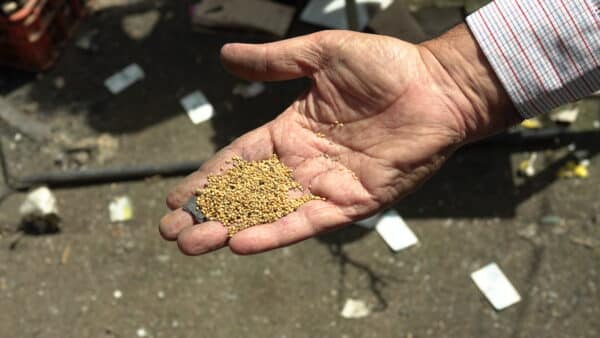
Sameer Al Junaidy, one of the four Al Junaidy brothers who owns and runs the nursery, says he doesn’t hire security because he would rather take damage to the property than put a Palestinian’s life at risk. Unarmed guards would be powerless against armed settlers, who regularly assault and murder local Palestinians.
The nursery is situated next to the illegal Shavei Shomron settlement, one of the West Bank’s first illegal settlements built in 1977 on land seized from Deir Sharaf and An-Naqura. Just before October 7, 2023, illegal settlers established an outpost on the other side of the nursery and have been intent on building a road that goes through it to connect them.
Since then, settlers have attacked the nursery at least five times. Recently, they set fire to bulldozers, a truck, and a forklift owned by the nursery. Settlers have also burned down olive trees, destroyed water pipes, and attacked Palestinians in neighboring communities. Footage from previous attacks that contains the assailants’ faces captured by Al Junaidy has been handed over to police, but no arrests were ever made.
Al Junaidy says that the Israeli Civil Administration told him that they understand how important the center is to West Bank agriculture and communities but they said: “There are two policies on the ground”, and some in the Israeli government want to see the assailants go unpunished. The nursery is also adjacent to Kedumin, the settlement where Israeli far-right Finance Minister Benzamar Smotrich lives, which is in the same council of settlements as Shavei Shomron.
The attack is a devasting blow to an already precarious food system in the besieged territory, bound to raise costs for local farmers who buy their seeds through the company. The nursery produces 80% of the West Bank’s olive tree saplings and all of its almond tree saplings, two crops central to Palestinian food security.
The destruction of over forty years of data could have far reaching impacts on agriculture across the West Bank. The data which has been lost included detailed information on how to best cultivate their thousands of seeds, meaning without this data, farmers may not know the ideal way to cultivate the crops. It is also used by agricultural engineering students at universities across Palestine.
Assaults on the West Bank’s economy and food systems through attacks like this one on the Al Junaidy Nursery are just one tactic in the occupiers’ overall project to ethnically cleanse the territory of all of its Palestinian inhabitants by disconnecting them from their land, their traditions, and the resources they need to survive.
Dozens missing after Israeli strike levels residential building in central Gaza
MEMO | September 23, 2025
At least 60 Palestinians are missing after an Israeli airstrike flattened a residential building in central Gaza City on Monday, local sources reported. Residents of the building were inside when it was bombed without prior warning, according to eyewitnesses.
The strike took place near the Shawa Building in the Al-Samar area, which itself has been threatened with attack. Gaza has come under heavy Israeli bombardment since 11 August as part of the army’s ongoing military campaign to seize control of the city.
Eyewitnesses said efforts to recover those trapped under the rubble are severely hampered by the lack of rescue equipment. Videos shared by Palestinians on social media showed the building reduced to rubble.
In one video, a woman—whose name was withheld—said her brother and his family were among those missing. Another man, standing nearby in tears, was heard calling out for his daughter trapped beneath the debris.
‘Peace through diplomacy’ is an excuse for collaboration with the Israelis
By Robert Inlakesh | Al Mayadeen | September 23, 2025
Following what has been widely dubbed as the failure of a recent emergency Arab-Islamic Summit, following the Israeli attack in Doha, many Arab Nations and political actors continue to pursue the concept of “peace through diplomacy”. This is not only a failed strategy, but also disingenuous.
The recent emergency conference, convened as a supposed step towards imposing a price on the Israelis for violating Qatari sovereignty and striking Doha, in a failed assassination attempt against Hamas leaders, has largely been dubbed a failure. Immediately after the conclusion of this summit, the Zionists escalated their terror bombing of Gaza City, and Israeli media announced the beginning of their ground operation to occupy the area.
Similarly, following the United Nations General Assembly (UNGA)’s adoption of the so-called “New York Declaration” on Palestinian Statehood, which is a combined Saudi-French initiative that is bringing about greater Western recognition of Palestine, the Israelis took it as a greenlight to escalate in the occupied West Bank.
Meanwhile, the Lebanese government and a range of ministers have adopted a plan towards disarming Hezbollah. Lebanese Prime Minister, Nawaf Salam, has also publicly stated his desire to normalise ties with the Zionist regime in a CNN interview, while claiming that diplomacy will be a sufficient response to force the Israelis to stop attacking his country.
Perhaps more embarrassingly, Syria’s ruler, Ahmad al-Sharaa, who is being widely mocked for his weak 50-second speech at the recent Arab-Islamic Summit, has now been offered a normalisation agreement by the Zionist regime, according to a report from Axios. This normalisation agreement is being sold as a “security deal”, yet has been compared to the 1979 Egyptian-Israeli normalisation accord.
In Syria, this so-called diplomatic approach will lead only to greater Israeli domination of the fractured nation. The Zionist entity demands that all of Syria south of Damascus be demilitarised, while it remains in the occupied Golan Heights, including the territory they just captured late last year. The Israelis were also revealed by Reuters to be funding around 3,000 militants in the Druze majority area of Suweida.
The Israeli demands in Syria are that they be allowed to have total air dominance and a corridor that would allow direct access to strike Iran, while the authorities in Damascus escalate their efforts to crack down on the Palestinian Resistance and prevent weapons transfers to Hezbollah in Lebanon.
As for the Lebanese government’s approach, the Israelis send their high-ranking officials to tour southern occupied Lebanon and forcefully assert that they will not leave the south of the country. They have carried out over 5,000 violations of the ceasefire agreement over the past year, continue to murder and abduct civilians, while the US-backed rulers in Beirut twiddle their thumbs and complain about Iran allegedly violating their sovereignty.
What is currently taking place is a public humiliation ritual against the Arab leaders, who behave like battered wives who refuse to admit that their rich husbands are abusive narcissists.
The Zionist Entity has bombed Gaza, the West Bank, Lebanon, Syria, Iraq, Yemen, Egypt, Qatar, Tunisia, and Iran over the past two years. Israeli Prime Minister Benjamin Netanyahu openly states that he pursues the so-called “Greater Israel” project, as he occupies more territory in Lebanon and Syria, threatening to annex the occupied West Bank and portions of Gaza too. The Israelis are even now threatening Egypt.
The leaders of the Arab and Islamic countries know all this, yet they continue to speak to their populations as if they are intellectually inferior to them and can’t figure out what is going on. The military spokesperson for the al-Qassam Brigades, Abu Obeida, stated in his last speech that these Arabs and Muslims are the enemies of Gaza and will one day be held accountable. His condemnation didn’t come out of nowhere, as he asserted that the whole Muslim world has failed to even deliver food to the people of Gaza.
Last year, prior to his assassination in Beirut, Sayed Hassan Nasrallah warned the Arab leaders that their complicity will come back to bite them, that they too would fall victim to the Zionists they have been collaborating with, and that nobody will be spared.
Frontline leaders in the battle against the Zionist regime have warned the Arab nations of what is to come, yet all of them decided to ignore these calls. Now, the chickens have come home to roost.
Ex-CIA chief Petraeus hails former Al-Qaeda leader for ‘clear vision’ in Syria
The Cradle | September 23, 2025
Self-appointed Syrian President Ahmad al-Sharaa engaged in a wide-ranging dialogue on 22 September with former CIA director David Petraeus as part of his visit to New York.
Sharaa, a former Al-Qaeda commander, met Petraeus, who commanded troops in Iraq after the 2003 invasion, at the Concordia Summit on the sidelines of the UN General Assembly. They discussed issues facing Syria, including reconstruction, governance, economic sanctions, and regional relations.
“We faced massive destruction over the past years, but we are focusing on economic development and building capabilities,” Sharaa stated.
“Syrians by nature are people of work and trade. So please lift the sanctions and see what we can do,” he added, referring to the 2019 US Caesar Act, which imposed crushing economic sanctions on Syria, impoverishing millions.
US President Donald Trump removed some sanctions earlier this year, but Congress must authorize their permanent removal.
Petraeus said that the conversation with the former Al-Qaeda in Iraq commander “has filled me with enormous hope.”
“Your vision is powerful and clear. Your demeanor is very impressive as well … We obviously hope for your success, Inshallah, because at the end of the day, your success is our success,” Petraeus added.
Though Sharaa was deemed a terrorist by the US State Department in 2012, the CIA covertly provided arms and funding to the Al-Qaeda affiliate he founded in Syria, then known as the Nusra Front.
According to journalist Seymour Hersh, Petraeus established a “rat line” between Libya and Syria to send weapons to the Nusra Front and other extremist groups seeking to topple the government of former Syrian president Bashar al-Assad.
The CIA operation, known as Timber Sycamore, enjoyed a budget of over $1 billion per year. The operation finally allowed Sharaa to oust Assad and establish an extremist Islamic state over Syria in December.
According to former French intelligence officer and political analyst Thierry Meyssan, Petraeus continued to help fund Al-Qaeda groups, including ISIS, after he was forced to resign from the CIA in 2012 after a sex scandal.
Meyssan says that Petraeus joined the private equity firm Kohlberg Kravis Roberts (KKR), headed by Jewish billionaire Henry Kravis, which funded the Nusra Front and ISIS on behalf of the CIA in an off-the-books manner.
Addressing Israel’s war on Gaza, Sharaa dismissed speculation about Syria joining the Abraham Accords to normalize relations with Israel.
He claimed the destruction of Gaza has made any broad normalization with Israel impossible, but said limited security arrangements could be considered.
Before Sharaa’s trip to New York, Syrian and Israeli officials were carrying out security talks that would allow Israel to maintain control of the strategic Mount Hermon, establish a no-fly zone over the south of the country, and prevent Syrian forces from entering a demilitarized zone in the south.
In a personal question, Petraeus asked how Sharaa manages the pressure of leading a country after years of conflict.
“I spent 25 of my 43 years in conflict and crisis, so I am used to hardship. Decisions that carry the destiny of a nation must be taken with calm and an open mind.”
Sharaa first traveled to Iraq to join Al-Qaeda after the 2003 invasion and was known for dispatching suicide bombers to kill civilians. He was allegedly arrested by US forces in 2005 and sent to the US prison at Camp Bucca.
After his release in 2009, he became the Emir of the Islamic State of Iraq (ISI) in Mosul, before traveling to Syria to establish the Nusra Front in 2011 on the instructions of Islamic State (later ISIS) leader Abu Bakr al-Baghdadi.
Ayatollah Khamenei rejects talks with US, warns of ‘serious, irreparable harms’
Press TV – September 23, 2025
Leader of the Islamic Revolution Ayatollah Seyyed Ali Khamenei has rejected Washington’s demands over nuclear negotiations, saying that accepting talks under threat is something “no honorable nation would ever do, and no wise statesman would ever endorse.”
Speaking in a televised address to the nation on Tuesday, Ayatollah Khamenei said negotiations with Washington under the current circumstances would bring “no benefit” to Iran and instead carry “serious and possibly irreparable harms.”
“Accepting negotiations under such threats would mean that the Islamic Republic of Iran is susceptible to intimidation.”
“If we were to negotiate under such threats, it would mean that we tremble and surrender whenever threatened,” the Leader said.
“If such susceptibility to threats were established, it would never end. Today, they say: if you enrich, we will do this. Tomorrow they will say: if you have missiles, we will do that … There would be endless threats, forcing us to retreat step by step.”
Ayatollah Khamenei said the United States is predetermining the outcome of any dialogue, and that Washington’s demands amount to dictation rather than negotiation.
“They have announced that the only acceptable result of negotiations is the shutdown of Iran’s nuclear activities and enrichment. So, we would sit at the table, and the outcome of the talks would be exactly what they had dictated in advance.”
“That is not negotiation,” the Leader stated, “that is dictation, that is imposition.”
“To negotiate with a party where the result must necessarily be what they want, and what they say; is that negotiation?”
The Leader pointed to recent American calls for Iran to abandon not only long-range but even short-range missiles.
The aim of such demands, Ayatollah Khamenei said, was to render Iran so weak and defenseless that it could not respond in any form if attacked.
West’s grip slips with Saudi–Pakistan security deal
Riyadh’s pact with Islamabad redraws alliances, weakens Indian leverage, and hints at a new Muslim deterrence framework beyond western control.
By F.M. Shakil | The Cradle | September 23, 2025
On 17 September, Riyadh rolled out the rare royal purple carpet for Pakistani Prime Minister Shehbaz Sharif – an honor previously reserved for global power players like US President Donald Trump.
Accompanying him on the trip was Pakistan’s Army Chief, Field Marshal Asim Munir. His presence highlighted that Riyadh values its defense pact with a nuclear power that, despite economic challenges, remains militarily strong.
Nuclear umbrella over Riyadh
The centerpiece of their visit was the signing of a “Strategic Mutual Defense Agreement” (SMDA), which declares that an attack on either country will be considered an attack on both.
Described by a senior Saudi official to Reuters as covering “all military means,” the pact has triggered speculation that it includes a nuclear umbrella, which would be a game-changing development in the military balance of West Asia.
With 81 percent of Pakistan’s weapon imports coming from China, the agreement implicitly aligns Saudi Arabia with the Chinese military-industrial orbit, whether by design or default. The kingdom has long been reliant on US arms, training, and security guarantees.
The pact was signed just two days after an extraordinary joint session between the Arab League and the Organisation of Islamic Cooperation (OIC) was called, following the 9 September Israeli airstrikes on Qatar – a major non-NATO ally and Gulf neighbor – with no substantial response from Washington, reinforcing perceptions that western security commitments are both selective and expendable.
Mushahid Hussain Syed, a former information minister and chairman of Pakistan’s Senate Defense Committee, tells The Cradle that the US has pivoted away from Arab allies toward Tel Aviv, leaving the region disillusioned and increasingly leaning toward alternatives.
“The strategy of ‘Greater Israel,’ spearheaded by Netanyahu, has involved military actions against five more Muslim nations. Pakistan’s recent triumph against India has demonstrated its capacity to contest Israel’s significant ally, India, and establish itself as a strategic alternative for Gulf nations.”
Toward an Islamic NATO?
Iraqi Prime Minister Mohammed Shia al-Sudani recently called for an Islamic military alliance, akin to NATO, in response to Israel’s airstrike on Doha. His proposal echoed Egypt’s earlier attempt to revive a joint Arab defense force under the 1950 treaty – an initiative blocked by Qatar and the UAE, reportedly under US pressure.
A similar proposal has also come from Islamabad when Pakistan’s Defense Minister, Khawaja Asif, urged Muslim countries to band together in a NATO-like military alliance in light of the Israeli aggression in Doha.
During an appearance on Geo TV last week, Asif drove home the point that a united Muslim military front is essential to tackle common security issues and fend off outside dangers. Asif invoked the wider role of the west in instigating instability in West Asia, emphasizing the intricate network of US support for Al-Qaeda and the CIA’s covert actions that led to Osama bin Laden’s relocation to Sudan or the regime change war in Syria.
Is nuclear deterrence a part of the Pact?
The nuclear dimension of the Riyadh–Islamabad pact remains opaque, but highly significant. While no official statement from either side confirms the presence of a nuclear component, Asif hinted that Pakistan’s nuclear capabilities could be shared with Saudi Arabia as part of the agreement.
Syed, however, clarifies to The Cradle that Pakistan’s nuclear doctrine is India-centric and that its deterrence posture is South Asia-specific and does not extend to the Persian Gulf.
“A novel security framework for the region appears to be taking shape, focusing on Global South nations such as Pakistan and Saudi Arabia, whereas the Indo-Israeli Axis, previously supported by the US, now finds itself significantly diminished.”
The defense agreement between Pakistan and Saudi Arabia, he says, represents a notable achievement for Pakistan, establishing it as a pivotal entity within the geopolitical framework of West Asia, particularly among Muslim countries.
“The agreement is shaped by three significant elements: the perceived neglect of Arab allies by the United States, Israel’s proactive maneuvers in areas such as Iran, Qatar, Lebanon, Syria, and Yemen, and Pakistan’s recent triumph over India in May.”
New Delhi, Tel Aviv on alert
Foreign media and analysts are already warning that the pact may have unintended consequences for India and Israel, despite claims that it targets neither. Others predict that this pact is really about Riyadh’s ambitions to counter Iran and Yemen’s Ansarallah-led government in the region.
Dr Abdul Rauf Iqbal, a senior research scholar at the Institute for Strategic Studies, Research and Analysis (ISSRA) at Islamabad’s National Defence University (NDU), tells The Cradle that New Delhi views the pact with unease as it formalizes Saudi–Pakistani security ties that could entangle Riyadh in South Asian rivalries, especially the India–Pakistan border tensions over Jammu and Kashmir:
“It represents a setback for Prime Minister Modi’s foreign policy, potentially leading to Saudi involvement in a prospective Indo–Pak conflict. Furthermore, future Saudi investments in Pakistan’s Gwadar port and economic corridors would challenge India’s regional influence and initiatives such as the India-Middle East-Europe Corridor (IMEC).”
He adds that Saudi Arabia’s pivot toward Pakistan reflects a broader alignment of Muslim powers and could push Tel Aviv to recalibrate its war on Gaza. It also pressures Tel Aviv by placing Pakistan – a vocal opponent of Israeli expansionism – into West Asian affairs.
“This agreement is not meant to counterbalance Iran’s regional influence, but rather to promote the Saudi Iranian reconciliation, as Pakistan maintains friendly relations with both nations. By formalizing ties with nuclear-armed Pakistan, Riyadh secures a credible deterrent as US security guarantees weaken. While western think tanks view it as an effort to contain Iran, the Arab world emphasizes it as strengthening Gulf deterrence independently of Washington.”
Indian concerns also stem from fears that the pact’s NATO-style clause could complicate ongoing operations like Sindoor, which remains active in a limited capacity following the skirmish between the two nuclear powers in May, especially given that the Gulf states’ swift mediation to resolve the crisis reflects their own interests with India and makes any military action against it unlikely.
Secondly, India is strategically analyzing Pakistan’s nuclear capability, which could see a boost if Saudi Arabia, having no such capacity, begins channeling funds to share Pakistan’s nuclear assets.
A post-western Gulf order?
While Tel Aviv and New Delhi remain publicly silent, both capitals are undoubtedly scrutinizing the fallout. Israel’s failed assassination attempt on Hamas leaders in Qatar, and India’s pressure campaign along the Line of Control, suggest that the axis is nervous about the consequences of a Saudi–Pakistani alliance. Israeli media downplayed the Saudi–Pakistan defense deal, seeing it as a show of force after Riyadh failed to influence Trump or West Asian policy.
As Syed notes, “The traditional ‘Oil for Security’ framework, which once defined US relations with the Middle East [West Asia], now serves as a remnant of a bygone era. As Saudi economic power increasingly reinforces China’s backing of Pakistan, India may feel vulnerable and isolated.”
Mark Kinra, an Indian geopolitical analyst with a focus on Pakistan and Balochistan, tells The Cradle that this development holds particular significance for India. New Delhi, he argues, has sustained robust economic and diplomatic ties with Saudi Arabia for many years, and the influx of Saudi investments in India continues to expand:
“India will be meticulously observing the progression of this agreement, particularly given that its specific terms are not publicly available. Any alteration in the regional security equilibrium may influence India’s strategic assessments, energy security, and diplomatic relations.”
As Washington’s selective security guarantees falter and Israel escalates unchecked, Persian Gulf states like Saudi Arabia are looking eastward for credible deterrents and strategic autonomy.
By aligning with nuclear-armed Pakistan, Riyadh is asserting greater independence from the western military order. It also signals the emergence of a multipolar Persian Gulf security architecture –one increasingly shaped by Global South coordination, not western diktats.
Featured Video
Matt Bracken: Hezbollah Re-Arming With Massive Help From Iran
or go to
Aletho News Archives – Video-Images
From the Archives
Examples of hate speech by Israel against Palestine
1. “There is a huge gap between us (Jews) and our enemies, not just in ability but in morality, culture, sanctity of life, and conscience. They are our neighbors here, but it seems as if at a distance of a few hundred meters away, there are people who do not belong to our continent, to our world, but actually belong to a different galaxy.” Israeli president Moshe Katsav. The Jerusalem Post, May 10, 2001
2. “The Palestinians are like crocodiles, the more you give them meat, they want more”…. Ehud Barak, Prime Minister of Israel at the time – August 28, 2000. Reported in the Jerusalem Post, August 30, 2000
3. ” [The Palestinians are] beasts walking on two legs.” Menahim Begin, speech to the Knesset, quoted in Amnon Kapeliouk, “Begin and the Beasts”. New Statesman, 25 June 1982.
4. “The Palestinians” would be crushed like grasshoppers … heads smashed against the boulders and walls.” Isreali Prime Minister (at the time) in a speech to Jewish settlers New York Times April 1, 1988
5. “When we have settled the land, all the Arabs will be able to do about it will be to scurry around like drugged cockroaches in a bottle.” Raphael Eitan, Chief of Staff of the Israeli Defence Forces, New York Times, 14 April 1983.
6. “How can we return the occupied territories? There is nobody to return them to.” Golda Maier, March 8, 1969.
… Continue
Blog Roll
 Aletho News
- Voters Don’t Want the Old GOP
- Former US officials who resigned over Gaza urge 2028 presidential candidates to reject architects of Biden-era policy
- Wired for War Crimes: Israeli spy-tech firm targeted Starlink users – researchers
- There is cautious optimism about ending the Ukraine war
- Here are the Bills Pushing Forward Authoritarian Control in Canada
- The accession of Ukraine could signal the collapse of the EU
- Italy puts Ukraine weapons package on hold – media
- US kills 5 in Pacific as unproven drug smuggling claims persist
- Iran Respects International Law, US & Israel are Rogue States
- Russia Helping Build a New Middle East /Trita Parsi
- If Americans Knew
- An error has occurred; the feed is probably down. Try again later.
- No Tricks Zone
- Germany’s Green Energy Transition Becoming Increasingly Expensive…Another 6 Trillion Euros!
- Sudden Stratospheric Warming, Powerful El Niño Combination May Lead To Extreme Europe Cold, Energy Crisis!
- Two New Studies Find Thwaites Glacier Melt Cannot Be Driven By Human Activity Or A Warming Ocean
- E-Cars Reduce CO2 Emissions By Only 41% Compared To Internal Combustion Engine Vehicles
- Predictions Made By Renowned Climate Professor Over Past Decades Have Been Proven To Be Poor
- New Study Suggests Large Regions Of The Pacific Ocean Have Been Cooling For The Last 80 Years
- Germany’s Green Energy Debacle: High Energy Costs Force Kahla Porzellan to Close After 182 Years!
- New Study: 50 Years Of The Most Aggressive ‘Net Zero’ Policies Can Only Affect The Global Climate By 0.03°C
- US September “Heat” Was No Record…Many Records Set Decades Ago
- Latest European Green Energy Debacle; Portugal’s Largest Flagship Solar Park Insolvent!

