Hamas: US proposal does not aim to end Gaza war
MEMO | September 9, 2025
A senior official in the Hamas movement, Bassem Naim, said on Monday evening that the initial ideas presented by the United States are “clearly intended to be rejected, rather than to reach an agreement that ends the war, ensures a full withdrawal of the occupation forces, and secures a prisoner exchange.”
In a statement sent to Quds Press, Naim explained that the American proposal suggests receiving all prisoners on the first day, linking withdrawal to the formation of a government acceptable to Israel and tasked with security duties. It also includes defining Hamas, considering pardons for its members, and disarming the resistance, “without any mention of reconstruction.”
The Hamas official stressed that the movement and other resistance factions seek “an agreement that stops the war and genocide, and opens the way for a political solution that fulfils legitimate national goals.”
Earlier on Monday, US President Donald Trump said that “the Israelis have accepted the terms of his proposal for a possible prisoner exchange and ceasefire in Gaza, and now it is Hamas’s turn to agree.”
Trump also spoke of the possibility of “reaching a deal soon to end the war on Gaza based on one of the proposals,” issuing what he described as “a final warning” to Hamas about the consequences of rejecting the new offer.
Suspected drone attack hits Gaza-bound Global Sumud Flotilla in Tunis
Al Mayadeen | September 9, 2025
The Global Sumud Flotilla announced it will hold a press conference today to update the media and the public on the drone attack sustained by one of its boats, the Family Boat. While all participants are safe, details about the attack remain limited, it said.
The conference will include remarks from Francesca Albanese, members of the steering committee, and civil society leaders, as well as direct testimonies from those who were aboard the Family Boat during the attack, in addition to updates on the flotilla’s ongoing mission to break “Israel’s” illegal blockade of Gaza.
The Global Sumud Flotilla, the largest civilian effort to break the Israeli blockade on Gaza, suffered an alleged attack when one of its leading vessels was struck while anchored in Sidi Bou Said, Tunisia.
According to Wael Nawar, a member of the flotilla, the attack was carried out by an Israeli drone and targeted the fleet’s largest ship, which sails under the Portuguese flag. He confirmed that all crew and passengers aboard the vessel were unharmed.
Egyptian committee: Cowardly escalation
The Egyptian committee of the flotilla condemned the incident as “a criminal aggression by a Zionist war drone and a cowardly escalation.” It described the strike on Tunisian territory as a military violation against an Arab state, reaffirming that Egyptian participation in the international fleet would continue despite the threats.
UN expert raises alarm
UN Special Rapporteur Francesca Albanese confirmed reports that the flotilla’s main vessel was hit and said she is working to verify the facts. She further warned that two additional boats en route to Tunisia are “in urgent need of protection.”’
Al Mayadeen’s correspondent reported that strict security measures were imposed at the port following the attack, adding that the ship was apparently hit with an incendiary device.
Tunisian authorities cite technical malfunction
In contrast, the spokesperson for Tunisia’s National Guard denied that local security or military units had detected any aerial activity over the port. Preliminary investigations, he noted, suggest the incident may have resulted from an internal malfunction aboard the vessel rather than an external strike.
The Tunisian Interior Ministry later released a statement saying that “reports circulating about a drone crashing onto a ship docked at Sidi Bou Said port are baseless.”
Earlier in May, a drone strike targeted a vessel of the Gaza Freedom Flotilla team in international waters off the coast of Malta, the Freedom Flotilla Coalition reported. Israeli authorities were widely condemned by activists for executing the attack; however, Tel Aviv never claimed responsibility.
In that earlier incident, Yasemin Acar, press officer for the Freedom Flotilla Coalition, confirmed to CNN that armed drones hit the ship twice, targeting the front of the vessel and causing a substantial breach in the hull. A fire erupted on board, and the ship began to sink. “There is a hole in the vessel right now, and the ship is sinking,” Acar said.
Largest flotilla yet to break the siege
The Global Sumud Flotilla includes hundreds of international activists from 44 countries, among them Swedish climate activist Greta Thunberg and Portuguese politician Mariana Mortágua. The mission, comprised of dozens of aid-laden boats, seeks to break “Israel’s” years-long naval blockade of Gaza by delivering humanitarian supplies and asserting international solidarity.
Despite the attack and mounting threats, organizers insist the mission will proceed, describing it as a historic show of defiance against the ongoing siege.
Israeli occupation attacks Hamas negotiators in Qatar, bombs Doha
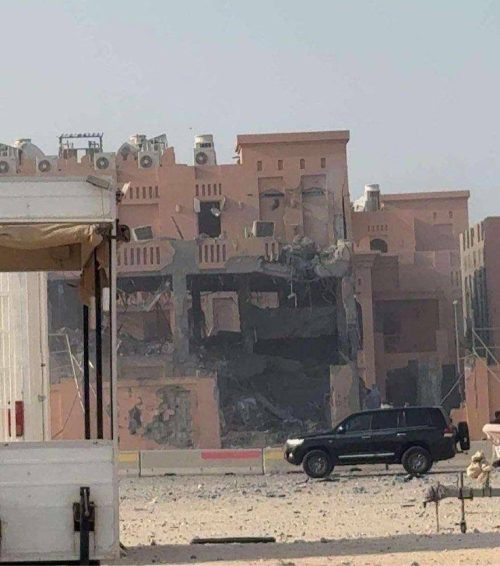
Al Mayadeen | September 9, 2025
In a statement, the Israeli occupation military, in coordination with its internal security agency, Shin Bet, claimed to have carried out an airstrike on the Qatari capital, Doha, claiming to target the senior leadership of the Palestinian resistance movement Hamas.
Israeli Channel 12, citing military sources, reported that the strikes targeted members of the Hamas negotiating delegation while they were discussing the latest US-mediated proposal in Doha.
Reuters correspondents confirmed hearing loud explosions in the Qatari capital, noting plumes of smoke rising over the Katara district.
This brazen Israeli strike on Hamas’ negotiating delegation in Doha exposes once again the pattern of aggression that has defined Israeli and American conduct, using violence at the very moment when talks for peace are on the table. Just as Washington and Tel Aviv undermined dialogue before they attacked Iran in June, they now repeat the same tactic against the Palestinian resistance, targeting representatives engaged in negotiations.
Far from seeking peace, such actions demonstrate a deliberate sabotage of negotiations and reveal that only Palestinians show a genuine commitment to ending the war, while the Israeli occupation regime and the US weaponize diplomacy as cover for escalation.
Hamas reaffirms commitment to ceasefire proposals
The development comes as Hamas reiterated its commitment, alongside other Palestinian factions, to the ceasefire framework put forward by mediators on August 18.
In a statement, Hamas emphasized its openness to “any ideas or proposals” that would secure a permanent ceasefire, guarantee the full withdrawal of occupation forces from Gaza, ensure the unconditional entry of humanitarian aid, and achieve a genuine prisoner exchange through serious negotiations brokered by mediators.
US President Donald Trump announced Sunday evening on his Truth Social account that “the Israelis have accepted my terms. It is time for Hamas to accept as well.”
In his post, Trump wrote: “Everyone wants the hostages home. Everyone wants this war to end! The Israelis have accepted my Terms. It is time for Hamas to accept as well. I have warned Hamas about the consequences of not accepting. This is my last warning, there will not be another one!”
According to Israeli Channel 12, Trump conveyed a new proposal through his envoy Steve Witkoff, bypassing the usual mediators Qatar and Egypt. The reported plan includes the release of all Israeli captives, both living and deceased, on the first day of the deal in exchange for the release of hundreds of Palestinian prisoners serving long sentences.
Hamas says received US proposal
The Islamic Resistance Movement in Palestine, Hamas, confirmed Sunday evening that it has received new American ideas through mediators aimed at reaching a ceasefire agreement in Gaza.
In a statement, Hamas said it welcomes any real initiative that contributes to ending the ongoing aggression against the Palestinian people.
Hamas expressed its readiness to immediately join negotiations to reach a comprehensive deal that would include:
- The release of all prisoners on both sides
- A clear declaration of an end to the war
- A complete Israeli withdrawal from the Gaza Strip
- The creation of a Palestinian independent committee to administer Gaza, to begin work immediately
The movement also demanded clear guarantees to ensure that “Israel” abides by any commitments, citing past agreements that were repudiated.
Hamas noted that it had already approved a mediator-brokered US proposal in Cairo on August 18, 2025, but “Israel” failed to respond and instead escalated its massacres and ethnic cleansing policy.
Christian Holy Places and the Jewish State
By Israel Shamir • Unz Review • September 9, 2025
Recently Israel bombed two old venerable churches of Gaza: the Greek Orthodox church of Saint Porphyrios and the Catholic Holy Family Church. Thus, we were reminded that the Holy Land is called the Holy Land because it is the cradle of Christianity; this is the land where Jesus Christ was born and lived and died on the Cross, and was Resurrected. Where the Church was formed, where the Empty Tomb of Christ is located. This land was fought for in numerous Crusades, the flower of European chivalry died on its fields and hills fighting Muslim warriors. After the Crusades, for the last thousand years, her churches, shrines and relics remained safe and accessible for Christian pilgrims. And they are not museum pieces: every day there are many thousands of Christian Palestinians who worship in the churches and venerate its relics. Things began to change with the advent of the Jewish State.
Without going into deep theology, let us sum it up: historically the Jews are, and always were hostile to Christ and Christians. You can learn that from the New Testament, or from the Talmud, Jewish holy text, or from the news, where you can see Jews daily spit on Christian pilgrims in Jerusalem.
Rami Rozen expressed the Jewish tradition in a long feature in a major Israeli newspaper Haaretz :[1] “Jews feel towards Jesus today what they felt in 4 CE or in the Middle Ages… It is not fear, it is hatred and contempt. For centuries, Jews concealed from Christians their hate for Jesus, and this tradition continues even now.”
“He [Jesus Christ] is revolting and repulsive,” intervened an important modern religious Jewish thinker. This “repulsion passed from the observant Jews to the general Israeli public,” Rozen replied.
On Christmas Eve, according to a feature in the Jerusalem local paper, Kol Ha-Ir.,[2] Hassids customarily do not read holy books because this might save Jesus from eternal punishment (the Talmud teaches that Jesus boils in hell).[3] This custom had been dying out, but Hassids of Chabad, fervent nationalists, have brought it back to life. I still remember old Jews spitting while passing by a church and cursing the dead while passing by a Christian cemetery. Last year in Jerusalem a Jew decided to refresh the tradition. He spat at a Holy Cross being carried in procession in a city street. Police saved him from consequent trouble, but the court fined him $50, despite his claim that he had been fulfilling his religious duty.
A few years ago, the biggest Israeli tabloid, Yedioth Aharonoth, re-printed in its library the Jewish anti-Gospel, Toledoth Eshu, compiled in the Middle Ages. It is the third recent reprint, including one in a newspaper. If the Gospel is the book of love, Toledoth is the book of hate for Christ. The hero of the book is Judas. He captures Jesus by polluting his purity. According to Toledoth, the conception of Christ was in sin, the miracles of Jesus were witchcraft, his resurrection but a trick.
Writing on the Passion of Jesus, Joseph Dan, Professor of Jewish mysticism at the Hebrew University in Jerusalem, stated:
The modern Jewish apologists, hesitantly adopted by the church, preferred to put the blame on the Romans. But the medieval Jew did not wish to pass the buck. He tried to prove that Jesus had to be killed, and he was proud of killing Him. The Jews hated and despised Christ and Christians.
Prof. Dan added that there is little place to doubt that the Jewish enemies of Jesus caused his execution. Even today, Jews in Israel refer to Jesus by the demeaning word ‘Yeshu’ (instead of ‘Yeshua’) meaning ‘perish his name’. In a similar pun, the Gospel is called ‘Avon Gilaion’, the booklet of Sin. These are the endearing feelings towards Christ of the friends of Christian Zionists.
If there was raison d’etre of the Jewish existence, it was to fight Christ and to eliminate Christianity. That is the very reason why Jews wanted Palestine – because it facilitates their war against Christ. It’s hard to say whether Christianity will survive the total Jewish takeover of Palestine. Jewish faith is not just another faith, like say Buddhism. It is a fighting doctrine, an anti-Christianity.
In 1920s and 1930s, to solve The Jewish Problem, the Jews were offered many places for living: The Argentine, Kenya (then it was called Uganda), Dominican Republic, Birobijan in the Soviet Far East, but they insisted on Palestine. It’s not strange: Palestine is the centre of the world, the most important place of all. Not in vain, people fought and died for it for centuries. The followers of Mackinder, geopolitics, considered the ancient holy places of the world being the strategic points. Amazing that England gave away this most cherished possession to the Jews. And the Jews immediately began their work of expelling the Divine Presence from our midst.
Wait, you will say, Jews also believe in God! Yes, but a different one. To Gentiles – that’s you and other non-Jews – there is no access to the Jewish god. You must live forever without God, or you may worship the Jews, as God’s intermediary. It just so happens that the elimination of God’s Presence on earth is Satan’s main desire, too. So he has become a powerful Jewish ally; he helps them to destroy everything beautiful and spiritual on Earth.
Israel is the Jewish state, but not the only one: there is a bigger Jewish state, the USA. It’s not only the mighty supporter of its smaller brother. The USA nowadays has up to 80 percent Jews in the administration of its government, but this began a long time ago. Karl Marx and Werner Sombart wrote that the US could become a Jewish state even without Jews. (More precisely, Marx said that it was the Jewish state without Jews, and Sombart corrected him, saying the Jews were there from the beginning.) In the USA, this great heresy of Christian Zionism was formed, the parody of Christianity. Likewise, in the US blossomed homosexuality, a parody of the sacred union of Man and Woman, as it was viewed in ancient Egypt, and in Japanese mythology, and in the book of Genesis. The Devil is a great mocker!
Jews are much more comfortable with Islam: a Jew can join Muslims in prayers, as the great luminary Rambam once ruled, and historically Jews escaped to Muslim states from Europe when they were ordered to baptise or else. Amazingly, Jews do not hate Islam and Muslims with the same fervour they hate Christians.
How do Muslims feel about Christianity? Muslims venerate Christ. He is called ‘The Word of God’, ‘Logos”, ‘Messiah’, ‘Christ’, ‘the Prophet’ and is considered a Messenger of God, along with Abraham, Moses and Muhammad. Many chapters of the Koran tell the story of Christ, his virgin birth and his persecution by Jews. His saintly mother is admired, and the Immaculate Conception is one of the tenets of Islam. The name of Christ glorifies the golden edifice of Haram al-Sharif. According to the Moslem faith, it was there that the founder of Islam met Jesus, and they prayed together. The Hadith, the Moslem tradition, says in the name of the prophet: “We do not forbid you to believe in Christ; we order you to.” Muslims identify their prophet Muhammad with Paracletes the Helper (Jn 14:16) whose coming was predicted by Jesus. They venerate places associated with the life of Jesus: the place of Ascension, the Tomb of Lazarus and the Nativity are adjacent to a mosque and perfectly accessible by Christians.
Although Muslims (and many Protestants) do not consider that Jesus is God, they do proclaim Him to be the Messiah, the Anointed one, the Paradise Dweller. This religious idea, familiar to Nestorians and other early churches but rejected by mainstream Christianity, opened the gates for those Jews who could not part with the notion of Unitarianism. That is why many Palestinian Jews and Christians of the Seventh Century accepted Islam and became Palestinian Muslims. They remained in their villages; they did not depart for Poland or England; they did not learn Yiddish; they did not study the Talmud, but they continued to shepherd their flocks and plant almond trees. They remained faithful to their land and to the great idea of the fraternity of mankind.
Paradoxically, nowadays in the US with its spiritual debt to Jews, a new term was coined: Judeo-Christian values, traditions, faith. This is sheer nonsense, it is a catachresis like cold-hot. And indeed, it works by submitting Christians to the Jews in the US, while in Palestine, it leads to destruction of the remains of all Christian life. Let us consider Bethlehem; before 1967 it was predominantly a Christian city. When the Jews captured Bethlehem, they ran a census, just like King Herod, and everybody absent from his home was stricken out. Students abroad, family visitors, war refugees, whoever was not in the house was deleted from the roll. By this first step Jews got rid of a third of the Christian population.
But before that, you can consider the pretty Christian village of Birim in Upper Galilee. The village of Birim has been dead for fifty years now. It is beautiful even in death, like Ophelia floating down the stream in the pre-Raphaelite painting of Millais. It was not ruined by war. Its Christian inhabitants were expelled from their houses well after the 1948 war. They were told to leave for a week or two, for ‘security’ reasons. They had no option but to obey the Israeli soldiers and move out. Their village was dynamited, their church surrounded by barbed wire. The people went to the Israeli Supreme Court, they went to the government, commissions were appointed and petitions signed. Nothing helped. For fifty years since then, they have lived in the nearby villages, and on Sundays they return to worship in their church. Their lands were seized by their Jewish neighbours, but they still bring their dead to be buried in the church graveyard, under the sign of the cross.
Until the arrival of the Israeli army, this ruined village with its orphaned church was the home of the rural Christians of Birim who for centuries of Moslem rule lived in peace with their Moslem neighbours of Nebi Yosha and with the old Sephardi Jewish community of nearby Safed. This Guernica of Galilee undermines the “Clash of Civilizations” myth of a “Judeo-Christian” civilization opposing a “monstrous” Islam.

Coming back to Bethlehem, we happen to see the beautiful image of Our Lady. She appeared to a Mexican peasant, and her flower-covered image arrested the strife and united Native Americans and Spaniards into one nation. She gave her rosary to Saint Dominic and a letter to Portuguese kids in Fatima. The Prophet Muhammad saved and cherished her icon found in a Mecca shrine, writes Maxim Rodinson. She appeared to the wealthy Jewish banker Alphonse Ratisbonne, and he took orders and built the convent of the Sisters of Zion in En Karim. A Palestinian Muslim in a refugee camp of Lebanon preserved the image he took from his native Galilee, tells Elias Khoury in his novel Bab Al-Shams. Syrian astronauts asked for her protection in the shrine of Seidnaya before their flight on the Soviet space shuttle.
In medieval legends, the Jews were often perceived as enemies of the Virgin. The Talmud refers to her in the most blasphemous and hostile way. A certain column-stump on Jerusalem’s Via Dolorosa marks the place of a legendary attack of Jews on her person, while in Antioch in 592, Jews were found despoiling her image. These are old tales. And now some newer facts. Twenty-two years before 6.10.23 (that is the event and date that Jews want to count from) in Bethlehem, a Jew shelled the Virgin. A Jewish soldier in the formidable tank Merkava-3, constructed according to US technology at US taxpayer’s expense, fired a shell from a distance of fifty yards at the statue of the Madonna atop the Holy Family church in the town of the Nativity. The Virgin lost an arm, and her pretty face was disfigured. She became one of a hundred Palestinian women shot by the Jews in that outburst of war. This seemingly unnecessary act of vandalism could not have been an accidental shot. No terrorist hid behind her gentle figure on the pinnacle of the hospital church. At fifty yards, you make no mistake. It could have been orders; it could have been a spontaneous expression of feelings by a Jewish fanatic. Our world rewinds full speed back into the Dark Ages, and as Israel rekindles traditional Jewish hostile rejection of Christianity, we cannot indulge in Judaeo-Christian fantasy.
I also must mention the beautiful old Byzantine church of St Barbara, a local girl and the village patron saint. It is one of these bitter-sweet semi-ruined churches that still attract worshippers, along with St Anne of Safurie and Emmaus of Latrun, and it stands on a hill a mile away from the village. It would be called St Barbara-without-the-walls if it were in England.
On the thirty-first of May 2002, the Israeli army dynamited St Barbara, the living relic of the Christian past of the Holy Land. I do not know whether the sappers said the benediction prescribed for such occasions by the Jewish religious codex, Shulkhan Aruch: “Blessed you are, Our Lord, who destroys the Assemblies of Proud.” This destruction followed the Bethlehem siege; when, for the proverbial forty days and forty nights, from the Catholic Good Friday to the Orthodox Easter Sunday, the Jews besieged the Church of Nativity.
To conclude, it is only by a miracle Christianity may survive Jewish rule in Palestine, or indeed wherever anti-Christians rule. Historically, the Palestinian Church has served as a bellwether for the health of the Church everywhere else. It is the touchstone of our faith. Without the earthly testimony of Christians living in and working on the same lands walked by Christ and His apostles, Christians quickly fall victim to science-fiction fancies like Christian Zionism. The Holy Land is a living history that naturally refutes anti-Christian narratives that rely upon the ignorance of historical facts. It is the last relic of Christendom. And if it dies, Christendom is doomed to the same rootless, wandering extinction that plagues the Jews.
The collapse does not stop in Gaza: in France, once the beloved daughter of the Church, ruled by ex-Rothschild clerk Macron, in La Baconnière, the Church of Saint Cornelius and Saint Cyprian was demolished: the 12th-century building with stained glass by Auguste Allo and a bell from 1584 was declared unsafe and demolished due to the lack of 7 million euros for restoration. But in order to conclude with good news, I’ll say: last Sunday, Moscow witnessed a huge Crucession of hundreds of thousands of worshippers, for the first time since 1918. It happened soon after the ardent local Jews moved away to Israel. Christianity still has the potential for Resurrection.
Edited by Paul Bennett
 Notes
Notes
[1] 28.1.94.
[2] 14.12.93.
[3] Gittin, 56b-57a.
Spanish PM reveals 9 measures to halt genocide in Gaza
Al Mayadeen | September 8, 2025
Spanish Prime Minister Pedro Sanchez on Monday announced nine new measures aimed at stopping the “genocide in Gaza,” stating, in a televised address, “What Israel is doing is not defending itself, it is exterminating a defenseless population.”
He said that although Spain has de facto been applying an export ban on weapons to “Israel” since 2023, the government will now urgently legislate a “permanent” ban, a measure that will be joined by prohibiting ships transporting fuel to Israeli forces from using Spanish ports and banning aircraft carrying defense material from Spanish airspace.
The Spanish Premier added that individuals “directly involved in the genocide, violating human rights and war crimes in Gaza” will be prohibited from entering Spain.
Other measures include banning imports from illegal Israeli settlements in the occupied West Bank and Gaza, limiting Spanish consular services to Spanish citizens living in the occupied territories to the bare minimum, and increasing Spain’s presence in Rafah with additional troops and new joint projects with the Palestinian Authority to provide food and medicine.
Spain will also increase its contribution to the UN agency for Palestinian refugees (UNRWA) by €10 million ($11.7 million) and commit €150 million in additional humanitarian aid for Gaza in 2026.
“We know these measures will not be enough to put an end to the war crimes, but we hope they serve to apply pressure to Prime Minister Benjamin Netanyahu and alleviate the suffering of the Palestinian people,” Sanchez stated, adding that “Spain alone cannot stop the war, but that doesn’t mean we can’t try.”
Assassination of Yemeni Ministers: How the Media Normalizes Israel’s Crimes
Israel carried out the unprecedented act of assassinating the head of the Sanaa government and 11 of his ministers to punish Yemen for its unwavering solidarity with Gaza, making it one of the few countries in the world to take seriously the obligation to prevent the crime of genocide. The media, complacent or even complicit, never deem it necessary to point out that targeting a civilian administration constitutes a blatant war crime. This silence only encourages Israel to push ever further the limits of its monstrosity.
By Alain Marshal | September 6, 2025
On August 28, a massive Israeli strike on Sanaa, the Yemeni capital, targeted a council of ministers of the de facto authority in Yemen, assassinating Prime Minister Ahmed Ghaleb Nasser al-Rahawi and 11 members of his government: Secretary of the Council of Ministers Zahid Mohammed Al-Amdi, the Prime Minister’s Chief of Staff Mohammed Qasim Al-Kabsi, as well as the Ministers of Foreign Affairs (Jamal Ahmed Ali Amer), Economy (Moeen Hashim Ahmed al-Mahaqri), Justice (Ahmed Abdullah Ali), Energy (Dr. Ali Saif Mohammed Hassan), Information (Hashim Ahmed Abdulrahman Sharaf Al-Din), Agriculture (Dr. Radwan Ali Ali Al-Rubai’i), Social Affairs and Labor (Samir Mohammed Ahmed Baja’ala), Tourism and Culture (Dr. Ali Qasim Hussein Al-Yafei), and Youth and Sports (Dr. Mohammed Ali Ahmed Al-Mawlid).
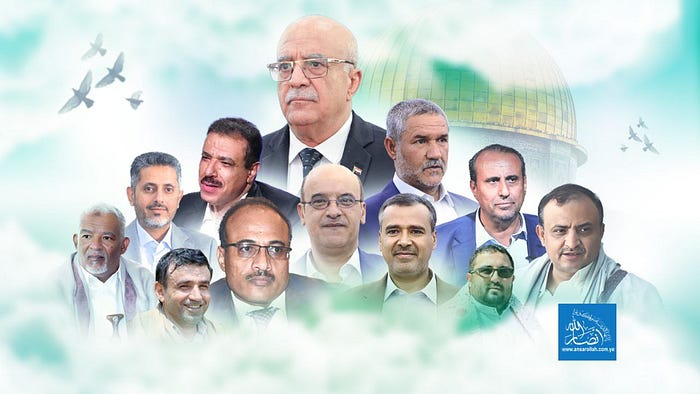
Yemen’s Martyrs
Israel, which has been perpetrating an openly acknowledged genocide in Gaza and the West Bank — broadcast live for nearly two years — and which has attacked no fewer than five other countries during this period (Lebanon, Syria, Yemen, Iran, Iraq, not to mention all the countries whose airspace it has violated), has clearly claimed responsibility for this attack. War Minister Israel Katz declared that Israel had delivered “an unprecedented knockout blow against the senior-most figures of the Houthi security-political leadership in Yemen, in a daring and brilliant operation […]. The fate of Yemen is the fate of Tehran — and this is only the beginning.” There is therefore little doubt about Israel’s intentions.
Despite this deliberate and acknowledged attack, the word “assassination” was nowhere to be found in the Western media: the AFP dispatch, reprinted by Mediapart (allegedly the most prominent French media outlet supporting Palestine) and many other newspapers, refers only to the “death” of the head of government and members of his cabinet, “killed” in Israeli raids, as if the causal link between the bombings and the deaths were indirect. AFP adopts the terms “Houthis,” “rebels,” and “Iranian-backed,” noting that “the internationally recognized Yemeni government, driven out of Sanaa, has its headquarters in Aden, the major city in the south.” Without specifying that the Aden regime, supported by Saudi Arabia (which itself has been waging a genocidal war against Yemen since 2015, with Western backing), has no more legitimacy to represent Yemen and its people than the Taiwan-based Kuomintang had to occupy China’s seat at the UN (which it did from 1945 to 1971).
Moreover, Israel’s action was rationalized, even legitimized, with AFP categorically stating that the strikes against Yemen were “in response to missile and drone attacks by rebels against Israeli territory.” As for Yemen’s own position — that its attacks are nothing more than a response aimed at ending the genocide in Gaza and the blockade starving its two million inhabitants — the article distances itself and places full responsibility on the Houthis: “The houthis claim to be launching these attacks in ‘solidarity’ with the Palestinians in the Gaza Strip, who are caught up in the war triggered by Hamas’ attack on Israel on October 7, 2023.”
The pattern is recurring: whatever Israel says, however grotesque, is taken at face value (Israel is only defending itself, retaliating against Hamas, against Yemen, and against all of humanity if need be), while whatever its adversaries say — even when it is self-evident — is treated with suspicion and put in quotation marks to signal distance. The underlying suggestion is that Israelis are not being targeted as occupiers who dispossess Palestinians of their rights and subject them to systematic extermination, but as Jews, out of pure anti-Semitism or out of hatred for “freedom” and “Western values,” a recurring discourse from Reagan, Bush, Netanyahu, and others. In the media and civil society, so-called “reactionary” voices openly adopt this vocabulary, while so-called “progressive” voices generally do so implicitly — even though the French CGT union spelled it out in its magazine Ensemble, La Vie Ouvrière №19 (November 2023), which described Hamas’ action of October 7 as “ignoble,” denouncing, with regard to the Nova rave party held at the gates of the Gaza concentration camp, a targeting “by religious fanaticism [of] youth and [of] the expression of freedom […] At least 260 people were killed, by gunfire or explosives, because they were Jewish.”
In a recent article, Mediapart’s founder Edwy Plenel himself described Israel’s genocidal campaign in Gaza as “Israel’s war in retaliation for October 7,” a blatantly negationist statement that obscures more than a hundred years of Zionist history — a colonial movement explicitly aimed at the expulsion, even the annihilation, of the indigenous people, a sine qua non condition for its success. The total destruction of the Gaza Strip and the will to empty it of its population are clearly in continuity with the ethnic cleansing of the Nakba (1948) and the Naksa (1967), October 7 having been nothing more than a catalyst, a pretext seized Machiavellianly by Netanyahu’s fanatical government to liquidate the Palestinian cause once and for all and to work openly towards “Greater Israel.” Until then, the sham “peace process” had allowed colonization to progress slowly but surely, but now the time has come for the “final solution.” The media’s complicity in the liquidation of the Palestinian cause did not begin on October 7, and rather than acknowledging their errors, they persist in denial — even as the Israelis have dropped the mask and are stating more clearly than ever that they will never tolerate a Palestinian state or Palestinian sovereignty, even symbolic.
Just as they flout history to pander to Zionist propaganda, our journalists have no regard for international law — otherwise they would point out that targeting a political leadership, even one not recognized by the international community, even in wartime, is an egregious crime. Israel Katz proudly underscores the “unprecedented” nature of these assassinations and fully assumes the targeting of civilians, but our “journalists” do not care. They have thoroughly internalized their duty of loyalty to Israeli talking points, even going so far as to condone the systematic targeting of hospitals (by taking seriously the alleged existence of Hamas command centers beneath them), medical personnel, and even journalists (by crediting their supposed links to the Palestinian Resistance). Corporatism no longer applies when it comes to covering the war crimes and crimes against humanity committed by the occupying army, the armed wing of Western imperialism. Let us recall that the attack on Hezbollah’s pagers was praised by our media — including Mediapart, which described it as “a stroke of tactical genius by the Israeli military and spies” (before discreetly retracting this statement, calling it a mere “strategic success”). Yet, with its implications — potentially turning any everyday object into a bomb — this terrorist attack is even more dangerous than 9/11, threatening to transform the entire world into a dystopia.
To grasp how utterly unacceptable the absence of political reaction (with the exception of the Axis of Resistance) and the complacent media coverage following the decapitation of the Yemeni government — whose role is purely administrative — really are, let us imagine for a moment that a Western head of government and his cabinet were targeted by a foreign power: François Bayrou in France, Friedrich Merz in Germany, Keir Starmer in the United Kingdom, for example. Let us even imagine that Zelensky, whose country is at war (NATO and the EU are regarded as co-belligerents), were killed in a Russian strike. Who would dare doubt the international outrage that this would provoke? Who could ignore the ensuing diplomatic, economic, or even military apocalypse? Who would not be moved to tears at the mere thought of the mournful hagiographies that would flood editorial columns?
A simple alleged GPS jamming of the plane carrying Ursula von der Leyen to Bulgaria (to visit a munitions factory — an act of the highest neutrality), without any evidence (Flight Radar denied any interference with the GPS signal from takeoff to landing), provoked indignation among our politicians and media, who set aside fact-checking and exhausted the vocabulary of outrage: “victim,” “blatant Russian interference,” “We are of course aware of, and in a sense accustomed to, the threats and intimidation that form an integral part of Russia’s hostile behavior,” “The head of European diplomacy, Kaja Kallas, announced that she would summon the Russian ambassador in the wake of the incident.”
But when it comes to Yemeni leaders, the structural racism of our societies — especially entrenched among our journalists and editorialists — combined with the abject submission of our capitals and their media echo chambers to Israeli and American interests, suffices to relegate this flagrant war crime to a mere footnote, a veritable carte blanche granted to Israel, encouraging it to continually push back the red line of its crimes and atrocities. Israel’s impunity is guaranteed unconditionally.
Bound only by the demands of our conscience, and not by the fear of losing our job for failing to comply with a tacit or assumed pro-Israeli editorial line, we take the liberty of forcefully reminding everyone that international humanitarian law prohibits the targeting of civilian leaders, by virtue of the fundamental principle of distinction between civilians and combatants:
1949 Geneva Conventions (1977 for the Additional Protocols):
- “Persons taking no active part in the hostilities […] shall in all circumstances be treated humanely […]. To this end, the following acts are and shall remain prohibited at any time and in any place whatsoever with respect to the above-mentioned persons: violence to life and person, in particular murder of all kinds […].” (Fourth Geneva Convention, Article 3)
- “In order to ensure respect for and protection of the civilian population and civilian objects, the Parties to the conflict shall at all times distinguish between the civilian population and combatants and between civilian objects and military objectives and accordingly shall direct their operations only against military objectives.” (Additional Protocol I, Article 48)
- “A civilian is any person who does not belong to [the Armed forces]. In case of doubt whether a person is a civilian, that person shall be considered to be a civilian.” (Additional Protocol I, Article 50)
- “The civilian population and individual civilians shall enjoy general protection against dangers arising from military operations. […] Civilians shall enjoy the protection afforded by this section, unless and for such time as they take a direct part in hostilities.” (Additional Protocol I, Article 51)
International Criminal Tribunal for the former Yugoslavia, 1993:
- “If essentially the total leadership of a group is targeted, it could also amount to genocide. Such leadership includes political and administrative leaders, religious leaders, academics and intellectuals, business leaders and others — the totality per se may be a strong indication of genocide regardless of the actual numbers killed. […] Thus, the intent to destroy the fabric of a society through the extermination of its leadership, when accompanied by other acts of elimination of a segment of society, can also be deemed genocide.” (Final Report of the Commission of Experts Established Pursuant to Security Council Resolution 780 (1992), Annex to the Letter dated 24 May 1994 from the Secretary-General to the President of the Security Council, S/1994/674)
Rome Statute of the International Criminal Court, 1998:
- “The Court shall have jurisdiction in respect of war crimes in particular when committed as part of a plan or policy or as part of a large-scale commission of such crimes. For the purpose of this Statute, ‘war crimes’ means: […] Intentionally directing attacks against the civilian population as such or against individual civilians not taking direct part in hostilities.” (Rome Statute, Article 8, “War Crimes”)
It therefore appears that, even in times of war, a Minister of Defense or a President of the Republic, as head of the armed forces, only loses civilian status if they take a direct part in hostilities — something that remains extremely rare, since operational command lies with military officers. What then can be said of a Prime Minister, a Minister of Justice, or a Minister of Culture? These are purely and simply extrajudicial killings, which by definition have no legal basis.
Furthermore, a “combatant” is only recognized as such on the battlefield or in barracks, and regains civilian status as soon as he is at home. If, as Israel does, we consider that members of Lebanese Hezbollah, Ansar Allah in Yemen, the Palestinian resistance, or Iranian commanders remain combatants even while asleep in their family homes, it would logically follow that targeting soldiers and reservists of regular armies would also be legitimate wherever they are found — even when on leave with their families — even if it means killing, injuring, or maiming their wives and children along with them.
Similarly, Israel’s declared intention to “eliminate” — a term used by certain “journalists,” such as in this article in Le Figaro — the entire Ansar Allah command structure, because of its unwavering support for Gaza, combined with its repeated strikes against the country’s civilian infrastructure (ports, airports, power grids, fuel depots, the presidential palace, industry, residential neighborhoods, etc.), clearly amounts to a war crime or even an intent to commit genocide, as defined by the jurisprudence of the International Criminal Tribunal for the former Yugoslavia.
Robert Fisk, Middle East correspondent for Time (1976–1988) and later for The Independent (1989–2020), held, like Amira Hass (Haaretz), that the role of journalists is to challenge established authority and centers of power, particularly in the context of war. Yet the overwhelming majority of the media does precisely the opposite, working to rationalize, legitimize, and even normalize the unacceptable — from the assassination of political leaders (see this Mediapart article entitled In Iran, the Twilight of the Supreme Leader, a textbook case of incitement to murder), to the mass murder of starving women and children as they try to find food, to ethnic cleansing and genocide.
In conclusion, let us recall that the Convention on the Prevention and Punishment of the Crime of Genocide (1948) establishes in its first article that: “The Contracting Parties confirm that genocide, whether committed in time of peace or in time of war, is a crime under international law which they undertake to prevent and to punish.”
Faced with the inaction of the international community, is it not Yemen, through its naval blockade of Israel and its active support for the Palestinian cause, that takes the obligation to prevent the crime of genocide most seriously? By contrast, the “civilized West” not only fails to impose sanctions on Israel, but refuses to stop providing it with military, economic, and diplomatic support, thereby becoming complicit in the extermination of the Palestinians.
As Israel’s frenzy of bloodshed and destruction continues daily, not only in Gaza but also in the West Bank, Lebanon, Syria, and of course Yemen, it is difficult not to recall the lessons of history: any regime founded on barbarism and hubris is doomed to an ignominious end — and its sycophants and apologists to an equally humiliating fate.
Contact: alainmarshal2@gmail.com
When does murder get ignored? When the victim is white and the killer black
A black man kills a white woman in an American city, and the mainstream media gives it zero coverage. Imagine if the races were reversed.
By Henry Johnston | RT | September 8, 2025
The US mainstream media tends to operate by encouraging a certain prefabricated outrage. Sensationalized narratives are cultivated along predictable tracks. But no less egregious is what the media chooses to ignore. Few events of late have better exposed the ideological underpinnings of the media – and of the elite whose narratives it plugs – than the recent brutal and shocking murder of a young Ukrainian woman on a train in Charlotte, North Carolina.
On August 22, a career criminal, Decarlos Brown Jr., casually walked up behind 23-year-old Ukrainian refugee Iryna Zarutska, who was seated on a train minding her own business, and stabbed her three times in the neck in cold blood, killing her. He sauntered away, still clutching the knife dripping blood.
The mindless and savage attack was captured on surveillance footage, but Charlotte’s Democratic Mayor Vi Lyles pushed for it not to be released, ostensibly out of respect for the victim’s family. But the footage did eventually surface, and the story spread like wildfire. But this was a wildfire that couldn’t reach the impervious redoubt of the mainstream media – even after Elon Musk gave it the push into viral territory by chiming in on an End Wokeness thread pointing out the stunning media silence.
In fact, not a single major legacy outlet – the New York Times, Washington Post, NPR, Reuters, CNN, Wall Street Journal, and others – picked it up. One would think that, by sheer chance, one of these esteemed outlets would have bucked the trend. But that didn’t happen because, as Matt Taibbi once brilliantly pointed out,
“Reporting is done in herds, no one wildebeest can break formation without screwing things up for the others. So, they’ll all hold the line, until they all stop holding the line.”
As of this writing, it seems the media herd is starting to reluctantly skate to where the puck is going. And that means that some version of the story, however sanitized, will soon appear everywhere.
So what exactly has given this story its irresistible momentum? Let’s start with the blatant double standard about reporting interracial crime. A white victim and a black perpetrator, as was the case in this instance, is usually a circumstance that tips the scales in favor of silence. When an instance of black-on-white crime cannot be avoided, the respective races of the individuals involved are not mentioned, and the tone is more along the lines of “aww shucks, what a tragedy.” When the racial roles are reversed, the media coverage is extensive and sensational, and the race angle is established immediately and runs throughout the ensuing coverage like an electric wire.
Given such highly distorted media coverage of interracial crime, one would be forgiven for assuming that it is blacks who are perpetually in mortal danger of racist attack by whites in the US. This view was a large part of the impetus behind the Black Lives Matter movement. However, the actual statistics on interracial crime, which are not easy to find, show otherwise. Buried inside this Department of Justice (DOJ) report from 2020 is a rather remarkable admission: “[In 2019], there were 5.3 times as many violent incidents committed by black offenders against white victims (472,570) as were committed by white offenders against black victims (89,980).” Such stark wording was not repeated in subsequent reports under the Biden DOJ, but there is no reason to believe anything has changed in the streets.
Zarutska’s murder certainly comes at a time of record-low American trust in the mainstream media. Instances of misreporting and factual disasters have become such a recurrent theme as to not require individual examples. The media’s efforts at narrative formation have also become so heavy-handed that identifying the establishment cause being promoted in almost any piece of reporting is now a parlor game.
But – and I venture into very risky terrain here – the uproar over this senseless killing also points to a deeply ensconced taboo slowly starting to unravel: Many white Americans are tired of being denied the right to display even the slightest and most tentative hint of the type of racial solidarity that other groups are extended so liberally. It is a story being played out on a different stage with different actors in Great Britain.
There’s another angle here, and it is one that has already been remarked upon in numerous places. The victim was a citizen of a country that the US has spent enormous treasure and effort ostensibly defending since 2022. The roughly $130 billion in aid that Washington has coughed up for Kiev comes out to some $3,500 per Ukrainian citizen. Certainly enough for a bodyguard on train rides.
And yet the silence from the pro-Ukraine crowd has mirrored that of the media at large. This certainly confirms what has been abundantly clear throughout the war and remains so today: Ukrainian deaths that don’t advance a Western elite media narrative are dismissed and ignored. But this lack of reaction also casts in sharp relief the reality that pro-Ukraine sentiment in the US is largely a cause bundled in with the rest of the progressive agenda, underpinned by the uniform mouthpiece of a jaded media. The Ukrainian flags one sees out and about rarely reflect a principled stance but rather deference to elite cues.
It will be said that all sides have merely assumed their positions on the barricades to score political points on this deeply human tragedy. We will all be accused of coming to praise Caesar rather than to bury him. This young woman’s death is indeed a human tragedy and a particularly painful one. But to see it as only a tragedy is to dismiss its larger context and to refuse to draw any conclusions. That is willful ignorance.
When a tragedy unveils such a confluence of two deep ideological biases, what it does is reveal the contours of the magnet moving underneath the pattern of American life.
Henry Johnston is a Moscow-based editor who worked in finance for over a decade.
China’s Warning
By Manlio Dinucci | Global Research | September 8, 2025
The global dominance that the United States, the greatest power in the West, wants to maintain at all costs violates the most basic norms of international law: the Trump Administration revoked the visas of representatives of the State of Palestine, preventing them from attending the United Nations General Assembly in September.
This claim to dominance is provoking growing opposition from the Global South. This is confirmed by the warning issued by China with the largest military parade in Beijing.
The official statement from the State Department states that the Trump administration has revoked the visas of members of the Palestine Liberation Organization (PLO) and the Palestinian Authority (PA) ahead of the upcoming United Nations General Assembly, “in the interest of our national security” because “the PLO and PA are responsible for undermining the prospects for peace through their appeals to the UN International Court of Justice to obtain unilateral recognition of a hypothetical Palestinian state.”
In addition, the Trump Administration announced the suspension of visas for all Palestinian passport holders, preventing them from entering the United States for medical treatment, university attendance, visits to relatives, and business activities. At the same time, the Trump administration announced that it is studying “the post-war plan for Gaza”: it provides for the “voluntary transfer” of the entire Palestinian population to transform Gaza into a luxurious “Middle East Riviera.” In this way, while Israel continues its genocide of Palestinians in Gaza and the West Bank, the United States is dismantling the foundations of the State of Palestine.
However, the global dominance that the West’s greatest power wants to maintain at all costs, violating the most basic norms of international law, is provoking growing opposition from the Global South. This is confirmed by the meeting of the Shanghai Cooperation Organization, whose members include China, Russia, Belarus, Iran, India, Pakistan, Kazakhstan, Kyrgyzstan, Tajikistan, and Uzbekistan, with several other countries participating. At the meeting held in China, President Xi Jinping reiterated the basic principles:
“First, we must respect the principle of sovereign equality. We must uphold that all countries, regardless of their size, strength, and wealth, are equal participants, decision-makers, and beneficiaries in global governance. We must promote greater democracy in international relations and increase the representation and voice of developing countries.”
*
This article was originally published in Italian on Grandangolo, Byoblu TV.
Manlio Dinucci, award-winning author, geopolitical analyst and geographer, Pisa, Italy. He is a Research Associate of the Centre for Research on Globalization (CRG).
UK arrests nearly 900 over support for Palestine Action activist group
Al Mayadeen | September 7, 2025
Nearly 900 people were arrested in the United Kingdom over the weekend during a protest in London in support of the banned pro-Palestinian group Palestine Action, according to the Metropolitan Police.
Authorities confirmed that 857 individuals were arrested under the Terrorism Act of 2000 for supporting a proscribed organization, with another 33 detained for separate offences, including alleged assaults on police officers.
Solidarity with Gaza targeted in crackdown
The protest, described by organizers as an expression of solidarity with Gaza, was held outside the UK Parliament and drew around 1,500 participants.
Many demonstrators carried signs condemning “Israel’s” aggression and genocide in Gaza and expressing support for Palestine.
This comes as “Israel” intensified its bombardment of Gaza and launched new strikes with the stated aim of seizing Gaza City to defeat the Palestinian resistance.
Critics have accused the UK government of using counterterrorism laws to suppress peaceful activism.
The United Nations and other human rights groups have condemned the July decision to designate Palestine Action as a terrorist organization, citing threats to civil liberties and free speech.
Police claim violence; organizers insist protest was peaceful
Of the 33 non-terrorism-related arrests, 17 were allegedly for assaults on officers. The police claimed their officers faced “intolerable” abuse. However, organizers from Defend Our Juries (DOJ), who coordinated the “Lift the Ban” rally, described it as “the picture of peaceful protest.”
Reports noted that many of those arrested were older individuals, some holding signs like “I oppose genocide. I support Palestine Action.”
If convicted, the majority face up to six months in prison, while organizers could face sentences of up to 14 years.
Public figures, UN slam ban as legal overreach
The ban on Palestine Action was pushed by former interior minister Yvette Cooper, who accused the group of engaging in “aggressive and intimidatory attacks” against public and private institutions.
She also claimed that court-imposed reporting restrictions have limited public understanding of the group’s actions.
Nonetheless, public support for Palestine Action has grown since the group’s proscription, with many viewing the UK’s actions as an attempt to silence those who speak out against the war on Gaza and stand in solidarity with Palestine.
Dr. Bursh: Medical staff, patients will not leave Gaza City’s hospitals
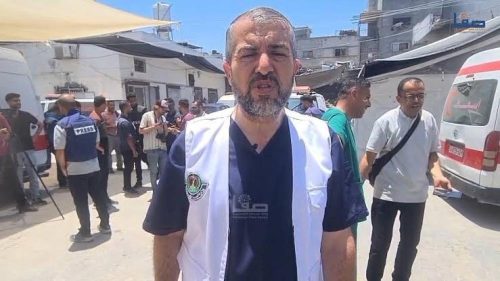
Palestinian Information Center – September 7, 2025
GAZA – Dr. Munir al-Bursh, director of Gaza’s health ministry, has affirmed that doctors and medical staff in Gaza City’s hospitals have decided to remain at their posts, staying close to children and all patients in intensive care units.
“There are more than 200 patients in intensive care who require life-support machines and artificial respiration, and these patients cannot be evacuated without facing certain death,” Dr. Bursh told Al Jazeera satellite channel on Sunday.
“If the Israeli occupation wants to kill us and our patients, so be it. We will not leave our hospitals or abandon our patients under any circumstances because the alternative is death,” he added.
He called for necessarily providing protection for hospitals and healthcare workers in Gaza in accordance with the Fourth Geneva Convention and international treaties.
AP Jerusalem chief participated in secretive Israeli govt anti-BDS event, leaked files reveal
By Max Blumenthal | The Grayzone | September 6, 2025

AP’s Israel-Palestine news director, Josef Federman, has spun data to minimize the Gaza death count. Leaked documents show he appeared on a panel aimed at assisting “Israel’s ability to effectively portray its narrative” during a gov’t-sponsored propaganda conference chaired by an ex-IDF official who legitimized killing journalists.
The Israeli massacre of five journalists in broad daylight on August 24, 2025 at Nasser Hospital in Gaza’s Khan Younis city prompted a sternly worded statement to the Israeli government from the Associated Press and Reuters, which each employed a reporter murdered by the IDF. The AP subsequently published a detailed investigation demonstrating that the Israeli military knowingly attacked a civilian target, then carried out a double tap strike after a rescue team and journalists arrived on the scene.
While the AP’s statement of outrage about the killing of its photographer in Gaza, Miriam Dagga, has brought the leading wire agency’s tension with the Israeli government to its height, the relationship with Tel Aviv was not always so adversarial.
The Grayzone has reviewed leaked documents revealing that the AP’s news director for Israel-Palestine, Josef Federman, participated in a private 2018 panel discussion aimed at assisting “Israel’s ability to effectively portray its narrative.” His host was a secretive Israeli government outfit dedicated to combatting the global BDS campaign to boycott, divest from, and sanction Israel. Called the Global Coalition For Israel (GC4I), the event was convened in Jerusalem on June 18, 2018 by Israel’s Ministry of Strategic Affairs and Diplomacy – the de facto propaganda arm of the Israeli government.
The moderator of the panel in which Federman participated was Avital Leibovich, the former spokeswoman for the IDF who has ardently defended the Israeli policy of defining Palestinian journalists as terrorists in order to assassinate them.
Federman has presided over the AP’s coverage of Israel-Palestine since 2014. Throughout Israel’s genocidal assault on Gaza began in October 2023, Federman has helped shape a narrative that has subtly but effectively advanced Tel Aviv’s objectives, regurgitating the baseless and comprehensively debunked claim that “Israelis were raped or sexually assaulted” on October 7; legitimizing Israel’s violent invasion and theft of Syrian land as a historical “shift,” and relying on bogus data from an Israel lobby-affiliated researcher to minimize the civilian death count in Gaza – a grim toll which now includes one of his colleagues at AP.
Federman’s penchant for uncritically quoting notoriously mendacious Israeli military officials has helped secure his reputation for biased coverage.
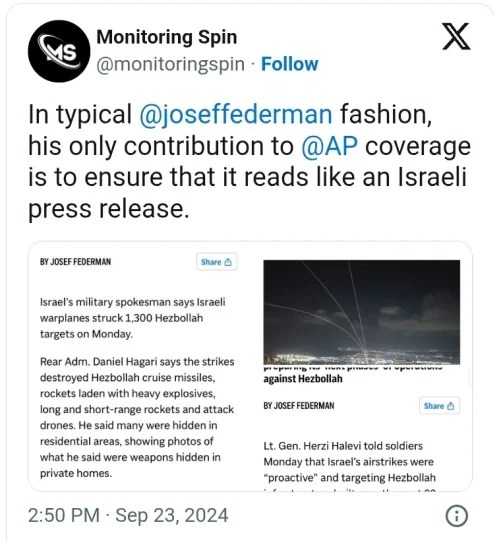
Federman’s participation in the 2018 Israeli government anti-BDS event appears to contradict clearly stated AP guidelines on conflicts of interest. According to the AP’s website, “We avoid addressing, or accepting fees or expenses from, governmental bodies; trade, lobbying or special interest groups; businesses, or labor groups; or any group that would pose a conflict of interest.”
In response to a detailed query from The Grayzone about Federman’s participation in the semi-covert conference, AP Vice President of Corporate Communications Lauren Easton stated, “Josef Federman is a professional journalist and a former chairman of Israel’s Foreign Press Association. It is not uncommon for journalists to speak about their work at conferences and other events. It remains AP policy to refrain from accepting honoraria, and that policy was followed here.”
The details of the GC41’s gathering were gleaned from a massive tranche of documents extracted by hackers from Israel’s Ministry of Justice in 2024. A full schedule and list of GC4I conference participants has never been seen before by the public.
View GC4I’s 2018 schedule here.

AP, other agencies join semi-secret Israeli gov’t event chaired by ex-IDF official who justified killing journalists
When GC4I gathered in 2018, it met at the Mamilla Hotel Conference Hall in Jerusalem for two days of discussions and briefings on the fight to crush the growing Palestine solidarity movement and its BDS campaign. The conference opened with an address by Sima Vaknin-Gil, then the Director-General of Israel’s Ministry of Strategic Affairs. A former Israeli intelligence official, Vakhnin-Gil had emerged as one of the most influential coordinators of the country’s propaganda efforts abroad, especially in the US, where she helps the Israeli government evade the Foreign Agent Registration Act law.
Her speech was followed by a discussion moderated by celebrity Republican pollster Frank Luntz on the feasibility of defining the BDS movement as a “hate group.” Further panels focused on “developing relations in the corridors of power” and “how… legislation in Europe and the United States can be used to reduce funding for organizations delegitimizing Israel.”
On the second day of the GC41 conference, Federman joined a panel aimed at “discuss[ing] the difficulties of reporting fairly and accurately on Israel, while dealing with issues such as BDS, delegitimization, and the Israel-Palestinian conflict.”
The panel was explicitly aimed at helping the Zionist operatives gathered at the GC4I “understand the shortcomings in Israel’s ability to effectively portray its narrative, what reporters are looking for when writing an article and why the anti-Israel camp’s narrative resonates in the Western world.”
Avital Leibovich, a former IDF spokeswoman who moved on to the American Jewish Committee, chaired the panel. During her stint at the IDF, Leibovich played a leading role in justifying Israel’s deliberate killing of journalists in the Gaza Strip. In 2012, for example, she fired off a letter to the New York Times which smeared Palestinian journalists slain at the hands of the Israeli military: “Such terrorists who hold cameras and notebooks in their hands, are no different from their colleagues who fire rockets aimed at Israeli cities and cannot enjoy the rights and protection afforded to legitimate journalists,” she wrote.
In 2016, Leibovich appeared at Washington DC’s Newseum amid protests – including by this reporter– and condemnation from the Palestinian Journalists’ Syndicate, which urged the institution in a May 31 letter “not to provide a platform to someone who has justified, on record and to a world audience, Israel’s grave violations of international law and war crimes, and in particular attacks against journalists and press freedoms.”
Chaired by Leibovich, the 2018 GC4I panel featured featured the Jerusalem Bureau Chief of RT, Paula Slier, and Laurent Lozano, who held the same position at Agence France Press, alongside the AP’s Federman. Slier has since left RT, while Lozano is currently AFP’s bureau chief in Dakar, Senegal.
Reached by The Grayzone, Slier described the gathering as “a very pleasant experience.”
She said she considered her participation in a semi-covert Israeli government conference as a normal part of her duties as a correspondent in Jerusalem. “It was a chance for them to hear how foreign channels worked in Israel,” Slier commented. “I used to participate and attend all conferences – whether they were pro-Israel or pro-Palestinian – I thought it important to engage with everyone, and it was also an opportunity to talk about RT.”
GC4I launched at “secret conference” with “closed sessions” on criminalizing BDS
GC4I’s first gathering took place in 2010, at a time of heightened Zionist anxiety about the rising global grassroots movement to boycott Israel. A who’s who of Israeli lobbyists from the US, UK and Australia were on hand, alongside Israeli officials from the office of Prime Minister Benjamin Netanyahu and the newly created Ministry of Strategic Affairs.
“The aim was to end the perceived lack of co-ordination within the pro-Israel movement, a concern frequently voiced by Israel-advocates,” wrote researcher Hil Aked.
Marcus Dysch of the Jewish Chronicle gained access to a 2014 GC4I meeting in London, England. He described it as a “secret conference… held in closed sessions amid heavy security.”
“We have the resources. We have the intelligence. Most important, we have unbounded determination,” Ronald Lauder, the billionaire Zionist financier and Netanyahu confidant, told the crowd of Jewish communal leaders and Israeli officials in London.
Lauder pledged to leverage his fortune to criminalize the BDS movement: “We will draft and lobby for legislation that will withhold government funding from academic institutions that boycott Israel.”
Reporting back to Jewish Federation at home, minimizing deaths in Gaza
Well before he emerged in the Middle East as a reporter, Josef Federman enrolled as a graduate student at Israel’s Hebrew University.
He grew up in Westborough, Massachusetts, where his parents helped found the B’nai Shalom Congregation, a Reform Jewish synagogue. Federman has returned on two occasions to deliver lectures at the synagogue, once in 2021 to discuss the Abraham Accords alongside an Israeli academic, and again in March 2024, during the height of Israel’s genocidal campaign in Gaza, for an event titled, “Reporting from Israel.” That speech was co-sponsored by the Jewish Federations of Central Massachusetts, a top sponsor of pro-Israel lobbying inside the US.
Two months later, the Israeli government seized camera equipment from the AP to prevent it from live-streaming video from the Israeli side of the northern Gaza frontier. While Israel announced that it would return the equipment and allow the broadcasts to continue, the event eerily foreshadowed the Israeli military’s double tap strike on the Reuters live position at the Nasser Hospital in Khan Younis this August 24.
The following month, Federman published a piece of “AP data analysis” that relied on dubious statistics to advance one of Israel’s most important propaganda objectives in Gaza. According to the headline of Federman’s piece, “Women and children are killed less frequently as war’s toll rises.” The article therefore implied that all men in Gaza between the ages of 18 and 59 were possible militants. Throughout the piece, Federman referred to Gaza’s Health Ministry as “Hamas-run,” casting doubt on its casualty counts.
To legitimize his conclusions, Federman turned to Gabriel Epstein, a researcher at the Washington Institute for Near East Policy, or WINEP, the most prolific think tank of the Israel lobby in Washington DC. WINEP director Robert Satloff, a veteran Israel lobbyist, praised the AP’s Federman for “tak[ing] a big step toward setting the record straight.”
Another researcher cited in the article, Michael Spagat, defended the quality of death counts by Gaza’s Health Ministry. Months later, in September 2024, Spagat revised his view of the death toll, declaring, “I now believe that the true death toll almost certainly exceeds the official total.”
This August, a review of an internal Israeli intelligence database further discredited Federman’s analysis, revealing that 83% of those killed by the Israeli military in Gaza were civilians.
Today, Federman’s “data analysis” on the Gaza death has been discredited by virtually every expert outside the Israel lobby, and by the gruesome reality on the ground. However, a revealing post remains on his personal LinkedIn page which shows him liking a rant by Idit Shamir, consul general of Israel in Toronto, mocking the official death count in Gaza:
“Isn’t it curious?” wrote the Israeli official. “Hamas is clueless about Israeli hostages’ status but has a crystal-clear count of Palestinian casualties before Israeli strikes even occur!”

Now that a fellow AP reporter, Miriam Dagga, has joined the tens of thousands of civilians murdered by Israel in Gaza over the past two years, Federman’s agency has been forced to release a rare expression of outrage at Tel Aviv. The indignation offers a stark contrast from the comity Federman displayed when he bantered at an Israeli government conference with the former IDF official who legitimized the policy that would claim Dagga’s life.
Elbit Systems shuts down UK site targeted by Palestine Action
Al Mayadeen | September 6, 2025
Elbit Systems UK’s arms factory in Bristol has gone quiet after years of determined resistance by Palestine Action, according to The Guardian, marking what campaigners see as a major victory against “Israel’s” largest weapons producer.
The Aztec West facility, repeatedly targeted by direct actions, now sits deserted save for a lone security guard at the gate. Although Elbit had a lease lasting until 2029, the company has offered no explanation for the site’s status.
Factory Silence
Palestine Action staged dozens of disruptive actions against the site, ranging from rooftop occupations and blockades to smashing windows and covering the premises in red paint to symbolize Palestinian blood. The latest protest, on July 1, came just days before the UK government banned the group under the Terrorism Act.
Campaigners argue that their actions have exacted a tangible toll. Elbit Systems UK swung from a £3.8 million profit in 2023 to a £4.7 million loss last year, with rising security costs and repeated shutdowns cited as key factors.
“This closure is extremely significant,” arms trade expert Andrew Feinstein told The Guardian. “We need to remind ourselves that Elbit (Systems) is one of the two most important Israeli arms firms, along with IAI, that is it is obviously a key component of Israel’s military industrial complex.”
Elbit Retreat
The closure in Bristol fits a broader pattern of Elbit’s retrenchment in Britain. In Oldham, an 18-month wave of roof occupations and blockades led to the sale of Ferranti P&C in 2022. In Tamworth, the company’s Elite KL subsidiary, targeted repeatedly by Palestine Action, was sold in 2024 after profits collapsed; its new owners, rebranding as Calatherm, pledged to scrap all defense contracts with Elbit.
Long-running campaigns at Shenstone in Staffordshire and at Instro Precision in Kent have also seen repeated shutdowns, rooftop occupations, and trials of activists, showing the breadth of pressure across Elbit’s UK operations.
Still, the company has not disappeared from Britain, The Guardian noted. Its Filton site in Bristol remains active, and 24 activists face trial for actions carried out there, including charges of criminal damage and aggravated burglary. Meanwhile, Elbit is reportedly close to securing a £2 billion Ministry of Defence contract as a “strategic partner”, a deal that former Labour minister Peter Hain has urged the government to block, citing “the devastation unfolding in Gaza.”
Defiant Resistance
Palestine Action has vowed to continue targeting Elbit and its partners. Though proscribed in July, the group has secured permission for a judicial review of the government’s decision in November. The Home Secretary is set to appeal that ruling later this month.
For campaigners, the deserted Aztec West site stands as proof that sustained action can shake even the most entrenched corporations. It also sends a message: as long as companies profit from “Israel’s” assault on Gaza, they will face resistance on British soil.
Featured Video

The Truth About the Trump Shootings with Ken Silva
or go to
Aletho News Archives – Video-Images
From the Archives
Trans ‘milk’ as good as the real thing – NHS
RT | February 18, 2024
The drug-induced nipple secretions of trans women are as good as mothers’ breast milk for babies, the University of Sussex Hospitals NHS Trust claimed in a letter to campaigners made public in a report by British think tank the Policy Exchange on Sunday.
The healthcare trust’s medical director, Rachel James, argued that the off-label prescription drug cocktail men transitioning to female take in order to produce milk was “similar to the natural hormones which encourage lactation to develop when the baby is newly born.”
“The evidence which is available demonstrates that the milk is comparable to that produced following the birth of a baby,” James wrote in the letter, sent to Children of Transitioners last August.
Biological men who wish to lactate must first take hormones to grow milk glands and then take high doses of either domperidone or metoclopramide to stimulate milk production. Neither drug is approved for this use, though they are occasionally prescribed off-label to biological women who have trouble lactating.
However, domperidone’s own manufacturer, Janssen, warns patients the drug “may cause unwanted side effects affecting the heart in a breastfed baby” and “should be used during breastfeeding only if your physician considers this clearly necessary.” … continue
Blog Roll
 Aletho News
- Seyed M. Marandi: U.S. Strike Imminent – Toward Total War in the Middle East
- Russia Voted Under Fire. Washington Is Loading the Tankers.
- 12 Things Your Oncologist Was Trained Not to Tell You
- Anthrax Attacks Paved Way for COVID-Era ‘Junk Drugs and Vaccines’
- How Real Is the Impact of Western Sanctions on Israel?
- France, You Are Guilty: How Paris Turned Western Sahara into the Maghreb’s Powder Keg
- 2025 Nature Paper Claiming Worsening Global Drought Gets RETRACTED …Heavily Flawed
- Your Milk Is Not the Problem
- The Truth About the Trump Shootings with Ken Silva
- ARE PATIENTS BEING PROPERLY INFORMED ABOUT OZEMPIC?
- If Americans Knew
- Salah Sarsour’s Legal Team Says DHS Has Not Met Its Burden to Prove He Is Deportable
- An analysis of tax forms by The Intercept show Kraft’s charity and LLC have donated to Friends of the IDF and AIPAC’s super PAC.
- Israeli attacks kill four Palestinians in Gaza – Daily Update
- Inside Gaza’s death trap of collapsing, bombed-out buildings
- The everyday items Israel bans from Gaza every day
- Inside the siege, the ruined buildings of Gaza – Daily Update
- Debunking The Claim That Macklemore Has A “History Of Antisemitism”
- CPJ demands release of arrested Palestinian-US journalist near Bethlehem
- Robert Kraft: The Billionaire Friend of Netanyahu Pulling The Strings Behind the Macklemore/Ed Sheeran Blow Up
- Columbia Administered Fund Gives Big Money to Pro-Israel Groups
- No Tricks Zone
- 2025 Nature Paper Claiming Worsening Global Drought Gets RETRACTED …Heavily Flawed
- New Study: ‘Global Drought Shows No Detectable Recent Acceleration Under Climate Warming’
- Economic Masterminds: German Socialists Suggest Taxing Productivity Gains Stemming From Using AI
- The South China Sea Has Not Been Cooperating With The Climate Change Narrative
- Energy Crisis: Germany Enters Heating Season With Historically Low Gas Reserve Fill Levels
- New Study: The Antarctic Ice Sheet Gained Mass From 2020-2024 Due To Staggering Snow And Ice Accumulation
- Study: Ocean Heating Rates From Thousands Of Years Ago ‘Dwarf’ Modern Ocean Heating Rates
- Climate Extremists Target, Attack Large-Scale Power Grid Infrastructure In Germany!
- New Study: Antarctic Ice Melt Has Contributed Less Than 1 Centimeter To Sea Level Rise In The Last 30 Years
- Fear Of Debate: Alarmist German Climate Scientist Calls On Mainstream Media To Discredit Skeptic Voices
 Aletho News