Saudi Arabia’s King Salman bin Abdulaziz has called for emergency meetings of the Persian Gulf Cooperation Council ([P]GCC) and the Arab League, following mysterious “sabotage” attacks on Saudi and Emirati oil tankers as well as drone strikes targeting Saudi oil pumping stations.
The official Saudi Press Agency (SPA) reported on Saturday that Salman had invited Arab leaders to convene urgent summits in the city of Mecca on May 30 to discuss ways to “enhance the security and stability in the region.”
An official source at the Saudi Foreign Ministry said that the Saudi monarch had called the meetings due to “grave concerns” about recent attacks on commercial vessels off the coast of the United Arab Emirates and drone strikes on oil pumping stations in Saudi Arabia as well as the effects of those incidents on supply routes and oil markets.
The summits are meant “to discuss these aggressions [sic] and their consequences on the region,” the source said.
The Emirates’ Ministry of Foreign Affairs and International Cooperation has welcomed the Saudi call for the emergency meetings.
“The current critical circumstances entail a unified Arab and [Persian] Gulf stance toward the besetting challenges and risks,” the ministry said in a statement.
On May 12, four oil tankers, including two Saudi ones, were purportedly targeted near the port of Fujairah, in what the Emirates described as “sabotage” attacks. While Riyadh and Abu Dhabi failed to produce evidence of the attacks on their vessels, pictures emerged of a Norwegian-flagged tanker at the port having sustained some damage.
Two days later, drone strikes were launched on two oil pumping stations in Saudi Arabia. These attacks were believed to have been carried out by Yemen’s Houthi fighters in retaliation for the prolonged Saudi war against Yemen.
The attacks led Saudi Arabia to halt its main cross-country oil pipeline temporarily.
Saudi and Emirati officials have not said who carried out the attacks on the tankers and the pumping stations, but some political and media figures within the United States have claimed that Iran is responsible.
A day after the reported attacks on the oil tankers, Tehran called them “worrying,” and Iranian Foreign Minister Mohammad Javad Zarif later called them “suspicious.”
Yemen’s Houthis also noted that the retaliatory drone strikes on the Saudi oil pipeline were an act of self defense and had nothing to do with Iran.
Pompeo calls bin Salman
On Saturday night, Saudi Crown Prince Mohammed bin Salman held a phone conversation with US Secretary of State Mike Pompeo.
The SPA reported that the two sides exchanged views on the “developments in the region and efforts to enhance security and stability.”
Jubeir claims Riyadh doesn’t seek war
In a separate development on Sunday, Saudi Minister of State for Foreign Affairs Adel al-Jubeir claimed that his country did not want a war with Iran.
“The kingdom of Saudi Arabia does not want a war in the region nor does it seek that,” he told a press conference in Riyadh.
“It will do what it can to prevent this war and at the same time it reaffirms that in the event the other side chooses war, the kingdom will respond with all force and determination, and it will defend itself and its interests,” he added.
Hypocritical to the core, the execution of false-flag events spare aggressive states the ignominy of appearing in public as the warmongering psychopaths they are, lest their subjects get the wrong idea as to exactly who is governing over them.
The last thing tyrannical rulers want, after all, are battles raging on two fronts, especially if one of those fronts just happens to be back in the Heartland. Psychopaths are mentally deranged, of course, but that does not mean they are necessarily stupid.
Thus, once again, the United States is flying its jolly tricolors from the Mediterranean Sea into the Persian Gulf led by the aircraft carrier USS Abraham Lincoln, as well as nuclear-capable B-52 bombers and a Patriot missile battery on standby. But America’s reputation as a rabble-rouser and hell raiser long preceded its entry into the Gulf, as did the frenetic rhetoric.
Just as the fleet was en route, US Secretary of State Mike Pompeo delivered a warning that was so far beyond the pale of reality that it sounded as though it were scripted by a Hollywood film director with a penchant for embellishing American history.
“The response of the United States and our partners and allies has been clear: We do not seek war,” the statement reads. “But Iran’s forty years of killing American soldiers, attacking American facilities, and taking American hostages is a constant reminder that we must defend ourselves.”
Forty years of killing Americans? Really? That comment brought to mind Pompeo’s recent display of braggadocio as he reminisced over his former CIA days. “We lied, we cheated, we stole,” he confessed with a hearty chuckle to an audience from Texas A&M University last month. “We had entire training courses. It reminds you of the glory of the American experiment.”
Ah yes, the glory days. Next he’ll be shooting off about how he enjoys shaving with napalm in the morning, or some such nonsense.
In any case, the prospect of America’s leading diplomat who basically admits to being a bald-faced liar, and darn proud of it, delivering a fiery shot across the bow of the Iranian Republic at the same time a large US naval group is entering the Persian Gulf and Iran is struggling under severe sanctions does very little to instill much comfort or confidence.
One week before the US naval fleet turned up in Gulf waters, Pompeo was already laying the necessary groundwork for the buildup, saying that the US has observed “escalatory actions from the Iranians, and it is equally the case that we will hold the Iranians accountable for attacks on American interests,” he said, without providing any details. “If these actions take place — if they do by some third-party proxy, a militia group, Hezbollah — we will hold the Iranian leadership directly accountable for that.”
Now for anyone who followed the protracted Syrian crisis understands, that is exactly the sort of crazy talk that inspires friends and foes alike to pull off a false-flag attack that will force the United States to live up to its word and go after the villains, which will predictably be – as was the case following the chemical attacks against the Syrian rebels when the ‘Assad regime’ was duly blamed – the Islamic Republic of Iran.
So where did the information regarding a possible Iranian strike on some “American interest” derive? According to Axios, that news was delivered to National Security Advisor John Bolton by an Israeli delegation led by national security adviser Meir Ben Shabbat.
It is not too much of a stretch of the imagination to figure that the Israelis may have produced the report knowing full well that it would ratchet up tensions between Washington and Tehran, and more so when it is understood that the mad hatters Pompeo and Bolton figure into the calculus. Who knows? Perhaps they really do mean what they have been saying for years about Iran and would relish the prospects of an ‘Iranian attack,’ or false flag event in order to get World War III, which they both seem to anticipate with more excitement than the Second Coming.
Meanwhile, it should come as no surprise that the mainstream media is doing everything in its power to stoke the flames. On Monday, the New York Times, citing unnamed sources, published an article alleging that the White House was drafting plans to deploy some 120,000 troops to the Middle East in the event Iran attacked US forces or expedited work on nuclear weapon research. The paper giddily reported that such a force “would approach the size of the American force that invaded Iraq in 2003.” Trump, however, ruined the war party, flat out denying the claim, saying he would send a lot more than 120,000 troops under such circumstances.
To underscore exactly how dangerous the situation is becoming, Sputnik reported that four commercial ships – two Saudi, one Emirati and one Norwegian – were targets of a “sabotage attack” off the coast of the United Arab Emirates (UAE) on Sunday.
It should come as no surprise as to what country was blamed. “Iranian or Iranian-backed proxies” are thought to be behind the attack, according to US officials.
Although Iran in the past may have played down such provocations, this time around they are showing a striking level of confidence in the face of American firepower. “An aircraft carrier that has at least 40 to 50 planes on it and 6000 forces gathered within it was a serious threat for us in the past,” Amirali Hajiadeh, who heads Iran’s Revolutionary Guard’s aerospace unit, told the Iranian Students’ News Agency (ISNA), as reported by RT. “But now, the threats have switched to opportunities,” he added.
The only thing left to consider now is whether Trump left Bolton and Pompeo to their own mischievous devices in their dealings with Iran and even Israel, or is there some sort of safety catch on the gun, so to speak.
Considering that Trump didn’t seem to be fully informed as to what was happening in Venezuela with regards to puppet president Juan Guaido’s recent failed attempt at a coup, it makes one wonder if Trump is equally in the dark as to what is happening with Iran. The prospect of such a possibility is simply too terrifying to even contemplate.
NEW YORK — For nearly two decades, one of the most overlooked and little known arrests made in the aftermath of the September 11 attacks was that of the so-called “High Fivers,” or the “Dancing Israelis.” However, new information released by the FBI on May 7 has brought fresh scrutiny to the possibility that the “Dancing Israelis,” at least two of whom were known Mossad operatives, had prior knowledge of the attacks on the World Trade Center.
Shortly after 8:46 a.m. on the day of the attacks, just minutes after the first plane struck the World Trade Center, five men — later revealed to be Israeli nationals — had positioned themselves in the parking lot of the Doric Apartment Complex in Union City, New Jersey, where they were seen taking pictures and filming the attacks while also celebrating the destruction of the towers and “high fiving” each other. At least one eyewitness interviewed by the FBI had seen the Israelis’ van in the parking lot as early as 8:00 a.m. that day, more than 40 minutes prior to the attack. The story receivedcoverage in U.S. mainstream media at the time but has since been largely forgotten.
The men — Sivan Kurzberg, Paul Kurzberg, Oded Ellner, Yaron Shimuel and Omar Marmari — were subsequently apprehended by law enforcement and claimed to be Israeli tourists on a “working holiday” in the United States where they were employed by a moving company, Urban Moving Systems. Upon his arrest, Sivan Kurzberg told the arresting officer, “We are Israeli; we are not your problem. Your problems are our problems, The Palestinians are the problem.”
For years, the official story has been that these individuals, while they had engaged in “immature” behavior by celebrating and being “visibly happy” in their documenting of the attacks, had no prior knowledge of the attack. However, newly released FBI copies of the photos taken by the five Israelis strongly suggest that these individuals had prior knowledge of the attacks on the World Trade Center. The copies of the photos were obtained via a FOIA request made by a private citizen.
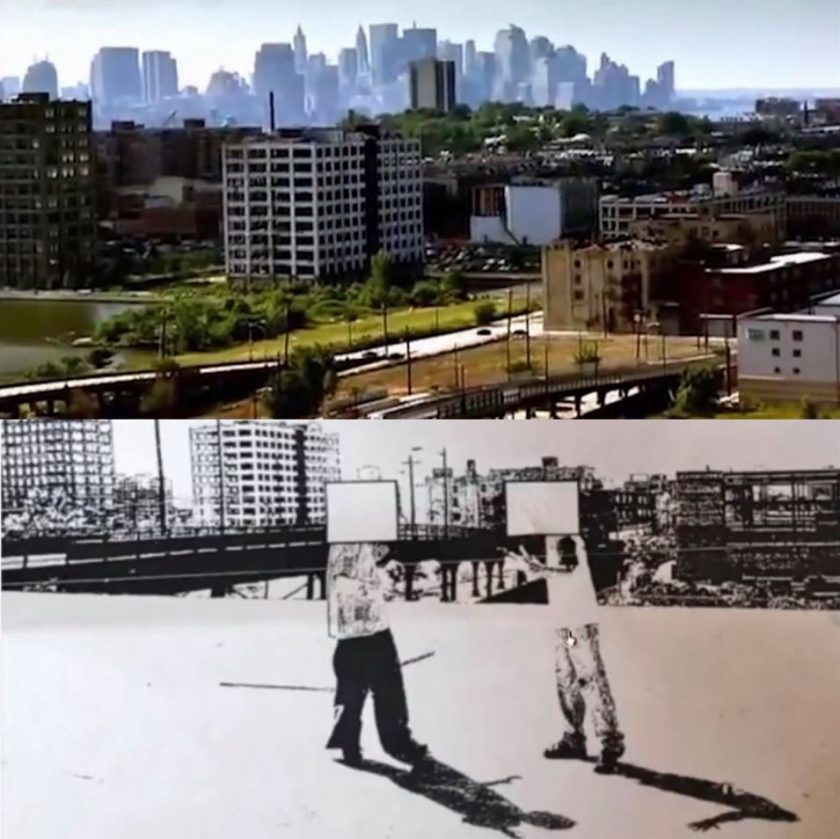
A high-quality photo, top, shows the area the dancing Israelis were staged. Credit | Panamza
According to a former high-ranking American intelligence official who spoke to the Jewish Daily Forward in 2002, the FBI concluded in its investigation that the five Israelis arrested “were conducting a Mossad surveillance mission and that their employer, Urban Moving Systems of Weehawken, NJ, served as a front.” At least two of the men arrested were determined to have direct links to the Mossad after their names appeared in a CIA-FBI database of foreign intelligence operatives. According to one of their lawyers, one of the men, Paul Kurzberg, had previously worked for the Mossad in another country prior to arriving in the United States. Another of those arrested, Oded Ellner, subsequently stated on Israeli TV that the five Israelis had been in New York at the time “to document the event,” meaning the attack on the World Trade Center.
The FOIA release of the photos is notable because responses to prior FOIA requests to the Department of Justice, which oversees the FBI, had previously claimed that all of the photos taken by the Israeli nationals had been destroyed in January 2014. The photos themselves are heavily redacted, making it impossible to see the Israelis’ facial expressions. However, previously declassified yet heavily redacted FBI reports state that the Israelis are “visibly happy” in nearly every photo, even when the burning towers are in the background. The photos released are also not original copies and instead appear to be photocopies of photocopies of the original pictures. In addition, of the original 76 pictures developed by authorities from the camera in the Israelis’ possession, only 14 were released.
However, three of these photos — despite the heavy redaction and poor quality — are damning. Since 2001, even though the photos were never released until now, it had been known that one of the Israelis arrested — Sivan Kurzberg — was seen in a photo “holding a lighted lighter in the foreground, with the smoldering wreckage [of the twin towers] in the background,” according to Steven Noah Gordon, then-lawyer for the five Israelis, as cited in a New York Timesreport from November 2001.
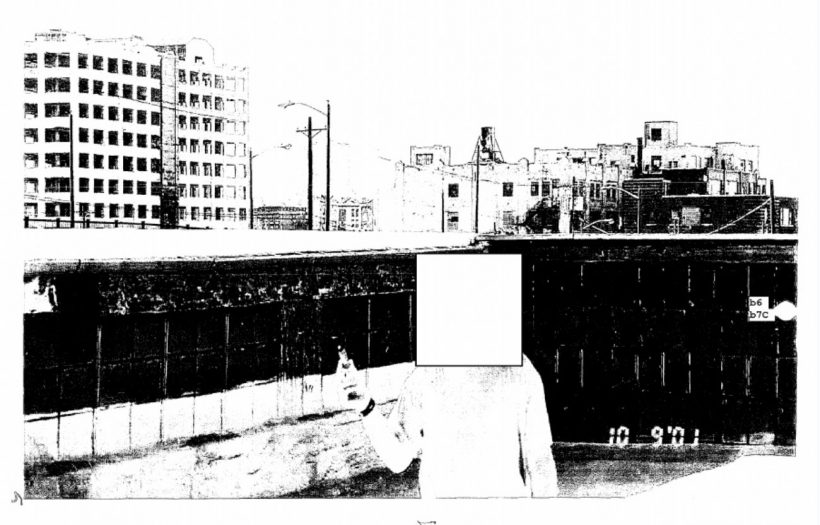
The picture of Kurzberg with the lit lighter appears to be photo #5 in the new FOIA release. Yet, the picture released includes a visible date of September 10, 2001, the day before the attacks, as do two other photos — images #7 and #8 in the collection — whereas all other photos with dates show only the month and the year (9 ‘01). The FOIA release did not provide any information as to the apparent discrepancy in dates.
While this could be explained away as the camera in question being programmed with a slightly inaccurate date, that doesn’t seem to be the case for two reasons. First, only two out of the 14 pictures carry that date and, second, previously declassified FBI reports report an eyewitness adamantly stating that Sivan Kurzberg had visited the Doric Apartments on September 10, 2001 at around 3 p.m. with at least one other man, with whom he was conversing in a foreign language, and had identified himself as a “construction worker” to a tenant (page 61 of declassified FBI report).
Sivan Kurzberg holds a lit lighter with the Manhattan skyline in the background. The date September 10, 2001 visible in the bottom right corner | Photo #5
In addition, the FBI report noted that a van from Urban Moving Systems, the company that employed the five Israelis at the time of their arrest, was present and was involved in moving a tenant out of the complex on September 10 and that the movers all had foreign accents. Thus, images 5, 7 and 8 strongly appear to have been taken at the same complex a day before the attacks. Kurzberg is seen in both images that display the visible date of September 10, 2001.
This raises two possibilities. First, that there are two images of Kurzberg with a lit lighter in front of the towers, one taken before the attack and one taken at the time of the attack, and that the FBI released only one of them. Second, that Kurzberg took the picture with the lighter only the day before the attack and his lawyer misrepresented the contents of the photo to the New York Times. Given that the background of the photo — particularly the state of the towers — is indiscernible in the recently released photo, it is difficult to determine which is the case.
One of the Israelis points to what is presumably the World Trade Center, in Manhattan on September 11, 2001 | Photo #2
Yet, in either scenario, Kurzberg had simulated the burning of the World Trade Center the day before the attacks took place. That the FBI concluded that Kurzberg was party to a Mossad surveillance operation at the time of his arrest would then suggest that Israeli intelligence also had foreknowledge of the attacks.
Notably, the relevant section of the FBI report that asks “1. Did the Israeli nationals have foreknowledge of the events at WTC and were they filming the events prior to and in anticipation of the explosion?” is redacted in its entirety, suggesting that the FBI did not determine the answer to that question to be an emphatic “no.”
One of the 9/11 loose-ends coverups?
If images 5 and 7 were indeed taken the day prior to the attack, the question then becomes why the FBI officially concluded that the arrested Israelis had no prior knowledge of the attacks? One report from ABC News dated June 2002 suggests that the Bush administration intervened in the investigation. That report states that “Israeli and U.S. government officials worked out a deal — and after 71 days, the five Israelis were taken out of jail, put on a plane, and deported back home [to Israel].” If the Bush administration had cut a deal with Israel’s government to cover up the incident, it certainly would not have been the first time a U.S. presidential administration had done so on Israel’s behalf.
Further evidence that higher-ups in the administration intervened is the fact that then-Attorney General John Ashcroft personally signed off on the detainees’ release. Upon his entering the private sector as a lobbyist and consultant in 2005, the Israeli government became one of Ashcroft’s first clients.
A cover-up certainly seems to have happened to some extent, between the destruction of records of the investigation and the fact that official conclusions of the investigation do not add up. In the latter case, the FBI — in a file dated September 24, 2001– officially stated that they “determined that none of the Israelis were actively engaged in clandestine intelligence activities in the United States.” However, that conclusion was directly contradicted by U.S. officials a year later and by the fact that Israel’s own government subsequently acknowledged that the five Israelis had indeed been involved in “clandestine intelligence activities in the United States.”
In addition, the new FOIA release of the photos suggests that another FBI conclusion — that “none of the pictures developed from the film found inside the 35-mm camera depicted the twin towers prior to the attack” — was inaccurate. This may explain why the images released via the recent FOIA request were heavily edited leaving details in the background greatly obscured, making it impossible to determine whether the photos were taken prior to or during the attacks based solely on the state of the towers.
“Tourists” with cash-stuffed socks, box cutters, and explosives?
Beyond the photos and observed activities of the so-called “Dancing Israelis,” it is worth revisiting several other suspicious circumstances linked to their arrest that clearly show that the men in question were hardly the “tourists” they had claimed to be. One often cited example is the fact that one of the men, Oded Ellner, had a “white sock-like sack filled with $4,700 in cash,” as well as maps of the city with certain places highlighted, and box cutters. In addition, the van in which the Israelis were arrested was “oddly” lacking “equipment typically used in a moving company’s daily duties,” according to the FBI, and residue of explosives was found in the van.
Of the explosive residue, the declassified FBI report states:
A search of the van and individuals was conducted at the time of the vehicle stop. The vehicle was also searched by a trained bomb-sniffing dog which yielded a positive result for the presence of explosive traces. Swabs of the vehicle’s interior were taken, and those samples were sent to the FBI laboratory for further analysis. Final results are still pending.”
In total, the FBI reported that four items related to explosives were found in the ban and are labeled in the report as “Fabric Sample (Explosive Residue),” “Control Swabs – SA [ – ] Gloves,” “Control Swabs – (Bomb Suits),” and “Blanket Samples For Explosive Residue.” In addition, a VHS tape and some still photographs found in the van “were sent to Laboratory Examiner [ redacted ] (Explosives Unit).”
In addition to the strange nature of some of the Israelis’ possessions in the van and on their person, the company that employed them — Urban Moving Systems — was of special interest to the FBI, which concluded that the company was likely a “fraudulent operation.” Upon a search of the company’s premises, the FBI noted that “little evidence of a legitimate business operation was found.” The FBI report also noted that there were an “unusually large number of computers relative to the number of employees for such a fairly small business” and that “further investigation identified several pseudo-names or aliases associated with Urban Moving Systems and its operations.”
The FBI presence at the Urban Moving Systems search site drew the attention of the local media and was later reported on both television and in the local press. A former Urban Moving Systems employee later contacted the Newark Division with information indicating that he had quit his employment with Urban Moving Systems as a result of the high amount of anti-American sentiment present among Urban’s employees. The former employee stated that an Israeli employee of Urban had even once remarked, “Give us twenty years and we’ll take over your media and destroy your country” (page 37 of the FBI report).
The FBI returned to search the premises of Urban Moving Systems a month later, but by that time found:
The building and all of its contents had been abandoned by… the owner of Urban Moving Systems. This [was] apparently being done to avoid criminal prosecution after the 09/11/2001 arrest of five of his employees and subsequent seizure of his office computer systems by members of the FBI-NK on or around 09/13/2001.”
The company’s owner — Dominik Otto Suter, an Israeli citizen — had fled to Israel on September 14, 2001, two days after he had been questioned by the FBI. The FBI told ABC News that “Urban Moving may have been providing cover for an Israeli intelligence operation.” Surprisingly, since at least 2016, Suter has been living in the San Francisco Bay Area, where he works for a contractor for major tech companies like Google and Microsoft. According to the public records database Intelius, in 2006 and 2007 Suter also worked for a telecommunications company — Granite Telecommunications — that works for the U.S. military and several other U.S. government agencies.
In addition to Urban Moving Systems, another moving company, Classic International Movers, became of interest in connection with the investigation into the “Dancing Israelis,” which led to the arrest and detention of four Israeli nationals who worked for this separate moving company. The FBI’s Miami Division had alerted the Newark Division that Classic International Movers was believed to have been used by one of the 19 alleged 9/11 hijackers before the attack, and one of the “Dancing Israelis” had the number for Classic International Movers written in a notebook that was seized at the time of his arrest. The report further states that one of the Israelis of Classic International Movers who was arrested “was visibly disturbed by the Agents’ questioning regarding his personal email account.”
A crowded dance floor
While the case of the “Dancing Israelis” has long been treated as an outlier in the aftermath of September 11, what is often overlooked is the fact that hundreds of Israeli nationals were arrested in the aftermath of the attacks.
According to a FOX News report from December 2001, 60 Israelis were apprehended or detained after September 11, with most deported, and a total of 140 Israelis were arrested and detained in all of 2001 by federal authorities. That report claimed that the arrests, ostensibly including the “Dancing Israelis,” were in relation to an investigation of “an organized [Israeli] intelligence gathering operation designed to ‘penetrate government facilities.’”
The report also added that most of those arrested, in addition to having served in the IDF, had “intelligence expertise” and worked for Israeli companies that specialized in wiretapping. Some of those detained were also active members of the Israeli military; and several detainees, including the “Dancing Israelis,” had failed polygraph tests when asked if they had been surveilling the U.S. government.
Watch | FOX News December 2001 report on Mossad spying prior to 9/11
A key aspect of that report, compiled by journalist Carl Cameron, also states that federal investigators widely suspected that Israeli intelligence had prior knowledge of the September 11 attacks. In the report, Cameron stated:
The Israelis may have gathered intelligence about the attacks in advance and not shared it. A highly placed investigator said there are ‘tie-ins’ but when asked for details he flatly refused to describe them saying: ‘Evidence linking these Israelis to 9-11 is classified. I cannot tell you about the evidence that has been gathered. It is classified information.’”
One exchange between Cameron and host Brit Hume included in the report is particularly telling:
HUME: “Carl, what about this question of advanced knowledge of what was going to happen on 9/11? How clear are investigators that some Israeli agents may have known something?”
CAMERON: “Well it’s very explosive information obviously and there is a great deal of evidence that they say they have collected. None of it necessarily conclusive. It’s more when they put it all together a big question they say is, ‘How could they have not known?’ — almost a direct quote, Brit.”
9/11 as a big — and acknowledged — Israeli win
If the “Dancing Israelis”, and more broadly the Mossad and the Israeli government, had foreknowledge of September 11, why would they remain silent and not attempt to warn the American government or public of the coming attacks? In the case of the “Dancing Israelis,” why would Israelis celebrate such an attack?
One of the detained “Dancing Israelis,” Omer Marmari, told police the following about why he viewed the September 11 attacks in a positive light:
Israel now has hope that the world will now understand us. Americans are naïve and America is easy to get inside. There are not a lot of checks in America. And now America will be tougher about who gets into their country.”
While Marmari’s statement may suggest one reason some of the “Dancing Israelis” were so “visibly happy” in their photographs, there are also other statements made by top Israeli politicians that suggest why the Israeli government and its intelligence agency declined to act on apparent foreknowledge of the attack.
When asked, on the day of the 9/11 attacks, how the attacks would affect American-Israeli relations, Benjamin Netanyahu — the current Israeli prime minister — told the New York Times that “It’s very good,” before quickly adding “Well, not very good, but it will generate immediate sympathy.” He then predicted, much as Marmari had, that the attacks would “strengthen the bond between our two peoples, because we’ve experienced terror over so many decades, but the United States has now experienced a massive hemorrhaging of terror.”
Netanyahu, in a candid conversation recorded in 2001, also echoed Marmari’s claim that Americans are naïve. In that recording, Netanyahu said:
I know what America is. America is something that can easily be moved. Moved to the right direction. … They won’t get in our way. They won’t get in our way… 80 percent of the Americans support us. It’s absurd.”
In addition, also on the day of the September 11 attacks, Netanyahu — who at the time was not in political office — held a press conference in which he claimed that he had predicted the attacks on the World Trade Center by “militant Islam” in his 1995 book, Fighting Terrorism: How Democracies Can Defeat Domestic and International Terrorism. In that book, Netanyahu had posited that Iranian-linked “militants” would set off a nuclear bomb in the basement of the World Trade Center.
During his press conference on the day of the attacks, Netanyahu also asserted that the 9/11 attacks would be a turning point for America and compared them to the 1941 attack on Pearl Harbor. Netanyahu’s statement echoes the infamous line from the “Rebuilding America’s Defenses” document authored by the neoconservative think tank, the Project for a New Ameican Century (PNAC). That line reads. “Further, the process of transformation [towards a neo-Reaganite foreign policy and hyper-militarism], even if it brings revolutionary change, is likely to be a long one, absent some catastrophic and catalyzing event — like a new Pearl Harbor.”
Then again, years later In 2008, the Israeli newspaper Maariv reported that Netanyahu had stated that the September 11 attacks had greatly benefited Israel. He was quoted as saying: “We are benefiting from one thing, and that is the attack on the Twin Towers and Pentagon, and the American struggle in Iraq.”
Indeed, it goes without saying that the aftermath of 9/11 — which involved the U.S. leading a destructive effort throughout the Middle East — has indeed benefited Israel. Many of the U.S.’ post-9/11 “nation-building” efforts have notably mirrored the policy paper “A Clean Break: A New Strategy for Securing the Realm,” which was authored by American neoconservatives — PNAC members among them — for Netanyahu’s first term as prime minister.
That document calls for the creation of a “New Middle East” by, among other things, “weakening, containing, and even rolling back Syria” and “removing Saddam Hussein from power in Iraq — an important Israeli strategic objective in its own right.” As is known now, both of those main objectives have since come to pass, each withstrong Israeli involvement.
Whitney Webb is a MintPress News journalist based in Chile. She has contributed to several independent media outlets including Global Research, EcoWatch, the Ron Paul Institute and 21st Century Wire, among others. She has made several radio and television appearances and is the 2019 winner of the Serena Shim Award for Uncompromised Integrity in Journalism.
Since then it has gotten a lot of play all across the alternate media (you can read our original report here, but there were manyotherstoo).
It has received virtually zero coverage in the mainstream media, of course. And that doesn’t appear likely to change any time soon.
The report spells out, in unambiguous language, that the two chlorine gas canisters were likely planted, rather than dropped from a helicopter.
In summary, observations at the scene of the two locations, together with subsequent analysis, suggest that there is a higher probability that both cylinders were manually placed at those two locations rather than being dropped.”
This finding adds to the pile of evidence which makes it appear very likely the whole event was staged.
The only question was whether or not the document could be confirmed genuine. And now it has been.
Peter Hitchens, for a long time the only mainstream voice to express any doubts about the “official narrative” on Douma, wrote to the OPCW to ask about the leaked report.
He wrote a column about it. We suggest you read it, but the most important passage, taken directly from an OPCW statement, is this:
Pursuant to its established policies and practices, the OPCW Technical Secretariat is conducting an internal investigation about the unauthorised release of the document in question.
Note the language. Nowhere is it disputing either the findings of the document, nor the veracity. Instead, they are “conducting an investigation” into its “unauthorised release”.
That is as close to an admission as makes no difference. For now, we can safely conclude the document is real, and the findings genuine.
That means, not only that the Douma “chemical attack” was likely staged, but that the OPCW knew this and chose to cover it up.
A very distressing series of events, and one that could easily have lead to an all-out war between Syria, Russia and NATO.
We welcome the OPCW’s admission that this document is genuine. However, we would suggest the question is not “How was it leaked?”, but rather “Why was it suppressed in the first place?”
Kit Knightly is co-editor of OffGuardian. The Guardian banned him from commenting. Twice. He used to write for fun, but now he’s forced to out of a near-permanent sense of outrage.
After dramatic and patently scripted warnings of “Iranian aggression” by bellicose US officials, there then follows – conveniently enough – an alleged sabotage incident in the Persian Gulf region implicating Iran.
Meanwhile, US Secretary of State Mike Pompeo poses with a straight face that his country doesn’t want war with Iran. His comments warp credulity given that American forces have suddenly escalated firepower in the Persian Gulf for the purpose of “responding” to alleged Iranian infractions.
Typically, Western news media are “reporting” (or rather, “echoing”) the purported sabotage incident as if it were fact, basing their source of information on Saudi and Emirati officials, sources which have a vested interest in creating a war pretext against Iran.
Given the grotesque, barefaced lies that have emanated from the Saudi regime over the past year with regard to the murder of journalist Jamal Khashoggi and also its barbaric, mass executions of political dissidents, it is nauseating how Western media can affect to be so credulous in citing Saudi claims as reliable over the latest alleged shipping incident.
“Two Saudi oil tankers have been sabotaged off the coast of the United Arab Emirates posing a potentially serious threat to world oil supplies,” reports [sic] Britain’s Guardian, attributing the source of this information to the “Saudi government”. What the Guardian omitted was the key word “alleged” before “sabotage”. Notice how the impression given is one of a factual incident of malicious intent. Most other Western news media adopted the same reliance on the official Saudi and Emirati claims.
Tellingly, however, Saudi and Emirati officials gave no details about the “significant damage” allegedly caused to a total of four tankers.
What we seem to know is that the four vessels were somehow disabled off the UAE port of Fujairah early on Sunday. The location at sea is in the Gulf of Oman, which lies outside the Persian Gulf, about 140 kilometers south from the Strait of Hormuz. The latter is the narrow passage from the Gulf of Oman into the Persian Gulf, through which up to 30 per cent of all globally shipped crude oil passes each day.
Last week, Iran once again threatened it would blockade its territorial waters in the Strait of Hormuz “if” the US carried out a military attack on it. Such a move by Iran would throw the global economy into chaos from the anticipated crisis in oil markets. It would also doubtless trigger an all-out war between the US and Iran, with American regional client regimes like Saudi Arabia and Israel piling in to facilitate attacks against Tehran.
So far, there have been no official accusations explicitly made against Iran over the latest shipping incident. But the implications are pointedly skewed to frame-up the Islamic Republic.
Saudi energy minister Khalid al Falih, whom Western media have quoted uncritically, claimed that one of the vessels allegedly attacked was on its way to load up on crude oil from the Saudi port of Ras Tanura, destined for the US market. The Saudi official did not give any substantiating details on the alleged sabotage, but emphasized that it was aimed “to undermine the freedom of navigation”. He called on international action to “protect security of oil tankers”. Wording that the American self-appointed global “policeman” (more accurately, “thug”) invokes all the time to cover for its imperialist missions anywhere on the planet.
When the US warned last week that it was sending a naval carrier strike armada to the Persian Gulf along with nuclear-capable B-52 bombers, it assumed the right to hit “Iran or its proxies” for any alleged attack on “American interests”. The wording out of Washington is so vague and subjective that it lends itself to any kind of perceived provocation.
An oil tanker on its way to collect crude from Saudi Arabia for the US market? That certainly could qualify as perceived Iranian aggression against American vital interests.
Last week, Washington issued hammed-up warnings that “Iran or its proxies” was set to “target commercial sea traffic”. Days later, as if on cue, the alleged sabotage of four ships appears to fit the theatrical bill.
Iran, for its part, has said it would not start a war with the US; that it will only act to defend itself from any American offensive. The foreign ministry in Tehran called the latest sabotage claims “highly alarming” and demanded more clarity from the Saudi and Emirati authorities as to what happened exactly. We can be sure that neither will come clean on that score, given their past record of calumny.
The clarifying question is, of course, who gains from the latest twist in tensions? Certainly, it fulfills American, Saudi and Israeli desires to intensify aggression towards Iran.
Another important question is the location of the alleged sabotage. If Iran wanted to carry out such an operation, it would be much more feasible to do it near the Iranian territorial waters in the Strait of Hormuz. Seriously: how feasible is it for several Iranian commando teams to strike four oil tankers in waters some 140 kms away? Waters that are forensically surveilled by the US Fifth Fleet based in the Persian Gulf.
Suspiciously, as already noted, there is no verifiable information about the alleged sabotage. All we’ve got are claims from Saudi and Emirati officials, the same kind of people who claim journalists disappear into thin air while in consular buildings, or that children in Yemen are slaughtered in air strikes by “mistake”, or that peaceful women protesters from Saudi’s oppressed Shia minority are “terrorists” to be executed by beheading with a sword.
And, shamefully, the Western media tamely go along doe-eyed and gullibly with this risible charade.
Sequencing, timing, sources, agenda and motives plus the dutiful Western media servility. The bets are this is a false-flag operation to incriminate Iran.
If it doesn’t result in a pretext for American military attack, at the very least Washington and its Saudi and Israeli clients are trying to make sure the European lackeys are bounced into toeing the line for increasing economic warfare on Iran over the floundering nuclear accord. An international treaty, by the way, which has been torpedoed – verifiably – by American political sabotage.
What’s really going on here is another brazen case of reality-inversion. Compare with contemporaneous US mendacity towards Venezuela, Syria, Cuba, Russia, China, North Korea, and so on. American criminal aggression is, incredibly, again being laundered with a moral license by lying corporate mass media which have the gall to call their blatant war propaganda a “news service”.
Indeed, the world is being lied into a potentially catastrophic war by a congenitally criminal US regime.
An apparent classified internal report from OPCW suggests that the Douma chemical attack – which allegedly took place in April 2018 – was in fact staged.
The report, signed by Ian Henderson (an investigative team leader for the OPCW), is an analysis of the two key locations which were used as evidence of the Syrian government launching a chemical attack using chlorine gas in Douma, last year.
These locations, referred to as Location 2 and Location 4 respectively, were made famous by these photographs:
Location 2: “The Patio”
Location 4: “The Bed”
The photographs, “analysed” in depth by Bellingcat and other establishment mouthpieces, were claimed as the “smoking gun”, proof of Assad’s guilt. However, the OPCW fact-finding mission appears to see things rather differently.
The report is fifteen pages long, detailed and thorough, but the most important paragraph is saved for the end (emphasis ours):
In summary, observations at the scene of the two locations, together with subsequent analysis, suggest that there is a higher probability that both cylinders were manually placed at those two locations rather than being dropped.”
So there you have it, an apparently genuine OPCW report (kept from the public for as yet unclear reasons), which appears to support the prevailing view of the alt-news community: Douma was staged.
This is not the first hole that has been blown in the Douma chemical bomb story (pun very much intended).
Firstly, initial reports from US-backed NGOs were that sarin had been used, not chlorine. This was dropped from the narrative after a preliminary OPCW report found “no evidence” of sarin being deployed.
Later, other witnesses came forward – including a young boy prominently featured in the “shocking footage”. They testified, at the OPCW meeting in The Hague, that no such attack had ever happened.
So, this report is but the latest piece of evidence which seriously undermines the establishment narrative of the so-called, “Douma chemical attack”.
You can read the full report here, or see the embedded version. We suggest you download it and share it widely. This is exactly the kind of document that could get memory-holed.
Kit Knightly is co-editor of OffGuardian. The Guardian banned him from commenting. Twice. He used to write for fun, but now he’s forced to out of a near-permanent sense of outrage.
With the beat of Washington’s war drums continuing to grow, particularly following the Monday revelation of a government plan to send as many as 120,000 troops to counter Iran, the threat of an “accidental” provocation or a “false flag” is also becoming increasingly likely. As MintPress recently reported, the possibility of an “accident” leading to open conflict between the U.S. and Iran is now being openly stated by top European officials — such as U.K. Foreign Minister Jeremy Hunt — following meetings with noted Iran hawk and current Secretary of State Mike Pompeo.
In Part I of this series, MintPress explored how current events — including seemingly unrelated regional events, such as the Israeli government’s bid to occupy the West Bank and the Syrian offensive against Al Qaeda-held Idlib — were converging to create a “now or never” scenario for those most eager for regime change in Iran and a U.S.-Iran military confrontation, particularly Israeli Prime Minister Benjamin Netanyahu and U.S. National Security Advisor John Bolton.
This installment will also reveal how Trump’s top political patron Sheldon Adelson — who is also the top donor to Netanyahu and a long-time confidant of Bolton, whom he helped install in his powerful post in the Trump administration — may be the deciding factor whether Trump authorizes the use of military force against Iran.
Yet, while the endgame for Bolton, Adelson and Netanyahu, as well as Pompeo, has long been a U.S.-led war with Iran, public justification for such hostilities must be given in order to manufacture American consent for a war against a country significantly larger than Iraq, complete with a more powerful army. Historically, the U.S. government has frequently planned and used false flags in order to justify the initiation or expansion of hostilities, with the best-known examples being Operation Northwoods and the Gulf of Tonkin incident.
However, given the current situation, it is essential to revisit two other incidents that reveal that the key players pushing for war in Iran — Israel’s government and neoconservatives of the Bush era (Bolton chief among them) — have planned and attempted to execute false flag attacks to push the U.S. into a major war that the American public would not normally support.
Remembering the U.S.S. Liberty
On June 8, 1967, one of the worst attacks on a U.S. naval vessel during peacetime took place, an attack that the U.S. government has kept shrouded in secrecy over 50 years later in what many have called a cover-up.
Around two in the afternoon on a cloudless, sunny day, unmarked aircraft and torpedo boats attacked the U.S.S. Liberty — a largely defenseless naval intelligence vessel flying visible American flags — without provocation. The attack saw the aggressors commit several war crimes, including attacking with unmarked aircraft and vessels; shooting survivor-bearing lifeboats out of the water with machine-gun fire; and the jamming of the Liberty’s ability to use international distress frequencies.
Thirty-four American sailors lost their lives and 173 were wounded, and the Liberty — which cost U.S. taxpayers $40 million to build — was so badly damaged it was subsequently sold for scrap metal for pennies on the dollar.
During the attack and in its immediate aftermath, Liberty survivors were puzzled as to why the U.S. Department of Defense ordered the recall of U.S. ships that were on route to aid the Liberty from the hostile attack, which many sailors had assumed at the time was being conducted by Egyptian or Arab forces in light of the ship’s proximity to the Sinai Peninsula.
Indeed, the attack on the Liberty took place during the Israeli-Arab Six Day War, a war that Israel claimed to have started as a preemptive means of self-defense but that was later revealed to have been the culmination of years of planning for a war of aggression. This fact was openly admitted by former Israeli Prime Minister Menachem Begin in the early 1980s. Israel, an American ally, was not suspected by Liberty crewmen at the time of the attack as being their potential assailants.
However, no Arab nation had attacked the Liberty that day, though that assumption by Liberty sailors was what their true assailants had hoped they and the American public would believe. Instead, it had been Israeli aircraft and torpedo boats that had fired on the clearly-marked American vessel with torpedoes, machine gun fire and even napalm. The Israelis “officially” maintain to this day, with little challenge from the U.S. government, that the attack was an accident, a fact that has been and continues to be heavily contested by the attack’s survivors.
Yet, beyond the testimony of survivors, the most compelling evidence that the attack on the Liberty was no accident comes from the Israelis themselves. Intercepted Israeli communications from the time of attack, made public only in recent years, reveal that the ship had been identified as American prior to the attack and, despite that, the plan was to sink the U.S.S. Liberty and ensure that there were no survivors. The goal of the attack was to place the blame on Egyptian forces, which necessitated there being no American survivors who could dispute the claim. If the Liberty had been sunk, it would have provided the United States legal cover and popular support for a more central role in the conflict and its crucial diplomatic aftermath. Indeed, the Israeli attack on the U.S.S. Liberty was a false flag, one that failed to achieve its intended goal of goading the U.S. into a major war.
Instead of responding with indignation, then-President Lyndon Johnson — whether it occurred before or during the attack is disputed — ordered that the Liberty not be rescued during the course of the attack, allegedly not wanting to harm relations with or “embarrass” an ally even if it meant consigning the 294-person crew of the Liberty to death.
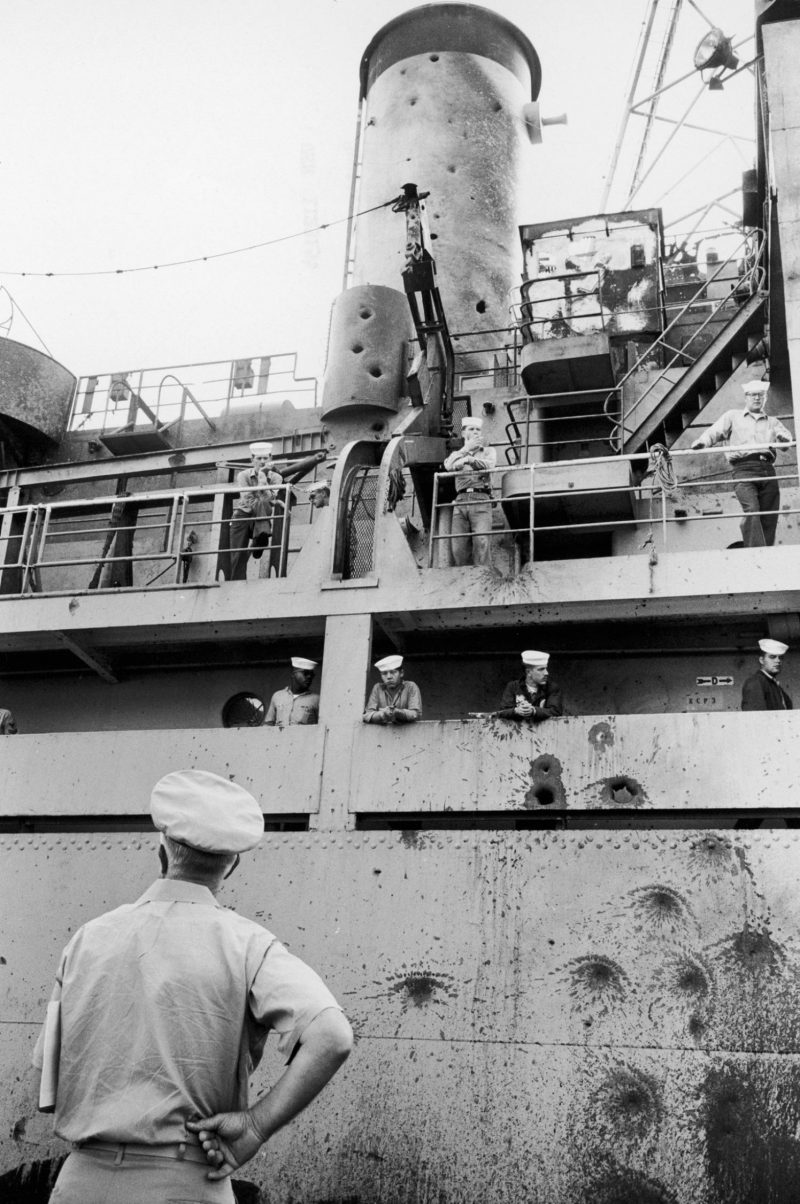
Damage to the starboard side of the USS Liberty following Israeli attacks, June, 1967. Photo | NSA Archive
Those who survived the assault of the Liberty owe their lives to the then-23-year-old Terry Halbardier, who valiantly navigated the Liberty’s napalm-glazed deck and managed to rig an antenna and send out an SOS signal to the Navy’s Sixth Fleet. Upon intercepting that distress signal, the Israelis immediately broke off the attack. Halbardier’s heroism prevented the massacre of all 294 crewmen and allowed them to live to tell their stories, despite Johnson’s having left them for dead.
Yet many Liberty survivors were unable to tell their stories for decades, as the U.S. government issued gag orders and threatened them with being court-martialed for speaking to anyone, even their spouses, about the incident. The Navy’s Board of Inquiry, which abetted the cover-up, was headed by Admiral John S. McCain Jr., the father of the late Senator John McCain of Arizona.
To this day, the U.S. government has failed to conduct a full, public inquiry into the attack. Liberty survivors who have since spoken out have been accused of “anti-Semitism” and of slandering Israel for discussing their personal and traumatic experiences of the attack, significantly compounding their suffering and post-traumatic stress.
While the survivors of Israel’s assault on the Liberty have been denied closure, the U.S. government’s response has endangered the lives of American personnel by clearly signaling to Israel that they will suffer no consequences for such “false flag” attacks, regardless of whether American servicemen are wounded or killed. As former CIA intelligence analyst Ray McGovern has previously noted for Consortium News, “the U.S. cover-up [of the attack on the U.S.S. Liberty ] taught the Israelis that they could literally get away with murder.”
In a 2015 interview on the Real News Network, McGovern warned that the attack on the Liberty still holds “current relevance” and that he felt that “the Israelis are capable of doing this kind of thing when they see their supreme national interests at stake.” McGovern further stated that Israeli officials may well have considered a provocation, such as false flag, to throw a wrench in the Iran nuclear deal, which was being negotiated at the time.
McGovern — in an open letter to President Barack Obama, co-authored with former Deputy National Intelligence Officer for the Near East in the National Intelligence Council Elizabeth Murray — noted that Admiral Mike Mullen, former member of the Joint Chiefs of Staff in the Bush administration, had flown to Israel in 2003 and told the Israeli government emphatically “to disabuse themselves of the notion that U.S. military support would be knee-jerk automatic if they somehow provoked open hostilities with Iran. According to the Israeli press, Mullen went so far as to warn the Israelis not to even think about another incident at sea like the deliberate Israeli attack on the U.S.S. Liberty.”
McGovern and Murray cited Mullen’s statements to Israeli officials as the first time that “a senior U.S. official braced Israel so blatantly about the Liberty incident.” In an email to MintPress, McGovern stated that he was unsure whether current Chairman of the Joint Chiefs of Staff Gen. Joseph Dunford “can be counted upon to play a similar restraining role” in preventing hostilities with Iran. Notably, Dunford was in attendance along with Bolton at the recent CIA meeting to discuss “highly sensitive covert actions” in relation to Iran.
An “accident” waiting to happen
Since Bolton announced the movement of the Lincoln carrier strike group towards the Persian Gulf, some have pointed out that the vessels could well be destined for use in a “false flag” provocation, such as one planned by former Vice President Dick Cheney in 2008 (to be discussed shortly) and another conducted by Israel in 1967. Indeed, as MintPress noted the day after Bolton’s announcement, the carrier strike group’s deployment was actually announced a month prior and was a routine deployment.
The political analysis blog Moon of Alabamaalso noticed that Bolton had framed this routine deployment as something more dire for his own purposes, writing:
The carrier deployment to the Gulf is routine. It had been announced on April 8. The U.S. has bombers on rotation in the Middle East since 2001. Moreover – a carrier in the Persian Gulf is a sure sign that the U.S. will not attack Iran. Within the restricted waters of the Persian Gulf a carrier is a too easy target. The idea though may be to provide for an ‘accident’’ as Iran’s Foreign Minister [Javad Zarif] described it in a recent CBS interview.”
In an interview late last month with CBS’ Face the Nation, Zarif explicitly told journalist Margaret Brennan his concern about an imminent “false flag” to trigger war with Iran by John Bolton in collaboration with Israeli, Saudi and Emirati leadership:
Foreign Minister Zarif| I don’t think military confrontation will happen. I think people have more prudence than allowing a military confrontation to happen. But, I think the U.S. administration is putting things in place for accidents to happen. And there has to be extreme vigilance, so that people who are planning this type of accident would not have their way.
Margaret Brennan | What do you mean? What kind of accident are you talking about?
Zarif | I’m talking about people who have — who are designing confrontation, whose interest —
Brennan | Who’s doing that?
Zarif | My ‘B’ team. I call —
Brennan | What do you mean ‘B’ team?
Zarif | I call the group ‘B’ team who have always tried to create tension, whose continued existence depends on tension. Ambassador Bolton, one ‘B,’ Bibi Netanyahu, second ‘B,’ Bin Zayed, third ‘B,’ Bin Salman, fourth ‘B.’ And I’m not just making accusations.
With an aircraft carrier little more than a sitting duck in the area amid rising tensions between the U.S. and Iran, an “accident” may well occur. As was noted in Part I of this mini-series, such a possibility was directly stated by British Foreign Minister Jeremy Hunt on Monday.
Hunt told reporters “We are very worried about the risk of a [U.S.-Iran] conflict happening by accident, with an escalation that is unintended really on either side but ends with some kind of conflict.” Hunt notably made the statement after meeting with Pompeo, who is currently in Europe meeting with European heads of state to discuss Iran. The Associated Press noted that the Trump administration had warned European officials, Hunt included, that “Iran or its proxies could be targeting maritime traffic in the Persian Gulf region.”
The possibility of such an “accident” is further compounded by Bolton’s aforementioned and “highly unusual” meeting about Iran and “highly sensitive covert actions” at CIA headquarters last week. Declassified CIA documents show that the agency had previously planned to stage terror attacks on U.S. soil and murder Americans to blame on Cuba in order to justify invading the Caribbean nation in the 1960s. That plan, known as Operation Northwoods, further called for the destruction of U.S. military vessels to be blamed on Cuba and also the staging of fires and mortar attacks on U.S. military installations in Cuba (i.e., Guantanamo Bay) or nearby (i.e., in Florida). Though Operation Northwoods was never enacted, the agency has been accused of orchestrating numerous “false flags” in the decades since.
As was recently seen with the alleged “sabotage” of Saudi oil tankers near Iran, there are many potential targets for provocation. However, the incident that would most assuredly force U.S. involvement in a military conflict would be an attack on an American military target. While some have dismissed Bolton’s announcement of the carrier’s movements as a self-serving manipulation of the facts, it may have had the added purpose of framing the lead-up to an unfortunate “accident” targeting American vessels in the area, particularly the Lincoln carrier strike group or one of the other subsequent U.S. naval deployments to the Middle East.
The neocon plan for a Liberty-like attack
If any sort of provocation blamed on Iran should occur, it is important to consider that a powerful group of U.S. politicians — the neo-conservatives — have long sought to plan provocations that would drag the U.S. into war with Iran. One of the most recent examples took place during the George W. Bush administration when then-Vice President Dick Cheney held a meeting with other administration officials in 2008 aimed at provoking war with Iran.
The details of that meeting were revealed by Pulitzer Prize-winning journalist Seymour Hersh, who described some of the ideas considered in that Cheney-led meeting as follows:
There were a dozen ideas proffered about how to trigger a war. The one that interested me the most was why don’t we build in our shipyard four or five boats that look like Iranian PT boats. Put Navy seals on them with a lot of arms. And next time one of our boats goes to the Straits of Hormuz, start a shoot-up. Might cost some lives.
And it was rejected because you can’t have Americans killing Americans. That’s the kind of, that’s the level of stuff we’re talking about. Provocation.
Silly? Maybe. But potentially very lethal. Because … if you get the right incident, the American public will support bang-bang-kiss-kiss. You know, we’re into it.”
It is unknown if any Bush officials now in the Trump administration were present at that meeting where the use of a “false flag” pitting Americans against Americans disguised as Iranian was discussed. However, what is known is that John Bolton — who was a member of the neo-conservative Project for a New American Century, along with Cheney, and who also served in the Bush administration — has zealously sought war with Iran for nearly two decades. Indeed, the New York Times recently described Bolton as “one of the administration’s most virulent Iran hawks, whose push for confrontation with Tehran was ignored more than a decade ago by President George W. Bush.” It is also known that Bolton has a history of playing fast and loose with unconfirmed intelligence and also distorting intelligence to fit his pre-determined narrative.
As MintPress reported last year, former Israeli Ambassador to the UN Danny Gillerman has stated that Bolton, when serving in the Bush administration, was prone to “direct fire on his own forces,” — i.e., the U.S. government — in order to advance the goals of the Israeli government, especially with respect to Iran. For instance, in more than one instance while in the Bush administration, Bolton traveled to Israel in violation of State Department rules and negotiated privately with Israeli officials, including the then-head of the Mossad, Meir Dagan, to lay the groundwork for a war with Iran. As journalist Gareth Porter has noted, Bolton did this in an effort to directly undermine Colin Powell, Bolton’s superior, just as Powell “was saying administration policy was not to attack Iran.”
Worse still, Bolton has pressured Israeli officials to initiate a war with Iran, even when they didn’t support such a move. One such case was Shaul Mofaz, former Israeli defense minister, who told Israeli media last March that Bolton “tried to convince me that Israel needs to attack Iran,” even though Mofaz did not see such a war as “a smart move — not on the part of the Americans today or anyone else until the threat is real.”
Pompeo’s Holy war and rapture
Furthermore, Bolton is not the only top Trump administration official who has long promoted a war with Iran, as current Secretary of State Mike Pompeo had also called for the preemptive bombing of Iran long before he joined the Trump administration. Pompeo’s desire to push the U.S. towards war with Iran is based on his fervent adherence to Christian Zionism. As a result of the admitted influence his beliefs hold over his foreign policy, Pompeo sees an “apocalyptic” war between Israel and Iran as a necessary precursor to the Second Coming of Christ and the “rapture.”
Pompeo is on record speaking about the rapture on several occasions, particularly as CIA director when he spoke about the event — which holds that “true believers” will ascend to Heaven prior to the tribulations and trials of the “end times” — so often that he made veteran intelligence officers uncomfortable. As a result, some have asserted that Pompeo is “a man who appears to view American foreign policy as a vehicle for holy war.”
The fact that the actions of the current Secretary of State are influenced by his Christian Zionist faith was on display last month, when American Christian journalist Chris Mitchell of the Christian Broadcasting Networkasked Pompeo: “Could it be that President Trump right now has been sort of raised for such a time as this … to help save the Jewish people from the Iranian menace?” Pompeo responded that this was definitely “possible.”
If Adelson has his way . . .
Yet, perhaps the most dangerous force driving the U.S. towards a war with Israel is not the public face of the Trump administration’s foreign policy but its private face. Sheldon Adelson — the top donor to Trump, the entire Republican Party, and also the top political donor to Israeli Prime Minister Netanyahu — has long sought war with Iran, and several of Adelson’s desired policies have already been enacted by Trump. These include recognizing Jerusalem as Israel’s capital, replacing H.R. McMaster with Bolton as National Security Advisor, and withdrawing from the Iran nuclear deal. Several reports have asserted that pressure from Adelson was a deciding factor in Trump’s fulfillment of these policies.
Adelson’s influence over Trump again takes on great significance, given recent events with respect to Iran, as Adelson has previously advocated for a U.S. nuclear attack on Iran without provocation, just so the U.S. could “impose its demands [on Iran] from a position of strength.”
Per Adelson’s plan, the U.S. would drop a nuclear bomb in the middle of the Iranian desert and then threaten that “the next one is in the middle of Tehran” to show that “we mean business.” Tehran, Iran’s capital, is home to nearly 9 million people with 15 million more in its suburbs. Were Tehran to be attacked with nuclear weapons, an estimated 7 million would die within moments, according to a 2013 study jointly conducted by researchers at the University of Georgia and Harvard.
Yet, any sort of diplomatic engagement with Iran, according to Adelson, is “the worst negotiating tactic I could ever imagine.”
In other words, Adelson has called for dropping nuclear weapons on a country, including its heavily populated capital city, for no reason other than to show that the U.S. “means business” and considers nuclear war a negotiating tactic.
While some media reports have suggested that Trump is unwilling to go to war with Iran and is uneasy with the hawkish policies of Bolton and Pompeo, he will have a hard time ignoring Adelson. Adelson, who poured $35 million into Trump’s 2016 campaign and spent $55 million on Republican primary campaigns last year, is the party’s most influential donor and angering him could well mean the end of Trump’s political career.
Would Trump resist a push for war from not just Netanyhu, Bolton and Pompeo but Adelson as well? It seems unlikely. Craig Holman of the watchdog group Public Citizen told ProPublica in 2018 that he “would put Adelson at the very top of the list of both access and influence in the Trump administration,” a sentiment that was also echoed by Alan Dershowitz, who has done legal work for Adelson and advised Trump. Dershowitz told ProPublica that Adelson “just calls the president all the time. Donald Trump takes Sheldon Adelson’s calls.” As MintPress has noted on several occasions, those calls often translate into policy decisions.
Unfortunately, Trump — even when he tries to follow a different path, as he attempted to do in Syria — often ends up conceding to the neo-conservatives and Zionist extremists who surround (and fund) him.
History issues a warning
The combination of current tensions and the documented history of both Israel and Bush-era neo-conservatives planning and even executing false flag attacks in order to justify U.S. military action against a desired target — should set off alarm bells. Instead, most corporate media outlets are playing up unfounded or baseless claims of the “Iranian threat” and Iran’s unproven role in recent acts of “sabotage” in Saudi Arabia and in the UAE in ways that are strikingly similar to the lead-up to the 2003 invasion of Iraq.
Furthermore, the history and mindset of both Bolton and Pompeo, in addition to the unprecedented influence of Sheldon Adelson in the Trump administration, add yet another layer to this increasingly complex yet undeniably troubling situation.
As a consequence, it is imperative for people around the world, particularly in the United States, to be skeptical of any act of violence blamed on Iran before a full investigation is completed, and to resist a rapid push to begin a conflict with Iran that could well follow such an act.
The time for resistance, ideally, would be before such an attack occurs, making critical the widespread dissemination of relevant information left unmentioned by the corporate media, such as that contained in Parts I and II of this series. The crucial context here is the well-documented willingness of both the Israeli and U.S. governments to sacrifice (i.e., kill) Americans in order to plunder the natural resources of “unfriendly” nations and pursue the objectives of the political and economic elite of both countries.
Whitney Webb is a MintPress News journalist based in Chile. She has contributed to several independent media outlets including Global Research, EcoWatch, the Ron Paul Institute and 21st Century Wire, among others. She has made several radio and television appearances and is the 2019 winner of the Serena Shim Award for Uncompromised Integrity in Journalism.
As tensions between the U.S. and Iran threaten to boil over, the probability of a provocation or “accident” that would provoke hostilities between the two countries is higher than ever. U.K. Foreign Minister Jeremy Hunt, after meeting with U.S. Secretary of State Mike Pompeo, openly stated as much on Monday, telling reporters in Brussels that the U.K. was worried of a conflict breaking out between the U.S. and Iran by “accident with an escalation that is unintended really on either side but ends with some kind of conflict.”
Yet, current and past events make it clear that such an “accidental” provocation is unlikely to be purely accidental in nature, as forces in the U.S. and Israel have been actively pushing for a U.S.-led war with Iran for years and have a track record that demonstrates little inhibition about using an “accident” or “false flag” to drag the country into a war with the Islamic Republic.
Notably, the state of Israel — in an event long since buried by the government and corporate media — has previously staged such a “false flag” by targeting an American naval vessel, killing 34 Americans, in order to blame the attack on Egypt and drag the U.S. into a war with several Middle Eastern nations in 1967. However, Israel is not alone in this, as the CIA as well as neo-conservatives serving in the Bush administration, led by then-Vice President Dick Cheney, have planned “false flags” that involved the murder of American servicemen and civilians in order to justify miltiary action against U.S. adversaries.
In this two-part series, MintPress explores the troubling evidence that preparations for another such “false flag” are well underway. In this first installment, current events in relation to U.S.-Iran relations and the role of Israel in the ratcheting up of tensions will be examined, while the second installment will focus on Israel’s past of conducting “false flags” to goad the U.S. into wars on Israel’s behalf as well as efforts by former Vice President Dick Cheney to conduct a “false flag” pitting American sailors against American sailors disguised as Iranian naval forces to justify a conflict with Iran.
Bolton, taking a page from Iraq 2003 playbook, sets ball rolling
Since National Security Advisor John Bolton sent out a dramatic press release announcing the deployment of a U.S. carrier strike group as a warning to Iran on May 5, tensions between the U.S. and Iran have risen dramatically, a development that Bolton — who has long advocated regime change and a pre-emptive war against Iran — likely welcomes. As MintPressrecently reported, that press release was intentionally vague, allowing justification for a military response to any number of incidents, whether committed by Iran or alleged “proxies” of Iran, including groups over which Iran’s government has no control.
Furthermore, it has since been revealed that the “intelligence” Bolton used to frame the deployment and the rationale for future U.S. military action against Iran was from the Israeli government — which has long pushed the U.S. towards war with Iran. In addition, several unnamed U.S. officials stated soon after that Bolton and other Trump administration officials had greatly exaggerated the nature of this intelligence and overreacted. MintPresshas noted on several occasions Bolton’s history of distorting intelligence to conform with a specific narrative or in order to promote specific policy actions and this tendency of Bolton’s was also recently noted in a New Yorker profile on the current National Security Advisor.
It was subsequently revealed that a few days prior to Bolton’s press release, Bolton had made a “highly unusual” visit to CIA headquarters to discuss Iran. NBC News reported that the “extremely rare” choice to hold this meeting at the CIA instead of the White House’s Situation Room likely meant that the purpose of the meeting was “to brief top officials on highly sensitive covert actions, either the results of existing operations or options for new ones,” based on statements from five former CIA operations officers and military officials.
That meeting, as noted by the political and financial news site ZeroHedge, “hearkens back to the Bush-Cheney White House’s direct intervention over Iraq intelligence in the lead-up to the 2003 invasion, which involved the VP and his staff making multiple personal visits to CIA headquarters and the Pentagon to pressure the intel analysts into conforming to a preferred ‘narrative.’” Yet, the emphasis on “covert actions” in relation to Iran suggests that something much more sinister may be afoot.
Indeed, in the weeks since that press release and the “highly unusual” CIA meeting, the U.S. has deployed more military assets towards the Persian Gulf and Secretary of State Pompeo has made several abruptschedule changes in order to discuss Iran with various countries. Notably, the Trump administration has also announced the end of waivers that have allowed some foreign companies to continue buying Iranian oil without facing U.S. sanctions.
The situation has forced Iran to respond, with Iran announcing that it would begin withdrawing from the Iran nuclear deal — which the U.S. unilaterally withdrew from over a year ago — as the U.S.’ economic war against Iran shoots to another level.
Perhaps most telling of all is the fact that Western media, particularly U.S. media, have been heavily promoting the Iranian “threat” since soon after Bolton’s Mary 5 press release, in yet another striking parallel to the lead-up to the 2003 invasion of Iraq. Yet, particularly notable in this case is that much of the “intelligence” that has been used to justify these recent moves by the Trump administration has come from Israel’s government, led by the recently re-elected Israeli Prime Minister Benjamin Netanyahu, whose desire to goad the U.S. into a war with Iran is an open secret.
One potential pretext already in play in the Persian Gulf
On Sunday, reports surfaced that several oil tankers were the victims of “sabotage” while sailing towards the Persian Gulf near Fujairah, one of the seven emirates that comprise the United Arab Emirates (UAE), which is located just outside the Strait of Hormuz. Fujairah’s government initially denied that any “sabotage” took place and maintained that its port facilities were operating normally after media reports from Iranian outlet PressTV and Lebanese outlet Mayadeen reported on a series of “explosions” on unidentified ships in the area.
The UAE’s foreign ministry later confirmed an incident in the area but said no casualties or spills occurred and notably did not provide details as to the number or nationalities of the ships involved nor the groups responsible for the alleged attack.
However, Saudi Arabia subsequently claimed that its tankers had been affected by this act of “sabotage” and that the targeted tankers had been approaching the Strait of Hormuz on route to load oil destined for the United States. Saudi Arabia, like the UAE, did not blame any country for the attack. A Norwegian-registered oil tanker experienced hull damage after striking “an unknown object,” potentially suggesting the attack was caused by an explosion of a sea mine or the result of a torpedo or other projectile launched underwater. Notably, the U.S., U.K. and France held a “mine warfare drill” in the Persian Gulf just last month and past Western media reports have characterized sea mines as “Iran’s favorite military asset.”
Iran rejected any responsibility for the attack and Iran’s Foreign Ministry spokesman Abbas Mousavi warned against a “conspiracy orchestrated by ill-wishers” and “adventurism by foreigners.”
However, the timing of the sabotage came right on the heels of statements made by the U.S. and Israeli governments that have led some to blame Iran or suggest Iranian responsibility for the attacks — despite the lack of evidence made public and the decision by both the Saudis and Emiratis, long-time adversaries of Iran, from blaming any country for the incident or describing any specifics about the attack.
This past Thursday, the U.S. Maritime Administration — a division of the U.S. Department of Transportation — stated that “Iran or its proxies could respond by targeting commercial vessels, including oil tankers, or U.S. military vessels in the Red Sea, Bab-el-Mandeb Strait or the Persian Gulf.” The U.S. Department of Transportation is currently headed by Elaine Chao, who was paid $50,000 for a five-minute speech to the Iranian exile group, Mujahedeen-e-Khalq (MEK), known to actively seek regime change for Iran. Other top U.S. officials, such as Bolton, have also been paid hefty sums for appearances at MEK events, where they have openly advocated for the overthrow of the Iranian government.
In addition to warning from a U.S. department headed by an official with links to an Iranian opposition group actively seeking regime change, Israeli officials “leaked” information on Israel’s Channel 13 on Saturday that Iran was allegedly planning to target Saudi oil assets in the region. According to the unsourced report, as cited by the Times of Israel, the Iranians were “considering various aggressive acts” against American assets or those of its regional allies, such as Saudi Arabia and Israel. The report also claimed that Iran had considered targeting American bases in the Gulf, but rejected it as too drastic and instead had decided to target “Saudi oil production facilities.”
In light of recent events, as well as the corporate media’s willingness to suggest Iranian culpability despite little to no publicly available evidence, it appears that this recent attack — regardless of who was responsible — could be seized upon by officials in the U.S. or Israel eager to see tensions between the U.S. and Iran escalate.
Netanyahu: “America is easily moved”
It is an open secret that Israel’s government, particularly under Netanyahu, has been eager to see the U.S. engage in hostilities with Iran. The main driver for this is the fact that, while Israel has since forged alliances with several Arab-majority nations such as Saudi Arabia, Egypt and the United Arab Emirates, Iran and its regional allies — namely Lebanon’s Hezbollah and Syria — oppose Israeli objectives for the region and those of its allies. More crucially, Iran is arguably the country that is most supportive of Palestine and the major barrier to Netanyahu’s plans to annex Palestine’s occupied West Bank, a promise on which Netanyahu rode to reelection last month. Now more than ever, Netanyahu wants Iran’s government out of the way.
Netanyahu has openly stated that he views the U.S. government as a vehicle for fulfilling Israeli objectives and believes that Americans are easily manipulated, by Israel in particular. For instance, in a video recorded in the early 2000s — later broadcast on Israeli TV and subsequently reported on by Consortium News — Netanyahu “brags about how he deceived President Bill Clinton into believing he [Netanyahu] was helping implement the Oslo accords when he was actually destroying them. The tape displays a contemptuous attitude toward, and wonderment at, a malleable America so easily influenced by Israel.”
In the video, Netanyahu states:
America is something that can be easily moved. Moved in the right direction. They won’t get in our way; 80 percent of the Americans support us. It’s absurd.”
Israeli journalist Gideon Levy later asserted that the video reveals Netanyahu to be “a con artist who thinks that Washington is in his pocket and that he can pull the wool over its eyes” and that the current Israeli prime minister’s attitude is unlikely to “change over the years.”
Now, with the Trump administration having shown its willingness to favor Israeli interests in the Middle East, Netanyahu has apparently sensed that the hour has come to push the U.S. towards war with Iran. For instance, the Trump administration organized a summit aimed at securing “peace and security in the Middle East,” to which Iran was not invited. The New York Timesdescribed that summit as follows:
…Leaders of Israel and Arab states met publicly again, at an international conference in Warsaw staged by the Trump administration. But the goal of this meeting, drawing officials of some 60 nations, was not peacemaking. It was to rally support for economic and political war with Iran, for which the United States has found little enthusiasm among allies since withdrawing from the 2015 deal that restricts Iran’s nuclear program.”
Notably, during that meeting, Netanyahu wrote in a since deleted tweet that the summit was “an open meeting with representatives of leading Arab countries, that are sitting down together with Israel in order to advance the common interest of war with Iran.”
In the wake of the Warsaw summit, Netanyahu has since claimed that he was responsible for the Trump administration’s decision to label Iran’s Islamic Revolutionary Guard Corps (IRGC) a terror group, a move that dramatically increased the risk of a military confrontation between the U.S. and Iran, especially given that Iran subsequently responded by declaring the U.S. military’s Central Command a terrorist organization.
Now, with Netanyahu feeding Bolton “intelligence” that Bolton has greatly exaggerated in order to justify their common goal — a U.S. war with Iran — and also “predicting” dubious “sabotage” attacks near the Persian Gulf, Israel’s government has revealed itself to be a driving force behind the spiking tensions between the two countries.
Equally troubling is the fact that world leaders are now openly positing that an “accident” or “false flag” provocation will be used to provoke such hostilities.
For Netanyahu, it’s now or never for a U.S.-Iran war
With the Iran nuclear deal in tatters, one consequence of the Trump administration’s “maximum pressure” campaign against Iran has been to push Iran to renege on aspects of the deal, from which the U.S. has already long since withdrawn. The goal, by all appearances, is to use Iran’s plan to breach parts of the deal as justification for further aggressive actions against the country by claiming that such breaches, instead of a response to U.S.-led economic warfare, are a sign of an intention to develop nuclear weapons.
With waivers for the purchases of Iranian oil now ending and Iran’s president announcing that Iran will end compliance with some aspects of the deal if Europeans do not find a meaningful workaround for U.S. sanctions, the Trump administration — and the Iran hawks within — seem to have their ducks in a row.
While there has long been concern about a U.S.-Iran conflict, several situations have arisen that have made this push for a regime-change conflict with Iran of extreme importance to both U.S. and Israeli interests in the region.
For instance, Syria’s government is set to take the Idlib province, after which Syria will turn its attention towards the Israel-controlled Golan Heights and the U.S.-occupied area of northeastern Syria. Israel was revealed to be the “brains” behind the Syria conflict and has been actively preparing for hostilities with Syria and nearby Lebanon since last year, following the failure to overthrow Syria’s government. Syria holds a mutual defense pact with Iran, meaning that it will join a conflict with Iran if Iran is threatened, thus preventing Syria’s government from focusing its efforts on retaking areas occupied by the U.S. and Israel.
If the U.S. and Israel wait until Syria consolidates control over Idlib, they will be facing a much stronger adversary in Iran’s closest regional ally than one distracted by a pocket of Al Qaeda-dominated terrorist groups in its north.
Yet, the clearest indicator that the push for war is very much in earnest is the intention of Netanyahu to effectively destroy Palestine. Several analysts, including ex-CIA analyst Ray McGovern, have long maintained that Israel’s and Netanyahu’s main reason for wanting a war with Iran is to “have Iran bloodied the same way we did to Iraq” so that Iran “would no longer be able to support Hamas and Hezbollah in Gaza, Lebanon, and elsewhere.” In other words, Netanyahu wants Iran out of the picture so it can no longer provide material or financial support to groups that resist Israeli occupation.
Having won reelection in part because of his promise to annex the occupied West Bank, Netanyahu worries that Iran and its regional allies will strongly oppose that annexation and may even go to war over it, particularly if the fate of the Al-Aqsa mosque compound in Jerusalem is threatened. Now, with the Trump administration’s “Deal of the Century” also set to be made public in less than a month, that deal’s push to enable the annexation is also threatened by the regional bloc led by Iran that still supports Palestine. If Netanyahu is able to eliminate Iran as a regional power, he will have eliminated the greatest single threat to both his plans for complete annexation and the enactment of the Trump administration’s “Deal of the Century.”
With top officials in the U.S. government and much of the media failing to push back, Netanyahu finally has a window of opportunity — albeit one that is shrinking — to push the U.S. to war with Iran and it appears that he, along with his allies in the Trump administration, plans on taking it.
As Part II of this series will show, Israel’s government and Bush-era neo-conservatives have a track record of enacting and planning “false flag” attacks to embroil the U.S. in foreign wars and that playbook would include provoking the U.S. into a war with Iran.
Whitney Webb is a MintPress News journalist based in Chile. She has contributed to several independent media outlets including Global Research, EcoWatch, the Ron Paul Institute and 21st Century Wire, among others. She has made several radio and television appearances and is the 2019 winner of the Serena Shim Award for Uncompromised Integrity in Journalism.
In our Briefing note on the Final Report of the OPCW Fact-Finding Mission on the Douma incident, we noted that the FFM had sought assessments in October 2018 from unidentified engineering experts on the “the trajectory and damage to the cylinders found at Locations 2 and 4”. The Final Report provided no explanation for why the FFM had not sought engineering assessments in April 2018, when the experts could have inspected the sites with cylinders in position, rather than six months later when inspection of the sites with cylinders in position was no longer possible and the assessments had to rely on images and measurements obtained by others. We raised this as an obvious anomaly.
OPCW staff members have communicated with the Working Group. We have learned that an investigation was undertaken by an engineering sub-team of the FFM, beginning with on-site inspections in April-May 2018, followed by a detailed engineering analysis including collaboration on computer modelling studies with two European universities. The report of this investigation was excluded from the published Final Report of the Fact-Finding Mission, which referred only to assessments sought from unidentified “engineering experts” commissioned in October 2018 and obtained in December 2018.
A copy of a 15-page Executive Summary of this report with the title “Engineering Assessment of two cylinders observed at the Douma incident” has been passed to us and we have posted it here. Please download and share this document via your own server if you link to it, so as not to overload our server.
We are studying this document, and encourage others with relevant expertise to contribute. We provide some initial comments below:
2 Commentary on the Engineering Assessment
The report is signed by Ian Henderson, who is listed as one of the first P-5 level inspection team leaders trained at OPCW in a report dated 1998. We have confirmed that as the engineering expert on the FFM, Henderson was assigned to lead the investigation of the cylinders and alleged impact sites at Locations 2 and 4. We understand that “TM” in the handwritten annotation denotes Team Members of the FFM.
In response to an enquiry on 11 May 2019, the OPCW press office stated that “the individual mentioned in the document has never been a member of the FFM”. This statement is false. The engineering sub-team could not have been carrying out studies in Douma at Locations 2 and 4 unless they had been notified by OPCW to the Syrian National Authority (the body that oversees compliance with the Chemical Weapons Convention) as FFM inspectors: it is unlikely that Henderson arrived on a tourist visa.
The OPCW press office also attempted to suggest that the report of the engineering sub-team was not part of the FFM’s investigation. This statement also is false. The sub-team report refers to external collaborators and consultants: we understand that this included two European universities. This external collaboration on such a sensitive matter could not have gone ahead unless it had been authorised: otherwise Henderson would have been dismissed instantly for breach of confidentiality. We can therefore be confident that the preparation of the report had received the necessary authorisation within OPCW. What happened after the report was written is another matter.
2.1 Methodology
As we have repeatedly emphasized, evidence can be evaluated only by comparison of competing hypotheses. This is a corollary of the likelihood principle, which can be derived from simple rules of logical consistency.
We noted that a key weakness of the published Final Report was that no competing hypotheses were considered. Thus the Final Report stated that engineering experts were asked to provide assessments of the “trajectory” of each of the two cylinders found: implying that they were not asked to assess whether the holes in the roof and the positions of the cylinders could be accounted for by anything other than cylinders being dropped from the sky.
The FFM’s Engineering Assessment does not make this error: competing hypotheses are clearly set out in advance.
For Location 2 (cylinder on roof terrace lying over a hole), the alternative hypotheses are stated as:
(2-1) the cylinder containing liquid chlorine was dropped from an aircraft, pierced the roof to form the hole and the impact fractured the valve causing release of chlorine.
(2-2) the cylinder was placed on the terrace next to a pre-existing crater
For Location 4 (cylinder on bed), the alternative hypothesis are stated as:
(4-1) the cylinder fitted with frame and fins was dropped from an aircraft, pierced the roof to form the hole, fell through the hole and was deflected laterally to end up on the bed, while the valve remained intact
(4-2) the cylinder fitted with frame and fins pierced the roof as for hypothesis (1), landed on the floor below the hole and was placed on the bed
(4-3) the cylinder fitted with frame and fins was placed on the bed, and the hole in the roof was created (by unspecified means) either before or after the cylinder was placed on the bed
2.2 Results: Location 2
An impact angle of approximately 20 degrees from the vertical “was found to be required for results to bear any resemblance to observations”
A concrete slab could not have stopped a cylinder falling at such an angle from a height of at least 500 metres. The front of the cylinder showed no sign of interaction with the concrete slab.
If the cylinder had been stopped by the steel reinforcing bars (rebars), this would have left indents on the cylinder, but no such indents were observed.
Modelling the impact of a falling cylinder could not reproduce the bending of the rebars to an angle of more than 90 degrees to point away from the impact. This was more consistent with an explosive blast.
The results of the modelling studies were summarized with the following sentence:
All the elements listed above point to the conclusion that the alleged impact event or events leading to observed vessel deformation and concrete damage were not compatible.
A criss-cross pattern on the paintwork of the cylinder body, that had been attributed by some observers to the cylinder falling through the wire mesh, was inconsistent with the near-vertical angle of incidence that would have been required to create the crater.
Experts consulted to assess the appearance of the crater took the view that it was more consistent with a blast (from a mortar round or rocket artillery) than with an impact from the falling object. Similar craters were present in concrete slabs on top of nearby buildings.
The mangled remains of the steel frame and fins found on the terrace were not consistent with the appearance of the cylinder, which showed no signs of having been fitted with such a frame or of the frame having been stripped from the cylinder as a result of impact.
2.3 Results: Location 4
The analysis of Location 4, where a cylinder was found on a bed, showed that the cylinder with intact valve and fins attached could not have fitted through the hole in the roof:
it was not possible to establish a set of circumstances where the post-deformation cylinder could fit through the crater with the valve still intact (whether or not an end-cap was assumed to have been fitted at the front end of the cylinder), and the fins deformed in the manner observed.
2.4 Conclusions of the Engineering Assessment
In summary:
The analysis at Location 4 showed simply that the cylinder with fins and valve attached could not have fitted through the hole.
The analysis at Location 2, using finite element analysis and computer simulation, was more complicated. This showed that the concrete slab could not have stopped the cylinder, that if the cylinder had been stopped by the rebars there would have been indents on the cylinder, and that an impact could not have bent the rebars through more than 90 degrees to point away from the impact location.
We note that several of the anomalies reported by the Engineering Assessment have been identified independently from open source images by members of the Working Group: these include the inability to fit the cylinder through the hole at Location 4, the presence of similar craters on nearby buildings at Location 2, and the incompatibility of the criss-cross pattern on the paintwork of the cylinder with a fall through wire mesh.
The results from both locations are summarized in paragraph 32:
The dimensions, characteristics and appearance of the cylinders, and the surrounding scene of the incidents, were inconsistent with what would have been expected in the case of either cylinder being delivered from an aircraft. In each case the alternative hypothesis produced the only plausible explanation for observations at the scene.
3 Implications of the Engineering Assessment combined with other findings
The conclusion of the Engineering Assessment is unequivocal: the alternative hypothesis that the cylinders were manually placed in position is “the only plausible explanation for observations at the scene”.
Our last Briefing Note listed two other key findings:
It is no longer seriously disputed that the hospital scene was staged: there are multiple eyewitness reports supported by video evidence
The case fatality rate of 100%, with no attempt by the victims to escape, is unlike any recorded chlorine attack.
Taken together, these findings establish beyond reasonable doubt that the alleged chemical attack in Douma on 7 April 2018 was staged.
This raises the question of where and how did the 35 victims seen in the images recorded at location 2 die? The images show signs of acute inhalation injury with blood and mucus flowing from the nose and mouth of most victims. Even though faces had apparently been washed to remove most of the mucus, yellow staining of the skin remained.
A few weeks before the release of the Final Report, two journalists appeared to suggest that there had been an earlier chemical attack somewhere else in Douma, perhaps attempting to prepare a fallback position in case the Final Report were to indicate that the scenes at Location 2 and 4 had been staged. This is to say the least an implausible explanation of the staging at Locations 2 and 4 – why move the bodies of the victims to Location 2 for a staged scene, rather than show the real chemical attack scene if there was one?
As emphasized above, in a real chemical attack with chlorine or any other irritant gas, most victims would try to escape and non-fatal cases requiring prolonged hospital treatment would far outnumber fatal cases. The images of the victims seen at Location 2 show that they were evidently exposed to an irritant gas but were unable to escape. A careful examination of these images leaves little doubt that the victims were murdered as captives. The staining of the victims’ faces by mucus flowing from their noses and mouths shows in at least some cases the mucus flowed up their faces towards the eyes. This implies that they were hung upside down while exposed to the agent. Bizarrely, the eyes of most victims appear to have been masked so that the eyes were not affected by gas or mucus. In a few victims there are visible strap marks suggesting that the eyes were protected by something like swimming goggles. A possible motive for masking the eyes may have been to make it less obvious that the victims had suffered prolonged exposure to an irritant gas.
We conclude that the staging of the Douma incident entailed mass murder of at least 35 civilians to provide the bodies at Location 2. It follows from this that people dressed as White Helmets and endorsed by the leadership of that organization had a key role in this murder.
We note that the Douma incident was the first alleged chemical attack in Syria where OPCW investigators were able to carry out an unimpeded on-site inspection. Since 2014, OPCW Fact-Finding Missions investigating alleged chemical attacks in opposition-held territory have relied for evidence on witnesses and materials collected by opposition-linked NGOs of doubtful provenance, including the CBRN Task Force, the Chemical Violations Documentation Centre Syria, and the White Helmets. Even for the investigation of the Ghouta incident in 2013, the OPCW-WHO mission was able to visit the the alleged attack sites for only a few hours, and was under the close supervision of the armed opposition. For those who until now have been prepared to accept the findings of OPCW Fact-Finding Missions that did not include on-site inspections, the finding that the Douma incident was staged, based on a careful on-site inspection, should cast doubt on the findings of these earlier Missions.
4 The hijacking of OPCW
In our last Briefing Note, we concluded by asserting that “It is doubtful whether [OPCW’s] reputation as an impartial monitor of compliance with the Chemical Weapons Convention can be restored without radical reform of its governance and working practices”. The new information we have removes all doubt that the organization has been hijacked at the top by France, UK and the US. We have no doubt that most OPCW staff continue to do their jobs professionally, and that some who are uneasy about the direction that the organization has taken nevertheless wish to protect its reputation. However what is at stake here is more than the reputation of the organization: the staged incident in Douma provoked a missile attack by the US, UK and France on 14 April 2018 that could have led to all-out war.
The cover-up of evidence that the Douma incident was staged is not merely misconduct. As the staging of the Douma incident entailed mass murder of civilians, those in OPCW who have suppressed the evidence of staging are, unwittingly or otherwise, colluding with mass murder. We think that in most jurisdictions the legal duty to disclose the cover-up of such a crime would override any confidentiality agreement with an employer. We would welcome legal opinions on this, given publicly, by those with relevant expertise. OPCW employees have to sign a strict confidentiality agreement, and face instant dismissal and loss of pension rights if they breach this agreement. We would welcome any initiative to set up a legal defence fund for OPCW staff members who come forward publicly as whistleblowers.
5 Acknowledgements
We thank the OPCW staff members who have communicated with us at considerable personal risk. We undertake to protect the identities of any sources who communicate with us. Emails to our protonmail addresses, if sent from another protonmail account (free to set up), are secure. We thank also the other open-source investigators and journalists who publicly questioned the official line on the Douma incident and thus created the climate for OPCW staff members to come forward.
Iran’s Foreign Ministry Spokesman Abbas Mousavi has expressed concerns over a “sabotage” attack on several merchant ships off the UAE coast on Sunday, calling the incident “worrisome and dreadful”, and has urged an investigation into the matter, ISNA reported.
Mousavi was cited as saying that “such incidents have a negative impact on maritime transportation security”, cautioning against any “conspiracy orchestrated by ill-wishers” as well as “adventurism by foreigners” to undermine the region’s stability.
The comments followed a reported remark by Saudi Arabia’s Energy Minister Khalid al-Falih, who said that two Saudi vessels were among those targeted near the UAE.
One of the two ships in question was attacked on its way to be loaded with Saudi crude at the port of Ras Tanura for delivery to Saudi Aramco in the US, Reuters reported.
The suspected attack didn’t lead to any casualties or oil spill, but is said to have caused significant damage to the structures of the two vessels.
“The international community has a joint responsibility to protect the safety of maritime navigation and the security of oil tankers, to mitigate against the adverse consequences of such incidents on energy markets and the danger they pose to the global economy”, al-Falih said in a statement, as quoted by Reuters.
As reports of the alleged sabotage attack kept flooding in, the Cooperation Council for the Arab States in the Gulf (GCC) issued a statement to condemn the incident:
“It is a dangerous development and escalation that reflects the evil intentions of those who planned and carried out these operations that endanger the safety of maritime navigation in the region and threaten the lives of the ships’ civilian crews”, the statement read.
On Sunday, the UAE said that four merchant vessels had been targeted in “acts of sabotage” in its territorial waters, thus brushing off previous reports by the Lebanon-based broadcaster al-Mayadeen, which said that several large blasts had occurred in the port of Fujairah. Reacting to the reports about explosions, authorities in Fujairah refuted the claims, stressing that the port was functioning as usual.
Increasingly, groups and even foreign governments have pandered to Israel and its supporters in the United States because they have come to understand that success in dealing with Washington can be dependent on Jewish support. Last week, Raed Saleh, the leader of the so-called White Helmets, also referred to as the Syrian Civil Defense, a terrorist-affiliated group operating in Syria, was in the United States to “… receive the Elie Wiesel Award from the Holocaust Memorial Museum for his organization’s work in Syria.” He was also dropping by to pick up a check for $5 million courtesy of the U.S. government that “… helps us with acquiring ambulances and helps us with search and rescue operations.”
During his visit, Saleh was treated to a nauseatingly obsequious interview courtesy of National Public Radio, which, inter alia, described how the Helmets “were the subjects of an Oscar-winning documentary two years ago, which captured images of them carrying broken and bloody Syrians from dust and rubble.”
Saleh claimed that the alleged victory of the Syrian regime in the yet to be completed war is an illusion as President Bashar al-Assad presides over a broken country, yet reports from inside Syria indicate that the return of the government to areas formerly controlled by terrorists has been welcomed and refugees from the fighting are now eager to return home. Saleh also claimed, falsely, that his organization has been “providing services to all Syrians and to providing support to all Syrians. Now after six years of war, we have saved more than 116,000 people from under the rubble. We have not asked any of these 116,000 people who did they belong to? Is he a Kurd? Is he a Christian? Is he a Muslim? Is he with Assad? Is he against Assad? Is he with the Kurds? Is he against the Kurds? We have never asked anyone these questions.”
Saleh, whose group has only operated in terrorist-controlled areas, could not, however, maintain his approved narrative. He fairly quickly abandoned his non-partisan quasi-humanitarian rhetoric when asked about how he sees the Syrian conflict developing, saying “We do not call this a civil war, but we rather call it a revolution against a dictatorship… the revolution still goes on. We have not lost.”
Those who are unfamiliar with the White Helmets should understand that the group has been praised by those who hate the government of President Bashar al-Assad in Syria and want to see it removed, which includes the United States, Israel, Saudi Arabia and the Emirates. The White Helmets have played a leading role in the propaganda campaign that seeks to instigate violence or use fabricated information to depict the Damascus government as guilty of slaughtering its own citizens. The propaganda is intended to terrorize the civilian population, which is part of the definition of terrorism.
Favorable media coverage of the group has largely derived from the documentary The White Helmets, which was produced by the group itself and tells a very convincing tale promoted as “the story of real-life heroes and impossible hope.” It is a very impressive piece of propaganda, so much so that it has won numerous awards including the Oscar for Best Documentary Short two years ago and the White Helmets themselves were even nominated for the Nobel Peace Prize. More to the point, however, is the undeniable fact that the documentary has helped shape the public understanding of what is going on in Syria, describing the government in Damascus in purely negative terms.
Nine months ago, with the Syrian Army closing in on the last White Helmet affiliates still operating in the country, the Israeli government, assisted by the United States, staged an emergency “humanitarian” evacuation of the group’s members and their families to Israel and then on to Jordan. It was described in a BBC article that included “The IDF said they had ‘completed a humanitarian effort to rescue members of a Syrian civil organization and their families’, saying there was an ‘immediate threat to their lives.’ The transfer of the displaced Syrians through Israel was an exceptional humanitarian gesture. Although Israel is not directly involved in the Syria conflict, the two countries have been in a state of war for decades. Despite the intervention, the IDF said that ‘Israel continues to maintain a non-intervention policy regarding the Syrian conflict.’”
All of the Israeli assertions are nonsense, including its claimed “humanitarianism” and “non-intervention” in the Syrian war, where it has been bombing almost daily. The carefully edited scenes of heroism under fire that have been filmed and released worldwide conceal the White Helmets’ relationship with the al-Qaeda affiliated group Jabhat al-Nusra and its participation in the torture and execution of “rebel” opponents. Indeed, the White Helmets only operate in terrorist-held territory, which enables them to shape the narrative both regarding who they are and what is occurring on the ground.
The White Helmets were accustomed to traveling to bombing sites with their film crews trailing behind them. Once at the sites, with no independent observers, they are able to arrange or even stage what is filmed to conform to their selected narrative. Exploiting their access to the western media, the White Helmets thereby de facto became a major source of “eyewitness” news regarding what was going on in those many parts of Syria where European and American journalists were quite rightly afraid to go, all part of a broader largely successful “rebel” effort to manufacture fake news that depicts the Damascus government as engaging in war crimes directed against civilians, an effort that has led to several attacks on government forces and facilities by the U.S. military. This is precisely the propaganda that has been supported both by Tel Aviv and Washington.
Perhaps the most serious charge against the White Helmets consists of the evidence that they actively participated in the atrocities, to include torture and murder, carried out by their al-Nusra hosts. There have been numerous photos of the White Helmets operating directly with armed terrorists and also celebrating over the bodies of execution victims and murdered Iraqi soldiers. The group’s jihadi associates regard the White Helmets as fellow “mujahideen” and “soldiers of the revolution.”
For those interested in further details, White Helmet activities have been thoroughly exposed by Maxim Grigoriev of the Russian NGO Foundation for the Study of Democracy. Grigoriev presented his findings at a special meeting of the United Nations just before Christmas 2018. A video prepared based on the U.N. meeting includes interviews with actual witnesses of White Helmet atrocities and participants in the staged chemical attacks that were blamed on the government.
So Raed Saleh was in Washington to pick up his award and his multi-million dollar check on top of the tens of millions that his organization has already received from Congress and the White House. He also met with a number of Congressmen who support his initiatives and was praised by New Jersey’s own seriously corrupt Israel-firster Senator Robert Menendez of the Senate Foreign Relations Committee who observed “that Saleh’s group of about 3,000 volunteers has ‘saved almost 100,000 lives’ doing ‘courageous work on the ground in Syria, while being targeted by Russia.’” Yes, Russiagate is alive and well.
There is considerable irony in the fact that the National Holocaust Museum, which is taxpayer funded, has given an apparently prestigious award to a terrorist group, something which could have been discerned with even a little fact checking. And the museum also might have been sensitive to how the White Helmets have been used in support of Israeli propaganda vis-à-vis Syria. Perhaps, while they are at it, the museum’s board just might also want to check out Elie Wiesel, for whom the award is named. Wiesel, who was a chronicler of Jewish victimhood while persistently refusing to acknowledge what Israel was doing to the Palestinians, notoriously mixed fact and fiction in his best-selling Holocaust memoir Night. Ironically, the award and recipient are well matched in this case as mixing fact and fiction is what both Elie Wiesel and the White Helmets are all about.
Prominent American anti-war figures from across the ideological spectrum are warning that the Trump administration may soon turn on Juan Guaidó — the man they recognize as Venezuela’s interim president — in order to justify military intervention in Venezuela.
These warnings followed Guaidó’s failed attempt to lead a military uprising on Tuesday, which analysts characterized as a desperate move, with Guaidó’s parallel government having failed to gain any significant traction in Venezuela since late January. With Guaidó now quickly losing legitimacy and momentum since Tuesday’s failed coup, it has become increasingly probable that his political patrons — the United States — may soon turn on him, as any harm done to him could be blamed on Venezuelan president Nicolás Maduro, which would allow the U.S. government to justify aggressive action against the Maduro-led government.
One of the first prominent anti-war voices to raise concern that the U.S. government, particularly the CIA, may now see Guaidó as more valuable dead than alive was Daniel McAdams, executive director of the Ron Paul Institute for Peace and Prosperity and co-host of the Ron Paul Liberty Report, with the former congressman, presidential candidate and well-known libertarian. During Tuesday’s edition of the Liberty Report, Paul raised concern that a provocation could be used to push for foreign (i.e., U.S.) military intervention in Venezuela:
The big danger is a hard war breaking out. I’d still bet it won’t be too bad, with thousands of troops moving. But it could be a guerrilla war or something like that. If there is a false flag or some important official on either side gets killed, you can’t tell what might happen.”
McAdams responded, pointing out that Guaidó himself could soon become such a target for a provocation:
He [Guaidó] has been a kind of a hapless figure so far. He calls for mass protests and no one shows up. I don’t think he realizes right now that he is actually now worth more dead than alive not only to the CIA, but also to his own opposition people. A shot in the crowd or something like that to take Guaidó out. It might shock you, Dr. Paul, but the CIA is pretty good at this kind of things.”
Almost immediately after the proxy war erupted, ISIS-tier footage of the torture and murder of Russians in Ukrainian custody emerged.
On July 6th, the New York Times published an astonishing investigation: In Ukraine, Killings of Surrendering Russians Divide an American-Led Unit. The article documents in grim detail how Chosen Company, an international volunteer battalion for Kiev, routinely executes Russian prisoners of war. It is the very first mainstream admission that this practice – a brazen breach of the Geneva Conventions, and a grave war crime – is widespread among Ukraine’s fighters, both foreign and homegrown. … continue
This site is provided as a research and reference tool. Although we make every reasonable effort to ensure that the information and data provided at this site are useful, accurate, and current, we cannot guarantee that the information and data provided here will be error-free. By using this site, you assume all responsibility for and risk arising from your use of and reliance upon the contents of this site.
This site and the information available through it do not, and are not intended to constitute legal advice. Should you require legal advice, you should consult your own attorney.
Nothing within this site or linked to by this site constitutes investment advice or medical advice.
Materials accessible from or added to this site by third parties, such as comments posted, are strictly the responsibility of the third party who added such materials or made them accessible and we neither endorse nor undertake to control, monitor, edit or assume responsibility for any such third-party material.
The posting of stories, commentaries, reports, documents and links (embedded or otherwise) on this site does not in any way, shape or form, implied or otherwise, necessarily express or suggest endorsement or support of any of such posted material or parts therein.
The word “alleged” is deemed to occur before the word “fraud.” Since the rule of law still applies. To peasants, at least.
Fair Use
This site contains copyrighted material the use of which has not always been specifically authorized by the copyright owner. We are making such material available in our efforts to advance understanding of environmental, political, human rights, economic, democracy, scientific, and social justice issues, etc. We believe this constitutes a ‘fair use’ of any such copyrighted material as provided for in section 107 of the US Copyright Law. In accordance with Title 17 U.S.C. Section 107, the material on this site is distributed without profit to those who have expressed a prior interest in receiving the included information for research and educational purposes. For more info go to: http://www.law.cornell.edu/uscode/17/107.shtml. If you wish to use copyrighted material from this site for purposes of your own that go beyond ‘fair use’, you must obtain permission from the copyright owner.
DMCA Contact
This is information for anyone that wishes to challenge our “fair use” of copyrighted material.
If you are a legal copyright holder or a designated agent for such and you believe that content residing on or accessible through our website infringes a copyright and falls outside the boundaries of “Fair Use”, please send a notice of infringement by contacting atheonews@gmail.com.
We will respond and take necessary action immediately.
If notice is given of an alleged copyright violation we will act expeditiously to remove or disable access to the material(s) in question.
All 3rd party material posted on this website is copyright the respective owners / authors. Aletho News makes no claim of copyright on such material.