Big Lie Day
By Leonid SAVIN – ORIENTAL REVIEW – 03/05/2019
2 May has gone down in modern history as the day that terrorist number one, Osama bin Laden, was killed. The official version states that, in 2011, he was shot dead by US special forces in the house where he was living with his wives and children. The house itself was in a city in Pakistan, where he had been hiding undetected ever since the senior members of al-Qaeda (a terrorist organisation banned in Russia) had fled Afghanistan following the defeat of the government of Mullah Omar, who had been sheltering them. Under cover of night, US helicopters carrying two groups of special forces flew to the operation location from Afghanistan, which was a violation of Pakistan’s state sovereignty.
Recalling the incident in his book Pakistan: A Personal History, which was published in the same year as Osama bin Laden’s official assassination, the current prime minister of Pakistan, Imran Khan, noted: “It was bad enough that the world’s most wanted man was not found in some cave but in a city only 50 kilometres from Islamabad, and a mile from Pakistan’s Military Academy. What made it worse was that the news was broken to us Pakistanis, and the rest of the world, by President Obama”.
“It was several hours later when a statement came from our government congratulating the US and taking credit for providing the US with all the information about Osama’s location. This begged the obvious question for all Pakistanis: if we knew about his whereabouts, then why did we not capture him ourselves? The media in India and the rest of the world went wild, blaming Pakistan’s ISI (in other words, the army) for having kept Osama in a safe house for the past six years. […]
“Three days later, the army chief denied all knowledge of the operation and announced that any such violation of our sovereignty would not be violated again. A week later the PM only added to the confusion when he finally gave a statement, suggesting ‘a matching response’ to any attack against ‘Pakistan’s strategic assets’. For Pakistanis, especially those living abroad, this was one of the most humiliating and painful times. The CIA chief Panetta further rubbed salt in our wounds by bluntly saying that the Pakistan government was either incompetent or complicit.”
The US propaganda machine, meanwhile, was continuing its work around the world and few now dispute the widely held view, or rather myth, that bin Laden was killed in Abbottabad. Films have been made, and books published, that back up America’s official version with an additional narrative. The Russian-language Wikipedia page on Operation Neptune Spear goes into great detail. What’s more, all of the links are to US resources or reprints of them.
The fact that everyone who took part in the raid on bin Laden’s house is now dead seems a little strange, however. Just as suspicious is the fact that Dr Shakil Afridi – who, according to official legend, obtained evidence of bin Laden’s whereabouts by running a fake vaccination programme – was arrested almost as soon as the operation was over and sentenced to 33 years for treason. Something else that gives pause for thought is the official story that bin Laden’s body was buried at sea on the same day. There had apparently been enough time for examination and identification at the US military base in Afghanistan and the Americans had got everything they needed to know.
The author of this article recently got the opportunity to go to Abbottabad and used the visit to see where bin Laden was killed and glean any details that were not published in the world’s press.
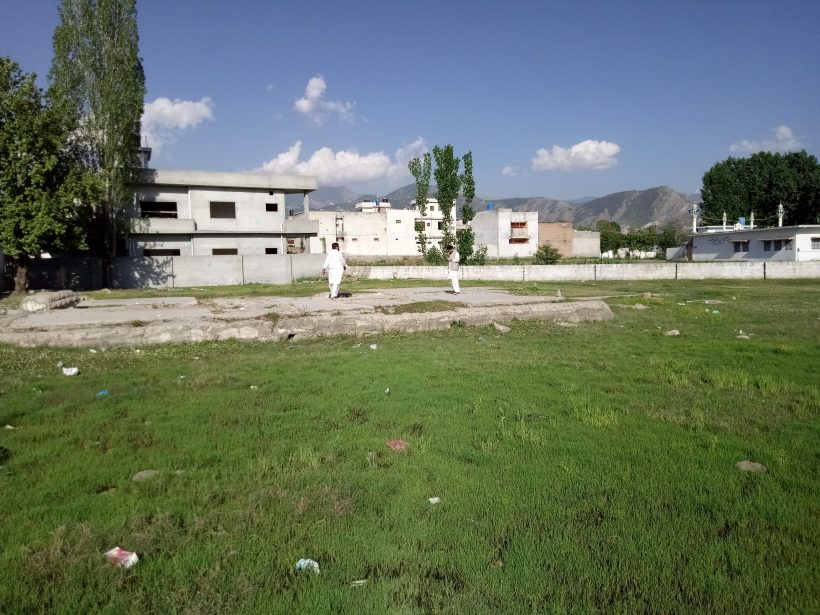
The city of Abbottabad is located in a valley surrounded by mountains and the Karakoram Highway passes close by. As well as the Military Academy in Abbottabad itself, there are a number of military bases and installations located around the city. The fence of an ordnance factory that produces a variety of weapons stretches for many kilometres along both sides of the Karakoram Highway. In other words, it is a place with a pretty high level of security requirements. In 2011, when the operation was carried out, the security measures in and around the city were probably just as strict and serious.
Almost immediately before entering the territory of the Academy, there is a single right turn that leads to the suburb of Bilal Town. We stopped alongside a small group of men outside a shop and asked for directions to bin Laden’s house. After a few seconds’ pause, one of them told us how to get there and where to turn. We stopped again outside another shop further along to clarify exactly where we were going and arrived a few minutes later.
The first person we met was an elderly gentlemen and we asked him about the house, to which he replied: “Yes, that’s the house where the Americans carried out their operation and killed people, only bin Laden wasn’t there. It’s a lie.”
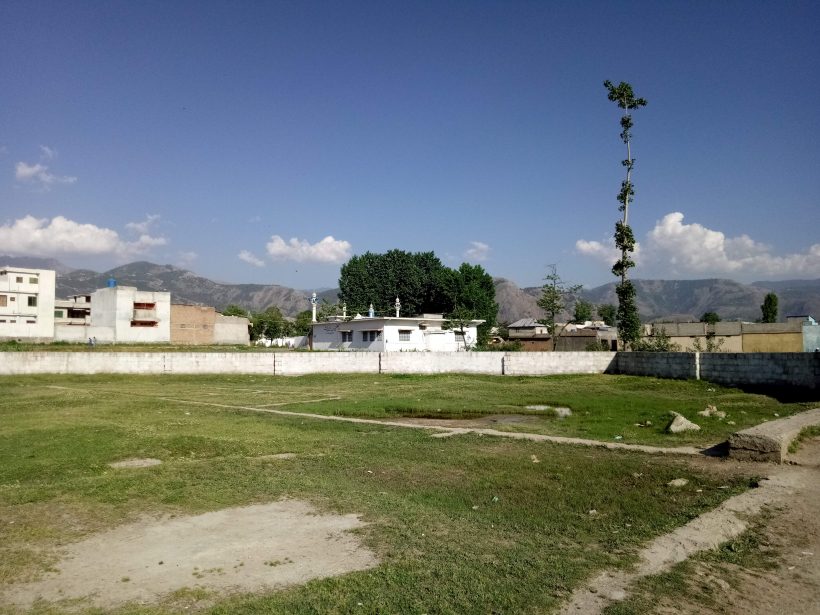
The man hurried on his way and we didn’t question him further. All that remains of the house are the foundations (the building was demolished some time after the operation – another strange fact), and the territory is surrounded by a fairly low concrete wall with a few openings. We saw two men within the walls of the compound itself and decided to talk to them. One of them willingly told us what he knew.
He lives close by and, on the night in question, he and his family heard the sound of helicopters. The sound was so loud that his father climbed up onto the roof, afraid that a helicopter might fall onto their house. A flash then lit up the sky, and explosions and gunfire rang out.
The house itself, where the operation took place, was located away from other structures. There are a few other buildings in the neighbourhood today but, in 2011, only a single-storey building stood opposite. Nevertheless, all the neighbours went up onto their roofs or outside to see what was going on.
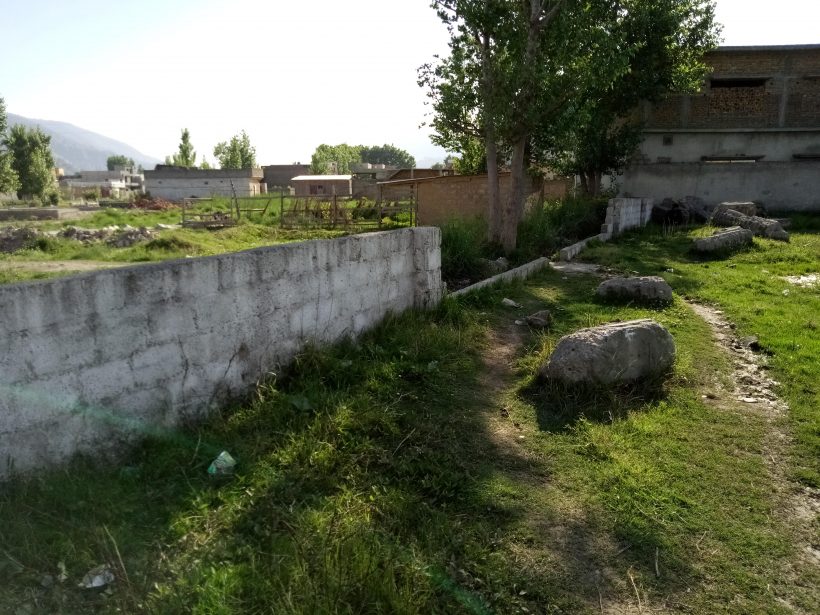
They all knew who was living in the house. According to one of the men we spoke to, it was the family of a businessman from Peshawar. All the neighbours respected him because he regularly helped the local community. The fence around his house was quite high and it’s possible that this was the deciding factor for those who had planned the operation.
“What happened next was like an Indian action movie from the 1990s,” recalls an eyewitness. One of the helicopters fell and burst into flames.
The police arrived about an hour after the first explosions and cordoned off the area, preventing anyone from getting in.
“It’s strange, because when there’s a wedding or a celebration, people often fire into the air and the police arrive in minutes, but this time it took them almost an hour,” said a neighbour.
Another helicopter arrived some time later, picked up the US special forces and flew away. While telling us about it, a young man stated several times that it was like a well-played drama, especially when you take into account what happened next.
“The elderly gentleman you met on the road back there was arrested by the Pakistani intelligence agency and then released,” added the neighbour.
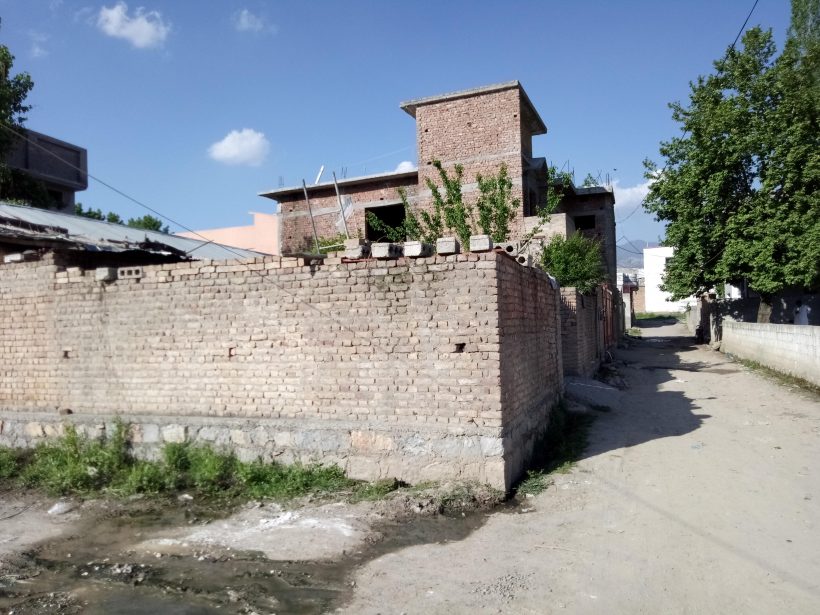
He also believes that bin Laden wasn’t there, and it was innocent people who suffered. Since the land was purchased from the state for residential development, it is legally private property. The deceased owner probably has family somewhere, but nobody has claimed it as yet. And it could be that the target was chosen intentionally so that there would be as few leads and witnesses as possible.
An interesting fate befell the wreckage of the US helicopter that crashed. The Pakistani military handed it over to China and, following relevant research, the country developed its own version of the US helicopter. So Operation Neptune Spear resulted in a leak of military technology. Such things aren’t talked about in America, however.
It should be added that, during America’s war on terror following 9/11, 36,000 people have been killed in Pakistan, including 6,000 soldiers; the country has lost approximately $68 billion; and nearly half a million people have been displaced. While it costs $1 million per year to keep an American soldier in Pakistan, the cost of one Pakistani soldier is $900 per year. And, until very recently, US combat drones repeatedly violated the airspace over Pakistan’s border with Afghanistan – often attacking civilians in the tribal area rather than militants.
However, media outlets under the control of the US State Department continue to report on the US Army’s successes in its war on terror. One needs only to recall Donald Trump’s recent statements regarding America’s victory over ISIS in Syria and Iraq. Fabricating lies and demonising America’s geopolitical opponents, as well as anyone who disagrees with the country’s global agenda, is all in a day’s work for the media lackeys of the US establishment.
Right On Cue, Indian Media Blames Pakistan For The Sri Lankan Terrorist Attacks
The Cheap Shot That The Whole World Saw Coming
By Andrew Korybko | EurasiaFuture | 2019-04-24
It was only a matter of time before Indian media predictably blamed Pakistan for the Sri Lankan terrorist attacks, which just happened earlier this week in a piece by Vicky Nanjappa for “Oneindia” about “How ISI radicalised Sri Lanka through the Pakistan High Commission“. The writer wasted no time in reminding the reader about a years-long scandal in Sri Lanka initiated by India’s National Investigation Agency (NIA) and claiming that a Pakistani diplomat on the island nation was responsible for plotting a Mumbai-style attack in South India, never mind the fact that the allegedly masterminded incident that this was being based on was actually a false flag. In fact, it can be argued that one of the consequences of the Mumbai attacks is that India capitalized on the manufactured notion that Pakistan’s ISI intelligence agency was behind it in order to portray its rival as a regional bogeyman who all of South Asia had to be suspicious of from then on out, so it’s logical in hindsight why India’s RAW intelligence agency would also cook up a conspiracy about this in Sri Lanka in an attempt to weaken historically strong Pakistani-Sri Lankan relations.
Convoluted And Conspiratorial Claims
The enduring motivation to divide Pakistan from its regional partners and opportunistically misportray it as a “state sponsor of terrorism” is what’s also behind the latest attempt trying to connect it to the Sri Lankan terrorist attacks. Mr. Nanjappa reminds his reader about the fake news claims that the Bodu Bala Sena (BBS) Buddhist nationalist organization is supposedly being bankrolled by the ISI, which is more than likely another weaponized narrative that ultimately originated with RAW. According to Mr. Nanjappa’s far-reaching theory, the Pakistani diplomat supposedly responsible for organizing a Mumbai-style attack in South Asia also paid the BBS to incite anti-Muslim violence in order to improve the ISI’s recruitment prospects of local Muslims afterwards, with the clear innuendo being that this somehow makes Islamabad responsible for last weekend’s Easter suicide bombings. This convoluted narrative is understandably confusing for most people to follow, but for as much as it turns off readers from outside the region, it nevertheless is meant to be ultra-intriguing for its intended audience in South Asia, especially the Indian one.
Fearmongering For Votes
It can’t be forgotten that Prime Minister Modi is battling for his political life during his country’s ongoing month-long electoral process and that he’s hoping to win re-election on a platform that heavily emphasizes national security. India was just utterly humiliated, however, following the dogfight that it initiated with Pakistan in late February after the Bollywood-style “surgical strike”, which led to New Delhi’s rival capturing one of the downed pilots prior to releasing him as a gesture of peace and then Modi’s own Defense Minister later publicly contradicting her own government by admitting that not a single person was injured in the Balakot attack. For a political leader who prides himself on his notion of national security, these events were certainly embarrassing and reduced his dwindling credibility among the electorate, hence the need to distract voters with more fearmongering scandals in the meantime so that he can improve his re-election odds. Therein lays the relevance of the ridiculous claims that Pakistan is conspiring with Russia and China to wage Hybrid Wars against the entire world and specifically India, respectively.
The BJP’s Hybrid War On India
In reality, these public accusations by the state and civil society are actually a form of Hybrid War in and of themselves, one that’s being waged not only on the minds of the international audience that India intends to trick into thinking that Pakistan is a “state sponsor of terrorism” and therefore should be subject to unilateral US sanctions and multilateral UN ones, but also against its own citizens who these perception management practitioners want to imbue with a deep sense of fear that they can then exploit to mislead their targets into thinking that India can only be protected by re-electing Modi and continuing his “muscular” foreign policy. I predicted in my piece earlier this week about my “Initial Assessment Of The Terrorist Attacks In Sri Lanka” that “it’ll be tempting for some [international forces] to imply that their rivals’ intelligence agencies might have had a hand in the latest events, or at the very least present themselves as super tough on terrorism for domestic political reasons (e.g. Modi during the elections)” which is exactly what India is now doing.
Political Purposes
India’s “Hindi Heartland/Cow Belt”, the stronghold of the BJP’s support, has yet to go to the polls but is about to real shortly in the election’s upcoming phases, so spinning the narrative that Pakistan might have indirectly had a hand in the Sri Lankan terrorist attacks is meant to ensure that as many of Modi’s supporters come out to vote as possible in order to help him win this neck-and-neck election. As an added benefit, New Delhi would be delighted if the Sri Lankan media picked up on Mr. Nanjappa’s piece and provoked one of their pro-Indian politicians to publicly praise it and/or demand an investigation into what India is framing as “Pakistan’s Hybrid War” in the country. Even better, since his article was written in English, international media further abroad might republish it too, especially some of the forces that have an interest in sparking a so-called “Clash of Civilizations”. It would be a dream come true for Modi if these weaponized fake news claims eventually made it to the UN, too.
Concluding Thoughts
It’s unsurprising that an Indian writer decided to opportunistically spin a convoluted and conspiratorial story purporting to link Pakistan’s ISI to the Sri Lankan terrorist attacks since the fake news claims and attendant innuendo being put forth appeal to the preconceived notions of the BJP’s base and will probably succeed in improving voter turnout for this constituency during the next phases of the country’s ongoing month-long electoral process. The introduction of this weaponized narrative into the Internet’s information ecosystem also carries with it the chance that it’ll be picked up by Sri Lankan media and consequently provoke a pro-Indian politician there to publicly praise the piece in order to trigger a crisis in Pakistani-Sri Lankan relations. Moreover, it’s too early to rule out the possibility of other forces republishing it with the intent of intensifying the so-called “Clash of Civilizations”, which might have the horrifying effect of inspiring right-wing “reprisal” attacks against the Western-based Pakistani diaspora in an attempt to trigger more inter-civlizational violence that would superficially advance this false divide-and-rule narrative.
From the Folks Who Lie, Cheat and Steal for a Living — Project Fake Duck
By Rob Slane | The Blog Mire | April 24, 2019
Mike Pompeo, the former CIA director and now chief diplomat of the United States, made the following remarks in a recent interview:
“I was the CIA director. We lied, we cheated, we stole. It’s — it was like — we had entire training courses. It reminds you of the glory of the American experiment.”
That perhaps won’t come as too much of a surprise to many people, but it is nonetheless welcome to have it admitted by no less a person than the former director of that organisation.
However, in the light of the stunning, albeit unwitting, revelation in The New York Times, that the then deputy director of the CIA (now director), Gina Haspel, used pictures of sick children and dead ducks allegedly from the Salisbury poisoning to persuade Donald Trump to expel 60 Russian diplomats — even though no children became ill and no ducks died — one wonders whether those entire training courses Mr Pompeo refers to include modules on “How to lie to the President,” and “The use of fowl play to manipulate the Commander-in-Chief”.
But there is, I think, even more to the duck story than meets the eye. In order to explain why this is so, it is necessary to first set out a timeline of events connected with it:
4th March
Two people were found unconscious on a bench in The Maltings in Salisbury in what was initially thought to be a Fentanyl overdose.
5th March
Military personnel in HazMats intensely searched a bin located adjacent to the Avon Playground (see here and here)
13th March
Theresa May spoke to Donald Trump by phone. According to Downing Street’s report of the conversation:
“The Prime Minister set out the conclusion reached by the UK government that it was highly likely that Russia was responsible for the attack against Sergei and Yulia Skripal. President Trump said the US was with the UK all the way, agreeing that the Russian government must provide unambiguous answers as to how this nerve agent came to be used.”
According to the British Government, no further phone calls took place between the two leaders after this until 28th March.
18th March*
The parents of Aiden Cooper and the two other boys involved in feeding the ducks were contacted by police and checked out for possible symptoms of poisoning, but were given the all clear.
(*I have stated 18th March, but this is an approximate date based on an interview with Aiden Cooper’s father, Luke, who said that the police came knocking on the door “two weeks after” the incident, which would make it on, or close to, 18th March.)
20th March
President Trump called President Putin, to congratulate him on his election win. He did not, however, mention the Skripal case. According to the Washington Post:
“Trump also chose not to heed talking points from aides instructing him to condemn the recent poisoning of a former Russian spy in Britain with a powerful nerve agent, a case that both the British and U.S. governments have blamed on Moscow… Trump’s failure to raise Moscow’s alleged poisoning of the former spy in Britain risked angering officials in London, who are trying to rally Britain’s closest allies to condemn the attack.”
Between 20th and 23rd March
The Deputy Director of the CIA, Gina Haspel, used fake images of sick children and dead ducks to persuade President Trump to take the toughest action against the Russian state, which involved the expulsion of 60 diplomats and the closing of the Russian consulate in Seattle.
Saturday 24th March
The first mention in the media (The Mirror ) that Mr Skripal fed ducks near the Avon Playground, giving bread to three boys. The article also contained two very significant statements. The first was this:
“The incident involving the boys, who are believed to have been given the all-clear, was confirmed by Public Health England and described by British officials to US authorities [my emphasis].”
The second was the first mention in the media of the possibility of the door handle as the place of poisoning:
“The shocking revelation is one of a series we can make today, including how investigators are now focusing on the double agent’s front door handle as the “ground zero” where spooks planted the deadly poison.”
25th March
At his Mar-a-Lago resort, President Trump was briefed by his aides who explained that the number of diplomats the US would be expelling – 60 – was roughly the same amount as the Europeans.
26th March
The expulsion of 60 Russian diplomats by the US was publicly confirmed. On the same day, Theresa May made a statement to the House of Commons, in which she said the following:
“And as I announced today, 18 countries have announced their intention to expel more than 100 Russian intelligence officers, including 15 EU member states as well as the US, Canada and the Ukraine. And this is the largest collective expulsion of Russian intelligence officers in history.”
It should also be noted that her statement contained an outright falsehood. She stated:
“Sergei and Yulia Skripal remain critically ill in hospital. Sadly, late last week doctors indicated that their condition is unlikely to change in the near future and they may never recover fully.”
This was not true, since “late last week”, Yulia Skripal was being taken out of an induced coma by doctors, which was completed by 23rd or 24th March (see here for further details).
28th March
The door handle as the place of poisoning was said to have been confirmed. On the same day, The Sun carried an interview with Aiden Cooper and his parents about the duck feed incident. In the piece, Aiden’s father, Luke, confirmed that it was “two weeks” after the poisoning that police had contacted them.
What can we make of this?
The first thing to say is that a key piece of evidence in this whole saga is to be found in the event that took place 5th March. Approximately 24 hours after the incident on the bench, military personnel in Hazmats were filmed searching very intensely in a particular bin. But there are three very curious points to note about this bin:
- It is not located near the bench on which the poisoned pair were found.
- It is absolutely not on the route from the Sainsbury’s car park to Zizzis or The Mill, and would in fact constitute a bizarre detour, if your intended destination was Zizzis or The Mill.
- It absolutely is located next to the Avon Playground, and is in fact the exact location of the duck feed.
It seems to me that the only explanation for why this bin, which is a good 50 yards or so away from the bench, and which is not on the route from the car park to Zizzis or The Mill, was the focus of such intense scrutiny, is that it was known already by the evening of 5th March that the Skripals had been there. Why else would it have been checked? Whether this was because police had already seen the clear CCTV footage of the Skripals in this area that was subsequently shown to the parents of the three children two weeks later, or whether it was known because Mr Skripal was being watched on 4th March, I do not know. But I can think of no reason why this particular bin would have been searched so meticulously, other than the one I have advanced, which is that it was already known on 5th March that the Skripals had been around it.
But if this is the case, it raises the following point:
That as early as 5th March, police knew that Mr Skripal had been in contact with three boys near that bin, and that he had shared bread with them in order to feed ducks.
If this is so, it leads to the huge question of why the boys’ parents were not contacted until two weeks later. Clues to why that might be are also in the timeline I have set out.
Mrs May spoke to Mr Trump on 13th March, the day after she originally set out the case against Russia in the House of Commons, and the day before she formally charged the Russian Government with being behind the case, expelling 23 Russian diplomats. On the surface of it, it seems that Mr Trump stood fully behind Mrs May, and that he would agree with whatever action was proposed to him, since — according to the British Government’s summary of the call — he said that “the US was with the UK all the way.”
However, the fact that this was not so was seen by what happened on 20th March. This was the day when Mr Trump phoned the Russian President, Vladimir Putin, and despite being advised by his aides not to congratulate him on his re-election, Mr Trump ignored them and did so anyway. But even more crucially, he also failed to mention anything about the Skripal case, which again went against the advice of his aides, who had urged him to condemn it in the conversation. Given that his reaction to seeing Ms Haspel’s fake pictures was to agree to the expulsion of 60 diplomats, I think we can safely say that at the time of his call to Mr Putin, he had not yet seen these images.
The fake pictures of the sick children and dead ducks were, I submit, very probably a reaction to that conversation. Although Mr Trump was apparently “with the UK all the way” on 13th March (at least that’s how Downing Street put it), it seems that on 20th March, he still wasn’t nearly as troubled by the event as Ms Haspel and Co. hoped he would be. She was angling for the “strong option” of expelling 60 diplomats, and there was Mr Trump not even bothering to mention it in his conversation with Mr Putin. And so he had to be “persuaded” by the deputy director of the organisation that “lies, cheats and steals”.
(As an aside, I have stated that this meeting with Ms Haspel probably took place between 20th and 23rd March. The reason for the former data is that, as stated above, I am sure that Mr Trump had not been shown these pictures when he spoke to Mr Putin on 20th March. The reason for the latter date is that the New York Times tells us that this meeting occurred at the White House, and by late afternoon on 23rd March Mr Trump was on his way to his Mar-a-Lago resort, and he didn’t return until late on Sunday 25th, the day before the public announcement of the expulsion of the diplomats. So Project Fake Duck had to have happened between those two dates).
All this raises huge issues in the US, where it appears that the CIA deputy director fed the President of the United States false information to twist his arm to achieve the outcome she wanted to see. That’s for journalists in the US to take up, if they care to, but what happened in Britain?
As I mentioned above, the activity around the bin next to the Avon Playground convinces me that the duck feed must have been known to the authorities as early as 5th March. And yet the parents of the boys involved were only contacted on 18th March. If Mr Skripal had really been contaminated with “Novichok” at the time of that incident, the best you could say of the investigators in relation to this is that they were woefully incompetent; the worst being that they were criminally negligent.
But of course, the fact that none of the boys or ducks became contaminated with the “Novichok” that Mr Skripal was apparently so covered with that they had to incinerate the table in Zizzis at which he was sat a few minutes after this incident, and the fact that the authorities didn’t bother contacting the parents of the boys for a fortnight, all indicates that he was not in fact contaminated at all at that time.
But if this is the case, why did the duck feed make it into the media at all? Given that it was almost certainly known about on 5th March, but the authorities decided not to do anything about it for two weeks (i.e. no public appeals showing the CCTV of Mr Skripal with the boys), why was it ever even mentioned at all? I think that there are two reasons, which are not mutually exclusive.
The first is that the British authorities, aware that their claims of a poisoning by the world’s deadliest nerve agent didn’t exactly match what actually happened — only three people ever experienced symptoms of poisoning and needed treatment — wanted to make it look far more dramatic than it actually was. And so they not only decided to finally visit the boys and their parents two weeks after the fact, but the story was then leaked to the media intentionally to add another sinister dimension to the event — the possible poisoning of children!
To give credence to the theory that officials were intent on exaggerating the fallout of the poisoning, because their claims of what happened didn’t actually match well with the facts, look at what Theresa May said of the incident in her statement to the House of Commons on 26th March:
“While Public Health England have made clear that the risk to public health is low — and this remains the case — we assess that more than 130 people in Salisbury could have been potentially exposed to this nerve agent.”
She really should win an award for the use of the most weasel words in one sentence, although I appreciate that she herself has set the bar pretty high on a number of other issues. More than 130? Could have been? Potentially exposed to this nerve agent? Absolute rot of course. Firstly, if the world’s deadliest nerve agent had been used and traipsed all over Salisbury by Mr Skripal and his daughter, as we were told, then an awful lot more than 130 would have been exposed. But more to the point, this didn’t actually happen. What happened is that three people were affected. Not four. Not five. Not 10. Not 130. Not 10,000. No, just three.
In other words, there was a blatant attempt to exaggerate what happened, or what might have, could have, potentially happened, with the Prime Minister getting in on the act. The duck feed, in my view, was part of this blatant attempt to embellish the story, even though the truth was that it had been known from 5th March that it had happened, yet nobody bothered to contact the parents because it was known that the children were never in any danger.
I am, of course, unsure whether British officials fed this story, together with fake pictures, to the CIA, or whether the CIA faked them, or whether both worked in concert together on Project Fake Duck. However, I have to say that the latter of these three possibilities seems to me to be by far the most plausible. I simply cannot imagine that British officials would dare to feed the CIA fake pictures, in the knowledge that these could be used to deceive the President. And I simply cannot imagine that the CIA would pass off pictures as being received from British Intelligence, in order to deceive the President.
What I can imagine is that both sides had a need to find a way to exaggerate the case. British officials needed to make what happened seem more dramatic, and what better way than to finally get around to visiting the boys who had received bread from Mr Skripal, and then pass the details to a journalist in a major British newspaper, who would then publish a story showing the sheer callousness of the poisoning — children were involved. As for the deputy director of the CIA, she also had a need to exaggerate the case, since it was her desire to take the harshest diplomatic response against Russia, and yet the President was probably too bored or distracted by Twitter to care or even notice. “Any pictures you’ve got will be welcome.” “Oh yes, we can get those for you.” And so the lying, cheating and stealing was used on the President himself, and Duckgate was spawned. Except no mainstream journalist will touch it of course.
But I think that there is another reason why the duck feed made it into the media, despite the fact that the boys and their parents were ignored for two weeks. It is to do with that other significant incident mentioned in the timeline above: the naming of the door handle as the place of poisoning.
I believe I have pretty conclusively shown why the door handle was not, and indeed could not have been, the location of the poisoning. The duck feed itself is ample evidence, since none of the boys became contaminated and no ducks died. But if that doesn’t convince you, the fact that in the days following 4th March unprotected police officers were seen going in and out of Mr Skripal’s house via the same front door which, weeks later, was said to have the highest concentration of the world’s deadliest nerve agent on, really ought to put it to bed for good (you can read a more detailed debunking here).
If you accept this conclusion, it necessarily follows that the door handle theory, rather than being an honest account of what really happened, was actually an attempt to divert attention from the actual place of poisoning, and also an attempt to try to explain how it was that Detective Sergeant Nicholas Bailey became the third person to be poisoned. And indeed this explains why the duck feed, which was ignored for two weeks (because it was known that the boys were not in any danger), suddenly became a thing. Why? Well imagine that investigators had come out with the claim that Mr Skripal had been poisoned at the door handle, but the boys and their parents were not contacted. That would have left open the potential for the boys’ parents, at some point, to raise the claim that their sons had been in contact with Mr Skripal, and the authorities had done nothing to contact them, thus putting their lives in danger. And so I believe that by far the most plausible explanation for this is that it was decided to contact the parents of the boys, even though it was two weeks after the incident, and even though it was known that they were never in any danger, in order to ensure that there was no possible comeback after the door handle explanation was made public.
However, like the whole of this saga, the incident has merely ended up raising more questions. It has raised the question of why the boys and their parents weren’t contacted for a whole fortnight, even though it was surely known by 5th March that they had fed ducks with Mr Skripal. It has raised the question of why these boys and the ducks they fed did not become ill. It has raised the question of why the incident was then used, together with fake pictures, to deceive the President of the United States.
The answer, as I have attempted to set out above, is essentially two-fold:
Firstly, because the poisoning and its aftermath didn’t actually chime with the claim of “Novichok” being used, something more dramatic was needed to up the ante. The fact that children were known to have been with Mr Skripal that afternoon was then exploited by both British officials and the CIA to further their own agendas.
Secondly, because the duck incident presented a potential problem for the door handle theory, in that the boys received bread from the apparently highly contaminated Mr Skripal just 15-30 minutes after he left his house, a visit to the parents of the boys was deemed necessary to avoid a potential claim of negligence later on.
Let me end by saying this: I don’t think it’s a coincidence that the first mention of the duck feed, the first mention of the door handle explanation, and the first mention of British officials describing the duck feed incident to US authorities all appeared in the same article (The Mirror ). The issues are intrinsically tied together, and they all provide more evidence that the truth has been covered up. But then again, when you’re talking about the sorts of people who think nothing of lying, cheating and stealing for a living, I don’t suppose that should surprise us.
Why the US & Saudi Arabia fear Iran-Pakistan cooperation
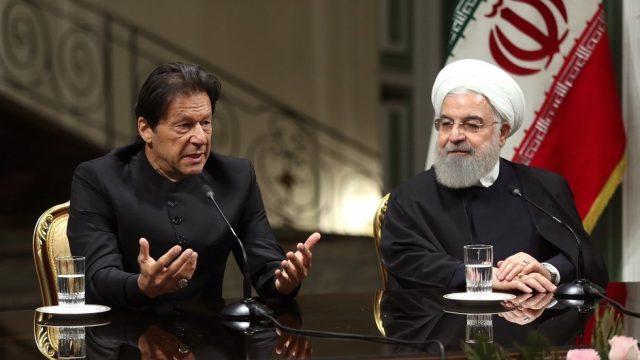
© AFP / IRANIAN PRESIDENCY
By Darius Shahtahmasebi | RT | April 23, 2019
Pakistani Prime Minister Imran Khan’s visit to Tehran has been marred by two recent deadly attacks. Despite an apparent willingness to cooperate, there remain many outside players who will push for this alliance to fail.
Someone clearly hates the idea of peaceful dialogue between Iran and Pakistan. Whether a coincidence or not, the timing of an attack in Pakistan within barely a day or two of a planned visit to Iran’s capital by Pakistani Prime Minister Imran Khan is certainly perfect timing for those who view an increasing relationship between the two nations through negative terms. The attack in question saw at least 14 Pakistani security forces personnel killed in a bus ambush. Not helping the issue, is the fact that Pakistan’s foreign office instantly blamed the attack on Iran, accusing Iran of inaction against ethnic Baloch separatist groups, even as Khan was set to visit Tehran.
In February, there was similarly an attack in eastern Iran that killed at least 27 Iranian security personnel. Tehran warned Islamabad it would “pay a heavy price” for allegedly harboring the militants who planned the suicide bombing, which was claimed by the Pakistan-based Jaish al-Adl group.
Now, I am not saying that there is any conspiracy behind the attacks. I mean, why would I need to bother? Whether there are attacks or not, the media and a handful of notable leaderships will continue to portray Iran-Pakistan relations as the worst possible form of détente imaginable.
All this being said, the two countries were able to have a somewhat fruitful and productive engagement during Khan’s visit. The news that is likely to infuriate some other major players on the world stage is the announcement of a creation of a joint rapid reaction force along the shared border of Iran and Pakistan.
Ironically, the recent attacks against Iranian and Pakistani personnel may have brought these two nations closer together, as Khan announced that Pakistan will not allow any militant groups to operate from Pakistani soil, vowing to dismantle any militant group inside the country.
On a side note, WikiLeaks documents have shown that Saudi Arabia financed militant groups inside Pakistan. Even Deutsche Welle notes that most of the Pakistani based militant groups “unleashing terror” on Pakistan’s minority Shiite population “take inspiration from the hardline Saudi-Wahhabi Islamic ideology”.
Khan’s visit also magically coincided with US Secretary of State Mike Pompeo’s announcement that it was clamping down hard on countries who sought to buy Iranian oil, namely, India, Japan, South Korea, Turkey and of course, China, who account for about half of Iranian oil exports. This would undoubtedly send a clear picture to Pakistan about what will happen if it continues down its current trajectory.
Undeterred, Pakistan and Iran have agreed to establish a so-called barter committee to help in a planned increase in trade, with an eye for bypassing US-enforced sanctions.
Despite the picture the media wants to paint of a hostile Pakistan weary of an aggressive, terrorist-supporting Iran, the truth is that Iran and Pakistan are not really traditionally that adversarial.
Historically speaking, the two countries have had relatively friendly relations. Iran was one of the first countries to recognise and reach out to Pakistan after its creation in 1947. In fact, then-Shah Mohammad Reza Pahlavi was the first head of a foreign nation to visit the newly created country. Iran also provided moral and material support to Pakistan during its infamous conflicts with India in 1965 and 1971.
The countries only really split along a Sunni-Shia divide after the Islamic revolution in Iran in 1979. Aside from strengthening its relations with Saudi Arabia, Iran’s major rival, Pakistan also became a major US ally, particularly during the Afghan-Soviet war in the 1980s. Iran then viewed Pakistan as nothing but a lackey state of the United States.
Even though, Khan has made it clear that Pakistan holds no ill will to Iran following the revolution, purportedly stating that “I came here [to Iran] in 1972. I saw a big difference between the rich and the poor, a big cultural difference. Iran has become a more egalitarian society that is what the revolution has done.”
Despite the fact these two countries have many long standing differences and areas of competition, they still have many avenues of cooperation that they have felt the need to pursue.
One such avenue is the question of Afghanistan. For example, India has increased its interest in the war-ravaged nation, which puts Pakistan in a very compromising position indeed given it is essentially on the verge of a major war with its Indian neighbour.
According to Khan, both Pakistan and Iran have been affected by the conflict in Afghanistan, hosting millions of refugees between the two nations.
Iran and Pakistan have also been in the line of fire of Donald Trump’s hawkish administration. While Trump’s desire to annihilate Tehran is much more apparent than any such desire to go to war with Pakistan, we cannot ignore the major blows to US-Pakistan relations that have occurred under the watch of Trump.
The two nations further share close relations with China, the formulation of which has been termed as a trilateral nexus by the Asia Times. Pakistan and Iran also have a pipeline of their own capability of pursuing, which will most likely entail the deepening of cooperation even in spite of their major differences.
Another interesting aspect that comes into play in this dynamic – which I guarantee you, you will never see highlighted in a corporate media outlet – is that Iranian President Rouhani actually enjoys the support of the local ethnic Sunni population of Iran. Therefore, it is not beyond the administration of Rouhani to work more closely with its predominantly Sunni neighbours (if you don’t believe me, I wrote an extensive article highlighting the notable attempts by Iran to reach out to Sunni Saudi Arabia over the last few years).
The major problem that Pakistan faces is that while it can find common ground with Iran, including on matters in relation to economic ties and security, it does not want to irk Saudi Arabia too much, a nation which just pledged $20 billion in investments to Pakistan. Islamabad is likewise not impressed by Iran’s growing relationship with India. This is why Pakistan put itself in a questionable position whereby its former Chief of Army staff was appointed to what is essentially the head of a Saudi-led Arab NATO, which does not include Iran (indeed, it seems as though its existence is based on the idea that it needs to counter Iran).
At the end of the day, the optimist in me reckons that there are enough areas of cooperation between the two countries which can help to balance out the devastating rivalries between Iran and Saudi Arabia and prevent a deadly war. But in all honesty, if you were to compare the outcomes between Saudi Crown Prince Mohammed bin Salman’s (MBS) visit to Pakistan and Khan’s visit to Tehran, the latter seems a bit weak in substance. It seems as though no matter how far Iran reaches its hand out to Pakistan, its loyalty to Saudi Arabia will continue to prevail ($20 billion will always be worth more than anything Iran can ever offer to its neighbour). Not to mention the money that Pakistan is offered from the United Arab Emirates (UAE), which also views Tehran mostly in hostile terms.
Perhaps Khan can act as a mediator between Iran and Saudi Arabia, but the available evidence suggests there is nothing to mediate. Since 2015, Saudi Arabia has destroyed an entire country on its border simply on the suspicion that Iran could be backing the rebel movement inside Yemen. Even the possibility that a rebel-controlled government installed on its border could align itself with Tehran is a major deal-breaker for the Saudi Kingdom, worth starving over 85,000 children to death and threatening behind closed doors that Yemen should “shiver” for generations when they hear Saudi Arabia uttered.
The optimist in me is going to have to be a bit more realistic.
Read more:
Iranian President Rouhani declares joint border ‘reaction force’ with Pakistan
What you won’t hear from US govt: Iran is open to working with Saudi Arabia
India sponsoring terror activities in Balochistan: Pakistan FM
The Frontier Post | April 23, 2019
ISLAMABAD – Foreign Minister Shah Mahmood Qureshi has said that India is trying to destabilize Pakistan and sponsoring the terror activities in Balochistan.
FM Qureshi said this on Tuesday while talking to a private news channel; Qureshi said that India is behind the terror activities in Balochistan province.
Regarding the Ormara terror incident, he said that Pakistan has already shared the details of the incident with Iranian authorities, adding that Afghanistan and Iranian territories are being used for carrying out terror acts in Pakistan.
He said Pakistan is helping Iran in recovering their kidnapped border guard personnel.
Qureshi repeated Pakistan’s resolve to have a stable and peaceful border with its neighboring countries, including Iran, to check cross border terrorism.
Earlier on Monday, Prime Minister Imran Khan reiterated his resolve not to allow any militant group to use Pakistani soil against anyone.
Addressing a joint press conference along with Iranian President Hassan Rouhani, the prime minister had said, Islamabad is taking decisive action against the militant groups.
The premier had said we will not allow Iran to be harmed from Pakistani soil and hopes to ensure the same from Iran.
It may be noted that Pakistan and Iran have also agreed to set up a Joint Rapid Reaction Force to guard the common borders.
Sri Lankan Authorities May Have Fallen Into a Trap Set by a Foreign Power
By Adam Garrie | EurasiaFuture | 2019-04-22
The entire world remains confronted with the horrors that unfolded yesterday throughout Sri Lanka. Whilst the country remains under curfew, the authorities have pinned the blame for the attack on an obscure group called National Thowheeth Jama’ath (NTJ). NTJ is reportedly an Islamist terror group that as noted by Sri Lankan authorities, has multiple links to foreign countries. The links to foreign countries appears to hold the key to determining who is really behind the attacks. Notably, it has been confirmed by journalists that the group trains in Chennai in Tamil Nadu – the same location where LTTE had previously trained.
As the Muslim population of Sri Lanka is less than 8% of the country’s entire population, it is difficult to conceive that any genuine local Islamist group would seek to stage such massive attacks when the possibility of any material gain would be limited by the fact that not only is Sri Lanka’s Muslim population at harmony with the Buddhist majority, but the population of Muslims is incredibly small. This contrasts sharply with the situation in Syria where a Sunni Muslim majority was weaponized against a leadership comprised of the minority Alawite faction.
Therefore, due to NTJ’s foreign links, it is highly likely that a foreign entity, most likely a foreign state or state intelligence agency was behind the attacks and that the men on the ground who have been captured are merely pawns in a much larger and even more dangerous game. When it comes to seeking to pin-pointing the country with a clear motive for orchestrating the attacks, India is the one that springs immediately to mind, not least because NTJ trains where the LTTE once did.
India has a long history of seeking to manipulate the power balance in Sri Lanka in order to turn the country into something of an Indian protectorate. These attempts have notably been resisted by most contemporary Sri Lankan leaders who seek an independent foreign policy that aims at securing win-win friendship not only with India but crucially, also with China and Pakistan.
In spite of this, India was one of the first open backers of the LTTE’s reign of terrorism that gripped Sri Lanka beginning in 1983. India ultimately paid a price for its dithering in the early stages of the Sri Lankan civil war. By the end of the 1987, India had given up on LTTE and instead sought to influence the situation by committing a deeply controversial peace keeping force to Sri Lanka whose overall effect only served to provoke further violence. As a result of India’s 1987 decision to publicly “switch sides”, LTTE assassinated Indian Prime Minister Rajiv Gandhi in 1991. In spite of this, it has been widely known in Sri Lanka and elsewhere that in spite of the official rhetoric in New Delhi, India’s RAW intelligence agency resumed covert support of LTTE later in the 1990s.
Since the end of the war against LTTE in 2009, India has sought to monopolise foreign influence in a post-war Sri Lanka that has developed ever more economic ties with China and plays a key role in the Belt and Road initiative. This has clearly been a source of consternation for an Indian state that has a track record of meddling in the affairs of both Sri Lanka and the much smaller Maldives. In both Sri Lanka and the Maldives, political factions are often divided by foreign observers into a pro-India side and a pro-China side. Although such divisions are not black and white, there is a level of truth to such descriptions. As such, India recently engaged in what geopolitical expert Andrew Kroybko described as a “electoral regime change in the Maldives”. This came after the prominent BJP supporter Subramanian Swamy called for a traditional war against the Maldives.
India was clearly looking to the south both in terms of Maldives and Sri Lanka for much of late 2018 and early 2019. Beginning in late 2018, Sri Lanka experienced a serious political crisis after President Maithripala Sirisena abruptly sacked Prime Minister Ranil Wickremesinghe and replaced him with former political rival (and former President) Mahinda Rajapaksa. According to Sirisena and his supporters, the proximate causes of Wickremesinghe’s dismissal were personal, cultural and class differences that Sirisena called irreconcilable. Furthermore, it was claimed by some in the Sri Lankan press that the sacking of Wickremesinghe was due to an Indian backed assassination plot against the President which resulted in the abrupt about face in respect of the Sri Lankan President’s loyalty. Later however, Sirisena assured Indian Premier Modi that he had never made such an accusation.
But while Sirisena took the time to assure India that stories regarding an Indian assassination plot are ‘fake news’, an inevitable geopolitical justification for Wickremesinghe’s sacking was offered from many quarters of Indian media.
According to the Indian narrative throughout the end of the 2018, the traditionally/”formerly” pro-India Sirisena dismissed the pro-India Wickremesinghe in favour of the pro-China Rajapaksa due to pressure from Beijing. Of course, no one has been able to present any evidence of any Chinese involvement in the matter while China itself has taken a diplomatic line on the matter that has respected Sirisena’s decision in a rather subdued manner.
Ultimately, the courts overruled Sirisena and Wickremesinghe has continued to serve as the country’s Prime Minister.
Whilst the saga which pitted Wickremesinghe against Rajapaksa on the orders of Sirisena does ultimately seem to have been a completely internal matter, India clearly has not forgotten that Sirisena had moved to install a Prime Minister who ostensibly was more favourable to China and less so to India. As Sri Lanka is a much larger country than Maldives, meddling in the political situation was clearly going to be more difficult than the “electoral regime change” that New Delhi pulled off in Malé. Beyond this, whilst Indian media did their best to meddle in the situation in Sri Lanka during late 2018 and early 2019, this may well not have been enough to satisfy elements of the Indian deep state seeking revenge against Sirisena.
Beyond this, the timing of the attacks is incredibly suspicious. After India’s recent provocation against Pakistan resulted in humiliation after Pakistan downed two Indian jets and safely captured and later released an Indian pilot, it can be logically deduced that India sought to create a different regional disturbance against a target that is generally seen as “softer” from the Indian perspective vis-a-vis Pakistan.
As Sri Lanka defeated LTTE ten years ago, the atmosphere of peace that had prevailed may well have created a false sense of security that was ripe for exploitation. Even before Colombo named an obscure Islamist group as the culprits of the attacks, Indian politicians up to and including Narendra Modi began banging the drums of jingoistic Islamophobia as is par for the course when it comes to the radical Hindutva BJP.
Therefore, when one connects the dots, one sees that India stands to uniquely benefit from Sri Lanka’s turmoil not only in terms of internal electoral politics but in terms of weakening a Sri Lankan government that in spite of its allegedly pro-India Prime Minister maintains healthy and growing ties to China and Belt and Road. Thus, the attack could well serve as a “punishment” for Sri Lanka’s “crime” of moving closer towards Belt and Road. Making matters all the more beneficial for India is that a relative of the Bangladesh Prime Minister’s family was also killed in the attack which took place on a five star hotel in which he was staying. It cannot be ruled out that RAW had knowledge of this and specially targeted the hotel in order to inevitably inflame Bangladeshi sentiment against Sri Lanka for its self-evident security failure.
Taken as a whole, India has clear motives for seeking to destabilise Sri Lanka at this time. What’s left for Sri Lankan investigators to do is make the foreign links of NTJ known to the wider world whilst Sri Lanka must also record and make public the voices of the surviving suspects so that experts can determine if the suspects speak in the language, dialect and vernacular that one would expect. Also, the bodies of the terrorists must be examined to determine whether they are circumcised or not. This is crucial as previous Indian false flag attacks have involved non-circumcised men (therefore not Muslims) participating in allegedly Islamist attacks whilst also, previous false flag attacks in India allegedly involving Pakistanis were later exposed due to the fact that the “Pakistani” suspects could not speak Urdu or any other official Pakistani language but instead spoke in languages and vernaculars common only to India.
Therefore, while it cannot be concluded with certainty that yesterday’s atrocity was a false flag attack, it can certainly not be ruled out. As such, anyone with a clear motive for conducting a false flag attack should be thoroughly investigated by the Sri Lankan authorities.
New York Times Accidentally Unravels UK Government’s Official Skripal Narrative
By Kit Klarenberg – Sputnik – 17.04.2019
While London almost immediately blamed Moscow for being behind the poisoning of ex-Russian spy Sergei Skripal and his daughter in the UK city of Salisbury in March 2018, Russia has strongly rejected its involvement, stressing it’s been denied access both to the investigation into the incident and the Russian nationals affected.
On 16th April, the New York Times published a glowing profile of Gina Haspel, who in May 2018 became the seventh director of the Central Intelligence Agency.
The article referred to Haspel — the former head of a CIA ‘black site’ in Thailand at which an indeterminate number of suspected terrorists were viciously tortured — as an “adept tactician” blessed with “good listening, empathy and an ability to connect”, and discussed the difficulties the intelligence chief faced in ensuring “her voice is heard at the White House”, due to the intransigence of President Donald Trump and a White House that allegedly treats national security professionals “with deep skepticism”.
So far, so obsequious — but buried in the hagiography is a fascinating disclosure. In a section titled ‘The keys to talking to Trump? Realism and emotion’, authors Julian E. Barnes and Adam Goldman document how Haspel “solidified her reputation” as one of the “most skilled briefers” of the President.
Following the 4th March 2018 poisoning of former spy Sergei Skripal and his daughter Yulia in Salisbury, UK, top national security officials are said to have gathered inside the White House to discuss with Trump how Washington should respond — at the time, Whitehall was preparing to expel dozens of Russian diplomats from the UK, and aggressively pushing various key international allies to follow suit.
Trump was said to have initially dismissed the significance of the poisoning, characterising it as “legitimate spy games, distasteful but within the bounds of espionage”. However, Haspel lobbied the President to expel 60 Russian diplomats from the US — and persuaded Trump to take the “strong option” by showing him the Skripals “were not the only victims of Russia’s attack”.
“Ms. Haspel showed pictures the British government had supplied her of young children hospitalized after being sickened by the Novichok nerve agent that poisoned the Skripals. She then showed a photograph of ducks British officials said were inadvertently killed by the sloppy work of the Russian operatives. Ms. Haspel was not the first to use emotional images to appeal to the president, but pairing it with her hard-nosed realism proved effective: Mr. Trump fixated on the pictures of the sickened children and the dead ducks. At the end of the briefing, he embraced the strong option,” the article states.
Lame Ducks
This small excerpt raises innumerable questions about the ever-mystifying Salisbury incident. Firstly, the images apparently provided to Haspel by the British government have never been published, or even mentioned, by the British media.
Given Whitehall’s determination to blame and diplomatically punish the Russian state for the poisoning before a motive had been established, any perpetrators identified, or other basic facts ascertained — in the face of significant public disapproval, and opposition leader Jeremy Corbyn demanding action be informed by evidence — it’s entirely inconceivable that if these pictures existed, they wouldn’t have been provided to major news outlets and prominently publicised. If they were sufficiently impactful to convince a sceptical US President to support Whitehall’s strategy, hesitant British citizens may well have been similarly swayed.
Moreover though, since March 2018 no UK media outlet, government minister/spokesperson, health professional or law enforcement official has ever even claimed a single child was “sickened” after coming into contact with so-called “Novichok” (there have likewise been no reports of any waterfowl having tragically died due to the nerve agent). Again, it’s utterly imaginable that had a child suffered adverse effects from the nerve agent, it wouldn’t have been widely reported.
There could be several explanations for this seeming anomaly. To name just some of the most unsettling:
- Several children were hospitalised, and several ducks did die, and for reasons unclear the British government didn’t inform the public and prevented the children and their parents from revealing they’d been affected, while secretly communicating the fact to other governments in literally graphic detail.
- Counterfeit and/or misleading images may have been produced by persons unknown to bolster Britain’s case for concerted international action, and further been relayed to Haspel (if not other overseas officials), conning her and Trump into backing its mass-expulsion policy.
Alternatively of course, perhaps the stirring tale of Haspel converting the reticent President with impactful images is mere gossip, or spin — after all, the article’s authors didn’t discuss the episode with the CIA chief herself, but based their article on interviews “with more than a dozen current and former intelligence officials who have briefed or worked alongside her”.
However, even if the explanation is quite so anodyne, that in turn raises major questions about how and why the individual(s) who relayed the story to Barnes and Goldman came to believe children and ducks had been affected by Novichok.
Shifting Chronicle
The official narrative of the Salisbury incident is ever-fluctuating. Seemingly each and every article, news segment, official statement or documentary about any element of the case contains new information, requiring the established account to be at least partially rewritten and/or contradicting established elements of the story.
To name but two significant instances of this strange phenomenon in recent memory, on 19th January it was revealed 16-year-old Abigail McCourt had won a ‘Lifesaver Award’ for giving first-aid to the Skripals after finding them unconscious on a public bench in the centre of Salisbury. Accompanying reports indicated she’d been the first person to notice the collapsed father and daughter, and had quickly alerted her mother Alison — together, they provided potentially life-saving assistance to Sergei and Yulia.
The story was somewhat at odds with the official timeline, as advocated by Whitehall and the Metropolitan Police, which stated an off-duty doctor and nurse had found the Skripals — but moreover, Abigail’s award announcement also revealed her mother wasn’t merely a nurse, but the Chief Nursing Officer for the British Army, with the rank of Colonel.
Similarly, on 3rd March the BBC reported police only “realised the seriousness” of the Salisbury incident after Googling the name Sergei Skripal — while the information wasn’t in fact new (similar claims were made in Panorama documentary Salisbury Nerve Agent Attack — The Inside Story in November the previous year), the article indicated the first police officer on the scene was Sergeant Tracey Holloway.
Again, this small detail had massive ramifications for the British state’s narrative — for previously government and police spokespeople had unanimously claimed Detective Sergeant Nick Bailey had been the first police officer to attend to the Skripals, hailing his courage in rushing to help them without any regard for his own safety. It was also claimed his contact with them on the scene exposed him to the nerve agent, leading to his own hospitalisation — it’s now ‘established’ he was poisoned after visiting Skripal’s home.
Elements of the official narrative also bizarrely and frequently vanish without warning or explanation — a key example being the Skripals giving bread to three local boys to feed to ducks in Salisbury’s Avon Playground at approximately 1:45pm on 4th March. The incident was initially widely reported in the media, with The Daily Mail claiming the children — one of whom apparently ate some of the bread given to them by the Skripals — had been “rushed to hospital for blood tests amid fears they’d been poisoned”, although the children were entirely unharmed, and discharged from hospital having been given “the all-clear”.
“To try to kill Skripal is one thing, but now it seems children may have been caught up in it. It shows whoever did this didn’t care who they killed or maimed,” a spokesperson for Public Health England told the Sunday Mirror.
Strikingly, this episode would soon completely disappear from media coverage of the Salisbury incident, while never appearing in any officially sanctioned narrative — although it’s easy to understand why. According to the Metropolitan Police’s timeline, after leaving the Avon Playground the Skripals went on to the Bishops Mill Pub in Salisbury town centre, before arriving at Zizzi restaurant at around 14:20pm. They left at around 15:35pm, and emergency services received the first report they’d been found unconscious at around 16:15pm.
British authorities determine Sergei and Yulia were poisoned by Novichok spread around their home — in particular the front door handle — at some point before 13:30pm, when Sergei’s car was seen on Devizes Road heading towards the town centre. The pair were apparently so infected by the nerve agent, and the substance so dangerous, Zizzi was forced to close for eight months due to high levels of contamination, and the table the pair dined at had to be destroyed. The Mill pub, which they headed to immediately after their exploits in Avon Playground was likewise subject to extensive decontamination and only declared safe for reopening in August, although it remains shut even today. The bench the Skripals were found lying on was also destroyed.In spite of this, the children given bread by the Skripals and the ducks they fed were completely unharmed by novichok. It was obviously necessary for the pair’s contact with the trio, one boy’s ingestion of the bread, and indeed their en-masse duck-feeding, to be suppressed. Otherwise, the finding that the pair were poisoned at home before travelling into Salisbury is simply unfeasible — and the pair were poisoned elsewhere, at another time and by another means entirely.
It’s puzzling in the extreme this keenly forgotten aspect of the incident allegedly is said to have featured so prominently in Haspel’s case for decisive US action against Russia — and begs the question of who deceived and is deceiving who, how and why.
Own Initiative?
Adding to the intrigue, on the day of its publication the New York Times article caught the attention of Sky News Foreign Affairs Editor Deborah Haynes, who duly shared the piece on Twitter, praising Barnes for his work (Goldman went uncredited) and drawing particular attention to the passage relating to the images of “sickened” children.
However, in a suspicious volte-face, within hours Haynes tweeted that “UK security sources” had told her they were in fact “unaware of children hospitalised because of novichok or wildlife killed” in the Salisbury incident.

Sky News’ Deborah Haynes Backtracks
For her part, Haynes claims she asked “UK contacts” about the images after reading the article, and their denials prompted her to post an “update”. This may well be the case — she certainly has close connections with security services and the military, as evidenced by her honorary membership of the Pen & Sword Club, a group which “[provides] a link between serving and retired officers and supporters within the Ministry of Defence”, and promotes “media operations as a necessary and valued military skill in the 21st century”. She’s one of very few journalists named in their ‘club members’ section — almost all others have military and/or intelligence backgrounds.
Moreover, it’s somewhat odd Haynes was initially seemingly unaware no children were hospitalised in the Salisbury incident, given she wrote extensively about the topic while Defence Editor of The Times. As my previous reports have documented, much of this output was heavily influenced by the Integrity Initiative, a British military intelligence operation which sought to systematically shape media reporting on, and Whitehall’s response to, the Salisbury incident from day one. Evidently, the British deep state is equally as capable of contacting Haynes directly as she is them — and its operatives would have every reason to want one of their most prominent media advocates to speedily retract and repudiate an extremely inconvenient disclosure such as that contained in the New York Times’ report.
If nothing else, that Haynes was willing to transmit an apparently obvious fiction speaks volumes about the willingness of mainstream journalists to parrot each and every fresh claim in the Skripal case, even if it wildly conflicts with what they themselves have written previously.
A tale of two cities – Paris and New York
johnplatinumgoss | April 16, 2019
 Paris
Paris
Sadly, last night, the impressive spire of the cathedral of Notre Dame de Paris fell onto the roof of the cathedral. Constructed of wood and covered with lead it burned for some seven hours before the weakest point gave way and the spire came down. I expect many others have drawn mental comparisons between the collapse of this spire and the structure called the “spire” which was demolished along with WTC1 in New York on 11 September 2001.
The collapse of the 19th century spire can be seen on several videos showing what would be expected to happen in accordance with Newtonian physics, the laws of motion and gravity. Newton’s first law (Law of inertia) is obeyed in that an object when acted upon by a force will continue in a linear direction unless acted upon by another force. In this case the force acting upon the spire was gravity (a natural force) which came into play when the point of least resistance gave way allowing the spire to fall. Importantly the spire continued to fall in the same direction until it was acted upon by another force – the cathedral roof – which stopped its further linear momentum.
This second picture shows that the spire continued in the same outward direction in which it started (featured image).

New York
While this article compares spires it is fair also to say that the whole of the North Tower fell without apparently following the laws of Newtonian physics though a case could be made for the stronger nuclear forces which can compromise atomic structures.
The “spire” which was a core column of WTC1 (North Tower) has been the subject of much speculation. It falls several seconds after other parts of the building have already fallen. It then appears to vanish into its own footprint, that is, straight down through the path of greatest resistance. Whereas the spire on Notre Dame cathedral leaves behind the structure that had been previously supporting it – the equal and opposite forces of Newton’s third law. Watch how it falls in the video below and imagine the stronger support structures beneath it. Where did they go?
As with the spire of the cathedral, which was a much weaker structure, one corner of WTC1, where the initial fire took place was weaker than other parts and the top section started falling, like Notre Dame spire, outwards. Unlike the spire in Paris it did not continue on that path. This photograph shows the original momentum and if a straight line was to be drawn from the corner edge the degree of tilt can be seen.

That still was taken from the video linked here. To obey Newton’s laws it would have continued in the same path for the simple reason that it is the path of least resistance. There are currently more than 3000 qualified engineers and architects who are seeking to find out what really happened almost 18 years ago. Below some of the pioneers of this movement explain why Newton’s laws of motion were not followed when the twin towers and Building 7 collapsed in almost freefall.
I hope people can see from the way the spire of Notre Dame fell that the twin towers -which were also much stronger below compared to the compromised section at the top – should have followed a similar path.
UK, Allies Want to Preserve Chemical Labs for New Provocations – Russian Embassy
Sputnik – 12.04.2019
LONDON – The United Kingdom and its allies strive to preserve their chemical laboratories to stage further provocations, a spokesperson of the Russian Embassy in London said on Thursday.
“Therefore, the problem is obviously not with Russia ‘loving Novichok so much’ (to use the words of Mr. Hunt), but with the UK and its allies willing to allow their laboratories, like the notorious Porton Down, to continue with chemical experiments and provocations”, the spokesperson said, as quoted by a press release published on the embassy’s website.
On Wednesday, UK Foreign Secretary Jeremy Hunt wrote in Twitter that Russia objected to a military-grade nerve agent Novichok being added to the list of banned chemical substances by the Organization for the Prohibition of Chemical Weapons (OPCW) and accused Moscow of using it in the poisoning incident in Salisbury last March.
The spokesperson also noted that Hunt highlighted just one side of the issue, as, in fact, during a session of the OPCW Executive Council in January, the United States, Canada and the Netherlands proposed to include only two groups of substances, named Novichok by Western countries, to the OPCW list. However, Russia opposed this initiative, as suggested that “all new generation toxic materials tested in many countries need to be added into those lists”.
On 4 March 2018, former Russian spy Sergei Skripal and his daughter Yulia were found unconscious on a bench near a shopping center in Salisbury. London claimed they were poisoned with a military-grade A234 nerve agent and accused Moscow of staging the attack, provoking a huge international scandal.
The Kremlin has repeatedly dismissed the claims about Russia’s involvement in the attack and stressed that Moscow has been denied access both to the investigation into the incident and to the Russian nationals.
The ‘Caesar Report’ conundrum and the increasing weaponisation of “international justice”

Moaz Moustafa (on right) facilitates John McCain’s illegal entry into Syria to meet with extremist group leaders and known kidnappers. (Photo: Antiwar)
By Tim Hayward | 21st Century Wire | April 6, 2019
The photos brought to public attention in January 2014 by the anonymous witness codenamed ‘Caesar’ show corpses, thousands in number, deceased from violent causes, some bearing signs of torture and many having suffered starvation and neglect.[1] The dead are said to be victims of Syrian state detention facilities, but it is now known that many were not, and it is still not known for sure how many of them were.[2]
If the atrocity of the crimes to which the photos attest is in no doubt, the question of who perpetrated them is less clear-cut. Yet Western reports have unequivocally blamed the ‘Assad regime’. A counter-hypothesis, hardly considered in public discussions, is that many of the bodies were of civilians captured by Jaish al-Islam (JAI) after taking control of Douma in December 2012. JAI are known to have starved their captives while using them as slave labourers, which they did on a scale monumental enough to create the extraordinary network of deep and impressively engineered tunnels that we now see had been built across the area under their control.[3]
Nevertheless, a Qatari-sponsored prosecution team vouched for the Caesar evidence as being ‘capable of being believed’ – in a court of law – to show ‘systematic torture and killing of detained persons by the agents of the Syrian government.’[4] The Western media’s subsequent dissemination of the prosecutors’ interpretation of the images – unchallenged – caused it to be widely believed in the ‘court of public opinion’. Despite significant unsettled and unsettling questions, then, a particular account of what the images show has exercised considerable influence over people’s default assumptions about accountability for atrocities in Syria.
It is the influence of this specific interpretation of evidence that will be reflected on here, and without prejudice as to what may be established about occurrences in Syrian detention on other bases.[5] Questions about the Caesar evidence point up concerns about the extent to which the dissemination of inaccurate information might have distorted the written historical record of our times and how it may have practically influenced real decisions and events.
It matters to get at the truth about the photos for those reasons, as well as for the sake of families whose loved ones have disappeared, but there is also a further reason. This concerns a use made of Caesar’s testimony that may affect the future course of history too. It is the promotion by Western prosecutors of judicial innovation in the pursuit of accountability for atrocity crimes. The purpose of this article is to set out how and why that is a concern, and fundamentally one about justice.
To situate the discussion it will be worth briefly outlining the contrasting kinds of reception the Caesar testimony has received – affirmative versus sceptical – and then also pointing to a much less noticed reception, one of significant silence. For there is an identifiable group of usually vocal critics of the Syrian president and government that has refrained from mentioning the name Caesar. This in itself could be somewhat revealing about what intelligence that group accepts as authoritative. But it also throws into relief the distinctive commitments of another group who, by contrast, have made considerable use of the Caesar name.
It is they who have, for instance, provided the impetus behind successful lobbying for the Caesar Syria Civilian Protection Act in the United States. Less spectacular, but of potentially more enduring international significance, is dissemination of Caesar’s narrative in a wider campaign aimed at creating increasingly flexible mechanisms for international criminal prosecutions.[6]
Billed by some as a progressive and cosmopolitan approach to ‘global justice’ that sets human rights above the prerogative of despots, this movement might more cautiously be assessed as legitimising ‘regime change’ by means of judicial innovation. Such use of the Caesar testimony could serve not only to delegitimise the current president of Syria but also to enhance the possibility of delegitimising any head of state.
This would be at the initiative of prosecution teams who themselves are accountable to their clients and sponsors rather than to the victims of conflict or to principles of humanitarian justice. The argument thus to be developed in this article commends caution about both the evidentiary value of the Caesar testimony and the intentions of those who have most vocally asserted it.
Caesar, his story and the questions raised.
The basic outline of Caesar’s story can be sketched quite succinctly. According to the testimony attributed to Caesar, he had been working as a military photographer in Damascus, where his job was to photograph the dead for purposes of state record keeping. In 2011, concerned at the number of deceased, and the visible indications of torture and starvation, he started smuggling digital files of the images to a contact, now referred to as Sami, who passed them to the Syrian National Movement (SNM). In August 2013, the SNM facilitated Caesar’s extrication from Syria, to be followed shortly after by his immediate family members.
The SNM, although based in Turkey, was backed by Qatar, and the Qatari government hired a team of lawyers and forensic specialists to assess the credibility of the witness and his evidence as a basis for potential prosecutions. In a matter of days the team pronounced Caesar’s evidence ‘capable of being believed’ in a court.[7]
Caesar was then taken to Washington on a visit facilitated by Mouaz Moustafa, director of the Syrian Emergency Task Force, a US State Department sponsored organisation representing some of the anti-government forces in Syria. When giving testimony there, Caesar’s face was concealed and his words were whispered to Moustafa, who acted as translator. After appearing in several other high profile venues with similar arrangements for anonymity, Caesar withdrew from the limelight.

Caesar testimony fed through Moaz Moustafa, facilitator of McCain’s trip to meet “rebels” in Syria. (Photo: Tim Hayward blog)
Meanwhile, an influential section of United States political opinion has pronounced itself confident enough in the witness Caesar to enact legislation in his name – the Caesar Syria Civilian Protection Act – aimed at enforcing ‘accountability’ measures on Syria. The lead author of the Caesar Report, David Crane, has spoken of the photographic evidence as a ‘smoking gun’, words echoed by Keith Harper, US Ambassador to the UN Human Rights Commission (UNHRC). Stephen Rapp, the former US Ambassador At Large for War Crimes, has stated that the photos help to provide ‘much better evidence than has been available to prosecutors anywhere since Nuremberg’.[8]
Prosecution teams in Europe have also attributed great value to the photos as evidence of atrocity crimes.[9] Among the lawyers prominent in promoting the prosecutorial value of the Caesar evidence are Toby Cadman,[10] Wolfgang Kaleck[11] and Patrick Kroker.[12] Meanwhile, the NGO Human Rights Watch produced its own report claiming to validate some of the Caesar evidence.[13] A number of journalists have also expressed themselves convinced, including Richard Engel, who has met ‘Caesar’, and Josh Rogin, Ben Taub, Susie Linfield,[14] Nick Robins-Early,[15] Adam Ciralsky,[16] Jim Muir for the BBC,[17] as well as many more contributors to news outlets including Spiegel,[18] Daily Mail,[19] CNN.[20]
Garance le Caisne wrote a book on Operation Caesar, and documentary films featuring it include Sara Afshar’s Syria’s Disappeared. Affirmation of the evidence has made its way into academic publications too. Some of this has come from people involved in organisations campaigning for an approach to justice and accountability for atrocity crimes that allows implementation of a ‘responsibility to prosecute’.
Those with this interest include prosecution lawyers and advisors like Stephen Rapp, David Crane, Wolfgang Kaleck, Patrick Kroker, and Beth Van Schaack. Other academics who have cited the Caesar evidence uncritically, treating it as part of an established factual record, include: Noha Aboueldahab;[21] Jamie Allinson;[22] Adam Bazco, Gilles Dorronsoro and Arthur Quesnay;[23] Nader Hashemi;[24] Bessma Momani and Tanzeel Hazak;[25] Chris Tenove;[26] and Thomas Weiss.[27]
Some academics have cited the HRW report rather than the original Caesar Report, even if, like Van Schaack,[28] they apparently did not notice how HRW had significantly modified some of the original report’s claims, such as the 11,000 victims figure that HRW corrected down. In all, it can certainly be said that Operation Caesar has made its way into publications that will be regarded as laying down the historical record.
Not everyone is convinced, however. Even the initial reception was cautious in some quarters. One reason was the revelation that Operation Caesar had been initiated by Qatar, a country that had been providing funds – now known to be in the billions of dollars – to opposition fighters aiming to bring down the government of Bashar al-Assad.
There were also the questions, flagged at the start of this article, that are simply begged by appeals – of Rapp and others – to the confirmation by the FBI that the photos showed real dead people.[29] Other serious concerns have been set out in detail by Rick Sterling[30] and Adam Larson[31], but an elementary and conspicuous one is the unconvincing justification for Caesar’s anonymity, which serves to prevent any rigorous independent questioning of his story.
The rationale given for secrecy appears to depend on the implausible proposition that a photographer in the state’s employ could go missing and yet not be missed. A result of the anonymity is that the public ultimately has to place a lot of trust in the competence, integrity and good faith of the people translating and relaying the story. Given that these are people pressing a case for the prosecution, it would be only proper to allow a full examination of the methods they have deployed in presenting their case.
From a defence perspective, it would be hard to ignore facts like prime mover Rapp and the fixer and translator Moustafa having been among the most persistent lobbyists on Capitol Hill for regime change – previously in Libya and then in Syria. Rapp, furthermore, has been campaigning for changes in international criminal law that would lower the barriers to prosecution for atrocity crimes. Even their allies in the quest to prosecute Assad have expressed reservations.
Notably, the directors of the organisations gathering the documentary evidence that Rapp finds the necessary complement of Caesar’s evidence have been quite clear on the point. Thus Bill Wiley, director of the Europe-based Commission for International Justice and Accountability (CIJA) has said ‘would it make a case against Assad? No, not at all, not at all.’[32] Wiley’s counterpart in America, Mohammad al-Abdallah – director of the Syria Justice and Accountability Centre – is also deeply sceptical of the photos’ evidentiary value.[33]
Who dares to cite Caesar?
The central concern of this study can now be further delineated by reference to a group of social media commentators who, to my initial surprise, have appeared to accept that point. This is a group of people who are generally vocal in matters relating to the war in Syria and would not typically pass up an opportunity to highlight crimes alleged of the Syrian president and government.
This group would include Idrees Ahmad, Eliot Higgins, Oz Katerji, Scott Lucas, George Monbiot,[34] Thomas Pierret and Robin Yassin-Kassab. None of them – as far as I can discern – has ever referred to Caesar.[35] The most natural explanation would be that each has individually examined the Caesar Report and decided it did indeed give rise to the critical concerns that sceptics have identified.
However, the same people have been prepared to refer to the HRW report that validates the Caesar evidence, even though it does not address the critical questions. It is as if they are aware that particulars of the Caesar story may be vulnerable to being discredited but they are satisfied that the reputation of the NGO makes it safe to cite as an authority.
What makes this anomalous is that similar caution does not come into play for members of the group with regard to other operations that are no less controversial. A notable example would be the White Helmets. The idea that the White Helmets organisation consists of unarmed humanitarian volunteers devoted to altruistic and impartial service of their home communities is demonstrably misleading in that the funding, coordination and training comes from abroad, its recruits are paid, and they do not represent or serve all sections of Syrian society.
If some of the men may simply be carrying out the tasks they are ostensibly paid to, others have appeared to bear arms and to collaborate with militant extremists. Some have been accused of crimes, including serious ones, and there are even questions about whether some may have been involved in committing atrocities. In short, if one sees reason to be cautious about the credibility of Caesar it would be consistent and reasonable to be cautious about the White Helmets too.
In order to try and resolve the anomaly, it is worth considering another feature of the White Helmets operation that invites comparison with the Caesar narrative:
‘Like Caesar, the White Helmets—also known as the Syrian Civil Defense forces—have become inadvertent documentarians. … White Helmet volunteers have testified before the Security Council, in capitals, and elsewhere and provided photographs and videos of the aftermath of attacks that have helped to shed light on chemical weapon use.’[36]
This documentary role – ‘inadvertent’ or otherwise – has not been lost on promoters of the two operations. Of the Caesar exhibition, Van Schaack observes ‘Such displays respond to the behavioral psychology research on the “picture superiority effect,” which teaches that humans respond to photos more viscerally than to text.’
Of the White Helmets, James Le Mesurier has explained how, in 2012, the security firm he then co-directed, ARK FZC, consulted global market research showing that military and security actors were least likely to win public trust whereas first responders are the most trusted.[37] Thereupon ARK created the White Helmets, and Le Mesurier subsequently formed the Netherlands-registered non-profit Mayday Rescue to manage them (although he was funded from sources like the UK FCO through his company Mayday Rescue FZ-LLC based in a UAE tax haven). As documentarians, the White Helmets have had a much more widespread and sustained impact than Operation Caesar.
So there are some differences worth reflecting on. First, the publicity value of the Caesar images needs no narrative or naming, no due process or due diligence to underwrite, since it is immediate and visceral.
The name that needs to be tagged to those images, moreover, is not Caesar but Assad.[38] People don’t need to be kept in mind of the codename for an operation but they do need to have in mind a constant association of those terrible images with the name of Assad. Seen in this light, therefore, silence about Caesar is an entirely consistent element of an anti-Assadist strategy to influence public opinion.
By contrast, although the White Helmets also make considerable use of imagery,[39] their narrative and their projected identity are necessary for situating and making sense of the images. Moreover, they are protagonists of their own narrative and have remained in situ to cover continuing developments on the ground (even if they have had to move towns as battle lines have shifted).
Their trustworthiness being necessary for the effect of their message, it has been vigorously defended even in the face of serious criticisms. So it is not so surprising, after all, that activists and publicists who have avoided getting drawn into discussion of the Caesar narrative stand firm in defence of the White Helmets narrative.
But if the preference for the White Helmets over Caesar is explicable in those terms, what then needs to be understood is why some other people have nevertheless so actively promoted the Caesar narrative. If the initial purpose of promoting it was to press President Obama’s administration to take a more active interventionist approach to Syria, then it had already failed, and Caesar was not in a position to produce any new evidence. In seeking an explanation it is worth reflecting on who has been most active and consistent in promoting Operation Caesar – from its inception to this day.
The Caesar promoters
The lead author of the Qatari-commissioned Caesar report is David Crane, and he also leads the Syrian Accountability Project (SAP), which he founded some time prior to Caesar’s defection.[40] SAP is said to be student-run and its clients include the Syrian National Council and US State Department.[41] It also ‘works very closely with’ the Syria Justice and Accountability Centre, which in turn is a conduit of US funding to CIJA.
Incidentally, Rapp, Crane, and fellow Caesar Report author Desmond De Silva, were all previously successive holders of the same job, namely, chief prosecutor at the Special Court for Sierra Leone.[42] The man who brought Caesar from his Qatari handlers to the West, and accompanied him on tour, even providing his voice, is Mouaz Moustafa.
Moustafa’s constant companion on the tour – which has included visits to the UK Foreign Office – is Rapp. Rapp was also involved in founding the organisation supplying the documentary evidence that is a sine qua non for the legal effect of Caesar materials. Now known as CIJA, that organisation grew out of Wiley’s collaboration at ARK FZC with the UK FCO’s go-to contractor, the former diplomat Alistair Harris, who through his ARK business also founded the White Helmets and other Syria security and ‘stabilisation’ projects.
Harris, a man of ideas and advocacy as well as action, was co-author with Cadman and Moustafa of a 2013 paper for RUSI urging that it was not too soon to start implementing transitional justice in Syria; and Harris’s ARK has been a conduit of funding – received from US as well as UK – for Moustafa’s organization SETF. As for the European prosecutions, and related initiatives pressing for ‘universal jurisdiction,’ Rapp is there too a constant and inspirational presence.
Stephen Rapp with Moaz Moustafa in New Hampshire. (Photo: New Hampshire Gazette)
Rapp’s core ambition is not focused exclusively on President Assad. He advocates in more general terms a principle of ‘no peace without justice’, which he interprets as implying a ‘responsibility to prosecute’ whose ultimate implications would be to enhance the legitimacy of externally imposed regime change operations on any nation – not just Syria – whose leadership is deemed to be oppressing its people and standing in the way of democracy and freedom.
It may be noted that Rapp has been part of on-going high level US deliberations about how to finesse that nation’s awkward situation of wanting to see other countries’ leaders prosecuted while not itself even signing up to the existing procedures that are provided by the International Criminal Court (ICC).
This conundrum has exercised the American elite for some years, and Rapp appears committed to a solution that lies in promoting innovative jurisprudence and hybrid courts. It would be facilitated by the emergence of a principle of ‘universal jurisdiction’, a principle that has gained particular traction in Germany, and some in other European countries too, like Spain, France and Sweden,[43] where the Caesar materials have apparently been deployed in courts.
In short, there is a discernible aim here of redefining the rules of the ‘rules-based international order’, with particular relevance to who shall be permitted to govern a country.[44] This is to press for global rules that override the powers of nation-states – a development whose effects are akin to what is already being accomplished through trade and investment agreements like TTP and TTIP by imposing rules of corporate globalism on nations with compliant governments.
Thus, from the standpoint of concern to serve US-based corporate interests, there is more at stake than the matter of who should be president of Syria.
The purpose of Caesar
Viewed from that perspective, Operation Caesar appears as a particular expedient in relation to a particular recalcitrant nation-state. The Caesar materials are likely to have little or no direct legal effect to that end, however, according to Wiley, and will not make a case against Assad in courts.
What the images do is harness powerful human emotion to the case. And it is entirely fitting that great human emotion should be stirred by images of human atrocities, as it may also be fitting that justice and accountability should be sought. If war crimes are committed, justice arguably requires accountability for them,[45] and so the value of evidence has to be assessed on its merits, and that means creating opportunities for such an assessment – even, conceivably, by deploying innovative judicial means.
I would just add that there are also other important considerations to keep in mind.
First, justice has to be assiduously sought by means that are rigorously directed to the pursuit of truth. This would be a sine qua non for just retribution. The pursuit of justice requires great scrupulousness of method and honesty of intent; it entails respecting the presumption of innocence, ensuring procedures are impartial and consistent, with due transparency and openness. These are qualities that need ensuring and cannot be assumed to follow from initiatives of ‘innovation’ that are pursued by special interest groups as is a concern about Operation Caesar.
Second is the need in due process to reserve judgement as to the honesty and intentions of witnesses to any alleged crime, pending their evidence being put to the test in a properly constituted hearing.
For the purposes of justice it is never to be assumed that all people at all times act honestly and in good faith, for it is precisely because they do not that institutions of justice are required to provide a remedy.
Thus a requisite degree of realism in retributive justice has always to attend to motivations, including thoughts about deterrents and incentives. As well as this general concern there is in the present context also a more specific kind of concern. It is a fact that deceptive events are sometimes staged, including by way of what are referred to as false flag operations.
Regarding many of the various accusations of atrocity crimes levelled against the Syrian government there are reasonable grounds for doubt, and justice certainly requires that no blanket presumption be made about the dependability of testimony from witnesses like the White Helmets or Caesar.
Third, although the Caesar evidence, like that of the White Helmets, has never been tested in a properly constituted court of law, it has sounded very loudly in the media and has thus exercised a determinate influence on the ‘court of public opinion’.
The media reports that shape public opinion, however, often appear to have scant regard for truth or accuracy, let alone justice. Insofar as promoters of prosecutions against state leaders are also seeking to use ‘innovative’ forms of justice effectively to lower the barrier to effective prosecutions, it could be perceived as extremely prejudicial that they are able to make their case so unrestrainedly to the wider public ahead of any properly constituted hearing.
Fourth, there is the distinct possibility that under circumstances where not only is public opinion manipulated but also political agendas are promoted, the communications can even provide incentives to stage harmful acts as false flag operations.
Specifically, the pronouncement of red lines can favour this effect. There are strong grounds for suspicion that in practice this effect has operated from time to time in Syria, as elsewhere, and a simple logic of incentives does nothing to assuage such suspicions.
It is therefore a matter of serious concern that the informal penumbra of ‘justice and accountability’ talk that goes to support the imposition of ‘red lines’ could be not only prejudicial to the trying of crimes that have occurred but potentially be used to support incentives for crimes to be committed.
The fifth point is the most important of all. Concerns about justice and accountability for war crimes are ultimately about acting on behalf of the moral conscience of humanity.
If any given war crime shocks the human conscience, then so much more ought the very occurrence of war itself do so, especially when it is not clearly just or necessary.
If war crimes have been committed in Syria it is because there has been a war in Syria – a war that need never have been but for the provocations and facilitations of external actors.
If we truly want to hold people responsible for war crimes, then should we not attribute great responsibility to those whose actions are among the root causes of them?
Let us bear in mind, for instance, that Qatar was the biggest supplier of funds and arms to the enemies of Syria’s government, and that the United States has been a major orchestrator of international collaboration to delegitimise that government. With such facts in mind, it can be argued that for agents of those states to be producing evidence to accuse Syria of war crimes is to add moral insult to injury.
Had these states not promoted an armed insurgency in the first place, there would have been no war and thus no war crimes in Syria. They certainly have earned no benefit of the doubt regarding the anonymous, secretive and unverifiable testimony their agents jointly presented in Operation Caesar.
On this last point, it is further interesting to note that we in the West do not receive much unfiltered communication from the side of the defence to these attempted prosecutions. We hear that Syria, Russia, China and various non-aligned countries have forceful reservations but this is always attributed to pure political calculation on their part. ‘They’, it seems, are always subject to conflicts of interest whereas ‘we’, in the West, are concerned only with the pure pursuit of humanitarian justice.
Just how far this might be from the truth is glimpsed in the reflections of former international criminal defence lawyer Christopher Black. His considerations of the modus operandi of prominent prosecutors like those pressing the ‘responsibility to prosecute’ as part of an ‘innovative justice’ agenda are sobering, to put it mildly.[46] For present purposes, however, it suffices to have indicated the much bigger game that the Caesar testimony has played a small part in.[47]
In conclusion, I would emphasise that it behoves us to try and be clear about the effects of Operation Caesar and learn lessons from the study of it. Having noted that even vocal critics of Assad and his government avoid appeals to Caesar, and given the serious criticisms made by others, we have good reason to reserve judgement as to its credibility.
This means that those who have committed to accrediting it as wholly true have quite possibly disseminated a falsehood. With NGOs, journalists and even academics embedding in it lessons of that possible falsehood, the historical record may already have been distorted in ways that may not be undone. But a still greater concern is that further harms may be generated in the future not only as a result of misinformation but also as a result specifically of what the West’s legal innovators are seeking, which is nothing less than a change in the rules of the ‘rules-based international order’.
We already find some scholars of international law viewing such changes as positive steps towards ‘global justice’. This is a matter about which more critical concern should be in evidence than has been to date.
To put bluntly this contextualised concern about Operation Caesar: not only may it already have altered the historical record, and not only may its effects have served to alter somewhat the course of history to date, but in serving to influence decision makers, it may contribute more indelibly to shifting the baseline of normative consensus in a direction favourable to ousting non-compliant leaders of sovereign states.
That is effectively to bestow legitimacy on imperialist regime change projects.
What justice meanwhile requires with regard to the ‘Caesar’ evidence is genuine and impartial investigation into the truth about who died and at whose hands. The instrumentalisation of those terrible deaths for the purposes of further destabilizing a country ripped apart by violent forces that are aided and abetted by foreign states – including so-called liberal democracies – is itself an affront to the conscience of humankind.
***
[1] For an overview of the story at the time see Ian Black in The Guardian https://www.theguardian.com/world/2014/jan/20/evidence-industrial-scale-killing-syria-war-crimes. For a later and fuller reconstruction see Adam Ciralsky in Vanity Fair: https://www.vanityfair.com/news/2015/06/assad-war-crimes-syria-torture-caesar-hospital.
[2] See the Human Rights Watch study of the Caesar evidence: https://www.hrw.org/report/2015/12/16/if-dead-could-speak/mass-deaths-and-torture-syrias-detention-facilities. For a more detailed and critical study of the evidence see the website of Adam Larson: http://libyancivilwar.blogspot.com/search?q=caesar.
Drawing on Larson’s study, Paul McKeigue has summarised what is not in dispute and what other factors should be borne in mind (personal communication) and I follow his advice in the summary that follows.
Not disputed:- The photos show the bodies of at least 5000 adult men at the Damascus military hospital, many of whom have been starved, over a period of about 8 months up to August 2013. Their identities are unknown, and the bodies have been labelled with numbers.
Other factors:- Some of them may be battlefield casualties, although most have no obvious external injuries. Some of them appear to have been gassed while hung upside down. From this, and the signs of prolonged starvation it is clear that most of them were captives. What is not known for certain regarding most of them is whether they were captured and/or killed by the government or by rebel forces (since the fact of being gathered for delivery to the mortuary could apply in either event. Some victims have tattoos indicating they are Christian, Shia or Assad supporters. The picture is further complicated by the fact that there were prisoner swaps between the Syrian Arab Army (SAA) and JAI in 2013.
Adam Larson (personal communication) adds that there is no semblance of a prison uniform evident in the photos, the men being mainly naked or in underwear, in street clothes or, in a few cases, still in their camouflage military uniforms.
For my part, I do not have the knowledge or expertise to offer an opinion as to the relative likelihoods of the two hypotheses. Nor does my argument depend on the likelihood of the JAI hypothesis being much greater than the official Western hypothesis, as Larson and McKeigue suggest it is. (Nor can some combination of those or other possibilities be definitively ruled out.) My argument relies only on the consideration that a self-consistent and materially possible explanation has not been ruled out while the accepted Western narrative has not been sufficiently established.
[3] https://www.youtube.com/watch?v=PgGqwAwJL5M&feature=youtu.be
[4] https://www.carter-ruck.com/images/uploads/documents/Syria_Report-January_2014.pdf
[5] This is a point made particularly effectively by Dan Murphy in an early response to the Caesar evidence: for he declares himself convinced on the basis of reports from other sources that the Syrian security apparatus is in fact responsible for large scale and egregious violation of human rights, and yet he vigorously challenges the credibility of the Caesar Report. https://www.csmonitor.com/World/Security-Watch/Backchannels/2014/0121/Syria-smoking-gun-report-warrants-a-careful-read
[6] These include, most recently, creation of the International Impartial and Independent Mechanism (IIIM).
[7] https://www.carter-ruck.com/images/uploads/documents/Syria_Report-January_2014.pdf
[8] Rapp in a 2016 interview with Ben Taub in the The New Yorker: https://www.newyorker.com/magazine/2016/04/18/bashar-al-assads-war-crimes-exposed
[9] These include ECCHR https://www.ecchr.eu/en/case/caesar-photos-document-systematic-torture/ and the Guernica teams https://www.guernicagroup.org/syria, and German Public Prosecutors in Karlsruhe https://en.qantara.de/content/assads-crimes-tried-in-german-courts-hoping-for-justice.
[10] Before setting up the Guernica teams, Cadman had been an associate at Cherie Blair’s law firm Omnia and was at the centre of a scandal: https://www.independent.co.uk/news/uk/politics/cherie-blairs-right-hand-man-previously-pitched-to-represent-the-other-side-in-maldives-case-a6779321.html. This is relevant to mention insofar as much of the drive for judicial innovation is based on arguments about humanitarianism and morality that sit uneasily alongside motivations of making business profits.
[11] Wolfgang Kaleck founded the European Center for Constitutional and Human Rights (ECCHR) together with other internationally renowned lawyers in Berlin in 2007. He has promoted prosecuting on the basis of Caesar evidence https://www.ecchr.eu/nc/en/press-release/torture-in-syria-investigations-in-austria-are-a-first-step-now-arrest-warrants-must-follow/
[12] Patrick Kroker is responsible for ECCHR’s work on Syria. He sets out his perspective in this interview: https://www.youtube.com/watch?v=qyi3jkDCRlE&feature=youtu.be
[13] https://www.hrw.org/report/2015/12/16/if-dead-could-speak/mass-deaths-and-torture-syrias-detention-facilities.
[14] Susie Linfield in The New York Review of Books: https://www.nybooks.com/daily/2019/02/09/syrias-torture-photos-witness-to-atrocity/)
[15] https://www.huffingtonpost.co.uk/2015/03/28/syria-war-crimes_n_6950660.html
[16] Adam Ciralsky in Vanity Fair: https://www.vanityfair.com/news/2015/06/assad-war-crimes-syria-torture-caesar-hospital.
[17] Jim Muir for the BBC: https://www.bbc.co.uk/news/world-middle-east-25822571
[18] http://www.spiegel.de/international/world/spiegel-reporting-supports-accounts-of-torture-and-execution-in-syria-a-945760.html
[19] https://www.dailymail.co.uk/news/article-2544711/Starved-tortured-throttled-The-true-horror-Assads-soldiers-execute-rebel-prisoners-revealed-new-images-released-today.html
[20] https://edition.cnn.com/2014/01/20/world/syria-torture-photos-amanpour/index.html t.
[21] Noha Aboueldahab, Writing Atrocities (2018)
[22] Jamie Allinson, ‘Disaster Islamism’ (http://salvage.zone/in-print/disaster-islamism/
[23] Adam Bazco, Gilles Dorronsoro and Arthur Quesnay Civil War in Syria, Cambridge UP 2017.
[24] Nader Hashemi, ‘The ISIS Crisis and the Broken Politics of the Middle East’ http://www.bu.edu/cura/files/2016/12/hashemi-paper1.pdf
[25] Bessma Momani and Tanzeel Hazak, ‘Syria’, in The Oxford Handbook of the Responsibility to Protect Edited by: Alex Bellamy, Tim Dunne 2016 Oxford University Press.
[26] Chris Tenove (2019), ‘Networking justice: digitally-enabled engagement in transitional justice by the Syrian diaspora, Ethnic and Racial Studies’, DOI: 10.1080/01419870.2019.1569702
[27] Thomas G. Weiss (2014) ‘Military Humanitarianism: Syria Hasn’t Killed It’, The Washington Quarterly, 37:1.
[28] Beth Van Schaack (2019) ‘Innovations in International Criminal Law Documentation Methodologies and Institutions’ https://papers.ssrn.com/sol3/papers.cfm?abstract_id=3329102
[29] Tim Anderson has commented that ‘we have no way of verifying in which year, circumstance or even which country the photos were taken. Those who finance and arm the sectarian groups have slaughtered hundreds of thousands in recent years, in the wars in Afghanistan, Iraq and Syria. There is no shortage of photos of dead bodies…’ (Tim Anderson ‘The Dirty War on Syria: Barrel Bombs, Partisan Sources and War Propaganda’ Global Research 7 October 2015). However, after a very close study of the photographs, Adam Larson believes that the photos were taken in the Damascus area and that the deaths occurred within that area, mostly in the period from mid-late 2012 to August 2013. This fact, nonetheless, does not make the Syrian government a more likely suspect for their murder than Jaish al-Islam. (Adam Larson, personal communication)
[30] Rick Sterling, ‘The Caesar Photo Fraud that Undermined Syrian Negotiations’ https://dissidentvoice.org/2016/03/the-caesar-photo-fraud-that-undermined-syrian-negotiations/
[31] Adam Larson, ‘Fail Caesar’, in 10 parts: http://libyancivilwar.blogspot.com/search?q=caesar
[32] Wiley interviewed in the Al Jazeera documentary Syria: Witnesses for the Prosecution https://www.youtube.com/watch?v=9GGK4zrl7P0 ). Speaking at a conference organised by his friend David Crane at Syracuse University, Wiley is clear that for advocacy groups like Amnesty and HRW ‘the burden of proof for the sort of evidence they need for their reports, it is very, very low. … Oftentimes they do allege crimes, in my opinion, incorrectly, but they are just drawing attention to the suffering.’ (19.55) (https://www.youtube.com/watch?v=enJvVvN8thU (Running for Cover conference, Syracuse, 2016)
[33] Mohammad al-Abdallah quoted in Enab Baladi’s Investigation Team (2018) ‘Al-Assad’s crimes in millions of documents: When will accountability start?’ https://english.enabbaladi.net/archives/2018/10/al-assads-crimes-in-millions-of-documents-when-will-accountability-start/
[34] For readers not familiar with these debates, but who know Monbiot for his interesting work on environmental issues, his inclusion in this list may be surprising. I for one was very surprised to discover the company he keeps in this matter, and after some rather disagreeable interactions with him on the subject, I did an extended study attempting to understand it: https://timhayward.wordpress.com/2018/04/11/how-we-were-misled-about-syria-george-monbiot-of-the-guardian/
[35] I stand to be corrected on this, of course, and I do note that Caesar has been referred to by Higgins, for instance, in the context of geolocating one of the photos, but without direct comment as to its significance.
[36] Beth Van Schaack (2019) ‘Innovations in International Criminal Law Documentation Methodologies and Institutions’, p.40.
[37] This information comes from an address delivered by Le Mesurier at The Performance Theatre in 2015 [links to the video recording of which appear to have been taken down].
[38] See the discussion in Lissa Johnson, ‘The Psychology of Getting Julian Assange’ Pt 5 https://newmatilda.com/2019/03/25/the-psychology-of-getting-julian-assange-part-5-war-propaganda-101/.
[39] As shown by Simone Rudolphi (2018), ‘Analysis of White Helmets’ Visual Strategy’, Masters Thesis, University of Sunderland.
[40] Already in 2013, before Caesar’s defection, Crane was ‘working with a team of lawyers and civil-society advocates to set up an archive of war crimes and atrocities committed in Syria that could be used as a basis for prosecution.’ As Crane put it, “We former chief prosecutors are like racehorses – you can put us out to pasture but we still want to run.” (https://www.newsweek.com/2013/09/27/david-cranes-prosecution-former-liberian-president-charles-taylor-238008.html)
[41] http://www.iamsyria.org/uploads/1/3/0/2/13025755/syria-sap_general_overview.pdf
[42] http://www.rscsl.org/prosecution.html
[43] Thierry Cruvellier (2019) ‘European Justice Strikes on Crimes in Syria’ https://www.justiceinfo.net/en/tribunals/national-tribunals/40383-european-justice-strikes-on-crimes-in-syria.html
[44] Ultimately, however, what is at stake affects the United States as a nation of people too, since what is driving it is a form of association that knows no national loyalties to any body politic but only to the interests of those with control of the world’s mega-corporations.
[45] I say ‘arguably’, since another view would take justice to have a more complex relationship with peace such as may find some place for the principle of amnesty – forgetting – but the present paper does not call into question the principle of punishing war crimes through due process.
[46] See Christopher Black (2014), ‘Rwanda and the Criminalisation of International Justice: Anatomy of War Crimes Trials’, Global Researchhttps://www.globalresearch.ca/rwanda-and-the-criminalisation-of-international-justice-anatomy-of-war-crimes-trials/5408604 and ‘Rwanda Confronting the 1994 Apocalypse’ https://christopher-black.com/rwanda-confronting-the-1994-apocalypse/
[47] See also the perspective offered by the historian John Laughland on the notion of International Justice, as in this video interview: https://www.youtube.com/watch?v=q4_J-ZxYnMw
Amesbury Survivor Charlie Rowley Meets with Russian Ambassador to UK
Sputnik – 07.04.2019
LONDON – Survived victim of a nerve agent poisoning in the UK city of Amesbury in early July, Charlie Rowley, on Saturday met with Russian Ambassador to the United Kingdom Alexander Yakovenko and discussed situation around inquiry into the incidents in Salisbury and Amesbury.
“They [Charlie Rowley and his brother] had a lot of questions to us, and I was happy to answer all of them. Of course, I handed them our report, which clearly describes everything we consider and think about what happened in Salisbury. I must say that most of the questions [from Rowley] were based on a complete lack of information on the part of Britons,” Yakovenko said following the meeting.
Yakovenko also noted that he proved to Rowly that a military-grade nerve agent Novichok could be produced in any laboratory in Europe.
Charlie Rowley does not have information on how he was treated after the incident and is interested in medical examination in a third country, Russian Ambassador to the United Kingdom Alexander Yakovenko said on Saturday.
On Saturday, Yakovenko met with Rowley and his brother Matthew to discuss situation around inquiry into the incidents in Salisbury and Amesbury.
“Answering my question on whether Rowley knew how he was treated, the brothers said that they did not know. Rowley knows about what he was poisoned with exclusively from police reports… I told them to ask any questions related to publications on this case. Perhaps, 80 percent of what I said today was a complete revelation to them… He [Rowley] expressed interest in undergoing a medical examination in a third country. This is a separate issue,” Yakovenko told reporters following the meeting.
Secret Document Reveals Plans for Civil War in Lebanon, Israeli False Flags, and Invasion
By Randi Nord | Geopolitics Alert | April 5, 2019
Beirut – During his visit with US Secretary of State, Mike Pompeo, Lebanese President Michael Aoun reportedly received a US-Israeli document detailing plans for creating a civil war in Lebanon with covert false flag operations and possible Israeli invasion.
Although the source of the document is Israeli and created in partnership with Washington, no one knows who presented it to Aoun. The Lebanese TV station, Al-Jadeed, initially reported the document on Lebanese TV and a video on its website. Geopolitics Alert translated the report for this article.
Israel and the United States Foment Civil War in Lebanon
The document details American plans to splinter the Lebanese Internal Security Forces, a domestic institution separate from the Lebanese Army. The plans involve Washington investing 200 million dollars into the Internal Security Forces (ISF) under the guise of keeping the peace but with the covert goal of creating sectarian conflict against Hezbollah with 2.5 million specifically dedicated to this purpose.
The document states the ultimate goal is to destabilize the country by creating a civil war in Lebanon which will “help Israel on the international scene.” The United States and Israel plan to accomplish this by supporting “democratic forces,” sounding remarkably similar to the same strategy used in Syria, Libya, Venezuela, and elsewhere.
According to the document, although “full load of our firepower will be unleashed,” they somehow do not anticipate any casualties. They do, however, expect the civil war to “trigger requests” for intervention from the Israeli Defense Forces (IDF) which Israel must only agree to after extreme reluctance.
The document says Israel will also play an important role by creating “covert false flag operations” as the conflict progresses. Perhaps these operations would include chemical attacks similar to the chemical attacks on civilians in Syria or even direct attacks on Lebanese or Israel civilians to blame on Hezbollah and justify international intervention.
The document admits that the United States and Israel will need an unprecedented amount of credibility to pull this off and also admits that the Lebanese Army may be an obstacle, likely due to the Army’s diverse makeup. As a legitimate political party with members throughout all aspects of Lebanese society, Hezbollah already has members and allies throughout the ISF as well as the Army.
Featured Video
“Historic Russia”: The Land Putin Will Not Give Back
or go to
Aletho News Archives – Video-Images
From the Archive
How Ukraine Tortured and Slaughtered Donbass
By Kit Klarenberg | Al Mayadeen | July 11, 2024
Almost immediately after the proxy war erupted, ISIS-tier footage of the torture and murder of Russians in Ukrainian custody emerged.
On July 6th, the New York Times published an astonishing investigation: In Ukraine, Killings of Surrendering Russians Divide an American-Led Unit. The article documents in grim detail how Chosen Company, an international volunteer battalion for Kiev, routinely executes Russian prisoners of war. It is the very first mainstream admission that this practice – a brazen breach of the Geneva Conventions, and a grave war crime – is widespread among Ukraine’s fighters, both foreign and homegrown. … continue
Blog Roll
 Aletho News
- Burnham tackles Britain’s poverty with aggression in Yemen
- Peace in Ukraine: the easy way – or the hard way
- Trump & the Rrrrussians
- US taxpayer money laundered back through Ukraine – Musk
- Before COVID, an NIH lab chief proposed making a SARS-like bat virus more infectious
- Gates, Bourla on Trial in Netherlands Accused of ‘Great Reset’ Scheme at Vaccine Injury Hearing
- BRITAIN’S WARNING: PREPARE FOR WAR
- “Historic Russia”: The Land Putin Will Not Give Back
- How the Cambridge Analytica scandal still haunts Mark Zuckerberg
- The Ongoing Cancellation Campaign Against a Dissenting Academic in Norway
- If Americans Knew
- DAILY UPDATE: Latest essential news on Palestine, Israel, & region
- Damning report shows the media must confront its failures on Gaza
- BBC senior broadcaster speaks out on Gaza coverage
- Netanyahu vows vast West Bank invasion in response to 20-minute skirmish that left 2 Israeli soldiers and 2 Palestinian fighters dead
- Tied up and tortured: Israel using US-made electroshock weapons on Palestinian detainees
- The outsourced risk: how newsrooms rely on Gaza’s freelancers without protecting them
- Gaza bakeries forced to shut as Israel blocks flour shipments
- Gaza’s breast cancer patients face a deadly wait for treatment amid Israel’s genocide
- DAILY UPDATE: Latest essential news on Palestine, Israel, & region
- The Israel Lobby’s Changing Fortunes
- No Tricks Zone
- Two New Studies Find Thwaites Glacier Melt Cannot Be Driven By Human Activity Or A Warming Ocean
- E-Cars Reduce CO2 Emissions By Only 41% Compared To Internal Combustion Engine Vehicles
- Predictions Made By Renowned Climate Professor Over Past Decades Have Been Proven To Be Poor
- New Study Suggests Large Regions Of The Pacific Ocean Have Been Cooling For The Last 80 Years
- Germany’s Green Energy Debacle: High Energy Costs Force Kahla Porzellan to Close After 182 Years!
- New Study: 50 Years Of The Most Aggressive ‘Net Zero’ Policies Can Only Affect The Global Climate By 0.03°C
- US September “Heat” Was No Record…Many Records Set Decades Ago
- Latest European Green Energy Debacle; Portugal’s Largest Flagship Solar Park Insolvent!
- Green Energy Debacle: German Expert Professor Fritz Vahrenholt Warns Of Severe Economic And Social Consequences
- Two More Paleo Reconstructions Affirm Meters-Higher Sea Levels Across Ireland, Brazil 7000-6000 Years Ago

