Syria’s Rukban Now Little More Than a US-Controlled Concentration Camp – and the Pentagon Won’t Let Refugees Leave
By Whitney Webb | MintPress News | March 28, 2019
DAMASCUS, SYRIA — The United States military has rejected offers to resolve the growing humanitarian crisis in the Rukban refugee camp in Syria, which sits inside a 55 km zone occupied by the U.S. along the Syria-Jordan border. The U.S. has also refused to let any of the estimated 40,000 refugees — the majority of which are women and children — leave the camp voluntarily, even though children are dying in droves from lack of food, adequate shelter and medical care. The U.S. has also not provided humanitarian aid to the camp even though a U.S. military base is located just 20 km (12.4 miles) away.
The growing desperation inside the Rukban camp has received sparse media coverage, likely because of the U.S.’ control over the area in which the camp is located. The U.S. has been accused of refusing to let civilians leave the area — even though nearly all have expressed a desire to either return to Syrian government-held territory or seek refuge in neighboring countries such as Turkey — because the camp’s presence helps to justify the U.S.’ illegal occupation of the area.
Though the U.S. has long justified its presence in al-Tanf as necessary to defeat Daesh (ISIS), the U.S. government has also acknowledged that al-Tanf’s true strategic importance lies in U.S. efforts to “contain” Iran by blocking a connection from Iran to Syria through Iraq. Al-Tanf lies near the area where the borders of Syria, Iraq and Jordan meet. Thus, in the U.S.’ game of brinkmanship with Iran, Rukban’s estimated 40,000 inhabitants have become pawns whose basic needs are ignored by their occupiers.
U.S. shows no interest in meeting
On Tuesday, delegations from Russia, Syria, the UN, and the Rukban refugee camp met to discuss the fate of the camp’s inhabitants after a UN survey found that 95 percent of the camp’s inhabitants wanted to leave the camp, while 83 percent wanted to return to their hometowns in areas of Syria now under Syrian government control.
However, the U.S. military and State Department officials in nearby Jordan rejected an invitation to Tuesday’s meeting. The U.S. military also prohibited a Syrian-Russian delegation from entering the Rukban camp on Tuesday. The delegation had sought to assess conditions in the camp, which have become increasingly desperate according to reports from a variety of outlets, including U.S. government-funded outlets like Voice of America.
The U.S.’ refusal to attend the meeting or allow the delegation passage comes less than a month after the U.S. military blocked the entry of evacuation buses overseen by Russian and Syrian forces that would have allowed refugees to leave the camp.
The buses would have entered through the “humanitarian corridors” that were recently opened on the Syrian-controlled side of the U.S.-occupied enclave. While camp inhabitants can, in theory, leave the camp through the corridors on foot, the barren area’s remoteness makes such evacuations unfeasible without vehicle transport. Although some families have left this way, the lack of record keeping within the camp has made it impossible to know how many have tried leaving this way since the corridors were opened last month.
An often overlooked problem that has prevented them from leaving is that U.S.-backed and U.S.-trained “moderate rebel” groups have been known to block camp inhabitants from leaving, demanding large payments in U.S. dollars to leave the area. The U.S. military took control of Al-Tanf alongside “moderate” rebel forces in 2014 after wresting the area from Daesh. Many of those opposition groups have since been revealed to have ties and sympathies to terrorist groups, including Daesh.
The U.S. has not given a reason for its rejection of Tuesday’s meeting and had previously said that its rejection of the evacuation buses was based on its view that the buses did not meet the U.S.’ “protection standards.”
Horrific conditions and a U.S. shrug
While the U.S. has blocked refugees from leaving on Russian-Syrian buses under U.S. “protection,” it has done little to abet the suffering of the tens of thousands of civilians in Rukban, even though the area is under complete U.S. military control and a U.S. military base is just a few miles away. Indeed, the extent of U.S. “aid” to the Rukban camp has been medical training of the handful of nurses in the camp, who work in conditions they describe as being like “the Stone Age” owing to the chronic lack of basic medications and doctors.
While medical care is decidedly lacking, the most pressing problem is the access to food, as starvation has become a real threat for those living in Rukban. Last October the opposition-aligned news service, the Syrian Observatory for Human Rights (SOHR), reported that the Rukban camp had been without food or essential supplies for months. Only two aid deliveries, managed jointly by the Syrian Arab Red Crescent (SARC) and the UN, were able to enter the camp.
One of those shipments, however, almost didn’t happen after the UN delayed the aid “for logistical and security reasons.” While the UN did not specify which “security reasons” had prompted the delay, it was apparently not the Syrian government, as the UN also said in the same statement that the convoy had received approval from Damascus. This suggests that the “security” concerns were related to U.S.-backed militants in the U.S.-controlled area surrounding al-Tanf. Notably, Russian and Syrian sources have claimed that these same militants often “plunder” the aid intended for the camp’s inhabitants for themselves.
Since then, the situation inside the camp has continued to deteriorate. Indeed, things have gotten so desperate that, in January, a mother attempted to set herself and her three children on fire after she couldn’t find food for three straight days and preferred to give her children a quick death rather than watch them starve. Others in the camp rescued the family, though the mother and her infant were seriously injured. Recently aid from the UN and SARC arrived in early February, the first aid shipment in over three months.
The lack of food combined with the lack of medical care has been responsible for scores of deaths in the camp — the majority of which are of children under the age of two, who often die from malnutrition and preventable diseases. Others have died from freezing weather owing to a lack of adequate shelter, with eight children dying in January for that very reason. Satellite images taken of the camp in early March showed the recent creation of a mass grave containing an estimated 300 bodies adjacent to the camp.
Despite the desperate conditions less than 13 miles from its military base, the U.S. has declined to send food, doctors, medical supplies or other forms of aid to Rukban’s inhabitants, while also preventing them from leaving. However, the U.S. has been providing militant groups in the same area with military and logistical support.
Rukban provides a pretext
In addition to presiding over the squalid and starvation conditions in the Rukban camp, the U.S. has also given militant groups present in the area it controls — including Daesh terrorists who have “embedded” themselves in the camp on the U.S.’ watch — free rein to terrorize the camp’s refugees. These militant groups not only control the flow of food and aid in the camp but terrorize its most vulnerable inhabitants, forcing women and children into sex slavery and engaging in human trafficking. All of this is taking place in a “deconfliction zone” controlled by the U.S. military.
These extremist groups, including Daesh, are well-armed, according to Jordanian Brigadier General Sami Kafawin, who told NBC News in 2017 that these groups “have whole weapons systems … small arms, RPGs, anti-aircraft.”
The official reason for the U.S. base in al-Tanf has long been counterterrorism operations that ostensibly target Daesh. However, very few attacks against the terror group have been launched from this base and a UN report released last August found that Daesh had been given “breathing space” in U.S.-occupied areas of Syria, including al-Tanf. The U.S. has stated that it uses the al-Tanf base to train Syrian opposition fighters who then control the area around the base, including Rukban.
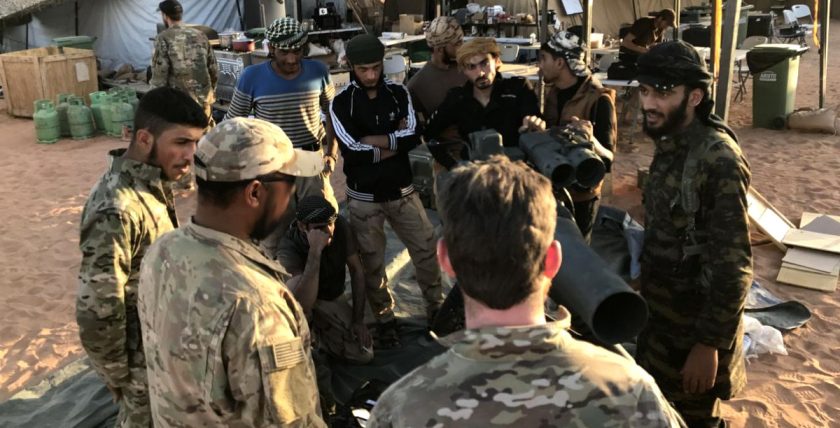
Unidentified Syrian rebels surround a piece of US weaponry during training by an American special forces member in Tanf. Photo | Hammurabi’s Justice News
With the U.S. now having claimed that Daesh has been completely defeated in Syria, the official justification for its illegal occupation of Syrian territory is wearing thin. With that justification now on shaky ground, the U.S. is increasingly having to acknowledge its main motive for its presence in al-Tanf — containing Iran and keeping Syria divided.
Indeed, a recent Reuters article notes that the U.S.-controlled area around al-Tanf that includes the Rukban camp “is designed to shield U.S. troops at the Tanf garrison and maintain for Washington a strategic foothold in an area close to a crucial supply route for Iranian weapons entering Syria from Iraq.” This was confirmed by General Joseph Votel late last year when he told NBC News that the U.S. base in al-Tanf was key in countering “the sway of Iran” in Syria.
This followed statements made last July by National Security Advisor John Bolton that U.S. troops would remain in Syria “as long as the Iranian menace continues throughout the Middle East.” This policy of Iran containment has clearly guided U.S. policy in Syria of late, with at least 1,000 U.S. troops set to stay in Syria illegally despite Daesh’s defeat and President Donald Trump’s recent calls for a troop withdrawal.
The U.S. has been accused of using the civilians trapped in Rukban as a “shield” for its continued operations in Syria aimed at containing Iran’s regional influence. Russian Foreign Minister Sergei Lavrov said earlier this month that “the fact that people are not allowed to leave [the camp] and are held hostage makes one suggest that the U.S. needs this camp to continue justifying its illegitimate presence there.” There appear to be few other explanations for the U.S.’ refusal to let camp inhabitants leave the area.
The hypocrisy of U.S. “humanitarian concerns”
The situation in the Rukban camp reveals the dark reality behind the U.S.’ occupation of Syrian territory in Al-Tanf and elsewhere. In order to pursue its policy of Iran “containment” and a divided and partitioned Syria, the U.S. is willing to imprison some 40,000 people — many of them children — in a concentration camp where international aid is blocked and where food is so scarce that mothers are setting themselves and their children on fire so they can avoid slowly starving to death.
According to the Cambridge Dictionary, a concentration camp is defined as “a place where large numbers of people are kept as prisoners in extremely bad conditions, especially for political reasons.” It is undeniable that the Rukban camp fits this definition to the letter.
That the U.S. justifies its aggressive policies around the world — from Syria to Venezuela and elsewhere — as being motivated by “humanitarian concerns” — when a refugee camp under the U.S.’ complete control in Syria is facing starvation conditions and its inhabitants are being forcefully kept confined in the camp by the U.S. military despite their expressed desire to leave — is an obscene Orwellian twist. All this to “contain” Iranian influence in the Middle East.
Whitney Webb is a MintPress News journalist based in Chile. She has contributed to several independent media outlets including Global Research, EcoWatch, the Ron Paul Institute and 21st Century Wire, among others. She has made several radio and television appearances and is the 2019 winner of the Serena Shim Award for Uncompromised Integrity in Journalism.
The Many Reasons to Believe Vasily Prozorov’s Testimony About Ukraine’s Role in Downing MH-17
Former Ukrainian intelligence officer Vasily Prozorov’s testimony will likely be dismissed by Western governments supporting Kiev, but there is plenty of evidence to back his claims.
By Whitney Webb | MintPress News | March 27, 2019
KIEV, UKRAINE — A former top official in Ukraine’s Security Service (SBU), who recently fled the country, has given explosive testimony regarding the involvement of the Ukrainian government in the 2014 downing of the MH-17 passenger plane. The incident, which killed all 283 passengers and 15 flight crew members on board, had been blamed on Russia by Ukraine’s government, the United States and much of Western media.
In addition, the former official, Vasily Prozorov, told a group of international reporters that Ukraine’s controversial Azov Battalion, known for its Neo-Nazi ideology and symbolism, ran and maintained secret prisons in contested areas of Eastern Ukraine where there is fighting between pro-government forces and pro-Russian separatists. Prozorov, who has sought asylum in Russia, also accused the United States and the United Kingdom of training an SBU division that returned to Ukraine to conduct terrorist attacks in the Donbass region, which has been the site of a civil war since the overthrow of Ukraine’s government in 2014 in a U.S.-backed coup.
Prozorov’s identity was kept secret until the press conference began, in breaking with standard protocol. Prozorov then introduced himself, stating that he had been employed by the SBU from 1999 to 2018, but — after the U.S.-backed coup in 2014 — had contacted Russian intelligence and began working undercover in the central office of the SBU. He does not describe himself as a defector, as he stated that his allegiance remains with the Ukrainian people while the allegiance of those who came to power with U.S. assistance in 2014 has long been suspect.
Prozorov then noted that, soon after the coup and before the civil war between Western and Eastern Ukraine had begun, the SBU — at Kiev’s behest — had begun to plan combat operations in the East and that the government had requested that plans be made that would result in mass civilian deaths among ethnic Russian populations, who were to be labeled as “accomplices to terrorists.”
The former SBU officer also detailed how the post-coup SBU had established secret prisons where prominent dissidents of the U.S.-backed government were interrogated, tortured and even killed. One of those prisons, located at an airstrip in Mariupol, was nicknamed “the Library” and Prozorov compared it to a “concentration camp” and showed images of severely beaten detainees he claimed had been imprisoned at the site. The former SBU officer also stated that SBU’s decisions, in regards to the black-site prisons and other areas, were often “led” by foreign advisers from the United States and the United Kingdom. The SBU’s use of torture in Ukraine’s civil war has been well-documented even though the SBU blocked UN efforts to probe its extent.
In addition, Prozorov asserted that the Neo-Nazi Azov Battalion, a militia that was incorporated into Ukraine’s Interior Ministry as a component of the country’s National Guard, also operates its own prisons in the Anti-Terrorist Operation (ATO) zones in Eastern Ukraine. The Azov Battalion receives funding from the government of Ukraine as well as from the U.S. government and has also received weapons from the Israeli government.
Insights into the MH-17 downing
Prozorov’s most shocking statements were related to the 2014 downing of Malaysian Airlines Flight 17, or MH-17, which was promptly blamed on Russia by the post-coup Ukrainian government, the United States and much of the Western world. Prozorov stated, noting first that it was his personal opinion based on his experiences, that the Ukrainian government had been an “accomplice to the Malaysian MH-17 flight disaster.”
He continued, stating:
The amazingly prompt reaction of the Ukrainian leadership was the first thing that made me feel suspicious. My unequivocal opinion was President Pyotr Poroshenko and his press-service had prior knowledge of the affair. Secondly, hostilities had been underway for several months by then, but the airspace over the area was not closed.”
He also noted that his efforts to learn more about the circumstances of the disaster within the SBU from a senior officer were met with the following reply: “Don’t poke your nose into this business, if you don’t wish to have problems.” However, Prozorov noted that “some information has leaked out in the end, though.”
He then concluded:
On the basis of my own analysis I can speculate who was an accomplice in the crime and who was involved in concealing evidence. In my opinion, there were two men involved – the current deputy chief of the Ukrainian presidential staff Valery Kondratyuk and chief of the Ukrainian Defense Ministry’s intelligence directorate, Vasyl Burba.”
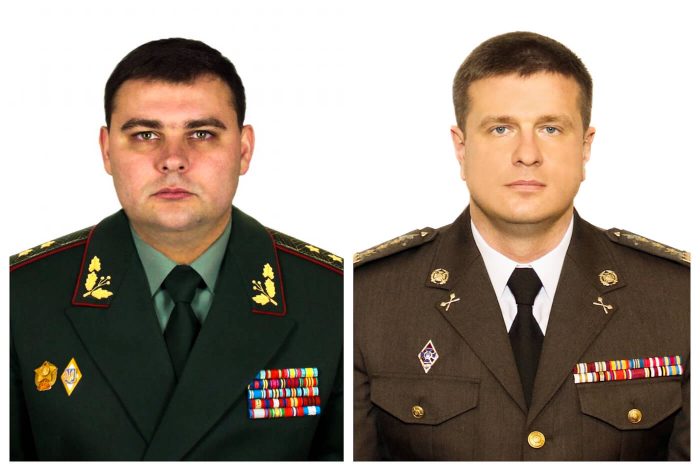
Valery Kondratyuk, left and Vasily Burba, right
Prozorov’s full conference can be watched here (in Russian). A summary with English subtitles can be watched here.
Claims well-supported by independent reporting
Though some may be quick to dismiss Prozorov’s testimony as “Russian propaganda,” many of his claims fit with independent reporting on the Ukrainian conflict. For instance, in regard to Prozorov’s claim of “black site” prisons, the SBU denied the UN access in 2016 to many detention centers in Mariupol — where Prozorov says “the Library” prison is located — and Kramatorsk. The SBU claimed that it blocked the UN inspectors access in order to protect “government secrets.” The UN had first tried to access the areas after several human-rights groups had found credible evidence of torture taking place at facilities in the area.
Prozorov’s claims that the post-coup SBU had made plans to murder ethnic Russians in the Donbass are also supported by publicly available evidence. For instance, when the civil war began, the Kiev-based government stated its intention to specifically target civilians in order “to clean the cities.” In 2016, then-Prime Minister Arseniy Yatsenyuk, who has been called “Washington’s man in Ukraine,” called pro-Russian civilians in the region “subhumans.” In an interview aired by the U.S.-funded, pro-government Ukrainian news channel Hromadske TV, a Ukrainian journalist aligned with the government asserted that the contested region was home to 1.5 million people “who are superfluous” and “must be exterminated.” With such sentiments having been openly stated by prominent politicians and journalists aligned with the current government in Kiev, Prozorov’s assertions seem hardly unreasonable.
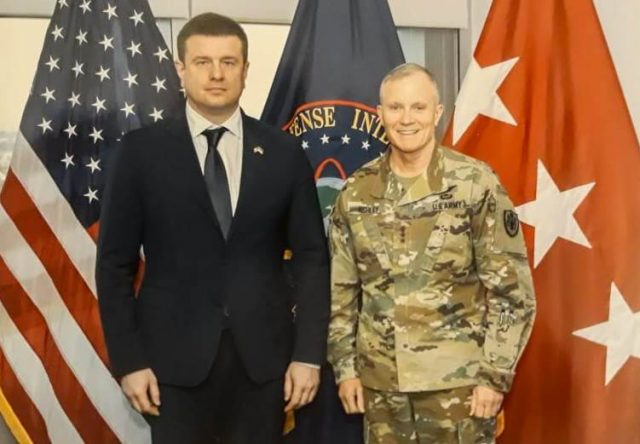
US Director of the Defense Intelligence Agency, Robert Ashley, right, meets with Vasyl Burba, Chief of the Defense Intelligence of Ukraine. Photo | Defence Intelligence of Ukraine
In regard to Ukraine’s alleged role in the downing of MH-17, it is worth noting that past reports by late American investigative journalist Robert Parry described in detail how the “independent” MH-17 investigation was almost completely dependent on information from Ukraine’s SBU in piecing together the event. According to Parry:
[This control by the SBU, combined with its past obstruction of the UN torture probe],suggests that the SBU also would steer the JIT away from any evidence that might implicate a unit of the Ukrainian military in the shoot-down, a situation that would be regarded as a state secret which could severely undermine international support for the U.S.-backed regime in Kiev. Among the SBU’s official duties is the protection of Ukrainian government secrets.”
In addition, one of Parry’s sources maintained that the CIA had, like Prozorov, found evidence that Ukraine’s government had indeed been “an accomplice” to the MH-17 incident:
A source who was briefed by U.S. intelligence analysts told me that the CIA’s conclusion pointed toward a rogue Ukrainian operation involving a hard-line oligarch with the possible motive of shooting down Russian President Vladimir Putin’s official plane returning from South America that day, with similar markings as MH-17. The source said a Ukrainian warplane ascertained that the plane was not Putin’s but the attack went ahead anyway, with the assumption that the tragedy would be blamed on the pro-Russian rebels or on Russia directly.”
Another reason Prozorov’s testimony should not be outright dismissed as propaganda is the fact that he pushed back on previous Russian media reports involving U.S. infiltration of the SBU. When asked by a reporter if he could confirm reports that foreign military officials, including Americans, occupied their own floor at SBU headquarters, Prozorov adamantly denied those claims, stating that after 2005 there were CIA officials present in SBU headquarters but that the practice had been discontinued. He stated that U.S. intelligence officials regularly visited SBU headquarters after the 2014 coup but were not based in the building.
Thus, while Prozorov’s testimony will likely be dismissed by mainstream Western media outlets and Western governments that support Kiev, there is plenty of evidence suggesting that many of his claims — including his most shocking — deserve careful consideration, not outright dismissal. Indeed, were Prozorov a defector from a country currently at odds with the U.S. — be it Russia, Venezuela or Iran — it is highly likely that mainstream media would repeat and his promote his claims regardless of their veracity. However, because he has sought asylum in Russia, his recent statements are unlikely to gain international traction merely because of where he is now located, in spite of the evidence supporting many of those statements.
Whitney Webb is a MintPress News journalist based in Chile. She has contributed to several independent media outlets including Global Research, EcoWatch, the Ron Paul Institute and 21st Century Wire, among others. She has made several radio and television appearances and is the 2019 winner of the Serena Shim Award for Uncompromised Integrity in Journalism
‘Lone Wolf’ Myth Covers Up Possible Mossad Role in New Zealand Terrorist Attack
By Max Parry • Unz Review • March 27, 2019
Ever since the news broke on March 15 of two consecutive mass shootings at the Al Noor Mosque and Linwood Islamic Centre in Christchurch, New Zealand, corporate media has been determined to establish that suspect Brenton Tarrant acted alone in the terrorist attacks that took the lives of 50 innocent Muslim worshippers and wounded 50 others. While mainstream media has been predictably eager to parade the tragedy as another chapter in the wave of rising Islamophobia and right-wing extremism globally, they have put equal effort into conscientiously avoiding any evidence that contradicts the ‘lone wolf’ theory they decided on in the initial hours following the first mass shooting in New Zealand since 1997.
Whenever terrorism is committed by Arabs or Muslims, the fourth estate is usually anxious to speculate whether or not the suspect is connected to a larger radical syndicate. However, the same scrutiny is seldom applied to white nationalists like Tarrant. In fact, they are even hesitant to label it ‘terrorism’ at all, with everyone from The Daily Telegraph to the fanatical Zionist Rupert Murdoch’s Fox News settling for the choice words ‘mass shooting.’ While Tarrant denies being part of any group in his public declaration, he does hint that he is part of a broader extremist network:
“I am not a direct member of any organization or group, though I have donated to many nationalist groups and have interacted with many more. No group ordered my attack, I make the decision myself. Though I did contact the reborn Knights Templar for a blessing in support of the attack, which was given.”
As many have noted, the “Knights Templar” is the name of an anti-Muslim militant group that another infamous right-wing terrorist, Anders Behring Breivik, claimed to belong to. During the 2011 Norway attacks, Breivik targeted a government building in the city of Oslo and a youth camp of the ruling Labour party on the island of Utøya in a sequential car bombing and mass shooting that killed a total of 77 people. However, the media and prosecutors in Breivik’s trial were insistent that the group was fictional and the only possibility was that he was an ‘army of one’ while suffering from a psychiatric disorder, another trait that is apparently only applicable to white-skinned terrorists. There was no serious inquiry into whether he was part of a larger nexus, even though he had direct contact with groups like the English Defense League (EDL), the British far right Islamophobic group led by neo-fascist agitator Tommy Robinson. Breivik was portrayed as a fundamentalist Christian but was curiously a member of the Norwegian Order of Freemasons, an organization with a history of ties to the espionage world and susceptible to infiltration because of its inherent secrecy. The original Knights Templar, or “Templars,” were a Christian army founded in the 10th century who initially shielded pilgrims voyaging to the Holy Land and later fought against Muslims during the Crusades while the name is drawn from the Temple Mount in Jerusalem.
What has been downplayed by the yellow press is the specific brand of Islamophobic extremism that was the basis of Tarrant’s attacks. His ideology is revealed in a 73-page manifesto, entitled “The Great Replacement” in reference to the ‘white genocide’ theory held by white nationalist identitarians, which he dispatched less than ten minutes prior to the ambush in emails to several media outlets and Prime Minister Jacinda Ardern’s office. While the corporate press is correct that Tarrant and Breivik clearly follow the practices of the anti-Islam xenophobic movement on the rise in Europe, North America and now Oceania, the key element they have deliberately avoided mentioning is a strong collective affinity for the state of Israel. The coverage of Christchurch has repeated the same pattern displayed following the 2011 Norway attacks where the distinguishing characteristic of the extremism both culprits adhere to is of a staunchly pro-Zionist variety which has been decidedly overlooked. In the eight years between the two attacks, the pro-Israel European right has only augmented in size. In his manifesto, Brenton Tarrant even boasted the unverified claim to have had “brief contact with Knight Justiciar Breivik” while taking “true inspiration” from him. His Norwegian idol had his own 1,500 page manifesto where Israel was approvingly name-dropped nearly 400 times while he declared:
“So let us fight together with Israel, with our Zionist brothers against all anti-Zionists, against all cultural Marxists/multiculturalists.”
The combination of far right nationalism and support for Israel may seem like an unlikely combination, but it is an ideology shared by most of the Islamophobic and anti-immigrant political parties throughout Europe that have performed impressively well in European Parliament elections. These include Hungary’s Fidesz, the Italian League and Five Star Movement, the Flemish Flaams Belang, Poland’s Law and Justice, Belgian People’s Party, the Progress Party of Norway (of which Breivik was a member), True Finns Party, France’s National Rally, Alternative for Deutschland, and many others. It is likely that Tarrant, like Breivik, is not anti-semitic and actually views Jews as ‘allies’ in a civilizational crusade against Islam. Just as Israel has helped orchestrate the US wars in the Middle East against its enemies that has contributed to the mass influx of refugees seeking asylum in the West, it has fostered the Islamophobic backlash to it by supporting the growing far right movement that is ascendant.
Following the tragedy in Christchurch, it was revealed that 28-year old Tarrant had traveled extensively throughout Europe, the Middle East and Asia, including to Afghanistan, Pakistan and even North Korea. The year prior, he also visited Israel for nine days, just as his fellow Christian Zionist Breivik had done several times prior to 2011. Tarrant’s journey in Europe included a stop in Ukraine, a hotbed of neo-Nazi activity and as it happens during the massacre he donned the SS wolf’s hook symbol used by the right wing paramilitary group Azov Battalion to which Israel has provided weapons support in its fight against pro-Russian separatists. The blend of such considerable travel activity while stockpiling a cache of semi-automatic firearms with a digital footprint espousing his extremist views online makes the likelihood that Tarrant managed to remain under the radar of the New Zealand Security Intelligence Service (SIS) difficult to believe. It is especially doubtful they would be unable to detect him considering he was reportedly interviewed by New Zealand police prior to obtaining his firearms license in 2017.
Judging by the Facebook live-streamed video of the massacre shot by the suspect himself wearing a GoPro head-mounted camera that resembled first-person shooter video game shows he was no amateur and possibly professionally trained as a militant. Given his extensive travel and the apparent expertise used to carry out the attacks, there are many legitimate questions about how his ventures were sponsored and whether he had accomplices. Police found undetonated car bombs in addition to his arsenal and believe he was planning on carrying out a third attack with them. What was he doing in his travels? Was he really able to finance everything alone using crypto-currency investments as purported by the media? He could very well have been a patsy in a larger plot or received support from abroad. For instance, from a certain national intelligence service whose notorious motto is “for by cunning stratagems, you wage war.”
Mossad covert operations have been exposed several times over the years violating New Zealand’s sovereignty and international law which caused a series of diplomatic rows between the two countries. Most recently was in 2011 following a 6.2 magnitude earthquake in Christchurch which caused significant damage to the city and killed 185 people, coincidentally the very same week as the attacks in Norway by Anders Breivik. Incredibly, a stone structure of a building collapsed onto a van during the earthquake which killed a man inside who turned out to be an Israeli national. His death accidentally unearthed a ring of Mossad agents after the man was discovered with multiple fake passports and USB flash drives which contained confidential data believed to have been illegally downloaded from the New Zealand police’s national computer system. The other agents in the Israeli sleeper cell were able to flee the country less than a day after his body was discovered, probably to avoid the fallout that occurred after an earlier incident in the country just a few years prior. In 2004, two Israeli men who turned out to be Mossad agents were arrested trying to obtain fraudulent passports and travel documentation that included stealing the identity of a quadriplegic. The two men were subsequently jailed for six months for engaging in criminal enterprise.
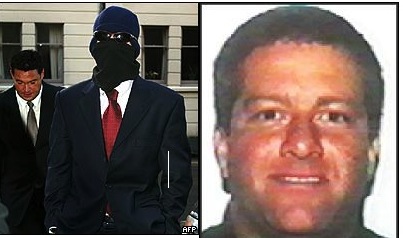
Pictured: Uriel Zosha Kelman, an Israeli spy, arrives in court in disguise in 2004 (left)) / Zev Barkan, another spy (right).
Mossad seemed to have developed a habit of revealing themselves in light of the infamous arrest of five of its agents in Secaucus, New Jersey on the morning of September 11th, 2001 by the FBI who were tipped off that a group of men were observed suspiciously dancing and celebrating while watching the WTC towers ablaze and collapsing across the Hudson River. The “dancing Israelis” were found with $5,000 in cash which raised suspicions while their vehicle was traced to a shady moving company called Urban Moving Systems that was suspected to be a front for an intelligence operation after their headquarters was abandoned and its owner, Dominick Suter, immediately fled to Israel following their apprehension. During their two month detention, the CIA intervened and halted the probe while the agents were subsequently deported in a deal with the Israeli government for overstaying their visas but not before it was confirmed that at least two of the men were intelligence officers and no ordinary moving company employees.
The world was briefly reminded of this mysterious case when Donald Trump as a presidential candidate in 2016 made the wild exaggeration that on 9/11 he had personally observed “thousands of Muslims” celebrating the destruction of the Twin Towers across the river in New Jersey. It is likely that Trump mixed up two different reports from 9/11, one of Reuters footage widely circulated by major networks of a small group of Arabs in East Jerusalem celebrating the attacks and the reports about the Israelis arrested in New Jersey who were initially believed to have been of “Middle Eastern appearance” and descent. One wonders if Trump would accurately recall his other observations that morning now that he is in the service of his Saudi and Israeli masters. Needless to say, this widely suppressed story which should have been front page news led many to rightly suspect there was prior knowledge and even direct involvement among Israeli intelligence in the 9/11 attacks, along with a trove of other evidence.
ABC News Friday 06/21/2002 05:42:40 pm-05:46:50 pm (Studio: Elizabeth Vargas) Report introduced. (Studio: John Miller) Exclusive ABC News investigation into what five Israelis were doing on …
The New Jersey cell were also in possession of foreign passports. Mossad has typically used fake passports, including that of Australians and Kiwis, regularly for its clandestine operations and carrying out assassinations like the 2010 targeted killing of Hamas official Mahmoud al-Mabhouh in Dubai which one of the spies apprehended in New Zealand, Zev Barkan, was involved in. After the arrest of the two spooks in New Zealand in 2004, the government imposed diplomatic sanctions against Israel and temporarily severed high-level contacts between the two countries in what became a significant diplomatic rift. WikiLeaks diplomatic cables revealed that the U.S. was not at all pleased.
Relations had returned to normal between the countries until December 2016 when along with Malaysia, Senegal, Venezuela and others, New Zealand co-sponsored the controversial United Nations Security Council Resolution 2334 which condemned Israeli settlements in occupied Palestinian territories during the last months of the Obama administration. The same motion briefly became mired in the Trump-Russia investigation when former National Security Advisor Michael Flynn pled guilty to lying to the FBI about lobbying activities related to the resolution during the transition between administrations on behalf of Israel. The Trump White House has since proven to be the most fanatically Zionist presidency since the foundation of the Jewish state in 1948. Over the years, New Zealand has shown a willingness to stand up to Jerusalem and its brazen disregard for international law that other nations could learn from. Despite being a small nation, it has played an important role in pro-Palestinian activism and the prospect of Palestinian statehood just as it did in protesting South African Apartheid in the 1980s. In 2018, when New Zealand-born popular musician Lorde canceled a concert in Tel Aviv in solidarity with the Boycott, Divestment and Sanctions (BDS) movement, she became the target of vicious Zionist smear campaign which saw right-wing Trumpist Rabbi Schmuley Boteach take out a full-page ad in The Washington Post denouncing her as a bigot while a $13,000 lawsuit was filed by the Mossad-linked Shurat HaDin lawfare NGO. Meanwhile, unlike Australian Prime Minister Scott Morrison, Jacinda Ardern has been critical of the Trump administration’s move of the U.S. embassy from Tel Aviv to Jerusalem, stating it undermines the Israeli-Palestinian peace process.
New Zealand’s relatively even-handed foreign policy has likely rattled the Zionists and their far right Islamophobic counterparts in the West and it is possible that it is viewed as a threat to the interests of Israel and the U.S. The feasibly manufactured terrorist attack against New Zealand has greatly disrupted the small country, a state which in 2018 had its lowest homicide rate in 40 years and averages well below 100 murders per year, making this attack an extremely rare occurrence for the peaceful country. In light of the attacks on the mosques in Christchurch, it could now end up acquiring the police state model of the U.S. and Israel as part of the global ‘War on Terror.’ The country immediately issued a ban on semiautomatic weapons following the tragedy in a disturbing rollback of civil liberties while engaging in an unprecedented censorship effort to criminalize sharing and possession of Tarrant’s manifesto and video. Prior to Breivik’s perpetration of the attacks in Norway, there had been significant political tensions between Oslo and Jerusalem in the months leading up to the violence due to Norway’s intent to recognize a Palestinian state and the circumstances in relations between New Zealand and Israel prior to Christchurch is eerily reminiscent.
Israel has a storied history of being a state sponsor of international terrorism as well as the use of ‘false flag’ operations to achieve its political objectives, most notably in the 1954 Lavon Affair, codenamed Operation Susannah, where the Aman branch of its military intelligence services recruited Egyptian nationals to commit bombings to be blamed on the Muslim Brotherhood in order to maintain desired British military presence in Egypt. It continues such cloak-and-dagger tactics to this day with the use of terror proxies such as the Kurdistan Free Life Party (PJAK) and Mojahedin-e-Khalq (MEK) to undermine Iran, as well as the arming and funding of al-Qaeda affiliated Syrian jihadist groups against the Assad government. If it is willing to co-sponsor radical Islamists with its ally Saudi Arabia to attack their mutual regional enemies, now that the ruling Likud Party has made strange bedfellows with far right Islamophobes in the West it is within the realm of possibility it would continue to do the same especially when the victims are Arab or Muslim.
Regardless of whether or not there turns out to be any Mossad fingerprints discovered on the Christchurch shootings, if the world is serious about confronting the emerging far right internationally it must be willing to accurately diagnose the phenomenon. One of its most distinctive attributes is its Christian Zionism and a shared belief that the Bible gives Israel evidential right to Palestinian land and that Jews are inherently non-indigenous to Europe. The ever-expanding colonization of the West Bank and Gaza has solidified Israel’s nationalist foundations, especially now that Arabic has been removed as a second official language and the passing of the 2018 Nationality Law defining Israel as an ethno-nationalist state with Arabs officially second-class citizens. If Israel did not directly participate in the 9/11 attacks by infiltrating the al-Qaeda cell in Hamburg, Germany and directing the airplane hijackings as many legitimately suspect, it has certainly facilitated the U.S. wars in the Middle East against its regional enemies and now it is nurturing the Islamophobic far right in the West hostile to the flood of displaced refugees fleeing them. Israeli policy has principally benefited from all this but one can only expect the hasbaric retaliation of ‘anti-Semitism’ smears like those against UK Labour Party leader Jeremy Corbyn and U.S. Congresswoman Ilhan Omar of Minnesota for pointing this out. In the meantime, the Russiagate hoax has deflected attention away from Jerusalem toward Moscow in regards to foreign cultivation of the growing far right nationalist movement in the West. One hopes the recent bust of Special Counsel Robert Mueller’s report will put some of the distraction to rest and shift the speculation toward Israel where it belongs.
Finally, the political confusion of zealots like Tarrant needs to be addressed as entirely predictable instead of as unintended consequences of the War on Terror and the financial crisis. Recently, 2020 Democratic U.S. Presidential candidate Andrew Yang became the subject of establishment-led smears simply for acknowledging verifiable facts about declining birth-rates of white Americans where he was vilified as adjoining with the views of those like Tarrant. Yet these statistics designated by race that Yang recognized are expressions of the results of class conflict while genuine anger is being misdirected toward immigrants instead of capital and its never-ending changes in labor demands. This is the cycle which must be broken if this holy war between the West and Islam stirred up by Zionists or what the orientialist Samuel Huntington called the ‘clash of civilizations’ is to end. If not, we cannot only expect the U.S. empire to continue its downward slide and its fear of a multipolar world to culminate in an internecine that will turn the whole world into a tragedy like Christchurch.
Alan “Israel Did 9/11” Sabrosky: Most Censored Man in America

By Kevin Barrett • Unz Review • March 24, 2019
Who’s afraid of Alan Sabrosky? Whoever they are, they have the ability to monitor and censor YouTube live-streams in real time. And they apparently don’t want you to know what Sabrosky thinks about the Holocaust.
That’s the obvious takeaway from the highly unusual example of YouTube censorship that disrupted the March 22 live broadcast of False Flag Weekly News. The broadcast, which live-streamed from Vimeo to three different YouTube channels, transpired normally up to the 59:31 mark, when Sabrosky stated that the Holocaust was “a technological and logistical impossibility—“ and suddenly his mike was cut… but only on the YouTube stream, archived here:
If you want to hear the rest of Dr. Sabrosky’s Holocaust statement (instead of long stretches of dead air) you’ll have to watch the Vimeo version, which was not censored:
False Flag Weekly News 03/22/2019–New Zealand False Flag? from No Lies Radio on Vimeo.
Whoever did this must have been monitoring the broadcast in real time. It must have been a human, not an AI algorithm. The censor must have had his or her finger hovering over the “cut his mike” button throughout the show. And that censor must have been trained and given the power to cut Sabrosky’s mike within a couple of seconds of Sabrosky starting to “deny the Holocaust.” Altogether quite an amazing feat of censorship!
But however logistically and technologically impressive this bizarre crime against free speech may have been, it seems even more impressively stupid and self-defeating. Can they really believe that actions like this are going to stop people from asking questions about the Holocaust? Haven’t they heard of the Streisand Effect? Isn’t everyone who hears about this going to say, “gee, if they have to take such extreme measures to silence this guy, maybe he’s onto something?”
It is really quite a tribute to Dr. Sabrosky and False Flag Weekly News that someone went to so much trouble. They must be spending far more money to monitor and censor us than we are spending doing the show in the first place. Talk about asymmetrical information warfare!
But I don’t believe the people behind this are as stupid as they seem. Such apparently counterproductive acts sometimes do serve strategic purposes. In this case, I assume the censors were beta-testing protocols for censoring live-streams in real time. It is no coincidence that this attack on Alan Sabrosky’s First Amendment rights came exactly one week after the allegedly live-streamed Christchurch shooting. Since the Christchurch terror event, Facebook and YouTube representatives have been all over the MSM announcing that they have to fix their systems to prevent “the live-streaming of hate.”
If I were a paranoid conspiracy theorist I would wonder whether the Christchurch attack was a set-up to roll out the beta testing of precisely this sort of censorship. I would note the incongruity of the fact that the people pushing for internet censorship are almost all Zionist Jews, not Muslims—yet the censorship is being rolled out on the pretext that it is supposed to protect Muslims and “honor the sacred Christchurch victims.” Since when did Zionists care about Muslim lives? They proudly slaughter a Christchurch worth of Palestinian Muslims every month or two. And they have murdered 32 million Muslims, and created tens of millions of refugees, in the 9/11 wars for Israel.
It’s as if the people behind the Christchurch push-for-censorship PR op, and the subsequent deployment of new censorship systems like the one just beta-tested against FFWN, are trying to conceal their true identities. Perhaps that is why they made sure that the word “Jew” was almost entirely absent from the Tarrant manifesto. As Daniel Haqiqatjou notes:
The 73-page document reads like it was written by someone who is trying very hard to pretend to be a White Nationalist… But there is one glaring inconsistency. If you ever visit places on the internet frequented and owned by White Nationalists, such as 4chan, 8chan, Daily Stormer, or Gab, one immediate, indubitable fact hits you in the face: These people hate Jews. More than anyone else, White Nationalists hate Jews and are not afraid of expressing it with thousands of different memes…. What is bizarre about Tarrant’s alleged manifesto is that he says a great deal about this (Jewish) plot. He rails against immigration, fertility rates, and “White genocide.” But he doesn’t mention who the supposed plotters are. Why? Why is Tarrant following the White Nationalist script to the letter but doesn’t mention Jews once in the entire 73 pages?
(Except one passing mention that they’re fine when they’re Israeli!)
If the perps were hiding their identities while orchestrating Christchurch and the internet censorship campaign it launched, they dropped the mask when they silenced Alan Sabrosky. We all know who reacts reflexively against “Holocaust denial.” And we all know who hates Alan Sabrosky, the former US Army War College Head of Strategic Studies who came out as a 9/11 truther on my radio show in March, 2010—and announced that Israel did it.
The Zionist fear and loathing of Sabrosky is so off-the-charts that the mere mention of his name can get you arrested. That’s what happened to Jeremy Rothe-Kushel in May 2016 when he tried to ask Dennis Ross a question during the Q&A after Ross’s talk at the Kansas City Public Library.
Tellingly, the Times of Israel report on Rothe-Kushel’s free speech lawsuit tiptoes around Sabrosky’s unspeakable name.
Alan Sabrosky, “he who must not be named,” is also “he who must not be broadcast.” Bonnie Faulkner’s Guns and Butter radio show, one of the most popular and respected Pacifica staples, was abruptly terminated by KPFA management last August due to Sabrosky’s appearance there.
“Somebody” apparently doesn’t want Sabrosky on False Flag Weekly News, either. Last January 4th Alan Sabrosky made his debut appearance as a regular FFWN co-host. The audience gave him a huge thumbs-up. But when he tried to return on a regular basis, his computer suddenly started coming down with bizarre ailments. It always seemed to happen right before the show. His computer would be working fine, and then suddenly WHAM—it would melt down right before broadcast time and we’d scramble to find a replacement. This has happened so many times in the past three months that I have lost count. Tech experts who have tried to solve the problem say Sabrosky is the victim of a highly sophisticated cyber-attack. It was only this past Friday, March 22, that after elaborate precautions we were finally able to get Alan broadcasting again on FFWN. And miraculously enough, he somehow got through 58 minutes of live-streaming before they cut his mike.
Why is Dr. Alan Sabrosky the most censored man in America? Those seeking to silence him don’t want you to know what he thinks about two issues: 9/11 and the Holocaust. Specifically, they don’t want you to know that he thinks 9/11 was “a Mossad operation, period.” And they don’t want you to know that he thinks the official Holocaust narrative of six million Jews killed mostly in gas chambers is “a technological and logistical impossibility.”
Why are these two issues so sensitive? The Holocaust, whatever it was, happened 75 years ago. And 9/11 happened more than 17 years ago. Isn’t all that stuff ancient history?
The answer, I believe, is that both Official Conspiracy Theories (OCTs) are foundational myths of Zionism. The myth (sacred narrative) of the Holocaust is Israel’s primary basis of legitimacy in global public opinion and especially Jewish opinion. The Platonic guardians of Zionism need the Holocaust horror story to bludgeon world Jewry into accepting the necessity of establishing and maintaining a “Jewish state.”
Likewise the sacred official myth of 9/11 is the lynchpin of the “clash of civilizations,” which in essence is a long-term Western war against Israel’s enemies. Were it widely known that Israel itself orchestrated 9/11 and the ensuing crusade, Israel’s already-dubious future wouldn’t just be dubious—it would be nonexistent.
Alan Sabrosky happens to be one of the world’s best-credentialed and most-eloquent voices debunking the two foundational myths of Zionism. The fact that he hails from a Jewish background makes him that much more annoying—and that much more credible. Dr. Sabrosky is extremely well-informed, and he expresses himself in an engagingly straight-shooting manner. An ex-Marine as well as Strategic Studies professor, Alan Sabrosky has a full clip of info-ammo and unloads it with uncanny accuracy and alacrity. In many respects he is the Zionists’ worst nightmare.
No wonder “Doc Sabrosky” is the most-censored man in America.
White Helmets Under Black Banners
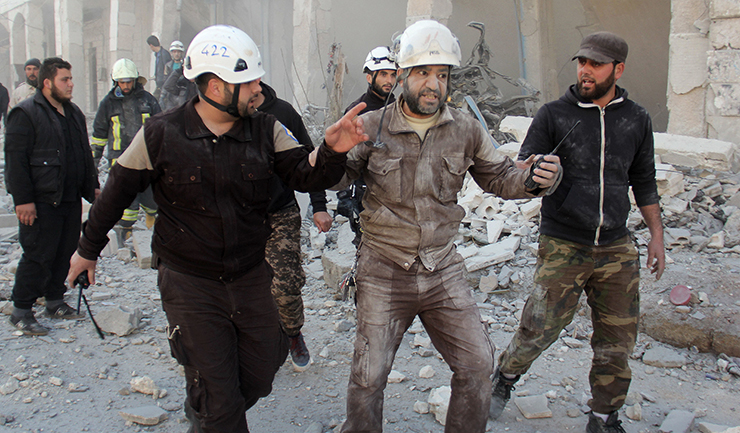
By Yuriy Zinin – New Eastern Outlook – 22.03.2019
During the recent Third Conference on Supporting the Future of Syria, in Brussels, the USA decided to allocate $5 million to the White Helmets, a decision which has once more turned the spotlight onto that organization.
It first emerged in 2013, under a banner of political neutrality: a non-partisan NPO formed of volunteers who carried out humanitarian missions, and its members were promptly branded as heroes by the media. They were represented as people who rushed to rescue their fellow citizens in the face of savage bombing raids by government forces: saving lives, providing first aid etc.
According to the White Helmets, its volunteers have “saved” some 115 thousand people in the years since the organization was founded. This figure was taken at face value by Western officials and media, and has been endlessly repeated.
In addition to their humanitarian mission the “rescuers” prepared various materials from the front lines of the conflict in Syria. They posted photographs and videos of bombed hospitals, schools and mosques on their social media accounts as evidence of the “evil” of the Damascus regime. They focused on producing content that would touch viewers in the West on a raw nerve. So they emphasized, above all, the suffering of Syrian children: the victims of shooting, bombing and other horrors of war.
All these materials were directed at a mass audience, and their creators were highly praised and awarded a number of international prizes. In 2015, for example, the White Helmets were awarded the Alternative Nobel Peace Prize – worth approximately € 50,000. The film The White Helmets won an Oscar in 2018 for the Best Short Subject Documentary.
Nevertheless, all this tub-thumping is unable to hide certain inconvenient facts. Particularly, the fact that, ever since the organization’s brigades first appeared on the scene they have operated exclusively in areas outside the control of the Syrian government and controlled by armed opposition groups, including DAESH and the Al-Nusra Front.
These groups punished the slightest insubordination in the areas they controlled. The White Helmets’ claims that they remained politically independent when active in these areas are therefore rather unconvincing. Their members accepted the new status quo and were loyal to the militants, which naturally played into the militants’ hands.
According to experts from a number of different countries, members of the White Helmets were drawn into the conflict In March 2017 on the side of the armed opposition groups, and provided them with various kinds of support. In March 2017, Abu Jaber, one of the leaders of the Al-Nusra Front expressed his sincere thanks to the White Helmets, calling them the “unseen warriors of the revolution”. It is not for nothing that a number of Arabic media have described the organization as “White Helmets under a black flag”.
That did not prevent their sponsors from the West and the Middle East from generously financing their activities. The organization’s director admits that it has received money from government and private donors in the USA, the United Kingdom, the Netherlands and a number of other European countries as well as Turkey, Qatar and other Persian Gulf states.
The largest donor has been the United States Agency for International development (USAID), which paid the White Helmets at least $23 million between 2013 and 2016.
The special services also lent a helping hand. One of the movement’s founders and inspirers is James Le Mesurier, a former British intelligence officer and soldier who has fought in Bosnia, Kosovo and the Lebanon. He is the head of the Mayday Rescue Foundation which supported the White Helmets using funds it received from donors, including $4.5 million from NGOs in the Netherlands and the same amount from donors in Germany.
The activists did their best to earn the funding and donations they were given.The organizations posted false reports on its social network accounts. It actively took part in a public relations campaign accusing the Syrian authorities and their allies of using chemical weapons.
The USA and its allies cited the materials fabricated by the White Helmets. These materials were used in meetings of the UN and the Organisation for the Prohibition of Chemical Weapons to prepare the ground for resolutions and other measures, including military intervention, against the Syrian government.
The White Helmets played a very underhand role as agents provocateurs, by fabricating chemical weapons attacks in the town of Khan Shaykhun, in Idlib Province on 7 April 2017, and in East Douma in April 2018. There was no proof of responsibility, but that did not prevent the USA from attacking the Syrian air base of Shayrat in response to the first of these incidents, after which the USA, the UK and France launched missile attacks against a number of targets in Syria which were allegedly connected with the manufacture of chemical weapons.
As the rebels have lost territory in Syria, the areas in which the White Helmets operate has been reduced. The situation has changed dramatically, and in 2018 the organization went through a “very difficult time”, as Raed Saleh, the head of the group has acknowledged.
In June 2018 the Israeli army helped with an urgent evacuation of several hundred so-called rescuers belonging to the White Helmets from Syria, along with their families. Many of the countries that supported the organization declared that they were ready to accept these refugees and provide them with support.
The story of the White Helmets is an example of a new kind of media project: one with a strong humanitarian element, which unfolds in front of the public’s eyes. This project was launched following the failure to topple the Syrian government, as had been done in Libya. When it became clear that Bashar Assad’s presidency was not about to collapse, then his opponents initiated a long-drawn-out siege. And one of their main weapons was the White Helmets, with foreign support.
The White Helmets now resemble a terminally ill patient who is confined to bed and scarcely breathing. Now that the terrorists have been defeated in most parts of Syria, the organization has exited the stage – the only region where its members are still partially active is Idlib Province, which is not yet under government control.
But will the latest grant of funds, which the US lobbied for in the Brussels conference on Syria, be able to help save this chronic invalid? It seems unlikely. On the contrary, it will merely go to prove, once again, who the White Helmets are supported by, and whose interests they really represent.
Yury Zinin, Leading Research Fellow at the Moscow State Institute of International Relations.
Journalist taken hostage by Farouk Brigade 2013 – ‘Syrian government didnt use chemical weapons in Ghouta’
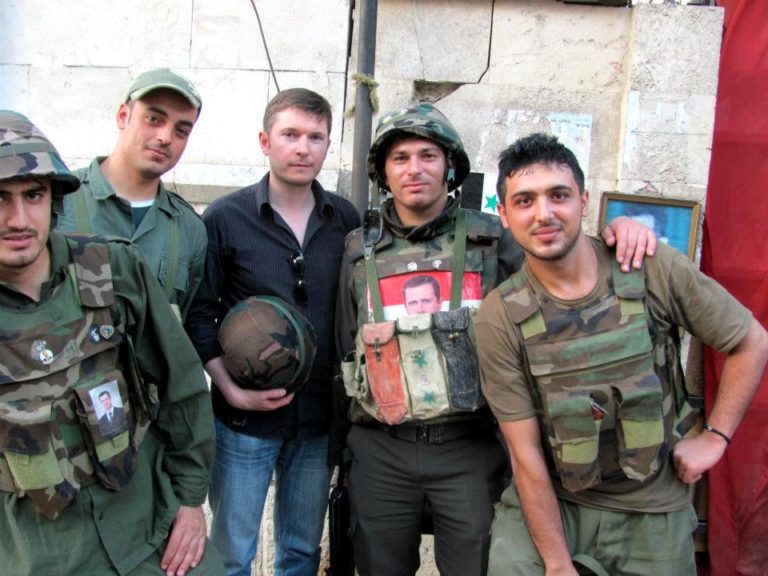
Journalist Pierre Piccinin da Prata with Syrian Arab Army. (Photo: Syria Times)
Syria Times | March 16, 2019
In its zealous pursuit to misinform western public opinion about Syria, MSM has canceled dozens of scheduled interviews with a war reporter after he has declared to Belgian RTL radio: “It wasn’t the government of Bashar al-Assad that used Sarin gas or any other gas in Ghouta”.
Pierre Piccinin da Prata, the Belgian War reporter and Editor-in-Chief of The Maghreb and Orient Courier, held hostage with Italian war reporter Domenico Quirico by Syrian ‘rebels’ for five months, eavesdropped a conversation through a closed door- between their jailers about the chemical weapon attack and saying that President al-Assad was not responsible for Ghouta Sarin gas attack.
“Syrian government had no interest in using the gas. Strategically, it was useless; and that could only ruin his image on the international level, with the risk of an American attack,” the reporter told the Syria Times e-newspaper, calling on western media outlets that have been wrong about Syria, about what has really happened since 2011 to recognize their errors and restore truth for their readers and listeners.
Piccinin, who was sold by the commander of the Katiba of the so-called the ‘Free Syria Army’ he was with al-Farouk for a few hundred dollars, posed the following question: what is the point of being a war reporter if it is not to tell the truth?
Following is the full text of the interview:
ST: Why and how were you taken hostage by the Farouk Brigade as you had been a fierce supporter of the so-called ‘Syrian Arab Army’?
Piccinin: I was kidnapped by al-Farouk Islamists in April 2013, in al-Qouseir, in the governorate of Homs.
I was doing an ’embedded’ report at the time, with the ‘rebels’ of the Free Syrian Army (FSA – when they still existed, before disappearing when the rebellion was completely Islamized).
At that time already (April 2013), the ‘non-Islamist’ rebels realized that they had lost the game. Many were returning home or fleeing to Lebanon or Turkey. Some joined the different Islamist groups. Jabhet al-Nusra, especially (al-Qaeda in Syria). But some groups of the FSA continued to occupy the land they still controlled. But they no longer fought the Syrian army: they behaved like bandits; they ransacked the population, under the pretext of taking money for the war effort. And some FSA chiefs started to kidnap people, to enrich themselves personally. That’s what happened to me: the commander of the katiba of the FSA I was with sold me at al-Farouk for a few hundred dollars.
ST: What is the lesson you have learned from the five months in captivity?
Piccinin: As a war reporter and specialist of Syria, and Islamist circles, this experience (although it was very painful nervously and physically) taught me a lot about the evolution of the conflict and also about the realities and internal functioning of these Islamist groups. On their behavior, their convictions, their vision of the world…
I have not been locked up for five months. I was moved very regularly as the conflict evolved. At this time, the fighting followed one another: the front lines moved a lot. In particular, I experienced the siege and the fall of al-Qouseir. The city was taken over by the Syrian government in early June 2013.
So I was able to observe what was happening, constantly moved between Damascus and Aleppo. And I was not attached, nor blinded. I could even talk to the fighters who held me, regularly and also to the people I met. I was very guarded, sometimes locked up, but very often free to communicate, with the Islamists and with the people who gravitated around them. I took my meals with them. We often slept in the same room. I was even present when they prayed or during their military meetings.
I hoped that someone (among the people I meet) would react and help me to free myself. But the Islamists terrorized the population. People were very afraid of Ammar al-Buqai, the al-Farouk chief, who held me. And nobody dared to defend me. One day (it was in Yabroud, near the Lebanese border), a man told me: “They (the Islamists) are a real problem for us. It’s dangerous to contradict them. They are very dangerous. We must pretend to obey them.”
It was a very hard and painful human experience (for my family, my parents in particular, they are old). But, professionally, I dare to say that it was a great enrichment.
On the human side, moral, I also learned a lot. I have seen what level of cruelty, violence, malice and cynicism the human being can reach…
ST: You have stated that it is not the Syrian government that used Sarin gas or any other gas in Ghouta. Have you tried to give your testimony to international investigation committee about the use of chemical weapons in Syria? And Why?
Piccinin : At the end of this period of detention (it was at the end of August 2013), the jihadists who held me spoke only about this: the events of Ghouta.
And, at that moment, I was transferred to a large building (it was in Bab al-Hawa, near the Turkish border). This building served as a common headquarters for al-Farouk and the Free Syrian Army. It was in this place that we caught a conversation that allowed us to know that, most likely, the gases were used in Ghouta by an Islamist group, to provoke a reaction from the United States of America (I say “we”, because I was kidnapped with an Italian journalist, who sometimes accompanied me to Syria, and we were detained together).
Obama had promised that he would attack Syria if the government used gas. And it was a time when the rebels were losing the war. Everywhere! So… I guess if the rebels did that, it was to try to drag the United States into the conflict, hoping to reverse the military situation.
The Syrian government had no interest in using the gas. Strategically, it was useless; and that could only ruin his image on the international level, with the risk of an American attack.
My testimony was published by some media and I developed this question in several conferences.
But, no … Never the UN institutions have asked me to testify.
It must also be said that very few European media have published this testimony…
To tell you the truth, when I came back to Europe, I was contacted by dozens of media outlets, who wanted to interview me, and a lot of Belgian and French media of course. But when I gave the first interviews on Belgian radio in the morning, the day of my come back … I obviously talked about this issue of gas in Ghouta … Just after, the phone immediately began to ring: the media that had programmed my intervention in their broadcasts (radio and television) called me to tell me that the interview was no longer possible … For various absurd pretexts … The interviews were cancelled! Indeed, all Western media had accused the government of Bashar al-Assad of using the gas and had claimed that he was guilty. And a reporter who has been on the ground for five months was coming to testify to the contrary … That did not suit them …
Even my Italian colleague has preferred to keep quiet … I never asked him directly why, because I would not like to embarrass him … But I’m sure it was his editor-in-chief who told him not to talk about that …
Anyway. I should have shut up too. It is certain that my professional career has suffered a lot because of this revelation.
But, honestly, I ask myself the question: what is the point of being a war reporter if it is not to tell the truth?
ST: Have you visited Syria after your release? Would you like to visit Ghouta after its liberation from terrorist groups?
Piccinin: I have been to Syria many times since 2013. For example, I covered the battle of Raqqa, against the Islamic State …
But mainly with the Kurdish rebels. Never again with the Free Syrian Army (it does not exist anymore besides… apart some groups, manipulated by Erdogan’s Turkey, in the north of Aleppo). And not with the Syrian regular army.
Of course, I would very much appreciate being allowed to go back to Syria, with the government’s agreement to see Damascus again … and Aleppo.
I had an ambitious project… To ask President Al-Assad for a series of long interviews, for a book.
ST: As you have been in Syria during the war, why President Bashar al-Assad is standing strong after 8 years of terror war on the country?
Piccinin: Already in July 2011 (including in the Belgian newspaper La Libre Belgique ), I analyzed the situation in Syria and announced that the Baathist government would remain at the head of the country…
I explained the reasons, complex, for which the president Assad was strong enough to break the ‘rebels’.
Of course, we must mention the complexity of the conflict that President al -Assad had to face. I mean: the complexity of alliances and actors. Syria had to count on faithful and solid allies: Hezbollah party, Iran and, of course, Russia.
But, more than all that, certainly, it is the cohesion of the Syrian army which allowed the victory and the incredible sacrifices of the Syrian soldiers. It is a fact. The Western media have never talked about those boys who gave their lives to defeat the Islamists.
I met them in Syria. They were citizens, young men doing their military service. No monsters, as the media in the West have presented.
More, President Al-Assad had the support of communities, ethnic and faith-based minorities, who have always been protected in Syria and have been able to live in peace in the country (this is not the case in other Arab countries); moreover, President Al-Assad also had a lot of support of the Sunni majority, and particularly in the middle class, who appreciated his policy of economic development and openness.
But, above all, it is obvious that the majority of Syrians have been scared by Islamist fanatics: Syria is a secular country, where the level of education is high, and where there is also a form of social security which ensures the inhabitants of rather good living conditions (in comparison with other countries of the Middle East).
When it became clear that the “revolution” had turned into a fanatic, jihadist, Islamist insurgency, only the regular army could protect the people from the creation of an “Islamic state”. And the vast majority of Syrians supported the government and the army in their efforts to save the country.
ST: Would you like to add anything?
Piccinin: Only one word, for Western media…
It is time for all those who were wrong about Syria, about what has really happened since 2011 … All those who have not understood anything about this conflict … Time to let themselves question… To recognize their errors and restore truth for their readers and listeners.
Unfortunately, the Western press is not as free as it claims … And I doubt that such a questioning will ever take place.
Especially when I read the analyses produced today: Western journalists have not remembered anything, learned nothing from the mistakes they made.
The consequence is that Western public opinion is very badly informed (or even “misinformed”) about Syria. And on this issue, citizens, especially in Europe, have the impression of “knowing”, but it is a “virtual” knowledge, and they live in a “virtual” reality, far removed from the truth.
***
Interviewed by: Basma Qaddour
Massacre in New Zealand
By Stephen Lendman | March 16, 2019
It’s too soon to know if Friday’s mass shootings at Christchurch, New Zealand’s Al Noor Mosque and Linwood Islamic Center were terrorist attacks, false flag deception, or something else – the country an unlikely location for either type incident.
It experienced few similar ones throughout its modern history. In 1985, Greenpeace’s Rainbow Warrior vessel was sunk by French intelligence.
Friday’s incident was the deadliest in New Zealand since the 1943 Featherston prisoner of war camp riot, resulting in 49 deaths.
It was the first mass shooting in the country since the 1997 Raurimu massacre. A gunman killed six, wounding four others with a sawed-off 12-gauge single-barreled shotgun – found not guilty by reason of insanity at trial.
Mass shooting terrorist attacks and false flags occurred numerous times in the US and Europe.
A recent US mass shooting happened in Aurora, Illinois last month, a gunman killing six, injuring a dozen others. Reportedly he was a former worker at a plant where the incident took place.
A separate early March Chicago mass shooting in a privately owned bar killed six individuals, wounding others. Gunfire reportedly followed a fight.
The above two incidents were neither terrorist or false flag attacks. The most recent major mass shooting in the US occurred last October in Pittsburgh – killing 11, wounding six others inside the city’s Squirrel Hill neighborhood Tree of Life synagogue.
The Christchurch, NZ toll included at least 49 killed, around 50 others injured – both mosques four miles from each other, indicating multiple gunmen involved.
A white male/Australian national suspect was arrested and charged with murder, identified as 28-year-old Brenton Harrison Tarrant, three others taken into custody, New Zealand Police Commissioner Mike Bush, saying:
“We have had no other threats since we responded to this incident. No agency had any information (about what appears to have been a) well-planned event,” adding:
“We never assume that there aren’t other people involved. At this point, we are not looking for any other persons.”
According to police, two improvised explosive devices (IEDs) were found attached to a vehicle, now defused.
During Friday prayers, police responded to reports of live fire in the city’s center. Residents were advised to stay off streets until resolution of what went on.
Police tweets said: Officers “respond(ed) to reports of shots fired in central Christchurch at around 1:40pm.”
“In response to a serious ongoing firearms incident in Christchurch, all Christchurch schools have been placed into lockdown. Police urge anyone in central Christchurch to stay off the streets and report any suspicious behavior immediately to 111.”
New Zealand Prime Minister Jacinda Ardern said alleged perpetrators held “extremist views,” adding:
“This is one of New Zealand’s darkest days. Many of those affected may be migrants, maybe refugees… They are us… The perpetrator is not.”
Authorities called what happened a terrorist incident, perhaps so, perhaps a false flag, perhaps something else.
The shootings were reminiscent of what happened on February 25, 1994. Kananist Baruch Goldstein, a Brooklyn born physician turned racist killer, massacred 29 Palestinian worshippers, wounding scores more at the Cave of the Patriarchs, serving as a mosque.
He died violently during the incident, overwhelmed and beaten to death by survivors. According to political scientist Ian Lustick, “(b)y mowing down Arabs he believed wanted to kill Jews, Goldstein was re-enacting part of the Purim story.”
Reportedly, the New Zealand gunman charged with murder published a 74-page manifesto, praising Trump and convicted Norwegian white supremacist Anders Breivik.
He live-streamed the attack on Facebook with a bodycam, ghoulishly showing his handiwork.
An AFP digital investigation determined that the video was genuine, including matching screenshots of the mosque he attacked.
Video footage showed him parking his car next to the mosque, exiting with a rifle, picking up a second one, entering the compound, firing repeatedly at worshipers inside.
The shooter’s Facebook, Instagram, and Twitter accounts were taken down, a Facebook statement saying:
“Police alerted us to a video on Facebook shortly after the livestream commenced and we quickly removed both the shooters Facebook and Instagram accounts and the video.”
New Zealand’s Interior Ministry spokesman said the video may be classified as objectionable content, illegal to share, calling it “disturbing and…harmful for people to see.”
Australian Prime Minister Scott Morrison called the shooter’s manifesto a “work of hate.” It praised Trump as “a symbol of renewed white identity and common purpose.”
It objected to New Zealand’s immigration policies, multiculturalism, and what it called “decaying” white, European, Western culture.
One report said shootings occurred at three locations. Police Commissioner Bush named the above two mosques, saying “(w)e are unsure if there are any other locations outside of… areas that are under threat.”
A tweet added that police are working “at a number of scenes.” According to New Zealand and Australian police, the shooter charged with murder was not on a terrorist watch list. Authorities had no reason to believe he was dangerous.
The Friday incident is an ongoing story, more information likely to be known ahead.
Stephen Lendman’s newest book as editor and contributor is titled “Flashpoint in Ukraine: How the US Drive for Hegemony Risks WW III.”
Palestinian Resistance Groups in Gaza All Deny Firing Shells Toward Israel
By Celine Hagbard | IMEMC | March 15, 2019
After two nights of wide-scale bombardment of the Gaza Strip by Israeli forces in which dozens of bombs were dropped on the crowded coastal enclave, someone in Gaza apparently attempted to retaliate Thursday night by firing several shells toward Israel.
But the Palestinian resistance groups in Gaza, usually quick to claim credit for actions they take, all denied involvement in this attack.
Hamas, the Islamic Jihad and the Popular Resistance Committees all issued separate statements officially denying any involvement in relation to the firing of the missiles.
The Al-Qassam Brigades, the armed wing of Hamas, said in a brief statement that the timing of these missiles being fired is suspicious, as it came while Hamas leaders were meeting with an Egyptian security team, discussing arrangements to maintain calm in the coastal region.
In addition, Daoud Shehab, the spokesperson of the Islamic Jihad, denied Israel’s allegation that the Islamic Jihad movement was the one that fired the missiles toward Tel Aviv.
The Salaheddin Brigades, the armed wing of the Popular Committees, also issued a statement denying any connection with the missiles.
It is worth mentioning that, from time to time, some unknown smaller group, tries to fire missiles largely into open areas in Israel, which to many observers looks like an act that is meant to create tension, and drag the region into a new wave of military escalation.
For its part, the Ministry In Interior and National Security In Gaza said that the firing of the missile violated the agreement between the resistance factions in Gaza, and the national consensus regarding avoiding military escalation with Tel Aviv. It added that it will conducted all needed measures to find the individuals who are responsible for firing the missiles.
US announces more support for ‘heroic’ White Helmets in Syria
RT | March 14, 2019
The Trump administration is doubling down on backing the White Helmets, the self-proclaimed civil defense group with often controversial activity in militant-held areas of Syria, pledging a $5 million donation at a conference.
The contribution was announced by ambassador James Jeffrey, US special envoy to the anti-Islamic State (IS, formerly known as ISIS) coalition, at the third Conference on Supporting the Future of Syria and the Region, held in Brussels.
The $5 million will fund both the “vital, life-saving operations” by the White Helmets and the work of the International, Impartial and Independent Mechanism (IIIM), a UN body created in late 2016 to investigate – but not prosecute – alleged atrocities in Syria after 2011.
As justification for the support, State Department spokesman Robert Palladino claimed the “heroic first responders” of the White Helmets have saved “more than 114,000” lives since the Syrian conflict began, including victims of “vicious chemical weapons attacks” the US is blaming on the Syrian government. Palladino’s statement, however, acknowledged that the group operates solely “in areas outside of the control of the regime.”
Though the Trump administration announced it would stop funding the White Helmets back in May 2018, it reversed course just a month later, sending $6.8 million to the group.
The Syrian government has repeatedly accused the White Helmets of being part of various Islamist rebel groups, while Russia has accused the group of staging alleged chemical attacks in order to provide pretexts for US military intervention in Syria.
Evidence of White Helmet involvement with anti-government militants and other abuses, such as organ harvesting and endangering children, was presented to the UN in December.
See also:
White Helmets stealing children for ‘chemical attack’ theater in Idlib
Douma “Chemical Attack”: Still Waiting for an Apology
By James O’Neill | OffGuardian | March 13, 2019
On 7th of April 2018 an alleged chemical attack took place in the city of Douma in the Syrian Arab Republic. Dramatic footage of the “victims” was widely broadcast throughout the western mainstream media. Particularly prominent were images of children foaming at the mouth and being hosed down.
The footage for these dramatic depictions was almost entirely sourced from a group known as the White Helmets. They are invariably depicted in the western media as a form of civil defence organisation. They are in fact an arm of Britain’s MI6, trained by the British and financed by the UK and the United States.
The alleged “chemical attack” was used by the US, UK and French governments to make a missile attack upon Syrian targets. The approximately 100 missiles fired destroyed buildings and caused civilian casualties. Many of the missiles failed to reach their target, being either deflected or shot down by Syrian air defences.
Speaking to a press conference on the Sunday following the attacks, the then Australian Prime Minister Malcolm Turnbull made a series of unqualified assertions. He gave his government’s “strong support” for the military action, and urged Russia to exercise its authority to ensure that the chemical weapons were destroyed.
He further called on Russia to use its influence to ensure the “most recent chemical weapons attack is thoroughly investigated.” He blamed the Assad government for the incident and described the military action by the US, UK and France, “targeted, proportionate and responsible.”
He even attempted to link the Douma incident with the Skripal events in Salisbury, England, using both as a stick with which to beat the Russians over the head. Both the timing of and the linking of the two incidents were not a coincidence. They were clearly part of a campaign to discredit Russia, whose intervention in the Syrian war proved a decisive turning point, to the chagrin of the “regime changers” in Washington and London.
As is now almost invariably the case there is a marked distinction between the political rhetoric and the actual situation, both in terms of the relevant international law, and the facts on the ground. That has become glaringly obvious in the Skripal case, as has been well documented elsewhere, by for example, www.theblogmire.com 3 March 2019.
Dealing briefly with the legal situation in the Syrian bombing, there is no such thing as a “targeted, proportionate and responsible” bombing of a sovereign state unless two pre-conditions are met. It must either be in self-defence, if the countries taking the action have themselves been attacked, and that was manifestly not the case; and secondly, in the alternative, it must be an action authorised by the United Nations Security Council. That didn’t happen either.
As in so many of Australia’s military forays around the world, the legal basis for the Syria involvement is notably absent, although in this particular case their role was limited to being cheerleaders on the sidelines. Australia’s participation in the so-called coalition of forces fighting in Syria and allied to the United States, a serial offender against international law, has no legal foundation whatsoever. The Australian government has had legal advice on the matter, and has had such advice since 2014. If it was confident of its legal position, why then does it continue to refuse to release that advice?
The facts on the ground do not support the Turnbull position either. Turnbull criticized Russia for using its Security Council veto to block motions to investigate chemical weapons crimes. In fact, both Russia and Syria asked the Organisation for the Prevention of Criminal Weapons (OPCW) to investigate the Douma incident.
The OPCW fact-finding mission began their investigation on 21 April 2018, two weeks after the alleged attack. Jihadist groups blocked their initial investigation and they were only able to enter the relevant areas with protection provided by the Syrian army and the Russian military police.
An interim report was published on 6 July 2018 in which it concluded, “no organophosphate (sarin) nerve agents or their degradation products were detected in the environmental samples or the plasma samples taken from the alleged casualties.” The use of sarin had been one of the principal accusations against the Syrian government. This interim conclusion received minimal media attention.
The OPCW Final Report of the investigation was released on 1st of March 2019 although one will hunt in vain for an accurate account of that report in the western mainstream media. The reason for the media silence is not difficult to discern. The 0PCW Report effectively destroys the arguments advanced by US President Trump, UK Prime Minister May and Turnbull.
The OPCW’s investigation was hampered in significant ways. The White Helmets and their jihadist allies had either cremated or buried all the deceased “victims” of the alleged chemical attack. Those burial locations were not disclosed to the investigators. No autopsy material was therefore available.
The evidence of the medical staff in attendance at the Douma hospitals at the time began receiving “victims” prior to the timing of the alleged chemical attack. None had symptoms of chemical or nerve agent attack.
The OPCW investigation team carried out a number of analyses from areas said to have been affected by the chemical attack. Again, they found no traces of any banned chemical substances.
They were shown two yellow cylinders claimed to have been responsible for the casualties. Even that “evidence” was compromised as the two cylinders had been moved by the jihadists and were located in two places and in such a manner that they had no probative value.
The OPCW team was unable to say how the cylinders might have been used to release any toxins. Given that no toxic traces could be found anywhere, the likely inference is that the two cylinders were simply stage props.
This inference is reinforced by the fact that the OPCW team did find a further yellow canister similar to the two mentioned above. That canister however, was found in a jihadist workshop that also contained a variety of chemicals and equipment associated with bomb production. Insofar as this finding received any media coverage, it was to suggest that the Syrian government had planted the material. The OPCW made no such suggestion.
What the OPCW team did find were traces of chlorine. Chlorine however, is a common household substance and for that reason it is not on the list of banned chemical weapons. Chlorine would not in any case be likely to cause death, much less the significant casualty figures claimed.
The evidence of the medical professionals interviewed by the OPCW team was that the victims they treated at the hospital were suffering from the effects of dust and smoke inhalation. None had life threatening injuries and none died in hospital.
There was accordingly no basis in fact for the missile attack by the US, UK and France (quite apart from its illegality) and therefore no justification for Turnbull’s unequivocal assertions of Syrian culpability and Russian complicity in a chemical weapons attack upon the civilian population.
Notwithstanding the OPCW’s demolition of the claims made by the US and others, including Turnbull’s ill-advised unequivocal support, the US and mainstream media still refer to Assad’s alleged use of chemical weapons as a reason to justify their continued occupation of Syrian territory.
That occupation itself is a violation of international law. The “debate” within US ruling circles about whether Trump’s original professed desire to leave Syria (since resiled from) should be carried out or not has a surreal tone to it. It never seems to occur to them that they are neither welcome nor legally entitled to be there at all.
Perhaps the final word should go to a senior BBC TV producer, Riam Dilati. On 13 February 2019 he tweeted: “after almost 6 months of investigations I can prove without a doubt that the Douma hospital scene was staged.”

If our own media and politicians could show a similar degree of honesty and integrity, they would be offering Syria and Russia the long overdue apologies to which they are entitled.
That may however, be a long wait.
James O’Neill is a barrister at law and geopolitical analyst. He may be contacted at joneill@qldbar.asn.au.
Pure: Ten Points I Just Can’t Believe About the Official Skripal Narrative
By Craig Murray | March 7, 2019
I still do not know what happened in the Skripal saga, which perhaps might more respectfully be termed the Sturgess saga. I cannot believe the Russian account of Borishov and Petrov, because if those were their real identities, those identities would have been firmly established and displayed by now. But that does not mean they attempted to kill the Skripals, and there are many key elements to the official British account which are also simply incredible.
Governments play dark games, and a dark game was played out in Salisbury which involved at least the British state, Russian agents (possibly on behalf of the state), Orbis Intelligence and the BBC. Anybody who believes it is simple to identify the “good guys” and the “bad guys” in this situation is a fool. When it comes to state actors and the intelligence services, frequently there are no “good guys”, as I personally witnessed from the inside over torture, extraordinary rendition and the illegal invasion of Iraq. But in the face of a massive media campaign to validate the British government story about the Skripals, here are ten of the things I do not believe in the official account:
1) PURE
This was the point that led me to return to the subject of the Skripals, even though it has brought me more abuse than I had received in my 15 year career as a whistleblower.
A few months ago, I was in truth demoralised by the amount of abuse I was receiving about the collapse of the Russian identity story of Borishov and Petrov. I had never claimed the poisoning, if any, was not carried out by Russians, only that there were many other possibilities. I understood the case against the Russian state is still far from established, whoever Borishov and Petrov really are, and I did not (and do not) accept Bellingcat’s conjectures and dodgy evidence as conclusive identification. But I did not enjoy at all the constant online taunts, and therefore was not inclined to take the subject further.
It is in this mood that I received more information from my original FCO source, who had told me, correctly, that Porton Down could not and would not attest that the “novichok” sample was made in Russia, and explained that the formulation “of a type developed by Russia” was an agreed Whitehall line to cover this up.
She wanted to explain to me that the British government was pulling a similar trick over the use of the word “pure”. The OPCW report had concluded that the sample provided to them by the British government was “of high purity” with an “almost complete absence of impurities”. This had been spun by the British government as evidence that the novichok was “military grade” and could only be produced by a state.
But actually that is not what the OPCW technical experts were attempting to signal. The sample provided to the OPCW had allegedly been swabbed from the Skripals’ door handle. It had been on that door handle for several days before it was allegedly discovered there. In that time it had been contacted allegedly by the hands of the Skripals and of DC Bailey, and the gloves of numerous investigators. It had of course been exposed to whatever film of dirt or dust was on the door handle. It had been exposed to whatever pollution was in the rain and whatever dust and pollen was blowing around. In these circumstances, it is incredible that the sample provided “had an almost complete absence of impurities”.
A sample cannot have a complete absence of impurities after being on a used doorknob, outdoors, for several days. The sample provided was, on the contrary, straight out of a laboratory.
The government’s contention that “almost complete absence of impurities” meant “military grade” was complete nonsense. There is no such thing as “military grade” novichok. It has never been issued to any military, anywhere. The novichok programme was designed to produce an organo-phosphate poison which could quickly be knocked up from readily available commercial ingredients. It was not part of an actual defence industry manufacturing programme.
There is a final problem with the “of high purity” angle. First we had the Theresa May story that the “novichok” was extremely deadly, many times more deadly than VX, in minute traces. Then, when the Skripals did not die, it was explained to us that this was because it had degraded in the rain. This was famously put forward by Dan Kaszeta, formerly of US Intelligence and the White House and self-proclaimed chemical weapons expert – which expertise has been strenuously denied by real experts.
What we did not know then, but we do know now, is that Kaszeta was secretly being paid to produce this propaganda by the British government via the Integrity Initiative.
So the first thing I cannot believe is that the British government produced a sample with an “almost complete absence of impurities” from several days on the Skripals’ doorknob. Nor can I believe that if “extremely pure” the substance therefore was not fatal to the Skripals.
2) Raising the Roof
Three days ago Sky News had an outside broadcast from the front of the Skripals’ house in Salisbury, where they explained that the roof had been removed and replaced due to contamination with “novichok”.
I cannot believe that a gel, allegedly smeared or painted onto the doorknob, migrated upwards to get into the roof of a two storey house, in such a manner that the roof had to be destroyed, but the house inbetween did not. As the MSM never questions the official narrative, there has never been an official answer as to how the gel got from the doorknob to the roof. Remember that traces of the “novichok” were allegedly found in a hotel room in Poplar, which is still in use as a hotel room and did not have to be destroyed, and an entire bottle of it was allegedly found in Charlie Rowley’s house, which has not had to be destroyed. Novichok was found in Zizzi’s restaurant, which did not have to be destroyed.
So we are talking about novichok in threatening quantities – more than the traces allegedly found in the hotel in Poplar – being in the Skripals’ roof. How could this happen?
As I said in the onset, I do not know what happened, I only know what I do not believe. There are theories that Skripal and his daughter might themselves have been involved with novichok in some way. On the face of it, its presence in their roof might support that theory.
The second thing I do not believe is that the Skripals’ roof became contaminated by gel on their doorknob so that the roof had to be destroyed, whereas no other affected properties, nor the rest of the Skripals’ house, had to be destroyed.
3) Nursing Care
The very first person to discover the Skripals ill on a park bench in Salisbury just happened to be the Chief Nurse of the British Army, who chanced to be walking past them on her way back from a birthday party. How lucky was that? The odds are about the same as the chance of my vacuum cleaner breaking down just before James Dyson knocks at my door to ask for directions. There are very few people indeed in the UK trained to give nursing care to victims of chemical weapon attack, and of all the people who might have walked past, it just happened to be the most senior of them!
The government is always trying to get good publicity for its armed forces, and you would think that the heroic role of its off-duty personnel in saving random poisoned Russian double agents they just happened to chance across, would have been proclaimed as a triumph for the British military. Yet it was kept secret for ten months. We were not told about the involvement of Colonel Abigail McCourt until January of this year, when it came out by accident. Swollen with maternal pride, Col. McCourt nominated her daughter for an award from the local radio station for her role in helping give first aid to the Skripals, and young Abigail revealed her mother’s identity on local radio – and the fact her mother was there “with her” administering first aid.
Even then, the compliant MSM played along, with the Guardian and Sky News both among those running stories emphasising entirely the Enid Blyton narrative of “plucky teenager saves the Skripals”, and scarcely mentioning the Army’s Chief Nurse who was looking after the Skripals “with little Abigail”.
I want to emphasise again that Col. Alison McCourt is not the chief nurse of a particular unit or hospital, she is the Chief Nurse of the entire British Army. Her presence was kept entirely quiet by the media for ten months, when all sorts of stories were run in the MSM about who the first responders were – various doctors and police officers being mentioned.
If you believe that it is coincidence that the Chief Nurse of the British Army was the first person to discover the Skripals ill, you are a credulous fool. And why was it kept quiet?
4) Remarkable Metabolisms
This has been noted many times, but no satisfactory answer has ever been given. The official story is that the Skripals were poisoned by their door handle, but then well enough to go out to a pub, feed some ducks, and have a big lunch in Zizzi’s, before being instantly stricken and disabled, both at precisely the same time.
The Skripals were of very different ages, genders and weights. That an agent which took hours to act but then kicks in with immediate disabling effect, so they could not call for help, would affect two such entirely different metabolisms at precisely the same time, has never been satisfactorily explained. Dosage would have an effect and of course the doorknob method would give an uncontrolled dosage.
But that the two different random dosages were such that they affected each of these two very different people at just the same moment, so that neither could call for help, is an extreme coincidence. It is almost as unlikely as the person who walks by next being the Chief Nurse of the British Army.
5) 11 Days
After the poisoning of Charlie Rowley and Dawn Sturgess, the Police cordoned off Charlie Rowley’s home and began a search for “Novichok”, in an attitude of extreme urgency because it was believed this poison was out amidst the public. They were specifically searching for a small phial of liquid. Yet it took 11 days of the search before they allegedly discovered the “novichok” in a perfume bottle sitting in plain sight on the kitchen counter – and only after they had discovered the clue of the perfume bottle package in the bin the day before, after ten days of search.
The bottle was out of its packaging and “novichok”, of which the tiniest amount is deadly, had been squirted out of its nozzle at least twice, by both Rowley and Sturgess, and possibly more often. The exterior of the bottle/nozzle was therefore contaminated. Yet the house, unlike the Skripals’ roof space, has not had to be destroyed.
I do not believe it took the Police eleven days to find the very thing they were looking for, in plain sight as exactly the small bottle of liquid sought, on a kitchen bench. What else was happening?
6) Mark Urban/Pablo Miller
The BBC’s “Diplomatic Editor” is a regular conduit for the security services. He fronted much of the BBC’s original coverage of the Skripal story. Yet he concealed from the viewers the fact that he had been in regular contact with Sergei Skripal for months before the alleged poisoning, and had held several meetings with Skripal.
This is extraordinary behaviour. It was the biggest news story in the world, and news organisations, including the BBC, were scrambling to fill in the Skripals’ back story. Yet the journalist who had the inside info on the world’s biggest news story, and was actually reporting on it, kept that knowledge to himself. Why? Urban was not only passing up a career defining opportunity, it was unethical of him to continually report on the story without revealing to the viewers his extensive contacts with Skripal.
The British government had two immediate reactions to the Skripal incident. Within the first 48 hours, it blamed Russia, and it slapped a D(SMA) notice banning all media mention of Skripal’s MI6 handler, Pablo Miller. By yet another one of those extraordinary coincidences, Miller and Urban know each other well, having both been officers together in the Royal Tank Regiment, of the same rank and joining the Regiment the same year.
I have sent the following questions to Mark Urban, repeatedly. There has been no response:
To: mark.urban@bbc.co.uk
Dear Mark,
As you may know, I am a journalist working in alternative media, a member of the NUJ, as well as a former British Ambassador. I am researching the Skripal case.
I wish to ask you the following questions.
1) When the Skripals were first poisoned, it was the largest news story in the entire World and you were uniquely positioned having held several meetings with Sergei Skripal the previous year. Yet faced with what should have been a massive career break, you withheld that unique information on a major story from the public for four months. Why?
2) You were an officer in the Royal Tank Regiment together with Skripal’s MI6 handler, Pablo Miller, who also lived in Salisbury. Have you maintained friendship with Miller over the years and how often do you communicate?
3) When you met Skripal in Salisbury, was Miller present all or part of the time, or did you meet Miller separately?
4) Was the BBC aware of your meetings with Miller and/or Skripal at the time?
5) When, four months later, you told the world about your meetings with Skripal after the Rowley/Sturgess incident, you said you had met him to research a book. Yet the only forthcoming book by you advertised is on the Skripal attack. What was the subject of your discussions with Skripal?
6) Pablo Miller worked for Orbis Intelligence. Do you know if Miller contributed to the Christopher Steele dossier on Trump/Russia?
7) Did you discuss the Trump dossier with Skripal and/or Miller?
8) Do you know whether Skripal contributed to the Trump dossier?
9) In your Newsnight piece following the Rowley/Sturgess incident, you stated that security service sources had told you that Yulia Skripal’s telephone may have been bugged. Since January 2017, how many security service briefings or discussions have you had on any of the matter above.I look forward to hearing from you.
Craig Murray
The lack of openness of Urban in refusing to answer these questions, and the role played by the BBC and the MSM in general in marching in unquestioning lockstep with the British government narrative, plus the “coincidence” of Urban’s relationship with Pablo Miller, give further reason for scepticism of the official narrative.
7 Four Months
The official narrative insists that Borishov and Petrov brought “novichok” into the country; that minute quantities could kill; that they disposed of the novichok that did kill Dawn Sturgess. It must therefore have been of the highest priority to inform the public of the movements of the suspects and the possible locations where deadly traces of “novichok” must be lurking.
Yet there was at least a four month gap between the police searching the Poplar hotel where Borishov and Petrov were staying, allegedly discovering traces of novichok in the hotel room, and the police informing the hotel management, let alone the public, of the discovery. That is four months in which a cleaner might have fatally stumbled across more novichok in the hotel. Four months in which another guest in the same hotel might have had something lurking in their bag which they had picked up. Four months in which there might have been a container of novichok sitting in a hedge near the hotel. Yet for four months the police did not think any of this was urgent enough to tell anybody.
The astonishing thing is that it was a full three months after the death of Dawn Sturgess before the hotel were informed, the public were informed, or the pictures of “Borishov” and “Petrov” in Salisbury released. There could be no clearer indication that the authorities did not actually believe that any threat from residual novichok was connected to the movements of Borishov and Petrov.
Similarly the metadata on the famous CCTV images of Borishov and Petrov in Salisbury, published in September by the Met Police, showed that all the stills were prepared by the Met on the morning of 9 May – a full four months before they were released to the public. But this makes no sense at all. Why wait a full four months for people’s memories to fade before issuing an appeal to the public for information? This makes no sense at all from an investigation viewpoint. It makes even less sense from a public health viewpoint.
If the authorities were genuinely worried about the possible presence of deadly noivchok, and wished to track it down, why one earth would you wait for four months before you published the images showing the faces and clothing and the whereabouts of the people you believe were distributing it?
The only possible conclusion from the amazing four month delays both in informing the hotel, and in revealing the Borishov and Petrov CCTV footage to the public, is that the Metropolitan Police did not actually believe there was a public health danger that the two had left a trail of novichok. Were the official story true, this extraordinary failure to take timely action in a public health emergency may have contributed to the death of Dawn Sturgess.
The metadata shows Police processed all the Salisbury CCTV images of Boshirov and Petrov a month before Charlie Rowley picked up the perfume. The authorities claim the CCTV images show they could have been to the charity bin to dump the novichok. Which begs the question, if the Police really believed they had CCTV of the movements of the men with the novichok, why did they not subsequently exhaustively search everywhere the CCTV shows they could have been, including that charity bin?
The far more probable conclusion appears to be that the lack of urgency is explained by the fact that the link between Borishov and Petrov and “novichok” is a narrative those involved in the investigation do not take seriously.
8 The Bungling Spies
There are elements of the accepted narrative of Borishov and Petrov’s movements that do not make sense. As the excellent local Salisbury blog The BlogMire points out, the CCTV footage shows Borishov and Petrov, after they had allegedly coated the door handle with novichok, returning towards the railway station but walking straight past it, into the centre of Salisbury (and missing their first getaway train in the process). They then wander around Salisbury apparently aimlessly, famously window shopping which is caught on CCTV, and according to the official narrative disposing of the used but inexplicably still cellophane-sealed perfume/novichok in a charity donation bin, having walked past numerous potential disposal sites en route including the railway embankment and the bins at the Shell garage.
But the really interesting thing, highlighted by the blogmire, is that the closest CCTV ever caught them to the Skripals’ house is fully 500 metres, at the Shell garage, walking along the opposite side of the road from the turning to the Skripals. There is a second CCTV camera at the garage which would have caught them crossing the road and turning down towards the Skripals’ house, but no such video or still image – potentially the most important of all the CCTV footage – has ever been released.
However the 500 metres is not the closest the CCTV places the agents to the Skripals. From 13.45 to 13.48, on their saunter into town, Borishov and Petrov were caught on CCTV at Dawaulders coinshop a maximum of 200 metres away from the Skripals, who at the same time were at Avon Playground. The bin at Avon playground became, over two days in the immediate aftermath of the Skripal “attack”, the scene of extremely intensive investigation. Yet the Borishov and Petrov excursion – during their getaway from attempted murder – into Salisbury town centre has been treated as entirely pointless and unimportant by the official story.
Finally, the behaviour of Borishov and Petrov in the early hours before the attack makes no sense whatsoever. On the one hand we are told these are highly trained, experienced and senior GRU agents; on the other hand, we are told they were partying in their room all night, drawing attention to themselves with loud noise, smoking weed and entertaining a prostitute in the room in which they were storing, and perhaps creating, the “novichok”.
The idea that, before an extremely delicate murder operation involving handling a poison, a tiny accident with which would kill them, professionals would stay up all night and drink heavily and take drugs is a nonsense. Apart from the obvious effect on their own metabolisms, they were risking authorities being called because of the noise and a search being instituted because of the drugs.
That they did this while in possession of the novichok and hours before they made the attack, is something I simply do not believe.
9 The Skripals’ Movements
Until the narrative changed to Borishov and Petrov arriving in Salisbury just before lunchtime and painting the doorknob, the official story had been that the Skripals left home around 9am and had not returned. They had both switched off their mobile phones, an interesting and still unexplained point. As you would expect in a city as covered in CCTV as Salisbury, their early morning journey was easily traced and the position of their car at various times was given by the police.
Yet no evidence of their return journey has ever been offered. There is now a tiny window between Borishov and Petrov arriving, painting the doorknob apparently with the Skripals now inexplicably back inside their home, and the Skripals leaving again by car, so quickly after the doorknob painting that they catch up with Borishov and Petrov – or certainly being no more than 200 metres from them in Salisbury City Centre. There is undoubtedly a huge amount of CCTV video of the Skripals’ movements which has never been released. For example, the parents of one of the boys who Sergei was chatting with while feeding the ducks, was shown “clear” footage by the Police of the Skripals at the pond, yet this has never been released. This however is the moment at which the evidence puts Borishov and Petrov at the closest to them. What does the concealed CCTV of the Skripals with the ducks show?
Why has so little detail of the Skripals’ movements that day been released? What do all the withheld CCTV images of the Skripals in Salisbury show?
10 The Sealed Bottle
Only in the last couple of days have the police finally admitted there is a real problem with the fact that Charlie Rowley insists that the perfume bottle was fully sealed, and the cellophane difficult to remove, when he discovered it. Why the charity collection bin had not been emptied for three months has never been explained either. Rowley’s recollection is supported by the fact that the entire packaging was discovered by the police in his bin – why would Borishov and Petrov have been carrying the cellophane around with them if they had opened the package? Why – and how – would they reseal it outdoors in Salisbury before dumping it?
Furthermore, there was a gap of three months between the police finding the perfume bottle, and the police releasing details of the brand and photos of it, despite the fact the police believed there could be more out there. Again the news management agenda totally belies the official narrative of the need to protect the public in a public health emergency.
This part of the narrative is plainly nonsense.
Bonus Point – The Integrity Initiative
The Integrity Initiative specifically paid Dan Kaszeta to publish articles on the Skripal case. In the weekly collections of social media postings the Integrity Initiative sent to the FCO to show its activity, over 80% were about the Skripals.
Governments do not institute secret campaigns to put out covert propaganda in order to tell the truth. The Integrity Initiative, with secret FCO and MOD sourced subsidies to MSM figures to put out the government narrative, is very plainly a disinformation exercise. More bluntly, if the Integrity Initiative is promoting it, you know it is not true.
Most sinister of all is the Skripal Group convened by the Integrity Initiative. This group includes Pablo Miller, Skripal’s MI6 handler, and senior representatives of Porton Down, the BBC, the CIA, the FCO and the MOD. Even if all the other ludicrously weak points in the government narrative did not exist, the Integrity Initiative activity in itself would lead me to understand the British government is concealing something important.
Conclusion
I do not know what happened in Salisbury. Plainly spy games were being played between Russia and the UK, quite likely linked to the Skripals and/or the NATO chemical weapons exercise then taking place on Salisbury Plain yet another one of those astonishing coincidences.
What I do know is that major planks of the UK government narrative simply do not stand up to scrutiny.
Plainly the Russian authorities have lied about the identity of Borishov and Petrov. What is astonishing is the alacrity with which the MSM and the political elite have rallied around the childish logical fallacy that because the Russian Government has lied, therefore the British Government must be telling the truth. It is abundantly plain to me that both governments are lying, and the spy games being played out that day were very much more complicated than a pointless revenge attack on the Skripals.
I do not believe the British Government. I have given you the key points where the official narrative completely fails to stand up. These are by no means exhaustive, and I much look forward to reading your own views.
Featured Video
“Historic Russia”: The Land Putin Will Not Give Back
or go to
Aletho News Archives – Video-Images
From the Archive
How Ukraine Tortured and Slaughtered Donbass
By Kit Klarenberg | Al Mayadeen | July 11, 2024
Almost immediately after the proxy war erupted, ISIS-tier footage of the torture and murder of Russians in Ukrainian custody emerged.
On July 6th, the New York Times published an astonishing investigation: In Ukraine, Killings of Surrendering Russians Divide an American-Led Unit. The article documents in grim detail how Chosen Company, an international volunteer battalion for Kiev, routinely executes Russian prisoners of war. It is the very first mainstream admission that this practice – a brazen breach of the Geneva Conventions, and a grave war crime – is widespread among Ukraine’s fighters, both foreign and homegrown. … continue
Blog Roll
 Aletho News
- Burnham tackles Britain’s poverty with aggression in Yemen
- Peace in Ukraine: the easy way – or the hard way
- Trump & the Rrrrussians
- US taxpayer money laundered back through Ukraine – Musk
- Before COVID, an NIH lab chief proposed making a SARS-like bat virus more infectious
- Gates, Bourla on Trial in Netherlands Accused of ‘Great Reset’ Scheme at Vaccine Injury Hearing
- BRITAIN’S WARNING: PREPARE FOR WAR
- “Historic Russia”: The Land Putin Will Not Give Back
- How the Cambridge Analytica scandal still haunts Mark Zuckerberg
- The Ongoing Cancellation Campaign Against a Dissenting Academic in Norway
- If Americans Knew
- An error has occurred; the feed is probably down. Try again later.
- No Tricks Zone
- Two New Studies Find Thwaites Glacier Melt Cannot Be Driven By Human Activity Or A Warming Ocean
- E-Cars Reduce CO2 Emissions By Only 41% Compared To Internal Combustion Engine Vehicles
- Predictions Made By Renowned Climate Professor Over Past Decades Have Been Proven To Be Poor
- New Study Suggests Large Regions Of The Pacific Ocean Have Been Cooling For The Last 80 Years
- Germany’s Green Energy Debacle: High Energy Costs Force Kahla Porzellan to Close After 182 Years!
- New Study: 50 Years Of The Most Aggressive ‘Net Zero’ Policies Can Only Affect The Global Climate By 0.03°C
- US September “Heat” Was No Record…Many Records Set Decades Ago
- Latest European Green Energy Debacle; Portugal’s Largest Flagship Solar Park Insolvent!
- Green Energy Debacle: German Expert Professor Fritz Vahrenholt Warns Of Severe Economic And Social Consequences
- Two More Paleo Reconstructions Affirm Meters-Higher Sea Levels Across Ireland, Brazil 7000-6000 Years Ago

