Bahrain admits US Patriot missile hit residential area, injured dozens
Al Mayadeen | March 21, 2026
Bahrain’s government has admitted that a US Patriot air defense system was involved in the March 9 interception over the Sitra residential area that left dozens of civilians injured, Reuters reported.
This admission directly refutes the account offered by US Central Command, which had attributed the casualties to an Iranian drone strike.
In a statement to Reuters, a Bahraini government spokesperson said the Patriot system intercepted an Iranian drone, insisting that the operation “prevented a drone strike and saved lives.”
CENTCOM had previously maintained that an Iranian drone directly struck a residential neighbourhood. Bahrain’s admission that a Patriot missile was involved now places both accounts in open contradiction with the footage and with each other.
Video published by Drop Site News shows an air-defense interceptor descending following a failed interception attempt, with an impact occurring off-camera shortly afterward. The images strongly suggest it was the interceptor, not an Iranian drone, that struck the residential area, injuring 32 civilians, including children, with four reported in critical condition.
Whose lives were being saved?
The Iranian missiles and drones at issue were directed at US military bases in Bahrain, installations that a significant portion of the Bahraini population regards as an occupying presence, which secures the authoritarian order and is complicit in the genocide in Gaza and the war waged on Iran and Lebanon.
Had those bases not existed on Bahraini soil, no Iranian missile would have targeted Bahrain, and no Bahraini civilian in Sitra would have been injured. The only lives the Patriot system could plausibly claim to have saved were those inside the bases themselves, the very presence most Bahrainis have long demanded be ended.
Death penalty for documenting the damage
Rather than launching an independent inquiry into how a US missile system came to strike a residential neighbourhood, Bahraini authorities have moved to prosecute those who documented the aftermath.
The kingdom’s Public Prosecution is seeking the death penalty for several citizens charged with photographing locations where photography is allegedly prohibited, in what prosecutors framed as “high betrayal”.
During court proceedings, they described the situation as “brutal Iranian aggression” and called for “maximum penalties, without the slightest mercy,” specifying that this meant capital punishment.
162 arrested, crackdown still ongoing
According to the Prisoners Affairs Authority in Bahrain, 162 citizens, including men and women, have been detained since the onset of the US-Israeli war on Iran, with only five released as of March 18.
Detentions have targeted citizens who filmed Iranian strikes on US military bases in the region, individuals who publicly expressed solidarity with those operations, as well as citizens who participated in peaceful protests denouncing the war and the assassination of martyred Iranian Leader Sayyed Ali Khamenei.
The Prisoners’ Affairs Authority warned that the documented figure almost certainly undercounts the actual number of arrests, as raids and detention operations were still ongoing at the time of reporting.
Western silence allows Israel to get away with killing journalists
By Eva Bartlett | RT | March 21, 2026
On March 19, RT war correspondent Steve Sweeney and his cameraman Ali Rida Sbeity were injured by an Israeli strike meters from where they stood in southern Lebanon.
Sweeney was on camera reporting on recent Israeli attacks on southern Lebanese towns and infrastructure when he heard the sound of an incoming projectile. Ducking and running, he managed to escape the brunt of the impact.
According to the journalists, an Israeli aircraft fired a missile at their filming position near Al-Qasmiya Bridge, where Sweeney was reporting on, “the targeting of bridges and the forced displacement of one million people, an ethnic cleansing operation on a larger scale than the Nakba,” as he later stated, referencing the violent displacement of Palestinians which accompanied the creation of the Jewish State in the late 1940s.
The men were treated for shrapnel injuries. Sweeney said, adding “I’m amazed that we survived. We were incredibly lucky to come away with the injuries we did.”
Just a day prior, Sweeney had posted on X about the Israeli targeted airstrike on Lebanese journalist and Al-Manar TV presenter Mohammad Sherri and his wife. Both were killed. Sweeney reposted the news with the words, “Targeting journalists is a war crime.”
The next day, he himself was targeted.
This deliberate targeting of journalists wearing press vests is another Israeli war crime, in a long list of Israeli war crimes which include killing at least 261 Palestinian journalists in Gaza in the past two years alone, as well as previously killing Lebanese journalists and bombing Iranian media repeatedly.
Targeted assassinations of journalists by the Israeli army are not new. Back in 2008, Fadel Shana, a Reuters cameraman in Gaza, was killed by a flechette shell fired by an Israeli tank as he worked.
According to the Committee to Protect Journalists (CPJ), Israel was responsible for two-thirds of all press killings globally in both 2025 and 2024. CPJ notes that the Israeli army has committed more targeted killings of journalists than any other government’s military since the CPJ began documentation in 1992.
Russian condemnation, British silence
RT Editor in Chief Margarita Simonyan posted on X about the targeted attack, clearly stating the journalists had been targeted by an Israeli strike and stating, “War journalists are not legitimate targets.”
Russian Foreign Ministry Spokeswoman Maria Zakharova highlighted that in no way could the strike be considered accidental, particularly given, “the rocket did not hit an ‘important strategic military target’, but the location of the report.”
While Western media is always quick to highlight claims of legacy media journalists in danger, no matter how staged it appears to be, when it comes to journalists actually under attack the outrage is selective.
Although the attack on Sweeney and Sbeity was filmed on camera in broad daylight, with Israel virtually the only possible culprit, British media in particular have been disinterested. The BBC’s report ran with the headline, “Missile lands next to presenter during live report from Lebanon.” Barely noticeable in small print many lines later, the BBC mentions the “ongoing Israeli air strikes and ground operations in southern Lebanon.”
The BBC listing an experienced war correspondent as a “presenter” was also not accidental. The overall flippant tone of their report was to insinuate a minor incident had occurred, the missile’s origin unknown.
Other media followed suit, including The Independent, which didn’t even mention, not even in small print, Israeli bombings of Lebanon.
As for the British government, the reaction thus far has been nothing. Declassified UK posted on X that the Foreign Office’s response to British journalist Steve Sweeney being targeted by an Israeli airstrike in Lebanon was simply to reply to the government’s position made before Sweeney was targeted, a word salad blaming Iran and Lebanese Resistance, Hezbollah, and whitewashing the US-Israeli strikes which were the direct cause of Iranian retaliation.
It also claimed the government would, “continue our support for British nationals in the region.” Clearly, that support doesn’t extend to Sweeney.
Remarkably, later the same day that he was nearly killed, Sweeney was already back outside reporting, defiantly stating, “If Israel thinks today’s strike will silence us and keep us out of the field they are very, very mistaken.”
To the CPJ’s credit, despite its failing elsewhere (like failing to report on Russian journalists killed by the Ukrainian regime), it did issue a strong and clear condemnation of the attack on Sweeney and Sbeity, unequivocally naming Israel as the perpetrator.
It called for “an investigation into the apparent targeting” of the journalists, and emphasized they were injured, “when an Israeli air strike hit just feet away from where they were filming while wearing clearly marked press gear and with their equipment clearly visible in southern Lebanon.”
CPJ stated, “Striking reporters who are clearly marked as a press constitutes a violation of international law.” See, BBC and co? It’s not that hard.
Not only does Israel, empowered by Western silence and cooperation, bomb civilians and civilian infrastructure. It also targets journalists, whose job it is to document these atrocities. Refusal to call these attacks out for what they are is cowardly at best, complicit at worst.
Eva Bartlett, an award-winning Canadian independent journalist. She has spent years on the ground covering conflict zones in the Middle East, especially in Syria and Palestine, as well as Venezuela and the Donbass.
FBI Resumes Buying Americans’ Location Data Without Warrants
The law stops the government from taking your location data, it says nothing about buying it.
By Ken Macon | Reclaim The Net | March 19, 2026
The FBI is buying Americans’ location data again. Director Kash Patel confirmed it to lawmakers on Wednesday, confirming what we already knew: that it has resumed purchasing commercial surveillance data, including detailed location histories, from data brokers.
The brokers feeding that data pipeline source much of it from phone apps and games that people use daily without realizing they’re being tracked.
By the time a precise location record reaches a federal agency, it may have originated from a weather app or a mobile game, passed through an advertising middleman, and been packaged for resale, with the person who generated it never consulted or notified.
Senator Ron Wyden asked Patel directly whether the FBI would commit to not buying Americans’ location data without a warrant. Patel declined. The agency “uses all tools… to do our mission,” he told the committee.
He followed up by confirming that “we do purchase commercially available information that is consistent with the Constitution and the laws under the Electronic Communications Privacy Act,” adding that it “has led to some valuable intelligence for us.”
Wyden called that arrangement exactly what it is: the government buying what it cannot legally seize. Purchasing information on Americans without a warrant is “an outrageous end-run around the Fourth Amendment,” he said, referring to the constitutional protection against unreasonable searches and seizures.
The workaround is not unique to the FBI. Federal agencies are generally required to convince a judge that probable cause exists before demanding private records from a tech or phone company.
The commercial data market offers a way around that requirement entirely. Agencies simply purchase what they would otherwise need a warrant to obtain, creating a market for data grabbing and exploiting a legal gap that courts have not yet addressed.
Wyden and other lawmakers introduced the Government Surveillance Reform Act last week, which would require a court-authorized warrant before any federal agency can purchase Americans’ data from brokers. The bill is bipartisan and bicameral. Without it, the gap that lets agencies buy their way around the Fourth Amendment remains open.
Israeli Journalist Demands Tucker Carlson and Candace Owens Be Placed in WWII-Style Internment Camps
The Talmudic mask comes off
José Niño Unfiltered | March 17, 2026
The landscape of American free speech has entered treacherous new terrain. On February 27, 2026, an Israeli historian and journalist named Yair Kleinbaum published an editorial in JFeed demanding that the United States government arrest and detain Tucker Carlson, Nick Fuentes, Candace Owens, Cenk Uygur, Jackson Hinkle, and other prominent commentators who have opposed American military action against Iran. The model he proposed for their imprisonment was the World War II internment of Japanese Americans.
“It’s time to put Fuentes, Owens, Carlson and Uygur inside a WWII-Style internment camp,” Kleinbaum wrote. “We have reached a point where there is no choice but to take decisive action and arrest them.”
Kleinbaum’s argument rested on the claim that these commentators had crossed from protected speech into criminal incitement by allegedly encouraging soldiers to defy orders and discouraging enlistment. He explicitly compared them to Japanese Americans during World War II, though he distinguished the cases by asserting that unlike those who were “unjustly profiled,” the targeted influencers had “proven that their loyalty is with anti-American forces.”
“Just as the Japanese-American population was suspected of loyalty to a murderous Japanese regime that had declared war on America during World War II, these figures, including Jackson Hinkle and others, have, unlike most those Japanese who were unjustly profiled, proven that their loyalty is with anti-American forces,” Kleinbaum wrote. “Hence their call for mutiny.”
Kleinbaum himself is a graduate student at the Hebrew University of Jerusalem in the Department of History of the Jewish People and Contemporary Jewry. He also served as a research assistant in the Jewish Peoplehood department at The Interdisciplinary Center Herzliya, now Reichman University. His academic work focuses on the history of the Israeli political left between 1967 and 1973.
For perspective, JFeed is an English language news platform founded in 2023 and led by CEO Yarit Elbaz and Editor in Chief Eli Gotthelf, who previously worked at Kikar HaShabbat, an Israeli Haredi news outlet. The platform describes itself as “proudly unfiltered, proudly Jewish, and proudly committed to conservative values,” with the stated mission of becoming “the leading English-language news source for global Jewry.” Kleinbaum serves as one of the platform’s most prolific writers, covering breaking news on the Iran conflict, antisemitism analysis, and U.S. Israel relations.
Kleinbaum’s call for internment is not a fringe view among the American Jewish community. Multiple surveys reveal a community deeply divided on these questions. A CHIP50 survey in 2024 found that 39 percent of American Jews supported restrictions “prohibiting speech that opposes Israel’s existence as a Jewish state” on college campuses, compared to only 21 percent of non-Jews.
A Forward-CHIP50 poll in 2024 found 31 percent of Jews supported “prohibiting certain political speech” on campus, while 47 percent were opposed. Separately, 44 percent supported banning statements of support for Hamas, and 58 percent supported using law enforcement to police campus demonstrations.
The Japanese American internment that Kleinbaum cited as his model represents one of the most egregious violations of civil liberties in American history. Following the attack on Pearl Harbor in December 1941, President Franklin Roosevelt signed Executive Order 9066, which authorized the forced removal of approximately 120,000 people of Japanese ancestry from the West Coast. The majority were American citizens. They were imprisoned in remote camps surrounded by barbed wire and armed guards, losing their homes, businesses, and livelihoods.
Decades later, the United States government formally apologized for this injustice. In 1988, President Ronald Reagan signed the Civil Liberties Act, which acknowledged that the internment was based on “race prejudice, war hysteria, and a failure of political leadership.” The government paid reparations to surviving internees.
An even more insidious aspect of the Japanese internment that is often overlooked by court historians is how Jewish individuals benefited from the Roosevelt administration’s internment policy. Gus Russo’s 2006 book Supermob: How Sidney Korshak and His Criminal Associates Became America’s Hidden Power Brokers contains a chapter that directly addresses the seizure and sale of Japanese American properties during WWII.
Russo’s book details how the Office of Alien Property Custodian (OAP), headed by David L. Bazelon—a well-connected Chicago attorney and son of Russian-Jewish immigrants—oversaw the liquidation of seized Japanese American (and German-owned) properties after the war. According to Russo, Bazelon sold many of these properties to associates linked to Chicago mob lawyer Sidney Korshak—also of Jewish extraction—and members of the Pritzker family for pennies on the dollar. Russo identifies David Bazelon as running the OAP and controlling the disposition of properties collectively worth an estimated $400 million in 1942 dollars (billions today), including half a million acres of California farmland and some 1,265 small Japanese-owned hotels.
Jay Pritzker — patriarch of the Hyatt hotel fortune — was hired as an assistant attorney at the OAP under Bazelon and allegedly profited from the fire-sale liquidations. The broader network Russo calls the “Supermob” — a cadre of mostly Chicago-connected figures with ties to organized crime — acquired California land, hotels, and urban parcels through these OAP sales.
Back to Kleinbaum, his demand for the state detention of Israel’s vocal critics reflects a deepening panic within the Jewish community following the October 7 conflict. The graphic, public nature of those events triggered a global realization, driving millions to critically examine the extent and nature of Jewish influence in their own nations. This shift signifies that the traditional methods of social control—specifically the use of guilt-based Holocaust tropes to silence dissent—have lost their efficacy. As Jewry’s reliance on soft power through propaganda falters, they are increasingly turning to the hard power of state-sanctioned speech suppression.
What appears as the reactionary outburst of a single, traumatized Jewish intellectual may signal a shift toward a broader, more aggressive strategy intended to crush the burgeoning opposition to Jewish hegemony across the West. These efforts to institutionalize censorship are a testament to the fragility of a crumbling Judeo-American order. The truth is no longer a hidden secret, and the attempt to force it back into the shadows is a battle that world Jewry is poised to lose once gentiles wake up from their slumber.
Meet The Ellisons: Zionists, Technocrats, Moguls
Corbett | March 10, 2026
Who are the Ellisons? Where does their immense fortune come from? And how do they plan to use that fortune? By the end of today’s episode, you’re going to know more about the Ellison family, Zionists, technocrats, media moguls, and how they are using their power to shape your future.
UK Parliament Plans ISP Blocking and Age Verification Powers
By Cam Wakefield | Reclaim The Net | March 10, 2026
If you wanted a case study in how modern democracies widen state oversight step by step, Britain has offered a clear example. On March 9, two major surveillance-related bills advanced through Parliament, each pointing toward broader government authority, reduced personal privacy, and tighter limits on protest activity.
These measures advanced through procedural votes and technical amendments that sounded administrative, yet carry consequences for how millions of people use the internet and exercise civic rights.
The main legislative action unfolded in the House of Commons during debate on the Children’s Wellbeing and Schools Bill. Members of Parliament actually rejected amendments from the House of Lords that would have required age verification for VPNs and certain user-to-user services.
But don’t get too excited. Replacement amendments approved by MPs would grant significant new authority to the state. The powers allow the government to require internet service providers to block or restrict children’s access to specific online platforms, impose time-of-day limits on when services can be used, and mandate age verification across nearly any platform that enables users to post or share content.
The replacement amendments allow the UK government to make regulations that require specified “information society services” (a definition that applies to most online services) to implement age verification to prevent children from using the service.
This is as bad as it gets. The practical challenges are considerable and the privacy issues are even worse. Internet service providers supply connections to households rather than individuals. Enforcing child-specific restrictions would require identifying which devices belong to minors through ID verification and applying controls selectively, a level of precision that home broadband systems were never designed to provide.
Enforcement may therefore produce household-wide restrictions or increased pressure on platforms to verify the age of all users.
The amendments now return to the House of Lords. Approval there would send the bill to Royal Assent.
Openly Pro-Israel Tech Group Now Has Control over UK’s Most Sensitive National Security Data
By Alan Macleod | MintPress News | February 7, 2023
This is the story of how a multibillionaire who has dedicated his life to advancing the cause of the Israeli national security state is now in control of Great Britain’s most sensitive public and military data.
In 2020, software giant Oracle won a gigantic contract with the United Kingdom’s Ministry of Defence (MoD) to provide it with cloud infrastructure, digital assistance, data visualization software, mobile hub and development tools. The military is far from the only British institution entrusting its most sensitive data to the Texas-based firm, however. The Home Office, Office of National Statistics and National Health Service, among others, also rely on Oracle databases to function.
For years before signing the MoD agreement, Oracle founder Larry Ellison had been ingratiating himself with the British establishment, employing all manner of well-connected individuals at his foundation. Among these included media executive and father-in-law of former Prime Minister Boris Johnson, Matthew Symonds, who earned over $600,000 per year as the executive director of the Larry Ellison Foundation. Richard Meredith, a longtime director of the U.K.’s Foreign and Commonwealth Office, was also snapped up at a similar salary to become deputy executive director.
Many other well-connected British government officials, including Vel Gnanendran, went straight from the Larry Ellison Foundation into the Foreign and Commonwealth Office and worked there at the time that the body signed off on the lucrative Oracle contracts. For years, the Larry Ellison Foundation also bankrolled the Tony Blair Institute for Global Change, the former U.K. prime minister’s new political project.
Yet, just after as the partnership with the Ministry of Defence was secured, Ellison abruptly shut down his foundation, prompting speculation that it had fulfilled its purpose.
“Our mission to support Israel”
Why this should be of concern is that both Ellison and key Oracle figures have made clear that their business model is less about making money, and more focused on furthering the interests of the Israeli national security state.
Furthermore, few people realize how important Oracle is to the functioning of the modern world. It is the third-largest software company globally. Yet because it sells its products to businesses and governments rather than consumers, it is far less known than competitors such as Microsoft or Amazon. Nevertheless, it is as important to the modern hi-tech economy as its rivals, its software and databases powering the likes of Netflix, Zoom, financial corporations such as JPMorgan Chase, as well as a myriad of educational institutions.
While opening a new data center in Jerusalem in 2021, the company’s Israeli-American CEO, Safra Catz, laid out Oracle’s purpose, stating,
We are not flexible regarding our mission, and our commitment to Israel is second to none. This is a free world and I love my employees, and if they don’t agree with our mission to support the State of Israel, then maybe we aren’t the right company for them. Larry [Ellison] and I are publicly committed to Israel and devote personal time to the country, and no one should be surprised by that.”
Catz made the comments in response to a question about Israel’s poor human rights record and the rebellion of Silicon Valley employees refusing to facilitate the country’s war crimes. In 2017, Catz was offered the position of U.S. Director of National Intelligence.

Safra Catz, Oracle’s CEO, poses with Alon Ben (left), CEO of Tel-Aviv-based Oracle data partner, Bynet
Ellison, if anything, is even more forthright in his support for the Israeli government and its agenda. The billionaire – currently the fourth-richest individual in the world – has bankrolled the Israeli Defense Forces (IDF) for years, giving tens of millions of dollars to the Friends of the IDF, including the largest single donation the organization has ever received. In 2017 alone, he pledged $16.6 million to build a new training facility for IDF soldiers defending, in his words, “our home”. As Ellison explained:
Through all of the perilous times since Israel’s founding, we have called on the brave men and women of the IDF to defend our home. In my mind, there is no greater honor than supporting some of the bravest people in the world, and I thank Friends of the IDF for allowing us to celebrate and support these soldiers year after year. We should do all we can to show these heroic soldiers that they are not alone.”
This was far from his first donation to the organization. Three years previously, he gave $9 million at a star-studded gala – the largest donation on a record-breaking night for the FIDF.
The big tech mogul also has a direct hand in furthering the Israeli settlement project. In 2007, he met with then-Foreign Minister Tzipi Livni to pledge half a million dollars in support to the Israeli border town of Sderot.
But if Ellison can count Livni as a friend, then Benjamin Netanyahu is virtually family. The pair have been close for many years; Ellison even flew Netanyahu out to his private Hawaiian island to vacation together. There, he offered the embattled prime minister a seat on Oracle’s board, replete with a salary of $450,000.
Netanyahu had previously gone to Ellison, encouraging him to buy out the struggling Yedioth Ahronoth newspaper in an attempt to change the outlet from an adversary of his political project into a mouthpiece for his Likud Party.
Unsurprisingly, Oracle has signed numerous deals with the Israeli national security state.
“The Israelis think they control the Foreign Office. And they do!”
In recent years, Israel and pro-Israel groups have managed to amass considerable influence over U.K. government policy. A measure of this is the fact that, by 2021, one-third of the cabinet – including then-Prime Minister Boris Johnson – were directly funded by the Israeli government or pro-Israel organizations. Chief amongst these groups is the Conservative Friends of Israel, who have claimed that 80% of Tory members of parliament belong to their organization.
The Israel lobby has been able to shape government policy, to the point where they blocked Boris Johnson’s appointment of Alan Duncan to the post of Middle East Minister. Johnson, according to Duncan, was “indignant”. “They shouldn’t behave like this”, the prime minister reportedly said about the Israelis, but acquiesced to their demands. “The Israelis think they control the Foreign Office. And they do”, Duncan later wrote. Home Secretary Priti Patel (a longtime champion of the apartheid state) also secretly flew to Israel for “off the radar” talks with Netanyahu – a huge breach of ministerial codes, for which she later resigned.
The Israeli Embassy also played a key role in the coordinated smear campaign demonizing Labour leader Jeremy Corbyn, an operation that helped to ensure Johnson’s electoral victory in 2019.
In addition to this, there have also been national security questions raised about the extent to which Israeli businessmen have bought up key British industries. Last year, for example, Patrick Drahi’s attempt to purchase 18% of BT, the formerly state-owned telecoms giant that owns and controls much of the country’s telecommunications infrastructure, was put on hold due to concerns over national security.
That a company like Oracle that defines itself so explicitly as pro-Israel raises serious concerns over the nature of the work they do for the United Kingdom or any other nation. How can the Ministry of Defence or the Home Office’s data be considered uncompromised in these hands?
The CIA in all but name
“The Oracle database is used to keep track of basically everything,” Ellison once said, adding,
The information about your banks, your checking balance, your savings balance, is stored in an Oracle database. Your airline reservation is stored in an Oracle database. What books you bought on Amazon is stored in an Oracle database. Your profile on Yahoo! is stored in an Oracle database.”
This should be of concern to everyone, as Oracle itself started off as a project for the Central Intelligence Agency. Indeed, Ellison named his company after Project Oracle, a 1970s CIA operation he worked on.
“Our very first customer was the Central Intelligence Agency,” Ellison boasted, telling the story of how, in 1977, the CIA commissioned his firm to build them a database. From there, Ellison immediately began pitching to other wings of the national security state, and within months had secured contracts with Navy Intelligence, Air Force Intelligence and the NSA. The bottomless pit of money available for the military has helped turn Oracle from a tiny operation to a $46 billion dollar per year behemoth.
One of Oracle’s largest deals came in 2020, when it was part of a consortium that won a 15-year contract with the CIA and the other 16 U.S. intelligence agencies said to be with tens of billions of dollars.
Part of the reason the CIA trusts Oracle is that the company’s upper echelons are filled with ex-CIA executives. A case in point is former CIA Director and Defense Secretary Leon Panetta, who was appointed to the company’s board in 2015. David Carney, who spent 32 years at the agency, rising to become its third-in-command, also joined Oracle, heading up its information assurance center.
Indeed, on its own website, Oracle aggressively recruits CIA agents, sharing stories of former spooks who have gone on to succeed in its ranks. One of those is Senior Technical Program Manager Andrew C. “As an Intelligence Officer in the US Navy, as well as in the CIA, Andrew has had to lead, build teams, and work on fast-breaking projects, all things Oracle requires on a regular basis,” Oracle writes, before actively encouraging other agents to apply,
Now that you’ve heard about Andrew’s experience, are you ready to join Oracle National Security Region team? If you hold a U.S. Government Top Secret SCI or higher clearance, click here to check out our latest opportunities. Once you’ve found an opening that fits your talent, passion, skills, and background, apply for us to consider you. Create the future with us.”
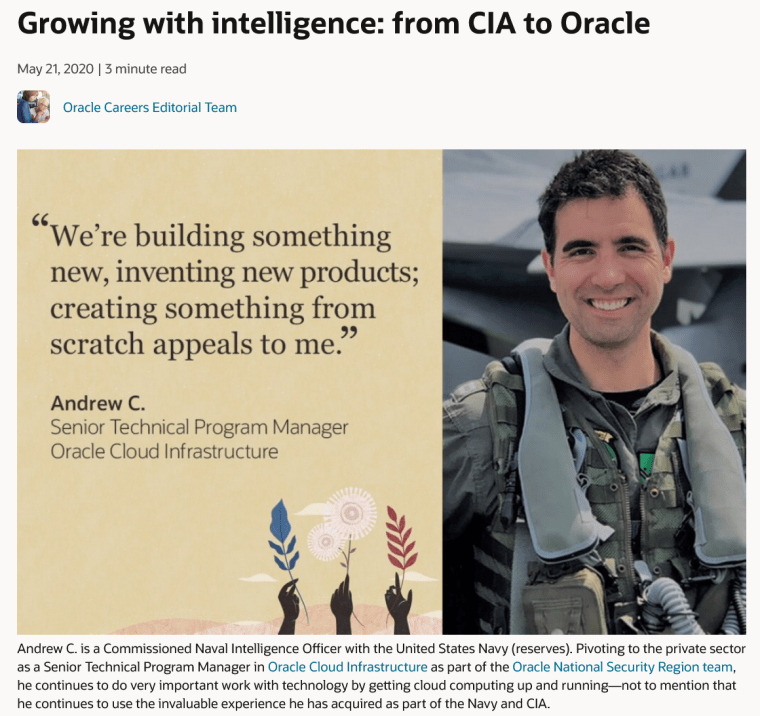
Oracle, a firm that stores reams of your sensitive data, openly boasts of its cozy ties to the CIA
The revolving door between Oracle and the CIA also swings the other way, with Oracle staff finding employment in Langley, VA.
The Silicon Valley giant also works closely with the U.S. military. “Oracle Cloud is advancing Department of Defense mission success”, it boasts on its website. Oracle notes that it is “delivering real-time intel to warfighters”, thereby “securing command and control at the tactical edge.” Thus, by the company’s own telling, it is a centerpiece of both the military-industrial-complex and the national security state. Big media outlets agree: “Larry Ellison is a billionaire today thanks to the CIA” concluded Business Insider.
Surveillance State
If Ellison had his way, however, Oracle would be an even more crucial part of a greatly expanded national security state. In the immediate wake of the September 11 attacks, he flew in for a series of meetings with top Bush-era officials, including NSA chief Michael Hayden and Attorney General John Ashcroft. There, he likely pitched an idea he had been promoting for some time: a single, comprehensive national security database that collected every piece of information possible to identify someone, from thumbprints and iris scans to medical history and social security details. “The single greatest step we Americans could take to make life tougher for terrorists would be to ensure that all the information in myriad government databases was copied into a single, comprehensive national security database,” he insisted.
In the end, even the Bush administration balked at such a sweeping project. Nevertheless, Oracle has deeply ingratiated itself into the world of policing and surveillance. In 2012, at the height of an anti-NATO demonstration, U.S. law enforcement used Oracle’s Endeca software to match protestors’ tweets with data about their criminal records, 911 calls and other information to pre-arrest demonstration leaders before the action took off.
Since then, Oracle has sold the same or similar software to authorities in Europe, South America, the Middle East and China. Job listings for developers at Guantánamo Bay also note that familiarity with Endeca and Oracle software is a desired trait.
Oracle is far from the only Silicon Valley giant with questionable ties to intelligence. Here at MintPress, we have exposed how Facebook’s top ranks are filled with former FBI and CIA agents, how ex-Israeli spies have found roles working for Microsoft and Google, and uncovered what we termed a “NATO to TikTok pipeline.”
Yet the openness with which Oracle and Ellison work with the Israeli state to further its interests should be highly concerning to those working in national security. Israel already has a long history of using its tech industry to surveil and eavesdrop on foreign governments.
Can it really be a wise idea for the United Kingdom to entrust its most sensitive government, health and defense data to a company with such close ties to the Israeli government?
So far, Great Britain has overlooked the potential grave national security threat this poses. Surely this cannot continue indefinitely.
Alan MacLeod is Senior Staff Writer for MintPress News. After completing his PhD in 2017 he published two books: Bad News From Venezuela: Twenty Years of Fake News and Misreporting and Propaganda in the Information Age: Still Manufacturing Consent, as well as a number of academic articles. He has also contributed to FAIR.org, The Guardian, Salon, The Grayzone, Jacobin Magazine, and Common Dreams.
Lowkey is a British-Iraqi hip-hop artist, academic, political campaigner, and a MintPress video and podcast host. As a musician, he has collaborated with the Arctic Monkeys, Wretch 32, Immortal Technique, and Akala. He is a patron of Stop The War Coalition, Palestine Solidarity Campaign, the Racial Justice Network, and The Peace and Justice Project founded by Jeremy Corbyn.
Indian journalist reveals severe Israeli censorship after escape from occupied territories
Press TV – March 7, 2026
An Indian journalist who was trapped in the occupied territories from February 28 to March 6 has revealed severe Israeli censorship amid the regime’s war of aggression against Iran.
Braj Mohan Singh of India’s Sandha News said he witnessed people dying in 100‑foot‑deep bunkers while Israeli officials withheld details.
Missiles “don’t differentiate between Indian or Israeli,” he said.
He contrasted press freedom in India with the restrictions in Israel, noting journalists cannot film bodies, visit hospitals, or receive accurate casualty numbers. Local accounts often reveal far higher losses than official reports, he added.
“When an incident takes place, we are not given the details of the location. The next day, when we visit the site, we are told, ‘There was only one casualty,’ but a local told us, ‘There were four houses, and everyone died,” which shows there was a major incident,’” he added.
Despite Israel’s touted advanced warning systems, Singh reported missiles arriving without sirens or prior alerts, highlighting technology failures and the unpredictability of drone and missile attacks.
He also mentioned reports of Iranian targeting of US embassies across West Asia and possible attempts in Tel Aviv, underscoring the heightened danger in the region.
The regimes in Washington and Tel Aviv started their unprovoked military assault on February 28, assassinating Leader of the Islamic Revolution Ayatollah Seyyed Ali Khamenei and top Iranian military commanders.
Iran began to swiftly retaliate against the criminal aggression by launching barrages of missile and drone attacks on the Israeli-occupied territories as well as on US bases in regional countries.
Majority of Israelis Back War with Iran as Anti-War Minority Faces Stigmatization
teleSUR | March 7, 2026
Israelis who oppose the war with Iran face threats and stigmatization, according to testimonies collected by a Spanish news agency. However, they represent a small minority, as 93% of Jewish Israelis support the offensive, a new poll by the Israel Democracy Institute (IDI) shows.
“Opposing the war and war crimes in Israel is practically a punishable offense. Even leftists and pacifists consider this a ‘just war,’” Adam Eli, secretary of the Jewish-Arab leftist coalition Hadash in Tel Aviv said.
Among those few critics is 19-year-old activist Itamar Greenberg, known in Israel for refusing to serve in the military in 2024. That decision, he recounted, cost him six months in prison and ostracism at his university, where he still leads a student circle while studying law.
Nearly one year after walking out of prison, Greenberg found himself back in custody on Tuesday for attending an anti-war rally that barely mustered 20 people across a nation of 10 million.
“About 40 police officers charged at us, confiscated our signs, and beat us. I was arrested and stripped naked for a search,” Greenberg said. He is also the founder of Mesarvot, a network of Israeli youth refusing military service.
An anti-war demonstration scheduled for Saturday at Habima Square in Tel Aviv will test wartime restrictions that cap gatherings at 50 people.
Meanwhile, restrictions on the right to assembly have been applied loosely during recent Purim celebrations—a sort of Jewish carnival—while Israeli authorities continue to bar Palestinians from praying at Al Aqsa Mosque despite Ramadan, and have militarily sealed off much of the West Bank.
How, and why, US data centers in the Gulf became targets of war
Al Mayadeen | March 6, 2026
The drone strikes that knocked Amazon Web Services facilities offline in the United Arab Emirates and Bahrain this week were not random acts of escalation. They were, according to analysts and industry insiders, a calculated strike on infrastructure that the United States has quietly woven into its military architecture across West Asia.
Amazon and Google hold a $1.2 billion contract with the Israeli government to provide cloud computing and artificial intelligence services to entities, including the Israeli occupation forces.
That contract, largely absent from Western coverage of the strikes, may explain why AWS facilities, and not the dozens of data centers operated by local Gulf companies on behalf of US tech giants, were the ones that were hit.
“It would be easier to target AWS,” Ed Galvin, founder of data center research firm DC Byte, told Bloomberg, noting that other US tech services are typically housed within locally operated facilities, making them harder to identify and strike.
Of approximately 230 data centers built or under development across Gulf Arab states, only a handful are wholly owned and operated by a US company, according to DC Byte. All three struck this week belong to Amazon.
What was hit
The strikes took down two of AWS’s three availability zones in the UAE, one site located near Al Maktoum International Airport in Dubai, according to DC Byte, and damaged a facility in Bahrain situated close to a local military base and the King Fahd Causeway connecting the island to Saudi Arabia.
Consumer services, including online banking, were disrupted across the region. In a statement to clients, AWS said it was working to restore services while urging customers to migrate workloads to data centers outside West Asia, acknowledging that “the broader operating environment in the Middle East remains unpredictable.”
What Western media outlets fail to mention is that the exchange has not been one-sided. “Israel” and the United States have struck at least two data centers in Tehran, according to Holistic Resilience, a nonprofit organisation that maps airstrike activity.
A new front in an old logic
Data centers have entered the battlefield as legitimate targets because they power surveillance systems, drone navigation, real-time analysis of satellite footage, and the digital backbone of modern military operations.
Attacking such facilities can “paralyze banks, paralyze government offices,” Daniel Efrati, chief executive of NED Data Centers, told Bloomberg. “If you have one minute of downtime, it can cost any organization millions.”
Soft targets with hard consequences
The physical vulnerability of these facilities has been laid bare by this week’s strikes. Data centers are sprawling, visible, and dependent on exposed infrastructure, e.g., cooling units, diesel generators, gas turbines, that can be disabled without a direct hit on the building itself.
“If you knock out some of the chillers you can take them fully offline,” Sam Winter-Levy, a fellow at the Carnegie Endowment for International Peace, told the Financial Times. Conventional data center security is designed to repel cyberattacks and physical intruders; it was not designed for drones.
Gulf AI ambitions under fire
The strikes land at a particularly fraught moment for Gulf states whose economic diversification strategies rest heavily on positioning themselves as global AI hubs. Saudi Arabia’s Humain and the UAE’s G42, both state-backed, have committed to vast data center clusters and signed major deals with Nvidia, Amazon, and Microsoft.
The UAE is constructing one of OpenAI’s “Stargate” facilities in Abu Dhabi. Microsoft announced last month it would open a new Azure facility in Saudi Arabia before the end of the year. Those ambitions now carry a new risk premium.
“The Gulf sold itself as a safe alternative to other markets,” Jessica Brandt, a senior fellow at the Council on Foreign Relations, told the Financial Times. “That argument just got harder to make.”
The new table stakes
Harder, but not necessarily fatal. Several analysts caution that the political and economic momentum behind Gulf AI investment is unlikely to be reversed by the strikes alone.
What has changed is the calculus around protection. “You can’t hide data centers,” Noah Sylvia, an analyst at the Royal United Services Institute, told Bloomberg. “But you can put air defence systems on them.”
One industry veteran based in the Gulf compared the situation to Intel’s chip manufacturing plants in “Israel,” ringed by military air defences, telling the Financial Times that for a project of Stargate’s scale, that kind of protection is now “table stakes.”
A global precedent
The broader implication reaches beyond the Gulf. “This is a harbinger of what’s to come,” Winter-Levy told the Financial Times, “and these types of attacks are not going to be limited to the Middle East.”
For the first time in history, the data centers that underpin the global digital economy have become a theater of war. The infrastructure the US built to project technological power across a volatile region has become a target precisely because of what it enables.
Security Researchers Warn Age Verification Laws Are Building a Global Surveillance System

By Ken Macon | Reclaim The Net | March 3, 2026
Three hundred and seventy-one security and privacy academics from 29 countries signed an open letter this week calling on governments to halt age verification rollouts until the privacy and security implications are properly understood.
The letter arrives as lawmakers across the world race to ban children from social media, pushing platforms to implement age checks before anyone has settled on what those checks should actually look like.
The signatories are unambiguous. Deploying large-scale identity verification systems without a clear grasp of what they do to user security, autonomy, and freedom is, in their words, “dangerous and socially unacceptable.”
Among those signing: Ronald Rivest, Turing Award winner, and Bart Preneel, president of the International Association for Cryptologic Research. These voices represent the core of the global security research community.
What governments are building, the letter argues, is surveillance infrastructure masquerading as child protection. A real age verification system, the academics explain, would require “government-issued IDs with strong cryptographic protection for every single interaction with the service.”
That means every search query, every message to a friend, every news article read online would require identity confirmation. Nothing in offline life demands that. The parallel doesn’t exist.
Companies are already moving. OpenAI, Roblox, and Discord have all begun implementing age checks in anticipation of legal mandates.
The academics aren’t dismissing the underlying concern. “We share the concerns about the negative effects that exposure to harmful content online has on children,” the letter states. What they’re rejecting is the proposed solution, which turns every adult into a suspect who must prove their identity before accessing the open web.
The technical problems compound the political ones. Building and maintaining identity verification at a global scale is genuinely hard. Many service providers, faced with the friction and cost, would simply refuse to comply.
And the platforms that can deploy these systems at scale are a handful of large corporations, meaning age verification becomes another mechanism for centralizing internet infrastructure in the hands of the few companies already dominant enough to afford it.
There’s another risk the academics name directly: governments banning VPNs. Age checks are trivially circumvented with a VPN, and the predictable policy response is to ban them outright. VPNs are currently one of the few tools available to people living under authoritarian regimes trying to protect their communications and identities.
Banning VPNs to enforce age checks on teenagers would strip that protection from dissidents, journalists, and activists worldwide. The collateral damage would be severe and global.
The academics are asking for a pause until scientific consensus forms around “the benefits and harms that age-assurance technologies can bring, and on the technical feasibility.”
What’s unreasonable is building mass identity verification systems first and studying the consequences after.
EPSTEIN FILES REVEAL POWER BROKERS IN SCIENTIFIC PUBLISHING
The HighWire with Del Bigtree | March 26, 2026
Newly surfaced documents and reporting are fueling questions about whether a small network of powerful players including Bill Gates, Jeffrey Epstein, and individuals linked to Robert Maxwell’s scientific publishing legacy sought outsized influence over how research is distributed and amplified. Emails, investments, and media-funding ties are being cited as potential indicators of an effort to shape which scientific ideas rise to prominence and which get sidelined. The broader issue: who controls the pipelines of modern science—publishing, PR, and perception—and what transparency is owed to the public when power concentrates behind the scenes.
Featured Video

Total War – Attacking Nuclear Plants, Desalination & Infrastructure
or go to
Aletho News Archives – Video-Images
From the Archives
Strike on Israel Shows US Bases Near Iran Are ‘Achilles Heel’
By Svetlana Ekimenko – Sputnik – 14.04.2024
Fears of a greater Middle East escalation were triggered after Iran launched a massive drone and missile attack against Israel, aided by Hezbollah and the Yemeni Houthis. Iran said the attack was in response to Israel’s bombing of the Iranian consulate in Damascus, Syria, which killed seven members of the elite Revolutionary Guard Corps.
Iran’s massive retaliatory attack on Israel from its own territory is a sign that the conflict could “escalate out of control.”
Michael Maloof, a former senior security analyst in the office of the US secretary of defense, told Sputnik that the first ever direct Iranian attack on Israel set a dangerous precedent.
“My concern is that this could easily escalate into something not only between Iran and Israel, but beyond the Middle East region,” he said.
Iran’s assault, which it stated was an act of “self-defense” after the Israeli strike on its consulate in Damascus, was originally intended to be a “limited” one, said Maloof.
Iran first sent in “swarms of drones with lights on as a sign of psychological warfare,” but sending in cruise and ballistic missiles by Tehran was a “distinct escalation,” said Maloof.
The scale of Iran’s attack on Israel suggests that Tehran was sending a message, demonstrating that it possesses “extraordinary capabilities,” said Maloof. … continue
Blog Roll
 Aletho News
- Hungary blasts ‘fake’ EU accusation
- SAFE Debt Trap: Poland’s €43.7 Billion Bet on Unipolar Illusion
- War on Iran threatens global Gulf capital flows: FT analysis
- Mossad De Facto Admits To Inciting Riots In Iran
- Tehran: World grown thoroughly exhausted with US-Israeli ‘false flag storylines’
- Trump ‘stuck between a rock and a hard place’, lacks Iran war strategy: Ex-CIA chief
- Trump’s bombardment of fake news so far is working quite well. But where is it heading?
- Iran to Mine Sea Lanes in Persian Gulf in Case of Attack – Defense Council
- Barak blasts Netanyahu: ‘Stop lying – you can’t destroy Iran’s nuclear, missile capabilities’
- Trump backs down on Iran strikes; Tehran denies any talks
- If Americans Knew
- From Sde Teiman, the truth about Israel’s military justice system has been set free
- Child denied life-saving bone marrow transplant by Israel ‘because he is from Gaza’
- Raffi Berg: BBC Middle East Editor Exposed as CIA, Mossad Collaborator
- Jerusalem Archbishop Rebukes Netanyahu’s Statements on Christianity
- US to embed Palantir AI across entire military: Report
- Israeli-US war on Iran to drag on “a few more weeks” – Not a ceasefire Day 164
- Lebanon deaths top 1,200; Palantir AI to be embedded across US military – Not a ceasefire Day 163
- Israel’s assassination game: Take all pragmatists off the board
- Food shortages return to Gaza as Israel tightens aid restrictions under the cover of its war on Iran
- Trump demands trillions in payments from Gulf countries, billions from Harvard – Not a ceasefire Day 162
- No Tricks Zone
- New Study: CO2 Is ‘Effectively Negligible’ As An Explanatory Climate Change Factor Since 2000
- Former Pfizer Toxicologist Dr. Helmut Sterz Tells Bundestag Hearing Pfizer Vaccine Should Have Never Been Approved
- Energy Expert: Germany’s Nuclear Phaseout Was A “500 Billion Euro Mistake”
- New Research: South Australia’s Mid-Holocene Sea Surface Temperatures Were 4°C Warmer Than Today
- Storing Green Energy To Last Germany 10 Days Would Require A 60-Million Tonne Battery
- New Studies: UK Sea Levels Were 4 Meters Higher Than Today During The Mid-Holocene
- Destructive Green New Deal: German Energy And Metal Group Warns Of Drastic Crisis
- New Study Documents A 20-Year Pause In Arctic Sea Ice Decline – Driven By Internal Variability
- Wake-up Call: Survey Shows Majority Of Germans Now Favor Postponing Climate Targets!
- Televised! Leading German Political Candidate Tells Schoolchildren CO2 Makes Sun Hotter!
 Aletho News