YouTube ‘arbitrarily’ shutters channels affiliated with Yemen’s Ansarallah resistance
The Cradle | July 18, 2023
US video-sharing and social media platform YouTube on 17 July closed 18 channels affiliated with Yemen’s ruling Ansarallah resistance movement, including those of the media bureau of Yemen’s Operations Command Center (OCC) and the resistance’s art and documentary production unit.
In a statement issued to Yemen’s SABA news agency, Yemeni officials called the move “an arbitrary measure and intellectual terrorism that reaffirms the aggressive intentions of the US-Saudi-Emirati coalition of aggression against Yemen by harnessing their media assets to serve their colonial project. It also reveals the falsity of the slogans of freedom of opinion and expression raised by western countries.”
The suspended channels reportedly had over 500,000 subscribers and hosted over 7 thousand videos with over 90 million views.
According to officials, many of the closed channels hosted art and music and did not promote any form of political hatred or incitement.
This is not the first time that YouTube and other social medial platforms have deleted Yemeni accounts or pages without any prior justification.
In 2021, the US Justice Department seized the website domain of the Yemeni Arabic-language Al-Masirah television channel and nearly three dozen other regional websites.
Social media giants often purge content that supports the Axis of Resistance and works to silence journalists who document Israeli and US war crimes in the region.
Western censorship often targets non-hegemonic news organizations like PressTV and RT.
Last year, a leak of internal Twitter files offered evidence that the Pentagon collaborated with Twitter to wage a secret “PsyOps campaign” across West Asia to sway public opinion in favor of Washington’s military interests in the region.
Biden is Calling Up Military Reserves… Are Your Kids Next?
By Ron Paul | July 17, 2023
As a rule, US war reporting since Vietnam has been mostly mainstream media cheerleading the mission rather than digging beyond government war propaganda. After all, it was images of American boys coming home in body bags shown on the six o’clock news across America that finally galvanized mainstream opposition to that war.
The Pentagon learned its lesson by the first Gulf War, and it severely restricted up-close media coverage. Only “trusted” journalists were able to report from the front lines. Most of the press corps wrote up stories based on US military press releases from luxury hotels in Baghdad.
By the time of Gulf War II the Pentagon came up with the concept of “embedding” select journalists with the troops. This allowed the story to be framed by the Pentagon with the false impression that actual journalism was taking place. It felt authentic, because the journalist was with the troops and close to the action, but the story presented what the Pentagon wanted to be presented.
This is perhaps a long way of pointing out that US mainstream media coverage of the war in Ukraine leaves a lot to be desired. Yes, sometimes the truth does slip out in publications like the New York Times, which reported last week that in just the first weeks of Ukraine’s “counter-offensive” at least 20 percent of the weaponry and equipment donated by the US and NATO has been destroyed.
However, usually what the mainstream media serves up are Pentagon and neocon talking points. Russia is losing, they report. Russia has already lost, as Biden said recently. Most Americans don’t go out of their way to listen to actual experts like Col. Doug Macgregor, who from the beginning has been telling a very different story. Thus Americans continue to be fed propaganda.
There is a funny thing about propaganda, though. Sometimes it comes face-to-face with contradictory reality and is shown to be nothing but a pack of lies.
Take for example last week’s shocking report that President Biden has signed an order to mobilize 3,000 US military reservists for deployment to Europe in support of the 2014 “Operation Atlantic Resolve.” What is Atlantic Resolve? It was launched in the aftermath of the US-backed coup in Ukraine and the ensuing unrest under the US-installed puppet government.
So, if Russia is losing – or has already lost, as Biden said last week – why has it suddenly become necessary to call up US reserve forces? Well, in the midst of one of the most serious US military recruiting crises ever, it seems Washington does not have sufficient troops for its anti-Russia mission in Ukraine. So what is the mission and why does it seem to be creeping toward sending more Americans close to the battle zone? No one in the Administration seems interested in explaining it and no one in the US media or Congress seems interested in asking.
We are on a very slippery slope, with Biden’s neocons continuing to escalate in the face of massive Ukrainian losses and an apparent shortage of US troops. Make no mistake, if the US/NATO proxy war with Russia is not halted the next step will be to look at the US Selective Service. That means they are coming for your kids. How long before America wakes up and says “NO”?
Copyright © 2023 by RonPaul Institute
Bank’s reasons for booting Nigel Farage revealed
RT | July 18, 2023
UK bank Coutts dropped British politician Nigel Farage as a customer not because his accounts contained insufficient funds but because his social and political views were incompatible with its “values,” according to a 40-page dossier compiled by the bank and seen by the UK Telegraph on Tuesday.
While admitting “there is no evidence of regulator or legal censure of [Farage],” the document concluded Farage was no longer “compatible with Coutts given his publicly-stated views that were at odds with our position as an inclusive organization.”
“This was not a political decision, but one centered around inclusivity and purpose,” the file stated, recommending the UKIP founder be put on a “glide path” to debanking as soon as his mortgage deal concluded – even though he was described as “professional, polite and respectful” in his dealings with Coutts.
While searching for a legitimate reason to drop him, Coutts apparently tried to leverage Farage’s “Russian connections,” only to find he did not have any. The file discussed his appearances on RT, where he was last a guest in 2017, alongside a claim about receiving payment from the Russian network that the bank admitted was bogus, and lamented that his comments about the conflict in Ukraine “fall short of endorsement” of the Russian position.
The bank ultimately settled on reputational risk. Farage “presents a material and ongoing reputational risk to the bank” as he is “regularly (almost constantly) the subject of adverse media,” the document explained, citing dozens of unfavorable news articles, including many from partisan sources like Hope Not Hate and Labour Movement for Europe.
The populist “is seen as xenophobic and racist” and a “disingenuous grifter” who promotes values that “do not align with the bank’s,” the dossier stated, referring to comments that were “distasteful and appear increasingly out of touch with wider society,” reportedly including tweets expressing his belief that the UK should leave the European Convention on Human Rights. His friendships with former US president Donald Trump and Serbian tennis champion Novak Djokovic were also brought up as liabilities.
When Farage revealed last month that Coutts had closed his account without giving a reason, the bank claimed his balance had fallen below the minimum amount required to maintain an account. The dossier, which he obtained through a subject access request, thoroughly contradicts the bank’s statement, explaining that his “economic contribution is now sufficient to retain on a commercial basis.”
Farage described the file to the Telegraph as a “Stasi-style surveillance report” that “reads rather like a pre-trial brief drawn up by the prosecution in a case against a career criminal,” noting the word “Brexit” appears 86 times and that Coutts found no fault with him before Brexit became an issue in 2016.
DISCUSSING THE UK ONLINE SAFETY BILL WITH AMY PEIKOFF
Computing Forever | July 14, 2023
The Online Safety Bill: https://bills.parliament.uk/bills/3137
Follow Amy Peikoff: https://dontletitgo.com/
Bitchute: https://www.bitchute.com/channel/J8ygO5SbU3L1/
Twitter: @AmyPeikoff
Ukraine Jails Senior Orthodox Cleric, Russia Demands Release
By Kyle Anzalone | The Libertarian Institute | July 17, 2023
A senior figure in the Ukrainian Orthodox Church (UOC) was placed in pretrial detention. Cleric Metropolitan Pavlo is facing charges for voicing opinions deemed too pro-Russian.
A Kiev court ordered Pavlo to jail on Saturday. The cleric’s bail was nearly $900,000, and he could remain in pretrial detention for a month. The judge claimed Pavlo violated a court order by contacting a witness in his trial. Pavlo, who is also known as Petro Lebid, says he did not know that the person was a witness.
On April 1, Pavlo was placed under house arrest. Though initially only scheduled for a month, his house arrest has been extended several times. The charges against Pavlo include inciting hatred and justifying the Russian war in Ukraine.
On Saturday, Moscow demanded Kiev release Pavlo. Russian Foreign Ministry spokeswoman Maria said, “We demand strict compliance by the Kiev regime with its international legal obligations, the immediate release of Metropolitan Pavlo, who is suffering from a serious illness, and the provision of proper medical care for him.” She added that the arrest was “yet another manifestation of political arbitrariness and lawlessness [by Kiev.]”
Ukrainian President Volodymyr Zelensky has waged a culture war. The UOC has been a primary target of the “derussification” campaign. On December 1, Zelensky announced that Kiev would attempt to expel all religious institutions with ties to Russia, arguing the move would make “it impossible for religious organizations affiliated with centers of influence in the Russian Federation to operate in Ukraine.”
Kiev further ratcheted up the campaign to erase the UOC by seizing the assets and placing travel bans on several of the church’s top officials. Additionally, a series of raids by Ukrainian police targeted the UOC.
Zelensky’s derussification campaign has extended far beyond the UOC. Kiev has nationalized the media, renamed public places named for Russian historical figures, banned books printed in Russian and outlawed political parties representing Ukraine’s ethnic Russians.
An Illustrious Censorship Institute
Harvard’s “Berkmen Klein Center for Internet & Society”
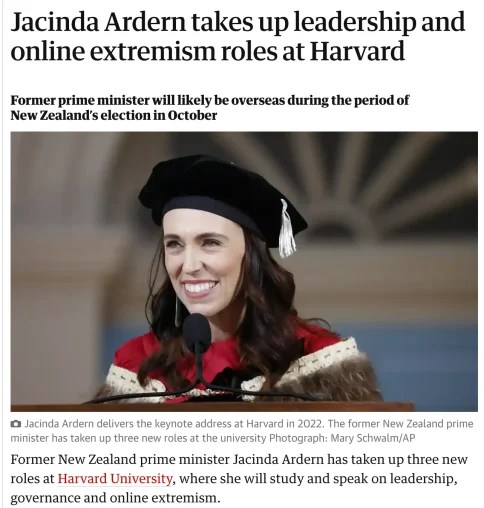
Former New Zealand Tyrant Jacinda Ardern delivering keynote address at Harvard
By John Leake | Courageous Discourse | July 17, 2023
A friend recently sent me a flagrantly political New York Times Editorial by Kate Klonick, “an associate professor of law at St. John’s University who studies law and technology, including the governance of online speech by private platforms.”
In her Opinion, Professor Klonick asserts:
No feat of rhetoric could disguise the flagrantly political nature of the federal court ruling on July 4 that restricted the Biden administration’s communications with social media platforms — but Judge Terry A. Doughty, who wrote the opinion, did his best to cover his tracks. The 155-page opinion, which could hinder the government’s efforts to counter false and misleading online speech about issues like election interference and vaccine safety, is laced with lofty references to George Orwell and quotations from Benjamin Franklin and Thomas Jefferson, making it more reminiscent of a civics essay than a federal judicial opinion.
Two things immediately came to mind as I read this essay:
1). Gramsci’s “Long March Through the Institutions” is now complete, having now made its way through the law department as St. John’s University. Words can’t express how disheartening I found this.
2). Professor Klonick should spend less time pontificating about “online speech” and “vaccine safety” and more time studying civics.
The trouble with lawyers like her is that they don’t understand the SPIRIT of the First Amendment. Because humans are mortal and human affairs are unstable and subject to powerful external forces, the state can always point to innumerable threats (real, perceived, and exaggerated) against which it invokes Emergency Power to reduce or suspend constitutional rules in order “to protect” the citizenry from itself and from foreigners.
James Madison, the author of the U.S. Constitution, recognized that in the grand scheme of human affairs, an overgrown executive posed a greater threat to the citizenry than the unfettered expression of free speech, which will often contain errors.
After reading Professor Klonick’s flagrantly political editorial, I pondered the question: how does the New York Times go about curating columnists like her—that is, a person with a distinguished academic resume who is willing to advocate America’s baleful new censorship regime?
A little Googling revealed that she is is on leave from St. John’s for 2022-2023 serving as a Visiting Scholar at the Rebooting Social Media Institute at Harvard University. An examination of this Institute revealed that it’s a project of Harvard’s Berkman Klein Center for Internet & Society, which recently announced that “Former New Zealand leader Jacinda Ardern joins Berkman Klein Center as Knight Tech Governance Leadership Fellow.”
Her appointment is a notable example of how many prominent public figures who advocated or imposed COVID-19 vaccine mandates “fell upward” by landing plum positions at America’s most prestigious academic institutions after public backlash against their policies and conduct. During her tenure as New Zealand Prime Minister, Ardern imposed some of the most draconian lockdowns and vaccine mandates in the world. In the spring of this year, as New Zealanders grew weary of her tyranny, she resigned and was shortly thereafter offered a job a Harvard.
A little research of financial supports of the Berkman Klein center resulted in this list of donors, which includes the Gates Foundation, George Soros’s Open Society Foundation, Microsoft, USAID, and the World Economic Forum.
And so we see how easy it is to capture men and women who have demonstrated great ambition, ability, and success in their careers, but who have no real interest in or understanding of Constitutional government.
Australian Communications Minister Michelle Rowland Tries To Justify New Censorship Law
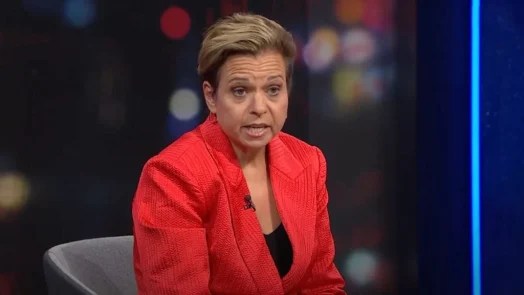
By Cindy Harper | Reclaim The Net | July 17, 2023
Australian Communications Minister Michelle Rowland is trying to push back against claims by Coalition MPs that the proposed upcoming legislation would lead to an Orwellian “Ministry of Truth.”
The newly proposed legislation aims to strengthen the Australian Communications and Media Authority’s (ACMA) abilities to manage digital platforms that are seen to propagate “misinformation and disinformation.” However, critics rightly know that the move will threaten the very essence of free speech.
Despite these assurances, skeptics like Coalition communication spokesman David Coleman argue that the regulator will inevitably need to form an opinion on what constitutes misinformation to ensure platforms comply with the new legislation.
“For government to start defining what can and cannot be said in a democracy is hugely concerning. This bill would allow that to happen,” Coleman said, to the Sydney Morning Herald.
The proposed bill gives ACMA the authority to collect information from digital platforms about how they adhere to existing codes.
Moreover, ACMA will have the power to introduce a new “code” for companies that repeatedly fail to address so-called misinformation and disinformation or establish an industry-wide “standard” requiring the removal of harmful content.
Failing to adhere to these standards will carry significant penalties. These include substantial fines, either $6.88 million or 5% of a company’s global turnover, whichever amount is higher.
This policy approach is not without its opponents. Critics argue the broad definitions of misinformation and disinformation as material that is “false, misleading or deceptive” and “reasonably likely to cause serious harm” could be abused by political subjectivity, potentially stifling legitimate views.
Coleman expresses concern over potential self-censorship by digital platforms due to fear of incurring hefty fines. The proposed legislation, in his view, could lead to the suppression of Australians’ authentic opinions. The exemptions within the bill for professional news content, authorized electoral content, and satirical material do little to assuage such fears.
Meta, the parent company of Facebook and Instagram, also expressed apprehensions about the bill’s potential to chill legitimate political expression online, due to the potential for imposing “binding standards” with severe penalties.
Despite previous attempts to increase ACMA powers by the former Morrison government in March 2022, draft legislation was never released. Rowland asserts the Albanese government’s openness to “constructive suggestions” to enhance the bill and is holding public consultations for feedback. However, the opposition has yet to take a formal stance on the legislation.
Ron DeSantis Vows to Ban CBDCs if Elected
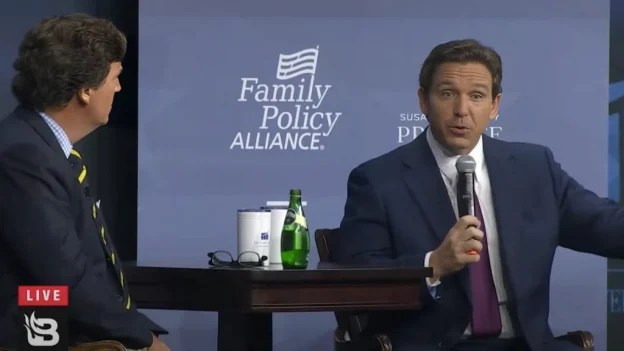
By Ken Macon | Reclaim The Net | July 15, 2023
Presidential hopeful Ron DeSantis, in a conversation with former Fox News anchor Tucker Carlson, vehemently argued against the possible introduction of a digital dollar by the Federal Reserve. The discourse took place at an event spearheaded by the right-leaning Family Policy Alliance lobby group.
DeSantis, who has a long-standing aversion to Central Bank Digital Currencies (CBDCs) emphasized that any move towards the creation of a digital dollar would necessitate congressional authorization.
Despite this, he warned that the Fed might endeavor to push this financial innovation unilaterally – an act he contends is at odds with constitutional principles.
“If I’m the President, on day one, we will nix central bank digital currency,” DeSantis affirmed, expressing his hostility towards CBDCs.
The underlying cause of DeSantis’s staunch opposition is rooted in his belief that the Federal Reserve will exploit CBDCs to advocate an anti-cash, anti-crypto policy. The Florida Governor predicts a future where CBDCs usurp all other forms of legal tender, effectively granting the Fed the power to restrict purchases they deem unfavorable, such as fuel and ammunition.
The controversial issue of CBDCs has taken center stage as the 2024 electoral race intensifies. Many, especially within libertarian sections of the Republican Party, are apprehensive that such currencies might encroach upon the sacrosanct privacy rights of American citizens. There’s a growing chorus arguing that CBDCs could bestow governments with an unprecedented level of control over individual expenditure.
In his critique, DeSantis harnessed the emblematic values of America. He insinuated that proponents of CBDCs aim to establish a “social credit system” in the US, emphatically referring to CBDCs as a “threat to American liberty.”
DeSantis is not the lone voice in the wilderness expressing discontent with CBDCs. Republican contender Vivek Ramaswamy also shared similar sentiments. “Just like ESG [Environmental, Social, and Governance] came out of the 2008 financial crisis, central bank digital currencies are what is going to come out of this next one… This is likely where this is heading. It is a longer-term game to a disaster,” Ramaswamy said.
On the Democratic front, Bitcoin advocate Robert F. Kennedy Jr. has categorized CBDCs as tools of control, cautioning about their potential misuse.
DeSantis’s skepticism towards CBDCs has been consistent. In his capacity as the Florida governor, he ratified a law in May barring CBDCs from achieving legal tender status. The aspiring president is pushing Republican-led states to adopt similar deterrents against CBDCs. As part of this mission, he has reached out to a coalition of 20 states to counteract federal endorsement of CBDCs.
Featured Video

The Truth About the Trump Shootings with Ken Silva
or go to
Aletho News Archives – Video-Images
From the Archives
The Geopolitics behind the War in Yemen (I)
By Mahdi Darius NAZEMROAYA | Strategic Culture Foundation | 30.03.2015
The United States and the Kingdom of Saudi Arabia became very uneasy when the Yemenese or Yemenite movement of the Houthi or Ansarallah (meaning the supporters of God in Arabic) gained control of Yemen’s capital, Sanaa/Sana, in September 2014. The US-supported Yemenite President Abd-Rabbuh Manṣour Al-Hadi was humiliatingly forced to share power with the Houthis and the coalition of northern Yemenese tribes that had helped them enter Sana. Al-Hadi declared that negotiations for a Yemeni national unity government would take place and his allies the US and Saudi Arabia tried to use a new national dialogue and mediated talks to co-opt and pacify the Houthis.
The truth has been turned on its head about the war in Yemen. The war and ousting of President Abd-Rabbuh Manṣour Al-Hadi in Yemen are not the results of «Houthi coup» in Yemen. It is the opposite. Al-Hadi was ousted, because with Saudi and US support he tried to backtrack on the power sharing agreements he had made and return Yemen to authoritarian rule. The ousting of President Al-Hadi by the Houthis and their political allies was an unexpected reaction to the takeover Al-Hadi was planning with Washington and the House of Saudi. … continue
Blog Roll
 Aletho News
- Pakistan-Iran talks secure LNG shipment to Islamabad through Hormuz
- Black Sea grain crisis puts global wheat supplies under pressure
- IRGC air defenses destroy another US MQ-1 drone over Strait of Hormuz
- Imran Khan’s entire immediate family detained in Pakistan ahead of mass protest demanding his release
- EU nation detains former presidential frontrunner
- Leaked: Britain’s Sham Conviction Of Hashim Thaci
- Seyed M. Marandi: U.S. Strike Imminent – Toward Total War in the Middle East
- Russia Voted Under Fire. Washington Is Loading the Tankers.
- 12 Things Your Oncologist Was Trained Not to Tell You
- Anthrax Attacks Paved Way for COVID-Era ‘Junk Drugs and Vaccines’
- If Americans Knew
- Huckabee aide solicited cash gifts from Israelis
- This isn’t sci-fi, AI is already killing people
- ‘The Most Brutal Thing’: Investigation Reveals Execution of Elderly Woman in Rafah
- Inside Israel’s ‘soft’ ethnic cleansing plan for Gaza through the eyes of its victims
- New online database tracks pro-Israel political donations in the United States
- Israeli president pardons soldier convicted for killing wounded Palestinian
- Singer Ed Sheeran says his ‘heart broken’ by Gaza devastation, addresses Macklemore controversy
- Israel Has Imprisoned Female Journalist Bushra Al-Tawil Without Trial Or Charge In Solitary Confinement For Past Month
- Israel poised to teach West Bank a lesson after one Israeli killed – Daily Update
- Salah Sarsour’s Legal Team Says DHS Has Not Met Its Burden to Prove He Is Deportable
- No Tricks Zone
- 2025 Nature Paper Claiming Worsening Global Drought Gets RETRACTED …Heavily Flawed
- New Study: ‘Global Drought Shows No Detectable Recent Acceleration Under Climate Warming’
- Economic Masterminds: German Socialists Suggest Taxing Productivity Gains Stemming From Using AI
- The South China Sea Has Not Been Cooperating With The Climate Change Narrative
- Energy Crisis: Germany Enters Heating Season With Historically Low Gas Reserve Fill Levels
- New Study: The Antarctic Ice Sheet Gained Mass From 2020-2024 Due To Staggering Snow And Ice Accumulation
- Study: Ocean Heating Rates From Thousands Of Years Ago ‘Dwarf’ Modern Ocean Heating Rates
- Climate Extremists Target, Attack Large-Scale Power Grid Infrastructure In Germany!
- New Study: Antarctic Ice Melt Has Contributed Less Than 1 Centimeter To Sea Level Rise In The Last 30 Years
- Fear Of Debate: Alarmist German Climate Scientist Calls On Mainstream Media To Discredit Skeptic Voices
 Aletho News