Offended By What Someone Said? Now You Can Report Them To Law Enforcement
MassPrivateI | May 7, 2019
Soon free speech will be a thing of the past in paranoid America.
DIGIT Lab’s “Hate Incident Reporting” app promises to turn complete strangers into secret, hate speech/bias spies.
Watch what you say, because the person sitting next to you could be reporting you to law enforcement.
Gone are the days when Americans were unafraid to voice their opinions or make snide comments in public. Because DIGIT Labs will turn smartphones into bias reporting devices.
According to a PHYS.org article, DIGIT LAB’s new app allows strangers to report someone for exercising their first Amendment rights.
“The first of its kind, the app accepts reports beyond crimes captured in police records. Users from around the country can document all incident types, from derogatory epithets written in bathrooms to slurs yelled from a car window in addition to violent assaults.”
This app will make swearing at a fellow motorist or flipping someone off: hate speech.
Where in our Constitution does it say that it is acceptable to report someone who has not committed a crime?
Since 9/11, Homeland Security has tried to turn the entire country into home-grown spies with their “See Something, Say Something” campaign that essentially does the same thing as DIGIT LAB’s Hate Reporting app. If someone see’s something or see’s someone acting suspiciously they are encouraged to report it to law enforcement.
But the University of Utah’s, Hate Incident Reporting app, promises to create a Federal free speech blacklist.
“The major problem we’re dealing with is that hate crimes are so underreported, not only to police, but from police to the federal government,” said Emily Nicolosi, researcher, and Richard Medina, professor of geography. (Nicolosi helped develop the app.)
Creating a national blacklist of people who use derogatory epithets and slurs will turn this country into a mirror image of China.
“We’d like to see it used nationally to get better hate incident statistics, and to understand why, how, and where people are active in hateful incidents, and how that offends or hurts people,” said Medina.
Although the PHYS article claims that all reporting is confidential and anonymous, the amount of detailed information a person is asked to provide would make it easy for law enforcement to identify someone.
Google Bans Press TV
What’s Next?
By J. Michael Springmann and Edward C. Corrigan | Dissident Voice | May 5, 2019
What?
On April 19, 2019 (the date of the original Patriots’ Day in New England), American tech giant Google disabled the accounts of Press TV, an Iranian news service, and its sister channel Hispan TV, an outlet in Spain. Google denied their access to all its services, including its popular video streaming platform YouTube and its E-mail service Gmail. The company’s move took place without prior notice or subsequent explanation.
The action’s date is particularly significant to Americans. That day marked the beginning of the American Revolution. It saw the first armed engagement between British soldiers and colonial militiamen at the Battles of Lexington and Concord in Massachusetts on April 19, 1775. Patriots’ Day was intended to commemorate the colonists’ fight to win freedom from British rule.
But, nearly 250 years later, it observes the loss of that freedom to invisible, uncontrollable organizations.
Google and Facebook, and other social media giants, have been accused of altering search algorithms to slant or even hide information that departs from the government or corporate agenda. Independent media sources on the right and on the left have complained that searched results are tainted and being secretly manipulated on a grand scale. Now the censorship is being imposed openly in the name of political correctness and social harmony. There is a clear campaign to de-legitimize critics of US Government policy.
Target: Iran.
According to the April 22, 2019 edition of MintPress, “Iran has been on the receiving end of more than its share of censorship. Facebook has repeatedly banned “networks” it believes are “tied to Iran.” Meanwhile, both Press TV and HispanTV have faced prior crackdowns from Google. Recently, Instagram banned a number of Iranian officials following the U.S. designation of Iran’s military as a foreign terrorist organization. In some cases, Facebook has even worked with CIA-funded cybersecurity firms to target accounts. The State Department later trumpeted those findings in a report on Iran’s cybersecurity threat to the U.S., but opted to omit the source of the evidence.”
Additionally, MintPress noted: “Google’s crackdown on Iran is multifaceted, not just singling out its media for censorship, but also shutting down the accounts of its officials. Indeed, Google is on a path to destroy Iran’s ability to independently communicate its message to the world.”
What’s the issue?
Quoting Yasha Levine, journalist and author of Surveillance Valley: The Secret Military History of the Internet… “American Internet companies,” such as Google and Facebook, “are not abstract global platforms, but privatized instruments of American geopolitical power.”
And that’s the real issue.
And it’s not only Press TV, the “Voice of the Voiceless” that’s censored. The American Herald Tribune has been under attack, it says, by Zionist gatekeepers. In August 2018, it wrote one of the authors: “Dear Michael, Google has disabled all of the services we were using.” Then, the next month, it wrote: “Dear Friends/Colleagues: We were unable to retrieve our Facebook page after it was taken down without any prior notice. We have created a new Facebook page.”
Protection from bigots?
The attacks on Press TV, American Herald Tribune, and others are always couched in terms of suppressing the malign influence of the “far-right” and/or “anti-Semitic figures and organizations.” On May 3, 2019, the Washington Post used those words to headline an article celebrating Facebook’s action in permanently banning “several far-right and anti-Semitic figures and organizations, including Nation of Islam leader Louis Farrakhan, Infowars host Alex Jones, Milo Yiannopoulos [a former Breitbart editor] and Laura Loomer [a right-wing American political activist] , for being ‘dangerous’…” The paper saw this as “a sign that the social network is more aggressively enforcing its hate-speech policies at a moment when bigoted violence is on the rise around the world.”
While the 1st Amendment to the United States Constitution states: “Congress shall make no law … abridging the freedom of speech, or of the press…,” it seems that “The People” can do as they please, as long as they have large Internet organizations behind them and lots of money. And if there is pressure from supposedly liberal governments influencing them.
The Post went on to say, “Governments around the world are pushing Facebook to take town [sic] bigoted and other harmful content more quickly–or risk being banned themselves.” Germany heavily fines social media if they run afoul of “The Enforcement on Social Networks Act” (Netzwerkdurchsetzungsgesetz). Although it came into force October 1, 2017, social networks were given a three-month grace period to change their policies. If criminal content, which can include hate speech, defamation, and fake news, isn’t removed within 24 hours of its being reported, social networks can face fines reaching €50 million (US$60 million).
Like in the United States, “hate speech” is in the eye (or ear) of the beholder, especially if it deals with illegal aliens, a sore subject in some countries. This concept is probably the reason why Facebook and Twitter refused to advertise J. Michael Springmann’s book, Goodbye, Europe? Hello, Chaos? Merkel’s Migrant Bomb, an analysis of forced migration into Europe from American wars in the Middle East.
Conclusion
This all boils down to “political correctness” and lack of common sense. And governmental power. Allegedly liberal societies now engage in censorship–in the name of freedom of speech and political correctness. But it’s really censorship and control of information that is the real objective.
The Encyclopedia Britannica notes “our perception of reality is determined by our thought processes, which are influenced by the language we use. In this way language shapes our reality and tells us how to think about and respond to that reality. Language also reveals and promotes our biases. Therefore, according to the [Sapir-Whorf] hypothesis, using sexist language promotes sexism and using racial language promotes racism.”
Clever people in well-placed governmental positions and their cats-paws in large corporations evidently have taken note of this linguistic mind control and are now implementing it on a grand scale.
Michael Springmann is a lawyer, author, political commentator, and former diplomat based in Washington, D.C. While abroad with the U.S. Department of State, he served in Germany, India, and Saudi Arabia. He can be contacted at attorney@springmannslaw.net or at 202-256-3878. Edward C. Corrigan is certified as a specialist by the Law Society of Ontario (formerly the Law Society of Upper Canada) in Citizenship, Immigration and Immigration and Refugee Law. He is an author and political commentator based in London, Ontario, Canada and can be contacted at corriganlaw@edcorrigan.ca or at 519-439-4015.
Twitter suspends the accounts of two newspapers and several Venezuelan government institutions, but verifies the “presidential” account of Guaidó
Orinoco Tribune | May 2, 2019
Between Tuesday, April 30 and Wednesday, May 1, the US corporation Twitter has suspended, without explanation, the accounts of several Venezuelan media and various government institutions led by President Nicolás Maduro. Among others, the accounts of the newspapers El Correo del Orinoco ( @correoorinoco ), the Diario Vea ( @DiarioVEAVen ) and the television station ViVe Televisión ( @ViVetvoficial ), as well as the accounts of the Ministry of Popular Power for Women ( @MinMujer ); of the Ministry of Popular Power for Education (@ mppeducacion ) and the Ministry of Popular Power for Petroleum ( @MinPetroleoVE ).
The newspaper Vea is a private media outlet whose editorial line is favorable to the Venezuelan revolutionary process, while El Correo del Orinoco and Vive Televisión are state media.
These actions occurred almost simultaneously with an attempted coup on April 30 against the government of President Nicolás Maduro, as part of the maneuvers to overthrow him that the opposition deputy Juan Guaidó, with the support of the US government, has been attempting since the 23rd of January.
It is noteworthy that the opposition deputy Juan Guaidó, who claims to be “President in charge” of Venezuela, announced last week the creation of a “National Communication Center”, which will function as an “official communications organ” or a kind of ministry of parallel communication. It will be directed by Alberto Federico Ravell, a journalist known for having directed the private channel Globovisión during the years in which it worked as a communication weapon to try to overthrow the then President Hugo Chávez, and later became the director of the opposition digital medium, La Patilla, of identical characteristics.
The (coup’s) “National Communication Center” announced on Monday that its social networks were already active, having created the @Presidencia_VE account , which they describe as the “Official Account of the Presidency (E) of the Bolivarian Republic of Venezuela.” This account, surprisingly, already appears as “verified account” (with the blue check that denotes that the Twitter company has verified the legitimacy of this account), although the real account of the Presidency of Venezuela, @PresidencialVen , which records the activities of the Venezuelan President Nicolás Maduro, was never verified by this company, despite the fact that it was created in April 2010 and has more than 1 million followers.
The verification to the @Presidencia_VE account of Juan Guaidó is, moreover, strange given that Twitter announced in November 2017 that its program for verification of accounts (to place the famous “blue check”) was temporarily suspended , and until today he has not reactivated it .
The blue check denotes that the Twitter company verified that the account belongs to its legitimate user. Generally it was approved for journalists, politicians, celebrities and famous people or of the world of show business, which allows to distinguish the legitimate accounts of impersonations, usurpers, false accounts and parodies.
For some, the fact that the Twitter company has decided to place as “verified account” the one of Guaidó seems to indicate in a brazen way what their political preferences are.
Worse yet: the @PresidencialVen account has been suspended this year on at least two occasions: March 12 and April 1. It was also suspended in September 2018. The restrictions lasted a few days; The reasons were never reported.
Maduro was re-elected on May 20, 2018 as President of Venezuela, in a widely audited process that was attended by international observers.
The account of Correo del Orinoco has been suspended several times, the most recent being on January 29. This account has more than 829 thousand followers and mainly publishes contents of the newspaper’s website , which is attached to the Venezuelan Ministry of Communication and Information and is directed by the journalist Desiré Santos Amaral. It is noteworthy that last year they celebrated the 200th anniversary of the creation of Correo del Orinoco by the Venezuelan Liberator Simón Bolívar, a newspaper that played an important role during the war of independence against Spain. The account was unlocked a few days later.
At that time, the @ViceVenezuela account of the Vice Presidency of the Republic, which has 329 thousand followers, was also restricted for several days .
Precedents
It is not the first time that major Twitter accounts linked to the Chavista government are massively blocked, particularly during politically critical moments.
In November 2013, Twitter suspended some 6,600 accounts of supporters of President Nicolás Maduro or of officials or institutions of his government, including two media outlets (CiudadCCS and the radio network La Radio del Sur). Among those blocked were the then Minister of Communication and Information, Delcy Rodríguez; Wilmer Barrientos, who at that time was assigned to the Office of the Presidency; the then Minister of Agriculture and Lands, Yvan Gil; the governor of Anzoátegui at that time, Aristóbulo Istúriz ( @psuvaristobulo); as well as the official accounts of the ministries of University Education, Land Transportation, for Women, Corpomiranda, the Social Vice Presidency, the Bolivarian University of Venezuela (UBV), the National Experimental University of Security (UNES), Pdval, Mercal, and networks of supporters of Maduro such as ForoCandanga, in addition to numerous journalists, professionals and recognized individuals. The accounts were restored days later, claiming that it was “an error” .
In June 2017, dozens of media accounts and chavismo activists were suspended without explanation. At least thirteen accounts of the state-run Radio Nacional de Venezuela were suspended, including its main account, @RNVContigo, and the accounts of regional broadcasters @rnvcentral, @rnvtachirafm, @rnvzulia, @rnvanzoategui, @rnvlosllanosfm, @rnvtachirafm and @rnvportuguesa, as well as the @rnvmusical and @rnvindigena channels, and the @rnvcultura, @rnvdeportes sections and @rnvinter. In addition, the accounts of Radio Miraflores ( @MirafloresFM ) and Miraflores TV ( @MIRAFLORES_TV ), media of the Presidency of the Republic, as well as important Chavez influencers and tweeters were blocked. None of these accounts could be recovered.
Translated by JRE\EF
RELATED CONTENT:
Instagram Acts as Arm of US Govt, Bans Top Iranian Officials After IRGC ‘Terrorist’ Designation
Poynter retracts list of ‘unreliable news sources’ after listed sites prove it to be unreliable
By Helen Buyniski | RT | May 3, 2019
Journalism nonprofit Poynter has retracted a long list of supposedly unreliable news websites, admitting the list itself was unreliable – a fact ironically brought to its attention by several of the outlets it calls untrustworthy.
“We regret that we failed to ensure that the data was rigorous before publication, and apologize for the confusion and agitation caused by its publication,” Poynter’s managing director Barbara Allen wrote after removing the list from its website. Allen notably didn’t apologize for compiling the list in the first place, and it is unlikely we’ve heard the last of Poynter’s unreliability index, given that mainstream media gatekeepers have been trying to convince the public it needs an exalted class of media-whisperers to interpret the news for years.
Before deleting entirely, Poynter apologized to the Washington Examiner and FirstPost, two of several sites included on the blacklist who politely inquired as to why they’d been included. Baybars Orsek even told the Examiner that “the total number of complaints is less than 2 percent of the whole database.” By Thursday night, however, the page had vanished, and “inconsistencies between the findings of the original databases… and our own rendering” were blamed, with a promise that a “more consistent and rigorous set of criteria” was on its way. We can hardly wait!
RT made the “unreliable” list, hardly a surprise given the notable bias of neocon-affiliated “fact-checkers” like the folks at NewsGuard, but the other 515 sites held a few surprises. In addition to about 30 well-known conservative outlets like the Daily Caller (“bias,” “clickbait”) and Drudge Report (“bias”), popular progressive pages like Common Dreams (“clickbait”) and Activist Post (“conspiracy,” “unreliable”) are listed side by side with apolitical platforms like Liveleak (“fake”) among the obvious fakes (including joke sites like Clickhole and Reductress ). The list thus appears to be a PropOrNot-style “wrongthink”-tracker designed to tar legitimate dissent and other inconvenient voices with the ‘fake news’ brush.
Poynter apparently doesn’t think much of its audience’s intelligence, as the list included “satire” among the otherwise somewhat interchangeable terms it used to smear included sites – “bias,” “unreliable,” “fake,” “clickbait,” and “conspiracy.” Never mind that some conspiracies are real – Watergate, anyone? – or that their definition of “clickbait” would condemn most of the internet (“sources that provide generally credible content, but use exaggerated, misleading, or questionable headlines, social media descriptions, and/or images”). Blacklisting “satire” because you assume readers are too dim to “get it” enshrines the lowest common denominator in the driver’s seat.
The blacklist was supposedly “built from pre-existing databases compiled by journalists, fact-checkers and researchers around the country,” though Poynter admits that more than half the domains in those databases were no longer active as of November 2018. Most of the data came from OpenSources, a database run by Merrimack University’s Melissa Zimdars, whose academic work, as Breitbart (“bias, unreliable”) noted, centers almost exclusively on obesity (“Watching Our Weights: The Consequences and Contradictions of Televising Fatness in the ‘Obesity Epidemic’”), despite her self-styled credentials as a ‘fake news’ analyst.
The absence of any mainstream voices from the list despite numerous instances of fake stories parading across their pages just in recent months – Covington Catholic students harassing peaceful protesters, the hate crime against Jussie Smollett, Maduro’s government burning humanitarian aid, Donald Trump’s campaign colluding with the Russians – says all that is necessary about the real purpose of Poynter’s list, which is less about protecting readers from fake news than protecting readers from dissenting views.
UK Foreign Sec supports increased press freedom for all, but not RT
By Simon Rite | RT | May 3, 2019
Britain’s Foreign Secretary says he wants improved global media freedom while at the same time suggesting that RT has a bit more freedom than he’d like.
Jeremy Hunt was marking World Press Freedom Day whilst on a trip to Ethiopia, which may seem like an unlikely setting to work in a dig about a Russian news organisation, but he did it anyway.
He said: “We shouldn’t forget the international context Channels like RT – better known as Russia Today – want their viewers to believe that truth is relative and the facts will always fit the Kremlin’s official narrative. Even when that narrative keeps changing.
After the Russian state carried out a chemical attack in the British city of Salisbury last year, the Kremlin came up with over 40 separate narratives to explain that incident. Their weapons of disinformation tried to broadcast those narratives to the world.”
So what Hunt, actually wants people to think is that there is only one truth and one narrative, and it’s the one the British government tells you.
To prove that, here’s what he said next: “The best defence against those who deliberately sow lies are independent, trusted news outlets. So the British Government is taking practical steps to help media professionals improve their skills.”
Just in case the point needs underlining, Hunt believes the best defence against lies is for independent news outlets to be trained by the British government, who can then be trusted to report the agreed narrative.
During his speech he drew attention to the best of African journalism, particularly highlighting work by BBC Africa. You can see the pattern of what Hunt considers good journalism, which is the stuff he agrees with.
You only need to look at Iraq, Libya and Russiagate to see how facts are being used to fit narratives and none of those have anything at all to do with RT. RT is such an easy target because it is the only real high profile network which can realistically push back on the agreed narratives. The viewer should be able to make up their own mind, but press freedom should always mean a plurality of views and not the domination of an agreed western narrative.
This idea of the independence of the western media has always seemed spurious. In much of the world the major outlets are owned by unaccounted corporate entities, and in Britain, all the national networks have daily government briefings to tell them what the news is, and when the government goes on holiday the media calls it ‘silly season’ because they don’t know what to report. Strange kind of independence.
When it comes down to media freedom, the best advice is not to be a total Jeremy Hunt about it.
Israel killed 102 Palestinian journalists since 1972
Palestine Information Center – May 1, 2019
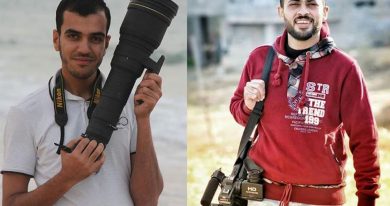 RAMALLAH – The Palestinian Journalists Union in the West Bank on Tuesday said that Israeli occupation forces have killed 102 Palestinian journalists since 1972.
Naser Abu Baker, head of the union, said during his speech for a conference on press freedom in Ramallah that 19 journalists have been killed since 2014.
During the past four months, the Palestinian Journalists Union documented 136 Israeli attacks on Palestinian journalists, and 838 in 2018, including the killing of Yaser Murataj and Ahmad Abu Hussein in Gaza.
In 2018, 52 Palestinian journalists were arrested, and 47 were injured by live ammunition, 189 by tear gas canisters, and 17 by rubber-coated metal bullets.
Baker said that 2018 witnessed an unprecedented increase in the violations and crimes committed against Palestinian journalists, including attacks carried out by settlers.
UK Labour leader targeted for accepting ‘Jews control banks’
Press TV – May 1, 2019
Leader of Britain’s opposition Labour Party is facing attacks from pro-Israeli lobbies in the country for merely endorsing thoughts of a thinker who suggested a century ago that Jews control the media and political discourse through their dominance on the European financial system.
Labour politicians and other notable political and social figures called on Corbyn on Wednesday to apologize for a foreword he wrote to a book first released in 1902 and re-published in 2011.
In his foreword to John Atkinson Hobson’s ‘Imperialism: A Study’, Corbyn said the economist’s description of how a certain Jewish household controlled banks and newspapers were “brilliant”, “very controversial at the time” and “a great tome.”
The book mainly argues that men of a singular and peculiar race use centuries of financial experience to control finance in Europe. It says that the dominance puts the Jews “in a unique position to control the policy of nations” and gives them a control that “they exercise over the body of public opinion through the press.”
However, pro-Israeli activists and politicians labeled Corbyn’s endorsement of the idea as a clear form of support for antisemitism and asked him to apologize.
“Jeremy Corbyn endorsed book that peddles racist stereotypes of Jewish financiers and imperialism as “brilliant” and a “great tome”,” said former Labour MP Ian Austin.
“The revelation Jeremy Corbyn wrote the foreword for a reportedly deeply antisemitic book is damning and damaging,” said Euan Philipps, of the campaign group Labour against antisemitism.
Corbyn, well known for his support of the Palestinian cause, has repeatedly been described by pro-Israeli lobbies in Britain as a threat to the life of Jews in the country if he takes office. He has denied having anything against the Jews and has sought to sort out differences with the Jewish community in the UK.
A senior Labour lawmaker said on Wednesday that Corbyn’s endorsement of Hobson’s thoughts in economy and politics was not antisemitic.
“I haven’t read the book myself but as I understand it, Jeremy like many politicians, has quoted this relevant political thinker,” said Rebecca Long-Bailey, a Labour frontbencher, adding, “I think he was looking at the political thought within the whole text itself, not the comments that were antisemitic in any shape or form.”
The New York Times Apologizes for “Anti-Semitic” Cartoon While Enabling Real Bigotry in Israel
By Helen Buyniski | Aletho News | May 1, 2019
The New York Times has begged forgiveness for printing a cartoon that supposedly “included anti-Semitic tropes” in its international edition, but no amount of shameless groveling will stop the Israeli weaponization of the “anti-Semitism” smear as it steamrolls America’s once-sacred First Amendment freedoms. This is a crusade to silence all legitimate criticism of a criminal regime, and if the Times has anything to apologize for, it is its complicity in that quest.
The offending cartoon depicts President Donald Trump as a blind man being led by a guide dog with the face of Israeli PM Benjamin Netanyahu, identified by a star-of-David collar. It’s unclear what the “anti-Semitic trope” in this case is supposed to be – the collar is arguably necessary to confirm the dog is Netanyahu, and the reader would have to be a political illiterate to interpret that as a stand-in for “all Jews.” The Times’ willingness to slap the “anti-Semitic trope” label on the cartoon anyway should put to rest the ridiculous “anti-Semitic trope” trope that is tirelessly deployed to smother accusations of wrongdoing by Israel or its lobbying organizations inside the US.
Netanyahu himself has boasted that Trump acted on his orders when he declared Iran’s Islamic Revolutionary Guard Corps a terrorist organization earlier this month, and Trump’s willingness to flout international law to unilaterally “give” the Golan Heights to Netanyahu as a re-election present shocked the world, unsettling even some Zionists who believe the land is rightfully theirs but worry the US’ official declaration will galvanize regional opposition to the occupation. Netanyahu’s last election campaign was arguably based on his ability to “lead” the US president blindly off the edge of a geopolitical cliff. Is he guilty of perpetuating anti-Semitic tropes for bragging about it?
Most papers only apologize when they’ve printed something erroneous. The Times has chosen instead to issue a correction for one of the few accurate depictions of the relationship between Israel and the White House, a glimmer of truth even more notable for its contrast with the paper’s usual disinformation painting Trump as some sort of foaming-at-the-mouth anti-Semite.
The Times’ decision to apologize for this cartoon while remaining silent when a cartoon depicting Trump in a gay love affair with Vladimir Putin was condemned by LGBT readers last year betrays the editorial board’s high moral dudgeon as the most transparent hypocrisy. US media has long smeared Putin’s government as homophobic, yet here they were presenting him half-clothed in a stomach-turning romantic embrace with Trump – a president who, it should be noted, has presided over the deterioration of US-Russia relations to levels not seen since the Cold War. But LGBT Twitter ultimately has little power in society, unlike the Israeli lobby, and the unfavorable depiction of Trump ensured most influential LGBT organizations steered clear of criticizing the cartoon. Outrage has become yet another commodity to be traded, not a genuine response to offense.
If it’s in a repentant mood, however, the Times could apologize for its one-sided coverage of the Israeli-Palestinian conflict – much of it fed to them by The Israel Project, which skews US coverage of the facts on the ground in Israel by supplying American reporters with talking points in order to “neutralize undesired narratives.” From these spinmeisters we get the passive voice used to frame IDF soldiers mowing down unarmed protesters as “clashes occurred” and “Palestinian protesters were killed,” as well as breathless coverage of tunnels, kites, and rocket attacks that rarely seem to hit anyone.
The Times could apologize for its failure to expose the global campaign to redefine “anti-Zionism” as “anti-Semitism,” instead of playing into it by pretending a truthful cartoon is somehow an affront to Jews – as if all Jews support the racist policies of the Israeli government. Indeed, to assume all Jews back the criminal Netanyahu regime in its openly genocidal campaign to eradicate the Palestinians from the few enclaves of the West Bank in which they remain while maintaining an open-air concentration camp in Gaza is wildly anti-Semitic.
The Times could apologize for failing to report on the massive Israeli spying operation – funded, in no small part, by the US taxpayer – targeting American activists on American soil, exposed in detail in the suppressed al-Jazeera documentary “The Lobby,” which leaked last year to deafening silence in the media. Journalist Max Blumenthal actually spoke with a Times journalist who wanted to cover the explosive revelations of the documentary, but no story ever appeared. As Ali Abunimah, founder of the Electronic Intifada, has pointed out, the suppression of the documentary should have been a story in and of itself – and would have, had it involved any other country.
“Imagine that this had been an undercover documentary revealing supposed Russian interference, or Iranian interference… in US policy, and powerful groups had gone to work to suppress its broadcast and it had leaked out. Just that element of it – the suppression and the leak – should be front page news in the Washington Post and the New York Times,” he told Chris Hedges, whose RT program was the closest thing to mainstream coverage the documentary received in the US.
The Times instead chooses to cover up the actions of groups like the Israel on Campus Coalition as they surveil and smear pro-Palestinian activists – college students, professors, and others sympathetic to Israel’s sworn enemy – using a strategy the ICC’s executive director Jacob Baime admits is based on US General Stanley McChrystal’s counterinsurgency strategy in Iraq. “The Lobby” revealed that agents working for the Israeli government infiltrate pro-Palestinian, pro-peace groups using fake social media accounts and report their findings back to the Israeli Ministry of Foreign Affairs, a shocking fact that none of the organizations named in the film have disputed. A foreign government operating a military-style surveillance network to target and smear American citizens in their own country – for nothing more than exercising their freedom of speech – gets a pass from the Times, but a cartoon showing Trump’s blind loyalty to Israel for what it is must be condemned.
It’s tough to electrify an outraged mob based on a story that wasn’t printed, but the Times’ failure to address the very real threat to Americans exercising their free speech – a threat all the more dire because it is funded by US tax dollars to the tune of $3.8 billion per year – merits at least a full-page apology. Compounding the insult is a domestic economic crisis, with many American cities facing record homelessness, skyrocketing cost of living, a dearth of secure employment and an excess of exploitative “gig economy” temp work, and a rapidly-disappearing social safety net. Israel is a wealthy country, as Netanyahu often boasts, a successful country. Only a truly blind government could continue to fork over such enormous sums of money while Americans languish in poverty.
“The anti-Semitism smear is not what it used to be,” one lobbyist laments to al-Jazeera’s hidden camera-equipped reporter. Perhaps this is why the state of Florida has advanced a bill to criminalize “anti-Semitism,” now broadly redefined to include “alleging myths… that Jews control the media, economy, government, or other institutions.” The bill passed the House unanimously, the one holdout bullied into submission when she voiced concerns about its incompatibility with the First Amendment, yet to point out – as AIPAC does – that this bipartisan approval exists because the Israeli lobby has influence over both parties, or that this influence can make or break a candidate, is about to become illegal. When even a milquetoast like Democratic congressman Beto O’Rourke has stuck his neck out to call Netanyahu a racist – and he receives more money from the Israeli lobby than most of his House colleagues – the Times should be ashamed of itself for pushing the fiction that criticism of Israel and its iron grip on the US government is equivalent to anti-Semitism.
The Times’ own article about its apology quotes an interview with the “guilty” party, Portuguese cartoonist Antonio Moreira Antunes, from the aftermath of the Charlie Hebdo attack, when four cartoonists and the magazine’s editor were murdered, supposedly for printing an offensive cartoon. There is a definite parallel with the Zionist outrage mobs calling for Antunes’ head – figuratively, if not yet literally; many are unsatisfied with the Times’ apology and insist Antunes suffer for his insolence by losing his job, if not his life. Antunes, in the interview, called his job “a profession of risk,” but states “there is no other option but to defend freedom of expression.”
The New York Times, and everyone else who demanded they apologize for a truthful cartoon while ignoring their failure to oppose genuine bigotry in the Netanyahu regime and supporters of Zionism, clearly do not agree that freedom of expression is worth defending. A press that cannot even defend itself does not deserve to be called “free.’
Attacks on Samidoun: PayPal’s complicity in silencing Palestinian prisoners
Samidoun Palestinian Prisoner Solidarity Network | April 30, 2019
The Israeli state and the Zionist movement are continuing their attacks on the Palestinian prisoners and the Palestine solidarity movement. One of the most recent effects of these attacks was the closing of Samidoun’s PayPal account. On its face, this is nothing new: PayPal has shut down the accounts of numerous groups supporting Palestinian rights around the world, including BDS campaign organizations, political parties and even media organizations at the behest of demands from various pro-apartheid politicians and agencies.
On the other hand, the sensationalistic attacks posted in pro-Zionist, pro-apartheid media on anyone who struggles for the rights of the Palestinian people and especially the Palestinian prisoners reflect an ongoing effort to isolate the Palestinian political prisoners in Israeli jails by cutting off international moral and political support for their freedom struggle. As a grassroots, unfunded organization, Samidoun very much relies on the small and generous donations provided by contributors, people of conscience who want to ensure that Palestinian prisoners – and the Palestinian people – are not silenced.
On 23 April, we were suddenly told that our account had been “permanently limited,” due to the “nature of our activities.” This is word-for-word the same message that numerous other global Palestine advocacy organizations have received over the years to block them from receiving donations via PayPal. No appeal mechanism is permitted. This cannot be separated from the company’s ongoing refusal to provide services to Palestinians in the West Bank and Gaza Strip, while continuing to make its products available to illegal Israeli settlements.
Closing our PayPal account is another method designed to make it more difficult for us to continue to do our work. We are committed to do so, however. So long as Palestinian women and men, children and elders, are held behind colonial bars because they struggle for freedom, we are determined to work alongside them to achieve that goal – for the prisoners and all of Palestine.
Your contribution can help to push back against these attacks. You can donate online to Samidoun here, and if you are interested in donating another way or giving your time to help us, please email us at samidoun@samidoun.net.
An entire Israeli state ministry, the Ministry of Strategic Affairs, has been granted an undisclosed budget that reportedly numbers in the tens of millions of dollars to fight back against the growing popular movement around the world in solidarity with the just cause of the Palestinian people. In particular, this ministry has directed its efforts against supporters of the Boycott, Divestment and Sanctions campaign. It has also taken a special interest in attacking Palestinian human rights defenders and solidarity organizations working to expose Israeli repression against Palestinian political prisoners and campaign for their freedom, including Samidoun.
This ministry is headed by Gilad Erdan, a far-right Likud politician who also heads the Ministry of Internal Security in Netanyahu’s government – overseeing the Israel Prison Service itself. It was the “Erdan commission” that promulgated the recent repressive attacks against Palestinian prisoners that led to the collective hunger strike of April 2019 – ending in a victory for the prisoners. It comes as no surprise that the same institutions responsible for confiscating the rights gained by Palestinian prisoners through years of struggle also want to silence, criminalize and suppress all activists and organizations who work to support those prisoners’ rights on an international level.
Most recently, this ministry published a report, “Terrorists in Suits.” Full of misinformation, deception and outright false information, the report aims to cast support for Palestinian prisoners, the boycott of Israel and human rights defense as “terrorism.” Samidoun was attacked alongside many other Palestinian and international organizations for one simple reason – because we defend the rights of Palestinian prisoners.
The Ministry is also heavily involved in interfering in campaigns for justice around the world. It was referred to repeatedly in the US “The Lobby” Al-Jazeera documentary series, censored and then revealed by the Electronic Intifada, working to pass anti-BDS laws and attack student groups and community organizers in the United States. It claimed credit for prohibiting a speech by former Palestinian prisoner and torture survivor Rasmea Odeh in Germany, as well as the stripping of her Schengen visa.
Via its social media accounts, it continues to attack Belgian artist, worker and activist Mustapha Awad after he returned home from being released after 253 days of unjust Israeli imprisonment. The ministry’s social media page has hosted death threats against Mustapha from various far-right, racist commenters – after even the notoriously biased Israeli court system released him early from Israeli imprisonment. It is difficult to see these ongoing attacks as anything other than an attempt to silence him from telling his story, including his experiences of cruel and inhumane treatment, and that of his fellow Palestinian prisoners in Israeli jails.
The Palestinian people are facing conditions of siege nearly everywhere, of course most notably in the Gaza Strip and in the Israeli occupation prisons. These arbitrary attacks – and PayPal’s acquiescence to these groundless threats over and over again – are but one small part of that larger siege which we are struggling to break, on the road to victory and liberation for Palestine.
Must The US Save Synagogues at the Expense of The Constitution?
By Eve Mykytyn | April 29, 2019
Jane Eisner wrote an editorial in the Forward yesterday entitled “Spare Me your Thoughts and Prayers. The US Has Betrayed Its Jews.” Her thesis is that by abiding by a “perverted, outdated, self-serving view” of the constitution, the government has failed in its “oblig[ation] to ensure that citizens have the freedom to live lives of dignity, equality and security.”
Specifically she blames the Second Amendment right to bear arms which she claims “was not meant to turn America into a killing field,” and the freedom of speech clause of the First Amendment which she opines, “was not meant to allow a few powerful, private corporations to ignore their civic responsibilities to prevent incitement and promote social harmony.”
Ms Eisner dismissively allows that “scholars” have noted that the Constitution was drafted to define rights as “negative rights.” She bemoans the lack of emphasis on “positive rights,” that would make it the duty of the “government to ensure that citizens have the freedom to live lives of dignity, equality and security.”
Perhaps Ms Eisner has failed to read the Constitution which sets forth the various powers of the federal government and then in its amendments makes clear its intent that the government interfere with its citizens to the least extent possible. The Ninth and Tenth Amendments specifically grant nonenumerated rights and powers to the States or the people. Importantly, even the 14th Amendment which has expanded certain rights of citizens is phrased in the negative. “No State shall make or enforce any law which shall abridge the privileges or immunities of citizens… ; nor … deprive any person of life, liberty, or property, without due process of law; nor deny to any person … the equal protection of the laws.”
Nowhere is there a positive obligation placed on the government to ensure that its citizens “live lives of dignity, equality and security.” Instead the constitution prescribes equality under the law and protection from government interference. Understanding this makes axiomatic the right to own a gun or to allow speech that Ms Eisner does not like.
Yet, Eisner claims the federal government has totally failed in its “central” job to “protect its people.” From what constitutional or other law does Eisner derive this “central job?” Would a government attempt to prevent attacks on what Eisner calls “vulnerable minorities (her list – Jews, African Americans or Muslims or gays and lesbians or random children in a school.) by eliminating guns and free speech deprive all of us of liberties?
The United States has existed for 240 years with our constitution and its particular blend of rights and obligations. Ms Eisner’s apparently seeks to add additional restrictions in order to ensure the safety of the Jews. This is a dangerous route. The framers (of the Constitution and its Amendments) were wise enough to understand that positive obligations placed on the government must be balanced by the burdens they place on individual freedom. If we were to enact some version of Eisner’s ‘dignity and security’ we would be inviting the government to control more aspects of our lives.
Neither private citizens nor corporations are obliged to let everyone speak nor to police other’s speech. Of course some may plan nefarious deeds on Facebook, but information canned is published in other ways. The shooter in Poway, John Ernest, posted his manifesto on pastebin. In addition, allowing speech that Ms Eisner does not like may defuse anger rather than cause shootings. Christopher Poole, creator of 4chan, said he was often thanked for providing an outlet to vent frustrations, “an outlet to say what they can’t say in real life.”
Perhaps the constitution Eisner wants might be more appropriate for Israel. After all, Rabbi Yosef Berger, has said that “[the shooting] is clearly Hashem telling the Jews to come home, to return to Jerusalem because “the sanctity of Israel can protect the Jews.” Israel has made clear that it considers itself the homeland of the Jewish people. Jews who want safety at the expense of the United States’ cherished constitutional rights might be happier in a country not committed to the US Constitution.
Butina Case Creates ‘Pretty Dangerous Situation’ for All Foreign Nationals
Sputnik – April 27, 2019
On Friday, 30-year-old Russian national Maria Butina was sentenced in a US federal court to 18 months in prison for conspiring to act as a “foreign agent.” However, even though the government agreed with Butina’s case, it twisted her sentencing in such a way as to nullify her plea deal and give her more time behind bars.
Judge Tanya Chutkan gave Butina 18 months in a US prison for actions she said were “sophisticated and penetrated deep into political organizations,” threatening US national security. In practice, this means that Butina will serve another nine months, having been imprisoned since her July arrest.
The former American University grad student pleaded guilty last month to one count of conspiring to act as an unregistered foreign agent as part of a plea deal negotiated late last year. She sought immediate deportation to Russia following her sentencing, but the Daily Beast reported that won’t happen until her prison sentence is completed.
“She looked shocked the whole time,” Sputnik News analyst Nicole Roussell told Radio Sputnik’s Loud and Clear Friday, noting that most people, including Butina’s attorneys, expected her to be sentenced to time served and be expelled. “She’s served nine months, and a lot of that has been in solitary confinement. This is for someone who — as the judge noted — never had any [prior convictions], is clearly hard-working, intelligent, had 24 letters of character and recommendation on her record. The judge noted a ton of positive stuff about her during the sentencing hearing, so it was definitely a little bit of a shock to see that [the judge] went entirely with the side of the prosecution and gave the full 18 months, meaning she has nine more in prison.”
Butina spoke before the court Friday, saying, “My parents discovered my arrest on the morning news they watch in their rural house in a Siberian village,” she said. “I love them dearly, but I harmed them morally and financially. They are suffering from all of that. I destroyed my own life as well. I came to the United States not under any orders, but with hope, and now nothing remains but penitence.”
Butina’s charge stems from her political lobbying work with the National Rifle Association — work the government says required her to register under the Foreign Agents Registration Act (FARA), an obscure measure dating to the 1930s that’s been revived in recent years in the interests of prosecuting foreign nationals and repressing alternative news sources. Sputnik, as well as RT, Xinhua and CGTN, have all been required to register under FARA due to their associations with the governments of other countries.
However, Butina isn’t associated with the Russian government and didn’t act on its behalf. She noted in a February interview that she never attempted to conceal her actions because she didn’t believe she was doing anything wrong.
“Anyone who thinks that someone who wasn’t Russian would be in this situation is fooling themselves,” Butina’s lawyer, Robert Driscoll, told Roussell Friday.
Roussell recalled Judge Chutkan saying to Butina in the courtroom: “No doubt you have suffered greatly due to the national atmosphere, including salacious details proven to be untrue.”
“So she noted these things, and yet, went ahead and just agreed” with the prosecution, ignoring that those “salacious details” had been given to reporters by the prosecution, the most notorious of which was that she’d traded sex for information and political connections, Roussell said. Becker noted that such a charge would never be levied against a male suspect.
“I think it would apply very broadly to very large numbers of people,” Driscoll told reporters Friday. “The government’s theory that you act as an agent whenever you do anything for a foreign official — I think that is an extremely broad interpretation that can apply not only to people like Maria, but to other people. I think it’s something that should be looked at. I think anyone who is a foreign national in this country should be exceedingly concerned by the government’s position in this case and what they did here.”
“This is a little bit different than some of the cases we’ve seen,” Roussell told hosts Brian Becker and John Kiriakou. “When some of these FARA regulations started to be prosecuted, what, two years ago, we were all a little bit shocked — very shocked, actually — because this was a statute that had not really ever been regulated, hadn’t really been criminally prosecuted. But even when they started to prosecute those FARA charges, it was for people who… there was a real case against them, even if it was something that was clearly politically motivated.”
“In this case, she never lied; she never stole documents; she never funnelled money to the NRA; she cooperated; she was an extroverted student interested in political discourse,” Roussell noted.
“The irony of this case is, the government believed her,” Roussell said.
“When we look at the record, when we look at what was said, she wasn’t a spy. She was not an agent of the Russian government, in the sense of ‘secret agent.’ She was more of an agent in the sense of a principal agent,” Driscoll said, noting that “if I buy you some opera tickets, I’m your agent.”
“When we entered into the plea agreement, the understanding was that if she cooperated she would get a downward departure motion, but the government’s decision not to try to apply guideline, and then jack up a base offense level, essentially took away the departure motion with their left hand while offering it with their right,” Driscoll said. “So, the substantive effect of the departure motion was probably nil.”
In other words, while promising Butina it would decrease the amount of time she would be sentenced to serve, the federal government chose to charge her with a more serious crime, increasing the amount of time she could possibly serve and then applying the deal from there, resulting in more time in prison for Butina than before.
Roussell said the precedent set by the case has “far-reaching implications.”
“Maria could not have been prosecuted under civil FARA, which is the one that everyone knows about through [Paul] Manafort and other cases, because she had no knowledge of the statute,” Driscoll explained to Roussell. “In order to be criminally prosecuted under FARA, you need to have a willful violation.”
“So, because of her lack of knowledge, she ended up being charged with a more serious crime under the foreign agent statute. I think it’s an area that’s ripe for reform. If you take it seriously and literally, the government’s position in this case, and applied it to other circumstances, you really end up in a pretty dangerous situation. Not only for foreign nationals here, but I think for Americans abroad doing similar activities, I think would not be thrilled with this,” Driscoll explained.
Butina’s lawyer also noted that, while Judge Chutkan invoked special counsel Robert Mueller’s Russiagate investigation, his client was wholly unconnected to any events described in that report.
“She had nothing to do with the Mueller investigation. The Mueller team was aware of Maria, they were aware of this case, they interviewed her as part of her cooperation, and obviously she didn’t appear anywhere in the Mueller report. I found it curious that that was mentioned, that what she did was during the time of Russian election interference, it was alleged by the judge, when in fact, had she been involved in any of that, I would imagine that special counsel Mueller would have mentioned it somewhere in his 400 pages if she had anything to do with it,” Driscoll said. “But he did not.”
Featured Video
Dan Dicks with James Corbett on Solutions Watch
or go to
Aletho News Archives – Video-Images
From the Archives
MMR (Measles, Mumps and Rubella) – Vaccine Risk Statement
MMR Vaccine (Measles, Mumps, and Rubella) Is It Safer Than Measles, Mumps and Rubella?
Physicians for Informed Consent | December 2024
… It has not been proven that the MMR vaccine is safer than measles, mumps, and rubella. The vaccine package insert raises questions about safety testing for cancer, genetic mutations, and impaired fertility. Although VAERS tracks some adverse events, it is too inaccurate to measure against the risk of measles, mumps, and rubella. Clinical trials do not have the ability to detect less common adverse reactions, and epidemiological studies are limited by the effects of chance and possible confounders. Safety studies of the MMR vaccine are particularly lacking in statistical power. A review of more than 60 MMR vaccine studies conducted for the Cochrane Library states, “The design and reporting of safety outcomes in MMR vaccine studies, both pre- and post-marketing, are largely inadequate.”19 Because permanent sequelae (aftereffects) from measles, mumps, and rubella are so rare (especially in children with normal levels of vitamin A and infected after birth),6,15-17 the level of accuracy of the research studies available is insufficient to rule out the possibility that the MMR vaccine causes greater death or permanent disability than measles, mumps, and rubella. – Read full article
Blog Roll
 Aletho News
- Yes, the Iran war has destroyed Trump’s presidency
- The fallacy of US delusions about Iran’s economic collapse
- Hezbollah denies Syria cell link, warns of Israeli plan to sow discord
- The legacy of US sanctions, war, and occupation in Iraq
- Iraqi resistance group rejects disarmament, vows to maintain support for Lebanon
- Sheikh al-Asadi warns of Iraqi government compliance with US demands
- How to MAKE THE CONSPIRATORS PAY for their crimes! Dan Dicks with James Corbett on Solutions Watch
- There’s a drought in academia: A drought in honest research on the subject of drought and other weather extremes
- Department of War Awards $20.7 Billion Contract to Raytheon for Air-to-Air Missiles
- ‘Distance yourselves from Israel’: IRGC urges US population to question govt policies
- If Americans Knew
- As settlers ravage West Bank, Israeli forces kill 10 in Gaza – Daily Update
- New Report: “Scholasticide and Genocide in Gaza: Assessment, Testimonies and Legal Analysis”
- Ex-Biden officials are desperate for a Gaza scapegoat
- Israeli “settlers” Invade Al-Aqsa; Pour Boiling Water on 75-Year-Old
- Israel Has Kidnapped Another American Teenager
- US arms sales to Israel worth $21.6 billion in 20 months
- Three Palestinians Killed in Israeli Attacks on Gaza
- Revealed: German “Anti-Semitism Expert” Driving Crackdown on Palestine Solidarity is Former Israeli Spy
- Egypt’s Warning to Israel Before Oct 7
- Israel’s siege signals another cruel winter for 1.8 million Gazans – Daily Update
- No Tricks Zone
- Two More Paleo Reconstructions Affirm Meters-Higher Sea Levels Across Ireland, Brazil 7000-6000 Years Ago
- New Study: Earth And Venus Surface Warmth Largely Explained By Convection And Lapse Rate, Not CO2 Or Radiation
- 2025 Nature Paper Claiming Worsening Global Drought Gets RETRACTED …Heavily Flawed
- New Study: ‘Global Drought Shows No Detectable Recent Acceleration Under Climate Warming’
- Economic Masterminds: German Socialists Suggest Taxing Productivity Gains Stemming From Using AI
- The South China Sea Has Not Been Cooperating With The Climate Change Narrative
- Energy Crisis: Germany Enters Heating Season With Historically Low Gas Reserve Fill Levels
- New Study: The Antarctic Ice Sheet Gained Mass From 2020-2024 Due To Staggering Snow And Ice Accumulation
- Study: Ocean Heating Rates From Thousands Of Years Ago ‘Dwarf’ Modern Ocean Heating Rates
- Climate Extremists Target, Attack Large-Scale Power Grid Infrastructure In Germany!

