B’Tselem under Investigation for urging Israeli Soldiers Not to Kill Gaza Protesters

IMEMC News & Agencies – April 8, 2018
Israeli Defense Minister Avigdor Lieberman has asked Israeli Attorney-General Avichai Mandelblit to investigate rights group B’Tselem for asking Israeli soldiers not to kill Gaza protesters.
In a tweet, Liberman urged the state to “probe the heads of B’Tselem for incitement to disobedience after their call for soldiers to refuse orders in defending the border.”
“This subversive and impermanent organisation, together with those who hate Israel and the international media who are trying to delegitimize our soldiers who are acting in a legal and moral manner in a complicated situation,” he says. “We will put an end to this.”
B’Tselem hit back at Lieberman, stressing that live fire to disperse demonstrators is illegal under Israeli law.
In a statement, the human rights group said that the order violates Section 110 of Israel’s penal code, and Lieberman’s efforts to have the group investigated are without merit.
“The defense minister is the one inciting to break the law, and it’s good that the attorney general will now have the opportunity to officially determine this,” B’Tselem says, according to Days of Palestine.
(Al Ray archive image)
US Homeland Security wants to track journalists & analyze media ‘sentiment’
RT | April 7, 2018
The US Department of Homeland Security is looking to build a media monitoring database. When some reporters objected, a DHS spokesman dismissed their concerns as fodder for “black helicopter conspiracy theorists.”
Service providers who want to bid for the program have until April 13 to submit a capabilities statement, according to the notice posted on the federal contractor website by the National Protection and Programs Directorate (NPPD), a division of DHS charged with protecting the “physical and cyber infrastructure.”
This has led Michelle Fabio of Forbes to wonder if the DHS is trying to use the cries of “Russian meddling” to justify creating a database of journalists and social media influencers. When the Committee to Protect Journalists retweeted Fabio’s article, DHS spokesman Tyler Houlton chimed in to say the database is “nothing more than the standard practice of monitoring current events in the media.”
“Any suggestion otherwise is fit for tin foil hat wearing, black helicopter conspiracy theorists,” he added.
Houlton adopted a similar tone in responding to an inquiry from Alex Kasprak of the fact-checking site Snopes. “You are embarrassing yourself with these questions and wild conspiracy theories,” he wrote.
With Houlton being less than helpful, perhaps the Statement of Work attached to the bid request could shed some light on what the DHS is actually looking to build. According to the six-page document, the contractor shall “provide media comparison tools, design and rebranding tools, communication tools, and the ability to identify top media influencers.”
There are six tasks being required of the contractors, starting with the ability to track more than 290,000 global news sources in over 100 languages, “including Arabic, Chinese and Russian,” and the ability to instantly translate the articles to English.
The next step would be a password-protected online platform enabling the DHS to access search results on “online articles and social media conversations,” an interactive dashboard providing “real-time monitoring, analysis, and benchmark of media coverage” and the ability to analyze the coverage in terms of content, volume, sentiment, geographical spread, influencers, language and momentum, among other things.
All this should be available in an encrypted mobile app, with enabled email alerts and customer service support.
Most interestingly, listed under “Media engagement” is the ability to access “contact details and any other information that could be relevant,” for any influencer in the database, including the publications the influencer writes for, and an overview of the influencer’s previous coverage. This database would have to be searchable, including in languages such as Arabic, Chinese and Russian.
Oh, and any staff working on the contract would have to have appropriate security clearances, ranging from Secret all the way to Top Secret with SCI (Sensitive Compartmented Information).
The DHS spokesman’s snark has certainly raised some eyebrows, as official denials in Washington are never quite so forceful. One is reminded of how former Director of National Intelligence James Clapper told Congress the NSA does not “wittingly” spy on Americans. Unfortunately for Clapper, just a few months later whistleblower Edward Snowden showed the entire world that the NSA was doing just that.
Haneyya: Return March battle of awareness
Palestine Information Center – April 7, 2018
 GAZA – Head of Hamas’s Political Bureau Ismail Haneyya on Saturday said that the Palestinian people are capable of challenging the Israeli occupation even under the most difficult circumstances.
Speaking at the funeral of the Palestinian photojournalist Yaser Murtaja in Gaza, Haneyya said that the Great March of Return represents a battle of awareness to emphasize on national constants, most importantly the right of return.
Haneyya praised the courage of journalist Murtaja who sacrificed his life for the sake of conveying truth to the world.
Murtaja died earlier Saturday after he succumbed to a serious injury he sustained after being deliberately shot in the abdomen by an Israeli sniper while covering peaceful protests near the border fence east of Khuza’a town in the southern Gaza Strip.
Hundreds of Palestinian citizens and dozens of journalists took part in Murtaja’s funeral chanting slogans calling for prosecuting Israel’s leaders over their crimes against the Palestinian people.
The Zionist Vision Is Rooted in Five Big Lies and Four Big Thefts
Review: Enclosure – Palestinian Landscapes in a Historical Mirror
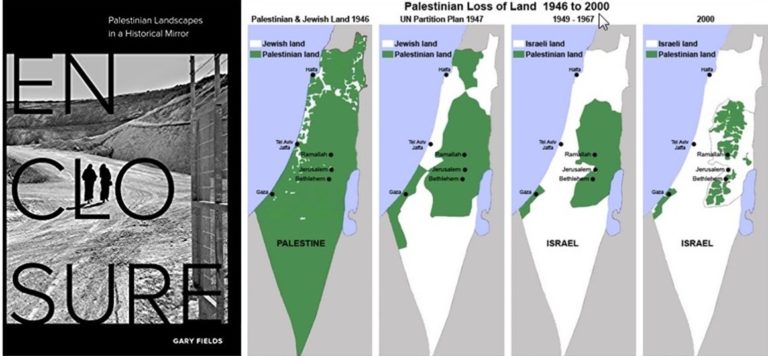
Gary Fields, ENCLOSURE: Palestinian Landscapes in a Historical Mirror (University of California Press, 2017)
Review by Robert David Steele | American Herald Tribune | April 7, 2018
This is easily a six-star work of history, political economy, human rights & atrocities, and cultural engineering.
On the one hand the author is “fair and balanced” in establishing that the enclosure of the commons and the dispossession of the freemen in the UK, and the genocide and dispossession of the Native Americans in the USA, are the antecedents for what the Zionists have done to the Palestinians. On the other hand, in a cold, rigorous, exquisitely detailed manner that integrates specific legal cases (most in violation of natural and common law), specific national policies and military actions, and specific acts of cultural and geographic “engineering” that include the re-naming of all points of the landscape, and an advanced form of archeological fraud inventing an entire history of Jewish presence out of thin air, this book is the modern equivalent of the Nuremberg Trials Prosecutor’s Handbook.
This book is a case study in occupation, dispossession, and a mix of moral, political, economic, military, and geospatial mendacity rooted in the evil practices of others, but imposed on the Palestinian people by the Zionists (not to be confused with Judaism), such that any unbiased observer can easily conclude that the Zionists have done to the Palestinians what they claim the Germans did to the Jews, easily co-equal in proportional terms to the worst of the other genocides in history from China to Russia and points south.
The book has been eleven years in the making, and the methodical, reasoned, and superbly-documented nature of this narrative easily shows the investment of time and energy and review by many others. The notes and the bibliography are extraordinary, with full credit to all who have explored and documented aspects of this long-running geospatial, ethnic, and cultural atrocity.
The core mental model of the Zionists – carefully described as identical to the core mental model of the colonial powers who considered “heathens” as non-persons – is rooted in the conception of land that is open (not enclosed) and not cultivated (never mind its organic productivity) as “vacant” and subject to claim, to cultivation, to enclosure, and therefore to EXCLUSION of those who have for hundreds of years been stewards of that same land, with documented title.
This books makes clear that the Zionist vision is rooted in five big lies and four big thefts.
Five Big Lies:
LIE #1: Palestine was “unoccupied” and consisted of “dead land.”
LIE #2: Zionists have earned, claimed, and are rightful owner of Israel not just by the contrived Balfour Declaration, itself a crime against humanity (this my opinion, the Balfour Declaration is mentioned only twice in 318 pages), but by virtue of Zionist patrimony – the cultivation of land, the building of settlements and the building of walls.
LIE #3: Every place in Palestine has a Hebrew name, with the Palestinian names that have been used for hundreds of years virtually assassinated – shades of Stalinism and historical revisionism. As Shlomo Sand has so carefully argued, Israel is an invented land, there is absolutely no basis in fact to its claims to Palestine. [It can also be said that both the Jewish and Catholic religions were invented as control mechanisms serving Caesar — I leave it to others to posit whether this might be true of other religions rooted in dogma.]
LIE #4: Every archeological site that can be found (or fabricated) is alleged to “prove” that Judaism has been deeply established across Palestine and particularly in Jerusalem, for hundreds of years. This is a lie. From allegedly serious history books to the Wikipedia comic book pages, the Zionists have fabricated history and done it so well – along with their broad ability to censor countervailing narratives – that loosely educated individuals incapable of doing primary research believe the Zionist lies about heritage sites.
LIE #5: Poor little Zionists are a beleaguered people being attacked by Palestinians who are incapable of working hard or creating new settlements and farms and so on. It is impossible to read this book without feeling the deepest sense of outrage over what the Zionists have done to the Palestinians in their ambition to “settle” Israel at any cost. It merits comment that the “Jewish state” is by definition a racist, genocidal state precisely because it excludes the Palestinians and other non-Jews, and anyone that does not “get” that is stupid or bribed or blackmailed into embracing the Zionist narrative.
Four Big Thefts:
THEFT #1: The outright seizures of land to which the Palestinians have had varied forms of hereditary title, and the use of “national security” to jump from 10% legitimate Jewish ownership to 85% Zionist control regardless of the legalities, is a theft co-equal to that of the colonial powers against the indigenous peoples of the Americas and Africa, but unique for being so concentrated and persistent, and in the Middle East.
THEFT #2: The seizure of the Negev stands as a special case and is ably documented by the book. 90% of all Palestinians living there were EVICTED, turned into REFUGEES.
THEFT #3: The seizure of the Galilee stands as a special case and is ably documented by the book. In the course of discussing THEFT #2 and THEFT #3 the author makes it clear that “cultural engineering” is a modern term for genocide. The Bedouins specifically, the Palestinians generally, have been GENOCIDED to create the “Jewish” state.
THEFT #4: Not discussed in this book but very well documented by Chuck Spinney among others, is the Zionist theft of water from the Jordanians in particular – the “miracle in the desert” is rooted in theft – very long underground pipelines violating Jordanian sovereignty and depleting the Jordanian aquifers, presumably with the complicity of the ruling family of Jordan.
The author is superb at explaining the intersection of Locke’s labor theory of value that perverted our understanding of the term – the “labor” of the indigenous is vastly more valuable because it does not destroy nature and impose what are now known as “true costs” – ecological and social costs – but by perverting the term, Locke justified the triumph of a factory and rent-seeking system of labor over the kinship and stewardship model of labor.
The true cost of Western civilization – its many benefits not-with-standing – is waste and war and the destruction of cultural, ecological, ethnic, experiential, and linguistic diversity.
I have a note about two thirds of the way through the book, after the author discusses how the Zionists decided to act outside of God’s framework: Israel in its present formation is BLASPHEMY. It is a direct violation of God’s plan and timing, it is an act of man, it is Satanic evil incarnate.
It is of great import to me to learn through the author’s scholarship that the Zionists have had a written plan for the conquest of Palestine since 1899. To achieve their goals – which I hasten to add are in my view REVERSIBLE – they have reduced the original Palestinian population of 900,000 in 1947 by 750,000 – they have genocided, through displacement if not death, 83% of the Palestinian population.
The author discusses Jerusalem, without doing what Henry Siegman and others have done, which is to say, challenged the rights of the Zionists to Jerusalem.
The author’s focus is on how the Zionists have used control of transportation to isolate the Palestinians clinging to Jerusalem, at the same time that they are building walls and using every tool they have including outright military theft of land, to eradicate the Palestinian presence in Jerusalem. In this I find the Arab leaders complicit, gutless, and culpable along with the Zionists for crimes against humanity associated with the occupation of the Holy City.
To end on a positive note, while weeping for the Zionist rape of Palestine: if President Donald Trump can unite the Koreas and denuclearize the North while eventually demilitarizing the South once the unification is completed, he can restore Palestine to the Palestinians. If there is to be a Jewish state, it must be a small Jewish state centered on Tel Aviv. From Gaza to Jericho the Palestinian nation must be restored. Jerusalem should become an international city with no Zionist military or official presence. All that is required to achieve this end is the complete cessation of US funding and support for Zionist atrocities: $30,000 a year for every man, woman, and child in Zionist Israel. ENOUGH!
Canada’s NDP Should Not Allow Dominant Media to Determine Palestine Policy
By Yves Engler | Dissident Voice | April 6, 2018
The NDP leadership’s suppression of debate on the Palestine Resolution exposed the hollow nature of its democracy. It also highlighted party insiders’ extreme deference to the dominant media.
As I detail here, the party machinery employed a variety of manoeuvres to avoid debating a Palestine Resolution unanimously endorsed by the NDP youth convention, many outside groups and over 25 riding associations. Far and away the most widely backed foreign policy resolution at the party’s recent convention, it mostly restated official Canadian policy, except that it calls for “banning settlement products from Canadian markets, and using other forms of diplomatic and economic pressure to end the occupation.”
The suppression of the Palestine Resolution wasn’t an anomaly or based on arcane policy disagreement, as party apparatchiks have repeatedly claimed since the convention. For two decades the party machinery has put Palestine resolutions sponsored by the Socialist Caucus and submitted to conventions by different riding associations at the bottom of the priority list, which means they are not discussed at the convention. During more recent conventions a broad range of internationalist minded party activists have come close to rallying a sufficient number of delegates to overturn the de-prioritization of Palestine solidarity resolutions at poorly publicized sessions before the main plenary. According to the Socialist Caucus website, at the 2011 convention “delegates at the foreign policy priorities panel succeeded in moving the Canadian Boat to Gaza resolution from very low on the list up to #2 position. But minutes before we could vote on approval of the content of the resolution, party officials herded 30 to 40 MPs and staff into the room to vote it down.”
In another authoritarian anti-Palestinian move, during the 2015 federal election the NDP responded to Conservative party pressure by ousting as many as eight individuals from running or contesting nominations to be candidates because they defended Palestinian rights on social media. In the most high profile incident, Morgan Wheeldon was dismissed as the party’s candidate in a Nova Scotia riding because he accused Israel of committing war crimes in Gaza, when it killed 2,200 mostly civilians in the summer of 2014.
Ousting a candidate elected by a riding association or suppressing debate on a widely endorsed resolution are stark examples of anti-Palestinian authoritarianism. But, a simple look at the polls highlights the party leadership’s democratic deficit on the subject. According to a 2017 poll, most NDP members have a negative or very negative view of the Israeli government and believe Canada is biased towards Israel. Even without the party taking up the issue, the Ekos poll of 1,000 Canadians found that 84% of NDP members are open to sanctioning Israel and 92% thought the Palestinian call for a boycott was reasonable.
No issue better highlights the divide between members’ wishes and leadership actions. In short, the Palestine question symbolizes the weakness of NDP internal democracy.
Various historic and current ties between the party brass and Israel lobby groups contributed to their suppressing debate on the Palestine Resolution, but while important, these relations aren’t the defining factor. Nor, is the party leadership’s hostility to members’ wishes on Palestine primarily ideological. Unlike his predecessor, party leader Jagmeet Singh isn’t anti-Palestinian. Rather, he is an ambitious politician operating in an anti-Palestinian political culture.
The main force driving the suppression of debate on the Palestine Resolution was fear of mainstream media backlash. Party leaders believe (correctly) that the Palestine Resolution’s call for a ban on settlement products, which after a half-century of illegal occupation should be entirely uncontroversial, would elicit a corporate media backlash. Additionally, they are right to fear the dominant media’s capacity to shape attitudes, especially on issues far removed from people’s daily concerns.
The dominant media can also be cynically manipulative. On the eve of the convention the Globe and Mail, probably at the prodding of the Centre for Israel and Jewish Affairs, published a story linking planned speaker Tamika Mallory to Louis Farrakhan. The story was titled “Supporter of homophobic, anti-Semitic U.S. religious leader to speak at NDP convention.” Even though Mallory was to speak as an organizer of last year’s Women’s March in Washington, half the story was about Palestine resolutions, which Mallory had nothing to do with. In fact, the convention organizers who invited her to speak confusingly renamed, deprioritized and then blocked the Palestine Resolution from being debated. To add insult to injury, most Palestine Resolution proponents would have preferred fewer convention speakers to give members more time to debate/determine party policy.
Electorally focused NDP leaders are right to fear media backlash for challenging Canada’s anti-Palestinian status quo. But, at some point members need to ask themselves why devote time, money, votes, etc. to a social democratic party, especially at a level where they’ve never formed government, if it is unwilling to push the parameters of official debate to the left? While those receiving a salary from the organization may feel differently, expanding the range of ‘politically acceptable’ discussion is a central reason for a third party’s existence.
And really, why be scared of the big bad media wolf? NDP provincial governments have legislated substantial social gains despite media-generated hysteria. The media decried the introduction of the Agricultural Land Reserve in B.C., public auto insurance in Manitoba and the party’s crowning glory, Medicare. Big media bitterly denounced the party when it implemented Medicare in Saskatchewan in 1962. During the 23-day-long doctors’ strike in response to Medicare, the Moose Jaw Times Herald ran editorials headlined: “Ugly Image of Dictators”, “Neutrality Never Won Any Fight For Freedom”, “Legal Profession Next to be Socialized” and “The Day That Freedom Died In Saskatchewan”. That editorial claimed “the people of Saskatchewan are now awakening and find that their province has been slowly, and in recent months much more rapidly, transformed from a free democracy into a totalitarian state, ruled by men drunk with power.”
In fact, the dominant media has condemned almost every progressive policy implemented by the left in the world over the past two centuries, from public schools, to banning child labour, pensions, shorter work days, daycare and more.
Leaving aside the abandonment of real left wing policy at the core of the NDP’s ‘avoid media backlash at all costs’, this may not even be the best short-term electoral strategy. The media has vilified leftist (pro-Palestinian) Labour party leader Jeremy Corbyn, but he is well placed to be the next Prime Minister of Britain. On a lesser scale a similar dynamic is at play with Bernie Sanders in the US.
On the specific question of the NDP’s challenge to Canadian complicity in Palestinian dispossession, the growth of online news and global television stations makes it easier than ever — if the party cared to try — to defend critical positions. Additionally, the long-standing nature of the conflict, the growing number of Canadians from countries more sympathetic to Palestinians and decades of solidarity activism on the subject, mean there are many politically active people who are yearning for a challenge to the Liberal/Conservative status quo. They are likely to be galvanized by media attacks.
NDP Palestine policy offers a sort of barometer by which to evaluate the party’s commitment to democracy and social justice. Right now the forecast doesn’t look good.
Yves Engler is the author of A Propaganda System: How Canada’s Government, Corporations, Media and Academia Sell War and Canada in Africa: 300 Years of Aid and Exploitation .
Journalist shot in abdomen by Israel sniper on Gaza border

MEMO | April 6, 2018
A Palestinian video journalist and photographer who had just been contracted to work with MEMO has been hospitalised after being shot by Israeli sniper fire today while covering The Great March of Return near Gaza’s eastern border.
Though wearing a vest marked ‘PRESS’, Yaser Murtaja, co-founder of Ain Media production company, was shot in the abdomen by Israeli snipers perched on a hilltop on Gaza’s border.
Israeli sniper shoots journalist on #Gaza border and now he is in the operation room in hospital. pic.twitter.com/m3Pw21SWRK
— Ahmad Samaan🇵🇸 (@ahmadsaman7) April 6, 2018
Ain Media, which is made up of a dozen Palestinian media professionals, has been covering the events taking place near Gaza’s border with Israel since Friday. In the past, the team have produced work for Al Jazeera Documentaries, BBC Arabic, VICE, Alaraby TV, UNICEF, UNRWA and Oxfam amongst others.
In an interview with MEMO earlier this month, Yaser said that his passion for filming and photography was born out of his desire to document the events taking place in the besieged Gaza Strip and to do what he could to help shed light on the reality of life in Gaza and the plight of fellow countrymen under occupation and blockade.
At least 23 Palestinians have been killed by Israeli forces in Gaza and more than 1,500 others wounded during the Great March of Return, a six-week demonstration and sit-in which started last Friday to mark Palestine Land Day and is calling for the implementation of the Right of Return.

Palestinians come together near Gaza’s eastern border for ‘The Great March of Return’
Demonstrators are demanding that Palestinian refugees be granted their right to return to their towns and villages in historical Palestine, from which they were driven in 1948 to make way for the state of Israel.
In the run-up to the mass demonstrations last week Israel deployed thousands of troops on the border, threatening to use live ammunition against anyone who threatened Israel’s “security infrastructure”.
West Uses Skripal Row to Boot Russia From Syrian Chemical Weapons Issue – Moscow
Sputnik – 04.04.2018
Blaming Skripal’s poisoning on Moscow, Western states are trying to push Russia aside from discussion of cases of chemical weapons usage in Syria, according to the Russian Foreign Ministry’s spokeswoman.
On Issue of Chemical Weapons
Ministry spokeswoman Maria Zakharova noted that chemical weapons remain a key issue in the decision-making process for all countries, as the legitimacy of Bashar Assad’s power in Syria is always being linked to it by Western countries and the US-led coalition.
“Before, we were told that Assad just had to leave, because he was bad but then this concept was abandoned. Now they say that he is bad and must leave because he violates international law using chemical weapons in Syria,” she said.
The representative went on saying that the West is trying to play the same card in the current row over Skripal’s poisoning.
“Thus, inventing the story about the alleged use of chemical weapons by Russia on British soil, Western countries are trying to push Russia aside from the legal field of discussion of issues pertaining to the chemical weapons in Syria. Under the pretext that there is nothing to talk about with Russia, as they claim Russia has used chemical weapons in Europe,” Zakharova added.
Earlier in the day, the British side presented its own version of why Russia proposed to convene an extraordinary session of the Organization for the Prohibition of Chemical Weapons (OPCW) Council. According to the UK permament representative to the OPCW John Foggo, Russia wants to use the organization’s meeting scheduled for April 4, the date on which a year ago a chemical attack in Syria’s Khan Sheikhoun took place, in order to make a political statement.
“For all of us gathered here, it is very sad to admit that chemical weapons attacks continue not only in Syria. Today marks exactly one month since the usage of the nerve agent here in Europe,” he said.
After the alleged use of chemical weapons in Syria’s Eastern Ghouta in January, US Secretary of State Rex Tillerson accused Damascus of using chemical weapons and also claimed that Russia was responsible for the victims because of its engagement in Syria.
The Russian Foreign Ministry back then said that Washington was spreading propaganda against Moscow in an attempt to demonize the Syrian government and subsequently topple it, underscoring that the information on the chemical attacks used by the United States was uncorroborated.
In October 2017, the OPCW report alleged that the Syrian government was responsible for the April 4 sarin attack on the Syrian city of Khan Sheikhoun, claiming that the nerve gas used during the attack had been taken from stockpiles belonging to the Syrian government. However, the latter was destroyed as part of a 2013 deal with the US and Russia — a process the OPCW itself signed off on as having been completed that November.
Damascus has constantly denied being in possession of chemical weapons, the destruction of which had been confirmed by the OPCW.
On Russian Media
Russia would like to receive clarifications from the US State Department after accounts of Russian media outlets were blocked on Facebook, Russian Foreign Ministry spokeswoman said.
“We expect an official reaction to this situation from US authorities … we would very much like to hear official comments from the US State Department,” she told a briefing.
She called on Facebook to specify its issues with Russian media accounts and explain reasons behind its decision to block them.
On Tuesday, Russia’s Federal News Agency (FAN) said that Facebook had blocked its official page without any warning. Also on Tuesday, Facebook CEO Mark Zuckerberg said that the company blocked more than 270 accounts and pages run by Russia’s Internet Research Agency.
On Russian Vessel Detained in Ukraine
Moscow summoned the Ukrainian temporary charge d’affaires in Russia on Wednesday to protest the detention of a Russian ship and to demand the release of its crew as well as the return of the vessel, the Russian Foreign Ministry said.
“On April 3, the charge d’affaires ad interim of Ukraine in the Russian Federation was summoned to the Russian Foreign Ministry where he was handed a protest note in connection with the illegal detention of Russian fishing vessel Nord by the Ukrainian Border Guard Service on March 25 in the Sea of Azov, the transfer of the vessel to the port of Berdyansk and illegal custody of its 10 Russian crew members,” spokeswoman Maria Zakharova noted.
According to Zakharova, Moscow demanded the immediate release of the illegally detained crew and the return of the vessel to its legitimate owner.
On March 26, Ukrainian border guards detained the Russian ship Nord, claiming that its crew had violated the sea border. The Russian Foreign Ministry demands the Ukrainian side to return the captured ship, which is in the Ukrainian port of Berdyansk, and to release the crew.
READ MORE:
Russia’s Offer for Joint Probe Into Skripal Case ‘Perverse’ – UK OPCW Delegation
Russia Concerned, Outraged Over US Claims on Attacking Syria — Moscow
Facebook, Instagram Delete Dozens of Russia-Linked Accounts
Russian Navy Disproves Dangerous Manoeuveres between Russian and UK Vessels
Never mind Facebook, Google is the all-seeing ‘big brother’ you should know about
RT | March 30, 2018
The Cambridge Analytica scandal put Facebook through the wringer in recent weeks, losing the company $100 billion in stock value and prompting a global debate on internet privacy.
The social media giant was forced to apologize and overhaul its privacy and data sharing practices, but it still remains in the media spotlight and in the crosshairs of the Federal Trade Commission, which says it may be liable for hundreds of millions of dollars worth of fines.
But amid all the furor, one monolithic entity has continued to harvest data from billions of people worldwide. The data gathered includes a precise log of your every move and every internet search you’ve ever made, every email you’ve ever sent, your workout routine, your favourite food, and every photo you’ve ever taken. And you have allowed it to happen to yourself, for the sake of better service and more relevant advertising.
Google is a ‘Big Brother’ with capabilities beyond George Orwell’s wildest nightmares. These capabilities are all the more chilling after Google’s parent company, Alphabet Inc., cut its famous “don’t be evil” line from its code of conduct in 2015.
Everything you’ve ever searched for on any of your devices is recorded and stored by Google. It’s done to better predict your future searches and speed up and streamline your browsing. You can clear your search history, but it only works for that particular device. Google still keeps a record of everything. Click here to see everything you’ve ever searched on a Google device.
The same goes for every app and extension you use. If it’s connected to Google, your data is stored. That means that your Facebook messages are not only farmed out to companies like Cambridge Analytica, Google also has them from the Facebook app you use.
YouTube, which is a Google subsidiary, also stores a history of every video you watch. It will know if you’ve listened to Linkin Park’s ‘In the End’ 3,569 times, or watched hours of flat-earth conspiracy theory videos.
Likewise, any file you’ve ever stored on Google Drive, any Google Calendar event you’ve attended, any photo you’ve stored on Google Photos, and every email you’ve ever sent are all stored. You can access a copy of all of this data by requesting a link from Google here.
Perhaps what hits home the hardest, though, is that Google keeps track of where you are and how you got there, at all times. If you have a smartphone, there’s a good chance it runs the Android operating system, considering Android phones account for 82 percent of the global market share. That’s over 2 billion monthly active users.
And, unless you’ve disabled this feature, clicking here will show you a list of every journey you’ve ever made with your phone, including an estimate of how you traveled there. If you’re back and forth between work and home at the same time every day, Google knows this is your commute. That heavy traffic warning Google maps gives you on your drive home; Google knows there’s a traffic jam because it knows that every Android phone in every car is moving slower than they usually do at that time of day.
Google doesn’t do this behind your back. On a desktop, Google Chrome allows sites to access your computer’s camera and microphone by default. On a smartphone, agreeing to an app’s terms of service allows the app to do nearly anything, from accessing your phone’s camera and location, to recording your calls and log your messages. The Facebook app, for example, requires 44 such permissions.
It is possible to opt out of most of Google’s tracking – including search history, location timeline and targeted advertising – but it takes a bit of rooting around in settings menus, and you have to know about the option first. And of course, Google says it’s not associating the data with you, as a person – instead, it’s linked to your “advertising ID,” and never shared unless you want it to be. Or unless a government requests that Google hands it over – which US government agencies alone have done almost 17,000 times in just the first half of 2017, with over 80 percent of requests fulfilled, at least to some extent.
Dutch vote to reject ‘Big Brother’ legislation expanding surveillance powers of security agencies
RT | March 29, 2018
The Dutch population does not want security agencies to receive more surveillance powers, official results of the referendum showed. Although only advisory, the vote sends a strong signal to the government pushing for the law.
The Electoral Council said 49.4 percent of the voters spoke out against the Intelligence and Security Law during the March 21 referendum. The legislation was supported by 46.5 percent, with four percent of those participating casting blank ballots, it added.
The addition of the law on the ballot boosted voter turnout to almost 52 percent, far exceeding the minimum turnout of 30 percent required for a plebiscite to be declared valid.
The new legislation, which the opponents dubbed the ‘Big Data Law,’ or data mining law, provides additional powers to the General Intelligence and Security Service (AIVD) and the Military Intelligence and Security Service (MIVD).
Among other things, it would allow the country’s two security agencies to tap telephone and internet traffic on a large scale, which would include reaching an alleged perpetrator by hacking devices of those not under suspicion.
The data obtained through such surveillance would be stored for up to three years, and the AIVD and the MIVD would be granted the right to share this information with foreign colleagues, even without performing any preliminary analysis themselves. The law would also enable the Dutch security agencies to store DNA material for people.
The legislation has already been approved by the government and was set to go into effect on May 1. The referendum was non-binding and the Dutch ministers have the right to ignore the public concerns, leaving the legislation unchanged. However, they would still have to revisit the legislation and debate it once again next month.
Dutch Interior minister Kajsa Ollongren said on Thursday that the cabinet wanted “to do justice” by the referendum and that the Intelligence and Security Law will be re-evaluated carefully and in the shortest time possible, NOS reported.
Last week, Prime Minister Mark Rutte also promised that the legislation will be revised, but refrained from providing any specifics.
Back in 2014, when the Dutch voted against approving the Association Agreement between the European Union and Ukraine, authorities in the Netherlands opted to secure an additional agreement between the 28 EU member-states, which it said addressed the concerns of the no-voters. However, it did not change the wording of the EU-Ukraine association agreement in any way as it was passed by the Dutch authorities.
Jeremy, Get on your Knees!
By Gilad Atzmon | March 29, 2018
In their response to Labour leader Jeremy Corbyn, the Jewish Leadership Council (JLC) and the Board of Deputies of British Jews (BOD) claim to ‘propose an agenda of actions for discussion’ between the Labour party and those who claim to ‘represent’ British Jews.
In practice the two Zionist institutions have managed to produce one of the most disgusting documents in modern Jewish history. A text that is little more than an ode to the self-defamation of its own authors and to the community they claim to ‘represent’: it is rude, authoritarian, and disrespectful to a democratically elected leader of Europe’s biggest party.
Read the BOD/JLC’s public address to Corbyn here
When you read some of the extracts below, remember that despite BOD and the JLC claims to ‘represent’ British Jewry, these two organisations managed to pull just 1500 members of their community into their ‘Enough is Enough’ anti-Corbyn demonstration earlier this week. We are talking about 0.5% of British Jewry. The BOD/JLC’s authoritarian document outlines a set of humiliating conditions for Corbyn to meet. The text proves how detached these Jewish institutions are from British values, specifically, and the Western ethos, in general. In fact their vision of the political arena is Orwellian in nature and tyrannical in practice.
Apparently, if Corbyn expects to meet with the demands of these self-appointed ‘Jewish leaders’ he must appoint a watchdog who will take care of the so called ‘antisemites’ in his party and, of course, under the supervision of these two ardent Zionist bodies. He must also meet a strict time-frame defined by Judea.
“Outstanding and future cases (of alleged antisemitism) are to be brought to a swift conclusion under a fixed timescale. An independent, mutually agreed upon ombudsman should be appointed to oversee performance, reporting to the Party, as well as to the Board of Deputies and the Jewish Leadership Council.”
Consistent with the spirit of Talmudic herem (excommunication) and totally in contradiction to notions of British openness and Western tolerance, these Jewish institutions insist that “MPs, councillors, and other party members should not share platforms with people who have been suspended or expelled for antisemitism and CLPs should not provide them with a platform.” The Jewish institutions also suggest how to penalise the sinners. “Anybody doing so should, themselves, be suspended from membership; in the case of MPs, they should lose the party whip.” Maybe someone should make the effort to explain to the Jewish leaders that the labour party is an established political institution. It is not a ghetto, I mean, not as yet.
The Jewish bodies insist on dominating the language as well as boundaries of political discussion. Criticism of Israel should be completely restricted. The words ‘Zio’ and ‘Zionist’ as terms of abuse should be eradicated. I actually believe that if the BOD/JLC truly wanted ‘Zionist’ to not be used as a ‘term of abuse,’ they should simply stop abusing Corbyn in the name of Zion as their first step forward.
The British Jewish ‘leaders’ clearly know how to distinguish between the ‘good Jews’ and the bad ones. Corbyn is told to “engage with the Jewish community via its main representative groups, and not through fringe organisations who wish to obstruct the Party’s efforts to tackle antisemitism.” And I wonder, how exactly the BOD or the JLC are ‘representatives’ of British Jews. When were they elected and by whom? And if these two organisations are ‘representative of British Jews,’ how is it that they so selectively call upon Labour to ignore the voice of Jewish collectives they don’t agree with?
The Jewish institutions talk at Corbyn as if he is a schoolboy. “These changes must be sustained and enduring.” Corbyn better quickly meet the Zionist demands before a meeting with The Lobby can materialise. “We firmly believe that this must happen urgently, and certainly before we meet.”
The BOD and the JLC express hope in starting a process of “constructive anti-racist” work within the Labour Party. Talking about racism, we better hear from both the BOD and the JLC how many Muslims and Blacks are members of their executive boards. I ask because, unlike those ‘Jews only’ institutions, the Labour party is, actually, a multi-ethnic and multi-racial political body. If Jewish institutions want to counter racism, they are more than welcome to do so. The racist ‘Jewish State’ is where they should start.
Featured Video
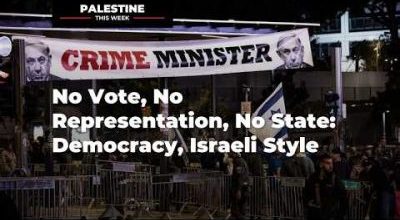
No Vote, No Representation, No State: Democracy, Israeli Style
or go to
Aletho News Archives – Video-Images
From the Archives
Sanctions, War and the Policy of Dual Containment
By SASAN FAYAZMANESH | March 17, 2008
It is now nearly three decades since the Unites States adopted the policy of dual containment of Iran and Iraq. While much has been written about the containment of Iraq, there has been very little in-depth analysis of this policy when it comes to Iran. In a book that is going to be released on March 31, 2008, entitled The United States and Iran: Sanctions, Wars and the Policy of Dual Containment (Routledge), I attempt to address this shortcoming by investigating when and why the US policy of containment of Iran came about, how it evolved, and where it stands today.[1] To the extent that Israel has been involved in US policy making, the study will also include the role that Israel has played in the containment of Iran. Also, since the fate of Iran has been inextricably linked to that of Iraq, occasionally the investigation will overlap with the containment of Iraq.
The policy of dual containment of Iran and Iraq originated during the Carter Administration, but it was not until the Clinton Administration that the expression “dual containment” became popular. … continue
Blog Roll
 Aletho News
- No Vote, No Representation, No State: Democracy, Israeli Style
- Zionist Bought Senate Blocks Information About American Citizens Killed By Israel
- While Gaza dominates the UN, these are the people keeping it alive
- New Report: “Scholasticide and Genocide in Gaza: Assessment, Testimonies and Legal Analysis”
- ‘THAAD Delusion’: Iran war exposes US missile shield limits – The Atlantic
- Moscow issues warning to NATO over Russian exclave
- Yes, the Iran war has destroyed Trump’s presidency
- The fallacy of US delusions about Iran’s economic collapse
- Hezbollah denies Syria cell link, warns of Israeli plan to sow discord
- The legacy of US sanctions, war, and occupation in Iraq
- If Americans Knew
- Mamdani releases plan to combat antisemitism and hate crimes in New York City
- Iran’s Revolutionary Guards Publish Letter to the American People
- DMFI launches $1 million ad campaign supporting Virginia’s Elaine Luria
- US Senate blocks resolution seeking report on Americans killed by Israel
- Israeli Attacks Kill Ten Palestinians in Gaza
- Massacre at Minab: The School That Became a Grave
- Israeli media: The IDF Shows It Doesn’t Turn a Blind Eye; It Actively Emboldens Settler Havoc
- As settlers ravage West Bank, Israeli forces kill 10 in Gaza – Daily Update
- New Report: “Scholasticide and Genocide in Gaza: Assessment, Testimonies and Legal Analysis”
- Ex-Biden officials are desperate for a Gaza scapegoat
- No Tricks Zone
- Green Energy Debacle: German Expert Professor Fritz Vahrenholt Warns Of Severe Economic And Social Consequences
- Two More Paleo Reconstructions Affirm Meters-Higher Sea Levels Across Ireland, Brazil 7000-6000 Years Ago
- New Study: Earth And Venus Surface Warmth Largely Explained By Convection And Lapse Rate, Not CO2 Or Radiation
- 2025 Nature Paper Claiming Worsening Global Drought Gets RETRACTED …Heavily Flawed
- New Study: ‘Global Drought Shows No Detectable Recent Acceleration Under Climate Warming’
- Economic Masterminds: German Socialists Suggest Taxing Productivity Gains Stemming From Using AI
- The South China Sea Has Not Been Cooperating With The Climate Change Narrative
- Energy Crisis: Germany Enters Heating Season With Historically Low Gas Reserve Fill Levels
- New Study: The Antarctic Ice Sheet Gained Mass From 2020-2024 Due To Staggering Snow And Ice Accumulation
- Study: Ocean Heating Rates From Thousands Of Years Ago ‘Dwarf’ Modern Ocean Heating Rates

