The (Criminal?) Subversion of the Academy in the Case Against Professor Anthony Hall
Power Against the Quest for Truth

Professor Anthony Hall. Image credit: The Lethbridge Herald
By Robin Mathews | American Herald Tribune | September 15, 2017
In “the civilized and democratic Western World” a huge battle is in process to control information, belief, understanding, ‘credible knowledge’, and the (real or contrived) ‘facts’ people hold to be true. The process involves a major activity of indoctrination – constant and on-going – towards the acceptance of an increasingly ‘top down’, undemocratic form of rule. The indoctrination does not just involve language as we (think we) know it but it involves a purposeful shaping and reshaping of language influenced by both action and inaction in the ‘public’ world.
The shaping of ‘the (apparently) real’ through language is darkly affected by action in society … and the failure of action. If Criminal Conspiracy – for instance – happens openly and observably and the State will not call it Criminal Conspiracy the real begins to become inauthentic and the language surrounding it begins to weaken. Criminal Conspiracy, just for instance, begins to possess a kind of non-existence although it really happens and really exists in law ….
In Canada (2015-2016), for instance, thirty-one criminal charges (put in place by the Canadian “Crown”) were levied against a controversial Senator in Canada’s “Upper Chamber” as part, many believe, of a huge campaign to indoctrinate Canadians about the (false) integrity of the people in power. The criminal charges were all (every last one!) thrown out by a judge of the Ontario Court of Justice with plain expression of his alarm at those conspiring to force actions upon the innocent Senator.
The judge gave every indication (without saying it outright) that Senator Duffy had been criminally conspired against. No criminal investigation, however, has been conducted against those conspiring and no criminal charges have been laid. None are expected. The Liberal government that has followed the Conservative government led by Stephen Harper (which undertook the unseemly set of actions against Senator Duffy) seems very clearly to be demonstrating that it doesn’t disapprove of criminal actions taken to indoctrinate the Canadian public.
The process of working at highest levels of government, of corporations, and the so-called Mainstream Press and Media to indoctrinate and condition the population to prescribed, false beliefs in a total or ‘totalitarian’ manner (‘as if exerted by a single force permitting no dissenting view’) is pervasive in almost all of ‘the civilized and democratic Western World’. The process is clearly intended to impose false views of reality upon whole, unsuspecting populations.
One of the significant, recent (in history) very successful (on-going) falsifications is described by Lance deHaven Smith in his book (2012) Conspiracy Theory in America. There deHaven Smith points out that the criticism of the Warren Commission inquiry into the assassination (1963) of John F. Kennedy was becoming so effective [the Commission and its ‘findings’ are now considered by many to be without any credibility] that the CIA set to work with surprising effectiveness to slander as “conspiracy theory” criticism of any spurious and/or fraudulent government or intelligence or police activity … and to designate that criticism as the product of cranks, imposters, and/or other wholly irresponsible rumour-mongers.
The CIA was so successful that the phrase “conspiracy theorist” has been lodged in the minds of a large population as a term indicating someone making fraudulent claims instead of someone pointing to possible unacceptable action taken by those in power. (Anthony Hall is accused – among other things – of being a conspiracy theorist.)
Since the Warren Commission (1963-1964) conspiracies against the “democratic” populations of the West have increased and grown in size. The falsification of evidence, supported by George W. Bush, U.S. president, and Tony Blair, British prime minister, in order to permit the invasions of Afghanistan and Iraq – just for instance – are now common knowledge (and both continue their lives untroubled by legal actions). Those wars, without naming related others, are resulting (still) in enormous destruction, death, and devastation of community.
Other egregious falsifications of actions and events by governments are not common knowledge – in fact are disputed by every device of modern misinformation. The Afghanistan and Iraq invasions (2001 and 2003) are both connected to the enormous (2001) alleged False Flag operation to destroy three Trade Tower buildings in New York – which operation had very quickly attached to it an official version which, today, lies in tatters but is still forcefully maintained by all the Western governments. [As I write, 79 year old, former CIA agent Malcolm Howard – given only weeks to live – has reported that he was involved in the “controlled demolition” of the building called World Trade Centre #7.]
The growing library of works rejecting the official version is becoming immense. Professor Anthony Hall – as a scholar seeking the truth about official allegations against non-white (so-called) terrorists in the matter – is named as a Conspiracy Theorist partly because he has engaged in denial of the official 9/11 accounts and has considered the allegation that Israeli interests may have been deeply involved in 9/11.
To entertain that possibility is not necessarily to be opposed to the State of Israel – and it is clearly not evidence of anti-Semitism. But those claiming or asking if the Israeli State had a part in 9/11 are immediately under threat of being charged with anti-Semitism. Part of the basis for naming Professor Hall an anti-Semite lies in his on-going concern, as a broadcaster, with The False Flag Weekly News and with the on-going researches being undertaken on the causes of what is called 9/11.
The nature of scholarly endeavour is very frequently to reconsider accepted explanations of events … to re-configure “history”, and/or to offer new analyses of forces at work. Anthony Hall does those things in his two large scholarly volumes dedicated to the history of the displacement and erasure of indigenous peoples … and the developing Imperial Globalization accompanying their (on-going) oppression since 1492.
A criminal conspiracy was almost certainly entered into in order to attempt the destruction of Senator Mike Duffy. A much wider conspiracy is, I believe, in play to destroy Professor Anthony Hall of the University of Lethbridge. In the briefest terms there seem to be four more-or-less invisible global forces at work (and in conflict) which very likely have shaped the personnel and the nature of (what I call) the conspiracy against Professor Hall.
One is the view of Germany from 1930 to 1945. Another is the shifting view of the State of Israel at the present. Another – which has already been referred to – is the problem of False Flag events, the dishonesty involved in them, and the official explanations of them. The fourth is the role of universities in the examination of truth and the conflicts engendered when questionable or fraudulent ideas are held and championed by powerful forces in or connected to the university which – almost of necessity – come into contact with ‘truth seekers’ in universities … working in the traditional environment of “academic freedom”: freedom to inquire, to seek clear answers, and to speak freely without fear of censure or repression about findings.
A generally held view of Germany from the 1930s to 1945 has been one that believes the emergence of Adolf Hitler and the Nazi Party took Germany on a path of increasing brutality and social violence, and that the path seemed to be approved by the larger population. The “SS State” is thought to have enslaved, starved, tortured, murdered and otherwise destroyed “enemy” people: Jews, Slavs, political dissidents, gypsies, gays, etc. Moreover, it is said to have conducted what is now called The Holocaust: the active process of exterminating all Jews – ‘the final solution’.
Over the years since 1945 voices have been raised to challenge that view or aspects of it. On a video made recently by the Committee for the Open Debate of the Holocaust Professor Hall is asked if he approves of the work of the Committee. He replies there that he approves of open debate on all subjects and accepted truths. He has said, also, that he has been reading more recent materials on Germany from 1930 to 1945 that are making him re-think some of his ideas.
In short, the ‘truth’ about Germany from 1930 to 1945 is being reviewed and reassessed. Many Germans – often children and grandchildren of the adult members of the German community in those years – are seeking a re-examination and a reassessment of the “accepted” view, to provide, perhaps, a view of a much less brutal and single-minded State and population. Where the truth lies is in contest.
The accepted view of Israel in the West is of an unfairly punished people who have gained a homeland and are building a new society on sovereign territory. It is a people viewed not only as having been brutally oppressed and punished for their identity by Nazi power, but rejected and demeaned by many so-called democratic populations. That view has never been globally consented to partly because of the dispute about Israel’s legitimacy (“on Palestinian land”) held in parts of the Middle East.
As the State of Israel appears to become more warlike, oppressive of Palestinians, and greedy for the possession of territory, (the last condemned by the United Nations), the feeling for brutally mistreated Jewish people of the past does not diminish. But alarm at what is thought by some to be oppressive policies and actions of the Israeli State has created a body of people sharply critical of that State’s policies and actions – especially in relation to Palestine and the Palestinians.
That sentiment comes into sharp conflict with the efforts of at least a part of the Israeli State to equate itself with Jewish identity – and so with the attempt to equate criticism of the actions of the Israeli State with anti-Semitism.
Needless to say, in that context, any mitigation of the view of a ruthless, inhumane, and anti-Semitic Germany from 1930 to 1945 probably offends some in the State of Israel and its closest supporting organizations outside Israel. They seem to see the necessity of a consenting global community about the persecution of the Jews in order to have the global community accept Israeli State policies, however offensive. If the Nazi regime was not as viciously brutal to Jews as some sources wish it to be seen to have been, (and as it may have been) then sympathy for the State of Israel might diminish.
In the playing out of the astonishing (and growing) scholarship concerning what might be called the (alleged) false information disseminated by governments to explain extraordinary, violent, and/or visibly brutal events in the community, claims are made that ‘government’ and/or related forces create many of the violent events to condition the population to be fearful and so to accept increasingly fascist rule, and/or to believe the government-created violence is the act of the enemy (whichever ‘foreigners’, religion, or State the government wishes the people of the country to learn to hate). The work undertaken by serious and reputable investigators to reveal and to prove that governments (or their proxies) create random terrorist acts – or what are called “False Flag Events” – has grown to sizable and convincing proportions. Indeed, the growing “False Flag Investigative Industry” suggests a growing field of government criminal acts disguised as the random, insane, or purposefully effected acts of “enemies” (or those that governments wish to convince their populations are enemies).
Professor Hall has engaged actively in “False Flag” inquiry and is a co-host of the weekly program (on the net) called The False Flag Weekly News in which recent (and suspected) manifestations of False Flag activity are tabled and discussed. Among the False Flag theories in play, one concerns the truth of the collapsed Trade Towers of 9/11 and who (if the official story is incorrect) was responsible for the attack. One theory (not by any means the only one) is that a major participant in the event may have represented the interests of the State of Israel or may have been, in fact, an arm of the State of Israel.
Professor Anthony Hall has encouraged open questioning of the standard view of Germany between 1930 and 1945 (without saying he believes the standard view is wrong). He has engaged in open discussion of the False Flag phenomenon and its relation to government and government policy. He has been willing to consider the possibility of Israeli involvement in 9/11 – the destruction of the Trade Towers in New York on September 11, 2001. He has exercised academic freedom and democratic ‘freedom of speech’ in those matters as well as others that have fallen within the scope of his research.
On August 26, 2016 a vicious anti-Semitic cartoon was posted on Professor Hall’s Facebook page when he was not in Canada. He was unaware of the posting, and of its removal – all happening in a period of several hours. And he was unaware of actions being taken over the next days against him as a guilty party wishing to defame and asperse Jews … by means of what (the posted cartoon, used as evidence) can easily be called Hate Literature.
He was unaware of all that went on … because he didn’t post the obnoxious cartoon and didn’t even know of its posting … and because the President of the University of Lethbridge, Mike Mahon, who was informed as soon as the next day and who entered into discussion with accusers of Professor Hall (and with others) over succeeding days did nothing whatever to make contact with Professor Hall, his colleague, and to test Hall’s reactions to news of the posting.
In the minds of many people the behaviour of president Mahon may well suggest he wanted to believe the accusers of Professor Hall and did not want to have to entertain the possibility that his senior colleague and twenty-six year member of the scholarly community of University of Lethbridge did not post … and had nothing to do with the posting … of the slanderous and hateful cartoon.
Some observations may be made about the conduct of President Mahon. One I derive from my own wide experience on every major campus in Canada (see “Canadianization Movement”,Wikipedia) where I consulted, variously, with student, faculty, and administrative personnel. The first observation is to note the failure of the President of the University of Lethbridge to respect collegial relations and to consult early with Professor Hall, simply as a colleague – and to gain absolutely necessary information about the incident. Secondly, one must observe President Mahon’s rejection of the demands of natural justice which would require him as President to consult and to inform (at the earliest possible moment) anyone at U. of Lethbridge whose reputation and livelihood were in peril by growing accusations (untested). Failing grossly on those two matters suggests, to me, that President Mahon might well appear to fair-minded people to have been astonishingly incompetent as a professional and as a human being in his treatment of the very serious allegations brought against Professor Hall.
An even more serious allegation may lie in another observation: President Mahon (growing evidence reveals) apparently consulted with some of the false accusers of Professor Hall, sat with committees of so-called investigators, and formulated punitive measures to take against Professor Hall without having asked to meet and speak with Professor Hall. That behaviour on the President’s part may well point to his participation in a Conspiracy to do irreparable harm to Professor Hall. A Conspiracy very strongly appears to have been undertaken against Senator Mike Duffy … as I have said … but a worse one may well have been undertaken against Professor Anthony Hall.
Though Professor Hall knew nothing about the vile cartoon posted on his Facebook Page, B’nai Brith Canada personnel and sympathizers knew about it very quickly. In very short order they – or a collaborator – informed the president of the University of Lethbridge, the Premier of the province of Alberta, the Solicitor General, and the Minister of Education of the province. Replies were returned to the person giving false information with what I call astonishing speed. In my experience of writing to top government figures I can provide witness that the average Canadian is not responded to with that alacrity. Who, then, could write to the Premier of Alberta and members of cabinet (conveying false information to them) and receive such speedy and sympathetic response? The name of that person is being (for some inexplicable reason) kept from inquirers by the Alberta government. What is the Alberta government hiding … what does the government of Alberta fear??
In a truly astonishing letter written to President Mike Mahon and sent to others like Premier Rachel Notley on September 1, 2016, Bert Raphael, Q.C., LSM, President of the Canadian Jewish Rights Association quotes the whole of the unsavoury text posted on Professor Hall’s Facebook Page. And he finishes his letter (a Queen’s Counsel assuming guilt with the rashness of a school boy) with the following paragraph:
“I trust you agree that such a statement has no place in Canada and most certainly from the lips of a university professor. I would respectfully suggest that such an odious pronouncement would warrant Professor Hall’s dismissal from your University. I would be interested in your response which I undertake to share with the members of my organization whose names appear on the reverse side of this stationery.”
President Mahon waited weeks without seeking a meeting with Professor Hall, then sought one (October 3) almost immediately – and when Professor Hall, otherwise committed, couldn’t comply, President Mahon announced the next day (October 4) (in a letter to Hall) that he was immediately “suspended, without pay from all duties and privileges as a member of the academic staff at the University of Lethbridge, including any and all duties and privileges associated with teaching, research, and community service.” Professor Hall was, in addition, told he could not “attend” at any University of Lethbridge campus.
Having thus, summarily effected in fact (and surely in the public mind) a punishment for wholly unproved (and, in fact, a false allegation against Professor Hall), President Mahon finished his letter by saying that the suspension was “being implemented as a precautionary, not disciplinary, measure… “
Receiving what was libellous, wholly incorrect information (and accepting it as truth without engaging in a word of consultation with his accused colleague) President Mahon wrote to the university community the following about the order that Professor Hall remain off campus, cease his on-going teaching there, and no longer receive his professional salary.
“This action is not focused on Dr. Hall’s published scholarship, driven by complaints of students, or the demands of external advocacy groups. It is focused on his You Tube based videos and comments in social media that have been characterized as being anti-Semitic, supportive of holocaust denial and engagement in conspiracy theories.” [Notice President Mahon uses the term ”conspiracy theories” in the way the CIA shaped the phrase in order to slander and make ineffective substantial criticism and research about government(s) (and others’) misuse of power.]
The questions that arise out of President Mahon’s strange statement are obvious: if president Mahon did not answer the demands of an external advocacy group, how did he come to know of the posting on Professor Hall’s Facebook Page? The President nowhere says he discovered it for himself in the brief few hours the posting was available. Moreover, he had to learn that the posting had been there by the (so far) anonymous writer and then by other writers plainly sympathetic to B’nai Brith … such as Bert Raphael QC whose astonishing accusation I have quoted above.
In addition, President Mahon is reported to have spoken personally on September 1, 2016 to the president of B’nai Brith Canada (but he did not speak to Professor Hall). The university, moreover, has refused to release for examination most of the records of its activities and communications involved in the actions against Professor Hall.
That, alone, is simply astounding – that a university (the bastion of free and open inquiry) would conspire to keep secret its actions and communications relating to what is almost certainly the most serious (and dubious) disciplinary matter in its history.
In addition, President Mahon writes not that he, the President, holds Anthony Hall’s (falsely alleged) comments to be “anti-Semitic” but that they “have been characterized as being anti-Semitic….” If that is the case, someone must have characterized them for President Mahon as the negative things he mentions; some “external advocacy” group or groups must have conveyed that impression to him. The President of the University of Lethbridge appears to be tripping embarrassingly over his own feet in an attempt to disguise the truth about his alleged knowledge and its sources. He has the knowledge of falsely alleged evil done by Professor Hall, “characterized as being anti-Semitic” but he doesn’t characterize it as that himself … and he appears to claim no one else does either!
Ken Rubin, contracted by the Canadian Association of University Teachers, reports further behaviour of the University of Lethbridge which points to a (criminal?) conspiracy to harm Professor Hall. I quote Ken Rubin:
“Incredibly, the records show President Mahon invited the 4 external groups (B’nai Brith et. al.) to consult with Robert Thompson, the university’s external lawyer investigating the Hall case where they could have their legal counsels present. Yet it appears Hall was never consulted or approached or at least there’s no record to that effect.” [Professor Hall reports he knew nothing of the meeting(s).]
The evidence convinces me that there is at least the likelihood that an intricate group of conspirators worked together to insult, to misrepresent, and to harm in character, reputation, and professional standing Professor Anthony Hall. President Mike Mahon of the University of Lethbridge, I believe, must be considered a possible central agent in such a concerted action. I may, of course, be wrong. The case being taken by Professor Hall against the University of Lethbridge should provide answers to most of the questions that the falsely attributed posting on Professor Hall’s Facebook have engendered.
At some time – quite early in this barbaric saga – the University of Lethbridge began and (apparently) completed a secret investigation of Professor Hall – an action repugnant in every way to the most basic principles of fairness held in university communities. In addition, it filed against him (without permitting him any participation) a complaint to the Alberta Human Rights Commission. The complaint was dismissed, but President Mahon’s team persisted, appealed the dismissal, apparently reformulated their materials, and had a complaint against Professor Hall accepted.
From the small part of it I have been able to examine, I judge I am reading a presentation that would be a delight to the CIA. Every statement of, for instance, “Islamic terrorism” or of a similar idea is accepted without murmur. Criticism of such easy acceptance is apparently a violation of someone’s Human Rights. That has to be a very peculiar state of mind in Canada. Especially since in July of 2016, Madam Justice Catherine Bruce of the B.C. Supreme court wrote a 217 page judgement making crystal clear that a so-called Islamic Terror Event staged at the British Columbia Legislature grounds (on July 1, 2013) was wholly undertaken by more than 200 RCMP employees, entrapping two socially challenged converts to Islam, spending millions of dollars of unknowing taxpayers money, and working with and through Ottawa Headquarters in relation to the action in British Columbia.
Other Islamic terror event shams have almost certainly occurred (probably frequently) in other places. Not to question those events may, indeed, contribute to the violation of the Human Rights of innocent people.
Anthony Hall – a wide-ranging, openly inquiring, continually scrutinizing Canadian – appears to have dared to ask questions and to be sympathetic to analyses that – while unproved – are in no way alien to discussion in democratic society … analyses that some forces in Canada wish to censor, to deny, and to erase from the attention of Canadians.
The seriousness of the attack on Professor Hall cannot be downplayed. Its perpetrators undertook to go around all established University of Lethbridge procedures built and agreed to by the faculty and administration there to manage such issues. The perpetrators undertook to ram into place a clause in a highly aberrant Alberta Education Law that permits university presidents to remove at will anyone they choose to remove. That strikes me as a plainly fascist initiative which President Mahon should have rejected openly and vigorously but which he seized upon to use against Professor Hall.
The size and the intensity of the conspiracy to destroy and defame Professor Anthony Hall can be glimpsed when one realizes it appears to want (A) to close down discussion of German history between 1930 and 1945. It appears to want (B) to close down discussion of False Flag (government and/or Deep State presentations of violent) events created apparently with the intention of placing blame for them upon whatever source those in power wish to defame and make ‘enemy’. It appears to want (C) to close down some perfectly legitimate considerations of the role of the State of Israel in Middle Eastern and global affairs. It wants (D) to keep secret almost all of its activities to inculpate Professor Hall. And, finally, (E), the conspirators appear to want to wipe out the idea of Academic Freedom – which is essentially what Canadians think of when they speak of “freedom of speech”. Canadians mean the right to inquire, to observe, to debate, to formulate and discuss ideas in public about public matters without fear of intimidation or punishment.
The (criminal?) conspirators (if that is what they are) acting against Professor Hall want, I believe, to decide what ideas Canadians in all walks of life are free to hold and to express. To name – as I think we must name – one university President as an actor among such alleged conspirators must be a wake-up call to all Canadians – and especially to those in the community of scholars – to make sure no one in the Academy can destroy its most fundamental and noble tradition: the open and unimpeded search for truth.
Robin Mathews is a retired professor who taught English literature at Carleton University in Ottawa Ontario and at Simon Fraser University in Vancouver BC. He is well known for his campaign to Canadianize the faculty and curricula of Canadian universities.
Facebook Promises To Censor All Material That Makes Zuckerberg Sad
By Tyler Durden | Zero Hedge | September 13, 2017
Earlier this morning, Facebook Vice President of Media Partnerships shared a new blog post on the company’s website detailing precisely how they intend to censor content with which they happen to disagree. Apparently all content providers who share “clickbait or sensationalism, or post misinformation and false news” will be deemed ineligible to monetize their efforts over Facebook.
To use any of our monetization features, you must comply with Facebook’s policies and terms, including our Community Standards, Payment Terms, and Page Terms. Our goal is support creators and publishers who are enriching our community. Those creators and publishers who are violating our policies regarding intellectual property, authenticity, and user safety, or are engaging in fraudulent business practices, may be ineligible to monetize using our features.
Creators and publishers must have an authentic, established presence on Facebook — they are who they represent themselves to be, and have had a profile or Page on Facebook for at least one month. Additionally, some of our features like Ad Breaks require a sufficient follower base, something that could extend to other features over time.
Those who share content that repeatedly violates our Content Guidelines for Monetization, share clickbait or sensationalism, or post misinformation and false news may be ineligible or may lose their eligibility to monetize.
Ironically, the biggest peddlers of “clickbait or sensationalism, or misinformation and false news” these days seems to be the largest, and ‘most respected’ mainstream media outlets… presumably there is a carve out for the likes of CNN, NYT and Wapo ?

Of course, we first noted the efforts of Facebook to combat the spread of “fake news” over social media back in December 2016 when they first introduced a filter intended to flag ‘fake’ content so that users wouldn’t have to go through the hassle of critically analyzing information on their own. As we noted at the time, it was a genius plan, except for one small issue: who determines what is considered “fake news” and how exactly do they draw those conclusions? From our prior post (see “Facebook Launches Campaign To Combat “Fake News”“):
The first problem, however, immediately emerges because as NBC notes, “legitimate news outlets won’t be able to be flagged”, which then begs the question who or what is considered “legitimate news outlets”, does it include the likes of NYTs and the WaPos, which during the runup to the election declared on a daily basis, that Trump has no chance of winning, which have since posted defamatory stories about so-called “Russian propaganda news sites”, admitting subsequently that their source data was incorrect, and which many consider to be the source of “fake news”.
Also, just who makes the determination what is considered “legitimate news outlets.”
Luckily, Zuckerberg cleared up all the confusion in a subsequent post in which he basically admitted that all ‘fact-checking’ would be outsourced to disaffected Hillary voters and the completely impartial, ‘myth-busting’ website Snopes.com.
Historically, we have relied on our community to help us understand what is fake and what is not. Anyone on Facebook can report any link as false, and we use signals from those reports along with a number of others — like people sharing links to myth-busting sites such as Snopes — to understand which stories we can confidently classify as misinformation. Similar to clickbait, spam and scams, we penalize this content in News Feed so it’s much less likely to spread.
Keep in mind folks, this entire Facebook witch hunt has been prompted by $50,000 worth of ads that ‘MAY’ have been purchased by Russian-linked accounts to run ‘potentially politically related’ ads.
ADL Campus guide describes how to block events about Palestine

The ADL claims to oppose injustice, but spends much of its huge budget defaming Palestinians and their allies who work for an end to Israel’s human rights abuses.
By Alison Weir | If Americans Knew | September 13, 2107
The ADL (Anti-Defamation League) has just launched a new initiative for college students called “ADL CAMPUS: Tools for Dealing with Anti-Semitic and Anti-Israel Incidents on Campus.”
This resource contains much useful information about addressing anti-Semitism, endorses such valuable principles as freedom of speech and non-violence, and recommends that students talk to others who may hold different perspectives.
It also, however, contains some deeply problematic components for anyone who believes that human rights and justice should apply to all people without exception.
Unfortunately, the ADL does not share this belief. While it announces prominently, “We protect the Jewish people and secure justice and fair treatment to all,” in reality the ADL supports Israeli injustice against Palestinians.
Its recent campus resource exemplifies this, and distorts facts and words in order to do so.
First of all, ADL Campus conflates criticism of Israel with anti-Semitism. Rather than meaning bigotry against Jewish people, the ADL’s use of the term anti-Semitism includes many forms of criticism of Israel. The Israeli government and certain of its partisans have been pushing this new, expanded definition in the U.S., Europe and elsewhere.
Below, this article will look in more detail at what kinds of criticism of Israel the ADL considers unacceptable, and why its parameters will include virtually all speakers truly critical of Israeli oppression of Palestinians. First, however, let us turn to the ADL’s advice on blocking events championing Palestinian human rights (and undermining free speech and academic inquiry).
ADL strategies to prevent events about Palestine
ADL Campus provides an entire section on how to block events on Palestine. The section starts out by assuring students that they have tremendous resources on their campuses to help them in this: faculty, Hillel, Chabad, J Street U, Stand With Us, The David Project, off-campus organizations like ADL, the Israel Action Network, Israel on Campus Coalition, AIPAC, and “your local Israeli Consulate.”
It provides an array of “Proactive Strategies to Prevent Anti-Israel Activity” – “steps you can take year-round to prevent an anti-Israel event from taking place on your campus, and to be prepared if and when an anti-Israel event does take place.”
They are advised to join – and lead, when possible – student organizations so that they can use this position to advocate for Israel and prevent campus activism on Palestine. The guide advises students to:
“Run for student government. Write for the campus newspaper. Join committees and other student organizations. Holding leadership positions on campus provides a great opportunity to meet new people, build coalitions, and exchange views with your peers. With a seat at the table, you can more effectively speak out (or even vote) against anti-Israel actions, including divestment resolutions.”
This is not a new idea. In 2010 an AIPAC official (American Israel Public Affairs Committee) said that AIPAC was going to take over student governments in order to block resolutions on behalf of Palestinian rights:
More recently, pro-Israel students have been working to insert an Israel-centric definition of anti-Semitism into student governments. This then blocks university funding for student groups wishing to bring speakers on Palestine.
ADL Campus expands further upon the value of building relationships with other students as a strategy to prevent Palestine activism:
“Build coalitions with other student groups. Take the time to understand the needs and priorities of other groups and learn how to be an ally to other communities. Attend their events and meetings. Join advocacy efforts for issues you care about. Think about opportunities for co-sponsoring events with these groups.”
Another suggested strategy is to put on Israel-related events; again the document suggests resources students can tap into:
“Hillel, the Israeli consulate responsible for the region in which your campus is located, ADL and other organizations, on campus and off, can help provide you with speakers and ideas.”
What to do if an event about Palestine is scheduled
If, despite their efforts, a program on Palestine is scheduled for their campus, ADL Campus tells students what to do next: investigate the speaker by contacting Hillel, ADL, ICC (Israel on Campus), or other organizations. (Some of these groups compile witch-hunt-like dossiers on Palestinian rights speakers which often contain inaccurate information, grossly exaggerated ad hominem attacks and claims that they are “anti-Semitic.”)
If they find that the speaker has engaged in alleged “hate speech, including anti-Semitic comments [sic],” ADL Campus tells them to contact the administration about it. Given that the ADL labels numerous valid statements about Israel “anti-Semitic (see below),” this could apply to virtually all honest and committed speakers on Palestine, and is often used in attempts to impugn the speaker’s integrity and block his or her talk. Such misrepresentations sometimes cause academic departments and other organizations to back out of sponsoring a lecture.
If an event does go forward with speakers that don’t pass ADL muster, ADL Campus tells students they should consider “an active, organized effort.” It advises them to “send a small contingent of pro-Israel students to the event to question the speaker about their views. Prepare some questions in advance based on what you’ve learned about the speaker [sic] in your research.”
ADL Campus also tells students: “Share information with fellow students attending the event about the speakers and organizations they’re about to hear from. Prepare fact sheets [sic] in advance that highlight how extreme the views of the speaker really are. ADL and other organizations make it easy to access information on extreme speakers who frequently appear on campuses.”
In reality, such “fact sheets” typically misrepresent speakers’ statements and contain non-factual information about Israel-Palestine in general and about the speaker in particular.
The ADL “deciphers” anti-Semitism
ADL Campus contains an entire section and video that claim to help students decipher when something is anti-Semitic or contains “anti-Israel bias” (the latter seems to be anti-Semitism’s almost equally objectionable sister sin).
According to the ADL, you are anti-Semitic if you who fail to affirm Israel’s alleged “right to exist as a Jewish state.”

Palestinians forced out in 1948 by Israel’s founding war
Affirming such a “right” may seem benign. In reality, it means affirming Israel’s “right” to have created its state through the violent expulsion of the majority indigenous population and confiscation of their land, simply because they were not Jewish. It also means you believe Israel has the “right” to prohibit these families from returning to their homes because they are of the “wrong” ethnicity or religion (even though returning to one’s home is an internationally recognized human right.)
In actuality, saying that Israel has a “right to exist as a Jewish state” entails the morally untenable position that universal human rights do not apply to the residents and indigenous people Israel does not want in its ethnically preferential state.
ADL Campus also states that BDS (Boycott, Divestment, & Sanctions), the international nonviolent movement that works to require Israel to adhere to international law and end its violations of human rights, is “anti-Semitic.”
In fact, the ADL head has just endorsed legislation that would make Americans who support boycotts targeting Israel criminals to be punished by fines of up to $1 million and 20 years in prison. Once again, we see the ADL turning morality on its head. Those who stand up for justice and who oppose oppression and discrimination are not bigots or criminals, they are human rights champions.
While the ADL Campus video allows in theory that “people can support the Palestinian cause without being anti-Israel,” it censures what the ADL claims is “illegitimate criticism.” As the narrator’s voice intones that this consists of “false accusations,” the screen shows the words apartheid, genocide, and ethnic cleansing.

Screenshot from ADL Campus video
Far from being “false accusations” and “illegitimate criticism,” however, all three characterizations of Israel and its actions are based on factual conditions and have been argued for by diverse scholars, institutions, and human rights advocates (see links below*).
ADL campus also decrees that statements comparing Israel to Nazis are “anti-Semitic” (reflecting the international redefinition of the term mentioned above). However, Israeli leaders themselves at times have referred to one another this way, beginning with Ben Gurion, who compared both Zionist leader Ze’ev Jabotinsky and future Prime Minister Menachem Begin to Hitler (Begin returned the epithet). An article in the Israeli newspaper Ha’aretz is headlined: Calling your political rival a Nazi is a time-hallowed tradition in Israel.
And while such comparisons are exaggerated and imprecise, some years ago there was an uproar in Israel when an Israeli military officer suggested that studying how the German army fought in the Warsaw ghetto could be useful in finding strategies to use in seizing “a densely populated refugee camp, or take over the casbah in Nablus.” Author Melvin Goodman, describing the cruel situation in Gaza, concludes: “Perhaps the comparison with the Warsaw Ghetto is not completely far-fetched after all.”
ADL helps mislead people, then calls them “anti-Semitic”
In one case, the ADL’s characterization of some statements about Israel as “anti-Semitic” may be legitimate. The ADL accuses individuals of being “anti-Semitic”– i.e. bigots – if they suggest that all Jewish people are responsible for the actions of Israel.
Such a conflation is erroneous and should be corrected. However, it is important to understand that the state of Israel itself and its strongest partisans, including the ADL, actively work to conflate Judaism and Jewish identity with Israel. This intentional conflation has gone on for decades. A century ago Supreme Court Justice and Zionist leader Louis Brandeis was known for specifically working to conflate Zionism with being Jewish at a time when most Jewish people were not Zionists.

Israeli flag featuring the “Star of David” Jewish identity symbol
Israel specifically calls itself “the Jewish state” and often claims to represent Jews worldwide, a claim specifically rejected by certain Jewish individuals and organizations.
The Israeli flag, which adorns tanks, helicopter gunships, and fighter jets that periodically attack Gaza civilians, consists of a star of David, thus working to symbolically conflate Israel and its actions with Judaism and Jews. Israelis regularly call the pro-Israel lobby in the U.S. “the Jewish lobby.”
In addition, virtually every mainstream national Jewish institution in the U.S. publicly supports Israel, numerous synagogues and schools across the country exhibit the Israeli flag and affirm their attachment to Israel, and Jewish Community Relations Councils and Jewish Federations advocate for Israel in cities throughout the country.
The ADL’s 2015 Annual Report itself conflates Israel and “the Jewish people,” stating: “Since the founding purpose of ADL is to protect the Jewish people, our work on behalf of and in support of the State of Israel is a significant way of fulfilling that mission.” The ADL Campus video itself uses an image of a menorah, a religious symbol, to represent Israel.

Graphic featuring the menorah used in ADL Campus video
If some people critical of human rights abuses or other actions by the government of Israel or certain Israel partisans connect all Jews to Israel’s actions, this intentional conflation is part of the problem, not the solution. Those taken in by it are mistaken, not necessarily prejudiced.
ADL: Advocate for Israel
For many years the ADL has been held in high regard by many Americans who believe its purpose is to oppose bigotry and assist those being treated unfairly, and who are unaware of the ADL’s work to defame human rights defenders and maintain Israel’s power over Palestinians, one of the world’s most oppressed populations.
Through its own well-funded efforts combined with the support of media figures who may also be pro-Israel, the ADL has attained considerable power. Its frequent reports on alleged anti-Semitism are cited regularly as though they are the work of an objective, official, accountable entity.
In reality, the ADL is a non-governmental organization without public accountability whose work is non-transparent, lacks objective review, and which has a publicly stated goal of advocating for a foreign country—a nation whose system is antithetical to the principles held by most Americans, and whose actions are frequently harmful to the United States.
With its $142 million assets, the ADL crows that it helps “shape laws locally and nationally, and develop groundbreaking model legislation,” thus exerting influence from the highest levels of the U.S. government down to American campuses.
ADL Campus is its latest effort to maintain US taxpayers’ $10 million+ per day to Israel, and thus maintain Israel’s hegemony over Palestinians and others in the region.
Opposing bigotry, prejudice, and racism are noble actions that benefit everyone. Sadly, that’s not what the ADL is about.
Alison Weir is executive director of If Americans Knew, president of the Council for the National Interest, and author of Against Our Better Judgment: The Hidden History of How the U.S. Was Used to Create Israel.
* According to the ADL, statements suggesting that Israeli actions and/or policies have constituted apartheid, genocide, and ethnic cleansing are “false claims” and therefore constitute “anti-Israel bias,” a phrase that the ADL seems to suggest is tantamount to anti-Semitism. In reality, however, there is considerable evidence that such statements are accurate; at minimum, they are valid criticisms worthy of investigation. Below are a few of the many resources available on these topics:
Apartheid
- Veteran anti-apartheid activist and Nobel Peace Prize laureate Desmond has called on the Presbyterian Church (USA) to pass a series of resolutions condemning Israel as an apartheid state and proposing policies to boycott it.
- South African Archbishop Desmond Tutu has accused Israel of practising apartheid in its policies towards the Palestinians
- Using these criteria, the May 2009 South African study found that “Israel, since 1967, is the belligerent Occupying Power in occupied Palestinian territory, and that its occupation of these territories has become a colonial enterprise which implements a system of apartheid.
- Israel has established an apartheid regime that seeks the domination of one racial group over another. The evidence provided by this report drafted by renowned experts is overwhelming.
- Former Head of AJC Says Israel Is Already an Apartheid State
- Discriminatory Laws Database
- Beyond Occupation: Apartheid, Colonialism and International Law in the Occupied Palestinian Territories
- The Inside Story on Our UN Report Calling Israel an Apartheid State
Genocide
- The Genocide of the Palestinian People: An International Law and Human Rights Perspective
- International legal definition of the crime of genocide
- Merriam-Webster definition of genocide
- Yes, What Israel Is Doing To Palestinians Is Actually Genocide
- The Palestinian Genocide By Israel, By Professor Francis A. Boyle
Ethnic Cleansing
- The Ethnic Cleansing of Palestine, by Ilan Pappe
- Israeli Chief Rabbis Endorse Ethnic Cleansing, Palestinian Servitude
- Historians agree: Israel committed ethnic cleansing in 1948
- Report of the Special Rapporteur on the situation of human rights in the Palestinian territories occupied since 1967, Richard Falk
- Collective Punishment & Ethnic Cleansing: Israel’s Destruction of Palestinian Homes
- Ethnic Cleansing in Jerusalem, Israeli Style
- Merriam-Webster definition of ethnic cleansing
Facing a Major Attack on Academic Freedom in Canada
By Prof. Tony Hall | American Herald Tribune | September 11, 2017
Sixteen years after the event, 9/11 stands as striking evidence of an insidious assault on science. Officialdom’s dogged adherence to a discredited account of 9/11 stands as a stark illustration of this phenomenon. The subordination of scientific method to the higher imperatives of imperial war propaganda is epitomized by officialdom’s failure to formulate a credible account of the 9/11 debacle. Universities have become important sites of this betrayal. The sabotage of society’s primary platforms of scholarly enterprise forms an essential feature of a more pervasive attack from within. Everywhere, but especially on the Internet, fundamental freedoms to investigate, publish, publicize and discuss interpretations that might undermine or inconvenience power are being menaced.
As a tenured full professor with 27 years of seniority at my home institution, I am currently facing a sharp attack on the remaining protections for academic freedom. In early October of 2016 the President of the University of Lethbridge, Michael J. Mahon, suspended me without pay. He also prohibited me from stepping foot on the University of Lethbridge campus. In explaining his actions Dr. Mahon’s speculated I might have violated a section of the Alberta Human Rights Act.
The vagueness of this assertion exposes the reality that severe punishment was imposed without any proper investigation. Dr. Mahon’s abrupt deviation from the terms of the collective agreement with my faculty association has established precedents and countervailing responses with broad implications. Adversarial proceedings on this matter began this August in the Lethbridge Alberta Court House. As evidenced by the intervention of the 68,000 members of the Canadian Association of University Teachers, the outcome of this case will in all probability significantly affect the future of university governance in Canada and beyond.
Dr. Mahon’ suspension letter detailed that there was a possibility that I might be guilty because of allegations that a) “my Facebook page had been used for virulent anti-semitic comments “and b) “Inferring that Israelis, and hence Jewish individuals, were responsible for the terrorist attacks on the World Trade Center on September 11, 2001.”
Before dealing with the manipulation of my Facebook wall in the prelude to my suspension, allow me to linger on questions concerning the academy and 9/11. Along with government, media and law enforcement agencies, universities are deeply implicated in sabotaging the quest for 9/11 truth and many other varieties of inconvenient truth as well. The punitive measures directed at me can be seen as a warning to scare other professors into compliance with all manner of official stories?
As for my own reading of the available evidence, I am far from alone in positing that Israel First partisans, including the American neocons that dominated the Project for the New American Century, are prominent among the many protagonists of the 9/11 crimes. These crimes extend to orchestrating the media spin, rigging investigations, and sustaining the ongoing 9/11 cover-up. In publications and on False Flag Weekly News, Dr. Kevin Barrett and I have joined others in extending this investigative and interpretation trajectory into many cases of possible false flag terrorism particularly after 2001.
I am astonished that the Administration of my University became so aggressive in attempting to outlaw an evidence-based interpretation of the most transformative event of the twenty-first century. New frontiers of subversion are being pioneered in the U of L’s audacious administrative attempt to criminalize independent academic work.
What are the implications of subordinating the scholarly judgments of academic experts on campus to the executive dictates of administrators? How can the principles of critical thinking be cultivated when adherence to conformity is so aggressively enforced by administrators?
The University Administration extends its claims of academic control several steps further in the complaint it brought forward to the Alberta Human Rights Commission seven months after I was suspended. The complaint begins with six sweeping statements outlining topics that the complainants want removed from the reach of critical academic examination. One of the complainants chief assertions is the Islamophobia-inducing proposition that “acts of terrorism between 2001 to the present… were in fact committed and financed by Islamic terrorists.”
Facebook Machinations
A maliciously-engineered Facebook operation created the original catalyst of the smear and disinformation campaign leading to my suspension. Without the originating momentum set in motion by the Facebook operation the campaign to discredit me could not have unfolded as it did. The most public face of this campaign was presented by the Canadian extension of the Israeli- and US-based Anti-Defamation League of B’nai B’rith. According to B’nai Brith Canada, an abhorrent post appeared and then disappeared on my Facebook wall during a short interval on Aug. 26, 2016. The text of the disgusting digital item proclaimed that the Holocaust didn’t happen and that Jews should be “KILLED, EVERY LAST ONE.”
This heinous assertion goes against everything I have tried to stand for in my life including in my academic work. As soon as I became aware of this blaspheme embedded in the planted Facebook post I publicly condemned it. By mid-September, however, my persecutors were far advanced in pushing forward the manufactured crisis. By then B’nai Brith Canada was mounting a petition campaign demanding that I be investigated, fired and silenced.
Recently the results of a Freedom of Information inquiry have brought to light documents illuminating the elaborate defamation pointed my way in the hours and days immediately following the August 26 Facebook operation. One document was sent to the Office of the University of Lethbridge President and copied to the Premier of Alberta as well as the Alberta Justice Minister. Citing the B’nai Brith, the document’s author characterized me as an “advocate for the murder of Jews.”
Another letter dated 1 Sept. 2016 was signed by the President of the Canadian Jewish Civil Rights Association. This signatory, who has since passed away, cited the complete text of the offending Facebook post. The letter to Dr. Mahon indicated the reprehensible words actually came “from my lips.”
I cannot understand why Dr. Mahon did not at this juncture properly investigate by consulting me directly and conferring with the University of Lethbridge Faculty Association. Instead the President opted to push ahead with drastic action based on incomplete information combined with the intense pressure brought to bear on him by an extremely influential external political lobby
Hate Speech Deceptions
None of my persecutors has yet identified the true source of the offending Facebook item. My own research into the matter, including my email exchange with cartoonist Ben Garrison, has led me to Joshua Goldberg. American Herald Tribune has published my article on this young man. Goldberg is widely reported to be the creator of many Internet personalities, all of whom generate abundant “hate speech deceptions” from various ethnic and ideological perspectives.
Goldberg’s case exposes much about the wholesale manufacturing and misrepresentation of so-called “hate speech” to justify censorship on the Internet. In my case an atrocious digital item was strategically inserted with the aim of ruining me professionally and personally.
The intervention of Internet leviathans like Google and Facebook is especially aggressive when it comes to disappearing material critical of the Israeli government’s treatment of Palestinians. My own experience with the Canadian branch of the Anti-Defamation League of B’nai B’rith points to the strength of this pattern. Why is it that this same Zionist organization is being tasked with the strategic responsibility of censoring and categorizing You Tube videos?
As illustrated by William Pepper’s development of civil litigation to bring to light the US government’s role in the tragedy suffered by the family of Martin Luther King Jr., we rarely get criminal trials pressed against the world’s most powerful interests and operatives. Instances of possible false flag terrorism, but especially 9/11, have been rendered especially immune to any kind of trial that would put before the public evidence garnered from genuine investigations of facts.
Perhaps the reference to 9/11 in a University Administration’s efforts to condemn me for academic thought crimes and speech crimes will force the forbidden topic into some kind of evidence-based juridical procedure. When it comes to understanding the real dynamics of who did what to whom on 9/11, the truth must prevail.
Dr. Hall is editor in chief of American Herald Tribune. He is currently Professor of Globalization Studies at University of Lethbridge in Alberta Canada. He has been a teacher in the Canadian university system since 1982.
Concerning Free Speech Zones
By John Rohn Hall | Dissident Voice | September 11, 2017
They say 9-11 changed everything. Although the U.S. Government has, from the very beginning, done everything within its power to stifle and quarantine free speech, the Bush era really kicked the practice into high gear. It’s been nearly fifteen years ago that I first heard the phrase “Free Speech Zone”. At the time, I co-habitated Jackson, Wyoming with Empire’s most successful war criminal and profiteer, Vice President Dick Cheney. The wet dream of worldwide military domination he shared with his criminal organization known as The Project for a New American Century (PNAC), was about to get a giant kick start and grow to fruition with the impending, made for television, Shock and Awe of The Iraq War; the sequel to the spectacular World Trade Center/Pentagon production of 9-11-2001.
Back in those days, shortly before U.S. Military bombs had begun turning Biblical Babylon into rubble, and Saddam Hussein still possessed a pulse and a head, a small group of Jackson Hole activists got together and planned a protest against the unstoppable, runaway train of The Iraq War. Our efforts were doomed from the start to fail. The Jackson P.D. had anticipated our soiree. After closing my small restaurant, I showed up late for the demonstration, scheduled to be held in front of God and everybody, under the famous, elk-antler-arched Town Square, only to discover that the local law-enforcement authorities had declared The Town Square off limits, and moved our little event to the seclusion of St. John’s Episcopal Church, a few blocks to the northwest, and out of earshot of the general public. A Designated Free Speech Zone, designed for the purpose of eliminating all effectiveness of protest and dissent. Trees falling in Free Speech Zones make no noise.
Fast forward to Santa Fe, New Mexico, early September, 2017. A few miles from my current home, on the historic Plaza de Santa Fe, The Entrada is underway. Few of the thousands of spectators understand exactly what is being celebrated, but who doesn’t love a good excuse to celebrate? Even if it’s the most extensive GENOCIDE ever to darken the sordid human history of planet earth. In order to properly explain, some background information is in order:
It is unknown exactly how long The Pueblo People have called Northern New Mexico home. The main structures at Taos have been continuously occupied for more than a millennium. Before the Spanish invaders arrived upon the scene in 1598, armed with unimagined weapons and The Vatican’s Doctrine of Discovery, a gentle culture which grew corn, beans, and squash occupied 98 interrelated pueblos or villages. After two decades of brutal assault, only 21 pueblos remained. The survivors of the occupation were enslaved, their gods and celebrations were outlawed, while Christianity and the one true God were shoved firmly up their asses.
82 years later, in 1680, The Pueblos organized a revolution. With the aid of neighboring Apaches, Hopis, Navajos, and Utes, they routed the Spanish occupiers out of Santa Fe, driving them hundreds of miles south, and into what is now Chihuahua. A dozen years of peace then fell upon The Pueblo People. The Spanish, however, did not accept defeat, nor take it in stride. They returned to their Capital City of Santa Fe with a vengeance in 1692. Led by Don Diego De Vargas, they brutally punished those who had formerly defeated them. Among countless other atrocities, De Vargas ordered a mass hanging of 70 Pueblo braves, on the Plaza de Santa Fe. The Pueblos would remain under Spanish occupation and subjugation for the next 130 years, until Mexico’s War of Independence sent the Spanish back to Europe, where they belong.
The Santa Fe Entrada is a three day celebration of genocide. It takes place on the very location of De Vargas’ mass-hanging of 70 Pueblo braves. They put on a little skit each year, with some prominent citizen playing the part of Don Diego De Vargas. A few years ago, it was our current mayor. Not sure why they leave out the part about the hanging. Maybe they can’t get 70 young Indigenous men to volunteer for that sort of humiliation. As I write this, the third and final day of festivities is in progress. Pueblo protests have been increasing in size, intensity, and enthusiasm over the last few years. On the first day, without announcing it, and hoping to fool the protesters, the organizers started their venue two hours early. But two hundred Pueblo People arrived in force, armed with chants, signs, and anger.
With Santa Fe SWAT snipers guarding the event from rooftops, the protesters were instructed, then forced by an intimidating and armed army of police, to take their disruptive voices a few blocks away to… wait for it… that’s right, a Designated Free Speech Zone. This heavily-guarded police barricade was far enough away from the Plaza, that the Pueblo voices would be guaranteed to fall silently upon deaf ears in an unoccupied forest. Police-induced chaos ensued Eight (or twelve, depending upon your source) were arrested and hauled off to jail. Activist leader and San Ildefonso Pueblo member Jennifer Marley was obviously singled out, as video of the event proves, forced to the ground, handcuffed, and paraded through The Entrada Fiasco like a war trophy. Apparently the next best thing to an actual hanging. At this time, all of those arrested, except Jennifer, have been released. She remains incarcerated, facing five charges, including battery of a police officer, criminal trespass, and disorderly conduct.

Jennifer Marley, activist leader arrested (Photo by Red Nation)
The First Amendment of The Constitution is just a pretty little accumulation of hollow words. Empire’s fairy tales must be protected from the caustic power of Truth at all cost. Those who speak it loud enough to be heard will be silenced. Those who convince others to follow them in protest will be incarcerated. Public hangings have not yet experienced a resurgence of acceptance. The Pueblo Nations have been under enemy occupation for over 400 years. Spanish, Mexican, U.S.A., and even The Confederacy for a short time. The celebration of The Entrada is a celebration of genocide. But what a great opportunity for tourists to watch the little production, then go out for Margaritas and chile-intensive New Mexican food. And what a wonderful time for Santa Fe’s Hispanic/Spanish/Chicano-identifying population to celebrate the lies of their heritage.
Finishing up this sordid little piece as the sun rises on 9-11-2017. Sixteen years ago, but it seems like yesterday. The red, white, and blue is out in force. 9-11 changed nothing, save the intensity of the erosion of freedom. My government’s thoughtful, spectacular, made for television production simply gave bigger teeth to the Police State. To the best of my knowledge, Jennifer Marley remains locked up. Out of earshot. Soon to disappear from memory. Makes me proud to be an Amerikan. Free speech, once again, stifled, quarantined, muffled, and muted. Next year, Santa Fe will once again celebrate The Great American Holocaust, but with increased police presence. Perhaps with a gallows.
John currently resides, writes, and protests injustice in the shadow of the Sangre de Cristo Mountains, and walks among the spirits of those who once occupied the 79 Disappeared Pueblos. He can be reached via email at: halls245@msn.com.
US Investigation Into Sputnik Undermines Principles of Press Freedom
Sputnik – September 11, 2017
The US investigation into the Sputnik news agency and the questioning of its ex-employee violate the principle of freedom of information, Deputy Secretary of the Russian Civic Chamber Sergey Ordzhonikidze told Sputnik Monday.
Earlier in the day, the Yahoo News portal reported citing anonymous sources that the US Federal Bureau of Investigations (FBI) had questioned former Sputnik employee Andrew Feinberg as part of an investigation into allegations that the agency was acting as a Russian propaganda agency in violation of the US Foreign Agents Act (FARA). The portal claimed that the FBI had access to Sputnik’s working correspondence from Feinberg and another former employee of Sputnik’s Washington bureau Joseph John Fionda.
“This is intimidation of media representatives who they believe provide the information they do not like, a violation of the principle of freedom to receive and disseminate information, as recorded in the Helsinki Act,” Ordzhonikidze said commenting on the reports.
The FBI itself has not responded to the official inquiry on whether it conducted an investigation against the agency despite two days having passed, Mindia Gavasheli, editor-in-chief of the Sputnik Bureau in Washington DC, said.
According to Gavasheli, “the request was sent on Saturday to the National Security Division of the US Justice Department to confirm or deny information that an investigation is underway in relation to Sputnik.” Gavasheli specified that he indicated the willingness to answer FBI’s questions if any arise.
In June, US Congressman David Cicilline, alongside Congressman Matthew Gaetz introduced legislation called The Foreign Agents Registration Modernization and Enforcement Act. The proposed bill specifically targets such media outlets as RT, obliging them to register as foreign agents and report their activity to the US Department of Justice.
In January, the US Central Intelligence Agency, Federal Bureau of Investigation and National Security Agency released a report accusing Russia of meddling in last year’s US presidential election. The report did not provide any proof, citing confidentiality protocols, while a significant part was focused on RT and Sputnik. Russian President Vladimir Putin, Foreign Minister Sergei Lavrov and other senior officials have repeatedly stated that Moscow refrains from meddling in the internal affairs of foreign countries.
The FBI itself has not responded within two days to Sputnik’s inquiry on whether it was conducting an investigation against the news agency.
See also:
FBI Questions Ex-Sputnik Employee, Scrutinizing News Agency’s Correspondence
FBI Questions Ex-Sputnik Employee, Scrutinizing News Agency’s Correspondence
Sputnik – 11.09.2017
The US Federal Bureau of Investigation (FBI) questioned former Sputnik employee Andrew Feinberg as part of the investigation of reports that the agency allegedly acted as a Russian propaganda agency in violation of the US Foreign Agents Act (FARA), Yahoo News reported Monday citing anonymous sources.
The portal claimed that the FBI also received access to Sputnik’s working correspondence of Feinberg and another former employee of the agency’s Washington bureau, Joseph John Fionda.
The news comes after a bill was submitted to the House of Representatives of the US Congress to amend requirements for registration of foreign agents under the FARA. The project involves the allocation of additional powers to the US Department of Justice, which includes the FBI, to identify and prosecute organizations that “illegally” try to influence the political processes in the United States.
The FBI itself did not respond to the official inquiry on whether it conducted an investigation against the agency within two days, Mindia Gavasheli, editor-in-chief of the Sputnik Bureau in Washington DC, said.
According to Gavasheli, “the request was sent on Saturday to the National Security Division of the US Justice Department to confirm or deny information that an investigation is underway in relation to Sputnik.” Gavasheli specified that he indicated the willingness to answer FBI’s questions if any arise.
“There had been no reply yet. Unfortunately, the media reports that an investigation is being conducted against us are not surprising, since the atmosphere of hysteria in relation to everything that belongs to Russia has been created in the country, and everything with the word ‘Russian’ is seen through the prism of spy mania. We are journalists, and mostly Americans work here. We believe that any assumption that we are engaged in anything other than journalism is an absolute lie and fabrication,” Gavasheli pointed out.
Jake Wallis Simons v Craig Murray
By Craig Murray | September 9, 2017
I have been given legal advice that I am permitted to publish the formal claim and defence documents. These are much less informative than the witness statements, which I am not allowed to publish, but at least it gives you some idea what is going on.
Over 3,000 people have now contributed to my defence fund. I can not tell you how touched I am by this overwhelming support. I should add that the letters and communications from those sending good wishes but financially unable to assist are equally valuable in maintaining my morale.
This is the original Claim (view here).
This interview with Mark Lewis, the lawyer suing me, is headlined “UK’s Foremost Libel Lawyer Sets His Sights on Israel’s Enemies.” It characterises opponents of Israel as “Nazis” and opines “I am quite happy to take their homes off them… at least they can be a homeless Nazi.” I sincerely hope he does not consider me a Nazi, though plainly this case is started by my falsely being smeared as an anti-Semite. But no matter how objectionable somebody may find my views on Israel/Palestine, how does it serve justice that “at least my” wife and 8 year old son “can be homeless.” That is however precisely what Mr Lewis seeks to achieve and to be plain, he has threatened me in person with bankruptcy. The money, of course, would go to Mr Lewis and his team still more than to Mr Wallis Simons.
English libel law is recognised throughout the world as a draconian affront to democracy. Its survival is due not only to the fact that it is an invaluable tool for the wealthy to use against poor radicals, but also to the fact that libel is a very wealthy industry, feeding money to rich and influential individuals, including of course not only the libel lawyers but also the judges and court system which are all part of this massive vested interest, which is extremely well represented in the Westminster parliament.
All of which I am afraid leads me to renew my appeal for funds for my defence, which despite the extremely generous response so far, do not yet match the scale of the threat. I should say that I was extremely depressed and humiliated a few days ago in having to ask for money in this way, but the response has been so overwhelming and so kind, and accompanied by so many warm words for my work over the years, that the feelings of deep shame have been completely displaced by gratitude, friendship and affection.
Contributions toward defense at bottom of page here.
Featured Video
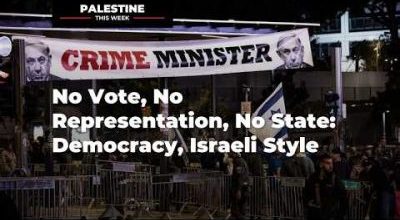
No Vote, No Representation, No State: Democracy, Israeli Style
or go to
Aletho News Archives – Video-Images
From the Archives
Sanctions, War and the Policy of Dual Containment
By SASAN FAYAZMANESH | March 17, 2008
It is now nearly three decades since the Unites States adopted the policy of dual containment of Iran and Iraq. While much has been written about the containment of Iraq, there has been very little in-depth analysis of this policy when it comes to Iran. In a book that is going to be released on March 31, 2008, entitled The United States and Iran: Sanctions, Wars and the Policy of Dual Containment (Routledge), I attempt to address this shortcoming by investigating when and why the US policy of containment of Iran came about, how it evolved, and where it stands today.[1] To the extent that Israel has been involved in US policy making, the study will also include the role that Israel has played in the containment of Iran. Also, since the fate of Iran has been inextricably linked to that of Iraq, occasionally the investigation will overlap with the containment of Iraq.
The policy of dual containment of Iran and Iraq originated during the Carter Administration, but it was not until the Clinton Administration that the expression “dual containment” became popular. … continue
Blog Roll
 Aletho News
- How Israel destabilizes the Middle East: Denying sovereignty and the right to exist
- Europe’s Establishment Is Embracing War – and Losing Voters
- NATO chief advocates war of aggression
- No Vote, No Representation, No State: Democracy, Israeli Style
- Zionist Bought Senate Blocks Information About American Citizens Killed By Israel
- While Gaza dominates the UN, these are the people keeping it alive
- New Report: “Scholasticide and Genocide in Gaza: Assessment, Testimonies and Legal Analysis”
- ‘THAAD Delusion’: Iran war exposes US missile shield limits – The Atlantic
- Moscow issues warning to NATO over Russian exclave
- Yes, the Iran war has destroyed Trump’s presidency
- If Americans Knew
- Israel map in LA Times ad includes all land from the river to the sea
- Inside Lebanon’s 200-page dossier on Israeli war crimes
- Flydubai, genocide, settler violence, Trump abuse of power to deport – Daily Update
- Counting Antisemitic Incidents: What the ADL Audit Reveals — and Obscures
- Mamdani releases plan to combat antisemitism and hate crimes in New York City
- Iran’s Revolutionary Guards Publish Letter to the American People
- DMFI launches $1 million ad campaign supporting Virginia’s Elaine Luria
- US Senate blocks resolution seeking report on Americans killed by Israel
- Israeli Attacks Kill Ten Palestinians in Gaza
- Massacre at Minab: The School That Became a Grave
- No Tricks Zone
- Green Energy Debacle: German Expert Professor Fritz Vahrenholt Warns Of Severe Economic And Social Consequences
- Two More Paleo Reconstructions Affirm Meters-Higher Sea Levels Across Ireland, Brazil 7000-6000 Years Ago
- New Study: Earth And Venus Surface Warmth Largely Explained By Convection And Lapse Rate, Not CO2 Or Radiation
- 2025 Nature Paper Claiming Worsening Global Drought Gets RETRACTED …Heavily Flawed
- New Study: ‘Global Drought Shows No Detectable Recent Acceleration Under Climate Warming’
- Economic Masterminds: German Socialists Suggest Taxing Productivity Gains Stemming From Using AI
- The South China Sea Has Not Been Cooperating With The Climate Change Narrative
- Energy Crisis: Germany Enters Heating Season With Historically Low Gas Reserve Fill Levels
- New Study: The Antarctic Ice Sheet Gained Mass From 2020-2024 Due To Staggering Snow And Ice Accumulation
- Study: Ocean Heating Rates From Thousands Of Years Ago ‘Dwarf’ Modern Ocean Heating Rates

