Under Israeli pressure, Facebook and Twitter delete large amounts of Palestinian content
MEMO | June 9, 2016
Facebook and Twitter have recently deleted thousands of posts, pages and accounts in response to demands from the Israeli ministry of justice, Quds Press reported on Wednesday.
“We succeeded to achieve our goals as around 70 per cent of our demands [to delete Facebook and Twitter content] were fulfilled,” Israeli Minister of Justice Ayelet Shaked said, according to Israeli newspaper Yedioth Ahronoth.
She also added: “We succeeded to delete incitement contents calling for death and violence across the internet.”
During a meeting she held to discuss “fighting incitement and shameful content on social media” three-days ago, Shaked reiterated Israel’s “cooperation with Facebook, Twitter and google regarding the violent electronic Palestinian incitement”.
Shaked claimed that when internet incitement decreased, the attacks on Israelis decreased.
“This proves that there is a direct relationship between internet incitement and violence in Israel,” she said.
FBI in new push to probe web browser history – report
RT | June 7, 2016
The FBI hopes to amend surveillance laws as early as this year, giving the agency explicit authority to access a personal Internet browser history by simply issuing an administrative “national security letter,” the Washington Post reports.
The new legislation being readied would empower the FBI to obtain “electronic communication transactional records” bypassing judges’ approval with the help of a “national security letter” (NSL) which could be issued by the special agent in charge of a bureau field office, the paper says.
The FBI chief made a specific point that gaining this access through changing legislation is topping agency’s priorities for the year 2016, since the inability to get the necessary data “affects our work in a very, very big and practical way,” James Comey told the Senate Intelligence Committee in February.
The Obama administration already tried to adopt a similar amendment some six years ago, but had to retreat after fierce opposition from the IT industry and privacy advocates.
Incidentally, Comey believes the current state of things is thanks to a “scrivener’s error” in the Electronic Communications Privacy Act, enabling internet providers and other technical companies to refuse providing certain personal information to the agency, citing infringement of American citizens’ privacy.
The ECPA is “needlessly hamstringing our counterintelligence and counterterrorism efforts,” Comey stressed.
The FBI also insists that a broader update of the ECPA should set electronic communication transactional records equal to telephone billing records.
The personal web ‘transactional records’ in question will allegedly include protocol addresses and the exact time a person spends on a web resource, but not content like search queries and email texts.
A coalition of privacy and civil society groups united with internet industry organizations to oppose the legal initiative, warning that the amendment would “dramatically expand the ability of the FBI to get sensitive information about users’ online activities without oversight.”
Security letters requesting data usually come with a gag order forbidding the internet providers from making the fact of the FBI request public.
The FBI has issued over 300,000 such requests within the past 10 years and in most cases they were accompanied by gag orders, estimated American Civil Liberties Union (ACLU) legislative counsel Neema Singh Guliani.
“That’s the perfect storm of more information gathered, less transparency and no accountability,” Guliani said.
Propagandists try to censor discussion on Refugee Crisis

By Rick Sterling | American Herald Tribune | June 7, 2016
Syria Solidarity Movement is an international network in solidarity with the Syrian people and their struggle to retain a secular, independent state.
Unfortunately, there is an organization in the UK called “Syria Solidarity UK” (SSUK). The similarity in names has caused some confusion, especially because their “solidarity” is with the “Syrian Revolution”. In reality, this ‘revolution’ consists of long exiled Syrians with heavy Muslim Brotherhood influence, some daydreaming Trotskyists, Western or Gulf or Turkish supported political agents and tens of thousands of terrorists and mercenaries supplied, paid, assisted and promoted by Saudi Arabia, Qatar, Israel, Turkey, USA, France, UK.
The genuine and positive forces seeking change in Syria disappeared long ago. James Foley documented the reality in Syria after his illusions were dispelled in Fall 2012. So did the native Aleppan known as Edward Dark. Initially he and his friends supported the uprising but then realized what it meant. While there is an array of takfiri factions, the conflict has crystallized into its essence: a brutal war of aggression with foreign funded mercenaries and international takfiries on one side, and a struggling multi-ethnic, multi-religious Syrian army and allies on the other.
SSUK and their American counterpart Syrian American Council are an integral part of Team Regime Change. They receive direct and indirect funding from the governments they are allied with. They are promoted in the Zionist establishment in the USA. Their voice is amplified by the media. Yet that is not enough. They aggressively attempt to block, prevent and censor any other voices.
In 2014 the voice of Mother Agnes Mariam was disrupted and attacked at various venues in the USA because she talked about the reality in Syria rather than what was being proclaimed by Washington and Doha. Her voice was shamefully shut down in London. The reason: because she opposed the media propaganda narrative about the chemical weapon attack in August 2013. Now some of the same sectarian propagandists are trying to prevent Dr. Tim Anderson from speaking at a global conference in Greece examining the refugee crisis and its causes. Dr. Anderson brings an analysis of the “Dirty War on Syria” and its connection to the refugee situation. That is what SSUK cannot abide and why they have threatened to disrupt the conference.
Under pressure from SSUK, the “Crossing Borders” conference organizers withdrew their invitation to keynote speaker Dr. Tim Anderson. This censorship led to hundreds of calls for the the conference to be true to its stated goals. To their credit, conference organizers realized the error and Dr. Anderson who will be presenting a paper and speaking at the conference. Now, the sectarian and bullying SSUK is again on the rampage; they are threatening to disrupt the conference and urging speakers to withdraw. After five years of continuous propaganda and demonization of the Assad government, what kind of academics or activists are so pathetic they cannot stand to hear a different perspective? What could be more relevant to an examination of the refugee crisis than an examination of the root causes?
The true nature of SSUK and their ‘revolution’ is revealed by their own actions. They talk about ‘freedom and democracy’ but practice censorship, repression and intimidation. Their threats need to be rejected and their actions condemned. They evidently do not want to solve the crisis; they want to escalate it.
Group SSUK condemns excess of Free Speech on Syria
By Paul Larudee | Dissident Voice | June 6, 2016
The group SSUK (sŭk), has registered its strong objection to, and condemnation of, the participation of Dr. Tim Anderson in the Crossing Borders Conference on Refugees, to convene July 7-10 on the Greek Island of Lesbos. Dr. Anderson is the author of The Dirty War on Syria: Washington, Regime Change and Resistance. Their complaint is that Anderson presents facts and a point of view that SSUK does not like.
We understand their concern. It is difficult enough to justify their support for some of the world’s most vicious terrorists without having someone like Dr. Anderson presenting genuine facts and arguments against doing so. How much more daunting, therefore, to justify violating international law and the UN Charter, and forming alliances with the Kingdom of Saudi Arabia and the world’s great imperialist powers for the sake of “freedom and human rights”? That’s a hard sell even without a voice like Dr. Anderson’s pointing out the hypocrisy.
But money can fix everything. SSUK’s White Helmets allies can bring $23 million from the US government, £15 million from the UK and millions more from private sources to mobilize a great marketing effort and twist a few arms to silence Dr. Anderson.
Dr. Anderson has nothing in his arsenal but facts and reason, and he is not even making an effort to silence the SSUK supporters of takfiri mercenaries. Perhaps he thinks that mere truth will be persuasive.
SSUK is trying to impress upon conference organizers that free speech must be sacrificed in order to win the fight for Syrian human rights. Rights like… well, like free speech. After all, isn’t victory more important than human rights?
Paul Larudee is one of the founders of the Free Gaza and Free Palestine Movements and an organizer in the International Solidarity Movement.
Palestinian journalist and human rights defender’s interrogation extended once more by Israeli court
Samidoun Palestinian Prisoner Solidarity Network – June 4, 2016
 The detention and interrogation of Palestinian journalist and human rights defender Hasan Safadi, Arabic media coordinator for Addameer Prisoner Support and Human Rights Association, was renewed on Friday, 3 June. Safadi, 24, has been under interrogation for more than a month, since his arrest by Israeli occupation forces on 1 May as he attempted to cross al-Karameh bridge, returning to the West Bank of occupied Palestine from Jordan.
The Jerusalem Magistrate Court extended his interrogation period for 4 additional days; he will have another court hearing on Tuesday, 7 June.
The arrest of Safadi comes amid an ongoing attack on Palestinian journalists and media workers, including the administrative detention without charge or trial of Omar Nazzal, member of the General Secretariat of the Palestinian Journalists’ Syndicate; Musab Kafisheh, freelance journalist; Mohammed Kaddoumi, freelance journalist; and Ali al-Oweiwi, an announcer at Arabah radio station.
In addition, Syrian journalist from the occupied Golan Heights (holding Israeli citizenship) Bassam al-Safadi, a correspondent for the Iranian Al-Alam TV channel, was arrested on 1 June and is being imprisoned in Tzalmon prison, accused of “incitement” and “support for terrorism,” apparently on the basis of public media statements.
Other Palestinian journalists like Sami al-Saee, Samer Abu Aisha and Samah Dweik are imprisoned and charged with “incitement” for publishing on social media; Abu Aisha faces charges for going to Lebanon – where hundreds of thousands of Palestinian refugees live – labeled an “enemy country.” Journalists like Hazem Nasser and Mujahid Saadi are targeted and accused of membership in or support for an “illegal organization” – any Palestinian political party.
samidoun@samidoun.ca
European Commission’s Hate Speech Deal With Companies Will Chill Speech
By Jillian York | EFF | June 3, 2016
A new agreement between the European Commission and four major U.S. companies—Facebook, Google, Twitter, and Microsoft—went into effect yesterday. The agreement will require companies to “review the majority of valid notifications for removal of hate speech in less than 24 hours and remove or disable access to such content,” as well as “educate and raise awareness” with their users about the companies’ guidelines.
The deal was made under the Commission’s “EU Internet Forum,” launched last year as a means to counter what EDRi calls “vaguely-defined ‘terrorist activity and hate speech online.’” While some members of civil society were able to participate in discussions, they were excluded from the negotiations that led to the agreement, says EDRi.
The agreement has been met with opposition by a number of groups, including EDRi (of which we’re a member), Access Now, and Index on Censorship, all of which have expressed concerns that the deal with stifle freedom of expression. The decision has also sparked debate on social media, with a wide variety of individuals and groups opposing the decision under the hashtag #IStandWithHateSpeech.
But you don’t have to stand with hate speech to stand against this decision. There are several reasons to oppose this Orwellian agreement. First, while Article 19 of the International Covenant on Civil and Political Rights allows states to limit freedom of expression under select circumstances, such limitations are intended to be the exception, and are permitted only to protect the following:
-
The rights or reputations of others,
-
national security,
-
public order,
-
public health, or
-
morals.
These limits must also meet a three-part test as defined by the ICCPR: be defined by law; have legitimate aim; and be truly necessary. While some of the speech that concerns the Commission may very well qualify as illegal under some countries’ laws, the method by which they’ve sought to limit it will surely have a chilling effect on free speech.
In addition, as EDRi points out, despite a lengthy negotiation between companies and the Commission, “hate speech” remains vaguely-defined. Companies have been tasked with taking the lead on determining what constitutes hate speech, with potentially disastrous results.
In fact, social media companies have an abysmal track record when it comes to regulating any kind of speech. As Onlinecensorship.org’s research shows, speech that is permitted by companies’ terms of service is often removed, with users given few paths to recourse. Users report experiencing bans from Facebook for 24 hours to up to 30 days if the company determines they’ve violated the Community Standards—which, in many cases, the user has not. Requiring companies to review complaints within 24 hours will almost surely result in the removal of speech that would be legal in Europe.
By taking decision-making outside of the democratic system and into backrooms, and granting corporations even greater control, the European Commission is ensuring a chill on online speech.
Dismantling Civil Society in Bahrain
By Rannie Amiri | CounterPunch | June 3, 2016
Like a vise which first grips its object and then slowly, deliberately and inexorably crushes it, the al-Khalifa regime has done similarly to civil society in Bahrain. It did not stop when peaceful, pro-democracy, reform protests erupted in 2011 and were violently put down by government forces aided by an invasion of Saudi troops in March of that year. Indeed, the vise continues to close and relentlessly so.
Nationalities have been revoked, mosques razed, citizens deported, human rights activists imprisoned on flimsy charges of insulting the monarchy at the least or plotting its overthrow at worst, and the most perfunctory of dialogues with the opposition abandoned. By smothering the figures and institutions who dare challenge the authority of the ruling dynasty in the most benign of fashions – a tweet, waving the country’s flag, tearing up a photo or merely questioning the tenure of the world’s longest serving prime minister – the Bahraini regime and its Gulf allies would like to believe monarchal rule has been preserved. Such desperate measures however, only speak to its precarity.
The stalwart activist Zainab al-Khawaja was given a sentence of three years and one month in Dec. 2014 for (again) tearing up a picture of King Hamad. She refused to be separated from her infant son whom she took with her to prison. Al-Khawaja has just been released on “humanitarian” grounds after serving 15 months in jail.
Her father though, Abdulhadi al-Khawaja, remains imprisoned serving a life sentence on trumped-up charges of attempting to topple the government. While authorities may have set Zainab al-Khawaja free, they simultaneously doubled the sentence of Sheikh Ali Salman, head of al-Wefaq, an opposition political party. Initially given a term of four years incarceration for alleged incitement against the regime, it was increased to nine years on appeal. The unflinching President of the Bahrain Center for Human Rights (BCHR) and founding Director of the Gulf Centre for Human Rights Nabeel Rajab, remains banned from leaving the country despite the need to secure medical treatment for his wife.
Busy highlighting the nation’s cordial relations with the United Kingdom and United States, the latter of which headquarters its Navy’s Fifth Fleet in the capital Manama, the Western media has largely ignored the plight of Bahrain’s ordinary citizens. The arrest and torture of disabled youth has now been documented by the BCHR. Indeed, for more than a decade, the Center has meticulously chronicled the dismantling of Bahrain’s civil society in all its forms by the al-Khalifa regime.
Most recently, with the passage of a law preventing any religious figure from joining political societies or engaging in political activities, the BCHR issued a statement condemning, “… the Bahraini parliament and Shura Council’s passage of amendments to the Political Societies Law, which places a ban on participation in political decision-making based on discriminatory religious grounds. In defense of this draft amendment, lawmakers supporting this motion argued it would prevent religious acts from being politicized. This decision restricts people’s ability to freely engage in religious practices, as those members willing to join political activities pertinent to the legislative process in Bahrain would now need to refrain from any activities carrying religious connotations.”
In the face of widespread and open abuses in civil society, lack of proportional parliamentary representation, curfews, detentions, and imprisonment and torture of those who dissent, these practices have nonetheless failed to adversely impact the ties enjoyed between Bahrain and the United States. But when a regime becomes alienated from those whom it rules and for example, gives lengthy jail sentences for tweets it finds offensive, it speaks to a tenuous reign.
The pillars of civil advocacy in Bahrain – Nabeel Rajab, Abdulhadi al-Khawaja, Maryam and Zainab al-Khawaja, Abduljalil al-Singace (sentenced to life in prison for participating in pro-democracy protests), Naji Fateel, Hussain Jawad and countless others both named and unnamed – have consistently engaged in purely secular, non-sectarian activism. Unlike the practice of the regime, the designations Sunni and Shia need not be applied when discussing the ongoing struggle for legal, political and socioeconomic rights in Bahrain. The people have waited too long for the West to recognize their demands are not based on sect, but on equity.
Despite an oppressive regime and the long shadow cast by the U.S. Fifth Fleet, resilient Bahrainis remain unintimidated.
Rannie Amiri is an independent commentator on Middle East affairs.
Dreams of Control: Israel, Global Censorship and the Internet
By Binoy Kampmark | CounterPunch | June 3, 2016
“Under the cover of darkness, there is no limit to the expansion of Big Brother.”
Ilan Gilon, Meretz Party (Israel), Times of Israel, Feb 4, 2016
While Israel’s central justification for its often reactionary policies is couched in hyper-exceptionalist rhetoric, nourished by the ashes of Holocaust remembrance, current interest in censoring the Internet is far from exceptional.
Like a machine of justification against its critics and its enemies, Israel enlists various projects under the banner of the remarkable and precious, when it is simply accomplishing what other states have done before or since: the banal and ordinary. All states want to limit expression, control criticism and marginalise the sceptics. Some do it more savagely, and roughly, than others.
Israel’s military censor, Col. Ariella Ben Avraham, who is part of the IDF’s Directorate of Military Intelligence, gave a good example of this in February by insisting that social media activists and bloggers submit material relevant to security matters for approval prior to posting. The move also revealed an increasing interest to police the digital realm, previously considered an anarchic jungle incapable of effective policing.
Up to 32 Israeli bloggers and social media activists were informed about the directive, one of the first being Yossi Gurvitz, a left-wing activist running the “Friends of George” Facebook page. In rather unceremonious fashion, he was informed via Ben Avraham’s private Facebook account that he was obligated to run future submissions by her office. To his credit, he promises to defy the order.
Internal censorship is but one aspect of this policy. Israel Public Security Minister Gilad Erdan has dipped into the discourse of censorship to convince others that limiting various social media platforms on a global scale is the way to go. In January, he revealed the inner ambition of Israel’s security establishment to internationalise the censorship effort.
To achieve that goal, Erdan speaks of an “international coalition” that would make limiting criticism of Israel its primary objective. The central aim is hardly imaginative: making such providers as YouTube, Twitter and Facebook face up to responsibility as to what they host on their sites.
The Erdan plan suggests that various countries would form a “loose coalition that would keep an eye on content and where it is being posted, and members of the coalition would work to demand that the platforms remove the content that was posted in any of their countries at the request of members.” The simple idea behind this collusion is extra-territorial cooperation, effectively circumventing the global nature of such platforms.
As for the scurrilous subject matter itself, the issues are universal fare for states keen to control matters that supposedly stimulate the darker side of human nature. (Read: contrary to state interests.) Erdan’s office gives the example of material from a Palestinian (of course) disclosing the best locations on the body to inflict fatal stab wounds.
This begs that grand question about how far such an effort goes: control the more sordidly violent sides of the Old Testament because it encourages various unsavoury practices? Limit suggestive literature being discussed in the whirl of social media, buzzing away with malicious promise? The mind is an untidy place filled with remarkable things, and not all of them necessarily make it to actual perpetration. This is a point that continues to elude the mighty warriors of the security state.
Another justification is being thrown in: they, the social media giants, rake in the proceeds, and should therefore man the barricades. “We are planning to put a stop to this irresponsibility,” claimed Erdan’s office, “and we are going to do it as part of an international coalition that has had enough of this behaviour as well.”
Other governments have also done their bit to limit the internet and content available to their citizens. Most famously, Beijing runs its own “Great Firewall of China”, overseen by the Ministry of Information Industry (MII), while the State Council Information Office and the Chinese Communist Party’s Propaganda Department examine content.
In recent times, countries of a supposedly democratic character have taken to the blinds and endeavoured to do what Erdan dreams about. Dangerous thoughts are seen as the reason for dangerous actions. To that end, the country that gave Europe the Enlightenment has been busy forging its own vision of global internet censorship, using a mixture of security and privacy concerns.
The latter has proven to have potentially pernicious consequences, framed largely as an effort to protect the privacy of the French citizen. From that vantage point, a vision of global control has been built on a premise forged in European law: the right to be forgotten. The Court of Justice of the European ruling of May 13, 2014 (Google Spain v Agencia Española de Protección de Datos, Mario Costeja González) has supplied the subject matter for the latest enlargement of censorship powers.
The French response has been intrusively enthusiastic, with the privacy regulator, CNIL, fining Google 100,000 Euros in March for not applying the right to be forgotten across the global network. In the chilling words of the regulator, “For people residing in France to effectively exercise their right to be delisted, it must be applied to the entire processing operation.” Erdan may well be irritated he did not come up with that one.
Binoy Kampmark was a Commonwealth Scholar at Selwyn College, Cambridge. He lectures at RMIT University, Melbourne. Email: bkampmark@gmail.com
The Web They Want: How a twitter wordsearch justifies internet censorship
Off Guardian | May 26, 2016
Earlier this year the Guardian launched their new campaign – “The Web We Want”. It’s an agenda driven campaign to suppress free speech and protect the ancien media regime from the alt-news revolution, in the name of protecting ethnic minorities, female writers and the LGBT community from the all the hate that pours out of the privileged fingertips of all the white men on the internet.
We have written extensively on what the Guardian really means by “the web they want”. We know their statistics are a farce and can see through their editorial double talk. Their place in a planned roll out of an idea is obvious, coinciding with political climbers from all parties making speeches attacking free speech in the name of freedom. Banning liberty because… won’t somebody please think of the children!
When the Guardian talks about “taking action” against internet abuse, we know what they mean. They mean censorship. There’s nothing more need be said. But this latest story cries out for a response.
Apparently by tracking the number of tweets that use the word “slut” or “whore” you can track the “huge scale” of social media misogyny. Yes, seriously:
The study monitored the use of the words “slut” and “whore” by UK Twitter users over three weeks from the end of April. It found that 6,500 individuals were targeted by 10,000 aggressive and misogynistic tweets in that period.
The study, conveniently published the day before Yvette Cooper launches her “Reclaim the Internet” movement, is rather vague on the details. We don’t know how they collected their data, or what their criteria for inclusion/exclusion were. Bearing that in mind we’re going to have to make some educated guesses: Since rough estimates put the number of twitter users in Britain at between 12 and 20 million people, 6,500 is roughly 1/2000th. You have, apparently, a 1/2000 chance of being “targeted” by a tweet using the word slut or whore. Personally, that is risk I am willing to take.
The study is not clear on how they select “aggressive” tweets, so we’ll have to assume they just collate all the tweets containing the word “slut” and/or “whore”. We don’t know how many of these uses are truly abusive – many may have been jokes – but it does not really matter.
Another interesting caveat:
… more than half of the offenders were women.
Yes. It seems women are the biggest misogynists of all. An interesting fact, buried in the article, made even more interesting with some context. Firstly, women make up considerably less than half of the twitter users in the UK. Less than half of the users, more than half the misogyny. Secondly, over 1/3 twitter users in Britain are between 15-24. With this context you can paint a rather more accurate picture – that the bulk of this “online misogyny” is made up of young women, aged 15-24, calling each other names (possibly in jest).
That this qualifies as a “study” at all is ludicrous, that the Guardian can try to peddle it as “shocking” is, frankly, laughable. The figures are meaningless.
Of course, this is the Guardian, so a poorly done, lazily explained statistical study must be followed by an editorial from whichever member of the Guardian’s insipid, pre-programmed writing staff happens to pull the day shift. In this instance it’s Polly Toynbee. “Why we need a feminist internet”, the headline declares, “feminist” in this instance meaning “controlled”.
She paints a picture of a dank, dark internet. A squalid, David Fincher-directed world, full of unwashed slug-like life-forms crawling over each other in an effort to spread slime and shit to every corner of the civilised world. She has nothing new to say. She repeats tired memes about free speech bullying “victims” into silence, about “trauma” and “safe spaces” and the “need to act.” She explains that women abusing each other on twitter is actually the fault of the Patriarchy, because female anger is all based on being unable to match the ideal woman presented in the media.
Like all Guardian editorials, you can discard the majority. It is designed to seed an idea, and can be reduced down to one key paragraph that pushes its agenda:
The internet has turned all discourse rougher, pushing politics and all views towards extremes. It can make individuals feel inadequate and vulnerable and let them lash out to express their own insecurities. As the Guardian’s the web we want project explores, it is in our hands to shape a civilising internet that serves us well, not one that tears civilisation apart.
There are important questions posed here: What does Toynbee mean by “our hands”? Who will this “reshaped” internet be “serving well”? What does “serves us well” mean? Does she really believe that teenaged name calling on twitter could “tear civilisation apart”? What does she really mean by “civilisation?”
To whom, or what, does a free internet REALLY pose a threat?
You’d be forgiven for reading “rougher” as slang for “more honest”, for reading “extreme” as “less controlled”. You might say the “individuals” it makes feel “inadequate”, are the workaday hacks who so consistently have their inaccurate agitprop ridiculed and corrected below the line.
With this paragraph you get the feeling of an organism protecting itself, like watching a pillbug curl in upon itself. The above is a plea for compliance. They want permission to enact a policy that leaves the definitions of “rough discourse” (see:honesty) and “civilisation” (see:establishment) open for interpretation. The repeated patterns and tired prose of the “web we want” sections have an increasing air of desperation. Again and again they wheel out the same faces to sell the same snake oil. Rather like the pillbug, it seems the Guardian’s last line of defense is to stick its head up its ass.
Brother of ‘Guantanamo Diary’ author denied entry to US
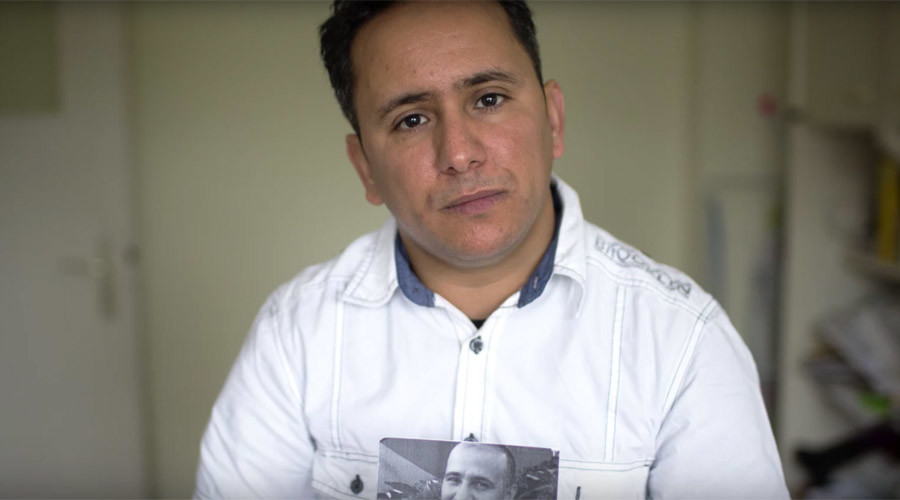
Yahdih Ould Slahi holds up a photo of his brother Mohamedou in a May 2016 video by American Civil Liberties Union © acluvideos / YouTube
RT | May 24, 2016
US authorities detained, interrogated and sent back a German citizen flying in to campaign for the release of his brother – author of the best-selling “Guantanamo Diary,” who has been imprisoned and tortured at the US camp since 2002.
Mohamedou Ould Slahi’s memoir, heavily redacted by government censors, was published in 2015 and quickly became a best-seller. The Mauritanian native was arrested in 2001 and rendered to Jordan for interrogation by the CIA. He was transferred to Guantanamo Bay the following year.
His younger brother Yahdih, a German citizen, has campaigned for Mohamedou’s release for years. Yahdih was supposed to attend a number of events in the US this week, seeking to persuade Guantanamo’s Periodic Review Board to set Mohamedou free at the June 2 hearing.
When Yahdih Slahi arrived at the John F. Kennedy airport in New York on Saturday, however, he was detained by US Customs and Border Patrol (CBP) agents, questioned for hours, and sent back to Germany the following day, The Intercept reported.
“He was asked questions about his family, his brother, and what he knew about why his brother was in Guantánamo,” said Hina Shamsi of the American Civil Liberties Union. “It was a harrowing, stressful, and exhausting experience.”
Yahdih Slahi is a German citizen who lives in Düsseldorf, and would have been able to enter the US under the visa waiver program that Germany participates in. The CBP gave no explanation for denying Slahi entry.
In his memoir, Mohamedou Slahi described being held in isolation and subjected to beatings, extreme cold, sleep deprivation, sexual abuse, a simulated kidnapping, and a simulated execution. At one point, his captors tried to trick him by showing him a forged letter from his mother, Yahdih recounted in 2015. The ploy failed because the forgery misspelled Slahi’s name – and because, unbeknownst to his jailers, Slahi’s mother was illiterate.
Mohamedou Slahi admits that he fought in Afghanistan in the early 1990s with what became Al-Qaeda– when the organization was backed by the US in its struggle against the socialist government in Kabul. While he had nothing to do with Al-Qaeda since 1992, Slahi did stay in touch with his cousin and former brother-in-law, Mahfouz Ould al-Walid, who served as a lieutenant to Osama Bin Laden.
Slahi was never charged with any crime, but the 2010 decision to release him has been held up by government appeals.
“The judge said there was no evidence in 2010 to hold him. There’s certainly not evidence now. The Chief Prosecutor said when he resigned in 2007, that there was no evidence then,” Slahi’s attorney Nancy Hollander told RT in January 2015.
Slahi’s family and friends hope the Periodic Review Board will recommend his release at the June 2 hearing. The inter-agency panel ruled on Monday to set free an Afghan man, known only as Obaidullah, who was held at Guantanamo for 14 years.
It took a decade of fighting with the government for the Guantanamo Diary, written in 2005, to see the light of day. Slahi is the first Guantanamo prisoner to publish a memoir while still at the camp. He has not been allowed to receive a copy of his book.
Counter-extremism scheme could turn cops into ‘Thought Police’
RT | May 24, 2016
Draconian plans to target alleged extremists through a controversial anti-radicalization program are at risk of creating a ‘Thought Police’ in the UK, the officer leading the operation has warned.
In a damning critique, Leicestershire Police Chief Constable Simon Cole said the ‘Prevent’ legislation risks making cops judges of “what people can and cannot say.”
The government formally announced a controversial new bill to tackle extremism in the Queen’s Speech to Parliament last week. It is considered to be Prime Minister David Cameron’s flagship policy of the year.
The legislation widens the police fight to include those who are defined as ‘extremists’, but who do not take part in or even advocate terrorism themselves.
“Unless you can define what extremism is very clearly then it’s going to be really challenging to enforce,” Cole told the Guardian.
“We don’t want to be the Thought Police. We absolutely don’t want to be the Thought Police.”
When asked if the Prevent strategy could make this happen, Cole said: “Potentially there is a risk.”
Cole’s intervention will prove damaging for the government, coming from a senior counterterrorism officer.
Cameron already faced several embarrassing defeats last parliamentary year, despite having a slim majority of seats in the House of Commons, and will be keen to avoid another capitulation.
But Cole believes the legislation has triggered serious reservations among British Muslims.
“The police need to be able to safeguard people without being drawn into a hugely contentious potential role about a kind of thought police control of what people can and cannot say.
“And that needs really clearly defining and it needs parliament to lay out what is and isn’t acceptable,” he added.
Despite spending eight months drafting a “legally robust” definition of extremism, government officials are still struggling to complete the task.
Cole said he has concerns about how “enforceable” the legislation would be, adding it is important for police officers to speak out.
While he accepted that society must impose “some limits” on what can and cannot be said, “They [the limits] need to be as broad as they possibly can be.”
Featured Video
10K More U.S. Troops Deploy as Trump Weighs New Iran Strikes
or go to
Aletho News Archives – Video-Images
From the Archives
Genetic baloney in thick slices
MAYBE COULD BE INC.
By Jon Rappoport | No More Fake News | July 8, 2021
Gene research companies tend to come and go. They start out banging and popping like fireworks in the sky, and then they fade out—selling themselves to larger outfits who’ve hired better liars…
Once upon a time, it sounded easy. Start with a disease, find the gene responsible for the disease, and correct the problem.
Then, researchers wondered, was disease the result of one gene or a group of genes acting together?
Either way, the proof would be in devising cures for diseases using gene therapy. “Not yet, but soon…”
And regardless, the major need was: money. Lots and lots of money.
This need required good PR people. “We have to pump up the idea that we’re on the edge of tremendous breakthroughs. We’re always on that edge…”
This hype also needed to obscure the fact that there wasn’t (and isn’t) ANY gene cure for ANY disease. … continue
Blog Roll
 Aletho News
- US military withdrawal from Iraq and the collapse of US-Israeli hegemonic project in West Asia
- What does Europe want – a war with Russia?
- She Followed the Actual Data on COVID Vaccines and Masks — Her Career Took a Huge Hit
- Florida AG Sues Pfizer, Bourla Over Deceptive Marketing of COVID Vaccines
- Von der Leyen gifts her spin doctor a job for life
- 10K More U.S. Troops Deploy as Trump Weighs New Iran Strikes /Suliaman Ahmed
- Iranian crew declared Dena training vessel ‘unarmed’ to US warship before deadly torpedo strike: Report
- Iran’s NPT debate moves beyond parliament
- Houthis condemn Saudi claims of attack on Medina
- Fatuous False Flags
- If Americans Knew
- The Israeli Right Portrays Islam as Murderous. It Serves a Political Purpose
- Jordan Has Had Enough: King Abdullah’s Scathing Warning to Israel
- Israeli Colonizers (i.e. Settlers) Kill Palestinian Man Near Salfit
- New Google Maps images reveal massive scale of devastation in Gaza
- Jewish supremacy, anti-Palestinian bigotry on display in Israel – Daily Update
- Israeli Soldiers Abduct At Least 22 Across Occupied West Bank
- Eight Palestinians Killed in Israeli Attacks on Gaza
- Israeli former leaders and security chiefs threaten legal action over ‘Jewish terrorism’
- Israel map in LA Times ad includes all land from the river to the sea
- Inside Lebanon’s 200-page dossier on Israeli war crimes
- No Tricks Zone
- Green Energy Debacle: German Expert Professor Fritz Vahrenholt Warns Of Severe Economic And Social Consequences
- Two More Paleo Reconstructions Affirm Meters-Higher Sea Levels Across Ireland, Brazil 7000-6000 Years Ago
- New Study: Earth And Venus Surface Warmth Largely Explained By Convection And Lapse Rate, Not CO2 Or Radiation
- 2025 Nature Paper Claiming Worsening Global Drought Gets RETRACTED …Heavily Flawed
- New Study: ‘Global Drought Shows No Detectable Recent Acceleration Under Climate Warming’
- Economic Masterminds: German Socialists Suggest Taxing Productivity Gains Stemming From Using AI
- The South China Sea Has Not Been Cooperating With The Climate Change Narrative
- Energy Crisis: Germany Enters Heating Season With Historically Low Gas Reserve Fill Levels
- New Study: The Antarctic Ice Sheet Gained Mass From 2020-2024 Due To Staggering Snow And Ice Accumulation
- Study: Ocean Heating Rates From Thousands Of Years Ago ‘Dwarf’ Modern Ocean Heating Rates

