UK Israeli boycott ban contradicts official govt business guidelines
RT | February 18, 2016
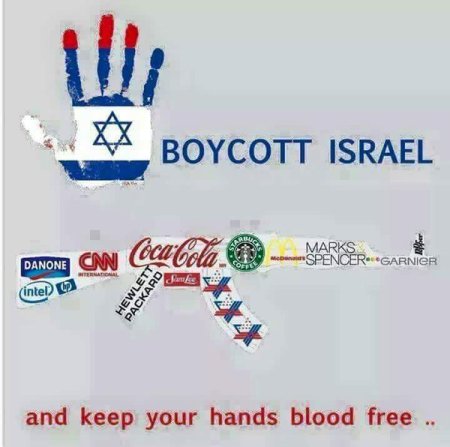
Britain’s ban on the public boycott of goods from Israel’s occupied territories contradicts its own official business guidelines, documents have revealed.
The controversial new law, which would ban local councils, student unions and other public bodies from boycotting goods for political reasons, was announced by the government on Monday and has been implemented without parliamentary debate or vote.
However, documents first seen by the Independent show the Foreign Office’s Overseas Business Risk assessment for Israel states that the government does “not encourage or offer support” to business with the occupied territories, apparently contradicting the new regulation.
“Settlements are illegal under international law, constitute an obstacle to peace and threaten to make a two-state solution to the Israeli-Palestinian conflict impossible,” the document reads.
“There are therefore clear risks related to economic and financial activities in the settlements, and we do not encourage or offer support to such activity.”
The new rules do not apply exclusively to Israel, but would ban institutions that receive the majority of their funding from the government from participating in procurement political campaigns, choosing not to buy products from companies on political grounds. The only exception would be nationwide boycotts mandated by the government.
The Palestinian Liberation Organization (PLO) has attacked the new law, saying it undermines the democratic rights and freedoms of public bodies.
PLO Executive Committee Members Dr Hanan Ashrawi and Dr Saeb Erekat released a joint statement after meeting with Middle East Minister Tobias Ellwood on Wednesday.
“This represents a serious regression in British policy and it would empower the Israeli occupation by sending a message of impunity,” said Ashrawi and Erekat.
“In order to accommodate the Israeli occupation, the British government is undermining British democracy and their own people’s rights.”
The Labour Party has panned the new measures as an “attack on democracy.”
“This government’s ban would have outlawed council action against apartheid South Africa. Ministers talk about devolution, but in practice they’re imposing Conservative Party policies on elected local councils across the board,” Labour Party leader Jeremy Corbyn said.
The government, however, has defended the anti-boycott measures, saying they are necessary for “community cohesion” and national security.
“There are wider national and international consequences from imposing such local level boycotts. They can damage integration and community cohesion within the United Kingdom, hinder Britain’s export trade, and harm foreign relations to the detriment of Britain’s economic and international security,” ministers said in a procurement policy note sent out to public authorities.
Coinciding with the law’s announcement, Cabinet Minister Matthew Hancock, who has recently come under fire for accepting a £4,000 donation from a right wing think tank, weeks before announcing a crackdown on lobbying by charities, is currently in Israel promoting business and trade links with the UK.
Read more:
Like Thatcher with apartheid: UK to ban public bodies from boycotting Israeli West Bank goods
Combating BDS Act of 2016
Congress Moves against BDS
By Lawrence Davidson | To The Point Analyses | February 17, 2014
It was bound to happen – an attempt by the U.S. Congress to sanction the attacks on the Boycott, Divestment and Sanctions movement already taking place in some states and municipalities. The strategy is to legitimize an increasingly standard approach to undermining the boycott of Israel, an approach wherein the investment of any state funds, including pension funds, in any business or organization that boycotts the Zionist state is forbidden.
Bipartisan pairs of senators – Mark Kirk (R-IL) and Joe Manchin (D-WV) – and Congressional Representatives – Robert Dold (R-IL) and Juan Vargas (D-CA) – introduced into both houses the “Combating BDS Act of 2016” (S.2531 and H.R.4514). We can be sure that all four of them are doing this at the coordinated behest of Zionist special interests to which they are financially tied. In other words, acting in their official capacity, their behavior on things that touch on Israel-Palestine is a payback for money and other forms of assistance offered by the Zionists to facilitate the politicians’ elections and reelections. Sadly, this is the way the U.S. campaign system works. Unless you are very wealthy, you are constantly scrounging for money. Under such circumstances one’s pathway to success is made easier if you don’t know the difference between ethics and your elbow.
Our four sponsors of the “Combating BDS Act” would, of course, deny any such tainted motives. Rather, they would insist that theirs is an effort to weigh in against anti-Semitism and defend the integrity the “only democracy in the Middle East.” If they really believe this is so, the kindest thing that can be said for these legislators is that they are profoundly ignorant about Israel and its true character. It is also possible that they know the truth about their patron, but really don’t care. It is all about the money.
Intimations of the Real Israel
For instance, are Senators Kirk and Manchin and Representatives Dold and Vargas aware that the Israeli legislature, the Knesset, recently voted down a bill to include the principle of equality among citizens in the wording of the country’s “Basic Law” on Human Dignity and Liberty? Basic Laws stand in for a constitution in Israel. The bill was introduced by one of the few Arab-Israeli MKs (members of the Knesset) , Jamal Zahalka, who noted that “All constitutions in modern countries begin with stressing the principle of equality amongst their citizens.” That did not matter to a majority of the Knesset who, following inherently discriminatory Zionist ideals, do not believe in equality between Jewish and non-Jewish citizens. Yet to Israel’s supporters in Washington the Zionist state remains a “democracy” much like the United States. Such an unquestioning assumption, so wide of the mark, displays a level of closed-mindedness that ought to require intensive remedial critical-thinking training before allowing someone to stand for office.
Are Senators Kirk and Manchin and Representatives Dold and Vargas aware that the Knesset “Ethics Committee” has suspended three Arab-Israeli MKs, including Mr. Zahalka, from participating in legislative sessions because they met with families whose members had been killed while violently resisting Israeli occupation? The aim of the meeting was to assist the families in recovering from Israeli authorities the bodies of their slain relatives. The Israelis refuse to recognize the truism that the violence of the oppressed will eventually reach the level of the violence of the oppressor. Instead, any violent blowback occurring in response to their own violence is conveniently characterized as “terrorism.”
In order for the action of the Arab MKs to make sense to most Israeli Jews and their Zionist supporters abroad, there has to be recognition of the historically established fact that the occupation of Palestinian land is real. This the Zionists will not do, and apparently, part of their deal with the U.S. politicians in Congress is that they too must echo that same denial.
Are Senators Kirk and Manchin and Representatives Dold and Vargas aware that the respected human rights organization Amnesty International has recently released a report accusing Israeli forces of using “intentional lethal force” against Palestinians in situations where such force was “completely unjustified”? Amnesty spokesman Philip Luther asserted that the Israelis had “ripped up the rulebook” by “flouting international standards” when it came to the use of force. For the politicians in Washington who have made their pact with the Zionists, such behavior, if noted at all, is rationalized as self-defense on the part of the Israelis. However, suppression of resistance to illegal occupation cannot not be judged self-defense either legally or logically. Who in Congress is aware of the Fourth Geneva Convention?
There are many other practices and policies of the State of Israel that must be ignored (including Israel’s support of al-Qaeda in Syria) if Senators Kirk and Manchin and Representatives Dold and Vargas are to carry on with clear consciences. But this might be based on a false assumption that these politicians have a conscience to which they pay attention. After all, our system of politics, which all but demands submission to special interests, may well select for amoral personalities.
Ignoring the Question of Constitutionality
The apparent indifference of Senators Kirk and Manchin and Representatives Dold and Vargas goes beyond Israel’s flouting of international law. It carries over to these politicians’ own disregard for the U.S. Constitution, which each gentleman has sworn to uphold.
Ever since the early 1980s the Supreme Court has regarded domestically initiated boycotts as a legitimate form of political speech. There is little excuse for our four defenders of Israel not to know this. And what are we to say of them if they do in fact know? Only that they, like their patrons, are willing to “rip up the rulebook.” They are willing to act as if what is unconstitutional is, after all, acceptable when it protects the interests of a foreign rogue state on whose payroll they happen to be. Just how long can they get away with this? Is the answer really just as long as the Zionist money keeps coming?
Congressmen and senators tied to Zionist special interests will eventually have to rethink these alliances. Their connection with a state that has no compunction about violating international law has led them to become accomplices in the undermining of U.S. law. Thus, the actions of politicians such Kirk, Manchin, Dold and Vargas act as a barometer indicating the degree to which under-regulated special interests have corrupted the U.S. government. Those involved are walking a path that can lead only to on-going ethical decline and policy failures.
British schoolboy questioned for wearing ‘Free Palestine’ badge
MEMO | February 15, 2016
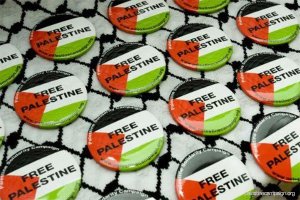 A schoolboy has been questioned by anti-terrorism police because he wore a “Free Palestine” badge to school, The Independent newspaper reported.
Rahmaan Mohammadi’s teachers at Challney High School for Boys in Luton referred him to police under Prevent – the controversial government anti-radicalisation programme.
The pupil was also wearing pro-Palestine badges and wristbands. He had previously requested permission to fundraise for children affected by the Israeli occupation.
Mohammadi said he had previously been warned by police not to talk about Palestine in school, and claimed that staff members approached his 14-year-old brother and pressured him to tell him to “stop being radical”.
Counter-terror laws hampering Islamic charities’ work – former ministers
RT | February 12, 2016
Former cabinet ministers have urged the government to set up an inquiry into the way UK counter-terror laws are affecting the humanitarian work of Islamic charities, many of which operate in Syria.
Two former international development secretaries have discussed the issue with parliamentary officials and have written to the Commons International Development Select Committee to call for an inquiry into complaints that Islamic charities are being treated unfairly.
Clare Short, who was international development secretary from 1997 to 2003, and Andrew Mitchell, who served in the same job from 2010 to 2012, have responded to concerns that Muslim charities are being discriminated against by banks or members of the authorities who worry funding could make its way to extremist organizations.
Almost one-fifth of government development aid goes to charities, and Islamic charities are some of the few British aid organizations that can operate in Syria.
Short wrote that the issue needed examining.
“This is an issue that needs clarifying and sorting out. It has been around as a problem for some time, but it has been getting worse and worse. We have got this enormous capacity in the UK of these Muslim humanitarian charities, yet they are struggling with one hand behind their back. We need a proper scrutiny and examination bringing all this out. It is preventing efficiency.”
Mitchell said: “These are some of the few charities that can get into Syria and help the benighted people of that country, yet they are being held back due to misunderstandings and banking bureaucracy.”
Commons International Development Committee chair Stephen Twigg said he would examine the request “very sympathetically.”
One charity which has complained of discrimination is Islamic Relief, one of the largest Muslim charities, who say their work is being hampered. The charity is funded by the Department for International Development, yet has had one of its bank accounts closed by HSBC.
Other charities have reported the closure of bank accounts, Pay Pal accounts and the blocking of financial transactions.
The government set up a working party to examine any issues after the complaints were made.
Short and Mitchell also travelled to Turkey to see some of the charity work by the Muslim Charities Forum, an umbrella organization for nine charities, being done to get aid into Syria. They returned with praise for the organization and its work.
Omayma El Ella, the operations manager of the Muslim Charities Forum, explained that there was no one to hold to account for the problem.
“No one is accountable for what is going on right now. Every time we speak to the government about this, they say it is a private sector issue and they cannot get involved. That is not good enough anymore. We are told no one will be prosecuted for ‘benign engagement’, but what is ‘benign engagement’? That has not been clarified.”
Obama regime seeks to roll back human rights conditions on aid to Egypt
RT | February 11, 2016
Despite reports that state repression in Egypt is taking place on a greater scale than it has been for generations, the Obama administration is seeking to roll back human rights conditions Congress had placed on foreign aid to Egypt’s military.
The request, which was tucked into the Obama administration’s 182-page budget proposal, seeks foreign aid to Egypt’s military regime and “the sale of crowd control weapons to ‘emerging democracies.’” The discovery was made by The Intercept.
If the new proposal, which was released on Tuesday, is adopted, it would end a Congressional restriction stipulating “that 15 percent of aid to Egypt is subject to being withheld based on human rights conditions.”
Interestingly, Congress was able to temporarily waive those restrictions in a foreign aid bill in June of 2015, arguing it was in the national security interest of the United Station, according to Al-Monitor. The conditions were that Egypt would have to hold “free and fair” parliamentary elections and take steps to foster democracy and protect human rights for an additional $1.3 billion in military aid to be released.
The US State Department issued a scathing report in May of 2015, arguing that “while Egypt had implemented parts of its ‘democracy roadmap’ the overall trajectory of rights and democracy had been negative.”
It pinpointed restrictions on freedom of expression, the press, and freedom of association, as well as lack of due process. It further said that “impunity remains a serious problem in Egypt.”
It was well known at the time the Egyptians were “infuriated” by the report.
Cole Bockenfeld, deputy director for policy at the Project on Middle East Democracy, told The Intercept that the White House probably didn’t want to explain why it had to waive restrictions this year.
“They had to basically do an assessment. … Here’s how they’re doing on political prisoners, here’s how they’re doing on freedom of assembly, and so on,” Bockenfeld said.
The Guardian reported in January that Egypt has jailed more journalists than any other country on earth except China under President Abdel Fattah al-Sisi. Three reporters were imprisoned, one forcibly “disappeared” and was later charged with being a member of a banned organization, and six were referred to judicial hearings because of their work.
Also in January, Italian academic Giulio Regeni, who was researching labor unrest and independent trade unions in Egypt, went missing during a security crackdown on the fifth anniversary of the beginning of Egypt’s revolution. His body was discovered nine days later by the side of the road marked with cigarette burns, bruising, and multiple stab wounds. The Guardian reported more than 4,600 academics worldwide have signed an open letter protesting his death and demanding an investigation into the growing number of forced disappearances. Egyptian officials appear to be cooperating with the investigation, according to the Italian foreign minister.
The budget also contains a request that would remove a provision from a law passed in 2012 in reaction to the Arab Spring protests that prohibits the transfer of tear gas and other crowd control weapons to countries that are “undergoing democratic transition.”
“It’s basically going to be free for all,” Husain Abdulla, executive director of Americans for Democracy and Human Rights in Bahrain, told the Intercept when speculating on the results of the administration rolling back that provision.
Among the Middle Eastern countries seeking this equipment are Egypt, Saudi Arabia, and Bahrain – all of which are simmering with pro-democracy challenges.
Turkey’s Revival of a Dirty ‘Deep State’
By Jonathan Marshall | Consortium News | February 10, 2016
Turkey’s embattled President Recep Tayyip Erdogan is resurrecting the “deep state” alliance of secret intelligence operatives and extreme rightists that he so notably challenged just a few years ago while putting hundreds of military officers and other opponents on trial for conspiring against Turkish democracy. In a remarkable about-face, Erdogan is now emulating the ruthless tactics of previous authoritarian rulers at the expense of Turkey’s evolution as a liberal state.
Like many of his secular predecessors, Erdogan has reverted to waging an all-out war against radical Kurdish separatists, the PKK. He is dramatically expanding the once discredited National Intelligence Agency, which in years past recruited Mafia criminals and right-wing terrorists to murder Kurdish leaders, left-wing activists and intellectuals. And he appears to be forging an alliance with ultranationalist members of the National Action Party (MHP), who supplied many of the ruthless killers for those murderous operations.
These developments should alarm U.S. and European leaders. They are ominously anti-democratic trends in a country that once promised to meld the best of Western and Near Eastern traditions. They are also helping to drive Turkey’s secret alliances with Islamist extremists in Syria and its violent opposition to Kurdish groups that are leading the resistance to ISIS in that country.
Erdogan successfully cultivated a democratic image after his moderate Islamic party, the Justice and Development Party (AKP), gained a two-thirds parliamentary majority in the November 2002 elections. Then in 2008, with public support for his party sagging, Erdogan oversaw the mass indictment of more than 200 former military officers, academics, journalists, businessmen and other opponents of the AKP.
The 2,455-page indictment alleged a vast conspiracy by members of an alleged “Ergenekon terrorist organization,” named after a mythical place in the Altay Mountains, to destabilize Turkish society and overthrow the government.
The alleged Ergenekon plot drew credibility from an all-too-real alliance of intelligence operatives, criminals and rightist terrorists exposed in the aftermath of the so-called “Susurluk Incident.” A car crash in the Turkish town of Susurluk in 1996 connected one of the country’s leading heroin traffickers and terrorists with a member of the conservative ruling party, the head of the counterinsurgency police, and the Minister of Interior.
Subsequent investigations linked this “deep state” network to a former NATO program — sometimes known by the name of its Italian version, “Operation Gladio” — to foment guerrilla resistance in case of a Soviet occupation of Turkey.
In contrast to the legitimate revelations that grew out of the Susurluk affair, the Ergenekon proceeding at times resembled a Soviet show trial. A court handed down life sentences to a former head of the Turkish military and several top generals, the heads of various intelligence organizations, a prominent secular ultranationalist, secular journalists, and a prominent deputy from a secular opposition party, among others.
A separate proceeding, known as “Sledgehammer,” convicted more than 300 secular military officers of involvement in an alleged coup plot against the AKP government in 2003.
Critics accused the Erdogan regime of using the cases to neutralize its potential rivals as part of its broader suppression of political dissent.
“The intimidation and the number of arrests have steadily risen in the last 10 years,” Der Spiegel observed in 2013. “Many journalists no longer dare to report what’s really happening, authors avoid making public appearances and government critics need bodyguards. The anti-terrorism law is an effective instrument of power for the government as the supposed terrorist threat is an accusation that’s hard to disprove. It plays on a deep-rooted fear among Turks that someone is trying to destabilize and damage the nation.”
The two big trials that fanned that fear were based on falsified evidence and a politicized judicial system. The injustice was effectively recognized by Istanbul’s high criminal court in 2014 when it freed the former army chief of staff convicted in the Ergenekon case. In March 2015, a prosecutor admitted that evidence submitted in the Sledgehammer case was “fake” and 236 convicted suspects were acquitted.
However, just as Erdogan had used those two cases to purge the Turkish power structure of his secular critics, so he used the discrediting of those cases as an excuse to purge supporters of another rival, the exiled moderate Muslim cleric Fethullah Gülen. Erdogan accused them of terrorism and of creating a “parallel state” to challenge his rule. The crackdown followed judicial actions and news leaks, attributed to Gülen followers, that implicated Erdogan’s family and supporters in high-level corruption. As the New York Times observed, Erdogan turned his back on those show trials “for the simple reason that the same prosecutors who targeted the military with fake evidence are now going after him.”
Now, in a complete reversal of his previous warnings about the dangers of the deep state, Erdogan is actively cultivating the very institutions that were at its core.
For example, the government is planning a 48 percent increase in spending for the National Intelligence Agency (MIT) in 2016, on top of a 419 percent increase over the past decade. The new money is slated to pay for construction of a big new headquarters building and to expand the agency’s operations.
According to Turkish expert Pinar Tremblay, “What we are observing here is a national intelligence agency that has become a prominent player in the decision-making process for Turkish politics. … [MIT head Hakan] Fidan acts as a shadow foreign minister. He is present in almost all high-level meetings with the president and prime minister. It is an open secret that both the president and the prime minister trust Fidan more than any other bureaucrat.”
After MIT trucks were caught in 2013 and 2014 smuggling ammunition, rocket parts, and mortar shells to radical Islamic groups in Syria, Erdogan’s allies put police and other officials involved in the raids on trial for allegedly conspiring with Gülen against the government.
A recent report also suggest that Erdogan is also seeking support for his Syrian adventures from members of the National Action Party (MHP), sometimes known as the Grey Wolves. Once openly neo-fascist in ideology, the party figured prominently in terrorist violence in the 1970s and 1980s with backing from military and police officials. Mehmet Ali Agca, the terrorist who tried to assassinate Pope John Paul II in 1981, was a member of the Grey Wolves.
Members of a youth branch of the MHP are reportedly now fighting in Syria to support that country’s Turkish ethnic minority, the Turkmen, against Syrian Kurds. (The Turkmen are also being armed by the MIT.) At least one MHP notable was killed recently by a Russian bombing raid; one of the mourners at his funeral was the Turkish gunman who murdered the pilot of the Russian jet shot down by Turkey in November.
A leading Turkish expert on the Grey Wolves, journalist Kemal Can, says they are drawn to supporting the Turkmen less for ideological reasons than because of state recruitment. “I think that, directly or indirectly, the state link is the decisive one,” he said. “The ultranationalists are the most fertile pool for secret operations.”
Many members of the MHP are also drawn to the cause by their violent opposition to the Kurds and other non-Turkish minority groups.
After PKK militants attacked Turkish soldiers and police last summer and fall, Grey Wolves attacked 140 offices of the HDP, the Peoples’ Democratic Party which supports the rights of Kurds and other minorities, according to the leftist Turkish journalist Sungur Savran, setting many offices on fire:
“Ordinary Kurds were hunted on the streets of the cities and towns of the Turkish-dominated western parts of the country, intercity buses stopped and stoned, and Kurdish seasonal workers attacked collectively, their houses and cars burnt down, and they themselves driven away en masse.”
Such polarizing violence suited the needs of Erdogan’s AKP party, which wants to eliminate the HDP from parliament in order to gain the super-majority it needs to revise the constitution to enhance Erdogan’s powers as president.
Last September, intriguingly, one leader of the ultranationalist MHP urged restraint against ordinary Kurds, saying that “equating the PKK and our Kurdish-origin siblings is a blind trap” that would ensure wider ethnic conflict. Further, he claimed that groups acting in the name of the Grey Wolves to attack Kurds were actually “Mafia” fronts for President Erdogan.
His claim about the “Mafia” may have been more than metaphorical. Following Erdogan’s recent denunciation of hundreds of Turkish academics as “traitors” for protesting the government’s vicious crackdown on Kurdish communities, an ultranationalist organized crime boss – who was briefly imprisoned for his alleged role in the Ergenekon conspiracy but is today chummy with Erdogan – promised to “take a shower” in “the blood of those so-called intellectuals.”
So there you have it: The Erdogan regime has revived an alliance of intelligence officials, right-wing ultranationalists and even organized criminals to crush Kurdish extremism, to cow political critics, and to support radical Islamists in Syria.
The Erdogan regime, once the great scourge of alleged anti-democratic conspirators, has recreated the Turkish deep state as part of a menacing power grab. It represents a direct threat not only to Turkish democracy, but to Turkey’s neighbors and NATO allies, who will bear the consequences of Erdogan’s ever-more risky, erratic and self-serving policies.
Jonathan Marshall is author or co-author of five books on international affairs, including The Lebanese Connection: Corruption, Civil War and the International Drug Traffic (Stanford University Press, 2012).
Egypt’s Foreign Minister defends mass imprisonment on US visit
Reprieve – February 10, 2016
The Egyptian Foreign Minister has defended his government’s mass imprisonment of political activists, and the use of lengthy pre-trial detention periods, during a visit to Washington DC to meet with US Secretary of State John Kerry among other officials.
In an interview with NPR that aired today, Foreign Minister Sameh Shoukry defended the detention without trial of activists and others arrested at protests in 2013, saying that arrests only took place where protestors didn’t have ‘permits’. Asked why many protestors were still imprisoned and awaiting trial two years later, he said: “It is a long time, but I believe justice has to be given the opportunity, within the impartiality of the judicial system, to ascertain all of the facts and to pass a verdict”.
Mr Shoukry added that “no country” has a perfect human rights record, and that “there will always be ups and downs.” He said that “it is our intention to do everything possible to live up to those [human rights] standards and provide the rights of all individuals.”
Since taking power in July 2013, the Sisi government has overseen thousands of arrests of protestors, journalists and others, many of whom have been put through mass trials that fail to meet international standards. International human rights group Reprieve, which assists several prisoners in Egypt, recently established that between 2014 and the end of 2015, nearly 600 death sentences were handed down, the majority in relation to political charges.
Hundreds of other prisoners are enduring lengthy periods of pre-trial imprisonment; one trial involving 494 people has been postponed 12 times since it began in 2014. The defendants, including Ibrahim Halawa – an Irish student, who is being assisted by Reprieve – are currently understood to be undergoing torture, including forms of ‘crucifixion’ and electrocution. Mr Halawa is one of several prisoners in the trial who were arrested as juveniles, and who are being tried as adults in violation of Egypt’s Child Law.
Reprieve has previously written to Secretary Kerry, asking him to press the Egyptian government to end the use of mass trials and release prisoners who were arrested as juveniles.
Israel’s International Conspiracy
Nearly every western country has an Israel lobby
By Philip Giraldi • Unz Review • February 9, 2016
Swedish Foreign Minister Margot Wallstrom recently suggested an inquiry into a surge in Israel’s reported extra-judicial killing of Palestinian demonstrators after Prime Minister Benjamin Netanyahu called for a harsh response and told his police and soldiers that those opposed to the continued occupation of the West Bank were “terrorists.” Almost immediately, the Israeli government denounced Wallstrom as engaging in “political stupidity,” banning her from travel to Israel, while one newspaper close to the government suggested that she might be assassinated, as fellow Swede Count Folke Bernadotte was by Jewish militants in 1948, because anti-Semitism appears to be in the Swedish DNA.
All of that outrage and personal ridicule is pro forma for an Israeli government that reflexively smears and denigrates any and all critics, but the more interesting epilogue was the unanticipated discovery by the Swedish and international media that Wallstrom has not been paying the full rent on the subsidized government apartment that she occupies. The revelation follows a familiar pattern, where critics of Israel suddenly find themselves being discredited for something completely unrelated to the Middle East. President George H. W. Bush (the good Bush) suffered a similar come to Jesus moment in 1991 when he went on national television to denounce the pressure tactics of the Israel lobby. The Israeli government was demanding U.S. Treasury backed loans to construct illegal settlements. President Bush, who was running for reelection and far ahead in the opinion polls, suddenly was confronted by a well-funded and organized opposition raising doubts about him and his record. And President Bush was not reelected, presumably learning along the way that one does not trifle with the Israel Lobby, to be replaced by the enthusiastically Zionist Bill Clinton.
United Nations Secretary General Ban Ki-moon is also wondering about Israel’s alleged commitment to peace. On Tuesday he said “it was human nature to react to occupation,” following up with a comment on Wednesday regarding Israel’s “stifling” occupation of Palestine. Netanyahu reacted with his usual over the top rhetoric, stating that Ban “was encouraging terror.” One might also anticipate, as in the case of Wallstrom, a well-orchestrated media blitz questioning Ban’s motives or explaining how he has always been a closet anti-Semite. It is par for the course and fully expected when one criticizes Israel.
Indeed, it is a global phenomenon. Wherever one goes – Western Europe, Canada, Australia, New Zealand and the United States – there is a well-organized and funded lobby ready, willing and able to go to war to protect Israel. Most of the organizations involved take at least some direction from officials in Tel Aviv. Many of them even cooperate fully with the Israeli government, its parastatal organizations and faux-NGOs like the lawfare center Shurat HaDin. Their goal is to spread propaganda and influence the public in their respective countries of residence to either hew to the line coming out of Tel Aviv or to confuse the narrative and stifle debate when potential Israeli crimes are being discussed.
Israel’s diaspora allies are backed up by a formidable government organized machine that spews out disinformation and muddies the waters whenever critics surface. The Israeli Foreign Ministry has a corps of paid “volunteers” who monitor websites worldwide and take remedial action and there is a similar group working out of the Prime Minister’s office. That is why any negative story appearing in the U.S. about Israel is immediately inundated with pro-Israel comments, many of which make exactly the same coordinated points while exhibiting the same somewhat less than perfect English. On sites like Yahoo they are actually able to suppress unwelcome comments by flooding the site with “Dislike” responses. If a comment receives a large number of dislikes, it is automatically blocked or removed.
The sayanim, local Jews in their countries of residence, are essential to this process, having been alerted by emails from the Israeli Foreign Ministry about what to do and say. The reality is that Israel has lost the war of public opinion based on its own actions, which are becoming more and more repressive and even inhumane and so are difficult to explain. That means that the narrative has to be shifted by Israel’s friends through subterfuge and the corruption of the information process in each country. In some places the key media and political players who are engaged in the process can simply be bought. In other places they can be intimidated or pressured into taking positions that are neither in their own countries’ interests nor morally acceptable. In large countries like the United States, Britain and France a combination of friendly suasion and coercive elements often come together.
In all cases, the objective is the same: to repress or misrepresent any criticism of Israel and to block any initiatives that might be taken that would do damage either to the Israeli economy or to the country’s perceived standing in the world. In some countries Israel’s advocates work right out in the open and are highly successful in implementing policies that often remain largely hidden but that can be discerned as long as one knows what to look for.
Recent Israel Lobby activity in the United States has included legislation at state levels to make illegal divestment from Israel or to promote boycott of Israeli products. A trade pact with Europe will reportedly include language requiring the United States to take retaliatory action if any European country tries to boycott Israel, to include the West Bank settlements, which the empowering legislation regards as part of Israel proper.
Israel is also working to create a mechanism for global censorship of the internet to ban “incitement,” which clearly is a euphemism for material that is critical of its policies. Recently Facebook has begun to delete from its site any “hate speech” and “terrorism” related material but what has not been widely noted is that the apparent restrictions also have involved sites critical of Israel including Christians United for Peace.
Many prominent critics of the American Israel Political Action Committee (AIPAC) are unaware that AIPAC exists in various forms in a number of other countries. BICOM , the Britain Israel Communications and Research Centre, is located in London. The French equivalent is the Conseil Representatif des Institutions Juives de France (CRIF). In Canada there is a Center for Israel and Jewish Affairs (CIJA) , in Australia a Zionist Federation of Australia and in New Zealand a Zionist Federation of New Zealand .
While AIPAC is specifically focused on the U.S.-Israel relationship, its counterparts in Europe often deal with a whole range of issues that they define as Jewish, but protecting Israel is always part of their agenda, particularly for those groups that label themselves as Zionist. The political power and financial muscle of the groups gives them access to government far beyond the actual numbers of their supporters. In France this has led to the legislation of hate crimes that de facto exist to protect Jews that have also been interpreted as limitations on one’s ability to criticize Israel. In its most recent test, a French court declared that a peaceful protest promoting Boycott, Divestment and Sanctions (BDS) directed against Israel was illegal.
Many believe that France now has less free speech than any other European country. Recently, the alleged humor magazine Charlie Hebdo, ran a revolting cartoon showing the little Syrian boy Alan Kurdi who drowned in Turkey last summer as all grown up and sexually assaulting a woman in Germany. There was considerable outrage throughout the world but no sign that the French government will do anything to prosecute the magazines since it was Muslims who were being ridiculed. Charlie Hebdo frequently insults Muslims (and also Christians) but rarely lampoons Jews.
 In Britain, Jewish organizations uniquely are allowed to patrol heavily Jewish neighborhoods in police-like uniforms while driving police type vehicles and there have been reports of their threatening Muslims who enter the areas. Prime Minister David Cameron’s government, which is responsive to a Conservative Friends of Israel lobbying group, has also done its part to create official barriers to any spread of the BDS movement. It is proposing legislation that will enable it to overrule decisions by local government councils that seek to cut business or investment ties with Israel and, more particularly, Israeli settlements, under the pretext that such action interferes with the conduct of foreign affairs. The British government is also considering its own brand of hate speech legislation, banning from social media any commentary that is considered to be anti-Semitic, which will almost certainly extend to criticism of Israel.
Canada’s government has also threatened to use hate speech laws to block criticism of Israel and forbid BDS related activity. Australia meanwhile, has ceased referring to east Jerusalem as “occupied” and is apparently leaning towards similar “non-pejorative” language relating to the militarized occupation of the West Bank, preferring the neocon favored dodge “disputed.” New Zealand has proposed Israeli-Palestinian peace talks that specifically demand that participants “refrain from referring a situation… to the International Criminal Court,” which would effectively decriminalize war crimes committed by both sides during the two recent invasions of Gaza. As a United Nations investigation determined that Israel was disproportionately responsible for what did occur, the proposal eliminates accountability and is effectively a get out of jail free card for some Israeli government officials.
And so it goes. Criticize Israel and there will be a comeuppance by virtue of a highly developed international system that relies on government direction as well as volunteer supporters who are able to shape both the media message and the political response. Accepting that as a given, I suppose one should be proud of being called an anti-Semite every time the label is misapplied to stifle dissent, but it all sadly reflects a lowering of the discussion to a dirt level. This might just be because there is no justification for Israeli behavior. The fact is that in terms of systematic human rights violations Israel is something beyond an apartheid state, frequently engaging in open racism and, in the opinion of many observers, crimes against humanity. It is furthermore a persistent source of instability in the Middle East and even beyond.
Israel is a liability to the United States and to the European nations that it has successfully manipulated into acquiescence regarding its bad behavior. When AIPAC and its overseas clones act for Israel the host nations in which these organizations exist should recognize exactly what is taking place. … Full article
Directorate of Military Intelligence demands popular Israeli bloggers submit posts to censor
RT | February 7, 2016
Israel’s new chief military censor has demanded that popular bloggers writing on security-related issues submit their posts to her before publication. Failure to do so will be considered a crime. Critics say the move is Orwellian.
The expansion of the IDF’s censorship scope was first revealed by one of the bloggers targeted, Yossi Gurvitz. He runs a Facebook page called “George’s Friends” – a title alluding to writer George Orwell – which has over 10,000 subscribers.
This week he tweeted that the IDF’s former spokesperson, who was appointed chief censor less than a year ago, has ordered that he submit his posts for prepublication review.
The message was sent from her private Facebook account, which has no status updates of its own, and Gutvitz initially thought it was a prank, he told the Calcalist business daily. He said he had no intention to obey the order and is reviewing his legal options.
Some 30 Israeli bloggers received similar notifications from the IDF, according to the Times of Israel. Many people online and some Israeli politicians have criticized the expansion of censorship.
“Under the cover of darkness, there is no limit to the expansion of Big Brother,” Ilan Gilon, a member of the Israeli parliament from the left-wing Meretz party, told Calcalist. “It recalls [the dystopian novel] ‘1984.’ I’ve asked for a debate to understand what the boundaries of censorship are and how far they can go. Am I also subject to censorship when I talk to you? This is totally unacceptable.”
The military censor is part of the IDF’s Directorate of Military Intelligence. It has the authority to prevent any information being published by the media and can even shut down outlets without any explanation – and has a record of doing so. This power can only be used during a state of emergency, but the Jewish state has been living under one since its establishment in 1948.
Previously censorship was applied only to established media outlets, book publishers and organizations such as emergency services and front-line community councils. Some blogger posts were subjected to military censorship in the past, but only after publication.
The move may be blowback from the greater recognition of blogging in Israel as a form of media. Since 2012, Israel’s Government Press Office has been issuing bloggers with press cards that give them the same kind of status as journalists employed by recognized media outlets.
“Now, after they managed to make one government office recognize them as journalists, they can only blame themselves when other officials accept them as such too. Journalists don’t only have rights, but also duties, and in Israel one of these duties is working with the censors,” a lawyer who specializes in media regulations told the Haaretz newspaper.
Many Israeli activists, however, see it as a sign of creeping assaults on civil liberties under the conservative cabinet of Prime Minister Benjamin Netanyahu. Last month, a censorship scandal shook the country after the Education Ministry banned high schools from teaching an award-winning novel about a love affair between a Jewish woman and a Palestinian man.
The ministry explained that depiction of “intimate relations between Jews and non-Jews threaten the separate identity of each sector.” Education Minister Naftali Bennett defended the move, saying that exposing high school students to a book that “depicts IDF soldiers as sadistic war criminals” was not a national priority.
A video showing mixed Jewish-Arab couples kissing, which was posted online in a protest against the ban, mysteriously disappeared from Facebook after going viral.
NLRB Finds Employer Rule Prohibiting Audio and Image Recording at Work Violates Employees’ Labor Rights
By Caroline Cohen | January 8, 2016
The National Labor Relations Board (“Board”) recently held that employees can take photos and record conversations in the workplace to safeguard their labor rights, setting an important precedent in the workplace in an era of smartphones and social media.
The case took issue with Whole Foods’ rule prohibiting employees from taking photos or recording conversations in a store without a managers’ prior permission or unless all parties involved give consent. The Board found the rule unlawful because of its potential chilling effect on employees’ Section 7 rights under the National Labor Relations Act. Section 7 rights include the right to take action together with other workers for the purpose of collective bargaining or protecting each other’s work place rights.
The Board made it clear workers have the right to use smartphones or other recording devices in their workplace to:
- document unsafe working conditions or hazards,
- record uneven application of workplace rules,
- capture evidence to use in employment-relations actions (such as conversations revealing discrimination), and
- record discussions about terms and conditions of employment.
The Board specifically reiterated the concept that photography and audio or video recording is protected in the workplace when done in the context of protected concerted activity or Union activity. Where employees are acting together and for the mutual aid and protection of their coworkers, and no overriding employer interest is present, such conduct is protected by law. Accordingly, the Board ordered Whole Foods to rescind or revise its handbook rules related to recording, and notify employees of this change.
The Board’s ruling is significant given the potential impact of smartphones in the workplace. First, managers’ knowledge of workers’ ability to take photos and record conversations should act as a deterrent to unlawful conduct by management and encourage compliance with the law. Second, when labor laws are broken, workers’ ability to prove and vindicate their rights increases. Third, the ruling signals another potentially powerful organizing tool. For example, workers in an organizing drive can record “captive audience” meetings to reveal a company’s aggressive anti-union tactics and expose the meetings’ true purpose. Lastly, any company with a policy similar to Whole Foods’ policy can now be more easily challenged as to that policy.
State laws on recording may still apply in certain scenarios. For example, California requires that parties to an audio recording or phone conversation must consent to its recording (for more detail, see Cal. Penal Code § 632). Connecticut, Florida, Illinois, Maryland, Massachusetts, Montana, New Hampshire, Pennsylvania and Washington have similar consent laws related to recording.
For more information regarding the use of smartphones or other devices in the workplace, contact your labor law counsel.
Closed military zone in Shuhada Street and Tel Rumeida extended yet another month
International Solidarity Movement | February 6, 2016
Hebron, Occupied Palestine – Since the 1st of November 2015 the Tel Rumeida area and Shuhada Street in occupied Al-Khalil (Hebron) has been declared a ‘closed military zone’. The first declaration of the closure was for one month, but since then the order has been extended several times.
The newest order from the 1st of February declares the area as closed till the 1st of March with the chance of extension.

Shuhada Checkpoint (Checkpoint 56)
The closure effects the residents of the area every single day. Every family living in the area has been given a number and was forced to register with the Israeli forces. When entering the area, through checkpoints, the residents have to show ID, give their number and often also answer questions and get bag and body searched. Friends and family of the residents are unable to visit them inside the area; even doctors or craftsmen are completely barred from entering the area.
Furthermore, the closed military zone has led to the eviction of two human rights organisations based in Tel Rumeida. These are now banned from living in their houses and working from their offices and since they are banned from the whole area are not able to observe and document the rampant Israeli human rights violations. The ‘closed military zone’ clearly intends to evict Palestinian residents in order to allow for an expansion of the illegal Israeli settlements, and by evicting human rights defenders to silence the truth on the Israeli forces harassment, attacks and human rights violations.
Ex-German media boss admits on live radio the national news agenda is govt controlled
RT | February 4, 2016
If you really want a lesson in how the Western popular press works, this is it.
Without question, Germany is the leading power in Europe. ZDF is its state broadcaster and most popular channel.
Together with sister network ARD; German’s are obliged to pay €17.98 per month to fund it.
This week, during a radio event in Berlin, the retired head of ZDF Bonn, Dr Wolfgang Herles, dropped a bombshell. He admitted the network, and others, takes orders from the government on what, and what not, to report.
Now, you’d expect this kind of story to be splashed across the world’s press, wouldn’t you? A former senior management figure acknowledging that his ex-employers work in tandem with the authorities to control the news agenda in such an important country? If such a revelation was made in a ‘developing’ nation, NATO media would be all over it.
Yet, it’s not. As I write, only London’s Daily Mail and America’s Breitbart and RT have bothered to report this amazing story.
The BBC, a carbon copy of ZDF and ARD in Britain, is busy promoting a documentary about a fake Russian invasion of Latvia. Meanwhile, in Germany itself, RT Deutsch and Munich’s Focus appear to be the only two significant outlets tackling the revelations. This in a country where the Dresden region was once known as the “valley of the stupid” because Western TV signals couldn’t reach much of it during the Cold War.
Well-founded fears
Many people across Europe suspect that most domestic state TV is under fairly direct control of politicians. The BBC, despite its mendacious cultivation of an image of fairness, is a pretty obvious example. It is governed by a Trust, wholly appointed by the Queen on the advice of government ministers of the day. Russia’s most popular station, the First Channel, although partially privately owned, is also administered by state appointees.
What makes Herles’ outburst so significant is his seniority. Before retiring last year, he was a prominent culture editor and presenter. In the 90’s, he hosted his own chat show, ‘Live’, and prior to these ventures, he’d been head of ZDF Bonn. At that time, Bonn was the West German capital. It’s important to understand that ZDF, while available across Germany, is technically owned by the Bundesländer (states).
Thus, Bonn-based Herles would have had far greater understanding of how German politics worked than most in ZDF’s Mainz headquarters, never mind far flung regions.
Turning a blind eye
Since the Cologne sex attacks on New Year’s Eve, there have been strong allegations that German media downplayed, or even ignored, the story. With migrants, predominately Arabic in origin, pouring into the country since last year, highlighting assaults where the alleged perpetrators were of Arab appearance could help turn public opinion against Angela Merkel’s “open-borders” policy. On the other hand, ignoring infractions by newcomers serves to keep Germans ignorant about how Berlin’s scheme could jeopardize their own safety. A lot of people are, understandably, angry about that.

Wolfgang Herles. © Wikipedia
Herles’ admission was prompted by the assertion that ordinary people have lost faith in Germany’s tightly-controlled media. “We have the problem that – now I’m mainly talking about the public [state] media – we have closeness to the government,” he revealed. “Not only because commentary is mainly in line with the grand coalition (CSU, CDU, and SPD), with the spectrum of opinion, but also because we are completely taken in by the agenda laid down by the political class.”
The retired ZDF chief went on to concede that the station took orders on what to broadcast. “The topics about which are reported are laid down by the government,” he confessed. Ironically, the Guardian, with no actual evidence, has prominently published numerous allegations of the Kremlin engaging in this practice. However, it ignores a similar assertion about Germany, which is actually backed up by a credible figure.
Of course, it’s not just the publicly-owned media; their private counterparts are also far from balanced. Bild Zeitung, Germany’s bestselling newspaper, is bound by the charter of its holding company, Axel Springer SE, “to further the unification of Europe.” Moreover, it must “support the Transatlantic Alliance, and solidarity with the United States of America in the common values of free nations.” Even the fairest editor in the world wouldn’t have much leeway under those conditions.
Pan European myopia
As it happens Germany is not alone. Last year, the Times Ireland exposed how Dublin’s state-controlled RTE routinely furnishes questions to government ministers before they appear on air. Incredibly, RTE News, currently helmed by controversial British executive Kevin Bakhurst, responded by attempting to smear The Times.
Meanwhile, in Sweden, the fervently liberal Expressen newspaper this week labeled The Daily Mail ‘racist.’ The British newspaper’s crime? Daring to report facts on the country’s migrant crisis that are precluded in Sweden. Because the domestic media refuse to cover negative stories involving migrants, many Swedes are now forced to access British and Russian media to read news about their country.
Right now, the pro-EU press is struggling to control the narrative. Dismissing rival viewpoints as “propaganda” can only work for so long. Furthermore, turning a blind eye to stories that question EU policy is a tougher proposition in the age of social media.
Last year, Germany’s Der Spiegel magazine closed online comment threads on all articles about migration. Last week, The Guardian followed suit, blocking all posts related to immigration, Islam and race.
These moves aren’t a huge surprise. In recent years, journalists and commentators who refuse to fall-in-line with the liberal European consensus have been increasingly barred from the mainstream media. This stands in marked contrast to previous decades in which debate was actively encouraged and opposing views cherished. Maybe Mikhail Gorbachev wasn’t far off when he warned:”The most puzzling development in politics during the last decade is the apparent determination of Western European leaders to re-create the Soviet Union in Western Europe.”
Bryan MacDonald is a journalist. He worked in Dublin for many years, for Ireland on Sunday and the Evening Herald.
Featured Video
10K More U.S. Troops Deploy as Trump Weighs New Iran Strikes
or go to
Aletho News Archives – Video-Images
From the Archives
Genetic baloney in thick slices
MAYBE COULD BE INC.
By Jon Rappoport | No More Fake News | July 8, 2021
Gene research companies tend to come and go. They start out banging and popping like fireworks in the sky, and then they fade out—selling themselves to larger outfits who’ve hired better liars…
Once upon a time, it sounded easy. Start with a disease, find the gene responsible for the disease, and correct the problem.
Then, researchers wondered, was disease the result of one gene or a group of genes acting together?
Either way, the proof would be in devising cures for diseases using gene therapy. “Not yet, but soon…”
And regardless, the major need was: money. Lots and lots of money.
This need required good PR people. “We have to pump up the idea that we’re on the edge of tremendous breakthroughs. We’re always on that edge…”
This hype also needed to obscure the fact that there wasn’t (and isn’t) ANY gene cure for ANY disease. … continue
Blog Roll
 Aletho News
- UK Government Body Kept Files on People Criticizing Prevent Program
- US military withdrawal from Iraq and the collapse of US-Israeli hegemonic project in West Asia
- What does Europe want – a war with Russia?
- She Followed the Actual Data on COVID Vaccines and Masks — Her Career Took a Huge Hit
- Florida AG Sues Pfizer, Bourla Over Deceptive Marketing of COVID Vaccines
- Von der Leyen gifts her spin doctor a job for life
- 10K More U.S. Troops Deploy as Trump Weighs New Iran Strikes /Suliaman Ahmed
- Iranian crew declared Dena training vessel ‘unarmed’ to US warship before deadly torpedo strike: Report
- Iran’s NPT debate moves beyond parliament
- Houthis condemn Saudi claims of attack on Medina
- If Americans Knew
- Israel is squeezing the life out of Palestinians – Daily Update
- The Israeli Right Portrays Islam as Murderous. It Serves a Political Purpose
- Jordan Has Had Enough: King Abdullah’s Scathing Warning to Israel
- Israeli Colonizers (i.e. Settlers) Kill Palestinian Man Near Salfit
- New Google Maps images reveal massive scale of devastation in Gaza
- Jewish supremacy, anti-Palestinian bigotry on display in Israel – Daily Update
- Israeli Soldiers Abduct At Least 22 Across Occupied West Bank
- Eight Palestinians Killed in Israeli Attacks on Gaza
- Israeli former leaders and security chiefs threaten legal action over ‘Jewish terrorism’
- Israel map in LA Times ad includes all land from the river to the sea
- No Tricks Zone
- Green Energy Debacle: German Expert Professor Fritz Vahrenholt Warns Of Severe Economic And Social Consequences
- Two More Paleo Reconstructions Affirm Meters-Higher Sea Levels Across Ireland, Brazil 7000-6000 Years Ago
- New Study: Earth And Venus Surface Warmth Largely Explained By Convection And Lapse Rate, Not CO2 Or Radiation
- 2025 Nature Paper Claiming Worsening Global Drought Gets RETRACTED …Heavily Flawed
- New Study: ‘Global Drought Shows No Detectable Recent Acceleration Under Climate Warming’
- Economic Masterminds: German Socialists Suggest Taxing Productivity Gains Stemming From Using AI
- The South China Sea Has Not Been Cooperating With The Climate Change Narrative
- Energy Crisis: Germany Enters Heating Season With Historically Low Gas Reserve Fill Levels
- New Study: The Antarctic Ice Sheet Gained Mass From 2020-2024 Due To Staggering Snow And Ice Accumulation
- Study: Ocean Heating Rates From Thousands Of Years Ago ‘Dwarf’ Modern Ocean Heating Rates

