Look who’s in charge of UK government cybersecurity

By Stuart Littlewood | My Catbird Seat | November 10, 2015
A chilling remark from a House of Lords debate just caught my eye.
Hansard 4 Nov 2015 : Column GC355
Lord Mendelsohn: We welcome the appointment of the former British ambassador to Israel, Matthew Gould, who will have a key role in cybersecurity inside the Cabinet Office — a very useful and important position.
Sure enough, the UK Government’s website confirms that Gould is now Director of Cyber Security and Information Assurance at the Cabinet Office. “He and his team are focussed on keeping Britain safe from cyber attack, through delivering the UK’s Cyber Security Strategy.”
They must think we have very short memories. Gould was the first Jew ever to hold the post of Britain’s ambassador to Israel. He describes himself as a “passionate” Zionist and whilst in Tel Aviv was instrumental in setting up the UK-Israel Tech Hub. In the words of MATIMOP (the Israeli Industry Center for R&D), the Hub was established “to promote partnerships in technology and innovation between Israel and the UK, and is the first initiative of its kind for the British Government and for an embassy in Israel. The Hub’s creation followed an agreement between Prime Ministers David Cameron and Benjamin Netanyahu to build a UK-Israel partnership in technology.”
Three years ago Cameron appointed venture capitalist Saul Klein as the UK Tech Envoy to Israel with the task of promoting the partnership, leading UK tech missions to Israel, bringing Israeli start-ups to Britain, and hosting tech events in both countries.
MATIMOP quotes Britain’s National Health Service as an example of successful UK-Israel tech collaboration. The NHS “has now formed strong collaborations with Israeli life sciences companies conducting clinical trials in the UK. The cooperation was made as part of the burgeoning partnership between Israel and Britain’s life sciences industries initiated by the UK-Israel Tech Hub.”
Four years ago Craig Murray, a former UK ambassador to Uzbekistan, argued that British policy was being driven in an underhanded fashion by the Israel lobby. He linked Gould with the Fox-Werritty scandal and raised questions about meetings between disgraced former Defence Minister Liam Fox and Fox’s friend/adviser Adam Werritty (who was backed financially by Israel lobbyists but had no security clearance and therefore no authorized role) and Gould.
Murray wrote to Gould asking when he first met Werritty, how many times he had met him, and how many communications of every kind had passed between them. He was told these questions would be answered in Cabinet Secretary O’Donnell’s investigation. “But Gus O’Donnell’s report answered none of these questions,” wrote Murray. “It only mentioned two meetings at which Fox, Gould and Werritty were all three present…”
This prompted Murray to dig further. “There were at least six Fox-Werritty-Gould meetings, not the two given by O’Donnell…. Matthew Gould was the only British Ambassador who Fox and Werrity met together. They met him six times. Why?”
Murray, with many useful sources from his days as an ambassador, claimed to have serious evidence connecting Gould with a secret plan to attack Iran, but the Foreign Office and the Cabinet Secretary blocked questions. Murray published his story ‘Matthew Gould and the plot to attack Iran’ here.
In it he pointed out that “Matthew Gould does not see his race or religion as irrelevant. He has chosen to give numerous interviews to both British and Israeli media on the subject of being a jewish ambassador, and has been at pains to be photographed by the Israeli media participating in jewish religious festivals. Israeli newspaper Haaretz described him as ‘Not just an ambassador who is jewish, but a jewish ambassador’. That rather peculiar phrase appears directly to indicate that the potential conflict of interest for a British ambassador in Israel has indeed arisen.”
He went on to say that Gould stood suspected of long term participation with Fox and Werritty “in a scheme to forward war with Iran, in cooperation with Israel”. The stonewalling by O’Donnell and the FCO led Murray to conclude that “something very important is being hidden right at the heart of government”.
Labour MP Paul Flynn remarked that no previous ambassadors to Israel had been Jewish so as to avoid conflict of interest and accusations of going native. He immediately came under intense flak. Flynn too asked about meetings between Werritty and Gould, as some reports suggested that Gould, Werritty and Fox discussed a potential military strike on Iran with Mossad. “I do not normally fall for conspiracy theories,” said Flynn, “but the ambassador has proclaimed himself to be a Zionist and he has previously served in Iran.”
Fox had earlier made the idiotic claim: “Israel’s enemies are our enemies” and “in the battle for the values that we stand for… Israel’s enemies are our enemies and this is a battle in which we all stand together”. The Jewish Chronicle hailed him as “a champion of Israel within the government”. Furthermore Fox continually rattled the sabre against Iran which, of course, was no threat to Britain but is regarded by Israel as a bitter enemy. Iraq too was Israel’s enemy, not ours. Yet Fox, according to the theyworkforyou.com, voted “very strongly” for the Iraq war. He was also an enthusiastic supporter of the war in Afghanistan.
Given that Fox so eagerly waved the flag of a foreign military power and was a man with dangerous beliefs and demonstrably weak judgement, how could those who appointed him not see that he was unemployable as a Minister of the British Crown – unless they were similarly tainted?
When the Werrity relationship came to light Fox jumped before being flung from the battlements. But the good people of North Somerset, in their wisdom, re-elected him at the general election last May. He’s already on the road to political rehabilitation among the Conservative high command.
Gould’s new job as head of The Office of Cyber Security & Information Assurance (OCSIA) involves giving strategic direction to cyber security and information assurance for the UK. This includes e-crime, working with private sector partners on exchanging information, and engaging with international partners in improving the security of cyberspace and information security. Does it seem right for such a person to be in charge of crucial security matters at the heart of our government? What was in fellow Zionist David Cameron’s mind when he appointed him?
Well, here’s a possible clue. In March of this year Francis Maude, the previous Cabinet Office minister responsible for cyber security, announced three UK-Israel academic collaboration ventures with cyber research funding, the partnerships being University of Bristol/Bar Ilan University, University College London/Bar Ilan University and University of Kent/University of Haifa. They’ll be working together on six specific areas of research:
- identity management
- governance: regulating cyber security
- privacy assurance and perceptions
- mobile and cloud security
- human aspects of security or usable security
- cryptography.
This builds on existing UK-Israel cooperation. Both parties signed a Memorandum of Understanding on digital co-operation in March 2014.
Still sitting comfortably? Only this week the Cameron government was lecturing us on threats to national security and announcing plans to trawl through our personal emails and web browsers in order to “keep us safe”.
Question is, who trawls Gould’s private emails?
Israeli Soldiers Shoot International Activist In Nabi Saleh Protest
IMEMC News | January 28, 2016
Israeli soldiers attacked, Friday, the weekly nonviolent protest in Nabi Saleh village, near Ramallah, and shot an international activist with a live round, while many protesters suffered the effects of tear gas inhalation.
Morad Eshteiwy, coordinator of the Popular Committee in Nabi Saleh village, northwest of Ramallah, said the activist was shot in the leg, and was moved to a local hospital for treatment. He added that many protesters suffered severe effects of tear gas inhalation, after the soldiers used excessive force.
The army surrounded the village, fired many gas bombs, live rounds and rubber-coated steel bullets.
Eshteiwy added that, for the second time in one week, the soldiers sealed the main entrance of the village, forcing hundreds of Palestinians from nearby villages and towns, to take longer, unpaved roads.
Also on Friday, dozens of protesters suffered the effects of tear gas inhalation, after Israeli soldiers attacked the weekly nonviolent protest in Bil’in village, near Ramallah.
American Take on the Freedom of the Press
By Martin Berger – New Eastern Outlook – 29.01.2016
 In the “free and democratic system” being pushed upon all other states in the world by the United States and its Western allies, journalists are increasingly unhappy about the repressions they’ve been facing over the last decade, along with constant surveillance and the demand to cooperate with intelligence services. That is why German-speakers have even coined a special term for the Western media – Lügenpresse or “lying press”. It’s no wonder that the credibility of the most famous Western media outlets recently has hit a new low.
Since the days of Richard Nixon no American president was as hostile to the media as Barack Obama – this was stated by the former editor-in-chief of the Washington Post, Leonard Downie in a report that he drafted on the dire situation of the freedom of speech in the United States. According to this report, the Obama Administration has been routinely spying on journalists, while punishing harshly all sorts of whistleblowers. Moreover, the members of the administration feel personally offended when a critical article about its actions appears somewhere in the media. In order to prevent such perceived slights, government officials are being accused of violating the Espionage Act of 1917 that in the first 90 years of its existence was used only three times to convict foreign spies. Yet, in the period from 2009 to 2013 eight US officials went to jail on accusations of providing journalists with the information that could lead to a major scandal. As for US journalists, Leonard Downie notes, they are living in the atmosphere of constant fear, under a sense of being monitored daily.
Despite promises to put an end to the “excessive secrecy” that was imposed by the Bush Administration, Obama has only expanded it further still. It happens so that even the documents that pose no threat to national security whatsoever are being classified today in the West as “Top Secret” to ensure that reporters never get access to them. Since October 2011, civil servants in all US government bodies are being officially encouraged to spy on their colleagues, while employees of federal departments since 2012 are forced to regularly report their contacts with the press, as well as to inform superiors about “suspicious behavior” of their colleagues. The former head of the CIA, Michael Hayden, stated that these measures were adopted to “prevent any contact.” Even the employees of media outlets obedient to Washington, such as the Associated Press and Fox News have been targeted by the Obama Administration.
There’s growing evidence that suggests that Operation Mockingbird, launched by the CIA in the 1950s, has never ceased to exist. The main objective of this operation was to influence both the US and foreign media through agents that were planted among genuine journalists. When the operation was made official, US authorities had more than three thousand permanent and contracted agents of the CIA in hundreds of Western media outlets. And it seems that nothing has changed since those days, since the Western media spreads disinformation, produces propaganda and whitewashes anything that might harm the well-being of Western elites.
But the worst part is that it’s not simply the American media that has been destroyed, since the European media has suffered a similar fate. How else can the bias of the European press be explained?
The Western media is usually tasked with targeting specific individuals who dare oppose Washington. It will suffice to recall the rigid disinformation campaign against Saddam Hussein and the so-called “weapons of mass destruction” that never existed in the first place. Libya’s leader Muammar Gaddafi was subjected to a similar treatment, and now we are hearing revelations made by Hillary Clinton that regime change in Libya was carried out in the best interests of Washington, since Gaddafi had considerable oil and gold reserves at his disposal. A similar propaganda campaign has been launched by the United States against Syria, and especially Russia in light of the Ukrainian crisis. Even the revelations made by the French journalist Laurent Bravard or the speech given by the Director of French Military Intelligence Christophe Gomart in front of the National Assembly of France were ignored by the absolute majority of Western media sources.
The total control of the media by Western intelligence services has become painfully obvious recently. A while ago a German journalist contributing to Frankfurter Allgemeine Zeitung, Dr Udo Ulfkotte, admitted that all authors are receiving gifts in the form of expensive watches, exotic tours, or stays in luxurious hotels. One can easily live a life of the rich and famous if he’s writing good things about NATO and demonizes Russia. In his book, published under the title Gekaufte Journalisten (Corrupt Journalists), Udo Ulfkotte says that those who write as they were told to, especially those “inspired” by the CIA or other Western intelligence services, are enjoying full protection and regular promotions. The utter and complete control over the Fourth Estate (as the press is usually referred to) exercised by intelligence services and oligarchs has turned the Western press into a political fifth column. As for those people who do not agree with this state of affairs, they simply have no say in the West.
It is impossible to publish facts in the West not simply because of the rigid censorship, but due to the fact that the better part of media outlets are owned by a small group of wealthy individuals. The world’s media, as well as the leading centers of Europe are being dominated by the Wall Street and the City of London, and none of these people, even if they understand the danger of obeying the orders of the few, dare to speak up against the actions of the US. For this reason European media outlets are facing a serious crisis these days.
The extensive amount of pressure that media is forced to live under has become so distinct and apparent that some Western reporters have decided to revolt against the system. A while ago, an American economist and author Paul Craig Roberts noted that we are a witnessing a complete decomposition of Western journalism, while journalists are forced to lie or simply give up their chosen profession.
According to the data published by the Insurge Intelligence project it’s not the media alone that is being used for propaganda purposes, but also search engines like Google as well. While bypassing the democratic norms and laws, Western intelligence agencies are influencing policies and public opinions in the United States and other states, to ensure “information superiority”. It is therefore not surprising that in 2015 the US took 49th place in the World Press Freedom Index, along with El Salvador, Burkina Faso and the Republic of Niger.
Martin Berger is a Czech-based freelance journalist and analyst.
#Justice4Rasmea: Palestinian activist’s supporters light up social media

Palestinian activist Rasmea Odeh. @all_exclusive123 / Instagram
RT | January 29, 2016
Palestinian activist Rasmea Odeh was trending on social media after her supporters started a campaign calling for justice as she awaits a decision on her appeal.
Odeh was arrested in the US in 2014, where she worked as an attorney in Chicago, and faced trial for falsifying immigration documents.
In 2004, after living in the US for 20 years, Odeh failed disclose her 1969 imprisonment in Israel when filling out her naturalization papers. Odeh says she didn’t mention it as she thought the question referred to US arrests and did not think of her imprisonment in Israel due to PTSD.
Odeh was imprisoned in Israel for allegedly bombing a supermarket in 1969. She says she confessed to the crime under torture by Israeli soldiers, who she claims raped and threatened her.
The judge in the original immigration trial refused to hear evidence on the torture claims or her PTSD, but heard evidence by the Israeli military court who had convicted her.
According to Odeh, she was subjected to beatings, electric shocks and witnessing a male prisoner being tortured to death. She also claims the Israelis said they would force her father to rape her, which led to her agreeing to confess.
The current appeal challenges the decision to jail Odeh for 18 months and then to deport her to Jordan, arguing the trial was unfair.
The trial has been called a ‘witch hunt’ by those who believe Odeh’s case is part of an FBI clampdown on anti-war activists that began in 2010.
“Rasmea is under attack because she is Palestinian, Arab and Muslim, because U.S. law enforcement is going after our successful Boycott, Divestment, Sanctions movement against Israeli apartheid, and because she embodies the proud and steadfast Palestinian struggle for self-determination, liberation, and the right of return,” Hatem Abudayyeh, a member of Odeh’s defense said in late 2014.
Some social media users used the campaign to share their views against Odeh.
Odeh was released from Israeli prison in 1979 as part of a prisoner swap. She spoke at the UN that year, detailing her treatment in Israel. She then lived in Jordan and Lebanon before moving to the US in 1995 to care for her father. She became involved in the Arab American Action Network and works with many Arab women who come to the US.
The Political Assassination of LaVoy Finicum?

By Anthony Hall | Veterans Today | January 27, 2016
According to a report on his own You Tube channel, LaVoy Finicum was killed on the evening of January 26, 2016 by a US special forces unit while the deceased Arizona rancher “was on his knees with his hands up.”
Finicum is said to have been shot “three times” in an episode that also included the arrest on Highway 395 in Oregon of some of the leadership of the Citizens for Constitutional Freedom. Nevada Assembly woman Michele Fiore also reported in a tweet that Finicum was shot by federal authorities with his hands up.
In a more recent report, North West Liberty News published an interview with Victoria Sharp who was in the “ambushed” car carrying the targeted entourage with LaVoy Finicum at the wheel. She said that Finicum was shot six extra times by special forces police after he was already downed by police gunfire.
Sharp confirmed that Finicum was initially shot outside the car with his hands in the air. She dismissed the story of three bullets being shot as bunk and indicated that at least 120 shots were fired at the car. She spoke of about 4o police vehicles being involved in the ambush with “FBI snipers” posted everywhere, including on perches in surrounding trees.
The group had left the camp of the armed protestors that took control of the federal building overseeing the Federal Malheur Wildlife Reservation. The entourage, including Ammon Bundy and Ryan Bundy who was wounded in the episode, was on their way to address a meeting in the Oregon community of John Day. Police reportedly apprehended a second group in an episode that at this moment remains ill defined.
Inevitably Finicum’s death will be viewed by many as a political assassination by a US federal government that has become accustomed to extrajudicial killing all over the world. A veteran of the controversial standoff at Cliven Bundy’s ranch in Nevada in 2014, Finicum was emerging as a compelling voice of a movement that some see as a patriotic defense of the rule of law in the United States. Where some see freedom fighters, others see as drove of coddled terrorists cut way too much slack by the federal authorities.
A member of the Church of Jesus of Latter-day Saints who grew up on the Navajo Reservation in the Four Corners area of the American West, Finicum was fast acquiring prominence as a go-to person by journalists covering the evolving standoff. Again and again Finicum threw out sound bites addressing in an usually clear way major issues whose scope goes far beyond the immediate issues of federal regulation of ranchers on federal lands in the American West. Finicum made history, for instance, when he commented eloquently on his own filmed removal of a spy camera from a lamp post in the vicinity of the protest camp.
After coming down from the ladder with the spy camera in hand, Finicum fended off pressures from his fellow protesters to destroy the expensive spy device. He made a point of letting it be known the spy ware would be sent back to the appropriate authorities in Washington DC. The symbolic importance of this ritual on contested federal lands is obvious during an era when Edward Snowden must live in exile in Russia, ruthlessly criminalized for exposing the pervasive, permeating, privacy-obliterating illegality of the national security state’s quickly expanding apparatus for “Total Information Awareness.”
Confounding the “Progressive” Left’s Stereotypes of Militia Members as Ignorant Red Neck Bigots
Most interesting to me was Finicum’s success in confounding the “progressive” left’s stereotypes of of militia members as ignorant Red Neck bigots. Citing his experiences growing up on the Navajo Reservation, Finicum made it very clear he well understood that the federal Bureau of Indian Affairs applies to the America’s Indian reservations many of the same repressive indignities visited on many non-Indian citizens by the Interior Department’s deeply corrupt and politicized Bureau of Land Management. The image cannot be easily brushed aside of LaVoy Finicum declaring days before his death, “The Native American People Need to Be Free…. The Tribes Need to Be Free.”
The symbolic sinew of Finicum’s outreach to the First Nations was his inspection of the deplorable conditions of the First Nations “artifacts” being held in the dank basement in federal headquarters of the Malheur Wildlife Reservation. Finicum made it clear that the artifacts should be “returned to their rightful owners.” Why should this collection of First Nations material culture be “locked away” apart from the communities whose properties they most genuinely are.
From these comments Finicum demonstrated his familiarity with the “repatriation” discourse among First Nations people. As this discourse has unfolded, museums around the world have been returning to their true owners material items such as ceremonial pipes, implements and regalia. The giving back of these embodiments of distinct heritages and cultures of Indigenous peoples signifies respect for living societies trying to secure places in the future by claiming for their posterity the material evidence of their own histories.
Finicum repeatedly called for representatives of Native Americans to come forward to begin a dialogue transcending the Hollywoodized mythology of cowboys and Indians. Finicum’s apparent sensitivity to the need for dialogue with Native Americans was part of a plea to find common ground in order to host and support a rainbow confederacy of constituencies all imperiled by an out-of-control federal juggernaut menacing the entire global community in this era of never-ending 9/11 wars.
Finigan made a point of telling the cameras that he and those for whom he was speaking are not “anti-government.” Rather it has been the failure of the federal authority to adhere to even its own laws that has made it necessary for the creation of a mass movement of citizens opposed the imposition of various forms of tyranny from above. As Finicum declared in the hours before his death, “This is not just a little occupation. This is a mass movement involving tens of millions of people.”
In my estimation Finicum was way too conservative in assessing the true extent of those who have lost all confidence that the federal authority in the USA, or in my own country of Canada for that matter, has any chance of redemption under current conditions. Like some of the leading activists of the Occupy movement, Finicum seemed well aware of the reality that the federal government of the United States has been taken over by a tiny cabal perfectly prepared to advance its interests through fascism, genocide, eugenics, forced migrations, geoengineering and banking frauds.
This of list of federal malevolence and malfeasance is far from complete. Under our current conditions only a popular mobilization on a massive scale capable of transcending many different types of divide has even a chance of holding back the onslaught. This onslaught of debt enslavement, militarization and environmental holocaust is being forced upon us by an extremely elaborate, old and well organized criminal gang that has rendered the federal authority of the world’s ailing superpower as a blunt weapon exclusively available for its own disposal.
Assassination or Suicide?
Finicum’s death is already raising bitter controversies even before his body is buried. Senior Veterans Today Editor, Gordon Duff, has already suggested Finicum’s killing by federal bullets amounted to “suicide by cop.” This characterization of Finicum’s death introduces a meme that will probably reverberate across media venues of the controlled opposition. It is true that Finicum spoke openly about his unwillingness to be incarcerated in “a concrete box.” Going from there to making Finicum the author of his own death, however, is a huge leap for the veteran special forces expert to make. Such a judgement while the body is literally still warm raises the ante of interpretation concerning the death of a person who will almost certainly be regarded as a martyr taken down in defence of a higher ideal.
Cliven Bundy, the Nevada-based patriarch of the US movement of which Finicum was a part, left no doubt of where he stands on the federal killing. The owner of the Nevada ranch at the eye of the conflict with the Bureau of Land Management in 2014 asserted, “It appears that America was fired upon by our government. One of liberties finest patriots is fallen… We’ve got one killed and I can say he was sacrificed for a good purpose.”
The killing is throwing up huge controversies for the USA’s Utah-headquartered Mormon Church that has many of its members involved in various capacities with the libertarian militia movement. How will this rich and successful religious denomination respond? In this election year, how will many right-wing politicians including Donald Trump respond to the death of such an iconographic family man, the natural and foster patriarch of a large extended Mormon clan? Is Mitt Romney or LaVoy Finicum a better embodiment of Mormon family values, of idealized patriotism growing out of love of country?
Mormon broadcaster Jake Morphonios has already disagreed with the Church establishment’s ruling that the Citizens for Constitutional Freedom are operating outside acceptable Mormon behaviour. For Morphonios, the CCF was engaged in the Nevada and Oregon standoffs in “a legitimate self-defence against and aggressive and abusive bureaucracy that is far outside the rule of law.”
Paul Craig Roberts versus Russia Today
Another emerging controversy over the meaning of Finicum’s death was foreshadowed in disagreement between conservative American pundit, Paul Craig Roberts, and Russia Today. Emphasizing, for instance, the huge implications of the 9/11 false flag event, Israeli domination of US foreign policy, and the undermining of America’s worldwide interests by a kleptocratic banking cabal based on Wall Street and the City of London, Roberts welcomed the militia stand in Oregon as a part of a necessary resistance to the grotesque neocon abuse of federal power.
Roberts criticized Russia Today for looking away from this larger picture and emphasizing instead the disparity of police treatment between the public demonstration by the protestors at the Black Lives Matter demonstration in Ferguson Missouri and the arms bearing “ranchers” who have gathered at the Malheur Wildlife Reservation. While the racism of the US police state was certainly a factor in the contrast, Roberts pointed out how this slant in coverage plays right into the divide-and-conquer agenda of the likes of American plutocrat George Soros.
It is well known that Soros funds the completely compromised and ineffective so-called peace movement. Multi-billionaire Soros also funded the so-called colour revolutions that laid the foundations for the Ukranian-Russian divisions presently pushed and exploited by NATO. It is less well known that Soros is also busily funding the Black Lives Matter movement. It seems that all is well with the dominant global cabal of organized crime as long as potential opponents of their bought-and-paid-for devices of pseudo-democratic government are sliced and diced into as many isolated fragments as possible.
Militia Fanatics or Average Americans Standing Up to Fascism?
Gordon Duff is utterly contemptuous of the “Bundy/Oregon militia,” alleging that its members’ are subject to a plague of “race hatred, religious extremism and tasteless ignorance.” No doubt the group Duff thus dismisses does have some factions and members that display some of these symptoms of extremism in varying degrees. How could it be otherwise in an American failed state permeated with racism, religious extremism, and forms of ignorance that are aggressively and insidiously promoted by a media culture that profits hugely from the dissemination of disinformation and round-the-clock PR bullshit.
But who of us is without sin? What religious extremist was it that said something like, “let he who is without sin cast the first stone?” Are we only qualified to work for revolutionary transformation of our present intolerable conditions when we follow Gordon Duff’s lead in rising above all the foibles and weaknesses inherent in the societies around us?
Part of Duff’s criticism is based on probably-true accusations that the group in and around the Wildlife Reservation protest camp is riddled with undercover federal agents. This observation itself, however, should speak to the covert thuggery of a federal authority that has removed from the vast majority of citizens the protections of social security and the rule of law including due process for the redress of grievances. The domestic and international versions of the national security state are all in place, at huge expense to us, so that no true movement for genuine redress can even get off the ground before the instruments of Full Spectrum Dominance kick in.
The name Pete Santilli seems to come up often when possible undercover agents are mentioned in this context. Santilli is the You Tube-making blogger of the protest camp who was apparently among those arrested. One could observe the great gulf between the positions of Santilli and of LaVoy Finicum. Shortly before his death Finicum vowed that the federal building on the Wildlife Reservation will never be returned to Washington. He spoke of it being handed over instead to the local Harney County government
This statement of intent contrasts dramatically with a You Tube of Santilli at the height of the crisis driving along somewhere in Oregon looking from time to time into the camera. He speaks into the recording device advising the FBI to hold back from attacking the protest camp said to be full of women and children. A female voice in the car echoes this caution. As justification for this advise, Santilli declares his intent to go to the camp and clear out its inhabitants.
Finicum himself described the build up of spy planes and spy drones over the camp in the hours before the mobilization of federal actions that led to his death. He anticipated “kinetic action” on the part of the feds stating, “I have no intention of spending my days in a concrete box. There are things more important than your life and freedom is one of them.”
Update January 29, 2016
Video shows execution occurring at 9:25:
Thousands Demand Freedom for Argentine Leader Milagro Sala

teleSUR | January 27, 2016
Milagro Sala was jailed 11 days ago for speaking out against President Mauricio Macri, sparking a wave of protests against criminalization of dissent.
Thousands of Argentines gathered in Buenos Aires’ central Plaza de Mayo Wednesday to protest the criminalization of social protest and demand freedom for Milagro Sala, a dissident lawmaker and Indigenous leader jailed for speaking out against President Mauricio Macri.
The protests come as Sala has been in prison for 11 days after being arrested in Argentina’s Jujuy province at the orders of Governor Gerardo Morales for criticizing the policies of Macri’s government. Outraged social movements have slammed the arrest as illegitimate and have vowed to continue protesting until the prolific social leader is free.
“For me personally she is an example of struggle, of life, of continuity of the defence of territories, defense of the people, defense of those who have less, building social inclusion—that’s what Milagro Sala is to me,” a demonstrator told teleSUR at the rally. “I demand freedom for Milagro Sala now!”
According to teleSUR correspondent Leo Poblete Codutti in Buenos Aires, the protest was a show of rage over the increase in criminalization of social protest in Argentina in recent weeks since Macri came to power.
During the demonstration, a documentary telling the story of Sala’s life and social struggles was shown in a tent set up in the middle of the protest.
Sala founded the Tupac Amaru organization based on the ideology of three important historical figures in Argentina: South American Indigenous liberator Tupac Amaru, revolutionary Che Guevara, and former First Lady Eva Peron. The 70,000 member-strong organization works on a number of political issues and with Indigenous communities.
Prior to her arrest, Sala had been participating in a sit-in, camping outside local government offices for over a month in support of various social organizations at risk of losing their legal status and social benefits after Governor Morales threatened to suspend them via decree.
According to Carolina Gairard, Argentine lawmaker with the Front for Victory, Sala’s arrest was illegitimate and illegal.
“She is the first political prisoner of Mauricio Macri,” Gairard told teleSUR during the CELAC Summit in Quito, Ecuador, on Tuesday. “And we hope she will be the last.”
The silent increase in London’s mass surveillance network, one year on…

Image by No CCTV
NO CCTV – 27/1/2016
On 27th January 2015 the Mayor of London, Boris Johnson, signed an order that increased the data collected by the police’s network of Automatic Number Plate Recognition (ANPR) cameras in the capital by 300% [1]. At the time no-one seems to have noticed. One year on the sound of silence is still deafening.
Johnson achieved this massive increase of blanket surveillance in London without erecting a single new camera. Instead he allowed the police to share Transport for London’s (TfL) network of around 1400 ANPR cameras used for the London Congestion Charge, the Low Emission Zone and other traffic monitoring. This was a policy tucked away in Johnson’s 2012 mayoral crime manifesto [2].
Since 2007 the Metropolitan Police Service has controversially been allowed limited access to TfL’s congestion charge cameras for “national security” purposes only. The new camera sharing arrangement allows the police “general access” to an expanded raft of number plate cameras.
The mayor used powers given to him by the Greater London Authority Act [3] whereby he can do anything that he considers will further one or more of the Authority’s principle purposes. In the case of expanding police use of automatic checkpoint cameras he decided that it will “further the promotion of social development in Greater London”. Quite how Johnson came to this conclusion is a mystery, as is the way in which he was so easily able to trade the freedoms of so many car drivers in London by simply issuing a mayoral decison.
In his 1929 book ‘The New Despotism’ [4] then Lord Chief Justice of England, Lord Hewart coined the phrase “Administrative Lawlessness” to describe a worrying trend in English politics at that time – the exercise of arbitrary power, where decisions are made in the shadows, not based on evidence and without proper debate. Hewart wrote:
Arbitrary power is certain in the long run to become despotism, and there is danger, if the so-called method of administrative “law”, which is essentially lawlessness, is greatly extended, of the loss of those hardly won liberties which it has taken centuries to establish.
Johnson and the police claim that the people of London were consulted, via an 8 week “consultation”. However there were just 2,315 responses to the online survey out of an estimated population in Greater London of over 8 million people [5].
Meanwhile the Metropolitan police responded to what they described as “concerns about the level of surveillance in the capital, data security and misuse” by stating that they are convinced that [6]:
the majority of the public will remain satisfied that this does not represent undue or unnecessary surveillance.
The important thing to the police, then, is not whether the policy is an illiberal assault on individual freedoms and liberties, but rather that most people will not understand or know what is going on, .
No CCTV has repeatedly warned that the UK police’s ANPR camera network is the biggest mass surveillance network that no-one’s ever heard of. We have laid out many of our concerns in our report ‘What’s wrong with ANPR?’ [7]. Police store the details of all cars that pass ANPR cameras in a central database for a minimum of two years. There are currently discussions within the police to extend this to seven years [8].
Whilst the mainstream media have all but ignored this massive expansion of the surveillance state it is worth pointing out that writer and artist James Bridle made a series of Freedom of Information requests in 2013/14 that reveal much of the disturbing progression of this policy [9].
Endnotes:
- [ 1] Mayoral Decision MD1439 and supporting documents https://www.london.gov.uk/decisions/md1439-delegation-transport-london-tfl-grant-metropolitan-police-service-mps-direct-access
- [ 2] 2012 Crime Manifesto p14 http://www.london.gov.uk/sites/default/files/Boris-Johnson-2012-Crime-Manifesto.pdf
- [ 3] The Greater London Authority Act 1999 http://www.legislation.gov.uk/ukpga/1999/29/contents
- [ 4] ‘The New Despotism’, Lord Hewart, 1929, page 52 https://archive.org/details/LordHewart-TheNewDespotism1929
- [ 5] 2001 census statistics for Greater London http://www.ons.gov.uk/ons/rel/census/census-2001-key-statistics/urban-areas-in-england-and-wales/urban-areas-in-england-and-wales-ks01-usual-resident-population.xls
- [ 6] Letter from Cressida Dick, Met Police https://www.london.gov.uk/sites/default/files/gla_migrate_files_destination/Appendix%20C%20-%20Letter%20of%20Response%20from%20Cressida%20Dick.pdf
- [ 7] What’s Wrong With ANPR? http://www.no-cctv.org.uk/whats_wrong_with_anpr.asp
- [ 8] ANPR National User Group Minutes 3rd June 2015 https://www.whatdotheyknow.com/request/289438/response/730763/attach/6/03%20ANPR%20NUG%20Minutes%2003062015.pdf
- [ 9] James Bridle’s Freedom of Information Requests – https://anon.to/5TtSr3
James Bridle also has an article about London and the congestion charge cameras, ‘ All Cameras Are Police Cameras’ at: http://shorttermmemoryloss.com/nor/2014/11/07/all-cameras-are-police-cameras/
Read more NO CCTV articles on our news/articles page
Documents Reveal Anaheim, CA Has Surprisingly Robust Surveillance Arsenal For Small City
By Matthew Cagle | ACLU | January 27, 2016
Anaheim Police have spent almost a decade secretly building an inventory of powerful cell phone surveillance devices and making them available to neighboring cities in Orange County, documents obtained by the ACLU of California reveal.
This cell phone spying program—which potentially affects the privacy of everyone from Orange County’s 3 million residents to the 16 million people who visit Disneyland every year—shows the dangers of allowing law enforcement to secretly acquire surveillance technology. The devices include the suitcase-sized “Stingray” equipment, another hand-held and easy-to-hide cell phone spy tool, and—most surprisingly—a military-grade piece of equipment known as a “dirtbox” that until now was only thought to be used by the federal government and two major cities.
If a city of only a few hundred thousand people like Anaheim has purchased this wide array of devices, it raises the question of how widespread these tools really are.
Additionally, Anaheim has claimed in its secretive funding requests that “every city in Orange County has benefited” from its cellular surveillance equipment, raising further concerns about transparency, democracy, and accountability. It’s bad enough that Anaheim’s secretive acquisition of this surveillance technology deprived the city’s residents of the opportunity to participate in critical decisions affecting their own community. But by loaning out this technology well outside Anaheim’s borders, the police department has subjected people all over Orange County to surveillance decisions made by unelected leaders from other communities.
A cell site simulator, often referred to as “Stingray,” mimics a cell tower and tricks nearby cell phones into communicating with it. In order to function, these devices interact with all cell phones in radio range, which means they potentially retain data about the communications and locations of innocent people.
Although federal, state and local governments widely use cell cite simulators, governments have gone to great lengths to hide information about how those simulators work and are used. Anaheim’s secrecy here is not an accident. The city and its departments bought these devices in secret and initially refused the ACLU’s request for public records. Only after we filed a public records lawsuit and engaged in extensive discussions did Anaheim produce any documents, which were heavily redacted—an on-going point of contention in our lawsuit.
What the documents show
Anaheim has possessed at least three different forms of cell phone surveillance technology since at least 2009, the documents show. The police department used a federal grant that year to purchase a dirtbox from a Maryland-based company named Digital Receiver Technology, Inc., or DRT. A dirtbox can collect information about thousands of phones at once, and a predecessor version of Anaheim’s device is capable of intercepting and recording digital voice data, according to a classified catalog recently leaked to the media. Other dirtbox models are capable of breaking the encryption of cellphone communications, according to media reports. One of the unique features of a dirtbox is that it can be airborne, and as a consequence scoop up information from not just a few hundred phones in its vicinity, but from thousands of phones. Until now, the only reported domestic use of these powerful devices was by the federal government and the cities of Los Angeles and Chicago.
In 2011, two years after buying the dirtbox, Anaheim appears to have bought a Stingray from Florida-based Harris Corp using a combination of federal grant dollars and local funds. And in 2013, Anaheim’s Chief of Police approved an upgrade to the department’s Stingray the ACLU believes enabled it to monitor modern LTE cellular networks.
Finally, in late 2013 Anaheim also purchased a controversial hand-held cell phone surveillance device manufactured by a company called KEYW and marketed as a tool for covertly locating phones and LTE signals in hard-to-reach places, including the interiors of buildings. The documents turned over to the ACLU, when compared with publicly available price quotes, strongly suggest that Anaheim bought a device called a Jugular. With a lightweight Jugular in hand, individual officers can easily conduct cell phone surveillance around and inside of buildings, including private homes, without alerting bystanders.
Potential warrantless use
The documents obtained in the public records suit do not confirm whether Anaheim police investigators obtain a warrant before using these devices. The records state that Anaheim obtains a “court order” or “court approval” for use of the DRT, KEYW, and Harris devices, but a court order is not necessarily based on probable cause, as is required for a warrant. This is important because devices like the KEYW Jugular can be used to find devices in hard-to-access spaces, such as the interiors of homes where people have the right to be secure from unreasonable searches under the Fourth Amendment.
The ACLU documents predate CalECPA, the new California law requiring a warrant for these devices. We do not know what legal process Anaheim seeks for cell phone surveillance today.
The ever-expanding use of these devices appears to go beyond Anaheim’s city limits. Anaheim represented in funding requests that it makes its cell surveillance arsenal available to other police departments in Orange County and had written procedures for sharing the dirtbox. The secretive use of this equipment outside of Anaheim means the police department not only deprived its own residents of the opportunity to debate or choose whether to be subjected to cell phone surveillance, it also did the same for the residents and elected leaders in neighboring jurisdictions, undermining the democratic process in those places as well.
It’s time for reform
Law enforcement entities should never acquire surveillance technology without telling the public, let alone multiple generations of devices capable of spying on private communications, as these Anaheim documents show has happened there.
Anaheim’s slide towards more and more surveillance illustrates the risks of secret surveillance outside of the democratic process. But communities are fighting back. As federal and state policymakers pass new restrictions on cell surveillance devices, local communities are moving forward with surveillance reforms that range from robust use policies for Stingrays to civilian oversight communities to an ordinance that requires transparency, accountability, and oversight for all surveillance technologies.
The ACLU is hopeful these reforms will take hold in places like Anaheim too so that when police seek the next generation of surveillance technologies, it won’t take the public seven years and a lawsuit to find out about it.
Read the Anaheim cell phone surveillance documents the ACLU received.
This is a condensed version of a post originally published by the ACLU of Northern California.
Online Thought Crimes: Cops Visit Critics of Dutch Migration Policy
Sputnik – 28.01.2016
Police in the Netherlands now prefer not to think twice before visiting homes of those who criticize a government policy on migrants, including via social networks, media reports said.
Critiquing the Dutch government’s policy on migrants via social networking websites and elsewhere is now considered a criminal offense in Holland. Dutch police have raided critics’ homes, media outlets reported, citing a recent mass protest in the town of Kaatsheuvel and how some citizens of the town of Sliedrecht had been targeted by the authorities for voicing their criticism of mass migration online.
Earlier this month, hundreds of residents of Kaatsheuvel took to the streets to protest the local authorities’ plans to house at least 1,200 migrants in their town. They carried placards with slogans reading “You do not belong here” and “No to the refugees.”
The government retaliated by sending local police to the addresses of those who had participated in the protest and inspecting their social media accounts.
A police spokesperson admitted that visits to the protesters and requests to delete anti-government posts on social networking websites are “unusual” practices, but maintained that police will continue to monitor the protesters’ accounts in order to uncover the further intentions of their authors.
In an interview with RT, one of the protesters said that police had arrived at his door and asked him if he wanted to remove his Facebook post criticizing the authorities’ migrant asylum policy.
“But my message has already disappeared, and I think it was [removed] earlier by police or Facebook itself. A police officer told me that apart from me, he was due to visit five more protesters. They want us to keep mum and refrain from discussing the topic,” he said.
Robin Tilbrook, leader of the English Democrats Party condemned the activity of the Dutch police as illegal.
“Trying to shut people’s mouths is a totally undemocratic and possibly illegal approach. This is nothing but an attempt to bully people who simply expressed concern about the situation [with migrants],” Tilbrook said.
Meanwhile, the Dutch newspaper De Volkskrant has reported that in the past few months, more asylum seekers have voluntarily left the Netherlands, in what can be seen as a show of disappointment with the country’s system for granting refugees asylum.According to the newspaper, about 3,000 asylum seekers decided to leave the Netherlands in 2015. The newspaper said that the main reason for their disappointment was that obtaining refugee status had been too time consuming and left them with few guarantees that they would be reunited with their families.
Life Terms for Turkish Journalists who Reported Shipping Arms to Syria Militants
Al-Manar | January 27, 2016
Turkish prosecutors demanded life sentences for two top journalists who reported that President Recep Tayyip Erdogan’s government tried to ship arms to insurgents in Syria.
Prosecutors asked the Istanbul court to sentence Cumhuriyet newspaper’s editor-in-chief Can Dundar and Ankara bureau chief Erdem Gul each to one aggravated life sentence, one ordinary life sentence and 30 years in jail, the Dogan news agency reported, quoting the indictment.
The report said that both Erdogan and his hugely powerful but low-profile ally, the head of the National Intelligence Organization (MIT) Hakan Fidan, are named as plaintiffs in the indictment.
Dundar and Gul were both placed under arrest in late November over the report earlier in the year that claimed to show proof that a consignment of weapons seized at the border in January 2014 was bound for Takfiri militants in Syria.
Since then, they have both been held in the Silivri jail on the outskirts of Istanbul ahead of their trial, whose date has still yet to be announced.
In the indictment, they have been formally charged with obtaining and revealing state secrets “for espionage purposes” and seeking to “violently” overthrow the Turkish government as well as aiding an “armed terrorist organization”, it said.
The penalties demanded by the prosecutors are significantly higher than had previously been expected.
The case has amplified concerns about press freedom under the rule of Erdogan, who had personally warned Dundar he would “pay a price” over the front-page story.
Documents Uncover NYPD’s Vast License Plate Reader Database
By Mariko Hirose | NYCLU | January 25, 2016
Supporters of license plate readers are fond of saying that unless you’re a criminal, you needn’t fear the invasive technology. But those who adhere to that argument should consider just a few examples from around the country:
- A police officer in Washington D.C. pleaded guilty to extortion after looking up the plates of cars near a gay bar and blackmailing the car’s owners.
- The DEA contemplated using license plate readers to monitor people who were at a gun show. Since the devices can’t distinguish between those who are selling illegal guns and those who aren’t, a person’s presence at the gun show would have landed them in a DEA database.
- A SWAT team in Kansas raided a man’s house where his wife, 7-year-old daughter, and 13-year-old son lived based in part on the mass monitoring of cars parked at a gardening store. The man was held at gunpoint for two hours while cops combed through his home. The police were looking for a marijuana growing operation. They did not find that or any other evidence of criminal activity in the man’s house.
With these stories firmly in mind, the New York Civil Liberties Union’s latest license plate reader discovery is all the more chilling.
Last year, we learned that the NYPD was hoping to enter into a multi-year contract that would give it access to the nationwide database of license plate reader data owned by the company Vigilant Solutions. Now, through a Freedom of Information Law request, the NYCLU has obtained the final version of the $442,500 contract and the scope-of-work proposal that gives a peek into the ever-widening world of surveillance made possible by Vigilant.
Surveillance is about power. Vigilant gives the NYPD power to monitor our whereabouts and, by extension, our affiliations, interests, activities and beliefs.
The scope-of-work proposal explains how Vigilant vastly expands the NYPD’s surveillance capability beyond what was possible with its own license plate database. Known as the Domain Awareness System, it collects the license plate data scanned by the approximately 500 license plate readers operated by the NYPD and combines it with footage from cameras and other surveillance devices around the city. The NYPD holds on to the license plate data for at least five years regardless of whether a car triggers any suspicion.
The Vigilant database raises similar privacy concerns as the Domain Awareness System, but those concerns are greatly magnified because the Vigilant database is massive: It contains over 2.2 billion location data points, and it is growing by almost a million data points per day. The database also isn’t limited to New York City, which means the NYPD can now monitor your car whether you live in New York or Miami or Chicago or Los Angeles. (See Vigilant’s Nationwide Scan Density Map on page 64.) Even more worrisome, the data comes from private license plate readers that scan locations that the police are less likely to scan: residential areas, apartment complexes, retail areas, and business office complexes with large employee parking areas. And, as far as we can tell, there is no limit on how long Vigilant keeps all of this private location data. There is no incentive for Vigilant to delete any data because its business model is to profit off of selling people’s data.
The Vigilant database also boasts “full suite data analytics tools.” These tools allow police officers to track cars historically or in real time, conduct a virtual “stakeout,” figure out which cars are commonly seen in close proximity to each other, and predict likely locations to find a car.
With this volume of private data and these types of tools, Vigilant enables the NYPD to learn intimate details about people’s lives with a click of a mouse. Through the “stakeout” feature, the NYPD may learn who was at a political rally, at an abortion clinic, or at a gay bar. Through the predictive analysis, the NYPD may learn that a person is likely to be near a mosque at prayer time or at home during certain hours of the day. Through the “associate analysis,” the NYPD may come to suspect someone of being a “possible associate” of a criminal when the person is simply a family member, a friend, or a lover.
Until now, law enforcement agencies under contract with Vigilant, including the NYPD, have said very little in public about how they use the database and what privacy protections they implement. That needs to change. Fifty police officers at the NYPD’s Real Crime Center have access to the Vigilant database and tools every day. The public has the right to know what rules regulate their access and what oversight mechanisms, if any, are in place. They have the right to know when and how the police are using the database and what the consequences are.
Surveillance is about power. Vigilant gives the NYPD power to monitor our whereabouts and, by extension, our affiliations, interests, activities and beliefs. By demanding answers to critical questions about NYPD’s use of Vigilant and other surveillance tools, New Yorkers can begin to take back the power imbalance created by the new era of mass digital surveillance.
“No Cost” License Plate Readers Turn Texas Police into Mobile Debt Collectors and Data Miners
By Dave Maass | EFF | January 26, 2016
Vigilant Solutions, one of the country’s largest brokers of vehicle surveillance technology, is offering a hell of a deal to law enforcement agencies in Texas: a whole suite of automated license plate reader (ALPR) equipment and access to the company’s massive databases and analytical tools—and it won’t cost the agency a dime.
Even though the technology is marketed as budget neutral, that doesn’t mean no one has to pay. Instead, Texas police fund it by gouging people who have outstanding court fines and handing Vigilant all of the data they gather on drivers for nearly unlimited commercial use.
ALPR refers to high-speed camera networks that capture license plate images, convert the plate numbers into machine-readable text, geotag and time-stamp the information, and store it all in database systems. EFF has long been concerned with this technology, because ALPRs typically capture sensitive location information on all drivers—not just criminal suspects—and, in aggregate, the information can reveal personal information, such as where you go to church, what doctors you visit, and where you sleep at night.
Vigilant is leveraging H.B. 121, a new Texas law passed in 2015 that allows officers to install credit and debit card readers in their patrol vehicles to take payment on the spot for unpaid court fines, also known as capias warrants. When the law passed, Texas legislators argued that not only would it help local government with their budgets, it would also benefit the public and police. As the bill’s sponsor, Rep. Allen Fletcher, wrote in his official statement of intent:
[T]he option of making such a payment at the time of arrest could avoid contributing to already crowded jails, save time for arresting officers, and relieve minor offenders suddenly informed of an uncollected payment when pulled over for a routine moving violation from the burden of dealing with an impounded vehicle and the potential inconvenience of finding someone to supervise a child because of an unexpected arrest.
The bill was supported by the criminal justice reform groups such as the Texas Criminal Justice Coalition, but it also raised concerns by respected criminal justice blogger Scott Henson of Grits For Breakfast, who theorized that the law, combined with ALPR technology, could allow police officers to “cherry pick drivers with outstanding warrants instead of looking for current, real-time traffic violations.”
He further asked:
Are there enough departments deploying license plate readers to cause concern? Will they use them in such a fashion? How will anyone know? Is it possible to monitor—or better, measure—any shift in on-the-ground police priorities resulting from the new economic incentives created by the bill?
As it turns out, contracts between between Vigilant and Guadalupe County and the City of Kyle in Texas reveal that Henson was right to worry.
The “warrant redemption” program works like this. The agency gets no-cost license plate readers as well as free access to LEARN-NVLS, the ALPR data system Vigilant says contains more than 2.8-billion plate scans and is growing by more than 70 million scans a month. This also includes a wide variety of analytical and predictive software tools.
The government agency in turn gives Vigilant access to information about all its outstanding court fees, which the company then turns into a hot list to feed into the free ALPR systems. As police cars patrol the city, they ping on license plates associated with the fees. The officer then pulls the driver over and offers them a devil’s bargain: go to jail, or pay the original fine with an extra 25% processing fee tacked on, all of which goes to Vigilant.1 In other words, the driver is paying Vigilant to provide the local police with the technology used to identify and then detain the driver. If the ALPR pings on a parked car, the officer can get out and leave a note to visit Vigilant’s payment website.
But Vigilant isn’t just compensated with motorists’ cash. The law enforcement agencies are also using the privacy of everyday drivers as currency.

From Vigilant Solutions contract with City of Kyle
Buried in the fine print of the contract with Vigilant is a clause that says the company also get to keep a copy of all the license-plate data collected by the agency, even after the contract ends. According the company’s usage and privacy policy, Vigilant “retains LPR data as long as it has commercial value.” Vigilant can sell or license that information to other law enforcement bodies, and potentially private companies such as insurance firms and repossession agencies.
In early December 2015, Vigilant issued a press release bragging that Guadalupe County had used the systems to collect on more than 4,500 warrants between April and December 2015. In January 2016, the City of Kyle signed an identical deal with Vigilant. Soon after, Guadalupe County upgraded the contract to allow Vigilant to dispatch its own contractors to collect on capias warrants.
Alarmingly, in December, Vigilant also quietly issued an apology on its website for a major error:
During the second week of December, as part of its Warrant Redemption Program, Vigilant Solutions sent several warrant notices – on behalf of our law enforcement partners – in error to citizens across the state of Texas. A technical error caused us to send warrant notices to the wrong recipients.
These types of mistakes are not acceptable and we deeply apologize to those who received the warrant correspondence in error and to our law enforcement customers.
Vigilant is right: this is not acceptable. Yet, the company has not disclosed the extent of the error, how many people were affected, how much money was collected that shouldn’t have been, and what it’s doing to inform and make it up to the people affected. Instead, the company simply stated that it had “conducted a thorough review of the incident and have implemented several internal policies.”
We’re unlikely to get answers from the government agencies who signed these contracts. To access Vigilant’s powerful online data systems, agencies agree not to disparage the company or even to talk to the press without the company’s permission:

From Vigilant Solutions LEARN-NVLS User Agreement
You shall not create, publish, distribute, or permit any written, electronically transmitted or other form of publicity material that makes reference to the LEARN LPR Database Server or this Agreement without first submitting the material to Vigilant and receiving written consent from Vigilant thereto…
You agree not to use proprietary materials or information in any manner that is disparaging. This prohibition is specifically intended to preclude you from cooperating or otherwise agreeing to allow photographs or screenshots to be taken by any member of the media without the express consent of LEARN-NVLS. You also agree not to voluntarily provide ANY information, including interviews, related to LEARN products or its services to any member of the media without the express written consent of LEARN-NVLS.
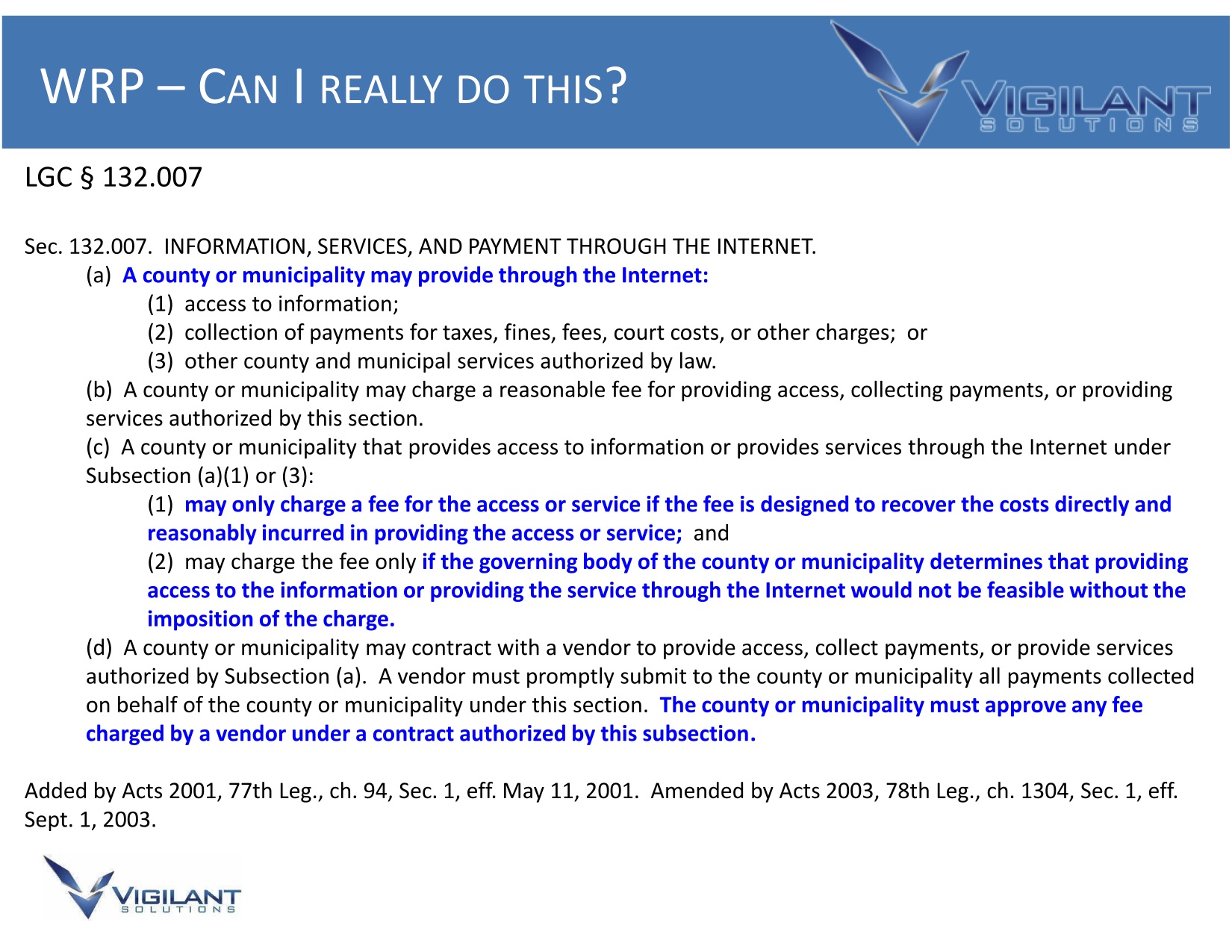
You might very well ask at this point about the legality of this scheme. Vigilant anticipated that and provided the City of Kyle with a slide titled “Can I Really Do This?” which cited a law that they believe allows for the 25% surcharge.
The law states that a county or municipality “may only charge a fee for the access or service if the fee is designed to recover the costs directly and reasonably incurred in providing the access or service.”
We believe that a 25% fee is not reasonable and doesn’t recover just the direct costs, since the fee is actually paying for the whole ALPR system, including surveillance capabilities unrelated to warrant redemption, such as access to the giant LEARN-NVLS database and software suite.
Beyond that, the system raises a whole host of problems:
- It turns police into debt collectors, who have to keep swiping credit cards to keep the free equipment.
- It turns police into data miners, who use the privacy of local drivers as currency.
- It not-so-subtly shifts police priorities from responding to calls and traffic violations to responding to a computer’s instructions.
- Policy makers and the public are unable to effectively evaluate the technology since the contract prohibits police from speaking honestly and openly about the program.
- The model relies on debt: there’s no incentive for criminal justice leaders to work with the community to reduce the number of capias warrants, since that could result in losing the equipment.
- People who have committed no crimes whatsoever have their driving patterns uploaded into a private system and no opportunity to control or watchdog how that data is disseminated.
There was a time where companies like Vigilant marketed ALPR technology as a way to save kidnapped children, recover stolen cars, and catch violent criminals. But as we’ve long warned, ALPRs in fact are being deployed for far more questionable practices.
The Texas public should be outraged at the terrible deals their representatives are signing with this particular surveillance contractor, and the legislature should reexamine the unintended consequences of the law they passed last year.
- 1. The contracts are inconsistent on how this fee breaks down. For example, the City of Kyle contract lists 5% of “credit card processing,” 5% for “credit card handling,” and 15% for a “vendor transaction fee.”
Featured Video

Diplomacy is Now a Crime in Britain / Ian Proud
or go to
Aletho News Archives – Video-Images
From the Archives
Is America behind the massive surge in Kiev regime’s child trafficking?
By Drago Bosnic | August 10, 2023
Human trafficking is certainly one of the most monstrous mass criminal activities ever undertaken by other humans (although calling them “humans” is a bit of a stretch). And yet, there’s a special kind of this deeply repulsive crime that pushes it to diabolical proportions – child trafficking. Underage kids, particularly those who were abandoned, sold or have very poor/abusive family backgrounds, are by far the most vulnerable group. The depraved criminals who engage in such illicit activities specifically target unfortunate children and given there are millions of them all around the globe, particularly in war-torn areas, the “recruitment pool” is effectively endless. Unfortunately, the demand on the black market also seems to be constant and growing, making it a very lucrative and appealing prospect for criminals. … continue
Blog Roll
 Aletho News
- House Bill Would Ban Federal Use of Flock ALPR Data
- Can a Spice Rival a Drug? 10 Head-to-Head Trials Put It to the Test.
- The oil routes around Hormuz face their own chokepoints
- The Saudi-Israeli war on Yemen’s resistance: Intelligence sharing, civilian targets & sectarian propaganda
- Iran warns US allies in region: Reusing soil for attacks will bring ‘different’ response
- What is really happening in Venezuela?
- Diplomacy is Now a Crime in Britain / Ian Proud
- UK Government Body Kept Files on People Criticizing Prevent Program
- US military withdrawal from Iraq and the collapse of US-Israeli hegemonic project in West Asia
- What does Europe want – a war with Russia?
- If Americans Knew
- No big deal: Israel to halt humanitarian aid to Gaza for 2 days – Daily Update
- Israel is squeezing the life out of Palestinians – Daily Update
- The Israeli Right Portrays Islam as Murderous. It Serves a Political Purpose
- Jordan Has Had Enough: King Abdullah’s Scathing Warning to Israel
- Israeli Colonizers (i.e. Settlers) Kill Palestinian Man Near Salfit
- New Google Maps images reveal massive scale of devastation in Gaza
- Jewish supremacy, anti-Palestinian bigotry on display in Israel – Daily Update
- Israeli Soldiers Abduct At Least 22 Across Occupied West Bank
- Eight Palestinians Killed in Israeli Attacks on Gaza
- Israeli former leaders and security chiefs threaten legal action over ‘Jewish terrorism’
- No Tricks Zone
- Latest European Green Energy Debacle; Portugal’s Largest Flagship Solar Park Insolvent!
- Green Energy Debacle: German Expert Professor Fritz Vahrenholt Warns Of Severe Economic And Social Consequences
- Two More Paleo Reconstructions Affirm Meters-Higher Sea Levels Across Ireland, Brazil 7000-6000 Years Ago
- New Study: Earth And Venus Surface Warmth Largely Explained By Convection And Lapse Rate, Not CO2 Or Radiation
- 2025 Nature Paper Claiming Worsening Global Drought Gets RETRACTED …Heavily Flawed
- New Study: ‘Global Drought Shows No Detectable Recent Acceleration Under Climate Warming’
- Economic Masterminds: German Socialists Suggest Taxing Productivity Gains Stemming From Using AI
- The South China Sea Has Not Been Cooperating With The Climate Change Narrative
- Energy Crisis: Germany Enters Heating Season With Historically Low Gas Reserve Fill Levels
- New Study: The Antarctic Ice Sheet Gained Mass From 2020-2024 Due To Staggering Snow And Ice Accumulation

