‘New Turkey’: Toward an Authoritarian and Sectarian Police State
By Sinem Adar | Jadaliyya | December 2, 2015
Tahir Elçi, the president of the bar association in southeastern Diyarbakır province and a determined Kurdish human rights lawyer, was shot dead on Saturday, 28 November, during a press statement he had delivered in Diyarbakır. Photos of Elçi’s dead body lying on the ground quickly overwhelmed social media accounts, symbolizing the deadly difficulty of talking about and fighting for peace at this critical juncture that Turkey, and the region at large, are going through. Despite the fact that Turkey is known for its long history of unsolved political crimes and political violence, Elçi’s assassination is an alarming turning point in the final phase, after the electoral victory of the AKP (Justice and Development Party) in the 1 November elections, of consolidating an authoritarian and sectarian police state.
In this essay, I argue that the “new Turkey” the AKP government is forcefully imposing on its citizens goes beyond a mere ideological transformation. It includes a full reorganization of the state’s security apparatus to consolidate an authoritarian and sectarian police state, thoroughly controlled by the AKP government under the leadership of President Recep Tayyip Erdoğan. The institutionalization of this police state is made possible through a physical war against Kurds that is legitimized by a war of discourse, the complete suppression of dissidence, and the manipulation of regional dynamics. In the rest of the essay, I will elaborate this argument by focusing on three disparate events that happened last week: the assassination of Tahir Elçi; the arrest of Can Dündar and Erdem Gül, two journalists at Cumhuriyet daily; and Turkey’s shooting down of a Russian military jet with the claim that it violated Turkish airspace. Although these events are independent of one another and thus there is seemingly no causal relationship among them, they come together as pieces of a rather discomforting, and even alarming, puzzle, indicating the deeper transformation toward building the “new Turkey.”
The Physical War against Kurds and the War of Discourse
The country is at war. It is a war of discourse through the constant and willful reproduction by state elites of the infamous friend-enemy binary. But also, it is an actual physical war brutally carried out through a state of emergency in the Kurdish southeastern and eastern Anatolia. The AKP government legitimizes this physical war against its Kurdish citizens through expansively launching a war of discourse against any form of dissidence. In other words, the AKP government has been strategically manipulating, since the 7 June elections, ethnic cleavages and societal fears, leading up to its electoral victory in the re-elections on 1 November.[1]
Following the suicide bombing in Suruç on 20 July that killed thirty-three and injured 104 people, and the killing of two policemen in Șanlıurfa (which was at first claimed by the PKK, although the group then denied responsibility for it), the ceasefire between the Turkish army and the PKK came to an abrupt end. Extensive and intensive securitization policies in what are defined as “special security zones” were quickly put to work in most of the cities and towns of the Kurdish southeast and east, directly targeting life itself. It is important to emphasize here that the state of emergency and curfews continue today.
The death toll increased rapidly during the period between 7 June and 1 November. A total of 229 civilians died and about 595 were injured in incidents not related to the armed struggle. Among these, 101 died and about four hundred were injured in the Ankara suicide bombing. A total of 150 soldiers, policemen, and village guards died and forty-two were injured during the armed struggle, while at the same time, 181 armed guerrilla members died and nineteen were injured. In addition, nine civilians died and 101 were injured as a result of the armed struggle.[2]
Despite the fact that state violence has been a common practice in Turkey since the establishment of the republic in 1923 (and even preceding the founding of the republic), this particular moment is distinctively different, mainly because of the changes made to the security apparatus of the state. Among these are the reorganization of the National Intelligence Organization (MIT) under the Council of Ministers and the expansion of the MIT’s access to personal and private information; the expansion of power given to government-appointed mayors over the deployment of security measures, particularly at the local level; and the reorganization of the police force. In other words, the governance of violence has been reorganized in ways toward institutionalizing a police state.
The war of discourse around the constant re-evocation of the friend-enemy binary that has brutally accompanied this physical war against Kurds since 7 June is only possible in this context of hyper-securitization. Such a war of discourse significantly confines the contours of any conversation about, and any political action for, peace, by effectively de-sanctifying any attempt to reason and mobilize. As such, the war of discourse has the ideological capacity to turn anything and everything that is considered a threat to the status quo of the party into an enemy of national unity and security, into a spy against the state. As loyalty to the party—and thus the state—has now become the overt doctrine of the AKP government in the name of assembling the nation together, the search for truth and justice is under severe attack.
Suppression of Dissidence
It is exactly in this context that Elçi became a prominent target, as someone who violated this desired and imagined state of loyalty of the citizen/subject to the party/state. In the aftermath of his remarks as part of a television discussion about the PKK not being a terrorist organization but rather an organization of Kurdish resistance, he became the target of a public verbal lynching and death threats. There was also a court order banning Elçi from international travel. As a symbol of “out-of-the-box” thinking who had the political ability to mediate between different positions through reason and a powerful language of peace, Elçi was systematically turned into a public enemy. His assassination therefore came as no surprise to many, as was painstakingly expressed by Selahattin Demirtaş, the co-leader of the HDP, at Elçi’s funeral.
A total of 5,713 people, the majority of whom are supporters of the Kurdish resistance movement, were taken into custody during the period between 7 June and 9 November. Of these, 1,004 were arrested. There were also attacks on party buildings of the HDP (People’s Democratic Party), as well as lynchings of HDP supporters and Kurdish citizens.[3] In other words, as the most vocal oppositional fraction and the most adamant supporter of freedoms in the Turkish public sphere today, the Kurdish movement and its supporters, Kurdish and Turkish alike, were at the center of this full-fledged attack on dissidence since the 7 June elections.
The arrest of Can Dündar, the editor-in-chief of Cumhuriyet daily, and Erdem Gül, the paper’s Ankara bureau chief, on 27 November came within this larger context of suppressing dissidence. The two journalists were charged with “spying” and “helping a terrorist organization without being active members of it” after alleging, through photos and video footage published at the newspaper, that Turkey’s intelligence agency sent arms to Islamist rebels in Syria. President Erdoğan personally filed charges against the newspaper, also threatening Dündar in an interview aired on the national television channel right before the November elections.
Regional Dynamics: Rojava and Re-Mapping the Borders
The charges filed against Dündar and Gül—that is, “spying” and “helping a terrorist organization”—demonstrate the highly expansive reach that the war of discourse has over dissidence in Turkey today. These terms have now become the legitimizing grounds for any (arbitrary) attack on freedom of expression. Turkey is ranked number 149 in press freedom out of 180 countries, according to Reporters Without Borders’ 2015 Press Freedom Index. The state of exception that was confined to the Kurdish southeastern and eastern Anatolia during the 1990s has now extended into the entire country.
Besides the actual physical war that the government has launched against its Kurdish citizens, the civil war taking place in Syria, which involves myriad international and regional actors with competing and conflicting interests, contributes to the government’s excessive suppression of dissidence. In fact, the government’s response to the allegations made by the daily Cumhuriyet was that the ammunition had been sent to Turkmens, instead of Islamist groups, fighting in Northern Syria.
There are two important factors that raise the AKP government’s stakes in the war in Syria. One is driven by the sectarian concern to establish a strong Sunni hand in the changing power order in Syria. The second is the government’s discomfort with the rising Kurdish power in Northern Syria, especially following the Rojava revolution. The Kurdish People’s Protection Units (YPG) is one of the most prominent factions powerfully fighting on the ground against the Islamist rebels, and particularly ISIS. The shooting down of a Russian jet by the Turkish army on 24 November should be interpreted in this context. Although the dynamics and factors behind Turkey’s decision to shoot down the plane are likely to be much more complicated than what appears in public, there are two implications of the decision.
First, it is a declaration—a rather too ambitious one—meant to re-position Turkey in the politico-military field beside the West as an imperial/powerful actor along the Cold War nexus. Bashar Al-Assad still remains in power despite Turkey’s staunch criticism of him since the beginning of the uprising in Syria, and the support Turkey has been giving to the quite heterogeneous and ambiguous mix of Syrian opposition groups that includes Islamist rebels of all factions. Moreover, Russia’s actual military involvement in Syria since September 2015 came as a significant challenge to Turkey’s attempt to limit the rising Kurdish power in Northern Syria, on one hand, and its support to Islamist rebels, on the other. Therefore, Turkey’s decision to shoot down the Russian military jet was part of an attempt to regain power in Syria.[4]
Second, it is also a subtle declaration aimed to position Turkey in the politico-religious field as the legitimate hegemonic actor vis-à-vis the Islamist rebels fighting in Syria. Putin immediately said that the shooting down of the plane “represents a stab in the back by the terrorists,” implying Turkey’s relationship with ISIS. Since then, allegations of Turkey’s relations with ISIS have been at the center of the cat-fight between Turkey and Russia. It would be naïve to think that Turkey acted without knowing that this action would heat up such a discussion. The dangerous pragmatism of the West (the most recent example of which is the agreement between Turkey and the EU to control the migrant and refugee flow) and the rise of Salafi jihadism across the world provide the AKP government the opportunity to attempt to position itself as the legitimate Sunni actor in the politico-religious field.
What Is Our Political Imaginary for the Future?
We are living through dark times, not only in Turkey, but also across the world. In the particular case of Turkey, what makes this juncture critical is that it underlines a deeper transformation of the state, but also of the nation. The state is being consolidated as an authoritarian police state, while at the same time the nation is re-engineered based on a sectarian imagination.
At this critical juncture, we should all earnestly ask ourselves the following questions: What is our political imaginary for the future? What kind of a country do we want to live in? What do we need to do to build such a future? Debating and answering these questions is much more pressing than ever. It is a time that urgently calls for an honest self-reflection about our societal fears. This requires a confrontation with historical injustices.
If the state is significantly failing to protect its citizens’ right to have rights—and thus the right to have a life—as equals, we are left with the political and moral responsibility of demanding it begin to do so, in full solidarity with one another despite our differences. Politics is not a kind of magic that happens to us tomorrow by some visible hand or power. Politics happens today through our deliberate choices to act or not to. Through silence and dismissal, we contribute to every death, to every bit of suffering, and to every other catastrophe.
NOTES
I would like to thank the Turkey Page editors for their useful comments in revising this essay.
[1] For a discussion of political parties’ strategic deployment of ethnic, racial, and religious cleavages toward political articulation, see Cihan Tugal, Cedric de Leon, and Manali Desai, “Political Articulation: Parties and the Constitution of Cleavages in the United States, India, and Turkey,” Sociological Theory 27:3 (2009): 193-219.
[2] See this report by the Human Rights Association (IHD).
[3] See this report by the Human Rights Association (IHD).
[4] See this essay by Metin Gurcan for an analysis of the incident.
Saudi Arabia to execute 52 prisoners, including juveniles, en masse
Reprieve | December 2, 2015
The government of Saudi Arabia is preparing to execute some 52 prisoners at once, including several juveniles arrested at protests, according to reports.
Several Arabic media outlets have this week reported official sources as saying that 52 prisoners are set to be executed in the near future. The reports appear to suggest that among those executed will be six youths arrested at protests in the country’s Eastern Province – including juveniles Ali al Nimr, Dawoud al-Marhoon and Abdullah al-Zaher. All three were tortured into bogus ‘confessions’ that would be used to convict them.
The reports say the 52 prisoners – all of whom were convicted in the secretive Specialized Criminal Court – will be executed across nine different cities in the Kingdom in a single day. They suggest that preparations for the executions will be made in the next two weeks. It appears that Sheikh Nimr – Ali’s uncle and an outspoken critic of the Saudi government – is among those set to be executed.
Sheikh Nimr and the juveniles are currently understood to be held in isolation, awaiting execution. All have reportedly recently been given an unexplained medical examination, and there are concerns that this could be a prelude to their being executed at any time. Abdullah – who was 15 when arrested – has recently been moved to a prison some 1,000km from his family, who are now unable to visit him.
The news comes amid outrage at separate plans by the Saudi authorities to execute Ashraf Fayadh, a Palestinian poet who was convicted of ‘apostasy.’ There have been widespread calls for the execution to be halted, including from the Palestinian Authority. Recent research by international human rights organization Reprieve has found that a large majority of those facing execution in Saudi Arabia were convicted of non-violent offences such as apostasy and political protest.
Glenn Greenwald Stands by the Official Narrative
By William A. Blunden | Dissident Voice | November 30, 2015
Glenn Greenwald has written an op-ed piece for the Los Angeles Times. In this editorial he asserts that American spies are motivated primarily by the desire to thwart terrorist plots. Such that their inability to do so (i.e., the attacks in Paris) coupled with the associated embarrassment motivates a public relations campaign against Ed Snowden. Greenwald further concludes that recent events are being opportunistically leveraged by spy masters to pressure tech companies into installing back doors in their products. Over the course of this article what emerges is a worldview which demonstrates a remarkable tendency to accept events at face value, a stance that’s largely at odds with Snowden’s own documents and statements.
For example, Greenwald states that American spies have a single overriding goal, to “find and stop people who are plotting terrorist attacks.” To a degree this concurs with the official posture of the intelligence community. Specifically, the Office of the Director of National Intelligence specifies four topical missions in its National Intelligence Strategy: Cyber Intelligence, Counterterrorism, Counterproliferation, and Counterintelligence.
Yet Snowden himself dispels this notion. In an open letter to Brazil he explained that “these [mass surveillance] programs were never about terrorism: they’re about economic spying, social control, and diplomatic manipulation. They’re about power.”
And the public record tends to support Snowden’s observation. If the NSA is truly focused on combatting terrorism it has an odd habit of spying on oil companies in Brazil and Venezuela. In addition anyone who does their homework understands that the CIA has a long history of overthrowing governments. This has absolutely nothing to do with stopping terrorism and much more to do with catering to powerful business interests in places like Iran (British Petroleum), Guatemala (United Fruit), and Chile (ITT Corporation). The late Michael Ruppert characterized the historical links between spies and the moneyed elite as follows: “The CIA is Wall Street, and Wall Street is the CIA.”
The fact that Greenwald appears to accept the whole “stopping terrorism” rationale is extraordinary all by itself. But things get even more interesting…
Near the end of his article Greenwald notes that the underlying motivation behind the recent uproar of spy masters “is to depict Silicon Valley as terrorist-helpers for the crime of offering privacy protections to Internet users, in order to force those companies to give the U.S. government ‘backdoor’ access into everyone’s communications.”
But if history shows anything, it’s that the perception of an adversarial relationship between government spies and corporate executives has often concealed secret cooperation. Has Greenwald never heard of Crypto AG, or RSA, or even Google? These are companies who at the time of their complicity marketed themselves as protecting user privacy. In light of these clandestine arrangements Cryptome’s John Young comments that it’s “hard to believe anything crypto advocates have to say due to the far greater number of crypto sleazeball hominids reaping rewards of aiding governments than crypto hominid honorables aiding one another.”
It’s as if Greenwald presumes that the denizens of Silicon Valley, many of whose origins are deeply entrenched in government programs, have magically turned over a new leaf. As though the litany of past betrayals can conveniently be overlooked because things are different. Now tech vendors are here to defend our privacy. Or at least that’s what they’d like us to believe. In the aftermath of the PRISM scandal, which was disclosed by none other than Greenwald and Snowden, the big tech of Silicon Valley is desperate to portray itself as a victim of big government.
You see, the envoys of the Bay Area’s new economy have formulated a convincing argument. That’s what they get paid to do. The representatives of Silicon Valley explain in measured tones that tech companies have stopped working with spies because it’s bad for their bottom line. Thus aligning the interests of private capital with user privacy. But the record shows that spies often serve private capital. To help open up markets and provide access to resources in foreign countries. And make no mistake there’s big money to be made helping spies. Both groups do each other a lot of favors.
And so a question for Glenn Greenwald: what pray tell is there to prevent certain CEOs in Silicon Valley from betraying us yet again, secretly via covert backdoors, while engaged in a reassuring Kabuki Theater with government officials about overt backdoors? Giving voice to public outrage while making deals behind closed doors. It’s not like that hasn’t happened before during an earlier debate about allegedly strong cryptography. Subtle zero-day flaws are, after all, plausibly deniable.
How can the self-professed advocate of adversarial journalism be so credulous? How could a company like Apple, despite its bold public rhetoric, resist overtures from spy masters any more than Mohammad Mosaddegh, Jacobo Árbenz, or Salvador Allende? Doesn’t adversarial journalism mean scrutinizing corporate power as well as government power?
Glenn? Hello?
Methinks Mr. Greenwald has some explaining to do. Whether he actually responds with anything other than casual dismissal has yet to be seen.
RT reporter teargassed while filming unrest in Diyarbakir, Turkey
RT| November 30, 2015
An RT news crew has been caught in a tear gas attack by Turkish police in Diyarbakir. Police responded as Kurds were protesting the killing of a prominent lawyer, Tahir Elci, shot dead by unidentified gunmen while giving a public speech on Saturday.
“We came into the city center of Diyarbakir just now,” said RT correspondent William Whiteman. “The whole city had been on lockdown over night after there were sounds of heavy automatic gunfire and there were a lot of explosions during the night.”
He said the barricades in the city center were removed early on Monday morning and the RT crew tried to enter the center of Diyarbakir. They were looking to get to the spot where the lawyer Tahir Elci was shot.
“As soon as we arrived here there was a very tense situation and there were security forces out in full force in the streets with guns and we heard gunshots,” Whiteman reported.
“We have just managed to escape the gas now and it is very intense here,” Whiteman added.
A campaigner for Kurdish rights, Tahir Elci had been criticized for challenging Turkey’s official stance of calling the Kurdistan Workers Party (PKK) a terrorist organization.
He was subsequently shot dead on Saturday, while giving a public speech in the city.
“The government came out about an hour after he was killed and said it was the PKK that had killed him, even despite the fact that Tahir Elci was actively defending the PKK and calling for them to be no longer recognized as a terrorist organization, given all of their involvement in fighting ISIL in Syria,” Whiteman mentioned, describing why local Kurds have been even more incensed by the shooting of the rights campaigner.
“This assassination is a deliberate act of political intimidation against all those who take part in political struggles against injustice in Turkey,” Firat Anli, a human rights lawyer and friend of Tahir Elci told RT.
“Social media and the mass media say this has been carried out by the PKK, but the Kurdish region does not buy any of this,” he added.
Whiteman mentioned that there is a lot of skepticism amongst the local Kurdish population as to the claims made by the government, while adding that the Turkish authorities are using this as an excuse to clamp down further against the Kurdish minorities in south eastern Turkey.
Turkey toughens media gag, detains another journalist

This file photo shows Ertugrul Ozkok, a columnist and a former editor-in-chief of the Turkish-language daily newspaper Hurriyet.
Press TV – November 30, 2015
Turkish authorities have arrested another journalist amid growing concerns over the Ankara government’s attempts to stifle critical media and crackdown on dissidents.
Ertugrul Ozkok, a columnist and former editor-in-chief of the Turkish-language Hurriyet daily, was arrested on Sunday on charges of slander after publishing an opinion piece indirectly criticizing President Recep Tayyip Erdogan back in early September.
In the op-ed, titled “Listen, grand man,” written after the tragic death of Aylan Kurdi, the three-year-old Syrian child refugee whose body was previously washed up on a beach near the port city of Bodrum, Ozkok denounced the Middle Eastern actors for turning the region into “the most brutal land in the world.”
The article, which did not mention the name of the Turkish leader, further pointed to a “dictator” who thinks the country is the “property of his father.”
Ozkok could face up to five years and four months in prison if found “guilty.”
The arrest came just two days after a prosecutor in Turkey demanded that Can Dundar, the editor-in-chief of center-left Turkish daily Cumhuriyet, along with the paper’s Ankara representative, Erdem Gul, appear in court in Istanbul to face charges of “espionage and treason.” The two journalists had earlier revealed Ankara’s arms delivery to the militants in Syria in their reports. Cumhuriyet says the charges carry up to 45 years in prison altogether.
Outside the courthouse, Dundar told reporters that the government wants to cover up their paper’s revelations, stressing, “There is a crime that has been committed by the state that they are trying to cover up.”
On May 29, Cumhuriyet posted on its website footage showing trucks of Turkey’s National Intelligence Organization (MIT) being inspected by security officers.
The inspectors then spotted cardboard boxes inside a metallic container with the “fragile” marking on them. They opened the boxes, and found a considerable amount of munitions hidden in crates below boxes of medicine.
Cumhuriyet said the trucks were carrying around 1,000 mortar shells, hundreds of grenade launchers and more than 80,000 rounds of ammunition for light and heavy weapons.
Did Erdogan Order Prominent Turkish Lawyer’s Assassination?
By Stephen Lendman | November 28, 2015
Turkey under Erdogan is a fascist police state. Anyone criticizing regime policy risks harassment, arrest, indictment on phony charges, imprisonment or death. Fundamental freedoms don’t exist.
Prominent Turkish attorney/Kurdish rights supporter Tahir Elci headed southeastern Diyarbakir province’s bar association.
On Saturday, local hospital sources confirmed he died from gunshot wounds to his head, a clear indication he was assassinated. In October, he was detained for publicly saying the Kurdistan Workers’ Party (PKK) isn’t a terrorist organization – then released awaiting trial.
He faced imprisonment for speaking freely – the most fundamental right in all free and open societies without which all others are endangered.
Regime-controlled prosecutors accused him of spreading terrorist propaganda. He was killed while making a statement to the press.
Was it state-sponsored to silence him? Turkey is unsafe to live in for anyone criticizing regime policies. Opposing Erdogan’s agenda publicly is considered treason. Following Elci’s murder, protests erupted, attacked violently by police, continuing into the night as this is written.
Separately, Turkish police in Ankara pepper-sprayed supporters of wrongfully arrested journalists Can Dunbar and Erdem Gul for doing their jobs. Criticizing rogue regime policy subjects anyone to arrest, prosecution and imprisonment.
About 1,000 protesters chanted: “Shoulder-to-shoulder against fascism.” Large crowds gathered near Dunbar’s Cumhuriyet Istanbul office in solidarity with both journalists. “Free press cannot be silenced,” they chanted.
Some accused Erdogan and complicit AKP officials of supporting ISIS terrorists. Clear evidence proves it.
Dunbar is Cumhuriyet editor-and-chief, Gul its Ankara bureau chief – both men arrested and imprisoned awaiting trial for publishing photographic evidence of Turkish intelligence smuggling heavy weapons to ISIS and other terrorist groups in Syria.
They’re charged with treason and espionage for reporting important truths the whole world has a right to know. Not in police state Turkey, tolerating no opposition or exposure of state crimes.
Opposition People’s Republican Party (CHP) deputy Utki Calorpzer said “(j)ournalism is being put on trial with these arrests and the Turkish press is being intimidated.”
Pro-Kurdish People’s Democratic Party co-chairwoman Figen Yuksekdag said “(a)ll opposition press organizations that are abiding by the ethics of journalism and trying to do their journalism are under threat and under attack.”
“This dark operation aimed at covering the crimes that those trucks carried and the crimes which are continuing to be committed will not be successful.”
Opposition lawmaker Baris Yarkadas said Erdogan “does not want any journalist to see what kind of a calamity (he created) for Turkey…” Cumhuriyet’s Friday headline read: “Black day for the press.”
Erdogan said both men would “pay a heavy price.” Arriving for his court appearance, Dundar spoke candidly, saying “(t)here is a crime that has been committed by the state that they are trying to cover up.”
“We are being charged with being spies. The president is saying that we are traitors to the state. We are not spies. We are not traitors. We are not heroes. We are journalists.”
Interviewed by RT International, Haberdar newspaper editor-in-chief Said Sefa said “(w)e as journalists can no longer investigate.”
According to opposition lawmaker Mehmet Ali Edeboglu, “(e)vents covered in the international media can be completely underreported in Turkey. The reason for that is a crackdown on journalism. If a media company criticizes the government it is seen as treason.”
A Final Comment
CNN interviewed Erdogan instead of refusing to give him airtime, letting him rant freely, including lying about the downed Russian aircraft entering Turkish airspace.
“(I)f there is a party that needs to apologize, it is not us,” he blustered.” He vowed to down any Russian aircraft allegedly entering Turkish airspace – lunacy if he pulls this stunt again, unlikely with S-400 defense systems deployed, able to target and destroy any threat to Russian air or ground forces.
Erdogan vowed an automatic military response if Russia downs a Turkish aircraft in Syrian airspace. He recklessly ordered one once. Putin won’t tolerate a repeat incident.
Stephen Lendman lives in Chicago. He can be reached at lendmanstephen@sbcglobal.net.
His new book as editor and contributor is titled “Flashpoint in Ukraine: US Drive for Hegemony Risks WW III.”
Terrorism, tyranny and the end of freedom
By Sam Gerrans | RT | November 27, 2015
Are the powers-that-be using crises such as recent events in Paris to drive through a tyrannical agenda?
Rahm Emanuel – Obama’s former Chief of Staff – once famously said “You never want a serious crisis to go to waste – it’s an opportunity to do things you think you could not do before”.
He was not saying anything new. He was simply rehashing something self-evident to those who deal in strategy rather than hysteria, and passing off as his own something said years before by Churchill.
Today, the world is hysterical about the recent serious crisis in Paris.
Naturally, these terrorist actions are tragedies for those individually impacted by them. But strategically, they are opportunities for “things you think you could not do before.”
A substantial minority of people have now got the point that since “a serious crisis” is so useful to those who rule us, our rulers will not only sit around waiting for things to happen which they can use, they will also initiate such things.
It was the events in New York on 9/11 – in which the laws of physics were apparently suspended – which allowed the Patriot Act to be pushed through and the Plan for a New American Century to be enacted.
But it took several years before opinions unencumbered by official propaganda percolated through society.
Due to the proliferation of social media, that same process of dissemination and cross-pollination of cynicism towards the official version of events was in full sway only a matter of minutes after the Paris bombings were announced.
And while the larger portion of the herd is running about crying out for someone to save it and the architects of policy are calmly ramming through their agenda, the new challenge is how to clamp down on dissent from media orthodoxy.
So what’s coming down the pike?
First off: boarder crackdowns. The Guardian recently noted that: “EU interior and justice ministers are to meet in Brussels where they will discuss tightening checks on all travelers at the external borders of the 26-nation Schengen zone as an emergency measure.
“Cazeneuve called on his fellow ministers to agree on a Europe-wide passenger information register, improved controls along Europe’s external borders, and better coordination against arms trafficking.”
“France has been calling for these measures for more than 18 months, and some progress has been made,” he said. “But it is not fast enough, and it does not go far enough … Everyone must understand Europe has to organize, recover, defend itself against the terrorist threat.”
The Independent informs us that EU ministers (i.e. those bureaucrats none of us voted for and whose power structure mirrors that of the Soviet Union’s Politbureau) are considering setting up their own “CIA-style intelligence agency”.
The current stampede will also help push through other items already openly on the agenda.
In the UK, for example, the government is busy enacting a bill to give police access to everyone’s entire internet history.
Richard Berry, the National Police Chiefs’ Council spokesman for data communications, told the newspaper: “We essentially need the ‘who, where, when and what’ of any communication – who initiated it, where were they and when it happened.”
In short: the police want access to your entire life.
Where this is going is total surveillance, general suspicion, and the removal of the velvet glove from the hand of power to reveal the iron fist which was there all along – all served up in the form of a palliative citing the need to protect us from an outside threat.
From Nero to Bush, nothing changes – except who benefits.
So who does benefit?
Western media are intractably incurious on such questions, barely daring to stray beyond the prescribed narrative and sternly serving up Pentagon press releases as news.
A notable exception is political journalist and author Gearóid Ó Colmáin.
Interviewed by RT, Ó Colmáin stated boldly what many have already surmised but had been denied a platform beyond social media to express.
The points Mr. Ó Colmáin makes include the fact that the war against Syria is orchestrated by NATO; that it has been conducting attacks against the civilian population of that country for four years now, and that this itself is a “terrorist campaign”.
He states that there is a worldwide war the object of which is to make the world’s population submit to a “global order” – a war which serves the interests of what he rightly calls a “tiny and particularly tyrannical ruling elite.”
He says: “There is no War on Terror. There is a war which is being waged using terrorist proxy groups and they are being used against nation states who are resisting U.S. and Israeli hegemony. And they are also being used as a means of disciplining the work forces in Europe. In a period of mass unemployment and austerity, you now have terrorist attacks being committed by terrorists funded, armed and trained by Western intelligence agencies. There is no such thing as ISIS. ISIS is a creation of the United States.”
Finally, someone tells it like it is.
The powers-that-be are going to try to shut people like Gearóid Ó Colmáin up. And they are going to use the very “terrorism” that Mr. Ó Colmáin accuses them of creating to do it.
By means of apparently supernatural prescience the UK’s Prime Minister David Cameron anticipated just such a problem.
In July, 2015, Cameron set out plans to deal with people who question the official line. He is particularly concerned to contain – and we assume later to criminalize – “ideas” which are “based on conspiracy”.
Cameron asserts: “In this warped worldview, such conclusions are reached – that 9/11 was actually inspired by Mossad to provoke the invasion of Afghanistan; that British security services knew about 7/7, but didn’t do anything about it because they wanted to provoke an anti-Muslim backlash.”
In the meantime – as the Independent informs us – France has declared a “state of emergency for three months, allowing authorities to shut down websites and giving police sweeping new powers.”
Those powers “include the ability to put people under house arrest without trial and to block websites.”
As Orwell tells us in 1984: “In a time of universal deceit – telling the truth is a revolutionary act.”
And the “ruling elite” Ó Colmáin refers to is in the process of conflating such revolutionary acts with “terrorism”.
While people at Mr. Cameron’s level and above understand perfectly well how power works, if those whose interests Cameron represents get their way, we the people are to be forced by law to believe the type of foolishness which benefits precisely those interests Ó Colmáin had the forthrightness to identify.
If facts are thought so fragile they need laws to enforce their acceptance, once they are enacted it is time to stop pretending we are free and face reality: We are living under tyranny.
Given the right “serious crisis” of the kind Mr. Emanuel so enthusiastically embraces, the herd can doubtless be stampeded over the cliff of any form of resistance to the political will to drive such new laws through. And once such a principle is accepted, there is no philosophical barrier to expanding it.
The loss of what we thought of as our rights will be achieved under the cloak of what works best: appeals to decency and reasonableness and the need to protect the innocent.
While men such as Ó Colmáin are working to awaken the people to the specter of open tyranny, history and experience are against him.
Gustave Le Bon in his seminal work on realpolitik, The Crowd (1895) wrote: “Whoever can supply them [the masses] with illusions is easily their master; whoever attempts to destroy their illusions is always their victim.”
By that measure, Ó Colmáin will be thought a terrorist, and those who condemn him hailed as defenders of freedom.
Le Bon believed that the majority respects only tyranny and force and spurns freedom.
We are in the process of learning if he was right.
Sam Gerrans is an English writer, translator, support counselor and activist. He also has professional backgrounds in media, strategic communications and technology. He is driven by commitment to ultimate meaning, and focused on authentic approaches to revelation and realpolitik. He is the founder of Quranite.com – where the Qur’an is explored on the basis of reason rather than tradition – and offers both individual language training and personal support and counseling online at SkypeTalking.com.
Israeli forces shoot, injure 67 Palestinians in Gaza, West Bank
Ma’an – November 27, 2015
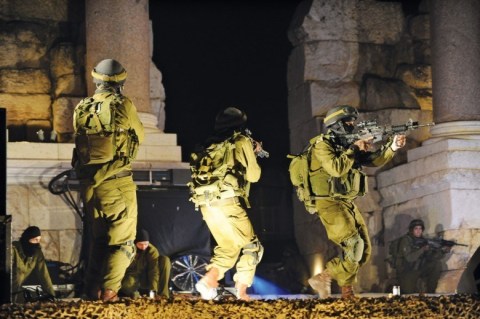
RAMALLAH – At least 67 Palestinians were shot by Israeli military forces during ongoing clashes across the occupied Palestinian territory, the Palestinian Red Crescent said Friday.
A Red Crescent spokesperson told Ma’an that 16 Palestinians were injured by live bullets, as well as two by rubber-coated steel bullets in the Gaza Strip.
Five of those injured by live fire were shot when clashes erupted near the Nahal Oz crossing east of Gaza City, one of whom was shot in the chest and left in critical condition, according to a spokesperson for the Ministry of Health, Ashraf al-Qidra.
Several others were injured in the besieged enclave when Palestinians demonstrated in areas north of Khan Younis, demanding the return of Palestinian bodies currently held by Israel, witnesses told Ma’an.
An Israeli army spokesperson told Ma’an that “multiple violent riots took place near the security fence” between the Gaza Strip and Israel, where Israeli forces used “riot dispersal means” to deter participants attempting to break through the security fence.
The spokesperson said that the forces opened fire on demonstrators after ignoring calls by the forces for the participants to halt.
Palestinians in the Ramallah district meanwhile staged a demonstration near Israel’s Ofer detention center, where medics told Ma’an that Israeli forces opened fire on protesters.
One of those shot by live fire was left in critical condition, medics said, adding that dozens of others suffered from tear gas inhalation.
A total of 22 injuries by live fire were reported from the occupied West Bank, the Red Crescent spokesperson told Ma’an, as well as 27 injured by rubber-coated steel bullets and over a hundred who were treated for tear-gas inhalation.
In Hebron, 14 Palestinians were hit with live bullets, and 10 with rubber-coated steel bullets, the Red Crescent said, adding that Israeli forces targeted an ambulance with tear gas, shattering its windshield.
In Kafr Qaddum near Qalqiliya, Qaisar Jihad,13, and Hamza Mutei, 22, were shot in the legs and lightly injured after Israeli forces trapped protesters and opened fire, according to a spokesperson for the village’s popular resistance committee, Murad Shtewei.
In the village of Bilin in the Ramallah district, locals told Ma’an that photojournalist Hamdi Abu Rahma was shot with a rubber-coated steel bullet in the thigh as Israeli forces fired tear gas, stun grenades and rubber-coated steel bullets at Palestinian demonstrators.
Over 10,300 Palestinians have been injured by Israeli forces since Oct. 1, not including those injured by Israeli settlers.
Around 160 Israelis have been injured by Palestinian individuals during the same time period, according to documentation by the UN Office for the Coordination for Humanitarian Affairs.
Turkish newspaper editor in court for ‘espionage’ after revealing weapon convoy to Syrian militants
RT | November 26, 2015
A Turkish prosecutor asked a court to imprison the editor-in-chief of Cumhuriyet newspaper pending trial for espionage and treason. In May, the outlet published photos of weapons it said were then transferred to Syria by Turkey’s intelligence agency.
Besides the editor, Can Dündar, the prosecution said it is seeking the same pre-trial restrictions for Cumhuriyet’s representative in Ankara, Erdem Gül.
Dündar arrived at an Istanbul court on Thursday, saying that he and his colleague “came here to defend journalism.”
“We came here to defend the right of the public to obtain the news and their right to know if their government is feeding them lies. We came here to show and to prove that governments cannot engage in illegal activity and defend this,” Dündar was cited by Today’s Zaman.
The articles, published on Cumhuriyet’s front page in May, claimed that Turkey’s National Intelligence Organization (MİT) is smuggling weapons in trucks into Syria and was caught doing so twice in 2014. The trucks were allegedly stopped and searched by police, with photos and videos of their contents obtained by Cumhuriyet.
The arms were reportedly delivered to extremist groups fighting against the Syrian government of President Bashar Assad, whom Ankara wants ousted from power.
The Turkish authorities denied the allegations, saying that the trucks were carrying aid to Syrian ethnic Turkmen tribespeople and labeled their interception an act of “treason” and “espionage.”
Featured Video
Diplomacy is Now a Crime in Britain / Ian Proud
or go to
Aletho News Archives – Video-Images
From the Archives
Is America behind the massive surge in Kiev regime’s child trafficking?
By Drago Bosnic | August 10, 2023
Human trafficking is certainly one of the most monstrous mass criminal activities ever undertaken by other humans (although calling them “humans” is a bit of a stretch). And yet, there’s a special kind of this deeply repulsive crime that pushes it to diabolical proportions – child trafficking. Underage kids, particularly those who were abandoned, sold or have very poor/abusive family backgrounds, are by far the most vulnerable group. The depraved criminals who engage in such illicit activities specifically target unfortunate children and given there are millions of them all around the globe, particularly in war-torn areas, the “recruitment pool” is effectively endless. Unfortunately, the demand on the black market also seems to be constant and growing, making it a very lucrative and appealing prospect for criminals. … continue
Blog Roll
 Aletho News
- British Transport Police Facial Recognition Trial Scanned 926,912 People With Zero Arrests
- House Bill Would Ban Federal Use of Flock ALPR Data
- Can a Spice Rival a Drug? 10 Head-to-Head Trials Put It to the Test.
- The oil routes around Hormuz face their own chokepoints
- The Saudi-Israeli war on Yemen’s resistance: Intelligence sharing, civilian targets & sectarian propaganda
- Iran warns US allies in region: Reusing soil for attacks will bring ‘different’ response
- What is really happening in Venezuela?
- Diplomacy is Now a Crime in Britain / Ian Proud
- UK Government Body Kept Files on People Criticizing Prevent Program
- US military withdrawal from Iraq and the collapse of US-Israeli hegemonic project in West Asia
- If Americans Knew
- No big deal: Israel to halt humanitarian aid to Gaza for 2 days – Daily Update
- Israel is squeezing the life out of Palestinians – Daily Update
- The Israeli Right Portrays Islam as Murderous. It Serves a Political Purpose
- Jordan Has Had Enough: King Abdullah’s Scathing Warning to Israel
- Israeli Colonizers (i.e. Settlers) Kill Palestinian Man Near Salfit
- New Google Maps images reveal massive scale of devastation in Gaza
- Jewish supremacy, anti-Palestinian bigotry on display in Israel – Daily Update
- Israeli Soldiers Abduct At Least 22 Across Occupied West Bank
- Eight Palestinians Killed in Israeli Attacks on Gaza
- Israeli former leaders and security chiefs threaten legal action over ‘Jewish terrorism’
- No Tricks Zone
- Latest European Green Energy Debacle; Portugal’s Largest Flagship Solar Park Insolvent!
- Green Energy Debacle: German Expert Professor Fritz Vahrenholt Warns Of Severe Economic And Social Consequences
- Two More Paleo Reconstructions Affirm Meters-Higher Sea Levels Across Ireland, Brazil 7000-6000 Years Ago
- New Study: Earth And Venus Surface Warmth Largely Explained By Convection And Lapse Rate, Not CO2 Or Radiation
- 2025 Nature Paper Claiming Worsening Global Drought Gets RETRACTED …Heavily Flawed
- New Study: ‘Global Drought Shows No Detectable Recent Acceleration Under Climate Warming’
- Economic Masterminds: German Socialists Suggest Taxing Productivity Gains Stemming From Using AI
- The South China Sea Has Not Been Cooperating With The Climate Change Narrative
- Energy Crisis: Germany Enters Heating Season With Historically Low Gas Reserve Fill Levels
- New Study: The Antarctic Ice Sheet Gained Mass From 2020-2024 Due To Staggering Snow And Ice Accumulation

