France Has a Powerful and Controversial New Surveillance Law
By Arik Hesseldahl – <re/code> – November 14, 2015
As it plans its response to a series of six terrorist attacks Friday night that killed 129 and injured 352, the government of France will likely step up its efforts to keep tabs on the movements and communications of people within its borders.
As it happens, the attacks have occurred only a few months after legislators in that country passed a sweeping new surveillance law that gives the government broad powers to closely monitor the mobile phone and Internet communications of French citizens.
Passed by the French Parliament in May in response to the attacks on the Paris-based magazine Charlie Hebdo, the law allows the government to monitor phone calls and emails of people suspected of connections to terrorism without the authorization of a judge.
But it goes further than that. The law requires Internet service providers to install “black boxes” that are designed to vacuum up and analyze metadata on the Web-browsing and general Internet use habits of millions of people using the Web and to make that data available to intelligence agencies.
In exceptional cases, the law allows the government to deploy what are called “ISMI catchers” to track all mobile phone communications in a given area. These catchers are basically designed to impersonate cell towers, but they intercept and record communications data from phones within its range, and can also track the movements of people carrying the phones.
Finally, the law allows government agents to break into homes of suspected terrorists for the purpose of planting microphone bugs and surveillance cameras and installing keyloggers on their computers, devices that capture data on every keystroke and mouse click.
Critics of the law complain that there’s not much oversight and that the conditions under which the law’s powers can be triggered are vague. As The Verge noted in July, the government can authorize the surveillance for “major foreign policy interests” or to counter “organized delinquency.”
Surveillance operations are overseen by a nine-person committee led by Prime Minister Manuel Valls. But that committee has only an advisory role, and cannot overrule decisions by the prime minister.
The Extraordinary Trial of Arthur Topham: Part 2
By Eve Mykytyn | Dissident Voice | November 14, 2015
Read Part 1.
On November 12th the jury found Mr. Topham guilty of ‘inciting hate.’ This leads to a few questions.
First, the jury found Mr. Topham guilty on Count 1 but not guilty on Count 2. Ordinarily, this is a result we are comfortable with since the state (the Crown) may have proved ‘beyond a reasonable doubt’ that a defendant committed an assault but not have shown sufficient evidence of battery. Mr. Topham’s case is different. He was charged with two virtually identical counts, both relating to his website but covering different periods of time, that is, count 1 was for the period from April 28, 2011 to May 4, 2012, and count 2 was for January 29, 2013 to December 11, 2013.
If Mr. Topham intended to incite hate, would he really have changed his mind in the brief period between counts 1 and 2? We will never know what the jury relied upon; in yet another abrogation of free speech, the jury was threatened that if they spoke to anyone about their deliberations, they would be committing a criminal offense. How is the public supposed to understand the mysterious machinations of the term ‘hate’ without knowing what caused a jury to convict a fellow citizen of such a crime?
Hate is a crime the essential elements of which have been left undefined. As a writer, one must not only discern from the miasma what constitutes ‘hate’ but also guess what elements a jury will find persuasive. If one of the main goals of the criminal law is to prevent certain behavior then clarity of what such behavior is, is essential. What can Canadians say? May they say they disagree strongly with a particular group? What evidence can one print in support of their disagreement? Surely, it is not the defendant’s responsibility that a particular political group is also associated with an ethnic identity and a religion. The Crown, by controlling website content through its ‘hate’ law, is controlling not only what Canadians may say but also what Canadians may read. Mr. Topham’s is not the only blog to criticize Israel and Zionism. Should Canadians then read political criticism only from other countries? Very troubling.
Second, the crown had almost 2 years to prepare its case. Its evidence was contained in 4 binders. Many of the pages were illegible and the Crown itself seemed to have extraordinary difficulties in citing to its own arguments. The defense quite properly objected. The Crown wanted to provide clear copies of the illegible pages in yet another binder cross referenced to the originals. The trial could have been an exercise in maze solving. Judge Butler ruled that the Crown had to provide legible copies. This seemed to present a large obstacle and endless court time was wasted in discussions of printing costs, etc. As a foreign observer it seemed ironic that the crown spent $190 an hour on its expert witness, who as an earlier independent complainant against Mr. Topham might have been willing to accept less, and I don’t know how much money on ‘security’ but had so much trouble producing legible copies.
I belabor this point because it is very odd for the prosecution to allow its evidence to be blurry. I would expect in proving an elusive crime like ‘hate’ they would want their evidence to be as clear and convincing as possible. Was the intent to confuse the jury? Was the Crown merely incompetent? This is not impossible. The judge spent much time instructing the crown’s representative, Ms. Johnston, on procedural issues. This gave me the impression (and perhaps the jurors as well?) that the judge was helping and thus favoring the prosecution. Surely this was unintentional on Judge Butler’s part.
Third, and this relates to point two, the jury was given 62 pages of ‘charges’ (or what Americans call jury instructions). Even if all twelve jurors, ordinary men and women, are speed readers, how are they to read and evaluate 62 pages of instructions and then apply them to four binders? The plethora of material leads me to suspect that the jury was not intended to read the material at all. This would tend the jury toward a guilty verdict.
There is not a sinister act by the jury. They were asked to sit through weeks of testimony about Jewish politics, history, religion, and identity. Jury selection would have excluded anyone who was actually interested in such topics. They were handed stacks of paper. Faced with these circumstances, they presumably decided that the Crown and the judge worked for their province and had British Columbia’s best interests at heart. It is actually a testimony to the weakness of the Crown’s case that Mr. Topham was found not guilty at all.
The battle is not over. Following the verdict, both sides indicated that they intended to appeal. (Here Canada differs from the United States where prosecutors can appeal only under very limited circumstances). The Crown asked that Mr. Topham’s bail restrictions be changed and that his website be taken down. Judge Butler did not decide these issues because first, as the defense pointed out, these requests were improperly made. Mr. Topham intends to present a Charter (constitutional) argument that the judge had stayed at the beginning of the trial so that the ‘facts’ of the case could be more fully developed at trial.
Eve Mykytyn graduated from Boston University School of Law and was admitted to bar of the state of New York.
Pro-Palestinian Scottish lawmaker strip-searched on Israel trip
Press TV – November 14, 2015
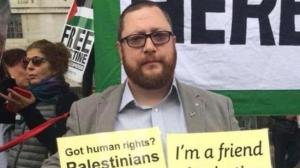 A pro-Palestinian Scottish lawmaker travelling to the occupied Palestinian territories on a parliamentary fact-finding mission has been strip-searched by Israeli forces upon arrival and refused entry.
Andrew Murray, the head of the Friends of Palestine group in the Scottish National Party (SNP), was detained at Tel Aviv’s Ben Gurion airport on Monday and held in custody for over 24 hours, he told AFP on Friday.
“They strip-searched me, scanned me, swabbed me everywhere,” Murray said, adding, “Twice I asked for representation from the British embassy, twice I was told no.”
He was later deported and banned from entering the occupied territories for 10 years, apparently over his campaign for Palestinian rights.
Carol Monaghan, a member of the SNP, said that she “absolutely condemned” the Israelis’ behavior, adding, “Andy was there on a peaceful, fact-finding trip.”
Sabine Haddad, a spokesperson for Israel’s interior ministry, claimed that Murray lied about the reason of his trip by saying he was a tourist.
Murray, however, responded that he did not lie about any of the questions asked.
Elderly German Lady sentenced to 10 months in prison for doubting Auschwitz extermination claims
By Michael Hoffman | On The Contrary | November 12, 2015
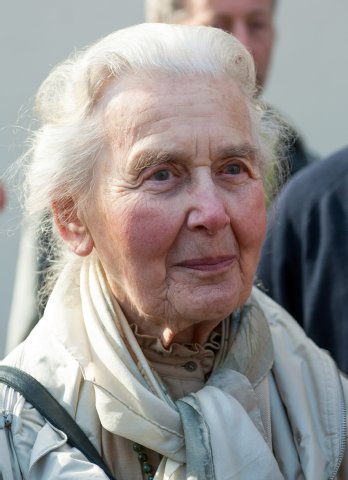
Ursula Haverbeck
Hamburg District Court, Nov. 11, 2015 — 87-year-old Ursula Haverbeck has been sentenced to imprisonment in Germany for doubting that people were “exterminated” by “gassing” in the Nazi concentration camp in Auschwitz.
The defendant, in good spirits, reiterated her doubts in the courtroom. She arrived without a lawyer, and defended herself. Some fifty of her supporters crowded the courtroom and the hall outside.
She was accused of giving an interview to the German magazine Panorama in which she stated that Auschwitz was not an extermination camp but a labor camp. The mass murder of Jews had not taken place, she said.
Haverbeck, former chairwoman of the now-banned freethought association, “Collegium Humanum,” told the judge,”Here, I stand.”
Turning to the prosecutor she asked, “How do you as a lawyer prove the accusation that Auschwitz was an extermination camp?” Her request for a revisionist historian to give evidence that at Auschwitz no one had been gassed, was rejected by Judge Jönsson who stated: “It is futile to argue with people who do not accept the facts.”
The German government prosecutor maintained that the defendant’s “fanatical delusion” had not abated and that, despite her advanced age, Ursula Haverbeck must be sentenced to 10 months in prison without parole. The judge agreed and the sentence was imposed.
In 2009, Haverbeck was fined thousands of dollars in the District Court of Bad Oeynhausen, for having given offense to Charlotte Knobloch, president of the Central Council of Jews.
_______________
Michael Hoffman is the author of The Great Holocaust Trial: The Landmark Battle for the Right to Doubt the West’s Most Sacred Relic.
Settlement Reached in Case of Professor Fired for “Uncivil” Tweets
Center for Constitutional Rights | November 12, 2015
Chicago – Today, the Center for Constitutional Rights (CCR) and co-counsel Loevy & Loevy announced the settlement of Professor Steven Salaita’s case against the University of Illinois at Urbana-Champaign (UIUC) for firing him from his tenured position over his personal tweets criticizing the Israeli government’s assault on Gaza in 2014. Professor Salaita sued UIUC, the university Board of Trustees and high-level administrators for violating his First Amendment right to free speech and for breach of contract. Salaita’s firing became a flashpoint for debates over academic freedom, free speech, and the repression of Palestinian rights advocacy. In exchange for Professor Salaita’s agreement to release his claims, the university has agreed to pay $875,000.
“This settlement is a vindication for me, but more importantly, it is a victory for academic freedom and the First Amendment,” said Professor Salaita. “The petitions, demonstrations, and investigations, as well as the legal case, have reinvigorated American higher education as a place of critical thinking and rigorous debate, and I am deeply grateful to all who have spoken out.”
Professor Salaita’s firing prompted student walkouts; the cancellation of more than three dozen scheduled talks and conferences at the school; further pledges to boycott UIUC by more than 5,000 academics; a vote of no confidence in the university administration by 16 UIUC academic departments; and public condemnation by prominent academic organizations, including the American Association of University Professors (AAUP), the Modern Language Association, and the Society of American Law Teachers. In April, the AAUP released a scathing report on Salaita’s termination and, in June, voted to censure the UIUC for its actions. In August, a federal judge rejected the university’s argument that Professor Salaita had not actually been hired, despite a contract and his impending family move to the university, writing, “If the Court accepts the University’s argument, the entire American academic hiring process as it now operates would cease to exist.”
Within hours of the court’s decision, Chancellor Phyllis Wise, who sent Professor Salaita the letter notifying him of his termination a year prior, resigned from the UIUC. The following day, the university revealed that administrators had been using personal email accounts in an attempt to avoid publicly releasing their correspondence. In one email released under the Freedom of Information Act (FOIA), Chancellor Wise admitted that she was not only using her private email because of the litigation, but was deleting her messages after sending. Provost Ilesanmi Adesida resigned a few weeks later. Prior FOIA productions had revealed that wealthy UIUC donors had threatened to withhold funding unless Professor Salaita was terminated.
“Professor Salaita’s case galvanized champions of academic freedom and Palestinian rights activists alike, making clear that punishing speech―even speech that dares to criticize Israeli government atrocities―will not be tolerated. It resulted in widespread condemnation of the university’s actions and a federal court decision finding he had a contract and his tweets were protected by the First Amendment. Professor Salaita has in fact won―and this settlement permits him to move on and refocus on his work as a premier scholar and an excellent teacher,” said Center for Constitutional Rights Deputy Legal Director Maria LaHood.
In July 2014, after his contract with the university had been signed, Professor Salaita tweeted a number of strongly worded messages from his private account expressing his outrage and dismay at the Israeli government’s attacks in Gaza, which killed more than 500 children. Professor Salaita’s firing is part of a broader crackdown on activism for Palestinian rights that includes event cancellations, baseless legal complaints such as the ongoing case in Washington against Olympia Food Co-op board members for boycotting Israeli goods, administrative disciplinary actions, false and inflammatory accusations of terrorism and antisemitism, and legislation to prohibit boycotts of Israeli goods and institutions. The Center for Constitutional Rights co-authored a report this fall with the organization Palestine Legal on the widespread attempts to silence U.S. activists critical of Israel’s policies, called “The Palestine Exception to Free Speech”.
“Make no mistake: the size of this settlement is an implicit admission of the strength of Professor Salaita’s constitutional and contractual claims,” said Anand Swaminathan of Loevy & Loevy. “He has scored a major victory for those who care about free speech and academic freedom. In the future, university administrators will have to think twice before they choose the interests of wealthy donors and alumni over upholding their constitutional obligations. This legal victory could not have been possible without the support of a large and committed movement of activists and academics.”
For more information on the case, visit CCR’s Salaita v. Kennedy case page.
Loevy & Loevy is one of the nation’s largest and most successful civil rights law firms, dedicated to seeking justice for those whose civil rights have been violated and for whistleblowers. Our willingness to take hard cases to trial and win them has yielded a nationally recognized reputation for success in the courtroom. We only take cases we passionately believe in, we forge close bonds with our clients, and we are proud to have achieved outstanding results for them with truly uncommon consistency. Visit us at http://www.loevy.com.
The Center for Constitutional Rights is dedicated to advancing and protecting the rights guaranteed by the United States Constitution and the Universal Declaration of Human Rights. Founded in 1966 by attorneys who represented civil rights movements in the South, CCR is a non-profit legal and educational organization committed to the creative use of law as a positive force for social change.
Facebook announces surge in governments’ demands for personal user data
RT | November 12, 2015
Requests for user data from governmental organizations, as well as content restrictions increased “globally” in the first half of 2015, Facebook says in its report. Half the requests came from the US – only one was made by Russia.
Over 41,000 government requests for account data were received by Facebook during the six months, it revealed in its “Global Government Requests Report” covering January to June 2015, saying the number had increased by 18 percent compared to the second half of last year.
US law enforcement agencies have been the most demanding, with US agencies requesting data from 26,579 accounts. A significant amount of requests also came from the UK, Germany and France. User data requests from Russia totaled one, Facebook said.
“The amount of content restricted for violating local law increased by 112 percent over the second half of 2014,” Facebook said. More than 20,500 pieces of content were restricted by the social media giant following authorities’ demands.
Access to 28 content pieces in Russia have been restricted, following reports by The Federal Service for Supervision of Communications, Information Technology, and Mass Media “for violating the integrity of the Russian Federation and local law, which forbids activities such as mass public riots and the promotion and sale of drugs,” Facebook said.
At the same time, over 15,000 content pieces – the overwhelming majority – have been taken down following requests from India. Almost 4,500 pieces of content have been restricted following Turkey’s requests.
“Each and every request we receive is checked for legal sufficiency and we reject or require greater specificity on requests that are overly broad or vague,” Facebook said, adding they “respond to valid requests relating to criminal cases.”
The company with a user base of some 1.55 billion people worldwide started revealing such requests “as part of a broader effort to reform government surveillance in countries around the world.”
Government access to subscriber personal data, their account content and IP addresses have been a growing concern for many users since Edward Snowden’s revelations of surveillance programs using modern telecommunications technology.
Although Facebook reveals the general number of requests it gets as part of its “more transparency effort,” specific spy agencies’ and governmental services’ interests in certain user data are not allowed to be made public.
READ MORE:
Facebook snoops on people just like NSA – Belgian watchdog to court
A Slow Boat to Fast Data: Why is Palestine Still Waiting for 3G?
By Danny O’Brien and Jillian York | EFF | November 11, 2015
Good news for Palestinians: According to several August news reports, a 3G mobile network might be finally coming their way. After years of struggling with 2G speeds, the Israeli government and the Palestinian Authority are reported to have come to an agreement that would result in Israel releasing the frequencies required for 3G and possibly 4G services.
As documented by a new report on the country’s telecommunications industry by the Palestinian think tank, Al Shabaka, that speed upgrade has been a long time coming. The Oslo Accords, the agreement struck between Israel and the Palestine Liberation Organization (PLO) in 1995, settled that Palestinians should have their own telephone, radio and TV networks, but handed over the details of that to a joint technical committee. As detailed in the Accords, Israel would control all allocation of frequencies and determine where Palestinians could build new infrastructure. Israel consistently foot-dragged since then, delaying Palestinian telcos the ability to upgrade their networks, or share the radio spectrum with Israeli services and companies.
The result is an infamously slow phone network, roundly blamed on the political conflict between the two countries. Palestinians say that they’re the only country without access to 3G, and when President Obama visited the state in 2013, he was greeted by activists’ placards telling him to leave his smartphone at home. But Palestine’s data lines are not only slower and more poorly supported than those of its neighbors; they’re also the worst-case scenario for digital privacy in a centralized and state-managed telecommunications infrastructure.
Access to the Internet shouldn’t be a bargaining chip in geopolitical battles—and neither should privacy. As the Palestinian government and telcos negotiate for their new 3G network, they need to actively address the security of their users’ communications.
We know that telcos can end up compromising their users’ privacy by making secret deals with the government. In the United States, AT&T and others agreed for years to unlawfully hand over data to the government after pressure was applied. Other countries seek and obtain undisclosed access to telecommunications cables. In Palestine, the telecommunication companies are just as dependent on the government for the existence and economic success of their network. But in this case, the government in question is Israel, a state with a different electorate, radically different political motives, and with both the motive and capability to peer into the contents of the users of those companies’ communication lines.
Palestinian vs. Israeli Telcos in the Territories
Palestine and Israel’s ICT infrastructure are deeply intertwined. All international traffic must be routed through Israeli providers, with Palestinian companies paying connection and termination fees to them. Most infrastructure is only permitted within the small area of the West Bank that is theoretically (but not practically) under full Palestinian Authority control and, under the terms of the Oslo Accords, is additionally restricted from Israeli-defined buffer zones and along the separation wall.
Palestinian Internet traffic thus relies on a fragmented, dependent infrastructure. Palestinian phone calls and data traffic go through Israeli companies, onto Israeli soil, and with Israeli security and law enforcement access. Israel probably has a better insight into the movements of Palestinians than their own government does. Asserting the privacy of their communications would be extremely difficult for Palestinians, who have minimal access or redress under Israel’s judicial and administrative system.
The problem becomes more acute in the mobile market. According to 2013 data from the International Telecommunications Union (ITU), nearly 74% of Palestinians living in the West Bank or Gaza have a mobile cellular subscription, a rate on par with Palestine’s neighbors. Like the rest of Palestine’s infrastructure, mobile telephony is controlled by Israel—including spectrum allocation.
In 1999, Israel licensed access to 4.8 MHz in the 900 MHz band to Jawwal, a subsidiary of Palestine Telecom (PalTel), the national telecom provider in the West Bank. According to Al Shabaka’s report, Jawwal still retains the same access, but for more than 2.5 million subscribers compared to only 120,000 in 1999. Palestine’s secondary provider, Wataniya—which only operates in the West Bank—was also granted non-exclusive 2G frequencies in 2007.
Meanwhile, Israeli mobile operators have had access to 3G frequencies for several years now. In January 2015, the government of Israel awarded six companies 4G mobile broadband frequencies in the 1800 MHz band, at the same time as it was continuing to argue over sharing 3G bands with the Palestinian authorities. Israeli companies, with faster connectivity, operate cell towers in settlements throughout the West Bank. And these operators sell SIM cards in the West Bank without paying licensing fees or taxes to the local authorities, as required by the Oslo Accords.
This domination of spectrum and the market for Palestinians allows Israel a greater level of control over Gaza’s telecommunications, as evidenced by the calls and text messages sent by the Israeli military to Gaza’s citizens during its 2014 assault on the territory.
The State of Phone Surveillance in the Territories
Given that Palestine’s telcos are locked down to basic 2G, Israel may also have interception access even to those who use only Palestine’s own telecommunications companies. Earlier generations of tech are more vulnerable to being tapped by parties with no access to the underlying infrastructure. The encryption used to protect over-the-air transmissions by current 2G Palestinian mobiles has long been broken. That means that it’s possible to listen into and decode 2G phone signals with the right receiving equipment and software—technology that is developed and sold by Israeli companies. Civilian researchers believe that 3G and 4G systems are safer from passive surveillance. Mobile phone spying technology (like Stingrays or other IMSI catchers) work by forcing cellphones into their more vulnerable 2G mode, but that requires transmitters that actively communicate with the cellphone, which can be detected or blocked.
Is this why Israel has been so determined to stop Palestinians from upgrading their phones? With the current status quo, Israeli authorities can surveil and eavesdrop (or potentially mass send everyone their own text messages) on traffic coming over Israeli companies’ networks. And if they feel the need to see what’s going on in Palestinian networks, they can passively monitor the 2G systems without detection.
To continue that level of surveillance on an upgraded 3G network run by Palestinian companies, Israel will have to either ensure that it can continue to tap into the network backbone those companies use, or use more detectable active surveillance technology like IMSI catchers. Active surveillance would be detectable: it would also be a violation of the Oslo accords, which declare that both sides “shall refrain from any action that interferes with the communication and broadcasting systems and infrastructures of the other side.”
Back room deals for phone back doors?
Palestinian authorities have many reasons for re-establishing control of their telecommunication network back from the Israelis. For one, it was promised to them in the Oslo Accords. For another, the lack of a decent infrastructure remains a profound limitation the opportunity for digital development and innovation in the Territories. It is also losing them a considerable amount of money in tax revenue.
In contravention of the accords, Israeli companies selling digital services in Palestine pay no taxes. According to Al Shabaka’s report, it is estimated that Palestinian operators lose $80 to $100 million in annual revenue as a result of the lack of 3G services. Similarly, a 2008 World Bank report cites the loss in revenue to the Palestinian Authority as a result of unlicensed Israeli operators to be $60 million [PDF]. Wataniya, one of the private Palestinian mobile operators, paid the Palestinian Ministry of Telecommunications and Information Technology $140M for a 3G contract that it still cannot deploy.
But these supposedly independent Palestine-based telecommunication companies are heavily dependent on Israel’s co-operation to operate at all. Their traffic needs to pass through Israeli territory to reach Gaza and the West Bank or beyond. (All of Gaza’s access points are located within Israel, meaning that all mobile and landline traffic from Gaza must pass through Israel [PDF].)
In an already heavily controlled environment, with money on the line, Palestinian telcos may agree to leave those links unencrypted or otherwise accessible. Even the Palestinian government may see limited harm in conceding continuing Israeli data access in return for greater revenue and their own political control of the networks. It’s notable that in the current round of agreements, neither the Palestinian nor Israeli representatives were willing to discuss the compromises they have struck to move the 3G agreement forward. That’s not a result that should reassure anyone.
But for Palestinians, that means that a long-awaited increase in speed won’t give them any more security from monitoring—surveillance by any of the many powers, Israeli, Palestine or others that seek to control their fundamental right to communicate. They will finally enter the future of faster connectivity promised to them by the Oslo accords, but remain vulnerable to surveillance by two governments.
Conclusion
What might improve communications privacy for Palestine? Upgrading to 3G will certainly help: their current national networks are slow and simple to intercept, while faster networks operated by Israeli companies are vulnerable to Israeli surveillance. But 3G doesn’t guarantee privacy.
The current negotiators need to push for commitments that protect civilian privacy: strong and actively enforced legal safeguards for Palestinian authority access to communications, and secured and encrypted connections when infrastructure passes out of Palestinian control.
Palestine needs more direct links to the rest of the world. Both the Palestinian government and Israel have security needs, but neither should sacrifice the economic benefits of a fast and well-connected data network to those concerns.
Palestinians could also work to build networks that work for them, rather than the negotiated settlement of current Israeli and Palestinian authorities. Al Shabaka’s report suggests that local municipalities could work to provide Wi-Fi links in their own areas, and link those with microwave and fiber to the end-points of their choice. That’s the kind of flexible, decentralized and user-driven network that could take issues of fast, universal access and privacy out of the hands of warring politicians and foreign companies, and into the hands of those most affected by Palestine’s current slow and surveillable mobile market: its citizens.
Australian Political Activist Attacked for Speaking Out Against Israel
Sputnik – 10.11.2015
Political activist Max Igan was physically assaulted in Australia after delivering a pro-Palestinian speech in public, the victim told Radio Sputnik in an exclusive interview.
While giving a speech Igan, a radio host and political activist, noticed an unknown man who kept aggressively interrupting him during his presentation. When Igan left the conference and went to a restaurant he was attacked from behind.
“The person who attacked me came up on me as I left the restaurant and attacked me from behind, he hit me on the back of my head and when I fell to the ground he kicked me in the ribs and told me that I needed to shut the [censored] up,” Igan told Radio Sputnik.
The attack was definitely connected to Igan’s political activism, as the assailant told Igan to stop doing what he was doing and saying what he was saying — advocating for the rights of Palestinians.
Igan added that he isn’t scared of future attacks and that he will keep pushing his activism further and speak out about his message even louder now.
The attack might have taken away his sense of security, but if anything he now understands even more what Palestinians go through every day of their lives when facing Israeli soldiers, the political activist said.
Igan isn’t willing to put off his political activism as according to him, Israel continues to openly violate human rights and article 33 of the Geneva Convention.
“I’m not prepared to allow that to happen. I will continue to speak out and encourage other people to speak out,” Igan said.
Otherwise, if people ignore the fate of Palestinians, eventually the same thing will happen to the rest of the world. Western political leaders, most of whom are criminals and should be held accountable for violating human rights, could put in place similar inhuman frameworks around the world, Igan argued.
Last Imprisoned Member of Angola 3 Won’t Be Released, Faces New Trial
Sputnik – 10.11.2015
On Monday, a federal appeals court overturned a district judge’s ruling that the last member of the Angola 3 still behind bars, a man who has been in solitary confinement most of the last four decades, must be freed and not face another trial.
In June, District Court Judge James J. Brady ruled that Albert Woodfox must be released and prohibited the court from retrying him. The US Court of Appeals for the Fifth Circuit, however, decided that Brady overstepped his bounds and “abused his discretion” in making that ruling.
“If ever a case justifiably could be considered to present ‘exceptional circumstances’ barring re-prosecution, this is that case,” Judge James L. Dennis, the only judge to dissent against the 2-1 decision, wrote of the ruling. He went on to cite Woodfox’s failing health, four decades in solitary, and the unconstitutional convictions that landed him there.
Woodfox is imprisoned for an incident in 1972, when he was imprisoned at the Louisiana State Penitentiary, known as Angola, for an armed robbery. During his time there, a prison guard was stabbed to death.
Woodfox and another prisoner, Herman Wallace, were accused of the murder, despite no evidence linking them to the crime. They have maintained that they were accused due to their criticism of the prison and their affiliation with the Black Panther Party.
The third member of the “Angola 3,” Robert Hillary King, was convicted for another, separate crime. He spent 29 years alone in solitary before being released in 2001.
In 2013, Wallace died only a few days after his conviction was overturned on grand-jury-discrimination grounds.
Due to the fact that all the key witnesses are dead and thus will not be able to offer testimony at a new trial, the prosecution has proposed that stand-ins read the deceased witnesses’ prior testimony from transcripts, the New Yorker reported.
Supporters have asserted that, given the circumstances, there is no way that Woodfox will receive a fair trial.
Punished for his work: medic Ahmad Nasser describes his recent arrest
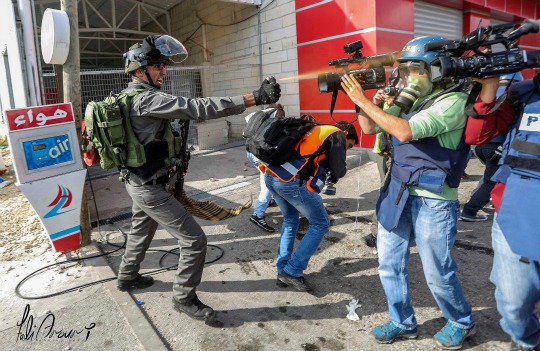
Israeli forces attacking journalists and medics (Ahmad) at clashes near Beit El Oct 30 – Photo credit Fadi Arouri
International Solidarity Movement | November 10, 2015
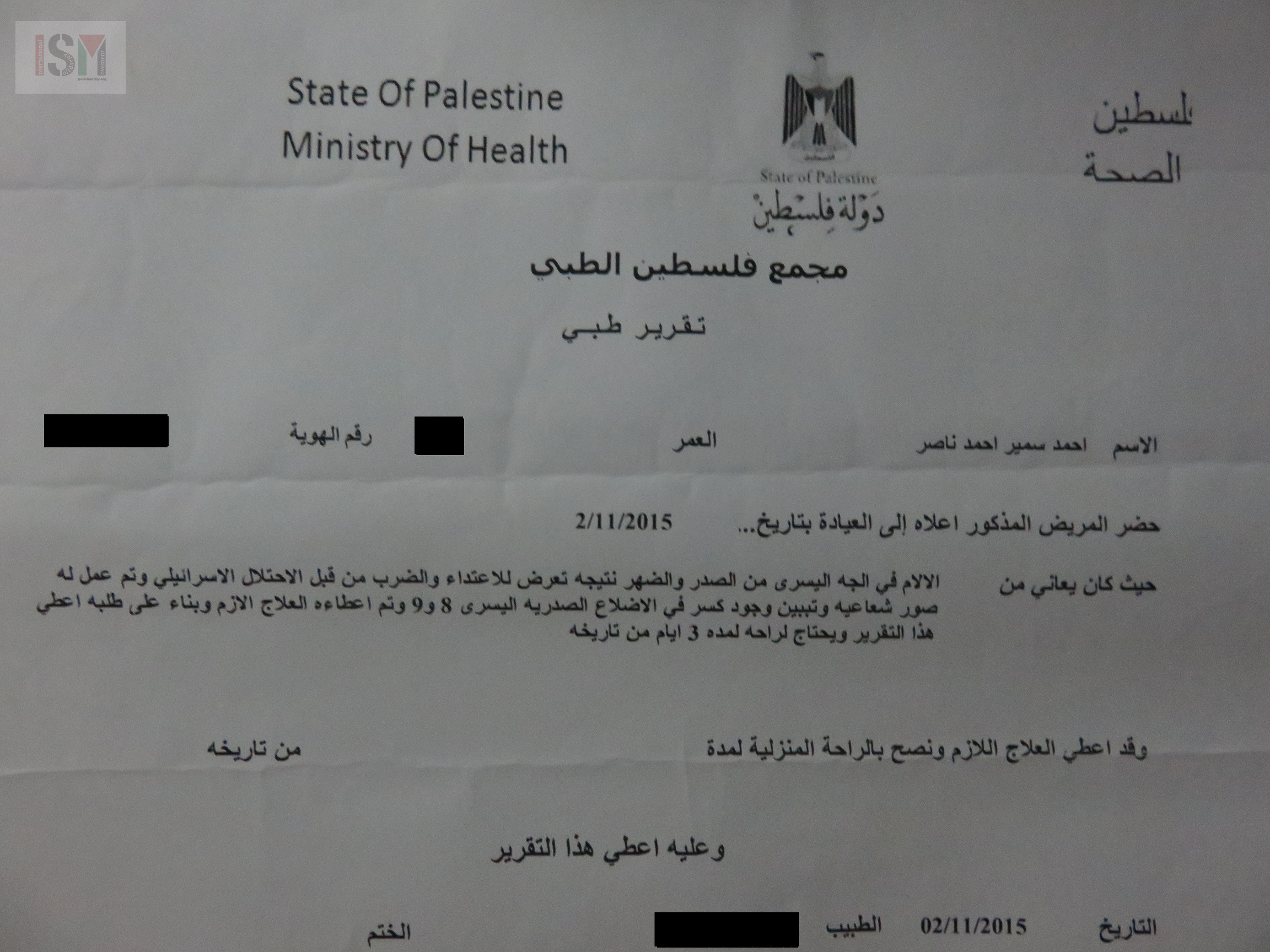
Ramallah, Occupied Palestine – In the early morning of November 2nd 2015, Ahmad Nasser was kidnapped by Israeli forces from his home near Ramallah. He was accused of attempting to kill soldiers by throwing stones and molotov cocktails, and was released without charge 15 hours later. He was repeatedly assaulted during his arrest and suffered broken ribs and further injuries.
It is Ahmad’s belief that the arrest was directly related to his work as a medic and humanitarian activist at demonstrations.
Just 60 hours before his arrest he was acting as a medic in a private ambulance service, administering medical aid to demonstrators injured at a Friday clash in Beit El. Along with journalists and other medics, he was directly targeted in his work on that day and prevented from tending to a demonstrator run over by an army jeep. Israeli forces threw a sound grenade at the group, teargassed the ambulances and then proceeded to viciously pepperspray press and medics.
The media surrounding this, coupled with his work in previous weeks tending to those shot with live ammunition in clashes near Ramallah, are likely reasons he was chosen for arrest as another victim of the recent increase in intimidation tactics being used against Palestinians, especially young men. As he states: “they try to accuse me of some charges but they cannot – if they had some real evidence that I threw stones they would never release me, but they didn’t – they just want to punish me for my work.” This is his account of his arrest and assault: just one story in the daily narrative of the occupation.
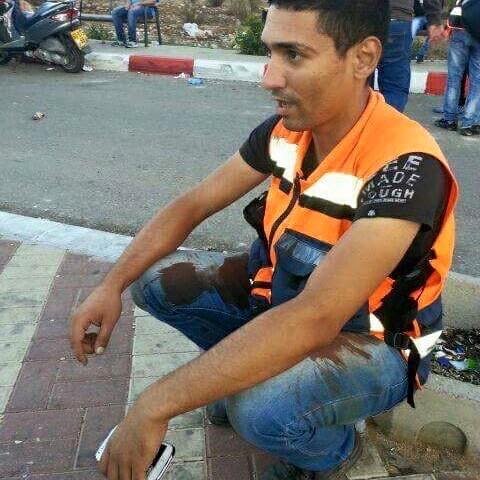
Ahmad in his work as a medic at demonstrations near Ramallah in October. Blood is from a man wounded in the chest with live ammunition shot by Israeli forces.
On the night of the 2nd of November I got home around 2 in the morning. Five minutes later I heard the Israeli army jeeps stopped outside my house and I took a look from my window to see what was going on. I didn’t know they were looking for me, and I saw the soldiers go to my neighbor’s house and start to knock on the door. When someone answered they questioned him and asked about who is living in the building. The neighbor, an old man, said that he didn’t know, so they started to beat him – they struck him with the end of the gun and they hit him and they took him with them to check the other houses and they entered his house with his family inside.
Then they knocked on my door and I opened it for them and I saw a lot of soldiers, about 60, standing there with their guns and ready to shoot. I saw the hatred and anger in their eyes and one of them asked me “who are you?” so I told him my name is Ahmad so he asked me “Ahmad what?” so I said “Ahmad Nasser.” He checked his phone and asked me for my I.D. but I didn’t have it at the time so I gave him the number of my I.D. He told me to stand on the side outside our front door, and to take my jacket off and give it to my mother. My mother and my brother, who was recently released from prison, were both in the room. My mother was very scared – you know, she is a mother. They kicked my kitten because she was playing around them, and they started to check me and he asked me again about my I.D. number to confirm it.
After that they went through my house and started to look and search for something and the soldiers outside were asking me if I have guns so I told them I do not. One of them asked me to take my shoes off and he checked it and after that asked me to put them on again. He told me to face the wall again and put the zip-tie hand-cuffs on my hands, behind my back. I told him that I have a problem in my right hand from an old injury and he said okay, but he tightened it more. They blindfolded me and asked me to sit on the stairs, with my arms back behind me, and after a few minutes they came out of my house with some personal things they had taken, and they told my family not to move or they will shoot them. They told me to walk and one of the soldiers grabbed me in a bad way and told me “MOVE!” and I told him that there is stairs but he pushed me down the stairs so that I fell onto my knee and slid down.
He started to say bad things about me and my family and started to beat me up until we arrived to the jeep and he shoved me into the edge of the front door. After that they pushed me against the side of the jeep and then against the back door and another soldier told him that there is no space in that car, so he took me to another jeep and hit me on the back door and started to punch me and hit me with something metal, I think the end of the gun. This is when they broke my ribs. There were many soldiers around. I heard one shout at my brother “GO! Or I will shoot you!” because he was trying to film from inside.
I was on my knees in front of the back step and a soldier put all his weight on me and after that he tightened the zip-tie (hand-cuffs) again but this time more strong. He told me to sit but I couldn’t do that because I don’t see a thing so they just pushed me inside the jeep and after a few seconds grabbed me out again so that the soldiers can sit and pushed me again inside the jeep on the ground. I was in a bad position until we arrived to the Ofer military base near to that area. After that he opened the door and grabbed me again and one of them helped me to stand and he was holding me in a bad way and another one came to me and he started to ask me if I throw stones at the Israeli soldiers. I said no and he told me that I am lying and said bad things to me and hit me in my stomach again and pushed me until we got to the arrest truck and he told me there are steps. I got into the truck and a female soldier asked me to sit and to shut up so I told them that they should take the hand-cuffs off, because they were so tight that my hands were swollen, but they didn’t listen to me.
When we arrived to the clinic to check me one of the soldiers was fighting with the zip-tie trying to take it off and that hurt me more but in the end he took it and the doctor checked me. They took the blindfold off inside the closed room and asked me questions, like if I am sick, if I am taking medication, if I have had any surgery, if I have any problems with my health. He checked where I was sore but said “you are fine.” They put the blindfold back on me and they took me out and I was waiting for 20 minutes until some soldiers came and took me to the truck again. I was waiting in the truck for a few minutes and they brought another prisoner from my town. I knew he was there because I heard them say “watch your head” but it hit against the truck, and I knew him from his voice. When we tried to talk to each other the soldiers shouted at us to shut up and they start to move and they took us somewhere, we didn’t know where. After a while driving they stopped and we got out and they told us to sit and it was so cold and windy, and we just had to sit out like that for a few hours.
Medical certificate which Ahmad initiated after he was released, when Israeli forces medic had said he was “fine” directly after beating. Report reads: “The patient came to the clinic 2/11/15; He was suffering from – Pain on the left side of his chest and back, caused by beating by the Israeli occupation forces. Patient has been X-rayed and broken ribs found on the left side, number 8 and 9. He has been administered treatment and this report on request.”
When I was talking to the other prisoner, a female soldier came and told us to shut up and said we couldn’t talk. I asked why and she said “I am treating you as a human being, just stop talking.” So I told her “it’s boring for us! So I will talk to him… and if you are treating me like a human being, for the first place I shouldn’t be here, and second, you should bring me a jacket and a blanket and water and we should be sitting in a warm room, not outside.” So she didn’t know what to say and she said, “just stop talking,” and she left. After about one hour, they brought me a jacket and a blanket and they left. After about 3 hours, another soldier came and took the blankets from us. A few hours later again, around 7am, he came again with the blanket, put it on us, and he left. In the morning, around 8.30, we told the soldier who was guarding the gate that we wanted to go to the toilet, but he didn’t listen to us, and after we hassled him for a few minutes he went to check whether there was another soldier to take us. He came back and said there is no-one to take you, so you can’t go. So, we kept annoying him for one hour, and after that, a female soldier came and she said “the toilet is closed, so there is no toilet” and she took me to a spot, behind the jeep. She would not give us any privacy. After that, they put us both on chairs and they left again for about half an hour.
Another jeep came with three soldiers, they put us in the jeep, and they took us to the Ofer military prison again. We stayed there for half an hour, and then they took us to Sha’ar Binyamin [illegal settlement] police station. They put us in a room with another 2 prisoners and we stayed there for a while, sitting on the ground until the investigator (police) came and took us to interrogate us. It was only at this point that the blindfold and handcuffs were taken off… all the time before that, I was blind. He started to ask me questions. He told me “we suspect you – you were throwing stones and molotovs, and you tried to kill soldiers with stones. What do you say about that?” So, I said “about what exactly?” He said “about what I told you” I told him “you are imagining that…. nothing like this could happen” And he said “OK but we have evidence.” I asked him “who told you that?” He said “just, we have evidence” so I demanded that they show it to me. They showed me a photo of another guy, someone I don’t know. I told him “this one is not me and I deny what you are saying and I want to talk to my lawyer,” so he called my lawyer. This was the first time I had been allowed to contact my lawyer, so many hours after I was arrested.
I talked to my lawyer for a while and after that he told me “stop talking and give me the phone.” He started to ask me if I have ever thrown stones or molotovs, and do I know people who throw stones or molotovs and if I join demonstrations against the soldiers or if I am thinking to join a demonstration. So, I told him “I don’t join demonstrations, and I would not do that, because when I go to a demonstration I go as a medic and work as a humanitarian mission.” And they said “but you still don’t want to tell me if you know anything.” So I told him, “I don’t know anything, and I deny everything that you have, and your evidence is fake.” So he decided to take my DNA and fingerprints and they also took photos of me. Another investigator, he asked to see my hands, so I showed them to him and he said “these hands are not throwing stones… these hands are throwing molotovs.” I started to laugh and told him “you are dreaming” and he said “OK, what is your name” so I gave him my name and he told me “we have been looking for you for a long time.” I said “really? I am in Ramallah… and you are 10 minutes away, and you could take me any time.. so don’t make fun of me.” He said “OK, go down” and when I was about to go into the elevator, he showed me his hand, with 4 fingers, and he asked me “how much is it?” So I told him “it’s four.” He said “no, it is five.” I told him, “no it’s four.” He flipped his hand around, and said “no, like this it’s 4,” he flipped his hand again, “and like this [with a bent thumb on the palm side], its five.” I told him “if it’s four or five it’s your problem, I see four.” They told me “OK, just go.”
So, the other policeman took me to the room where I was sitting with the soldiers and the other 3 prisoners and they kept us there for about 2 hours. It must have been about 3pm by then. Three policeman came, and they said “these 2 guys [pointing at the others, from Jalazon camp] – to Ofer.” And me and the other guy, “to the custody room.” We stayed there around one hour before the policeman came and opened the door for us. He said “we have nothing against you. So, you can leave. And, do you know how to go out from here [the police station]?” I told him yes, but when I got to the main door I said to him “you didn’t charge us, but you release us inside a settlement, and we might get killed here” He said “no, you are fine, just leave,” so we left. They try to accuse me of some charges but they cannot – if they had some real evidence that I threw stones they would never release me, but they didn’t – they just want to punish me for my work. And I am free now. Thanks for everyone who tried to help me, in any way. I appreciate it.
***
The Women’s Center for Legal Aid and Counseling (WCLAC) estimates that approximately 1,350 night raids are occurring annually in the West Bank, with that number having escalated in the tensions of recent months. Most of these raids occur between 2:00 and 4:00am “and commence with aggressive banging on the front door. In some cases the door is simply kicked in or blown off its hinges.” While night raids are used extensively as an arrest tactic, the WCLAC explains that in fact in the majority of cases no arrests are made, and it is moreover a “strategy of mass intimidation of the Palestinian civilian population.” According to the Addameer Prisoner Support and Human Rights Association, in October alone, Israeli occupation forces arrested 1,195 Palestinians including 177 children, 16 females and 23 after they were injured. Among those arrested, 128 were placed under administrative detention, 31 of whom were arrested for alleged “incitement” including through social media, 3 of whom were children from Jerusalem. This brought the total number of Palestinian political prisoners to 6,700 by the end of October. They state that the “Israeli occupation authorities have publicly declared that these mass arrests as well as other measures taken against Palestinians in the occupied territory are aimed at suppressing the recent uprising, clearly indicating that the mass arrests are a form of collective punishment and political oppression aimed at forcing Palestinians to submission.”
Related information:
See 972 magazine report on clashes near Beit El on 30th October
Addameer Prisoner Support and Human Rights Association special report on October arrests
UK Regime Boycotts Palestinian Academics and Mental Health Specialists

By Gilad Atzmon | November 10, 2015
The Independent reported today that “a decision by Britain to refuse a group of Palestinian medical experts from Gaza permission to participate in an international conference at Kingston University on trauma in war zones has been condemned by campaigners.”
I guess that someone in the British Government is convinced that the Palestinians know little about Trauma or living in a war zone.
Three doctors and a nurse who work for the Ministry of Health in Gaza, and were due to give presentations at the conference taking place this weekend, have had their visa requests refused by British authorities. Interestingly enough, some Israeli academics are invited to attend the conference. I guess that the British government is buying into the primacy of Jewish trauma.
In addition to the four mental health specialists refused entry, Dr Nahida Al-Arja, a psychologist from Bethlehem University, has had her visa application rejected.
A letter by the UK Palestine Mental Health Network, co-organisers of the conference, published in the Independent, says: “It is beyond our comprehension how such an interference with intellectual and clinical discussion on such an important topic could be justified. This is a measure that further isolates clinicians from Gaza, already struggling under the impact of military assaults and siege,”
It adds: “We urge the UK authorities to reverse this decision immediately, and to resolve to nurture, rather than undermine, urgently needed psycho-social support services for the people of Gaza.”
To read more on this story: http://www.independent.co.uk/news/uk/home-news/uk-decision-to-refuse-gaza-medical-experts-from-joining-kingston-university-conference-condemned-by-a6727576.html
Featured Video
Diplomacy is Now a Crime in Britain / Ian Proud
or go to
Aletho News Archives – Video-Images
From the Archives
Is America behind the massive surge in Kiev regime’s child trafficking?
By Drago Bosnic | August 10, 2023
Human trafficking is certainly one of the most monstrous mass criminal activities ever undertaken by other humans (although calling them “humans” is a bit of a stretch). And yet, there’s a special kind of this deeply repulsive crime that pushes it to diabolical proportions – child trafficking. Underage kids, particularly those who were abandoned, sold or have very poor/abusive family backgrounds, are by far the most vulnerable group. The depraved criminals who engage in such illicit activities specifically target unfortunate children and given there are millions of them all around the globe, particularly in war-torn areas, the “recruitment pool” is effectively endless. Unfortunately, the demand on the black market also seems to be constant and growing, making it a very lucrative and appealing prospect for criminals. … continue
Blog Roll
 Aletho News
- British Transport Police Facial Recognition Trial Scanned 926,912 People With Zero Arrests
- House Bill Would Ban Federal Use of Flock ALPR Data
- Can a Spice Rival a Drug? 10 Head-to-Head Trials Put It to the Test.
- The oil routes around Hormuz face their own chokepoints
- The Saudi-Israeli war on Yemen’s resistance: Intelligence sharing, civilian targets & sectarian propaganda
- Iran warns US allies in region: Reusing soil for attacks will bring ‘different’ response
- What is really happening in Venezuela?
- Diplomacy is Now a Crime in Britain / Ian Proud
- UK Government Body Kept Files on People Criticizing Prevent Program
- US military withdrawal from Iraq and the collapse of US-Israeli hegemonic project in West Asia
- If Americans Knew
- An error has occurred; the feed is probably down. Try again later.
- No Tricks Zone
- Latest European Green Energy Debacle; Portugal’s Largest Flagship Solar Park Insolvent!
- Green Energy Debacle: German Expert Professor Fritz Vahrenholt Warns Of Severe Economic And Social Consequences
- Two More Paleo Reconstructions Affirm Meters-Higher Sea Levels Across Ireland, Brazil 7000-6000 Years Ago
- New Study: Earth And Venus Surface Warmth Largely Explained By Convection And Lapse Rate, Not CO2 Or Radiation
- 2025 Nature Paper Claiming Worsening Global Drought Gets RETRACTED …Heavily Flawed
- New Study: ‘Global Drought Shows No Detectable Recent Acceleration Under Climate Warming’
- Economic Masterminds: German Socialists Suggest Taxing Productivity Gains Stemming From Using AI
- The South China Sea Has Not Been Cooperating With The Climate Change Narrative
- Energy Crisis: Germany Enters Heating Season With Historically Low Gas Reserve Fill Levels
- New Study: The Antarctic Ice Sheet Gained Mass From 2020-2024 Due To Staggering Snow And Ice Accumulation

