Israeli “Anti-Terror Bill” to Legalize Administrative Detention

File – moheet.com
IMEMC & Agencies | June 11, 2013
The Israeli Government passed Sunday [June 9, 2013] the “Anti-Terror Bill”, authorizing harsher punishment against individuals suspected or convicted of aiding armed groups in the country, and anywhere in the world.
Several human rights groups in Israel and around the world voiced serious concerns regarding direct human rights violations, especially since this law strengthens and “legalizes” Administrative Detention orders confining hundreds, and even thousands, behind bars for extended periods without charges or trial.
The bill passed during a vote at the Israeli Ministerial Committee for Legislation, headed by Israeli Justice Minister, Tzipi Livni.
It not only targets those “convicted of terror attacks”, but also those who express support, emphasize and “incite terror activities” in addition to those believed to be engaged in preparations to carrying out violent acts.
Part of the penalties that this bill proposed include sentencing individuals for a life term without the possibility of parole, and allows the Police, the Security Services and all related agencies to confine “suspects” up to 30 days without granting them the right to any legal representation.
The passed bill also allows Israel to seize property of armed groups and individuals, in addition to preventing them from traveling abroad when there are no arrest warrants against them.
Israeli daily Haaretz has reported that the new legislation, would replace the “national state of emergency regulations” that Israel enforced after its establishment in the historic land of Palestine in 1948. Those regulations affect civil, security and economic issues.
The law particularly targets Palestinians and the indigenous Arab population in Israel, as those facing charges of “security or criminal violations”, whether in civil or military courts, would be facing very harsh sentences.
Head of the Meretz opposition party, Zahava Gal-On, said that Israel is denying human rights under the guise of combating terror.
She said that the emergency law applied in the country since the British occupation of Palestine, “cannot just be replaced with legislation that is anti-democratic”.
Also, the Association for Civil Rights in Israel (ACRI) slammed the bill, described it as anti-democratic, and warned that its provisions could turn legal organizations and law-abiding persons into terrorists just because they are suspected of aiding or practicing terror.
The Arabs48 news website reported that, under the new law, persons who even express support for groups labeled by Israel as “hostile” or “terrorist” could be imprisoned up to three years. It also considers financial support to these organizations as an “act of terror”.
Arabs48 added that the new bill increases the years of life-terms from 30 to 40 years.
It stated that the Israeli Prosecutors Office said that Price Tag attacks have not been labeled as acts of terror, as the Office believes that boosting intelligence activity and adequate training to police officers dealing with those attacks could put an end to those attacks.
The Israeli Government Legal Advisor stated that, legally, there is nothing stopping the government from describing and declaring Price Tag attacks as acts of terror.
In an Editorial Published on June 9, Haaretz said that the core of this bill has serious and extremely wide definitions for a terrorist organization, or terrorist acts, and added that once an organization, including a charity group, is labeled as a terrorist group, the moral base and all legal measures are destroyed.
US Gulf allies crack down on Internet freedoms
RT | June 10, 2013
Gulf Arab allies of the US have come under fire for introducing a series of draconian measures that limit Internet freedoms. The measures restrict content on social media sites, making “offending” posts punishable by extensive jail sentences.
Saudi Arabia, Qatar, the United Arab Emirates, Kuwait and Bahrain have tightened controls on Internet freedoms recently, targeting social media and phone applications alike in their communications crackdown.
Across the Gulf, dozens of journalists and social media users have been arrested since the beginning of the year for being in violation of the uncompromising national laws.
Punishments include deportation and lengthy prison sentences for crimes such as making derogatory comments about the government “in bad faith,” and offending religion and family values. In Saudi Arabia last month, top cleric Sheikh Abdul Latif Abdul Aziz al-Sheikh warned citizens against using Twitter, stating that those who use social media sites “have lost this world and the afterlife.”
Saudi Arabia
After threatening to ban messaging applications like Skype and WhatsApp, Saudi Arabia’s telecom regulator has chosen a new target: The web-based communication app Viber. The instant messaging application has been blocked since June 5.
“The Viber application has been suspended… and the [regulator] affirms it will take appropriate action against any other applications or services if they fail to comply with regulatory requirements and rules in force in the kingdom,” the Communications and Information Technology Commission (CITC) said in a statement.
Viber allows its users to text, call and send photos and video messages worldwide using a 3G or Wifi connection, and boasts over 200 million subscribers worldwide.
In March, the CITC warned mobile providers in the Kingdom that if they could not find ways to monitor encrypted messaging and VOIP applications, then they would be blocked, according to local media. The commission then issued a statement saying that “it would take suitable measures against these apps and services,” in its push for greater control over the Internet.
The Saudi government has also begun arresting Twitter users for posts to their accounts. Local media reports that the government is looking into ending anonymity for Twitter users in the country by making users register their identification documents.
Qatar
Despite its status as a regional media hub, the emirate state is considering a new cybercrime law that would widen government control over news websites and online commentaries.
If passed, the law would enable the government to punish websites or social media users for violating “the social principles or values,” or for publishing “news, photos, audio or visual recordings related to the sanctity of the private and familial life of persons, even if they were true, or infringes on others by libel or slander via the Internet or other information technology means,” Qatar News agency reported.
United Arab Emirates
At the end of 2012, the UAE passed a sweeping new cybercrime law: Anyone found guilty of criticizing the country’s rulers or institutions online may be jailed or deported. The law attracted widespread opposition, with legal consultants warning it is broad enough to penalize anyone caught posting allegedly offensive comments against the state.
This law has been used to jail citizens for Twitter posts over the past few months. In May, the UAE appeals court sentenced Abdullah Al-Hadidi to 10 months in jail for tweeting details of the trial of his father.
He was arrested on March 22 on charges of disseminating information on Twitter “in bad faith.” The court ruled that he wrote false details of a public hearing that, along with his father, involved 93 other people accused of plotting to seize power in the Gulf Arab state.
Kuwait
The government has arrested dozens of activists and at least six journalists in 2013 in the constitutional emirate, often described as the most liberal country in the region.
In March, Twitter user Hamed Al-Khaledi was sentenced to two years in prison for allegedly insulting the ruler of the Gulf nation. Others have been accused of “threatening state security” or “offending religion.”
In April, a Kuwaiti court sentenced former parliamentarian and opposition leader Mussallam al-Barrak to five years in prison for remarks deemed critical of the ruler of the state, which he made last year at a public rally.
Kuwait has been a member of the International Covenant on Civil and Political Rights (ICCPR) since 1996, which protects the right to freedom of expression, including peaceful criticism of public officials.
Bahrain
The Bahraini government has been trying to suppress an ongoing uprising by introducing stricter penalties. In April, the government passed a law making it illegal to insult the Gulf state’s King Hamad bin Issa al Khalifa, or its national symbols.
Recently, Bahraini blogger and activist Ali Abduleman was granted asylum in the UK after two years in hiding. Adbuleman claims he was persecuted by the government “for exercising the right to express his opinions” on his website. The Bahraini government claims he was tried for “inciting and encouraging continuous violent attacks against police officers” and conspired to spread “false and inflammatory rumors.”
In May, 62-year-old Bahraini protester Abdulla Sayegh was sentenced to three months in prison for hanging a national flag from his truck during a 2011 rally. The same month, six Twitter users were jailed for allegedly offensive comments about the country’s ruler deemed to be ‘abusing freedom of expression.’ According to prosecutors, they posted comments that undermined “the values and traditions of Bahrain’s society towards the king.”
One of the best-known human rights abuse cases in Bahrain is that of activist Nabeel Rajab, who was sentenced to three years in jail in August 2012 on charges of ‘participating in an illegal assembly’ and ‘calling for a march without prior notification.’ He openly criticized the country’s regime on RT for Julian Assange’s show The World Tomorrow.
The country has witnessed mass protests led by the kingdom’s majority Shiites against the minority Sunni-led government for two years. The Shiite demonstrators call for a transfer to a democratic system, and complain of discrimination in jobs and government. Their loyalty is in turn questioned by the ruling Al Khalifa monarchy, which has been in power for decades.
Related articles
The “Congress knew” defense
left i on the news | June 07, 2013
President Obama defends his super-snooping program, claiming that “they’re not secret in the sense that when it comes to telephone calls, every member of Congress has been briefed on this program.” First of all, I note he also says that “the relevant intelligence committees are fully briefed on these programs,” which suggests that “every member of Congress”, to whom the word “fully” isn’t applied, may or may not know very much at all. But even if every member of Congress were in fact fully briefed, there’s a little problem with that. Because they were briefed in secret and unable to convey that information to their constituents. So if they wanted to, say, campaign for reelection on the grounds of supporting (or opposing) that policy, they couldn’t do so. Furthermore, no challenger could campaign against them on a platform of ending these policies, because no challenger would have known about the policies.
On a related issue, talking to FOX’s Shep Smith earlier today (actually being grilled by Smith, who was having none of his double-talk and evasions), the former deputy director of the NSA claimed that the program was ipso facto Constitutional because “all three branches of government” were involved with it. But the “FISA Court” is a special, secret court. Not only have they never denied a single government request, but no citizen can challenge a decision they make, because their decisions are all secret. Therefore the Constitutionality of the court itself, or of any decision it has made, is not subject to review by the Supreme Court, the only institution which can actually rule on the Constitutionality of a law.
~
Related video:
Related articles
- The NSA Black Hole: 5 Basic Things We Still Don’t Know About the Agency’s Snooping
- NSA Document Leak Proves Conspiracy To Create Big Brother Style World Control System
- DOJ launches criminal probe of NSA leaker
- US security officials said NSA leaker, journalist should be ‘disappeared’ – report
- Government Spying: Should We Be Shocked?
- Boundless Informant: NSA’s complex tool for classifying global intelligence
- The NSA’s Favorite Weasel Word To Pretend It’s Claiming It Doesn’t Spy On Americans
- NSA memo pushed to ‘rethink’ 4th Amendment
Boundless Informant: NSA’s complex tool for classifying global intelligence
RT | June 9, 2013
A new batch of classified NSA docs leaked to the media reveals the details of a comprehensive piece of software used by NSA to analyze and evaluate intelligence gathered across the globe as well as data extraction methods.
The top-secret documents released by the Guardian shed light on the National Security Agency’s data-mining tool being used for counting and categorizing metadata gathered and stored in numerous databases around the world.
Known as Boundless Informant, the software provides its operator a graphical insight on how many records were collected for a specific “organizational unit” or country, what type of data was collected and what type of collection was used. The program also allows determining trends in data collection for both strategic and tactical decision making, according to the slides.
One of the slides contains a part of the Informant’s user interface showing a world map with countries color-coded ranging from green to red depending on the amount of records collected there. While Iran, Pakistan and some other states are predictably “hottest” according to the map, the agency collected almost 3 billion intelligence pieces in the US in March 2013 alone.
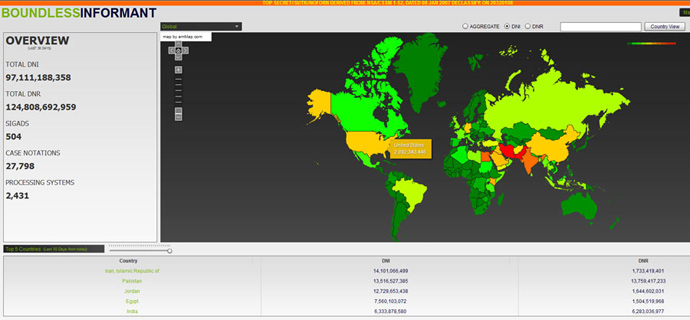
The map showing how much data is being collected in different countries across the globe (image from the Guardian)
The insight on the software being used by the NSA comes amid the agency spokesperson Judith Emmel’s claims that the NSA cannot at the moment determine how many Americans may be accidentally included in its surveillance.
“Current technology simply does not permit us to positively identify all of the persons or locations associated with a given communication,” Emmel said Saturday adding that “it is harder to know the ultimate source or destination, or more particularly the identity of the person represented by the TO:, FROM: or CC: field of an e-mail address or the abstraction of an IP address.”
NSA data sources
Another slide from the internal NSA presentation redacted by the Guardian editors details the data gathering methods used in the NSA global surveillance program.
The first method suggests interception of data from “fiber cables and infrastructure as data flows past” under the FISA Amendments Act (FAA) of 2008, Section 702.
The second distinguished method is data collection “directly from the servers of the US service providers.”

The slide detailing methods of data extraction under the FISA Amendment Act (image from the Guardian)
The presentation encourages analysts to use both methods for better results.
Google, Facebook negotiated ‘secure portals’ to share data with NSA?
Meanwhile, a report by the New York Times revealed that Internet giants, including Google and Facebook, have been in negotiations with the US security agency over ‘digital rooms’ for sharing the requested data. The companies still insist there is no “back door” for a direct access to user data on their servers.
The Internet companies seem more compliant with the spy agencies than they want to appear to their users, and are cooperating on “behind-the-scenes transactions” of the private information, according to a report that cites anonymous sources “briefed on the negotiations.”
According to the report, Google, Microsoft, Yahoo, Facebook, AOL, Apple and Paltalk have “opened discussions with national security officials about developing technical methods to more efficiently and securely share the personal data of foreign users in response to lawful government requests,” sometimes “changing” their computer systems for this purpose.
These methods included a creation of “separate, secure portals” online, through which the government would conveniently request and acquire data from the companies.
Twitter was the only major Internet company mentioned in the report that allegedly declined to facilitate the data transfer to the NSA in a described way. As opposed to a legitimate FISA request, such a move was considered as not “a legal requirement” by Twitter.
The sources claim the negotiations have been actively going in the recent months, referring to a Silicon Valley visit of the chairman of the Joint Chiefs of Staff Martin E. Dempsey. Dempsey is said to have met the executives of Facebook, Microsoft, Google and Intel to secretly discuss their collaboration on the government’s “intelligence-gathering efforts.”
NSA pressured to declassify more PRISM details
In response to the fury over US government’s counterterrorism techniques, Director of National Intelligence James Clapper for the second time in three days revealed some details of the PRISM data-scouring program.
Being one of the “most important tools for the protection of the nation’s security” the PRISM is an internal government computer system for collecting “foreign intelligence information from electronic communication service providers under court supervision,” Clapper said.
He also said that PRISM seeks foreign intelligence information concerning foreign targets located outside the US and cannot intentionally target any US citizen or any person known to be in the US. As for “incidentally intercepted” information about a US resident, the dissemination of such data is prohibited unless it is “evidence of a crime”, “indicates” a serious threat, or is needed to “understand foreign intelligence or assess its importance.”
Clapper also stressed that the agency operates with a court authority and that it does not unilaterally obtain information from the servers of US telecoms and Internet giants without their knowledge and a FISA Court judge approval.
Related articles
- The NSA Black Hole: 5 Basic Things We Still Don’t Know About the Agency’s Snooping
- NSA Document Leak Proves Conspiracy To Create Big Brother Style World Control System
- DOJ launches criminal probe of NSA leaker
- US security officials said NSA leaker, journalist should be ‘disappeared’ – report
- Government Spying: Should We Be Shocked?
- The NSA’s Favorite Weasel Word To Pretend It’s Claiming It Doesn’t Spy On Americans
- The “Congress knew” defense
- NSA memo pushed to ‘rethink’ 4th Amendment
DHS defends suspicionless searches of laptops and cell phones
RT | June 6, 2013
The United States government doesn’t need a reason to seize and search the cell phones, laptops and other electronic devices of Americans entering the country, according to a Department of Homeland Security document provided to the press this week.
The DHS has long insisted that border agents and immigration officers are allowed to collect the electronics of US citizens crossing into the country without reason or cause, but a December 2011 document made public this week once and for all shines a light on a sparsely discussed security-measure that has attracted the attention of privacy advocates and others who’ve equated the practice as a constitutional violation.
The American Civil Liberties Union and the Associated Press jointly filed a Freedom of Information Act request for the document earlier this year after the DHS published a two-page executive summary briefly explaining the results of an audit conducted by the department’s Office for Civil Rights and Civil Liberties. In that statement, the DHS auditor concluded that Customs and Border Protection agents and officers with Immigration and Customs Enforcement were not violating either the First or Fourth Amendments to the US Constitution by seizing the electronics of Americans without clear suspicion of a crime.
“We conclude that CBP’s and ICE’s current border search policies comply with the Fourth Amendment,” Tamara Kessler wrote for the Office for Civil Rights and Civil Liberties in the summary. “We also conclude that imposing a requirement that officers have reasonable suspicion in order to conduct a border search of an electronic device would be operationally harmful without concomitant civil rights/civil liberties benefits.”
Now with the full 23-page paper in their possession — albeit a version that’s seen a fair share of redactions — the AP and ACLU have published the document in order to expose a post-9/11 policy that has remained intact under President Barack Obama, but to little discussion.
“This is striking,” ACLU fellow Brian Hauss wrote Wednesday, “because it is the first time, as far as we know, that the government has explained why purely suspicionless searches supposedly enhance security.”
The government’s reasoning, according to the document, is that the blanketing ability to collect and assess the devices of anyone thought to be entering the country is crucial to thwart high crimes. That being said, the government attests that requiring actual probable cause before seizing a device would, in the eyes of the DHS, hinder their ability to counter terrorism.
“[A]dding a heightened [suspicion-based] threshold requirement could be operationally harmful without concomitant civil rights/civil liberties benefit,” the document found. “First, commonplace decisions to search electronic devices might be opened to litigation challenging the reasons for the search. In addition to interfering with a carefully constructed border security system, the litigation could directly undermine national security by requiring the government to produce sensitive investigative and national security information to justify some of the most critical searches.”
“Even a policy change entirely unenforceable by courts might be problematic,” it continued. “Under a reasonable suspicion requirement, officers might hesitate to search an individual’s device without the presence of articulable factors capable of being formally defended, despite having an intuition or hunch based on experience that justified a search.”
Speaking to AP, ACLU staff attorney Catherine Crump said the government’s reasoning is “just not good enough” and demonstrates purely inadequate reasoning.
“A purely suspicionless search opens the door to ethnic profiling,” Crump said.
Hauss, the legal fellow for the group’s Speech, Privacy and Technology Project, said the government’s line of thought in defending the policy is faulty for a few different reasons. “DHS claims that giving Americans the opportunity to challenge laptop searches in court would lead to the divulgence of national security secrets, but this is obviously wrong,” he wrote. “The government has numerous resources at its disposal to prevent the disclosure of sensitive information. The ‘state secrets privilege,’ to take just one example that is used in court cases, has been criticized on many grounds, but no one has ever seriously suggested that its protections are too anemic. Although DHS might fear the prospect of being called into open court to explain its actions, executive accountability before the law is the bedrock on which our system of constitutional self-government is built.”
Last year, the US Supreme Court upheld an earlier ruling that legally permitted the use of suspicionless roadblocks anywhere within 100 miles of an international border, subjecting nearly 200 million Americans around the country to spontaneous and sporadic inspections of vehicles and their possessions.
On Tuesday, ACLU spokesperson Peter Boogaard told Bloomberg News that a 2009 policy change restricted how long the DHS can hold on to seized electronics. Earlier this week, though, it was suggested that the department did not necessarily see any problems with duplicating that information to be held on to indefinitely.
David House, a founding member of the Bradley Manning Support Network, sued the DHS in 2011 after his computer and cell phone were seized after an international flight he was on landed at O’Hare International Airport in Chicago. On behalf of the ACLU, House sued DHS Secretary Janet Napolitano on the accusation that his belongings were searched solely on the basis of his association with the Support Network, an organization that has paid in full the legal bills for the 25-year-old Army private accused of committing espionage and aiding terrorists by sharing sensitive files with the website WikiLeaks. House’s devices were held for 49 days by ICE — longer than the 30 days allowed legally — and the contents of those electronics were copied by investigations. House dropped his lawsuit last after the DHS agreed to delete its copy of the data.
“They’re giving us exactly what we wanted,” House told Wired.
Oh, And One More Thing: NSA Directly Accessing Information From Google, Facebook, Skype, Apple And More
By Mike Masnick | TechDirt | June 6th 2013
Obviously, the Verizon/NSA situation was merely a small view into just how much spying the NSA is doing on everyone. And it seems to be spurring further leaks and disclosures. The latest, from the Washington Post, is that the NSA has direct data mining capabilities into the data held by nine of the biggest internet/tech companies:
The technology companies, which participate knowingly in PRISM operations, include most of the dominant global players of Silicon Valley. They are listed on a roster that bears their logos in order of entry into the program: “Microsoft, Yahoo, Google, Facebook, PalTalk, AOL, Skype, YouTube, Apple.” PalTalk, although much smaller, has hosted significant traffic during the Arab Spring and in the ongoing Syrian civil war.
Dropbox , the cloud storage and synchronization service, is described as “coming soon.”
This program, like the constant surveillance of phone records, began in 2007, though other programs predated it. They claim that they’re not collecting all data, but it’s not clear that makes a real difference:
The PRISM program is not a dragnet, exactly. From inside a company’s data stream the NSA is capable of pulling out anything it likes, but under current rules the agency does not try to collect it all.
Analysts who use the system from a Web portal at Fort Meade key in “selectors,” or search terms, that are designed to produce at least 51 percent confidence in a target’s “foreignness.” That is not a very stringent test. Training materials obtained by the Post instruct new analysts to submit accidentally collected U.S. content for a quarterly report, “but it’s nothing to worry about.”
Even when the system works just as advertised, with no American singled out for targeting, the NSA routinely collects a great deal of American content.
I expect we’ll be seeing more such revelations before long.
Related article
Communication surveillance undermines privacy, freedom of expression – UN report
RT | June 6, 2013
The widespread use of surveillance technologies to monitor peoples’ communications violates the human rights to privacy and freedom of expression, the UN’s Special Rapporteur on Freedom of Expression and Opinion stated in his report.
Rapporteur, Frank La Rue, presented his report to the United Nations Human Rights Council in Geneva on Tuesday.
The document underlined that there’s no way to ensure freedom of expression without respect of privacy in communications and called for global attention towards the increased use of surveillance technologies by many governments.
“The right to privacy is often understood as an essential requirement for the realization of the right to freedom of expression. Undue interference with individuals’ privacy can both directly and indirectly limit the free development and exchange of ideas,” the report stated.
La Rue praised the technological innovations, which promote fast, anonymous, cross-cultural dialogues around the world, but warned that the same technologies can backfire as concerns about national security and criminal activity may lead to previously unseen scale of state surveillance intrusions.
“The Internet has facilitated the development of large amounts of transactional data by and about individuals. This information, known as communications data or metadata, includes personal information on individuals, their location and online activities, and logs and related information about the e-mails and messages they send or receive.”
The rapporteur stressed that this communications data is “storable, accessible and searchable” and when it’s combined and used by the state it can be “both highly revelatory and invasive”.
According to La Rue, governments are in possession of multiple instruments to breach communication privacy as access to the stored content of an individual’s e-mails and messages can be obtained through Internet companies and service providers.
Secret services can easily track the movements of mobile phones, identify all individuals with a mobile phone within a designated area and intercept calls and text messages.
The majority of digital communication information flows through fiber-optic cables, so by placing taps on them and applying word, voice and speech recognition, the governments can achieve almost complete control of communications, the report warns.
The document mentions Egypt and other governments confronted with the Arab Spring as one of the most recent examples of such technologies being used.
The report also noted that the surveillance of human rights defenders or journalists has been “well documented” by the governments of many countries.
“On these occasions, human rights defenders and political activists report having their phone calls and e-mails monitored, and their movements tracked. Journalists are also particularly vulnerable to becoming targets of communications surveillance because of their reliance on online communication. In order to receive and pursue information from confidential sources, including whistleblowers, journalists must be able to rely on the privacy, security and anonymity of their communications.”
La Rue urged governments worldwide to review their national laws regulating surveillance as they are often inadequate or simply don’t exist – to ensuring privacy in communication is protected.
“Communications surveillance should be regarded as a highly intrusive act that potentially interferes with the rights to freedom of expression and privacy and threatens the foundations of a democratic society. Legislation must stipulate that State surveillance of communications must only occur under the most exceptional circumstances and exclusively under the supervision of an independent judicial authority.”
The document stressed that individuals should be allowed all technological means to secure their communications and governments “should not interfere with the use of encryption technologies, nor compel the provision of encryption keys”.
Related articles
- Electronic Snooping Threatens Free Speech, Says U.N. Report (reason.com)
- Internet Surveillance and Free Speech: the United Nations Makes the Connection (eff.org)
- Anonymity, Encryption, and Free Speech: What Nations Need to Do (eff.org)
- Top-secret court order reveals NSA’s daily data collection on millions of Americans (Aletho News)
London Declaration on Anti-Semitism – a Glimpse Into Jewish Phobia
Introduction by Gilad Atzmon | June 5, 2013
Below you will find the London Declaration on Antisemitism followed by a great analytical deconstruction by Stuart Littlewood.
The declaration doesn’t leave much room for doubt, Israel and its Lobby are in a state of panic. The London Statement is a clear attempt to stop discussion on issues to do with Jewish past, the Holocaust, the Jewish State and its Jewish nature.
Interestingly enough, the declaration provides us with an insight into Zionist projection. Far from being a universal statement, the declaration is primarily concerned with anti-Jewish discrimination. The declaration is a brutal and crude attempt to interfere with freedom of expression that is still regarded by some as a precious human value.
The declaration is full of logical flaws. Here is one example. Though Israel defines itself as the Jewish State, the declaration calls to stop those who “target the State of Israel as a Jewish collectivity” (1). I guess that the meaning of it is simple. Israel is happy to define itself as a Jewish State but it doesn’t like to be defined as such by others.
The declaration calls “national governments, parliaments, international institutions… to affirm democratic and human values, build societies based on respect and citizenship and combat any manifestations of antisemitism and discrimination.” I would expect the Israeli Government to follow this call and to make sure that Israel, once and for all, becomes a ‘state of its citizens’ and succumb to principles of ‘human values’ and true democracy, because at the moment Israel is still a ‘Jewish State’ and its legal system discriminates non-Jews.
The declaration is an attempt to seal Jewish past “Governments must challenge any foreign leader, politician or public figure who denies, denigrates or trivialises the Holocaust” (3). It is obviously clear that some Jews don’t like it when gentiles look into their past. But the question is why? Is there something secretive in Jewish past? The declaration also fails to define exactly what denial, denigration or trivialization may entail.
I guess that the desperate appeal to law and international community is taking place now because Israel and its supporters grasp that the tide has changed. -resentment towards Israel and its lobbies cannot be contained anymore.
I guess that Israel and its Lobby better learn to self-reflect rather than attempting to silence criticism.
http://www.antisem.org/london-declaration/
The London Declaration on Combating Antisemitism, signed by some of the worlds leading parliamentarians, represents a new era in global cooperation in the fight against antisemitism.
Parliamentarians wishing to sign the declaration should click here
The London Declaration on Combating Antisemitism
Preamble
We, Representatives of our respective Parliaments from across the world, convening in London for the founding Conference and Summit of the Inter-parliamentary Coalition for Combating Antisemitism, draw the democratic world’s attention to the resurgence of antisemitism as a potent force in politics, international affairs and society.
We note the dramatic increase in recorded antisemitic hate crimes and attacks targeting Jewish persons and property, and Jewish religious, educational and communal institutions.
We are alarmed at the resurrection of the old language of prejudice and its modern manifestations in rhetoric and political action -against Jews, Jewish belief and practice and the State of Israel.
We are alarmed by Government-backed antisemitism in general, and state-backed genocidal antisemitism, in particular.
We, as Parliamentarians, affirm our commitment to a comprehensive programme of action to meet this challenge.
We call upon national governments, parliaments, international institutions, political and civic leaders, NGOs, and civil society to affirm democratic and human values, build societies based on respect and citizenship and combat any manifestations of antisemitism and discrimination.
We today in London resolve that;
Challenging Antisemitism
1. Parliamentarians shall expose, challenge, and isolate political actors who engage in hate against Jews and target the State of Israel as a Jewish collectivity;
2. Parliamentarians should speak out against antisemitism and discrimination directed against any minority, and guard against equivocation, hesitation and justification in the face of expressions of hatred;
3. Governments must challenge any foreign leader, politician or public figure who denies, denigrates or trivialises the Holocaust and must encourage civil society to be vigilant to this phenomenon and to openly condemn it;
4. Parliamentarians should campaign for their Government to uphold international commitments on combating antisemitism -including the OSCE Berlin Declaration and its eight main principles;
5. The UN should reaffirm its call for every member state to commit itself to the principles laid out in the Holocaust Remembrance initiative including specific and targeted policies to eradicate Holocaust denial and trivialisation;
6. Governments and the UN should resolve that never again will the institutions of the international community and the dialogue of nation states be abused to try to establish any legitimacy for antisemitism, including the singling out of Israel for discriminatory treatment in the international arena, and we will never witness – or be party to -another gathering like the United Nations World Conference against Racism, Racial Discrimination, Xenophobia and other related Intolerances in Durban in 2001;
7. The OSCE should encourage its member states to fulfil their commitments under the 2004 Berlin Declaration and to fully utilise programmes to combat antisemitism including the Law Enforcement programme LEOP;
8. The European Union, inter-state institutions, multilateral fora and religious communities must make a concerted effort to combat antisemitism and lead their members to adopt proven and best practice methods of countering antisemitism;
9. Leaders of all religious faiths should be called upon to use all the means possible to combat antisemitism and all types of discriminatory hostilities among believers and society at large;
- The EU Council of MinistersProhibitions
- Governments
- Parliamentarians should legislate effective Hate Crime legislation recognising “hate aggravated crimes” and, where consistent with local legal standards, “incitement to hatred” offences and empower law enforcement agencies to convict;
- Governments that are signatories to the Hate Speech Protocol of the Council of Europe ‘Convention on Cybercrime’ (and the ‘Additional Protocol to the Convention on cybercrime, concerning the criminalisation of acts of a racist and xenophobic nature committed through computer systems’) should enact domestic enabling legislation; Identifying the threat
- Parliamentarians should return to their legislature, Parliament or Assembly and establish inquiry scrutiny panels that are tasked with determining the existing nature and state of antisemitism in their countries and developing recommendations for government and civil society action;
- Parliamentarians should engage with their governments in order to measure the effectiveness of existing policies and mechanisms in place and to recommend proven and best practice methods of countering antisemitism;
- Governments should ensure they have publicly accessible incident reporting systems, and that statistics collected on antisemitism should be the subject of regular review and action by government and state prosecutors and that an adequate legislative framework is in place to tackle hate crime;
- Governments must expand the use of the EUMC ‘Working Definition of antisemitism’ to inform policy of national and international organisations and as a basis for training material for use by Criminal Justice Agencies;
- Police services should record allegations of hate crimes and incidents -including antisemitism -as routine part of reporting crimes;
- The OSCE
- Education, awareness and training
- Governments
- Governments
- The Council of Europe should act efficiently for the full implementation of its ‘Declaration and Programme for Education for Democratic Citizenship based on the Rights and Responsibilities of the Citizens’, adopted on 7 May 1999 in Budapest;
- Governments should include a comprehensive training programme across the Criminal Justice System using programmes such as the LEOP programme;
- Education Authorities
Community Support
- The Criminal Justice System should publicly notify local communities when antisemitic hate crimes are prosecuted by the courts to build community confidence in reporting and pursuing convictions through the Criminal Justice system;
- Parliamentarians
Media and the Internet
- Governments should acknowledge the challenge and opportunity of the growing new forms of communication;
- Media Regulatory Bodies should utilise the EUMC ‘Working Definition of antisemitism’ to inform media standards;
- Governments should take appropriate and necessary action to prevent the broadcast of antisemitic programmes on satellite television channels, and to apply pressure on the host broadcast nation to take action to prevent the transmission of antisemitic programmes;
- The OSCE should seek ways to coordinate the response of member states to combat the use of the internet to promote incitement to hatred;
- Law enforcement authorities should use domestic “hate crime”, “incitement to hatred” and other legislation as well as other means to mitigate and, where permissible, to prosecute “Hate on the Internet” where racist and antisemitic content is hosted, published and written;
- An international task force
Inter-parliamentary Coalition for Combating Antisemitism
- Participants will endeavour to maintain contact with fellow delegates through the working group framework, communicating successes or requesting further support where required;
- Delegates
Please click the links below for French, German & Spanish translations.
The London Declaration on Combating Antisemitism (FR)
The London Declaration on Combating Antisemitism (GER)
The London Declaration on Combating Antisemitism (SPA)
~
London Declaration on Anti-Semitism: Seeking to Criminalize Criticism of Israel
Criticism of Israel cannot be regarded as anti-Semitic.
By Stuart Littlewood | June 4 2013
Australian federal and state MPs have been indulging in an orgy of anti-anti-Semitism by signing en masse the London Declaration on Combating Anti-Semitism. Over 100 have put their mark on it.
The Israeli newspaper Haaretz reports that even more of the nation’s 226 federal parliamentarians in Canberra are expected to sign up, and all 105 federal Liberal MPs and senators have done so.
About 300 other lawmakers from some 60 countries have also signed, according to a spokesperson from the Inter-parliamentary Coalition for Combating Anti-Semitism. Fifty of these are Canadians, 18 are British, six are Israeli and two are American (what, only two?).
Moreover, last month Australia’s Julia Gillard became the fourth prime minister to sign, after Britain’s Gordon Brown and David Cameron, and Canada’s Stephen Harper, who in 2010 signed the Ottawa Protocol, reaffirming the London Declaration.
The Stooges’ Pledge
So what exactly have they put their names to? The full document can be found here. It seeks to “draw the democratic world’s attention to the resurgence of anti-Semitism as a potent force in politics, international affairs and society”.
The authors of this one-sided treatise (the aforementioned Inter-parliamentary Coalition for Combating Anti-Semitism) want their 34 “commandments” enforced by all the big battalions – national governments, parliaments, international institutions, political and civic leaders, non-governmental organizations and civil society.
In the process, of course, efforts to expose the tightening noose of Zionism on those very same areas of politics, international affairs and society, will be stifled.
Commandment no.1 states that “Parliamentarians shall expose, challenge, and isolate political actors who engage in hate against Jews and target the state of Israel as a Jewish collectivity”.
Oh dear, how confusing. Here I was foolishly thinking the state of Israel was indeed some sort of Jewish collective since its founding document says:
“We, members of the People’s Council, representatives of the Jewish community of Eretz Israel and of the Zionist movement hereby declare the establishment of a Jewish state in Eretz Israel,to be known as the State of Israel. The State of Israel will be open for Jewish immigration and for the Ingathering of the Exiles… We appeal to the Jewish people throughout the diaspora to rally round the Jews of Eretz-Israel in the tasks of immigration and upbuilding…”
Commandment no.6 states that “Governments and the UN should resolve that never again will the institutions of the international community and the dialogue of nation states be abused to try to establish any legitimacy for anti-Semitism, including the singling out of Israel for discriminatory treatment in the international arena…”
In other words, mustn’t pick on, criticize or punish Israel for its horrendous crimes. It’s an old tune.
Commandment no.24 states that “Education authorities should ensure that freedom of speech is upheld within the law and to protect students and staff from illegal anti-Semitic discourse and a hostile environment in whatever form it takes including calls for boycotts”.
But what exactly constitutes “illegal anti-Semitic discourse”? And is this an attempt to make boycotting illegal? Surely, that would be an infringement of personal and civil liberty.
Commandment no.29 states that “Governments should take appropriate and necessary action to prevent the broadcast of antisemitic programmes on satellite television channels, and to apply pressure on the host broadcast nation to take action to prevent the transmission of antisemitic programmes.”
The heavy hand of state censorship rides again.
“A Flawed Document”
There is good, sensible stuff in the declaration but it is laced with neurotic nonsense. The above are just a few examples. Readers will find more to annoy them when they see the full text, including its hectoring tone, and may feel the whole thing trespasses too far on their personal discretion and good sense.
To their credit two Australian Green MPs, John Kaye and David Shoebridge, have publicly refused to sign the declaration, saying that the document,
“wrongly conflates valid criticism of the state of Israel with anti-Semitism” and is “an unacceptable slander on those of us who speak up for the rights of the Palestinians. Criticism of the state of Israel… that is motivated by concern for a people dispossessed of their land, the consequences of a state that is founded on a religion or ethnicity or the actions of a government that ignores UN resolutions, is a valid contribution to public discourse.”
They add: “It is a tragedy that the London Declaration is a flawed document. The fundamental intent – to combat and end irrational hatred against a people – is too important to be subverted by the political objectives of Zionism.”
They further argue:
“When people of goodwill express their opposition to Israeli soldiers routinely humiliating Palestinians at checkpoints, the construction of an apartheid-style segregation wall through the West Bank or the brutal use of Israeli military force against civilians in Gaza, their motivation is not to denigrate the Jewish people but to highlight injustices perpetrated on the Palestinian people.”
Is there a working definition of anti-Semitism? According to the European Forum on anti-Semitism,
“Anti-Semitism is a certain perception of Jews, which may be expressed as hatred toward Jews. Rhetorical and physical manifestations of anti-Semitism are directed toward Jewish or non-Jewish individuals and/or their property, toward Jewish community institutions and religious facilities.”
For example….
Making mendacious, dehumanizing, demonizing or stereotypical allegations about Jews as such or the power of Jews as collective – such as, especially but not exclusively, the myth about a world Jewish conspiracy or of Jews controlling the media, economy, government or other societal institutions.
When did fact become myth? Is Jewish ownership of large sections of the media a myth? Is the subservience of the American Israel Public Affairs Committee (AIPAC) and the US government to Israel a myth? Is repeated interference in church affairs by Jewish groups a myth?
Accusing Jewish citizens of being more loyal to Israel, or to the alleged priorities of Jews worldwide, than to the interests of their own nations.
Legitimate worries over dual loyalty are here to stay.
There’s more to chew on in this part of the document:
Examples of the ways in which anti-Semitism manifests itself with regard to the state of Israel taking into account the overall context could include:
-Denying the Jewish people their right to self-determination, e.g. by claiming that the existence of a state of Israel is a racist endeavour.
-Applying double standards by requiring of it a behaviour not expected or demanded of any other democratic nation.
-Using the symbols and images associated with classic anti-Semitism (e.g. claims of Jews killing Jesus or blood libel) to characterize Israel or Israelis.
-Drawing comparisons of contemporary Israeli policy to that of the Nazis.
-Holding Jews collectively responsible for actions of the state of Israel. However, criticism of Israel similar to that leveled against any other country cannot be regarded as anti-Semitic.
Self-determination? The Israelis have denied the Palestinians their right to self-determination for decades and just recently opposed their moves towards statehood. And let’s get this straight: critics require from Israel only the same standards of behaviour expected of other countries, i.e. conformity with international law, proper respect for humanitarian law and acceptable standards of justice. This is core.
Furthermore, the state of Israel is always welcome to demonstrate to the world that it is not a racist endeavour after all. Wanted: a declaration against irrational hatred of all kinds, not just anti-Semitism
So, are you entirely comfortable with these “commandments”? Would you brandish the blue pencil or eagerly sign up like those fine, thrusting parliamentarians in Australia and Canada – and Brown and Cameron?
What’s the alternative? It seems to me that some Jews would do well to examine their own thoughts and deeds before pleading a special case. Tackling anti-Jewish hatred is a priority but not the only one. Hatred of non-Jews also needs to be curbed, and I’m thinking especially of the Israelis’ Arab neighbours – Christian and Muslim – whose lands, homes and resources they have stolen, whose economy, wellbeing and livelihoods they daily trash, and whose freedom, security and dignity they have long denied. This hatred often spills over into cruelty, murder and other atrocities such as out-and-out military assaults and mass bombing of civilians and infrastructure essential to life.
So here’s a suggestion for the promoters of both documents. Please delete the word “anti-Semitism” from the title and redraft to make it a fair and balanced undertaking against irrational hatred of all kinds.
That, hopefully, would earn universal support. Note the word “earn”. Reasonable, sensible people won’t be pushed and shoved.
It is astonishing how any self-respecting lawmaker could wholeheartedly subscribe to the declaration as it stands.
Naked Citizens – World
journeymanpictures · May 7, 2013
Naked Citizens (2013): Increasing numbers of ‘terror suspects’ are being arrested on the basis of online and CCTV surveillance data. Authorities claim they act in the public interest, but does this intense surveillance keep us safer?
“I woke up to pounding on my door”, says Andrej Holm, a sociologist from the Humboldt University. In what felt like a scene from a movie, he was taken from his Berlin home by armed men after a systematic monitoring of his academic research deemed him the probable leader of a militant group. After 30 days in solitary confinement, he was released without charges. Across Western Europe and the USA, surveillance of civilians has become a major business. With one camera for every 14 people in London and drones being used by police to track individuals, the threat of living in a Big Brother state is becoming a reality. At an annual conference of hackers, keynote speaker Jacob Appelbaum asserts, “to be free of suspicion is the most important right to be truly free”. But with most people having a limited understanding of this world of cyber surveillance and how to protect ourselves, are our basic freedoms already being lost?
Journeyman Pictures is your independent source for the world’s most powerful films, exploring the burning issues of today. We represent stories from the world’s top producers, with brand new content coming in all the time. On our channel you’ll find outstanding and controversial journalism covering any global subject you can imagine wanting to know about.
Subscribe to journeyman for daily uploads: http://www.youtube.com/subscription_c…
For downloads and more information visit: http://www.journeyman.tv/film/5797/na…
Follow us on Twitter:
Featured Video

10K More U.S. Troops Deploy as Trump Weighs New Iran Strikes
or go to
Aletho News Archives – Video-Images
From the Archives
Genetic baloney in thick slices
MAYBE COULD BE INC.
By Jon Rappoport | No More Fake News | July 8, 2021
Gene research companies tend to come and go. They start out banging and popping like fireworks in the sky, and then they fade out—selling themselves to larger outfits who’ve hired better liars…
Once upon a time, it sounded easy. Start with a disease, find the gene responsible for the disease, and correct the problem.
Then, researchers wondered, was disease the result of one gene or a group of genes acting together?
Either way, the proof would be in devising cures for diseases using gene therapy. “Not yet, but soon…”
And regardless, the major need was: money. Lots and lots of money.
This need required good PR people. “We have to pump up the idea that we’re on the edge of tremendous breakthroughs. We’re always on that edge…”
This hype also needed to obscure the fact that there wasn’t (and isn’t) ANY gene cure for ANY disease. … continue
Blog Roll
 Aletho News
- UK Government Body Kept Files on People Criticizing Prevent Program
- US military withdrawal from Iraq and the collapse of US-Israeli hegemonic project in West Asia
- What does Europe want – a war with Russia?
- She Followed the Actual Data on COVID Vaccines and Masks — Her Career Took a Huge Hit
- Florida AG Sues Pfizer, Bourla Over Deceptive Marketing of COVID Vaccines
- Von der Leyen gifts her spin doctor a job for life
- 10K More U.S. Troops Deploy as Trump Weighs New Iran Strikes /Suliaman Ahmed
- Iranian crew declared Dena training vessel ‘unarmed’ to US warship before deadly torpedo strike: Report
- Iran’s NPT debate moves beyond parliament
- Houthis condemn Saudi claims of attack on Medina
- If Americans Knew
- Israel is squeezing the life out of Palestinians – Daily Update
- The Israeli Right Portrays Islam as Murderous. It Serves a Political Purpose
- Jordan Has Had Enough: King Abdullah’s Scathing Warning to Israel
- Israeli Colonizers (i.e. Settlers) Kill Palestinian Man Near Salfit
- New Google Maps images reveal massive scale of devastation in Gaza
- Jewish supremacy, anti-Palestinian bigotry on display in Israel – Daily Update
- Israeli Soldiers Abduct At Least 22 Across Occupied West Bank
- Eight Palestinians Killed in Israeli Attacks on Gaza
- Israeli former leaders and security chiefs threaten legal action over ‘Jewish terrorism’
- Israel map in LA Times ad includes all land from the river to the sea
- No Tricks Zone
- Green Energy Debacle: German Expert Professor Fritz Vahrenholt Warns Of Severe Economic And Social Consequences
- Two More Paleo Reconstructions Affirm Meters-Higher Sea Levels Across Ireland, Brazil 7000-6000 Years Ago
- New Study: Earth And Venus Surface Warmth Largely Explained By Convection And Lapse Rate, Not CO2 Or Radiation
- 2025 Nature Paper Claiming Worsening Global Drought Gets RETRACTED …Heavily Flawed
- New Study: ‘Global Drought Shows No Detectable Recent Acceleration Under Climate Warming’
- Economic Masterminds: German Socialists Suggest Taxing Productivity Gains Stemming From Using AI
- The South China Sea Has Not Been Cooperating With The Climate Change Narrative
- Energy Crisis: Germany Enters Heating Season With Historically Low Gas Reserve Fill Levels
- New Study: The Antarctic Ice Sheet Gained Mass From 2020-2024 Due To Staggering Snow And Ice Accumulation
- Study: Ocean Heating Rates From Thousands Of Years Ago ‘Dwarf’ Modern Ocean Heating Rates

