Australian surveillance ‘out of control’: 20% increase in 1 year
RT | December 3, 2012
Access to private data has increased by 20 per cent by Australia’s law enforcement and government agencies – and with no warrant. Australians are 26 times more prone to be placed under surveillance than people in other countries, local media report.
In such a way, state structures accessed private information over 300,000 times last year – or 5,800 times every week, figures from the federal Attorney General’s Department showcase.
The data includes phone and internet account information, the details of out and inbound calls, telephone and internet access location data, as well as everything related to the Internet Protocol (IP) addresses visited, the Sydney Morning Herald reports.
Australian media report that every government agency and organization use the gathered telecommunications data, and those include the Australian Crime Commission, the Australian Securities and Investments Commission, the Australian Tax Office, Medicare and Australia Post.
New South Wales (NSW) Police became the biggest users of the private data, with 103,824 access authorizations during the last year – a third of all information accessed by the security forces.
The news triggered massive public outrage, with Australian Greens Senator Scott Ludlam telling Sydney Morning Herald, ‘‘This is the personal data of hundreds of thousands, indeed millions of Australians, and it seems that just about anyone in government can get it.”
He said the move demonstrated the current data access regime was “out of control” and amounted to the framework for a “surveillance state”.
The reports come as the federal government proposes even wider surveillance powers, including a minimum two-year standard for telephone and web providers – a measure causing public controversy.
The president for the local NSW Council for Civil Liberties, Cameron Murphy, told the Australian Financial Review that, according to the statistics, recent proposals to step up police surveillance powers and keep internet and phone data for two years or more was little more than a “fishing expedition”.
“It’s stunning and completely outrageous that so much interception is going on,” Murphy said. “What seems to be happening now is this is being done as a matter of first course and not as a matter of last resort.”
The statistics gathered by the council demonstrate that Australians are 26 times more likely to be placed under surveillance than in comparable countries.
However, a spokesperson for Attorney-General Nicola Roxon indicated that “these new statistics show telephone interception and surveillance powers are playing an even greater role for police so they can successfully pursue kidnappers, murderers and organized criminals.”
Ludlam, on the other hand, detailed what the expansion should be accompanied by.
“It’s incumbent on the parliament’s national security inquiry to recommend some form of warrant authorization be introduced, and that there be a review and reduction of the government agencies that can access the personal communications data of millions of Australians,” he said.
Related articles
- Spying ‘out of control’ (smh.com.au)
- Sharp rise in private data surveillance (theage.com.au)
- Access to private net, phone use up by 20% – without warrants (smh.com.au)
CPJ: Israel must explain targeting of journalists in Gaza
CPJ | December 2, 2012
Dear Prime Minister Netanyahu,
The Committee to Protect Journalists is gravely concerned that Israeli airstrikes targeted individual journalists and media facilities in the Gaza Strip between November 18 and 20. Journalists and media outlets are protected under international law in military conflict.
A series of Israeli airstrikes struck two buildings that house news media, resulting in injuries to nine journalists, while separate missile attacks resulted in the deaths of three journalists, according to news reports and CPJ research. Israeli officials have broadly asserted that the individuals and facilities had connections to terrorist activity but have disclosed no substantiation for these very serious allegations. CPJ has repeatedly sought, by email and phone, supporting details or evidence from the Israel Defense Forces spokesperson’s office. We have yet to receive information from the spokesperson’s office to substantiate its allegations.
On November 18 and 19, airstrikes targeted Al-Shawa and Housari Tower and Al-Shuruq Tower, both of which are well-known for housing numerous international and local news organizations. The attacks damaged the offices of Hamas-run Al-Aqsa TV and Al-Quds TV, Sky News, Russia Today, Al-Arabiya, and the independent Bethlehem-based Ma’an News Agency. Among the nine wounded journalists was Khader al-Zahhar, a cameraman for Al-Quds TV who lost his right leg in the explosion, according to news reports. Several other international and local news organizations, including Reuters, Agence France-Presse, The Associated Press, and CNN, also have offices in the targeted buildings. Israeli spokesman Mark Regev told Al-Jazeera English on November 19 that Al-Aqsa TV is a “Hamas command and control facility” and that “Hamas used communication facilities on top of the buildings.” He did not state whether or how Hamas used the station militarily.
On November 20, Mahmoud al-Kumi and Hussam Salama, cameramen for the Hamas-run Al-Aqsa TV, were driving away from an assignment at Al-Shifaa Hospital when an Israeli missile hit their vehicle, according to Al-Aqsa TV. The car was marked “TV” in neon-colored letters, the Hamas-run station said. The two men were killed.
A third journalist was killed when his car was hit by a missile that same day, AP reported, citing a Gaza health official. Local news reports identified the victim as Mohamed Abu Aisha, director of the private Al-Quds Educational Radio, whose vehicle was hit while he was driving in the Deir al-Balah neighborhood. The reports did not say whether Abu Aisha was engaged in journalistic work at the time, and CPJ continues to investigate the circumstances of his death.
Al-Aqsa TV, the official Hamas-run television channel, provides news and information that overtly reflect the organization’s anti-Israel perspective. Al-Quds Educational Radio is a private radio station geared toward educational programs; it also provides a pro-Hamas perspective.
On November 20, AP cited Lt. Col. Avital Leibovich, an Israeli military spokeswoman, as saying the three individuals were Hamas operatives. “The targets are people who have relevance to terror activity,” AP quotes Leibovich as saying. An unsigned entry posted on the Israel Defense Forces blog that day asserted that an individual named Muhammed Shamalah, whom it referred to as a Hamas military commander, had been targeted in an airstrike that struck a vehicle identified as “TV.” Neither Leibovich nor the IDF blog entry provided any details to support the claims. Leibovich reiterated these unsupported claims in a letter to The New York Times published on November 29.
CPJ has contacted the IDF spokesperson’s office multiple times, beginning on November 20 and then again on November 27, 28, and 29, and we have sent three written requests seeking an explanation for its claims. We were directed to a Maj. Zohar Halevi who has not responded to our requests.
Alarmingly, spokeswoman Leibovich seeks to erase the crucial legal distinction between armed combatants and journalists covering the perspective of an adversary. “Such terrorists, who hold cameras and notebooks in their hands, are no different from their colleagues who fire rockets aimed at Israeli cities and cannot enjoy the rights and protection afforded to legitimate journalists,” Leibovich writes in the letter to The Times.
All journalists, whether local or foreign, regardless of the perspective from which they report, are afforded the same civilian protections under international law. The Israeli government does not have the right to selectively define who is and who is not a journalist based on national identity or media affiliation. International law also places strict limits on military attacks on all civilian sites, including media outlets. Article 51 of Additional Protocol I to the Geneva Conventions prohibits attacks on civilian sites in which potential damage and loss of civilian life “would be excessive in relation to the concrete and direct military advantage anticipated.”
We request your government provide an immediate and detailed explanation for its actions in targeting Mahmoud al-Kumi, Hussam Salama, and Mohamed Abu Aisha and the two media buildings in the Gaza Strip.
We ask that you consider this a matter of urgency.
Sincerely,
Joel Simon
Executive Director, CPJ
Related articles
- Israel’s War on Palestinian Children (alethonews.wordpress.com)
- #GazaUnderAttack | 2 journalists killed in Israeli airstrike on Gaza (occupiedpalestine.wordpress.com)
Speak2Tweet: Google & Twitter Partner Up with US State Dept. to Monopolise Information Flow Out of Syria
By Martin Iqbal | Empire Strikes Black | 1 December 2012
Amid Internet and telephone network outages in Syria, US-trained opposition activists are using US-supplied satellite phones to contact Google & Twitter’s ‘Speak2Tweet‘ service. Despite these efforts, the service seems so far to be a resounding failure.
Internet and telecommunications networks have been failing across Syria, leading some including Tony Cartalucci to speculate that NATO may be preparing a psychological warfare operation(1) to bolster the flagging unconventional war against Syria.
Recent developments add weight to this theory. There are now reports(2) that Google and Twitter have re-launched their ‘Speak2Tweet’(3) service to ostensibly aid isolated Syrians affected by the communication network outages.
This is reminiscent of Iran’s CIA-sponsored(4) ‘Green Revolution‘ in 2009 wherein Twitter followed White House instructions(5) to delay its scheduled maintenance, in order to provide continued service to Iran’s Green opposition. If this event hinted at Twitter’s possible status as being a CIA tool in this respect, today’s events should leave little doubt.
‘Speak2Tweet‘ is a communication service which allows the user to dial a conventional telephone number and leave a voice message which is then posted to https://twitter.com/speak2tweet where web users can listen. Speak2Tweet was first launched during Egypt’s January 25th ‘revolution’ back in 2011.
At this important time for Google, Hillary Clinton offered an interesting tidbit yesterday. While giving an especially servile, fawning speech at the Saban Center for Middle East Policy’s Opening Gala Dinner in Washington D.C, she quoted Google’s Executive Chairman Eric Schmidt(6) who recently called Israel, “the most important high tech center in the world, after the United States.” I will leave it to the reader to decide whether this suggests a central Israeli role in Google’s recent ventures.
After interviewing Google’s Christine Chen, Al Arabiya tellingly reported:(3) “Although phone connections are also are suspended, some Syrians were able to call and get through.”
This begs the question: if Internet and telecommunications networks have been failing across Syria, how does the opposition manage to communicate using Speak2Tweet, which requires the user to call an international telephone number (using either a mobile telephone or landline)?
US State Department provided Syrian opposition activists with satellite communications equipment and training
Ever since August 2012 Syrian opposition activists have been travelling to Istanbul, Turkey, to receive satellite communications equipment and training from the U.S. State Department.(7) The UK Telegraph reported in August 2012 that the US State Department’s Office of Syrian Opposition Support (OSOS) was overseeing this scheme, with $25 million reportedly being set aside for the project, and a further $5 million coming from Britain.
According to ForeignPolicy.com(8) the activists are all ‘given a satellite phone and computer‘ at the end of their training, and they are expected to return to Syria.
It is important to note at this point that satellite telephony is not affected by Internet and telecommunications network outages, and indeed satellite telephones allow users to call any conventional telephone number. In fact satellite phones are often used in warzones and in areas affected by natural disasters, as terrestrial cell antennas and networks are often damaged and non-operational in such cases.
In view of this it is highly likely as many have posited, that the country-wide communications outages were engineered by the NATO-GCC axis, with a view to allowing the opposition activists to monopolise the information flow using the satellite equipment and training given to them by the U.S. State Department. It should be noted that Google has been involved in training ‘Arab Spring’ opposition activists(9) through its partnership with the US State Department’s Movement.org.
The voice messages that are posted to the service can be listened to online at: https://twitter.com/speak2tweet. After listening to a sample of the messages, at this point in time the service seems to be a resounding failure insofar as the NATO-GCC axis is concerned. Messages range from merely “Allahu Akbar“, to garbled nonsense, and they do nothing to bolster the ongoing propaganda campaign against the Syrian regime. Furthermore, the Speak2Tweet service has most definitely not ‘made waves’ online, with many web users not even being aware of its existence.
Though many of the Speak2Tweet audio messages seem to be coming from people outside Syria, it is eminently clear that the US State Department intended their activist-proxies whom they had trained and supplied with satellite telephones in Istanbul, to be the only people within Syria able to use the service.
As with all aspects of the now struggling NATO-GCC unconventional war against sovereign Syria, this too seems to have been an embarrassing failure and a waste of time and money.
Notes
(1) ‘URGENT: NATO Preparing Psy-Op in Syria’ by Tony Cartalucci.
(2) ‘Google reactivates Speak2Tweet for Syrian Internet cutoff’ – CNET.com, November 30, 2012.
(3) ‘Google and Twitter re-launch ‘Speak2Tweet’ to aid isolated Syrians’ – Al Arabiya, Saturday, 01 December 2012.
(4) ‘Color revolution fails in Iran’ by Thierry Meyssan
(5) ‘US confirms it asked Twitter to stay open to help Iran protesters’ – The Guardian, Wednesday 17 June 2009.
(6) ‘Remarks at the Saban Center for Middle East Policy 2012 Saban Forum Opening Gala Dinner’ – U.S. State Department
(7) ‘Britain and US plan a Syrian revolution from an innocuous office block in Istanbul’ – The Telegraph, 26 Aug 2012.
(8) ‘Holding Civil Society Workshops While Syria Burns’ – ForeignPolicy.com, OCTOBER 10, 2012.
(9) ‘Google’s Revolution Factory’ by Tony Cartalucci.
Related articles
Ninth Circuit Gives the A-OK For Warrantless Home Video Surveillance
By Hanni Fakhoury | EFF | November 29, 2012
Can law enforcement enter your house and use a secret video camera to record the intimate details inside? On Tuesday, the Ninth Circuit Court of Appeals unfortunately answered that question with “yes.”
U.S. Fish and Wildlife agents suspected Ricky Wahchumwah of selling bald and gold eagle feathers and pelts in violation of federal law. Equipped with a small hidden video camera on his clothes, a Wildlife agent went to Wahchumwah’s house and feigned interest in buying feathers and pelts. Unsurprisingly, the agent did not have a search warrant. Wahchumwah moved to suppress the video as an unreasonable search under the Fourth Amendment, but the trial court denied his motion. On appeal before the Ninth Circuit, we filed an amicus brief in support of Wahchumwah. We highlighted the Supreme Court’s January 2012 decision in United States v. Jones — which held that law enforcement’s installation of a GPS device onto a car was a “search” under the Fourth Amendment — and specifically focused on the concurring opinions of Justices Alito and Sotomayor, who were worried about the power of technology to eradicate privacy.
In our brief we argued that although a person may reveal small bits of information publicly or to a house guest, technology that allows the government to aggregate that data in ways that were impractical in the past means that greater judicial supervision and oversight is necessary. After all, a video camera can capture far more detail than the human eye and is specifically designed to allow the government to record, save and review details for another day, bypassing the human mind’s tendency to forget. That means police need a search warrant to engage in the type of invasive surveillance they did in Wahchumwah’s house.
Unconvinced, the Ninth Circuit instead relied on a case from 1966, Hoffa v. United States, ruling that Wahchumwah forfeited his privacy interest when he “voluntarily” revealed the interior of his home to the undercover agent. But its conclusion contradicts not only the Supreme Court’s decision in Jones, but also earlier Ninth Circuit caselaw as well.
In Jones, the Supreme Court made clear that a law enforcement trespass onto private property for the purpose of obtaining information was a “search” under the Fourth Amendment. Under common law, a defendant was not liable for trespass if their entry was authorized. But the Ninth Circuit previously made clear in Theofel v. Farey-Jones that a person’s consent to a trespass is ineffective if they’re “mistaken as to the nature and quality of the invasion intended.” In fact, Theofel cited another Ninth Circuit case where the court found a “police officer who, invited into a home, conceals a recording device for the media” to be a trespasser.
What that means here is that when the undercover agent concealed his identity and purpose, making Wahchumwah “mistaken as to the nature and quality” of the home visit, the government trespassed onto Wahchumwah’s property. Since that trespass was done for the purpose of obtaining information — to get evidence of bald and gold eagle feather and pelt sales — the government “searched” Wahchumwah’s home. And it needed a warrant to do that; without one, the search was unconstitutional.
Its troubling that the Ninth Circuit did not see it this way (nor are they the only one). Because the sad truth is that as technology continues to advance, surveillance becomes “voluntary” only by virtue of the fact we live in a modern society where technology is becoming cheaper, easier and more invasive. The Wahchumwah case exemplifies this: on suspicion of nothing more than the benign misdemeanor of selling eagle feathers, the government got to intrude inside the home and record every intimate detail it could: books on a shelf, letters on a coffee table, pictures on a wall. And we’re entering an age where criminal suspicions is no longer even necessary. Whether you’re calling a friend’s stolen cell phone and landing on the NYPD massive database of call logs, driving into one of the increasing number of cities using license plate scanners to record who comes in or out, or walking somewhere close to hovering drones, innocent people are running the risk of having their personal details stored in criminal databases for years to come.
The only way to avoid pervasive law enforcement monitoring shouldn’t be to make the choice to live under a rock in the wilderness somewhere. Instead, the Fourth Amendment means today what it meant in 1787: that the “right of the people to be secure in their persons, houses, papers, and effects” shouldn’t be violated unless the government comes back with a warrant.
Related articles
Syrian rebels seize Lebanese journalist over ‘incompatible’ reporting
RT | October 28, 2012

Fidaa Itani (Image from facebook.com/fidaa.itani)
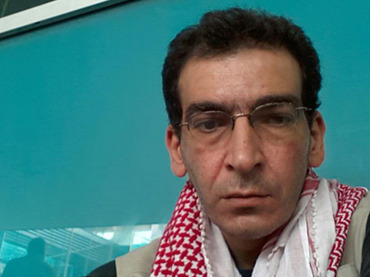
In their fervent struggle, a Syrian rebel group has “arrested” a Lebanese journalist in Aleppo saying his “presence as a journalist no longer receives approval in areas controlled by the rebels.”
Fidaa Itani, who works for the Lebanese Broadcasting Corporation (LBCI) and several other news outlets, was travelling though Aleppo under protection of a rebel group when he was arrested and handed over to another rebel group which controls a small town some 30km away from the besieged port-city.
The rebels said on their Facebook page they found Itani’s work “incompatible with the path of the Syrian revolution and rebels.”
They promised to free the reporter who is now in rebel custody “shortly” – after the necessary documents and information are acquired.
Itani was seized after he raised suspicions, taking pictures and videos of “large amounts of operations” in Syria’s second largest city. The content of his reports also seems to have fallen afoul of how the rebels want the popular uprising against Bashar Al-Assad’s government to be covered.
“Reports and videos have not proven yet Itani’s involvement with any party that works against the revolution, but his presence as a journalist no longer receives approval in areas controlled by the rebels,” the group said in a statement.
LBCI, as well as Lebanese MPs, are in contact with the group and their leader, Abu Ibrahim. They expect Itani to be set free in a couple of days.
Abu Ibrahim and the Azaz rebel group have abducted Lebanese nationals before. Eleven Lebanese pilgrims, who were returning from Iran through Syria, were kidnapped by the group in May. Only two of them have been released so far.
The rebels have used the term “detained” to describe the abduction of the journalist, but they in fact have committed “a criminal action” and “kidnapped” him, Manuel Ochsenreiter, editor-in-chief of the German monthly news magazine Zuerst, told RT.
“Indeed this is an alarming development but this is not new,” he said. “He is not the first journalist to have been kidnapped in Syria. We see a huge number of journalists that were killed by the rebels in Syria, who were killed by the Al-Qaeda related groups. I just want to remember the journalists of the Syrian TV channel, Syrian News TV where some journalist were killed and where the building was attacked at the end of June this year.”
At the same time the Syrian government does not prevent journalists making reports that disagree with the official line, says Ochsenreiter, who himself had visited Damascus during the conflict.
“I was in Damascus and what I can say is that I met a lot of journalists who were not filing reports consistent with the official line of the Syrian government’s cause and they were not detained, they were not kidnapped, they were free to work in the country,” he said. “So, you see that there is a huge difference how journalists work in Syria and there is a monster huge difference in the risk.”
Itani was kidnapped just hours after the release of a video in which Al-Qaeda leader Ayman al-Zawari had called for Muslims to kidnap Westerners as a bargaining chip, to win the release of its members held captive around the world. In a new video posted online he also urged Islamists to support Syrian rebels with “all that they can.”
This is not the first time that a foreign reporter has gone missing in the Arab country since it plunged into civil unrest in March 2011. In one of the most recent incidents, Ukrainian reporter Anhar Kochneva disappeared several weeks ago and has not yet been freed. In total, according to the Committee to Protect Journalists, three international reporters remain unaccounted for in Syria, while over 20 have been killed adding to more than 20,000 casualties suffered by Syria.
Whistleblower who revealed CIA torture sentenced to prison
RT | October 23, 2012
Former CIA agent John Kiriakou pleaded guilty Tuesday morning to crimes related to blowing the whistle on the US government’s torture of suspected terrorists and was sentenced to two-and-a-half years in prison.
The Wall Street Journal reports that Kiriakou, 48, agreed to admit to one count of disclosing information identifying a covert agent early Tuesday, just hours after his attorney entered a change of plea in an Alexandria, Virginia courtroom outside of Washington, DC.
Kiriakou was originally charged under the Espionage Act of 1917 after he went public with the Central Intelligence Agency’s use of waterboarding on captured insurgents in the wake of the September 11, 2001 terrorist attack. On Monday morning, though, legal counsel for the accused former CIA agent informed the court that Kiriakou was willing to plead guilty to a lesser crime.
Initially, Kiriakou pleaded not guilty to the charge that he had outted two intelligence agents directly tied to the drowning-simulation method by going to the press with their identities.
As RT reported last week, defense attorneys had hoped that the government would be tasked with having to prove that Kiriakou had intent to harm America when he went to the media. Instead, however, prosecutors were told they’d only need to prove that the former government employee was aware that his consequences had the potential to put the country in danger.
Had Kiriakou been convicted under the initial charges filed in court, he could have been sentenced to upwards of five decades behind bars.
“Let’s be clear, there is one reason, and one reason only, that John Kiriakou is taking this plea: for the certainty that he’ll be out of jail in 2 1/2 years to see his five children grow up,” Jesselyn Raddack, a former Justice Department official who blew the whistle on Bush administration’s mishandling in the case of “American Taliban” John Walker Lindh, wrote Tuesday.
Kiriakou, Raddack wrote, was all but certain to enter the Alexandria courthouse on Tuesday and plead guilty to the lesser charge of violating the Intelligence Identities Protection Act (IIPA), explaining, “there are no reported cases interpreting it because it’s nearly impossible to prove–for “outing” a torturer.”
“’Outing’ is in quotes because the charge is not that Kiriakou’s actions resulted in a public disclosure of the name, but that through a Kevin Bacon-style chain of causation, GITMO torture victims learned the name of one of their possible torturers,” Raddack wrote. “Regardless, how does outing a torturer hurt the national security of the U.S.? It’s like arguing that outing a Nazi guarding a concentration camp would hurt the national security of Germany.”
Speaking on condition of anonymity, a former government official told Firedoglake recently that the CIA was “totally ticked at Kiriakou for acknowledging the use of torture as state policy” and allegedly outing the identity of a covert CIA official “responsible for ensuring the execution” of the water-boarding program.
Kiriakou “outted” to the reporters the identities of the CIA’s “prime torturer” under its Bush-era interrogations, Firedoglake wrote. “For that, the CIA is counting on the Justice Department to, at minimum, convict Kiriakou on the charge of leaking an agent’s identity to not only send a message to other agents but also to continue to protect one of their own.”
Former National Security Agency staffer Thomas Drake suffered a similar fate in recent years after the government went after him for blowing the whistle on the NSA’s poorly handled collection of public intelligence. A grand jury indicted Drake on five counts tied to 1917’s Espionage Act as well as other crimes, but prosecutors eventually agreed to let him off with a misdemeanor computer violation that warranted zero jail time.
Together, Drake and Kirakou are two of six persons charged under the Espionage Act during the administration of US President Barack Obama. The current White House has indicted more people under the antiquated World War 1-era legislation than all previous presidents combined.
What shall we not talk about today?

“. . . a significant part of the community wants to talk about Israeli policy in the context of Jewish history and Jewish identity, and do so in a highly critical manner. Clearly a lot of people, including many in our community, want to have these conversations and regard them as necessary to resolving the Middle East conflict. We don’t. We are tired of serving as a platform for this discussion, including in the comment section, and don’t see the conversation as a productive one. From here on out, the Mondoweiss comment section will no longer serve as a forum to pillory Jewish culture and religion as the driving factors in Israeli and US policy.
We are making this change because this discussion makes for a toxic, often racist, discourse, and scares off others who would otherwise be drawn to the issues this site concerns itself with.”
Xymphora responds:
I look forward to the ‘Roots of Slavery in the Old South’ forum, which consists entirely of a discussion of the sufferings of the slaveholders, and how their actions derived entirely from the racism experienced by their Scots-Irish forefathers.
Of course, the deeper issue is that Zionism is based, not in Jewish suffering or the mythology of a universal irrational hatred of Jews, but in Jewish violent group supremacism. This is easy to see in that Zionism waxes in times of Jewish group dominance (like now), and wanes in the relatively rare times of Jewish group oppression. The lite Zionists are always more skittish about hiding Jewish supremacism than the hard-core Zionists.
~~~
Aletho News adds the following list containing the names of those who have publicly disavowed Gilad Atzmon due to his recognizing a connection between Jewish cultural identity and Zionist ideology:
As’ad AbuKhalil, The Angry Arab News Service, Turlock, CA
Suha Afyouni, solidarity activist, Beirut, LEBANON
Max Ajl, essayist, rabble-rouser, proprietor of Jewbonics blog site, Ithaca, NY
Haifaa Al-Moammar, activist, stay-at-home mom, and marathon walker, Los Angeles, CA
Electa Arenal, professor emerita, CUNY Graduate Center/Hispanic & Luso-Brazilian Literatures and Women’s Studies, New York, NY
Gabriel Ash, International Jewish Anti-Zionist Network, Geneva, SWITZERLAND
Joel Beinin, Donald J. McLachlan Professor of History, Stanford University, Palo Alto, CA
Dan Berger, Wild Poppies Collective, Philadelphia, PA
Chip Berlet, Boston, MA
Nazila Bettache, activist, Montréal, CANADA
Sam Bick, Tadamon!, Immigrant Workers Center, Montréal, Québec
Max Blumenthal, author; writing fellow, The Nation, New York, NY
Lenni Brenner, author, Zionism in the Age of the Dictators, New York, NY
Café Intifada
Paola Canarutto, Rete-ECO (Italian Network of Jews against the Occupation), Torino, ITALY
Paulette d’Auteuil, National Jericho Movement, Albuquerque, NM
Susie Day, Monthly Review, New York, NY
Ali Hocine Dimerdji, PhD student at The University of Nottingham, in Nottingham, UK
Roxanne Dunbar-Ortiz, professor emerita, California State University
Todd Eaton, Park Slope Food Coop Members for Boycott/Divestment/Sanctions, Brooklyn, NY
Mark Elf, Jews sans frontieres
S. EtShalom, registered nurse, Philadelphia, PA
Benjamin Evans, solidarity activist, Chicago, IL
First of May Anarchist Alliance
Sherna Berger Gluck, professor emerita, California State University/Israel Divestment Campaign, CA
Neta Golan, International Solidarity Movement
Tony Greenstein, Secretary Brighton Unemployed Centre/UNISON, Jews for Boycotting Israeli Goods, Brighton, UK
Andrew Griggs, Café Intifada, Los Angeles, CA
Jenny Grossbard, artist, designer, writer and fighter, New York, NY
Freda Guttman, activist, Montréal, CANADA
Adam Hanieh, lecturer, Department of Development Studies/SOAS, University of London, UK
Swaneagle Harijan, anti-racism, social justice activism, Seattle, WA
Sarah Hawas, researcher and solidarity activist, Cairo, EGYPT
Stanley Heller, “The Struggle” Video News, moderator “Jews Who Speak Out”
Mostafa Henaway, Tadamon!, Immigrant Workers Center, Montréal, CANADA
Elise Hendrick, Meldungen aus dem Exil/Noticias de una multipátrida, Cincinnati, OH
Doug Henwood, Left Business Observer, New York, NY
Ken Hiebert, activist, Ladysmith, CANADA
Elizabeth Horowitz, solidarity activist, New York, NY
Adam Hudson, writer/blogger, San Francisco Bay Area, CA
Dhruv Jain, Researcher at the Jan Van Eyck Academie and PhD student at York University, Paris, FRANCE
Tom Keefer, an editor of the journal Upping the Anti, Toronto, CANADA
Karl Kersplebedeb, Left Wing Books, Montréal, CANADA
Anne Key, Penrith, Cumbria, UK
Mark Klein, activist, Toronto, CANADA
Bill Koehnlein, Brecht Forum, New York, NY
L.A. Palestine Labor Solidarity Committee, Los Angeles, CA
Mark Lance, Georgetown University/Institute for Anarchist Studies, Washington, DC
David Landy, author, Jewish Identity and Palestinian Rights: Diaspora Jewish Opposition to Israel, Dublin, IRELAND
Bob Lederer, Pacifica/WBAI producer, Queers Against Israeli Apartheid, New York, NY
Matthew Lyons, Three Way Fight, Philadelphia, PA
Karen MacRae, solidarity activist, Toronto, CANADA
Heba Farouk Mahfouz, student activist, blogger, Cairo, EGYPT
Marvin Mandell and Betty Reid Mandell, co-editors, New Politics, West Roxbury, MA
Ruth Sarah Berman McConnell, retired teacher, DeLand, FL
Kathleen McLeod, poet, Brisbane, Australia
Karrie Melendres, Los Angeles, CA
Matt Meyer, Resistance in Brooklyn, New York, NY
Amirah Mizrahi, poet and educator, New York, NY
mesha Monge-Irizarry, co-director of Education Not Incarceration; SF MOOC City commissioner, San Francisco, CA
Matthew Morgan-Brown, solidarity activist, Ottawa, CANADA
Michael Novick, People Against Racist Terror/Anti-Racist Action, Los Angeles, CA
Saffo Papantonopoulou, New School Students for Justice in Palestine, New York, NY
Susan Pashkoff, Jews Against Zionism, London, UK
Tom Pessah, UC Berkeley Students for Justice in Palestine, Berkeley, CA
Marie-Claire Picher, Theater of the Oppressed Laboratory (TOPLAB), New York, NY
Sylvia Posadas (Jinjirrie), Kadaitcha, Noosa, AUSTRALIA
Roland Rance, Jews Against Zionism, London, UK
Danielle Ratcliff, San Francisco, CA
Liz Roberts, War Resisters League, New York, NY
Emma Rosenthal, contributor, Shifting Sands: Jewish Women Confront the Israeli Occupation, Los Angeles, CA
Penny Rosenwasser, PhD, Oakland, CA
Suzanne Ross, Free Mumia Abu-Jamal Coalition, The Riverside Church Prison Ministry, New York, NY
Gabriel San Roman, Orange County Weekly, Orange County, CA
Ian Saville, performer and lecturer, London, UK
Joel Schwartz, CSEA retiree/AFSCME, New York, NY
Tali Shapiro, Anarchists Against the Wall, Boycott From Within, Tel Aviv, OCCUPIED PALESTINE
Simona Sharoni, SUNY, author, Gender & the Israeli-Palestinian Conflict, Plattsburgh, NY
Jaggi Singh, No One Is Illegal-Montreal/Solidarity Across Borders, Montréal, CANADA
Michael S. Smith, board member, Center for Constitutional Rights, New York, NY
Pierre Stambul, Union juive française pour la paix (French Jewish Union for Peace), Paris, FRANCE
Muffy Sunde, Los Angeles, CA
Bhaskar Sunkara, editor of Jacobin, Bronx, NY
Tadamon! (http://www.tadamon.ca/), Montréal, CANADA
Ian Trujillo, atheist, Los Angeles, CA
Gabriella Turek, PhD, Auckland, NEW ZEALAND
Henry Walton, SEIU, retired, Los Angeles, CA
Bill Weinberg, New Jewish Resistance, New York, NY
Abraham Weizfeld, author, The End of Zionism and the liberation of the Jewish People, Montreal, CANADA
Ben White, author, Palestinians in Israel: Segregation, Discrimination, and Democracy, Cambridge, UK
Laura Whitehorn, former political prisoner, NYS Task Force on Political Prisoners, New York, NY
Naomi Wimborne-Idrissi, founding member, Jews for Boycotting Israeli Goods (J-BIG)
Asa Winstanley, journalist for Electronic Intifada, Al-Akhbar and others, London, UK
Ziyaad Yousef, solidarity activist
and also:
- Ali Abunimah
- Naseer Aruri, Professor Emeritus, University of Massachusetts, Dartmouth
- Omar Barghouti, human rights activist
- Hatem Bazian, Chair, American Muslims for Palestine
- Andrew Dalack, National Coordinating Committee, US Palestinian Community Network
- Haidar Eid, Gaza
- Nada Elia, US Academic and Cultural Boycott of Israel
- Toufic Haddad
- Kathryn Hamoudah
- Adam Hanieh, Lecturer, School of Oriental and African Studies (SOAS), London
- Mostafa Henaway, Tadamon! Canada
- Monadel Herzallah, National Coordinating Committee, US Palestinian Community Network
- Nadia Hijab, author and human rights advocate
- Andrew Kadi
- Abir Kobty, Palestinian blogger and activist
- Joseph Massad, Professor, Columbia University, NY
- Danya Mustafa, Israeli Apartheid Week US National Co-Coordinator & Students for Justice in Palestine- University of New Mexico
- Dina Omar, Columbia Students for Justice in Palestine
- Haitham Salawdeh, National Coordinating Committee, US Palestinian Community Network
- Sobhi Samour, School of Oriental and African Studies (SOAS), London
- Khaled Ziada, SOAS Palestine Society, London
- Rafeef Ziadah, poet and human rights advocate
Related articles
Fact Checking Obama’s Misleading Answer About Warrantless Wiretapping on The Daily Show
By Trevor Timm | EFF | October 24, 2012
On last Thursday’s Daily Show, Jon Stewart boldly went where no mainstream reporter has gone so far this election cycle: asking President Barack Obama why has he embraced Bush’s warrantless wiretapping program after campaigning against it on the grounds that it violated Americans’ civil liberties. While Stewart’s question was commendable, Obama’s answer was puzzling because it seems so obviously untrue.
Stewart first reminded Obama of his Bush-era statements that “we don’t have to trade our values and ideals for our security,” and pointedly asked the President, “do you still believe that?” He then specifically raised warrantless wiretapping, which Obama frequently criticized as a presidential candidate in 2008:
STEWART: I think people have been surprised to see the strength of the Bush era warrantless wiretapping laws and those types of things not also be lessened—That the structures he put in place that people might have thought were government overreach and maybe they had a mind you would tone down, you haven’t.
OBAMA: The truth is we have modified them and built a legal structure and safeguards in place that weren’t there before on a whole range issues.
To the contrary, there’s no indication that the still-active warrantless wiretapping program—which includes a warrantless dragnet on millions of innocent Americans’ communications—has significantly changed from the day Obama took office. With regard to the FISA Amendments Act, the Obama Administration has actively opposed all proposed safeguards in Congress. All the while, his Administration has been even more aggressive than President Bush in trying to prevent warrantless wiretapping victims from having their day in court and has continued building the massive national security infrastructure needed to support it.
But let’s take a closer look at the President’s actions on wiretapping and related issues:
Voting against FISA Amendments Act, Filibuster Telecom Immunity
Early in his first presidential campaign, then-Senator Obama was a leading critic of giving telecom companies like AT&T immunity for breaking the law to assist in the government in warrantless wiretapping. He repeatedly promised to filibuster any bill that contained retroactive immunity for telecom companies. Yet in 2008, when Congress debated the FISA Amendments Act—the law that allowed the President to give telecom companies full, retroactive immunity—Obama not only refused to filibuster the bill, but voted for it.
That decision came full circle just two weeks ago, when Obama’s Justice Department successfully convinced the Supreme Court to deny EFF’s appeal challenging the law’s constitutionality, ensuring AT&T and other telecommunications companies will never face legal consequences for breaking the law, both in the past and in the future.
Fixing FISA Amendments Act After Elected
Despite voting for the FISA Amendments Act, then-candidate Obama still promised to reform the law when he was elected president. But four years later, the FISA Amendments Act is up for renewal in Congress, as it expires at the end of this year. This would be perfect time to implement the reforms Obama promised, and there are several common sense amendments that would do so.
The Obama administration, however, is actively opposing any new privacy safeguards or transparency provisions, saying it is their “top priority” to renew it with no changes.
Stopping the Use of the State Secrets Privilege
Congress isn’t the only place where the President has been hostile to any “legal structure or safeguards” for the warrantless wiretapping. He has steadfastly sought to prevent the courts from engaging in any meaningful review
In EFF’s long-running lawsuit Jewel v. NSA, along with several related lawsuits, the Obama administration has continued the Bush Administration strategy of invoking the ‘state secrets’ privilege and demanding immediate dismissal (a practice which Obama specifically criticized on his 2008 campaign website). This, plus many other invocations of the privilege occurred even after a supposed internal policy change that was supposed to restrict its use.
Using the state secrets privilege for electronic surveillance is plainly wrong, since FISA specifically requires courts to determine the legality of national security spying. And of course the argument that the spying is a secret is increasingly untenable, as multiple whistleblowers, hundreds of pages of already-public evidence—including government admissions—and a massive construction project in Utah attest to its ongoing existence.
Sovereign Immunity
In addition, in both Jewel and other cases, the government has raised extremely technical legal arguments that the cases must be dismissed because it has “sovereign immunity.”In Al-Haramain v. Obama, a case where the government was caught red-handed illegally wiretapping attorneys, the Obama Administration was even able to convince the Ninth Circuit to dismiss the case because, according to the court, only government individuals can be sued, not the agencies that actually did the spying.
Declassifying Secret FISA Court Opinions
Both in 2010 and 2011, Obama administration officials promised to work to all declassify secret FISA court opinions that contained “important rulings of law.” These opinions would shed light whether and how Americans’ communications have been illegally spied on.
Since then, the administration has since refused to declassify a single opinion and still refuses to release the full (rescinded) legal memo written by Bush administration lawyer John Yoo that attempted to justify the illegal and unconstitutional program in 2001.
FISA court secrecy has never been more troubling, given the administration admitted in July that the FISA court ruled that collection done by the NSA violated the Fourth Amendment rights of some unknown American on at least one occasion. EFF has since filed a Freedom of Information Act lawsuit for that opinion, plus any others discussing the constitutionality of warrantless surveillance, but the Obama administration is fighting mightily against it.
Secret Safeguards Aren’t Safeguards
Some have suggested it’s possible when Obama said “safeguards” on the Daily Show, he is referring to some unspecified secret administrative rules he has put into place. Yet if these “safeguards” exist, they have been kept completely secret from the American public, and at the same, the administration is refusing to codify them into the law or create any visible chain of accountability if they are violated. But given the ample evidence of Constitutional violations since Obama took office (see: here, here, and here), these secret safeguards we don’t know exist are clearly inconsequential.
Here’s hoping other reporters follows up on Stewart’s question soon and ask Obama to be much more specific about his past and future plans to make sure the American people are not illegally spied on.
Related articles
- Warrantless Wiretapping Worse Under Obama; Fascism on the Rise (tenthamendmentcenter.com)
- Supreme Court Allows NSA’s Warrantless Wiretapping to Continue (thenewamerican.com)
- The New York Times Reminds Us the NSA Still Warrantlessly Wiretaps Americans, and Congress Has the Power to Stop It (eff.org)
Easily Abused, Domestic Drones Raise Enormous Privacy Concerns
By Linda Lye, ACLU of Northern California | October 19, 2012
Shortly before next week’s one-year anniversary of the Oakland Police Department’s brutal crackdown on Occupy Oakland, Alameda County Sheriff Greg Ahern announced that he was seeking funds to purchase a drone to engage in unspecified unmanned aerial surveillance. One of the many unfortunate lessons of OPD’s Occupy crackdown is that when law enforcement has powerful and dangerous tools in its arsenal, it will use them. Drones raise enormous privacy concerns and can easily be abused. Before any drone acquisition proceeds, we need to ask a threshold question – are drones really necessary in our community? – and have a transparent and democratic process for debating that question. In addition, if the decision is made to acquire a drone, do we have rigid safeguards and accountability mechanisms in place, so that law enforcement does not use drones to engage in warrantless mass surveillance? The ACLU of Northern California has sent the Sheriff a Public Records Act request, demanding answers to these crucial questions.
Drones should never be used for indiscriminate mass surveillance, and police should never use them unless there are legitimate grounds to believe they will collect evidence related to a specific instance of criminal wrongdoing or in emergencies.
One of the reasons cited by Sheriff Ahern in support of drones is that they are much cheaper than other forms of aerial surveillance; by his account, a helicopter costs $3 million to purchase and a drone less than 1/30 of that. But the relative inexpensiveness of electronic surveillance is also precisely why strong safeguards need to be in place. When the police have to mount elaborate and costly foot and squad patrols to follow a suspect 24/7, the expenditure of resources serves as a deterrent to abuse; it forces the police to limit their surveillance to instances when it is actually necessary. Drones permit the police to surveil people at all hours of the day and, apparently, at 1/30 the cost of other forms of aerial surveillance. The natural deterrent to abuse goes away, and invites abuse. This makes strong safeguards absolutely essential.
Before Sheriff Ahern proceeds with the drone acquisition, the community deserves answers to the questions we raised in our Public Records Act request: Why are drones necessary? How much will they cost? And what safeguards will be in place to prevent abuse?
Related articles
Featured Video

Diplomacy is Now a Crime in Britain / Ian Proud
or go to
Aletho News Archives – Video-Images
From the Archives
Genetic baloney in thick slices
MAYBE COULD BE INC.
By Jon Rappoport | No More Fake News | July 8, 2021
Gene research companies tend to come and go. They start out banging and popping like fireworks in the sky, and then they fade out—selling themselves to larger outfits who’ve hired better liars…
Once upon a time, it sounded easy. Start with a disease, find the gene responsible for the disease, and correct the problem.
Then, researchers wondered, was disease the result of one gene or a group of genes acting together?
Either way, the proof would be in devising cures for diseases using gene therapy. “Not yet, but soon…”
And regardless, the major need was: money. Lots and lots of money.
This need required good PR people. “We have to pump up the idea that we’re on the edge of tremendous breakthroughs. We’re always on that edge…”
This hype also needed to obscure the fact that there wasn’t (and isn’t) ANY gene cure for ANY disease. … continue
Blog Roll
 Aletho News
- Diplomacy is Now a Crime in Britain / Ian Proud
- UK Government Body Kept Files on People Criticizing Prevent Program
- US military withdrawal from Iraq and the collapse of US-Israeli hegemonic project in West Asia
- What does Europe want – a war with Russia?
- She Followed the Actual Data on COVID Vaccines and Masks — Her Career Took a Huge Hit
- Florida AG Sues Pfizer, Bourla Over Deceptive Marketing of COVID Vaccines
- Von der Leyen gifts her spin doctor a job for life
- 10K More U.S. Troops Deploy as Trump Weighs New Iran Strikes /Suliaman Ahmed
- Iranian crew declared Dena training vessel ‘unarmed’ to US warship before deadly torpedo strike: Report
- Iran’s NPT debate moves beyond parliament
- If Americans Knew
- Israel is squeezing the life out of Palestinians – Daily Update
- The Israeli Right Portrays Islam as Murderous. It Serves a Political Purpose
- Jordan Has Had Enough: King Abdullah’s Scathing Warning to Israel
- Israeli Colonizers (i.e. Settlers) Kill Palestinian Man Near Salfit
- New Google Maps images reveal massive scale of devastation in Gaza
- Jewish supremacy, anti-Palestinian bigotry on display in Israel – Daily Update
- Israeli Soldiers Abduct At Least 22 Across Occupied West Bank
- Eight Palestinians Killed in Israeli Attacks on Gaza
- Israeli former leaders and security chiefs threaten legal action over ‘Jewish terrorism’
- Israel map in LA Times ad includes all land from the river to the sea
- No Tricks Zone
- Green Energy Debacle: German Expert Professor Fritz Vahrenholt Warns Of Severe Economic And Social Consequences
- Two More Paleo Reconstructions Affirm Meters-Higher Sea Levels Across Ireland, Brazil 7000-6000 Years Ago
- New Study: Earth And Venus Surface Warmth Largely Explained By Convection And Lapse Rate, Not CO2 Or Radiation
- 2025 Nature Paper Claiming Worsening Global Drought Gets RETRACTED …Heavily Flawed
- New Study: ‘Global Drought Shows No Detectable Recent Acceleration Under Climate Warming’
- Economic Masterminds: German Socialists Suggest Taxing Productivity Gains Stemming From Using AI
- The South China Sea Has Not Been Cooperating With The Climate Change Narrative
- Energy Crisis: Germany Enters Heating Season With Historically Low Gas Reserve Fill Levels
- New Study: The Antarctic Ice Sheet Gained Mass From 2020-2024 Due To Staggering Snow And Ice Accumulation
- Study: Ocean Heating Rates From Thousands Of Years Ago ‘Dwarf’ Modern Ocean Heating Rates

