Obama increases Clandestine Ops against Venezuela
By Eva Golinger | Postcards from the Revolution | November 11, 2010
Millions of dollars are being channeled to opposition groups in Venezuela via USAID, while the Pentagon has established a new PSYOP program directed at Venezuela, including a “5-day a week television program in Spanish broadcast in Venezuela” during 2011
The 2010 annual report of the Office of Transition Initiatives (OTI), a division of the US Agency for International Development (USAID), regarding its operations in Venezuela, evidences that at least $9.29 million USD was invested this year in efforts to “support US foreign policy objectives…and promote democracy” in the South American nation. This amount represents an increase of almost $2 million over last year’s $7.45 million distributed through this office to fund anti-Chávez political activities in the country.
The OTI is a department of USAID dedicated to “supporting US foreign policy objectives by helping local partners advance democracy in priority countries in crisis. OTI works on the ground to provide, fast, flexible short-term assistance targeted at key political transition and stabilization needs”.
Although OTI is traditionally used as a “short-term” strategy to filter millions of dollars in liquid funds to political groups and activities that promote US agenda in strategically important nations, the case of Venezuela has been different. OTI opened its office in 2002, right after the failed coup d’etat against President Hugo Chavez – backed by Washington – and has remained ever since. The OTI in Venezuela is the longest standing office of this type in USAID’s history.
OTI’S CLANDESTINE OPS
In a confidencial memo dated January 22, 2002, Russell Porter, head of OTI, revealed how and why USAID set up shop in Venezuela. “OTI was asked to consider a program in Venezuela by the State Department’s Office of Andean Affairs on January 4…OTI was asked if it could offer programs and assistance in order to strengthen the democratic elements that are under increasing fire from the Chavez government”.
Porter visited Venezuela on January 18, 2002 and then commented, “For democracy to have any chance of being preserved, immediate support is needed for independent media and the civil society sector…One of the large weaknesses in Venezuela is the lack of a vibrant civil society…The National Endowment for Democracy (NED) has a $900,000 program in Venezuela that works with NDI, IRI and the Solidarity Center to strengthen political parties and the Unions…This program is useful, but not nearly sufficient. It is not flexible enough, nor does it work with enough new or non-traditional groups. It also lacks a media component”.
Since then OTI has been present in Venezuela, channeling millions of dollars each year to feed the political conflict in the country. According to the 2010 annual report, OTI is now operating “out of the US Embassy and is part of a larger US diplomatic effort to promote democracy in Venezuela”.
The principal investment of the $9.29 million in US taxpayer dollars in 2010 went to the opposition’s campaign for the legislative elections, held last September 26 in Venezuela. “USAID works with several implementing partners drawn from the spectrum of civil society…offering technical assistance to political parties…and supporting efforts to strengthen civil society”.
In Venezuela, it’s widely known that the term “civil society” refers to the anti-Chavez opposition.
A SECRET FLOW OF FUNDS
Despite revealing its overall budget, the actual flow of funds from USAID/OTI to groups in Venezuela remains secret. When OTI opened its offices in 2002, it contracted a private US company, Development Alternatives Inc (DAI), one of the State Department’s largest contractors worldwide. DAI ran an office out of El Rosal – the Wall Street of Caracas – distributing millions of dollars annually in “small grants of no more than $100,000” to hundreds of mainly unknown Venezuelan “organizations”.
From 2002 to 2010, more than 600 of these “small grants” were channeled out of DAI’s office to anti-Chavez groups, journalists and private, opposition media campaigns.
In December 2009, DAI began to have severe problems with its operations in Afghanistan, when five of its employees were killed by alleged Taliban militants during an attack on their office December 15 in Gardez. Just days earlier, another DAI “employee”, Alan Gross, had been detained in Cuba and accused of subversion for illegally distributing advanced satellite equipment to dissidents.
When an article written by this author titled “CIA Agents assassinated in Afghanistan worked for “contractor” active in Venezuela, Cuba”, published December 30, 2009 on the web, evidenced the link between DAI’s operations in Afghanistan, Cuba and Venezuela, and their suspicious nature, the CEO of DAI, Jim Boomgard, was alarmed. Days later, he attempted to coerce me into a private meeting in Washington to “discuss” my article. When I refused, he threatened me by claiming that my writing was “placing all DAI employees worldwide in danger”. In other words, if anything happened to DAI employees, I would be personalIy responsible.
But Boomgard, who claimed little knowledge of his company’s operations in Venezuela, understood that what DAI was doing in Venezuela was nowhere near as important (to his company) as what DAI was doing in Afghanistan and other countries in conflict. Weeks later, DAI abruptly closed its office in Caracas.
Nonetheless, OTI continues its operations in Venezuela, and although it has other US “partners” managing a portion of its annual multimillion-dollar budget, such as IRI, NDI, Freedom House and the Pan American Development Foundation (PADF), there is zero transparency regarding funding to Venezuelan groups.
A report published in May 2010 by the Spanish think tank FRIDE assessing “democracy assistance” to Venezuela revealed that a significant part of the more than $50 million annually in political funding from international agencies to anti-Chavez groups in Venezuela was entering illicitly. According to the report, in order to avoid Venezuela’s strict “currency control laws”, US and European agencies bring the monies in dollars or euros into the country and then change them on the black market to increase value. This method also avoids leaving a financial record or trace of the funds coming in to illegally finance political activities.
If DAI is no longer operating in Venezuela and distributing “small grants” to Venezuelan groups, then how are USAID’s multimillion-dollar funds reaching their recipients? According to USAID, they now operate from the US Embassy. Is the US Embassy illegally dishing out funds directly to Venezuelans?
OTI’s 2010 report also reveals the agency’s ongoing intentions to continue supporting and funding Venezuelan counterparts. In the section marked “Upcoming Events”, OTI makes clear where energies will be directed, “December 2012 – Presidential elections”.
PSYCHOLOGICAL OPERATIONS
USAID isn’t the only US agency intervening in Venezuela’s affairs. In the Pentagon’s 2011 budget, a new request for a “psychological operations program” for the Southern Command (USSOUTHCOM), which coordinates all US military missions in Latin America, is included. Specifically, the request refers to the establishment of a “PSYOP voice program for USSOUTHCOM”.
PYSOP are, “planned operations to convey selected information and indicators to foreign audiences to influence their emotions, motives, objective reasoning, and ultimately the behavior of foreign governments, organizations, groups and individuals. The execution of PSYOP includes conducting research on various foreign audiences; developing, producing and disseminating products to influence these audiences; and conducting evaluations to determine the effectiveness of the PSYOP activities. These activities may include the management of various websites and monitoring print and electronic media”. Or, as the 2011 request indicates, running a radio or audio program into a foreign nation to promote US agenda.
USSOUTHCOM’s new PSYOP program in Latin America will complement a new State Department initiative run out of the Board of Broadcasting Governors (BBG), which manages US propaganda worldwide. BBG’s whopping 2011 budget of $768.8 million includes “a 30-minute, five-day-a-week VOA [Voice of America] Spanish television program for Venezuela”.
This increase in PSYOP and pro-US propaganda directed at Venezuela evidences an escalation in US aggression towards the region.
And the Office of the Director of National Intelligence (DNI) is still running a special intelligence “mission” on Venezuela and Cuba, set up in 2006. Only four of these country-specific “mission management teams” exist: Iran, North Korea, Afghanistan/Pakistan, and Venezuela/Cuba. These “missions” receive an important part of DNI’s $80 billion annual budget and operate in complete secrecy.
US-Backed Death Squad Files Surface
As Obama Lands in Indonesia
By ALLAN NAIRN | CounterPunch | November 10, 2010
Secret documents have leaked from inside Kopassus, Indonesia’s red berets, which say that Indonesia’s US-backed security forces engage in “murder [and] abduction” and show that Kopassus targets churches in West Papua and defines civilian dissidents as the “enemy.”
The documents include a Kopassus enemies list headed by Papua’s top Baptist minister and describe a covert network of surveillance, infiltration and disruption of Papuan institutions
The disclosure comes as US President Barack Obama is touching down in Indonesia. His administration recently announced the restoration of US aid to Kopassus.
Kopassus is the most notorious unit of Indonesia’s armed forces, TNI, which along with POLRI, the national police, have killed civilians by the hundreds of thousands.
The leaked cache of secret Kopassus documents includes operational, intelligence and field reports as well as personnel records which list the names and details of Kopassus “agents.”
The documents are classified “SECRET” (“RAHASIA”) and include extensive background reports on Kopassus civilian targets — reports that are apparently of uneven accuracy.
The authenticity of the documents has been verified by Kopassus personnel who have seen them and by external evidence regarding the authors and the internal characteristics of the documents.
Some of the Kopassus documents will be released in the days to come, in part via my website.
Those being released with this article concern West Papua, where tens of thousands of civilians have been murdered and where Kopassus is most active. Jakarta has attempted to largely seal off Papua to visits by non-approved outsiders.
When the US restored Kopassus aid last July the rationale was fighting terrorism, but the documents show that Kopassus in fact systematically targets civilians.
A detailed 25-page secret report by a Kopassus task force in Kotaraja, Papua defines Kopassus’ number-one “enemy” as unarmed civilians. It calls them the “separatist political movement” “GSP/P, ” lists what they say are the top 15 leaders and discusses the “enemy order of battle.”
All of those listed are civilians, starting with the head of the Baptist Synod of Papua. The others include evangelical ministers, activists, traditional leaders, legislators, students and intellectuals as well as local establishment figures and the head of the Papua Muslim Youth organization.
The secret Kopassus study says that in their 400,000 – person area of operations the civilians they target as being political are “much more dangerous than” any armed opposition since the armed groups “hardly do anything” but the civilians — with popular support — have “reached the outside world” with their “obsession” with “merdeka” (independence/ freedom) and persist in “propagating the issue of severe human rights violations in Papua,” ie. “murders and abductions that are done by the security forces.”
The Kopassus document cited above is embedded below, followed by supplementary field reports. [The documents can be viewed here. Satgas Ban – 5 Kopassus Triwlapharian.]
Given that the Kopassus report states as settled fact that security forces do “murder, abduction,” those who they define as being the enemy can be presumed to be in some danger.
In its discussion of “State of the enemy” Kopassus identifies the enemy with two kinds of actions: “the holding of press conferences” where they “always criticize the government and the work being done by the security forces” and the holding of private meetings where they engage in the same kind of prohibited speech.
The Kopassus “enemies” list — the “leaders” of the “separatist political movement” includes fifteen civic leaders. In the order listed by Kopassus they are:
— Reverend Socrates Sofyan Yoman, chair of the Papua Baptist Synod
— Markus Haluk head of the Association of Indonesian Middle Mountains Students (AMPTI) and an outspoken critic of the security forces and the US mining giant Freeport McMoRan;
— Buchtar Tabuni, an activist who, after appearing on the Kopassus list, was sentenced to three years prison for speech and for waving Papuan flags and was beaten bloody by three soldiers, a guard, and a policeman because he had a cell phone;
— Aloysius Renwarin, a lawyer who heads a local human rights foundation;
— Dr. Willy Mandowen, Mediator of PDP, the Papua Presidium Council, a broad group including local business people, former politcal prisoners, women’s and youth organizations, and Papuan traditional leaders. His most prominent predecessor, Theys Eluay, had his throat slit by Kopassus in 2001;
— Yance Kayame, a committee chair in the Papuan provincial legislature;
— Lodewyk Betawi;
— Drs. Don Agustinus Lamaech Flassy of the Papua Presidium Council staff
— Drs. Agustinus Alue Alua, head of the MRP, the Papuan People’s Council, which formally represents Papuan traditional leaders and was convened and recognized by the Jakarta government;
— Thaha Al Hamid, Secretary General of the Papua Presidium Council;
— Sayid Fadal Al Hamid, head of the Papua Muslim Youth;
— Drs. Frans Kapisa, head of Papua National Student Solidarity;
— Leonard Jery Imbiri, public secretary of DAP, the Papuan Customary Council, which organizes an annual plenary of indigenous groups, has staged Papua’s largest peaceful demonstrations, and has seen its offices targeted for clandestine arson attacks;
— Reverend Dr. Beny Giay, minister of the Protestant evangelical KINGMI Tent of scripture church of Papua;
— Selfius Bobby, student at the Fajar Timur School of Philosophy and Theology.
Reached for comment, Reverend Socrates Sofyan Yoman of the Baptist Synod laughed when told he headed the Kopassus list. He said that churches were targeted by TNI/ Kopassus because “We can’t condone torture, kidnapping or killing.” He said that he has received anonymous death threats “all the time, everywhere,” but that as a church leader he must endure it . He said the real problem was for Papua’s poor who “live daily in pressure and fear.”
Markus Haluk said that he is constantly followed on foot and by motorcycle, has been the subject of apparent attempts to kill him, and receives so many sms text death threats that he has difficulty keeping current with the death-threat archive he tries to maintain for historical and safety purposes.
One threat, written months after his name appeared as a target in the Kopassus documents, promised to decapitate him and bury his head 200 meters deep, while another imagined his head as a succulent fruit to be devoured and swallowed by security forces.
But as a famous figure in Papua, Haluk enjoys, he thinks, a certain kind of protection since when security forces have actually arrested him it has at times touched off street uprisings.
Village Papuans, he said, enjoy no such advantage. For them, being targeted by Kopassus “can get you killed. If there’s a report against you, you can die.”
Contacted in prison, Buctar Tabuni, the number three enemy on the Kopassus list, told of getting a death threat with a rat cadaver, described living with round-the-clock surveillance, and said the threats to him repeatedly stated that “you will be killed unless you stop your human rights activities.”
Three days ago, writing from his prison cell, Buctar Tabuni called on President Obama to cut off aid to TNI and back a democratic vote on Papuan independence. He told me that Indonesia follows the US lead and that the US was complicit since, as he wrote Obama, US-trained “troops in cities and villages all over West Papua treat the people like terrorists that must be exterminated.”
Anti-terrorism was indeed Obama’s main argument for restoring US aid to Kopassus, but the documents make clear that Kopassus mainly targets unarmed civilians, not killers.
In fact, the main unit that wrote the secret documents, SATGAS BAN – 5 KOPASSUS, is ostensibly doing anti-terrorism, with the Kopassus Unit 81, Gultor.
Obama justified the Kopassus aid restoration to Congress by saying that the initial US training would be given not to Kopassus as a whole but only to its anti-terror forces. The White House and Pentagon suggested that these forces were less criminal than the rest of Kopassus and of TNI/POLRI, but the documents establish that they, like the rest, go after civilians like the Papuan reverends and activists.
Reverend Giay said, when reached for comment that TNI, Kopassus and POLRI were making the case that “it’s OK to kill pastors and burn churches since the churches are separatist.”
Among Giay’s collection of anonymous sms death threats was a political missive demanding that “the reverend stop using the platform of the church to spread the ideology of free Papua.”
Giay said that “they need ideological and moral support from the Indonesian majority and the media” so they use Kopassus and others to attack the churches as constituting security threats.
He compared TNI/Kopassus actions in Papua now to those earlier in East Timor and the Malukus where “they created this conflict between Muslims and Christians” to expand their presence and get more money and power.
Reverend Giay said that “local pastors have been targeted. They kill them off and report them as separatists.”
The Kopassus documents boast that “in carrying out the operational mission of intelligence in the kotaraja area, we apportion work in order to cover all places and avenues of kotaraja society.”
The files show that Kopassus indeed penetrates most every part of
popular life. In addition to plainclothes Kopassus officers who go undercover in multiple roles, Kopassus fields a small army of non-TNI “agents” — real people with real lives and identities, who are bought, coerced or recruited into working covertly.
Kopassus Kotaraja area agents discussed in the secret personnel files include reporters for a local newspaper and for a national TV news channel, students, hotel staff, a court employee, a senior civil servant who works on art and culture, a 14 year old child, a broke, “emotional, drunken” farmer who needs money and “believes” that Kopassus will “take care of his safety,” a “hardworking” “emotionally stable” farmer who also is a need of funds, a worker who “likes to drink hard liquor,” is poor and “likes to believe things,” a motorcycle taxi driver, a cellphone kiosk clerk who watches people who buy SIM card numbers, and a driver for a car rental company who “frequently informs on whether there are elements from the Separatist Political Movement who hire rental cars and speak regarding independence/freedom (merdeka).”
In the file, though, the word “merdeka” is not spelled out. In accord with Kopassus practice, only an initial is written, in quotation marks: “‘M'”, the unwritable, unspeakable M-word.
The documents support the longtime word on the street: you rarely know who is Kopassus. So best watch what you say if you care for safety, especially if what you say is “freedom.”
Allan Nairn is a journalist living in Indonesia.
The Resurrection of Ariel Sharon
Why the curious renewed interest in the former Prime Minister?
By William A. Cook | Palestine Chronicle | November 8, 2010
‘He’s neither alive nor dead.’
Raanan Gissin, Sharon’s former advisor, made the above comment last month as quoted in the Jerusalem Post (20-10-2010) upon the exhibit of a lifelike sculpture by Noam Braslavsky in Tel Aviv. The wax figure shows the comatose Sharon’s chest move up and down “to depict Sharon’s dependence on a breathing machine.” Some have found the work unsettling. “It’s very tragic,” Gissin noted. It’s “only sickening voyeurism,” Kadima MK Yoel Hasson declaimed. Braslavsky created “the sculpture because Sharon has been absent from the public eye for so long,” according to the Post’s article. Regardless, the exhibit has stirred up the Israelis as they are forced to revisit the former PM who is not yet dead.
Coincidentally, this week Christoph Schult published an article in Spiegel Online titled “The Israeli Patient: Searching for Ariel Sharon’s Political Legacy.” While noting that the former Prime Minister has been in a coma now for 5 years, “his presence looms over the country’s political course.” In an effort to explore whether or not the comatose PM would have taken Israel into peace negotiations with the Palestinians or not, he decided to interview Sharon’s sons and selected friends. Sharon’s sons offer little, indeed nothing worth recounting if the article’s lack of quotes is true. But Schult makes this point, “the entire country is living with the consequences of a policy that the former Prime Minister began but was never able to end. It was Sharon who ordered the construction of the security wall … and withdrew the Jewish settlers from the Gaza strip…” But Braslavsky got it wrong; Sharon breathes but lives via a gastric feeding tube. Can he hear? Can he see? Will he recover? No one seems to know for sure. His sons hope he will eventually wake.
So why the curious renewed interest in the former Prime Minister? It seems that the current policies of the Netanyahu administration, the increased vigor in the Knesset as it rams through a series of “thought” legislation, and the uncertainty that surrounds Obama’s ambiguous thrusts and withdrawals regarding his negotiations have shed klieg lights on what Sharon wrought before he fell into the coma. Five years ago I wrote an article, “Hope Destroyed, Justice Denied, The Rape of Palestine,” (11-29-2005) that reflected then, when Sharon first went into the coma, what legacy he left to the Jewish state. It is a legacy of calculated carnage both of the people of Palestine and Judaism; it is imaged in his Wall of Fear that physically imprisons the Palestinians on one side and psychologically imprisons the Jews in fear and victimhood, a true legacy of isolationist tribalism as their efforts to control thought symbolizes. Magnify and multiply the abuses this man inflicted in 2005 by the atrocities of the 2006 Lebanon invasion, the Christmas invasion of Gaza, and the attack on the Marmara, added to those reported in B’Tselem since 2005, and one can understand why this state needs to hide behind thought control and the insulation that protects ruthless self interest. This passage from that article illustrates the point:
“As we moved through month after month of 2005, Sharon’s forces have continued their illegal “targeted killing” of Hamas militants, a short hand way of saying Israel has disbanded the basis of law in the West to reintroduce the law of the ancient barbarian states that granted license to the tribal chief or local tyrant absolute authority to determine guilt without arrest, without issuance of a charge, without counsel, without a plea, and without a court resulting in illegal assassination that goes unnoticed and unpunished in Israel and the United States, the self-extolled bulwarks of Democracy in the world. What hypocrisy. Thus have we come full circle in the mid-east as a new barbarian horde inflicts its merciless power on the innocent as well as the condemned for it inevitably happens, as it did this week, that innocent bystanders suffer the same fate as the object of the extrajudicial execution. The IDF record as reported by the Palestine Center for Human Rights as of January 2004 shows 309 civilians killed as a result of 157 executions. Rule without law, an action approved by the US government and supported by the American tax dollar. Yet no one objects. The above litany of Sharon’s brutality constitutes what is countable in the way of deaths attributable to the illegal actions of the IDF. But there are other consequences to this occupation that are lost to the non-observant eye…”
“The decline in the well-being and quality of life of Palestinian children,” reports Human Rights Watch, “[in the occupied territories] over the past two years has been rapid and profound according to CARE, 17.5% of children in Gaza are malnourished.” Thirteen percent of children between the ages of six months and five years “have moderate to severe acute malnutrition.” Nearly half of Palestinians live below the poverty line. Hospitals are in dire need of basic supplies including water and electricity. Almost ninety percent of the Rafah population depends on food aid. And while malnutrition and poverty imposed by the Israeli oppressors seems hideous enough, it pales in comparison to the reality facing the children as they grow up in the occupation. Dr. Shamir Quota, Director of Research for the Gaza Community Mental Health Programs, makes this observation: “Ninety percent of children two years old or more have experienced ¬ some many, many times ¬ the [Israeli] army breaking into the home, beating relatives, destroying things. Many have been beaten themselves, had bones broken, were shot, tear gassed, or had things happen to siblings and neighbors.”
Contemplate that statistic, ninety percent of two year olds growing up have witnessed soldiers bursting through the door of their home, rifles pointed at their mother or father, pushed against walls, beaten perhaps, shouted at certainly, cursed we might assume, and left in fear knowing another raid is imminent. What torture is here? This is intentional, calculated, psychological torture, genocidal “mental harm” as described in the UN Convention.
But there’s more. I left Palestine shortly after the “disengagement” from Gaza, a word that masks the reality of that “peace” move by Sharon. There is no disengagement: Sharon’s government owns the sky above Gaza; it owns the fence around Gaza; it owns access and exit from Gaza; it owns sea passage and use of the sea that borders Gaza; and it owns the missiles that it hurls from F-16s into the cities and refugee camps inside of Gaza indifferent to the innocent incinerated by its savagery. The only real disengagement that Sharon authorized in Gaza is disengagement from responsibility under the Geneva Conventions for occupying powers to provide adequately and humanely for the people so occupied. That means Israel does not have to pay for the care of the people who are locked into their prison in this most heinous apartheid on the face of the planet.”
But lest the disengagement plan be observed as an Israeli weakness in light of world opinion against its occupation policies, Israel redoubled its efforts to punish the Palestinians in Gaza.
“Israel’s policy of assassinating wanted Palestinians continued in Gaza following the unilateral withdrawal. The policy was reaffirmed by then-Israeli Prime Minister Ariel Sharon and Military Chief of Staff, Dan Halutz, at a meeting on 8 November 2005. According to statistics from Al Mezan, 47 targeted assassinations took place from 12 September 2005 to 10 September 2006, usually in the form of air strikes on a moving vehicle. Such attacks killed and wounded a total of 25 bystanders; for instance, an attack on 27 October 2005 killed seven Palestinians, including three children, and injured 19 more. Based on Al Mezan statistics, 362 Palestinians in Gaza died as a result of Israeli military attacks in the year following the unilateral withdrawal: 151 from 12 September 2005 to 27 June 2006, and 211 in Operation ‘Summer Rains’ between 28 June and 10 September 2006. The majority of casualties were civilian. The number of attacks escalated over the course of the year. Between 12 September and 31 December 2005, 544 artillery shells were fired into Gaza, and there were 124 air strikes. Between January and April 2006, more than 3,600 artillery shells and 63 air strikes were launched. Most recently, in June alone, there were 1,376 shells fired and 122 air strikes, as well as an explosion on Beit Lahiya beach which a Human Rights Watch investigation attributed to Israel; these recent attacks resulted in the deaths of thirty-six people, including 12 children, and injured 110. (The Disengagement Plan and Israel’s Status as Occupying Power, NGO in Consultation Status with the Economic and Social Council of the UN).
Following Sharon’s withdrawal into the coma, Israeli politicians were faced with determining what actions to pursue: continued disproportionate and ruthless military attacks against Gaza and the West Bank in keeping with Sharon’s policies or withdraw to a more conciliatory posture to appease growing international criticism of that behaviour. It didn’t take long for the world to witness Israel’s answer. The fall 2006 invasion and razing of Lebanon’s infrastructure followed by its merciless killing of over a 1000 Lebanese including the second destruction of Qana village (the first occurred ten years earlier) where 63 Lebanese refugees including 42 children were hunted down, chased from home to home until destroyed. Again, the savage behaviour executed by Israel was meant to demonstrate to the world that Israel was not defeated by world opinion.
But world opinion appears to be having an impact. Neve Gordon notes in “Thought crimes in Israel” that Israel’s Knesset has a raft of laws before it that will “seal Israel’s transformation into a fully fascist state that persecutes and marginalizes everyone who does not subscribe to the official racially-oriented ideology.” These measures include swearing an oath of loyalty and allegiance to Israel as a Jewish and democratic state and to its laws and symbols as a condition for receiving public funding for film projects; for newly naturalized citizens to declare loyalty to the Jewish character of the state (similar Gordon notes to Jews and Muslims in Britain to swear to loyalty to the Church of England); for those protesting against or denying Israel’s Jewish character incarceration can be levelled effectively denying political freedom of speech; for those desiring to live in settlements who do not accept the settlement committee’s political views or religion no recourse is allowed to achieve their end thereby making it legal for settlements to deny access to non-Jews and Palestinians; for those who wish to mark the anniversary of the Nakba, public funds will be denied thus preventing expression to citizens of views that are critical of Israeli actions; for those who wish to encourage boycotts or disinvestment actions against the state monetary penalties will be imposed effectively silencing free speech; for all these measures the Association for Civil Rights in Israel has warned that they would effectively make an alternative political ideology, such as the idea that Israel should be a democracy for all its citizens, a crime.
This then is the legacy of Ariel Sharon: a retreat into self-righteousness that finds fault with all who oppose the Zionist ideology, the isolation within that fears anyone who does not accept the Zionist mindset of force that ensures adherence to rights determined by them to be rights. It is imaged in Sharon’s Wall of Fear that would visually erase their neighbours whom they have erased from their minds as people, to force their citizens to walk the streets, roam the highways, bathe in the sea yet not see one who is different from them though they live in the same land, raise their families under the same sun, drink from the same aquifers, and retire in rest as they watch the sun set over the same sea. But they are not the same if they do not believe what the Zionists believe for there is cemented into that mindset an absolute understanding that they alone determine what will be at any cost regardless of international law or international agreements, and they will use whatever means at their disposal to control all who could or would find fault with their desires and will. … Full article
The great book robbery of 1948
By Arwa Aburawa, The Electronic Intifada, 9 November 2010

Stolen Palestinian books labeled “absentee property.” (Courtesy of The Great Book Robbery)
A new documentary reveals a hidden chapter in the history of the Nakba — the Palestinian expulsion and flight at the hands of Zionist militias as Israel was established in 1948 — which saw the systematic looting of more than 60,000 Palestinian books by Israeli forces and the attempted destruction of Palestinian culture.
As the violence which came to mark the formation of Israel erupted, Palestinian families living in the urban centers and villages of the country fled their homes in search of safety and refuge. One Palestinian family after another escaped, and believing that they would soon return, many left behind their most precious belongings. As Palestinian homes sat silent in the haze of conflict, however, a systematic Israeli campaign was underway to enter the homes and rob them of a precious commodity — their books.
Between May 1948 and February 1949, librarians from the Jewish National Library and Hebrew University Library entered the desolate Palestinian homes of west Jerusalem and seized 30,000 books, manuscripts and newspapers alone. These cultural assets, which had belonged to elite and educated Palestinian families, were then “loaned” to the National Library where they have remained until now. Furthermore, across cities such as Jaffa, Haifa, Tiberias and Nazareth, employees of the Custodian of Absentee Property gathered approximately 40,000-50,000 books belonging to Palestinians. Most of these were later resold to Arabs although approximately 26,000 books were deemed unsuitable as they contained “inciting material against the State [Israel]” and were sold as paper waste.
This untold story of the Nakba has remained hidden over the years until, by complete accident, Israeli graduate student Gish Amit stumbled across archives documenting the systematic looting of Palestinian books. “I came across this topic quite accidentally,” Gish admits. “I spent the first few months of my doctoral studies at various archives, among them the archive of the Jewish national and university library, where one day, I discovered the first documents regarding the collecting of the Palestinian libraries left behind during the 1948 war. Anyhow, it took me a few more weeks — and dozens of documents — to realize that there was a story to tell. A story that hasn’t yet been told and one that might enrich our knowledge about the Palestinian culture and its erasure.”
Although many Palestinian families were aware that their books were taken during the aftermath of 1948, they had no idea that there was a systematic and conscious effort to appropriate their books.
Ghada Karmi, a Palestinian activist and author who lived in Jerusalem until 1948 when her family was forced to flee, recalls that her father was an avid reader and had an impressive personal library. “My family was part of the small, relatively educated elite in Palestine at the time which has lots books,” she explains. “For the Zionists to steal those books … I don’t know, it’s shocking. Well, they stole everything so I guess it doesn’t surprise me at all.”
The cultural destruction that occurred during the Nakba has remained a relatively marginalized aspect of the wider narrative of Palestinian suffering. It is seen as a small, irrelevant detail which affected a small minority of urban elites living in the cities, as apposed to the complete annihilation of Palestinian villages that affected a large portion of the Palestinian population.
“What you need to understand is that the Palestinian loss was so massive that such details were overwhelmed,” says Karmi, who now lives and works as a university lecturer in the UK. She is also the author of several books including In Search of Fatima, a memoir of her family’s experience during the Nakba. “People lost their homes, their lives, their land and I guess the loss of books in the homes of a small Palestinian elite would not have been high up on the scale. Now that all these years have passed since the Nakba, these details are starting to emerge and their importance is being acknowledged.”
In fact film director Benny Brunner, Arjan El Fassed (co-founder of The Electronic Intifada) and others have made it their task to highlight the state-sponsored looting of 1948-49. The Great Book Robbery is a project and documentary in the making which hopes to expose the untold story of the book looting and help Palestinians reclaim their cultural heritage and even revive it (a brief video is available on the film website).
Brunner, a Dutch and Israeli citizen who has worked on various films related to Israel and the Palestinians, says “The story is really significant because it’s more than the fact that 60,000 books were looted — it’s about the destruction of a culture. That’s the real impact of this event; that’s the real significance and I think that needs to be communicated. And if possible, efforts have to be put in resurrecting the lost cultural world that was destroyed in 1948.”
Before the Nakba scattered the Palestinian elites, cities such as Jerusalem and particularly Jaffa were a hive of cultural and political activity. Well-educated elites published newspapers, magazines, books and poetry and intellectual clubs thrived and cafes served as venues for discussion of important issues. This all came to an abrupt end in 1948 and is now an almost completely forgotten chapter in Palestinian cultural history.
While the books seized by Israel were initially marked with the names of the Palestinian owners, in the 1960s this policy was changed and the books were later marked with just two letters: “AP” or “abandoned property.” As time passed, these became “Israeli” books especially as a vast majority of them were embedded in the national collection and so it became impossible to trace the looted Palestinian books. “They became ‘our’ books and part of ‘our’ cultural heritage,” says Brunner.
As Karmi explains, “What’s really horrible about the book thefts is that it’s like saying, ‘I’m not only going to steal your home and your land but also an intellectual heritage’ because they took these books, put in them in their Israeli libraries and then pretended that they were always there. Therefore we’re in a fight because we’re not just trying to reclaim something which has been sitting there gathering dust — we’re trying to reclaim something before it’s destroyed. And that’s why it’s so urgent and why [Brunner’s] project is extremely valuable.”
Right now, Brunner is trying to trace more Palestinians who either witnessed the looting or lost their books in the Nakba. “We want people to tell us how they see the event, to analyze it and to contribute to us, not only financially — although that would help — but with their stories.”
“If people care about their past and making a serious attempt to revive part of the cultural heritage they need to be a part of this project,” says Brunner. He urges Palestinians to “look into your family history and see if there is anything you can contribute to this project” and to get in touch directly if they can.
Karmi emphasizes the urgency of reclaiming this part of Palestinian history and the significance of this moment: “We are no longer in a stage of trauma or shock which Palestinians have been in for a very long time. The actual shock of losing everything and having to build yourself up again has occupied people’s energies for a very long time. Now, it’s time to reclaim our history, our culture, our towns, our architecture, our geography before the Israelis demolish everything.”
But even Karmi admits that some things have been lost forever. Manuscripts which were never published, books sold as paper waste, personal diaries or even the Arabic-English dictionary which Karmi’s father was working on at the time of the Nakba is now lost forever. Even so, both Karmi and Brunner believe that Israel must return the 6,000 books that are clearly marked as Palestinian property to their rightful owners.
Karmi also adds that it’s time for a Palestinian movement to emerge — parallel to the movement reclaiming Jewish and other cultural artifacts lost under the Nazis — dedicated to relocating pieces of cultural heritage lost during the Nakba. The Great Book Robbery aims to highlight the scale of the loss and hopefully act as a first step in this direction.
Arwa Aburawa (http://arwafreelance.wordpress.com/) is a freelance journalist based in the UK who writes on the Middle East, the environment and various social issues.
Where is Everybody?
Election Money Flows in 2010, But Voters Stay Home
By BILLY WHARTON | CounterPunch | November 5, 2010
While all eyes were placed firmly on Tea Party electoral breakthroughs such as Rand Paul in Kentucky, other disturbing trends also developed behind the scenes of this round of elections. This was the first election since the Supreme Court decision that reversed the limits on corporate campaign donations by affirming corporate personhood. The money did certainly flow in 2010 and it served to shape the outcome of at least some of the elections. Ominous unnamed sources funded dozens of attack ads in contested races, Political Action Committee (PAC) funds flowed freely and the unions continued their failed strategy of footing the bill for the Democratic Party. The sheer scale of the spending combined with restrictive ballot access laws, served to further drown out independent candidates. Voters responded by staying home.
Money, Money, Money
Overall spending increased rapidly in 2010. The Center for Responsive Politics (CRP) reports that more than $4 billion, or the annual GDP of Mongolia, was spent on this election. The Supreme Court decision on corporate personhood seems to have had the biggest impact on outside spending. Outside spending relates to activities such as the purchases of election ads, making phone calls for candidates and other electoral activities on behalf of candidates. Spikes in outside spending normally occur during presidential years and then wane in by-elections. Until this year.
CRP tallies of outside spending show it surging in 2010 to nearly $300 million, a level equal to the heavily financed presidential election of 2008. In a reversal of 2008, Conservative concerns outspent Liberal ones by nearly two to one. Much of the Conservative money, some $32 million, was funneled through Chambers of Commerce in support of Republican candidates. Who did this spending is still unknown, as contributors evaded or delayed disclosure of their contributions.
One race that attracted serious money was the hotly contested Colorado Senate race in which Democrat Michael Bennet squeaked by Republican Ken Buck by less than 1% of the vote. Bennet spent more than $10 million on the race and received more than $1 million from a Democratic Party PAC. The outside spending was equally remarkable. Nearly $6 million was spent on advertisements opposing Bennet and another $2.4 million to support Buck. The total spending in this race amounted to around $34 million, a figure equal to the monthly GDP of Caribbean island-nation of Dominica.
Unions: The Definition of Insanity
Albert Einstein’s definition of insanity is useful when evaluating the role of unions in elections. Einstein understood insanity as “doing the same thing over and over again and expecting different results.” If you think of the trade unions as people, they are in serious need of mental counseling. They keep on doing the same thing, supporting the Democrats, with the same results, working people get screwed. This time, the strategy of the union leadership was to do this same thing again, but on a much grander scale.
Union leaders took advantage of the new rules by avoiding the annoying formality of setting up a separate fund for campaign donations. This year they spent directly from member’s dues. And, boy did they spend. The Service Employees International Union and the American Federation of State, County and Municipal Employees alone spent about $37 million in outside spending on electoral races. Union money flowed throughout the country with little affect on policy proposals – the Democrats are still firmly committed to budget cutting or in Washington-speak “restructuring entitlements.”
The folly of union electoral politics was most clearly on display in the race for Governor in New York State. Here, Democratic candidate Andrew Cuomo left the heavily union-financed Working Families Party (WFP) twisting in the wind for weeks. The WFP offered their endorsement, but Cuomo refused, thereby putting the group’s ballot line in jeopardy. Cuomo eventually relented, but forced WFP officials to sign off on his proposals to cut the state budget – including cutbacks on unionized public workers! With the WFP politically neutered, Cuomo went on an embarrassing media offensive against public employees unions targeting them for concessions. Though the WFP kept its ballot access, it sold its soul and with it the last progressive cover for the trade union’s suicidal Democratic Party insider strategy.
Unintended Consequences
Things did not work out exactly as planned on Tuesday. Though big-moneyed interests did manage to shape some outcomes, the trend toward self-financed mega-rich candidates took a hit. This is not entirely negative as long as the inane notion that fueled it – that these candidates were too rich to give in to special interests – dies along with it.
The CRP reports that only 1/5 of the 58 Federal level candidates who contributed at least $500,000 to their own campaigns achieved victory. The rest faced spectacularly expensive defeats. The poster-child for this reversal was Republican Senate Candidate in Connecticut Linda McMahon. McMahon coughed up more than $46 million in profits from her wrestling empire yet still came up empty.
While self-financed narcissists were going down in flames, there were also some small signs of grassroots resistance. In New York, thousands of disaffected progressives and independents found their way to Green Party candidate Howie Hawkins. Hawkins’ vote total of more than 57,000 surpassed previous Green efforts and secured permanent ballot access for the party. Simultaneously, in Ohio, Socialist Party USA candidate for Senate Dan LaBotz captured the attention of more than 27,000 voters. Though LaBotz and the Socialists were practically starting from scratch in the state, they managed to present socialist politics in a manner that drew some amount of attention. Both Hawkins and LaBotz bucked the money trends as they ran their campaigns on the cheap and got the most out of small individual contributions.
Where is Everybody?
Despite all the money spent. Despite all the attack commercials. Despite the unrelenting reports on 24/7 political news channels, the American people still did not turn out to vote. The United States Election Project reports that the average turn out was around 41%. Heavily contested races peaked out just above 50% while other states hovered around the high 30’s. Anecdotal evidence also suggests that turnout among African-American voters was far lower than the 2008 Presidential election. Overall, for the entire country, people just stayed home.
The explanation for all this is exceedingly simple. Save the moralistic homilies about the duty of people to vote. The American people get at least one part of the problem. There are no significant choices offered at the ballot box. There is a basic agreement between the Democrats and Republicans over issues ranging from budget cuts, to free trade, to military strategy and expenditures. No amount of well-financed public relations can effectively dress up this agreement as difference. The American voters know this, so they stay home.
The next step, of course, is to build that alternative. This process is likely to take place primarily outside of the electoral arena. With the Obama Deficit Commission preparing to issue a report in December that is widely expected to propose dramatic cutbacks in public programs such as Social Security and Medicare, there will be plenty of issues to organize around. Protest politics will come back to the US. Whether this reappearance will be represented in the electoral arena remains to be seen. Certainly, thanks to the Supreme Court decision on corporations, there will be powerful interests lining up to prevent such manifestations.
Billy Wharton is a writer and activist whose articles have appeared in the Washington Post, the NYC Indypendent, Spectrezine and In These Times. He can be reached at whartonbilly@gmail.com
‘Norway not to accept US espionage’
Press TV – November 5, 2010
Norway is not going to accept US espionage, says an expert, after a TV report accused Washington’s embassy in Oslo of conducting surveillance.
Norway’s TV2 channel said on Thursday that the US embassy in Oslo had employed 15 to 20 people, including police officers, to keep an eye on Norwegians since 2000.
“They [Norwegians] have a long record of objecting very very strongly to foreign countries checking on their residents and behaving with extra-territorial powers. They are not going to accept the US doing that,” Ian Williams, with the Foreign Policy in Focus, New York told Press TV on Friday.
“Norway is a member of NATO, but it is an independent member of NATO, and it is a very wealthy member of NATO… By setting standards, they might send ripples throughout NATO and the rest of the world that you really don’t have to do what the US says all of the time,” he added.
The Norwegian TV2 channel also accused Washington of taking photographs of demonstrators and adding their names to a computer database.
The issue has strained ties between Norway and the United States. The Norwegian Foreign Ministry says it has asked the US embassy for information about the surveillance program.
The US Department of State spokesman, Philip J. Crowley, has confirmed that the operation had taken place, but has also alleged that Norwegian authorities were aware of the situation and were cooperating with the embassy.
See also:
Danish party urges Arab TV ban
People’s Party says Al Jazeera and other Arabic channels sow hatred against Western society in immigrant communities
Awad Joumaa | Al-Jazeera | 02 Nov 2010
Pia Kjærsgaard, leader of the far-right Danish People’s Party, is calling for a ban on satellite antennas in residential areas with large immigrant populations in Denmark.
She has since pushed for the national broadcasting authority to prevent Al Jazeera and other Arab satellite channels from broadcasting in Denmark.
Kjærsgaard accuses them of “broadcasting indoctrination from the Middle Eastern world”, and “inoculating the viewers in Denmark to hate Denmark and the West”.
The controversial proposal has so far been met with criticism from the Danish People’s Party’s coalition partners, the liberal and conservative parties.
Although both main parties disagree with the proposed ban, they fundamentally agree with the People’s Party’s claims – as a spokesman for the conservatives put it – that Arab channels “espouse anti-Jewish and anti-Western propaganda”.
But banning Arab channels will give the impression that Denmark is suppressing Arab points of view, the spokesman said.
The current government has relied on Kjærsgaard and the People’s Party for its majority since 2001, when the coalition came to power following campaign laced with anti-immigration rhetoric.
The ruling party’s Kristian Jensen says Denmark should defend freedom of speech, but cautions that there is an opportunity to make a case to the country’s broadcasting authority if the channels break the law.
Conflicting opinions
Kjærsgaard says that the broadcasting authority can move to ban a channel it sees as promoting hatred.
Meanwhile, opposition parties are outraged, describing the People’s Party’s proposal as a “desperate” attempt to maintain its grip on the debate on Muslims and immigrants in Denmark.
The main opposition party, the Social Democrats, thinks that it is “un-Danish” to forbid people from deciding which TV channels they can access.
“We live in Denmark, not in North Korea or China,” the party has said.
Al Jazeera broadcast a documentary in 2009 entitled Confrontation in Copenhagen, which dealt with the racialised debate on crime in Denmark as well as the new anti-immigrant laws, sparking a huge debate in the country.
Calls to strip me, the producer of the piece, of my citizenship were heard on the fringes.
In the lead-up to the film’s screening, headlines such “A Palestinian-Dane produces a dark film that portrays Denmark as a racist country” filled the screens and front pages of many Danish media outlets.
The main two television broadcasters, TV2 and Danish Broadcast Co-operation, as well as all major national news papers, treated the film as second “cartoon crises in making”, referring to the controversy stirred when the Danish newspaper Jyllands-Posten published cartoons of the Prophet Muhammad in 2005.
In the hours before the documentary’s screening, there was a heightened state of alert across Danish embassies in the Arab and Muslim world. As Al Jazeera went on air with the film, Denmark’s main TV channel picked up the telecast live.
Nasser Khader and Fathi al-Abded, two Danish politicians and representatives of the communities, concluded that the film would harm Danish national interests, especially if the “imams” made use of it.
Sober evaluation
The verdict of independent media experts and the Danish ministry of foreign affairs was considerably less alarmist. They judged the film “innocent”, “critical”, “fair and balanced”.
The next day the Danish press reported that no embassy representatives across the Arab and Muslim world had reported any attacks or threats against Danish embassies. The story died down.
Nonetheless, the initial panic was reflective of how the Danish People’s Party, major media outlets and the government have been dealing with any critique of Denmark’s treatment of its Muslim minorities.
However, unlike during the cartoon crisis, the shoe was on the other foot this time around. It was Denmark that was under the spotlight. It was Denmark that was reacting, not so-called outsiders, as we saw during the cartoon crisis.
Free speech under attack in Canada
A TIME TO SPEAK OUT DAY OF ACTION TO DEFEND FREE SPEECH ON NOVEMBER 8
Independent Jewish Voices – October 30, 2010
The Harper government is sponsoring a conference of the ‘Inter-Parliamentary Coalition to Combat Anti-Semitism’ (ICCA) – the CPCCA’s international counterpart – in Ottawa on November 8 and 9. The CPCCA and ICCA have an agenda to attack free speech and to silence legitimate criticism of Israel by falsely conflating this with anti-Semitism.
Independent Jewish Voices, along with many other human rights, peace, union, and Palestinian rights groups, is deeply concerned about the threat to free speech and civil liberties posed by the Canadian Parliamentary Coalition to Combat Anti Semitism'(CPCCA). It is legitimate and ethically necessary for Canadians of conscience to criticize Israeli human rights abuses and to support non-violent remedies.
A NEW MCCARTHYISM
The Harper government has already slashed funding to NGOs that dared to express support for Palestinian rights, brutally attacked and abused G20 demonstrators, barred British MP George Galloway from entering Canada because of his aid to the people of Gaza, and attacked CUPE, CUPW, and Israeli Apartheid Week activities. The list goes on!
The CPCCA, with Minister of Censorship and Deportation Jason Kenney as one of the CPCCA’s driving forces, aims to entrench these attacks on free speech, for example, by changing hate crime legislation to include legitimate criticism of Israel, by criminalizing BDS campaigns, by pressuring schools to teach that criticizing Israel is anti-Semitic, and by pressuring universities to ban events critical of Israel. Already in France, people have been arrested for distributing pamphlets critical of Israel.
The CPCCA held hearings this past year to try to paint a veneer of credibility on its transparent intention to attack free speech in Canada. It ignored many critical submissions. Even the CPCCA’s own witnesses from Canadian universities and the police confirmed that there is no rise in anti-Semitism and called on the CPCCA to respect free speech.
The ICCA conference is intended to distract from this embarrassing result. At a cost of over $451,280 in federal funds, the ICCA conference is closed to the public and the media, and makes no pretence of unbiased research.
STAND UP, FIGHT BACK
1. Organize a day of action for free speech on Monday, November 8.
Local events could include press conferences, protests, teach-ins, or other creative ideas to build the movement to defend free speech. IJV will release a 10 minute video on Nov. 8, which will be posted on YouTube and the IJV web site. Contact Independent Jewish Voices at ijv@magma.ca if you’d like us to send you a copy.
2. Contact your MP and the federal party leaders and demand they stand up for the principle of free speech in Canada and reject any attempts to silence or criminalize legitimate criticism of Israel. You can get their contact info at: http://webinfo.parl.gc.ca/MembersOfParliament/MainMPsCompleteList.aspx?TimePeriod=Current&Language=E
3. Contact university presidents and human rights offices in your city and ask them also to issue a statement affirming the right of students and faculty to free speech.
4. Sign our Free Speech Petition at http://ijvcanada.org/sign-signez-petition-cpcca-hearings/ which will be released to the press and all MPs on Nov. 8.
5. Send a photo to ijv@magma.ca of yourself holding a sign saying “I support free speech” or an anti-CPCCA sign (perhaps with duct tape over your mouth). We will post it on line with a title “This is what Democracy looks like.”
6. Join Independent Jewish Voices: Go to www.ijvcanada.org.
Knesset member demands expulsion of Palestinian leader Salah
Palestine Information Center – 28/10/2010
 UMM AL-FAHM — Far-right Knesset member Baruch Marzel called for the expulsion of the head of the Islamic Movement Sheikh Ra’ed Salah from occupied Palestine during his participation in a provocative march held on the outskirts of Umm Al-Fahm city.
Palestinian residents of Umm Al-Fahm and nearby towns had stood by since early morning hours to confront the extremist Jewish settlers who staged a protest outside the house of Sheikh Salah.
The Israeli policemen deployed throughout the city started without prior notice to disperse the Palestinian crowds attacking them with batons and firing tear gas and stun grenades. Many injuries and suffocation cases were reported among the Palestinians including Arab Knesset members Hanin Zoabi and Afo Igbariya.
Deputy head of the Islamic Movement Sheikh Kamal Al-Khatib told journalists during the events that the Zionist extremist right-wing which is led by Marzel does not just represent itself but also the Israeli government which was established on hatred and racism against everything Palestinian.
The Israeli high court had allowed Marzel’s group, which is notorious for extremism, to stage a march in Umm Al-Fahm in protest at Sheikh Salah’s participation in Freedom Flotilla aid convoy.
Sheikh Salah is still in Israeli jails and serving a five-month sentence after the Israeli occupation authority (IOA) fabricated lies against him claiming he assaulted an Israeli police officer during events that erupted years ago at the Aqsa Mosque.
For his part, secretary-general of the Palestinian legislative council (PLC) Dr. Mahmoud Al-Ramhi condemned the Jewish settlers’ march as provocative and racist showing the extremism of its organizers and protectors.
“The recent Zionist practices against the Palestinians in the territories occupied in 1948 are happening in the context of the restrictions imposed on the Palestinians there to force them to leave their land and Arab-Palestinian property to the Zionist occupier who came from outside Palestine, and from the whole region in fact,” lawmaker Ramhi stated on Wednesday.
The lawmaker hailed the Palestinians in the 1948 occupied lands for courageously standing up to the Jewish extremists and police forces that protected them in Umm Al-Fahm city.
The Hamas lawmakers in the West Bank also denounced the Israeli police for brutally attacking Palestinian citizens during the settlers’ provocative march in Umm Al-Fahm, saying such acts were a clear indication of Israel’s sadistic policy.
They warned in a statement yesterday that Israel escalated its ethnic cleansing policy against the Palestinians in the 1948 occupied lands in order to end the Arab presence completely in this occupied area of Palestine.
The lawmakers noted that the Israeli occupation state has recently targeted dozens of Palestinians through its racist laws and arbitrary measures in order to force them to leave their homes and place of residence.
Arundhati Roy Responds to Threat of Arrest for Sedition
Pity the nation that has to silence its writers for speaking their minds. Pity the nation that needs to jail those who ask for justice.
Arundhati Roy | Pulse Media | October 26, 2010
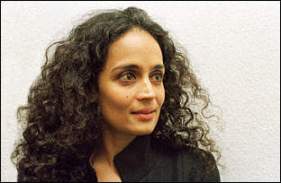
Kashmir — I write this from Srinagar, Kashmir. This morning’s papers say that I may be arrested on charges of sedition for what I have said at recent public meetings on Kashmir. I said what millions of people here say every day. I said what I, as well as other commentators have written and said for years. Anybody who cares to read the transcripts of my speeches will see that they were fundamentally a call for justice. I spoke about justice for the people of Kashmir who live under one of the most brutal military occupations in the world; for Kashmiri Pandits who live out the tragedy of having been driven out of their homeland; for Dalit soldiers killed in Kashmir whose graves I visited on garbage heaps in their villages in Cuddalore; for the Indian poor who pay the price of this occupation in material ways and who are now learning to live in the terror of what is becoming a police state.
Yesterday I traveled to Shopian, the apple-town in South Kashmir which had remained closed for 47 days last year in protest against the brutal rape and murder of Asiya and Nilofer, the young women whose bodies were found in a shallow stream near their homes and whose murderers have still not been brought to justice. I met Shakeel, who is Nilofer’s husband and Asiya’s brother. We sat in a circle of people crazed with grief and anger who had lost hope that they would ever get insaf-justice-from India, and now believed that Azadi-freedom-was their only hope. I met young stone pelters who had been shot through their eyes. I traveled with a young man who told me how three of his friends, teenagers in Anantnag district, had been taken into custody and had their finger-nails pulled out as punishment for throwing stones.
In the papers some have accused me of giving ‘hate-speeches’, of wanting India to break up. On the contrary, what I say comes from love and pride. It comes from not wanting people to be killed, raped, imprisoned or have their finger-nails pulled out in order to force them to say they are Indians. It comes from wanting to live in a society that is striving to be a just one. Pity the nation that has to silence its writers for speaking their minds. Pity the nation that needs to jail those who ask for justice, while communal killers, mass murderers, corporate scamsters, looters, rapists, and those who prey on the poorest of the poor, roam free.
JOHN ASHCROFT’S IMMUNITY AND THE U.S. LEGAL SYSTEM
By Dr. Lawrence Davidson | 26. Oct, 2010
The Situation
One of the cases the Supreme Court of the United States will take up in its 2011 session is Ashcroft vs. al-Kidd. John Ashcroft was the Attorney General under President George Bush Jr. In that capacity he appears to have knowingly violated the U.S. Constitution (as well as periodically forced his employees to listen to his horrendous singing voice). Abdullah al-Kidd is a Muslim American citizen who Ashcroft illegally ordered detained through the illicit use of a material witness warrant. Kidd was one of 70 detained in this manner. He was picked up at Dulles International Airport after the FBI lied to a judge in order to get the warrant for his seizure. Al-Kidd was subsequently held for long periods in a security cell where the lights never went out.
That John Ashcroft is the criminal and al-Kidd his victim is certain. That is how the Ninth Circuit Court of Appeals sees it. That court has refused to dismiss al-Kidd’s lawsuit against Ashcroft noting that the former Attorney General can be held personally responsible for action “repugnant to the Constitution.” That he knowingly and criminally acted to “arrest and detain American citizens for months on end, in sometimes primitive conditions, not because they have committed a crime, but merely because the government wants to investigate them for possible wrongdoing.” Ashcroft’s lawyers avoid the question of the illegality of his actions and simply say that he is immune from lawsuits for actions he took as Attorney General. On that basis they have asked the Supreme Court to dismiss the suit. The Justices have now decided to consider Ashcroft’s request.
Certainly John Ashcroft is not the first high U.S. official to reveal himself as an alleged criminal. Nor is it the first time that high government officials have acted in an unconstitutional manner. Right out of the starting gate , so to speak, the young United States created the Alien and Sedition Acts (1798) through which the Federalist party sought, quite unconstitutionally, to jail its political opponents. Andrew Jackson spit in the eye of both the Supreme Court and the Constitution by evicting the Cherokee Indians (1838), James Polk should have been impeached for high crimes and misdemeanors for lying to the Congress in order to start the Mexican-American War (1846), Abraham Lincoln probably violated the Constitution by some of his police actions during the Civil War, the raids and deportations that took place as a result of the Red Scares of the 1920s were at least in part unconstitutional, then you have Watergate, Irangate and now multiple potential Bushgates. Few of the politicians who ordered these criminal actions, or those who carried out those orders, ever faced punishment.
The Position of the Obama Administration
What is interesting about the present case of Ashcroft vs. al-Kidd is that the Obama administration has decided to make illegality acceptable by institutionalizing the concept of immunity for highly placed men like Ashcroft. The administration will try to do this not through legislation, but through precedent– by defending Ashcroft’s claim to immunity before the Supreme Court. At first it seems strange that a professed liberal president such as Barack Obama would do this. But unfortunately, it is quite consistent with the illiberal stance he has maintained on the question of the constitutional responsibility of his predecessors in the Bush White House. From the beginning of his presidency, Obama decided to shield them from the consequences of their crimes. This position was initiated by the president’s “we should look forward” statement in January of 2009. In this statement he made it clear that he did not want to pursue those who had ordered or implemented (in this case) torture under the Bush administration. When popular pressure forced the president to allow his attorney general, Eric Holder, to open an investigation of the issue of torture it was arranged so the inquiry would have no teeth. Publically and up front we were told that no one would be prosecuted whatever the outcome of the probe. That is the last anyone has heard of Holder’s investigation of torture American style. The long and short of this is that the principle set down at Nuremberg, to wit following orders is no excuse for criminal behavior, will not be applied. Nor will giving the orders incur a penalty. The decision to defend Ashcroft’s claim of immunity is in solid accord with this position.
The logic of this position, and its likely consequences, warrants close examination. If we were to ask President Obama why he has decided to defend the immunity of alleged criminals who happen to be high government officials, and if he were to be perfectly candid in his reply, here is what he might say:
1. President Obama – It would be difficult for the president, or those who carry out his orders, to act freely and as needed if they had always to worry about litigation after the fact. This is particularly true in time of war and emergency.
My Reply – This assertion has been made by leaders of states from time immemorial. It is a variation on the raison d’etat argument that has historically allowed all manner of bad behavior under the guise of state interests. On the other hand, it is true that following the law can prove inconvenient under wartime or emergency conditions. Nonetheless, in the long run, lawlessness is much worse than inconvenience. It is to be noted that, in the American case, appointed and elected high officials (particularly attorney generals!) are sworn to uphold the law not to transgress it.
2. President Obama – While I have stopped the more egregious policies of the Bush administration, I am still responsible for the safety of all American citizens and, in our modern age, I have to be able to use all the methods, high tech and otherwise, to achieve this goal. Some of these methods might very well prove unconstitutional (warrantless wiretaps, for instance) and yet I must be free to use them because another 9/11 style attack must be prevented. And, if I am to use these methods, then I can not prosecute those who have done so before me. Otherwise I would be accused of being a hypocrite by my political foes.
My Reply – This argument juxtaposes unattainable 100% security against the traditional freedoms that makes America the country its founders intended. Do we want to sacrifice the latter for the illusion of the former? As James Madison once observed, “The means of defense against foreign danger historically have become instruments of tyranny at home.” That is the slippery slope President Obama seems willing to take us down. It also prioritizes the president’s political interests over the Constitution. This latter point of view can be carried further.
3. President Obama – You have to understand, that if I do not do all that is possible, be it constitutional or otherwise, to protect the nation I put myself in mortal political danger. I open myself to the accusation by my political rivals that I am “soft” on security or terrorism. And, if something does happen, such as another terrorist attack, then I am politically dead.
My Reply – Well, yes, this is so. However, what is also true is that prioritizing politics above law always leads us in the direction of corruption, or worse. By defending Ashcroft isn’t President Obama saying it is all right to break the law if you are highly placed and so lacking in imagination that you can not figure out a legal way of dealing with an emergency? For let us be clear, there is no evidence that after 9/11 the unconstitutional route was the only possible route to defend the country. Were the legal options and their constitutional variants ever seriously itemized and discussed? The Obama administration, like the Bush operatives, have never publically addressed this question.
Likely Consequences
If the Obama Justice Department proceeds with its plans to defend Ashcroft’s immunity claim and if, as is likely, the Supreme Court upholds that claim, we will be left with a politically based two tier legal system. It will set free to break the law every highly placed federal official every time he or she can claim an emergency situation. Then, after the fact, they will cite the immunity precedent. In the meantime, the fact that high federal officials are sworn to uphold the laws of the land will be rendered worthless, just another bit of political hypocrisy.
So what is it that we want for America? Do we want a two tier legal system where presidents and their appointees can break the law with impunity? Do we want a legal system where it is accepted that citizens and residents can disappear into federal dungeons? Is it all right with us that our fellow citizens, following the orders of the president, will torture, detain, shackle and otherwise abuse others without any regard for law – and they too will be immune? Because, whether they realize it or not, that is what the Obama Justice Department is arguing for when it defends John Ashcroft.
DR. LAWRENCE DAVIDSON is professor of Middle East history at West Chester University in West Chester, PA, and the author of America’s Palestine: Popular and Official Perceptions from Balfour to Israeli Statehood (University of Florida Press, 2001), Islamic Fundamentalism (Greenwood Press, 2003), and Foreign Policy, Inc.: Privatizing American National Interest (University of Kentuck Press, 2009).
Palestinian Tour Guides Angered By Proposed Jerusalem Plan To Deny Them Permits
By Saed Bannoura – IMEMC News – October 20, 2010
Tourism in Israel and the Occupied Palestinian Territories is an extremely political issue. The narrative given by tour guides shapes the views of visitors to the area, and the Israeli narrative is far different from the Palestinian one. So when Israeli Knesset (Parliament) members propose a plan to ban Palestinian tour guides from Jerusalem, Palestinians say that what this means is the all-out negation of the Palestinian narrative of the history of the region.
In the last year, Israeli tour guides have slowly taken over the guidance of tours in the West Bank, which has always been the purview of Palestinian guides. Now, that takeover has extended to Jerusalem, thus ridding the tourism industry of the last of the tour guides who provide a different perspective from the Israeli one.
A group of Israeli Knesset members led by Gideon Ezra have called on the Israeli government to de-commission all Palestinians licensed to lead tours in Jerusalem, saying that they do not represent Israel’s interests in their tours and are “hostile to the state of Israel”. The bill, if passed, would prevent all Palestinian residents of Jerusalem from being tour guides, as it includes a clause that all tour guides would be required to be citizens of Israel.
The text of the bill reads in part, “Some of the residents of Israel, like those in East Jerusalem, often have ‘dual loyalty,’ since they vote in elections of the Palestinian Authority. These residents often present anti-Israeli positions to groups of tourists that they guide. To ensure foreign tourists are exposed to the national Israeli viewpoint, we suggest ruling that travel agencies, and any organization providing tours for foreign tourists, ensure that the groups are accompanied by a tour guide who is an Israeli citizen and has institutional loyalty to the State of Israel.”
The indigenous Palestinian population of the city are not considered to be citizens under Israeli law. They are “residents” and Israeli authorities issue them Jerusalem residency cards, which are often revoked if a Jerusalem resident is found to have left the city for any significant period of time.
The ‘Jerusalem residency’ laws are one of a number of methods used by the Israeli government to rid the city of its indigenous Palestinian inhabitants.
Featured Video

When Israel Is Mighty
or go to
Aletho News Archives – Video-Images
From the Archives
US murdering 1 million Iraqis is democracy, Iran giving yogurt to Iraq is “domination”
By Ali Salaam | American Herald Tribune | July 31, 2017
The New York Times, owned by the Zionist Jewish supremacist Ochs-Sulzberger family, has no problem with Iraqi suffering as long as Iran is not the one behind it.
The Iraq War was a genocide of the Iraqi people by Zionist supremacists in the Bush administration. Over 1 million innocent people were killed based on a lie. American soldiers died in an Israeli war and now an average of 22 soldiers commit suicide every day because their consciences cannot cope with the fact they committed crimes in an illegal war that served no purpose other than to benefit Israel, not America.
Benjamin Netanyahu, Prime Minister of the Zionist regime, once said “We are benefiting from one thing, and that is the attack on the Twin Towers and Pentagon, and the American struggle in Iraq.”
Paul Wolfowitz had his sights on Iraq since his time in the first Bush administration. Former Israeli official and Bush administration official Richard Perle had his eyes on Iraq since at least his authorship of the Clean Break white paper. The Zionist regime had their eyes on Iraq since the 1980s when strategist Oded Yinon wrote his white paper in support of dividing the Arab-Muslim world along ethnic and sectarian lines. The global Zionist lobby has had their eyes on Iraq since Theodor Herzl stated that Eretz Israel’s true borders go from the Nile River in Egypt to the Euphrates River in Iraq. … continue
Blog Roll
 Aletho News
- MEP blasts ‘Euro-Gestapo’ for lecturing Russia on democracy
- Syria May Send Troops to Saudi Arabia Amid War with Ansar Allah
- UK whines about losing billions to ‘Putin tax’
- Baghaei to Rubio: Distorted narratives cannot erase US record of broken commitments
- Houthis Don’t Have to Conquer Saudi Arabia to Make It Pay
- MOE: Nearly 22,000 Students and Education Workers Killed
- Guterres in Islamabad: Genocide, cowardice, and the cage of Imran Khan
- Johnson, Marandi say Yemen holds upper hand over Saudi Arabia
- False flags won’t save aggressors, Iran FM spokesman says
- The Makkah Pact Enters Into Force: The End of American Dominance or Its New Form?
- If Americans Knew
- Report claimed Mark Levin used by Israeli government to influence Trump
- Over 2,000 Gazans have died awaiting medical evacuation amid Israel’s continued siege
- How a U.S. Diplomat Suppressed and Altered Reports Critical of Israel
- 5 Palestinians Die from Israeli Strikes in Gaza as Relentless Attacks Continue
- Report: Ceasefire Slows Killing but Leaves Devastation Intact
- Country Music Singer Zach Bryan Breaks Attendance Record at Robert Kraft’s Gillette Stadium While Wearing ‘Free Palestine’ Shirt for Second Night in a Row
- Three years of death and devastation: Israel’s war on Gaza in pictures
- Why Hamas believed the status quo was more dangerous than its 7 October gamble
- Debunking Israel’s latest list of ‘terrorist’ journalists in Gaza
- In Gaza, focus is on survival, “every step is a struggle” – Daily Update
- No Tricks Zone
- New Study: 50 Years Of The Most Aggressive ‘Net Zero’ Policies Can Only Affect The Global Climate By 0.03°C
- US September “Heat” Was No Record…Many Records Set Decades Ago
- Latest European Green Energy Debacle; Portugal’s Largest Flagship Solar Park Insolvent!
- Green Energy Debacle: German Expert Professor Fritz Vahrenholt Warns Of Severe Economic And Social Consequences
- Two More Paleo Reconstructions Affirm Meters-Higher Sea Levels Across Ireland, Brazil 7000-6000 Years Ago
- New Study: Earth And Venus Surface Warmth Largely Explained By Convection And Lapse Rate, Not CO2 Or Radiation
- 2025 Nature Paper Claiming Worsening Global Drought Gets RETRACTED …Heavily Flawed
- New Study: ‘Global Drought Shows No Detectable Recent Acceleration Under Climate Warming’
- Economic Masterminds: German Socialists Suggest Taxing Productivity Gains Stemming From Using AI
- The South China Sea Has Not Been Cooperating With The Climate Change Narrative

