Israel is all geared up for war against all for BDS (Boycott, Divestment and Sanctions) and the de-legitimization of the Zionist state. The ministry of strategic affairs headed by Gil’ad Erdan – which is charged with this task – is now equipped with a budget, a former Israeli army general, retired Brig. General Sima Vakini-Gil who acts as the ministry’s General Director and a new assistant to the General Director, Tsahi Gavrieli who has brought a new wind to the sails of the anti-BDS ship. Gavrieli brought in a team that includes legal experts, economists and media people and according to a story recently published in Hebrew on Ynet they call on the Israeli public to take part in the campaign. According to the story, some parts of the campaign are overt and some covert, and the ministry will no longer be on the defensive but take an active, offensive position. Israelis are now encouraged to join this campaign with apps like ACT.IL which shows how to take the fight on social media and combat the “slurs” against Israel.
According to Gavrieli the BDS movement is losing ground in the US, and he brings as examples recent laws passed by over twenty states that criminalize the call to boycott Israel. Among those states are California, New York and New Jersey, to name a few. Currently there is a bill being proposed in the United States Senate that proposed to make the call to boycott Israel a federal offense that will carry a twenty-year prison sentence and a one million dollar fine. This bill was opposed by the American Civil Liberties Union, ACLU in a letter that was sent to members of the United States Senate. Gavrieli also claims that the BDS call is a “masked attempt to de-legitimize Israel by calling for Palestinian rights.” He said that the claim made by the BDS movement that Israel is an apartheid regime “is insulting to South Africans” and that it is “baseless.” “I call on every Israeli,” says Gavrieli “to take part in this.”
The aims of the BDS movement could not be more clearly stated, and all one needs to do is read them to see that the lies being spread by the State of Israel and its supporters, are unfounded. The call for BDS calls to impose Boycott, divestment and sanctions on the state of Israel until such time that the military occupation is ended, Palestinian citizens of Israel enjoy equal rights, and Palestinian refugees are permitted to return to their homes and their land. There is no racism, no hate and no discrimination of any kind is suggested or implied. It is an unequivocal demand to bring the Zionist State to do what is needed to achieve these goals. We must remember that negotiations with consecutive Israeli governments have all have failed and Israel has made it clear that it has no intention to end its policies of occupation, killing, dispossession and racist discrimination and its demand that the Palestinians capitulate.
It is worth reviewing and replying to remarks made by Senator Chuck Schumer regarding BDS at the American Jewish Committee’s Global Forum on June 5, 2017. “Sometimes anti-Semitism is cloaked, hidden by certain movements that profess no bias but suspiciously hold Israel—and, by extension, the Jewish people—to a different standard than others.” This is in fact a very dangerous statement that could very well be misconstrued. Is the Senator implying that that all Jews should be held accountable for the acts of the government of Israel?
“There is no greater example than this insidious effort to harm the Jewish state than through the boycotts, divestment and sanctions” Schumer continued, and the question that begs to be asked here is, was South Africa harmed by the call to boycott the Apartheid regime? Certainly not the Black South Africans. “The global BDS movement is a deeply biased campaign aimed at delegitimizing the Jewish state,” Schumer says, yet nothing in the demands of the BDS call or the actions of the BDS movement speak of destroying or getting rid of the Jewish State. Rather, the demands call to improve the conditions in which Palestinians live, conditions that were created by Israel and for which Israel is responsible. The demands of the BDS call seek to repair the inequities within which Palestinians live, like the military occupation and lack of rights. “And” Schumer adds, “its supporters, sometimes wittingly, sometimes unwittingly, but all of them practice a modern form of anti-Semitism.” Indeed, is it wise to refer to calls for justice and equality anti-Semitism. What modern form of anti-Semitism is it which does not incite against Jews, does not call for the killing of or discrimination against Jews but rather demands inclusion of all people so that they all may enjoy the same privileges. Is Senator Schumer saying that the call for justice and freedom is antithetical to Judaism?
Tsahi Gavrieli says that there is something even more serious than the BDS movement, it is the de-legitimization of the Jewish state particularly within Jewish communities. He is right, this is a serious issue because from its very inception there was no way in which the state of Israel could be legitimized except by fraud and deception. It is a state that was established by a settler colonial movement, which means that like all settler colonial movements, it was founded on racism and the use of violence against indigenous people. Israel has been engaged in genocide, a claim easily proven by reading the Geneva Convention on the crime of Genocide: particularly article 2, a, b, and c and article 3. Furthermore, the state of Israel has been engaged in ethnic cleansing and has a legal system in which Palestinians are denied rights that are provided to Jews. Legitimizing such a state is indeed a serious if not an impossible task.
The Jerusalem Post recently published an article by Adnan Oktar who claims that BDS “serves the continuity if not the escalation of the conflict.” Indeed all resistance movements may be accused of “escalating” conflicts. According to this argument the French should not have fought the Germans during WW-2; the Algerians should not have fought the French; the Vietnamese should not have insisted on fighting the French and then the Americans. Certainly the Lebanese should not have fought the Israelis to end the Israeli occupation of Southern Lebanon. Indeed, an entire movement that we know today as Hezbollah was created by the Lebanese for that purpose and it was successful. According to Mr. Oktar’s argument had all oppressed people been willing to die in silence the world would be a peaceful place. But would it indeed? The oppressed are always to blame for their unwillingness to remain oppressed – but resistance is a response to violence, it is never the cause of violence.
What is clear from the many articles written, conferences held, strategies contrived and laws passed regarding BDS is the following: there is nothing in this world that can stop the Palestinian struggle for justice. The call for BDS and the movement which was created because of it cannot be defeated. Boycotting Israel is the right thing to do, indeed the demands listed by the BDS call are just, reasonable and measured and every person of conscience and every government must heed this call. One would want to remind governments that claim to support the Palestinian cause, that expressing solidarity while conducting trade with Israel is hypocrisy.
September 11, 2017
Posted by aletho |
Ethnic Cleansing, Racism, Zionism, Illegal Occupation, Solidarity and Activism, Timeless or most popular, War Crimes | Human rights, Israel, Palestine, Zionism |
Leave a comment
Moscow will bring the terms of work of its diplomatic missions in the US and those of Washington in Russia into “full parity,” Russian Foreign Minister Sergey Lavrov announced. The statement comes after the Russian Consulate in San Francisco and two trade missions in Washington, DC, and NYC were forced to close at the end of August.
Russian authorities, Lavrov said, asked the Americans to make sure the overall number of their diplomatic staff working in Russia equals that of the number of Russian diplomats working in the US.
“But in doing so, we included into that overall number everyone who work at the Russian mission in the UN,” Lavrov told reporters at a press conference in Amman, Jordan, on Monday.
“Understandably, this is a separate issue not relating to bilateral [US-Russia] relations.
“Nevertheless, doing so we showed our good will,” he continued. “The US has sort of pocketed our kind gesture and said ‘If Russians want parity, make them close one of four consulates [in the US] as we have only three consulates in Russia.’”
The US State Department insisted that the move was reciprocal to Moscow’s decision to cut the number of American diplomatic staff in Russia.
Lavrov added that Moscow is now looking at conditions under which the American diplomatic missions operate in Russia, and vice versa.
“If the US makes parity a criterion, we will bring those conditions in full accordance with what is called parity,” Lavrov said.
Last week, President Vladimir Putin also spoke of disparity between Russia and the US in the number of their diplomatic staff.
“We have agreed with our [American] partners that there should be parity of the number of diplomatic staff in Russia and the United States. There were some 1,300 diplomats from the US; we had 455. We corrected this,” Putin told journalists last Tuesday.
“But among those 455 diplomatic staff working in the United States there are 155 people working at the United Nations. Strictly speaking, they are not part of the diplomatic corps accredited by the US State Department,” he added.
“So true parity would be the US not having 455 diplomats in Russia, but 155 fewer.”
The lingering diplomatic row between Washington and Moscow began back in 2016, when the outgoing Obama administration expelled 35 Russian diplomats and closed two Russian diplomatic compounds in New York and Maryland. Notably, Moscow chose not to retaliate at the time, hoping to mend ties during Donald Trump’s presidency.
American lawmakers, however, limited Trump’s ability to formulate foreign policy towards Russia by barring him from easing sanctions on Russia without congressional approval.
In July, following the US Congress’ approval of new sanctions against Russia, Iran and North Korea in one package, Moscow cut the staff at American missions in Russia by 755 people. This brought the number to the same as Russian diplomatic staff in the US, which is 455 people.
In August, Washington announced in response that US consulates in Russia had halted issuing all non-immigrant visas for Russian citizens until further notice.
On August 31, on the Trump administration cited “the spirit of parity invoked by the Russians” and ordered the Russian Consulate in San Francisco, as well as two trade missions in Washington, DC, and New York City, to close. Moreover, FBI operatives conducted searches at Russia’s San Francisco Consulate.
The Russian Foreign Ministry vehemently opposed the closures, accusing operatives of the US security agencies that entered the Russian Consulate in San Francisco of “behaving like raiders.”
“Representatives of the US law enforcement agencies conduct unknown activities on the territory of the Russian Consulate General in San Francisco. They mutilate expensive parquet and do work without permission. Most importantly, nobody knows who these people are, who behave like raiders,” the ministry said.
Under the Vienna Convention
on Diplomatic Relations, premises of [any] diplomatic or consular mission “shall be inviolable” and “agents of the receiving State may not enter them, except with the consent of the head of the mission.”
September 11, 2017
Posted by aletho |
Illegal Occupation, Russophobia | Russia, United States |
Leave a comment
The Syrian government forces have broken through the ISIS’ 3-year long siege of the air base in the eastern city of Dier Ezzor. The dramatic developments in the weekend signifies for all purposes the end of the conflict in Syria. The capture of the city itself is now a forgone conclusion and with that ISIS becomes a spent force in Syria.
The covert US operation to evacuate by helicopter the ISIS commanders in Dier Ezzor last week suggests that the Pentagon accepts that the ISIS saga is ending in Syria, finally. Presumably, the ISIS and its “advisors” will now be reassigned to new theatres – such as Afghanistan. The lingering question will be: Is the US winding up business in Syria? A Russian commentary seems to think so.
On the other hand, there are reports that the rebel forces supported by the US Special Forces (with air cover) are making a dash from northern Syria to take a piece of Dier Ezzor, leaving behind the unfinished business of capturing Raqqa, ISIS’ “capital”. This risks a potential flashpoint involving them and the Russia-supported government forces in a struggle for supremacy in eastern Syria. (Reuters )
At stake are two things – one, seizure of the vast oil fields that lie to the east and north of Dier Ezzor that are the jewel in the crown of the Syrian economy; two, control of the Syrian-Iraqi border along the Euphrates and down south across which a “land bridge” could potentially connect Damascus with Tehran via Baghdad. Thus, both in economic terms as well as for geopolitical reasons, the US (encouraged by Israel) is racing against time in the final phase of the conflict to establish a military presence in the eastern and south-eastern regions of Syria.
The geopolitical reasons are three-fold: a) US would seek a “say” in any Syrian settlement; b) US hopes to challenge Iran’s cascading influence in Syria and Lebanon; and, c) US feels obliged to be a provider of security for Israel. All three factors are inter-connected. The point is, as a report in the Times of Israel underscores, Israel understands its limitations in taking on the Iranian militarily on its own steam. Gen. Yair Golan, former deputy chief of staff in the Israeli military has been quoted as saying in a stunning speech at the Washington Institute of Near East Policy last Thursday,
- We (Israel) live in a world where we cannot operate alone not just because we have no expeditionary forces in Israel… And while we can achieve decisive victory over Hezbollah… and while we can defeat any Shia militia in Syria … we cannot fight Iran alone… So, all right, they could affect us, we could affect them. But it’s all about attrition… If you want to gain something which is deeper, we cannot do it alone. And this is a fact of life. It’s better to admit that. We need to know our limitations.
Suffice to say, Israel will not allow the Trump administration to countenance a total US troop withdrawal from Syria. Put differently, some sort of US presence along the eastern banks of the Euphrates is on the cards on Israel’s insistence. Read an opinion piece titled Trump’s Big Decision in Syria by David Ignatius in the Washington Post last week on the debate in Washington.
Will Russia accept such an outcome? Arguably, it may suit Russia if the US is present in the region in some token form, necessitating, in turn, some sort of continued engagement with Russia, which has always been Moscow’s strategic priority. What about Turkey? Indeed, continued US alliance with the Syria Kurdish militia can only lead to the eventual consolidation of a Kurdistan in northern Syria, which Ankara abhors. But on the other hand, Turkey takes care not to collide with the US in Syria. Equally, Iran’s approach also may not be to simply “sidestep” the token American presence of a few hundred soldiers from the Special Forces and concentrate instead on the serious business of expanding its regional influence in Syria and Lebanon. Indeed, the US is unlikely to directly challenge Russia or Iran in eastern Syria, either.
What matters will be the new facts on the ground. The Syrian government forces (backed by Iranian and Hezbollah militia and Russian air power) have an edge over the US-led thrust from the north of Dier Ezzor. The highway connecting Damascus with Dier Ezzor is open for the first time in years. The Syrian forces are occupying the strategic heights in the region. On the contrary, the US has no reliable local ally other than the Syrian Kurdish militia, who from now onward will be fighting in regions inhabited by Sunni Arab tribes that are even further beyond the borders of their traditional homeland in northern Syria.
In the final analysis, therefore, at some point wisdom will dawn on the Pentagon that it is foolhardy to dream about carving out a “zone of influence” within Syria. With Saudi Arabia Qatar closing shop in Syria, and Jordan coming to terms with the Syrian regime, the US is finding that it is pretty much alone in that desolate region in the middle of nowhere. Some Iranian reports suggest that even the British bulldog is pulling out.
September 11, 2017
Posted by aletho |
Ethnic Cleansing, Racism, Zionism, Illegal Occupation, Militarism | Dier Ezzor, Iran, ISIS, Israel, Syria, United States, Zionism |
Leave a comment
For those (mostly Christians) attracted to the idea that the ‘war on terror’ is a clash of civilizations (a poisonous notion guaranteed to foment decades of unrestrained violence), a caution: you might want to consider ignoring the old testament injunction an ‘eye for an eye.’ For if there is a moral equivalent to the dead on both sides an eye for an eye will mean literally thousands of terror attacks like the recent horrific one in Barcelona (sixteen dead).
The body count in the West’s criminal assault on Middle East nations is now in the millions. In Syria the death toll is now 470,000. In Iraq, it is a staggering 1,455,590 (not counting foreigners). In Afghanistan, 105,000 including Taliban and Afghan soldiers and police. In Yemen, pulverized by US-backed Saudi Arabia repeatedly accused of war crimes, the toll is now over 12,000 (including 1500 from war-induced cholera) mostly civilians. A child dies of malnutrition every ten minutes. It is impossible to get an accurate count for Libya which the West turned into a grotesque failed state as a result of its exalted ‘responsibility to protect’ doctrine. Estimates range from 30,000 to 100,000.
Divide that roughly 2 million dead by 16 and you get a moral equivalent that would require 125,000 Barcelona attacks. Hard to imagine? Try imagining the daily horror in these countries with a combined daily death toll in multiples of sixteen, week after week, month after month, year after year.
And, of course, that doesn’t take into account the many more millions who have been wounded, displaced as refugees, died trying to get to Europe or permanently traumatized by war – categories that include millions of children whose lives will never be the same.
This is what we have done. What our governments have done in our name. And we are still doing it. The West either invaded these countries completely illegally (as in Iraq and Afghanistan) or encouraged and then betrayed dissident movements that our governments knew could not possibly prevail. Or, as in Syria, our governments quickly handed over the revolution to armed gangs and jihadists because they were more likely to prevail against Assad in the West’s goal of regime change. Or in Libya where we violated the UN resolution for a no fly zone and turned it into an assassination mission.
Does any of this absolve the guilt of the killers in Paris, London, Barcelona and other places? Of course not. Does it mean that every killer has a legitimate grievance against the West? No. But that, of course, is one of the perverse aspects of terrorism: anyone can be a jihadist by simply declaring membership.
It is stunning that there is almost never any connection made between the terrorist threat, which is very real, and the almost twenty year assault on the Muslim countries of the Middle East. Small wonder then that the popular responses to the terror attacks are almost always completely devoid of any recognition of the context of the slaughter. In response to the latest attack tens of thousands marched in Barcelona. The theme was ‘We are not afraid!’ The public response in Britain, France and elsewhere was almost identical.
Do people actually think this is a thoughtful let alone strategic response to terror? It implies that these attacks are similar to hurricanes – unpredictable, unstoppable, inevitable. In fact they should be afraid because more is coming. A more appropriate slogan might have been ‘Get the West out of the Middle East’ and in fact a few demonstrators actually made the point about Western foreign policy. They received little coverage.
Canada has been incredibly lucky that it has not been targeted by ISIL. Our contribution to the destruction and humiliation of Muslim countries was our eager participation in the ruination of Libya – a country which had boasted the highest standard of living and most generous social programs in Africa. It is a particularly egregious result of imperial hubris. Libya had done everything the West had asked of it: it co-operated fully with the war on terror, and it radically reduced the size of its military. It also abandoned its nuclear weapons program – a lesson North Korea will never forget.
In contributing to the assassination of Muamar Gadhafi Canada contributed to the unprecedented refugee crisis which has engulfed Europe. Gadhafi new exactly what would happen if he were forced from power and said so as Canadian jets pounded his country. He stated, in desperation: “Now you people in NATO listen to me – you are bombing the wall that stopped African migration into Europe. This wall stopped the terrorists from al Qaeda. This wall was Libya. You are destroying it, you fools.”
Even the Canadian air force pilots knew what the result of regime change would be knowing full well that the vacuum created would be filled by Al Qaeda and other Jihadist groups. They referred to themselves as “Al Qaeda’s air force.”
We as citizens face the consequences of our actions every day. If we threaten people or hurt them, we get arrested, if we burn down their house, we go to jail, if we drive recklessly, steal a loaf of bread, or fish without a licence, we face consequences. But our government can join in the complete destruction of a country and it – and we – don’t even get a reprimand.
Our new Middle East policy? It’s simple. We have no business being there, we have no lofty goals capable of being achieved, we have no genuine national interest, we are complicit in a senseless daily slaughter and we contribute to the creation of jihadists who want to kill us, not for “our freedoms” but because we treat them as less than human. We should just get the hell out.
MURRAY DOBBIN, now living in Powell River, BC has been a journalist, broadcaster, author and social activist for over forty years. He can be reached at murraydobbin@shaw.ca
September 9, 2017
Posted by aletho |
Illegal Occupation, Timeless or most popular, War Crimes, Wars for Israel | Canada, Middle East |
Leave a comment
Many people still want to believe that the United Nations engages in impartial investigations and thus is more trustworthy than, say, self-interested governments, whether Russia or the United States. But trust in U.N. agencies is no longer well placed; whatever independence they may have once had has been broken, a reality relevant to recent “investigations” of Syrian chemical weapons use.
There is also the larger issue of the United Nations’ peculiar silence about one of its primary and original responsibilities, shouldered after the horrors of World War II – to stop wars of aggression, which today include “regime change” wars organized, funded and armed by the United States and other Western powers, such as the Iraq invasion in 2003, the overthrow of the Libyan government in 2011, and a series of proxy wars including the ongoing Syrian conflict.
After World War II, the Nuremberg Tribunals declared that a “war of aggression … is not only an international crime; it is the supreme international crime differing only from other war crimes in that it contains within itself the accumulated evil of the whole.”
That recognition became a guiding principle of the United Nations Charter, which specifically prohibits aggression or even threats of aggression against sovereign states.
The Charter declares in Article One that it is a chief U.N. purpose “to take effective collective measures … for the suppression of acts of aggression or other breaches of the peace.” Article Two, which defines the appropriate behavior of U.N. members, adds that “All Members shall refrain in their international relations from the threat or use of force against the territorial integrity or political independence of any state…”
However, instead of enforcing this fundamental rule, the United Nations has, in effect, caved in to the political and financial pressure brought to bear by the United States and its allies. A similar disregard for international law also pervades the U.S. mainstream media and much of the European and Israeli press as well.
There is an assumption that the United States and its allies have the right to intervene militarily anywhere in the world at anytime solely at their own discretion. Though U.S. diplomats and mainstream journalists still voice outrage when adversaries deviate from international law – such as denunciations of Russia over Ukraine’s civil war – there is silence or support when a U.S. president or, say, an Israeli prime minister orders military strikes inside another country. Then, we hear only justifications for these attacks.
Shielding Israel
For instance, on Friday, The New York Times published an article about Israel conducting a bombing raid inside Syria that reportedly killed two Syrians. The article is notable because it contains not a single reference to international law and Israel’s clear-cut violation of it. Instead, the article amounts to a lengthy rationalization for Israel’s aggression, framing the attacks as Israeli self-defense or, as the Times put it, “an escalation of Israel’s efforts to prevent its enemies from gaining access to sophisticated weapons.”
The article also contains no reference to the fact that Israel maintains a sophisticated nuclear arsenal and is known to possess chemical and biological weapons as well. Implicit in the Times article is that the U.S. and Israel live under one set of rules while countries on the U.S.-Israeli enemies list must abide by another. Not to state the obvious but this is a clear violation of the journalistic principle of objectivity.
But the Times is far from alone in applying endless double standards. Hypocrisy now permeates international agencies, including the United Nations, which instead of pressing for accountability in cases of U.S. or Israeli aggression has become an aider and abettor, issuing one-sided reports that justify further aggression while doing little or nothing to stop U.S.-backed acts of aggression.
For instance, there was no serious demand that U.S. and British leaders who organized the 2003 invasion of Iraq, which resulted in the deaths of hundreds of thousands of Iraqis, should face any accountability for committing the “supreme international crime” of an aggressive war. As far as the U.N. is concerned, war-crimes tribunals are for the little guys.
This breakdown in the integrity of the U.N. and related agencies has developed over the past few decades as one U.S. administration after another has exploited U.S. clout as the world’s “unipolar power” to ensure that international bureaucrats conform to U.S. interests. Any U.N. official who deviates from this unwritten rule can expect to have his or her reputation besmirched and career truncated.
So, while harshly critical of alleged abuses by the Syrian military, U.N. officials are notoriously silent when it comes to condemning the U.S., Saudi Arabia, Jordan, Turkey, Israel and other countries that have been “covertly” backing anti-government “rebels” who have engaged in grave crimes against humanity in Syria.
The U.S. and its allies have even mounted overt military operations inside Syrian territory, including airstrikes against the Syrian military and its allies, without permission of the internationally recognized government in Damascus. Yet, the U.N. does nothing to curtail or condemn these clear violations of its own Charter.
Breaking the Independence
The reason is that, for much of this century, the U.S. government has worked to bring key agencies, such as the U.N. Commission on Human Rights (UNCHR), the International Atomic Energy Agency (IAEA), and the Organization for the Prohibition of Chemical Weapons (OPCW), under U.S. control and domination.
This drive to neutralize the U.N.’s independence gained powerful momentum after the 9/11 attacks and President George W. Bush’s launching of his “global war on terror.” But this effort continued under President Obama and now under President Trump.
In 2002, after opening the prison at Guantanamo Bay, Cuba, and effectively waiving the Geneva Convention’s protections for prisoners of war, Bush bristled at criticism from the United Nations High Commissioner for Human Rights Mary C. Robinson.
Soon, Robinson was targeted for removal. Her fierce independence, which also included criticism of Israel, was unacceptable. The Bush administration lobbied hard against her reappointment, leading to her retirement in 2002.
Also, in 2002, the Bush administration engineered the firing of OPCW’s Director General Jose Mauricio Bustani who was viewed as an obstacle to the U.S. plans for invading Iraq.
Bustani, who had been reelected unanimously to the post less than a year earlier, described his removal in a 2013 interview with Marlise Simons of The New York Times, citing how Bush’s emissary, Under-Secretary of State John Bolton, marched into Bustani’s office and announced that he (Bustani) would be fired.
“The story behind [Bustani’s] ouster has been the subject of interpretation and speculation for years, and Mr. Bustani, a Brazilian diplomat, has kept a low profile since then,” wrote Simons. “But with the agency [OPCW] thrust into the spotlight with news of the Nobel [Peace] Prize [in October 2013], Mr. Bustani agreed to discuss what he said was the real reason: the Bush administration’s fear that chemical weapons inspections in Iraq would conflict with Washington’s rationale for invading it. Several officials involved in the events, some speaking publicly about them for the first time, confirmed his account.”
The official U.S. explanation for getting rid of Bustani was incompetence, but Bustani and the other diplomats close to the case reported that Bustani’s real offense was drawing Iraq into acceptance of the OPCW’s conventions for eliminating chemical weapons, just as the Bush administration was planning to pin its propaganda campaign for invading Iraq on the country’s alleged secret stockpile of WMD.
Bustani’s ouster gave President Bush a clearer path to the invasion by letting him frighten Americans with the prospect of Iraq sharing its chemical weapons and possibly a nuclear bomb with Al Qaeda terrorists.
Dismissing Iraq’s insistence that it had destroyed its chemical weapons and didn’t have a nuclear weapons project, Bush launched the invasion in March 2003, only for the world to discover later that the Iraqi government was telling the truth.
Compliant Replacements
In comparison to the independent-minded Bustani, the biography of the current OPCW director general, Ahmet Uzumcu, a career Turkish diplomat, suggests that the OPCW could be expected to slant its case against the Syrian government in the current Syrian conflict.
Not only has Turkey, a NATO ally of the United States, been a key player in supporting the proxy war to overthrow Syrian President Bashar al-Assad, but Uzumcu also served as Turkey’s ambassador to Israel, which has long sought regime change in Syria and has publicly come out in favor of the anti-government rebels.
Another one-time thorn in the side of the U.S. “unipolar power” was the IAEA when it was under the control of Director General Mohamed ElBaradei, an Egyptian. The IAEA challenged the Bush administration’s claims about Iraq having a nuclear program, when one really didn’t exist.
However, being right is no protection when U.S. officials want to bring an agency into line with U.S. policy and propaganda. So, early in the Obama administration – as Secretary of State Hillary Clinton was pushing for a hardline on Iran over its nascent nuclear program – the U.S. government engineered the insertion of a pliable Japanese diplomat, Yukiya Amano, into the IAEA’s top job.
Before his appointment, Amano had portrayed himself as an independent-minded fellow who was resisting U.S.-Israeli propaganda about the Iranian nuclear program. Yet behind the scenes, he was meeting with U.S. and Israeli officials to coordinate on how to serve their interests (even though Israel is an actual rogue nuclear state, not a hypothetical or fictional one).
Amano’s professed doubts about an Iranian nuclear-bomb project, which even the U.S. intelligence community agreed no longer existed, was just a theatrical device to intensify the later impact if he were to declare that Iran indeed was building a secret nuke, thus justifying the desire of Israeli leaders and American neoconservatives to “bomb-bomb-bomb” Iran.
But this U.S. ploy was spoiled by Pvt. Bradley (now Chelsea) Manning’s leaking of hundreds of thousands of pages of U.S. diplomatic cables. Among them were reports on Amano’s hidden collaboration with U.S. and Israeli officials; his agreement with U.S. emissaries on who to fire and who to retain among IAEA officials; and even Amano’s request for additional U.S. financial contributions.
The U.S. embassy cables revealing the truth about Amano were published by the U.K. Guardian in 2011 (although ignored by The New York Times, The Washington Post and other mainstream U.S. news outlets). Despite the silence of the major U.S. news media, Internet outlets, such as Consortiumnews.com, highlighted the Amano cables, meaning that enough Americans knew the facts not to be fooled again. [For details, see Consortiumnews.com’s “Did Manning Help Avert War with Iran?”]
A Collective Collapse
So, over the years, there has been a collective collapse of the independence at U.N.-related agencies. An international bureaucrat who gets on the wrong side of the United States or Israel can expect to be fired and humiliated, while those who play ball can be assured of a comfortable life as a “respected” diplomat.
But this reality is little known to most Americans so they are still inclined to be influenced when a “U.N. investigation” reaches some conclusion condemning some country that already is on the receiving end of negative U.S. propaganda.
The New York Times, CNN and other major U.S. news outlets are sure to trumpet these “findings” with great seriousness and respect and to treat any remaining doubters as outside the mainstream. Of course, there’s an entirely different response on the rare occasion when some brave or foolhardy human rights bureaucrat criticizes Israel’s treatment of the Palestinians. Then, the U.N. finding is just a sign of anti-Israeli bias and should be discounted.
In the far more frequent cases when a U.N. report is in line with U.S. propaganda, American journalists almost never turn a critical eye toward the quality of the evidence or the leaps of logic. We saw that happen this week with a thinly sourced and highly dubious U.N. report blaming the Syrian government for an alleged sarin incident on April 4. A major contradiction in the evidence – testimony given to OPCW investigators undercutting the conclusion that a Syrian warplane could have dropped a sarin bomb – was brushed aside by the U.N. human rights investigators and was ignored by the Times and other major U.S. news outlets.
But what is perhaps most troubling is that these biased U.N. reports are now used to justify continued wars of aggression by stronger countries against weaker ones. So, instead of acting as a bulwark to protect the powerless from the powerful as the U.N. Charter intended, the U.N. bureaucracy has turned the original noble purpose of the institution on its head by becoming an enabler of the “supreme international crime,” wars of aggression.
Investigative reporter Robert Parry broke many of the Iran-Contra stories for The Associated Press and Newsweek in the 1980s.
September 8, 2017
Posted by aletho |
Illegal Occupation, Mainstream Media, Warmongering, Timeless or most popular, War Crimes, Wars for Israel | Hillary Clinton, Israel, Mary C. Robinson, New York Times, United Nations, United States, Yukiya Amano |
Leave a comment
Illinois governor candidate Daniel Bliss has dropped Carlos Ramirez-Rosa as his running mate following Rosa’s alleged support of a Palestinian group calling to boycott Israel.
Rosa’s support for the Palestinian-led ‘Boycott, Divestment and Sanctions’ (BDS) movement was the reason he was dropped from the ticket, Biss said in a statement.
BDS calls for companies to stop doing business with Israel over its occupation of Palestinian territories.
The Democratic state senator wrote that Rosa told him he opposed the group prior to being chosen. Rosa’s position on the issue then changed, Biss claimed.
“I strongly support a two-state solution. I support Israel’s right to exist, and I support Israel as the homeland of the Jewish people. I also care deeply about justice for Palestinians, and believe that a vision for the Middle East must include political and economic freedom for Palestinians,” Biss wrote, adding “That’s why I oppose the Boycott, Divestment, and Sanctions movement, or BDS, as I believe it moves us further away from a peaceful solution.”
In a Facebook post, Rosa wrote that while he and Biss “both oppose pursuing BDS at the state level, the difference of opinion we have on the role the BDS movement plays at the federal level would make it impossible to continue moving forward as a ticket.”
Rosa did not immediately respond to RT’s request for comment.
Before Biss made his decision to drop Rosa, he lost the endorsement of Democratic Congressman Brad Schneider, who cited Rosa’s “past comments about the United States support of our ally Israel, and his affiliation with a group that is an outspoken supporter of the Boycott, Divestment and Sanctions movement against Israel.”
Schneider was referring to the Democratic Socialists of America (DSA), a political organization, which passed a resolution supporting BDS.
Rosa joined DSA in March.
“I said, if someone could run for president of the United States and say ‘I’m a democratic socialist,’ then, hell, I can come out of the closet. I’ve come out of the closet before,” Rosa told the Chicago Reader, referring to presidential candidate Bernie Sanders.
Rosa, 28, is the first openly gay Latino to serve on Chicago’s City Council. He is also the youngest current alderman.
“I was asked to join the ticket to even more strongly advocate for the critical issues facing this state, such as medicare for all, a $15 living wage today, affordable childcare, and free college tuition,” Rose wrote in his statement.
On Friday, Biss announced his new running mate – Democratic State Congresswoman Litesa Wallace.
“As a woman of color, she understands that justice and opportunity are not equally distributed and in fact are not available to many. As a champion for social and economic justice, she’s a proven fighter for the issues and people that Illinois government so often forgets about,” Biss said of Wallace in a video statement.
Wallace’s views on BDS were not immediately clear.
The international community has long called for a two-state solution in the conflict between the Israelis and Palestinians where the two peoples would eventually live in separate states. Israel had formally agreed to the two-state solution but has yet to take any practical steps to make it happen.
In August, UN Secretary General Antonio Guterres said Israel’s continued construction of settlements on what the UN recognizes as Palestinian territories was illegal and a “major obstacle” to achieving a two-state solution and peace with the Palestinians.
Read more
Israel Army stages mock war against Hezbollah, biggest exercise in 20yrs
September 8, 2017
Posted by aletho |
Ethnic Cleansing, Racism, Zionism, Illegal Occupation, Solidarity and Activism | Israel, Palestine, United States, Zionism |
Leave a comment
The United States of America has sunk to a new low in diplomacy and civilized relations between nation states with its demand that Russia close its consular missions in San Francisco, Washington and New York, quickly followed by its order that the consular staff leave the premises while the FBI conducted a search of the premises and staffers personal apartments. To order the closure of a mission, or to order the withdrawal of a member of diplomatic staff, is within its right but a search of consular property is not. It is a flagrant violation of the Vienna Convention on Diplomatic Relations of 1961.
Article 22 of the Convention states:
1. “The premises of the mission shall be inviolable. The agents of the receiving State may not enter them, except with the consent of the head of the mission.
2.The receiving State is under a special duty to take all appropriate steps to protect the premises of the mission against any intrusion or damage and to prevent any disturbance of the peace of the mission or impairment of its dignity.
3.The premises of the mission, their furnishings and other property thereon and the means of transport of the mission shall be immune from search, requisition, attachment or execution.”
Article 45 states that even
“If diplomatic relations are broken off between two States, or if a mission is permanently or temporarily recalled:
(a) The receiving State must, even in case of armed conflict, respect and protect the premises of the mission, together with its property and archives;
(b) The sending State may entrust the custody of the premises of the mission, together with its property and archives, to a third State acceptable to the receiving State;”
The Vienna Convention is one of the foundations of international relations. Without it, and the ancient customs enshrined in it, international relations cannot exist. The United States of America is a state party to the Convention and so is bound by it as part of international law and as part of American law.
The Russian Foreign Ministry correctly stated that, “the occupation of Russian diplomatic properties in the US is a blunt act of hostility and in violation of international law.” The Russians also expressed their logical concern that the only reason for such a search to be conducted, aside from bullying and intimidation of the Russian people, is to use it as an opportunity for the Americans to plant items, which they will then use in their propaganda war against Russia. This concern is valid and strong since there can be no valid reason to insist on the staff leaving the premises so a “search” can be made except that the US government does not want its FBI agents observed.
This action by the USA is not just a crime against Russia. It is a crime against all the nations of the world who depend on the articles of the Vienna Convention to protect their diplomats and properties in host nations without which international diplomacy cannot be conducted. For if the USA will do this to Russia it will do it to anyone it chooses. No nation can now regard its diplomatic missions in the United States as protected, as the Convention requires. The ramifications will take a while to sink in but in effect the United States has now declared itself to be a rogue state that has no respect for its own or international law and the rights of other nations.
It is also a profoundly stupid action that can only damage the United States itself since, by its own example, it can no longer expect other nations to respect the diplomatic immunity of its diplomatic missions around the world.
So, why has the United States undertaken such a reckless and provocative action? There is no doubt that it is part of the bizarre and clumsy propaganda theme that Russia interfered in the American elections and so the “search” is meant to raise in the minds of Americans that there is something to be searched for, some evidence of a “crime.” Why this would be found in San Francisco is a mystery but the American government and media never seem to bother about logical plot lines in their propaganda stories.
The other reason is to provoke Russia. The provocations against Russia from Ukraine, to Latvia, from Crimea to Syria, continue to escalate. The provocations on the diplomatic front have been many, but it was Obama that expelled 35 Russian diplomats just before he left office and ordered the seizure of two Russian compounds. The Russia government held off responding to that for several months, hoping that the new US administration would be more reasonable, but in vain. Things just got worse and so the Russians ordered America to cut its diplomatic presence in Russia. The American seizure of more Russian properties and the search of the San Francisco mission are in line with the American logic of hostility towards Russia.
The provocative nature of this action is revealed in the statement of Russian Foreign Ministry spokeswoman, Maria Zakharova, quoted by Tass, on Sunday the 3rd of September,
“By the way, do you know, what they were looking for – as we were told before the searches? You would not believe it – they were looking for explosives,” she said, adding ironically that it can be easily imagined how Russian diplomats are carrying explosive substances in their elegant cases.”
And,
“According to Zakharova, the US security services obviously hoped Russian diplomats would lose their nerves and here there will be ‘an image of an aggressive Russian. Just try to imagine that you are being brainwashed for a year that an enemy is living overseas and this enemy is impacting your life and everything bad that might happen – the election of a president you don’t like – has been done by the Russians,’ she said.”
There we have it, The American government has become completely unhinged. They appear to have lost all sense of reality and can be said to be suffering from a type of psychosis and for all that are becoming more dangerous. A US government spokesperson stated that President Trump ordered this latest action, once again proving that Trump, for all his narcissism and arrogance, simply follows the long line of American presidents who have stirred up trouble in the world.
So far as I can determine, no other country has conducted itself like this before, not even the United States. Even the Japanese were not treated this way after Pearl Harbor. The Japanese embassy was locked down, put under the control of a neutral country and the Japanese diplomats allowed to leave the country. That is, the United States then, even in the face of a direct military attack against it by Japan, still adhered to international law and respected diplomatic customs. So far has the United States declined into barbarity that it does not now afford to Russia, a fellow member of the United Nations, and with whom war has not broken out, the same courtesies that were applied to Japan, a nation that attacked it. In fact, by its action, it negates Russia as a sovereign nation, since it denies Russia is entitled to the respect and courtesy due to all sovereign nations.
So far the Russian response has been muted, simply calling in the American deputy ambassador to hand him a note of protest. The First deputy chairman of the Foreign Affairs Committee of the Duma stated, “The US authorities may rest assured that the searches will not go unanswered.” But how? It is clear the Americans don’t give a tinker’s dam about law or custom or civilized behavior and are intent on provoking Russia. So what can an appropriate response be? I can only recall, once again, something my friend, Harold Pinter, the Nobel Laureate for Literature said in his acceptance speech. He stated,
“The United States quite simply doesn’t give a damn about the United Nations, international law or critical dissent, which it regards as impotent and irrelevant.”
“How to make them give a damn,” he once asked me, “before they kill us all?”
How indeed? I do not know but I do know that the nations of the world, including Russia, should pay heed to what Harold Pinter said, to think about it, to understand what the American action means at a deep level, and only then to respond accordingly.
Christopher Black is an international criminal lawyer based in Toronto. He is known for a number of high-profile war crimes cases and recently published his novel “Beneath the Clouds. He writes essays on international law, politics and world events.
September 6, 2017
Posted by aletho |
Illegal Occupation, Russophobia, Timeless or most popular | United States |
Leave a comment
Russian Foreign Minister Sergey Lavrov has told his American counterpart, Rex Tillerson, that Moscow has initiated legal proceedings over the “seizure” of Moscow’s diplomatic properties in the country at the behest of the current White House administration.
The Foreign Ministry in Moscow said that Lavrov and Tillerson spoke by phone on Tuesday.
“When discussing international relations, Lavrov pointed out that the seizure of Russian diplomatic property on US soil was a flagrant violation of international norms,” the ministry said in a statement. “The minister drew the secretary of state’s attention to the words of Vladimir Putin during the BRICS summit in Xiamen, China about Russia’s intention to use legal means to fight back against Washington’s illegal actions.”
On August 31, Russia was given 72 hours to clear out its consulate in San Francisco, and the diplomatic annexes in Washington DC and New York. Russia says that the buildings were subsequently searched, in violation of the Vienna Convention on Diplomatic Relations, and that it has been denied access to them, despite their status as “inviolable” diplomatic properties.
“The American decision to deprive Russia of the use of its property is an obvious violation of Russia’s property rights,” Putin said in China earlier on Tuesday. “Let’s see how well the much-praised American legal system works in practice.”
Meanwhile, Putin’s press secretary Dmitry Peskov said that Russia was open to filing its lawsuit with whichever court best gave it a chance of defending its interests.
In its written motivation for the closures, the US said that it was restoring “parity” after Russia’s order to close several consulates, and cut the numbers of American diplomatic staff in July, and hoped to halt the spiral of tit-for-tat sanctions between Moscow and Washington.
In a statement given out to the media on Tuesday, the Russian diplomatic service said that it took an “extraordinary” amount of work to vacate properties at such short notice, and noted that it has received “tens” of letters of support, expressing bemusement at the US decision.
September 5, 2017
Posted by aletho |
Illegal Occupation, Russophobia | Russia, United States |
Leave a comment
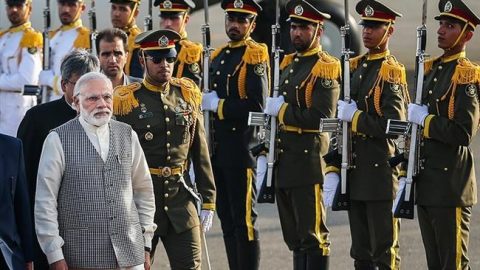
Indian PM Narendra Modi
Iran’s Ministry of Petroleum says it has started preliminary talks with Russians to develop Farzad B but negotiations also continue with the Indians who have long coveted the giant gas field.
“For the development of the Farzad B field, we are pursuing three separate paths in parallel, but none of the options is definite yet,” director of the integrated planning at the National Iranian Oil Company (NIOC) Karim Zobeidi said on Monday.
The third path is the implementation of a development study plan in cooperation with a foreign consultant and Iran’s Petropars company, the official explained.
Zobeidi said negotiations with the Indians have not achieved satisfactory results but they have not stopped either and that Iran was pursuing preliminary talks with a Russian company as the second path.
“Along these two routes, the study of the development of Farzad A and B and the feasibility of the injection of gas from these fields into Aghajari (oil field) in cooperation with a foreign consultant and Petropars company is in progress,” he added.
Indian companies discovered the Farzad B gas field in Iran in 2008 and have bid several times for the development rights.
The Indians were supposed to develop the field after its exploration, but they stopped their activities after the West intensified sanctions on the Islamic Republic in 2012.
With the lifting of the sanctions, India once again called for the development of Farzad B by ONGC Videsh which is the overseas investment arm of the country’s biggest energy exploration firm.
According to an agreement, the Indians were first to submit a technical plan and then a financial proposal for the development of the field, but Iran did not agree with the other side’s financial proposals.
In the absence of an agreement between Iran and India, the development plan for Farzad B will be put to international tender.
In May, Minister of Petroleum Bijan Zangeneh announced that Iran had signed a basic agreement with Russia’s energy giant Gazprom over the development of Farzad B.
Indians shift attention to Israel
On Monday, Reuters cited India’s Oil Minister Dharmendra Pradhan as saying that state-run Oil and Natural Gas Corp planned to bid for disputed Israeli offshore oil-and-gas exploration blocks.
A high-ranking Indian delegation visited Israel last month to discuss taking part in the tender for blocks in the Mediterranean Sea, the news agency reported.
“We will definitely bid for Israel’s oil-and-gas blocks,” Reuters quoted Pradhan as saying.
New Delhi has deep military ties with Tel Aviv but they reportedly seek to expand their relationship to other sectors such as energy and technology following Prime Minister Narendra Modi’s visit to Israel in July.
According to Reuters, Israeli officials were pleased with the visit by the Indian economic team, while many oil majors have been hesitant to enter the Israeli market, fearing a backlash from oil-rich Arab states.
Lebanon has a long-standing dispute with Israel which stands accused of stealing Arab resources.
Lebanese Parliament Speaker Nabih Berri has said Israel was overtly stealing Lebanon’s underwater oil and gas reserves off the coast of south Lebanon. Hezbollah has warned that it would use force to protect Lebanon’s resources.
The gas discoveries have created a new source of friction between Lebanon and Israel, which have clashed repeatedly.
Lacking in natural resources, Israel has said it had discovered two fields thought to contain about 24 trillion cubic meters of natural gas, enough to make it energy self-sufficient for decades. Lebanese leaders have said the reserves were a “golden opportunity” for Lebanon to service its huge debt and rebuild its economy.
September 5, 2017
Posted by aletho |
Economics, Ethnic Cleansing, Racism, Zionism, Illegal Occupation | Farzad B, India, Israel, Lebanon, ONGC, Zionism |
Leave a comment
After years of fomenting the Syrian conflict from the shadows, the U.S. has recently seemed to back away from its push to militarily intervene in the embattled nation, instead choosing to focus its saber-rattling and destabilization efforts on other theaters. The consequence of this has seemingly been the winding down of the long-running conflict, now entering its seventh year.
Buoyed by Russia, Iran and Lebanon, the Syrian government led by President Bashar al-Assad has managed to retake vast swaths of territory, all while surviving and growing stronger over the course of a largely foreign-funded onslaught. As a result, many of the governments that were instrumental in funding and arming the so-called “moderate” opposition have begun to extricate themselves, unwilling to further test the resilience of Assad or the Syrian people.
With some anticipating the long-awaited conclusion of the Syrian conflict, recent threats from Israel’s government to assassinate Assad by bombing his residence seemed to appear out of the blue. According to the Jerusalem Post, a senior Israeli official accompanying Israeli Prime Minister Benjamin Netanyahu on a recent visit to Russia warned the Kremlin that if Iran continues to “extend its reach” in Syria, Israel would bomb the presidential palace in Damascus.
Israel’s comments should come as no surprise, however, as the foreign-funded and manufactured conflict in Syria was always Israel’s war. The only real surprise is Israel’s growing isolation in pushing for the further escalation of the conflict.
WikiLeaks sheds light on the origins of the war
Though it has successfully avoided being labeled a major player in the effort to oust Assad, Israel has long been the mastermind of the plan, which stems in large part from the long-standing hostilities between the two nations as well as Israel’s own regional ambitions. State Department diplomatic cables released by WikiLeaks have shown that in 2006, five years before the conflict in Syria manifested, the government of Israel had hatched a plan to overthrow the Assad government by engineering sectarian strife in the country, creating paranoia within the highest-ranks of the Syrian government, and isolating Syria from its strongest regional ally, Iran.
Israel then passed this plan along to the United States, which would then involve Saudi Arabia, Turkey, Qatar and Egypt in fomenting the “breakdown” of the Assad regime as a way of weakening both Iran and Hezbollah — with the effect of empowering both Israel and the Gulf monarchies, two seemingly disparate forces in the region that are becoming increasingly allied.
Leaked emails belonging to former Secretary of State Hillary Clinton further reveal Israel’s role in covertly creating the conflict and its clear role in securing the involvement of the U.S. and other nations in executing its plan for Assad’s removal. One email, forwarded by Clinton to her advisor Jacob Sullivan, argues that Israel is convinced that Iran would lose “its only ally” in the region were Assad’s government to collapse.
It further stated that “The fall of the House of Assad could well ignite a sectarian war between the Shiites and the majority Sunnis of the region drawing in Iran, which, in the view of Israeli commanders would not be a bad thing for Israel and its Western allies.” This possible sectarian war was perceived as a potential “factor in the eventual fall of the current government of Iran.”
Another Clinton email released by WikiLeaks stated:
“The best way to help Israel deal with Iran’s growing nuclear capability is to help the people of Syria overthrow the regime of Bashar Assad,
Adding
Bringing down Assad would not only be a massive boon to Israel’s security, it would also ease Israel’s understandable fear of losing its nuclear monopoly.”
The email also notes:
A successful intervention in Syria would require substantial diplomatic and military leadership from the United States” and states that “arming the Syrian rebels and using western air power to ground Syrian helicopters and airplanes is a low-cost high payoff approach.”
Read the full Wikileaks release below:
Stated plainly, the U.S.’ decision to spend over $1 billion until 2015 to arm Syria’s terrorist-linked “rebels” — and to invoke the assistance of Wahhabi terrorism exporters like Saudi Arabia and Qatar in funneling weapons and funds to these same groups — was spurred by Israel, which not only drafted the original blueprint for the Syrian conflict but guided U.S. involvement by exerting its powerful influence over the foreign policy of that country.
Aiding the Rebels
Israel did more, however, than covertly instigate and guide the funding of opposition “rebels” — having secretly funded and aided opposition groups, including ones with overt terrorist affiliations, over the course of the six-year-long conflict.
Israeli involvement in direct funding and aiding the Syrian “rebels” was suspected for years before being officially made public by the Wall Street Journal in June of this year. The report revealed that Israel, since the beginning of the conflict, had been “supplying Syrian rebels near its border with cash as well as food, fuel, and medical supplies for years, a secret engagement in the enemy country’s civil war aimed at carving out a buffer zone populated by friendly forces.” Israel has also frequently brought wounded “rebels” into Israel for medical treatment, a policy it often touts as a “humanitarian effort.”
These “friendly” forces were armed groups that formed part of or were allied with al-Nusra Front, al-Qaeda’s Syrian branch, known for committing atrocities against thousands of Syrian civilians and slaughtering religious and ethnic minorities. Since 2013, al-Qaeda-affiliated terrorist groups have dominated the “eight-square-kilometer separation zone on the Golan.” Israel has stated officially that these fighters are part of the U.S. coalition-supported Free Syrian Army (FSA). However, it has long been known that the vast majority of the groups comprising FSA have pledged allegiance to the al-Qaeda-affiliated al-Nusra Front, and that those who still fight under the FSA banner meet with al-Nusra on a daily basis.
Israel’s support for terrorist groups went far beyond medical treatment, food supplies and cash. The Israeli army was also found to have been in regular communication with these terrorist groups and even helped “pay salaries of fighters and buy ammunition and weapons.” In addition, when the positions of the “rebel” groups it funded, armed and paid were in danger of being overtaken by Syrian government forces, Israel stepped in to directly bomb Syrian targets. For instance, in June, Israel attacked several Syrian military positions after claiming a stray mortar had landed within the boundaries of the Golan Heights, part of Syria that has long been occupied by Israel. However, the attack tellingly coincided with Syrian army advancements against the “rebel” groups that Israel has long cultivated as part of the so-called “buffer zone.”
Furthermore, Israel has launched attacks inside Syria “dozens and dozens of times,” according to a recent admission by Netanyahu. Earlier this year, Israel also threatened to “destroy” Syrian air defenses after the Syrian army fired missiles at Israeli warplanes striking targets within Syria.
Also very telling has been Israel’s position on Daesh (ISIS). In June of last year, Israel’s military intelligence chief, Major General Herzi Halevi, openly stated that Israel does not want to see Daesh defeated in Syria — expressing concern about the offensives against Daesh territory and lamenting their “most difficult” situation. Prior to Halevi’s comments, Israeli officials had regularly noted that Daesh conquering the whole of Syria would be preferable to the survival of the Assad government. These comments have been echoed by Israeli and NATO-affiliated think tanks, one of which called Daesh “a useful tool in undermining” Iran, Hezbollah, Syria and Russia — despite Daesh’s barbaric tactics, war crimes, enslavement of women and ethnic cleansing efforts.
Israel’s larger geopolitical agenda
Though Israel’s support of Wahhabi terrorists like Daesh (ISIS) and al-Nusra may seem counter-intuitive, Israel’s overarching purpose in expelling Assad from power is based on strategic geopolitical and economic goals that Israel is determined to meet at any cost. While Israel frequently mentions Iran as the pretext for its involvement in Syria, the strongest motivators for Israel’s participation in the destruction of its northern neighbor are oil and territorial expansion.
One of Israel’s clearest reasons for being interested in the destabilization of Syria is its ability to assert further control of the Golan Heights, an area of Syria that Israel has illegally occupied since 1967 and annexed in 1981. Despite filling the area with illegal settlements and military assets, Israel has been unable to convince the international community, and even its close allies such as the U.S., to recognize its sovereignty over the territory. However, the conflict in Syria has proven beneficial to this end, allowing Israel to send even more settlers into the Golan, an estimated 100,000 over five years.
Israel is largely interested in gaining control over the Golan for economic reasons, owing to the occupied territory’s oil reserves, which are estimated to contain “billions of barrels.” Under the cover of the Syrian conflict, the Israeli branch of an American oil company — whose investors include Dick Cheney, Jacob Rothschild and Rupert Murdoch — has been drilling exploratory wells throughout the region, as the Heights’ uncertain territorial status prevents Israel from financially exploiting the resource.
Despite the prohibitions of international law, Israel is eager to tap into those reserves, as they have the potential to “make Israel energy self-sufficient.” Israel has even offered, per the Galant plan, to “rebuild” Syria with billions in U.S. taxpayer dollars in exchange for the Golan Heights — though the plan received a tepid reception from all involved parties other than Israel itself.
As its stands, Assad’s removal and replacement with a government friendly to Israeli and Western interests is Israel’s only real means of claiming the Golan Height’s energy resources for itself.
Pawns blocking Israel’s endgame
Aside from the oil and the territory it seeks to gain in the Golan Heights, Israel is also seeking to expand well beyond that territory in order to more widely exert its influence and become the region’s “superpower.” This ambition is described in the Yinon Plan, a strategy intended to ensure Israel’s regional superiority in the Middle East that chiefly involves reconfiguring the entire Arab world into smaller and weaker sectarian states. This has manifested in Israel’s support for the partition of Iraq as well as Syria, abetted by its support for the establishment of a separatist Kurdish state within these two nations.
This goal, in particular, largely explains Israel’s obsession with curbing Iranian influence in the Middle East, whether in Syria or elsewhere. Iran – more than any other nation in the region – is the most likely to threaten the “superpower” status that Israel seeks to gain for itself, as well as Israel’s loss of monopoly as the region’s only nuclear power.
Given Israel’s compound interests in seeing the removal of Assad and the partition of Syria, it is hardly surprising that Israeli political rhetoric has reached new heights of saber-rattling as Tel Aviv becomes increasingly concerned that the conflict it masterminded could backfire. Prior to the explosive comments regarding Israeli threats to bomb Assad’s residence, an anonymous Israeli government minister blamed the U.S. for backing out of Syria, a move he argued sacrificed Israeli interests:
The United States threw Israel under the bus for the second time in a row. The first time was the nuclear agreement with Iran, the second time is now that the United States ignores the fact that Iran is obtaining territorial continuity to the Mediterranean Sea and Israel’s northern border [through Syria].”
Not only that but Israel has recently vowed to “nullify” the ceasefire deal brokered between Russia and the U.S. with Syrian and Iranian support if it fails to comply with Israel’s needs — an ultimatum based on rather subjective terms given that “Israel’s needs” are hardly static. Israel’s response again shows the perception among officials in Tel Aviv that the Syrian conflict is of primary importance to Israeli geopolitical interests.
Furthermore, given that the response suggested so far by Israeli officials – on more than one occasion – has been to assassinate Syria’s democratically-elected President – the contemplated means of Israel “nullifying” the ceasefire deal will likely have explosive implications. Israel — apparently refusing to accept that the conflict it orchestrated is not going, and may not end, as planned — is now willing to escalate the situation militarily, with or without allies, resorting to dangerous brinkmanship with global implications.
September 5, 2017
Posted by aletho |
Illegal Occupation, Timeless or most popular, War Crimes, Wars for Israel | al-Nusra Front, al-Qaeda, Hillary Clinton, ISIS, Israel, Middle East, Saudi Arabia, Syria, Turkiye, United States, Zionism |
Leave a comment
The latest extraordinary roughshod violation of Russian diplomatic rights by the American authorities shows that the US doesn’t want to restore normal bilateral relations. Indeed, it has now resorted publicly to jackboot diplomacy.
The rapid ordering of Russia to vacate three of its diplomatic properties – in a matter of hours – amid reported threats from the American authorities that they would smash down entrance doors if the orders were not complied with, shows a reckless disregard for Russia’s sovereign rights. Not just Russia’s sovereign rights, but the rights of all nations, as far as America is concerned.
There were also reports that US secret service agents conducted inspections of the properties while Russian officials were deprived access to the building. Such conduct marks not only provocative contempt for Russian authorities, it also raises concerns that US agents were attempting to plant incriminating evidence which might be subsequently «uncovered» by the ongoing probes into alleged Russian interference in the American presidential election last year.
What’s more, the manhandling of Russian diplomatic rights came on the personal orders from President Donald Trump, according to press reports. Previously, Trump had stated his desire to restore normal bilateral relations with Russia. One has to conclude that the latest breach of Russian sovereignty is a blunt sign that American official policy is now fully aligned in an antagonistic agenda toward Moscow.
The collective American amnesia is astounding. The shuttering of the three Russian properties in San Francisco, New York and Washington was presented by the US State Department and US media as a «retaliation» for Russia’s expulsion of some 455 American diplomats in July. Downplayed or omitted in the US media coverage was the fact that Russia expelled those diplomats in response to the Obama administration expropriating three Russian properties and ejecting 35 Russian diplomats back in December 2016. Russia had patiently waited seven months to see if the new Trump administration would do the decent thing and undo the Obama violations. The Trump administration not only did not undo the damage, it went further to impose new trade and political sanctions on Russia.
Thus, Russia had every right to reciprocate with its expulsions in July, which in any case brought the remaining 400 or so US diplomats down to the same number as Russian diplomats residing in the US. Moscow also gave the American side a month to vacate its premises. The Americans gave the Russians 12 hours.
Trump’s latest diplomatic infringement brings the total number of closed Russian properties to six, and marks a dramatic escalation in the dispute. Moscow has said it will respond appropriately.
Relations between the two nations are deteriorating rapidly beyond the already frayed level. But let’s be clear: it is the US side which is responsible for the downward spiral.
Obama’s unprecedented expulsions and expropriations were premised on lurid accusations that the Russian government ordered an interference campaign in the US presidential election. No evidence has yet been provided by the US intelligence agencies to support this sensational and nebulous claim. Yet we are in an extraordinary situation of tit-for-tat diplomatic blows based on unproven American allegations. This is a mockery of legal due process.
Russia has consistently dismissed those accusations, saying that they are motivated by anti-Russian prejudice and US political in-fighting and scapegoating. Ironically, Trump who has lambasted the «Russia collusion» claims as fake news put out by the pro-Democrat news media and intelligence community is now, in effect, jumping on the anti-Russia juggernaut with his latest order of diplomatic seizures. American folly knows no bounds.
The American amnesia is even more problematic. The sanctions against Russia began in 2014 over the Ukraine crisis. That crisis was instigated by American and European interference in the internal affairs of Ukraine and the eventual violent coup against an elected government in Kiev. The US-backed regime that seized power has been attacking the separatist ethnic Russian population of eastern Ukraine for the past three years. Meanwhile the people of Crimea voted in a referendum to join the Russian Federation instead of recognizing the Neo-Nazi Banderite Kiev regime. Yet it is Russia which is sanctioned by the US and its European allies for «destabilizing Ukraine».
The US is showing itself with full inglorious nakedness to be a petulant bully that flaunts international law. In short, an utterly shameless rogue regime that is now completely out of control, and doesn’t even care what others think. The latest violation of Russian sovereignty epitomizes the general high-handed attitude of the Americans to international law and the sovereign rights of all nations.
Amazingly, US media made self-justifying speculative comments that the alleged burning of documents inside the Russian consulate in San Francisco was «evidence» of Russian subterfuge and espionage. It is every nation’s sovereign right under international law to be afforded privacy for its diplomats. Instead of insinuating Russian wrongdoing, the proper, more disturbing, perspective should be that America has so little respect for international law that other nations no longer trust the US to abide by diplomatic legal standards.
The violation of Russian rights is consistent with the US violation of Ukraine which is in turn consistent with American violation of Syria, Libya, Yemen, Pakistan, Venezuela, Somalia, Iraq and Afghanistan, to mention just a few other recent cases.
On North Korea, what gives the US the legal and moral authority to declare that diplomacy does not work, or that negotiations might only be permitted if stringent preconditions are met by Pyongyang? How is it that the US arrogates the «right» to threaten war on North Korea (as well as Iran and Venezuela and others) while glibly ruling out the obligation to hold equal dialogue and comply with diplomatic protocols? This is the behavior and mindset of a tyrant. A fascist state.
The latest manhandling of Russian sovereign rights is a stark milestone in the degeneration of the United States. It is abandoning any pretense at civil diplomacy.
Jackboot diplomacy is the corollary of US wars of aggression, mass murder, mass torture, and the systematic destruction of international law. All with the narcissistic smile of smug self-righteousness.
September 4, 2017
Posted by aletho |
Illegal Occupation, Militarism, Timeless or most popular | United States |
Leave a comment
The shutting and subsequent searches of Russia’s diplomatic sites are a meaningless show of power and domination by the US, which, however, could help push through controversial new intelligence related legislation, believes Annie Machon, a former MI5 intelligence officer.
It’s part of efforts to push through the Intelligence Authorization Act that would recognize actors, such as WikiLeaks, as a “non-state hostile intelligence service,” Machon told RT.
RT:The State Department is saying the trade mission has been stripped of its immunity, that it was essentially lifted when that consulate was shut down. The Vienna Convention which governs consular relations says otherwise. Which do you think has got this right?
AM: The international law lays it down really clearly. The 1961 Vienna Convention on Diplomatic Relations says that any diplomatic and affiliated premises in a foreign country are inviolable. And any incursion on that territory is therefore seen as an attack on the country that is hosting that diplomatic mission.
So this is breaching all international law. And I have to say it seems very hypocritical because for example, going back to the Snowden disclosures of 2013, where it was disclosed that there were big illegal spying technical operations on the roof off, for example, the British embassy in Berlin, the American embassy in Berlin… Can you imagine the outcry if Germans then said: ‘We don’t want this in our country. We’re going to go raid these embassies and see what is going on inside them.’ I cannot imagine the international fallout. So why is that okay for America to do this to another sovereign state’s property in its own country?
RT:It seems a strange decision in a sense – I mean really, all you need to do is conduct an internet search… that this apparently goes against the Vienna Convention, and yet the US has gone ahead with this. Why do you think they are doing this?
AM: I don’t know, I really don’t know why they are trying to do this now. Well, obviously the tension has been ramping up. So Barack Obama in his last days as a president, at the end of last year, actually sent home 35 diplomats from Russia, which sort of confirmed in the public mind globally that Russia was involved in this bogus election hacking. And it just escalated from there.
So more sanctions being placed against Russia at the beginning of August. Russia was retaliating by expelling more American diplomats and their associates. So it is just escalating from this point.
Why they are doing it now, I do not know. It seems that President Trump initially wanted to try and recalibrate the relations with Russia to try to build a peaceful and a profitable world for both nations. And he has been hedged in, hedged in, hedged in, ever since his election by an American establishment plot to try and stop him, to make sure he can’t do that.
RT:Why conduct a search of the premises? Is it just a pantomime, a kind of theatre?
AM: I think there is a certain degree of theatre always in these sort of acts but also what is particularly concerning to me is that there is a Senate Intelligence Authorization Act going through the corridors of power in America. It was announced in the middle of August and this will actually effectively attack intelligence agencies working in America and even non-state hostile intelligence agencies, as they are calling WikiLeaks for example.
Now we all know that Julian Assange has had a safe haven in the Ecuadorian embassy in London since 2012. We also know that in 2012, the UK government was looking at the idea that they might try and raid the embassy against all international law, again to try to get him out to try to get him extradited.
So I’m wondering if this might be linked? There is some sort of meaningless parade of power by raiding these consulates in America, Russian consulates in America. Because they are going to push through this new law and then they can use it globally against anyone else they perceived to be an enemy. And we know that Julian Assange and WikiLeaks are perceived to be an American enemy. And they want him back there, and they want to persecute him under some secret laws.
RT: And this deadline to vacate the premises, it is really short notice, isn’t it? We saw that the Russian gave the US a whole month to clear out. Do you think the US is trying to set a precedent to let foreign nations know – don’t get too comfortable, we could ask you to get out at any moment?
AM: Absolutely. We have had a situation since the end WWII where there’s been a sort of detente with diplomatic relations, where people have assumed that there are certain rules in play, and it has been quite civilized. And it appears now increasingly on all sort of fronts, not just diplomatic fronts but you know on internet fronts, corporate fronts, whatever, that America keeps trying to claim global dominion.
And I think they are trying to assert that in this case – the question is why and why now? And I think it might be linked to this Senate Intelligence Authorization Act that is going through at the moment that is not being much reported on in America.
Annie Machon is a former intelligence officer for MI5, the UK Security Service, who resigned in the late 1990s to blow the whistle on the spies’ incompetence and crimes with her ex-partner, David Shayler. Drawing on her varied experiences, she is now a public speaker, writer, media pundit, international tour and event organiser, political campaigner, and PR consultant. She has a rare perspective both on the inner workings of governments, intelligence agencies and the media, as well as the wider implications for the need for increased openness and accountability in both public and private sectors.
September 3, 2017
Posted by aletho |
Illegal Occupation, Timeless or most popular | Obama, United States |
Leave a comment

 Aletho News
