Marco Rubio and Hillary Clinton both want the U.S. government to set up a “safe zone” in Syria to care for refugees from the raging civil war. You may assess their judgment by noting that Secretary of State Clinton and Sen. Rubio also pushed for bombing and regime change in Libya, which was crucial in spreading bin Ladenite mayhem far and wide. And Rubio thinks knocking out the Sunni Islamic State would hurt Shi’ite Iran.
Ted Cruz does not call for a safe zone; he merely wants to bomb the Islamic State back to the stone age while arming the Kurds, whom the leadership of NATO member Turkey wants to destroy and the Sunni Arabs distrust. Cruz says the Kurds would be “our ground troops,” yet he does not rule out American troops as a last resort.
Where do the reputed anti-establishment candidates stand on the safe zone? Alas, Donald Trump favors it, and Bernie Sanders is ambiguous.
If this is disestablishmentarianism American-style, we are in bad shape.
“What I like is build a safe zone in Syria,” he said. “Build a big, beautiful safe zone, and you have whatever it is so people can live, and they’ll be happier. You keep ’em in Syria. You build a tremendous safe zone. It’ll cost you tremendously much less, much less, and they’ll be there and the weather’s the same.”
Like Cruz, Trump says he’d send U.S. ground forces “if need be,” but he also promises to “take the oil.” How would he do that without an extended stay for grounds troops.
What about Sanders? He is reported as opposing Clinton’s call for a safe zone, or a no-fly zone, but look at his precise wording from October: “I oppose, at this point, a unilateral American no-fly zone in Syria which could get us more deeply involved in that horrible civil war and lead to a never-ending U.S. entanglement in that region” (emphasis added).
I realize that candidates don’t like to close doors because reopening them later can look awkward. Still, that makes me nervous.
Sanders approves of President Obama’s bombing of the Islamic State in Syria and Iraq, and favors “supporting those in Syria trying to overthrow the brutal dictatorship of Bashar Assad” — which in reality means supporting bin Ladenites or worse. He has also said the Saudi regime should be pressured to fight the Islamic State: “This war is a battle for the soul of Islam and it’s going to have to be the Muslim countries who are stepping up. These are billionaire families all over that region. They’ve got to get their hands dirty. They’ve got to get their troops on the ground. They’ve got to win that war with our support.”
A Saudi-led effort, however, would be awkward, considering that the Saudis and their Gulf state partners enabled the rise of radical jihadism as part of an effort to make trouble for Iran and its ally Assad, their Shi’ite rivals. And let’s not forget that for a year the Saudis have practically been committing genocide, with Obama’s help, in Yemen. What’s with Sanders anyway?
“Why,” asks blogger Sam Husseini, “should a U.S. progressive be calling for more intervention by the Saudi monarchy? Really, we want Saudi troops in Syria and Iraq and Libya and who knows where else? You’d think that perhaps someone like Sanders would say that we have to break our decades-long backing of the corrupt Saudi regime — but no, he wants to dramatically accelerate it…. If the position of the most prominent ‘progressive’ on the national stage is for more Saudi intervention, what does that do to public understanding of the Mideast and dialogue between people in the U.S. and in Muslim countries?”
At least Sanders and Trump understand that George W. Bush’s Iraq war gave birth to the Islamic State, just as U.S. bombing and regime change in Libya and Obama and Clinton’s declaration of open season on Assad led to its expansion. What Sanders and Trump do not understand is that even the relatively limited involvement they favor would have a dynamic that could well lead a U.S. president to deploy ground troops to the quagmire both men say they want to avoid.
Canada has passed a motion to condemn “any and all attempts” to promote the Boycott, Divestment and Sanctions (BDS) movement against Israel both at home and abroad.
The motion passed on Monday by a 229-51 vote, CIJ News reports. The bill was introduced by members of the Conservative Party and won support from Liberal Party members. The motion calls on the government to condemn attempts by Canadian organizations, groups, and individuals to promote the BDS movement, claiming it “promotes the demonization and delegitimization” of Israel.
BDS is a global grassroots movement that is trying to pressure Israel to “comply with international law and Palestinian rights” through the boycott of products and companies that profit from violating Palestinian rights. It also includes Israeli cultural and academic institutions.
Inspired by the successful BDS movement that aided in ending South African apartheid, its supporters believe the movement is the only way to push for a solution to the Palestinian-Israeli conflict.
Speaking after the vote, the National Council of Canada Arab Relations said, “At its core, the vote on the anti-BDS motion would go against the spirit of Freedom of Speech, a right enshrined in Canada’s Charter of Rights and Freedoms. Democratic governments do not ordinarily attempt to dictate the political views of their citizens. NCCAR Chair, Gabriel Fahel, reminds us that ‘freedom of speech and conscientious objections to buying products from countries that contravene international law are core values of a free and democratic society.’”
The CEO of the Center for Israel and Jewish Affairs, Shimon Fogel, however insisted that the boycott movement “does not contribute to peace and is not pro-Palestinian.”
“It is discrimination based on nationality, and it harms both Israelis and Palestinians alike by driving the two sides further apart. The BDS movement is a fringe movement and is outside genuine peace efforts,” Fogel said, as quoted by The Times of Israel.
Liberal Prime Minister Justin Trudeau is likely to continue former Prime Minister Stephen Harper’s close ties with Israel. He is against the BDS movement, and tweeted his opinion in March of last year.
Students at McGill University in Montreal passed a pro-BDS motion on Tuesday.
In 2014, Trudeau spoke out in favor of Israel’s right to defend itself during Operation Protective Edge, acknowledging the suffering of Israelis, but not that of the Palestinians, 2,200 of whom were killed during the 50 day conflict.
Israel has pushed back against BDS efforts, accusing its promoters of “anti-semitism.” AP recently revealed that the Israeli government had allotted $26 million for a covert cyberattack on the BDS movement, which would include “flooding the internet” with pro-Israel content and monitoring Muslim activists online.
Israel has a population of approximately 7.8 million, or a million fewer than the state of New Jersey. It is among the world’s most affluent nations, with a per capita income similar to that of the European Union.[1] Israel’s unemployment rate of 5.8% is better than America’s 7.3%,[2] and Israel’s net trade, earnings, and payments is ranked 30th in the world while the US sits in last place at a dismal 193rd.[3]
Yet, Israel receives more of America’s foreign aid budget than any other nation.[4] The US has, in fact, given more aid to Israel than it has to all the countries of sub-Saharan Africa, Latin America, and the Caribbean combined—which have a total population of over a billion people.[5]
And foreign aid is just one component of the staggering cost of our alliance with Israel.
Given the tremendous costs, it is critical to examine why we lavish so much aid on Israel, and whether it is worth Americans’ hard-earned tax dollars. But first, let’s take a look at what our alliance with Israel truly costs.
Before the Iraq War in 2003
Direct Foreign Aid
According to the Congressional Research Service , the amount of official US aid to Israel since its founding in 1948 tops $121 billion (adjusting for inflation, $233.7 billion as of March 2013), and in the past few decades it has been on the order of $3.1 billion per year.[6] (In 2014, for example, this amounted to $8.5 million every single day.)
But this money is only part of the story. For one thing, Israel gets all of its aid money at the start of each year, rather than in quarterly installments like other countries.[7] This is significant: It means that Israel can start earning interest on the money right away – interest paid by the US since Israel invests these funds in US Treasury notes. In addition, because the US government operates at a deficit, it must borrow money in order to give it to Israel and then pay interest on it all year. Together these cost US taxpayers more than $100 million every year.
Israel is also the only recipient of US military aid that is allowed to use a significant portion annually to purchase products made by Israeli companies instead of US companies. (The costs to Americans caused by this unique perk are discussed below.)
In addition, the US gives roughly $1.6 billion per year to Egypt and Jordan in aid packages arranged largely in exchange for peace treaties with Israel. The treaties don’t include justice for Palestinians, and are therefore deeply unpopular with the local populations.[8]
On top of this, the US gives more than $400 million to the Palestinian Authority each year,[9] much of it used to rebuild infrastructure destroyed by Israel and to bolster an economy stifled by the Israeli occupation.[10] This would be unnecessary if Israel were to end the occupation and allow the Palestinians to build a functioning and self-sustaining economy.
Yet, there’s still much more to the story, because parts of US aid to Israel are buried in the budgets of various US agencies, mostly the Department of Defense. For example, since at least 2006, the American Defense budget has included between $202 and $504 million per year for missile defense programs in Israel.[11]
In all, direct US disbursements to Israel are higher than to any other country, even though Israelis only make up 0.1% of the world’s population. On average, Israelis receive 7,000 times more US foreign aid per capita than other people throughout the world, despite the fact that Israel is one of the world’s more affluent nations.[12] And that number rises significantly when one considers disbursements to Egypt, Jordan, and the Palestinian Authority and Defense spending on behalf of Israel.
Additional Ad hoc support for Israel
Dr. Thomas Stauffer, a Harvard economist and Middle East studies professor who twice served in the Executive Office of the President, wrote a comprehensive report about all components of the relationship with Israel’s cost to American taxpayers for the Washington Report on Middle East Affairs in 2003. He wrote:
“Another element is ad hoc support for Israel, which is not part of the formal foreign aid programs. No comprehensive compilation of US support for Israel has been publicly released. Additional known items include loan guarantees… special contracts for Israeli firms, legal and illegal[13] transfers of marketable US military technology, de facto exemption from US trade protection provisions, and discounted sales or free transfers of ‘surplus’ US military equipment. An unquantifiable element is the trade and other aid given to Romania and Russia to facilitate Jewish migration to Israel; this has accumulated to many billions of dollars.”[14]
Israel has often used its privileged access to US military technology against both the US government and US corporate interests. According to the Associated Press in 2002,
“In France, Turkey, The Netherlands and Finland, Israeli companies have edged such U.S. firms as Raytheon, Northrop Grumman and General Atomics out of arms deals worth hundreds of millions of dollars in recent years. The irony, experts say, is that tens of billions of U.S. tax dollars and transfers of American military technology helped create and nurture Israel’s industry, in effect subsidizing a foreign competitor.”
The AP article quoted a vice president at the Aerospace Industries Association of America, who bluntly said, “We give them money to build stuff for themselves and the U.S. taxpayer gets nothing in return.”[15]
Meanwhile, according to the Christian Science Monitor , Israel has also “blocked some major US arms sales, such as F-15 fighter aircraft to Saudi Arabia in the mid-1980s. That cost $40 billion over 10 years.”[16]
Even worse, Israeli weapons “buttress the arsenals of nations such as China that the United States considers strategic competitors, alarming US military planners,” the Associated Press article went on to report. “[In 2001] US surveillance planes flying along China’s coast were threatened by Chinese fighter jets armed with Israeli missiles… Had Chinese fighter pilots been given the order to fire, they could have brought down the US planes with Israeli Python III missiles… US defense chiefs say Israel sold China the missiles without informing the United States.”[17]
Lost jobs, trade, and standing
One of the most devastating indirect costs of the US alliance with Israel was the Arab oil boycott of 1973. The Arab states imposed the boycott in protest of U.S. support of Israel during the 1973 war, in which Arab countries attempted to reclaim lands Israel had invaded and occupied in 1967.
“Washington’s intervention triggered the Arab oil embargo which cost the U.S. doubly: first, due to the oil shortfall, the US lost about $300 billion to $600 billion in GDP; and, second, the US was saddled with another $450 billion in higher oil import costs,” wrote Stauffer in the Washington Report on Middle East Affairs.[18]
Then there’s the cost in lost jobs. “US policy and trade sanctions reduce US exports to the Middle East about $5 billion a year, costing 70,000 or so American jobs,” Stauffer estimates. “Not requiring Israel to use its US aid to buy American goods, as is usual in foreign aid, costs another 125,000 jobs.”[19]
But perhaps the most damaging cost to the US has been its loss of standing in the Arab and Muslim worlds, where US largesse towards Israel as it commits human rights violations[20] provokes deep resentment. “To many of the world’s Muslims, it places the US taxpayer on the Israeli side of its conflicts with Arabs,” observed the Associated Press article.[21]
According to Harvard professor Stephen Walt, “The 9/11 Commission reported that 9/11 plotter Khalid Sheikh Mohammed’s ‘animus toward the United States stemmed not from his experiences there as a student, but rather from his violent disagreement with US foreign policy favoring Israel.’ Other anti-American terrorists—such as Ramzi Yousef, who led the 1993 bombing of the World Trade Center—have offered similar explanations for their anger toward the United States.”[22]
There are many more potential categories of costs that are even more difficult to quantify. All in all, Stauffer estimates that Israel cost the US about $1.6 trillion between 1973 and 2003 alone—more than twice the cost of the Vietnam war.[23]
Costs since Stauffer’s study in 2003
Israel’s cost to American taxpayers has remained high since Stauffer’s 2003 study. The US currently gives Israel an average of $3 billion a year in military aid, under an agreement signed by the Bush administration to transfer $30 billion to Israel over ten years, starting in 2009.[24]
All of the other extras and costs remain and in some cases have increased since 2003. For example, “Despite a tough economic climate and expected US budget cuts—including drastic cuts to the US military budget—US lawmakers will provide $236 million in fiscal 2012 for the Israeli development of three missile defense programs,” reported Israeli newspaper Haaretz.[25]
In addition, the US government “has provided $205 million to support the Iron Dome, manufactured by Israel’s state-owned Raphael Advanced Defense Systems Ltd. The system uses small radar-guided missiles to blow up in midair Katyusha-style rockets with ranges of 3 miles to 45 miles, as well as mortar bombs… Legislation moving through the Republican-controlled US House of Representatives would give Israel additional $680 million for the Iron Dome system through 2015.”[26]
And if, as many experts believe, the US would not have invaded Iraq without intense and sustained pressure from Washington insiders who advocate actively on behalf of Israel,[27] this adds yet another dimension of staggering cost to the equation: “hundreds of billions of dollars, 4,000-plus U.S. and allied fatalities, untold tens of thousands of Iraqi deaths, and many thousands of other US, allied, and Iraqi casualties,” according to retired US foreign service officer Shirl McArthur.[28]
Nobel Prize-winning economist Joseph Stiglitz and Harvard professor Linda Bilmes put the cost of the Iraq War at over $3 trillion, and incalculably more if you take into account the opportunity costs of the resources spent on this unproductive war. For example, higher oil prices due to the war have had a devastating impact on America’s economy, and so have the surging federal debt and the servicing of that debt. Without the war, the 2008 financial crisis almost certainly would not have been as severe, and the Afghanistan war most likely would have been shorter, cheaper, and more effective.[29]
The Israel lobby and partisans are currently gunning for a war with Iran with the same zeal they showed in the run-up to the 2003 invasion of Iraq.[30] By all estimates, the costs of a war with Iran will be much higher than the Iraq war. In addition to the loss of life, analysts predict, for example, that if Iran’s oil production were taken out of the world market, gas prices would rise 25-70 percent.
If the Straits of Hormuz (straits adjacent to Iran through which 20% of the world’s oil production passes on a daily basis) were attacked or blockaded, the cost of oil would skyrocket to a level never seen before, and the economic recession or depression that followed would be nothing short of “apocalyptic,” according to Matthew Yglesias writing for Slate .[31]
Reasons and Consequences
So now we are back to the question of why America continues to pour money into a state that commits daily human rights violations, defies US strategic interests,[32] provokes rage and resentment among billions of people,[33] competes with and crowds out US interests using technology subsidized by US taxpayers, and sells America’s military secrets to its enemies.[34]
The answer is simple and summed up well by professors Stephen Walt and John Mearsheimer in their ground-breaking article in the London Review of Books , “The Israel Lobby,”[35] and their book The Israel Lobby and US Foreign Policy .[36]
“Why has the US been willing to set aside its own security and that of many of its allies in order to advance the interests of another state?” the article asks. “One might assume that the bond between the two countries was based on shared strategic interests or compelling moral imperatives, but neither explanation can account for the remarkable level of material and diplomatic support that the US provides.
“Instead, the thrust of US policy in the region derives almost entirely from domestic politics, and especially the activities of the ‘Israel Lobby.’ Other special-interest groups have managed to skew foreign policy, but no lobby has managed to divert it as far from what the national interest would suggest, while simultaneously convincing Americans that US interests and those of the other country—in this case, Israel—are essentially identical.”[37]
AIPAC, the American Israel Public Affairs Committee, is consistently ranked in the top two most powerful lobbies in Washington.[38] And it is only one arm of the much larger, multi-faceted, and well-financed Israel lobby.[39]
According to Congressman Jim Moran, “AIPAC is very well organized. The members are willing to be very generous with their personal wealth. But it’s a two edged sword. If you cross AIPAC, AIPAC is unforgiving and will destroy you politically. Their means of communications, their ties to certain newspapers and magazines, and individuals in the media are substantial and intimidating. Every [Congress] member knows it’s the best-organized national lobbying force.”[40]
Senator Joseph Lieberman proudly stated, “Any attempt to pressure Israel, to force Israel to the negotiating table by denying Israel support, will not pass in Congress… Congress will act against any attempt to do that.”[41]
It’s true: The US Congress, along with the executive branch, overwhelmingly support virtually any action or wish of the Israeli government, no matter how at odds with US national interest or security,[42] primarily because of the power of the Israel lobby.[43]
Even when two AIPAC employees were indicted on espionage charges in 2005, and it was determined that they had obtained classified US government information illegally and passed it to Israeli agents, the charges were quietly dropped on technicalities.[44] AIPAC fired both employees and issued a statement that they were fired because their actions did not comport with AIPAC standards.[45] One of the fired employees, Steven Rosen, filed a lawsuit for defamation, claiming his actions were, in fact, common practice at AIPAC.[46]
When Israel attempted to sink a U.S. Navy ship, the USS Liberty , in 1967, killing 34 Americans and injuring over 170, it still failed to put a dent in aid to Israel.[47] Indeed, aid quadrupled the following year.[48]
Though Congressmen receive payments and support from the lobby in exchange for their loyalty, the American taxpayer is left footing the bill. As detailed above, the total cost has run from a bare minimum of $121 billion since 1948 (the cost of foreign aid alone) to $1.6 trillion or more, factoring in Defense appropriations, oil crises, the sinking of the USS Liberty , the heightened risk of terrorism, lost trade and co-opted technology, and countless other factors. If the Iraq war and the increased risk of a war with Iran are factored in, the cost skyrockets even higher.
Critics point out how much brighter our future would be if we had invested these billions or trillions in veteran rehabilitation and care, education, job creation, social security, housing, environmental clean-up and prevention, roads, bridges, health care, and scientific and health research. Or if Americans had simply held onto their tax dollars and used them as they saw fit, in our own economy. If some of the higher estimates are closer to the mark, our support for Israel could easily have covered the $700 billion TARP bailout with a great deal left over for massive stimulus spending and/or tax breaks.
If Israel were using these funds for a good purpose, one could debate whether the price was worth it. But Israel uses most of the money to prolong a 47-year military occupation (which regularly involves gross violations of international law),[49] commit egregious human rights violations,[50] and destroy billions of dollars worth of Palestinian homes and infrastructure[51] (resulting in still more U.S. tax money being sent to Palestinians to rebuild demolished homes, hospitals, and schools), while building illegal, Jewish-only settlements on Palestinian land.[52]
It makes the prospect of peace ever more distant, creates dangerous hostility to the US, placing Americans in peril, and puts the US Congress in violation of the Arms Export Control Act,[53] all for the sake of campaign contributions.
There is no good reason to keep throwing good money after bad in a failed, ill-founded policy. It’s long past time for a fundamental rethinking of the American government’s blank check to Israel.
#
This report was produced by If Americans Knew analysts, particularly Pamela Olson, a President’s Scholar at Stanford University 1998-2002 with a major in Physics, a minor in Political Science, and 1600 GRE scores. Before coming to IAK, Olson lived and worked in the West Bank; worked as a researcher in Moscow, Siberia, and China; and was a research analyst at the Institute for Defense Analysis. She is the author of Fast Times in Palestine.
This analysis updates the groundbreaking 1998 work by Richard Curtiss, “The Cost of Israel to U.S. Taxpayers,” published in the Washington Report on Middle East Affairs. Mr. Curtiss, following military service in World War II, served for 30 years as a career Foreign Service Officer. He received the U.S. Information Agency’s Superior Honor Award and the Edward R. Murrow award for excellence in Public Diplomacy, USIA’s highest professional recognition. Upon retirement, Mr. Curtiss co-founded and the American Educational Trust, which produces the Washington Report on Middle East Affairs. He is also the author of two books on U.S.-Middle East relations. A more extensive bio can be read here.
(Particularly noteworthy is the subsection of this report entitled, “Special Benefits for Israel.)
[8] US Department of State, “State and USAID – FY 2013 Budget,” February 13, 2012. http://www.state.gov/r/pa/prs/ps/2012/02/183808.htm Most of this money goes to elites rather than the general population, adding to the resentment about these policies.
[10] “Sustaining Achievements in Palestinian Institution-building and Economic Growth,” World Bank, September 18, 2011. http://unispal.un.org/pdfs/WBank09-2011_AHLCReport.pdf Quote from the report: “Ultimately, in order for the Palestinian Authority to sustain the reform momentum and its achievements in institution-building, remaining Israeli restrictions must be lifted.” See also: Dan Murphy, “Amid Palestinian statehood push, a grim World Bank report on the West Bank, Gaza,” Christian Science Monitor, September 14, 2011. http://www.csmonitor.com/World/Backchannels/2011/0914/Amid-Palestinian-statehood-push-a-grim-World-Bank-report-on-the-West-Bank-Gaza Quote from the article: “The World Bank says that recent economic growth in Gaza and the West Bank has been almost entirely thanks to foreign aid, that a slowing of foreign aid delivery has presented the PA with a possible fiscal crisis, and that Israeli policies continue to stand in the way of sustainable economic improvement in the territories.”
[13] ‘Illegal transfers’ refers to several instances in which Israel has been accused of violating the Arms Export Control Act, which prohibits the use of US military assistance for purposes other than legitimate self-defense. For example, during Israel’s invasions of Lebanon in 1982 and 2006, the Israeli air force dumped tens of thousands of cluster bomblets over wide civilian areas, resulting in horrific and long-lasting civilian casualties with dubious military utility. That’s not even to begin to touch on daily Israeli violations of human rights in the Palestinian territories. Despite overwhelming evidence of Israeli violations of international law using US-supplied weapons, the US Congress has done little to comply with its own laws against funding such violations.
[24] Shirl McArthur, “A conservative estimate of total direct US aid to Israel: more than $130 billion,” Washington Report on Middle East Affairs, November 2008. http://ifamericansknew.org/stat/130bill.html
[27] John Mearsheimer and Stephen Walt, “The Israel Lobby,” London Review of Books , March 23, 2006. http://www.lrb.co.uk/v28/n06/john-mearsheimer/the-israel-lobby See also: Stephen J. Sniegoski, “The Transparent Cabal: The Neoconservative Agenda, War in the Middle East, and the National Interest of Israel,” Ihs Press, September 1, 2008.
[28] Shirl McArthur, “A conservative estimate of total direct US aid to Israel: more than $130 billion,” Washington Report on Middle East Affairs, November 2008. http://ifamericansknew.org/stat/130bill.html
[36] John Mearsheimer and Stephen Walt, The Israel Lobby and US Foreign Policy, Farrar, Straus and Giroux, August 2007.
[37] John Mearsheimer and Stephen Walt, “The Israel Lobby,” London Review of Books , March 23, 2006. http://www.lrb.co.uk/v28/n06/john-mearsheimer/the-israel-lobby An earlier book by former Congressman Paul Findley, They Dare to Speak Out: People and Institutions Confront Israel’s Lobby, first exposed this in 1985. Findley and others founded the Council for the National Interest to try to counter this.
[38] Jeffrey Birnbaum, “Washington’s Power 25: which pressure groups are best at manipulating the laws we live by?” CNN Money , December 8, 1997. http://money.cnn.com/magazines/fortune/fortune_archive/1997/12/08/234927/index.htm Other top contenders include the American Association of Retired Persons, with over 40 million members, and the National Rifle Association.
[47] The findings of the Independent Commission of Inquiry into the Israeli Attack on the USS Liberty , the Recall of Military Rescue Support Aircraft while the Ship was Under Attack, and the Subsequent Cover-up by the United States Government can be read at http://ifamericansknew.org/us_ints/ul-commfindings.html
[53] The Arms Export Control Act prohibits the use of US military assistance for purposes other than legitimate self-defense. Despite overwhelming evidence of Israeli violations of international law using US-supplied weapons (a few of them outlined in citations above), the US Congress has done little to comply with its own laws against funding these violations.
The European Union (EU) foreign policy chief has cautioned against the risk of a war with active military hostilities between Turkey and Russia over Syria, where regional powers have sided with warring sides to the conflict gripping the Arab country.
Federica Mogherini issued the warning during a debate at the European Parliament’s Foreign Affairs Committee in the Belgian capital city of Brussels on Tuesday.
“We are always referring to Syria as a proxy war among regional actors,” Mogherini said, adding, however, that the current situation in Syria risks becoming “something bigger”.
“I’m not thinking of a cold war. No, we risk a hot war among different actors than the one we always think of. Not necessarily Russia and the United States, but Russia and Turkey, could be,” she said.
Russia launched its own anti-terror campaign in Syria on September 30, 2015, upon a request from the Damascus government. The airstrikes have expedited the advances of Syrian forces against militants.
On the contrary, Turkey is among the main supporters of militants fighting to topple Syrian President Bashar al-Assad. Ankara has also been accused on numerous occasions of being involved in illegal oil trade with the Takfiri Daesh terrorist group.
All sides to Syria conflict should respect truce
In another development on Tuesday, the Arab League urged all sides to the conflict in Syria to adhere to the terms of a ceasefire deal announced by the United States and Russia the previous day.
The 22-member body said in a statement that Arab League Secretary General Nabil Elaraby believes that the truce will be “an important step towards a political settlement of the Syrian crisis.”
On Monday, Washington and Moscow said the ceasefire has been planned to take effect in Syria on February 27.
Over the past few weeks, Syrian government forces, backed by Russia’s air cover, have managed to gain major positions from the foreign-backed militants.
I have a meeting today in London with the Ambassadors of Venezuela, Bolivia, Cuba, Nicaragua and Ecuador to brief them on Scotland’s continuing struggle for Independence. These nations have been at the forefront of the international movement against colonialism, and know all about the sharp end of neo-Imperialism and the evil-doing of the CIA and other western security agencies.
The test of the Independence of a state is nothing to do with domestic or regional government, or even with bilateral arrangements with the state from which it secedes. The test of Independence is, purely and simply, whether or not you are recognised by other states as independent. That is the very clear cut position in international law. For this reason, it is essential that Scotland reaches out, not just within the EU but to the entire international community. Ultimately we need these people to vote and lobby for us in the United Nations and other international institutions.
Frankly, the SNP is rubbish at this. I am doing this meeting because the hierarchy of the SNP spurned the approach from the Ambassadors, as previously detailed on this blog. This reluctance seems part of the hierarchy’s effort to be NATO friendly and thus CIA friendly. The Ambassadors would far rather be meeting with an official SNP representative than a nobody like me. Unfortunately the SNP won’t do it. That is a disgrace.
I can increasingly foresee, as Westminster governments move ever further to the right and encroach more and more on civil liberties, a situation arising where Scotland wishes to claim its independence without the consent of Westminster. In that situation, we will need all the international support we can get, just as the Palestinians have been making headway in UN institutions. Work needs to be put now into laying the foundations for that support. Personally I would characterise Scottish Independence as an anti-colonial struggle; use of Scots as British cannon fodder and integration of the Scots elite into the Metropolitan elite does not make Scotland any less a colony. Rome had an African Emperor, but still her African possessions were colonies.
But even for those who do not accept that analysis, there is no doubt that Scottish Independence would have a highly beneficial impact on the global balance of power. The weakening of the USA’s most powerful sidekick; the lessening of the UK’s ability to participate in illegal neo-imperial invasions and to host weapons of mass destruction; the re-opening of the question of the undemocratic Security Council structure at the UN.
Then there is also the positive role Scotland can play as a major contributor to UN Peacekeeping Forces, and a voice for sanity, reason, human rights and the pre-eminence of international law. An independent Scotland as a state party will be able to request the International Criminal Court to lay war crime charges against Blair and Straw for the illegal invasion of Iraq, which would be a powerful deterrent to future aggressive war.
I am but one man and a private individual. Everything I can do, I shall.
Turkey has the right to carry out military operations not only in Syria, but in any other country, which is hosting terror groups that threaten the Turkish state, Turkey’s President Recep Tayyip Erdogan said.
“Turkey has every right to conduct operations in Syria and the places where terror organizations are nested with regards to the struggle against the threats that Turkey faces,” Erdogan was cited as saying by the Hurriyet newspaper Sunday.
Ankara’s stance has “absolutely nothing to do with the sovereignty rights of the states that can’t take control of their territorial integrity,” the president insisted.
“On the contrary, this has to do with the will Turkey shows to protect its sovereignty rights,” he added.
The Turkish president used an unexpected platform to make his hawkish remarks as he visited an event celebrating the inclusion of Turkey’s southeastern province of Gaziantep on the list of UNESCO’s Creative Cities Network in the gastronomy category.
Erdogan warned that his government will treat “attitudes to prevent our country’s right [to self-defense] directly as an initiative against Turkey’s entity – no matter where it comes from.”
“No one can restrict Turkey’s right to self-defense in the face of terror acts that have targeted Turkey; they cannot prevent [Turkey] from using it,” he added.
The Turkish forces have been shelling Kurdish People’s Protection Units (YPG) forces, which Ankara views as a terrorist organization, as well as government troops on Syrian territory since mid-February.
The bombings of YPG targets, the military wing of the Democratic Union Party (PYD), continue despite Turkey’s ally, the US, considering the Kurdish fighters an important partner in fighting Islamic State (IS, Daesh, formerly ISIS/ISIL) .
There were also reports of dozens of Turkish military vehicles crossing into Kurdish northern Syria, with servicemen digging tranches in the area.
In December, Ankara also deployed 150 soldiers backed by artillery and around 25 tanks to northern Iraq, without consent from the government in Baghdad.
“Turkey will use its right to expand its rules of engagement beyond [responding to] actual attacks against it and to encompass all terror threats, including PYD and Daesh, in particular,” Erdogan said Sunday as cited by Anadolu news agency.
28 people, mainly Turkish military, were killed and 61 other injured in a suicide bombing Ankara on Wednesday.
Despite the Kurdistan Freedom Hawks (TAK) militants group claiming responsibility for the attack, Turkey claims that YPG was also involved.
In an attempt to protect itself, Turkey will treat anyone, who opposes it as a “terrorist and treat them accordingly,” the President said.
“I especially want this to be known this way,” he added.
Erdogan also slammed the countries, who criticized Ankara for their incursion into Iraq and Syria, calling them “disingenuous” due to “preaching only patience and resoluteness” to Turkey, but acting in a completely different manner when attacked themselves.
Having confirmed a strike on an ISIS camp in Libya, Washington officials had difficulties explaining under which legal authority the US acts. While the Pentagon cites post-9/11 legislation, stripped of such powers, the State Department refers to unnamed international laws.
On Friday, the US announced that its warplanes targeted a training camp near the Libyan city of Sabratha, reportedly killing up to 40 people. The Pentagon has treated the attack as a success as it declared the elimination of a Tunisian national, Noureddine Chouchane, who was an Islamic State (IS, formerly ISIL/ISIS) facilitator in Libya.
Also known as “Sabir,” the militant is believed to be behind the deadly attack on the Bardo Museum in Tunis in March 2015.
However, regardless of its achievement, the US authority to carry out strikes on Libyan soil has again come into question. It has appeared that Washington does not have a single answer.
After briefing reporters on Friday, the Pentagon press secretary Peter Cook was asked to clarify under what authority the US came to Libya, given that no Americans had been killed in the 2015 Tunisia attack.
“We have struck in Libya previously under the existing Authorization for the use of [military] force,” Cook replied.
The Pentagon’s spokesperson allegedly referred to the AUMF, which was passed and then signed by President George W. Bush shortly after 9/11, in September 2001, to target al-Qaeda. It authorized United States Armed Forces to carry out attacks against those responsible for September 11.
However, the Defense Department “believes” that the AUMF can be used 15 years later to fight ISIS.
“We believe that this was carried out under international law and, specifically, that this operation was consistent with domestic and international law,” Cook said, while not explicitly referring to any particular legislation.
In February 2015, President Obama did propose his own AUMF, which “does not address the 2001 AUMF”, but the draft was rejected by the Congress in December.
Other AUMF drafts, including for example, one of the most recently submitted by Senate Majority Leader Mitch McConnell, have not gotten Congressional approval either.
RT has also tried to clarify the US’s authority for the attack with the State Department, but failed to get a conclusive answer.
RT’s Gayane Chichikyan: “Under what legal authority did the US carry out strikes in Libya this morning?”
State Department’s Mark Toner: “It was in full accordance with international law. We’ve talked about this many times. I’d refer you to the Department of Defense to speak about specifics.”
Chichikyan: “So not the AUMF? It’s – it was international law?”
Toner: “Exactly. I mean – exactly.” He then refused to “get into details here,” again readdressing the question back to the Pentagon.
Approved by ‘some Libyan authority’?
At the same time both departments unanimously stress that “the Libyan authorities were aware” about the US’s strike. However, when asked to specify what “Libyan authorities” he referred to, Toner seemed to be at a loss, saying that “there is some governmental structure present” there.
“The new – well, I mean, there’s obviously Libyan authorities on the ground,” he replied to a question about Libya’s recently announced unity government. “It’s not – we’re still working to stand up the Government of National Accord. We want to see it returned and establish itself in Tripoli.”
Meanwhile, as experts tell RT, until its approval, the UN-backed unity government does not have powers to authorize foreign intervention.
“There is really no Libyan authority in existence that’s able to invite them [the US], so I think they did it on their own authority,” Oliver Miles, former UK ambassador to Libya, said. Miles believes the Libyans would oppose “very strongly” any foreign intervention.
Five years after the US-led force toppled Colonel Muammar Gaddafi, Libya remains in a power vacuum, which dragged the country into a civil war and let terror groups gain a foothold in the region.
There is a glimpse of hope for improvement and stability as the unity government, consisting of 13 ministers and five ministers of state, was formed Sunday and is currently expecting Libya’s eastern parliament’s approval.
The State Department “disagrees” that the US’s devastating intervention in Libya in 2011 has been a reason for its current involvement in Libya.
“We’re very clear-eyed in our assessment that when we see ISIL take these kinds of actions, we need to be able to strike at them,” Toner said, stressing that it is not “second intervention.”
In the meantime, the Pentagon has announced that it “will go after ISIL whenever it is necessary, using the full range of tools at our disposal.”
Call it a Freudian slip, but US President Barack Obama appears to have come clean, for once, on the connection between American foreign policy and the so called Islamic State (ISIS) terror group.
In an address earlier this week to the leaders of the Association of South East Asian Nations (ASEAN), gathered in California, Obama was answering questions from news reporters on various international topics. On the matter of terrorist groups expanding their foothold in Libya, the president said the following: “With respect to Libya… we will go after ISIS wherever it appears, the same way we went after al Qaeda wherever they appeared.”
In casual parlance the phrase “go after” can mean “to destroy”. But the more literal meaning and perhaps the one that Obama inadvertently let slip is simply “to follow”–as in a partnered way.
In that case, what Obama is referring to is the actual foreign policy function of ISIS and its related al Qaeda terror network. Wherever these groups appear, then Washington appoints itself to follow them under the pretext of fighting terrorism.
This pretext works very efficiently to nullify problems of international law. When the US sends its military into a foreign country to ostensibly combat terrorism then it is untrammeled by legal objections that it is violating other countries’ sovereignty. What would normally be seen as a gross violation –a military invasion by the US –is neatly transformed into an “anti-terror”operation. And if the incumbent foreign government complains about the “benevolent US assistance” then it can be toppled because it is “siding with the terrorists”.
This is, of course, the whole rationale behind the so-called War on Terror that Washington crafted in the aftermath of the 9/11 attacks. Just uttering the phrase War on Terror gives Washington license to invade and ransack any foreign state it chooses, as in Afghanistan and Iraq, where more than one million people were killed by US forces “hunting down terrorists”.
Before that, the official pretexts were “War on Communism”or “War on Drugs”. But with the collapse of the “Evil Soviet Empire”, the first of these pretexts became redundant. Although, Washington and its NATO allies are trying their best to revive the “Russian Scare” by demonizing Vladimir Putin as the “new Hitler in Europe”. As for the War on Drugs, it didn’t quite have the required kick to pump up the Pentagon’s $600 billion annual budget, or to enthuse the American public, many of whom rather enjoy drugs anyway.
But the War on Terror, now that is, or at least was, a satisfying wheeze. It also has the added benefit of allowing federal authorities to crack down on civil rights and make all sorts of invasive controls over individual liberty, as in the latest controversy of the FBI demanding that Apple give them a digital key for unlocking phones and computers.
The primary function, however, remains: the terror groups, whether they go by the name of al Qaeda or ISIS, give Washington the convenient cover to militarily invade any country on the globe. The real agenda being regime change or commandeering the natural resources of the target country for the gratification of Wall Street banks and other American corporations –in the exact same scam that pertained in the old days of Marine Corps Major General Smedley Butler, who later confessed to being a henchman on behalf of US capitalism, by overthrowing governments in Central America and the Caribbean during the early 1900s.
Admittedly, sometimes the terrorists do get whacked by the Pentagon. No doubt about it that Obama and his generals have killed numerous al Qaeda-linked operatives with assassination drone strikes in Afghanistan, Pakistan, Libya, Somalia and Yemen. Many more innocent civilians have also been murdered along the way by US drones.
The assassination of terror cadres by Washington may seem like a contradiction to the overall argument here that there is a mutual connection between the two. However, we shouldn’t think of Washington as a monolith. There are no doubt people within the US establishment who are dedicated to genuinely fighting terrorism, and sometimes they succeed.
But that doesn’t negate the central point that the US has covertly created these same terrorist groups to expedite its own foreign policy and geopolitical ambitions. We can’t go into the full history here, but it is well documented that the CIA engendered, mobilized and weaponized al Qaeda “the database” to fight the Soviet Union in Afghanistan during the 1980s. It wasn’t just the CIA. British MI6, French DGSE and Pakistani ISI were involved, as were the Saudi regime who provided the billions of dollars of finance and fundamentalist Wahhabi ideology that perversely empowers cadres to kill anyone –men, women and children –whom is designated an “infidel”. In other words, perfect proxy killers for the powers-that-be.
Despite the propaganda pumped out in the Western mainstream media of a US-led coalition “fighting terrorism” in Syria, the hard fact is that al Qaeda, ISIS and a plethora of other terrorist mercenary brigades were sent into Syria by the same US-led coalition for the purpose of regime change against the Russian and Iranian-allied government of President Bashar al-Assad. Readers can look up the candid admission of Lt General Michael Flynn, the former chief of US Defense Intelligence Agency as to the cynical calculations that Washington made in unleashing the terrorists on Syria.
If the US were really fighting terrorism in Syria then how do you explain this headline from McClatchy News referring to the huge discrepancy in Russian bombing raids compared with American. “Russia hit 1,888 targets in Syria in a week; the US count? Just 16”.
Face it. Until Russia intervened last September, the ISIS terror network had proliferated under US “bombing” to such an extent that Syria was in danger of being overthrown (as according to Washington’s plan).
Having failed in that mission largely because of Russia’s military intervention over the past five months, the fallback option provided by the terror groups is that they could be used to justify an outright military invasion of Syria by the US-led coalition, in the form of NATO-member Turkey and Saudi Arabia along with the other American-Arab puppet-regimes.
As Obama let slip at the ASEAN summit this week: “Wherever ISIS or al Qaeda appears, we will go after them.”
Well said Mr President. For once, you told the plain truth.
PS. The ASEAN venue where Obama was speaking at in Sunnylands, California is called “Rancho Mirage”. Kind of appropriate, don’t you think?
The Academy of Motion Picture Arts & Sciences announced that it is suing Distinctive Assets, the company distributing a luxury gift bag to Oscar nominees, which this year includes an all-expenses paid trip to Israel sponsored by the Israeli government.
Palestinians had denounced the inclusion of the trip to Israel as a “cynical and desperate” attempt by the Israeli government to fight its increasing international isolation through bribes to celebrities instead of addressing its human rights abuses against them.
Responding to this latest development Omar Barghouti from the Palestinian BDS National Committee (BNC), the broadest Palestinian coalition that leads the global BDS movement, said:
“By distancing itself from the company marketing Israel’s propaganda trip to Oscar nominees, the Academy is taking a step in the right direction. The so-called ‘Oscars swag bag’ has fallen into further disrepute with its association with the Israeli regime of occupation, settler-colonialism and apartheid.”
“The Academy needs to do much more, clearly, to address the serious charges of bias and racism raised by the #OscarsSoWhite campaign as well as Palestinian human rights campaigners, among many others.”
“Campaigners will continue to urge nominees to act with conscience and reject Israel’s latest propaganda attempt to whitewash its war crimes and other egregious violations of human rights. Any artist with a conscience would have similarly declined a free trip paid for by the apartheid regime in South Africa in the 1980s.”
A petition has been launched calling on nominees not to take the free trip to Israel, echoing demands by the Palestinian arts community. The Palestinian Performing Arts Network denounced the hypocrisy by saying Israel deliberately attacks Palestinian art and cultural production.
Oscar nominees Mark Rylance and Asif Kapadia have already promised not to visit Israel professionally as long as the human rights violations persist. Five-time Oscar nominee Mike Leigh, Director Ken Loach and musician Brian Eno today publicly denounced the Israeli government’s propaganda initiative.
The Environmental Quality Authority yesterday seized an Israeli truck full of chemical remains heading to illegally unload in occupied Palestinian territories, Quds Press reported.
The truck, which left the Israeli settlement of Karnei Shomron, was seized between the Palestinian villages of Kafr Thulth and Azzun near the West Bank city of Qalqilya.
The truck was to be offloaded near a residential compound in Qalqilya, a statement by the Environmental Quality Authority revealed.
The load included remains of several chemical industries, including paint.
The authority said it handed the truck and driver over to the District Coordination Offices.
A senior official in the authority said a complaint regarding this Israeli violation would be filed to the Secretariat of the Basel Convention, which is in charge of the transport of dangerous goods.
He also said that the Palestinian contractors, who were involved in this issue, would be prosecuted.
Environment expert George Karzam told Quds Press: “The Israeli occupation recently closed a number of its dumps and facilities related to treating solid and chemical waste in the lands occupied in 1948 [Israel] moving them to new sites in the West Bank, mainly in the Jordan Valley.”
This was because of the poisonous substances which were being discarded as well as the odors coming from the dumps, Karzam explained.
Israel has also been putting pressure on the Palestinian Authority to open new waste sites for illegal settlements in the West Bank, he added.
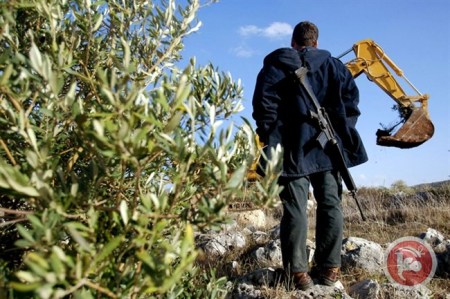
SALFIT – Israeli forces uprooted 100 olive trees in the Wadi Qana area west of the village of Deir Istiya in Salfit district on Tuesday amid ongoing efforts to push Palestinians out of the area, locals said.
Farmers from Deir Istiya told Ma’an the forces arrived in Wadi Qana and uprooted the trees without prior notice.
Soldiers then forced locals from the area in order to allow Israeli settlers to arrive there, the farmers said.
Ibrahim al-Hamad, director of the Palestinian Ministry of Agriculture’s Salfit branch, told Ma’an that soldiers removed the seven-year-old trees on the grounds that the area is a nature reserve, with planting prohibited in the area.
Al-Hamad added that Israeli soldiers also removed a water tank belonging to Palestinian locals.
A spokesperson for Israel’s Coordination of Government Activities in the Territories (COGAT) was not immediately available for comment.
Wadi Qana, a valley that has historically served agricultural and recreational purposes for local Palestinians who own land in the area, was declared a nature reserve by Israel’s Civil Administration in 1983.
Israel has used this designation for years to justify uprooting Palestinian crops and forcing Palestinians from the area, according to Israeli rights group B’Tselem.
Several Jewish-only Israeli settlements and outposts have been illegally established along the ridges of the valley since the 1970s.
Waste water dumped from the settlements has gradually polluted the river, forcing out Palestinians who have lived in and visited the valley for generations.
Palestinian owners of land in Wadi Qana and the village of Dir Istiya have meanwhile been prevented from building or planting in the area, the majority of which is in Area C, under the full civil and military control of Israel.
Saudi Arabia and Turkey appear to be backpedaling on rhetoric to launch ground operations inside Syria, with officials saying they would wait for a go-ahead from the US and to see if a planned ceasefire transpires.
Prime Minister Ahmet Davutoglu said on Tuesday Turkey will continue to take preventative measures to avoid becoming involved in the war in Syria.
He made the remarks in an address to members of his ruling AK Party in parliament as Turkey’s military shelled a Syrian city across the border for the fourth straight day.
Both Turkey and Saudi Arabia have said they were waiting for a US nod after announcing their bid for ground operations inside Syria.
Moscow and Washington said on Sunday Russian President Vladimir Putin and and US President Barack Obama spoke by phone about a possible ceasefire.
The Kremlin said the phone call was at Washington’s initiative, and that the two leaders agreed to implement an agreement reached in Munich to determine the technicalities of a Syria ceasefire.
On Tuesday, a Turkish official said Ankara would not launch an offensive in Syria on its own, even though it thought “there should be a ground operation.”
“Turkey is not going to have a unilateral ground operation. We are asking coalition partners that there should be a ground operation. We are discussing this with allies,” the official told reporters at a briefing in Istanbul.
The official, however, said four Saudi jets to will be deployed to Turkey’s Incirlik air base by end of February, which indicates earlier claims of warplanes having already been deployed to the base were not true.
Defense Minister Ismet Yilmaz had said on Sunday that Ankara had no intention of intervening in Syria.
Meanwhile, a Saudi diplomat said the kingdom was “very serious” about sending ground troops into Syria, but would wait to see if the planned truce would take effect, The Independent reported.
The unnamed diplomat said Saudi Arabia and Turkey were largely “on the same page” concerning the potential deployment and that Saudi officials had discussed the possibility with Prime Minister Davutoglu.
“Turkey isn’t against the ground troops, but they want to say ‘we gave the peace process a chance,’” added the diplomat, whose name was not published.
Saudi Foreign Minister Adel al-Jubeir, meanwhile, said, “The kingdom’s readiness to provide special forces to any ground operations in Syria is linked to a decision to have a ground component to this… US-led coalition.”
By Mahdi Darius NAZEMROAYA | Strategic Culture Foundation | 30.03.2015
The United States and the Kingdom of Saudi Arabia became very uneasy when the Yemenese or Yemenite movement of the Houthi or Ansarallah (meaning the supporters of God in Arabic) gained control of Yemen’s capital, Sanaa/Sana, in September 2014. The US-supported Yemenite President Abd-Rabbuh Manṣour Al-Hadi was humiliatingly forced to share power with the Houthis and the coalition of northern Yemenese tribes that had helped them enter Sana. Al-Hadi declared that negotiations for a Yemeni national unity government would take place and his allies the US and Saudi Arabia tried to use a new national dialogue and mediated talks to co-opt and pacify the Houthis.
The truth has been turned on its head about the war in Yemen. The war and ousting of President Abd-Rabbuh Manṣour Al-Hadi in Yemen are not the results of «Houthi coup» in Yemen. It is the opposite. Al-Hadi was ousted, because with Saudi and US support he tried to backtrack on the power sharing agreements he had made and return Yemen to authoritarian rule. The ousting of President Al-Hadi by the Houthis and their political allies was an unexpected reaction to the takeover Al-Hadi was planning with Washington and the House of Saudi. … continue
This site is provided as a research and reference tool. Although we make every reasonable effort to ensure that the information and data provided at this site are useful, accurate, and current, we cannot guarantee that the information and data provided here will be error-free. By using this site, you assume all responsibility for and risk arising from your use of and reliance upon the contents of this site.
This site and the information available through it do not, and are not intended to constitute legal advice. Should you require legal advice, you should consult your own attorney.
Nothing within this site or linked to by this site constitutes investment advice or medical advice.
Materials accessible from or added to this site by third parties, such as comments posted, are strictly the responsibility of the third party who added such materials or made them accessible and we neither endorse nor undertake to control, monitor, edit or assume responsibility for any such third-party material.
The posting of stories, commentaries, reports, documents and links (embedded or otherwise) on this site does not in any way, shape or form, implied or otherwise, necessarily express or suggest endorsement or support of any of such posted material or parts therein.
The word “alleged” is deemed to occur before the word “fraud.” Since the rule of law still applies. To peasants, at least.
Fair Use
This site contains copyrighted material the use of which has not always been specifically authorized by the copyright owner. We are making such material available in our efforts to advance understanding of environmental, political, human rights, economic, democracy, scientific, and social justice issues, etc. We believe this constitutes a ‘fair use’ of any such copyrighted material as provided for in section 107 of the US Copyright Law. In accordance with Title 17 U.S.C. Section 107, the material on this site is distributed without profit to those who have expressed a prior interest in receiving the included information for research and educational purposes. For more info go to: http://www.law.cornell.edu/uscode/17/107.shtml. If you wish to use copyrighted material from this site for purposes of your own that go beyond ‘fair use’, you must obtain permission from the copyright owner.
DMCA Contact
This is information for anyone that wishes to challenge our “fair use” of copyrighted material.
If you are a legal copyright holder or a designated agent for such and you believe that content residing on or accessible through our website infringes a copyright and falls outside the boundaries of “Fair Use”, please send a notice of infringement by contacting atheonews@gmail.com.
We will respond and take necessary action immediately.
If notice is given of an alleged copyright violation we will act expeditiously to remove or disable access to the material(s) in question.
All 3rd party material posted on this website is copyright the respective owners / authors. Aletho News makes no claim of copyright on such material.


 Aletho News
 Aletho News