Taliban slams UN report on Afghan civilian casualties
Press TV – February 19, 2015
The Taliban militants have censured the United Nations for what they describe as its “unjust and political motives” in attributing a rise in the number of Afghan civilian casualties in 2014 to the group’s militancy.
“The findings of the report are unjust and we refute them,” the Taliban militant group declared in a Thursday statement, claiming that Afghan government forces may have also contributed to the high civilian toll in the war-ravaged country in the past year.
The development came after the United Nations announced in a Wednesday report that 72 percent of the overall civilian casualties throughout Afghanistan were attributed to the Taliban and other militant groups.
“The United Nations does not show the crimes that the Afghan military under the Kabul administration is committing against civilians,” the Taliban statement further said.
According to the United Nations Assistance Mission in Afghanistan, more than 10,000 civilian casualties were recorded across the Asian country during 2014, reflecting a 22-percent hike compared to figures from the previous year.
“Rising civilian deaths and injuries in 2014 attests to a failure to fulfill commitments to protect Afghan civilians from harm,” said Nicholas Haysom, UN Secretary General Ban Ki-moon’s special representative for Afghanistan.
The report, however, does not attribute any civilian casualties in the war-torn country to the US-led foreign forces, most of which withdrew from the country by the end of 2014.
Washington’s assassination drone strikes and other air raids and military operations conducted by the US-led forces have been widely blamed for large number of civilian casualties since the foreign troops began their military invasion of the country in 2001.
Afghan civilians have been bearing the brunt of the 13-year war in Afghanistan since the US-led occupation of the country under the pretext of a “war on terror.”
Obama, Kashmir, and India’s “Perfect Genocide”
teleSur | February 15, 2015
Welcome to Kashmir, the land known for its flowers, mountains and pristine lakes!
 But here, I am talking about an absolutely different Kashmir:
Welcome to the land of watchtowers and barbed wire, of military convoys, of torture and rape! Welcome to the place where India, the U.S. and Israel are continuously conducting their joint military exercises, while plotting in unison, the best strategy of how to oppress and “pacify” the local population.
Welcome to the land of 7,000 mass graves!
Welcome to a land of torture and extra-judicial executions, where at least 80,000 people have already died, most of them in just the last two decades.
Welcome to that exhausted land, where at least 8,000 people have been “disappeared” without a trace, where the entire female population of some border villages have been raped, where torture perpetrated by Indian security forces has reached an unimaginable level of brutality.
Maybe you have never heard about the crimes against humanity committed by the Indian forces in Kashmir or in the Northeast, and it is not surprising if you haven’t. Because India is like Indonesia, like Rwanda, Uganda or Ukraine — it is now a staunch ally of the West; virtually its client state. As a reward to the Indian rulers and elites, there is almost no criticism coming from the Western mainstream media. And all the Indian mass media now belongs to the right-wing business conglomerates, so there is no criticism coming from there, either!
What takes place in Kashmir is called genocide — by some, by many. But their voices are barely audible. Their voices are muffled, even silenced, by the Western and Indian regimes.
*
“By inviting President Obama to New Delhi, India betrayed BRICS, politically, economically and militarily,” explained Mr. Binu Matthew, editor of an influential alternative Indian web-based magazine Countercurrents, which operates from the southern state of Kerala (www.countercurrents.org).
For years, I actually tried to define India’s position in BRICS. My conclusion is increasingly straightforward: it does not belong there at all! Its social, economic, political and military stands are anti-BRICS, pro-business and pro-Western.
While Obama was visiting India in January 2015, I was actually working in Kashmir. In fact, exactly at the time when his Air Force One was touching down near New Delhi, I was supposed to be transiting at Indira Gandhi International Airport, en route from Kerala to Srinagar, Kashmir.
The madness of the Indian security apparatus in action has turned into something indescribable! Two maniacal countries — India and the United States, have joined their hands, as well as their paranoia.
My Air India flight had to circle in the air for an extra hour, before being allowed to land. And several days later, long after Obama departed, when I checked into the same hotel where the U.S. President had been staying (ITC Maurya), the place was still overflowing with those brave and beefed-up U.S. security apparatchiks and their confused Indian lackeys.
I was told that at its peak, there were approximately 1,600 members of the U.S. security, operating in the India’s capital. They brought everything with them, from surveillance equipment, to oxygen bombs, in order to “fight” the legendary New Delhi pollution and supply their Commander-in-Chief with clean, breathable air.
The Metro system was shut down, and snipers, both from local and foreign security forces occupied most of the high-rise buildings in the center.
In India, even without Obama’s visit, surveillance and “security” has become a national obsession. Outrageous “security” measures here are always justified by “terrorism” and by all other “threats” (most of them fabricated). The main reason why they exist is very simple: they serve the elites who are protecting themselves against the great majority of their own miserably poor, cheated and underprivileged citizens.
Obama got from his Indian sojourn exactly what he hoped for: both countries (or more precisely, their elites) are now moving closer and closer towards each other, both militarily (India is readily offering itself to the U.S. geo-political interests, particularly to the most important one, which is to ostracize, demonize and provoke China) and economically by maintaining a despotic market fundamentalist system, which is for the exclusive benefit of the upper classes, corporations and moneyed mobsters.
The mechanism is simple: India, which is actually a police state, oppresses the majority of its citizens on behalf of the Empire and its business interests. And in exchange it gets promoted as “the largest democracy on Earth.”
Its big boys are now finally getting what they have dreamt about ever since the collapse of the British Empire: acceptance to the exclusive Western imperialist club. When they were in charge there, the Brits put up warnings all over Sub-Continent: “No Indians and Dogs!” Such sleights are now conveniently forgotten. Everything Western is glorified.
“Let’s walk together!” declared Obama during his visit. He forgot to mention, where?
*
Now imagine what a police state based on thoroughly cynical principles and deceptions is capable of doing to an occupied territory, like Kashmir!
Parvez Imroz, the Director of “Jammu & Kashmir Coalition of Civil Society,” explained to me during our meetings on the outskirts of Srinagar, in Kashmir:
“India, being a growing regional power, with an increasingly free market open to the United States and other such states, has been emboldened by foreign powers.
The army since 1989 has resorted to war crimes as they have been given legal impunity, and seldom have any armed personnel been punished for crimes against humanity. The militarization in Jammu and Kashmir has affected all aspects of life and unfortunately the Indian media and civil society, with some exceptions, have also been extending the moral and political impunity to the army who they believe are fighting trans-border terrorism. The systematic disappearances, mass graves, and torture have been completely ignored by the Indian and international media.”
In New Delhi, I discussed the joint exercises of Indian, US and Israeli military forces, with a renowned independent documentary film-maker, Sanjay Kak. He concluded:
“When it comes to brutality, Indian forces could actually teach both Israel and United States quite a few things.”
*
It is easy to confirm it.
For several days, I worked in Kashmir, with two members of “Jammu & Kashmir Coalition of Civil Society,” but also with reporters employed by large Western press agencies, as well as with prominent lawyers from New Delhi. The journalists and attorneys asked not to be identified in this report, for reasons of safety and fear of losing their jobs. But they readily shared their knowledge and contacts.
I visited the border region with Pakistan, near the city of Kupwara. I also worked in the city of Sopore, known for its resistance against what the majority of local people calls, “the occupation of Kasmire.” I worked in Srinagar and its vicinity, and in several other places. It is obvious that Kashmir is brutalized, and the loss of lives here is so high that it could easily qualify as genocide.
The torture of civilians accused of supporting the “Mujahedin,” is comparable only with other examples of the most outrageous atrocities, committed in the 20th century. There seems to be no justice for the victims.
I spoke to local people from the villages of Kunan and Poshpora, where more than 2 decades ago, the Indian military arrested all men, took them to a frozen creek and tortured them, then raped all the women in their houses, killing five, including a four-day old baby. This case is well documented, and the victims pressed charges, but no one had been punished as of yet.
I spoke to a man in Sopore, Hassan Bhat, who lost both of his sons. They were murdered at the age of 15. One was shot by a cop while he was buying a carton of milk at local grocery store, and the other, shot with a teargas canister when he was trying to hide in the river, scared of a confrontation between local youth and armed forces. No justice; no one had been punished, although Mr. Bhat knows the names of the officers who were in charge.
I was shown several photos, and the case of a man who was detained after being accused of sympathizing with the “Mujahedeen,” was explained to me. When he was not “too cooperative,” both his feet were cut off. He survived. Later, pieces of flesh were cut off from various parts of his body, cooked, and force-fed to him. He survived again. For years he has been pressing charges, but no one has been punished.
The methods of torture used in Kashmir includes driving nails into victim’s feet, amputations, electric shocks, burning of genitals and other parts of the body, and the removal of nails. Rape is a common form of torture.
All this is documented. Nothing is done.
Even in India itself, I spoke to several people who are aware of the situation.
Just today, in Darjeeling, West Bengal, my colleague explained:
“My friend’s brother confessed that when he recently served in Kashmir, he was in a special Gorkha unit, well known and hated for its brutality. A Mujahedeen fighter, in one of deep villages, killed one of their men. The soldiers did not inform their commander: they just went on the rampage, ‘killing literally everything that moved, from women and children, to dogs, cats and chickens’. None of them were punished. They were discharged without honors. No one was punished.”
*
Mr. Parvez Imroz concluded:
“In order to suppress the struggle for freedom in Jammu and Kashmir, the Indian government has resorted to systematic and institutional repression. More than 700,000-strong, armed force has been pressed into service to neutralize the armed struggle and to control the people of Jammu and Kashmir who are seeking the right of self-determination which the government of India had promised before the United Nations in the 1948 and 1949 resolutions. The repression of the Indian state has been part of their policy. In this lie, even the judiciary is culpable, they as a wing of the State, have served the interests of the executive and not the people of Jammu and Kashmir.
The international institutions, particularly western civil society and governments after 9/11 and because of Islamophobia and other interests, are completely ignoring the situation in Jammu and Kashmir.”
Arundhati Roy, a famous Indian writer and activist, came to a similar conclusion two years earlier when she spoke on “Democracy Now”:
“Today Kashmir is the most densely militarized zone in the world. India has something like 700,000 security forces there. And in the ’90s, early ’90s, the fight became — turned into an armed struggle, and since then, More than 70,000 people have died, maybe 100,000 tortured, more than 8,000 disappeared. I mean, we all talk a lot about Chile, Pinochet, but these numbers are far greater.”
Locals often compare Kashmir to Palestine, to the Intifada there, but they never fail to point out that their land is suffering a much worse fate, as many more people have died here, and under much more horrible circumstance. Kashmir is far from the cameras, and far from international scrutiny.
I met stone-throwing youth in Kashmir. I stood between them and the security forces. I managed to photograph the encounter. The intensity here was the same as I had witnessed in Palestine. But in Srinagar, I was alone. I was told: “Foreigners do not dare to come. The Indian media does not care and if it did come, perhaps it would have to face the wrath of the locals. And the local media is scared: whenever they come, they get beaten up by the security forces.”
Not long ago, a Mexican journalist dared, and was badly beaten by Indian police. When his case became known, the police apologized: “Sorry, he looked like a local. We thought he was a Kashmiri.”
People, who dare to speak and write about the plight of Kashmir, are intimidated, deported, and even physically attacked. Some of the critics are ordinary individuals, while others are well-known figures:
Arundhati Roy is periodically threatened with sedition charges, lawsuits and life imprisonment.
Others, like the legendary radio host David Barsamian, got deported from India, no explanation was given.
In October 2011, a senior Supreme Court lawyer Mr. Prashant Bhushan (who drafted the “Lokpal Bill”) was brutally beaten in his chambers at the Supreme Court after he made comments on the human rights situation in Kashmir.
*
In Sopore, several people formed a circle around me, after dark, in front of a house that recently saw fighting between pro-independence fighters and the security forces.
“What would save Kashmir?” I asked.
A heroic but desperate battle, of 200 to 300 pro-independence fighters struggling against 700,000 members of the security forces, was not looking too promising.
“Only pressure from the international community can help,” I was told.
“BRICS,” I thought. The West was too busy admiring Indian oligarchs, the military top brass, and politicians who had recently just been considered to be responsible for some heinous crimes against humanity, including those committed in 2002 in the state of Gujarat!
Jewish organization to start “aggressive” excavations under Aqsa mosque
Ma’an – February 15, 2015
JERUSALEM – A right-wing Jewish organization called the Western Wall Heritage Foundation has circulated an invitation for bids to conduct excavations in tunnels under the Al-Aqsa Mosque compound, a top Palestinian official said Sunday.
Ahmad Qurei, a member of the Executive Committee of the Palestine Liberation Organization, said the work would start on Feb. 20.
In a statement, Qurei, who chairs a PLO department for Jerusalem affairs, described the move as dangerous. He said that Israeli engineers and contractors had toured the al-Aqsa mosque compound secretly a few days ago to explore the location before they submit their bids.
The Israeli occupation government, added the statement, through these “aggressive excavations,” plans to create new paths and chambers under the Western Wall of the al-Aqsa Mosque compound in order to enhance its grab on the Old City of Jerusalem and eventually transform it into a Jewish city both physically and demographically.
Israel has already excavated dozens of tunnels under the Old City as part of its efforts to displace the indigenous Palestinian residents and replace them with Jewish settlers, according to Qurei.
One of the tunnels, he said, runs from Ein Silwan to the western wall of the al-Aqsa mosque. Another major tunnel runs from the wall to the Omari school in the Muslim quarter. A third tunnel runs from the Muslim Quarter to the Western Wall of the al-Aqsa mosque.
In addition, added Qurei, there are ongoing excavations in attempts to connect between illegal settlement outposts in the Old City.
Israel divestment narrowly fails at Stanford
The Stanford University undergraduate senate needed a two-thirds majority to approve a resolution calling on the school to “divest from companies violating human rights in occupied Palestine,” and it came close: Nine in favor and five against, with one abstention.
But the 64% in favor vote, sponsored by Stanford Out of Occupied Palestine, a coalition of 19 campus organizations including the Black Student Union, MEChA, and Students for Justice in Palestine, wasn’t enough for passage of the resolution according to the Stanford Daily.
Updated Resolution 2/9/2015
A Resolution to Divest from Companies Violating Human Rights in Occupied Palestine
WHEREAS the Stanford University Code of Conduct states that all members of the Stanford University community “are responsible for sustaining the highest ethical standards of this institution, and of the broader community in which we function,[1]”
WHEREAS in managing university investments, Stanford University Trustees have a fiduciary responsibility to consider both financial risk and “substantial social injury,” defined as “proximate corporate direct or indirect actions that cause injury to… individuals, or groups… [and] violat[e], subver[t], or frustrat[e] enforcement of rules of domestic or international law intended to protect individuals and/or groups against deprivation of health, safety, basic freedoms or human rights,”[2]
WHEREAS Stanford University has a rich history of calling for ethical oversight of its endowment as a non-violent strategy towards social change, which has included divestment from companies violating human rights in South Africa and Sudan, the adoption of criteria pertaining to conflict minerals in the Democratic Republic of the Congo, and divestment from coal mining companies following last year’s fossil free divestment student campaign,
WHEREAS international humanitarian law recognizes the right of all people, including Israelis and Palestinians, to life, security[3] and self-determination[4],
WHEREAS Israel has been recognized by international law since 1967 as an occupying power in the West Bank, including East Jerusalem, and Gaza[5], hereafter referred to as the Occupied Palestinian Territories,
WHEREAS this resolution calls for targeted divestment from multinational corporations causing substantial social injury by violating international humanitarian law in the Occupied Palestinian Territories, regardless of which countries contract said corporations,
WHEREAS multinational corporations disproportionately conduct business in the Occupied Palestinian Territories, as compared to other conflict areas (e.g. Syria or North Korea), where binding law often prevents engagement with human rights violators,
WHEREAS many of the same companies profiting from human rights violations in the Occupied Palestinian Territories also profit from such violations against communities of color within the United States,[6]
WHEREAS Stanford’s May 2014 Securities and Exchange Commission (SEC) filings demonstrate past direct holdings in Raytheon and Eaton Corp[7], corporations that are implicated in such violations of international humanitarian law[8], suggesting that Stanford’s current and future investment portfolios are likely to include similar companies,
WHEREAS investment in these companies shows implicit support for such violations, and the only way to achieve financial neutrality is to end our investment in such companies,
WHEREAS selective divestment, as in the context of South Africa and Sudan, does not seek to determine a political solution nor target a particular ethnic or religious community, but rather the actions of a set of multinational corporations that facilitate human rights abuses and violations of international law,
WHEREAS our peers at many university student associations, including Wesleyan University, Oberlin College, DePaul University, Evergreen State College, UC Irvine, UC Berkeley, UC Riverside, UC San Diego, UCLA, and UC Davis have passed resolutions calling for divestment from companies that violate international law and human rights in Israel and the Occupied Palestinian Territories,
WHEREAS the petition asking Stanford’s Board of Trustees to selectively divest from companies that violate international law and human rights in the Occupied Palestinian Territories has been signed by over 1500 current students and 19 Stanford student groups, including Students for Justice in Palestine (SJP), Students for Alternatives to Militarism (SAM), the Asian American Student Association (AASA), MEChA de Stanford, Stanford National Association for the Advancement of Colored People (Stanford NAACP), Black Student Union (BSU), Student And Labor Alliance (SALA), Stanford Asian American Activism Committee (SAAAC), Muslim Students Awareness Network (MSAN), Pilipino American Student Union (PASU), Arab Students’ Association at Stanford (ASAS), First Generation Low Income Partnership (FLIP), International Socialist Organization at Stanford (ISO), Stanford Students for Queer Liberation (SSQL), Stanford American Indian Organization (SAIO), Islamic Society of Stanford University (ISSU), Pakistanis at Stanford (PaS), Stanford University Students for UNICEF (SUSU), and the Stanford Law School chapter of the National Lawyers Guild (SLS-NLG),
WHEREAS these companies’ actions affect the Stanford community directly, including students whose families live under occupation, and thus attend an institution complicit in violence against their own communities,
WHEREAS the Associated Students of Stanford University has been authorized “to exercise major privileges and responsibilities” with the express purpose of “[encouraging] responsible citizenship and the exercise of individual and corporate responsibility on the part of students,”[9]
THEREFORE BE IT RESOLVED by the Associated Students of Stanford University Undergraduate Senate, exercising its representative authority on behalf of all undergraduates:
THAT the ASSU Undergraduate Senate calls upon the Stanford University Trustees to divest from companies that violate international humanitarian law by:
- Maintaining the illegal infrastructure of the Israeli occupation, in particular settlements and separation wall, which includes companies like Veolia Transdev and Elbit Systems[10]
- Facilitating Israel and Egypt’s collective punishment of Palestinian civilians, which includes companies like Raytheon, Lockheed Martin, and Eaton Corp[11]
- Facilitating state repression against Palestinians by Israeli, Egyptian or Palestinian Authority security forces, which includes companies like Combined Tactical Systems and G4S,[12]
THAT the ASSU Undergraduate Senate calls upon the Stanford University Trustees to withdraw investments in securities, endowments, mutual funds, and other monetary instruments with holdings in Veolia Transdev, Caterpillar, Raytheon, Eaton Corp, Lockheed Martin, Combined Tactical Systems, G4S, and all corporations that are similarly complicit in violating these criteria, at such time and in such manner as to be determined by the Board of Trustees with the goal of maintaining the divestment until they cease these specific practices deemed as unethical by the Stanford community,
THAT this is not a resolution concerning boycotts nor sanctions from any nation state,
THAT this resolution overrules the previous resolution UGS-W2013-10 that passed in the 14th Undergraduate Senate,
LET IT FINALLY BE RESOLVED that the ASSU Undergraduate Senate, exercising its representative authority on behalf of all undergraduates, calls upon our university to affirm its commitment to justice for all people by divesting from companies implicated in our criteria for substantial social injury in the Occupied Palestinian Territories, many of which facilitate parallel injury against communities of color here in the United States.
[1] https://adminguide.stanford.edu/chapter-1/subchapter-1/policy-1-1-1
[2] Stanford University’s Statement on Investment Responsibility
[3] http://www.un.org/en/documents/udhr/
[4] UN General Assembly, International Covenant on Civil and Political Rights, 16 December 1966, United Nations, Treaty Series, vol. 999, p. 171, available at: http://www.refworld.org/docid/3ae6b3aa0.html
[5] Geneva Convention, UN, Amnesty International, Human Rights Watch; http://www.amnesty.org/en/library/asset/MDE15/007/2009/en/4c407b40-e64c-11dd-9917-ed717fa5078d/mde150072009en.html#2.2.1.2.%20Law%20of%20occupation|outline
[6] See supplementary document.
[7] Stanford’s May 2014 SEC Filings: https://www.sec.gov/Archives/edgar/data/1315828/000106299314002805/xslForm13F_X01/form13fInfoTable.xml
[8] See supplementary document.
[9] The Constitution of of the Associated Students of Stanford University: http://assu.stanford.edu/wp-content/uploads/2014/08/ASSU-Constitution.pdf,4.
[10] In violation of Article 49 of the Fourth Geneva Convention. See supplement.
[11] In violation of Article 33 of the Fourth Geneva Convention. See supplement.
[12] In violation of the United Nations’ International Covenant on Civil and Political Rights. See supplement.
Supplementary Document
Background on our Criteria for Substantial Social Injury
Demonstrators face military violence for protesting Israeli President Rivlin’s visit
International Solidarity Movement | February 5, 2015
Hebron, Occupied Palestine – On Monday, February 2nd, Palestinian demonstrators faced military violence at the hands of Israeli forces in occupied Al-Khalil (Hebron). Protesters gathered in Bab Al-Zawiye, on the H1 (Palestinian administered) side of Shuhada checkpoint, to denounce Israeli president Reuven Rivlin’s visit to the illegal Israeli settlement of Beit Hadassah. Israeli sodliers and border police fired rounds of tear gas and numerous stun grenades, injuring at least two protesters.
The demonstration was organised by local Palestinian organisation Youth Against Settlements against the visit of the Israeli president to the settlement, which is illegal under international law and serves as a frequent source of oppression and violence against local Palestinians. Palestinians claimed their own rights, trampled by the military occupation, in the face of the visit’s attempt to legitimate the settler colonisation. Some signs called for opening the once vibrant and now closed Shuhada street, some for an end to the illegal settlements, some for President Rivlin to be brought before the International Criminal Court.
Around fifty Palestinians began the demonstration outside of Shuhada Checkpoint, holding signs and banners and hanging Palestinian flags on the fence. Israeli forces stopped them from passing through the checkpoint, preventing them from protesting on Shuhada street, near where the president was due to speak. As protesters continued to demonstrate, holding signs, waving flags and chanting for an end to occupation, a group of Israeli soldiers and border police exited the checkpoint and pushed protesters further back. Soldiers also occupied the roofs overlooking Bab Al-Zawiye “I just heard a soldier on a roof say ‘okay, enough’ and five minutes later they started throwing stun grenades and tear gas,” stated an ISM activist. “It was extremely sudden, and very scary.”
Israeli forces targetted Palestinian activists and organizers, hitting many in the legs with stun grenades and tear gas grenades. One man was hit directly with a stun grenade, which detonated right by his leg. “He screamed and fell down, rolling on the ground” one ISM activist recalled. Another man was also hit in the head with a stun grenade after the Israeli forces continued to use potentially lethal force against unarmed Palestinian protesters.
Demonstrators then attempted to continue the protest into the souq (Al-Khalil’s Old City market), but Israeli forces threatened them with stun grenades and prevented them from advancing. The protesters decided to go back after the army launched one stun grenade directly into the group of demonstrators. The protest eventually dispersed in Bab Al-Zawiye, after being targeted by a few more rounds of tear gas grenades.
Demolitions in Qusra
International Solidarity Movement | February 3, 2015
Qusra, Occupied Palestine – In the early morning of February 2nd, 2015, Israeli forces demolished a two-room structure, a water well, and damaged a stone wall in Qusra, Occupied West Bank. All of the destroyed property was on land belonging to brothers Anwar and Akram Tayseer.
Israeli forces, at approximately 5:00am, destroyed the property with bulldozers. When farmers went out into their fields at 5:00am, five Israeli military jeeps were still present at the site, loitering around the recently destroyed infrastructure. The occupying forces refused to speak with anyone. The water well and small concrete structure were built with money donated by the French Consulate, to facilitate agricultural development in the vulnerable region. Located in Area C, Qusra is subject to common attacks from nearby illegal Israeli settlements, mainly the Esh Kodesh outpost. Settlers living in the illegal outpost Esh Kodesh have been implicated in various ´price tag´ attacks throughout the West Bank (acts of violence against Palestinians by settlers). Settlers come after every time local Palestinians work their land, in day or night, sometimes armed with iron bars; families often wake up to destroyed trees, structures, or crops. Israeli soldiers are often present at these incidents, intervening only to protect settlers. An Israeli military watchtower was constructed on the hill overlooking the agricultural lands around ten months ago. In the past, village residents have received Israeli orders to stop building on their land, which they have always respected (despite their illegality). However, it is not uncommon, according to locals, for farmers to have their agricultural structures demolished shortly after receiving these orders, despite the lack of further development.
This is not the first time the Tayseer´s family land has been attacked by settlers. On one occasion two years ago, Akram Tayseer was taken by the settlers, and severely beaten. He sustained injuries which put him in the hospital for two months, in his head, face, and arm. He was unable to leave his home for one year. Since this incident, residents recount that they have not seen him smile, and perceive that he is broken inside. The family has documents indicating their ownership of the land and the property which once stood on it.
The cost of agricultural structure demolished is approximately 5000 NIS (~$1275USD). The water well served as a collection site, and an important reservoir to nourish the fields. Enclosing the plots of land, around 500 meters of a traditional Palestinian stone wall was dismantled. The fields are the main source of income for the family.
According to OCHA (United Nations Office for the Coordination of Humanitarian Affairs), 82 Palestinian homes and agricultural structures have been demolished by Israel since the beginning of 2015. Under the Fourth Geneva Convention, it is illegal for occupying powers to destroy property; Article 53 states: “Any destruction by the Occupying Power of real or personal property belonging individually or collectively to private persons…is prohibited.” Since 1967, Israel has demolished over 27,000 Palestinian structures in the Occupied West Bank.
Hollywood uses ‘American Sniper’ to destroy history & create myth
By John Wight | RT | January 23, 2015
The moral depravity into which the US is sinking is shown by American Sniper glorifying the exploits of a racist killer receiving six Oscar nominations, whereas ‘Selma’ depicting Martin Luther King’s struggle against racism has been largely ignored.
American Sniper is directed by Clint Eastwood, and tells the story of Chris Kyle, a US Navy Seal who served four tours of duty in Iraq as a sniper credited with 160 confirmed “kills”, and earning him the dubious honor of being lauded the most lethal sniper in US military history.
Played by Bradley Cooper, in the movie Kyle is an all-American hero, a Texas cowboy who joins the military out of a sense of patriotism and a yearning for purpose and direction in his life. Throughout the ‘uber-tough’ selection process, Kyle is a bastion of stoicism and determination, willing to bear any amount of pain and hardship for the honor of being able to serve his country as a Navy Seal – America’s equivalent of the Samurai.
The personal struggle he endures as a result of what he experiences and does in Iraq is not motivated by any regrets over the people he kills, including women and children, but on his failure to kill more and thereby save the lives of American soldiers as they go about the business of tearing the country apart, city by city, block by block, and house by house.
If American Sniper wins one Oscar, never mind the six it’s been nominated for, when this annual extravaganza of movie pomp and ceremony unfolds in Hollywood on February 22, it will not only represent an endorsement of US exceptionalism, but worse it will be an insult to the Iraqi people. In the movie they are depicted as a dehumanized mass of savages – occupying the same role as the Indians in John Wayne Western movies of old – responsible for their own suffering and the devastation of their country, which the white man is in the process of civilizing.
Anything resembling balance and perspective is sacrificed in American Sniper to the more pressing needs of US propaganda, which holds that the guys who served in Iraq were the very best of America, men who went through hell in order to protect the freedoms and way of life of their fellow countrymen at home. It is the cult of the soldier writ large, men who in the words of Kyle (Bradley Cooper) in the movie “just want to get the bad guys.”
The ”bad guys” are, as mentioned, the Iraqis. In fact if you had just arrived in the movie theatre from another planet, you would be left in no doubt from the movie’s opening scene that Iraq had invaded and occupied America rather than the other way round.
Unsurprisingly, the real Chris Kyle was not as depicted by Clint Eastwood and played by Bradley Cooper. In his autobiography, upon which the movie is supposedly based, Kyle writes, “I hate the damn savages. I couldn’t give a flying f**k about the Iraqis.”
It is clear that the movie’s director, Clint Eastwood, when faced with the choice between depicting the truth and the myth, decided to go with the myth.
But it should come as no surprise, given that the peddling of such myths is the very currency of Hollywood. Over many decades the US movie industry has proved itself one of the most potent weapons in the armory of US imperialism, helping to project a myth of an America, defined by lofty attributes of courage, freedom, and democracy.
As the myth has it, these values, and with them America itself, are continually under threat from the forces of evil and darkness that lurk outwith and often times within. The mountain of lies told in service to this myth has only been exceeded by the mountain of dead bodies on the basis of it – victims of the carnage and mayhem unleashed around the world by Washington.
Chris Kyle was not the warrior or hero portrayed in American Sniper. He was in fact a racist killer for whom the only good Iraqi was a dead Iraqi. He killed men, women, and children, just as his comrades did during the course of a brutal and barbaric war of aggression waged by the richest country in the world against one of the poorest.
They say that patriotism is the last refuge of the scoundrel. In the hands of a movie director with millions of dollars and the backing of a movie studio at its disposal, it is far more dangerous than that. It is a potent weapon deployed against its victims, denying them their right to even be considered victims, exalting in the process, when it comes to Hollywood, those who murder and massacre in the name of America.
With this in mind, it is perhaps fitting that Chris Kyle was shot and killed by a former Marine at a shooting range in Texas in 2013. “Man was born into barbarism,” Martin Luther King said, “when killing his fellow man was a normal condition of existence.”
77 Palestinians, Mostly Children, Displaced in Three Days

IMEMC News & Agencies | January 24, 2015
The United Nations Resident and Humanitarian Coordinator James W. Rawley confirmed on Friday that, in the past three days alone, a total of 77 Palestinians, over half of them children, have become homeless.
He expressed concern over Israel’s recent spate of demolitions of Palestinian homes in the occupied West Bank, including East Jerusalem.
According to Rawley, “demolitions that result in forced evictions and displacement run counter to Israel’s obligations under international law and create unnecessary suffering and tension.”
Home demolitions must stop immediately, Rawley demanded, in a press release that WAFA received.
UN concerns stem from the fact that some of the demolished structures were provided by the international community to support vulnerable families. Rawley explained: “At least eight of these structures were funded by international donors.”
Since 20 January, the UN Office for the Coordination of Humanitarian Affairs (OCHA) has recorded the Israeli demolition of 42 Palestinian-owned structures in the Ramallah, Jerusalem, Jericho and Hebron governorates.
In addition to those displaced, 59 Palestinians were affected, mainly due to the demolition of structures essential for their livelihood, mostly animal shelters.
According to OCHA figures, in 2014, “Israeli authorities destroyed 590 Palestinian-owned structures in Area C and East Jerusalem, displacing 1,177 people – the highest level of displacement in the West Bank since OCHA began systematically monitoring the issue in 2008.”
Area C of the West Bank is under complete Israeli control.
Humanitarian and Legal bodies and institutions such as the UN, OCHA and B’Tselem confirm that the planning policies applied by Israel in Area C and East Jerusalem discriminate against Palestinians, making it extremely difficult for them to obtain building permits.
Having no other choice, many Palestinians are forced to build without permits to be able to provide a shelter for themselves and their families, risking having their buildings demolished, in the process.
Rawley demanded that Palestinians must have the opportunity to participate in a fair and equitable planning system that ensures their needs are met.
Occupier’s Justice: Heads and Tails You Lose
By Jonathan Cook | Dissident Voice | January 23, 2015
Yesterday I had an idea for a short story to explain the unrelenting insanity of the occupation for ordinary Palestinians. Tell me what you think.
In my story, there is a Palestinian family, let’s call them the Jaabaris, and they live next to a Jewish settlement, let’s call it Kiryat Arba, close to Hebron deep in the Israeli-occupied West Bank.
One day the settlers decide to build a synagogue on the family’s private land in an effort to force them off.
This family decide to stand their ground. Sadly, they have no way to stop the takeover of land that has been in their family for generations other than by appealing to the Israeli legal system. They petition the Israeli Supreme Court to order the synagogue demolished.
In the court room, the settlers argue that the land is not under Kiryat Arba’s control – it’s private Palestinian property – and therefore it is outside the court’s jurisdiction. The judges have no right to issue a ruling in this case, they claim.
The court disagrees and says the land is under Kiryat Arba’s control – ie the judges treat it as part of Israel – and therefore the court can issue a ruling. The judges’ verdict is a triumph for justice: the synagogue should be demolished.
However, now that the settlers have a piece of paper with the court’s decision stating that the land belongs to Kiryat Arba, they can bill the Palestinian family for years of arrears on property taxes amounting to $22,000 – more than the family earns in several years. If they don’t pay, the settlers will seize the land and sell it.
Heads the Jaabaris lose; tails they lose too. That’s Israeli occupiers’ justice.
What do you think? Have I gone a bit too far? Too crazy to be credible.
Or have I simply plagiarised this story from the Times of Israel, where exactly this just happened to the Jaabari family?
Israeli settlement asks Hebron man to pay property tax
Ma’an – 22/01/2015
HEBRON – The council of the Jewish-only settlement of Kiryat Arba in Hebron has ordered a Palestinian local to pay property tax, claiming that his house is located on land belonging to the settlement.
The Hebron-based group Youth Against Settlements told Ma’an that Abdul-Karim al-Jaabari received warrants demanding he pay 88,200 shekels ($22,000) in Arnona, or property tax, to the Jewish-only settlement’s council.
Al-Jaabari said the move was unprecedented in the occupied West Bank and was intended to force his family from their land.
Settlers from Kiryat Arba have been attempting to expel him since 2001, he said.
Issa Amro, coordinator of Youth Against Settlements, denounced the demand.
“This is meant to give legal status to the illegal settlements which have been trying to claim legal custody over the lands under their control and the lands near these settlements.”
Israeli settlements are built on land confiscated from Palestinians, either on privately-owned lands or those that were previously communal state land.
Israeli occupation forces demolish house in East Jerusalem
Ma’an | January 21, 2015
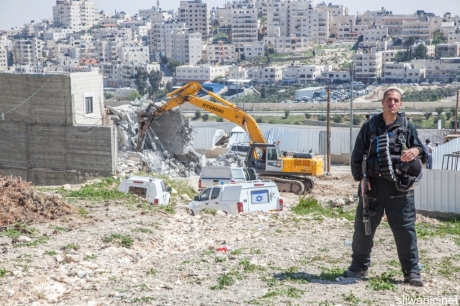
JERUSALEM – Israeli forces demolished a Palestinian house in the East Jerusalem neighborhood of Jabal al-Mukabir on Wednesday, locals told Ma’an.
Israeli forces raided the neighborhood and surrounded a house belonging to Ulayyan Jalal Rabaya before a bulldozer destroyed the property.
Rabaya said he had begun renovation work on the interior of the house some months ago to live there with his fiance, who he is due to marry.
Jerusalem municipality workers posted a demolition order on the property last Monday saying that it lacked a building permit.
Two other house belonging to the Rabaya family are also slated for demolition, with a court decision expected Friday.
Local organizations in the neighborhood called for a sit-in protest outside the Israeli Supreme Court to protest the demolition.
Around 150 demolitions orders are pending in the Jabal al-Mukabir neighborhood, a local official Suleiman Shqeirat said. Most are issued under the pretext that they lack building permits.
Israeli forces stormed the East Jerusalem town of al-Isawiya before dawn Tuesday and demolished a Palestinian house allegedly being built without a license from the Israeli municipality of Jerusalem.
Israel rarely grants construction permits to Palestinians in the West Bank and East Jerusalem, and regularly demolishes structures built without permits.
Israeli bulldozers demolished at least 359 Palestinian structures in the West Bank in 2014, according to the Israeli Committee Against House Demolitions.
During the 1967 war, Israel captured East Jerusalem from Jordan, occupied it, and later annexed it in a move never recognized abroad.
Also Wednesday, the Silwan neighborhood of Jerusalem police detained three Palestinians.
They were identified as Ziad al-Qaq, Mousa Audah and his brother Naji.
Featured Video
HE SAVED LIVES. NOW HE FACES PRISON.
or go to
Aletho News Archives – Video-Images
From the Archives
NATO Sanctions and the Coming Global Diesel Fuel Disaster
By F. William Engdahl – New Eastern Outlook – 11.04.2022
Amid the ongoing global inflation crisis, NATO heads of state and mainstream media repeat a mantra that high energy prices are a direct result of Putin’s actions in Ukraine since end of February. The reality is that it is the western sanctions that are responsible. Those sanctions including cutting SWIFT interbank access for key Russian banks and some of the most severe sanctions ever imposed, are hardly having an impact on the military actions in Ukraine. What many overlook is the fact that they are increasingly impacting the economies of the West, especially the EU and USA. A closer look at the state of the global supply of diesel fuel is alarming. But Western sanctions planners at the US Treasury and the EU know fully well what they are doing. And it bodes ill for the world economy.
While most of us rarely think about diesel fuel as anything other than a pollutant, in fact it is essential to the entire world economy in a way few energy sources are. The director general of Fuels Europe, part of the European Petroleum Refiners Association, stated recently, “… there is a clear link between diesel and GDP, because almost everything that goes into and out of a factory goes using diesel.” … continue
Blog Roll
 Aletho News
- Qatar PM calls for Gulf security framework with Iran, says war must be ‘wake-up call’
- China condemns US extortion of Iranian airlines, rejects Washington’s ‘illegal’ sanctions threats
- Italy to move military personnel from Taif base after missile strike
- Finland’s Stubb tells European leaders to calm down
- Defeating Russia on battlefield impossible – Fico
- Finland’s Gender Clinic Reversal
- Massachusetts Wants Mental Health Visits, Why Does Government Use ‘Health’ to Enter Our Homes & Families?
- US lawmaker admits American people footing bill for Trump’s failed aggression against Iran
- Pfizer Gave $500,000 to Groups That Lobbied to End Religious Exemption in Massachusetts
- HE SAVED LIVES. NOW HE FACES PRISON.
- If Americans Knew
- Sanctions are collective punishment: immoral and self-defeating
- Phosphorus Munitions Fired by Israel Burn Groves, Orchards in Southern Lebanon
- Israel Carries Out New Ceasefire Violations Across Gaza
- AI – Emphasis on the ‘I’: Israel Is Funding AI Chatbot Propaganda
- Israel Blocking Hundreds of Wheelchairs for Injured Children From Entering Gaza
- Israel Is Expanding and Upgrading Compounds for Palestinian Militias in Gaza
- The Palestinian-American Residents of This West Bank Town Are Wondering: Where Is Trump?
- Gaza desperately needs tents, wheelchairs, fuel… and everything else (Israel blocks it all) – Daily Update
- Israeli Attacks in Gaza Kill at Least Seven Palestinians Over Three Days, including Woman and Child
- Trump’s militarization of Washington DC as he pursues Israel’s war against Iran
- No Tricks Zone
- 2025 Nature Paper Claiming Worsening Global Drought Gets RETRACTED …Heavily Flawed
- New Study: ‘Global Drought Shows No Detectable Recent Acceleration Under Climate Warming’
- Economic Masterminds: German Socialists Suggest Taxing Productivity Gains Stemming From Using AI
- The South China Sea Has Not Been Cooperating With The Climate Change Narrative
- Energy Crisis: Germany Enters Heating Season With Historically Low Gas Reserve Fill Levels
- New Study: The Antarctic Ice Sheet Gained Mass From 2020-2024 Due To Staggering Snow And Ice Accumulation
- Study: Ocean Heating Rates From Thousands Of Years Ago ‘Dwarf’ Modern Ocean Heating Rates
- Climate Extremists Target, Attack Large-Scale Power Grid Infrastructure In Germany!
- New Study: Antarctic Ice Melt Has Contributed Less Than 1 Centimeter To Sea Level Rise In The Last 30 Years
- Fear Of Debate: Alarmist German Climate Scientist Calls On Mainstream Media To Discredit Skeptic Voices

