Anti-base Okinawa governor blocks relocation of US Marines
RT | March 23, 2015
Okinawa’s governor ordered a halt to an underwater survey needed for reclamation of land for a new $8.6-billion base, which would host US troops after the Futenma facility on the island is closed.
Takeshi Onaga is delivering on the promise he made to voters to oppose the construction, after his election last November. At a media conference on Monday, he announced that defense ministry contractors must stop the survey due to the damage it’s causing to corral reefs. If they don’t, Onaga said he would revoke approval for drilling operations given by his predecessor in December 2012 within days.
The survey is necessary for the eventual construction of an off-shore runway for the future US military base in the less populous area of northern Okinawa, which would house thousands of troops after the closure of the Futenma base in the south.
The facility is viewed by locals as a source of noise, pollution and crime. Opposition to its presence flared up after the rape and abduction of a 12-year-old girl by three US servicemen in 1995.
In 1996, Tokyo and Washington agreed to shut the base down, but construction of a replacement stalled due to local resistance.
Onaga’s move coincides with the announcement of Prime Minister Shinzo Abe’s visit to the US in late April. Abe, who supports the construction of the new base, is expected to be praised for his determined position to oppose Chinese influence in the region.
Chief Cabinet Secretary Yoshihide Suga told journalists the Japanese government was examining Onaga’s documents. He called the governor’s steps “extremely regrettable.”
“We are going to continue with construction work without delay,” the spokesman said.
Read more: Anti-US military base candidate wins Okinawa governor race
The charade of Europe’s annual ‘threats’
By Jonathon Cook | The Blog from Nazareth | March 20, 2015
There is something deeply mendacious and cowardly about this ritual leaking by European diplomats of their annual report on Jerusalem. This year they’ve chosen to deposit the “confidential” report in the hands of the Guardian.
Obviously, the Europeans – and Americans – want this information about how angry they are with Israel disseminated as widely as possible in the wake of Netanyahu’s election win. “We’re mad and we’re not going to take it any more!” they shout – yet again, as they have done over the past four or five years.
As ever, the report is being described as “hard-hitting”; as ever, it threatens penalties against Israel; and as ever, it signifies nothing.
This is paltry theatre designed to persuade us – people with consciences – that our representatives care and that they are planning – at some point – to do something. But what it really indicates is that that something is going to amount to nothing more than empty threats. These are the same threats they have been making for more than a decade. And even were Europe actually to carry them out, they would have almost no impact on Israel.
Here’s what these “threats” consist of:
Known Jewish terrorists may face “restrictions” on entering Europe. (One would have hoped such “restrictions” were already in place.)
Europe may give its consumers more information about whether they are being misled into buying products from illegal settlements. (Such products should not even be available in Europe.)
And efforts will be made to “raise awareness” among European companies that it could be bad for business to be associated with the settlements. (And yet, according to free-market ideology, market forces ought to be enough to dissuade most companies from such associations – after all, they are supposed to want to maximise profits.)
In short, this list of potential “sanctions” is complete hot air. It’s zilch. And anyone claiming otherwise, including the Guardian, is simply conspiring in this diplomatic charade.
Jewish leaders condemn British university debate on Israel and international law

RT | March 11, 2015
The University of Southampton has hit back at appeals to revoke its sponsorship of a conference questioning the legality of Israel’s right to exist under international law.
The three-day conference, titled “International Law and the State of Israel: Legitimacy, Responsibility and Exceptionalism” is scheduled to take place April 17-19.
According to the organizers, it will “explore the relatedness of the suffering and injustice in Palestine to the foundation and protection of a state of such nature and asks what role International Law should play in the situation.”
“It is unique because it concerns the legitimacy in International Law of the Jewish state of Israel.”
Conservative MP Mark Hoban, a prominent supporter of the state of Israel, has called on the university vice-chancellor to withdraw sponsorship, branding the conference “provocative.”
Critics say the event may “well affect the attractiveness of the School of Law for future UK and international students.”
In a climate of rising anti-Semitism in the UK, the institution insists its event will not add to it.
Jewish community leaders nevertheless say the conference “surpasses the unacceptable.”
Judging by the name and the advertised speakers, Jewish leaders said the symposium “sets out explicitly to question the very legitimacy of a member of the UN,” the Jerusalem Post reported.
In a letter to the university, Jewish leaders accused Southampton’s Law School of “being used as an academic platform to advance, not just to legitimate, Palestinian national rights.”
“What other state in the global community of nations – democratic or tyrannical – is ever subjected to such a critique? The conference causes us great concern and distress. It will undoubtedly trouble greatly the members of the UK Jewish community,” the leaders said.
They urged the university to reconsider holding the event.
Despite the appeal and a petition signed by almost 3,000 people, the university insisted the conference would go ahead as planned.
According to the Jerusalem Post’s sources, Hazel Biggs, the head of the University of Southampton’s Law School, rejected the appeal.
Even though the title of the symposium raised an important question, the event would take “no explicit perspective,” Biggs said.
Despite the event being in “final stages of preparation,” the Jewish Leadership Council or the Board of Deputies of British Jews are welcome to recommend suitable speakers as the institution is “happy to receive their nominations.”
The university has received nearly a dozen letters from Jewish organizations and members of parliament urging them to cancel the event.
However, a source close to the Jewish delegation told the Jerusalem Post it is clear the university is “not going to budge.”
A spokesperson for the university said: “We are committed to academic freedom, free speech and opportunities for staff and students to engage with a wide range of opinions.”
The spokesperson said that “discussion and critical thinking” was fundamental to the institution, and added that academics have freedom to explore “controversial issues,” while “giving due regard for the need to respect others.”
“The conference aims to examine the role international law can play in political struggles and to act as a platform for scholarly debate, welcoming academic contributions from a range of perspectives,” the spokesperson said.
Israeli forces level land east of Jerusalem
Ma’an – 10/03/2015
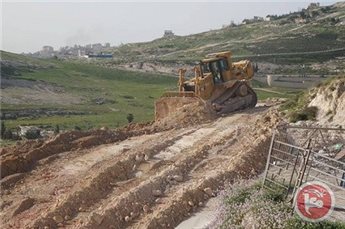 JERUSALEM – Israeli forces leveled vast areas of land in the East Jerusalem town of al-Issawiya on Tuesday morning, a local committee member told Ma’an.
According to Muhammad Abu al-Hummus, member of a local follow-up committee, large numbers of Israeli troops and municipality inspectors escorted bulldozers and excavators into the southeastern outskirts of the town, where they demolished stone walls and steel structures used by local farmers as store houses and livestock barns.
Abu al-Hummus said the bulldozers “deliberately” ruined the dirt roads used by farmers to access their fields.
The land is located in an area Israeli authorities have earmarked for a national park, in a controversial plan known as “11092”, which aims to turn 700 dunums of land in the Palestinian towns of al-Issawiya and al-Tur into Israeli parkland.
A statement from the Palestinian Center for Human Rights in 2013 previously stated that “the plan is part of the Israeli government’s plans to create a Jewish demographic majority in the occupied city.”
In September 2014, an Israeli planning council suspended the plan until the needs of the Arab towns could be assessed. However, the council, which previously approved the annexation of the 700 dunums, said that approval of the plan could be justified and was not fundamentally illegal.
According to Abu al-Hummus, the local Israeli municipality has ignored the plan’s suspension.
“Israeli forces brush aside court decisions and decisions made by different committees when it comes to implementing settlement expansion plans,” he said.
The land leveled on Tuesday is owned by the Abu Asab, Ubeid, Dari, Abu al-Hummus and Ulayyan among others.
East Jerusalem was seized by Israel along with the West Bank in 1967 during the Six-Day War, and since then, the Israeli government has undertaken a policy of “Judaization” across the city, constructing Jewish settlements and demolishing Palestinian homes.
There are now believed to be more than 300,000 Jewish settlers in East Jerusalem.
The international community views East Jerusalem as part of the Palestinian territories and recognizes the annexation and settlement programs as illegal under international law.
(MaanImages/Muhammad Sayyad)
Danish companies warned about settlement investments

By Henriette Johansen | MEMO | March 9, 2015
A new report from the investigative journalism team at DanWatch gives more disturbing evidence of Danish businesses helping to keep the wheels of Israel’s military occupation of Palestine turning.
Danish investment funds invest 689 million Danish Krone (around £67 million) in companies with activities in illegal Israeli settlements on the West Bank, it claims. These funds, therefore, contribute to the maintenance of the apparatus of the Israeli occupation, including the Separation (“Apartheid”) Wall and the settlements.
In addition, say DanWatch, more than 1 billion krone is invested by Danish pension funds in companies either building or operating military checkpoints, the Wall or settlements. Such investments have been exposed in a previous DanWatch report. See, for example. Businesses such as G4S and ISS have reduced their activities in the occupied territories following global publicity about their support for the occupation, but have no plans to end it altogether. Investment in companies profiting from the occupation is illegal under Danish law.
The investment funds named by DanWatch are: Danske Invest, Nykredit Invest, Bank Invest, Nordea Invest, Sydinvest, Jyske Invest, Sparinvest and SEB Invest, all of which are subject to the UN’s Guiding Principles on Business and Human Rights. Indeed, the UN, EU and the Danish government have warned companies repeatedly against investing in the Israeli occupation. The settlements, Separation Wall and checkpoints in the West Bank breach international law as they violate the human rights of the Palestinian people.
Despite this, the new report identifies huge Danish investment in companies that deliver surveillance equipment to checkpoints, cement and building materials to the maintenance of the Separation Wall and bulldozers to the Israeli army. They risk accusations of complicity in human rights violations in the occupied territories.
The DanWatch report reveals the contradictions inherent in investments by the companies mentioned therein. All, for example, claim that they stick to the UN guidelines upon which they base their “ethical investments”. Bank Invest, Jyske Invest and Sydinvest support Cemex, which owns a supplier of cement to Israeli settlements, checkpoints and the Wall. Cemex is blacklisted by Nordea Invest, which has holdings in the Israeli Hapoalim Bank which, in turn, provides loans to construction projects in settlements and is, as a result, blacklisted by Danske Invest.
According to DanWatch all of the funds, bar one, have investments in the US firm Caterpillar. This supplies the D9 bulldozers used by the Israeli army for its devastating and sometimes lethal house demolitions. According to Human Rights Watch, it was these bulldozers that were used in 2010 to destroy buildings while civilians were still inside.
The investments continue despite Danish government appeals for companies to avoid engaging with business involved in, or benefiting from, the Israeli settlements. “The government,” said Trade and Development Minister Mogens Jensen last September, “has on several occasions reminded the public that Danish citizens and businesses should not participate in activity and business that can benefit the Israeli settlements. I will say this yet again.”
Interestingly, Copenhagen Municipality has a total of 2.21 million Dkr invested in seven companies which contribute to the construction or operation of checkpoints, the Wall or settlements in the occupied West Bank.
The coverage given to illegal investment in Israeli settlements has had the effect of Ahava beauty products being taken off the shelves by Danish retailers. A number of supermarkets sell fruit bought from Israeli exporter Mehadrin, which has produce grown in Israel and in the settlements. The Coop supermarket chain now insists on Israeli exporters signing a formal agreement that they will only supply produce from the exporter’s sources in Israel, not the settlements.
Another example of a settlement-based company affected by a boycott is Sodastream, which has had to move production to Israel this year following negative publicity in 2014. A number of Danish companies still stock Sodastream products.
Israel not to cede occupied land to Palestinians: Netanyahu

Press TV – March 9, 2015
Israeli Prime Minister Benjamin Netanyahu says Tel Aviv will not give away any occupied land to Palestinians, rejecting the idea of Palestinian statehood.
In a Sunday statement released by his right-wing Likud party, Netanyahu said that a speech he gave in 2009, endorsing a Palestinian statehood as a solution to decades of conflict, was now “irrelevant.”
“Prime Minister Benjamin Netanyahu said that [in light of] the situation that has arisen in the Middle East, any evacuated territory would fall into the hands of Islamic extremism and terror organizations supported by Iran. Therefore, there will be no concessions or withdrawals; they are simply irrelevant,” the statement read.
Later on Sunday, Netanyahu’s office said in response that the prime minister made no comment to that effect.
“Prime Minister Netanyahu has made clear for years that given the current conditions in the Middle East, any territory that is given will be seized by radical Islam just like what happened [in] Gaza and in southern Lebanon,” Netanyahu’s office said.
However, Netanyahu has repeatedly said he would not run the risk of handing over land that might fall into the hands of the resistance movement.
Palestinian official Saeb Erekat said Netanyahu was using regional strifes as an excuse, saying, “Today Netanyahu revealed his true face.”
“Since 1993, he worked hard for the destruction of the option of peace and the option of a two-state solution,” the Palestinian chief negotiator added.
In the past few months, the Palestinian national unity government has been pushing for a UN resolution that determines the borders of the future Palestinian state based on the pre-1967 lines. Israel has expressed outcries over the motion. Palestinian President Mahmoud Abbas says there will be no negotiations over land with Israel as Palestinians will not give up even an inch of their land.
In 1967, Israel occupied the West Bank, East al-Quds (Jerusalem), and the Gaza Strip but withdrew from the enclave in 2005. Palestinians are seeking to create an independent state on the territories of the West Bank, East al-Quds and the Gaza Strip. Tel Aviv, however, has refused to return to the 1967 borders and is unwilling to discuss the issue of East al-Quds.
PLO plans to end all security cooperation with Israel: Officials
Press TV – March 5, 2015
The Palestinian Liberation Organization (PLO) has decided to end all security cooperation with Israel, Palestinian officials say.
According to reports on Thursday, the Palestinian Central Council (PCC) of the PLO, led by Palestinian President Mahmoud Abbas, made the decision to cut all forms of security cooperation with Israel after two-day discussions in Ramallah.
“Security coordination in all its forms with the authority of the Israeli occupation will be stopped in the light of its (Israel’s) non-compliance with the agreements signed between the two sides,” the PCC, the second highest Palestinian decision-making body, said in a statement.
Tel Aviv “should shoulder all its responsibilities towards the Palestinian people in the occupied state of Palestine as an occupation authority according to international law,” the statement read.
The statement also called on the United Nations Security Council to “determine a deadline to end the Israeli occupation and ensure that the state of Palestine is enabled to practice its sovereignty on its land occupied since 1967, including its capital east Jerusalem and, resolve the issue of refugees according to resolution 194.”
“The concept of a Jewish state is rejected and also of a (Palestinian) state with provisional borders is rejected. Any formula that will keep an Israeli military or settler presence on any part of the land of the state of Palestine is rejected,” the statement further read.
“Gangster” regime
At the opening of the two-day talks, attended by officials from the PCC, on Wednesday, Abbas (pictured below) denounced a decision by the Israeli regime to withhold Palestinian tax revenues worth more than $100 million a month.
“How are they allowed to take away our money? Are we dealing with a state or with a gangster?” he asked.
The two-day meetings, attended by legislators, union leaders, and other figures, focused on a review of interim agreements with the Israelis.
In response to Palestinian efforts to finally attain membership at the International Criminal Court (ICC), Tel Aviv announced a freeze on the revenues transfer in January.
Palestinians are continuing efforts to file war crime charges against the regime at the ICC.
The Palestinian president further called the tax freeze a provocation, noting that “peaceful, popular resistance is the only way for us” in the fight against Israel.
Abbas also asked “all countries of the world to recognize the state of Palestine.”
“But we want to say to the Israeli side, these recognitions do not mean in any way that we do not want to negotiate, or that we’re running away from negotiations,” Abbas said, adding that talks would continue with “whoever” wins the Israeli general elections on March 17.
Israeli settlement activities increased by 40% in 2014
MEMO | February 24, 2015
Israeli settlement construction in the occupied Palestinian territories increased by 40 per cent during 2014, Anadolu has reported. According to Israeli NGO Peace Now, which campaigns against illegal settlement construction, Israel started building 3,100 residential units in the Palestinian territories last year. It added that tenders for 4,485 additional residential units were published throughout 2014.
“On 30 January,” notes a Peace Now report, “tenders were issued for 450 more units in the occupied West Bank by the government of Israeli Prime Minister Benjamin Netanyahu.” Between 31 March 2009 and last month, the NGO pointed out, the two governments led by Netanyahu promoted at least 106 construction plans for 13,077 different residential units in 57 settlements.
International law considers the West Bank and East Jerusalem as occupied territories captured by Israel in 1967. All construction of Jewish settlements on the land is illegal. Palestinian negotiators have insisted that the establishment and building of Israeli settlements has to end before the stalled peace talks with Israel can resume.
Israel is still banning Gaza students from West Bank universities
MEMO | February 20, 2015
Palestinian students from Gaza are still prevented by Israel from studying at West Bank universities, after an announcement this week to the contrary was retracted as a mistake.
On Wednesday, Israel’s Coordinator of Government Activities in the Territories (COGAT) announced that a quota of 50 students would be permitted to exit Gaza “for the purpose of academic studies” in the West Bank. However, as related by NGO Gisha, the very same evening, COGAT clarified that there had been a “clerical error” in the relevant document, and that there would be no such permits.
The Israeli government has opposed Palestinians from Gaza studying in the West Bank on the grounds of ‘security’. The High Court of Justice has also rejected petitions by human rights groups on the matter, including one filed on behalf of five women studying gender, democracy and law.
In 2009, 21-year-old, Bethlehem University student Berlanty Azzam was arrested at a West Bank checkpoint and immediately returned to the Gaza Strip, after a solider noted Gaza City as the town of residence on her ID.
The ill-fated announcement was included on a list of various measures apparently prepared by Israel to “ease” restrictions. According to reports from COGAT and Palestinian officials, it would appear that the number of merchant permits will rise, as will the type and quantity of goods permitted to exit from Gaza for sale in the West Bank.
Back in November, two truckloads of wooden planks left Gaza for sale in the West Bank, the first time that wood from Gaza has been sold in the West Bank since the blockade was imposed in 2007. The same month, some truckloads of clothes, fish, and agricultural products made the same journey, again for the first time.
This is less indicative of Israeli authorities’ generosity but rather highlights the deception that is the ‘security’ rationale for the restrictions in the first place. Why were Gaza’s farmers allowed to send cucumbers to the West Bank on November 6, 2014 – but not before? Why won’t Israel lift restrictions on exports, save for piecemeal exceptions?
The continued refusal to allow Palestinian students from Gaza to study in West Bank universities is further evidence that Israel’s approach is one based on collective punishment. Worth remembering, the next time someone tries justifying yet another apartheid policy in the name of ‘security’.
Featured Video

HE SAVED LIVES. NOW HE FACES PRISON.
or go to
Aletho News Archives – Video-Images
From the Archives
NATO Sanctions and the Coming Global Diesel Fuel Disaster
By F. William Engdahl – New Eastern Outlook – 11.04.2022
Amid the ongoing global inflation crisis, NATO heads of state and mainstream media repeat a mantra that high energy prices are a direct result of Putin’s actions in Ukraine since end of February. The reality is that it is the western sanctions that are responsible. Those sanctions including cutting SWIFT interbank access for key Russian banks and some of the most severe sanctions ever imposed, are hardly having an impact on the military actions in Ukraine. What many overlook is the fact that they are increasingly impacting the economies of the West, especially the EU and USA. A closer look at the state of the global supply of diesel fuel is alarming. But Western sanctions planners at the US Treasury and the EU know fully well what they are doing. And it bodes ill for the world economy.
While most of us rarely think about diesel fuel as anything other than a pollutant, in fact it is essential to the entire world economy in a way few energy sources are. The director general of Fuels Europe, part of the European Petroleum Refiners Association, stated recently, “… there is a clear link between diesel and GDP, because almost everything that goes into and out of a factory goes using diesel.” … continue
Blog Roll
 Aletho News
- Qatar PM calls for Gulf security framework with Iran, says war must be ‘wake-up call’
- China condemns US extortion of Iranian airlines, rejects Washington’s ‘illegal’ sanctions threats
- Italy to move military personnel from Taif base after missile strike
- Finland’s Stubb tells European leaders to calm down
- Defeating Russia on battlefield impossible – Fico
- Finland’s Gender Clinic Reversal
- Massachusetts Wants Mental Health Visits, Why Does Government Use ‘Health’ to Enter Our Homes & Families?
- US lawmaker admits American people footing bill for Trump’s failed aggression against Iran
- Pfizer Gave $500,000 to Groups That Lobbied to End Religious Exemption in Massachusetts
- HE SAVED LIVES. NOW HE FACES PRISON.
- If Americans Knew
- Sanctions are collective punishment: immoral and self-defeating
- Phosphorus Munitions Fired by Israel Burn Groves, Orchards in Southern Lebanon
- Israel Carries Out New Ceasefire Violations Across Gaza
- AI – Emphasis on the ‘I’: Israel Is Funding AI Chatbot Propaganda
- Israel Blocking Hundreds of Wheelchairs for Injured Children From Entering Gaza
- Israel Is Expanding and Upgrading Compounds for Palestinian Militias in Gaza
- The Palestinian-American Residents of This West Bank Town Are Wondering: Where Is Trump?
- Gaza desperately needs tents, wheelchairs, fuel… and everything else (Israel blocks it all) – Daily Update
- Israeli Attacks in Gaza Kill at Least Seven Palestinians Over Three Days, including Woman and Child
- Trump’s militarization of Washington DC as he pursues Israel’s war against Iran
- No Tricks Zone
- 2025 Nature Paper Claiming Worsening Global Drought Gets RETRACTED …Heavily Flawed
- New Study: ‘Global Drought Shows No Detectable Recent Acceleration Under Climate Warming’
- Economic Masterminds: German Socialists Suggest Taxing Productivity Gains Stemming From Using AI
- The South China Sea Has Not Been Cooperating With The Climate Change Narrative
- Energy Crisis: Germany Enters Heating Season With Historically Low Gas Reserve Fill Levels
- New Study: The Antarctic Ice Sheet Gained Mass From 2020-2024 Due To Staggering Snow And Ice Accumulation
- Study: Ocean Heating Rates From Thousands Of Years Ago ‘Dwarf’ Modern Ocean Heating Rates
- Climate Extremists Target, Attack Large-Scale Power Grid Infrastructure In Germany!
- New Study: Antarctic Ice Melt Has Contributed Less Than 1 Centimeter To Sea Level Rise In The Last 30 Years
- Fear Of Debate: Alarmist German Climate Scientist Calls On Mainstream Media To Discredit Skeptic Voices

