The Girl Who Stole My Holocaust
Review by Jessica Purkiss
The Girl Who Stole my Holocaust is essentially about an epiphany. Noam Chayut’s memoir charts his journey from a battle hardened soldier protecting an illegal occupation into a conscientious man who relentlessly confronts the injustice of that occupation. As the novel progresses through its 36 chapters the reader bears witness to the unravelling of Noam the Zionist, the enthusiastic IDF recruit and the military fundraiser.
The catalyst to this unravelling is a young girl who he encounters during a raid on a Palestinian village while he is still a soldier. The pure terror he sees in her face makes Noam realise that he is “playing the role of absolute evil in the play of her life”. The absolute evil that has governed his life, in the shadow of which he has grown up under- the Holocaust, begins to disintegrate.
The association of the Holocaust and the occupation is a daring one. It is also insightful – it demonstrates the role the historical victimhood of the Jewish people plays in the Israeli psyche. While the book is about Noam’s personal journey, it also tells us much about the hegemonic Israeli narrative.
Noam does not shy away from confronting his own racism and his actions as an Israeli soldier in a painfully honest manner. As he exposes the actions of others via testimonies collected as a member of Breaking the Silence, a group of ex-soldiers who seek to make people aware of the conduct of the Israeli military, he uncovers a sustained pattern of behaviour which makes up a whole system of abuse.
Noam ends his memoir with a letter to the young girl he encountered. It reads: “That’s probably why you think that my horror is inferior to yours. But know that my idea of absolute evil stretches beyond anything your wildest imagination could conceive.” The letter reads almost like a lecture to the wronged and an attempt to minimise the “absolute evil” she perceives. This cannot be Noam’s intention, for the rest of the book is deeply self-aware. In this one paragraph he has marred the memoir. This should, however, not deter anyone from reading what is a startling and brutally honest account of one Israeli soldier’s journey of questioning.
SodaStream closes illegal settlement factory but remains actively complicit in the displacement of Palestinians
Palestinian Students’ Campaign for the Academic Boycott of Israel | October 30, 2014
Palestinian boycott, divestment and sanctions (BDS) activists today welcomed the news that SodaStream has announced it is to close its factory in the illegal Israeli settlement of Mishor Adumim following a high profile boycott campaign against the company.
“SodaStream’s announcement today shows that the boycott, divestment and sanctions (BDS) movement is increasingly capable of holding corporate criminals to account for their participation in Israeli apartheid and colonialism,” said Rafeef Ziadah, a spokesperson for the Palestinian Boycott, Divestment and Sanctions National Committee (BNC), the broad coalition of Palestinian civil society organisations that leads and supports the BDS movement.
“BDS campaign pressure has forced retailers across Europe and North America to drop SodaStream, and the company’s share price has tumbled in recent months as our movement has caused increasing reputational damage to the SodaStream brand,” she added.
The news of this major success against a company famed for its role in illegal Israeli settlements broke amidst intensifying demonstrations against Israel’s policies of colonisation in Jerusalem.
Grassroots boycott activism saw SodaStream dropped by major retailers across North America and Europe including Macy’s in the US and John Lewis in the UK.
SodaStream was forced to close its flagship store in Brighton in the UK as a result of regular pickets of the store.
Soros Fund Management, the family office of the billionaire investor George Soros, sold its stake in SodaStream following BDS pressure.
SodaStream’s share price fell dramatically in recent months as sales dried up, particularly in North America.
After reaching a high of $64 per share in October 2013, the stock fell to around $20 per share this month. SodaStream has estimated its third quarter revenue will be $125 million, down almost 14 percent from the same period last year.
But Ziadah warned that SodaStream will still remain actively complicit in the displacement of Palestinians and will remain a focus of boycott campaigning.
“Even if this announced closure goes ahead, SodaStream will remain implicated in the displacement of Palestinians. Its new Lehavim factory is close to Rahat, a planned township in the Naqab (Negev) desert, where Palestinian Bedouins are being forcefully transferred against their will. Sodastream, as a beneficiary of this plan, is complicit with this violation of human rights,” she said.
SodaStream’s participation in Israel’s forced displacement of Palestinians gained international notoriety when A-list celebrity Scarlett Johansson signed up to be a brand ambassador for the company. Following an international campaign urging Oxfam end its relationship with Johansson for endorsing SodaStream, the actor decided to quit Oxfam.
SodaStream has also come under fire for its treatment of Palestinian workers in its West Bank factory, as Ziadah explains:
“Any suggestion that SodaStream is employing Palestinians in an illegal Israeli settlement on stolen Palestinian land out of the kindness of its heart is ludicrous.”
“Palestinian workers are paid far less than their Israeli counterparts and SodaStream recently fired 60 Palestinians following a dispute over food for the breaking of the Ramadan fast. Workers have previously said they are treated ‘like slaves’”.
“Palestinians are forced to work inside settlements in sub-standard conditions because of Israel’s deliberate destruction of the Palestinian economy. There’s an urgent need for the creation of decent and dignified jobs within the Palestinian economy.”
SodaStream have said all workers will be offered jobs at its new plant, although Israel’s apartheid wall and severe restrictions on movement will make the commute to the new plant difficult for its Palestinian workers.
All of the main Palestinian trade unions have called for boycott and are members of the Palestinian BDS National Committee, the civil society coalition that leads the BDS movement and helped to initiate the campaign against SodaStream.
The BNC quotes included in this release can be found in the following coverage of this story:
New York Times : http://www.nytimes.com/2014/10/31/world/middleeast/sodastream-to-close-factory-in-west-bank.html?_r=0
International Business Times : http://www.ibtimes.co.uk/israel-bds-movement-scores-victory-sodastream-close-controversial-factory-west-bank-settlement-1472320
The American Resistance to Israel
By Paul Larudee | Dissident Voice | October 29, 2014
The movement to prevent Israeli cargo ships from being unloaded or loaded is potentially one of the greatest challenges that Israel faces from ordinary citizens around the world. Amazingly, it doesn’t even require huge numbers or even very much unity of organization, only of purpose.
The August, 2014 picket of the Zim Piraeus in Oakland, California, is a case in point. It began with a massive demonstration of thousands that responded to a call from the Block the Boat coalition to picket the port on August 16 and 17. During that time, the ship chose to remain in a stationary position more than 100 miles away. The organizers then declared victory on the basis that the ship had been delayed more than 24 hours, and the ship came into port.
For some of the picketers, however, this was not enough. They chose to continue the picket after the ship had docked and was ready to be worked. This required maintaining the picket line on a sustained basis and eliciting the cooperation of the workers in not crossing the line. Because of these efforts, there was no one to work the ship for another three days.
Finally, the employer, Ports America, tried to trick both the picketers and the workers by reassigning workers from another ship (an illegal practice). This was only partly successful, and the ship left on August 20 for Russia with most of its Oakland-bound cargo still on board and without taking on any of the cargo that it was to pick up.
One of the volunteers did follow-up research, even calling Zim’s clients. What she discovered was that the extra cargo on board created problems for the loading operations in Russia and had to be off loaded without a clear picture of when it would reach Oakland. At least two of the clients also decided to stop using Zim because of uncertain delivery. The cost of delays, fuel, berthing fees and additional transport must have been staggering.
The following month brought even worse news to Zim. This time, a group calling itself the Stop Zim Action Committee succeeded in completely blocking the Zim Shanghai from unloading or loading any cargo at all in the port of Oakland. After trying for only 24 hours, it left for Los Angeles, where it had apparently made alternate arrangements for the cargo to be offloaded and transported to Oakland by other carriers (possibly by truck). Again, the result was extra cost and delay.
Unfortunately for Zim, Los Angeles and other cities decided to follow the Oakland example. On August 26, Block the Boat – LA held its first protest against the Zim Haifa. Then, on October 18, the Zim Savannah remained at anchor for two days while picketers stayed at the port, calling on workers not to work the ship. In the end the workers agreed to cross the picket lines with police herding the protesters away, and the ship came in.
Protests and pickets were also held against Zim ships in Seattle/Tacoma, Washington and Tampa, Florida, but officials claimed that there were no delays. In Vancouver, Canada, an informational picket was held in order to initiate a dialog with the workers.
Indeed, workers were the key to the degree of success or failure at each port. Oakland has an activist union tradition with a keen socio-political conscience. In 1984 ILWU (International Longshore and Warehouse Union) Local 10 refused to unload a South African ship for eleven days, and in 2010 it refused to cross 24 hours of picket lines set up to block another Zim ship from unloading. That tradition may be less strong in other ports, but it argues for a partnership that may empower both labor and activist communities in ways that we have not seen in decades.
But what about other countries? Palestinians and others were quite frankly astonished that the first successful denial of service to an Israeli ship would happen in a U.S. city, to say nothing of demonstrations in at least five different North American ports. The American resistance surprised everyone. Why, then, do we not see similar actions in other parts of the world?
Part of the reason is that Zim doesn’t operate everywhere. It has no ports of call on the west coast of South America, for example, or in Scandinavia. Nevertheless, its ships sail to Barcelona, whose dockworkers union sent a message of congratulations and solidarity to the Oakland workers. Why are no Zim ships being turned away in Barcelona?
South Africa also seems a likely location. COSATU, the giant South African union, has repeatedly declared its solidarity with the Palestinian struggle. Why is it not participating? What about Cuba and Venezuela? Other possibilities might be Malaysia, Brazil, Greece and even Liverpool in the UK.
Until now, Zim and the Israeli government have been very cool about the potential impact of a movement that ought to terrify them to the depths of their souls. It takes only a small amount of disruption to cause shipping customers to take their business elsewhere. As noted, this has already happened, starting with the first picket in August. We can only guess at the effect when a second Zim ship had to leave Oakland untouched.
In October, a third Zim ship, the Zim Beijing, was scheduled to arrive in Oakland, and another picket was planned. This time, however, the ship kept delaying its arrival date until it was de-listed from the port arrival schedule. There are no Zim ships currently scheduled to arrive in Oakland for the foreseeable future, although Zim bravely refuses to declare this as a policy.
Zim and the Israeli government dare not reveal how vulnerable they are. It will take only a few major ports around the world to sound the death knell for an Israeli shipping giant that is the tenth largest cargo carrier in the world (more than $3 billion in annual revenue). The loss of a few million in Oakland may not seem like much to them, but uncertain and unreliable delivery can put them at a huge disadvantage – perhaps even out of business. This is why we saw no counter-demonstrators at the port (actually one): they have to pretend it means nothing to them.
On the other hand, the Oakland victory cannot be sustained alone. If it does not spread to other countries, it will wither. Israel knows that, but all their power and influence may be insufficient to prevent the movement from happening. We have been looking for a way to strike a blow for Palestine. Now is our chance.
Paul Larudee is one of the founders of the Free Gaza and Free Palestine Movements and an organizer in the International Solidarity Movement.
Israel closes al-Aqsa to all visitors after the shooting of a right-wing rabbi
Al-Akhbar | October 30, 2014
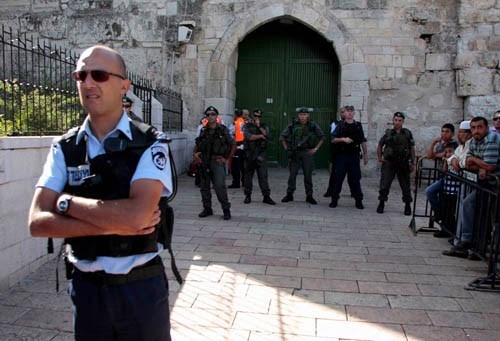
Israeli Occupation Forces on Thursday closed the al-Aqsa Mosque compound to all visitors after an overnight shooting incident in which a man on a motorbike tried to gun down an Israeli hardliner.
“This dangerous Israeli escalation is a declaration of war on the Palestinian people and its sacred places and on the Arab and Islamic nation,” Palestinian President Mahmoud Abbas spokesman Nabil Abu Rudeina quoted him as saying on Thursday.
“We hold the Israeli government responsible for this dangerous escalation in Jerusalem that has reached its peak through the closure of the al-Aqsa mosque this morning,” he told AFP.
“The state of Palestine will take all legal measures to hold Israel accountable and to stop these ongoing attacks,” he added.
Earlier on Thursday, Israeli forces killed a Palestinian man suspected of the shooting attack on the Israeli hardliner, a spokesman said.
“The Palestinian, who was the main suspect in the Wednesday night attack, was eliminated at his home in Jerusalem’s Abu Tor neighborhood by special police forces,” police spokesman Micky Rosenfeld told AFP.
Abu Tor straddles the seam line between west Jerusalem and the occupied eastern sector, which was occupied by Israel during the 1967 Six Day War.
The suspect’s death took place just hours after a gunman on a motorcycle had opened fire at a right-wing Zionist Rabbi called Yehuda Glick at a rally in Jerusalem, leaving him critically wounded.
Glick was reportedly shot in his upper body at “close range” at an event outside the Menachem Begin Heritage Center in Jerusalem, where a number of Israeli members of Knesset and right-wing activists were in attendance, Israeli news site Ynet said.
Israeli Prime Minister Benjamin Netanyahu on Thursday ordered a “significant increase” in police deployments in Jerusalem following the shooting.
“I have ordered a significant increase in forces as well as in means (available to them) so we can both ensure security in Jerusalem and also maintain the status quo in the holy places,” he said in a statement released by his office.
The attack was reported after a conference focused on the reconstruction of a Jewish temple on top of the al-Aqsa mosque was concluded at the center, with top right-wing Zionist officials and activists in attendance.
The incident comes amid increasing tension in Jerusalem over an expected Knesset vote to potentially divide the al-Aqsa mosque compound — the third-holiest site in Islam — between Muslims and Jews, or else restrict Muslim worship at the site.
The Israeli army radio announced early October that the ministry of tourism was working on a plan to allow Jews to enter the al-Aqsa compound through the Cotton Merchants Gate, in addition to the Moroccan Gate which is already used as an entrance for non-Muslims.
Although mainstream Jewish leaders consider it forbidden for Jews to enter the area, right-wing nationalist activists have increasingly called for Jewish prayer to be allowed on the site.
Since Israel occupied East Jerusalem in 1967, an agreement with Jordan has maintained that Jewish prayer be allowed at the Western Wall plaza — built on the site of a Palestinian neighborhood of 800 that was destroyed immediately following the conquest — but not inside the al-Aqsa mosque compound itself.
Yehuda Glick is an American-born Israeli and the chairman of the Temple Mount Heritage Fund, a Zionist organization focused on “strengthening the relationship between Israel and the Temple Mount.”
Critics charge that the Fund actually leads Jewish tours to the site with the intention of leading Jewish prayer there — currently banned under Israeli agreements — and encouraging Jews to destroy the Al-Aqsa mosque and build a Jewish temple there.
He has been previously banned by Israeli authorities from entering the compound due to provocations while on the site.
For Muslims, al-Aqsa represents the world’s third holiest site.
Al-Aqsa restrictions, violations
Israel continues to restrict the entry of Palestinian worshipers into al-Aqsa for the fifth week in a row.
In an urgent message to the US administration on Sunday, Palestinian Authority President Mahmoud Abbas warned that Israel’s continued provocations at the mosque complex would lead to a “wide-reaching explosion.”
Israeli authorities have imposed restrictions on Palestinians seeking to enter the al-Aqsa Mosque compound, denying Muslim men under 40 access to the holy site while facilitating the entry of Zionist settlers of all ages.
In recent months, hundreds of extremist Zionist settlers – often accompanied by Israeli security forces – have repeatedly forced their way into East Jerusalem’s flashpoint al-Aqsa Mosque complex.
The frequent violations anger Palestinians who fear Zionist presence on the al-Aqsa is aimed at usurping the site.
Abbas said Saturday legal measures would be taken to prevent Zionist settlers from attacking Jerusalem’s flashpoint Al-Aqsa mosque compound.
“The Palestinian leadership will be taking the necessary legal measures, at the international level, regarding the aggression of settlers on the Al-Aqsa mosque,” Abbas said in a speech to the Revolutionary Council of his Fatah party.
“We will not allow settlers to attack the mosque,” he added, referring to the entire compound, which is the third holiest site in Islam.
A Palestinian official last week called for holding an emergency Arab and Islamic summit to discuss Israeli plans to divide the al-Aqsa Mosque compound between Palestinians and Israelis.
“Israel is racing against time to legitimize storming of the al-Aqsa Mosque compound by herds of extremist settlers,” Ahmed Qurei, a member of the Executive Committee of the Palestine Liberation Organization (PLO), said in a statement.
Earlier this month, UN chief Ban Ki-moon said he was “deeply concerned by repeated provocations at the holy sites in Jerusalem,” saying that such actions “only inflame tensions and must stop.”
Meanwhile, Lebanon’s Hezbollah resistance movement condemned the “Israeli aggressions within the al-Aqsa Mosque compound” and slammed “Arab silence” and “international complicity.”
The resistance group called on “directing all efforts to protect al-Aqsa and the Islamic and Christian holy sites.”
Israel occupied East Jerusalem during the 1967 Middle East War. It later annexed the holy city in 1980, claiming it as the capital of the self-proclaimed Zionist state – a move never recognized by the international community.
In September 2000, a visit to the site by controversial Israeli leader Ariel Sharon sparked what later became known as the “Second Intifada” – a popular uprising against the Israeli occupation in which thousands of Palestinians were killed.
(Ma’an, AFP, Al-Akhbar)
Sweden recognizes Palestinian state as UN fails to condemn Israeli settlements
Al-Akhbar | October 30, 2014
Sweden on Thursday officially recognized the state of Palestine, Stockholm’s foreign minister said, less than a month after the government announced its intention to make the move and one day after UN Security Council failed to condemn Israeli settlement plans.
“Our decision comes at a critical time because over the last year we have seen how the peace talks have stalled, how decisions over new settlements on occupied Palestinian land have complicated a two-state solution and how violence has returned to Gaza,” Swedish Foreign Minister Margot Wallstrom told reporters.
“By making our decision we want to bring a new dynamic to the stalled peace process.”
Palestinian President Mahmoud Abbas hailed the decision, his spokesman told AFP.
“President Abbas welcomes Sweden’s decision,” Nabil Abu Rudeina told AFP, saying the Palestinian leader described the move as “brave and historic.”
Sweden is the first EU member state in western Europe to recognize Palestine.
European countries are stepping up the pressure on Israel to seek a peace deal, with the British and Irish parliament recently holding a non-binding vote on recognizing statehood.
Abu Rudeina claimed that Sweden’s recognition was linked to months of soaring tensions in occupied East Jerusalem, where Palestinians have clashed almost daily with Israeli Occupation Forces and where Israel has recently pushed ahead with plans to build another 3,600 settler homes.
“This decision comes as a response to Israeli measures in Jerusalem,” he said.
Meanwhile, Israel’s Foreign Minister Avigdor Lieberman on Thursday denounced the Swedish government’s recognition of a Palestinian state as “deplorable”, saying it would undermine efforts to resolve the conflict.
“The decision of the Swedish government to recognize a Palestinian state is a deplorable decision which only strengthens extremist elements,” he claimed in a statement.
“It is a shame that the Swedish government chose to take this declarative step which causes a lot of harm and offers no advantage,” he said.
“The Swedish government must understand that relations in the Middle East are a lot more complex than the self-assembly furniture of IKEA and that they have to act with responsibility and sensitivity.”
Wallstrom rejected accusations that Sweden was taking sides and she hoped other EU countries would follow Sweden’s lead.
No Security Council statement condemning Israel
The Palestinians urged the UN Security Council on Wednesday to demand that Israel immediately reverse plans to build more Zionist settlements, at an emergency meeting called to address tensions in occupied East Jerusalem.
The 15-nation council met for urgent talks at Jordan’s and Palestine’s request after Israel announced plans on Monday to build 1,000 new settler homes in East Jerusalem.
However, no resolution was adopted and there was no Security Council statement condemning Israel.
“Israel, the occupying power, must be demanded to cease immediately and completely its illegal settlement activities throughout the occupied Palestinian territory, including East Jerusalem,” Palestinian ambassador Riyad Mansour told the council.
Mansour said he was disappointed that the council had failed to issue a statement but praised members for speaking forcefully against Israeli settlements.
Speaking to the council, top UN official Jeffrey Feltman said the Israeli practice of moving settlers to Palestinian territories was “in violation of international law” and runs counter to a two-state solution of a Palestinian state alongside Israel.
UN Secretary-General Ban Ki-moon is “alarmed” by the latest plans for new Israeli settlements which “once again raise grave doubts about Israel’s commitment to achieving durable peace,” Feltman told the council.
Israel’s ambassador Ron Prosor shot back, rejecting suggestions that settlement building jeopardized peace and accusing the UN of “playing second fiddle” to a Palestinian “campaign to vilify” his country.
“There are many threats in the Middle East, but the presence of Jewish homes is not one of them,” Prosor told the council.
Speaking to reporters outside council chambers, Prosor insisted the settlements were “not illegal” and that “building housing units in Jerusalem for children in places where there are Jewish neighborhoods is something that we will continue to do.”
Besides the 1,000 new settler homes, Israel has recently approved the construction of more than 2,600 settler homes in East Jerusalem.
More than 500,000 Israeli settlers live in settlements across the West Bank, including East Jerusalem, in contravention of international law.
Israel occupied East Jerusalem and the West Bank during the 1967 Six-Day War. It later annexed the city of Jerusalem in 1980, claiming it as the capital of the self-proclaimed Zionist state – a move never recognized by the international community.
US, European countries “condemn” Israeli settlements
Even though there was no Security Council statement condemning the Israeli violations, Israel came under strong criticism from several countries, which called for an end to unilateral actions including settlement expansions.
The US representative David Pressman told the council “settlement activity will only further escalate tensions at a time that is already tense enough.”
British Ambassador Mark Lyall Grant warned that ongoing construction of Zionist settlements in Palestinian territories “makes it much more difficult for Israel’s friends to defend it against accusations that it is not serious about peace.”
French Ambassador Francois Delattre said “the risk of an explosion of uncontrolled violence in Jerusalem and the West Bank cannot be ignored” and called on Israel to drop the planned settlement.
Russian Ambassador Vitaly Churkin said the plan should be “frozen” and urged the council to play a more pro-active role to jump-start Israeli-Palestinian peace talks.
On Wednesday, the Spanish government expressed its regret at the settlements plan. The Ministry of Foreign Affairs said in a statement that the decision “does not reflect the formally accepted target of negotiating with the Palestinians to seek a peaceful, global and lasting solution based on two states.”
The ministry also reiterated its position, shared by the international community, that all forms of Israeli settlement construction in occupied Palestinian territories are illegal.
Israel’s latest push for settlements followed weeks of clashes between Palestinian youths and police in East Jerusalem over fears that Israel wanted to restrict access to the al-Aqsa mosque, Islam’s third holiest site.
Feltman called for a de-escalation, saying that both sides “can ill-afford” to inflame tensions so soon after the devastating Gaza war, which left more than 2,000 Palestinians dead.
In a draft resolution circulated, the Palestinian Authority set November 2016 as the deadline for ending the Israeli withdrawal from the territories occupied by Israel during the Six-Day War in 1967 and establishing a two-state solution.
It is worth noting that numerous pro-Palestine activists argue in favor of a one-state solution, arguing that the creation of a Palestinian state beside Israel would not be sustainable. They add that the two-state solution, which is the only option considered by international actors, won’t solve existing discrimination, nor erase economic and military tensions.
(AFP, Ma’an, Al-Akhbar)
Palestine, Israel and the ADL
By Robert Fantina | CounterPunch | October 29, 2014
On October 24 of this year, the Anti-Defamation League (ADL) which, according to its website, “…was founded in 1913 ‘to stop the defamation of the Jewish people and to secure justice and fair treatment to all’,” printed an overview of what it called ‘Anti-Israel Activity on Campus After Operation Protective Edge: A Preview of the 2014-2015 Academic Year’. This article provides information about student groups that were appalled at Israeli cruelty during that country’s so-called ‘Operation Protective Edge’, the ridiculous name of the most recent invasion and carpet bombing of the Gaza Strip. It discusses the increase in student activity opposing Israeli policies, and projects that it will probably only continue to grow.
It is certainly true that opposition to Israel’s decades-long, brutal occupation of Palestine is growing. But the ADL made some statements in the article that belie belief. A look at one sentence suffices: “Student groups that constitute today’s anti-Israel movement hurl a multitude of hateful accusations against Israel, falsely claiming that Israel is guilty of apartheid, ethnic cleansing, genocide, and a number of other war crimes in an effort to demonize Israel.”
Let us break this amazing sentence down into its component parts, and see what we can learn from it.
‘Student groups that constitute today’s anti-Israel movement’. Certainly, it can’t be denied that college campuses not only in the United States, but also throughout the world are seeing more opposition to Israeli practices. But such groups do not constitute this movement; they are simply a part of greater, ad-hoc organizations around the world that are finally waking up to Israel’s unspeakable cruelties.
‘Hurl a multitude of hateful accusations against Israel’. It would not be difficult to diffuse these ‘hateful’ accusations. If Israel is indeed innocent of these charges, all it would need to have done would be to have cooperated with any of the international investigations of the last few years, or that are currently ongoing, into its practices. If Israel has nothing to hide, why not show the facts to the world? On the other hand, if the facts are already there for all the world to see, why not try calling them ‘hateful accusations’ and see if that accomplishes anything?
“Falsely claiming that Israel is guilty of apartheid, ethnic cleansing, genocide, and a number of other war crimes”. Are these false claims? A quick Internet search shows this definition for apartheid: ‘any system or practice that separates people according to race, caste, etc.’. Palestinians in the West Bank cannot drive on the same roads that Israeli’s use. They are hindered in their daily activities by countless checkpoints that Israelis establish and man arbitrarily. A Palestinian arrested in the West Bank may spend months incarcerated without charge, and without access to legal representation. An Israeli arrested in the West Bank is either charged or released within hours, and has access to legal representation immediately. Palestinians in the Gaza Strip and the West Bank need to ask permission from Israel to farm their own lands, and to harvest their own crops. No such restrictions or requirements are placed on Israelis.
Is Israel guilty of ethnic cleansing? Going to the same Internet source, this is how ‘ethnic cleansing’ is defined: “The elimination of an unwanted ethnic group or groups from a society, as by genocide or forced migration.” Israel was established in 1948 only after the forced removal (‘migration’) of 750,000 Palestinians from their ancestral homes. In the decades since that time, Palestinian homes have been, and continue to be, routinely demolished to make room for illegal Israeli settlements, in which only Israelis can live.
Now let us look at the charge of genocide. Returning again to the same dictionary site, genocide is defined thusly: “The deliberate and systematic extermination of a national, racial, political or cultural group.” When three-quarters of a million Palestinians were forcibly removed from their homes in 1947 and 1948, at least 10,000 of them were killed. Hundreds of Palestinian villages were completely destroyed, leaving no trace of mosques, museums, schools, cemeteries or other signs of Palestinian culture. Since then, countless mosques, schools and other vital structures of Palestinian culture have been obliterated by Israel, in order to make room for more, Israeli-only, illegal settlements. Ironically, in June of 2011, Israel bulldozed the ancient Muslim cemetery, Ma’man Allah, in order to build a ‘Museum of Tolerance’ on the site.
During Israel’s recent horrific bombing of the Gaza Strip, many more ancient mosques were destroyed, further decimating Palestinian culture.
These student groups accuse Israel of ‘a number of other war crimes’, says the ADL article. According to International Law, an occupying force (Israel) cannot move permanent settlers into the occupied territory. Israeli Prime Murderer Benjamin Netanyahu has stated flatly that he has no intention of giving up the West Bank, where over 500,000 settlers live illegally. It is also in violation of international law to remove residents from their property, something Israel does routinely, and has done for decades, causing the displacement of hundreds of thousands of Palestinians, many who had to leave their homes for refugee camps.
International law also says that in war time, schools, hospitals, residences, places of worship and press and media facilities cannot be bombed. During the recent bombing of the Gaza Strip, Israel bombed all of these, as well as clearly-defined United Nations refugee centers, with apparent impunity.
All possible care, according to international law, must be taken to prevent civilian casualties. Yet IDF (Israeli Defense Forces) soldiers (read: terrorists) blatantly targeted children playing a beach, killing them in front of international reporters.
The protection of the occupied people is also a requirement of international law. Yet in the West Bank, IDF soldiers and illegal settlers constantly harass Palestinians, and routinely shoot and kill Palestinians, including children. When this happens, if there is any international outcry at all, Israel says it is ‘investigating’. Yet nothing substantive ever comes of these ‘investigations’.
Like many other organizations that exist ostensibly to protect poor, vulnerable little Israel from the non-existent power of its enemies, the ADL attempts to defend the indefensible. The many crimes that Israel commits on a daily basis may once have been hidden behind a wall of secrecy. But that was before Facebook, Instagram, Twitter and other social media enabled everyone with a cell phone and an internet connection to broadcast facts to the world. People around the globe see the horrors that Israel perpetrates, and understand it as all the things the ADL denies: apartheid, ethnic cleansing, genocide, and a number of other war crimes.
That students are waking up and taking action is another positive sign for Palestine. That Israel is becoming more and more isolated in the world community, with more and more countries recognizing Palestine and sanctioning Israel, is also very positive. That the ADL and other similar organizations are in panic mode, no longer able to defend a cruel, racist, apartheid regime, bodes well for a better future for Palestine.
Perhaps Israel felt it could once again bomb the Gaza Strip, and kill youths in the West Bank who have no weapons other than stones, with complete impunity. It must not be blamed for believing so; that was the model that was followed for years, and Israel can’t be faulted for not paying attention to sea changes that were occurring. Now that those changes have hit it in the face, full force, it can’t avoid seeing them. This new knowledge makes Israel all the more dangerous; any wild animal cornered will lash out, however erratically, in instinctive defense. Yet like the cornered animal that is eventually captured and controlled, this is what Israel can realistically expect. It will take time, but the process has begun, and it cannot be stopped now. Despite all Israel’s efforts to obliterate Palestine, it will fail; Palestine will be free.
Robert Fantina’s latest book is Empire, Racism and Genocide: a History of US Foreign Policy (Red Pill Press).
Denied land access, Palestinians miss olive harvest
Ma’an – 29/10/2014
AL-JANIYA (AFP) — Abbas Yousef points wistfully towards his olive trees, which are bearing their annual fruit. Yet again, the 70-year-old Palestinian farmer will be unable to make the autumn harvest.
Yousef’s olive groves lie on land either side of an Israeli settlement in the northern occupied West Bank. For years, he has been denied access by the army, and the settlers have plowed it, uprooting many of his trees.
For the 1,400 residents of al-Janiya — Yousef’s village — attacks by settlers who have uprooted trees and burnt Palestinian farmland have become a daily occurrence, he says.
“Each time I try to get to my olive groves, an Israeli soldier tells me I can’t go, because it’s been designated a ‘closed military zone,'” Yousef says.
“My father planted those trees, seed by seed, and I toiled over the land,” he sighs, pointing to one section of his land, now farmed by settlers.
This year, for the first time since 2000, Yousef was allowed access to his land, but only for two days — not nearly enough time to gather all the olives during the harvest that begins in early October.
When he got there, he found 400 of his trees had been uprooted.
UN figures show that since the start of the year, around 7,500 trees have been damaged or uprooted across the West Bank.
‘Now it’s my land’
Arik Ascherman, president of Israeli rights group Rabbis for Human Rights, says Yousef’s experience is common and in danger of becoming the norm in the West Bank.
“They start by preventing Palestinians from accessing their land, then they cultivate it themselves, and then they say ‘Now it’s my land,'” he explains.
Since Israel took over the West Bank in 1967, 135 Jewish settlements have been built there as well as around 100 unauthorized outposts, which are considered illegal even under Israeli law, UN figures show.
All settlements built on occupied territory are illegal under international law.
Figures compiled by the Yesha Settlers Council show there are some 380,000 Israelis living in the West Bank — a number which has more than tripled in the two decades since the Oslo peace accords were signed in 1993.
The attacks against olive groves, which make up half of all cultivated Palestinian farmland, threaten a crucial source of livelihood.
Olive farming and olive oil production bring in around a quarter of Palestinian agricultural revenue, according to the UN’s top humanitarian official for the occupied territories, James Rawley.
The harvest is increasingly threatened by both settlement building and by Israel’s vast separation barrier — in some parts an eight-meter-high (25 foot) concrete wall — whose construction began in 2002.
Some 85 percent of the barrier’s route runs inside the West Bank, rather than along the internationally recognized Green Line, cutting off Palestinians from 30 percent of their land, according to a UN spokeswoman.
For Ahmed Diwan, a farmer who lives in Biddu village east of Ramallah, the problem is not limited to olives.
He says he has also missed the grape harvest, the almonds, the apples, and vine leaves — “a symbol of Palestinian cuisine” — due to a lack of access to his land.
Diwan holds out little hope for this year’s olive harvest as he packs his farming equipment into his car.
“We’re only allowed access to our olive groves two days this year. We can’t maintain the trees or harvest in that time!”
End of an era?
Israel has granted access to farmers for a total of 37 days so far this year, the UN says.
Even those who do have limited access to their farmland are subjected to violent attacks by settlers, who are often armed.
So far this year, 88 attacks have been recorded and 142 farmers injured, according to the UN.
The elderly Yousef was one of the victims.
“About 50 settlers turned up. We were four farmers, people of around my age. We were no match for them,” he recalls.
“In the end it was the Israeli soldiers who got us out to protect us from the settlers.”
The violence is making “entire villages” which had been self-sufficient for decades dependent on international aid, the UN says.
A disillusioned younger generation is turning away from the age-old family tradition.
“Farming is finished. The young people don’t want to work on the land. They’re scared of being killed by settlers,” Yousef says.
Settler violence against Palestinians and their property is a regular occurrence in the West Bank and East Jerusalem, but settlers are rarely held accountable by Israeli law enforcement.
Ma’an staff contributed to this report.
Natural resource exploitation in the Dead Sea area – The case of Ahava
Alhaqhr | October 28, 2014
This is the first in a series of new Virtual Field Visits focusing on the topic of business and human rights. This video will highlight corporate complicity in the exploitation of natural resources in the Dead Sea area of the Occupied Palestinian Territory.
Middle East borders bound to change: Israel minister
Press TV – October 24, 2014
Israeli Minister for Military Affairs Moshe Ya’alon says the borders of many Middle Eastern countries are bound to change in the future as a result of recent developments in the region.
The Israeli minister said in a recent interview with the US-based National Public Radio (NPR) that the current borders would change in the coming years, as some have “been changed already.”
The Israeli minister added that the borders of some countries in the region were artificially drawn by the West.
“Libya was a new creation, a Western creation as a result of World War I. Syria, Iraq, the same — artificial nation-states — and what we see now is a collapse of this Western idea,” he stated.
However, Ya’alon said the borders of some nations, including the Egyptian border with Israel, would remain unchanged.
“We have to distinguish between countries like Egypt, with their history. Egypt will stay Egypt,” said Ya’alon.
The minister did not say whether the borders of Israel, also drawn by Western powers after World War I, would change or not.
Regarding the right to return for Palestinian refugees, Ya’alon said Tel Aviv could not allow such a move, as it would keep the Israeli-Palestinian conflict alive “forever.”
He also said that the insistence to remove Israeli settlers from the West Bank amounts to ethnic cleansing.
The Israeli regime expelled more than 700,000 people from their homeland after it occupied Palestine in 1948.
Israeli forces have wiped nearly 500 Palestinian villages and towns off the map, leaving an estimated total of 4.7 million Palestinian refugees hoping for an eventual return to their homeland more than six decades later.
Since 1948, the Israeli regime has denied Palestinian refugees the right of return, despite United Nations’ resolutions and international laws that uphold the people’s right to return to their homeland.
Tel Aviv has built over 120 illegal settlements built since the occupation of the Palestinian territories of the West Bank and East al-Quds.
The Israeli Solution

Zionism is incompatible with peace. (Tamar Fleishman/PC)
By Hasan Afif El-Hasan | Palestine Chronicle | October 18, 2014
I tried to explore the long term plans of the ruling elite of Israel regarding the Palestinians. But since no Israeli government ever publicly revealed its long term vision other than maintaining the status quo, I sought to examine their thoughts through one of their surrogates, Caroline Glick. I read her book “The Israeli Solution” that has been published recently. Caroline Glick is a right wing Israeli and a strong supporter of Prime Minister Benyamin Netanyahu policies. She is American born Israeli journalist, the deputy managing editor of the Jerusalem Post and she writes for the Israeli daily newspaper, Makor Rishon. In her book, she covers many topics that reflect the right wing Zionists views on Palestine, and she also promotes a one state plan in Palestine.
Glick argues that the two-state-solution is not acceptable because it falls short of meeting the Zionists’ goals. She writes: “The Jewish people’s rights to sovereignty over Judea and Samaria [West Bank]—as with their rights to the rest of the Land of Israel—are overwhelming from historical and political perspective.” She calls for creating an ethnic religious Jewish majority state that includes the West Bank “Judea and Samaria” and Jerusalem, but the one-state she is advocating does not include Gaza Strip and she rejects the refugees’ right of return.
Her plan offers Israeli citizenship and the right to vote to the Arab population of the West Bank neighborhoods. Glick claims that Gaza had been already an independent Palestinian state since Israel withdrew its military forces and removed its civilians from the Strip. She removed Gaza from the demographic equation and gave the Palestinians of the West Bank the option of moving to Gaza in the event that they prefer to live under Palestinian sovereignty. But she claims that Israel has the right to levy a maritime blockade of Gaza coast since it is a foreign entity governed by a terrorist organization that routinely engages in acts of war against Israel. She used a Machiavellian divide-and-conquer lie to exclude Gaza from her plan by creating fictional cultural differences between the Palestinians in Gaza and the West Bank. She writes that the cultural affinity of the Palestinians in Gaza with Egypt is much higher than their cultural affinity with “Judea and Samaria.”
Glick states that once Israel annexes the West Bank it makes amends for the historic injustice that Jews there had suffered under the British regime which barred them from buying land! Glick ignored the November 2nd, 1917 infamous Britain’s “Balfour Declaration” that recognized the Zionist goal of establishing a Jewish home in Palestine, a country that was not a British land, its indigenous population never been consulted, and the Jews never constituted more than one percent of its population. Britain even allowed the Zionist leadership to dictate the text of the Declaration, and Britain executed it while occupying Palestine as a Mandate Power.
To support the feasibility of her one-state vision, Glick uses empirical analysis from a 2007 extensive official Israeli government study for expanding the state by absorbing all historical Palestine and maintaining Jewish majority. Based on this study, she concludes that demography is one of Israel’s greatest advantages if it decides to impose a one-state-solution. According to her book, Israel assembled a team of Israeli and American researchers to review the Palestinian population. The team was called American-Israel Demographic Research Group (ADRG). Its members included academic experts in forecasting models, demographics, and history, the former head of the civil administration in the West Bank “Judea and Samaria”, and experts in mathematical modeling. Findings compiled by the research team were presented to the leading US demographer Nicholas Eberstadt from the American Enterprise Institute (AEI). It uncovered new demographic facts that had not been recognized in the past. Of the combined population of Israel, Jerusalem and the West Bank, 67% are Jewish, 14% are Israeli Arab citizens living in Israel proper, 3% live in East Jerusalem, and 16% are the West Bank Arabs. The study shows annexing the West Bank would have less impact on Israel’s democracy than previously believed.
AIDRG presented to the Israeli government a step-by-step analysis of each zone in the West Bank, demonstrating that Israel can review the impact of dealing with each zone while considering territorial and security needs. Any decision made by the state was based on a rational discussion within the Israeli government and its AIDRG consultants. It was compared against alternatives for governing this same zone population by the Palestinian Authority, by a third party such as Jordan, or by intervention of the international community. Israel, according to this study can annex the West Bank gradually and retain its Jewish character.
The AIDRG study discovered that the 1997 census done by the Palestinian Central Bureau of Statistics (PCBS) was a “fraud”. The Palestinians had exaggerated their population figures by 50 percent, or 1.34 million according to the report. The flaw in the PCBS census was in the natural growth forecast projection of annual growth of 4.4 percent in the West Bank “Judea and Samaria” and 5.2 percent in Gaza between 1997 and 2003. Growth based on actual data from the Israeli records showed real growth of 1.8 percent in the West Bank and 2.9 percent in Gaza. The PCBS census also forecast that the Palestine Authority would experience receiving 236,000 people in the West Bank and Gaza between 1997 and 2003, but the official numbers tallied by Israeli border authorities was only 74,000.
Actions by successive Israeli governments in the occupied lands since 1967 suggest they are thinking in the direction of Glick’s Greater Israel plan: the establishment of a one Jewish majority state within the borders of the 1922 British Mandate and maintain its Jewish character. The 600,000 settlers that Israel has transplanted in the West Bank and Jerusalem with their networks of freeways, roads, electricity and water suggests that Israel is in the process of creating the state which Glick proposes.
Israel continues to build new settlements and expand the old ones. Palestinian’s homes and villages are being demolished because they were built without permits and permits are denied because the applicants are Palestinians. Israel drove more than 56,000 Palestinian Jerusalemites out of their city by denying them residence permits because they work outside the city municipality borders, and even prayers at al-Aqsa Mosque are disallowed by the military or interrupted by Jewish extremists under the protection of the Israeli security. Israel and Egypt have no intention to ease or lift the crippling economic blockade and siege on Gaza that has been destroyed multiple times and kept its inhabitants in absolute poverty. International donors convened in Cairo to raise funds for the reconstruction of the Strip following the third Israeli brutal assault in five years, but not to end the occupation and realization of Palestinian sovereignty, the main cause of violence. There is urgent need to rebuild Gaza now, but that does not compensate for the loss of thousands of innocent lives; and the aid is not even a temporary solution to the suffering of refugees of two wars living for decades under inhumane conditions. Until the occupation ends and the Palestinians live free in their country and a just solution for the refugees is reached, there will be a never-ending cycles of violence and destruction.
Israel insists that no concessions are possible on territorial or security issues, Jerusalem or the Palestinians’ right of return.Israel’s economy minister, Naftali Bennett said recently: “The idea that a Palestinian state should be established within the land of Israel has reached a dead end”. In his 2014 speech to the UN General Assembly, Netanyahu denied that Israel was occupying Palestinians lands. He said, “The people of Israel are not occupiers in the land of Israel. History, archaeology and common sense all make clear that we have had a singular attachment to this land for over 3,000 years.” He also said on last July 11: “There cannot be a situation, under any agreement, in which we relinquish security control of the territory west of the River Jordan.” Israel’s Vice Premier Moshe Ya’alon ruled out the possibility of establishing a Palestinian state alongside Israel in a speech at a cultural event recently in the South Sharon Regional Council.
In the mean time the Palestinian Authority (PA) leaders who lost credibility among their people promise to liberate their people from occupation and threaten to prosecute Israel in the International Courts while their security forces collaborate with the occupation forces to suppress any Palestinian resistance against the occupation. Members of the PA security force may even join the Israelis at the tightly monitored crossings to Gaza to prevent any possibility of allowing goods shipped to the starved people in the Strip that would threaten Israel’s security. Zionism is incompatible with peace and it is not easy for the Palestinians to be optimistic about the future when no one trusts a thing their leaders say!
– Hasan Afif El-Hasan, Ph.D. is a political analyst. His latest book, Is The Two-State Solution Already Dead? (Algora Publishing, New York), now available on Amazon.com and Barnes & Noble.
Protesters challenge Israeli basketball tour in Ohio, Oregon
By Celine Hagbard | IMEMC News | October 21, 2014
Basketball fans joined with human rights supporters in several U.S. towns to call for a boycott of Israeli sports teams, and to challenge what they call a ‘public relations tour’ by Israeli teams in the U.S. They gathered outside and inside the exhibition games to try to bring attention to the ongoing Israeli military occupation of Palestine.
In Cleveland, Ohio, dozens of protesters chanted and held signs outside the exhibition game last week, and a similar protest took place on Friday in Portland, Oregon.
According to organizers, “These teams represent the injustice and occupation of Palestine. While this team travels freely, Palestinian athletes are denied that same right.
“The Israeli basketball tour is a PR campaign to cover up the horrific massacre of the past summer that killed over 2,100 people in Gaza, including over 500 children. In some cities the games are being used as a fundraiser for the Israeli military. That is the same military that continues to occupy Palestine, kill indiscriminately, and deny Palestinian citizens the right to live freely and with justice.
“The image of the 4 young boys killed by Israeli bombs while playing soccer on the beach is Gaza is forever engraved in our hearts. We won’t let this tour be a smokescreen over the ongoing horror of the occupation of Palestine.
The groups protesting the games say that they are calling for a boycott of Israeli sports teams and events to call for freedom, justice and human dignity for the Palestinian people, who are living under an Israeli military occupation.
In Cleveland, the exhibition game was accompanied by a fundraiser for the Israeli military – the only foreign military that is allowed to hold fundraisers in the U.S., and accept direct contributions from U.S. citizens.
The Cleveland basketball team, the Cavaliers, recently hired as its head coach David Blatt, who came to the job after serving as head coach of Maccabi Tel Aviv (the team featured in the exhibition game). Blatt called the recent Israeli invasion of Gaza that killed over 2,100 people, including 500 children, “Israel’s most justified war”.
The Ohio basketball boycott action follows an ongoing controversy at the University of Illinois, in which a professor who expressed support for Palestinian equal rights on Twitter was denied employment. Recent releases of documents related to the case show a close relationship that could constitute a conflict of interest between members of the university and Zionist leaders in the community. The documents also revealed that the University President lied about the sequence of events in the case.
Macy’s stops stocking SodaStream
Alternative Information Center | October 19, 2014
The department store chain Macy’s has stopped carrying Israeli settlement products of SodaStream, according to the Wall Street Journal. Macy’s has been targeted the past year by pro-Palestinian activists, who have called on it and other major chains to stop carrying the SodaStream home carbonation system and soda flavourings due to the company’s role in the military occupation of Palestine.
This news comes amidst sinking share prices of the company, which earlier this month announced preliminary results for the fourth quarter. It projected $125 million in revenue in the quarter and operating income of $8.5 million. That’s well short of the $154.4 million of revenue and $17.6 million in operating income expected by analysts. In the third quarter of last year, the revenue was about the same, but operating income of $18 million was more than double what it expects this year. Its shares have dropped by 45% so far this year.
Jim Charnier, an analyst at Monness Crespi Hardt, told the Wall Street Journal that he had been expecting a poor quarter when he learned early in September that Macy’s had stopped carrying SodaStream and saw other negative figures from the market.
Macy’s did not respond to questions by North American activists concerning SodaStream.
For more than a year, religious and human rights organizations throughout the United States have urged Macy’s, Target and other corporations to de-shelve SodaStream products because of the company’s complicity with Israel’s occupation and settlements. SodaStream products are largely manufactured in the West Bank Mishor Adumim settlement industrial zone.
“We are very disappointed in our recent performance,” said Daniel Birnbaum, Chief Executive Officer of SodaStream. “Our U.S. business underperformed due to lower than expected demand for our soda makers and flavors which was the primary driver of the overall shortfall in the third quarter. While we were successful over the last few years in establishing a solid base of repeat users in the U.S., we have not succeeded in attracting new consumers to our home carbonation system at the rate we believe should be achieved. The third quarter results are a clear indication that we must alter our course and improve our execution across the board. We have already begun a strategic shift of the SodaStream brand towards health & wellness, primarily in the U.S., where we believe this message will resonate more strongly with consumers….”
SodaStream states that calls for boycott are indeed a “risk factor” and a cause for “rising political tensions and negative publicity”, although this official notice makes no mention of boycott. However, the company has declared in the past that moving its factory out Mishor Adumim would require the expenditure of resources and, more importantly, “limit certain of the tax benefits for which we are currently eligible.” These benefits stem from the fact that the Israeli government provides economic incentives, including tax deductions, for businesses operating in West Bank settlements.
John Lewis in the UK had been the latest retailer to stop stocking SodaStream products and protests forced a SodaStream store in Brighton, UK, to close recently. SodaStream also had to deal with a public relations headache early this year when the U.K. charity Oxfam criticized its brand ambassador Scarlett Johansson for working with the settlement company. Johansson stepped down from her role with Oxfam and defended the company.
Soros Fund Management, the family office of the billionaire investor George Soros, also sold its stake in SodaStream this past August.
“Soros Fund Management does not own shares of SodaStream,” Michael Vachon, a spokesman for the fund, told The National, declining to comment further on when and why it sold the shares.
In a May filing with the US markets regulator, the fund said it had bought 550,000 shares of SodaStream during the first quarter. Bloomberg reported that the fund acquired the shares for $24.3 million, with the new holding making up 0.3 per cent of the fund’s $9.3 billion stock portfolio.
“After pressure from Soros partners in the region and the world, they dropped SodaStream and promised, in private letters so far, to issue guidelines similar to those adopted by the EU to prevent any investment into companies that sustain the Israeli occupation and settlements in particular,” said Omar Barghouti, the Palestinian activist and co-founder of the BDS movement.
The activist group Adalah-NY continues its campaign against SodaStream following the decision by Macy’s, and at the end of October will visit New York stores that stock and sell SodaStream, letting owners and managers know why they should stop. Adalah-NY notes that this planned week of visits will be used to develop its future NYC-based campaign against SodaStream.
Featured Video

Trita Parsi: Middle East Unraveling — Are We on the Path to World War?
or go to
Aletho News Archives – Video-Images
New Book
Trans agenda is ‘normalization of sadism’ – US author

RT | September 23, 2026
The US Democratic Party has embraced a transgender agenda that amounts to “the normalization of sadism,” author A.J. Rice has said, warning that radical trans policies would return if the party is allowed to regain power.
Speaking to RT’s America First host Scotty Nell Hughes about his new book, ‘The Curse of the Bearded Lady: How the Trans Mafia Whacked American Sanity’, Rice argued that activists have gained significant influence in schools, medicine, and corporate America while people who questioned the agenda have faced pressure to stay silent.
The author described the “trans mafia” as the sprawling network of people and institutions that have helped the movement gain influence. He singled out parts of academia, wealthy backers, and corporations, and stated that providers of transition-related treatment also have a financial incentive to keep young people in their care indefinitely.
Rice argued that the consequences of these policies ultimately fall on children who are being drawn toward gender-affirming medical treatments and on girls who are expected to share locker rooms or compete in sports with biological males.
He noted that while voters rejected the Democrats’ approach to gender in 2024, the party, which has been “captured by madness,” has since only doubled down and is seeking what is effectively “the normalization of sadism.” … Full report
Blog Roll
 Aletho News
- NATO chief wants Europeans to fight American wars [for Israel]
- German chemicals giant reveals details of downsizing
- Refaat Al-Areer Was The Canary In The Coal Mine In Israel’s War On The Truth
- Israeli election committee bars candidate from Knesset race over Gaza war opposition
- French-Lebanese man files war crimes complaint over Israeli attacks
- Mahan Air Flight Lands in China Despite US Threat against Iranian Airlines
- US eyes $10bn fund to rebuild war-battered Gulf infrastructure
- Trump meets Rodríguez near Maduro’s prison as Venezuela’s oil flows to US
- Trita Parsi: Middle East Unraveling — Are We on the Path to World War?
- Iran FM meets with US envoy on UN meeting’s sidelines at American side’s insistence: Report
- If Americans Knew
- Caught on Tape: AIPAC CEO Boasted of Controlling Trump’s National Security Officials
- Why Hamas Attacked Israel in October 2023 – Israeli professor Ilan Pappé
- They see them, then kill them: Israeli quadcopters track, deliberately target civilians in Gaza
- Winter could turn Gaza’s treacherous, war-damaged buildings into deathtraps
- Majority of Democratic Voters Want to Prosecute Both Biden and Trump Administration Officials Over Gaza
- As Gaza languishes, world leaders gather at the UN – Daily Update
- Sanctions are collective punishment: immoral and self-defeating
- Phosphorus Munitions Fired by Israel Burn Groves, Orchards in Southern Lebanon
- Israel Carries Out New Ceasefire Violations Across Gaza
- AI – Emphasis on the ‘I’: Israel Is Funding AI Chatbot Propaganda
- No Tricks Zone
- New Study: Earth And Venus Surface Warmth Largely Explained By Convection And Lapse Rate, Not CO2 Or Radiation
- 2025 Nature Paper Claiming Worsening Global Drought Gets RETRACTED …Heavily Flawed
- New Study: ‘Global Drought Shows No Detectable Recent Acceleration Under Climate Warming’
- Economic Masterminds: German Socialists Suggest Taxing Productivity Gains Stemming From Using AI
- The South China Sea Has Not Been Cooperating With The Climate Change Narrative
- Energy Crisis: Germany Enters Heating Season With Historically Low Gas Reserve Fill Levels
- New Study: The Antarctic Ice Sheet Gained Mass From 2020-2024 Due To Staggering Snow And Ice Accumulation
- Study: Ocean Heating Rates From Thousands Of Years Ago ‘Dwarf’ Modern Ocean Heating Rates
- Climate Extremists Target, Attack Large-Scale Power Grid Infrastructure In Germany!
- New Study: Antarctic Ice Melt Has Contributed Less Than 1 Centimeter To Sea Level Rise In The Last 30 Years

