Israel creates mock Jewish graves south of Aqsa Mosque
Palestine Information Center – 18/10/2014
 OCCUPIED JERUSALEM – The land research center said that the Israeli occupation authority (IOA) established fake graves in Silwan district, south of the Aqsa Mosque, as part of feverish steps to Judaize the Arab history and identity of the holy city.
In a report released on Friday, the center stated that Zionist settler groups in cooperation with the nature and parks authority planted tombs built of stone on a tract of Palestinian land located between Silwan district and the Umayyad Palaces area, south of the Aqsa Mosque.
It noted that the tombs, engraved with the Star of David, were made look like age-old ones and presented to tourists as Jewish graves built before 1948.
“Such step confirms once again that the occupation state is seeking on purpose to fake the history of Jerusalem in violation of the international norms and laws that demand it not to make changes to any land under its occupation,” the center underlined.
The center also warned that creating fake graves enables Israel to seize more areas in east Jerusalem.
Zoabi appeals against Israeli ban on Palestinian women entering Al-Aqsa
MEMO | October 16, 2014
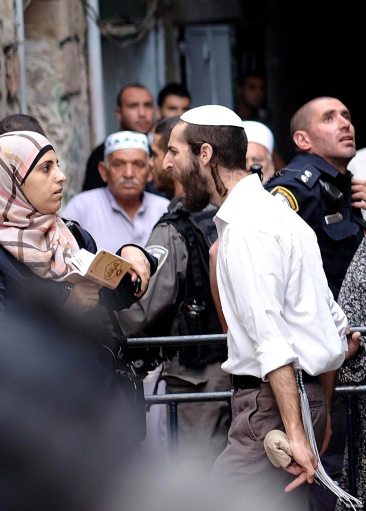 Arab Knesset Member Hanin Zoabi is to appeal against the Israeli police’s ban on Palestinian women from entering Al-Aqsa Mosque, the minister said today.
The Anadolu news agency reported a statement for Zoabi saying she had informed the Israeli police of her plan to appeal to the Israeli court against the “arbitrary” banning of women from entering the mosque.
She did not disclose with which court she was planning to file the appeal, but the process starts by filing an appeal to the magistrate court, then to the district court then to the High Court.
Zoabi described Israel’s ban on Palestinian women entering Al-Aqsa Mosque as a “dangerous precedent”, noting that the reason behind banning them is their role in “facing the settlers’ desecration of the mosque” in recent months.
For more than two months, Israeli police have banned women from entering the mosque from time to time. “They [Palestinian women] formed the front defence line against the Israeli violations and aggression on Al-Aqsa Mosque,” Zoabi said.
The Knesset member said she had sent a written letter to the Israeli Minister of Internal Security Yitzhak Aharonovich informing him of the “violations” committed by the Israeli police and Israeli border guards against women around and inside the holy site.
She noted in her letter that the violations and aggression on Palestinian women and banning them from entering into the mosque “undermines and ignores” their freedom. She also stressed that the lack of punishment against aggressors is a “green light” for more violations.
For about two months, the Israeli settlers, including extremist officials such as Knesset Deputy Speaker Moshe Feiglin have stormed Al-Aqsa Mosque on almost a daily basis.
Palestinians remain inside the mosque trying to prevent such aggressions, but the Israeli police and occupation forces took measures to secure the settlers including preventing women and men under the age of 50 from entering Al-Aqsa’s grounds.
Yesterday, 20 Palestinians, including women, were wounded in clashes in the mosque and seven others were arrested, including minors.
Ben & Jerry’s is Selling Ice Cream in Illegal Israeli Settlements
Vermonters for a Just Peace in Palestine/Israel
 |
This photo was taken in a supermarket in Gilo – an illegal Israeli settlement in occupied East Jerusalem – by an activist who documented the sale of Ben & Jerry’s ice cream in the settlements of Gilo (pop. 28,980), Pisgat Ze’ev (pop. 39,748) and Ma’ale Adumim (pop. 35,673), and in the industrial park of Mishor Edomim, which services Ma’ale Adumim. |
Ben & Jerry’s Caters to Illegal Israeli Settlements
In August, 2011, an Israeli Jewish activist working with us contacted Ben & Jerry’s factory in Israel, by e-mail and telephone, and confirmed that the company delivers ice cream to Israeli settlements in the occupied territory. Here is an e-mail communication, translated into English, between an employee at the factory and the Israeli activist, discussing arrangements for an ice cream cart to travel to the Israeli settlement of Ma’ale Adumim:
B&J Employee: Thanks for writing. Our ice cream cart comes with 5 flavors to choose from, glasses, wafers, ice cream toppings, 2 stewards and all accessories. The cost for 250 people (free distribution); 3,500 [NIS (Israeli Shekels), or $919 US] including VAT. Attached is a list of flavors. I’ll be happy to answer any questions.
Activist: Is there an extra cost that relates to the distance of your factory to the location of the party? i.e., is there an extra cost because the event is held in Ma’ale Adumin? I’m sorry about the need for detail but it’s necessary for our accounting department.
B&J Employee: Yes, the cost of transportation is 250 [NIS (Israeli Shekels), $65 US]. This is because we come from Be’er Tuvia (near Kiryat Malachi) to Ma’ale Adumim.
Israeli Settlements are Illegal Under International Law
Israel’s settlements in the Palestinian Territory violate Article 49(6) of the Fourth Geneva Convention, which declares that “the Occupying power shall not deport or transfer parts of its own civilian population into the territory it occupies.” The commentary to the Convention states that this provision was intended “to prevent a practice adopted during the Second World War by certain powers, which transferred portions of their own population to occupied territory for political and racial reasons or in order, as they claimed, to colonize those territory. Such transfers worsened the economic situation of the native population and endangered their separate existence as a race.”
Transfer of settlers to occupied territory by an occupying power is also an international war crime under Article 8(2)(b)(viii) of the 1998 Rome Statute of the International Criminal Court. Moreover, the UN Security Council and General Assembly, the High Contracting Parties to the Geneva Conventions, the International Committee of the Red Cross, and most legal scholars have concluded that Israel’s settlements in the oPt contravene international law. The International Court of Justice declared in a 2004 decision that “the Israeli settlements in the Occupied Palestinian Territory (including East Jerusalem) have been established in breach of international law.”
Ben & Jerry’s business in illegal Israeli settlements also violates its obligations under the U.N.’s “Norms on the Responsibilities of Transnational Corporations and Other Business Enterprises,” which asserts that corporations “shall not engage in nor benefit from war crimes, [or] crimes against humanity…” nor take actions that obstruct or impede economic, social, cultural, civil and political rights.
[Citations for the references above are in Our Report on Ben & Jerry’s business practices in the occupied Palestinian Territory.]
 |
The Israeli supermarket chain Shufersal distributes Ben & Jerry’s ice cream at stores both in Israel and in illegal settlements in the occupied Palestinian Territory.
The map at left, with dots denoting the locations of their stores, was displayed in their store in Mishor Adumim (an industrial zone that services one of Israel’s largest settlements, Ma’ale Adumim). Notice that it depicts Israel and occupied Palestine as one state. Palestinians under occupation are not allowed to enter most Israeli settlements, so the supermarkets in those places only sell Ben & Jerry’s ice cream to Jewish settlers. |
Vermonters for a Just Peace in Palestine/Israel Calls on Ben & Jerry’s to:
Until Israel ends its occupation and colonization of Palestinian lands in compliance with international law:
- End the marketing, catering and sales of Ben & Jerry’s products in Israel and Jewish-only settlements in occupied East Jerusalem and the West Bank.
- Stop manufacturing ice cream in Israel.
- Issue a statement (a) calling on Israel to end its occupation and settlement enterprise and (b) appealing directly to other socially responsible companies to do likewise and to cease business operations in Israel and its illegal settlements.
|
Click here to send a message to Ben & Jerry’s headquarters in Vermont. Tell Ben & Jerry’s that its complicity in Israel’s military occupation and illegal settlements is wrong and must stop! |
Boycott Divestment & Sanctions:
In Solidarity with the Palestinian People
Vermonters for a Just Peace in Palestine/Israel’s opposition to Ben & Jerry’s business practices in Israel and occupied Palestine is motivated by the grave human rights abuses being committed by the State of Israel. We are are also aware that in 2005 Palestinian civil society called for an international campaign of boycotts, divestment and sanctions (BDS) against Israel until it complies with three rights codified in international law.
- End Israel’s occupation and colonization of all Arab lands and dismantle its separation wall;
- Recognize the fundamental rights of the Arab-Palestinian citizens of Israel to full equality; and
- Respect, protect and promote the rights of Palestinian refugees to return to their homes and properties as stipulated in United Nations Resolution 194.
| Ben & Jerry’s CEO, Jostein Solheim, said in an interview:
“My mantra that I’ve repeated a hundred times since starting at Ben & Jerry’s is: ‘Change is a wonderful thing,’…. The world needs dramatic change to address the social and environmental challenges we are facing. Values led businesses can play a critical role in driving that positive change. We need to lead by example, and prove to the world that this is the best way to run a business. Historically, this company has been and must continue to be a pioneer to continually challenge how business can be a force for good and address inequities inherent in global business.” Vermonters for a Just Peace in Palestine/Israel agrees: The world – including Israel-Palestine |
Syrian Kurds Refuse To Fight Assad Army: Kurdish Leader
RIA Novosti | October 13, 2014
ANKARA – Kurds are not going to fight alongside Turkey against Syrian President Bashar Assad in Syria, Syrian Kurds leader Salih Muslim said in an interview with the Hurriyet newspaper Monday.
“Do you want us to fight against them in Damascus and be a soldier there instead of you? We will not do that. We have stopped being soldiers for others, which Kurds have done throughout history,” he said as quoted by Hurriyet.
Salih Muslim also commented on the situation in the Syrian border town of Kobani, which has been under attack by Islamic State (IS) militants for weeks now. Kurds living in the city have repeatedly asked Turkey for help, however Ankara has refused to intervene in the conflict.
“They [Turkish authorities] do not need to give anything else but anti-tank weapons if they really want to help our people in the region,” he stated.
The Kurdish leader added that he will see a single-sided establishment of buffer zones in northern Syria proposed by Turkey as an occupation. However, he stated that if the zone is established in accordance with international agreements, then he would not raise any objections.
For the past several weeks, the IS militants have besieged Kobani, one of the largest towns in the Kurdish region of Syria bordering Turkey. More than 400 people have died in clashes between the IS and Kurdish fighters in Kobani, according to the UK-based Syrian Observatory for Human Rights. Some 200,000 refugees have crossed into Turkey to flee the IS threat.
The Islamic State is a Sunni jihadist group that has been fighting the Syrian government since 2012. In June 2014, it launched an offensive in Iraq, seizing vast areas in both countries and announcing the establishment of an Islamic caliphate on the territories under its control.
Jewish holiday leads to large influx of settlers, zionist tourists, and Israeli soldiers
International Solidarity Movement | October 12, 2014
Hebron, Occupied Palestine – Today in al-Khalil (Hebron), as part of the Jewish holiday of Sukkot, thousands of settlers and Zionist tourists descended upon the city. The Israeli military presence in Hebron, which is already a large and oppressive part of everyday life, greatly increased.

Hebron is the only city in the West Bank where there is an illegal settlement in the heart of the city. It is split into H1 and H2, H1 under Palestinian Authority Control, and H2 under Israeli military control.
This morning, in both the Salaymeh and Qeitun neighbourhoods, the checkpoints designating the end of H1 were extended further into Palestinian territory.


Israeli soldiers drove between Salaymeh and Qeitun, entering houses, hiding in alleyways, and aiming their guns at passing schoolchildren and other people in the area.

In the afternoon, the army presence was just as heavy, with children walking home past heavily armed soldiers.

In H1, Bab al-Zawiye (the centre of Hebron), Israeli forces partially closed the road to allow settlers and Zionist tourists through the checkpoint to visit a religious holy site.


They were escorted by approximately 45 Israeli border police and soldiers. Several Palestinian shops were forced to close for several hours, to allow the setters and tourists to pass.

The Ibrahimi mosque and nearby checkpoint was also closed today, with all Palestinian shops in the area forced to close with it.
Israeli troops seize Hebron home for military post
Ma’an – October 12, 2014
HEBRON – Israeli soldiers raided a private Palestinian home in Hebron on Sunday morning and turned the third floor of the house into a military post, the owner said.
Salim al-Salayma told Ma’an that Israeli troops broke into his house in the al-Baqaa neighborhood in eastern Hebron and locked him and his 17 family members on the first floor.
While the family was locked on the first floor, al-Salayma said, Israeli soldiers brought military equipment to the third floor, turning it to a military post.
An Israeli military spokeswoman did not immediately return calls seeking comment.
Israeli forces regularly occupy the homes of Palestinian civilians in the West Bank located in what they deem sensitive areas to conduct surveillance and enforce control.
South African trade unions call for expulsion of Israeli Medical Association
MEMO | October 10, 2014
South Africa’s largest trade union federation, the Congress of South African Trade Unions (COSATU), has joined with health sector unions to demand the expulsion of the Israeli Medical Association (IMA) from the World Medical Association (WMA).
COSATU, along with NEHAWU (National Education, Health and Allied Workers’ Union), DENOSA (Democratic Nursing Organisation of South Africa), as well as the SA Medical Association (SAMA), issued the joint call earlier this week. Organisers will protest outside the WMA today, Friday 10 October, supported by campaign groups like BDS South Africa.
In issuing the call for expulsion, COSATU claimed that the IMA “has never denounced or seriously confronted the Israeli government on its shameless use of torture”, and has “shown blatant disregard for the ethical issue of medical neutrality.”
The South African trade unions also accused the IMA of having “stood silently in the face of…the killing, harassment and wounding of Palestinian health professionals on duty; and the destruction of the Palestinian health systems.” They note that “direct appeals to the IMA [over many years] have been unavailing.”
COSATU was one of the first trade unions in the world to endorse the Palestinian-led, international boycott, divestment and sanctions (BDS) campaign. Citing the struggle against South African apartheid, COSTAU is urging the expulsion of the IMA from the WMA, until the Israeli body “unequivocally condemns, distances and actively counter’s Israel’s torture, occupation and apartheid policies.”
Erdogan’s expansionist dreams in Syria
Press TV – October 9, 2014
The policies of the Turkish government and President Recep Tayyip Erdogan are becoming more and more dangerous both in Syria and the whole Middle East.
Ankara has not only been promoting terrorist and extremist groups, alongside its sole ally in the region, Qatar, but it is now preparing an invasion of northern Syria.
Erdogan thinks that he has the right to invade and occupy territories of Turkey’s neighbors and ignore and violate the sovereignty of these Arab countries. He has supported terrorist organizations in Syria and allowed illegal oil trading by these groups, ignored Baghdad’s sovereignty over the Iraqi Kurdistan and its resources and insulted the Egyptian president in the United Nations.
The Erdogan government has long been a key supporter of ISIL, al-Nusra Front and some other terrorist organizations. However, Ankara is now trying to use ISIL advances towards its border as a pretext to illegally send troops to occupy a part of the northern Syrian territory without the authorization of the Syrian government. This is clearly a war act.
Turkish propaganda is invoking a false excuse, the humanitarian protection for Kurds fleeing the advance of ISIL, to promote the creation of a buffer zone and a no-fly zone in Syria.
The objective of this strategy is to weaken the Syrian state and give the Ankara-backed opposition armed groups a sanctuary from which they can launch attacks on the Syrian army and where the Turkish forces can train them.
On his return from New York, Erdogan unveiled some of the plans of the Turkish leadership, which explain the situation prevailing in northern Syria. “We must look to the events in Syria, not only from the angle of terrorism, but also from the angle of the Syrian regime”, he said.
He openly called for the creation of a buffer zone and a no-fly zone in northern Syria, while criticizing Germany’s decision to provide Peshmerga Kurdish forces fighting against ISIL in Iraq with arms, claiming that they could end up in the hands of terrorist organizations, according to the Turkish classification, such as PKK.
That is, from Erdogan’s point of view, the main enemy is not ISIL but the Syrian government and PKK, which are both fighting the ISIL terrorists.
It is noteworthy to point out that the Turkish foreign minister, Mevlut Cavusoglu, has also claimed that Turkey opposes supplying the Iraqi army with weapons, because “95 percent” of the soldiers are Shiites, according to him.
Recently, Abdulkadir Selvi, journalist in the newspaper Yeni Safak, which is considered a leading pro-Erdogan outlet, said that Turkey will not take part in any air war or ground war with the coalition against ISIL in order to press the US to establish a buffer zone in Syria or allow Turkey to do so with its own warplanes and troops.
Erdogan is now using the events in the Kurdish town of Kobani to increase this pressure: If you do not allow me to send troops to Syria, Kobani will fall. This is Erdogan’s new strategy.
According to several media, Syrian Kurds are denouncing Erdogan’s plans. One of them, Binici Ibrahim, member of the Popular Democratic Party (HDP), has blamed Ankara for the situation in northern Syria due to its support for ISIL “The Turkish authorities are partly responsible for this situation. They protect ISIL, which is a terrorist organization”, Binici said, “Today they prevent young Kurds from returning to Syria to defend their territory.” “The Turkish government does not want to defend our city”, accused Mehmet Eminakma, another young HDP activist. “It crazily supports ISIL and not the Syrian people.”
Therefore, Ankara is trying to prevent young Syrian Kurds living in Turkey from returning and fighting against ISIL in order to create a humanitarian crisis and press ahead with its plans.
Facing this blackmail, the strategy of the Obama Administration is not clear. US Secretary of State, John Kerry, has said that stopping ISIL terrorists in Kobani is not a priority because “the strategic objective of the US war is to attack ISIS infrastructure”.
This could mean that Washington understands the Turkish game and is unwilling to fall into the trap.
Nevertheless, on October 8, US Secretary of State John Kerry claimed that the UK and the US were “ready to examine the Turkish idea of setting up a buffer zone in Syria to protect refugees fleeing ISIL violence.” Kerry made the announcement in a joint press conference with British Foreign Secretary Philip Hammond in Washington DC.
“The buffer zone is an idea that is out there. It is worth examining. It is worth looking at very, very closely,” said Kerry. The US Secretary of State added that creating a buffer zone will be one of the issues General John Allen, President Barack Obama’s anti-ISIL envoy, will be discussing with Turkish officials during an upcoming meeting in Turkey.
Some months ago, Turkey sent some troops to protect the Tomb of Suleiman Shah, located 33 km from the border. According to Turkish media, the convoy entered the Syrian territory without asking permission of Damascus. The excuse was some alleged links between the site and the Ottoman history. If such an argument was acceptable, dozens of countries could use a similar pretext to invade other neighbouring states.
Obstacles for a Turkish intervention
However, there are some obstacles for a possible Turkish intervention. First of all, Syrian and Arab peoples remember the Ottoman occupation and they do not want to see the Turks return. Erdogan’s policies have outraged not only Syria and Iraq but also other states of the region. In fact, Jordan’s alleged decision to suspend its participation in the airstrikes in Syria has been linked by some Arab media to Turkish actions in this country.
Other countries, such as Egypt and United Arab Emirates, do not want a Turkish intervention in Syria either. They think that Turkish government, alongside with Qatar, is trying to mobilize its allies of the Muslim Brotherhood in northern Syria and this is a clear threat for these countries, which are battling this group in their territories.
Even Saudi Arabia, despite its hostility towards the Syrian government, will not likely be happy either, as the Saudi regime does not want a more powerful Brotherhood-supporting Turkey in the region.
Secondly, Syria and Iraq have rejected any military Turkish interference. Iraqi Prime Minister Haydar Abadi reiterated on October 7 to his Turkish counterpart, Ahmed Davutoglu, that Iraq rejects any ground intervention of foreign forces in his country under the pretext of fighting ISIL. Syria has also warned that any Turkish military deployment in its territory would be an “act of aggression”.
Thirdly, Iran and Russia have clearly stated that Syria is a red line and any aggression against Syria would violate their principles and interests. Russia will certainly block any project in the UN Security Council to create a buffer or a no-fly zone. Both countries would also respond to such a Turkish action. Russia has recently sent a new warship to the Mediterranean and has held military maneuvers in the Caspian Sea alongside with Iran in order to send a signal to Turkey.
In Turkey, a large part of the population strongly rejects Erdogan’s policies in the Middle East. Major Turkish opposition parties opposed a motion by AKP (Erdogan’s party) aimed at authorizing a military intervention in Syria and Iraq. The Republican People’s Party and Freedom and Democracy Party said that such a step would be “unacceptable”.
There have also been demonstrations in Istanbul and other cities against the government’s interference in Syria and its support for ISIL. On October 5th, 10,000 people marched in Istanbul behind banners proclaiming “ISIL killer; AKP accomplice”.
For the West, Erdogan’s Turkey is becoming a serious problem too. Turkey, a NATO member, is one of the main supporters of extremism in the Middle East, and its imperialist “neo-Otoman” dreams are endangering the whole region and feeding terrorism everywhere. Thus, it is not surprising that Erdogan has become the new hero of the extremist sites and forums in Internet.
However, a Turkish intervention in Syria would have dire consequences for both Erdogan and Turkey. He will soon discover everyone is against him and such a step would renew the fear of “the Otoman resurgence” among the Arab peoples. Therefore, it would become the last nail of the coffin of the Turkish leadership’s ambitions in the Middle East.
Featured Video

Trita Parsi: Middle East Unraveling — Are We on the Path to World War?
or go to
Aletho News Archives – Video-Images
New Book
Trans agenda is ‘normalization of sadism’ – US author

RT | September 23, 2026
The US Democratic Party has embraced a transgender agenda that amounts to “the normalization of sadism,” author A.J. Rice has said, warning that radical trans policies would return if the party is allowed to regain power.
Speaking to RT’s America First host Scotty Nell Hughes about his new book, ‘The Curse of the Bearded Lady: How the Trans Mafia Whacked American Sanity’, Rice argued that activists have gained significant influence in schools, medicine, and corporate America while people who questioned the agenda have faced pressure to stay silent.
The author described the “trans mafia” as the sprawling network of people and institutions that have helped the movement gain influence. He singled out parts of academia, wealthy backers, and corporations, and stated that providers of transition-related treatment also have a financial incentive to keep young people in their care indefinitely.
Rice argued that the consequences of these policies ultimately fall on children who are being drawn toward gender-affirming medical treatments and on girls who are expected to share locker rooms or compete in sports with biological males.
He noted that while voters rejected the Democrats’ approach to gender in 2024, the party, which has been “captured by madness,” has since only doubled down and is seeking what is effectively “the normalization of sadism.” … Full report
Blog Roll
 Aletho News
- NATO chief wants Europeans to fight American wars [for Israel]
- German chemicals giant reveals details of downsizing
- Refaat Al-Areer Was The Canary In The Coal Mine In Israel’s War On The Truth
- Israeli election committee bars candidate from Knesset race over Gaza war opposition
- French-Lebanese man files war crimes complaint over Israeli attacks
- Mahan Air Flight Lands in China Despite US Threat against Iranian Airlines
- US eyes $10bn fund to rebuild war-battered Gulf infrastructure
- Trump meets Rodríguez near Maduro’s prison as Venezuela’s oil flows to US
- Trita Parsi: Middle East Unraveling — Are We on the Path to World War?
- Iran FM meets with US envoy on UN meeting’s sidelines at American side’s insistence: Report
- If Americans Knew
- Caught on Tape: AIPAC CEO Boasted of Controlling Trump’s National Security Officials
- Why Hamas Attacked Israel in October 2023 – Israeli professor Ilan Pappé
- They see them, then kill them: Israeli quadcopters track, deliberately target civilians in Gaza
- Winter could turn Gaza’s treacherous, war-damaged buildings into deathtraps
- Majority of Democratic Voters Want to Prosecute Both Biden and Trump Administration Officials Over Gaza
- As Gaza languishes, world leaders gather at the UN – Daily Update
- Sanctions are collective punishment: immoral and self-defeating
- Phosphorus Munitions Fired by Israel Burn Groves, Orchards in Southern Lebanon
- Israel Carries Out New Ceasefire Violations Across Gaza
- AI – Emphasis on the ‘I’: Israel Is Funding AI Chatbot Propaganda
- No Tricks Zone
- New Study: Earth And Venus Surface Warmth Largely Explained By Convection And Lapse Rate, Not CO2 Or Radiation
- 2025 Nature Paper Claiming Worsening Global Drought Gets RETRACTED …Heavily Flawed
- New Study: ‘Global Drought Shows No Detectable Recent Acceleration Under Climate Warming’
- Economic Masterminds: German Socialists Suggest Taxing Productivity Gains Stemming From Using AI
- The South China Sea Has Not Been Cooperating With The Climate Change Narrative
- Energy Crisis: Germany Enters Heating Season With Historically Low Gas Reserve Fill Levels
- New Study: The Antarctic Ice Sheet Gained Mass From 2020-2024 Due To Staggering Snow And Ice Accumulation
- Study: Ocean Heating Rates From Thousands Of Years Ago ‘Dwarf’ Modern Ocean Heating Rates
- Climate Extremists Target, Attack Large-Scale Power Grid Infrastructure In Germany!
- New Study: Antarctic Ice Melt Has Contributed Less Than 1 Centimeter To Sea Level Rise In The Last 30 Years

