Beggars’ Belief
The Farmers’ Resistance Movement on Iejima Island, Okinawa
By Jon Mitchell | November 14, 2009
The first American invasion of Iejima occurred on April 16th, 1945. U.S. Army accounts chronicle in meticulous detail the vicious battle for this small island, situated three miles west of Okinawa Hontou. One thousand troops aboard eighty landing craft stormed Iejima’s eastern beaches, meeting heavy resistance from dug-in Japanese defenders. In the following five days of bloodshed, two thousand Imperial Army soldiers were killed, together with one and a half thousand civilians. Three hundred Americans lost their lives, including Ernie Pyle – the combat correspondent famous for putting a human face to World War Two.
The second U.S. invasion came a decade later. It is barely documented by American historians, but to those who were living on the island, it wrought almost as much distress. On March 11th, 1955, with Okinawa under United States administration, landing craft came ashore once again on the beaches of Iejima. Their mission: to expropriate two-thirds of the island in readiness for the construction of an air-to-surface bombing range. This time, the Army only brought three hundred soldiers, but they assumed these would be sufficient – their new enemies were the island’s unarmed peanut and tobacco farmers, and the only shelters they had were the houses they’d constructed in the years since the end of the war.
The Americans made quick progress across the south of the island. They dragged families from their houses, burned down the buildings and bulldozed the smoldering ruins. Those who protested were assaulted and arrested, then sent to the regional capital for prosecution. When one family pled for their home to be spared because their six-year old daughter was seriously-ill in bed, soldiers carried the terrified child from the house and dumped her outside the doors of the island clinic. A herd of goats that impeded the Americans’ advance was let loose from its enclosure and slaughtered by rifle fire. After the entire village had been leveled, Army officers veneered the invasion with a thin layer of legitimacy – at gun-point, they forced fistfuls of military script into the hands of the farmers, then twisted their faces towards a camera and took pictures to send to Headquarters as proof of the islanders’ acquiescence.
“The Americans weren’t the only ones taking photographs that day,” explains Shoko Jahana, “The farmers realized that if they wanted the world to understand what they were going through, they needed their proof, too.” Jahana is a white-haired woman in her late sixties with a smile that instantly wipes twenty years from her full-moon face. She works as the caretaker of the Nuchidou Takara no Ie ( “Treasure House of Life Itself” ) – the Iejima museum dedicated to the farmers’ ongoing struggle to retrieve their land from the American military. The museum consists of a pair of ramshackle buildings, located very close to the shoreline where the Americans landed in 1955. Now the beach is home to a Japanese holiday resort, and as we speak, our conversation is punctuated by the shouts of Tokyo holidaymakers, the slap and drone of jet skis.
Jahana shows me the farmers’ photographs of the destruction from March 1955 – empty monochrome scenes of charred land and blackened bricks of coral. Some of the pictures are blurred as though the camera is trying to focus on where the houses used to be. “Shoko Ahagon was one of the farmers whose home was destroyed that day. He went on to organize the islanders in their struggle against the bombing range. People call him the Gandhi of Okinawa.”
Jahana points to a large colour photograph on the wall. A sun-wrinkled man smiles serenely from beneath the brim of a straw hat. Think a slimmer Cesar Chavez with thickly-hooded eyes that glimmer with intelligent compassion. Jahana tells me he gave lectures on the movement to visiting parties of schoolchildren right up until his death in 2002. He was 101 years old.
As she speaks, there’s a gentle knock on the door and an elderly woman enters, carrying a small convenience store bag. When she sees that Jahana is busy talking to me, she bows and sets the bag carefully on the side of her desk. It’s full of earthy cylinders pushing against the white plastic and I remember, earlier at the port, seeing the island’s famous peanuts for sale, alongside dusty bricks of black sugar and tangles of bright pink dragon fruit.
“Ahagon-sensei established the Treasure House in 1984,” Jahana continues, “He wanted to create a permanent exhibit of what went on here after the Americans came ashore in 1955. I’ll ask my assistant to show you around the main museum.” A younger woman in her forties comes in. Jahana lifts the plastic bag from the desk, but when she passes it to her assistant, its sides split open. A dozen rusty bullets clatter to the floor. I jump but neither woman bats an eyelid as they bend and scoop them back up.
The assistant walks me from the reception to the exhibition hall at the rear of the property. When she slides open the doors, I’m struck by a hot blast of air, the smell of second-hand clothes mixed with used book stores. Inside, the museum is a mélange of memorabilia from the past fifty years. American parachutes hang next to musty protest banners. Old newspaper articles line the walls alongside dozens of photographs taken by the farmers to record their struggle. Just in front of the doorway, there’s a massive mound of rusting metal – shell casings and missile fins, grenades and rockets. The assistant kneels down and adds the bullets to the heap. Her action wakes a small white gecko and it scuttles across the deadly pile, finding shelter in a half-blown mortar round.
“Within days of leveling the farmers’ houses, the Americans had completed construction of their bombing range. They marked huge bull’s eye targets with white sand trucked in from the beaches. The explosions went on day and night. Those shells are just a selection of the things they fired. Farmers still come across them now and bring them here for our collection.”
When I ask her what happened to the displaced villagers, she points to a photo of a row of tents. “The Americans had promised them building materials and they were good to their word.” She gives me a sad smile. “The cement they gave had already hardened to concrete in its bags. The boards were rotten and the nails long corroded spikes that couldn’t be used for anything.” One picture shows a family of fifteen packed into a small, open-sided tent. “The villagers quickly fell sick with dehydration, sunstroke and skin diseases.”
Along with the poor-quality building supplies, the American Army offered the farmers financial compensation. Realizing that any acceptance of the money would be interpreted as their assent to the seizure of their land, they refused. With no other means to support themselves, Ahagon and the villagers decided to throw themselves on the mercy of their fellow Okinawans. She shows me a letter they wrote to explain their actions. “There is no way for [us] to live except to beg. Begging is shameful, to be sure, but taking land by military force and causing us to beg is especially shameful.”
On July 21st 1955, the villagers boarded a ferry to Okinawa Hontou. Calling themselves the “March of Beggars”, over the next seven months, they made their way from Kunigami in the north to Itoman almost seventy miles to the south. In every town they passed, the villagers met with the local people and told them of their struggle. Throughout their walk, they were greeted with warm welcomes and sympathy. Even the poorest villages gave them food and shelter for the night. The assistant shows me the photos the farmers exchanged as thanks to the people who supported them. The men stare proudly at the camera – their trousers are patched and threadbare, but their shirts are starched clean white. The women try to hold their smiles while stopping the children from squirming from their knees.
The reception of the authorities stood in stark contrast to the hospitality encountered from ordinary people. Both Okinawan politicians and academics alike ignored Iejima’s farmers’ pleas for assistance. Many of these officials only retained their jobs with the mercurial support of the American administration and they feared dismissal. When the islanders confronted the U.S. High Commission, General James Moore played the Red card and claimed the farmers were uneducated dupes who were being manipulated by communist agitators. An Air Force spokesman called the problem “a petty dispute” – inconsequential in light of the practice bombings which were ensuring security “both for the Free World and for [Okinawan] people.”
After seven months on the road, the March of Beggars finally returned home to Iejima in February, 1956. They found their situation no better than when they had left; the leaking tents still stood and they continued to be denied access to the fields upon which they’d depended for their livelihoods. Bombings and jet plane strafings went on day and night, wearing down already tattered nerves and making rest impossible.
“When the farmers attempted to send word of their predicament to the main Japanese islands, their letters were intercepted by the American military,” explains the assistant. “They didn’t want the world to know what they were doing here.” Some letters, however, did make it through the cordon of censors, and when the Japanese media reported news of the farmers’ struggle, the people of the main islands rallied to their help. School students, homemakers, businessmen – even imprisoned war criminals – started sending care packages to Iejima. They flooded the islanders with powdered milk and sugar, rice and canned fish, notebooks, textbooks and pens. The boxes are on display at the museum. Many of them are addressed simply “To the brave farmers of Iejima.”
No matter how small the parcel, each one was rewarded with a handwritten banner of appreciation and a photograph from the islanders. Upon receiving a massive package from far-off Hokkaido, the entire village gathered to witness the opening of the thirty-one crates. Even the sick and elderly got out of bed to see the gifts from the snowbound northern island. The sign the villagers penned still hangs in the museum today – “To the coal miners of Kushiro, We who live in this southern country thank you very warmly.”
These packages, though substantial, were not enough to sustain the villagers forever. As the 1950s progressed, with no financial aid from the government or the military, many of the islanders were forced to support themselves in an increasingly desperate manner. Where once they harvested tobacco and sweet potatoes, now they scavenged the fringes of the bombing range for scraps of military metal. They collected chunks of shrapnel and bullet casings, and sold them to traders for a few yen a kilogram. From time to time, they’d come across a whole bomb that had failed to explode. The farmers would drag it away and defuse it themselves with a plumber’s wrench and a length of steel pipe. In this manner, they taught themselves to become bomb disposal technicians as expert as any found in modern armies. But for these men – like their professional counterparts – sometimes their luck ran out. Between 1956 and 1963, a dozen islanders were killed or wounded while collecting or dismantling American ordinance. Photos on the walls show farmers with their arms torn off and their faces sheered away – combat pictures from an island purportedly at peace.
“In the early 1960s,” says the assistant walking me down the room, “one of the farmers stumbled across a piece of scrap far too precious to sell.” She gestures towards a long white tube with four tell-tale fins. “He found it sticking out of his field one day. He hid it in his shed while the Americans searched high and low.”
I can well understand the military’s eagerness to retrieve this particular missile. I recognize it almost immediately from another story I’ve been covering about Okinawa. In December 1965, some hundred and fifty miles north of Iejima, the USS Ticonderoga ran into rough seas. A Sky Hawk jet that was on the ship’s deck slipped its cables and tumbled into the ocean. The accident would not have been particularly newsworthy if it hadn’t been for the payload it was carrying: a one megaton hydrogen bomb. The Japanese constitution prohibits nuclear weapons in its waters, and it was only when the device started to leak in 1989, that a nervous Pentagon confessed to Tokyo about the missing bomb.
The assistant must have noticed the panic on my face. “Don’t worry, it’s just a dummy one they used for practice runs.” It looks so real that this does little to allay my fears. Nearby a cicada ticks Geiger-like. “You can touch it if you want,” she offers. I take two steps back and she laughs.
Back in the reception, Jahana tells me of the successes achieved by Ahagon and the islanders. Thanks to their demonstrations throughout the 1960s and a concerted publicity campaign (including three books and a documentary), the bombings stopped and the range was closed down. Many of the farmers were able to recover the fields that were stolen in 1955.
Jahana takes a map of Iejima from her desk drawer. The western portion is marked off by a red dotted line. “Today, the American military controls a third of the island. The Marines have a training area where they still conduct parachute drops. A few years ago, some of their jumpers went astray and landed in a tobacco field. They wondered why the farmer was so angry. They’d only crushed a few tobacco plants – perhaps a carton of cigarettes’ worth. They don’t know what these people have had to put up with over the past fifty years. They have no idea of the sufferings they’ve been through.”
Before I head back to the port, I ask Jahana if she’s hopeful the Americans will change their policy and return the rest of the land. She smiles wryly. “Ahagon-sensei had a saying he often quoted. ‘Even the most evil beasts and devils are not beyond redemption. They might become human one day. All they need to be shown is the error of their ways.’ Ahagon-sensei believed this very strongly. That’s why he built this museum and that’s why it will be here until the day the farmers get back their land.”
Jon Mitchell is a Welsh-born writer, currently working at Tokyo Institute of Technology. He can be reached at: jon.w.mitchell@gmail.com
Israel detains thousands of army deserters every year
MEMO | April 21, 2014
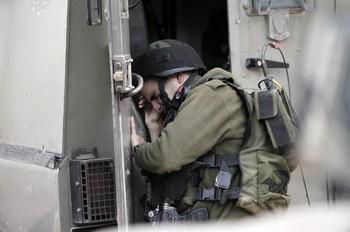
The Israel Defence Forces detain nearly 22,000 deserters and “undisciplined soldiers” every year, Haaretz newspaper revealed on Sunday. The paper said that nearly 13,000 of the soldiers are detained in army prisons while the rest are held inside military bases.
The paper quoted data from the Military Police, which revealed that around 400 escape attempts, rebellions and acts of violence occur inside army prisons annually. At least 13,452 soldiers were detained in 2013; 76 per cent of them were charged with evading military service, while 18 per cent were soldiers classified as “undisciplined” and 6 per cent had committed criminal offences.
According to the data, 13 per cent of detained soldiers are of Ethiopian origin although they represent only 3 per cent of the total personnel in the IDF.
Israeli forces storm Aqsa compound, dozens injured and detained
File Photo
Ma’an – 20/04/2014
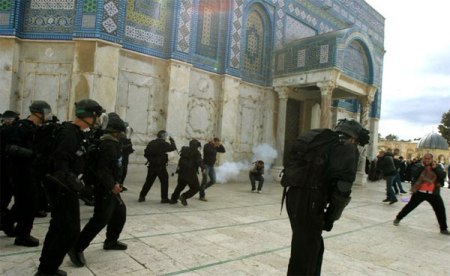
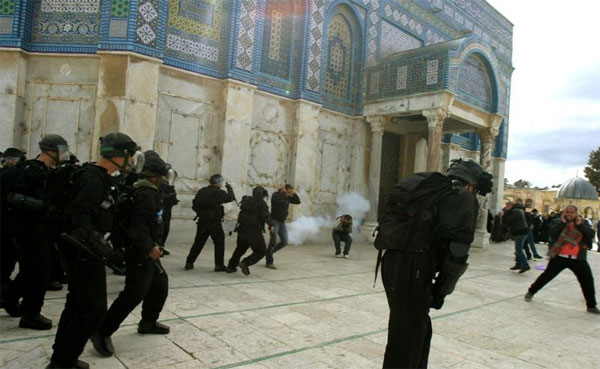
JERUSALEM – Dozens of Palestinian worshipers were wounded and dozens were detained after clashes broke in the Al-Aqsa Mosque compound on Sunday morning with Israeli forces who had stormed the courtyards firing stun grenades and rubber-coated bullets.
The raid comes amid frequent clashes in recent days after right-wing Jewish groups urged Jews to flock to the compound — which they believe is the site of a former Jewish temple — and conduct Passover rituals inside.
Director of Al-Aqsa Mosque Omar Kiswani told Ma’an that more than 400 police officers stormed the courtyard of the Al-Aqsa Mosque through the Moroccan Gate and the Chain Gate escorting Ultra-Orthodox Jews other Jewish visitors into the compound.
Israeli forces, Kiswani said, “besieged” worshipers in the southern mosque “attacking them with clubs and pepper spray,” after clashes broke out with Palestinian worshipers in the compound.
Dozens of Palestinians sustained injuries during the assault, while several others suffered from excessive tear gas inhalation. Twenty five young men were reportedly detained by Israeli forces.
Kiswani said that Likud member of Knesset Moshe Feiglin had also entered the compound during the raid, accompanied by special security units. Feiglin has visited the site frequently in recent months, and he has vocally supported the extension of Israeli sovereignty over the compound.
Earlier on Sunday morning, clashes erupted outside the Lions’ Gate (Bab al-Asbat) and Gate of Remission (Bab al-Hutta) of the Al-Aqsa compound when Israeli police denied hundreds of worshippers access to the compound.
Witnesses said that Israeli officers had denied all Palestinian residents of Jerusalem under the age of 60 access to the compound, including students who attend schools inside. Men and women were also attacked with clubs and pepper spray, witnesses said.
Israeli forces detained a young man after he was beaten brutally.
Israeli police spokesman said in a statement that police had detained 16 Palestinian “rioters,” adding that they were all detained “as they threw stones/blocks at officers at the scene this morning.”
He also said that two police officers lightly injured in the clashes, which broke out after the Palestinians threw stones as “tourists visited.”
About 100 Muslim worshipers have decided to stay inside the compound day and night throughout Passover after right-wing Jewish organizations called for Jewish worshipers to enter the area en masse for religious festivities.
Because of the sensitive nature of the Al-Aqsa compound, Israel maintains a compromise with the Islamic trust that controls it to not allow non-Muslim prayers in the area. Israeli forces regularly escort Jewish visitors to the site, leading to tension with Palestinian worshipers.
The compound, which sits just above the Western Wall plaza, houses both the Dome of the Rock and Al-Aqsa mosque and is the third holiest site in Islam.
It is also venerated as Judaism’s most holy place as it sits where Jews believe the First and Second Temples once stood. The Second Temple was destroyed by the Romans in 70 AD.
Al-Aqsa is located in East Jerusalem, a part of the internationally recognized Palestinian territories that have been occupied by the Israeli military since 1967.
UN envoy slams Israel’s ‘unacceptable’ police handling of ‘Holy Fire’ ritual in Jerusalem
RT | April 20, 2014
Israeli police reportedly blocked a top UN diplomat, alongside other diplomats and Palestinians, entrance to a pre-Easter Holy Fire ceremony at the Church of the Holy Sepulchre in Jerusalem, which Israeli authorities called a ‘micro-incident.’
Robert Serry, the UN special envoy for Middle East peace, said he and Palestinian Christians were making their way to attend the ‘Holy Fire’ ceremony at the Church of the Holy Sepulcher, the site where Christians believe Jesus was crucified and buried before rising from the dead.
Despite earlier promises of unrestricted access to the church, Israeli police refused to let the group of worshipers pass, saying they had orders to that effect.
Serry said he, along with Italian, Norwegian and Dutch diplomats, were forced to wait for up to 30 minutes, crushed by the excited crowd against a barricade, while Israeli officers ignored his request to speak with a superior, according to Reuters.
“A precarious standoff ensued ending in an angry crowd pushing their way through,” Serry said, lashing out at “unacceptable behavior from the Israeli security authorities.”
“It became really dangerous because there was a big crowd and I was pushed against a metal fence the police put up there, the crowd tried to push really hard,” the diplomat said, adding they might have been trampled had police not finally let them pass.
Serry in a statement called on “all parties to respect the right of religious freedom, granting access to holy sites for worshipers of all faiths and refraining from provocations, not least during religious holidays.”
The incident comes as the Holy City, which is of religious importance to Christians, Jews and Muslims alike, prepares Pope Francis’s Holy Land visit next month.
Israel dismissed the UN diplomat’s complaint, calling it an attempt to exaggerate a “micro-incident” while crediting police with maintaining order as crowds of worshipers descended on the city.
Later on Saturday, Israel’s Foreign Affairs Ministry dismissed Serry’s account as “an odd communique on a non-event.”
“Christian dignitaries of the highest level have this evening thanked the Jerusalem Police Department for its efficient service, which has enabled the Holy Day’s celebrations to take place without any hindrance,” the ministry said.
“Had any harm come to the pilgrims due to uncontrolled crowd movements, Mr. Serry would have been prompt to cast responsibility on the same police which he now condemns for doing its job properly,” the Israeli statement added.
Meanwhile, Pope Francis is scheduled to visit Jerusalem in May, an event that may be overshadowed by a breakdown in US-brokered peace talks between Israeli and Palestinians, who face an April-29 deadline to resolve their differences.
Israeli forces injure 30 Palestinians in al-Aqsa
Press TV – April 16, 2014
Israeli forces have shot and wounded at least 30 Palestinians in the al-Aqsa Mosque in East al-Quds (Jerusalem).
Local sources said that clashes erupted between the Israeli forces and Palestinian worshippers in the mosque compound when Israeli settlers entered the holy site on Wednesday.
According to witnesses, Israeli troops raided the mosque to protect the settlers. They said the forces fired tear gas and rubber bullets to disperse the worshippers.
“About 1,000 Israeli officers stormed the compound,” Palestinian Ma’an news agency quoted Sheikh Azzam al-Khatib, the director-general of Muslim endowments and Al-Aqsa affairs, as saying.
In recent months, Israeli forces and illegal settlers have stepped up their attacks on Palestinians visiting the mosque. This has led to violent confrontations between the two sides.
On Sunday, clashes broke out between Israeli forces and Palestinians at the al-Aqsa Mosque compound when Israeli police prevented Muslims from entering one of the gates of the compound.
Israeli forces used stun grenades to disperse protesters.
The Israeli regime has also imposed severe restrictions to stop Muslim worshippers from entering the mosque.
On February 25, the Israeli parliament (Knesset) discussed a plan to annex the compound.
The Organization of Islamic Cooperation has condemned the Knesset move as a “dangerous escalation,” calling it part of Israel’s goal to “Judaize Jerusalem.”
The al-Aqsa compound, which lies in the Israeli-occupied Old City of al-Quds, is a flashpoint. The compound, known to Jews as the Temple Mount is Islam’s third-holiest site after Mecca and Medina in Saudi Arabia.
DFLP militants ‘fire 3 mortar shells’ at Israeli vehicles in Gaza
Ma’an – 14/04/2014
GAZA CITY – The military wing of the Democratic Front for the Liberation of Palestine said it fired mortar shells at Israeli military vehicles that entered Gaza early Monday.
 The National Resistance Brigades said in a statement that four Israeli military vehicles crossed into Palestinian territory east of the village of al-Qarara in the southern Gaza Strip.
According to the statement, the group responded by firing three mortar shells at the Israeli vehicles.
No injuries or damages were reported.
“National resistance will remain the only path to restore Palestinian rights,” the Brigades’ statement said.
An Israeli military spokeswoman said she was not familiar with the incident.
The shells were fired two days after the DFLP said the National Resistance Brigades targeted an Israeli military jeep near the Kissufim military base east of the Gaza Strip.
A statement said that on Saturday “the military site Kissufim was also targeted with three mortar shells in response to the ongoing Israeli attacks on unarmed Palestinians.”
An Israeli military spokeswoman said on Sunday that “there was alarm in the area overnight,” and an explosion was heard, but she said that Israeli forces were still searching the area.
On Friday, five Palestinian medics suffered from excessive tear gas inhalation after Israeli forces fired a tear gas canister at their ambulance in the northern Gaza Strip, a day after Israeli forces shot four Palestinians in two incidents near the border fence.
ASA Increases Membership, Support in Wake of Academic Boycott of Israel Endorsement
By Chris Carlson |International Middle East Media Center | April 13, 2014
In the wake of the American Studies Association’s December 2013 endorsement of the Palestinian civil society call for an academic boycott of Israel – and as two efforts to legislate against academic boycotts fail to move forward in the Illinois and Maryland state legislatures – the ASA has gained new members and support. Over the past several months, the ASA has welcomed more than 700 new members. The ASA has also collected more membership revenue in the past three months than in any other three-month period over the past quarter-century and its ongoing “Stand with the ASA” grassroots fundraising campaign has exceeded the association’s expectations thus far.
Last week, South African Archbishop Desmond Tutu, winner of the Nobel Peace Prize, released a statement in support of the ASA’s boycott efforts. In it, he states that: “In South Africa, we could not have achieved our democracy without the help of people around the world, who through the use of non-violent means, such as boycotts and divestment, encouraged their governments and other corporate actors to reverse decades-long support for the Apartheid regime. … The [anti-boycott] legislation being proposed in the United States would have made participation in a movement like the one that ended Apartheid in South Africa extremely difficult.” The day before his statement was released, an Illinois State Senate Committee rejected a resolution condemning academic boycotts. A bill to defund universities that subsidize faculty associations with organizations supporting boycotts was also scuttled in Maryland, where non-binding condemnatory language was instead inserted into the budget bill.
ASA President Curtis Marez stated, “Despite the backlash of the last few months, the ASA is thriving. The boycott vote is consistent with our longstanding support for human rights and opposition to war and militarism. Many Americans are now for the first time hearing about their government’s support for the occupation and discriminatory laws against Palestinians. I’m proud that the ASA helped open up discussion about BDS (Boycott, Divestment, and Sanctions) and the difference it can make.” Commentary by ASA leaders, members and supporters was published in the Los Angeles Times, Chronicle of Higher Education,Washington Post, New York Times, CNN.com, and the Chicago Tribune, among other news outlets.
In response to the legislative threats from politicians, threatened legal action, and physical threats from others, veteran attorneys have stepped forward to assist the ASA in responding to such legal bullying for taking a principled stand in support of Palestinian human rights. The ASA is not the only organization to face such bullying; in 2013 alone, Palestine Solidarity Legal Support, an initiative built in partnership with the Center for Constitutional Rights,documented more than 100 cases of legal and other intimidation against Palestinian rights activists on U.S. campuses.
Incoming ASA president Lisa Duggan noted, “We are looking forward to our upcoming annual meeting in November, which will feature a wealth of panels and events presenting first-rate American Studies scholarship on topics ranging from the politics of settler colonialism and transnational Black studies to popular culture and contemporary performance art. We will be welcoming Palestinian and Israeli scholars along with large contingents of other international ASA members poised to continue addressing matters of global concern affecting all of us.”
Jewish settlers move into the Rajabi building in Hebron
Hebron Rehabilitation Committee | April 13, 2014
Hebron, Occupied Palestine – On Sunday 13 April 2014 in the early afternoon, Israeli settlers with assistance from the Israeli occupation forces started moving into the so-called Rajabi building in Hebron. After seven years of litigation, on 11 March 2014, the Israeli Supreme Court handed over the building to the settlers despite previous court rulings that said that the relevant purchase documents and power of attorneys had been forged.
Early this morning, the Israeli Minister of Defence Moshe Ya’alon approved the settlers to move into the building. As a result, three families entered the building later the day and started preparing the building for occupation. The settlers were observed cleaning the house, bringing in pieces of furniture and fixing the windows. The occupation forces provided the settlers with power generators and water tanks to help them in their efforts as the building is not connected to the electricity or water grid. According to Israeli sources, the settlers are to hold a Passover Seder dinner on the site during the upcoming holiday and ten more families are to move into the building after the end of the Passover.
Local Palestinians voiced their fears that the creation of a new settlement will cause further violations of their rights and violence against them. During 2007 and 2008, when settlers were dwelling in the building, the community witnessed multiple attacks by the settlers as well as routine house searches and arbitrary detentions by the occupation forces. Following their eviction by the Israeli police and army in December 2008, the settlers went on a rampage torching Palestinian property and assaulting Palestinians.
‘Israel planning new Jewish temple near al-Aqsa Mosque’
Press TV – April 11, 2014
Israeli officials have unveiled the model of a Jewish temple near the al-Aqsa Mosque Compound in East al-Quds (Jerusalem).
Palestinian activists say the model of the so-called third Jewish temple has a big hall and can accommodate hundreds of visitors each day.
Israeli authorities hope the project could attract tens of thousands of local and foreign tourists every year.
The al-Aqsa Foundation for Endowment and heritage says the move is a direct threat to the mosque.
The organization argues that the project is aimed at building enough support to make a Jewish temple on al-Aqsa site.
Palestinian groups have already warned of large-scale Israeli excavations near al-Aqsa’s southern gate.
On February 25, the Israeli parliament, Knesset, discussed a plan to annex al-Aqsa Mosque Compound.
The Organization of Islamic Cooperation has condemned the debate as a “dangerous escalation,” calling it part of Israel’s goal to “Judaize Jerusalem.”
The Israeli Knesset is set to discuss a proposal later this week to place the so-called Temple Mount, where Al-Aqsa Mosque is located, under Israeli sovereignty.
Palestinians have denounced the plan as desecration. They say it is part of the Israeli regime’s ongoing attempts to distort Arab and Islamic history.
Over the past decades, Israel has tried to change the demographic makeup of al-Quds by constructing illegal settlements, destroying historical sites and expelling the local Palestinian population.
Israel unveils economic sanctions on Palestine
Al-Akhbar | April 11, 2014
Israeli and Palestinian officials held fresh US-mediated talks Thursday, but the crisis-hit peace process was dealt a new blow as Israel unveiled sanctions against the Palestinians.
Israel, which collects about $111 million in taxes on behalf of the Palestinian Authority – two-thirds of its revenues – has decided to freeze the transfer of that money, an official told AFP.
Israel was also suspending its participation with the Palestinians in developing a gas field off the Gaza Strip and putting a cap on Palestinian deposits in its banks, the Israeli official said, asking not to be named.
However, the official said “discussions under the aegis of the United States to overcome the talks crisis will continue.”
Palestinian chief negotiator Saeb Erakat lashed out at the move, calling it an act of “Israeli hijacking and the theft of the Palestinian people’s money.”
The decision is a “violation of international law and norms by Israel” in revenge for the Palestinians’ move to join a raft of international treaties as a state, Erakat told AFP.
Earlier State Department spokeswoman Jen Psaki confirmed a new round of talks between the Israeli, Palestinian and US negotiators had been held Thursday. But she downplayed reports of a deal in the works.
“The gaps are narrowing, but any speculation about an agreement are premature at this time,” said Psaki.
Washington remains in “intensive negotiations” with both sides, she told reporters.
“We’re working, as you know, to determine what the path forward is for these negotiations, and that is up to the parties.”
The talks hit a new impasse last week after Israel refused to release a final batch of Palestinian prisoners and the Palestinians retaliated by seeking accession to several international treaties.
US Secretary of State John Kerry blamed Israel this week for the deadlock as Washington mulled how much more time and effort to put into the faltering negotiations.
American envoy Martin Indyk presided over Thursday’s meeting in Jerusalem between Israel’s chief negotiator, Justice Minister Tzipi Livni, and her Palestinian counterpart, Saeb Erakat, said a Palestinian source close to the talks.
Also present were Palestinian intelligence chief Majed Farah and Yitzhak Molcho, a confidant of Prime Minister Benjamin Netanyahu.
The Palestinian side was pushing for the release of a final batch of prisoners, a commitment Israel reneged on in a move that sparked the crisis.
Israeli television reported that the two sides were on the verge of a deal to extend peace talks beyond their April 29 deadline.
The deal would see the Palestinian prisoners released in return for Washington freeing American-born Israeli spy Jonathan Pollard, Channel 2 television said.
But insisting there was no deal yet, Psaki said “no decision has been made about Jonathan Pollard,” who is eligible for release next year.
Meanwhile Israel’s Economy Minister Naftali Bennett, who heads the far-right Jewish Home party, threatened to pull his party out of the coalition if there was a deal on the release of Palestinian prisoners.
“If the government proposes this deal to us, the Jewish Home party will pull out of the coalition,” he said.
The Israelis have repeatedly asked Barack Obama and previous US presidents to release Pollard, sentenced to life in 1987 for passing US secrets on Arab and Pakistani weapons to Israel.
Psaki revealed that Indyk would return to Washington this week for consultations with Kerry and the White House.
He would then go back to the region some time next week.
A Palestinian official also denied any deal was yet on the table, telling AFP there was still a “deep chasm” between the two sides.
When Israel refused to release 26 long-time Palestinian prisoners, it went back on a pledge it made at the launch of the peace talks.
The Palestinians responded by abandoning their own commitment not to seek international recognition until the nine months of talks ended, applying for accession to 15 treaties.
The United Nations said Thursday it had accepted the deposit of the request, but Psaki said that was merely “a technical step… so I don’t think it changes, necessarily, what we’re negotiating now.”
(AFP, Al-Akhbar)
Arrests and stolen land in Osarin village
International Solidarity Movement | April 10, 2014
Osarin, Occupied Palestine – In the last month, the Israeli army has arrested 10 boys under the age of 16 from Osarin village. As of today, they all remain in the prison.
This is the latest in a long line of tactics employed by the Israeli military to intimidate the people of Osarin and the surrounding villages. According to a member of the village’s local council, the Israeli army approached the village around six months ago demanding that Osarin and three other neighboring villages sell three dunams (3,000 square meters) of land to the Israeli government. The threat was that if they did not comply the army would simply take the land. Despite this pressure, the people of the village collectively chose to refuse and have had to live with the consequences of this choice ever since.
The land the army asked for originally was intended to build three watchtowers, one of which would be just outside Osarin. The other two would be near the villages of Yatma and Qabalan, who also had demands from the Israeli army to sell their land. In total the army was trying to obtain 320 dunams of important farmland, containing olive trees, other crops and grazing areas from the three villages.
The village’s decision to refuse was met with a new plan by the army to build a wall on either side of the main road (route 505), running adjacent to the village, all the way to Za’tara checkpoint. This would be roughly 10km in length and would unsurprisingly require the confiscation of land on either side of the road, which belongs to the village of Osarin. The reasoning for this intrusion into Palestinian land was allegations that boys from the village had been throwing stones onto the main road, where settlers from the illegal settlements pass by in their cars and sometimes on foot. In fact, the Israeli army used these allegations to call a meeting with four villages, one of which was Osarin, the others being Beita, Beit Furik and Madama. In this meeting the army told the representatives from the villages that unless the alleged stone throwing ceased they would make all four of the villages into closed military zones. In other words, force out the inhabitants of all four villages and make it impossible for them to return.
While the Israeli army demands that children stop throwing stones, they are also at the same time increasing attacks on the civilian population of Osarin. During these periods physical force has been used, including punching individuals with no just cause and firing live ammunition into the air to intimidate the local population. Also during these incursions, the roads are closed around the village even when ambulances need to either enter or leave the village, endangering lives in the process.
The village has attempted to go through the court system to block the Israeli authorities’ plans for the area, but has lost each court battle numerous times. This is despite the fact that the village is located in Area B (Palestine Authority and Israeli control) and therefore any seizure of land, including for the purposes of military building construction, is illegal. The area has long been an area of high activity for the Israeli military, where in November 2013 witnesses report that military training took place involving up to 1,000 Israeli soldiers. During the week-long action villagers were told to stay in at night, creating a curfew, and at times local groups of boys were used to provide training with how to deal with stone throwing.
When a local representative was asked if he felt matters had gotten worse in terms of Israeli military interference and intimidation, his answer was an unequivocal yes. The construction of the wall along either side of Route 505 has yet to begin but will most probably commence in the near future. In the meantime, arrests of children and physical violence towards the villagers continue.
Featured Video

Trita Parsi: Middle East Unraveling — Are We on the Path to World War?
or go to
Aletho News Archives – Video-Images
New Book
Trans agenda is ‘normalization of sadism’ – US author

RT | September 23, 2026
The US Democratic Party has embraced a transgender agenda that amounts to “the normalization of sadism,” author A.J. Rice has said, warning that radical trans policies would return if the party is allowed to regain power.
Speaking to RT’s America First host Scotty Nell Hughes about his new book, ‘The Curse of the Bearded Lady: How the Trans Mafia Whacked American Sanity’, Rice argued that activists have gained significant influence in schools, medicine, and corporate America while people who questioned the agenda have faced pressure to stay silent.
The author described the “trans mafia” as the sprawling network of people and institutions that have helped the movement gain influence. He singled out parts of academia, wealthy backers, and corporations, and stated that providers of transition-related treatment also have a financial incentive to keep young people in their care indefinitely.
Rice argued that the consequences of these policies ultimately fall on children who are being drawn toward gender-affirming medical treatments and on girls who are expected to share locker rooms or compete in sports with biological males.
He noted that while voters rejected the Democrats’ approach to gender in 2024, the party, which has been “captured by madness,” has since only doubled down and is seeking what is effectively “the normalization of sadism.” … Full report
Blog Roll
 Aletho News
- Integrity Initiative: UK-funded network framed dissent as Russian disinformation for years
- ‘We don’t seek permission to defend our country’: Snippets from President Pezeshkian’s UNGA address
- NATO chief wants Europeans to fight American wars [for Israel]
- German chemicals giant reveals details of downsizing
- Refaat Al-Areer Was The Canary In The Coal Mine In Israel’s War On The Truth
- Israeli election committee bars candidate from Knesset race over Gaza war opposition
- French-Lebanese man files war crimes complaint over Israeli attacks
- Mahan Air Flight Lands in China Despite US Threat against Iranian Airlines
- US eyes $10bn fund to rebuild war-battered Gulf infrastructure
- Trump meets Rodríguez near Maduro’s prison as Venezuela’s oil flows to US
- If Americans Knew
- Caught on Tape: AIPAC CEO Boasted of Controlling Trump’s National Security Officials
- Why Hamas Attacked Israel in October 2023 – Israeli professor Ilan Pappé
- They see them, then kill them: Israeli quadcopters track, deliberately target civilians in Gaza
- Winter could turn Gaza’s treacherous, war-damaged buildings into deathtraps
- Majority of Democratic Voters Want to Prosecute Both Biden and Trump Administration Officials Over Gaza
- As Gaza languishes, world leaders gather at the UN – Daily Update
- Sanctions are collective punishment: immoral and self-defeating
- Phosphorus Munitions Fired by Israel Burn Groves, Orchards in Southern Lebanon
- Israel Carries Out New Ceasefire Violations Across Gaza
- AI – Emphasis on the ‘I’: Israel Is Funding AI Chatbot Propaganda
- No Tricks Zone
- New Study: Earth And Venus Surface Warmth Largely Explained By Convection And Lapse Rate, Not CO2 Or Radiation
- 2025 Nature Paper Claiming Worsening Global Drought Gets RETRACTED …Heavily Flawed
- New Study: ‘Global Drought Shows No Detectable Recent Acceleration Under Climate Warming’
- Economic Masterminds: German Socialists Suggest Taxing Productivity Gains Stemming From Using AI
- The South China Sea Has Not Been Cooperating With The Climate Change Narrative
- Energy Crisis: Germany Enters Heating Season With Historically Low Gas Reserve Fill Levels
- New Study: The Antarctic Ice Sheet Gained Mass From 2020-2024 Due To Staggering Snow And Ice Accumulation
- Study: Ocean Heating Rates From Thousands Of Years Ago ‘Dwarf’ Modern Ocean Heating Rates
- Climate Extremists Target, Attack Large-Scale Power Grid Infrastructure In Germany!
- New Study: Antarctic Ice Melt Has Contributed Less Than 1 Centimeter To Sea Level Rise In The Last 30 Years

