Donetsk self-defense forces give Kiev troops 24 hours to withdraw
RT | May 15, 2014
Donetsk self-defense forces set an ultimatum for the Kiev military, warning that if troops do not withdraw from block posts in the Donetsk region within 24 hours, they will be taken by force, RIA Novosti reported.
The pro-autonomy militia of Donbass region in eastern Ukraine made the statement on Wednesday.
“If the armored vehicles are not pulled back, the roadblocks of the so-called legitimate authorities are not removed, I will have enough power and means – the commander supported me today – to destroy and burn everything. Reconnaissance and sabotage groups are ready to move and some are steady,” deputy commander of the pro-autonomy militia of Donbass, Sergey Zdrilyuk, told RIA Novosti.
“I give 24 hours for them to withdraw all troops, all forces,” he added.
The statement follows referendums in Donetsk and Lugansk regions, which showed that the majority of voters support self-rule amid an intensified military operation by Kiev.
Almost 90 percent of voters in Donetsk region have endorsed political independence from Kiev, the head of the Central Election Commission of the self-proclaimed Donetsk People’s Republic, Roman Lyagin, previously announced.
In Lugansk region, 96.2 percent of voters supported the region’s self-rule, according to final figures announced by the local election commission.
After the referendum, the Donetsk People’s Republic proclaimed itself a sovereign state and asked Moscow to consider its accession into Russia.
Freedom Flotilla Update: “We Will Sail in the Fall!”
Statement from the Freedom Flotilla Coalition regarding the attack on Gaza’s Ark | May 12, 2014
The Freedom Flotilla Coalition met in London over the last two days to discuss future plans in the wake of the terrorist attack on Gaza’s Ark in the port of Gaza, as well as future plans to struggle against the blockade of Gaza
The attack, which occurred on April 29th, caused substantial damage to the hull of the boat. These hull damages and others caused by the explosion need a minimum of 2 months work to repair at a cost of approximately US $30,000.
In response to this attack we will increase our efforts to challenge the blockade through non-violent direct action. We now plan to sail Gaza’s Ark early in the fall of 2014.
The authorities have not yet concluded their investigations of the incident, so it is premature to blame anyone, but it is well known who enforces the blockade on Gaza and who doesn’t want it challenged.
Preliminary results of the investigation and inspection by our partners indicate that the materials which were used in the attack are not readily found in Gaza.
Freedom Flotilla boats have been sabotaged before in the ports of Cyprus, Greece and Turkey, over the last 5 years, as they were preparing to sail to Gaza to challenge the blockade.
Boats that sailed to Gaza have been attacked by the Israeli Navy in international water, in one case lethally, and in others with force which caused a boat to sink. Boats that were not sabotaged (over half a dozen) were hijacked and towed to Ashdod.
This attack on Gaza’s Ark took place as Israel is under increased legal pressure for its deadly attack on the first Freedom Flotilla in 2010 at the International Criminal Court (ICC) and in Turkish courts.
It also happens as Israel is increasing pressure against all Palestinians in retaliation against efforts at national reconciliation between the West Bank and Gaza.
The Freedom Flotilla Coalition commits to continue its work against the blockade of Gaza in all ways and by all non-violent means possible, including supporting the May 31st International Freedom Day for Gaza.
For further information:
Ehab Lotayef +44 (753) 877 0353 or +1 (514) 941 9792
Ann Ighe +46 (70) 974 0739
Zaher Birawi +44 (785) 089 6057
US, UK run illegal facilities in Afghanistan: Karzai
Press TV – April 30, 2014
Afghanistan President Hamid Karzai says the United States and Britain continue running “illegal” detention facilities in the country.
“After many decrees that have been issued by the presidential palace about not having any detention centers run by foreign forces, still foreign forces are detaining Afghan and putting them in prisons,” Karzai said in a statement on Tuesday.
“It’s a clear violation of the law of Afghanistan,” he added.
Karzai’s remarks came after an investigation panel revealed that six Afghan prisoners are held at a UK-run facility at Kandahar Air Field in the country’s south and 17 others at a facility at Camp Bastion in Helmand Province, which is also run by British forces.
Ghalum Farooq Barakzai, the head of the panel, said that his team has not found any prisoners at the American facilities, stressing that such facilities should no longer exist.
Under pressure from Afghan President, the US signed an agreement with Kabul to transfer its prisons and inmates into Afghan custody. British forces in the country are only allowed to hold suspects for 96 hours and can detain them longer only in exceptional conditions.
Barakzai called on Britain to hand over any Afghans held in the facilities, saying that the 23 inmates detained ranging from several weeks to 31 months.
“All the detainees should be transferred to Afghan security forces in the areas where they were arrested. Then the judicial officials in that area will investigate them and put them on trial. If they are guilty they should be jailed, if they are innocent they should be freed,” he also said.
Earlier this year, Afghan government freed dozens of detainees held in the US-run Bagram prison.
In November 2012, President Karzai ordered Afghan forces to take control of the prison and accused US officials of failing to fully comply with the terms of the Memorandum of Understanding on Detentions signed between Kabul and Washington.
University of Regina set to endorse Israeli occupation?
By Andrew Loewen • Briarpatch Magazine • April 24, 2014
What would you do if the Canadian university you attended was planning to enter into a partnership with a university in another country whose persecution of your people meant you couldn’t speak out publicly – in Canada – for fear of reprisals against you and your family?
What if, further, the proposed partnership included course delivery for a degree in public safety management inside a country conducting a nearly 50-year-long occupation in contravention of international law? An occupation in which basic freedoms – of movement, speech, and self-determination – were denied your people, and in which security forces routinely imprisoned, shot, and killed civilians, including university students and children, with near total impunity.
Strange as it may sound, this is the reality facing Palestinian students at the University of Regina today. As part of a new MBA program in public safety management geared toward police service professionals, the Faculty of Business Administration is considering a partnership that would see students take optional courses at Israel’s Hebrew University in Jerusalem.
An open letter to administrators from University of Regina faculty highlights the kind of instruction on offer in the Policing and Homeland Security Studies program in the Faculty of Law at Hebrew University: “faculty expertise in this program includes ‘Policing terrorism, Political violence and protest policing, Minorities and law enforcement, Terrorism and crime, and Terror and society.’”
An article in the student newspaper The Carillon in late January alerted students to the proposed collaboration.
Speaking on condition of anonymity for fear of complications when returning to Palestine, a University of Regina alumnus and Regina resident says, “It’s a shame that the Board [of Governors] or the administration within the Faculty of Business kept it so low key. An educational institution is supposed to keep open channels of communication.”
According to the alumnus, “It says a lot about the nature of this co-operation [with Hebrew University] or even of the nature of this Faculty of Business. Maybe they know that this is bad publicity for them.”

Palestinians line up at an Israeli checkpoint near Bethlehem. Photo: Flickr/delayed gratification
The president and the dean
Following a 2012 trip to Israel as part of a delegation of Canadian academics, University President Vianne Timmons praised the work of Israeli academics in the fields of justice and police studies. “Israel is a leader in innovation,” she told the Canadian Jewish News.
President Timmons has declined interview requests regarding the potential MBA arrangement with Hebrew University, directing inquiries to the Dean of the Faculty of Business Administration, Andrew Gaudes.
When asked what Palestinian students on campus thought of the proposed partnership, Gaudes said in an interview, “I don’t know of any Palestinian students here on our campus.”
Asked if Palestinian students would be able to participate in courses delivered at Hebrew University, or if they could face unique travel restrictions, Gaudes said he had not looked into the matter: “There’s no point in me looking at something that’s not relevant to the program.”
But this rings hollow for Palestinian students. The Palestinian alumnus as well as a current Palestinian graduate student in the Faculty of Business Administration say that as Palestinians with dual (Palestinian-Canadian) citizenship they cannot enter Israel, nor can their Palestinian family and friends in the West Bank enter East Jerusalem, where Hebrew University is situated.
“They might approve [the visas] here, but that’s not what matters,” says the alumnus, stressing that it’s not Hebrew University but the Israeli military that has final say on travel and entry permits.
The current MBA student adds that millions of displaced Palestinians around the world are denied entry to their homeland. “So how is Dean Gaudes going to get them the visas to enter? It doesn’t make any sense,” she says.
Noting President Timmons’ remarks following her official visit to Israel in 2012, I asked the Dean which university administrators were behind the proposed partnership with Hebrew University. He said that the entire process was internal to the Faculty of Business. This account is not convincing for some.
The alumnus, who travels home to the West Bank annually, says, “The Faculty of Business does not make decisions for the university. [The President] knows exactly what’s going on.” He’s also skeptical of the Dean’s position that course content is the only consideration in such an arrangement.
“I’m taking courses in project management,” he says, “where they teach us that before entering into procurement agreements, it’s best practice to look at the firm’s history, to look at their policies, to look at their culture. You don’t just look at what you’re going to be getting from them, you look at everything in the background of that institution or corporation you’re going into a contract with. That’s important. If you’re skipping that step, you’re entering blindly.”
He points out that earlier this month, just days after my interview with the Dean, Israeli security forces stormed the campus of al-Quds Open University in the West Bank, firing at least 70 rounds of tear gas at students.
No ethics, no problem
When I sat down with the Dean in his office, I drew his attention to a recently published Amnesty International report called “Trigger-happy: Israel’s use of excessive force in the West Bank.” The report states, “Israel’s security forces have displayed a callous disregard for human life by killing scores of Palestinian civilians, including children, in the occupied West Bank over the past three years with near total impunity.”
I asked Gaudes how he reconciled this information with selecting an Israeli institution as an appropriate place for his students to learn public safety management and policing.
After an initial pause, Gaudes said he hoped that students from the program who “become mid to senior managers in the area of public safety” would be “more mindful of the impacts [of their decisions] at the ground level.” Referring to the Amnesty report, he said, “My hope is that if we’re educating managers [who] make decisions that can lead towards that possible outcome, they think twice.”
The irony of Gaudes’ remarks about mindfulness and the implications of decisions “at the ground level” is not lost on students. When reminded that undergraduates in the Faculty of Business must take courses in ethics and decision-making, Gaudes reiterated that his only consideration at this stage is the course content Hebrew University offers.
“It’s shocking that he would make that comment,” says the Palestinian alumnus.
“I’m worried about the content of what’s going to be delivered,” he says. “And not just the content. If it’s being conducted, where’s this research going to be put to test? Where’s it going to go? In decision-making in Canada or is it going to influence decision-making in Israel? That’s a big thing.”
It’s a chilling question for Palestinian students. “To me the content of what Hebrew University wants to do makes me think of a guinea pig experiment,” continues the University of Regina graduate. “From a Palestinian perspective, I look at myself right now as a guinea pig, because the policies that come out of Israeli universities inform the decision-making within the army. It serves the army that’s enforcing the occupation.”

Palestinian children stand in the rubble of a school in Gaza destroyed by Israeli shelling. Photo: Ashraf Amra/APA images
It is also of concern to Indigenous activists here in Canada, who are key targets of policing and surveillance operations. The website of the Office of the President at the University of Regina proudly incorporates Indigenization into the university’s mandate and vision. Yet, policies to impose Israeli curriculum on Palestinian students in East Jerusalem have resonances with Canada’s residential school system.
It’s part of an attempt “to slowly erase Palestinian identity,” says the former student. I asked the Dean how the partnership with Hebrew University would fit with the university’s commitment to Indigenization. He seemed confused by the question, before saying that he didn’t know.
The university’s reputation
The MBA student, meanwhile, is surprised by the Dean’s apparent lack of concern about the Faculty’s reputation and credibility. “I’ve been here a long time,” she says, “and all the instructors come into the class in the Faculty of Business Administration and say ‘we have to link all the courses together. What you learn in organizational behavior has to be linked to human resources, ethics has to be linked to statistics.’”
There is a sense of betrayal in her remarks: “Now if I’m sitting in the classroom and someone is standing in front of me lecturing from the Faculty of Business Administration about ethics? I would stand up and say that’s hypocrisy. You guys are teaching one thing and you’re doing something else. They will lose credibility with their students. It’s going to affect them really badly. I can’t believe they didn’t consider ethics in this way.”
Andrew Stevens, an assistant professor in the Faculty of Business Administration and a signatory of the open letter from faculty, has expressed similar concerns: “a partnership with Hebrew University, especially in the area of public safety and policing, could do damage to our reputation.”
Academic boycott
The MBA student says that had she known such a partnership might become reality, she never would have enrolled in the Faculty of Business at the University of Regina. She is likely not alone in this view, especially as the international campaign of boycott, divestment, and sanctions against Israel continues to build momentum on campuses worldwide.
Even in the U.S., where pro-Israel sentiment and propaganda is pervasive, the American Studies Association recently voted to endorse a boycott of Israeli academic institutions.
“The academic institutions and the [Israeli] army are interconnected and they influence one another. You cannot separate them,” says the MBA student, before underlining her central point: “The Faculty of Business Administration is actually supporting the occupation if it goes ahead with the partnership with Hebrew University.”
There has been no final decision on the proposed partnership, and it is not too late for administrators at the University of Regina to find more appropriate, more inclusive, and more respectable institutional partners abroad.
~
Join concerned students and faculty at the University of Regina t in calling for this partnership to be abandoned, please write to:
Dean Andrew Gaudes: Andrew DOT Gaudes AT uregina.ca
Associate Dean Ron Camp: Ronald DOT Camp AT uregina.ca
President Vianne Timmons: the DOT president AT uregina.ca
What ‘Destruction of Israel’?

Netanyahu’s ‘destruction of Israel’ mantra should not be taken seriously. (Photo: Wikimedia Commons)
By John V. Whitbeck | Palestine Chronicle | April 29, 2014
When, in response to the threat of potential Palestinian reconciliation and unity, the Israeli government suspended “negotiations” with the Palestine Liberation Organization on April 24 (five days before they were due to terminate in any event), Prime Minister Netanyahu’s office issued a statement asserting: “Instead of choosing peace, Abu Mazen formed an alliance with a murderous terrorist organization that calls for the destruction of Israel.”
In a series of related media appearances, Netanyahu hammered repeatedly on the “destruction of Israel” theme as a way of blaming Palestine for the predictable failure of the latest round of the seemingly perpetual “peace process”.
The extreme subjectivity of the epithet “terrorist” has been highlighted by two recent absurdities – the Egyptian military regime’s labeling of the Muslim Brotherhood, which has won all Egyptian elections since the overthrow of Hosni Mubarak, as a “terrorist” organization and the labeling by the de facto Ukrainian authorities, who came to power through illegally occupying government buildings in Kiev, of those opposing them by illegally occupying government buildings in eastern Ukraine as “terrorists”. In both cases, those who have overthrown democratically elected governments are labeling those who object to their coups as “terrorists”.
It is increasingly understood that the word “terrorist”, which has no agreed definition, is so subjective as to be devoid of any inherent meaning and that it is commonly abused by governments and others who apply it to whomever or whatever they hate in the hope of demonizing their adversaries, thereby discouraging and avoiding rational thought and discussion and, frequently, excusing their own illegal and immoral behavior.
Netanyahu’s assertion that Hamas “calls for the destruction of Israel” requires rational analysis as well.
He is not the only guilty party in this regard. The mainstream media in the West habitually attaches the phrase “pledged to the destruction of Israel” to each first mention of Hamas, almost as though it were part of Hamas’s name.
In the real world, what does the “destruction of Israel” actually mean? The land? The people? The ethno-religious-supremacist regime?
There can be no doubt that virtually all Palestinians – and probably still a significant number of Native Americans – wish that foreign colonists had never arrived in their homelands to ethnically cleanse them and take away their land and that some may even lay awake at night dreaming that they might, somehow, be able to turn back the clock or reverse history.
However, in the real world, Hamas is not remotely close to being in a position to cause Israel’s territory to sink beneath the Mediterranean or to wipe out its population or even to compel the Israeli regime to transform itself into a fully democratic state pledged to equal rights and dignity for all who live there. It is presumably the latter threat – the dreaded “bi-national state” – that Netanyahu has in mind when he speaks of the “destruction of Israel”.
For propaganda purposes, “destruction” sounds much less reasonable and desirable than “democracy” even when one is speaking about the same thing.
In the real world, Hamas has long made clear, notwithstanding its view that continuing negotiations within the framework of the American-monopolized “peace process” is pointless and a waste of time, that it does not object to the PLO’s trying to reach a two-state agreement with Israel; provided only that, to be accepted and respected by Hamas, any agreement reached would need to be submitted to and approved by the Palestinian people in a referendum.
In the real world, the Hamas vision (like the Fatah vision) of peaceful coexistence in Israel/Palestine is much closer to the “international consensus” on what a permanent peace should look like, as well as to international law and relevant UN resolutions, than the Israeli vision – to the extent that one can even discern the Israeli vision, since no Israeli government has ever seen fit to publicly reveal what its vision, if any exists beyond maintaining and managing the status quo indefinitely, actually looks like.
As the Fatah and Hamas visions have converged in recent years, the principal divergence has become Hamas’s insistence (entirely consistent with international law and relevant UN resolutions) that Israel must withdraw from the entire territory of the State of Palestine, which is defined in the UN General Assembly resolution of November 29, 2012, recognizing Palestine’s state status as “the Palestinian Territory occupied since 1967” (including, significantly, the definite article “the” missing from “withdraw from territories” in the arguably ambiguous UN Security Council Resolution 242), in contrast to Fatah’s more flexible willingness to consider agreed land swaps equal in size and value.
After winning the last Palestinian elections and after seven years of responsibility for governing Gaza under exceptionally difficult circumstances, Hamas has become a relatively “moderate” establishment party, struggling to rein in more radical groups and prevent them from firing artisanal rockets into southern Israel, a counterproductive symbolic gesture which Israeli governments publicly condemn but secretly welcome (and often seek to incite in response to their own more lethal violence) as evidence of Palestinian belligerence justifying their own intransigence.
Netanyahu’s “destruction of Israel” mantra should not be taken seriously, either by Western governments or by any thinking person. It is long overdue for the Western mainstream media to cease recycling mindless – and genuinely destructive – propaganda and to adapt their reporting to reality, and it is long overdue for Western governments to cease demonizing Hamas as an excuse for doing nothing constructive to end a brutal occupation which has now endured for almost 47 years.
Gaza’s Ark Attacked
Gaza’s Ark Steering Committee | April 29, 2014
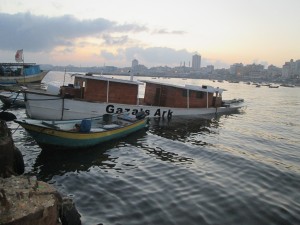 At 3:45 AM Gaza time on April 29th, the night guard on board Gaza’s Ark received a call to leave the boat because it was going to be attacked.
The guard left, but when nothing happened, he returned after 5 minutes. A few minutes later, a large explosion rocked the boat causing extensive damage.
The boat sank part way and is now sitting on the shallow sea floor. The guard was not injured but was taken to hospital for tests.
Mahfouz Kabariti, Gaza’s Ark Project Manager, says: “The extent and nature of the damage are currently being investigated. We will provide an update when available.”
“Gaza’s Ark and all our partners in the Freedom Flotilla Coalition are considering our next move in response to this cowardly act of terrorism, but our position remains clear: Neither this nor any other attack will stop our efforts to challenge the blockade of Gaza until it ends,” adds David Heap of Gaza’s Ark Steering Committee.
“Freedom Flotilla boats have been sabotaged before. This attack comes as we were almost ready to sail. You can sink a boat but you can’t sink a movement,” concludes Ehab Lotayef, another member of the Steering Committee.
For information:
Ehab Lotayef +1-514-941-9792 <lotayef@gmail.com>
David Heap +1-519-859-3579 <david.heap@gmail.com>
Charlie Andreasson +970 (59) 8345327 <charlie.andreasson@outlook.com>
http://www.gazaark.org
@GazaArk
info@gazaark.org
#GazaArkAttacked
The Dangerous VIP Palestinian Class

By Jamal Kanj | Palestine Chronicle | April 27, 2014
The Palestinian Authority (PA) must stop demeaning its people. One can understand being fooled once or even twice, but being fooled over and again every three to four years for the last 20 years is just going overboard.
It becomes a bit annoying to continue hearing cries from the same “deceived” Palestinian leaders repeating empty threats in response to Israeli intransigence and lies.
I heard it directly from several high level PLO officials that should the current negotiations fail to reach an agreement by April 29, the PA was prepared to join UN organizations. They spoke specifically of the International Criminal Court of Justice (ICCJ).
Early in April, Israel broke a nine-month-old agreement by refusing to release the final batch of Palestinian “hostages” as it agreed to with the US Secretary of State last July. Half-heartedly, the PA submitted applications to join 15 UN organizations.
Half-heartedly, because the token measure ratified accords obligating the PA to fulfil UN conventions, none of which could have empowered the PA to put an end to Israel’s wanton disregard of international law.
The decision to endorse UN treaties such as the 4th Geneva Convention, protocol one, Conventions against Corruption, Rights of the Child, Civil and Political Rights, Consular Affairs … etc., was most likely to mollify rising internal frustrations with the sham negotiations. It was not directed at Israel and this might explains the US’ muted displeasure with the toothless measures.
Now the PA is disingenuously leaking out information about dismantling the Authority and turning over its role of managing the occupation to Israel.
Israel and its America Israel Public Affair Committee (AIPAC) ex-staffer who is mediating the talks on America’s behalf, understand very well that the PA threats are for local political consumption just like the inconsequential move to join irrelevant UN organizations.
It is mind-boggling that the PA expects others to take its threats seriously. Shouldn’t they first take other steps such as ending security co-ordination to protect Israel’s illegal settlers? How about joining relevant UN organizations like ICCJ or endorsing article 49 of the 4th Geneva Convention- which Israel is categorically violating- instead of signing the worthless protocol one.
Just like the self-proclaimed “chief” Palestinian negotiator who publicly resigned more than a month ago protesting, ostensibly, the lack of progress at the peace talk. In reality however, he was incensed by informal parallel secret negotiations conducted with Israel behind his back.
He backed off once assured of his role as the main collaborator. Interestingly though, he did not seem bothered enough to resign after Israel failed to carry out a feeble agreement he himself negotiated last July.
It is not just Israel’s disregard to the international law, but this type of Palestinian leadership – lacking self-respect- who represent the biggest threat to the future of Palestine. It is the groveling Oslo-created Palestinian VIP class.
VIP passes are renewable benefits bestowed by the Israeli army to supposedly facilitate the movement of Palestinian officials. Obviously, VIP Palestinian club members do not experience the reality of occupation and have for the most part enjoyed this status since the establishment of the PA in 1994 as long as Israel was content with their performance.
To be taken seriously, the PA must first end this joke and limit the “intravenous” VIP status for its officials to no more than two years.
Not to suggest a far-fetched “radical proposal” like ending security co-ordination with Israel, PA should at a minimum return all VIP passes and insist on its security coordinators and negotiating team to navigate Israeli military barriers like normal citizens.
Besides making Israel and AIPAC American’s mediator sit and wait, reminding these officials of the evil of occupation might be an incentive to change the way VIP holders negotiate with Israel.
– Jamal Kanj (www.jamalkanj.com) writes weekly newspaper column and publishes on several websites on Arab world issues. He is the author of “Children of Catastrophe,” Journey from a Palestinian Refugee Camp to America. (A version of this article was first published by the Gulf Daily News newspaper.)
Colombia Professor Victorious in His Quest for Academic Freedom
KAKE | April 21, 2014
After Iymen Chehade’s class at Columbia College Chicago was canceled, he realized that his academic freedom had been violated and skillfully protested until his class was reinstated. In this interview, Chehade discusses the importance of recognizing and fighting for academic freedom in schools across the globe.
(Interviewer: Kellen Winters @_ITSKELS @_KAKEME – Filmed and edited by @AndrewZeiter & @FragDfilms.)
Israeli state water company loses Portugal deal and faces global protests
Palestinian BDS National Committee | April 21, 2014
Lisbon’s water company EPAL has announced that it terminated a technology exchange deal with Israeli state water company Mekorot following protests over Mekorot’s role in Israel’s ‘water apartheid’ over Palestinians.
Portuguese MPs and campaign groups had argued that the deal amounted to support for Mekorot’s role in the theft of Palestinian water.
Mekorot, who lost out on a $170m contract with Argentinian authorities earlier this year following similar protests, illegally appropriates Palestinian water, diverting it to illegal Israeli settlements and towns inside Israel. The state owned company is the key body responsible for implementing discriminatory water polices that Amnesty International has accused Israel implementing “as a means of expulsion”.
“Many Palestinian communities suffer from a lack of access to adequate water due to the encroachment of Israeli settlers on water resources and to Israeli policies and practices that deny Palestinians the human right to water,” explained Dr. Ayman Rabi from Friends of the Earth Palestine / PENGON.
EPAL this week responded to fresh calls to terminate its relationship with Mekorot by announcing that it had terminated their relationship with Mekorot in 2010 when the public campaign against the collaboration was at its height. The campaign saw large demonstrations in Lisbon’s main square and pressure against local authorities.
A statement released by the coalition of Portuguese organisations that campaigned against Mekorot said that the decision will “strengthen and encourage the efforts of solidarity movements that work towards the international isolation of Israel because of its policies of ethic cleansing, occupation and colonization”.
The EPAL announcement follows a similar decision by municipal authorities in Buenos Aires and Dutch national water carrier Vitens and comes at the end of an international week against Mekorot that saw demonstrations and campaign actions take place across at least 12 countries.
In Paris, BDS France activists burst into a luxury hotel where delegates from Mekorot were taking part in a business breakfast as part of the Global Water Summit. Campaigners urged dozens of stunned delegates not to cooperate with the Israeli water company.
A French parliamentary report has accused Israel of imposing a system of “water apartheid” in the occupied Palestinian territory.
The French mobilisation followed a noise demonstration that disrupted a London water conference that was being addressed by Mekorot and other Israeli water companies.
In Rome, a ‘water checkpoint’ street theatre protest highlighted the campaign against collaboration between Mekorot and the city’s water company ACEA. The campaign is backed by the broad coalition of campaign groups resisting privatisation of water.
In Argentina, the Congress of the Trade Union Federation Capital (CTA Capital) was dedicated to the campaign against Mekorot and hosted a discussion of how Mekorot is attempting to export discriminatory water policies developed in Palestine to Argentina. The session celebrated the successful campaign that led to Mekorot losing out on a $170m contract and discussed how best to prevent Mekorot from being awarded other contracts it has won or is bidding for.
A seminar in Uruguay brought together Palestine solidarity, environmental and anti-privatisation groups to discuss struggles for water and land in Uruguay and Palestine.
On March 22 world water day, more than 250 people joined a Thunderclap Twitter storm that had a social reach of over 300,000 people.
Campaigns against Mekorot are also underway in Greece.
“The amazing reach of the first week against Mekorot and the fact that public authorities are increasingly refusing to collaborate with Mekorot are further signs that people and governments across the world are no longer prepared to fund Israeli apartheid,” said Jamal Juma’ from Stop the Wall, a member of PENGON/Friends of the Earth Palestine, one of the Palestinian organisations that called for the week of action against Mekorot.
“We call on people all over the world to continue to take action against Mekorot and its attempts to export Israel’s discriminatory water policies,” he added.
Featured Video

Trita Parsi: Middle East Unraveling — Are We on the Path to World War?
or go to
Aletho News Archives – Video-Images
New Book
Trans agenda is ‘normalization of sadism’ – US author

RT | September 23, 2026
The US Democratic Party has embraced a transgender agenda that amounts to “the normalization of sadism,” author A.J. Rice has said, warning that radical trans policies would return if the party is allowed to regain power.
Speaking to RT’s America First host Scotty Nell Hughes about his new book, ‘The Curse of the Bearded Lady: How the Trans Mafia Whacked American Sanity’, Rice argued that activists have gained significant influence in schools, medicine, and corporate America while people who questioned the agenda have faced pressure to stay silent.
The author described the “trans mafia” as the sprawling network of people and institutions that have helped the movement gain influence. He singled out parts of academia, wealthy backers, and corporations, and stated that providers of transition-related treatment also have a financial incentive to keep young people in their care indefinitely.
Rice argued that the consequences of these policies ultimately fall on children who are being drawn toward gender-affirming medical treatments and on girls who are expected to share locker rooms or compete in sports with biological males.
He noted that while voters rejected the Democrats’ approach to gender in 2024, the party, which has been “captured by madness,” has since only doubled down and is seeking what is effectively “the normalization of sadism.” … Full report
Blog Roll
 Aletho News
- ‘We don’t seek permission to defend our country’: Snippets from President Pezeshkian’s UNGA address
- NATO chief wants Europeans to fight American wars [for Israel]
- German chemicals giant reveals details of downsizing
- Refaat Al-Areer Was The Canary In The Coal Mine In Israel’s War On The Truth
- Israeli election committee bars candidate from Knesset race over Gaza war opposition
- French-Lebanese man files war crimes complaint over Israeli attacks
- Mahan Air Flight Lands in China Despite US Threat against Iranian Airlines
- US eyes $10bn fund to rebuild war-battered Gulf infrastructure
- Trump meets Rodríguez near Maduro’s prison as Venezuela’s oil flows to US
- Trita Parsi: Middle East Unraveling — Are We on the Path to World War?
- If Americans Knew
- An error has occurred; the feed is probably down. Try again later.
- No Tricks Zone
- New Study: Earth And Venus Surface Warmth Largely Explained By Convection And Lapse Rate, Not CO2 Or Radiation
- 2025 Nature Paper Claiming Worsening Global Drought Gets RETRACTED …Heavily Flawed
- New Study: ‘Global Drought Shows No Detectable Recent Acceleration Under Climate Warming’
- Economic Masterminds: German Socialists Suggest Taxing Productivity Gains Stemming From Using AI
- The South China Sea Has Not Been Cooperating With The Climate Change Narrative
- Energy Crisis: Germany Enters Heating Season With Historically Low Gas Reserve Fill Levels
- New Study: The Antarctic Ice Sheet Gained Mass From 2020-2024 Due To Staggering Snow And Ice Accumulation
- Study: Ocean Heating Rates From Thousands Of Years Ago ‘Dwarf’ Modern Ocean Heating Rates
- Climate Extremists Target, Attack Large-Scale Power Grid Infrastructure In Germany!
- New Study: Antarctic Ice Melt Has Contributed Less Than 1 Centimeter To Sea Level Rise In The Last 30 Years

