UN: Marked increase in forced displacement of Palestinians
Ma’an – 21/07/2011
BETHLEHEM — The UN Office for the Coordination of Humanitarian Affairs released a report Thursday documenting alarming trends in the forced displacement of Palestinians in Area C.
The OCHA report found that more demolitions have taken place so far in 2011 than in all of 2009 and 2010 combined.
The Khan Al-Ahmar village near Jerusalem received four stop work orders last week, the report said, and there are ongoing demolition orders against another two hundred and fifty structures in surrounding communities.
Around twenty Bedouin communities with a population of 2,353 people live in the Jerusalem periphery with over 80 percent of them at risk of displacement due to the expansion of the Maale Adumin settlement and the separation wall.
The report, based on field visits to thirteen communities in Area C, found that in most cases Palestinian families are being forced to leave due to “restrictive policies and practices of the Israeli authorities, including movement and access restrictions, settlement activity and restrictions on Palestinian construction.”
Thousands are at risk of displacement, the report added.
Three hundred and forty two Palestinian owned structures were demolished by Israel in the first half of 2011 and 656 people, including 351 children, lost their homes in the first half of 2011, almost five times more than within the same period last year.
There are also over 3,000 demolition orders outstanding, including 18 targeting schools.
Over 60 percent of the West Bank is considered Area C where Israel retains control over security, planning and zoning.
Around 300,000 settlers live in Area C.
Israel has occupied the West Bank and Gaza Strip since 1967.
No place for Muslims to pray in Beer Sheva
By Jillian Kestler-D’Amours | The Electronic Intifada | 20 July 2011
Encircled by a grey, metal fence, the Big Mosque in Beer Sheva is an impressive Ottoman-era structure with a towering minaret, white dome and intricate metal detailing on its many windows.
Closed off by the Israeli authorities since 1991, it is suffering from neglect. And after the Israeli high court ruled last month that it should be turned into a museum of Islamic culture instead of being open to prayer, the mosque is once again at the heart of a battle between the area’s Muslim residents and the municipality.
“All the Arab citizens in Beer Sheva don’t have a mosque or place to pray. They asked the city to renovate the mosque so that they can use it to pray and the city refused,” explained Jaber Abu Kaf, a resident of Umm Bateen, a Bedouin village just south of Beer Sheva and a representative of the Regional Council for Unrecognized Bedouin Villages (RCUV) in the Negev.
“As Muslims, we refuse for a mosque like this to be changed into a museum. We ask for the mosque to be used for people to pray,” Abu Kaf told The Electronic Intifada.
Ten years of deliberations
In August 2002, Adalah, the Legal Center for Arab Minority Rights in Israel — along with the Association for the Support and Protection of the Rights of the Bedouin in Israel, the Islamic Committee in the Naqab (Negev), and 23 Palestinian citizens of Israel from Beer Sheva — submitted a petition to the Israeli high court demanding that the Big Mosque of Beer Sheva be re-opened for prayer.
The Big Mosque was built in 1906 for the use of the Muslim residents of Beir al-Sabe — the original Arabic name of the town which has since been Hebraized to Beer Sheva. Residents and Bedouin communities throughout the Naqab used the mosque for worship until the State of Israel was created in 1948 and Beir al-Sabe ethnically cleansed. From 1948 until 1953, the mosque was used as a court and prison. Then, the structure was used as a museum until 1991, when its contents were finally emptied and the mosque was closed by the state.
In essence, thousands of Muslim residents of contemporary Beer Sheva — and more than 180,000 Bedouin citizens of Israel living in nearby communities — have been denied access to the mosque since 1948.
Latest chapter in a history of injustice
“The opening of the mosque in Beer Sheva is one of the rights that should be given to Beer Sheva’s Muslim citizens and one of the services that Beer Sheva should offer the people of the area,” explained Adel Badir, a lawyer from Adalah who has worked on the case since 2003, shortly after the ruling was delivered on 22 June.
Instead, the municipality of Beer Sheva argued to the high court that the Big Mosque should be used as a general museum. The mosque currently sits a few meters from the Negev Museum, which was built on mosque lands and is housed in an Ottoman-era building known as the Governor’s House. The museum houses pieces of contemporary Israeli art — including video installations, photographs and paintings — all related to the Negev region.
The municipality argued that opening the Big Mosque for prayer would lead to violence and disturb the peace in the community, but did not specify how or why this would be the case. Indeed, high court Justice Salim Jubran criticized the municipality’s argument and asked whether the municipality was saying “that religious ritual by their very nature led to fighting and conflict, or whether it claimed that it was specifically Muslim worship that involved something that could result in confrontations between groups that would otherwise enjoy normal relations with one another,” according to a statement released by Adalah on 24 June (“Israeli Supreme Court Rules to Turn Big Mosque in Beer el-Sabe into an ‘Islamic Museum’”).
According to Badir, the idea that the mosque would create problems in Beer Sheva is wholly unfounded.
“The Beer Sheva municipality’s claim that the opening of the Beer Sheva mosque will cause problems is a weak and mistaken one. There are many mosques in mixed cities. In Herzliya, Tel Aviv, Jaffa and Haifa there are mosques and there isn’t any problem,” Badir said.
According to the same Adalah statement, Justice Ayala Procaccia stated in her ruling that “concerning the stated moral considerations, I doubt that the municipality has given any consideration whatsoever to the legitimate expectations of Muslims to restore their religious connection to the mosque.”
Converting the mosque into a museum of Islamic culture and religion, she added, would “achieve the objectives of the petition, if partially, by restoring the link between the Muslim community and the Big Mosque, as a site that is connected to the cultural values and history of this community.”
Destruction, neglect of holy places since 1948
In December 2004, the Nazareth-based Arab Association for Human Rights (HRA) released a report on the destruction and abuse of Muslim and Christian holy places in Israel. According to the report, not only has the Israeli government not fulfilled its obligations to protect the religious rights of Palestinian citizens of the state — which number approximately 1.6 million, or 20 percent of the total population — it has also actively denied their right to practice their religions freely and maintain their places of worship (“Sanctity Denied: The Destruction and Abuse of Muslim and Christian Holy Places in Israel”).
“The destruction of Christian and Muslim holy places should be seen in the context of the wide-scale destruction of more than 400 Palestinian villages inside the borders of the new Jewish state during and for many years after the 1948 war,” the report adds. HRA estimates that 249 Muslim and Christian places of worship located inside the boundary between the West Bank and Israel had been destroyed or made unusable since 1948.
The State of Israel has also denied Palestinians access to religious sites, thereby allowing them to deteriorate due to lack of care and neglect, and has allowed places of worship to be converted for other purposes by Jewish communities, the report adds.
The report mentions that Bedouin rights activist Nuri al-Okbi “was arrested for writing ‘This is a mosque’ on the museum sign that remains outside the mosque [in Beer Sheva], and a criminal file was opened against him by the police.”
“This accusation of vandalizing public property was unique,” the report adds. “No police action has been taken over the steady growth of graffiti that has accumulated inside and outside the mosque over the years of its closure and dereliction. In January 2004 the court ordered that he pay a 1,000 shekel [$290 US] fine or serve seven days in prison.”
Ultimately, the HRA finds that “Israel is reneging on its promises and duties under international law to protect the holy places of the two other major faiths in the Holy Land and instead allowing the destruction and mistreatment of sites sacred to Muslims and Christians.”
Such restrictions violate international law, such as Article 18 of the International Covenant on Civil and Political Rights, which states that “Everyone shall have the right to freedom of thought, conscience and religion. This right shall include … freedom, either individually or in community with others and in public or private, to manifest his religion or belief in worship, observance, practice and teaching.”
Article 27 of the Covenant also states: “In those States in which ethnic, religious or linguistic minorities exist, persons belonging to such minorities shall not be denied the right, in community with the other members of their group, to enjoy their own culture, to profess and practice their own religion, or to use their own language.”
Appeal to the planning authorities
According to Adalah attorney Adel Badir, the Israeli high court stated in its ruling that the petitioners in Beer Sheva could approach the planning authorities to request a change of purpose for the Big Mosque from a general museum to a place of worship. Should the planning authorities reject this request, the case can again be taken to the courts.
“This doesn’t finish here,” Badir said. “We will go to the planning authorities and make an application to open this mosque for prayer, not just as a museum.”
For Jaber Abu Kaf, from the Bedouin village of Umm Batin near Beer Sheva, the court’s decision to turn the Big Mosque into an Islamic museum doesn’t address the needs of the area’s Muslim residents and how they continue to lack a suitable place to pray.
“There is no mosque in Beer Sheva. People go to pray in the Arab villages around Beer Sheva, like Tel Sheva, Lakiah, Hura and Rahat. They travel far distances to pray on Friday. Why can’t they pray in the mosque in Beer Sheva?” Abu Kaf said.
“There should be justice and there is no reason not to give people the opportunity to pray [at the Big Mosque],” he added. “We request that the Israeli government and all those responsible allow Muslims to pray there.”
Jillian Kestler-D’Amours is a reporter and documentary filmmaker based in Jerusalem. More of her work can be found at http://jkdamours.com.
Murdoch is not the only maggot in the rotten apple
By Stuart Littlewood | My Catbird Seat | July 20, 2011
Having disposed of the Murdoch menace – for the moment anyway – it’s time for the British public to turn the spotlight on the other villains our craven politicians pay homage to.
Public enemy Number One is the pro-Israel lobby. An organization called the Conservative Friends of Israel states it has “twin aims of supporting Israel and promoting Conservatism. With close to 2000 activists as members – alongside 80% of Conservative MPs – CFI is active at every level of the Party”.
And the rot goes all the way to the top, with Conservative prime minister David Cameron endorsing it enthusiastically: “I am proud not just to be a Conservative, but a Conservative Friend of Israel; and I am proud of the key role CFI plays within our Party.”
Back in 2006 The Jewish Chronicle ran a report on the backers bankrolling Cameron’s bid for the party leadership. It was sent to the Committee on Standards in Public Life as an example of how the pro-Israel lobby infiltrates government and undermines the very principles the standards watchdog was established to uphold. But Zionist tentacles reach further than you think. The Committee ignored it.
At the time Cameron, a self-proclaimed Zionist, pledged: “If I become Prime Minister, Israel has a friend who will never turn his back on her…”
The Liberal Democrats allow a similar lobby group to flourish within their ranks. Its stated aim is to “maximise support for the State of Israel within the Liberal Democrats and Parliament”. Labour also has a virulent Israel supporters club that broadcasts Tel Aviv’s propaganda and, when in power, appoints Israel lobby stooges to key ministerial and other positions.
Britain, as everyone knows, has carved an unfortunate niche for itself as America’s poodle. But not enough people ask the key question: whose poodle is America? The American Israel Public Affairs Committee (AIPAC) has the private parts of US Congress in such a vice that the Zionist regime’s interests come first in Washington. “Don’t worry about American pressure on Israel, we the Jewish people control America, and the Americans know it,” Ariel Sharon told Shimon Peres at an Israeli cabinet meeting in 2001, according to Kol Yisrael radio.
Israel’s propaganda machine of course denies it. Nevertheless the US House of Representatives felt obliged to endorse, by 390 votes to 5, Israel’s murderous assault on Gaza in the winter of 2008/9, an atrocity that killed over 1,400 (mostly Palestinian civilians including a large number of women and children), wounded and maimed thousands more, left tens of thousands homeless and horrified the rest of the world.
The knock-on effect in the UK is inevitable. We too are so embroiled in the Zionists’ perpetual strife with the Islamic world that we’ve been sucked into the same cesspit. Britain is now one of the most hated nations on earth thanks to our cosy association with US-Israeli ambitions in the Middle East.
Meet the ‘Israel-firsters’
Israel was founded on terror, land theft, ethnic cleansing and extreme brutality. Why would the British Establishment wish to snuggle up to it? Why did Liam Fox, now Defence Secretary, famously say: “We must remember that in the battle for the values that we stand for, for democracy against theocracy, for democratic liberal values against repression – Israel’s enemies are our enemies and this is a battle in which we all stand together or we will all fall divided.”
As if that wasn’t absurd enough William Hague, now foreign secretary, came out with this in 2008: “The unbroken thread of Conservative Party support for Israel that has run for nearly a century from the Balfour Declaration to the present day will continue. Although it will no doubt often be tested in the years ahead, it will remain constant, unbroken, and undiminished by the passage of time.”
Undimished by the passage of crime, too. Tzipi Livni was Israeli foreign minister at the time of Operation Cast Lead and largely responsible for the unimaginable terror and destruction unleashed on Gaza’s civilians. Livni’s office issued a statement saying she was proud of Operation Cast Lead and, lacking all remorse, she later declared: “I would today take the same decisions.” Obviously she is on several wanted lists. When a warrant for her arrest was issued in London she went whining to our then foreign secretary David Miliband, who apologized. When the Conservative coalition came in and Hague took over the Foreign Office who can forget how Hague rushed to prove his loyalty by promising that our universal jurisdiction laws would be changed to protect Israel’s suspected war criminals? It was “an appalling situation where a politician like Mrs Livni could be threatened with arrest on coming to the UK” he said.
David Cameron, for his part, told Conservative Friends of Israel: “The ties between this party and Israel are unbreakable. And in me, you have a Prime Minister whose belief in Israel is indestructible.”
And he recently told a Jewish audience: “I want to be clear, we will always support Israel… when Iran flouts its international obligations Britain is and will remain at the forefront of the international community in ratcheting up the pressure with tough sanctions. We will not stand by and allow Iran to cast a nuclear shadow over Israel or the wider region.”
Considering it is Israel which casts the nuclear shadow, menaces the region and flouts international laws and conventions, that remark was beyond ridiculous. Cameron, like Fox, seems determined to make Israel’s enemies Britain’s enemies when we have no quarrel with any of them.
Who gave him permission to spout such dangerous drivel in our name?
Hague too loves ratcheting up the violence. While still deeply embroiled in an unwinnable Afghan campaign he started bombing the hell out of Libya months ago – with no end in sight – and is now sending more British aircraft into “theatre” to intensify the carnage, seemingly oblivious to the fact that back home in Britain we are struggling to make ends meet with a monumental economic and financial deficit around our necks.
Who’s he doing all this bloodshed for? Certainly not for us.
Lacking military experience these Israel-firsters, liked Blair and others before them, show an unhealthy lust for death and destruction. They are what I believe our American cousins call ‘chicken-hawks’ – talking tough but taking care never to risk their own worthless skins.
Lawlessness rules, OK?
Another ardent admirer of the Zionist regime is James Arbuthnot, the Parliamentary chairman of the Conservative Friends of Israel. He told Parliament: “Everyone in this House should have an interest in Israel, because it is a country that embodies the values that we should stand for. Israel [has] become a bastion of the rule of law…”
Israel’s prime minister Netanyahu heads their Likud party, which is the embodiment of greed, racist ambition, lawlessness and callous disregard for other people’s rights. In any other country it would be banned and its leaders locked up. Yet Netanyahu is welcomed like a hero in the US and given 29 standing ovations by Congress.
Likud intends to make the seizure of Jerusalem permanent and establish Israel’s capital there. It will “act with vigor” to ensure Jewish sovereignty in East Jerusalem (which still officially belongs to the Palestinians as does the Old City). The illegal settlements are “the realization of Zionist values and a clear expression of the unassailable right of the Jewish people to the Land of Israel”. They will be strengthened and expanded. As for the Palestinians, they can run their lives in a framework of self-rule “but not as an independent and sovereign state”.
Are these the values Arbuthnot is suggesting we adopt?
Kadima, the party of Livni, Olmert and Barak, is little better and has also pledged to preserve the larger settlement blocs and steal Jerusalem.
As for Arbuthnot’s claim that Israel is a bastion of the rule of law, a UN fact-finding mission, dealing with the assault on the Mavi Marmara last year, declared that “no case can be made for the legality of the interception”.
But here’s Arbuthnot again, arguing the case for Israel… “Given that the flotilla was designed to be provocative and to end in violence, we should not blame Israel for the violence against which it failed to guard itself; the blame lies with those who went on to the flotilla expressly seeking martyrdom.”
The Mission considered that Israel’s naval blockade of Gaza amounted to collective punishment and thus was illegal and contrary to Article 33 of the Fourth Geneva Convention. The interception of the Mavi Marmara on the high seas was “clearly unlawful” and could not be justified even under Article 51 of the Charter of the United Nations (the right of self-defence).
The Centre for Constitutional Rights agrees that the blockade “cannot be reconciled with the principles of international law, including international humanitarian law”. http://bit.ly/oV2Bt9 [.pdf]
If the blockade is illegal, why is it allowed to continue? Because subservient Israel-firsters in London, Washington and other capitals won’t act. Lawlessness rules, OK?
Arbuthnot, by the way, is also chairman of Britain’s Defence Select Committee. Worrying, isn’t it?
Conflict of interests
The British government’s policy of shielding and cosseting Israel’s extremists makes all of us complicit in that regime’s crimes. How does this perverse devotion to a foreign power square with the Seven Principles of Public Life, especially the one about Integrity, which the government is supposed to uphold? The Principle of Integrity lays down that holders of public office should not place themselves under any financial or other obligation to outside individuals or organisations that might seek to influence them in the performance of their official duties.
Do MPs and ministers not understand this simple imperative? If the Israel lobby has no influence, as some have claimed, how do our leaders explain away the 80 percent of Conservative MPs who are Friends of Israel? How do they explain the appointment of a Foreign Secretary who has been a Friend of Israel since boyhood and a minister in charge of Middle East affairs who is a former officer of the Conservative Friends of Israel?
There are rules about conflict of interests. Why aren’t they followed? Do we ever hear an MP or minister, when taking part in a Middle East debate, say “Mr Speaker, I wish the House to know that I am a staunch member of Friends of Israel and Jewish money paid for my election campaign”?
In his infatuation with Israel Mr Hague even stoops to provide cover for its mega-crimes. At the height of the murderous Gaza blitz, Hague announced to Parliament: “The immediate trigger for this crisis… was the barrage of hundreds of rocket attacks against Israel on the expiry of the ceasefire or truce.”
The truce with Hamas didn’t “expire”. It was violated after five months by Israeli forces in order to provoke Hamas and provide an excuse for the long-planned assault. Israel had also failed to deliver its side of the ceasefire bargain, which was to lift the blockade.
Our Middle East minister, Alistair Burt, is another comedian. He recently announced that Britain would not recognise a Palestinian state unless it emerged from a peace deal with Israel. London, he said, could “not recognise a state that does not have a capital, and doesn’t have borders”.
Hadn’t he heard? Palestine’s borders are the pre-1967 armistice lines as defined in UN resolutions and recognised by the international community. Where does Burt suppose Israel’s borders are? Is Israel where Israel is supposed to be, within internationally defined borders? No, it isn’t. Israel keeps its borders fluid, all the time grabbing a bit more land here and confiscating a bit more there. Yet London recognises Israel.
Burt, Hague, Cameron, Fox, Arbuthnot… there are many more like them. How can we be sure where their allegiance lies? Whom do they really work for?
I’ll leave the last word on Israel’s evil machinations to Sir Gerald Kaufman, the straight-talking Jewish MP. He said in a Commons debate in January 2008: “Is it not a fact that only international action can bring to an end the humanitarian disaster caused by collective punishment imposed by the gang of amoral thugs who comprise the Israeli Government and violate not only international law but the historic Jewish conscience?”
Sir Gerald’s family suffered horribly during the Holocaust and his sick grandmother was shot dead in her bed by a German soldier. “They’re not simply war criminals, they’re fools”, he said of the Israelis when Operation Cast Lead was launched. “My grandmother did not die to provide cover for Israeli soldiers murdering Palestinian grandmothers in Gaza.”
Cameron’s judgement, already wobbly, has finally been shot to pieces by his cosiness with Murdoch’s ‘mafia’, and he should be clearing his desk. Add to that his dangerous obsession with racist Israel which drags us into unnecessary wars against countries that pose no threat, and sacrifices our lads in uniform in an unjust cause, and it’s clear that he must go.
Our elected MPs belong to us, the British voters. Not to some gang of foreign thugs. We must mobilise to make sure they clearly understand this. And we must work to take back our parliament.
Gaza condemns Israel’s interception of Dignity as act of ‘piracy’
Palestine Information Center – 19/07/2011
GAZA — The government in Gaza has expressed strong condemnation after Israeli naval forces surrounded the lone vessel that slipped past Greece’s Gaza flotilla ban, calling the move a ”new Zionist maritime piracy”, and placing some of the blame on the United Nations.
Three naval ships have intercepted the French yacht, dubbed Dignite – Al-Karama, and towed it into Israel’s Ashdod port with 16 activists and several journalists on board.
Tahir al-Nunu, a spokesman for the government in Gaza, has told the AFP that the UN must take some of the responsibility as it has yet to take sanctions against Israel over its lethal attack on the Mavi Marmara ship that joined the first Freedom Flotilla last year, which has emboldened Israel into continuing the same ”illegal and aggressive approach”.
Israeli soldiers intercepted the first Freedom Flotilla in late May 2010 and attacked the Mavi Marmara ship, killing nine and injuring many on board.
Nunu called on the international community to take a ”a clear position”.
He wondered: ”Is the Gaza siege legal and moral or not? The answer is certainly that it is neither legal nor moral.”
He said the matter calls for ”a serious stand against Israel, away from political hypocrisy and double standards”.
The Method in Netanyahu’s Madness
Israel Rules Out Non-Violence
By Jonathan Cook | Dissident Voice | July 18th, 2011
It was an Arab legislator who made the most telling comment to the Israeli parliament last week as it passed the boycott law, which outlaws calls to boycott Israel or its settlements in the occupied territories. Ahmed Tibi asked: “What is a peace activist or Palestinian allowed to do to oppose the occupation? Is there anything you agree to?”
The boycott law is the latest in a series of ever-more draconian laws being introduced by the far-right. The legislation’s goal is to intimidate those Israeli citizens, Jews and Palestinians, who have yet to bow down before the majority-rule mob.
Look out in the coming days and weeks for a bill to block the work of Israeli human rights organisations trying to protect Palestinians in the occupied territories from abuses by the Israeli army and settlers; and a draft law investing a parliamentary committee, headed by the far-right, with the power to veto appointments to the supreme court. The court is the only, and already enfeebled, bulwark against the right’s absolute ascendancy.
The boycott law, backed by Benjamin Netanyahu’s government, marks a watershed in this legislative assault in two respects.
First, it knocks out the keystone of any democratic system: the right to free speech. The new law makes it illegal for Israelis and Palestinians to advocate a non-violent political programme — boycott — to counter the ever-growing power of the half a million Jewish settlers living on stolen Palestinian land.
As the Israeli commentator Gideon Levy observed, the floodgates are now open: “Tomorrow it will be forbidden to call for an end to the occupation [or for] brotherhood between Jews and Arabs.”
Equally of concern is that the law creates a new type of civil, rather than criminal, offence. The state will not be initiating prosecutions. Instead, the job of enforcing the boycott law is being outsourced to the settlers and their lawyers. Anyone backing a boycott can be sued for compensation by the settlers themselves, who — again uniquely — need not prove they suffered actual harm.
Under this law, opponents of the occupation will not even be dignified with jail sentences and the chance to become prisoners of conscience. Rather, they will be quietly bankrupted in private actions, their assets seized either to cover legal costs or as punitive damages.
Human rights lawyers point out that there is no law like this anywhere in the democratic world. Even Eyal Yinon, the naturally conservative legal adviser to the parliament, assessed the law’s aim as stopping a “discussion that has been at the heart of political debate in Israel for more than 40 years”. But more than half of Israelis back it, with only 31 per cent opposed.
The delusional, self-pitying world view that spawned the boycott law was neatly illustrated this month in a short video “ad” that is supported, and possibly financed, by Israel’s hasbara, or propaganda, ministry. Fittingly, it is set in a psychiatrist’s office.
A young, traumatised woman deciphers the images concealed in the famous Rorschach test. As she is shown the ink-splodges, her panic and anger grow. Gradually, we come to realise, she represents vulnerable modern Israel, abandoned by friends and still in profound shock at the attack on her navy’s commandos by the “terrorist” passengers aboard last year’s aid flotilla to Gaza.
Immune to reality — that the ships were trying to break Israel’s punitive siege of Gaza, that the commandos illegally boarded the ships in international waters, and that they shot dead nine activists execution-style — Miss Israel tearfully recounts that the world is “forever trying to torment and harm [us] for no reason”. Finally she storms out, saying: “What do you want – for [Israel] to disappear off the map?”
The video — released under the banner “Stop the provocation against Israel” — was part of a campaign to discredit the recent follow-up flotilla from Greece. The aid mission was abandoned after Greek authorities, under Israeli pressure, refused to let the convoy sail for Gaza.
Israel’s siege mentality asserted itself again days later as international activists staged another show of solidarity — this one nicknamed the “flytilla”. Hundreds tried to fly to Israel on the same day, declaring their intention to travel to the West Bank. The goal was to highlight that Israel both controls and severely restricts access to the occupied territories and to Palestinians.
Proving precisely the protesters’ point, Israel threatened airlines with retaliation if they carried the activists and it massed hundreds of soldiers at Ben Gurion airport to greet arrivals. Some 150 peaceful protesters who reached Israel were arrested moments after landing.
Echoing the deranged sentiments of the woman in the video, Israel’s prime minister, Benjamin Netanyahu, denounced the various flotillas as “denying Israel’s right to exist” and a threat to its security.
In reality, however, the surge in flotilla activity reflects not an attack on Israel but a growing appreciation by international groups that Israel is successfully sealing off from the world the small areas of the occupied territories left to Palestinians. The flotillas are a rebellion against the Palestinians’ rapid ghettoisation.
Although Netanyahu’s comments sound delusional, there may be a method to the madness of measures like the boycott law and the hysterical overreaction to the flotillas.
These initiatives, as Tibi points out, leave no room for non-violent opposition to the occupation. Arundhati Roy, the award-winning Indian writer, has noted that non-violence is essentially “a piece of theatre. [It] needs an audience. What can you do when you have no audience?”
Netanyahu and the Israeli right understand this point. They are carefully dismantling every platform on which dissident Israelis, Palestinians and international activists hope to stage their protests. They are making it impossible to organise joint peaceful and non-violent resistance, whether in the form of boycotts or solidarity visits. The only way being left open is violence.
Is this what the Israeli right wants, believing both that it will confirm to Israelis’ their paranoid fantasies as well as offering a justification to the world for entrenching the occupation?
Netanyahu appears to believe that, by generating the very terror he claims to be trying to defeat, he can safeguard the legitimacy of the Jewish state — and destroy any hope of a Palestinian state being created.
Jonathan Cook is a writer and journalist based in Nazareth, Israel. He won this year’s Martha Gellhorn Special Prize for Journalism.
Settlers Bulldoze Farmlands near Hebron
By Saed Bannoura | IMEMC & Agencies | July 18, 2011
Israeli settlers uprooted on Tuesday Palestinian farmlands in Sair town, north of the southern West Bank city of Hebron; Israeli soldiers were present but did not attempt to stop the settlers.
The Land Research Center in Hebron reported that four bulldozers driven by fundamentalist settlers bulldozed vast areas of farmlands close to the “Asiar” illegal settlement outpost. The settlers came from Asfrat illegal settlement.
Resident Mustafa Ash-Shalalda told the Land Research Center that the lands in question are not within the boundaries of the illegal settlement, and that they belong to members of his family.
Ash-Shalalda voiced an appeal to the International Community and human rights groups to intervene, and also called on local and international media agencies to document the ongoing violations carried out by the settlers and the soldiers.
Israeli settlers are carrying out constant attacks against the residents and their lands, in an attempt to force them out of their homes and lands, in order to control more privately-owned Palestinian property.
Hamas Perspectives on September, Unity Government: Interview with PLC Member Totah
Mark West for the Alternative Information Center | 17 July 2011
Negotiations for a Palestinian unity government are seemingly at an impasse and new questions rise daily concerning the “September initiative” to request full United Nations membership for Palestine. What are the perspectives of Hamas leadership concerning these issues, and possible developments in the Palestinian struggle for liberation? Mark West interviews Palestinian Legislative Council Member Mohammad Totah.
What are your thoughts on the Hamas-Fatah unity deal? What are the main points of disagreement between Fatah and Hamas concerning the agreement?
Totah: Hamas were hoping for a successful reconciliation as both sides are under occupation and will be more powerful when united. The central problem at the moment is Fatah’s choice of Salam Fayyad as the current Prime Minister. When we signed the reconciliation agreement with Fatah in Egypt, it was stated that both factions will agree on the PM and ministers of the government.
In fact, we agreed on two things: first of all, to rebuild Gaza and secondly, to prepare the ground for new elections. That means both sides had to agree on the PM and ministers. Unfortunately, Abbas wants to impose his decision to keep Salam Fayyad as PM, which does not adhere to the reconciliation agreement signed by both sides.
Fayyad’s main achievement has been to build institutions in Palestine. Nonetheless, while some institutions are ready for statehood, we are still under occupation. Hamas thinks that we have to achieve the freedom of our land and people before we build national institutions. Let me tell you, any country or people that is under occupation has to confront the occupation, to resist, until they get their freedom and then start building organizations. It is futile to construct organizations and institutions under occupation because the Israelis can come at any time and destroy everything that was built.
Last of all, two years ago, Fayyad promised that by September 2011 Palestinians would no longer need to depend financially on any external donor. Yet, the PLO is currently unable to pay its salaries because they are still dependent on foreign aid. How can you say you are ready to be a state when you cannot pay for that same state without foreign aid?
How do the methods of Hamas to resist occupation differ from Fatah? Do you think Hamas has a stronger hand in eventual negotiations with Israel?
Totah: Hamas and Fatah employ two innately different strategies. Fatah’s plan is to get peace for our people and land through negotiations and the renunciation of violence. However, over the last 20 years Fatah has continuously been negotiating with Israel, but on the ground nothing has changed, no rights have been gained. That can only mean their strategy has failed to return any rights to the Palestinian people.
Our approach differs fundamentally. Palestinians have the right, under international law, to resist the occupier by any means as an occupied people. As a result, Hamas keeps resisting the occupation in various forms, violent and non-violent. But resistance does not always mean the use of military force; there are many alternate means to resist occupation. My fellow parliamentary members and I who are residing in the ICRC tent while Israel wants to deport us are an example of an alternative method to resist the occupation.
Ultimately, Hamas prefers a peaceful solution: to live in our homes peacefully and freely. But when they occupy us, what should we do? Look at the history, all over the world those who lived under occupation have resisted by all means. Without resistance you will never attain the right to be free. What will force the occupier to listen when there is no resistance? If we don’t resist, the Israelis will live freely, and we will live like slaves. Instead, we refuse to be slaves of the occupation and we choose to live with dignity.
Last of all, let’s not forget that in 2006 the Palestinian people chose to give 59 percent of all parliamentary seats to Hamas because they realized Israelis are not going to give them their land peacefully.
If it disagrees fundamentally with Fatah’s strategy, will Hamas eventually engage in direct negotiations with Israel?
Totah: We are not against negotiations. If you want to achieve anything, you will have to negotiate. But there are two prerequisites: to negotiate, you need have good cards on the table, and secondly, Israel will have to agree on several fundamental Palestinian rights before any negotiations can take place.
In 2006, Hamas and other factions agreed on the borders of 1967 as the basis for negotiations, the right of return for Palestinian refugees, and a truce for ten to fifteen years. Before any negotiations can take place, Israel will have to agree on this framework and discuss how they will withdraw from the occupied territories and allow Palestinians to return to their land.
And if there are no strong cards to play, if you don’t have force in one hand and peace in the other, you will not be able to negotiate successfully. Our experience as Palestinians has shown that to be true.
Then what does Hamas think of plan to submit to the UN secretary general an official request for Palestine to be accepted as a full member of UN by the PLO?
Totah: Palestine already gained recognition in 1988, so the appeal for UN membership does not add anything new to the cause. But why not go for it? Why should Hamas create obstacles for Fatah to reach its goal to attain international recognition? If they want to go to the UN, let’s go, but we know the Palestinian people will not gain their sovereign rights this way. At the same time, Hamas also knows we have nothing left to lose, so let them go and we will see what happens. The good thing is that it will show the world what Israel stands for and that the Palestinians are fighting for their rights.
Did Fatah communicate their intentions to go to the UN during the Hamas-Fatah reconciliation talks?
Totah: During the reconciliation talks it was not mentioned by Fatah. But when they discussed it with Hamas at a later date, Hamas agreed not to block the procedure. At the same time, we made it clear that we are convinced the appeal for full UN membership will not return Palestinian rights to its people. But as we cannot see any negative consequences, we will do nothing to obstruct the move.
Some say that, in case the Palestinian people do not attain any actual gains through the UN process this September, there is a chance of a third Palestinian wave of resistance against Israel. What are your thoughts on that?
Totah: Fatah and Abbas believe in peace through negotiations, not resistance. After September, Fatah will continue with negotiations as usual, with no deadline in sight. Abbas has also stated that he will reject any form of violent intifada, and confront any instigator of violence. Hamas, on the other hand, does believe in resistance.
Everywhere in the world, people who are under occupation have other choices than negotiations. The truth is that if your only choice is peaceful negotiations, then the occupier does not care about your cause. But if we resist the occupation in other ways, then Israel knows we hold other cards. That’s when concessions can be made from both sides. But when only peaceful resistance is used, all concessions will be from our side and the occupation will never end.
In case a truly autonomous Palestinian state is declared in the coming years, what kind of political system does Hamas envision for Palestine?
Totah: Ultimately, we want to live peacefully in a democratic state with human rights and the rule of law. Look at me, as a member of the Palestinian parliament I have been in prison for three and a half years. Now I’ve been living in the ICRC compound for 1 year, a place from which I cannot leave because they want me to resign from parliament and revoke my residency.
The reason I refuse to leave is that I believe in democracy, and that only the Palestinian people have the right to ask me to resign, not the Israeli government.
UNESCO criticized after declaring Jerusalem as Israeli capital
Palestine Information Center – 14/07/2011
CAIRO — The United Nations Educational, Scientific and Cultural Organization (UNESCO) has received strong criticism after naming Jerusalem the capital of Israel.
In closing statements, the administrators of Palestinian affairs conference in Cairo addressed UNESCO’s calling Jerusalem Israel’s capital on its website, declaring it a violation of international law and the UN General Assembly’s decision declaring the city a part of the occupied Palestinian territories.
The conference, which stretched over four days, recommended that the Arab League general secretariat follow the situation and try to reverse it. It suggested sending a letter to the UN general secretariat and UNESCO discussing the seriousness of the situation.
It also called for twinning Arab capitals with the holy city and called on educational and cultural organizations to twin with Jerusalem organizations to ensure support for the city and its Palestinian natives.
In addition, the conference called on the Arab League to continue discussing the possibility of prosecuting Israel in national and international courts for its violations against Jerusalem and its people.
The conference also made a focus of the affairs of Palestinian refugees and addressed the UN Relief Works Agency’s removal of the words “relief works” from its title. It said that recent calls for recognition of Israel as a Jewish state were aimed at relinquishing the refugees’ right of return.
The hosting Arab states called on donor states to fulfill obligations concerning UNRWA’s budget, emphasizing the need to cover the agency’s 2010-11 deficit to ensure that it can execute its programs according to previous budgets.
Israel navy attacks international boat in Gaza
Ma’an – 14/07/2011
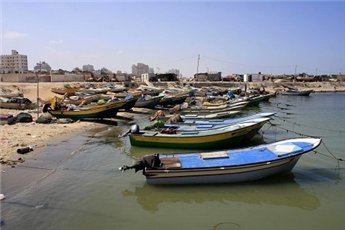
BETHLEHEM — Israeli naval forces attacked an international third party monitor on Wednesday in Gazan territorial waters.
Civil Peace Service Gaza works as part of a non-violent initiative to monitor human rights abuses in Gaza.
Israeli forces fired at the CPS Gaza monitoring boat, the Oliva, with water cannons on Wednesday at 12.05 p.m local time, a statement by the organization said.
There were four people aboard at the time, two CPS Gaza members, the captain and a journalist.
“We were fewer than two miles away from the Gaza coast when they fired at us. We saw them firing water at some fishing boats so we headed to the area. When we got close, the warships left the fishing boats, and turned on us.
“They attacked us for about ten minutes, following us as we tried to head to shore and eventually lagged when we reached about one mile off the Gaza coast,” British human rights worker Ruqaya Al-Samarrai said.
A fishing boat was also fired at and damaged with live rounds.
An Israeli army spokesman said he was unaware of the incident.
The Gazan fishing community is often similarly targeted and the fishing limit is enforced with comparable aggression, with boats shot at or rammed as near as 2 nautical miles to the coast by Israeli gunboats, CBS Gaza added.
A marine blockade imposed by Israel restricts Gazan fisherman from accessing eighty five percent of Gaza’s fishing waters as agreed upon under the Oslo agreements.
Following the capture of Israeli soldier Gilad Shalit in 2006 the Israeli navy imposed a complete sea blockade on the Gaza Strip for several months.
After Hamas took control of the coastal enclave in 2007, Israel limited fishing access to 3 nautical miles from the coast.
During the Oslo accords negotiators had agreed upon 20 nautical miles of fishing access along Gaza’s coastline.
Rights groups have condemned the blockade of Gaza as a form of collective punishment of the 1.6 million residents.
Israeli Authorities Uproot, Confiscate 450 Olive Trees in Salfit
WAFA – July 11, 2011
SALFIT – Israeli authorities Monday uprooted and confiscated 450 olive trees in Wadi Qana, an area west of Deir Estia near Salfit in the northern West Bank, according to Nazmi Salman, mayor of Deir Estia.
Israeli soldiers prevented Palestinian farmers from reaching their land in Wadi Qana under the pretext of it being classified as a closed military area, said Salman.
He added that an Israeli bulldozer accompanied by officers in the civil administration and soldiers uprooted 450 olive trees and destroyed land that belongs to a Palestinian resident in Deir Estia.
He said that Israeli forces confiscated the olive trees and the fence that surrounds the lands. It is believed that they took the trees to the nearby settlements of Karnei Shomron, Yakir and Nofim.
The mayor condemned the continuous Israeli attacks against Palestinians, targeting the area of Wadi Qana, uprooting olive trees and destroying land reclamation projects in the area without any justification.
He pointed out that these measures are for the benefit of settlements and settlers who aim to control the water-rich area of Wadi Qana.
Salman stressed that Wadi Qana is witnessing an unprecedented campaign of occupation to make its residents’ lives difficult in order to pressure them to leave the area, as a prelude for Israel to judaize it.
He said these measures are taken on grounds of protecting nature and said, ‘Does uprooting trees protect nature?’
Israeli authorities had uprooted and confiscated 300 olive trees in the same area in late June.
The Zionist Entity Seeks a U.N. Opinion on Maritime Borders with Lebanon
Al-Manar – July 10, 2011
The Zionist entity is to seek a U.N. opinion on its maritime borders with Lebanon in the Mediterranean, where lucrative offshore gas fields have been found, Zionist Foreign Minister Avigdor Lieberman said on Sunday.
“We will soon be presenting the United Nations headquarters in New York with our position on our maritime borders,” Lieberman told Zionist public radio.
“We have already concluded an agreement on this issue with Cyprus… Lebanon, under pressure from Hezbollah, is looking for friction, but we will not give up any part of what is rightfully ours,” he added.
The occupying entity has been moving to develop several large offshore natural gas fields in the Mediterranean that it hopes could help it to become an energy exporter.
Those development plans have stirred controversy with Lebanon, which argues the gas fields lie inside its territorial waters.
Israeli entity does not have officially demarcated maritime borders with Lebanon since IOF had been forcibly withdrawn from part of the Lebanese land, occupied since 1982.
A senior Zionist official told AFP that their regular cabinet meeting will be held on Sunday, where ministers would endorse a map of Israel’s maritime borders in the Mediterranean to be presented to the U.N.
The two biggest known offshore fields, Tamar and Leviathan, lie off Occupied Palestine’s northern city of Haifa.
Tamar is believed to hold at least 8.4 trillion cubic feet of gas (238 billion cubic meters), while Leviathan is believed to have reserves of 16 trillion cubic feet (450 billion cubic meters).
In recent weeks, a Zionist company has also announced the discovery of two new natural gas fields, Sarah and Mira, around 70 kilometers (45 miles) off the city of Hadera further south.
Israel Marks New Path of Apartheid Wall
WAFA – July 9, 2011
BETHLEHEM – Israeli forces Saturday marked Palestinian land in al-Walaja, a village northwest of Bethlehem, to draw a new path of the Apartheid Wall, said a Palestinian official.
Deputy Head of Walaja village council, Adel al-Atrash, said that the Israeli forces marked the land to raze the land and to uproot olive trees to complete the construction of a section of the wall.
He added that the six-kilometer Wall will take over 500 dunums (1 dunum = 1000 square meters) and isolate another 1958 dunums, including an ancient olive tree called ‘Zytonet al-Badawi’ (Bedouin Olive Tree), which is estimated to be 1500 years old.
The Israeli measure coincides with the seventh anniversary of the International Court of Justice advisory opinion that found the construction by Israel of a wall in the Occupied Palestinian Territory and its associated régime are contrary to international law in 2004.
Featured Video

Thomas Fazi: NATO’s Hybrid Warfare – Deception & Permanent War
or go to
Aletho News Archives – Video-Images
Book Review
UAE tortured, killed journalist for opposing Israel normalization
The Cradle | October 31, 2026
UAE security officers detained, tortured, and killed Emirati poet and news editor Habib al-Sayegh in August 2019, shortly after he published a column opposing UAE normalization with Israel, according to a newly published book.
“Princes and Thieves,” a book by investigative journalist Matthew Cole published on 25 October, alleges that UAE security officers raided Sayegh’s Abu Dhabi home shortly after the publication of the column, hooded him in front of his wife and took him to a detention facility where he was tortured to death.
His interrogators reportedly pulled out several of his teeth with pliers and beat him repeatedly with a sharp metal object.
On 11 August 2019, Sayegh criticized the UAE’s plan to normalize relations with Israel as part of the Abraham Accords in his weekly column for Khaleej newspaper. The column was titled “Israel Is Our Real Enemy and A Dangerous Project.”
Sayegh described Israel as “a real and natural enemy” while questioning “who authorized the normalizers to speak on behalf of everyone?”
Nine days after the column was published, Emirati state media announced his death, without stating a cause. … continue
Blog Roll
 Aletho News
- Poland Is the Symptom and Europe Is the Patient
- UAE security forces tortured, killed journalist for opposing Israel normalization: Report
- They Compared the Spice to the Drug. The Spice Won — Again. (Part 2)
- Thomas Fazi: NATO’s Hybrid Warfare – Deception & Permanent War
- Wrong, AP and NPR: Europe’s 50,000 Heat Deaths Are a Computer-Model Estimate, Not a Real Body Count
- Questioning Your Doctor Is Now Considered A Psychological Problem (Seriously)
- London tourism expo promotes Israeli agency linked to theft of Palestinian land
- Dockworkers launch global strike against Israeli and US military shipments
- Europe facing gas price shock – Gazprom chief
- Ukraine continues recruiting people with disabilities
- If Americans Knew
- An error has occurred; the feed is probably down. Try again later.
- No Tricks Zone
- Germany’s Green Energy Transition Becoming Increasingly Expensive…Another 6 Trillion Euros!
- Sudden Stratospheric Warming, Powerful El Niño Combination May Lead To Extreme Europe Cold, Energy Crisis!
- Two New Studies Find Thwaites Glacier Melt Cannot Be Driven By Human Activity Or A Warming Ocean
- E-Cars Reduce CO2 Emissions By Only 41% Compared To Internal Combustion Engine Vehicles
- Predictions Made By Renowned Climate Professor Over Past Decades Have Been Proven To Be Poor
- New Study Suggests Large Regions Of The Pacific Ocean Have Been Cooling For The Last 80 Years
- Germany’s Green Energy Debacle: High Energy Costs Force Kahla Porzellan to Close After 182 Years!
- New Study: 50 Years Of The Most Aggressive ‘Net Zero’ Policies Can Only Affect The Global Climate By 0.03°C
- US September “Heat” Was No Record…Many Records Set Decades Ago
- Latest European Green Energy Debacle; Portugal’s Largest Flagship Solar Park Insolvent!

