British Colonial War Crimes in 1950s Kenya Mau-Mau Rebellion Whitewashed
By Jemima Pierre | BAR | 05/17/2011
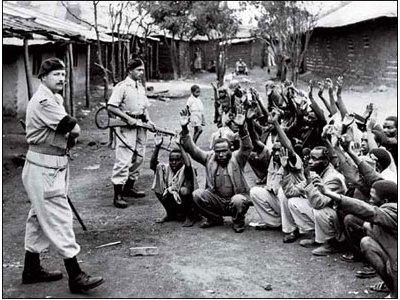
The western-manipulated International Criminal Court, which has indicted only African leaders, tries to give the world the impression that barbarity descended on the continent when the white colonists left. But four aging Kenyan “Mau Mau” freedom fighters, demanding reparations, are forcing Britain to acknowledge the savagery of white settlers and soldiers. “The generation of Africans who fought against colonialism is dying without recognition of their fight or their suffering at the hands of racist colonialism.”
In early April 2011, four elderly Kenyansi—three men and one woman—appeared in the High Court in London, accusing England of systematic torture during their siege of the so-called Mau Maus and demanding reparations for their treatment. One of the men was castrated by the British colonial government in Kenya. Handcuffed and pinned to the ground with his legs pulled apart, his genitals were sliced off by the white officers. He was then left for days without medical attention until he was liberated by Kenyan rebels. The one woman claimant was subjected to sexual torture. White soldiers repeatedly inserted bottles of boiling hot water into her vagina. In addition to these cases, thousands of Kenyans were maimed, lynched and brutally murdered by the British during the last century. Thousands of others were subjected to rape, forced labor, and gross abuse and torture in detention camps. It was part of a deliberate policy of the colonial British government to break a civilian population cast as “baboons,” “barbarians,” and “terrorists” and who were seen as a threat to the colonial order in east Africa.
The proper name for the liberation forces that fought against British colonialism and land-grabbing in East Africa was the Kenya Land and Freedom Army.ii The movement was derisively called “Mau Mau” by the British propaganda machine in an attempt to depict these African freedom fighters as a primitive and anti-white tribal cult. Against this, the late C. L. R. James described the movement as “an ad hoc body of beliefs, oaths, disciplines newly created for the specific purpose of gathering and strengthening the struggle against British imperialism, its military, political and economic domination and, in particular, the Christianity it sought to inject and impose.” And it was land and white settlers, not African “tribal” beliefs that were at the heart of the so-called Mau Mau revolt against British colonialism.
The colonial invasion of Central Kenya began in the late 1880s. It was formalized through military conquest, particularly over the most numerous ethnic group, the Gikuyu, as well as the Embu and the Meru. By 1903, the British colonial government sent in waves of white settlers, from South Africa and England, with the hope of creating another “white man’s country” in Kenya. They stole between 60,000 and 1 million acres of land, settling whites in the most fertile regions with the coolest climates—an area they eventually named the “White Highlands.” By the time the colony of Kenya came into being in 1920, more than 10,000 whites had settled over 25% of Kenya’s best territory. At the same time, the African population, mainly but not entirely the Gikuyu, were driven into reservations or were forced to work as sharecroppers. Then, through hut and poll taxes, restrictions on movement through the issuing of kipande (identity passes), and limits on agricultural production, Africans became systematically entrapped into the racist Kenyan colonial system. Add to this mix the ever-expanding power of the white settlers and Christian missionaries, and Kenya was primed for a revolution.
Though all ethnic groups were affected by British colonial land-grabbing and dispossession, the Gikuyu experienced this most acutely. They did not take lightly the heavy theft of land. When, in 1943, the colonial government threatened groups of Gikuyu with yet another eviction from their lands, they decided to take action. Their struggle began with overt passive resistance but was quickly radicalized. Wings of the movement began armed guerilla attacks on white settler holdings and on Africans who supported the British regime. At the height of the revolt, it was estimated that 1.5 million Gikuyu and other Kenyan groups had taken secret oaths of unity to fight against white settlers and colonial rule. They were met with a brutal armed retaliation. By late 1952, the colonial governor of Kenya declared a state of emergency. The colonial government established and enforced communal punishment, curfews, schemes to confiscate African properties, censors for publications, detention without trial, control of African markets, forced migrations, and detention and labor camps.
By late 1954 the revolt was said to have been militarily defeated by the British army, but the state of the emergency was not lifted until 1960. During the six intervening years, the Mau Mau struggle continued as the British colonial government established a terrorist state. The assault on the Africans continued both through the campaign to arrest and dispose of the alleged Mau Mau leadership, and in detention camps, prisons, and “emergency villages.” The British focused primarily on forcing the Gikuyu to renounce their oath of unity by the most brutal means. According to the Kenya Human Rights Commission, by the time the colonial government ended the state of emergency, over 90,000 Kenyans were executed, maimed, or tortured, while 160,000 were held in detention camps. Others have argued that the numbers were higher. What is well documented is how colonial agents were unrivaled in their barbarity. They castrated and sexually abused, starved, and maimed detainees in order to force the alleged oath takers to confess. They used electric shock, cigarettes and fire, broken bottles, gun barrels, knives, snakes, vermin, and hot eggs were thrust up men’s rectums and women’s vaginas. The assault only came to an end when the Gikuyu population was almost physically decimated and psychologically broken.
If not for the legal case brought against the British government by four surviving Kenyans, we would not know about the trove of secret colonial files documenting the systematic nature of their torture of Africans. The generation of Africans who fought against colonialism is dying without recognition of their fight or their suffering at the hands of racist colonialism. In the current context where Africans, through organizations such as the ICC, are constructed and targeted as the greatest purveyors of “crimes against humanity,” it is well worth remembering the venal work of Europeans in Africa. The demands for reparations may begin with four elderly Kenyans traveling to the old center of the British empire, but the colonial archive surely documents crimes against the Herero, the Congolese, and many other victims of European colonialism. We should not forget their struggles.
i – Wambugu Wa Nyingi, Jane Muthoni Mara, Paulo Nzili, and Ndiku Mutwiwa Mutua
ii – For Further Reading: C. L. R. James, A History of Pan-African Revolt (1995); Caroline Elkins, Britain’s Gulag: The Brutal End of Empire in Kenya (2005); Cora Presley, Kikuyu Women, the Mau Mau Rebellion, and Social Change in Kenya (1992); Gerald Horne, Mau Mau in Harlem? The U.S. and the Liberation of Kenya (2009)
Jemima Pierre can be reached at BAR1804@gmail.com.
Multinational companies mining occupied Palestinian land
Adri Nieuwhof – The Electronic Intifada – 17 May 2011
HeidelbergCement and Cemex, two building materials industries from Germany and Mexico, respectively, are involved in the operation of quarries in the occupied West Bank. The Electronic Intifada has obtained documentation showing loaded trucks leaving the illegal quarries and traveling into Israel.
International law prohibits Israel’s exploitation of natural resources in the occupied West Bank, Gaza Strip and Syrian Golan Heights for its own benefit.
Meanwhile, Israeli run-quarries in the West Bank — including Nahal Raba and Yatir quarries, which are operated by subsidiaries of HeidelbergCement and Cemex — supply almost a quarter of Israel’s construction material.
HeidelbergCement’s subsidiary Hanson Israel operates the Nahal Raba quarry in the West Bank near the green line — Israel’s internationally-recognized boundary with the occupied West Bank — and Kfar Qasim, a Palestinian village in Israel.
Cemex owns fifty percent of Yatir Quarry through its subsidiary ReadyMix Industries. The Yatir quarry lies next to the Israeli settlement of Teneh Omarim in the south Hebron hills of the West Bank.
Invested in the settlements
Who Profits? — a research project of the Israeli Coalition of Women for Peace — has documented the illegal activities of the two companies in the West Bank.
All Israeli settlements in the West Bank and Syrian Golan Heights are illegal under international law.
According to the research project, Hanson Israel owns two concrete plants in the West Bank settlements of Modiin Illit and Atarot, and an asphalt plant south of the Elqana settlement.
Meanwhile, ReadyMix owns plants in various Israeli settlements. This includes Mevo Horon, the Atarot industrial zone and the Mishor Edomim industrial zone, all in the occupied West Bank, and Katzerin in the occupied Golan Heights.
ReadyMix also provides concrete elements for the construction of Israel’s wall and military checkpoints in the West Bank and provides concrete for the construction of Israel’s controversial light rail project. The project strengthens Israel’s grip on the greater Jerusalem area by connecting West Jerusalem with several settlements in or surrounding occupied East Jerusalem.
The activities of HeidelbergCement and Cemex subsidiaries in Nahal Raba and Yatir quarry are contrary to international law.
Article 55 of The Hague Regulations of 1907 explicitly stipulates on quarrying that it “forbids wasteful or negligent destruction of the capital value, whether by excessive cutting or mining or other abusive exploitation, contrary to the rules of good husbandry.” UN General Assembly Resolution 1803, passed in 1962, states that permanent sovereignty over natural wealth and resources is a “basic constituent of the right to self-determination.”
In 2004, the International Court of Justice reaffirmed the Palestinian people’s right of self-determination and Israel’s status as the occupying power in the Gaza Strip and West Bank, including East Jerusalem. The court also determined that Israel’s wall and settlement construction in occupied territory were illegal under international law.
According to an Israeli Ministry of Interior report, the quarries in the occupied West Bank provide 12 million tons of construction material annually. Seventy-five percent of this material is used inside Israel and the rest is used for Israeli construction in the occupied West Bank (the report was referenced in a petition to the Israeli high court filed by attorney Michael Sfard on behalf of Yesh Din).
The Israeli daily Haaretz reports that in its annual report for 2005, Israel’s state comptroller revealed that although any royalties from the quarries should be used for the benefit of the Palestinian population, they were paid into the Israeli state treasury instead (“Digging up the dirt,”3 September 2010).

Photo taken by a human rights researcher documents a truck loaded with material from Yatir quarry entering Israel via Meitar checkpoint, 1 May 2011. (Dror Etkes)
Mining companies taken to court
In 2009, the Israeli human rights organization Yesh Din filed a petition with the Israeli high court, demanding a halt to illegal mining activity in West Bank quarries, including those operated by Hanson Israel and ReadyMix.
In Yesh Din’s petition to the court, attorney Michael Sfard wrote: “Indeed, we are committing a crime on the West Bank’s land when we extract deposits of gravel and rock from its soil and take them by the truckload to the sovereign territory of the State of Israel to serve the Israeli economy.”
The Israeli high court refused to order a temporary halt to mining activities or stop new mining concessions from being issued. Instead, it requested the response of the parties involved in the petition, which meant that it was business as usual for the companies operating the 11 quarries identified in Yesh Din’s report.
In response, in May 2009 Avi Dicht of the state attorney’s office wrote that the state would freeze the existing situation, including the planning of new quarries, recommending a six-month review (“Israel freezes expansion of West Bank quarries following high court petition,” The Jerusalem Post, 21 May 2009).
There has been no court action since then.
Meanwhile, the mining at both Nahal Raba and Yatir quarry continues. Dror Etkes, a human rights researcher who initiated and collected the data for the Yesh Din petition, documented how a Volvo truck loaded with construction material left Yatir quarry and entered Israel via Meitar checkpoint on 1 May.
According to Etkes, trucks transport construction material from the quarry into Israel several times per day. WhoProfits? also filmed a truck leaving the Nahal Raba quarry with gravel on 1 May. A video produced by the group indicates where the truck crosses the green line (“Hanson Quarry of HeidelbergCement in the West Bank”).
Mining contravenes corporate responsibility conventions
The involvement of multinational companies HeidelbergCement and Cemex in the plundering of the occupied West Bank and Golan Heights’ natural resources are not only in violation of international law, but also contravene commitments to codes of conduct and conventions which regulate the activities of multinational corporations.
These rules governing corporate responsibility include the 2000 UN Global Compact, the 2003 UN norms on the responsibilities of transnational corporations and the Organization for Economic Cooperation and Development (OECD) Guidelines for Multinational Enterprises adopted in 2000.
Both Heidelberg Cement and Cemex have endorsed the principles of the UN Global Compact. The UN Global Compact is a strategic policy initiative for businesses that are committed to sustainability and responsible business practices.
The first two principles of the Global Compact state that businesses should support and respect the protection of international human rights within their spheres of influence, and make sure they are not complicit in human rights abuses.
While HeidelbergCement was listed as a participant in the Global Compact in February 2004, today, the company no longer appears as a participant. Nevertheless, the company has developed a sustainability strategy and on its website, it claims that “The fair distribution of natural resources to current and future generations is one of the fundamental goals of sustainable development.”
Meanwhile Cemex continues to be registered as a participant in the Global Compact.
Institutional investors are increasingly wary of investing in companies that openly flout international law and corporate codes of conduct, including the importing of natural resources.
Meanwhile, the growing boycott, divestment and sanctions movement has exposed the complicity of a number of multinational corporations in the Israeli occupation, leading investors to divest from those companies. It is unlikely that HeidelbergCement and Cemex will be immune to this scrutiny.
Adri Nieuwhof is a consultant and human rights advocate based in Switzerland.
SOUTH HEBRON HILLS: Israeli settlers invade Palestinian village of Tuba
CPTnet | 16 May 2011
Israeli settlers invaded the village of Tuba in the South Hebron Hills late Sunday night, 15 May. They damaged property and killed and stole livestock belonging to the Ali Awad family. Palestinians of Tuba reported that they counted seven masked settlers, who entered and left the village on foot, and saw two cars at the outskirts of Tuba, near the chicken barns of Ma’on settlement. sight where one of the sheep was attacked and killed 008
The rampaging settlers stole seven sheep, killed two, and injured others, including one which lost an eye. In addition, the settlers upended three water tanks, which held a total of 4.5 cubic meters of water. They destroyed fences, punctured a storage tent and three large sacks of yogurt, damaged a goat pen and destroyed the ventilation pipe of an outhouse. They also set loose a donkey, which later returned.
A Tuba resident called Christian Peacemaker Teams about midnight Sunday to report the settler invasion and request help in urging the Israeli police to respond. The police refused to go to the village because no one there could speak to them in Hebrew. Two Israeli soldiers arrived in Tuba on Monday morning, but did not speak Arabic and so could not communicate with the villagers.
The Ali Awad family is considering making a complaint to the Israeli police, despite the fact that all their previous complaints about settler attacks, vandalism or harassment have not yet resulted in any indictments or compensation. On 21 March 2011, a masked settler from the illegal outpost of Havat Ma’on stabbed Mahmoud Ibrahim Ali Awad as the Palestinian traveled by donkey from Tuba to the city of Yatta. Mahmoud Ali Awad spent a week in the hospital recovering from stab wounds on his chest and arm.
Israeli Navy Attack Aid Ship to Gaza and Force it Back to Egypt
PNN – 16.05.11
Egypt – Israeli Naval forces attacked and intercepted on Monday morning aid boat named “The Spirit of Rachel Corrie Mission” off the Gaza coast. The ship’s 12 crew and passengers are safe. Currently the ship has been forced to anchor in the Egyptian waters at one and a half nautical miles from the Gazan waters. The vessel left the Port of Piraeus, Greece on Wednesday, May 11.
The humanitarian initiative is sponsored by Perdana Global Peace Foundation (PGPF) and participating in this mission includes anti-war activists and journalists from the Asian, American and European continents.
The cargo ship The Spirit of Rachel Corrie (officially known as FINCH) is carrying 7.5 kilometers of UPVC (plastic) sewage pipes to help restore the devastated sewerage system in Gaza. The ship was named after the courageous American activist who was crushed and killed by an Israeli bulldozer in 2003 while trying to prevent the demolition of another Palestinian home. She died at 23.
The Spirit of Rachel Corrie Mission is part of the Perdana Global Peace Foundation’s (PGPF) “Break the Siege on Gaza” campaign. The purpose of this campaign is to highlight the effects of the illegally imposed Israeli siege and raise awareness of the human rights violations of the people of Gaza. Breaking the siege and ending the illegal collective punishment of 1.5 million people must be a priority for the international community.
“The Palestinian struggle is nothing more than a struggle for justice, to which they, as much as everyone else, have a right.” Tun Dr. Mahathir Mohamad, President of PGPF stated.
In a press release by PGPF the group said that on 27 December 2008, the Israeli military launched Operation Cast Lead, which not only killed some 1400 Palestinians, but also destroyed vital infrastructure leaving the Gazans with critical water and sewage problems. PGPF says Repair of the infrastructure has proved impossible as Israel has prevented the entry of construction materials and fuel to resolve this dire situation.
According to a report from the Emergency Water, Sanitation and Hygiene group (EWASH), “the release of 80 million litres of untreated or partially treated sewage into the environment and Mediterranean Sea each day is primarily a result of the Israeli imposed blockade on the Gaza Strip.”
According to Physicians for Human Rights-Israel: “Between 90% and 95% of the aquifers in the Gaza Strip are not safe for drinking.” The primary cause of the current problem originates from the destruction, during Operation Cast Lead, of “20 kilometers of water pipes, 7.5 kilometers of sewage pipes and 5,700 mobile water tanks”.
Jewish settlers throw firebombs into Palestinian home
Palestine Information Center – 16/05/2011
AL-KHALIL — Armed Jewish settlers tossed a number of Molotov cocktails into the house of a Palestinian citizen in the Old City of Al-Khalil on Sunday night after encircling it.
The owner, Jamal Su’ifan, said that tens of settlers besieged his home and threw the firebombs into it, starting fire and burning part of the house, which was sheltering 20 individuals.
He said that Israeli soldiers were escorting the settlers, noting that two members of the Temporary International Presence in the City of Hebron (TIPH) team in Al-Khalil arrived to his home to check the incident but were also surrounded by those settlers.
The Su’ifan home is only a few meters away from the Kiryat Arba settlement, which was established on Palestinian land east of Al-Khalil. Settlers in Arba routinely attack nearby Palestinian homes in a bid to terrorize their inhabitants away and take control of them.
Israel Attacks Humanitarian Ship to Gaza in International Waters
By Michel Chossudovsky | Global Research | May 16, 2011
Global Research has been in contact with the Spirit of Rachel Corrie, a Malaysian ship carrying a humanitarian aid cargo to Gaza, which has been attacked in international waters by Israel.
The vessel left the Port of Piraeus, Greece on Wednesday, May 11 carrying 7.5 kilometers of UPVC (plastic) sewage pipes to help restore the devastated sewerage system in Gaza. The humanitarian initiative is sponsored by Perdana Global Peace Foundation (PGPF) and participating in this mission includes anti-war activists and journalists, consisting of 7 Malaysians, 2 Irish, 2 Indians and 1 Canadian.
The Spirit of Rachel Corrie is an initiative of The Perdana Global Peace Foundation (PGPF) chaired by Malaysia’s former Prime Minister Dr. Mahathir Mohamed. The Centre for Research on Globalization (CRG) (Global Research) is also participating in this mission.
At 10.54 pm Eastern Time (EDT), the Spirit of Rachel Corrie was intercepted by an Israeli ship and a Egyptian ship in international waters.
10:54pm EDT, Gaza 5:54am: We have been intercepted by Israeli ship and Egyptian ship. We are disobeying the orders and sailing ahead to Gaza.
10:57pm EDT, Gaza 5:57am: One Israeli warship coming to us very fast! We are in international waters, therefore they have no right to attack us. We are still sailing ahead.
10:59pm EDT, Gaza 5:59am: They are opening fire across our ship! We are still sailing ahead.
11:09pm EDT, Gaza 6:09am: They are shooting all over the place. We can’t continue …
11:35pm EDT, Gaza 6:35am: They circled our ship twice and fired across our ship. Machine guns. No one was injured. One of the fishing nets caught the propeller, so we can’t move now.
11:37pm EDT, Gaza 6:37am: The Israeli ship was coming from one end and the Egyptian ship was coming from another end. Firing. We are just stalled now. Everybody is okay. No one is injured.
In a subsequent communication from the boat, it would appear that Israel sought the active collaboration of Egypt in the interception of the humanitarian mission to Gaza, involving prior coordination between the Israelis and the Egyptian navy.
We will be informing our readers as events unfold.
UPDATE
AFP REPORT
The first press reports state that:
“Israeli naval forces fired warning shots at a Malaysian ship carrying aid to Gaza as it approached the shore, forcing it to withdraw to Egyptian waters, the vessel’s Malaysian organiser told AFP.”
“The MV Finch, carrying sewage pipes to Gaza, had warning shots fired at it by Israeli forces in the Palestinian security zone this morning at 0654 Jordan time (0354 GMT),” said Shamsul Azhar from the Perdana Global Peace Foundation.
Israeli naval forces fired warning shots at a Malaysian ship carrying aid to Gaza as it approached the shore, forcing it to withdraw to Egyptian waters, the vessel’s Malaysian organiser told AFP.
“The MV Finch, carrying sewage pipes to Gaza, had warning shots fired at it by Israeli forces in the Palestinian security zone this morning at 0654 Jordan time (0354 GMT),” said Shamsul Azhar from the Perdana Global Peace Foundation.
“Currently the ship has been forced to anchor in Egyptian waters, 30 nautical miles from Gaza,” he told AFP.” emphasis added
The information we have received from the ship is that (1) these were not “warning shots” as conveyed in the press reports.
The ship was (2) in international waters when it was attacked by Israel in violation of international law.
Israeli Puppets: Exposing the Enemies of the Free Flotilla to Aid Gazans
Aletho News | May 16, 2011
On Wednesday, Reps. Steve Israel (D – NY) and Tom Cole (R – OK) led a bipartisan letter to Turkish Prime Minister Recep Tayyip Erdoğan urging the Prime Minister to stop another flotilla from departing Turkey for the Gaza Strip.
Thirty-six Members of Congress signed the bipartisan letter including:
New York 2
Israel, Steve D 2457 RHOB 202-225-3335 (NO COMMITTEE ASSIGNMENT)
5 Ackerman, Gary D 2111 RHOB 202-225-2601 Financial Services
Foreign Affairs7 Crowley, Joseph D 2404 RHOB 202-225-3965 Ways and Means
8 Nadler, Jerrold D 2334 RHOB 202-225-5635 Judiciary
Transportation and Infrastructure24 Hanna, Richard R 319 CHOB 202-225-3665 Education and the Workforce
Transportation and Infrastructure
14 Maloney, Carolyn D 2332 RHOB 202-225-7944 Financial Services
Oversight and Government ReformOklahoma 4
Cole, Tom R 2458 RHOB 202-225-6165 Appropriations
BudgetCalifornia
28 Berman, Howard D 2221 RHOB 202-225-4695 Foreign Affairs
Judiciary29 Schiff, Adam D 2411 RHOB 202-225-4176 Appropriations
Permanent Select Intelligence
30 Waxman, Henry D 2204 RHOB 202-225-3976 Energy and Commerce JASON CHAFFETZ
Montana
At Large Rehberg, Dennis R 2448 RHOB 202-225-3211 Appropriations Texas
6 Barton, Joe R 2109 RHOB 202-225-2002 Energy and Commerce 2 Poe, Ted R 430 CHOB 202-225-6565 Foreign Affairs
Judiciary28 Cuellar, Henry D 2463 RHOB 202-225-1640 Agriculture
Homeland Security29 Green, Gene D 2470 RHOB 202-225-1688 Energy and Commerce Nevada
1 Berkley, Shelley D 405 CHOB 202-225-5965 Ways and Means Illinois
5 Quigley, Mike D 1124 LHOB 202-225-4061 Oversight and Government Reform
Judiciary9 Schakowsky, Jan D 2367 RHOB 202-225-2111 Energy and Commerce
Permanent Select IntelligenceArkansas
4 Ross, Mike D 2436 RHOB 202-225-3772 Energy and Commerce Florida
19 Deutch, Ted D 1024 LHOB 202-225-3001 Foreign Affairs
Judiciary20 Wasserman Schultz, Debbie D 118 CHOB 202-225-7931 Budget
JudiciaryLouisiana
1 Scalise, Steve R 429 CHOB 202-225-3015 Energy and Commerce North Carolina
2 Ellmers, Renee R 1533 LHOB 202-225-4531 Agriculture
Foreign Affairs9 Myrick, Sue R 230 CHOB 202-225-1976 Energy and Commerce
Permanent Select Intelligence11 Shuler, Heath D 229 CHOB 202-225-6401 Budget
Transportation and InfrastructureKansas
2 Jenkins, Lynn R 1122 LHOB 202-225-6601 Ways and Means Wisconsin
8 Ribble, Reid R 1513 LHOB 202-225-5665 Agriculture
BudgetNew Jersey
8 Pascrell Jr., Bill D 2370 RHOB 202-225-5751 Budget
Ways and Means9 Rothman, Steven D 2303 RHOB 202-225-5061 Appropriations West Virginia
2 Capito, Shelley Moore R 2443 RHOB 202-225-2711 Financial Services
Transportation and InfrastructureConnecticut
5 Murphy, Christopher S. D 412 CHOB 202-225-4476 Foreign Affairs
Oversight and Government ReformPennsylvania
3 Kelly, Mike R 515 CHOB 202-225-5406 Education and the Workforce
Foreign Affairs
Oversight and Government ReformOhio
2 Schmidt, Jean R 2464 RHOB 202-225-3164 Agriculture
Foreign Affairs
Transportation and Infrastructure6 Johnson, Bill R 317 CHOB 202-225-5705 Foreign Affairs
Natural Resources
Veterans’ AffairsColorado
5 Lamborn, Doug R 437 CHOB 202-225-4422 Armed Services
Natural Resources
Veterans’ Affairs
1948 – Al Nakba: a family’s collective memory
By Myrna Azzeh – 15 May 2011
“The old will die and the young will forget.” This was the prediction of the first Israeli Prime Minister David Ben Gurion. 63 years later, I still wonder what made him think so. Would the Jewish masses – or indeed any of the other groups of people – that suffered the Holocaust ever forget?
As far as I know, having lived in a refugee camp for most of my life, there has always been much space in the tiny alleys of the camp for the collective memory of Israeli massacres, systematic displacement and ethnic cleansing. These images have been printed in the minds of Palestinian refugees both young and old.
I never forget that 2003 Spring when my grandmother and I “went back” to our destroyed village Beit Jibrin. We managed to get there despite the checkpoints and high level of security. It isn’t easy although the actual distance that separates my refugee camp from the village is less than an hour’s drive. I’d been there a few times before but never with her. This was the first time. I walked behind her climbing up a hill in the village. She seemed much stronger and able to walk faster than I remembered. She knew where exactly we were going as if she was there yesterday.
Under a fig tree we sat and my grandmother smiled and remembered when she used to play with her friends, decades ago. She said, “It’s the same tree, a little bit different now; it’s been more than 50 years after all. Nonetheless, it is the same tree.”
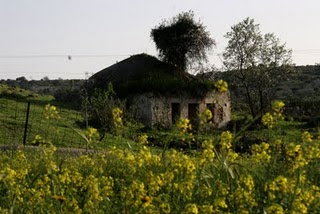 My head was saturated with thoughts; she must have whispered some of her childhood secrets to the old tree. She didn’t say much but the sadness in her eyes said it all. We smiled and kept seated, listening to birds singing and breathing as much of the village’s fresh air as possible as if we had never drawn breath before. This is, after all, the village I have been raised to understand is mine.
Her memories dated back to 1948. She was nearly 10 years old. Despite her young age, she remembered. She remembered her school, the lovely summer evenings she spent with her family in the village. She remembered the harvest time and travelling to Haifa and Yafa with her dad to sell their produce. She also remembered the nights when the peaceful village was first attacked. “We never saw a fighter jet before”, she said. Maybe they had, I thought, but I’m sure it wasn’t the same sight as the one that was now spreading death and fear into people’s hearts in 1948. This was the same year that witnessed over 750,000 of the native Palestinian population expelled from their homes and villages. So far, to this day, they have never been able to return.
63 years since, and in spite of the number of UN resolutions and world condemnations, Israel’s impunity still prevails. No justice has been achieved as Palestinian refugees are yet to see the implementation of the United Nation’s Resolution 242 that clearly affirms “a just settlement of the refugee problem” as well as Resolution 149 which states that “refugees wishing to return to their homes and live at peace with their neighbours should be permitted to do so at the earliest practicable date”.
As much as these resolutions have been alive in my grandmother’s memory, they are also imprinted in refugees’ consciousness whether they are acquainted with international law or not. Every Palestinian refugee resolutely believes in the right to live in the town or village from where they originate, and indeed where they and their families have been uprooted from by force.
Photo taken by Makbula Nassar- Al Jazeera documentary 2009
My grandmother passed away last March 2010 in the refugee camp. However, her dream of returning to Beit Jibrin is still alive and I deeply believe that she is in a place where borders do not exist. Her soul is finally free of the shackles of ethnic division, and she is able to hover over Palestine and our beloved village, our home, Beit Jibrin. She might be whispering secrets to the fig and olive trees there right now. Her dreams of return are still alive. As I will never forget her nor will I forget her passion when talking abut the village, I will always make sure I pass her dreams and aspirations to the coming generations. This, I believe is a promise that each refugee has taken unintentionally until the return and the full realisation of rights.
We will never forget my village and all the ethnically cleansed Palestinian villages as the memory remains in the heart and soul of all Palestinians. For us, the old may well die, but the young will never forget.
Israeli forces violently arrest demonstrators in al-Walaja
15 May 2011 | International Solidarity Movement
At 11 AM on al-Nakba remembrance day, 500 residents from the West Bank village of al-Wallajeh and international supporters marched towards the Israeli Apartheid Wall. The Wall was built to separate the villagers from their original land from which they were expelled in 1948. The demonstration was violently attacked by the Israeli military with rubber coated steal bullets, tear gas and protesters were beaten with batons and rifles. One youth was hospitalized after being injured by a rubber coated steal bullet.
Eight Palestinians including twins aged 11 and 6 internationals (American, Dutch, German and Canadian nationals) were arrested. The army proceeded to raid the village and invade each house, searching for people who had participated in the demonstrations. The raids as well as confrontations between the army and the village youth are ongoing.
The Arrested Palestinans are:
Mazen Qumsiyah
Basel Al Araj
Ahmed Al Araj
Mohammad Al Araj
Allah And Mohammed Abu Tin 11 year old twins
Tarek Abu Tin
Adel Abu Tin
Al-Walaja is an agrarian village of about 2,000 people, located south of Jerusalem and West of Bethlehem. Following the 1967 Occupation of the West Bank and the redrawing of the Jerusalem municipal boundaries, roughly half the village was annexed by Israel and included in the Jerusalem municipal area. The village’s residents, however did not receive Israeli residency or citizenship, and are considered illegal in their own homes.
Once completed, the path of the Wall is designed to encircle the village’s built-up area entirely, separating the residents from Bethlehem, Jerusalem, and almost all their lands – roughly 5,000 dunams. Previously, Israeli authorities have already confiscated approximately half of the village’s lands for the building of the Har Gilo and Gilo settlements, and closed off areas to the south and west of it. The town’s inhabitants have also experienced the cutting down of fruit orchards and house demolition due to the absence of building permits in Area C.
According to a military confiscation order handed to the villagers, the path of the Wall will stretch over 4890 meters between Beit Jala and al-Walaja, affecting 35 families, whose homes may be slated for demolition.
Israeli Army Places West Bank Under Siege
By Saed Bannoura – IMEMC & Agencies – May 15, 2011
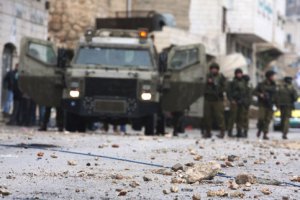
Photo credit – Oren Ziv, Active Stills

As the Palestinians prepare the mark the Nakba Day on Sunday, the Israeli authorities decided to place the West Bank under a 24-hour siege under direct orders issued by Israeli Defense Minister, Ehud Barak.
The Israeli Radio reported that Israel will be deploying nearly 10.000 policemen and soldiers in East Jerusalem, and in Arab towns in the 1948 Territories.
The Israeli government said that it will be arresting any person who marks the Nabka in “Israel”, and also deployed hundreds of policemen in cities have have Arab and Jewish inhabitants.
The extensive police presence in Jerusalem, and other areas, is expected to remain in effect for several days especially after a settler shot and killed a youth, identified as Milad Ayyash in Silwan town, in East Jerusalem.
Ayyash was seriously wounded on Friday and died of his wounds at a Jerusalem hospital on Saturday morning. He was shot by a Dumdum illegal round fired by a settler from the illegal “Yonatan” outpost in East Jerusalem. The police also kidnapped two residents in Silwan neighborhood.
Furthermore, hundreds of residents held a massive protest in Jaffa marking the Palestinian Nakba, no clashes were reported.
Israel places Hamas leader in administrative detention
Palestine Information Center – 15/05/2011
 NABLUS — The Israeli prison authority transferred Khalid al-Hajj to administrative detention Saturday night, the Tadhamon international organization for human rights reported.
The Ofer military court sentenced Hajj, 45, to six months in administrative detention a week after he was arrested at an Israeli checkpoint near the West Bank city of Jenin.
He has been detained seven times in Israeli prisons over the past two decades, with prison time exceeding 13 years. He was released about a year ago after he was placed in administrative detention for three years. He was later arrested as the Palestinians began to reconcile.
Israel has also transferred prisoner Rami Esam Suleiman, 32, from Marda near Salfit to serve six months in administrative detention. That was after he had already served four years in prison, Tadhamon researcher Ahmed al-Beitawi added.
The Israeli army arrested Suleiman 18 May 2007 and placed him in administrative detention before he was sentenced to four years in prison. After he completed the term, he was switched to administrative detention. He was said to have been arrested three times spending more than nine years in Israeli prisons.
Beitawi said that the policy of placing prisoners in administrative detention after they serve their terms is a regular policy that Israel has taken against its Palestinian captives.
Afghan Civilians Intentionally Targeted by NATO/ISAF Forces
Veterans Today | May 14, 2011
Careful examination of numerous reports, and images/video footage, along with eye-witness and victim testimonies, clarify that Afghan civilians are the main targets of deadly attacks by North Atlantic Treaty Organization (NATO) and International Security Assistance Force (ISAF).
Although the Coalition forces claim that previous civilian massacres were accidental, Afghan-led peace movements believe that the killings are at best negligent to at worst intentional in nature.
Foreign military presence and intervention in the past ten years has worsened the Afghanistan situation while civilian casualties have increasingly created tension between the Coaliton forces, the Afghan government, and the people of Afghanistan.
These events have further brought into perspective the sheer human and material damages of the war. No one should become accustomed to or believe in this illogical method of bombing the country to peace.
This mentality is not justifiable and should not be the norm. Acts of violence must always be questioned. The people of Afghanistan want justice and accountability. Not surprisingly, they get the usual response from NATO – an initial denial of civilian casualties, a shift of blame on insurgency, occasional investigations with an admittance to a tweaked number of civilian deaths, and rarely a contrived apology. This has become a wanton pattern. Explaining away repeated deadly civilian attacks as “mistakes” is unacceptable. Furthermore, this proves that the military solution to Afghanistan is not a viable option.
NATO-led forces are equipped with the most advanced technology with the capability of zooming in on even the smallest of objects with precise vision. This begs the question as to why so many civilians are dying. To put it into perspective, below is a compiled short summary of recent NATO attacks:
It was reported that a total of three civilian atrocities were committed by the Coalition forces within the last two weeks. The correct estimate is actually four.
- Alahsay district of Kapisa province (5 civilians) Feb 17, 2011
- Khoygani District of Nangarhar province (6 civilians) Feb 20, 2011
- Ghazi Abad District of Kunar province (60+ civilians) Four Day Operation February 17/18/19 (different reports)
- Mountains of Nanglam in Kunar province (9 children/boys) March 1st, 2011
In Kapisa province on Thursday February 17th, Alahsay district Governor Mohammed Omari confirmed that five civilians were killed by an air strke from the NATO-led ISAF. The five civilians- three of them adult males and two children ages 12 and 13 – were reportedly without meat for the last few months and were desperate to hunt, hence why they were carrying bird hunting equipment.
In Nangarhar province on February 20th, an entire family of six was killed by a NATO air strike into their home in the Khoygani district. A photo captured by Reuters shows that the missile directly hit the roof of the family’s home. The parents and their four children were all inside when the reportedly stray missile landed in their residential community. The father was a soldier for the Afghan National Army who died of excessive bleeding after troops delayed his arrival to a hospital.

After a four day operation by ISAF and NATO in the Ghazi Abad District of Kunar over 65 civilians were killed, and this was confirmed by the governor of the province. More than half of the casualties were women and children. Contrary to the abundant evidence, NATO claimed no civilians were killed and later insisted that insurgents were among the deceased, although villagers rejected this assertion.
Two reports from the Afghan investigation team:
“As soon as the villagers heard the shooting and planes roaring overhead, they all struggled to take refuge in an old trench that was used by the mujahedeen during jihad [against the Russians].”
“Those who succeeded in reaching the trenches were killed when the trench collapsed after it was hit by rockets or bombs being fired from coalition helicopters,” he said. “Those who were on their way to the trench were killed by rockets or bullets. I visited the trench. I saw old, dried blood. I saw women and children’s garments. I saw blood-stained walls of the trench. I saw pieces of blankets and cotton from the quilts the villagers wrapped themselves in because of the cold weather.”
In an attempt to hide the news story ISAF detained two Al Jazeera journalists, Abdullah Nizami and Saeedullah Sahel during the investigation of the Kunar massacre. Samer Alawi, the Al Jazeera bureau chief in Kabul, strongly described the detentions of Nizami and Seedullah as repressive acts since it kept them from reporting. Another report released this past month by Columbia Journalism Review, has documented the difficulty of reporting honest accounts of the Afghanistan war.
On March 1st, NATO helicopters killed 9 Afghan boys, and injured one. This occurred without any warning signals as the children were targeted “one after another”. Aged seven to nine years old, the boys were from poor families, and were collecting firewood in the mountains. This is once again an attack on the young children of Kunar. How is it that NATO soldiers, again, confused children for insurgents, and this time by gunfire?

General David H. Petraeus apologized for this killing, yet regarding the previous attack in Kunar (that killed over 65 civilians), he erroneously accused the Afghan parents of intentionally burning their children due to cultural practices of discipline. Hamid Karzai’s spokesman Waheed Omar described the US Generals comments as being “outrageous, insulting and racist.” Karzai, himself, has rejected the apology. Mohammed Bismil, the brother of two of the boys killed, did not care for Petraeus’ apology but said, “The only option I have is to pick up a Kalashnikov, RPG [rocket-propelled grenade] or a suicide vest to fight.”
The father of two of the boys killed cried, “They don’t value humanity and don’t care about our children.”
Waheed Mujda, an Afghan political analyst stated that, “[for international forces], Afghan people’s blood is of no value. For the Americans, apologising for a mistake is a very big deal but for Afghans it is not. ISAF troop actions that raise anger among Afghans are a major reason for people joining the insurgents or Taliban.”
These are the four war crimes committed by the Coalition forces in the past two weeks. Victimization and the feeling of betrayal continues to spread all across Afghanistan.

While this article initially started on the four recent attacks by NATO, it is important to look at the previous events as well. In doing so, we realize that these are not isolated incidents or simply negligence but an ongoing pattern of the failures of the “military solution to Afghanistan”.
Apologies from the Coalition, as rare as they are, mean little to nothing to Afghans. Months earlier in 2010, after initially choosing not to investigate, NATO forces offered an apology for killing a fourteen year old girl. Her father Mohammad Karim simply responded, “Now, what should I do with ‘sorry’?”
Earlier in Nangarhar, in May 2010, when NATO soldiers raided a home shooting at least nine civilians indiscriminately, a mourner said:
“If the Americans do this again, we are ready to shed our blood fighting them. We would rather die than sit by and do nothing. If there was anyone here trying to destroy our country, we would capture them and hand them over to the government. It is our land and our duty to defend it against both foreigners and insurgent infiltrators.”
He spoke further on this by saying, “If the military keeps doing this, the people will go into the mountains to fight them. When I saw my daughter injured, all I could think about was putting on a suicide jacket.”

Last month was the one year anniversary of the killing of two pregnant mothers, men and a teenage girl by a NATO night raid. In an attempt to cover it up, the US forces literally dug the bullets out of the victims bodies. In a Democracy Now interview Glenn Greenwald said, “Here you have an incident that we know about only because of sheer luck with the determination of a single reporter, and again the military lying about what took place.” A recent report on survivors of night raids gives a close look at how foreign troops justify killing civilians. One witness of night raids, Anwar Ul Haq, said, “Whenever they shoot or kill anybody, they call him al Qaeda whether he is or not.”
Without regard for civilians, the Tarok Kolache village in Afghanistan’s Arghandab River Valley was completely destroyed with 25 tons of bombs. Is the destruction of entire villages, which are the support system for the majority of Afghans, a logical tactic in counter-insurgency? Clearly, the Afghans who have suffered due to this disagree. A farmer of the Arghandab district asked “Why do you have to blow up so many of our fields and homes?”, while one angry villager accused the military of ruining his life after the demolition.
In addition to witness and victim testimonies, the Coalition forces themselves have made eye-opening revelations on the target killings of civilians. In September 2010, it was revealed that a dozen US soldiers faced charges in their involvement of not only killing innocent Afghan civilians at random for sport, but also collecting the victims finger bones, leg bones, teeth, and skulls as trophies. The military refuses to release photos that show US soldiers posing with naked, mutilated and charred corpses of their victims. Sound familiar? The father of one of the victims killed was quoted as saying, “The Americans really love to kill innocent people.” In fact, they had planned on killing more civilians had it not been for one soldier, Spc. Adam Winfield, and his father who tried relentlessly to blow the whistle. He had said his squad leader “gives high-fives to the guy who kills innocent people and plans more with him.- I have proof that they are planning another one in the form of an AK-47 (machine gun) they want to drop on another guy.” Instead of honoring Winfield for exposing the truth, he was instead charged with the same crimes. His father had reported Winfeld’s statements to Army officials, but they turned a blind eye. One can’t help but to wonder whether the killing of civilians for sport is more abhorrent or the apparent negligence and silence by the higher ups in the Armed forces.
Speaking of higher ups in the Armed forces, General Mattis, who replaced Petreaus as chief of US Central Command, said “Its fun to kill people…it’s a hell of a lot of fun to shoot [Afghans].” He continued: “Actually, it’s a lot of fun to fight. You know, it’s a hell of a hoot. It’s fun to shoot some people. I’ll be right upfront with you, I like brawling.” A bit later he spoke of the “emotional satisfaction you may get from really whacking somebody.”‘ He reportedly even told his troops to “have a plan to kill everybody you meet.”
Afghans have been resisting this dehumanizing way of life where they are regarded as savages or merely objects to be killed for sport. A recent poll conducted in Afghanistan shows that more than half of the Afghans interviewed believed NATO-led forces should begin withdrawing from the country in mid-2011 or sooner. Afghans no longer want anything from NATO but to simply leave. Massive protests and demonstrations against the Coalition following recent attacks are now erupting throughout Afghanistan in cities like Kunar, Kabul city and Nanglam, where Afghan demonstrators have been marching in streets chanting, “death to the invaders” and “We don’t want the invading forces.” Another man explained, “We say to ISAF that revenge is part of our culture. We say to our leaders, our government, that this kind of violence should be investigated. Those responsible should be punished.” A woman held a placard that read, “Occupation = Killing + Destruction.” In one demonstration, angry protesters burned a pile of blankets, clothing, and other items donated by Coaltion troops. An independent member in the legislature, Ramazan Bashardost, said “These killings must be stopped or the people will rise against foreigners and we will stand by them.”
Civilians fear not only NATO and ISAF but also suicide bombings by Armed Opposition Groups. Simultaneously with the terror by Coalition forces, recent suicide blasts have taken the lives of around 100 Afghan civilians.
The almost decade long war and occupation has done more harm than good, escalating violence in Afghanistan to its peak, and continues to deteriorate chances of peace for the future. Afghanistan has already been subjected to previous decades of war and now each new generation is haunted with both the memory and reality of endless bloodshed, death, and misery. The fact remains that Afghans continue to live with hunger and worsening poverty, torture and humiliation, planted with weapons, escalating air strikes and night raids.
The responsibility lies on the Afghan government, Taliban, warlords, and especially NATO/ISAF forces, including top commanders like General Petreaus, who must be brought by the people of Afghanistan and the world through a judicial process to account for their crimes, failed military solutions, and indiscriminate killings. Instead, the corrupt system in power continues to leave Afghans helpless and without a voice, and has them convinced that they are incapable of self-determination. However, it must not be forgotten that Afghanistan has a long history of independence and are more than capable of running their affairs. It is vitally important to listen to Afghans. It is the right of the people to decide the fate of their country and there are no exceptions. With the recent revolts in Arab countries, it’s only a matter of time before Afghans follow their lead. This requires immediate change and an honest vision for a truly democratic Afghanistan. In doing so, we must be aware of the ground realities, namely the presence of NATO, Taliban, warlords as well as regional intervention.
Global Afghan-led peace groups such as Afghans for Peace (AFP), Afghan Youth Peace Volunteers (AYPV), and the Afghan Canadian Student Association (ACSA) stand in solidarity with the people of Afghanistan in their struggle for justice and freedom. They fully acknowledge and strongly condemn these cruel, targeted massacres of innocent human life. AFP, AYPV and ACSA calls on the people of the world, especially Afghans, to rightfully demand an end to this illegal war and occupation. When children are being killed one by one, as was the case in Kunar last week, all of humanity suffers. When civilians have become the targets, it is time for everyone to stand up.
Signed by:
Afghans for Peace
Afghan Youth Peace Volunteers
Afghan Canadian Student Association
Afghan Perspectives
Featured Video

Death Spikes & Rising Cancer In Our Youth Explained
or go to
Aletho News Archives – Video-Images
From the Archives
Politicians lie
By Mazin Qumsiyeh | Popular Resistance | August 18, 2013
There is no way to say this truth nicely: Politicians lie. That includes Japanese, American, Egyptian, Israeli, and Palestinian politicians! Is there something more common sense than that? Yet, so many citizens around the world believe their own politicians or wistfully acknowledge lies but think it is part of the job needed to run things. They believe even when politicians contradict themselves blatantly. This phenomenon is rather remarkable. It is a dissonance and disconnect from reality that many seem oblivious to. It is very dangerous because it can lead to accepting rationales for going to war. These can be deadly wars that lead to millions of lives lost as happened in what was called World War 1 and WW2. Even when incredible and declassified evidence abound, politicians continue to lie and old mythologies refuse to die. Here are just a few of the countless lies told to us over the past few decades… continue
Blog Roll
 Aletho News
- China pushes back against US on Cuba, Iran
- Ukrainian Soldiers, Potential Mercenaries: Have Gun, Will Travel!
- Burnham’s UN debut… A masterclass in British disinformation
- Iran flights continue despite US aviation sanctions
- Global Tipping Points Lead the World Into a State of Entropy
- The day-after at the White House: USA and Xi Jinping
- The Geopolitical Balance in the Red Sea: The UAE Being Displaced by New Players
- Iraqi resistance group vows to stage airport sit-ins over Iran aerial blockade
- Turkish parliament to review Saudi-Pakistan defense pact next month
- DEATH SPIKES & RISING CANCER IN OUR YOUTH EXPLAINED
- If Americans Knew
- Deconstructing Netanyahu’s pants-on-fire UN rant – Daily Update
- Trump betrayed voters with his campaign lies and prioritized a foreign country once he took office
- Netanyahu calls Israel’s war in Gaza ‘opposite of genocide’ in UN speech to near-empty hall
- Settler Kidnappings: Torture, Sexual Abuse and Terrorisation of Palestinian Abductees as Israel Deepens Annexation of West Bank
- Gaza winter nears as 162,000 tents become unusable, raising fears of humanitarian crisis
- Netanyahu says, “It’s the opposite of genocide”; UN says Gaza economy is world’s ‘most severe crisis on record’ – Daily Update
- Israel’s US-Backed Assault on Gaza Has Created the ‘World’s Most Severe Economic Crisis on Record’: UN
- ‘Protecting U.S. Citizens’… From Israel
- ‘This is where I live now, the back of a truck’: a day in the life of a grandmother in Gaza
- In UN Speech, Iran’s President Displays Pictures of Children Killed by US, Brings Attention to Israel’s Nuclear Arsenal
- No Tricks Zone
- New Study: Earth And Venus Surface Warmth Largely Explained By Convection And Lapse Rate, Not CO2 Or Radiation
- 2025 Nature Paper Claiming Worsening Global Drought Gets RETRACTED …Heavily Flawed
- New Study: ‘Global Drought Shows No Detectable Recent Acceleration Under Climate Warming’
- Economic Masterminds: German Socialists Suggest Taxing Productivity Gains Stemming From Using AI
- The South China Sea Has Not Been Cooperating With The Climate Change Narrative
- Energy Crisis: Germany Enters Heating Season With Historically Low Gas Reserve Fill Levels
- New Study: The Antarctic Ice Sheet Gained Mass From 2020-2024 Due To Staggering Snow And Ice Accumulation
- Study: Ocean Heating Rates From Thousands Of Years Ago ‘Dwarf’ Modern Ocean Heating Rates
- Climate Extremists Target, Attack Large-Scale Power Grid Infrastructure In Germany!
- New Study: Antarctic Ice Melt Has Contributed Less Than 1 Centimeter To Sea Level Rise In The Last 30 Years

