Hebron: Checkpoint soldiers shoot driver
Ma’an – 21/01/2011
HEBRON — Soldiers at a flying checkpoint on Route 60 north of Hebron shot and critically wounded a Palestinian citizen of Israel on Thursday night.
The Israeli military said events around the shooting were unclear.
Security sources identified the man as 28-year-old Jalal Al-Masri, and said he sustained a bullet wound in his head.
Officials said the Israeli report was that Al-Masri disobeyed orders of checkpoint soldiers and was fired on.
According to reports by the Israeli newspaper Yedioth Ahronoth, the military is investigating the possibilities that the driver either did not notice the flying checkpoint, or that he intended to harm soldiers and sped toward it.
Hours earlier in the northern West Bank, the Ya’bad Mevo Dotan checkpoint was closed and eyewitnesses said the body of a Palestinian man remained lying in the car passage terminal after the Israeli military reported a man was shot in an exchange of gunfire.
The slain man, identified as Salem Omar As-Samudi, 24, from Yamoun in the Jenin district, was said by eyewitnesses to have opened fire on Israeli forces at the checkpoint, confirming Israeli military reports that a man approached checkpoint soldiers and opened fire.
Two others had been shot dead at checkpoints in the last three weeks. On January 8 Israeli troops stationed at Hamra checkpoint east of Nablus shot and killed a Palestinian man who onlookers identified as 25-year-old Khaldoun Sammoudi, of Al-Yamun village near Jenin.
An Israeli military spokesman said a man approached the checkpoint in a taxi, then got out of the vehicle and ran towards forces holding a suspicious object and shouting “Allahu Akbar.” He did not heed orders to stop and forces followed operational procedures and shot him, the army official said.
At the same checkpoint on January 1, soldiers shot and killed a 21-year-old Palestinian identified as Ahmad Maslamani, who a military spokeswoman said approached soldiers in an unauthorized lane carrying a glass bottle and did not heed orders to stop.
Witnesses said the victim approached the checkpoint carrying a coca-cola can, a female soldier shouted at him and two male soldiers immediately opened fire. Medics said Maslamani’s body was riddled with bullets.
UN Security Council: An organization for injustice
By Kourosh Ziabari | The People’s Voice | January 19, 2011

Since its very inception in 1946, the United Nations Security Council demonstrated that it cannot be trusted as a podium of justice for the world countries, specially the oppressed and defenseless nations which eye the assistance and patronage of the powerful and economically influential nations for tackling their political predicaments and crises, and showed that it merely pursues the interests of its small bloc of five permanent members and undemocratically discriminates against a multitude of countries who don’t have a say in the policies which directly affects them.
United Nations Security Council is said to be one of the principal organs within the operative system of the United Nations and is “allegedly” charged with the maintenance of international peace and security. The authorities possessed by UNSC are the establishment of peacekeeping missions, imposition of international sanctions and authorization of military actions whenever necessary.
UNSC has five permanent members: China, Russia, Britain, France and the United States. What’s the reason? Why should the UNSC have permanent members which cannot be removed from power and must wield an unyielding and resolute authority to make decision over the international affairs? The answer is simple: these five countries are the victorious powers of the Second World War. Their victory in a war which took place and was concluded more than half a century ago minimally accounts for the eternality and endlessness of the power which they possess.
UNSC has also 10 non-permanent members which are elected on a rotating basis and through the vote of the members of United Nations General Assembly.
According to the Article 27 of the UN Charter, a draft resolution on non-procedural matters is adopted if nine or more of the fifteen members of the UNSC vote for the resolution, provided that none of the permanent members veto it.
What is the veto power? The answer is simple. It’s a discriminatory and biased privilege given to five countries to dictate their own will to some 200 countries as they wish. If a draft resolution, put forward by one of the fifteen members of the UNSC, is vetoed by any of the five permanent members, its adoption will be precluded. Veto power, seen by many as the most unfair and inequitable law of the world which enables a powerful and authoritative minority to determine the fate of an indispensable and subjugated majority, is unquestionably an insult to the insight and perception of the international community.
The permanent members of the UNSC are free to exercise their right of veto whenever they wish to, and nobody can question the legitimacy or justifiability of this approach. Several international organizations, lawyers and lawmakers, journalists, politicians and even statesmen have put forward alternatives to the right of veto wielded by the Big 5, but all of their efforts have been in vain, as the United Nations Security Council has showed the least flexibility with regards to the reformation of its autocratic and undemocratic structure.
Interestingly, all of the permanent members of the UNSC are the countries which we’ve long got used to hearing their claims of being the pioneers of democracy and freedom; nevertheless, in the very approach which they’ve implemented over the past fifty years and the manner of their interaction with the other countries of the world, one can hardly trace the footsteps of democratic and civilized behavior.
Unfortunately, the United Nations Security Council has become an instrument for the five superpowers to further their political will in the arena of international politics and alter the political equations according to their interests. They put forward a draft resolution whenever their interests are jeopardized and pressure the rest of members to vote for it, and veto the resolutions in which the interests of their allies are endangered.
Since its establishment up to now, the UNSC has adopted 1966 resolutions. Now the question lies: how many of these resolutions have become operative and come into effect? How many of these resolutions have been fair, lawful and defendable? Whose interests are met through these resolutions? Is the will of five nations more valuable or worthy than the will of 200 countries who don’t have access to UNSC?
Let’s bring up some examples. UNSC’s treatment with Iran is a notable and clear example of discrimination and prejudice exercised by the Security Council against an independent nation which wants to stride on its own path towards self-sufficiency and progress, free from the pressure of bullying powers. Since 2006 UNSC has adopted seven resolutions against Iran’s civilian nuclear activity and imposed four rounds of sanctions against the country for what it claims to be “Iran’s failure to halt its uranium enrichment program”. The imposition of four rounds of sanctions against an independent country which tries to achieve a scientific breakthrough is an ironic drama. All of the reports published by the International Atomic Energy Agency attest to the legality and rightfulness of Iran’s nuclear program. There has been not a single paper of evidence signifying that Iran wants to develop nuclear weapons. All the international community knows about Iran’s nuclear program is that Iran enriches uranium, and enriched uranium, to some certain extents, might be used to fuel a nuclear bomb! At the same time, the international community is well aware of the fact that the regime of Israel possesses 170 to 200 nuclear warheads, and this is a figure which is confirmed by the Federation of American Scientists, an organization within the country which is the staunchest ally of Israel. So why did the UNSC, being headed by the Big 5, impose four rounds of crippling sanctions and pass seven resolutions against Iran instead of condemning Israel and imposing sanctions on it?
Ironically, 118 members of the Non-Aligned Movement and 57 members of the Organization of Islamic Conference unconditionally backed Iran’s peaceful nuclear program; however, the country should face financial sanctions because 5 countries like this way. Is it fair, not? Five is bigger than 118!
World superpowers don’t tolerate the emergence of a new political and scientific power. Iran is an inspiring example for the developing world and should be obstructed at any rate, so the UNSC can effectively function as an impediment on the way of Iran and any country such as Iran which looks for improvement and progress.
However, UNSC’s treatment with Iran was a simple example of the discriminatory approach of this unfair and unjust organization with the world nations. Hundreds of unfair and unjust resolutions have been passed against the oppressed nations of the world, from the Latin America to Africa, adding to the pains and problems of these impoverished nations.
UNSC needs a drastic reformation. The veto power should be dissolved as soon as possible. There should be a permanent seat for the representative of the Islamic world with more than 1.5 billion population. The power to authorize sanctions or military expeditions should be handed over to the UN General Assembly rather than the Security Council. The members of UNSC should be held accountable for the decisions which they make. Their responsiveness to the international community should be built up. The impunity of UNSC members should be abolished. They should not be able to make any decision which they want and get away with it. It’s only with the implementation of such reforms that we can be hopeful for a successful future for the UNSC; otherwise, this organization will forever remain an organization of injustice and bias.
-###-
– Kourosh Ziabari is an Iranian freelance journalist
Gaza Strip runs out of cooking gas
Palestine Information Center – 19/01/2011

GAZA — No trace of cooking gas was to be found in Gaza Tuesday, fuel companies warned, as the Israeli blockade limits supply and solutions appear unpromising.
Mahmud al-Shawa, head of the fuel companies assembly, warned of a humanitarian disaster as the strip’s stations run out of fuel and accumulate thousands of empty gas cylinders.
The answer to the crisis will require a daily supply of 300 tons of gas over no less than three straight months, Shawa said.
“The Gas crisis goes more than two months back. No gas has been supplied to Gaza for the past two days,” Shawa said.
With a daily requirement of 250 tons, only 130 tons reached the Gaza Strip daily last week.
Shawa accused Israel of rationing Gaza’s cooking gas as a means of tightening its four year economic siege of the region. Even though gas is not a commodity that should be subject to restrictions according to the blockade’s intent.
As all other border crossings are blocked, no more than 200 tons pass through the Karam Abu Salim Crossing on its best day. The crossing operates only five days weekly from 9am to 3pm.
Israel plans 1,400 new units in al-Quds
Press TV – January 16, 2011
An Israeli planning commission is set to give the green light to a new settlement project in East al-Quds (Jerusalem), despite global criticisms against Tel Aviv’s settlement activities.
The two-phase project aims to build 1,400 new housing units near the “Gilo” settlement, located beyond the Green Line, Israel’s Army Radio announced on Sunday.
This would expand Gilo’s borders toward the occupied West Bank.
The plan is one of the largest to be established across the Green Line, and is even bigger than the settlement plans which raised tensions in relations between Israel and the United States.
Jerusalem Council member Meir Margalit (Meretz) said that “the plan is a more serious and dangerous step than all the previous plans for construction beyond the Green Line.”
“This is a confirmation of the death of the peace process,” Margalit told the Army Radio.
Last year, Israeli Prime Minister Benjamin Netanyahu and acting Palestinian Authority Chief Mahmoud Abbas agreed to renew direct talks in order to reach a concession on the two-state solution roadmap, erected by the United States.
But the talks faded away after the Israeli regime refused to stop the construction and expansion of Jewish settlements in the occupied West Bank and East al-Quds.
In September 2, the talks were re-launched, but were stalled again only three weeks later when Tel Aviv refused to extend a partial 10-month freeze it had imposed on its illegal settlement activities.
The Palestinians say that the settlement construction aims at preventing the establishment of an independent Palestinian state.
Along with other Palestinian and Arab territories, Tel Aviv occupied East al-Quds during the Six-Day War in 1967.
The occupation and later annexation of the city — which the Palestinians have long been demanding as the capital of their future state — has never been recognized by the international community.
Israeli bulldozers do the talking
By Khaled Amayreh | Al-Ahram | January 13, 2011
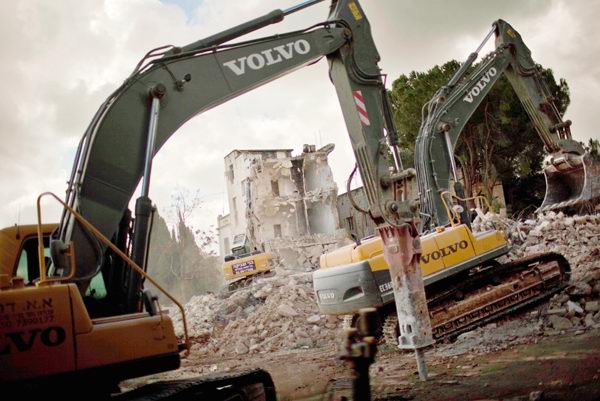
Israel this week demonstrated once again its determination to scuttle any genuine peacemaking effort that might lead to the establishment of a viable Palestinian state based on 1967 borders.
Israeli bulldozers and huge hydraulic jackhammers descended on the Palestinian neighbourhood of Sheikh Jarrah to demolish the Shepherd Hotel, a huge complex dating back to the 1930s. Part of the structure served as home to the former grand mufti of Jerusalem Haj Amin Al-Husseini. The doomed structure thus had a lot of historical significance related to the history of the Palestinian struggle.
The demolition was the latest step by Israel to consolidate Jewish hegemony over the occupied Arab town and obliterate its erstwhile Arab- Islamic identity. The forced Judaisation of the city — holy to Muslims, Christians and Jews — is done feverishly through shadowy deals and dubious expropriation practices in which deception, cheating and trickery loom large.
Moreover, Zionist circles in cooperation with the Israeli government and Jewish settler interests have allocated hundreds of million of dollars for the purpose of channelling Arab-owned property to Jewish interests all over East Jerusalem. The demolition of the Shepherd Hotel took place despite international — including American — objections.
However, given the generally ineffectual nature of these objections, the Israeli government has grown accustomed to taking them lightly, calculating that they are only meant for public relations consumption and that in no way do they constitute a credible challenge to Israel’s settlement policy.
According to reliable Israeli sources in Jerusalem, the Israeli municipal authorities are awaiting an opportune time to carry out further large-scale demolitions of Arab homes in the Silwan neighbourhood. “If the government finds out that international reactions, especially US reactions, are weak as usual, then it will mean a kind of go-ahead signal for the demolitions,” said the source that was not authorised to speak to the media.
“They [the pro-settler Municipal Council of the city] want to desensitise international public opinion to accept [their] reality and come to terms with the fact that Israel will have its way in Jerusalem.”
Reactions to the latest provocation in East Jerusalem have been “normal”, whether from the Palestinian Authority (PA) — which as usual appealed to “the international community” to pressure Israel — or from EU, UN and Arab states, which more or less repeated the same old platitudes pertaining to Israel’s settlement policy being unlawful and counterproductive to peace.
Saeb Ereikat, the chief Palestinian negotiator, urged the West to act on its condemnation of Israeli provocations. “The UN and governments around the world, including the US and the UK, have already condemned plans to demolish this particular hotel. We call on the world to take a strong stand in defence of their positions. This intransigent and illegal behaviour on behalf of Israel must not be allowed to proceed unchecked.”
Speaking in desperate tone, Ereikat said Israeli Prime Minister Binyamin Netanyahu was undercutting and corroding international efforts to create a Palestinian state. “While Netanyahu continues his public relations campaign regarding the peace process, on the ground he is rapidly moving to prevent the establishment of a sovereign Palestinian state.
“Israel continues to change the landscape of Jerusalem aiming to change its status and turn it into an exclusive Jewish city. This process of cleansing and colonisation must be stopped to change the dark reality of Israeli occupation into a free and sovereign Palestinian state with East Jerusalem as its capital.”
Meanwhile, the Israeli government has been trying to give the impression that diplomatic movement was underway, probably to create a public relations counterbalance to settlement expansion and ethnic cleansing of Palestinians in East Jerusalem and the West Bank.
Netanyahu met with Egyptian President Hosni Mubarak in Cairo this week. He also asked for a meeting with King Abdullah of Jordan, ostensibly for the same reason. Mubarak did urge Netanyahu to reverse present Israeli policies vis-à-vis the Palestinians and the peace process. Netanyahu heard Mubarak’s appeal but didn’t listen to it. For as soon as he returned to Israel, the demolitions in East Jerusalem took place.
Meanwhile, Israel is about to dispatch an envoy to Washington to assure the Obama administration that the Netanyahu government is still committed to the peace process. This comes in the aftermath of the clarion failure of the Obama administration to convince Israel to freeze settlement expansion in the occupied Palestinian territories, even in exchange for huge diplomatic inducements and military incentives.
Some analysts believe that the obsequious American behaviour towards the Netanyahu government, especially the excessive patience displayed by Secretary of State Hillary Clinton, has further emboldened Israel and encouraged the Israeli leadership to ignore US pressure. “I am sure that Mrs Clinton dreads Israeli wrath and displeasure more than the Israelis dread American wrath and displeasure,” said one veteran European journalist based in East Jerusalem.
The US reaction to the demolition of the Shepherd Hotel as well as the latest coldblooded killing of innocent Palestinians in the West Bank and Gaza Strip, including farmers tilling their land and old men sleeping in their beds, has been characteristically hollow and wrapped in diplomatic jargon.
Meanwhile, Clinton put the peace process on the backburner as she toured Gulf Arab emirates and sheikhdoms, inciting them against Iran’s nuclear programme. Predictably, Clinton implied that Israel posed no threat to the Arabs and that the real common enemy of both Israel and the Arabs is Iran. Clinton went as far as discrediting statements by former Mossad chief Meir Dagan in which he said that Iran wouldn’t have nuclear weapons capability before 2015.
A few weeks ago, Clinton dismissed the charge that “unilateral Israel actions” were derailing the peace process. “Bilateral negotiations,” she said, “are the only way to reach peace between Israel and the Palestinians.” One PA cabinet minister commented on Clinton’s remarks, saying: “This is very much like telling a rapist and his victim to sort it out among themselves.”
Book review: Arafat’s ghost and the Palestinian national movement
Osamah Khalil, The Electronic Intifada, 13 January 2011
 |
November 2010 marked the sixth anniversary of the death of Palestinian Authority President Yasser Arafat. For the last two years of his life, the once peripatetic leader who was a constant fixture on the world stage for almost four decades, was reduced to living in a small compound-cum-prison. Only after he became gravely ill did Israel permit Arafat to leave for medical treatment in France. Less than three weeks later, he returned to Ramallah in a coffin and was buried in a chaotic funeral. While the circumstances surrounding his death remain shrouded in controversy, its impact on the Palestinian national movement is indisputable.
Although As’ad Ghanem’s new book Palestinian Politics after Arafat: A Failed National Movement focuses on the post-Arafat era, the dead leader permeates the pages and his legacy hangs like a specter over the Palestinian body politic. As Ghanem documents, Arafat’s actions and decisions as chairman of the Executive Committee of the Palestine Liberation Organization (PLO) (1969-2004) and as president of the Palestinian Authority (1996-2004) served not only to consolidate his rule, but were directly responsible for the current crisis in the Palestinian national movement and its inability to achieve its goals.
A senior lecturer in the School of Political Science at the University of Haifa, Ghanem is unsparing in his assessment of the current state of Palestinian politics and unsentimental in his analysis. The Palestinian national movement has not only failed as the book’s subtitle declares, but is “disintegrating.” What follows, Ghanem argues, is fratricidal chaos.
Ghanem’s main argument is bleak. “The crisis among the Palestinians is so severe,” he writes, “that the street fighting and confrontations covered by the media barely scratch the surface” (p. x). He adds that “the Palestinians have actually lost the ability to function efficiently, internally or externally, as a single national group” (p. 173).
Drawing on primary and secondary sources in English and Arabic, Ghanem identifies three internal and external indicators that demonstrate that the Palestinian movement has failed. Internally, he argues, the movement has descended into “internecine struggle and internal collapse” (p. 18). More importantly, he contends that the movement has not achieved a single goal in its conflict with Zionism: it has not liberated Palestine, established an independent state, or even achieved a stable peace with Israel. Nor has Zionism been rejected internationally as a colonial movement. Finally, the stature of the Palestinian national movement in the Arab and international arenas has “plummeted” (p. 18).
What is the cause of this failure? Ghanem argues that the seeds were planted during the Oslo period (1993-2000). He asserts that a combination of factors have led to the “political bankruptcy” of the PA and the PLO (p. 12). These include the PLO’s shift from pursuing a comprehensive solution to a partial resolution of the Palestinian-Israeli conflict as embodied by the Oslo accords, Arafat’s dominance over the national movement and the increased corruption under his leadership.
Palestinian Politics after Arafat picks up where works by Yezid Sayigh and Rashid Khalidi left off. But while Ghanem cites and references Sayigh’s Armed Struggle and the Search for State (1997), Khalidi’s The Iron Cage (2007) is notably absent. Ghanem also benefits from and draws upon his earlier critical examination of the Palestinian national movement and the PA in The Palestinian Regime (2001). In both books Ghanem’s analysis echoes many of Edward Said’s criticisms of Arafat and the PA, particularly those discussed in his edited volumes Peace and its Discontents (1996), The End of the Peace Process (2001), and From Oslo to Iraq and the Road Map (2005). Indeed, Ghanem substantiates many of Said’s claims of the cronyism, corruption and authoritarianism that pervaded the PA and became synonymous with Arafat’s regime.
In chapter 1, Ghanem addresses the influence of external factors on the Palestinian national movement, offering a compelling analysis of Israel’s “post-Oslo strategy.” Adopted in the wake of the failed Camp David Summit in 2000, he argues that Israeli policy toward the Palestinians under Prime Minister Ariel Sharon shifted from conflict resolution to conflict management. The key element of this strategy was the separation of the two populations through the unilateral withdrawal from the Gaza Strip and the construction of Israel’s “separation wall” in the occupied West Bank, including East Jerusalem. Meanwhile, the existence of the PA allowed Palestinians to retain some measure of limited self-governance. Ghanem convincingly demonstrates that Israel’s goal was the establishment of a “Palestinian entity,” offering “more than autonomy and less than a state” (p. 36).
The reorientation of Israeli policy was driven by two related factors: first, Israel’s preoccupation with the “demographic threat” — in other words, that Palestinians will become the majority within the boundaries of historic Palestine. And second, the fear that Israel will be transformed into a binational state. Ghanem argues that in spite of Israeli efforts to ensure a Jewish majority, the higher birth rate of Palestinians portends the opposite, creating a constant source of “concern among Jewish politicians and academics interested in the character and identity of the state, prompting many of them to seek new ways of guaranteeing a Jewish majority” (p. 23). He demonstrates that Israeli academia, think tanks and the government often worked closely in researching and assessing strategies to deal with this issue. However, Israel’s post-Oslo strategy has been complicated by the parallel policies of increased settlement activity and the annexation of the Jordan River Valley. As a result, Israel’s goal of separation from the Palestinians is undermined by the greater desire for Palestinian land and resources.
In chapter 2, Ghanem discusses recent Israeli public opinion polls to demonstrate that the shift in Israeli policy has benefited from broad-based support. More importantly, these polls reveal that the maximum the Israeli public would be willing to concede in any peace agreement does not meet the minimum of Palestinian demands or fulfill their rights under international law. Thus, barring a dramatic shift in Israeli public opinion, the strategy adopted by the Palestinian leadership of negotiations accompanied by attempts to convince Israelis of their willingness to achieve peace is bound to fail.
The core of Palestinian Politics after Arafat focuses on the internal causes for the current state of affairs and their implications. In chapter 3, Ghanem analyzes Arafat’s successful effort to consolidate power first within the PLO and then the PA. He convincingly argues that the failures of the PA were rooted in the structure of the PLO and Arafat’s leadership of the organization, which “provide a partial explanation for both Palestinian achievements since the 1950s and also for the Palestinians’ failure to attain their national goals” (p. 71). Indeed, as Sayigh demonstrates, after the assassinations of Fatah’s cofounders and his closest advisors, Khalil al-Wazir (Abu Jihad) and Salah Khalaf (Abu Iyad) in 1988 and 1991, respectively, Arafat had few rivals within Fatah or the PLO with the authority to challenge his decision-making. Therefore, with the decline of the leftist wing of the PLO by the end of the Cold War and the predominance of Fatah within the organization, Arafat was able to consolidate his rule over both.
Building on Sayigh’s Armed Struggle and the Search for State, Ghanem demonstrates that the Oslo accords and creation of the PA represented the logical conclusion of Arafat’s leadership of the PLO. In other words, the agreement could not have been signed if the PLO were truly a democratic and representative organization with a leadership that was elected by and responsive to its constituency or with functional independent institutions. Instead, the PLO’s quota system was exploited by Arafat “to guarantee passage of the decisions he supported and the selection of his confidants to important posts” (p. 72). Meanwhile, it allowed for representation of the different Palestinian political groups and “independents” in the Palestinian National Council (i.e., the Palestinians’ “parliament in exile”) and the PLO’s Central and Executive Committees based largely on their size. In reality, the independents were largely aligned with Fatah, further bolstering its weight within the PLO and enhancing Arafat’s power. The end result was that the PLO’s different legislative and executive organs “had no real power, a vacuum was created at the top of the power structure — a vacuum that was filled by one man, a single individual who had replaced the institution” (p. 73).
The implications of Arafat’s control over the national movement were evidenced after his death with the scission of the Palestinian body politic. While the election of Mahmoud Abbas as Arafat’s successor in 2005 appeared to ensure Fatah’s hold on power, Hamas’s victory under a banner of “Reform and Change” in the parliamentary elections a year later represented the most significant threat to Fatah’s nearly forty years of dominance over the national movement. The ensuing clashes led to a rift between the two organizations as well as between the West Bank and the Gaza Strip that has yet to be resolved. Ghanem asserts that the conflict between Fatah and Hamas is “substantial in every respect” and that it “relates to deep and fundamental political, social and cultural differences in approach between the two movements.” Overcoming these differences, he argues, will require “great effort” to resolve the conflict between the two organizations based on their mutual embrace of “democratic principles” (p. 143-144).
However, Ghanem is pessimistic that such a rapprochement is possible. He concludes that “new thinking” is required by Palestinians “about all of the options available to them in their internal affairs and their relations with Israel, the West and the Arab world” (p. 182). While the current crisis in the national movement can be directly attributed to the “choice of Arafat and the PLO to guide Palestinian affairs,” Ghanem opines that “it is hard to envision the various factions and currents in the Palestinian national movement taking a consensual and logical step in this direction, and therefore it is improbable that it can extricate itself from the crisis” (p. 183).
Palestinian Politics after Arafat is a welcome addition to the literature on the Palestinian national movement, the Palestinian-Israeli conflict and the Middle East peace process. It is written in a clear style that makes it accessible to both specialized and general audiences. Although the text does suffer from repetition and would have benefited from closer and more thorough editing, these minor flaws do not diminish the overall work. It is highly recommended for readers seeking a better understanding of the history and current state of Palestinian politics.
Six years after his death, Arafat’s ghost still haunts the Palestinian national movement. From the cult of personality he constructed to the institutions he established and the agreements he signed, Arafat’s influence was not only profound but enduring. Indeed, the politics of divide and rule, and governance through intimidation, wasteful duplication and destructive rivalries that Ghanem describes have been adopted by Arafat’s children — his former supporters and associates who are ubiquitous inside and outside of government and who have chosen to mimic his style of leadership. Thus, Arafat’s specter is likely to hang over yet another generation of Palestinians. If Palestinians are to find a way out of this crisis, they must begin not by glorifying the national movement but by demystifying and demythologizing its history, and conducting a frank assessment of its successes and failures. Palestinian Politics after Arafat is an important step in that direction.
Osamah Khalil is a PhD candidate in US & Middle East History at the University of California, Berkeley. This essay was originally published by H-Net Reviews and is republished with the author’s permission.
Related Links
Canada’s double standards
Yves Engler, The Electronic Intifada, 13 January 2011
Canada’s tax system currently subsidizes Israeli settlements that Ottawa deems illegal, however, the Conservative government says there’s nothing that can be done about it.
In June of last year, Guelph activist Dan Maitland emailed Foreign Affairs Minister Lawrence Cannon concerning Canada Park, a Jewish National Fund of Canada initiative built on land Israel occupied after the June 1967 War. Three Palestinian villages (Beit Nuba, Imwas and Yalu) were demolished to make way for the park.
A few weeks ago Maitland received a reply from Keith Ashfield, Minister of National Revenue, who refused to discuss the particulars of the case but provided “general information about registered charities and the occupied territories.” Ashfield wrote that “the fact that charitable activities take place in the occupied territories is not a barrier to acquiring or maintaining charitable status.”
This means Canadian organizations can openly fundraise for settlements Ottawa (officially) deems illegal under international law and get the government to pay up to a third of the cost through tax credits for donations. To justify the government’s position, Ashfield cited a September 2002 Federal Court of Appeal case (Canadian Magen David Adom for Israel v. Minister of National Revenue), which reversed the Canadian Revenue Agency’s previous position.
The exact amount is not known but it’s safe to assume that millions of Canadian dollars make their way to Israeli settlements every year. In 1997, when it was more of a legal grey area, tax lawyer David Drache claimed that “there are hundreds of [Canadian] organizations … supporting organizations directly or indirectly beyond the Green Line,” referring to the internationally-recognized armistice line between Israel and the occupied West Bank.
In the late 1990s, Israel’s largest settler group, Yesha, raised more than $700,000 a year in Canada. When former Israeli Prime Minister Ariel Sharon visited in the mid-1990s, the Canadian Arab Federation’s Jehad Aliweiwi said he “left with more than $1 million in tax-deductible funds, with no secret as to the destination.” Through the 1990s the Press Foundation was probably the largest known source of funds for settlements, raising as much as $5 million annually for settlers in the occupied West Bank town of Hebron and in the occupied Golan Heights, which was captured from Syria in 1967.
Illegal settlements are not the only questionable activities in Israel that Canadians subsidize through their tax system. A mid-1990s survey found more than 300 registered Canadian charities with ties to Israel, a relatively wealthy country. Every year Canadians send a few hundred million dollars worth of tax-deductible donations to Israeli universities, parks, immigration initiatives and, more controversially, “charities” that aid the Israeli army in one way or another.
One example is Aid to Disabled Veterans of Israel or Beit Halochem (Canada), which brings soldiers singled out as heroes by the Israeli military on trips to Canada. Many Canadians, including the Charles R. Bronfman Foundation, support the Libi Fund — “The Fund For Strengthening Israel’s Defense.” In early 2008, Major Gil Chemke, a member of the Israel’s elite search and rescue team, toured the country on behalf of the Canadian Magen David Adom for Israel (CMDAI), which operates in the occupied West Bank. Established to assist wounded soldiers and the population during disasters, CMDAI has raised millions of dollars. Chemke drummed up financial contributions for CMDAI by showing “behind-the-scenes video footage of a rescue operation in Lebanon for a female air crew member whose helicopter was shot down by Hizballah” during Israel’s 2006 invasion of Lebanon.
Established in 1971, the Association for the Soldiers of Israel in Canada (ASI) provides financial and moral support to active duty soldiers. In 2009, ASI (Canada) — which provides tax receipts through the Canadian Zionist Cultural Association — and El Al airlines granted a 50 percent discount on flights to Israel from Canada for families of “lone soldiers” who join the Israeli military.
While it’s legal — and government will foot part of the bill — to finance charities linked to a foreign army responsible for numerous war crimes and settlements that contravene international law, Ottawa has made it illegal for Canadians to aid a hospital operated by the elected Hamas government.
Ottawa’s post-11 September 2001 terrorist list makes it illegal to financially assist Hamas, the Popular Front for the Liberation of Palestine, the al-Aqsa Martyrs’ Brigade, the Abu Nidal Organization, the Popular Front for the Liberation of Palestine-General Command, the Palestine Liberation Front, the Palestinian Islamic Jihad and groups associated with these organizations. Only one Israeli group, the marginal Kahane Chai, is on the list.
On 25 December, Hamas criticized Canada for re-listing it a “terrorist” entity. “The decision is a clear bias to Israel,” Hamas spokesman Fawzi Barhoum told Xinhua. “This encourages Israel to commit more crimes against the Palestinian people.”
Ottawa makes it difficult for Canadians to support many Palestinian groups all the while subsidizing expansionist and militaristic Israeli institutions. Canadians of good conscience should protest and demand change.
Yves Engler’s most recent book is Canada and Israel: Building Apartheid.
Thirteen homes and three school buildings destroyed by Israeli forces
 Dkaika children outside their destroyed classroom
More than 13 homes and three school buildings were bulldozed this morning by occupation forces in the small Bedouin village of Dkaika near Yatta south of Hebron. One eye witness – an English teacher at the school – said “the Israeli army arrived at the village at around 7:30am with over fifty military vehicles and at least six bulldozers before forcibly removing the children from the school and destroying three classrooms.” He went on, “the children, some of whom are as young as seven years old, were crying and shouting at the soldiers to stop.”
In addition to the destruction wrought upon the school, ISM representatives were led by the crushed earthen tracks and violent gouge marks left by bulldozers to the tell tale piles of rubble and twisted steel which littered the surrounding area. If there had been any doubt that each had once been a home, then the hurriedly assembled mounds of personal possessions, furniture, and children’s toys which accompanied each pile of rubble surely testified to the fact that these were dwellings.

Furniture from the destroyed classrom in front of a crushed building
As it was, there were plenty of family members eager to testify themselves, and in the moments following the re-opening of the village’s only road, EAPPI and ISM members– who had been prevented by road blocks from accessing the scene – moved in to speak to those left homeless by the action.
When asked what reason was given for the demolition, the above witness, visibly upset, replied “they do not want us to live here, that is the reason. I would like to tell you that this community has been here since before the establishment of the Israeli [state]. They took most of our land during the Nakba and they would like to dismiss us from here completely”.
Israeli troops cross into Lebanon
Press TV – January 12, 2011
Lebanon’s army say Israeli troops have once again breached the country’s sovereignty, crossing into the Lebanese territory and kidnapping a civilian.
A statement released by the Lebanese army on Wednesday said that an Israeli patrol has crossed into the southern village of Rmeish and abducted a Lebanese shepherd.
“In a flagrant assault on residents of southern Lebanon, enemy troops crossed the technical fence south of the village of Rmeish and kidnapped a Lebanese man, whom they took back into the occupied territories,” the statement said.
The army says it has contacted the UN Interim Force in Lebanon (UNIFIL), which is tasked with monitoring the disputed Lebanon-Israel border, to free the Lebanese national identified as Sharbel Khoury, AFP reported.
The Israeli military, which frequently violates Lebanon’s airspace, territorial waters and border, has not yet commented on the incident.
The violations contravene United Nations Security Council Resolution 1701, which ended the Israeli war on Lebanon in 2006.
The Lebanese government has submitted documentation to the UN proving that Israel has breached the provisions of the resolution on more than 7,000 occasions.
Hundreds displaced in village demolition
Ma’an | January 12, 2011
HEBRON — Three-hundred Palestinians were displaced Wednesday afternoon when their homes outside a village were torn down by Israeli military order, and witnesses said parts of a schoolhouse were also destroyed.
Odeh An-Najada, a local councilman for the Dakika village, on the Green Line southeast of the Hebron district, said four Israeli bulldozers accompanied by 30 military vehicles entered the area and began taking down the brick and mortar homes.
“They demolished everything in the area, the whole thing, they left no building for people to live in,” An-Nahada said, adding that he had called on the International Red Cross to come and provide shelter for the families for the night.
The director of the office of the Palestinian Authority ministry of education in southern Hebron, Fawzi Abu Hlayyil, said parts of the village school were taken down. The building, used as a preparatory school, contained six classrooms. A space shortage prompted villagers to add an additional room for students, which was taken down.
Villagers protesting the demolitions, including teachers from the local school, were dispersed and four were detained.
Calls to Israel’s Civil Administration, the body which hands out demolition orders for homes deemed illegally built, were not returned.
Hebron district Governor Kamil Hmeid described the demolition as part of Israel’s “ongoing escalation in the Hebron district,” following a mass hand out of demolition orders in the Ein Assy area of Halhoul, a town north of Hebron city, which took place on Jan 5.
Residents said Israeli authorities told them the buildings were slated for demolition because they were built without permission in Area C, under full Israeli planning control.
Area C makes up 60 percent of the West Bank, and Palestinian building is rarely approved by Israeli authorities.
Governor Hmeid said that some of the infrastructure in Dakika was funded by international donors, and he called on the donor countries to protect the money they invested from being rendered useless by Israeli demolition crews.
“Come to Hebron, and see the mass scale of the demolitions,” he invited.
The PA ministry of education condemned the demolition as an “ugly crime.”
Subhi Al-Kayid, the assistant undersecretary to the PA’s education minister, said the demolition was part of a “series of Israeli crimes and violations against the ministry of education.”
Featured Video

Ivermectin and iodine
or go to
Aletho News Archives – Video-Images
Book Review
UAE tortured, killed journalist for opposing Israel normalization
The Cradle | October 31, 2026
UAE security officers detained, tortured, and killed Emirati poet and news editor Habib al-Sayegh in August 2019, shortly after he published a column opposing UAE normalization with Israel, according to a newly published book.
“Princes and Thieves,” a book by investigative journalist Matthew Cole published on 25 October, alleges that UAE security officers raided Sayegh’s Abu Dhabi home shortly after the publication of the column, hooded him in front of his wife and took him to a detention facility where he was tortured to death.
His interrogators reportedly pulled out several of his teeth with pliers and beat him repeatedly with a sharp metal object.
On 11 August 2019, Sayegh criticized the UAE’s plan to normalize relations with Israel as part of the Abraham Accords in his weekly column for Khaleej newspaper. The column was titled “Israel Is Our Real Enemy and A Dangerous Project.”
Sayegh described Israel as “a real and natural enemy” while questioning “who authorized the normalizers to speak on behalf of everyone?”
Nine days after the column was published, Emirati state media announced his death, without stating a cause. … continue
Blog Roll
 Aletho News
- Ivermectin and iodine
- Congratulations climate skeptics — you are a ‘Hybrid weapon of war’ and a growing public health threat
- ‘The Arab Vote’: How Israeli Racism Has Ruined Their Elections
- Israel forces Palestinians in Gaza to choose between assassination alone or death with their families: Report
- US Approves Sale of 500 Patriot Missiles to Ukraine, Deliveries May Take Years
- German Imperialism: An Urgent Explainer
- Backed by AAP, West Virginia Proposal Would Allow Dental Hygienists to Give HPV Vaccine to 9-Year-Olds
- Poland Is the Symptom and Europe Is the Patient
- UAE security forces tortured, killed journalist for opposing Israel normalization: Report
- They Compared the Spice to the Drug. The Spice Won — Again. (Part 2)
- If Americans Knew
- An error has occurred; the feed is probably down. Try again later.
- No Tricks Zone
- Germany’s Green Energy Transition Becoming Increasingly Expensive…Another 6 Trillion Euros!
- Sudden Stratospheric Warming, Powerful El Niño Combination May Lead To Extreme Europe Cold, Energy Crisis!
- Two New Studies Find Thwaites Glacier Melt Cannot Be Driven By Human Activity Or A Warming Ocean
- E-Cars Reduce CO2 Emissions By Only 41% Compared To Internal Combustion Engine Vehicles
- Predictions Made By Renowned Climate Professor Over Past Decades Have Been Proven To Be Poor
- New Study Suggests Large Regions Of The Pacific Ocean Have Been Cooling For The Last 80 Years
- Germany’s Green Energy Debacle: High Energy Costs Force Kahla Porzellan to Close After 182 Years!
- New Study: 50 Years Of The Most Aggressive ‘Net Zero’ Policies Can Only Affect The Global Climate By 0.03°C
- US September “Heat” Was No Record…Many Records Set Decades Ago
- Latest European Green Energy Debacle; Portugal’s Largest Flagship Solar Park Insolvent!

