Anti-Wall Popular Committee Leader Beaten, Two Children Arrested
By Circarre Parrhesia – IMEMC & Agencies – January 26, 2011
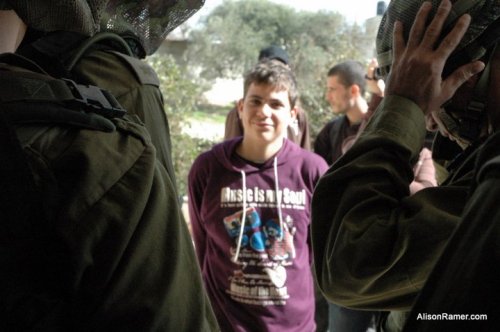
Islam Tamimi was arrested Sunday in Nabi Saleh. Picture Credit: Alison Rammer

Following the arrests of Karim Saleh al-Tamimi and, his brother, Islam, the leader of the Popular Commitee Against The Wall & Settlements in Nabi Saleh, Bassam Tamimi has been arrested, on Wednesday, along with two fifteen year old boys.
Bassam Tamimi was taken from the village, near the West Bank city of Ramallah, at midday on Wednesday, and according to eye witnesses was beaten during his abduction. Tamimi was released an hour later, and confirmed the eye witness report, but the whereabouts of the two fifteen year old children are, as yet, unknown.
Karim al-Tamini, ten years old, was arrested on Tuesday, but was released to his father after seven hours in custody due to the work of an Israeli law firm.
His brother, Islam, fourteen years old, was abducted in a raid on Sunday, and was brought before a court today. Following his abduction, the second in three weeks, Islam was interrogated for eight hours.
He was denied access to legal council for the first five hours, during which he confessed to throwing stones during the weekly protest against the annexation wall, and his parents were denied access to their son during the interrogation; their legal right.
Islam will remain in prison Wednesday night, and will appear in front of the court once more on Thursday.
The village of an-Nabi Saleh joined the call to protest against the building of the annexation wall, the construction of settlements in the Occupied West Bank, and Israel’s military occupation one year ago, following the confiscation of a local spring, Ein al-Kus, by settlers from the nearby Halamish. Since then the village has come under harassment in the form of regular detentions of the villagers, and the violent repression of the Friday protests, including the use of live ammunition.
The Palestine Papers, a dangerous shift on 1967 lines
US position on borders perhaps opens the door to dangerous Israeli ambitions to transfer non-Jewish citizens
Ali Abunimah | A-Jazeera | January 24, 2011
One of the more astonishing revelations in The Palestine Papers — detailed records and minutes of the Middle East peace process leaked to Al Jazeera — is that the administration of US President Barack Obama effectively repudiated the Road Map, which has formed the basis of the “peace process” since 2003. In doing so it has backed away even from commitments made by the George W. Bush administration and blown an irreparable hole in the already threadbare “two-state solution.”
But even worse, the US position perhaps unwittingly opens the door to dangerous Israeli ambitions to transfer — or ethnically cleanse — non-Jewish Palestinian citizens of Israel in order to create an ethnically pure “Jewish state.”
Shortly after it took office in January 2009, the Obama administration publicly called on Israel to freeze all settlement construction in the occupied West Bank, including East Jerusalem. After months of grueling shuttle diplomacy by US envoy George Mitchell, Obama eventually made do with an Israeli promise of a ten-month partial settlement moratorium excluding Jerusalem.
While those talks were ongoing, frustrated Palestinian negotiators tried repeatedly to wrestle a commitment from Mitchell that the terms of reference for US-brokered peace negotiations that were to begin once the settlement moratorium was in place would be for the establishment of a Palestinian state on the 1967 line with minor, agreed land swaps between the Israeli and Palestinian sides. This, the Palestinians argued, was the position the Bush administration had endorsed and was contained in the Road Map peace plan adopted by the Quartet (US, EU, Russia and the UN) in 2003.
But in apparently contentious meetings between Mitchell and Palestinian chief negotiator Saeb Erekat and their respective teams in September and October 2009 — whose detailed contents have been revealed for the first time — Mitchell claimed the Bush administration position was nonbinding. He pressed the Palestinians to accept terms of reference that acquiesced to Israel’s refusal to recognize the 1967 line which separates Israel as it was established in 1948 from the West Bank and Gaza Strip where Palestinians hoped to have their state.
Dropping the 1967 border
On 23 September 2009, Obama told the UN General Assembly that his goal was for “Two states living side by side in peace and security — a Jewish state of Israel, with true security for all Israelis; and a viable, independent Palestinian state with contiguous territory that ends the occupation that began in 1967, and realizes the potential of the Palestinian people.”
In 2008, Israeli negotiators – including then-foreign minister Tzipi Livni – proposed “swapping” some of Israel’s Arab villages into a future Palestinian state, even though a vast majority of Israeli Arabs oppose such a plan.
But this did not satisfy the Palestinians. The next day during a meeting at the US Mission to the United Nations in New York, Erekat refused an American request to adopt Obama’s speech as the terms of reference for negotiations. Erekat asked Assistant Secretary of State for Near Eastern Affairs David Hale why the Obama administration would not explicitly state that the intended outcome of negotiations would be a Palestinian state on the 1967 borders with a third party security role and a staged Israeli withdrawal. Hale responded, “You ask why? How would it help you if we state something so specific and then not be able to deliver?” according to Palestinian minutes of the meeting.
At the same meeting, which Mitchell himself later joined, Erekat challenged the US envoy on how Obama could publicly endorse Israel as a “Jewish state” but not commit to the 1967 borders. Mitchell, according to the minutes, told Erekat “You can’t negotiate detailed ToRs [terms of reference for the negotiations]” so the Palestinians might as well be “positive” and proceed directly to negotiations. Erekat viewed Mitchell’s position as a US abandonment of the Road Map.
On 2 October 2009 Mitchell met with Erekat at the State Department and again attempted to persuade the Palestinian team to return to negotiations. Despite Erekat’s entreaties that the US should stand by its earlier positions, Mitchell responded, “If you think Obama will force the option you’ve described, you are seriously misreading him. I am begging you to take this opportunity.”
Erekat replied, according to the minutes, “All I ask is to say two states on 67 border with agreed modifications. This protects me against Israeli greed and land grab – it allows Israel to keep some realities on the ground” (a reference to Palestinian willingness to allow Israel to annex some West Bank settlements as part of minor land swaps). Erekat argued that this position had been explicitly endorsed by Secretary of State Condoleezza Rice under the Bush administration.
“Again I tell you that President Obama does not accept prior decisions by Bush. Don’t use this because it can hurt you. Countries are bound by agreements – not discussions or statements,” Mitchell reportedly said.
The US envoy was firm that if the government of Israeli Prime Minister Benjamin Netanyahu did not agree to language in the terms of reference the US would not try to force it. Yet Mitchell continued to pressure the Palestinian side to adopt formulas the Palestinians feared would give Israel leeway to annex large parts of the occupied West Bank without providing any compensation.
At a critical 21 October 2009 meeting, Mitchell read out proposed language for terms of reference:
“The US believes that through good faith negotiations the parties can mutually agree on an outcome that achieves both the Palestinian goal of an independent and viable state encompassing all the territory occupied in 1967 or its equivalent in value, and the Israeli goal of secure and recognized borders that reflect subsequent developments and meets Israeli security requirements.”
Erekat’s response was blunt: “So no Road Map?” The implication of the words “or equivalent in value” is that the US would only commit to Palestinians receiving a specific amount of territory — 6258 square kilometers, or the equivalent area of the West Bank and Gaza Strip — but not to any specific borders.
“Two states for two peoples”
This is an earthquake. It not only up-ends the two-state solution as it is conventionally understood, but opens the door to possible future American acceptance of Israeli aspirations to create an ethnically-pure Jewish state by “exchanging” territories where many of Israel’s 1.4 million Palestinian citizens are concentrated. This would be a violation of these Palestinians’ most fundamental rights and a repudiation of the universally-accepted self-determination principles established at the Versailles Conference after World War I. It potentially replaces the two-state solution with what Israeli officials call the “two states for two peoples solution.”
Then Israeli Foreign Minister Tzipi Livni elaborated what this would look like during a November 13, 2007 negotiating session with Palestinian officials, confidential minutes of which were also revealed among The Palestine Papers:
“Our idea is to refer to two states for two peoples. Or two nation states, Palestine and Israel living side by side in peace and security with each state constituting the homeland for its people and the fulfillment of their national aspirations and self determination.”
Livni stressed, “Israel [is] the state of the Jewish people — and I would like to emphasize the meaning of ‘its people’ is the Jewish people — with Jerusalem the united and undivided capital of Israel and of the Jewish people for 3007 years.”
Livni thus makes clear that only Jews are guaranteed citizenship in Israel and that Palestinian citizens do not really belong even though they are natives who have lived on the land since before Israel existed. It negates Palestinian refugee rights and raises the spectre of the expulsion or “exchange” of Palestinians already in the country. Yet Livni’s troubling statement appears to reflect more than just her personal opinion.
A 29 October 2008 internal Palestinian memorandum titled “Progress Report on Territory Negotiations” states that Palestinian negotiators rejected the notion that Palestinians could be included in land swaps. But, according to the document, “the Israelis continued to raise the prospect of including Palestinian citizens of Israel” in such swaps, during negotiations between Palestinian officials and the government of former Israeli Prime Minister Ehud Olmert.
In September last year, Israeli Foreign Minister Avigdor Lieberman presented a plan the UN General Assembly in which Israel would keep West Bank settlements and cede to a future Palestinian state some lands with highly concentrated populations of non-Jewish citizens. “A final agreement between Israel and the Palestinians,” Lieberman said, “has to be based on a program of exchange of territory and populations.”
While Lieberman heads the ultranationalist Yisrael Beitenu party, and Livni the Kadima opposition (often inaccurately perceived as more “moderate” than Israel’s current government), the two politicians’ views are symptomatic of increasingly overt racism within Israeli society.
The Obama administration’s failure to press Israel to accept the international consensus that the Palestinian state would be established on all the territories Israel occupied in 1967, except for minor adjustments, dooms the two-state solution. It may well be that a US administration that came to office promising unparalleled efforts to bring peace, ends up clearing the path for Lieberman’s and Livni’s abhorrent ideas to enter the mainstream.
This is not only catastrophic for Palestinian rights and the prospects for justice, but represents a return to nineteenth century notions, banished in the wake of two world wars, that population groups can be traded between states without their consent as if they were mere pieces on a chess board.
Ali Abunimah is author of One Country, A Bold Proposal to End the Israeli-Palestinian Impasse and is a contributor to the newly-released book The Goldstone Report: The Legacy of the Landmark Investigation of the Gaza Conflict. He is a co-founder of the widely read online publication The Electronic Intifada, an award-winning online publication about Palestine and the Palestine conflict.
Related:
Boycott vote in Sydney suburb sparks media furor, death threats
Sarah Irving, The Electronic Intifada, 24 January 2011

Anne Paq/ActiveStills
On 15 December 2010, the councilors of Marrickville, a suburb of Sydney, Australia voted by a 10-2 majority to support the Palestinian call for boycott, divestment and sanctions (BDS). A month later, they have belatedly become the subjects of vilification in the press owned by international media proprietor Rupert Murdoch and death threats from Australia’s lunatic fringe.
“What does the desert theocracy of Saudi Arabia have in common with Marrickville Council in Sydney’s Inner West?” howls an article in Murdoch’s Telegraph, under a headline comparing the local authority to North Korea. The piece — which manages to be factually inaccurate on subjects as diverse as kosher food laws and Palestine Liberation Organization factions — goes on to hail Israel as “one of the most innovative and entrepreneurial countries in the world. Its products and inventions find their way into computers, mobile phones and medicines.” The online version of the article seeks to demonstrate Israel’s virtues by illustrating it with both a photo gallery of Israeli swimsuit model Bar Refaeli and a video of her writhing in the sand on a photo shoot.
“This is what passes for ‘journalism’ and commentary over Israel/Palestine in Australia,” laments Antony Loewenstein, the Sydney-based author of Australian best-seller My Israel Question and co-founder of Independent Australian Jewish Voices. His blog also points out the inconsistencies and omissions in recent coverage of the incident by The Australian, supposedly a more serious paper than the Telegraph. The Australian quotes Anthony Albanese, a member of the Australian federal parliament whose constituency covers Marrickville council’s turf. Albanese claims that “Foreign policy is a fair way outside the parameters of the role of Marrickville Council” and suggests that the local authority stick to “local” issues.
But Councilor Cathy Peters, who supported the boycott motion at Marrickville, rejects the suggestion that boycotting Israeli products is outside her remit as a council representative. “It’s not a matter of foreign policy at all, but rather the right of a council to make decisions regarding our purchasing policy and the relationships and engagements we have with outside organizations,” she said in an interview with The Electronic Intifada. “It’s completely within our purview to make those decisions. We’ve done it before. We have an ongoing boycott of companies involved in Burma. The council has a long, proud tradition of making ethical decisions.”
Peters also stressed that many Marrickville residents had expressed their concerns about Israeli actions towards the Palestinians to local councilors. Marrickville mayor Fiona Byrne, writing on the Australian Broadcasting Corporation website, also described how “Marrickville Councilors interact with the people we represent on a day to day level. We have spoken with many local residents, with community and multi-faith groups who have told us of their feelings towards the unresolved issue of Palestine and Israel and their desire to be able to take direct action.” The boycott motion has also, she said, been supported by members of Jews Against the Occupation, and she cited the many Australian church and trade union organizations which have supported whole or partial boycotts of Israeli products and organizations.
Anthony Albanese has in the past been supportive of Palestine solidarity campaigns and critical of Israel’s human rights record, so his stance has surprised some local people. Jennifer Killen, a Marrickville resident who strongly supports the council’s twinning with Bethlehem and its boycott initiative, commented to The Electronic Intifada: “I’m very disappointed in my local member of parliament for not being more supportive of our hard-working local councilors at this time.” Killen also pointed out that the contact details of the councilors who voted for the boycott motion are on the website of the Sydney-based Coalition for Justice & Peace in Palestine, and called on international activists to support Marrickville where its MPs had failed to do so.
Councilor Cathy Peters, a Green Party member, emphasized that the boycott motion at Marrickville had cross-party support and that the former mayor of Marrickville, who visited its sister city of Bethlehem in 2010, was a member of the Australian Labor Party. But Antony Loewenstein and other Sydney commentators have suggested that the realpolitik of upcoming elections could be behind Albanese’s condemnation of the boycott vote. The Australian’s article mentions the risks to Albanese’s seat from the Green Party.
But it failed to highlight the fact that Carmel Tebbutt, the New South Wales state legislature member for Marrickville who is quoted in the same article, is also Albanese’s wife — and that her seat is under threat from Marrickville Green Mayor Fiona Byrne in upcoming state-level elections. The New South Wales Green Party adopted a strong boycott, divestment and sanctions position in December 2010 and Albanese’s attacks on the boycott motion could, Sydney commentators suggest, be an attempt to put some political space between himself and his spouse, and their Green challengers.
Outside the mainstream media, Australia’s nastier extremists have also waded in on the Marrickville debate. An article on the Australian Islamist Monitor website entitled “Australian Council Disgraces Itself” berates the local authority, saying that “you have got it all wrong — you have sided with the aggressors, the bullies, the friends of Hitler and those whom Hitler considered his friends in their antisemitism [sic].” The writer goes on to claim that “Israel is a tiny land surrounded by aggressive Muslim nations and as David Horowitz has pointed out repeatedly, the aim of those nations is to deny Israel the right to exist.” David Horowitz, cited by the Australian Islamist Monitor author, is an American commentator and founder of the Freedom Center who claims that “free societies” are “under attack by leftist and Islamist enemies at home and abroad.” As well as attacking Arab and left-wing campaigners, he has also been accused of racism against African Americans.
And one comment following the article reads: “This is insane I hate these people. I would like to have a 22 and pick them off one by one for target practice. Better still a suicide bomber in their midst. In fact I might make a giant blow up of the photo and sell it to a shooting range.” A “smiley” emoticon follows the comment. Immediately after it, the same commenter, “Skipping Girl,” adds: “God Bless Israel.”
Despite its claims to be “anti-racist in all its forms” and to support freedom of speech when this does not lead to violence, the Australian Islamist Monitor site is rife with hysterical and sometimes violent comments about Muslim people. A number of its contributors have links to more extreme hate sites and have made openly racist comments in other forums. The website’s membership is strictly controlled, with potential members approved by a human moderator as well as by electronic tests. However, in more than three weeks it has made no move to remove Skipping Girl’s bloodthirsty comments.
Cathy Peters says that she has been made aware that some threatening comments have been made regarding Marrickville councilors, but that the matter has been turned over to the council’s general manager for consideration. For her, the larger concern is how the issue of Palestine is debated in Australia.
“I think it’s unfortunate that these kind of emotional comments have been triggered by an overall reluctance by the Board of Deputies and other groups to tolerate debate and criticism of Israeli policies regarding Palestine and the occupied territories,” she says, rejecting charges that Marrickville’s councilors have been influenced by “political correctness” or ideology. Her fellow members, she points out, include some “very experienced” local councilors with diverse backgrounds and political opinions.
“The problem at the moment is one of groups trying to close down dialogue on the subject,” Peters insists. “What is really needed at the moment is a mature, calm debate on Israel’s policies on Palestine and how Australians should respond to them.”
Sarah Irving is a freelance writer. She worked with the International Solidarity Movement in the occupied West Bank in 2001-02 and with Olive Co-op, promoting fair trade Palestinian products and solidarity visits, in 2004-06. She now writes full-time on a range of issues, including Palestine. Her first book, Gaza: Beneath the Bombs, co-authored with Sharyn Lock, was published in January 2010. She is currently working on a new edition of the Bradt Guide to Palestine and a biography of Leila Khaled.
Settlers Attack Internationals Escorting Palestinians in South Hebron Hills
By Ramona M. – IMEMC & Agencies – January 24, 2011
On Sunday, settlers assaulted internationals while they were escorting Palestinians to their pasture to graze their herds in Um al Hir , in South Hebron Hills.
Settlers threw stones and succeeded in hitting the international activists. Only the international escorts were targeted, who were specifically requested to be there due to recent tensions in the area.
One international had a stills camera stolen from him, however managed to hold on to his video camera and was able to film the event. When this international activist went to the police to file a report, the police told him that if he erased all his footage on the video camera, he would return the other camera to him.
After the incident, the army arrived and protected the Palestinian residents from settler disturbances, harassment and attacks. The grazing was completed with army protection.
Um al Hir is a Beduoin village close to Susya which has been suffering by the encroaching settlement of Carmel, which was first established in 1981 on their land and has since been closing in on them. The village was recently in Israeli news due to the army’s decision to issue a demolition order on the village’s “Taboon,” an outdoor stove used for baking bread. Apparently the stove was built without permit, and it must be destroyed.
Last Friday, settlers went to the pastures of Um al Hir to plant trees in honor of the Tu B’svhat holiday, which marks the beginning of the tree-planting season. They were escorted by large amounts of army protection.
Would isolation of the US persuade Obama not to veto?
By Alan Hart | January 23, 2011
Despite strong US opposition, a proposed resolution condemning Israeli settlements on the occupied West Bank did make it to the UN Security Council. It was not put to a vote and no vote is expected for some time, if ever, because of the probability as things stand of an American veto. But given growing global support for the resolution, there is a case for wondering if President Obama can remain Zionist-like in his own implicit defiance of international law on Israel’s behalf.
Introduced by Lebanon, the resolution states that “Israeli settlements established in the Palestinian territory occupied since 1967, including East Jerusalem, are illegal and constitute a major obstacle to the achievement of a just, lasting and comprehensive peace”. And it demands that Israel cease “immediately and completely” not only all settlement construction in the occupied territory, including East Jerusalem, but also “all other measures aimed at altering the demographic composition, character and status of the territory, in violation of international humanitarian law and relevant resolutions.”
US position ridiculous
Washington had hoped that signalling its opposition to the proposed resolution would be enough to cause its Palestinian and other Arab sponsors to back away from taking it to the Security Council. Deputy American UN Ambassador Rosemary DiCarlo said the US opposed bringing the settlement issue to the Council “because such action moves us no closer to a goal of a negotiated final settlement and could even undermine progress towards it”. She also said the Security Council should not be the forum for resolving the issues at the heart of the Israel-Palestine conflict. In my view that has to be among the most ridiculous statements any diplomat has ever made in any place at any time.
When the Arab sponsors discovered that they do have testicles and refused to be intimidated by Uncle Sam, the result was a huge embarrassment for Obama because, as noted by Tony Karon in an article for Time, the resolution’s substance “largely echoes the administration’s own stated positions.” In Haaretz under the headline “Settlements issue isn’t Israel’s problem, it’s Obama’s”, Natasha Mozgovaya was more explicit. The resolution has put Washington “in the awkward position of having to veto a resolution it absolutely agrees with”.
That was why a number of former senior US diplomats and officials wrote to Obama urging him to support the resolution. They included former Reagan Defence Secretary Frank Carlucci and former assistant secretaries of state Thomas Pickering and James Dobbins. They said the resolution is not incompatible with negotiating an end to the conflict and does not deviate from the US commitment to Israel’s security. They added:
The proposed resolution is consistent with existing and established US policies; deploying a veto would severely undermine US credibility and interests, placing us firmly outside of the international consensus, and further diminishing our ability to mediate this conflict.
USA internationally isolated
How far outside the international consensus the US already is on account of its unconditional support for Israel right or wrong was demonstrated by the fact that the resolution attracted the support of 120 nations. Diplomats were certain that the US was the only one of the five permanent members on the 15-country Security Council with veto power that would have vetoed if the resolution had been put to a vote when it was introduced. In other words, without a US veto it would have passed. That would have more or less confirmed Israel’s pariah status in much of the world and just might have been a game-changer.
In contrast to the Zionist lobby in America which has naturally been urging – ordering? – Obama to veto, J Street, the “dovish” Jewish advocacy group which is pro-Israel and more or less anti-AIPAC [American Israel Public Affairs Committee], is among those who understand that a veto would not be in America’s own best interests. Or Israel’s, despite what its deluded leaders assert to the contrary. In a statement J Street said:
As a pro-Israel organization and as Americans, we advocate for what we believe to be in the long-term interests of the state of Israel and of the United States… Ongoing settlement expansion runs counter to the interests of both countries and against commitments Israel itself has made. While we hope never to see the state of Israel publicly taken to task by the United Nations, we cannot support a US veto of a resolution that closely tracks long-standing American policy and that appropriately condemns Israeli settlement policy”.
Because J Street almost certainly speaks for far more silent and troubled American Jews than AIPAC does, that’s quite an important statement.
The advocacy group Americans for Peace Now was more explicit in its message to Obama. It not only urged him to avoid vetoing the resolution, it also said this:
It is indefensible that the Netanyahu government, heedless of the damage settlement activity does to Israel’s own interests and indifferent to the Obama administration’s peace efforts, has not only refused to halt settlement activity, but has opened the floodgates, including in the most sensitive areas of East Jerusalem. In this context, the move by the United Nations Security Council to censure Israel’s settlement activity should surprise no one… Vetoing this resolution would conflict with four decades of US policy. It would contribute to the dangerously naive view that Israeli settlement policies do no lasting harm to Israel. And it would send a message to the world that the US is not only acquiescing to Israel’s actions, but is implicitly supporting them.
It might well have been their fear of a Tunisian domino effect that helped to embolden the regimes of the sponsoring Arab states to defy a US administration on this occasion. Their challenge to America’s unconditional support for Israel was, as Tony Karon noted, “a low-cost gesture that will play well on the restive street”. At least for a while, I add. (The truth about the Arab street is that for the past 40 years very many people on it have been humiliated and angered not only by Israel’s arrogance of power and American support for it, but also by the complete failure of their own governments to use the leverage they do have to put real pressure on the US to oblige Israel to end its occupation of all the Arab territory it grabbed in 1967.)
Crunch time for Obama?
If the sponsoring Arab regimes have the will to keep the heat on Washington over the resolution and insist that there must be a vote on it at some point in the not too distant future, and if the number of nations who support the resolution stays firm and better still increases, crunch time for Obama on the Israel-Palestine conflict will arrive.
If and when it does he will have three options: to veto; to order America’s vote in the Security Council to be cast for the resolution; or to abstain. An American abstention would have the same practical effect as a “Yes” vote – the resolution would be passed.
A veto would protect Obama from the wrath of the Zionist lobby and its stooges in Congress. But it would also propel America further down the road to isolation, perhaps to the point where, like Israel, it was regarded as a pariah state by much of the world. Can Obama or any American president really afford that?
But an American vote for the resolution or even an abstention would, of course, put Obama into head-on confrontation with the Zionist lobby. Could he come out of it a winner (and, some will add, remain alive)?
My crystal ball doesn’t tell me the answer, but it does indicate how he could be the first American president to break the Zionist lobby’s stranglehold on America policy for the Middle East. If he went over the heads of Congress and used his rhetorical skill to explain to his people why it is not in America’s own best interests to go on supporting Israel right or wrong, there’s a chance that he could win the argument. Americans are not stupid. What they are, most of them, is extremely gullible because of the way they have been misinformed, lied to, by a mainstream media which, for a number of reasons, are content to peddle Zionist propaganda.
It’s your call, Mr President. The fate of the region – the Middle East – and quite possibly the whole world will be determined by it.
Footnote
If the US endorses the Whitewash Israeli inquiry into Israel’s deadly attack on the Free Gaza Flotilla last May, we’ll know that the prospects of Obama putting America’s own interest first at crunch time are very, very remote, to say the least.
Gaza family remembers grandfather killed by Israeli bullet
Rami Almeghari writing from occupied Gaza Strip, Live from Palestine, 21 January 2011
Shaban Qarmout, a 65-year-old farmer from the Jabaliya refugee camp in the northern Gaza Strip, got up early on Monday, 10 January and headed out to his farmland as he usually did, accompanied by his 22-year-old son Khaled. Their land is located about 500 meters from the boundary fence with Israel, near the Agriculture School in the town of Beit Hanoun. At about midday, as the two were working, a bullet fired from an Israeli watchtower ripped through the elder Qarmout’s chest, wounding him fatally.
Khaled Qarmout told The Electronic Intifada what happened: “My father and I were working normally, clearing some rocks from the land using a cart. At noon a number of people from a relief organization came to see my father. One of them wanted to take some pictures, but my father refused. He told them it might expose him to some danger from the Israeli military post nearby. Of course the area is dangerous, and my father was always keen to avoid any trouble with the Israelis.”
After the visitors left, Shaban Qarmout resumed his work and Khaled moved about a hundred meters away. “Suddenly I heard my father screaming, ‘Khaled!’ and I rushed to see what happened. I found him silent and blood began to drip from his mouth,” Khaled recalled.
Asked if he had observed any trouble or activity near the boundary, Khaled replied: “I kept silent, and looked around to see what was going on, but saw nothing. Then with the help of some neighboring farmers we carried my father on a bulldozer for a distance of about 300 meters until he was taken to a nearby hospital by ambulance. He died a few minutes after he was shot from the Israeli watchtower.”
At the Jabaliya refugee camp home of Shaban’s son Shaker, family members were gathered, including Shaban’s wife Umm Khaled, daughters Khulud (15), Rana (26), and daughter-in-law Umm Thaer.
Shaban Qarmout had a small house on his land, but the family left it two years ago during Israel’s winter 2008-2009 assault on Gaza and moved to Jabaliya refugee camp. Despite this, Khaled told The Electronic Intifada that he and his father continued to work their land during the past two years from the early morning until evening. According to Khaled, the Israeli soldiers at the watchtower that is close to their land know them well, yet, Khaled says, they shot his father in cold blood.
“Almost two weeks ago, my father received some financial assistance from a relief organization and he asked me to keep the small amount of money at the house on the farmland, telling me, ‘My son, maybe we will need this money some time in the future, so it is better that we keep it rather than spend it.’ He said these words as if he were aware that his destiny was awaiting him,” Khaled said, surrounded by family members in the home.
Umm Khaled spoke to The Electronic Intifada, her face pale, about what she called the “martyrdom” of her husband: “Let me tell you that my slain husband has been there in the same farmland for about 45 years and I personally spent almost half of this period with him along with our children. I am wondering why they killed him; I am sure they know him.”
One week after the Israeli assault started in December 2008, Umm Khaled recalled, the Israelis using loud speakers ordered them to leave the area, and that was when they moved to Jabaliya.
“Shaban, my husband, was a very kind-hearted father,” Umm Khaled said. “He was so kind to his children and generous towards other people. When we used to live in the house on the farm, before the war broke out, Shaban used to welcome all the relatives who used to spend some time with us among the citrus trees, to the extent that he always insisted to serve them food. May God accept him as martyr and believe me I wish I were martyred along with him.”
“My father was the kindest to me,” said 15-year-old Khulud. “I am his youngest and I never felt deprived of anything — tenderness, food, pocket money or anything else. My father used to give me whatever I wanted and always cared for me.”
Reflecting on those who took her father away from her, Khulud added, “I don’t believe there is a chance for coexistence with such killers, the Israelis! Why did they kill him? Did he shoot at them with his 45-year-old axe?”
Rana spoke of her father as she held his infant grandchild in her arms and as neighbors and relatives came to offer condolences.
“My father used to be very generous with me and his grandsons despite the fact his economic situation was not that good,” Rana said. “Every now and then, he would give me some money to spend on my children, for he knew my husband is jobless. During Ramadan, he used to invite me and my children to iftar [the breaking of the fast], showing a great deal of kindness to us.”
Umm Thaer, Shaban Qarmout’s daughter-in-law and niece, said that her uncle was like a father to her. His loss was not the first tragedy she has suffered. On 29 December 2008, her 16-year-old son Thaer Shaker Qarmout was critically wounded in an Israeli missile strike. He died of his injuries on 4 January 2009. Two friends who were with Thaer, Muhammad Madi and Tareq Afani, were killed instantly.
On the terrible day her son died, Umm Thaer remembers her uncle Shaban telling her, “Dear daughter, Thaer has gone to the best place, to paradise, and believe me, may God take us the same way he took Thaer.”
It seems that God heard Shaban and in the same month in which Thaer went to paradise, his grandfather followed him two years later.
Rami Almeghari is a journalist and university lecturer based in the Gaza Strip.
Hebron: Checkpoint soldiers shoot driver
Ma’an – 21/01/2011
HEBRON — Soldiers at a flying checkpoint on Route 60 north of Hebron shot and critically wounded a Palestinian citizen of Israel on Thursday night.
The Israeli military said events around the shooting were unclear.
Security sources identified the man as 28-year-old Jalal Al-Masri, and said he sustained a bullet wound in his head.
Officials said the Israeli report was that Al-Masri disobeyed orders of checkpoint soldiers and was fired on.
According to reports by the Israeli newspaper Yedioth Ahronoth, the military is investigating the possibilities that the driver either did not notice the flying checkpoint, or that he intended to harm soldiers and sped toward it.
Hours earlier in the northern West Bank, the Ya’bad Mevo Dotan checkpoint was closed and eyewitnesses said the body of a Palestinian man remained lying in the car passage terminal after the Israeli military reported a man was shot in an exchange of gunfire.
The slain man, identified as Salem Omar As-Samudi, 24, from Yamoun in the Jenin district, was said by eyewitnesses to have opened fire on Israeli forces at the checkpoint, confirming Israeli military reports that a man approached checkpoint soldiers and opened fire.
Two others had been shot dead at checkpoints in the last three weeks. On January 8 Israeli troops stationed at Hamra checkpoint east of Nablus shot and killed a Palestinian man who onlookers identified as 25-year-old Khaldoun Sammoudi, of Al-Yamun village near Jenin.
An Israeli military spokesman said a man approached the checkpoint in a taxi, then got out of the vehicle and ran towards forces holding a suspicious object and shouting “Allahu Akbar.” He did not heed orders to stop and forces followed operational procedures and shot him, the army official said.
At the same checkpoint on January 1, soldiers shot and killed a 21-year-old Palestinian identified as Ahmad Maslamani, who a military spokeswoman said approached soldiers in an unauthorized lane carrying a glass bottle and did not heed orders to stop.
Witnesses said the victim approached the checkpoint carrying a coca-cola can, a female soldier shouted at him and two male soldiers immediately opened fire. Medics said Maslamani’s body was riddled with bullets.
UN Security Council: An organization for injustice
By Kourosh Ziabari | The People’s Voice | January 19, 2011

Since its very inception in 1946, the United Nations Security Council demonstrated that it cannot be trusted as a podium of justice for the world countries, specially the oppressed and defenseless nations which eye the assistance and patronage of the powerful and economically influential nations for tackling their political predicaments and crises, and showed that it merely pursues the interests of its small bloc of five permanent members and undemocratically discriminates against a multitude of countries who don’t have a say in the policies which directly affects them.
United Nations Security Council is said to be one of the principal organs within the operative system of the United Nations and is “allegedly” charged with the maintenance of international peace and security. The authorities possessed by UNSC are the establishment of peacekeeping missions, imposition of international sanctions and authorization of military actions whenever necessary.
UNSC has five permanent members: China, Russia, Britain, France and the United States. What’s the reason? Why should the UNSC have permanent members which cannot be removed from power and must wield an unyielding and resolute authority to make decision over the international affairs? The answer is simple: these five countries are the victorious powers of the Second World War. Their victory in a war which took place and was concluded more than half a century ago minimally accounts for the eternality and endlessness of the power which they possess.
UNSC has also 10 non-permanent members which are elected on a rotating basis and through the vote of the members of United Nations General Assembly.
According to the Article 27 of the UN Charter, a draft resolution on non-procedural matters is adopted if nine or more of the fifteen members of the UNSC vote for the resolution, provided that none of the permanent members veto it.
What is the veto power? The answer is simple. It’s a discriminatory and biased privilege given to five countries to dictate their own will to some 200 countries as they wish. If a draft resolution, put forward by one of the fifteen members of the UNSC, is vetoed by any of the five permanent members, its adoption will be precluded. Veto power, seen by many as the most unfair and inequitable law of the world which enables a powerful and authoritative minority to determine the fate of an indispensable and subjugated majority, is unquestionably an insult to the insight and perception of the international community.
The permanent members of the UNSC are free to exercise their right of veto whenever they wish to, and nobody can question the legitimacy or justifiability of this approach. Several international organizations, lawyers and lawmakers, journalists, politicians and even statesmen have put forward alternatives to the right of veto wielded by the Big 5, but all of their efforts have been in vain, as the United Nations Security Council has showed the least flexibility with regards to the reformation of its autocratic and undemocratic structure.
Interestingly, all of the permanent members of the UNSC are the countries which we’ve long got used to hearing their claims of being the pioneers of democracy and freedom; nevertheless, in the very approach which they’ve implemented over the past fifty years and the manner of their interaction with the other countries of the world, one can hardly trace the footsteps of democratic and civilized behavior.
Unfortunately, the United Nations Security Council has become an instrument for the five superpowers to further their political will in the arena of international politics and alter the political equations according to their interests. They put forward a draft resolution whenever their interests are jeopardized and pressure the rest of members to vote for it, and veto the resolutions in which the interests of their allies are endangered.
Since its establishment up to now, the UNSC has adopted 1966 resolutions. Now the question lies: how many of these resolutions have become operative and come into effect? How many of these resolutions have been fair, lawful and defendable? Whose interests are met through these resolutions? Is the will of five nations more valuable or worthy than the will of 200 countries who don’t have access to UNSC?
Let’s bring up some examples. UNSC’s treatment with Iran is a notable and clear example of discrimination and prejudice exercised by the Security Council against an independent nation which wants to stride on its own path towards self-sufficiency and progress, free from the pressure of bullying powers. Since 2006 UNSC has adopted seven resolutions against Iran’s civilian nuclear activity and imposed four rounds of sanctions against the country for what it claims to be “Iran’s failure to halt its uranium enrichment program”. The imposition of four rounds of sanctions against an independent country which tries to achieve a scientific breakthrough is an ironic drama. All of the reports published by the International Atomic Energy Agency attest to the legality and rightfulness of Iran’s nuclear program. There has been not a single paper of evidence signifying that Iran wants to develop nuclear weapons. All the international community knows about Iran’s nuclear program is that Iran enriches uranium, and enriched uranium, to some certain extents, might be used to fuel a nuclear bomb! At the same time, the international community is well aware of the fact that the regime of Israel possesses 170 to 200 nuclear warheads, and this is a figure which is confirmed by the Federation of American Scientists, an organization within the country which is the staunchest ally of Israel. So why did the UNSC, being headed by the Big 5, impose four rounds of crippling sanctions and pass seven resolutions against Iran instead of condemning Israel and imposing sanctions on it?
Ironically, 118 members of the Non-Aligned Movement and 57 members of the Organization of Islamic Conference unconditionally backed Iran’s peaceful nuclear program; however, the country should face financial sanctions because 5 countries like this way. Is it fair, not? Five is bigger than 118!
World superpowers don’t tolerate the emergence of a new political and scientific power. Iran is an inspiring example for the developing world and should be obstructed at any rate, so the UNSC can effectively function as an impediment on the way of Iran and any country such as Iran which looks for improvement and progress.
However, UNSC’s treatment with Iran was a simple example of the discriminatory approach of this unfair and unjust organization with the world nations. Hundreds of unfair and unjust resolutions have been passed against the oppressed nations of the world, from the Latin America to Africa, adding to the pains and problems of these impoverished nations.
UNSC needs a drastic reformation. The veto power should be dissolved as soon as possible. There should be a permanent seat for the representative of the Islamic world with more than 1.5 billion population. The power to authorize sanctions or military expeditions should be handed over to the UN General Assembly rather than the Security Council. The members of UNSC should be held accountable for the decisions which they make. Their responsiveness to the international community should be built up. The impunity of UNSC members should be abolished. They should not be able to make any decision which they want and get away with it. It’s only with the implementation of such reforms that we can be hopeful for a successful future for the UNSC; otherwise, this organization will forever remain an organization of injustice and bias.
-###-
– Kourosh Ziabari is an Iranian freelance journalist
Featured Video

AIDS Inc. by Gary Null (2007)
or go to
Aletho News Archives – Video-Images
From the Archives
Clash of Civilization, Iran Part II
By Jamal Kanj – Intifada-Palestine.com – January 14, 2011
Israel’s survival kit is: perpetuate conflict, insecurity to rationalize collective hate and finally playing victim.
Devoid of conflict, Israel implodes internally; without hate, Zionism loses its justification; and playing eternal victim to continue blackmailing the West. Absence of this holy trinity, Israel ceases to exist.
From its inception, the house of Zion has mastered exploiting adversarial powers to advance Israel’s cause. For instance, their influence over the Democratic Party in the US began with President Truman’s bid for 2nd term election in 1948.
Responding to strong opposition from Secretary of State General George Marshall and Department experts urging against recognition of Israel, President Truman replied: “I’m sorry gentlemen but I have to answer to hundreds of thousands [Jewish voters] who are anxious for the success of Zionism. I do not have hundreds of thousands of [voting] Arabs among my constituents”
Zionists influence over liberal American politics was matched with the doctrinal school of Conservative theoreticians aligning the Republican Party’s platform with Israel’s objectives. The Neoconservative Zionists, coined Zioncons, invented the “Clash of Civilization” concept to fight Israel’s wars. … continue
Blog Roll
 Aletho News
- Merck Virologists Admitted to Falsely Certifying Vaccine Efficacy
- Mandatory Folic Acid for every man, woman & child
- Pro-Palestine protesters arrested outside UK’s ruling Labour Conference in Liverpool
- Mauritius denies landing permit to flight from Israel, forcing cancellation: Tour operator
- Israeli finance minister calls for genocidal war on West Bank, annexation of south Lebanon
- 12 Things Your Psychiatrist Was Trained Not to Tell You
- From Unipolar Universalism to Multipolar Civilizational Distinctiveness
- RSF military group defects, joins Sudanese army: State media
- Ireland goalkeeper refuses to play ‘Israel’ as squad weighs boycott
- China pushes back against US on Cuba, Iran
- If Americans Knew
- Israel forces Gazans to live in constant peril – Daily Update
- Deconstructing Netanyahu’s pants-on-fire UN rant – Daily Update
- Trump betrayed voters with his campaign lies and prioritized a foreign country once he took office
- Netanyahu calls Israel’s war in Gaza ‘opposite of genocide’ in UN speech to near-empty hall
- Settler Kidnappings: Torture, Sexual Abuse and Terrorisation of Palestinian Abductees as Israel Deepens Annexation of West Bank
- Gaza winter nears as 162,000 tents become unusable, raising fears of humanitarian crisis
- Netanyahu says, “It’s the opposite of genocide”; UN says Gaza economy is world’s ‘most severe crisis on record’ – Daily Update
- Israel’s US-Backed Assault on Gaza Has Created the ‘World’s Most Severe Economic Crisis on Record’: UN
- ‘Protecting U.S. Citizens’… From Israel
- ‘This is where I live now, the back of a truck’: a day in the life of a grandmother in Gaza
- No Tricks Zone
- New Study: Earth And Venus Surface Warmth Largely Explained By Convection And Lapse Rate, Not CO2 Or Radiation
- 2025 Nature Paper Claiming Worsening Global Drought Gets RETRACTED …Heavily Flawed
- New Study: ‘Global Drought Shows No Detectable Recent Acceleration Under Climate Warming’
- Economic Masterminds: German Socialists Suggest Taxing Productivity Gains Stemming From Using AI
- The South China Sea Has Not Been Cooperating With The Climate Change Narrative
- Energy Crisis: Germany Enters Heating Season With Historically Low Gas Reserve Fill Levels
- New Study: The Antarctic Ice Sheet Gained Mass From 2020-2024 Due To Staggering Snow And Ice Accumulation
- Study: Ocean Heating Rates From Thousands Of Years Ago ‘Dwarf’ Modern Ocean Heating Rates
- Climate Extremists Target, Attack Large-Scale Power Grid Infrastructure In Germany!
- New Study: Antarctic Ice Melt Has Contributed Less Than 1 Centimeter To Sea Level Rise In The Last 30 Years

