Hebron settler calls Spanish FM anti-Semite
Ma’an – 08/02/2011
Spanish FM Trinidad Jimenez tours the Old City of Hebron, moments before she was verbally assaulted by settlers. [MaanImages]

HEBRON — A heated argument broke out between Hebron settlers and local Governor Kamil Hamid as the latter was escorting the visiting Spanish Foreign Minister through the occupied Old City.
As Minister Trinidad Jimenez left the historic Ibrahimi Mosque, also known as the Cave of Patriarchs, right-wing settler leader and activist Itamar Ben-Gvir shouted at the woman, calling her an anti-Semite and “Israel hater,” the Israeli daily news site Ynet quoted.
Speaking to Ma’an after the incident, Hamid confirmed the report, saying a group of setters had accosted the delegation and called Jimenez and “anti-Semite,” and told her to “go back to Spain.”
The settlers, he added, “were under the protection of the Israeli police.”
Hamid condemned the assault, saying it was a shame for settlers to attack the representative of a nation that is behind the peace process. “It is a clear message to the EU,” he said.
Minister Jimenez said she was unsettled by the incident. “I do not hate anyone, I came to the Middle East to support the peace process and to provide more support for the awful humanitarian situation in Hebron,” she told Ma’an.
The Spanish government is ready to help the PA and the Palestinians she said, adding that her government was ready to recognize a Palestinian state.
In January, Ben-Givr initiated a swarming of a home the governor was visiting in the Tel Rumeida district of the city. A mob of settlers surrounded the home shouting “terrorist,” preventing his delegation from leaving the area for more than three hours.
Israeli police operating in the neighborhood reportedly interfered when a fight broke out between settlers and members of the governor’s delegation, but the governor complained when the police failed to evacuate the settlers from outside the home.
Angered at the failure of the police to remove the settlers, Governor Hamid said the officers “might as well go home and let the settlers take control,” adding that the mob clearly already had the upper hand on the soldiers.
US-led forces kill 2 Afghan civilians
Press TV – February 7, 2011
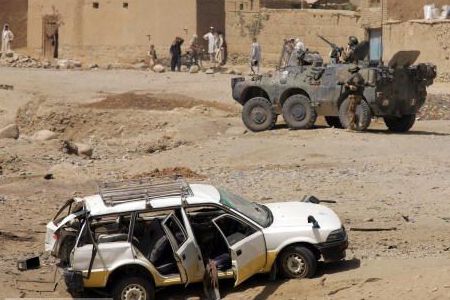
US-led forces have killed two Afghan civilians and seriously injured another one in Afghanistan’s southern Helmand province, a foreign company announces.
The Central Asia Development Group (CADG) said Monday that the foreign forces killed two Afghan employees of the Singapore-based engineering firm last week.
CADG added that another Afghan civilian hired by the company was injured by “friendly fire” from US-led security forces on February 3.
“On February 3, 2011, a CADG vehicle, carrying four of CADG’s Afghan national staff were caught in kinetic activity between ISAF (International Security Assistance Force) forces and insurgent forces on Highway 1 near Spin Masjid Bazaar, near Gereshk in Helmand Province,” CADG spokesman Matthew Goldthwaite told AFP.
“As a result of this exchange, two of the passengers were killed, one passenger was seriously wounded (and) the fourth passenger was unharmed,” Goldthwaite added.
“CADG was informed that ISAF have accepted responsibility for this incident… We believe it’s friendly fire,” he went on to say. ISAF has not yet commented on the incident.
US-led coalition forces and NATO troops in Afghanistan have been frequently criticized for the increase in civilian casualties caused by their military operations in the war-torn country.
More than 2,400 civilians lost their lives in violence across Afghanistan in 2010, marking the deadliest year for ordinary Afghans, a human rights watchdog said last week.
Civilian casualties have long been a source of friction between the Afghan government and 150,000-strong US-led foreign forces.
The loss of civilian lives at the hand of foreign forces has dramatically heightened anti-American sentiments in Afghanistan, causing thousands of Afghans to protest against US-led military presence in the Asian country.
Rejoinder to Open Letter to JNF Leadership
As chairperson of AL-BEIT: Association for the Defence of Human Rights in Israel, which is the publisher of the current volume*, I was utterly dismayed to have come across the text of an “Open Letter to Ronald Lauder, Stanley Chesley, Russell Robinson and the entire leadership of the Jewish National Fund” signed by 27 NGOs, human rights organizations and social movements from the Negev and Israel and by 7 American Jewish organizations.

I find the said text to be a sad illustration of the ongoing weakness of such among “human rights activists, social organizations in Israel, Jewish and other allies in the United States and around the world” as failing to position at the center of their political programme and grass-root practice the demand for the implementation of the right of all 1948 Palestine refugees and their families to return and to the repossession of the titles to their properties inside Israel. Furthermore, the said text fails to recognize the extent of the JNF’s complicity in the racist and apartheid policies of the State of Israel since its founding in 1948.
Allow me point out at the outset that the term “apartheid” is not synonymous with the terms “racism” and “xenophobia”. The terms “racism” and “xenophobia” are not synonymous with the term “apartheid”.
Racism is defined by the International Convention on the Elimination of All Forms of Racial Discrimination of 1965 as “any distinction, exclusion, restriction or preference based on race, colour, descent, or national or ethnic origin which has the purpose or effect of nullifying or impairing the recognition, enjoyment or exercise, on an equal footing, of human rights and fundamental freedoms in the political, economic, social, cultural or any other field of public life”. (Article 1) There is a certain degree of accuracy in the argument put forth by the Israeli Foreign Ministry (which is located in Jerusalem on land belonging to Palestinian refugees who were expelled from the city in the widespread ethnic cleansing perpetrated in Palestine in course of and in the wake of the 1948 war), and other representatives of the State of Israel around the world, that Israel should not be singled out from among other member states of the United Nations as a state uniquely afflicted by racism – not because Israel is not afflicted by racism, but because it is not greatly different from other member states of the UN, such as Indonesia and Canada, to name but two.
However, the State of Israel is not merely afflicted by racism. The core of the Israeli-Palestinian conflict hinges upon access to land and to subsoil (minerals and, above all, water), and in respect of this core the State of Israel is anchored in a regime of apartheid. Apartheid is a political regime that imposes upon the population which is under its control racist preferences and choices by power of Acts of Parliament, and enforces the said racist preferences and choices upon the population which is under its control by means of the law enforcement instruments of the state, such as the judicial system, the security forces (police, army, secret services), the planning authorities, the municipal authorities, etc.
Whereas racism in the modern sense of the term is a rampant social affliction at one level or another in all of the member states of the UN (some more and some less), a regime of apartheid as defined above is less common and, to the best of my knowledge, with the dismantling of the apartheid regime in South Africa – a process that began with the release of Nelson Mandela from prison in 1990 and was completed with his election as President of the Republic in 1994 in the first democratic elections ever to be held in the history of South Africa – the State of Israel remains the only member state of the UN that is an apartheid state.
It is possible that my knowledge is insufficient; there may be additional member states of the UN which are apartheid states as defined above, but in any event they would be few and far between. An apartheid regime constitutes a blatant violation of the UN’s founding charter, of the Universal Declaration of Human Rights, and of the standards of international law. Therefore, it is the duty of the international community to single out apartheid states, separately and collectively, including the State of Israel, for the same specific attention that was paid to the apartheid regime of the Republic of South Africa, i.e., a boycott of industrial and other products, academic, cultural and sport institutions (including research grants and international conferences), and international sanctions enforced by the UN. This is our duty, not because Israel claims to be “the Jewish state” (or any other name, for that matter), but in order to assist such states, in the same way as the international community assisted South Africa, to replace the apartheid regime with a democratic constitution.
In this regard it is important to note that, in the first democratic elections in the Republic of South Africa in 1994, Nelson Mandela was elected as President of the Republic by majorities of votes, not only among the “non-White” tribes and ethnic groups that comprise the social mosaic of the territory that comes under the authority of the Republic, but also among the “White” tribes and ethnic groups. This was after decades of political imprisonment and extensive and coordinated efforts on the part of the apartheid regime to remove him from sight and to defame him as a “terrorist”.
93% of the entire territory of the State of Israel within the borders of 4 June 1967 are defined as “national lands” and are legally designated for “Jews only”, more specifically, for those persons who are defined under the laws of the State of Israel as “Jews”. Only some 7% or less of the entire territory of the State of Israel within the borders of 4 June 1967 are privately owned, approximately half of which are estimated to be privately owned by Arabs and half by Jews. The legal system of apartheid by which this blatant discrimination is maintained in the territories under Israeli sovereignty has resulted in a land tenure system worse than that of the Republic of South Africa at the height of the apartheid regime, where 87% of the territory of the Republic was legally designated in law for the use of “Whites only”.
The strategic settler colonial apartheid legislation in the State of Israel is anchored, inter alia, on the following series of laws:
- Absentees’ Property Law; Law of Return; Development Authority Law all of 1950
- World Zionist Organization [WZO]-Jewish Agency for the Land of Israel [JA] (Status) Law, 1952
- Jewish National Fund [JNF] Law; Lands Acquisition (Validation of Acts and Compensation) Law both of 1953
- Covenant between the Government of Israel and the Zionist Executive, also known as the Executive of the Jewish Agency for the Land of Israel, 1954
- Perscription Law, 1958
- Basic Law: Israel Lands; Israel Lands Law; Israel Lands Administration Law all of 1960
- The Covenant between the Government of Israel and the JNF, 1961
- Agricultural Settlement (Restriction on Use of Agricultural Land and Water) Law, 1967
It is beyond the limits of this contribution to elaborate further upon the apartheid laws that operate in the State of Israel. In order to properly appreciate the case, one must begin by examining the cornerstones of the aforementioned legislation, and first and foremost understand how the Israel Lands Administration operates; what is the status in Israel of the Jewish Agency and the Jewish National Fund; and the modalities and the links that obtain among them.
Given the above, aren’t the signatories to the above “Open Letter” aware of the articles of incorporation of the JNF company as registered in Israel such as were approved and signed in 1954 by the Justice Minister at the time, Pinhas Rosen? They read inter alia as follows:
To purchase, acquire on lease or in exchange, etc., … in the prescribed region (which expression shall in this Memorandum mean the State of Israel in any area within the jurisdiction of the Government of Israel) or any part thereof, for the purpose of settling Jews on such lands and properties (Article 3a, Jewish National Fund, Association Limited in Liability and Without Capital Distributed to Shareholders, Memorandum of Association, Government Gazette No. 354, 10.6.1954).
Aren’t the signatories to the said “Open Letter” aware of the JNF’s complicity with the crime against humanity of the ethnic cleansing of Palestine under the cover of the 1948-49 war and their critical role in “greenwashing” the said crime by planting its forests, cultivating its parks and developing its recreational facilities over the ruins of many of the 500 odd ethnically cleansed Palestinian Arab villages inside pre-1967 Israel and over their lands?
How can the said 27 NGOs, human rights organizations and social movements from the Negev and Israel and 7 American Jewish organizations suggest that “If you, the leaders of the JNF, fail to heed this call, you will bear responsibility for the betrayal of Israel’s commitment to the values of equality and justice enshrined in its Declaration of Independence”? It is the “greenwashing” by the JNF of the crime against humanity of the ethnic cleansing of Palestine that has significantly made possible for the apartheid State of Israel to conceal these crimes for several decades and project itself as the “only democracy in the Middle East”.
How can the said 27 NGOs, human rights organizations and social movements from the Negev and Israel and 7 American Jewish organizations call upon the leadership of the JNF “to end your complicity in the destruction of Bedouin villages in the Negev and in the dispossession of Israel’s Bedouin community”, rather than call upon governments world-wide and western governments in particular to direct their Commissioners of Charities to strike the JNF off the list of charitable societies the charitable registration of the JNF, to nullify the JNF tax privileges in their respective states (as well as demand that the JNF reimburse their respective treasuries with all the monies fraudulently gained as tax-exemptions), and to declare the JNF an illegal organization under their respective liberal democratic constitutions.
Political Zionism is a form of apartheid and the appropriate penalties prescribed by the International Covenant on the Suppression and Punishment of the Crime of Apartheid of 1973 should be applied to its institutions, notably the WZO, the JA and the JNF, and to the State of Israel, which has granted those institutions statutory status by power of parliamentary legislation.
It is the duty of civil society, including professional associations, trade unions, and religious organizations, as well as the responsibility of every concerned individual of conscience (notably, the 27 NGOs human rights organizations and social movements from the Negev and Israel and the 7 American Jewish organizations) to single out the State of Israel for the same specific attention that was paid to the apartheid regime of the Republic of South Africa, inter alia in the International Convention on the Suppression and Punishment of the Crime of Apartheid of 1973, not because racism in Israel as defined in international law is that different from racism in the UK or North America, but because apartheid in Israel (the regulation of racism through Acts of Parliament) is akin to apartheid in the former (pre-1994) South Africa.
It is the duty of civil society, including professional associations, trade unions, and religious organizations, as well as the responsibility of every concerned individual of conscience (notably, the 27 NGOs human rights organizations and social movements from the Negev and Israel and the 7 American Jewish organizations) to mobilize for boycott, divestment and sanctions (BDS) and act to:
NULLIFY ISRAELI JNF LAW!
REVOKE THE CHARITABLE REGISTRATION OF THE JNF AND CANCEL ITS TAX EXEMPT STATUS IN THE UK AND BEYOND!
ANNUL THE NGO OBSERVER STANDING OF THE JNF IN THE UNITED NATIONS AND DECLARE THE JNF AN ILLEGAL ORGANIZATION UNDER INTERNATIONAL LAW!
*About the contributor and publisher of Vol 3 of the JNFebook:
Professor Dr Uri Davis is a Palestinian Hebrew, citizen of the alleged constitutional monarchy of the U.K. and of the apartheid State of Israel, born in Jerusalem in 1943. He has been at the forefront of the defence of human rights in Israel, notably Palestinian rights, since 1965 and has pioneered critical research on Zionism and the State of Israel since the mid-1970. He has published extensively in these fields, including Israel: An Apartheid State (Zed Books, London 1987 & 1990; abridged edition, MRN, Laudium, 2001); (associate author with Walter Lehn, author), The Jewish National Fund. Kegan Paul International, London and New York, 1988; Citizenship and the State: Comparative Study of Citizenship Legislation in Israel, Jordan, Palestine, Syria and Lebanon (Ithaca Press, Reading, 1997); Citizenship and the State in the Middle East: Approaches and Applications (co-ed) (Syracuse University Press, 2000) and most recently Apartheid Israel: Possibilities for the Struggle Within (Zed Books, London, 2003); A Secular Anti-Zionist COMPANION of an Abridged Passover Haggadah (with Ricky Romain, forthcoming).
Dr Davis is Associate Professor at AL-QUDS University, Institute of Regional Studies, Israel Studies Programme, Jerusalem/Abu Dis; member of the Middle East Regional Committee of the international Journal Citizenship Studies; Honorary Research Fellow at the Institute of Arab & Islamic Studies (IAIS), University of Exeter and Honorary Research Fellow at the Institute for Middle Eastern & Islamic Studies (IMEIS), University of Durham; Chairperson of AL-BEIT: Association for the Defence of Human Rights in Israel; member of the Palestinian National Liberation Movement (FATH) Revolutionary Council; and Observer-Member of the Palestine National Council (PNC).
AL-BEIT: Association for the Defence of Human Rights in Israel was founded in March 1995 by a group of Arab and Hebrew veteran human rights activists as a not-for-profit organization with the view to address a largely neglected area of human rights abuse in Israel, namely, the violation of Article 13 of the Universal Declaration of Human Rights (UDHR):
(i) Everyone has the right to freedom of movement and residence within the borders of each state;
(ii) (ii) Everyone has the right to leave any country, including his own, and to return to his country.
The organization has been a small and innovative voluntary association aiming to contribute to the process expanding the choice of residence in the State of Israel for all citizens (UDHR Article (i), above); advance the implementation of the right of return for all 1948 Palestine refugee families (UDHR Article (ii), above); and promote the idea of open localities and mixed cooperative and other communities, Jewish-Arab/Arab-Jewish communities in the first instance on an equal footing. AL-BEIT is a signatory to the Call for Academic and Cultural Boycott of Israel (Published by PACBI: Palestinian Campaign for the Academic and Cultural Boycott of Israel http://www.PACBI.org). All members of the AL-BEIT Management Committee volunteer their time and their skills.
UN Rebukes Israel’s destruction of Palestinian Water Cisterns
Palestine Monitor | 3 February 2011
The United Nations Resident and Humanitarian Coordinator for the Occupied Palestinian Territories, Mr. Maxwell Gaylard, has publically denounced Israel’s systematic destruction of rainwater collection devices, such as water cisterns, throughout the West Bank.
Mr. Gaylard remarked on 1 February 2011, “It is difficult to understand the reasoning behind the destruction of basic rain water collection systems, some of them very old, which serve marginalized rural and herder Palestinian communities where water is already scarce and where drought is an ever-present threat.”
The United Nations Office for the Coordination of Humanitarian Affairs (OCHA) documented that in 2010 Israel demolished 27 water cisterns and other rainwater collection systems in the West Bank. Moreover, OCHA recorded that 15 water springs that connect to the Mountain Aquifer, the sole source of water available to Palestinians in the West Bank, were also destroyed. Israel takes more than 80 percent of water collected by the Aquifer, leaving Palestinians with less than 20 percent.
Communities throughout the West Bank have come to rely on such basic water collection mechanisms, such as holes in the ground, due to the economic unsustainability of tankered water.
Human rights organizations, such as Amnesty International, have documented the untenable nature of water tankers, as they are forced to take circuitous routes to avoid military checkpoints and Israeli only roads that fragment the West Bank. These detours have resulted in steep increase in the prices of water.
Palestinian residents of the West Bank are required to acquire a permit for any structure in Area C, including water cisterns and holes. Permits are nearly impossible to obtain.
Despite these stringent permit criteria, the Alternative Information Center points out that destruction of water infrastructure is in violation of an Israeli-Palestinian joint agreement from 2001, the “Joint Declaration for Keeping the Water Infrastructure out of the Cycle of Violence.”
The joint declaration states, “The Israeli and Palestinian sides view the water and waste water sphere as a most important matter and strongly oppose any damage to water and wastewater infrastructure.”
According to Dr. Shaddad Attili, the Minister of the Palestinian Water Authority, water cisterns do not require a permit from the Israeli Civil Administration. Nevertheless, the Government of Israel has increased demolitions of cisterns.
“In addition to preventing the rehabilitation of Palestinian water cisterns, particularly in Area C, the Government of Israel has recently intensified its campaign of destroying these same cisterns. The rehabilitation of water cisterns does not require prior approval from the Joint Water Committee (JWC), nor does it require a construction permit from the Israeli Civil Administration,” Dr. Attili stated on 31 January.
Palestinian Minister Condemns Ongoing Destruction of West Bank Water Cisterns
PNN – 31.01.11
Ramallah – Dr. Shaddad Attili, Minister of the Palestinian Water Authority (PWA), issued on Monday a press statement condemning Israel’s ongoing destruction of Palestinian water cisterns in the West Bank, saying they are vital to the survival of Palestinian communities with little access to water.
Israel has recently intensified its campaign targeting Palestinian water cisterns, Dr. Attili said. His comments coincided with the 10th anniversary of the 2001 Israeli-Palestinian Joint Water Committee’s “Joint Declaration to Keep the Water Infrastructure Out of the Cycle of Violence.”
“The Government of Israel uses water to target some of the most vulnerable and marginalized Palestinian communities in the occupied West Bank,” said Dr. Attili. “This includes Israel’s destruction of household and community water cisterns used by Palestinians to capture rainwater runoff. Some of these cisterns are centuries old, and many are vital to the survival of Palestinian communities who have little access to water.”
“In addition to preventing the rehabilitation of Palestinian water cisterns, particularly in Area C,” he continued, “the Government of Israel has recently intensified its campaign of destroying these same cisterns. The rehabilitation of water cisterns does not require prior approval from the Joint Water Committee (JWC), nor does it require a construction permit from the Israeli Civil Administration.”
He added, “The destruction of Palestinian water-related infrastructure is in clear violation of the 2001 Israeli-Palestinian Joint Water Committee ‘Joint Declaration for Keeping the Water Infrastructure out of the Cycle of Violence.’”
Today marks the 10th anniversary of the Joint Declaration, signed by both parties at the Erez Crossing on January 31, 2001. The declaration is intended to protect water infrastructure and the welfare and rights of civilians who need it.
According to the Palestinian Water Authority, many Palestinian communities in Area C, under Israeli army control, are not connected to a water network due to severe infrastructure development restrictions imposed by Israel. For most, water cisterns serve as the only available source of water alongside tankard water, which remains prohibitively expensive. The most marginalized communities rely on this water for their livelihoods, since it is primarily used for livestock and agriculture.
Israel announces new land seizure near Bethlehem
Ma’an – 01/02/2011
HEBRON — Israel’s Civil Administration announced in the newspapers on Tuesday plans to seize some 600 dunums of lands southwest of Bethlehem, in the southern West Bank.
Residents of Wadi An-Nis and Beit Ummar, locals said, could produce ownership documents for at least 400 dunums of the land.
According to an announcement made in the Arabic papers, “agricultural land will be used for an educational institution according to article 20/24 of construction law number 79 of the year 1966.”
The announcement gave residents 60 days to contest the seizure in Israeli court.
Beit Ummar resident Mahmoud Awwad said his family owned 400 dunums near the site identified in the newspaper, and said he was told that the land would be used to build a school for Ultra-Orthodox Jewish students.
Awwad said he believed the other 200 dunums belonged to the Ikhleil and Sabarna families. His own family, he said, had been working the land near Wadi An-Nis for more than 200 years.
Ownership certificates for the land, he explained, were registered in the Ottoman, British Mandate and Jordanian eras of rule over the area.
Representatives from the Civil Administration did not answer calls for comment.
Golan Heights activist: “We dream of freedom”
By Adri Nieuwhof, The Electronic Intifada, 28 January 2011
Since the Syrian Golan Heights were occupied during the June 1967 War, the indigenous Arab population has resisted Israeli control. The Electronic Intifada contributor Adri Nieuwhof interviews Taiseer Maray, general director of the non-profit organization Golan for Development, about the situation in the occupied Golan Heights.
Adri Nieuwhof: Tell us about the activities of the Golan for Development.
Taiseer Maray: The Golan for Development was established in 1991 in the occupied Golan Heights. We are working on development projects as a method to resist Israel’s occupation and control. We provide basic services in many different projects. We cover most of the health services in all five Arab villages, and we increase awareness of health issues. We offer agricultural outreach services to the farmers. We have a theater project, and in our music center fifty pupils receive music lessons. We run a kindergarten for children, we organize teaching courses and activities for women. We also developed a project on alternative tourism. With our research project we monitor the Israeli settlements in the Golan and relevant issues in our society. We are innovative. For example, we have developed a new technique of growing shitake mushrooms on apple wood. We researched and published information about this.
AN: The media does not cover the situation in the occupied Golan Heights. What can you tell us about it?
TM: In 1967, before the June War, 130,000 Arabs lived in 139 villages and more than sixty farms in the Syrian Golan Heights. After the war, about 60,000 to 90,000 Syrians remained in the Golan. Within two months following the June [1967] war, the Israeli forces transferred the rest of the population. People were pushed out of their houses. Only about 6,300 Syrians remained in five villages, mainly farmers. People were frightened at that time. You don’t hear much about us because of our small numbers. In 1981, Israel annexed the Golan Heights. The people resisted, there were clashes and demonstrations. We were attractive to the press then. Israel tried to force us to take Israeli citizenship. We refused.
In the 1990s, Israel understood that putting pressure on the Arabs in the Golan Heights led to more unity and resistance. Now they want us to assimilate into Israeli society. We don’t face hard Israeli policies like in the 1970s and 1980s. They are trying to destroy our cultural heritage by forcing us to assimilate. The fight is about education, and against the silent attack on our cultural heritage and identity. It makes resistance more difficult. Israel tries to control the brains of the new generation through education. We have to study Hebrew, Zionist history, Jewish history. The culture of Arabs that is taught is in the best case half the truth. In Syria, we have a culture of resisting occupations, by the French, the Ottomans. Our resistance is reflected in our poetry, but the Arab poetry that is taught in school is about love. The Israeli educational curriculum brainwashes the youth.
AN: What are Israel’s motivations for maintaining its occupation of the Golan Heights?
TM: It goes back to the history of the Zionist movement. The Golan Heights has been part of Zionist ambition since its establishment. In the literature you find how the Zionists asked the British to include the Golan Heights in the plans for the new Jewish state. Water is the main reason for Israel to occupy the Golan Heights. The Jordan River springs into the Golan Heights. We in the Golan get about 1,000 mm of rain per year. About 25 percent of the water Israel uses is from the Golan Heights. The biggest water company from Israel, Eden Springs, bottles our water in a factory on our land and exports it worldwide.
Another reason is that we have very fertile land. Since 1967, Israel has used all the potential of the Golan Heights: agriculture, tourism, minerals, grazing land, vineyards. Israeli wine produced from grapes from the vineyards in the Golan Heights is sold in the Netherlands. Flowers grown by Israel in the Golan are exported, also to the Netherlands. There is an Israeli olive oil factory in the Golan. We have lots of Israeli industries on our land.
AN: What does the Israeli occupation look like for the Arabs in the Golan Heights?
TM: In the 43 years of the Israeli occupation we have seen different strategies. The first ten years we were under military rule. Hundreds of people were taken to jail for political resistance in the 1970s and 1980s. You were taken to jail for discussing politics. After the annexation of the Golan Heights in 1981, we resisted and had clashes with the Israeli military forces. They tried to suppress and break us. We resisted and still do not have Israeli citizenship. Israel’s policies change. Now, they opened the gates to work, to assimilate us into Israeli society.
We fight about land and water resources. We fight to cultivate our land, while the settlers have free access to land and free access to water. Arab farmers may only use 150 cubic meters per dunam, which is one thousand square meters. A settler may use 700 cubic meters for one dunam. Water costs us about $1 per cubic meter, settlers pay $0.25 cents. The last four to five years Israel has uprooted more than 10,000 apple trees. Israel claimed it was state land. People went to the land collectively and replanted it with apple trees.
The farmers in the Arab villages in the Golan produce forty percent of the apples and fifty percent of the cherries for the Israeli market. We want to export our produce to the occupied West Bank and Gaza, but we don’t have access to them. We want to export to Europe. Maybe Fair Trade could be an option.
The last four years we could sell about ten percent of our apples to the Syrian market — to Damascus. We negotiated that the apples can pass the demarcation line with Syria. And now Israel tries to use it for political pressure. To use the sale of our apples as an example of normalization. But our apples are a Syrian product, grown by Syrian farmers on our land with our water. The apples are sold to our government in Damascus.
We fight about the education system. We have a big fight about building areas and rights. The municipalities in the Golan Heights are not elected. Israel appoints the mayors. Since 1981 we are forced to pay taxes but we receive nothing in return. We pay more taxes than the settlers. Our population grew from 6,300 in 1967 to 21,000. Israel controls the land near our villages to claim it for future needs of the settlers. We are fed up with it. With a few thousand people we went to the mountain near the village and opened roads. We are going to hand out our land to villagers to build on it.
AN: Do you see similarities between the occupation of the Golan Heights and the occupation of the West Bank and the Gaza Strip?
TM: We are the same people under the same occupation. At present our reality is different. The political prisoners of the Golan Heights spend their time in jail with Palestinians from the West Bank and Gaza. People say the first Palestinian intifada was inspired by the resistance in the Golan Heights. The Palestinians supported our struggle. We had a six-month strike and could not survive without the support of the Palestinians from the West Bank, Gaza and Israel. The first Palestinian intifada was a sort of continuation of what happened in the Golan Heights in the 1980s. We had lots of demonstrations to support the Palestinians. In 2008, during Israel’s invasion of Gaza, we collected food and sent trucks to Gaza. We keep close relations, we have the same struggle against the same aggressor. We have the same policy, the same goals. Israel tries to limit our development.
AN: What is the dream of the Arabs living under occupation in the Golan Heights for the future?
TM: Freedom for all of us. We dream that the Golan Heights will be given back to Syria. That Palestinians should be liberated and have their own state. We dream of the liberation of the Jewish people from the Zionist ideology. We dream of a Middle East where we have equal rights. We are not against Jews. No, we should be equal. I want to see Israel become a free, democratic country with no fascism and racism. This is an important step for our liberation from the Israeli occupation.
Photo by Ayman Abu Jaba/Golan for Development.
Adri Nieuwhof is a consultant and human rights advocate.
Featured Video

AIDS Inc. by Gary Null (2007)
or go to
Aletho News Archives – Video-Images
From the Archives
Clash of Civilization, Iran Part II
By Jamal Kanj – Intifada-Palestine.com – January 14, 2011
Israel’s survival kit is: perpetuate conflict, insecurity to rationalize collective hate and finally playing victim.
Devoid of conflict, Israel implodes internally; without hate, Zionism loses its justification; and playing eternal victim to continue blackmailing the West. Absence of this holy trinity, Israel ceases to exist.
From its inception, the house of Zion has mastered exploiting adversarial powers to advance Israel’s cause. For instance, their influence over the Democratic Party in the US began with President Truman’s bid for 2nd term election in 1948.
Responding to strong opposition from Secretary of State General George Marshall and Department experts urging against recognition of Israel, President Truman replied: “I’m sorry gentlemen but I have to answer to hundreds of thousands [Jewish voters] who are anxious for the success of Zionism. I do not have hundreds of thousands of [voting] Arabs among my constituents”
Zionists influence over liberal American politics was matched with the doctrinal school of Conservative theoreticians aligning the Republican Party’s platform with Israel’s objectives. The Neoconservative Zionists, coined Zioncons, invented the “Clash of Civilization” concept to fight Israel’s wars. … continue
Blog Roll
 Aletho News
- Merck Virologists Admitted to Falsely Certifying Vaccine Efficacy
- Mandatory Folic Acid for every man, woman & child
- Pro-Palestine protesters arrested outside UK’s ruling Labour Conference in Liverpool
- Mauritius denies landing permit to flight from Israel, forcing cancellation: Tour operator
- Israeli finance minister calls for genocidal war on West Bank, annexation of south Lebanon
- 12 Things Your Psychiatrist Was Trained Not to Tell You
- From Unipolar Universalism to Multipolar Civilizational Distinctiveness
- RSF military group defects, joins Sudanese army: State media
- Ireland goalkeeper refuses to play ‘Israel’ as squad weighs boycott
- China pushes back against US on Cuba, Iran
- If Americans Knew
- Israel forces Gazans to live in constant peril – Daily Update
- Deconstructing Netanyahu’s pants-on-fire UN rant – Daily Update
- Trump betrayed voters with his campaign lies and prioritized a foreign country once he took office
- Netanyahu calls Israel’s war in Gaza ‘opposite of genocide’ in UN speech to near-empty hall
- Settler Kidnappings: Torture, Sexual Abuse and Terrorisation of Palestinian Abductees as Israel Deepens Annexation of West Bank
- Gaza winter nears as 162,000 tents become unusable, raising fears of humanitarian crisis
- Netanyahu says, “It’s the opposite of genocide”; UN says Gaza economy is world’s ‘most severe crisis on record’ – Daily Update
- Israel’s US-Backed Assault on Gaza Has Created the ‘World’s Most Severe Economic Crisis on Record’: UN
- ‘Protecting U.S. Citizens’… From Israel
- ‘This is where I live now, the back of a truck’: a day in the life of a grandmother in Gaza
- No Tricks Zone
- New Study: Earth And Venus Surface Warmth Largely Explained By Convection And Lapse Rate, Not CO2 Or Radiation
- 2025 Nature Paper Claiming Worsening Global Drought Gets RETRACTED …Heavily Flawed
- New Study: ‘Global Drought Shows No Detectable Recent Acceleration Under Climate Warming’
- Economic Masterminds: German Socialists Suggest Taxing Productivity Gains Stemming From Using AI
- The South China Sea Has Not Been Cooperating With The Climate Change Narrative
- Energy Crisis: Germany Enters Heating Season With Historically Low Gas Reserve Fill Levels
- New Study: The Antarctic Ice Sheet Gained Mass From 2020-2024 Due To Staggering Snow And Ice Accumulation
- Study: Ocean Heating Rates From Thousands Of Years Ago ‘Dwarf’ Modern Ocean Heating Rates
- Climate Extremists Target, Attack Large-Scale Power Grid Infrastructure In Germany!
- New Study: Antarctic Ice Melt Has Contributed Less Than 1 Centimeter To Sea Level Rise In The Last 30 Years

