Iran and Hezbollah warn Turkey: all your forces are in our line of fire
Iranian Advisory Center in Syria: we call on Turkish forces to act rationally for the benefit of the Syrian and Turkish peoples
Al-Manar, February 29, 2020
The Iranian Advisory Center in Syria, which takes part in the fighting in northern Syria, issued a press release through the news agency U-News in reaction to the recent confrontation between the Syrian army and the Turkish army. It should be noted that the Iranian Advisory Center is made up of the group of Iranian experts who advise the Syrian State and its armed forces, and that this is the first statement it has issued since the beginning of the war in Syria.
Full text of the statement
In reaction to the latest confrontation between the Syrian Arab Army and the Turkish Army, it is important for us to inform the public of the following:
First: We fought alongside the Syrian Arab army and supported it, at the request of the Syrian State, to open the M5 highway, with a Syrian force led by elements of the Iranian Revolutionary Guards and of Hezbollah, and with the participation of factions of the Resistance within the force; and we have helped civilians and residents of the liberated villages.
Second: Protected by the Turkish army, the armed (terrorist) groups attacked the positions of the Syrian army, and so we participated in the fighting aimed at preventing the M5 highway to fall again in their hands.
Third: Since the beginning of the presence of our forces, the Turkish positions located in the Syrian territories have been in the sight of our forces, whether they comply with the Astana Agreements or violate them, but the elements of the Resistance did not strike these Turkish forces out of deference to the decision of their (respective) leaders, and this decision remains in effect until now.
Fourth: Four days ago, foreign elements, Tajiks from the Turkestan Party, elements from the Al-Nusra Front, as well as other terrorist factions, carried out a large-scale attack on the positions of the Syrian army. Our forces directly supported the Syrian Army to prevent the liberated areas from falling into their hands.
Fifth: Despite the defensive nature of the action of our forces, the Turkish army targeted our elements and our forces from the air, with precision missiles and artillery support, which prompted us to send mediators to the Turkish army to end its attacks and renounce this approach
Sixth: Our mediators announced to the Turkish army that the terrorists attacked our positions with their support, that our forces are there to confront the terrorists, and that we are on the side of the Syrian army for this mission; but unfortunately, the Turkish military ignored this request and continued its bombing, and a number of our fighters (Iranian & Hezbollah’s) were martyred.
Seventh: Syrian army artillery responded by striking the source of the fire; for our part, we did not retaliate directly, and once again, we announced to the Turkish army through mediators that we have no objective or decision to confront the Turkish army and that our leadership is determined to reach a political solution between Syria and Turkey.
Eighth: We have informed our forces since morning not to target Turkish forces inside Idlib in order to spare the lives of their soldiers, and our forces have not opened fire, but the Turkish army continues to shell the points and locations of the Syrian army (where we are also located) with artillery fire.
Ninth: The Iranian Advisory Center and the fighters of the Resistance front call on the Turkish forces to act rationally in the interest of the Syrian and Turkish peoples, reminding the Turkish people that their sons (soldiers) have been in our sights for one month and that we could have targeted them in revenge, but we did not do so in accordance with the orders of our leaders; we call on them to pressure the Turkish leadership to rectify its decisions and avoid spilling the blood of Turkish soldiers.
Tenth: Despite the current difficult circumstances, we reaffirm our continuing position alongside the people, the State and the army in Syria in their fight to defeat terrorism and preserve their full sovereignty over the Syrian territories, and we all call on actors to be rational and aware of the great risks of continuing the aggression against Syria.
Iranian Advisory Center in Syria
Translation: resistancenews.org
Israel Sends Condolences for Turkish “Martyrs”. Erdogan Expands War to Hezbollah, Iran
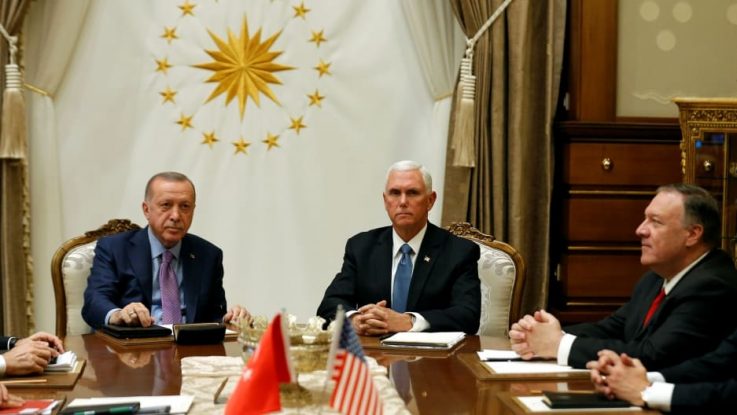
By Marko Marjanović | Anti-Empire | February 29, 2020
In the aftermath of the (probably Russian) strike that killed 33 Turkish soldiers in Syria late (10pm) Thursday Israel sent its condolences for the Turkish “martyrs”, ie using Islamic terminology:
Israel sends its condolences to Turkey over the killing of Turkish soldiers in Idlib.
“We are deeply saddened by the martyring of Turkish soldiers”
Interesting that they used “martyr” in Turkish https://t.co/X8SCOo3nWO
— Ragıp Soylu (@ragipsoylu) February 28, 2020
In fact, earlier that same day as Turkey was hitting the Syrian army heavily around Saraqib Israel snuck in two attacks on the other country:
Israeli helicopters struck Syrian military positions in the Quneitra province in the Syrian Golan Heights and wounded three Syrian soldiers, Syria’s official news agency SANA reported overnight Thursday.
Earlier Thursday, Syrian state TV reported that an Israeli drone fired a missile at a car in southern Syria, killing one person whom it named as a “civilian.” Several other media outlets aligned with Syrian President Bashar Assad’s regime said that the man was a local policeman.
Soon after Turkey expanded its Syria strikes to Hezbollah:
Turkish strikes using drones and smart missiles late on Friday that hit Hezbollah headquarters near Saraqeb killed nine of its members and wounded 30 in one of the bloodiest attacks on the Iran-backed group in Syria ever according to a commander in the regional alliance backing Damascus.
Sure the Shia Lebanese Hezbollah is fighting on the other side in Syria so hitting them would have some tactical value (at a great cost in other ways), but even at the time I wondered if that wasn’t really more a dog whistle to Tel-Aviv and the Israel supporters in DC and the US at large.
Apart from State Department apparatchiks and their hack boss Pompeo, Turkey had found itself very lonely in its new Syria adventure. The asked-for US-manned Patriot missiles to somehow wrestle the control of Idlib skies from Russia aren’t materializing.
But start hitting Hezbollah and suddenly you’ve got the attention of the powerful pro-Israel currents in the US, as well as of Israel itself.
My suspicion was confirmed Saturday when it became clear the Turks had hit Iranians as well:
Statement by Iran’s “advisory mission in Syria”: Turkish army is still shooting at our positions and bases. We call on Turkey to show rational behavior. The Turkish nation’s children are within range of our military forces.
(First statement by Iranian command in Syria, I guess)
— Reza Khaasteh (@Khaaasteh) February 29, 2020
The use of the word “children” above is a misleading translation, the Iranian communique spoke about “sons”, which naturally refers to Turkish troops.
Iranian embassy in Syria: “The Iranian government informed Erdogan that it would respond with full force to the Turkish points if it continued to bomb our forces and the Syrian army.”
— Rojava Network (@RojavaNetwork) February 29, 2020
Iran issued a warning to Erdogan to knock it off or his troops will face the consequences but you get the feeling that may be exactly what Erdogan is trying to provoke. Get the pathologically anti-Iranian Trump administration to see Turkey’s ‘safe-zone-for-bin-Ladenites’ Idlib invasion as an anti-Iranian enterprise and the prospects of American backing look quite a bit brighter.
#Turkey was informed in details of the position of Hezbollah and the Iranian brigades along with the Syrian army but decided to ignore the information and continued bombing these positions over and over again.
It is now clear that Turkey is in the battle with his army to stay.
— Elijah J. Magnier (@ejmalrai) February 29, 2020
Keep in mind that neither #Iran nor #Hezbollah ever attacked the Turkish army until this hour. It is #Turkey that took the initiative to bomb the Iranian-led forces and Hezbollah HQ and military hospital.
— Elijah J. Magnier (@ejmalrai) February 29, 2020
US Demands Russia ‘Immediately Ground Warplanes’ Over Syria
Sputnik – February 29, 2020
The situation in the northwestern Syrian renegade province of Idlib escalated again on Thursday after Syrian forces responding to a Nusra Front assault accidentally struck Turkish positions, killing 33 troops and injuring dozens more. The attack prompted the UN Security Council to call an emergency meeting on the situation in Syria.
The US “fully supports” Turkey’s right “to respond in self-defence” to the “unjustified” attacks on Turkish forces in Idlib, Syria which killed nearly three dozen troops Thursday, US Permanent Representative to the UN Kelly Craft has said.
“We call on the Russian Federation to immediately ground its warplanes. And we call for all Syrian forces and their Russian backers to withdraw to the ceasefire lines first established in 2018,” Craft said, speaking at the UN Security Council’s emergency meeting on Syria on Friday.
“The United States is not here today to listen and discuss. We are here to speak directly and without qualification,” Craft warned. “In the days ahead, the United States’ commitment to our NATO ally, Turkey, will not waver,” the ambassador added.
Calling the Astana format for Syrian peace talks “broken beyond repair,” Craft said that the US wants “an immediate, durable, and verifiable ceasefire in northwest Syria,” and urged the UN to “play a central, active role if we are to avoid even greater escalation.”
Responding to Craft, Russian Permanent Representative to the UN Vasily Nebenzya pointed out that the incident involving the deaths of Turkish military personnel took place outside Turkey’s observation post base, and stressed that Syria has the right to target terrorists. Nebenzya recalled that the Nusra terrorists in control of large swathes of Idlib have dramatically increased their attacks against civilians and the Syrian military in recent weeks, giving the Syrian Army the right to respond.
The Syrian Ambassador to the UN Bashar al-Jaafari, meanwhile, accused Turkey of aggression, and alleged that Ankara was using its observation posts to provide assistance to the terrorists. Al-Jaafari also accused the UK of calling Friday’s Security Council meeting to try to discredit the Astana format.
Black Thursday
Turkish and Syrian forces became engaged in a shooting war in the restive Idlib region earlier this month, after a Syrian artillery attack on one of Turkey’s dozen observation posts killed over half-a-dozen Turkish troops, resulting in a wave of Turkish attacks on Syrian forces. On Thursday, Nusra terrorists launched a large-scale offensive on Syrian Army positions, with Syrian forces responding, with 33 Turkish troops killed in Syria’s counterattack. Shortly thereafter, the Russian military’s Syrian monitoring mission reported that Turkish troops were mixed in among the Nusra militants as the latter came under artillery attack.
On Saturday, the Russian Foreign Ministry stated that Moscow and Ankara had committed to reducing tensions on the ground in Idlib. The same day, however, Turkish President Recep Tayyip Erdogan told reporters that he had asked Russian President Vladimir Putin to “get out of our way” and to leave Turkey “face to face” with the Syrian government.
US, Taliban Sign Peace Agreement in Doha
Sputnik – February 29, 2020
Negotiators from the United States and the Taliban are meeting in Doha, Qatar to sign an accord that envisages the timetable of the US withdrawing some of its 13,000 troops. The Taliban, in turn, is expected to sever ties with all extremist groups and prevent the territories of Afghanistan from becoming havens for militants.
The United States and the Taliban movement have signed the long-awaited peace agreement in the Qatari capital of Doha on Saturday.
The troop withdrawal will be phased, with the US forces set to be slimmed down to 8,600 in the first 135 days since the deal’s announcement, while allied and coalition forces will be scaled down proportionately.
The residual US, allied and coalition forces will pull out within the remaining nine-and-a-half months, whereby all military bases will be abandoned.
Up to 5000 Taliban prisoners will be released from prisons by 10 March, the first day of intra-Afghan talks. The remaining prisoners will be freed within the next three months. The Taliban commits that its released prisoners will not pose a threat to the security of the US and its allies.
As soon as intra-Afghan talks begin, the US will start the review process of its sanctions on the Taliban and rewards lists issued for its members, with the goal of removing sanctions by 27 August. It will also engage with the UN Security Council and Afghan authorities to have national sanctions on the Taliban scrapped by 29 May.
The US pledges to seek economic cooperation for reconstruction with the new post-settlement Afghan Islamic government and will not intervene in its internal affairs.
In return, the Taliban will take steps to prevent terrorist groups, such as al-Qaeda, from using Afghan soil to threaten the security of the US and its allies.
They include sending a “clear message” that those posing such threat have no place in Afghanistan. The Taliban will instruct its members not to cooperate with such groups or individuals and prevent them from recruiting and fund-raising. It will only grant asylum to people who do not pose a security threat and will not issue visas or other documents to those considered a risk.
Following the signing of the deal, US State Secretary Mike Pompeo enumerated key conditions of the deal between the United States and the Taliban.
“Keep your promises, cut ties with Al-Qaeda. Keep up the fight against Daesh,” Pompeo said, addressing the Taliban.He added that the agreement was “a true test,” stressing that Washington will calibrate the pace of the troop withdrawal with the actions of the Taliban.
US President Donald Trump, for his part, welcomed the agreement as a move to put an end to the US most protracted war.
“We are working to finally end America’s longest war and bring our troops back home,” he said.The head of the militant group’s political office in Qatar said that the Taliban will adhere to the peace agreement signed in Doha on Saturday.
“The US and the Taliban movement have successfully concluded talks in Qatar. I congratulate everyone on this achievement. We will comply with the pact and, as a political force, we want it to be implemented by neighbouring countries,” Abdul Ghani Baradar said.In his turn, Afghan President Ashraf Ghani expressed hope that the long-awaited US-Taliban peace agreement would lead to a permanent ceasefire that in turn would bring stability to Afghanistan.
International Reactions to Historic Accord
NATO Secretary-General Jens Stoltenberg has said that the alliance supports the signing of the US-Taliban peace deal.
“This [deal] is a victory for peace, victory for Afghan people,” Stoltenberg said.The European Union has welcomed the long-awaited peace deal between the United States and the Taliban as a first step toward a negotiated peace process among all Afghans.
“The European Union considers today’s conclusion of the Afghanistan-US Joint Statement for Peace and the settlement between the US and the Taliban as important first steps towards a comprehensive peace process, with intra-Afghan negotiations at its core,” the declaration read.It urged the sides not to miss this opportunity for a lasting peace that could create an environment of security and stability in the war-torn country. Keeping up the reduction in violence is an important part of that process, it added.
“The EU calls on all stakeholders to put the interests of the nation above all other considerations, as the collective responsibility of all Afghan political forces,” it concluded.The UN Assistance Mission in Afghanistan (UNAMA) has called for the continuation of the reduced violence in Afghanistan and welcomed the commitment of the conflicting sides to further dialogue.
“Intra-Afghan negotiations are central to the peace efforts. The United Nations welcomes the commitment expressed by the parties to intra-Afghan negotiations; and urges them to move ahead expeditiously with their preparations to start the negotiations, including through forming a truly representative negotiation team,” UNAMA said in a statement.The United Nations also expressed its support to an inclusive Afghan-led process and called for concrete steps toward ending the war.
“The United Nations stresses the importance of continuing to reduce violence, especially violence that harms civilians, and urges all parties, in the period ahead, to redouble efforts to reduce violence on the way to a permanent ceasefire and a lasting political settlement,” the statement said.
Since 2018, Washington and the Taliban have been attempting to negotiate a peace deal that would ensure the withdrawal of foreign troops from Afghanistan in exchange for the movement’s guarantee that the country would not become a safe haven for terrorists. The parties’ representatives have been regularly meeting in Doha to address the issue.
Yemenis encircle strategic city in al-Jawf as Saudi countermeasures fail: Report
Press TV – February 29, 2020
Yemen’s armed forces have encircled the strategic city of al-Hazm – the capital city of the northern al-Jawf province – as Saudi attempts to break Yemeni advances failed, a report says.
The Beirut-based al-Akhbar newspaper reported Saturday that the advances by Yemeni forces, led by the popular Houthi Ansarullah movement, continue towards the strategic city and that major Saudi positions surrounding al-Hazm have fallen.
A tribal source loyal to Ansarullah told al-Akhbar that advances are currently ongoing northwest of the city, adding that a Saudi counteroffensive seeking to recapture the al-Ghail region south of al-Hazm had failed.
The source added that the Yemeni forces have gained control over a number of positions overlooking provincial government buildings in the city.
Up to 70 percent of the province is currently under the control of the Yemeni forces, he added.
According to the report, Saudi Arabia has sent dozens of military vehicles along with hundreds of mercenaries from the central Ma’rib and southern Shabwah province in a bid to push back the Yemenis advances.
Saudi Arabia has also sought to win the loyalty of Yemeni tribes against the Yemeni forces in the region by offering money, the report added.
Yemen’s al-Jawf province had been under Riyadh’s control for up to 50 years.
Due to Saudi intervention and influence, al-Jawf province was effectively deprived of using its oil reserves, which are largest in Yemen, and attracting needed investment, it added.
According to the report, Saudi Arabia expelled as many as 370,000 Yemeni workers from the kingdom in 2013 to put pressure on the former Yemeni government shortly after Yemen’s Safer oil company started operating the first oil well in al-Jawf province.
Saudi Arabia launched its war on Yemen in March 2015, with the goal of bringing back to power the government of former president Abd Rabbuh Mansour Hadi and crushing the popular Houthi movement.
The US-based Armed Conflict Location and Event Data Project (ACLED), a nonprofit conflict-research organization, estimates that the Saudi war has claimed more than 100,000 lives since the war broke out.
The ‘Stolen Province’: Why Turkey Was Given A Corner Of Syria By France 80 Years Ago
Sputnik – February 29, 2020
Turkey’s President Recep Tayyip Erdogan is becoming more and more embroiled in a direct fight with Syria over Idlib Province. The fighting is directly across the border from Hatay, a province which was given to Turkey in 1939 after a disputed referendum.
Turkey has lost a total of 54 soldiers in Idlib province this month as Syria’s President Bashar Assad and his Russian allies have accused Turkey of failing to honour a deal to separate extremist groups from other fighters in the region.
The Syrian Army now controls the southern half of Idlib province but the fighting has increased the stream of refugees attempting to cross the border into the Turkish province of Hatay.
The border between Syria and Turkey is a relatively straight line from east to west until it reaches the Orontes river.
Then it suddenly dips and heads southwards for about 80 miles, before turning west again and meeting the Mediterranean just beyond Mount Kilic.
Strategically this little corner of the Levant – known as Liwa Iskanderoun to the Syrians – is vitally important to the Turkish state.
Now called Hatay province, it contains the cities of Antakya and Iskanderun – previously known as Antioch and Alexandretta – and the port of Dortyol, which was known as Chork Marzban to its Armenian population before the genocide which finally ended in 1923.
In that same year the founder of modern Turkey, Kemal Ataturk, signed the Treaty of Lausanne, which enshrined the boundaries of the Turkish state.
Those borders remain exactly the same today – except for Hatay province, which suddenly joined Turkey in 1939.
Syria, Lebanon and much of the Middle East had been part of the Ottoman Empire until it collapsed after being defeated in the First World War.
Under the Treaty of Lausanne, Hatay was part of the French mandate of Syria and Lebanon but just before the Second World War broke out, Paris suddenly decided to hold a referendum and Hatay voted to become part of Turkey.
Syria became independent in 1945 – with Lebanon as a separate state – and refused to recognise Hatay as part of Turkey.
But little was said about it until the conflict in Syria began to draw in President Erdogan and the Turkish armed forces several years ago.
Syrian media began to highlight the suspicious and controversial way Hatay, or Liwa Iskanderoun, was given to the Turks.
In the late 1930s, France was growing increasingly worried about an impending war with Hitler’s Germany and French diplomats were desperately trying to sign up potential allies in Europe and the Middle East.
Ataturk died in 1938 and his successor, Ismet Inonu, was keen to continue his Turkish nationalist fervour.
So when the French suggested a treaty of friendship during the upcoming war, Inonu was willing to accept, on one condition that Turkey recover Hatay.
France agreed, but was technically breaching the Treaty of Lausanne, so in order to give it a fig leaf of respectability, the French suggested a referendum.
Hatay was at the time a mixture of nationalities – Turks, Turkmen, Sunni Arabs, Alawites (Alevis), Armenians and even some Greeks – with no clear majority, but Ankara is widely believed to have bussed in Turks from other parts of Anatolia and rigged the result of the referendum.
Relations between Turkey and Syria were strained for decades over the issue of Hatay but they began to improve in the 1990s as Turkey sought Syrian help in combating Kurdish guerrillas.
Just before the Syrian civil war broke out in 2011, an agreement was signed to build a $28 million Syrian-Turkish Friendship Dam on the Orontes River.
But construction was postponed by the conflict and now Turkey and Syria have had a falling out, with Erdogan furious at Assad for daring to target Turkish troops even though they were siding with jihadist rebels.
Even NATO is unwilling to touch Turkey’s Idlib mess with a ten-foot pole
By Scott Ritter | RT | February 28, 2020
Having been hit by the Syrian Air Force in Idlib, Turkey has called on NATO’s protection, but as much as the alliance would like a fight with Assad and his ally Russia, it’s refused to back Ankara’s questionable adventure.
Turkey engaged NATO in Article 4 consultations, seeking help regarding the crisis in Syria. The meeting produced a statement from NATO condemning the actions of Russia and Syria and advocating for humanitarian assistance, but denying Turkey the assistance it sought.
The situation in Idlib province has reached crisis proportions. A months-long military offensive by the Syrian Army, supported by the Russian Air Force and pro-Iranian militias, had recaptured nearly one-third of the territory occupied by anti-Assad groups funded and armed by Turkey. In response, Turkish President Recep Tayyip Erdogan dispatched thousands of Turkish soldiers, backed by thousands of pieces of military equipment, including tanks and armored vehicles, into Idlib to bolster his harried allies.
The result has been a disaster for Turkey, which has lost more than 50 soldiers and had scores more wounded due to Syrian air attacks. For its part, Russia has refrained from directly engaging Turkish forces, instead turning its attention to countering Turkish-backed militants. Faced with mounting casualties, Turkey turned to NATO for assistance, invoking Article 4 of the NATO charter, which allows members to request consultations whenever, in their opinion, their territorial integrity, political independence or security is threatened.
Dangerous precedents
Among the foundational principles of the NATO alliance, most observers focus on Article 5, which declares that an attack against one member is an attack against all. However, throughout its 75-year history, Article 5 has been invoked only once – in the aftermath of 9/11 – resulting in joint air and maritime patrols, but no direct military confrontation. The wars that NATO has engaged in militarily, whether in Kosovo, Afghanistan, Libya or Iraq, have all been conducted under Article 4, when NATO made a collective decision to provide assistance in a situation that did not involve a direct military attack on one of its member states.
With that in mind, Turkey’s decision to turn to Article 4 was a serious undertaking. For additional leverage, Ankara linked the NATO talks with a separate decision to open its borders to refugees seeking asylum in Europe, abrogating an agreement that had been reached with the European Union to prevent uncontrolled migration into Europe through Turkish-controlled territory and waters. Through this humanitarian blackmail, Turkey sought to use the shared economic and political costs arising from the Syrian situation as a bargaining chip for NATO support.
A failed gamble
The best Turkey could get from its Article 4 consultation, however, was a lukewarm statement by Jens Stoltenberg, the NATO secretary general, condemning Syria and Russia while encouraging a diplomatic resolution to the fighting in Syria that focused on alleviating the unfolding humanitarian crisis regarding refugees. This is a far cry from the kind of concrete military support, such as the provision of Patriot air defense systems or NATO enforcement of a no-fly zone over Idlib, Turkey was hoping for.
The provision of military support under Article 4 is serious, involving as it does the entire weight of the NATO alliance. This was underscored by recent comments made by the Supreme Commander of Allied Forces in Europe, US General Tod Wolters, which linked NATO’s nuclear deterrence posture to current Article 4 NATO operations in Afghanistan and Iraq. At a time when NATO is focused on confronting Russia in the Baltics, opening a second front against the Russians in Syria is not something the alliance was willing to support at this time.
While the US was vocal in its desire to support Turkey at the consultations, NATO is a consensus organization, and the complexities of Turkey’s Syrian adventure, which extend beyond simple Russian involvement to include issues involving the legality of Turkey’s presence inside Syria, and the fact that many of the armed groups Turkey supports in Idlib are designated terrorist organizations, precluded a NATO decision to intervene on Turkey’s behalf. Having failed in its effort to get NATO support in Syria, Turkey is now left with the Hobson’s choice of retreating or doubling down. Neither will end well for Turkey, and both will only further exacerbate that humanitarian disaster taking place in Idlib today.
Scott Ritter is a former US Marine Corps intelligence officer. He served in the Soviet Union as an inspector implementing the INF Treaty, in General Schwarzkopf’s staff during the Gulf War, and from 1991-1998 as a UN weapons inspector. Follow him on Twitter @RealScottRitter
Once Saudi Allies, Tribes in Eastern Yemen’s Al-Mahrah Are Now Battling Saudi Forces
By Ahmed Abdulkareem | MintPress News | February 28, 2020
AL-MAHRAH, YEMEN — Saudi Arabia’s continued efforts to occupy Yemen’s province of al-Mahrah, which lies on the country’s border with Oman, appear only to have emboldened al-Mahrah tribes, who have resorted to using military tactics to drive out Saudi forces from their province. The tribes are fueled by a collective social desire for sovereignty stemming from their long history as an independent region and a local culture that remains wary of foreign forces.
On Wednesday, Saudi troops in Nashton Port in al-Mahrah were subjected to an explosive device targeting a Saudi military convoy in Fujeet District killing multiple troops including members of a local Saudi-funded militia. The attack came after Saudi forces occupied al Shehn port last week.
Since 2017, when Saudi forces once again entered the isolated province, the deep-seated sense of local identity spurred a growing opposition movement. The opposition developed and took the form of festivals and protests near Saudi military sites which included speeches, the reading of poetry and the playing of patriotic music.
In the past year, Mahri tribes have increasingly confronted encroachments on local sovereignty. Several confrontations have led to violence – including the al-Anfaq incident in November 2018, clashes near the Omani border in March 2019, and a shoot out at al-Labib checkpoint in April.
Their military deployment in al-Mahrah has given the Saudis de facto military control over the governorate. Today, Saudi Arabia controls al-Mahrah’s airport and Saudi forces have assumed a role akin to a state security apparatus in the province as air reconnaissance and other operations are launched from a command center at the base, bypassing even its allies. In addition to border crossings and the main seaport, dozens of Saudi bases have been established in Hat District, Lusick in Hawf District, Jawdah in Huswain District, and Darfat in Sayhut District.
Moreover, the militarization of al-Mahrah by Saudi forces has affectedthe province’s social cohesion and identity. Maharis were already divided between opposing the presence of Saudi forces and supporting it. The Saudi have reinforced this division by recruiting from and distributing weapons to certain tribes, changing the social fabric of the area which is likely to lead to open internal conflict.
Despite the fact that local opposition has prevented the construction of several military outposts, Saudi forces have continued to pursue their strategic interests in southern Yemen, including the construction of an oil shipping port in al-Mahrah on the coast of the Arabian Sea. This has resulted in renewed calls for military resistance against the Saudi presence, with opposition leaders declaring their intention to establish local anti-Saudi forces.
Al-Mahrah is Yemen’s second-largest province. It is bordered by Oman to the east, Saudi Arabia to the north, and the Arabian Sea to the south. It’s Empty Quarter, a vast desert, covers much of southern al-Mahrah. The governorate also contains a mountainous region in the east that is seasonally covered with lush green foliage. The province is a largely peaceful area that has been mostly spared from Yemen’s five-year war.
Al-Mahrah’s tribes vow resistance
Attacks from Al-Mahrah’s tribes have flared up as recently as last week after Saudi forces began construction on a number of new security checkpoints and military camps in al Shehn District. Last Monday, Saudi forces attempted to storm the town of Shahn. Armed helicopters, ground vehicles, and both Saudi troops and local mercenaries were deployed in the assault which was ultimately repelled. Later, Saudi forces succeeded in occupying the area after resorting to a plan played by the ousted president Abdu Rabu Mansour Hadi.
Prior to Monday’s Saudi military incursion, local tribal fighters had withdrawn from Shehn after an agreement between Saudi forces and local tribes was reached following tribal mediation which stipulated that tribal fighters in the town would be replaced by forces loyal to the Saudi-led Coalition. The tribes say they were deceived into withdrawing ahead of the Saudi advance.
In the wake of recent events, Ali bin Salem al-Huraizy, al-Mahrah’s former deputy governor who plays a critical role as a figurehead in the popular opposition movement against Saudi Arabia, criticized ousted Yemeni President Abdrabbuh Mansur Hadi saying, “I did not expect the treachers.. to authorize the Saudi occupation forces to crush al-Mahrah people… who were defending the independence and sovereignty of the country.” The deputy head of the Al-Mahra Peoples’ Sit-in Committee, Aboud Heboud Qumsit expressed similar disdain, saying: ”you [Hadi] sold yourself to Saudi [Arabia], please do not sell the Yemeni people and the whole country to Saudi Arabia.”
The Al-Mahra Peoples’ Sit-in Committee has said that Saudi actions constitute a flagrant violation of Yemeni sovereignty and national identity. The group said in a statement: “In this dangerous turning point of our honorable history, we call on all the tribes of the province, their sheiks and their dignitaries, and their citizens to unite alongside all the liberals of the province to prevent the Saudi occupation from imposing its domination over Al-Mahrah.”
Hadi recently issued a decree appointing Muhammad Ali Yasser, a parliamentarian loyal to the Saudi-led Coalition, to be the governor of Mahrah instead of sitting governor, Ba Kreit. The move is seen as an attempt to implement a new Saudi strategy, according to al-Mahrah residents. Mahris have a unique history of running their own affairs. Saudi Arabia, however, has used “internationally recognized president Hadi ” to force the replacement of uncooperative officials in al-Mahrah and appoint pliant replacements, activists say.
Despite having a Saudi proxy as governor and thousands of Saudi troops and their proxy forces deployed around in and around al-Mahrah, the Saudi military presence in al-Mahrah appears to be increasingly challenged in the face of growing peaceful opposition and increasing military resistance.
Saudis levy punitive measures on al-Mahrah
Saudi forces have also imposed trade restrictions on al-Mahrah. Cargo entering Yemen through al-Mahrah has been confiscated by Saudi officials according to businessmen who spoke to MintPress. Local residents are concerned that the move is part of a broader effort to stifle al-Mahrah economically and push it towards starvation, just like the rest of Yemen.
Earlier this week Saudi forces arrested several Yemeni businessmen and truck drivers attempting to import goods into al-Mahrah. The drivers included Pakistani and Syrian nationals, and their trucks, which carried official authorization from their country of origin, were confiscated by Saudi officials according to local Yemen businessman.
After 2015, when the war began, most of Yemen’s official points of entry fell into coalition control. However, Shehn border crossing in al-Mahrah remains one of the only routes for traders to ship goods into Yemen. The customs revenues from the crossing have bolstered the governorate’s budget and allowed it to pay local civil servant salaries, unlike most other governorates in Yemen that have been left nearly penniless since the war began.
Al-Mahrah’s Shehn and Sarfait border crossings with Oman have been under the control of local tribes since 2015 when they took advantage of a security vacuum following the withdrawal of government security forces due to the Saudi-led coalition military campaign.
Saudi ambitions in Al-Mahrah date back decades
In 2015, when the Saudi-led coalition war on Yemen began, Riyadh revived its aspirations for the construction of an oil pipeline that would allow the kingdom to transport oil directly to the Arabian Sea, bypassing the Strait of Hormuz and the Bab-el-Mandeb Strait. The costs related to exporting Saudi oil would be reduced by allowing tankers to avoid the Bab al-Mandab and Hormuz straits, both vulnerable to political strife and regional enemies.
In fact, Saudi Arabia’s aspirations in Al-Mahrah date back to the end of the last century. In the 1990s, Saudi Arabia sought to build influence in al-Mahrah as part of its ambitions to build an oil pipeline through the district to the Arabian Sea. And for that, tribal sheiks were granted Saudi residency, travel documents, and financial benefits.
Moreover, in the 1980s, Saudi Arabia launched negotiations with former South Yemeni President Ali Nasser Mohammed to build the pipeline, but the negotiation failed after Ali Nasser refused, stating the pipeline would threaten the state’s sovereignty. In the 1990s, in the wake of Yemeni unification, the Saudis pressed the Yemeni government to permit the deployment of Saudi forces into a 4-kilometer buffer zone around the proposed pipeline route to maintain security. The Riyadh project was shelved after Sana’a rejected it once again.
In late 2017, Riyadh began deploying armed forces in al-Mahrah under the premise of combating smuggling across the Omani border. However, al-Mahrah residents see the presence of Saudi troops in the region as malign and colonial. According to people who have organized an open sit-in since 2018, smuggling is just a pretext for a Saudi takeover of the province.
Saudi Arabia and the UAE also claim that arms smuggling operations by Ansarullah (Houthis) are being carried out from Oman into Yemen via the al-Mahrah border crossing, though they have provided no evidence to back their claim, which Oman has repeatedly denied.
Moreover, in addition to an electrified fence along a portion of the border built by Oman in 2013, U.S. special operations forces have also deployed to al-Mahrah in 2018 to support the coalition’s alleged anti-smuggling operations according to diplomatic sources cited by the Sana’a Center.
In fact, despite their support for the Saudi-led coalition and being free from the presence of Houthi fighters, Yemen’s southern provinces, including not only al-Mahrah but also the strategic island of Socotra, have been fully controlled and managed by Saudi Arabia and UAE.
Some analysts believe that the Saudi Coalition’s continued military presence in al-Mahrah may also be intended to cordon off Oman, which enjoys long borders and solid relations with Yemen. Much to the dismay of Saudi Arabia and the UAE, Oman also enjoys cordial relations with Saudi rival Iran, a relationship that the Coalition is eager to undermine.
As a result, Oman has supported popular protests demanding the removal of Saudi forces. Recently, Muscat arranged meetings in the Omani capital between the protest leaders, European and American officials, and representatives from international organizations. Oman allowed Western journalists to cross into al-Mahrah without visas or stamps.
Ahmed AbdulKareem is a Yemeni journalist. He covers the war in Yemen for MintPress News as well as local Yemeni media.
Turkey, Russia tiptoe toward ‘unnecessary war’
By M. K. BHADRAKUMAR | Indian Punchline | February 28, 2020
A military confrontation between Turkey and Syria has erupted in Syria’s northwestern province of Idlib. Latest reports say that at least 34 Turkish soldiers were killed on Thursday in a Syrian air attack. A Turkish retaliation commenced last night itself.
The Syrian airstrike in Idlib took place in an area between the towns Baluon and Al-Bara, and was in response to Syrian rebels backed by the Turkish military recapturing the strategic town of Saraqeb earlier on Thursday.
Earlier in the week, through the past 3-day period, Syrian forces had seized about 60 towns and villages in the southern Idlib area and the adjoining province of Hama.
The backdrop is the warning by Turkey that by the end of February, Syria should vacate the territories in Idlib captured from the terrorist groups in recent months and retreat to the ceasefire line agreed between Turkey and Russia as per the Sochi agreements of 2018, failing which it will be pushed back by force.
The denial by Kremlin spokesman Dmitry Peskov on Thursday that any meeting between President Vladimir Putin and his Turkish President was being scheduled over Idlib was a definitive signal that Moscow anticipated that a showdown with the Turkish military was imminent. Erdogan had claimed that a meeting with Putin was on cards on March 4.
Evidently, Moscow has taken note of Erdogan’s increasingly belligerent statements, especially his assertion that Turkish intervention in Idlib is in accordance with the Adana Agreement of 1998 between Ankara and Damascus on the mutual commitments regarding border security, which is of course an ingenious interpretation of the 21-year old accord that neither Russia nor Syria will accept.
The Russian line has perceptibly hardened, based on the assessment that ongoing Syrian military operations in Idlib must be taken to their logical conclusion, namely, the defeat of the al-Qaeda affiliates ensconced in the province, which is also what Damascus demands.
Turkey senses that the ongoing consultations with Russia are only providing time for Moscow and Damascus to advance their operations in Idlib.
The eruption on Thursday adds a new dimension to the military balance. Russia will back Syria. The air space over Idlib is under Russian control.
On the other hand, Turkey recently deployed anti-aircraft guns in Idlib that threaten Russian and Syrian jets supporting the ground operations.
Turkey feels emboldened by the assessment that the killing of General Qasem Soleimani in a US drone strike in Baghdad in January has thrown the Iran-backed militia groups into disarray while Syrian government forces are overstretched.
Turkey also assumes that Russian forces will not get involved in the fighting on the ground. These Turkish assumptions are going to be put to severe test in the coming days and weeks.
However, the big question is about the extent to which the US is prepared to support Turkey militarily. Washington did not accede to a recent Turkish request for deploying the Patriot missile system in Turkey as a deterrent against Russia. Will there be a rethink on this? Ankara and Washington are in constant touch with each other.
The US state department is yet to react on the clashes in Idlib on Thursday. But unnamed US officials told the Turkish news agency Anadolu, “We stand by our NATO Ally Turkey and continue to call for an immediate end to this despicable offensive by the Assad regime, Russia and Iranian-backed forces. As the President and the Secretary have said, we are looking at options on how we can best support Turkey in this crisis.”
Following the latest developments on Thursday, Turkish Foreign Minister Mevlut Cavusoglu spoke to NATO secretary-general Jens Stoltenberg over the phone. Possibly, Turkey proposes seeking NATO support / intervention. Will Turkey invoke Article 5 of the NATO Charter, which states that an attack on one member of the alliance is an attack on all of its members?
The Turkish ruling party’s spokesman has said, “We call on NATO to [start] consultations. This is not [an attack] on Turkey only, it is an attack on the international community. A common reaction is needed. The attack was also against NATO.”
However, as things stand, the probability is low, since a NATO and / or US intervention, would mean military confrontation with Russia, which neither the Trump administration nor the western alliance would want. The Russian assessment also seems to be that the West will huff and puff for a while but will eventually calm down and desist from getting entangled with Erdogan’s Syrian project.
The point is, the western world also has its grievances against Erdogan and is wary of his mercurial nature. The Trump administration has far from forgiven Erdogan’s strategic defiance to buy the S-400 AMB system from Russia.
Having said that, Turkey can always leverage the Syrian refugee flow to compel an EU intervention, especially by Germany.
The crunch time comes if a direct Turkish-Russian military conflict ensues. Of course, in such an eventuality, NATO will be hard-pressed to ignore an important member country of the alliance being at war.
Erdogan believes that he’s holding a strong hand. Russia on the other hand cannot afford a retreat in Idlib, as that could well lead to a quagmire in Syria with assorted foreign powers using the al-Qaeda groups as proxies to challenge the Russian bases.
The complex alignments bring to mind the Crimean War (1853-1856) which was also a geopolitical struggle like the Syrian conflict.
The Crimean War had its genesis in Russia pressuring the Ottomans with a view to winning control of the Black Sea so that it could gain access to the Mediterranean Sea, which in turn threatened British commercial and strategic interests in the Middle East and India and prompted France to cement an alliance with Britain and to reassert its military power.
The Crimean War was a classic example of an unnecessary conflict bearing out A.J.P. Taylor’s thesis of wars caused by blundering politicians and diplomats — where the causes are trivial but the consequences aren’t. The Jamestown Foundation, which is wired into the US intelligence and defence establishment, has a commentary titled Russia and Turkey Drift Toward War, here.
Erdoğan Unleashes New Migrant Crisis in Europe
By Paul Antonopoulos | February 28, 2020
At least 33 Turkish soldiers who were illegally operating in Syria’s Idlib province were killed and another 35 injured by a Syrian military attack on Thursday night. The attack came just days before Turkish President Recep Tayyip Erdoğan’s end of month deadline for the Syrian Army to forfeit the large swathes of area it has liberated from Turkish-backed jihadists and to return to positions it held at the beginning of the year. The powerful assault suggests that the Syrian Army has no intentions to withdraw from any positions it holds on its own land and is willing to engage the Turkish military, even under threat of a full-scale war.
Although Russia has denied any involvement in the attack, hundreds of Turks congregated at the Russian consulate in the middle of the night chanting “Russian Killers, Putin Killer.” Despite this, Ankara has ignored the emotions of the people and thus far has only blamed the Syrian government for the “nefarious attack against heroic soldiers in Idlib who were there to ensure our national security,” as described by Turkish director of communications Fahrettin Altun in a statement.
Of course, this is a long stretch to claim that Turkey is in Idlib to ensure natural security as they are the main backers of terrorist organizations like ISIS and the Al-Qaeda affiliated Al-Nusra and Turkistan Islamic Party. Although they claim the Kurdish People’s Protection Units are a threat to Turkey’s national security, they have no presence in Idlib, meaning the notion that Turkey’s national security is under threat in Idlib has to be rejected and rather this is part of a project for a neo-Ottoman Empire.
Although Turkish Foreign Minister Mevlüt Çavuşoğlu spoke to NATO Secretary General Jens Stoltenberg following the Syrian attack in the hope of invoking Article 5 and forcing NATO members into Erdoğan’s adventurism in Idlib, Article 6 explicitly excludes Article 5 being invoked in areas outside of NATO members territory. As Article 5 cannot be invoked, Stoltenberg made a weak condemnation against both Syria and Russia and said “defusing the tension, all sides should prevent this terrible situation and humanitarian conditions in the region from getting worse.”
Despite cold relations over the past few years, the U.S. has continued taking advantage of tense relations between Moscow and Ankara with a State Department representative saying “We stand by our NATO Ally Turkey and continue to call for an immediate end to this despicable offensive by the Assad regime, Russia, and Iranian-backed forces.” This was followed up by U.S. ambassador to NATO, Kay Bailey Hutchison, saying that Turkey should see “who is their reliable partner and who isn’t” and expressed her “hope that President Erdoğan will see that we are the ally of their past and their future and they need to drop the S-400.” Washington is taking every opportunity to firmly put Turkey back into the NATO sphere even if it is acting independent of NATO and after Ankara’s short-lived flirtation with multipolarity.
Even though Antonio Guterres, Secretary General of the United Nations, repeated his call for a ceasefire in Idlib following the attack, the Syrian Army are unlikely to halt their operation to clear the northwest province of Turkish-backed terrorist forces. Rather, as Erdoğan’s deadline approaches, the Turkish president is likely to weaponize the high casualty rate of Turkish soldiers in Idlib to justify a direct war with Syria and get the general population into an emotional frenzy, bypassing any calls for a ceasefire that will likely be rejected by Syria anyway.
Although NATO made a weak response to Turkey, the EU also responded weakly by offering condolences as Erdoğan opens his country’s borders for 72 hours, allowing tens of thousands of illegal immigrants to flood to the borders of Greece and Bulgaria, violating the 2016 EU-Turkey refugee deal. Effectively Erdoğan has once again weaponized refugees to blackmail the EU despite the latter having no involvement in Idlib. Spearheading this migrant flow into Europe in response to the Syrian attack on Turkish soldiers is the Turkish Intelligence Agency MIT who were directly transporting illegal immigrants with buses to the border regions. Erdoğan hopes that by flooding Europe with illegal immigrants it will force the EU to become more involved in Idlib against the Syrian government and Russia.
However, as many EU members are also NATO members, it is unlikely to work as frontline EU states like Greece and Bulgaria will only have more hostile relations with Turkey and are not wanting to get involved in Syria for the sake of Erdoğan’s dreams. Close ally of Erdoğan, Nationalist Movement Party (MHP) Chairman Devlet Bahçeli, and Justice and Development (AK) Party Spokesman Omer Çelik, demanded overnight that NATO become involved. But as Turkey is going to flood two NATO members with illegal migrants and violates Greek airspace on a daily basis, it is unlikely to find widespread support.
Although Washington is taking every advantage of Turkey’s spat with Russia to mend relations, it is also unlikely that the U.S. will want to risk a potential conflict with Russia over Idlib and Erdoğan, and will probably limit its support to intelligence, weapons and diplomacy if Turkey is to go to war with Syria. But what is for certain, Turkey will not find massive support for any adventurism in Syria from NATO as it hopes to achieve and rather it will make many NATO members criticize Turkey’s one-sided and aggressive policy towards Syria.
Paul Antonopoulos is a Research Fellow at the Center for Syncretic Studies.
Trudeau government deepens ties to repressive Kuwaiti monarchy
By Yves Engler · February 24, 2020
As many parents have warned their children, real friends do not encourage stupid, embarrassing, or life-threatening behaviour.
But because of our “friend” to the south, Justin Trudeau’s government has deepened ties to a repressive 250-year old monarchy in Kuwait and pursued other questionable policies.
After participating in the recent African Union Summit in Ethiopia Trudeau jetted off to meet the Emir of Kuwait, which has been part of the coalition bombing Yemen. The prime minister’s visit marked the most high-profile step in a bevy of diplomatic activity with a government where questioning the Emir or Islam is punishable with a significant prison sentence. During their meeting, notes the official press release, Trudeau “welcomed the long-standing friendship between Canada and Kuwait and thanked the Government of Kuwait for its support of our CAF [Canadian Armed Forces] personnel stationed in Kuwait as part of Operation IMPACT. The two leaders discussed recent developments in the region and agreed on the importance of working towards long term stability and security.”
Before the PM’s visit defence minister Harjit Sajjan had traveled to Kuwait City twice since December 19. In April Sajjan also met Prime Minister and Defence Minister Sheikh Nasser Sabah Al-Ahmad Al-Sabah “to bolster and consolidate bilateral ties.” Three months earlier Governor General Julie Payette visited the Emir in Kuwait City. In November Payette sent a cable to the Emir to wish him well after an illness and the next month Assistant Deputy Minister of Global Affairs Peter McDougall met a Kuwaiti counterpart “to strengthen bilateral relations.” In August 2018 the two countries signed a memorandum of understanding on establishing regular consultations between senior officials.
At the Munich Security Conference last week foreign minister Francois-Philippe Champagne met his Kuwaiti counterpart Ahmad Nasser Al-Mohammad Al-Sabah. At an event in the Canadian Embassy on Monday Kuwait’s deputy foreign minister Khaled Al-Jarallah described the “distinguished … ties between the two countries” and “continuous communication and common interests.” On Thursday Minister of Veterans Affairs and Associate Minister of National Defence Lawrence MacAulay attended a celebration at Kuwait’s Embassy in Ottawa for Canadians who fought in the 1991 Iraq war.
The inaugural Kuwait and Canada Investment Forum took place in April. Finance minister Bill Morneau and parliamentary secretary Omar Alghabra participated. At the time Alghabra wrote, “let’s celebrate and continue our efforts to grow the relationship between Canada and Kuwait in investments, trade and defence.”
So, why the budding romance?
Relations with Kuwait are important to Ottawa because of the Canadian Forces base there. About 300 Canadians are stationed in Kuwait to support the Canadian special forces deployed to Iraq as well as two intelligence and one Canadian air-to-air refuelling aircraft. Alongside 200 highly skilled special forces, there’s a Canadian tactical helicopter detachment, intelligence officers and a combat hospital in Iraq. Despite being labeled a “training” mission, the Canadians called in US airstrikes, provided up-to-date battle intelligence and repeatedly engaged the enemy. A Canadian even killed someone with a record-breaking 3.5-kilometre sniper shot. The Canadian Forces backed Kurdish forces often accused of ethnic cleansing areas they captured. Canadian special forces supported a multi-month battle to dislodge ISIS from Mosul that left thousands of civilians dead in 2017.
Alongside the special forces and air support operations, Canada assumed command of the NATO Mission Iraq in November 2018. A Canadian commands 580 NATO troops, including 250 Canadians. They train instructors at three military schools and advise Iraq’s defence ministry.
The Liberals failed to properly explain why Canada took on a second mission in Iraq. But, it was likely tied to weakening the influence of the Iranian aligned Popular Mobilization Forces, Shia militias that helped defeat ISIS. According to Scott Taylor, “Canada agreed to take command of the NATO-led training mission in Iraq because the Liberal government knew it could not sell the Canadian public on sending troops back into the war in Afghanistan. That is where the NATO leaders wanted Canadians, which seems an incredibly ironic twist in that we originally agreed to go into Afghanistan because it was not Iraq.”
Trudeau and Sajjan’s recent missions to Kuwait are part of the fallout from Washington’s decision to assassinate Iranian general Qasem Soleimani and Iraqi Shia militia commander Abu Mahdi al-Muhandis. After the January 3 killings some Canadian forces in Iraq were withdrawn to the base in Kuwait. Iraq’s parliament passed a resolution demanding foreign soldiers leave the country and Iran threatened to retaliate against US troops in the region.
The flurry of recent diplomatic activity is likely designed to reassure Kuwaiti officials of Canadian backing and to ensure Kuwait doesn’t back out of the base arrangement. The Trudeau government has happily deepened ties to a repressive monarchy to support US policy in Iraq.
To maintain foreign troops in Iraq the Trudeau government has also pushed back against the Iraqi parliament’s call for foreign troops to leave. After the country’s parliament passed a resolution calling for foreign troops to go, defence minister Harjit Sajjan sought to convince his Iraqi counterpart of the importance of Canada’s presence. Last week Sajjan celebrated Iraqi leaders willingness to keep Canadian troops. Additionally, Middle East Eye reported on Iraqi and US military officials holding a secret meeting “in the private residence of the Canadian ambassador to Jordan in Amman” to discuss pulling back US troops from Iraq.
Makes one wonder what else the Trudeau government has done or will do to support US policy in Iraq?
Erdogan Confirms Intention to Meet With Putin, Merkel, Macron to Discuss Idlib on 5 March
Sputnik – February 22, 2020
Turkish President Recep Tayyip Erdogan confirmed on Saturday that he intended to meet with Russian President Vladimir Putin, German Chancellor Angela Merkel and French President Emmanuel Macron in Istanbul on 5 March to discuss the situation in Syrian Idlib.
“I held telephone conversations with Putin, Macron and Merkel on Idlib. We will meet together on 5 March and discuss this topic again”, Erdogan said, speaking in Izmir province.
On Friday, Erdogan said that the leaders of France and Germany had offered Putin hold a summit on Syria on 5 March in Istanbul.
Earlier in February, Russian Foreign Minister Sergey Lavrov said that Turkey had not fulfilled several key commitments on Idlib, including its failure to distinguish between the armed opposition, which is ready for dialogue with the government within the framework of the political process, and terrorists. In turn, Turkish Vice President Fuat Oktay has claimed that Ankara had fulfilled its obligations in Idlib.
Idlib remains the last stronghold of militants and terrorists in Syria. In September 2018, Russia and Turkey agreed to create a demilitarized buffer zone in the province, but militants continued to stage attacks on the Syrian government troops and civilians, which resulted in a new offensive of Damascus in the region.
Featured Video

Iran’s Mass Protests /Patrick Henningsen & Lt Col Daniel Davis
or go to
Aletho News Archives – Video-Images
From the Archives
Does Kevin Barrett Seek to “Absolve Islam of a Terrible Crime”?
The Kevin Barrett-Chomsky Dispute in Historical Perspective – Last part of the series titled “9/11 and the Zionist Question”
By Prof. Tony Hall | American Herald Tribune | August 28, 2016
Amidst his litany of condemnations, Jonathan Kay reserves some of his most vicious and vitriolic attacks for Kevin Barrett. For instance Kay harshly criticizes Dr. Barrett’s published E-Mail exchange in 2008 with Prof. Chomsky. In that exchange Barrett castigates Chomsky for not going to the roots of the event that “doubled the military budget overnight, stripped Americans of their liberties and destroyed their Constitution.” The original misrepresentations of 9/11, argues Barrett, led to further “false flag attacks to trigger wars, authoritarianism and genocide.”
In Among The Truthers Kay tries to defend Chomsky against Barrett’s alleged “personal obsession” with “vilifying” the MIT academic. Kay objects particularly to Barrett’s “final salvo” in the published exchange where the Wisconsin public intellectual accuses Prof. Chomsky of having “done more to keep the 9/11 blood libel alive, and cause the murder of more than a million Muslims than any other single person.” … continue
Blog Roll
Recent Comments
loongtip on Eilat port faces worst crisis… loongtip on British minister dreams of kid… loongtip on Kiev awards major mining proje… loongtip on UK believes it can seize any t… loongtip on Pirates of the Caribbean loongtip on Australian festival boycotted… loongtip on Kiev seeks to ban Russian musi… seversonebcfb985d9 on Somaliland and the ‘Grea… John Edward Kendrick on Kidnapped By the Washington… aletho on Somaliland and the ‘Grea… John Edward Kendrick on Somaliland and the ‘Grea… aletho on Donald Trump, and Most America…


 Aletho News
- Knesset advances bill mandating death by hanging for Palestinian prisoners
- Eilat port faces worst crisis as Red Sea shipping collapses
- Iran protest-riots can only achieve US-Israeli intervention, ‘shadow CIA’ concludes
- The Coming War on Iran: What Has Really Been Happening?
- US Cargo Planes Have Flooded the Persian Gulf Since the First of December
- Deep-state forces from abroad instigated violence in Nepal – former foreign minister
- Rare Earths—or Arctic Control? Greenland’s Riches May Just Be Excuse
- Kiev awards major mining project to Trump-linked investors
- US makes money from weapons, not from Ukrainian minerals
- Drone hits Kazakh tanker en route to Russian port
- If Americans Knew
- The New Neoconservatives
- As more Gaza children freeze to death, Trump eyes Gaza as starting point for world domination – Not a ceasefire Day 95
- More death: in Gaza, West Bank, Israeli prison – Not a ceasefire Day 94
- The Israeli Influence Operation Aiming to Install Reza Pahlavi as Shah of Iran
- Avoidable tragedy: another infant dies from cold – Not a ceasefire Day 93
- Israel is quietly erasing Palestinian refugee camps from existence in the West Bank
- The “Zionist tint” to the Maduro abduction, if not operational, then normative
- Press association condemns Israel’s continued ban on media access to Gaza
- Israeli Indifference to Palestinian Suffering Is Fertile Ground for the Growth of Sadism
- Surge in premature births, congenital defects, cancer deaths in Gaza – Not a ceasefire Day 92
- No Tricks Zone
- Denmark Places Climate Protection Above Animal Welfare, Poisoning And Culling Cows
- New Study: Greenland Was 3-7°C Warmer And Far Less Glaciated Than Today 6000-8000 Years Ago
- German Media Report That Current Frigid Weather Can Be Explained By Arctic Warming!
- Berlin Blackout Shows Germany’s $5 Trillion Green Scheme Is “Left-Green Ideological Pipe Dream”
- Modeling Error In Estimating How Clouds Affect Climate Is 8700% Larger Than Alleged CO2 Forcing
- Berlin’s Terror-Blackout Enters 4th Day As Tens Of Thousands Suffer In Cold Without Heat!
- Expect Soon Another PIK Paper Claiming Warming Leads To Cold Snaps Over Europe
- New Study: Human CO2 Emissions Responsible For 1.57% Of Global Temperature Change Since 1750
- Welcome To 2026: Europe Laying Groundwork For Climate Science Censorship!
- New Study Finds A Higher Rate Of Global Warming From 1899-1940 Than From 1983-2024
 Aletho News