“Canadian Terror Patsies” Walk Free… but Media Cover-up Begins re “TRAVESTY OF JUSTICE”
Greencrow | December 20, 2018
I just checked the front pages of the three “national” newspapers in Canada, the CBC, The Globe and Mail and the National Post. NONE of these papers contains any reference to the fact that the Appeals Court Justice called the RCMP/CSIS behaviour of entrapping Nuttall and Korody a “Travesty of Justice“. No one is calling the Prime Minister, the Attorney General of Canada or any politicians to task over this shocking revelation. In fact, it would appear that a “cover up” has been set in motion…. so that these kinds of taxpayer-paid-for police/security agency criminal exploitations of vulnerable citizens for foreign policy subservience and Deep State agendas can happen again.
NOTE: Regular Commenter on this blog, “Reading Between The Lines” has just advised that a paper finally has the guts to write about the issue. Here is the link to that paper. Thanks RBTL!
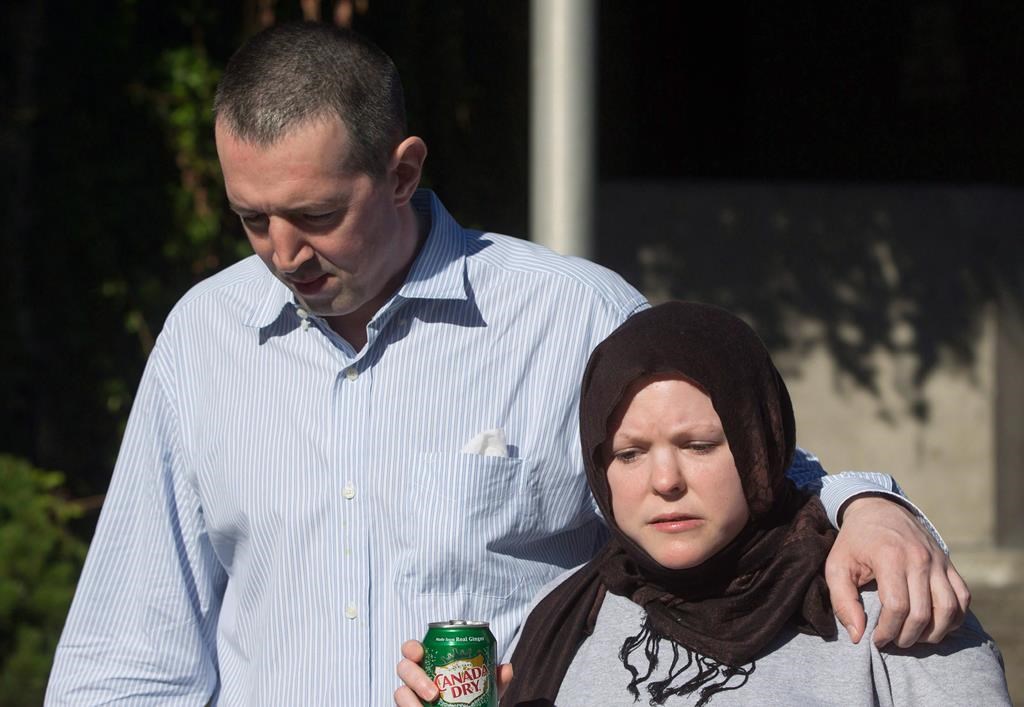
John Nuttall and Amanda Korody, set free today from Canadian Security Agencies
Efforts to Use them as Terror Patsies way back in 2013
As regular readers know, I have been following this local story for years. In my opinion, this legal decision is the most significant decision in Canadian history… during my lifetime, anyway. This decision reinforces the fundamental legal principle that “no one is above the law”… not even the police or security agencies. Please read the report and I will have more comments to follow:
From News 1130
B.C. couple found guilty of plotting to bomb legislature to walk free
John Nuttall-Amanda Korody’s convictions had been stayed due to entrapment, abuse of process
“The judge said police used deceit and veiled threats to engineer the bomb plot.”
VANCOUVER (NEWS 1130) – A couple found guilty of plotting to set off pressure cooker bombs outside the provincial legislature have had their convictions stayed.
The BC Court of Appeal has agreed with a lower court judge who said the RCMP officers manipulated John Nuttall and Amanda Korody into going ahead with the attack planned for Canada Day 2013.
A jury initially convicted the two on several charges in 2015, but the judge tossed them out months later because of issues with the investigation.
More to come…
Wanting to get this posted ASAP, I will save my detailed summation of the significance of this decision for a later time. Suffice it to say that this “travesty of justice” has been a powder keg ticking “time bomb” in Canada for years. Now that the ruling reinforces the rule of law in Canada.. .there will be huge ramifications for the government, the security agencies and the victims, John Nuttall and Amanda Korody. The couple can now get themselves good lawyers and sue the pants off the government, the RCMP and CSIS [aka the USrael mole in Canada], which in my opinion was the “brains” behind the operation…getting the RCMP to do its dirty work. It won’t be the first time the Canadian government has had to pay million$ to victims of miscarriage of justice resulting from corruption in the “security agencies“… actually malfeasance is a regular event here in Canada.
The timing is also significant. After this decision has been delayed [justice delayed justice certainly denied… as I said time after time] for so many years… why now? Why indeed, when Canada has recently been betrayed by the government/security agencies in USrael, recently, after toadying up to them and arresting the Chinese CEO… then being left hung out to dry by them.
If there is a thorough “Royal Commission” investigation into this travesty, which I believe there should be, then we can all follow the smell of Deep State Corruption… right back to the cesspool in Langley, Virgina… the home of the MosCIAd. These patsy/Terror bomb FALSE FLAG capers were SOP and still are–all over the West. Just in this case, the RCMP botched the assignment so badly that the public was able to surmise what has been going on… well, at least the 33% of the public with two brain cells to rub together anyway. As the 1130 report says… … more to come.
December 19, 2018: According to Global News the lawyer for Amanda Korody said the following today:
“…. Sandford said she feels Wednesday’s decision sends a clear message.
“I think that the court has drawn a line and underscored that these type of American-style sting operations… are not going to be tolerated here and that we have a strong and robust principle of entrapment that the courts are going to uphold.”…
Greencrow says: Canadians need and deserve to know the history of this “travesty of justice”. It was much more than a “sting operation”. It was a potential False Flag. Perhaps under different dynamics the “security agencies” would have allowed it to follow its course and citizens could have been killed… as they have been in other similar cases. It signals deep corruption on the part of the government, the police and CSIS. Remember the million$ in police salaries, including overtime? Who made the corrupt decisions? Are these individuals still in positions of power in Canada??? Watch the government, the M$M and particularly the “security agencies” go into desperate damage control mode. After the previous “Travesties of Justice” in the Omar Khadr and Maher Arar cases [amongst many others]… will we be suckered again? Or, this time will some intrepid investigative team or preferably a Royal Commission…. FINALLY trace the stench of the Nuttall/Korody matter right back to its source… IMO, in Langley, Virginia?
Controlling the Israel Message: How to Manage the American Sheeple
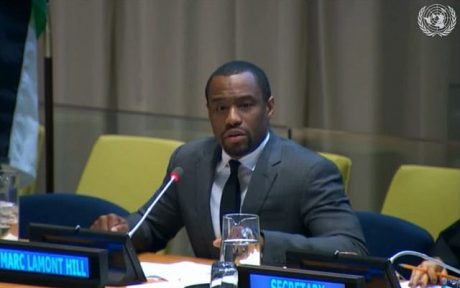
By Philip Giraldi | American Herald Tribune | December 3, 2018
There has been another defenestration of a television-based political commentator for touching the only real electrified third rail remaining in reporting what passes for the news. Marc Lamont Hill, a Temple University professor of Media Studies and Urban Education, who is a regular political commentator on CNN, was fired for what he said in a speech at the International Day of Solidarity with the Palestinian People, which took place last Wednesday at the United Nations. Hill called for a “free Palestine from river to the sea,” which CNN considered grounds for terminating his contract.
As ever, the Israelis were quick to jump on the bandwagon with their New York Consul General Dani Dayan denouncing Hill as a “racist, a bigot, [and] an anti-Semite.” He noted that Hill is under contract both with Temple University and CNN, implying that he should be punished by being fired, and called the remarks “appalling.” To no avail, Hill responded “I support Palestinian freedom. I support Palestinian self-determination. I am deeply critical of Israeli policy and practice. I do not support anti-Semitism, killing Jewish people, or any of the other things attributed to my speech.”
Hill was fired by CNN within 24 hours. The message is clear. You can criticize Christianity, Muslims, white males, Donald Trump and the American government at will and you can even criticize blacks or sexual alphabet soups if you are clever in how you do it, but never, never go after Jews or Israel even indirectly if you want to keep your job. One recalls the fate of Rick Sanchez, a CNN anchor who was fired in September 2010 one day after he complained about how Jon Stewart and others in the Jewish mafia that runs the media treat Hispanics, saying “Yeah, very powerless people. He’s such a minority. I mean, you know, please. What—are you kidding? I’m telling you that everybody who runs CNN is a lot like Stewart, and a lot of people who run all the other networks are a lot like Stewart. And to imply that somehow they, the people in this country who are Jewish, are an oppressed minority?”
Sanchez was forced to publicly grovel for his “inartful” comments and even had to write a letter of apology to the monstrous Abe Foxman of the Anti-Defamation League (ADL). Far worse, he also had to endure two hours of counseling with “America’s rabbi” Shmuley Boteach. Sanchez subsequently drifted through low level jobs for a number of years, but he is now a news anchor with RT America.
Also in 2010, Octavia Nasr, a Lebanese-American journalist who had been CNN’s Senior Editor for Mideast Affairs for over 20 years was immediately fired after she tweeted “sad to hear of the passing” of Lebanese cleric Sayyed Mohammad Hussein Fadlalah. Fadlalah’s only crime was that he had been demonized by Israel and the neocons as a “spiritual mentor” of Hezbollah. Nasr’s only crime is that she granted the admittedly controversial dead man some respect.
To be sure, CNN is pro-Israeli in its reporting and, more important, in terms of choosing what not to report. Its lead political anchor is Wolf Blitzer, a former American Israeli Political Action Committee (AIPAC) employee, who speaks Hebrew and has lived in Israel. Like most major American mainstream media outlets, CNN has numerous Jewish employees working to select, edit and produce the news stories that actually air, well placed to manage what does finally go out to the public.
Reports critical of Israel or Jews are not welcome anywhere in the U.S. national media, which is why Israel gets away with slaughtering unarmed Gazans using army snipers. I note a recent bizarre though interesting story that appeared in the British media and was not picked up by the U.S. mainstream at all. The story detailed how the leadership of the European Jewish Congress is seeking the insertion of “warning messages” in both Christian and Muslim holy texts. In a document entitled “An End to Antisemitism,” which was released last week, it was recommended that “Translations of the New Testament, the Qur’an and other Christian or Muslim literatures need marginal glosses, and introductions that emphasize continuity with Jewish heritage of both Christianity and Islam and warn readers about antisemitic passages in them. While some efforts have been made in this direction in the case of Christianity, these efforts need to be extended and made consistent in both religions.” One wonders when the same body will be recommending that the nastier bits of the Torah and Talmud be “glossed” to deal with the numerous slaughters of conquered peoples as well as slurs on Jesus Christ and assertions that Jews have the right to treat non-Jews as no better than livestock?
Some in the media might argue that the same set of rules about not offending one’s religious beliefs would apply to all religions, not just to Judaism, but it is difficult to find evidence of any even handedness, particularly when Islam is being discussed by commentators who are completely ignorant of the tenets of the religion. Nor are there any apparent limits in making ridiculous statements on CNN if one is disparaging Arabs, most particularly if they are Palestinians. CNN paid commentator former Pennsylvania Senator Rick Santorum has claimed absurdly that Palestinians do not even exist, which many Israelis believe, without any admonishment. Consider the outrage if he were to say that Jewish Israelis do not exist, which may actually be much closer to the truth according to some geneticists.
And what about when a Jew is attacking Christians? Far from there being any consequences, there is a demonstrable double standard as Christian beliefs appear to be fair game in some circles. Dana Jacobson currently co-anchor for the weekend edition of CBS national morning news experienced an apparently alcohol driven meltdown at a sports roast that she was helping emcee in January 2008 when she was working for ESPN.
Belting down vodka and cursing “like a sailor,” Jacobson went after Catholics in particular and said “Fuck Notre Dame,” “Fuck touchdown Jesus” and “Fuck Jesus” a number of times before she was hauled off the stage. Her after-the-fact apology consisted of written concession that she had demonstrated a “poor lack of judgment.” And her punishment by ESPN also demonstrated a “lack of judgment” when the company spokesman Josh Krulewitz reported that “Her actions and comments were inappropriate and we’ve dealt with it.” Dealing with it apparently consisted of a one-week suspension.
Any company operating in the United States should be able to dismiss an employee for any reason or for no reason, but anything even mildly critical of Jewish collective behavior or Israel is severely punished immediately. Professor Marc Lamont Hill said nothing wrong. On the contrary, he said something badly needed and which should have been accepted by CNN if it were really a global communications network dedicated to the truth and, one might add, to justice. Instead it was more of the same old, same old. If you criticize Israel don’t let the door hit you in the ass as you leave the building.
The Legacy and Fallacies of Bernard Lewis
By As`ad AbuKhalil | Consortium News | June 29, 2018
There is no question that Bernard Lewis was one of the most politically—not academically—influential Orientalists in modern times.
Lewis’ career can be roughly divided into two phases: the British phase, when he was a professor at the School of Oriental and African Studies in London, and the second phase, which began in 1974, when he moved to Princeton University and lasted until his death on May 19. His first phase was less overtly political, although the Israeli occupation army translated and published one of his books, and Gold Meir assigned articles by Lewis to her cabinet members.
Lewis knew where he stood politically but he only became a political activist in the second phase. His academic production in the first phase was rather historical (dealing with his own specialty and training) and his books were then thoroughly documented. The production of his second phase was political in nature and lacked solid documentation and citations. In the second phase, Lewis wrote about topics (such as the contemporary Arab world) on which he was rather ignorant. The writings of his second phase were motivated by his political advocacy, while the writings of the first phase was a combination of his political biases and his academic interests.
Shortly upon moving into the U.S., Lewis met with Senator Henry “Scoop” Jackson, the dean of ardent Zionists in the U.S. Congress. He thus started his political career and his advocacy, which was often thinly hidden behind the title of superficial books on the modern Arab world. Lewis not only mentored various neoconservatives, but he also elevated the status of Middle East natives that he approved of. For instance, he was behind the promotion of Fouad Ajami (he dedicated one of this books to him), just as he was behind introducing Ahmad Chalabi to the political elite in DC.
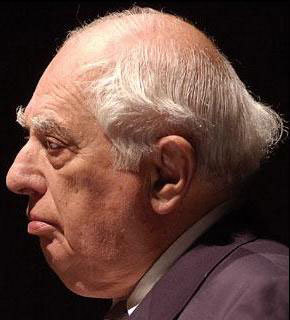
Lewis: A questionable legacy
Furthermore, Lewis was also behind the invitation of Sadiq Al-Azm to Princeton in the early 1990s (as Edward Said told me at the time) because Lewis always relished Al-Azm’s critique of Said’s Orientalism. Sep. 11 only elevated the status of Lewis and brought him close to the centers of power: he advised George W. Bush, Dick Cheney, Donald Rumsfeld and other senior members of the administration.
In the lead-up to the Iraq war, he assured Cheney (relying on the authority of Ajami) that not only Iraqis, but all Arabs, would joyously greet invading American troops. And he argued to Cheney before the war, using the dreaded Zionist and colonial cliché, that Arabs only understand the language of force. (Lewis would later distort his own history and claim that he was not a champion of the Iraq invasion although the record is clear).
Lewis was not only close to the higher echelons of the U.S. government, but in addition to his long-standing ties to Israeli leaders, he was close to Jordanian King Husayn and his brother, Hasan (although Lewis would mock what he considered a Jordanian habit of eating without forks and knives, as he wrote in Notes on a Century: Reflections of a Middle East Historian, on page 217).
Lewis was also close to the Shah’s government, and to the military dictatorship in Turkey in the 1980s. Kenan Evren, the Turkish general who led the 1980 military coup, had a tete-a-tete with Lewis during one of his visits to D.C. Lewis had contacts with the Sadat government, and Sadat’s spokesperson, Tahasin Bashir, in 1971 sent a message through Lewis to the Israeli government regarding Sadat’s interest in peace between the two countries.
Distorted View of Islam
There are many features of Lewis’s works, but foremost is what French historian Maxime Rodinson called “theologocentrism”, or the Western school of thought which attribute all observable phenomena among Muslims to matters of Islamic theology.
For Lewis, Islam is the only tool which can explain the odd political behavior of Arabs and Muslims. Lewis used Islam to refer not only to religion, but also the collection of Muslim people, governments ruling in the name of Islam, Shari`ah, Islamic civilization, languages spoken by Muslims, geographic areas in which Muslims predominate, and Arab governments. A review of his titles show his fixation with Islam. But what does it mean for Lewis to refer to Islam as being “the whole of life” for Muslims, as he does in Islam and the West?
Lewis also began the trendy Islamophobic, Western obsession with Shari`ah when he wrote years ago in the same book that for Muslims religion is “inconceivable without Islamic law.” There are hundreds of millions of Muslims in the world who live under governments which don’t subscribe to Shari`ah. No Muslim, for example, questions the Islamic credentials of Muslims who live in Western countries under secular law. Lewis even notes this fact, but it confuses him. In Islam and the West he states in bewilderment: “There is no [legal] precedent in Islamic history, no previous discussion in Islamic legal literature.”
Lewis could have benefited from reading James Piscatori’s book, Islam in a World of Nation States, which shows that Shari`ah is not the only source of laws even in countries where Islam is supposedly the only source of law. But Lewis was stuck in the past, he could only interpret the present through references to the original works of classical Islam.
His hostility and contempt for Arabs and Muslims was revealed in his writings even during the British phase of his career, when he was politically more restrained. He was influenced by the idea of his mentor, Scottish historian Hamilton Gibb, regarding what they both called “the atomism” of the Arab mind. The evidence for their theory is that the classical Arabic poem of Jahiliyyah and early Islam was not organically and thematically unified, but that each line of poetry was independent of the other. I remember back in 1993 when I discussed the matter with Muhsin Mahdi, a professor of Islamic philosophy at Harvard University, when I was reading the private papers of Gibb at the Widener Library. Mahdi said that their ideas are completely out of date and that recent scholarship about the classical Arabic poem refuted that thesis. (Lewis would resurrect the notion about the “atomism” of the Arab mind in his later Islam and the West).
Other writings of Lewis became obsolete academically. In his The Muslim Discovery of Europe he recycles the view that Muslims had no curiosity about the West because it was the land of infidelity and that they suffered from a superiority complex. A series of new scholarly books have undermined this thesis by Lewis largely by scholars looking into Indian and Iranian archives. The Palestinian academic, Nabil Mater, in his books Britain and the Islamic World, 1558-1713, Europe Through Arab Eyes, 1578-1727, and Turks, Moors and Englishmen in the Age of Discovery, paints a very different—and far more documented—picture of the subject that Lewis spent a career distorting.
Relished in Disparaging Arabs
In addition, the tone of Lewis’ writings on Arabs and Muslims was often sarcastic and contemptuous. Lewis did the work of the Middle East Media Research Institute (MEMRI), which was started in 1998 by a former Israeli intelligence agent and an Israeli political scientist,before MEMRI existed: he relished finding outlandish views of individual Muslims and popularizing them to stereotype all Arabs and all Muslims.
In the early editions of Arabs in History, Lewis remarked that none of the philosophers of the Arab/Islamic civilization were Arab in ethnic extraction (except Al-Kindi). What was Lewis’s point except to denigrate the Arab character and even genetic makeup? In the same book he cites an Ismaili document but then quickly adds that it “is probably not genuine.” But if it is “probably not genuine” why bother to cite it except for his fondness for bizarre tidbits about Arabs and Muslims?
The Orientalism of Lewis was not representative of classical Orientalism with all its flaws and shortcomings and political biases. His harbored more of an ideology of hostility against Arabs and Muslims. This ideology shares features with anti-Semitism, namely that the whole (Muslims in this case) form a monolithic group and that they pose a civilizational danger to the world, or are plotting to take it over, and that the behavior or testimony of one represents the total group (Islamic Ummah).
In writing about contemporary Islam, Lewis spent years recycling his 1976 Commentary magazine article titled, “The Return of Islam.” What he doesn’t answer is, “return” from where? Where was Islam prior? In this article, Lewis exhibits his adherence to the most discredited forms of classical Orientalist dogmas by invoking such terms as “the modern Western mind.” He thereby resurrected the idea of epistemological distinctions between “our” mind and “theirs”, as articulated by the 1976 racist book, The Arab Mind by Israeli anthropologist, Raphael Patai. (This last book would witness a resurrection in U.S. military indoctrination after Sep. 11, as Seymour Hersh reported).
An Obsession with Etymology
For Lewis, the Muslim mind never seems to change. Every Muslim, regardless of geography or time, is representative of any or all Muslims. Thus, a quotation from an obscure medieval source is sufficient to explain present-day behavior. Lewis even traces Yaser Arafat’s nom de guerre (Abu `Ammar) to early Islamic history and to the names of the Prophet Muhammad’s companions, though `Arafat himself had explained that the name derives from the root `amr (a reference to `Arafat’s construction work in Kuwait prior to his ascension to the leadership of the PLO).
Because `Arafat literally embraced Ayatollah Ruhollah Khomeini of Iran when he first met him, Lewis finds evidence of a universal Muslim bond in the picture. But when Lewis revised his book years later, he took note in passing of the deep rift which later developed between `Arafat and Khomeini and said simply: “later they parted company.” So much for the theory of the Islamic bond between them. Lewis must not have heard of wars among Muslims, like the Iran-Iraq war.
Lewis read the book Philosophy of Revolution by the foremost political champion of Arab nationalism, Nasser of Egypt, as containing Islamic themes. He must have been the only reader to come to that conclusion.
Another feature in Lewis’s writings is his obsession with etymology. To compensate for his ignorance of modern Arab reality, Lewis would often return to the etymology of political terms among Muslims. His book, The Political Language of Islam, which is probably his worst book, is an example of his attempt to Islamize and standardize the political behavior of all Muslims. His conclusions from his etymological endeavors are often comical: he assumes that freedom is alien to the Arabs because the historical meaning of the word in an ancient Arabic dictionary merely connoted the absence of slavery. This is like assuming that a Westerner never engaged in sex before the word was popularized. He complains that some of contemporary political terms, like dawlah (state), lost some of their original meanings, as if this is a problem peculiar to the Arabic language.
In his early years, Lewis was close to the classical Orientalists: he wrote in a beautiful style and his erudition and language skills showed through the pages. His early works were fun to read, while his later works were dreary and dull. But Lewis was unlike those few classical Orientalists who managed to mix knowledge about history of the Middle East and Islam with knowledge of the contemporary Arab world (scholars like Rodinson, Philip Hitti and Jacques Berque). Lewis’s ignorance about the contemporary Arab world was especially evident in his production during the U.S. phase of his long career. His book on the The Emergence of Modern Turkey, which was one of the first to rely on the Ottoman archives, was probably one of his best books. There is real scholarship in the book, unlike many of his later observational and impressionable works.
In his later best-selling books, What Went Wrong? and The Crisis of Islam, one reads the same passages and anecdotes twice. Lewis, for example, relishes recounting that syphilis was imported into the Middle East from the new world. His discussion of Napoleon in Egypt appears in both books, almost verbatim. The second book contains calls for (mostly military) action. In The Crisis of Islam, Lewis asserts: “The West must defend itself by whatever means.” The book reveals a lot about his outlook of hostility towards Muslims.
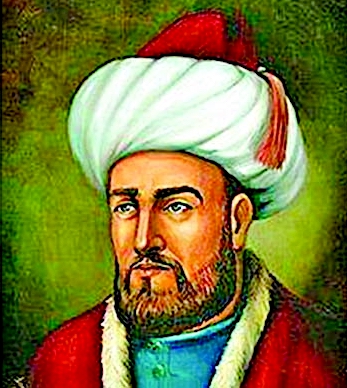
Al-Ghazzali: Lewis thought bin Laden was like him
Misunderstood Bin Laden
One is astonished to read some of his observations on Muslim and Arab sentiments and opinions. He is deeply convinced that Muslims are “pained” by the absence of the caliphate, as if this constitutes a serious demand or goal even for Muslim fundamentalist organizations. One never sees crowds of Muslims in the streets of Cairo or Islamabad calling for the restoration of the caliphate as a pressing need.
But then again: this is the man who treated Usamah Bin Laden as some kind of influential Muslim theologian who is followed by world Muslims. Lewis does not treat Bin Laden as the terrorist fanatic that he is, but as some kind of al-Ghazzali, in the tradition of classical Islamic theologians. Furthermore, Lewis insists that terrorism by individual Muslims should be considered Islamic terrorism, while terrorism by individual Jews or Christians is never considered Jewish or Christian terrorism.
In his retirement years, his disdain for the Palestinian people became unmasked. Although in his book The Crisis of Islam he lists acts of violence by PLO groups—curiously, only ones that are not directed against Israeli occupation soldiers—he lists not one act of Israeli violence against Palestinians and Arabs. To discredit the Palestinian national movement, he finds it necessary to tell yet again the story of Hajj Amin Al-Husayni’s visit to Nazi Germany, apparently seeking to stigmatize all Palestinians.
He is so disdainful of the Palestinians that he finds their opposition to Britain during the mandate period inexplicable because he believes that Britain was, alas, opposed to Zionism. Lewis is so insistent in attributing Arab popular antipathy to the U.S. to Nazi influence and inspiration that he actually maintains that Arabs obtained their hostility to the U.S. from reading the likes of Otto Spengler, Friederich Georg Junger, and Martin Heidegger. But when did the Arabs find time to read those books when all they read were their holy book and Islamic religious texts—as one surmises from reading Lewis?
While he displays deep–albeit selective–knowledge when he talks about the Islamic past (where his documentation is usually thorough), his analysis is quite simplistic and superficial when addressing the present (where he often disregards documentation altogether). For instance, he sometimes produces quotations without endnotes to source them: In Islam and the West he quotes an unnamed Muslim calling for the right of Muslims to “practice polygamy under Christian rule.” In another instance, he debates what he considers to be a common Muslim anti-Orientalist viewpoint, and the endnotes refer only to a letter to the editor in The New York Times.
Lewis once began a discussion by saying: “Recently I came across an article in a Kuwaiti newspaper discussing a Western historian,” without referring the reader to the name of the newspaper or the author. He also tells the story of an anti-Coptic rumor in Egypt in 1973 without telling the reader how he collects his rumors from the region. On another page, he identifies a source thus: “a young man in a shop where I went to make a purchase.”
Lewis was not shy about his biases in the British phase of his career, but be became an unabashed racist in his later years. In Notes on a Century, he did not mind citing approvingly the opinion of a friend who compared Arabs to “neurotic children”, unlike Israelis who are “rational adults.” And his knowledge of Arabs seems to decrease over time: he would frequently tell (unfunny) jokes related to Arabs and then add that jokes are the only indicator of Arab public opinion because he did not seem to know about public opinion surveys of Arabs. He also informs his readers that “chairs are not part of Middle Eastern tradition or culture.” He showers praise on his friend, Teddy Kollek (former occupation mayor of Jerusalem) because he set up a “refreshment counter” for Christians one day.
The political influence of Lewis, who lent Samuel Huntington his term, if not the theme, of “the clash of civilization”, has been significant. But it would be inaccurate to maintain that he was a policy maker. In the East and the West, rulers rely on the opinions and writings of intellectuals when they find that this reliance is useful for their propaganda purposes. Lewis and his books were timely when the U.S. was preparing to invade Muslim countries. But the legacy of Lewis won’t survive future scholarly scrutiny: his writings will increasingly lose their academic relevance and will be cited as examples of Orientalist overreach.
As’ad AbuKhalil is a Lebanese-American professor of political science at California State University, Stanislaus. He is the author of the Historical Dictionary of Lebanon (1998), Bin Laden, Islam & America’s New ‘War on Terrorism’ (2002), and The Battle for Saudi Arabia (2004). He also runs the popular blog The Angry Arab News Service.
Same As It Ever Was: The GWOT and Colonial History
By Ron Jacobs | CounterPunch | June 28, 2018
Since the events popularly called 9-11, the general public of the western nations have grown used to ever intensifying security measures. These measures affect the way the public travels, attends sporting and musical events, and thinks about those who don’t look like them. Long gone are the days when one could buy an airline ticket with cash at the counter and walk on a flight without showing identification.
In her 2018 book, Deport, Deprive, Extradite: 21st Century State Extremism, Nisha Kapoor examines several cases of Muslims living in Britain accused of lending material support to terrorism. In her examination of these case studies, she exposes the abuses of the British internal security apparatus and its intimate collaboration with the much greater security apparatus of the United States. The processes she reveals describe a Kafkaesque web that is impossible to escape once one is trapped in its threads. Indeed, virtually every case she explores ends with the individual targeted by the surety services taking a plea no matter how flimsy the evidence against them is. It’s as if they are found guilty and sentenced before the trial like those in the Queen of Heart’s courtroom found in Lewis Carrol’s Through the Looking Glass. Indeed, Kapoor quotes from this fiction in her text to make that exact point.
Although many US and British citizens were (and are) appalled at the torture and extraordinary rendition of suspects, in part because of the illegality of the practice, fewer seem opposed to the practice of legal extradition. As Kapoor points out throughout her text, this policy is actually quite similar to extraordinary rendition in how it is actually carried out. Like those who are moved illegally via extraordinary rendition, the suspects extradited (usually to the United States) are hooded, bound and tortured. The fact that their movement is legal only points to the weakness of the law.
Underlying the case studies discussed in the text is Kapoor’s contention that the practices of rendition, extradition and the  accompanying torture and abuse of detainees are a continuation of strategies and policies established under colonial administrations in the past. In other words, they are racist and therefore dismissive of the subject’s humanity and importance except as a target of abuse and imprisonment. Their very existence demands suspicion of crimes against the regime and their rationale of any actions (or thoughts about actions) is not rational but the result of a fanaticism. In the nominally secular world of the western regimes primarily involved in the capture and imprisonment of these suspects it is the religion of Islam which is the cause of their irrationality.
Another important context that is crucial to the text’s understanding of the “war on terror” is Kapoor’s emphasis on the fact that this entire project is a direct extension of liberal governance and philosophy. In her writing, she references John Stuart Mill and other liberal philosophers’ disparaging comments on non-Western civilizations. Furthermore, she draws a clear line from liberalism to authoritarianism, pointing out that as the judicial element in such governments has been weakened, the legislatures have given more and more power to the executive, which has rendered any existing balance of power virtually meaningless. In other words, the pretense that liberal government is somehow different from authoritarianism has been ripped away by the increasingly invasive, harsh and repressive measures undertaken in the name of the war on terror.
Unwritten, but clearly present is this essential fact: the more time that passes under this regime of what Kapoor justly calls state extremism goes on, the fewer people there will be who can remember when liberal governments were more liberal than illiberal and human beings were not suspect at birth. Deport, Deprive, Extradite is not merely an examination of human rights abuses of the recent past; it is also a harbinger of a harsher future. One would do well to heed its warning and act against the possibilities it discusses.
Did Israel Kill the Kennedys?
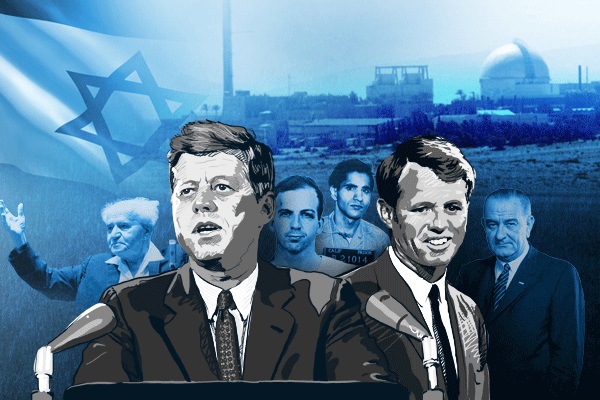
By Laurent Guyénot • Unz Review • June 3, 2018
Introduction
Just after midnight of June 6, 1968, Senator Robert Kennedy was assassinated in a backroom of the Ambassador Hotel in Los Angeles. He had just been celebrating his victory at the California primaries, which made him the most likely Democratic nominee for the presidential election. His popularity was so great that Richard Nixon, on the Republican side, stood little chance. At the age of 43, Robert would have become the youngest American president ever, after being the youngest Attorney General in his brother’s government. His death opened the way for Nixon, who could finally become president eight years after having been defeated by John F. Kennedy in 1960.
John had been assassinated four and a half years before Robert. Had he survived, he would certainly have been president until 1968. Instead, his vice-president Lyndon Johnson took over the White House in 1963, and became so unpopular that he retired in 1968. Interestingly, Johnson became president the very day of John’s death, and ended his term a few months after Robert’s death. He was in power at the time of both investigations.
And both investigations are widely regarded as cover-ups. In both cases, the official conclusion is rife with contradictions. We are going to sum them up here. But we will do more: we will show that the key to solving both cases resides in the link between them. And we will solve them beyond a reasonable doubt.
As Lance deHaven-Smith has remarked in Conspiracy Theory in America:
“It is seldom considered that the Kennedy assassinations might have been serial murders. In fact, in speaking about the murders, Americans rarely use the plural, ‘Kennedy assassinations’. […] Clearly, this quirk in the Kennedy assassination(s) lexicon reflects an unconscious effort by journalists, politicians, and millions of ordinary Americans to avoid thinking about the two assassinations together, despite the fact that the victims are connected in countless ways.”[1]
John and Robert were bound by an unshakable loyalty. Kennedy biographers have stressed the absolute dedication of Robert to his elder brother. Robert had successfully managed John’s campaign for the Senate in 1952, then his presidential campaign in 1960. John made him not only his Attorney General, but also his most trusted adviser, even on matters of Foreign or Military affairs. What John appreciated most in Robert was his sense of justice and the rectitude of his moral judgment. It is Robert, for example, who encouraged John to fully endorse the cause of the Blacks’ civil rights movement.[2]
Given this exceptional bond between the Kennedy brothers, what is the probability that the two Kennedy assassinations were unrelated? Rather, we should start with the assumption that they are related. Basic common sense suggests that the Kennedy brothers have been killed by the same force, and for the same motives. It is, at least, a logical working hypothesis that Robert was eliminated from the presidential race because he had to be prevented from reaching a position where he could reopen the case of his brother’s death. Both his loyalty to his brother’s memory, and his obsession with justice, made it predictable that, if he reached the White House, he would do just that. But was there, in 1968, any clear indication that he would?
Did Bobby plan to reopen the investigation on his brother’s assassination?
The question has been positively answered by David Talbot in his book Brothers: The Hidden History of the Kennedy Years, published in 2007 by Simon & Schuster. Robert had never believed in the Warren Report’s conclusion that Lee Harvey Oswald was the sole assassin of his brother. Knowing too well what to expect from Johnson, he had refused to testify before the Warren Commission. When its report came out, he had no choice but to publicly endorse it, but “privately he was dismissive of it,” as his son Robert Kennedy, Jr. remembers.[3] To close friends who wondered why he wouldn’t voice his doubt, he said: “there’s nothing I can do about it. Not now.” [4]
From 22 November 1963, Robert was alienated and monitored by Johnson and Hoover. Although still Attorney General, he knew he was powerless against the forces that had killed his brother. Yet he lost no time beginning his own investigation; he first asked CIA director John McCone, a Kennedy friend, to find out if the Agency had anything to do with the plot, and came out convinced that it hadn’t. In March 1964, he had a face-to-face conversation with mobster Jimmy Hoffa, his sworn enemy, whom he had battled for ten years, and whom he suspected of having taken revenge on his brother. Robert also asked his friend Daniel Moynihan to search for any complicity in the Secret Service, responsible for the President’s security[5]. And of course, Robert suspected Johnson, whom he had always mistrusted, as Jeff Shesol documents in Mutual Contempt: Lyndon Johnson, Robert Kennedy, and the Feud that Defined a Decade (1997).
In fact, a mere week after JFK’s death, November 29, 1963, Bill Walton, a friend of the Kennedys, travelled to Moscow and passed to Nikita Khrushchev, via a trusted agent who had already carried secret communications between Khrushchev and John Kennedy, a message from Robert and Jacqueline Kennedy; according to the memo found in the Soviet archives in the 90s by Alexandr Fursenko and Timothy Naftali (One Hell of a Gamble, 1998), Robert and Jackie wanted to inform the Soviet Premier that they believed John Kennedy had been “the victim of a right-wing conspiracy,” and that “the cooling that might occur in U.S.-Soviet relations because of Johnson would not last forever.” [6]
Robert also contacted a former MI6 officer who had been a friend of his family when his father was Ambassador in London. This British retired officer in turn contacted some trusted friends in France, and arrangments were made for two French Intelligence operatives to conduct, over a three-year period, a quiet investigation that involved hundreds of interviews in the United States. Their report, replete with innuendo about Lyndon Johnson and right-wing Texas oil barons, was delivered to Bobby Kennedy only months before his own assassination in June of 1968. After Bobby’s death, the last surviving brother, Senator Ted Kennedy, showed no interest in the material. The investigators then hired a French writer by the name of Hervé Lamarr to fashion the material into a book, under the pseudonym of James Hepburn. The book was first published in French under the title L’Amérique brûle, and was translated under the title Farewell America: The Plot to Kill JFK. Its conclusion is worth quoting:
“President Kennedy’s assassination was the work of magicians. It was a stage trick, complete with accessories and fake mirrors, and when the curtain fell, the actors, and even the scenery disappeared. […] the plotters were correct when they guessed that their crime would be concealed by shadows and silences, that it would be blamed on a ‘madman’ and negligence.”[7]
Robert had planned to run for the American Presidency in 1972, but the escalation of the Vietnam War precipitated his decision to run in 1968. Another factor may have been the opening of the investigation by New Orleans District Attorney Jim Garrison in 1967. Garrison was allowed to view Abraham Zapruder’s amateur film, confiscated by the FBI on the day of the assassination. This film, despite evident tampering, shows that the fatal shot came from the “grassy knoll” well in front of the President, not from the School Book Depository located behind him, where Oswald was supposed to be shooting from.
When talk of the investigation began, Kennedy asked one of his closest advisors, Frank Mankievitch, to follow its developments, “so if it gets to a point where I can do something about this, you can tell me what I need to know.” He confided to his friend William Attwood, then editor of Look magazine, that he, like Garrison, suspected a conspiracy, “but I can’t do anything until we get control of the White House.” [8] He refrained from openly supporting Garrison, believing that since the outcome of the investigation was uncertain, it could jeopardize his plans to reopen the case later, and even weaken his chances of election by construing his motivation as a family feud.
In conclusion, there can be little doubt that, had he been elected president, Robert Kennedy would have done everything possible to reopen the case of his brother’s assassination, in one way or another. This fact certainly did not escape John’s murderers. They had no other option but to stop him. This first conclusion is a sufficient reason to conduct a comparative analysis of both Kennedy assassinations, in search of some converging clues that might lead us to the trail of a common mastermind.We begin with Robert’s assassination.
Sirhan Sirhan, a Palestinian motivated by hatred of Israel?
Just hours after Robert’s assassination, the press was able to inform the American people, not only of the identity of the assassin, but also of his motive, and even of his detailed biography.[9] Twenty-four-year-old Sirhan Bishara Sirhan was born in Jordania, and had moved to the United States when his family was expelled from West Jerusalem in 1948. After the shooting, a newspaper clipping was found in Sirhan’s pocket, quoting favorable comments made by Robert regarding Israel and, in particular, what sounded like an electoral commitment: “The United States should without delay sell Israel the 50 Phantom jets she has so long been promised.” Handwritten notes by Sirhan found in a notebook at his home confirmed that his act had been premeditated and motivated by his hatred of Israel.
That became the story line of the mainstream media from day one. Jerry Cohen of the Los Angeles Times wrote a front page article, saying that Sirhan is “described by acquaintances as a ‘virulent’ anti-Israeli,” (Cohen changed that into “virulent anti-semite” in an article for the The Salt Lake Tribune), and that: “Investigation and disclosures from persons who knew him best revealed [him] as a young man with a supreme hatred for the state of Israel.” Cohen infers that “Senator Kennedy […] became a personification of that hatred because of his recent pro-Israeli statements.” Cohen further revealed that:
“About three weeks ago the young Jordanian refugee accused of shooting Sen. Robert Kennedy wrote a memo to himself, […] The memo said: ‘Kennedy must be assassinated before June 5, 1968’—the first anniversary of the six-day war in which Israel humiliated three Arab neighbors, Egypt, Syria and Jordan.”[10]
After September 11, 2001, the tragedy of Robert’s assassination was installed into the Neocon mythology of the Clash of Civilizations and the War on Terror the story. Sirhan became a precursor of Islamic terrorism on the American soil. In a book entitled The Forgotten Terrorist, Mel Ayton, who specializes in debunking conspiracy theories, claims to present “a wealth of evidence about [Sirhan’s] fanatical Palestinian nationalism,” and to demonstrate that “Sirhan was the lone assassin whose politically motivated act was a forerunner of present-day terrorism” (as written on the back cover).
In 2008, on the 40th anniversary of Robert’s death, Sasha Issenberg of the Boston Globe recalled that the death of Robert Kennedy was “a first taste of Mideast terror.” He quotes Harvard professor Alan Dershowitz (best known as Jonathan Pollard’s lawyer), as saying:
“I thought of it as an act of violence motivated by hatred of Israel and of anybody who supported Israel. […] It was in some ways the beginning of Islamic terrorism in America. It was the first shot. A lot of us didn’t recognize it at the time.”[11]
The fact that Sirhan was from a Christian family was lost on Dershowitz. The Jewish Forward took care to mention it on the same occasion, only to add that Islamic fanaticism ran in his veins anyway:
“But what he shared with his Muslim cousins — the perpetrators of September 11 — was a visceral, irrational hatred of Israel. It drove him to murder a man whom some still believe might have been the greatest hope of an earlier generation.”
“Robert Kennedy was the first American victim of modern Arab terrorism,” the Forward journalist hammered; “Sirhan hated Kennedy because he had supported Israel.” [12]
This leitmotiv of the public discourse begs the question: Was Bobby really a supporter of Israel? But before we answer that question, there is on more pressing one: Did Sirhan really kill Bobby?
Did Sirhan Bishara Sirhan really kill Robert Kennedy?
If we trust official statements and mainstream news, the assassination of Robert Kennedy is an open-and-shut case. The identity of the killer suffers no discussion, since he was arrested on the spot, with the smoking gun in his hand. In reality, ballistic and forensic evidence show that none of Sirhan’s bullets hit Kennedy.
According to the autopsy report of Chief Medical Examiner-Coroner Thomas Noguchi, Robert Kennedy died of a gunshot wound to the brain, fired from behind the right ear at point blank range, following an upward angle. Nogushi restated his conclusion in his 1983 memoirs, Coroner. Yet the sworn testimony of twelve shooting witnesses established that Robert had never turned his back on Sirhan and that Sirhan was five to six feet away from his target when he fired.
Tallying all the bullet impacts in the pantry, and those that wounded five people around Kennedy, it has been estimated that at least twelve bullets were fired, while Sirhan’s gun carried only eight. On April 23, 2011, attorneys William Pepper and his associate, Laurie Dusek, gathered all this evidence and more in a 58-page file submitted to the Court of California, asking that Sirhan’s case be reopened. They documented major irregularities in the 1968 trial, including the fact that the bullet tested in laboratory to be compared to the the one extracted from Robert’s brain had not been shot by Sirhan’s revolver, but by another gun, with a different serial number; thus, instead of incriminating Sirhan, the ballistic test in fact proved him innocent. Pepper has also provided a computer analysis of audio recordings during the shooting, made by engineer Philip Van Praag in 2008, which confirms that two guns are heard.[13]
The presence of a second shooter was signaled by several witnesses and reported on the same day by a few news media. There are strong suspicions that the second shooter was Thane Eugene Cesar, a security guard hired for the evening, who was stuck behind Kennedy at the moment of the shooting, and seen with his pistol drawn by several witnesses. One of them, Don Schulman, positively saw him fire. Cesar was never investigated, even though he did not conceal his hatred for the Kennedys, who according to his recorded statement, had “sold the country down the road to the commies.” [14]
Even if we assume that Sirhan did kill Robert Kennedy, a second aspect of the case raises question: according to several witnesses, Sirhan seemed to be in a state of trance during the shooting. More importantly, Sirhan has always claimed, and continues to claim, that he has never had any recollection of his act:
“I was told by my attorney that I shot and killed Senator Robert F. Kennedy and that to deny this would be completely futile, [but] I had and continue to have no memory of the shooting of Senator Kennedy.”
He also claims to have no memory of “many things and incidents which took place in the weeks leading up to the shooting.” [15] Some repetitive lines written of a notebook found in Sirhan’s bedroom, which Sirhan recognizes as his own handwriting but does not remember writing, are reminiscent of automatic writing.[16]
Psychiatric expertise, including lie-detector tests, have confirmed that Sirhan’s amnesia is not faked. In 2008, Harvard University professor Daniel Brown, a noted expert in hypnosis and trauma memory loss, interviewed Sirhan for a total of 60 hours, and concluded that Sirhan, whom he classifies in the category of “high hypnotizables,” acted unvoluntarily under the effect of hypnotic suggestion: “His firing of the gun was neither under his voluntary control, nor done with conscious knowledge, but is likely a product of automatic hypnotic behavior and coercive control.” [17]
We know that in the 1960s, American military agencies were experimenting on mental control. Dr Sidney Gottlieb, son of Hungarian Jews, directed the infamous CIA MKUltra project, which, among other things, were to answer questions such as: “Can a person under hypnosis be forced to commit murder?” according to a declassified document dated May 1951.[18] According to Israeli journalist Ronen Bergman, author of Rise and Kill First: The Secret History of Israel’s Targeted Assassinations (Random House, 2018), in 1968, an Israeli military psychologist by the name of Benjamin Shalit had concocted a plan to take a Palestinian prisoner and “brainwash and hypnotize him into becoming a programmed killer” aimed at Yasser Arafat.[19]
If Sirhan was hypnotically programmed, the question is: Who had some interest in having a visceral anti-Zionist Palestinian blamed for the killing of Robert Kennedy? Israel, of course. But then, we are faced with a dilemma, for why would Israel want to kill Robert Kennedy if Robert Kennedy was supportive of Israel, as the mainstream narrative goes?
Was Robert Kennedy really a friend of Israel?
The dilemma rests on a misleading assumption, which is part of the deception. In fact, Robert Kennedy was definitely not pro-Israel. He was simply campaigning in 1968. As everyone knows, a few good wishes and empty promises to Israel are an inescapable ritual in such circumstances. And Robert’s statement in an Oregon synagogue, mentioned in the May 27 Pasadena Independent Star-News article found in Sirhan’s pocket, didn’t exceed the minimal requirements. Its author David Lawrence had, in an earlier article entitled “Paradoxical Bob,” underlined how little credit should be given to such electoral promises: “Presidential candidates are out to get votes and some of them do not realize their own inconsistencies.”
All things considered, there is no ground for believing that Robert Kennedy would have been, as president of the US, particularly Israel-friendly. The Kennedy family, proudly Irish and Catholic, was known for its hostility to Jewish influence in politics, a classic theme of anti-Kennedy literature, best represented by the 1996 book by Ronald Kessler with the highly suggestive title, The Sins of the Father: Joseph P. Kennedy and the Dynasty He Founded.[20]
Robert had not been, in his brother’s government, a particularly pro-Israel Attorney General: He had infuriated Zionist leaders by supporting an investigation led by Senator William Fulbright of the Senate Committee on Foreign Relations aimed at registering the American Zionist Council as a “foreign agent” subject to the obligations defined by the Foreign Agents Registration Act of 1938, which would had considerably hindered its efficiency (after 1963, the AZD escaped this procedure by changing its status and renaming itself AIPAC)[21].
In conclusion, it is only with outstanding hypocrisy that The Jewish Daily Forward could write, on the 40th anniversary of Bobby’s death:
“In remembering Bobby Kennedy, let us remember not just what he lived for, but also what he died for—namely, the precious nature of the American-Israeli relationship.”[22]
Robert Kennedy’s death had not been a bad thing for the precious “American-Israeli relationship.” Rather, it was a great loss for the Arab world, where Bobby was mourned just as had his brother John before him.
Of course, the fact that the Zionist media lied when granting Robert Kennedy some posthumous certificate of good will toward Israel, and thereby provided Israel with a fake alibi, is not a sufficient reason for concluding that Israel murdered Robert. Even the fact that the masterminds of the plot chose as their programmed instrument an anti-Zionist Palestinian, and thereby stirred a strong anti-Palestinian feeling among Americans at the same time as getting rid of Robert, does not prove that Israel was involved. What is still lacking for a serious presumption is a plausible motive.
The motive of Robert’s assassination must be found, not in what Robert publicly declared in an Oregon synagogue during his presidential campaign, but rather in what he confided only to his most close friends: his intention to reopen the investigation on his brother’s death. Our next question, therefore, is: What would an unbiased investigation, conducted under the supervision of Robert in the White House, have revealed?
Did the CIA assassinate Kennedy?
It is obvious to anybody just vaguely informed that a genuine investigation would first establish that Oswald was a mere “patsy”, as he said himself, a scapegoat prepared in advance to be blamed for the crime and then be slaughtered without a trial. We will not here review the evidence that contradicts the official thesis of the lone gunman. It can be found in numerous books and documentary films.
Just as notorious is the theory that the plot to kill Kennedy originated from a secret network within the CIA, in collusion with extremist elements in the Pentagon. That conspiracy theory looms the largest in books, articles and films that have been produced since John Kennedy died.
That CIA-Pentagon theory, as I will call it (add the military-industrial complex if you wish) has a major flaw in the motive ascribed to the killers: besides getting rid of Kennedy, the theory goes, the aim was to create a pretext for invading Cuba, something the CIA had always pushed for and Kennedy had refused to do (the Bay of Pigs fiasco). With Oswald groomed as a pro-Castro communist, the Dallas shooting was staged as a false flag attack to be blamed on Cuba. But then, why did no invasion of Cuba follow Kennedy’s assassination? Why was the pro-Castro Oswald abandoned by the Warren Commission in favor of the lone nut Oswald? Those who address the question, like James Douglass in his JFK and the Unspeakable, credit Johnson with preventing the invasion. Johnson, we are led to understand, had nothing to do with the assassination plot, and thwarted the plotters’ ultimate aim to start World War III. This is to ignore the tremendous amount of evidence accumulated against Johnson for fifty years, and documented in such groundbreaking books as Phillip Nelson’s LBJ: The Mastermind of JFK’s Assassination (2010) or Roger Stone’s The Man Who Killed Kennedy: The Case Against LBJ (2013).
Another weakness in the CIA-Pentagon theory is the lack of agreement about the mastermind of the plot. In fact, one of the names that comes up most often is James Jesus Angleton, the head of Counter-Intelligence within the CIA, about whom Professor John Newman writes in Oswald and the CIA :
“In my view, whoever Oswald’s direct handler or handlers were, we must now seriously consider the possibility that Angleton was probably their general manager. No one else in the Agency had the access, the authority, and the diabolically ingenious mind to manage this sophisticated plot.”[23]
But there is plenty of evidence that Angleton, who was also the head of the CIA “Israel Office,” was a Mossad mole. According to his biographer Tom Mangold, “Angleton’s closest professional friends overseas […] came from the Mossad and […] he was held in immense esteem by his Israeli colleagues and by the state of Israel, which was to award him profound honors after his death.” [24] No less that two monuments were dedicated to him at memorial services in Israel during ceremonies attended by chiefs of Israeli Intelligence and even a future Prime Minister.[25]
Another aspect must be taken into account: if the trail of the CIA is such a well-trodden path among Kennedy researchers, it is because it has been cut and marked by the mainstream media themselves, as well as by Hollywood. And that began even before the assassination, on October 3, 1963, with an article by the New York Times’ chief Washington correspondent Arthur Krock. The article denounced the CIA’s “unrestrained thirst for power” and quotidian unnamed “very high official” who claimed that the White House could not control the CIA, and that:
“If the United States ever experiences an attempt at a coup to overthrow the Government, it will come from the CIA and not the Pentagon. The agency represents a tremendous power and total unaccountability to anyone.”[26]
In such a way, The New York Times was planting a sign, a month and a half before the Dallas killing, pointing to the CIA as the most likely instigator of the upcoming coup. The sign said: “The President is going to fall victim of a coup, and it will come from the CIA.”
One month after Kennedy’s assassination, it was the turn of the Washington Post to use a very similar trick, by publishing an op-ed signed by Harry Truman, in which the former president said he was “disturbed by the way CIA has been diverted from its original assignment.” “I never had any thought when I set up the CIA that it would be injected into peacetime cloak and dagger operations,” at the point of becoming across the globe “a symbol of sinister and mysterious foreign intrigue […] there are now some searching questions that need to be answered.” [27] Truman was hinting at the CIA’s role in toppling foreign governments and assassinating elected leaders abroad. But given the timing of his article, one month to the day after Dallas, it could only be understood by anyone with ears to hear, and at least subliminally by the rest, as an indictment of the CIA in the Kennedy assassination. This article, widely reprinted in the 1970s after the creation of the Church Committee and the House Select Committee on Assassinations, is regarded as Truman’s whistleblowing. Yet its mea culpa style is quite unlike Truman; that is because it was not written by Truman, but by his longtime assistant and ghostwriter, a Russian born Jew named David Noyes, whom Sidney Krasnoff calls “Truman’s alter ego” in his book, Truman and Noyes: Story of a President’s Alter Ego (1997). Truman probably never saw the article prior to its publication in the Washington Post morning edition, but he may be responsible for its deletion from the afternoon print runs.[28]
So the two most influential American newspapers, while ostensibly defending the official theory of the lone gunman, have planted directional signs pointing to the CIA. Most Kennedy truthers have followed the signs with enthusiasm.
In the 70s, the mainstream media and publishing industry played again a major role in steering conspiracy theorists toward the CIA, while avoiding any hint of Israeli involvement. One major contributor to that effort was A. J. Weberman, with his 1975 book Coup d’État in America: The CIA and the Assassination of John F. Kennedy, co-authored by Michael Canfield. According to the New York Jewish Daily Forward (December 28, 2012), Weberman had “immigrated to Israel in 1959 and has dual American-Israeli citizenship,” and is “a close associate of Jewish Defense Organization founder Mordechai Levy, whose fringe group is a spin-off of the late Rabbi Meir Kahane’s militant right-wing Jewish Defense League.” Weberman acknowledged Neocon Richard Perle’s assistance in his investigation.[29] The Weberman-Canfield book contributed to the momentum that led the House Select Committee on Assassinations (HSCA) to reinvestigate in 1976 the murders of JFK and Dr. Martin Luther King.
It is also in this context that Newsweek journalist Edward Jay Epstein published an interview of George De Mohrenschildt, a Russian geologist and consultant for Texan oilmen who had befriended Oswald and his Russian wife in Dallas in 1962. In this interview, De Mohrenschildt admitted that Oswald had been introduced to him at the instigation of Dallas CIA agent J. Walton Moore.[30] That piece of information is dubious for several reasons: First, Moore was officially FBI rather than CIA. Second, De Mohrenschildt was in no position to confirm or deny the words that Epstein ascribed to him: he was found dead a few hours after giving the interview. In fact, De Mohrenschildt’s interview published by Epstein contradicts De Mohrenschildt’s own manuscript account of his relationship to Oswald, revealed after his death.[31] De Mohrenschildt’s death was ruled a suicide. The Sheriff’s report mentions that in his last months he complained that “the Jews” and “the Jewish mafia” were out to get him.[32] Needless to say, Epstein didn’t mention anything about this. More suspicions arise from the fact that Epstein’s main source for his 1978 book, Legend: the Secret World of Lee Harvey Oswald, was James Jesus Angleton, who was actively spreading disinformation at the time of the HSCA, defending the theory that Oswald was a KGB agent with CIA connections.
That Israeli agents have been instrumental in spreading conspiracy theories targeting the CIA is also evidenced by Oliver Stone’s film JFK released in 1991, starring Kevin Costner in the role of New Orleans District Attorney Jim Garrison. This film, which shook public opinion to the point of motivating the President John F. Kennedy Assassination Records Collection Act of 1992, was produced by Arnon Milchan, described in a 2011 biography as being from his youth “one of the most important covert agents that Israeli intelligence has ever fielded,” involved in arms smuggling from the US to Israel.[33] In 2013 Milchan publicly revealed his extended activity as a secret agent of Israel, working in particular to boost Israel’s nuclear program.[34] It is therefore no wonder that Stone’s film gives no hint of the Mossad connection that Garrison stumbled upon.
Who killed JFK?
By a strange paradox, the authors who stand for the consensual conspiracy theory of a CIA plot against Kennedy build their case on the biography of Oswald, while at the same time claiming that Oswald had almost nothing to do with the killing. If Oswald was “just a patsy,” as he publicly claimed, the quest for the real culprits must logically begin by investigating the man who silenced Oswald.
Oswald’s assassin is known as Jack Ruby, but few people know that his real name was Jacob Leon Rubenstein, and that he was the son of Jewish Polish immigrants. Ruby was a member of the Jewish underworld. He was a friend of Los Angeles gangster Mickey Cohen, whom he had known and admired since 1946. Cohen was the successor of the famed Benjamin Siegelbaum, aka Bugsy Siegel, one of the bosses of Murder Incorporated. Cohen was infatuated with the Zionist cause, as he explained in his memoirs: “Now I got so engrossed with Israel that I actually pushed aside a lot of my activities and done nothing but what was involved with this Irgun war”.[35] Mickey Cohen was in contact with Menachem Begin, the former Irgun chief, with whom he even “spent a lot of time,” according to Gary Wean, former detective sergeant for the Los Angeles Police Department. So there is a direct line connecting Jack Ruby, via Mickey Cohen, to the Israeli terrorist ring, and in particular to Menachem Begin, a specialist in false flag terror. We also know that Ruby phoned Al Gruber, a Mickey Cohen associate, just after Oswald’s arrest; no doubt he received then “an offer he couldn’t refuse,” as they say in the underworld.[36] Ruby’s defense lawyer William Kunstler wrote in his memoirs that Ruby told him he had killed Oswald “for the Jews,” and Ruby’s rabbi Hillel Silverman received the same confession when visiting Ruby in jail.[37]
That is not all. At every level of the conspiracy to kill Kennedy, we also find the fingerprints of the Israeli deep state. JFK’s trip to Dallas, being officially “non political,” was sponsored by a powerful business group known as the Dallas Citizens Council, dominated by Julius Schepps, “a wholesale liquor distributor, member of every synagogue in town, and de facto leader of the Jewish community,” as described by Bryan Edward Stone in The Chosen Folks: Jews on the Frontiers of Texas.[38] Kennedy was on his way to the reception organized in his honor when he was shot.
The “host committee” inviting Kennedy was chaired by another influential figure of the wealthy Jewish community in Dallas: advertising executive and PR man Sam Bloom. According to former British Intelligence Officer Colonel John Hughes-Wilson, it was Bloom who suggested to the Police “that they move the alleged assassin [Oswald] from the Dallas police station to the Dallas County Jail in order to give the newsmen a good story and pictures. ”Oswald was shot by Ruby during this transfert. Hughes-Wilson adds that,“when the police later searched Ruby’s home, they found a slip of paper with Bloom’s name, address and telephone number on it.” [39]
After the Dallas tragedy, Israel’s sayanim were also busy fabricating the official lie. Apart from its chairman Earl Warren, chosen for his figurative role as Chief Justice, all key people in the investigative Commission were either personal enemies of Kennedy—like Allen Dulles, the CIA director fired by Kennedy in 1961—or ardent Zionists. The man who played the key role in fabricating the government lie purveyed by the Warren Commission was Arlen Specter, the inventor of what came to be called the “magic bullet” theory: a single bullet supposed to have caused seven wounds to Kennedy and John Connally sitting before him in the limousine, and later found in pristine condition on a gurney in Parkland Memorial Hospital in Dallas. Specter, who with an ironic touch of chutzpah titled his autobiography Passion for Truth, was the son of Russian Jewish immigrants, and, at his death in 2012, was mourned by the Israeli government as “an unswerving defender of the Jewish State,” and by AIPAC, as “a leading architect of the congressional bond between our country and Israel.” [40]
So, at all stages of the plot, we find a Zionist cabal including business men, politicians and Irgun-connected gangsters, not forgetting media executives, all devoted to Israel.
The most plausible motive for Israel to kill Kennedy has been revealed by two books: Seymour Hersh’s The Samson Option in 1991, then Avner Cohen’s Israel and the Bomb in 1998, and the lead has been followed up in 2007 by Michael Karpin in The Bomb in the Basement. What these investigators reveal is that Kennedy, informed by the CIA in 1960 of the military aim pursued at the Dimona complex in the Negev desert, was firmly determined to force Israel to renounce it. With that purpose in mind, he replaced CIA Director Allen Dulles by John McCone, who had, as Eisenhower’s chairman of the Atomic Energy Commission (AEC), leaked to The New York Times the truth about Israel’s Dimona project; the story was printed on December 19, 1960, weeks before Kennedy was to take office. As Alan Hart writes, “there can be no doubt that Kennedy’s determination to stop Israel developing its own nuclear bomb was the prime factor in his decision to appoint McCone.”[41] Then Kennedy urged Ben-Gurion to allow regular inspections of Dimona, first verbally in New York in 1961, and later through more and more insistent letters. In the last one, cabled June 15, 1963 to the Israeli ambassador with instruction to hand it personally to Ben-Gurion, Kennedy demanded Ben-Gurion’s agreement for an immediate visit followed by regular visits every six months, otherwise “this Government’s commitment to and support of Israel could be seriously jeopardized.” [42] The result was unexpected: Ben-Gurion avoided official reception of the letter by announcing his resignation on June 16. As soon as the new Prime Minister Levi Eshkol took office, Kennedy sent him a similar letter, dated July 5, 1963, to no avail. Did Ben-Gurion resign in order to deal with Kennedy from another level?
Five months later, Kennedy’s death relieved Israel of all pressure (diplomatic or otherwise) to stop its nuclear program. Faced with Johnson’s complete lack of interest in that issue, John McCone resigned from the CIA in 1965, declaring: “When I cannot get the President to read my reports, then it’s time to go.”
Kennedy’s determination to stop Israel’s Dimona project was only part of the “Kennedy problem”. During his first months in the White House, Kennedy committed himself by letters to Nasser and other Arab heads of State to support UN Resolution 194 for the right of return of Palestinian refugees. Ben-Gurion reacted with a letter to the Israeli ambassador in Washington, intended to be circulated among Jewish American leaders, in which he stated:
“Israel will regard this plan as a more serious danger to her existence than all the threats of the Arab dictators and Kings, than all the Arab armies, than all of Nasser’s missiles and his Soviet MIGs. […] Israel will fight against this implementation down to the last man.’”[43]
Kennedy behaved warmly toward Nasser, Israel’s worst enemy. Historian Philip Muehlenbeck writes:
“While the Eisenhower administration had sought to isolate Nasser and reduce his influence through building up Saudi Arabia’s King Saud as a conservative rival to the Egyptian president, the Kennedy administration pursued the exact opposite strategy.”[44]
After Kennedy’s death, American foreign policy was reversed again, without the American public being aware of it. Johnson cut the economic aid to Egypt, and increased the military aid to Israel, which reached 92 million dollars in 1966, more than the total of all previous years combined.
For 50 years, the Israeli trail in the Kennedy assassination has been smothered, and anyone who mentioned it was immediately ostracized. American congressman Paul Findley nevertheless dared write in March 1992 in the Washington Report on Middle East Affairs: “It is interesting to note that in all the words written and uttered about the Kennedy assassination, Israel’s intelligence agency, the Mossad, has never been mentioned.” One single author has seriously investigated that trail: Michael Collins Piper, in his 1995 book Final Judgment: The Missing Link in the JFK Assassination Conspiracy. Piper was largely ignored by the mainstream of the Kennedy truth movement. But his work has made its way nevertheless. In 2013, Martin Sandler wrote about Piper’s work in his edition of letters by Kennedy, which included those addressed to Ben-Gurion about Dimona: “Of all the conspiracy theories, it remains one of the most intriguing.” It is, in fact, a theory widespread in Arab countries.[45]
The case against Lyndon Johnson
Several investigators have identified Lyndon Johnson, Kennedy’s vice-president, as the mastermind of the Kennedy assassination. It is, at least, beyond doubt that the plotters acted with the foreknowledge that Johnson, who automatically stepped in as head of State after Kennedy’s death, would cover them. The context of national crisis enabled him to bully both Justice and the press while achieving his life’s ambition. Johnson not only benefitted from the plot; he participated in its elaboration. As a former senator from Texas, he could mobilize high-ranked accomplices in Dallas to prepare the ambush. Johnson also had his men in the Navy. In 1961, Texan senator John Connally had been appointed as Navy Secretary at the request of Johnson. When Connally resigned eleven months later to run for governor of Texas, Johnson convinced Kennedy to name another of his Texan friends, Fred Korth.
Johnson’s privileged control over the Navy is an important aspect of the case because the Navy was critical in the setting up and in the cover-up of the plot. First, contrary to a widespread but erroneous belief, Lee Harvey Oswald had been recruited by the Navy and not by the CIA. He was a Marine, and as a Marine he had worked for the Office of Naval Intelligence (ONI). Secondly, it is at the Naval Hospital in Washington, under the control of Navy officers, that Kennedy’s autopsy was performed, after his body had been literally stolen at gunpoint from Parkland Hospital in Dallas. The report of this autopsy stated that the fatal bullet had entered the back of Kennedy’s skull, which contradicted the testimonies of twenty-one members of the Dallas hospital staff who saw two entry bullet-wounds on the front of Kennedy’s body. This was critical because Oswald was presumably shooting from behind Kennedy, and could not possibly have caused these bullet wounds.
It is noteworthy that Johnson had actually taken advantage of his connections in the Navy to participate in the greatest corruption case ever recorded at that time. His accomplice Fred Korth was forced to resign as Navy Secretary in November 1963, only weeks before the Dallas coup, after the Justice Department headed by Robert Kennedy had implicated him in a fraud involving a $7 billion contract for the construction of 1,700 TFX military aircraft by General Dynamics, a Texas company. Johnson’s personal secretary, Bobby Baker, was charged in the same case.
Because of this mounting scandal and other suspicions of corruption, Kennedy was determined to change Vice-President for his upcoming reelection campaign.[46] While in Dallas the day before the President’s visit, Nixon publicized the rumor of Johnson’s removal, and the Dallas Morning News was reporting on November 22nd: “Nixon Predicts JFK May Drop Johnson.” Instead, Johnson became president that very day.
Many Americans immediately suspected Johnson’s involvement in the Dallas coup, especially after the publication in 1964 of a book by James Evetts Haley, A Texan Looks at Lyndon, which portrayed Johnson as deeply corrupt. According to his biographer Robert Caro, Johnson was a man thirsting “for power in its most naked form, for power not to improve the lives of others, but to manipulate and dominate them, to bend them to his will.” [47]
The evidence incriminating Johnson does not conflict with the evidence against Israel, quite the contrary. First, both trails converge in the person of Jack Ruby, whom Nixon identified a one of “Johnson’s boys,” according to former Nixon operative Roger Stone.[48] The hypothesis that Ruby acted on Johnson’s orders is a likely explanation for some of his odd statements to the Warren Commission:
“If you don’t take me back to Washington tonight to give me a chance to prove to the President that I am not guilty, then you will see the most tragic thing that will ever happen.” “There will be a certain tragic occurrence happening if you don’t take my testimony and somehow vindicate me so my people don’t suffer because of what I have done.”
He said that he feared that his act would be used “to create some falsehood about some of the Jewish faith,” but added that “maybe something can be saved […], if our President, Lyndon Johnson, knew the truth from me.” [49] With such words, Ruby seems to be trying to send a message to Johnson through the Commission, or rather a warning that he might spill the beans about Israel’s involvement if Johnson did not intervene in his favor. We get the impression that Ruby expected Johnson to pardon him.
Yet Johnson did nothing to get Ruby out of jail. Ruby’s sense of betrayal would explain why in 1965, after having been sentenced to life imprisonment, Ruby implicitly accused Johnson of Kennedy’s murder in a press conference: “If [Adlai Stevenson] was Vice-President there would never have been an assassination of our beloved President Kennedy.” [50]
Ruby died from a mysterious disease in his prison in 1967.
A Crypto-Zionist president?
Ruby is not the only link between Johnson and Israel, far from it. In truth, Johnson had always been Israel’s man. His electoral campaigns had been funded since 1948 by Zionist financier Abraham Feinberg, who happened to be president of the Americans for Haganah Incorporated, which raised money for the Jewish militia. It is the same Feinberg who, after the Democratic primaries in 1960, made the following proposal to Kennedy, as Kennedy himself later reported to his friend Charles Bartlett: “We know your campaign is in trouble. We’re willing to pay your bills if you’ll let us have control of your Middle East policy.” Bartlett recalls that Kennedy was deeply upset and swore that, “if he ever did get to be President, he was going to do something about it.” [51]
It is on record, thanks to Kennedy insider Arthur Schlesinger (A Thousand Days: John Kennedy in the White House, 1965), that the two men who convinced Kennedy to take Johnson as his running mate, were Philip Graham and Joseph Alsop, respectively publisher and columnist of the Washington Post, and strong supporters of Israel.[52] Schlesinger doesn’t reveal Graham and Alsop’s arguments, and states that Kennedy’s final decision “defies historical reconstruction”—a curious statement for a historian so well informed on the topic. But Evelyn Lincoln, Kennedy’s personal secretary for twelve years, had her own idea about it. She believed that Kennedy was blackmailed with proofs of his many infidelities to his wife: “Jack knew that Hoover and LBJ would just fill the air with womanizing.” Whatever the details of the blackmail, Kennedy once confided to his assistant Hyman Raskin, as an apology for taking Johnson, “I was left with no choice […] those bastards were trying to frame me. They threatened me with problems and I don’t need more problems.” [53]
In 2013, Associated Press reported about newly released tapes from Johnson’s White House office showing LBJ’s “personal and often emotional connection to Israel,” and pointed out that under Johnson, “the United States became Israel’s chief diplomatic ally and primary arms supplier.” An article from the 5 Towns Jewish Times “Our First Jewish President Lyndon Johnson?” recalls Johnson’s continuous support of Jews and Israel in the 1940s and 50s, and concludes: “President Johnson firmly pointed American policy in a pro-Israel direction.” The article also mentions that, “research into Johnson’s personal history indicates that he inherited his concern for the Jewish people from his family. His aunt Jessie Johnson Hatcher, a major influence on LBJ, was a member of the Zionist Organization of America.” And, in an additional note: “The line of Jewish mothers can be traced back three generations in Lyndon Johnson’s family tree. There is little doubt that he was Jewish.” [54]
Whatever was the reason of Johnson’s loyalty to Israel, it is a fact that, thanks to Johnson, Israel could continue its military nuclear program undisturbed, and acquire its first atomic bomb around 1965. Historian Stephen Green writes: “Lyndon Johnson’s White House saw no Dimona, heard no Dimona, and spoke no Dimona when the reactor went critical in early 1964.” [55]
Thanks to JFK’s death, Israel was also able to carry out its plan to annex Palestinian territories beyond the boundaries imposed by the United Nations Partition plan. By leaning on Pentagon and CIA hawks, Johnson intensified the Cold War and created the climate of tension which Israel needed in order to demonize Egyptian president Nasser and reinforce its own stature as indispensable ally in the Middle East.
During the Six Day War of 1967, Israel managed to triple its territory, while creating the illusion of acting in legitimate defense. The lie could not deceive American Intelligence agencies, but Johnson had given a green light to Israel’s attack, and even authorized James Angleton of the CIA to give Israel the precise positions of the Egyptian air bases, which enabled Israel to destroy them in just a few hours.
Four days after the start of the Israeli attack, Nasser accepted the ceasefire request from the UN Security Council. It was too soon for Israel, which had not yet achieved all its territorial objectives. On June 8, 1967, the USS Liberty, a NSA spy ship stationed in international waters off Sinai, was bombed, strafed and torpedoed during 75 minutes by Israeli Mirage jets and three torpedo boats, with the obvious intention of sinking it without leaving any survivors. (Even the rescue channels were machine-gunned.) Meanwhile, Johnson, from the White House, intervened personally to prohibit the nearby Sixth Fleet from rescuing the USS Liberty after the crew, despite the initial destruction of its transmitters, had managed to send off an SOS.
The attack would have been blamed on Egypt if it had succeeded, that is, if the ship had sunk and its crew had all died. The operation would then have given Johnson a pretext for intervening on the side of Israel against Egypt.
But it failed. The USS Liberty affair was suppressed by a commission of inquiry headed by Admiral John Sidney McCain II, Commander-in-Chief of US Naval Forces in Europe (and Father of Arizona Senator John McCain III). Johnson accepted Israel’s spurious “targeting error” explanation. In January 1968 he invited the Israeli Prime Minister, Levi Eshkol, to Washington, and warmly welcomed him to his Texas ranch. What’s more, Johnson rewarded Israel by lifting the embargo on offensive military equipment: US-made tanks and aircraft immediately flowed to Tel Aviv.
This failed false flag attack is evidence of the secret complicity of Johnson and Israel, implying high treason on the part of Johnson.
Conclusion
Let’s now conclude our overview of the evidence: beside the fact that John and Robert were brothers, their assassinations have at least two things in common: Lyndon Johnson and Israel.
First, their deaths are precisely framed by Johnson’s presidency, which was also the context for other political assassinations, such as Martin-Luther King’s. Johnson was in control of the State during the two investigations on John and Robert’s murders.
Secondly, in both cases, we find the fingerprints of Israel’s deep state. In the case of Robert, it is the choice of the manipulated patsy, which was obviously meant to disguise Robert’s assassination as an act of hatred against Israel. In the case of John, it it is the identity of the man asked to kill the patsy, a Jewish gangster linked to the Irgun.
Johnson and Israel, the two common elements in the Kennedy assassinations, are themselves closely linked, since Johnson can be considered as a high-level sayan, a man secretly devoted to Israel, or owned by Israel, to the point of committing high treason against the nation he had been elected to lead and protect.
The causal link between the two assassinations then becomes clear: even if Robert had been pro-Israel, which he was not, Israel and Johnson would still have had a compelling reason to eliminate him before he got to the White House, where he could—and would—reopen the investigation on his brother’s death.
What should have been obvious from the start now appears brightly clear: in order to solve the mystery of the assassination of John Kennedy, one has simply to look into the two other assassinations which are connected to it: the assassination of Lee Harvey Oswald, the man whose trial could have exposed the hoax and possibly put the plotters into the light, and the assassination of Robert Kennedy, the man who would have reopened the case if he had lived. And both these assassinations bear the signature of Israel.
At his death in 1968, Robert Kennedy left eleven orphans, not counting John’s two children, whom he had somewhat adopted. John’s son, John F. Kennedy Jr., aka John John, who had turned three the day of his father’s funeral, embodied the Kennedy myth in the heart of all Americans. The route seemed traced for him to become president one day. He died on July 16, 1999, with his pregnant wife and his sister-in-law, when his private plane suddenly and mysteriously nose-dived into the ocean a few seconds after he had announced his landing on the Kennedy property in Massachusetts.
John John had long been portrayed as a superficial, spoiled and harmless young man. But that image was as misleading as young Hamlet’s in Shakespeare’s play. John had serious interests in mind, and, at age 39, he was just entering politics. In 1995 he founded George magazine, which seemed harmless until it began to take an interest in political assassinations. In March 1997, George published a 13-page article by the mother of Yigal Amir, the convicted assassin of Israeli Prime Minister Yitzhak Rabin. The article was supporting the thesis of a conspiracy by the Israeli far-right. So JFK Jr. was eliminated while following in the footsteps of his father, entering politics through the door of journalism and taking an interest in the crimes of the Israeli deep state. Canadian-Israeli journalist Barry Chamish believes John Kennedy Jr. was assassinated precisely for that.[56]
The nonsensical notion of a mysterious curse on the Kennedy family is an obvious smoke screen. The unsolved murders of JFK and his two legitimate heirs—his younger brother and his only son—require a more rational explanation. The sense that the official stories about their deaths amount to a huge cover-up is obsessing the American psyche, a bit like a repressed family secret affecting the whole personality from a subconscious level.
President John Kennedy and his brother are heroic, almost Christ-like figures, in the heart of a growing community of citizens who have become aware of the disastrous longtime effect of their assassinations. Only when the American public at large come to grips with the truth of their deaths and honor their legacy and sacrifice will America have a chance to be redeemed and be great again.

Laurent Guyénot is the author of JFK-9/11: 50 years of Deep State, Progressive Press, 2014, and From Yahweh to Zion: Jealous God, Chosen People, Promised Land … Clash of Civilizations, 2018. ($30 shipping included from Sifting and Winnowing, POB 221, Lone Rock, WI 53556).
Footnotes
[1] Lance deHaven-Smith, Conspiracy Theory in America, University of Texas Press, 2013,kindle 284-292.
[2] John Lewis’ testimony is in the PBS documentary American Experience Robert F. Kennedy.
[3] Associated Press, “RFK children speak about JFK assassination,” January 12, 2013, on http://www.usatoday.com
[4] David Talbot, Brothers: The Hidden History of the Kennedy Years, Simon & Schuster, 2007, p. 278-280, 305.
[5] David Talbot, Brothers, op. cit., 2007, p. 21-22.
[6] David Talbot, Brothers, op. cit., p. 25-7.
[7] James Hepburn, Farewell America: The Plot to Kill JFK, Penmarin Books, 2002, p. 269.
[8] David Talbot, Brothers, op. cit., p. 312-314.
[9] Extract of TV news in the documentary film Evidence of Revision: Part 4: The RFK assassination as never seen before, 01:11:42
[10] Jerry Cohen, “Yorty Reveals That Suspect’s Memo Set Deadline for Death,” Los Angeles Times, June 6, 1968, pages 1 and 12, on latimesblogs.latimes.com/thedailymirror/2008/06/june-6-1968.html. Jerry Cohen, “Jerusalem-Born Suspect Called An Anti-Semite,” The Salt Lake Tribune, June 6, 1968, on http://www.newspapers.com. See also Harry Rosenthal, “Senator Kennedy’s support for Israel promoted decision declares Sirhan,” The Telegraph, March 5, 1969, on news.google.com
[11] Sasha Issenberg, “Slaying gave US a first taste of Mideast terror,”Boston Globe, June 5, 2008, on http://www.boston.com
[12] Jeffrey Salkin, “Remember What Bobby Kennedy Died For,” Forward.com, June 5, 2008. Also Michael Fischbach, “First Shot in Terror War Killed RFK,” Los Angeles Times, June 02, 2003, on articles.latimes.com
[13] Frank Morales, “The Assassination of RFK: A Time for Justice!” June 16, 2012, on http://www.globalresearch.ca; watch on YouTube, “RFK Assassination 40th Anniversary (2008) Paul Schrade on CNN.”
[14] Philip Melanson, The Robert F. Kennedy Assassination: New Revelations On the Conspiracy And Cover-Up, S.P.I. Books, 1994, p. 25. For a full overview, watch Shane O’Sullivan’s 2007 investigative documentary RFK Must Die: The Assassination of Bobby Kennedy. For more detail, read his book Who Killed Bobby? The Unsolved Murder of Robert F. Kennedy, Union Square Press, 2008. See also Don Schulman’s testimony in The Second Gun (1973), from 42 min 40.
[15] In a parole hearing in 2011, failing to convince the judges for the fourteenth time. Watch on YouTube, “Sirhan Sirhan Denied Parole”: http://www.youtube.com/watch?v=nsm1hKPI9EU
[16] Shane O’Sullivan, Who Killed Bobby? The Unsolved Murder of Robert F. Kennedy, Union Square Press, 2008, p. 5, 44, 103.
[17] Jacqui Goddard, “Sirhan Sirhan, assassin of Robert F.Kennedy, launches new campaign for freedom 42 years later,” The Telegraph, December 3, 2011, on http://www.telegraph.co.uk/search/
[18] Colin Ross, Bluebird: Deliberate Creation of Multiple Personality by Psychiatrists, Manitou Communications, 2000,summary on http://www.wanttoknow.info/bluebird10pg
[19] David B. Green, “Brainwashing and Cross-dressing: Israel’s Assassination Program Laid Bare in Shocking Detail,” Haaretz, February 5, 2018.
[20] Ronald Kessler, The Sins of the Father: Joseph P. Kennedy and the Dynasty He Founded, Hodder & Stoughton, 1996.
[21] The Israel Lobby Archive, http://www.irmep.org/ila/forrel/
[22] Jeffrey Salkin, “Remember What Bobby Kennedy Died For,” op. cit..
[23] Michael Collins Piper, False Flag, op. cit., p. 78.
[24] Tom Mangold, Cold Warrior: James Jesus Angleton: the CIA’s Master Spy Hunter, Simon & Schuster, 1991, p. 318.
[25] Michael Howard Holzman, James Jesus Angleton, the CIA, and the Craft of COunterintelligence, University of Massachusetts Press, 2008, p. 153.
[26] “Assassination studies Kennedy knew a coup was coming,” on Youtube. Image of Arthur Krock’s article is shown on http://www.youtube.com/watch?v=snE161QnL1U at 1:36.
[27] “Harry Truman Writes: Limit CIA Role to Intelligence,” Washington Post, December 22, 1963, quoted in Mark Lane, Last Word: My Indictment of the CIA in the Murder of JFK, Skyhorse Publishing, 2011, p. 246.
[28] Thomas Troy, “Truman on CIA,” September 22, 1993, on http://www.cia.gov ; Sidney Krasnoff, Truman and Noyes: Story of a President’s Alter Ego, Jonathan Stuart Press, 1997.
[29] Michael Collins Piper, False Flags: Template for Terror, American Free Press, 2013, p. 67.
[30] James Douglass, JFK and the Unspeakable: Why He Died and Why It Matters, Touchstone, 2008, p. 46.
[31] George de Mohrenschilldt, I am a Patsy! on jfkassassination.net/russ/jfkinfo4/jfk12/hscapatsy.htm
[32] Read the Sheriff’s Office report on mcadams.posc.mu.edu/death2.txt
[33] Meir Doron, Confidential: The Life of Secret Agent Turned Hollywood Tycoon – Arnon Milchan, Gefen Books, 2011, p. xi.
[34] Stuart Winer, “Hollywood producer Arnon Milchan reveals past as secret agent,” The Times of Israel, November 25, 2013, on http://www.timesofisrael.com ; Meir Doron, Confidential: The Life of Secret Agent Turned Hollywood Tycoon – Arnon Milchan, Gefen Books, 2011, p. xi
[35] Mickey Cohen, In My Own Words, Prentice-Hall, 1975, p. 91-92.
[36] Michael Collins Piper, Final Judgment: The Missing Link in the JFK Assassination Conspiracy, American Free Press, 6th ed., ebook 2005, p. 133-155, 226.
[37] William Kunstler, My Life as a Radical Lawyer, Carol Publishing, 1994, p. 158; Steve North, “Lee Harvey Oswald’s Killer ‘Jack Ruby’ Came From Strong Jewish Background,” The Forward, November 17, 2013, on forward.com
[38] Bryan Edward Stone, The Chosen Folks: Jews on the Frontiers of Texas, University of Texas Press, 2010, p. 200.
[39] John Hughes-Wilson, JFK-An American Coup d’État: The Truth Behind the Kennedy Assassination, John Blake, 2014.
[40] Natasha Mozgovaya, “Prominent Jewish-American politician Arlan Specter dies at 82,” Haaretz, October 14, 2012, on http://www.haaretz.com.
[41] Alan Hart,Zionism: The Real Enemy of the Jews, vol. 2: David Becomes Goliath, Clarity Press, 2009, p. 273.
[42] Warren Bass, Support any Friend: Kennedy’s Middle East and the Making of the U.S.-Israel Alliance, 2003, p. 219.
[43] Quoted in George and Douglas Ball, The Passionate Attachment: America’s Involvement With Israel, 1947 to the Present, W.W. Norton & Co., 1992, p. 51.
[44] Philip Muehlenbeck, Betting on the Africans: John F. Kennedy’s Courting of African Nationalist Leaders, Oxford UP, 2012.
[45] Listen to Libyan leader Muammar Gaddafi on the topic on http://www.youtube.com/watch?v=PV4kvhs8I8E
[46] Phillip Nelson, LBJ: The Mastermind of JFK’s Assassination, XLibris, 2010, p. 372.
[47] Quoted in Phillip Nelson, LBJ: The Mastermind, op. cit., p. 17.
[48] Patrick Howley, “Why Jack Ruby was probably part of the Kennedy conspiracy,” The Daily Caller, March 14, 2014, on dailycaller.com
[49] Read Ruby’s deposition on jfkmurdersolved.com/ruby.htm
[50] See on YouTube, “Jack Ruby Talks.”
[51] Seymour Hersh, The Samson Option: Israel’s Nuclear Arsenal and American Foreign Policy, Random House, 1991, p. 94-97.
[52] Arthur Schlesinger, A Thousand Days: John Kennedy in the White House (1965), Mariner Books, 2002, p. 56; Alan Hart, Zionism, vol. 2, op. cit., p. 257.
[53] Phillip Nelson, LBJ: The Mastermind, op; cit., p. 320.
[54] Morris Smith, “Our First Jewish President Lyndon Johnson? – an update!!,” 5 Towns Jewish Times, April 11, 2013, on 5tjt.com.
[55] Stephen Green, Taking Sides: America’s Secret Relations With a Militant Israel, William Morrow & Co., 1984, p. 166.
[56] Barry Chamish, “The Murder of JFK Jr – Ten Years Later,” www.barrychamish.com (also on: www.rense.com/general87/tenyrs.htm).
Iran Blasts US 9/11 Ruling as ‘Mockery of Americans, Victims of Terror Attack’
Sputnik – 06.05.2018
On Wednesday, a US court ordered Iran to pay billions of dollars to the families of those killed in the September 11 terrorist act. The ruling is part of a larger case being pursued by the families against Saudi Arabia for its alleged role in the 2001 terrorist attacks.
Tehran has strictly condemned the decision made by the US court, which had ruled that Iranian authorities have to pay compensations to the relatives of the victims of the September 11 attacks, according to a statement by the Iranian Foreign Ministry’s spokesperson Bahram Kasemi.
“The court’s decision is unacceptable and rejected, it is not only a mockery of the system of international law, but also a mockery of the American people, especially the victims of the September 11 attacks and their families,” the diplomat stressed.
Kasemi has further stated that the court’s decision was “politically motivated” and accused the US of attempts to “rewrite history.”
“The government of Iran reserves the right to object to this illegal court proceedings,” the spokesman added.
On Wednesday, the US court ordered Iran, the Islamic Revolutionary Guard Corps (IRGC) and the Central Bank of Iran to pay billions of dollars in compensation to the relatives of the victims of the September 11 attacks, since they were found guilty of killing more than 1,008 people.
The decision was taken despite the fact that the special investigation commission had not previously established direct evidence of Iran’s involvement in the terrorist act.
The families of those killed in the attacks on September 11, 2001, in New York filed a lawsuit against the Iranian authorities in 2004.
Pro-Israel editor’s joke about Iran-Iraq War provokes response

MEMO | January 4, 2107
The editor of a prominent Jewish community newspaper has come under strong attack for making a joke about a war in which more than a million Iranians and Iraqis lost their lives.
Stephen Pollard, editor of Britain’s Jewish Chronicle, now stands accused of inciting hatred and bigotry following a tweet in which the staunchly pro-Israel and equally enthusiastic Tottenham Hotspur fan compared the Premier League game between Chelsea and Arsenal yesterday to the war between Iran and Iraq because he wanted both sides to lose.
“Time to wheel out my regular comment,” tweeted Pollard. “It’s Arsenal v Chelsea tonight, the football version of the Iran/Iraq war when you want both sides to lose.”
Tweet: https://twitter.com/stephenpollard/status/948617705351012352
Other twitter users condemned the JC editor for his insensitive and callous remarks about a war in which more than a million people were killed.
“I wonder what your reaction would of been if someone made football related jokes about the Holocaust!” one furious twitter user responded. Another said: “Wow, how callous can you be? 1 Million people died and 10s of thousand people suffer from chemical attack and you make this comment. What is next? you will compare it to Holocaust?”
Others described the comment as “vile” and “disgusting”. Many were keen to point out the latent racism displayed by Pollard.
“You despicable man. A million people died & you make fun of them? Is this implicit #Islamophobia coming out? If someone had made such a hideous analogy with Israel etc you’d be crying antisemitism. Truly hideous man”.
Tweet: https://twitter.com/alihadi68/status/948847842931638272
“His hate and contempt for Arabs and Muslims is so obvious. And this is the editor of a major Jewish paper!” wrote another angry user.
One took aim at Pollard’s well-known support for Israel: “Is it a bit like the Israeli Palestinian conflict where you wish Israel would just leave after their away game with Palestine, instead of permanently making the stadium their home?”
Tweet: https://twitter.com/Vghandi/status/948669884321484800
Featured Video
US IRAN TALKS: Who Are the Crazy Ones Here? /Lt Col Daniel Davis
or go to
Aletho News Archives – Video-Images
From the Archives
Woolsey Fire started at Santa Susana Field Lab — where “radioactive materials released were never accurately measured”
By John Laforge | CounterPunch | November 30, 2018
In my Nov. 16 column, I reported on potential radiation risks posed by California’s Woolsey wildfire having burned over parts or all of the Santa Susana Field Laboratory—south of Simi Valley, Calif., 30 miles outside Los Angeles—site of at least four partial or total nuclear reactor meltdowns.
The field laboratory operated 10 experimental reactors and conducted rocket engine tests. In his 2014 book Atomic Accidents, researcher James Mahaffey writes, “The cores in four experimental reactors on site … melted.” Reactor core melts always result in the release of large amounts of radioactive gases and particles. Clean up of the deeply contaminated site has not been conducted in spite of a 2010 agreement.
Los Angeles’s KABC-7 TV reported Nov. 13 that the Santa Susana lab site “appears to be the origin of the Woolsey Fire” which has torched over 96,000 acres. Southern Calif. Public Radio said, “According to Cal Fire, the Woolsey Fire started on the afternoon of Thursday, Nov. 8 … on the Santa Susana site.” … continue
Blog Roll
 Aletho News
- US IRAN TALKS: Who Are the Crazy Ones Here? /Lt Col Daniel Davis
- Talks with the US end without a deal over excessive US demands: Iran
- Feeling Better, Getting Worse: How Psychiatric Drugs Create the Illusion They Cure
- ‘Nobody Told Me’: Former Mental Health Patient Calls Out Dangerous Side Effects of Psychiatric Drugs
- Dr. Abu-Sitta: Beirut ‘felt like a day in Shifa Hospital’
- Iran Has Won the War, It Will Be Up to the US to Secure the Peace: Mohammad Marandi
- Iran condemns assassination threats against Iranian negotiators amid US talks
- Brussels cannot say where its own pipeline inspectors are as Hungary’s oil lifeline remains shut
- Israel’s Iran War: Myth and Reality
- Between war and industrial breakdown: The US-Israeli attrition crisis
- If Americans Knew
- Pro-Israel ‘Thinktanks’ and Individuals who Influence U.S. Foreign Policy
- Mearsheimer reveals how Israel dictates US policies on Iran, Gaza – video
- After killing 350+, Israel still has a “score to settle” with Lebanon before ceasefire – Daily Update
- Military aid to Israel emerges as the latest political litmus test for Democrats
- The only Palestinian children’s rights organization closes following years-long Israeli campaign against it
- ‘I Can’t Forget the Smell’: Lebanese Reel After Israel Kills Over 300 in Single Day
- DNC Shoots Down Resolutions Calling Out AIPAC and Limiting Arms to Israel
- TCN: Is Israel Blackmailing President Trump?
- Israel killed at least 303 Lebanese yesterday – who were they? Daily Update
- Amnesty: Urgent – Protect Lebanese civilians from brutal escalation in Israeli attacks
- No Tricks Zone
- German Expert: Heat Dome Led To Record Temps In Western USA…Warmer In 1934, 1936
- New Study: No Linear Warming Or Glacier Retreat Along Northern Antarctic Peninsula Since 1980s
- An Inconvenient Tree: Uncovered In Alps… Europe Much Warmer Than Today 6000 Years Ago
- New Study Reports A 60% Slowdown In Greenland’s Ice Loss Rate In The Last Decade
- Low Intensity Tornado Wrecks Major Solar Farm, Creating A Potential Toxic Dump
- New Study Finds Warming Saves Lives…Cold Temperatures 12 Times More Deadly Than Excess Heat
- German Science Blog Accuses PIK Climate Institute Of Hallucinating Climate Tipping Points
- Devastating Assessment Of Comirnaty Vaccine By Former Senior Pfizer Europe Toxicologist
- New Study: CO2 Is ‘Effectively Negligible’ As An Explanatory Climate Change Factor Since 2000
- Former Pfizer Toxicologist Dr. Helmut Sterz Tells Bundestag Hearing Pfizer Vaccine Should Have Never Been Approved
 Aletho News