Hezbollah Returns: It Didn’t Start a War, It Is Ending One
By Robert Inlakesh | The Palestine Chronicle | March 12, 2026
Hezbollah’s intervention in the war with Israel followed months of Israeli ceasefire violations in Lebanon, challenging Western media narratives about responsibility.
Key Takeaways
- UNIFIL recorded more than 15,400 Israeli ceasefire violations in Lebanon between November 2024 and February 2026.
- Hundreds were killed inside Lebanon during the ceasefire period, including around 150 civilians, while Israeli strikes repeatedly hit Beirut.
- Hezbollah largely maintained the ceasefire for 15 months, cooperating with the Lebanese Armed Forces despite continued Israeli attacks.
- Western media narratives claiming Hezbollah “dragged Lebanon into war” overlook the ongoing Israeli military actions and territorial violations.
- Hezbollah’s battlefield performance suggests the group retained significant military capacity, contradicting claims that it had been decisively weakened.
Media Narrative vs. Reality
When Lebanese Hezbollah chose to fire on Israel, effectively transforming the US-Israeli assault on Iran into a regional war, it did so in retaliation for aggression against Lebanon. Contrary to what Western corporate media has reported, the group is not responsible for initiating the war, and its role in it is crucial to the region’s future.
At the beginning of this month, the BBC ran a story entitled “Battered and isolated, Hezbollah drags Lebanon into another war”. Written by the British State-funded media’s correspondent in Tel Aviv, the piece not only presents a biased and false depiction of events, cheap propaganda that you would expect from the Sun or other tabloids, but fails to even mention Israel in its title.
CNN and others throughout the Western corporate media landscape also published pieces with similarly worded headlines. Therefore, the first point of entry into this topic is to establish the facts, which reveal just how atrocious the BBC and others have been in their framing of the Lebanon-Israel war.
On February 25, 2026, UNIFIL, the United Nations peacekeeping mission in Lebanon, had recorded over 15,400 Israeli violations of the ceasefire agreement that technically went into effect at the end of November 2024. This included the killing of hundreds of people inside Lebanon, mostly Lebanese, but also Syrians and Palestinians, including around 150 civilians in total.
Thousands of civilians, over the 15-month ceasefire period, were forced to flee their homes due to bombings, while Israel attacked the capital, Beirut, a number of times. Additionally, Israel was caught spraying cancer-causing chemical substances across southern Lebanon, also illegally occupying seven points there and refusing to leave the nation’s territory.
That entire time, Hezbollah held its fire and cooperated with the Lebanese Armed Forces, even when Lebanon’s pro-US Prime Minister, Nawaf Salam, pursued a campaign against the group. He aggressively pursued Israeli-US demands, forcing the Lebanese army to disarm Hezbollah, while announcing his intentions to eventually normalize ties with Tel Aviv, a blatant stab in the back to his own people, who were experiencing daily bombing raids by Israel.
Israel committed more ceasefire violations of the Lebanon truce than any military has ever committed against any ceasefire in human history.
In other words, the idea that Hezbollah dragged Lebanon into a war is categorically false. Israel never implemented its side of the deal, and for the residents of southern Lebanon, the war was ongoing throughout those 15 months. The only reason we continued to call it a ceasefire is that Hezbollah chose to uphold it.
The Myth of Hezbollah’s Weakness
Following the cessation of hostilities — at least from the Lebanese side — in November of 2024, US and Israeli officials publicly bragged that they had defeated Hezbollah. In February of 2024, then US envoy to Lebanon, Morgan Ortagus, asserted publicly that Hezbollah had been “defeated” and that its “reign of terror” was over.
This theory of Hezbollah’s apparent weakness was widely accepted among Western leaderships. Evidently, the Lebanese leadership under Nawaf Salam had also gotten this impression. They believed Israel’s unsubstantiated statistics about how it had taken out the majority of the group’s weapons, believing that the terrorist pager attacks and assassinations of key leaders had, in effect, destroyed the organization. At the very least, Hezbollah was believed to have been badly degraded and hanging on by a thread.
Here for the Palestine Chronicle, I have been writing over the past 15 months against this notion, arguing that the merits of this argument do not hold up to scrutiny. The reasons for this are rather simple: the group has a ground force of around 100,000 fighters — larger than the Lebanese Army — as it also demonstrated all the way up until the last days of the 2024 war that it still possessed strategic weapons.
Hezbollah was so confident in its stockpile of drones, for example, that there were accounts of them using dozens of them in singular operations against invading Israeli soldiers toward the end of November 2024. In addition to this, at the end of the conflict, is when the group began to reveal its most deadly capabilities, which clearly still existed after the ceasefire was declared.
The fall of former Syrian leader Bashar al-Assad was initially interpreted as being a major impediment to the transfer of weapons to Hezbollah, yet this eventually turned out to be only partially true. There were even some sources that argued that larger quantities of weapons were being transferred than in the last years of Assad’s reign in power. Other sources alleged that weapons belonging to the former Syrian Arab Army (SAA) may have fallen into Hezbollah’s hands during the collapse of the state.
A key reason why the weapons continued to flow into Lebanon was that the new Syrian state had no real security apparatus. It is, in essence, a collection of armed groups that operate in an environment inside the country where gangsters, local militias, and groups all maintain their own arms.
As has been on display since Ahmed al-Shara’a came to power, he is unable to control many of the militias inside the country, despite his best efforts alongside his US allies to do so. The conflict in Sweida and the coastal massacres were great examples of this.
Therefore, when Hezbollah chose to retaliate against Israel after 15 months of non-stop fire against Lebanon, they did so not from a position of weakness, but with the understanding that it was waging a war effort with the most favorable circumstances for achieving victory.
A War Israel Provoked
Although there are many within the Lebanese Army that seek to resist and protect Lebanon, including its current commander — after all, it is the nation’s official armed forces — it is held back by the government and under constant pressure from the United States. The US does not allow it to possess strategic weapons and won’t allow Hezbollah to integrate into it.
This means that Hezbollah is the only force capable of defending the country against Israeli aggression. That being said, if the pro-US regime in Syria — which has already reached a security understanding with the Israelis — attempts to attack Lebanon, the Lebanese Armed Forces will likely prove capable of defending their borders.
Although the Lebanese Army is not capable of fighting Israel, the Syrian militia forces that constitute its army are clearly less well prepared. Hezbollah will also likely assist the Lebanese Army in such a defense, as it did against Daesh and Al-Qaeda militants during the Syrian War.
Hezbollah, since entering the conflict against the Israeli occupiers, has managed to inflict countless deadly ambushes, thwarted two landing attempts in the Bekaa Valley, and taken out dozens of Israeli military vehicles with guided anti-tank weapons along the border area. In addition to this, it has fired precision missiles at strategic locations south of Tel Aviv and around Haifa, accurately striking their targets with pinpoint precision.
The strength of Hezbollah this time around has shocked Israeli analysts, who are scrambling to explain the sudden revival of the group that they believed to have been weakened south of the Litani River (southern Lebanon).
It is likely that Hezbollah are seeking to drag the Israeli army as deep into Lebanese territory as possible, making them commit to a costly invasion, one in which they can then engage in all-out ground warfare. While Israel has air superiority and more advanced weapons, Hezbollah is a much more formidable ground force than the Israeli army.
In order to force the Israelis into committing to such a large-scale invasion, where their troops will be led into countless ambushes — especially if they try to invade the Bekaa Valley through Syria — we may even see some cross-border operations in the future.
All of this could have been avoided by the Israelis and their arrogant backers in the White House, yet they chose to illegally occupy Lebanese lands and to violate the ceasefire at least 15,400 times. Just as is the case in Gaza, where Israel has committed around 2,000 ceasefire violations so far, it is they who are at fault.
Despite the fact that Hezbollah’s true strength is on full display and that Israel clearly started this conflict, the corporate media will continue to lie about the situation in Lebanon. This should come as no surprise, considering their atrocious and racist reporting throughout the Gaza genocide.
– Robert Inlakesh is a journalist, writer, and documentary filmmaker. He focuses on the Middle East, specializing in Palestine. He contributed this article to The Palestine Chronicle.
The US fell for its own Iran propaganda
By Robert Inlakesh | Al Mayadeen | March 13, 2026
The US government’s mistake with Iran has been that it clearly fell into believing its own lies. Think tanks, donors, paid advisors, lobby groups, and establishment analysts are all responsible for the catastrophic mistakes that have been made in attacking the Islamic Republic.
What was supposed to be a war, destined to be all over in four days, quickly turned into weeks, months, and now, in US President Donald Trump’s own words, a “forever” war. In order to understand why, we have to assess the way the political system in Washington works.
As we now know, US politicians are oftentimes chosen by the donor class. Most of the US Congress and Senate take considerable sums from AIPAC and affiliated pro-Israeli, pro-war donors. The Israeli Lobby not only pays its chosen politicians, but also hands them materials to run through, so that they skip to the Zionist script and position themselves as attack dogs against anyone who stands up to the lobby.
Hiding underneath this, we have think tanks, which are the policy expert wing of the lobbyists. These think tank “experts” are brought in as the brains behind the operation. They shift around between holding positions within different administrations, sitting on boards, and writing briefs or analyses for think tanks.
Then you have the mainstream media, which is owned by many of the same people funding the think tanks and lobby groups, employing articulate individuals to parrot their propaganda. The media itself is a bubble, where the so-called “reputable” outlets rely on each other for validity and help to police the boundaries of the “acceptable” discourse, meaning the likes of the New York Times, BBC, and others.
When it comes to broadcast media in specific, the top suppliers of stories, soundbites, on-the-ground footage, and leads are Reuters, AFP, and the Associated Press. Oftentimes, broadcast media channels will simply copy and paste the leads or descriptions from what these suppliers provide, altering them ever so slightly to suit their channel’s bias. That is why they often use very similar language and report the same stories for their news bulletins. Anyone who has worked in a newsroom knows this to be the case.
This trio of information control, which often intersects and enjoys some crossover, is what pollutes the minds of the masses on a daily basis. This is important to understand in order for the rest of this article to make sense.
Falling for their own lies
In the lead-up to the illegal attack on the Islamic Republic of Iran, the Western ruling class constantly repeated the idea that Iran and its allies were severely weakened. Revelling in what will likely prove to be a pyrrhic victory in Syria, with the installation of a pro-US Zionist collaborator regime in Damascus, the annihilation of Gaza’s infrastructure, along with the severe blows to Hezbollah’s leadership, all three elements of the Zionist information control system began to grow arrogant.
Think Tanks like the Zionist Washington Institute for Near East Policy (WINEP) held a series of conferences about the disarmament of Hezbollah and discussed how the so-called Gaza ceasefire was supposed to be weaponized in “Israel’s” favour, while discussing war on Iran as if it was like putting down a once dominant racehorse with a broken leg.
Still, today, if you look at WINEP’s homepage, there are analysis pieces, written by Zionists salivating over a victory over Iran and envisaging how the future will pan out in a West Asia dominated by the Israelis. “The Middle East’s 1919 Moment” and “A Levant Without Militias” discuss the downfall of Iran and Hezbollah, respectively. Even at a time of great crisis for the Zionist entity, they cannot help but fantasize about how they will dominate in the future.
The trio of information control has created a parallel universe for themselves, one which they continue to cling to, for fear of shattering their entire view of reality.
When Donald Trump and Israeli PM Benjamin Netanyahu claimed to have greatly degraded Iran, it wasn’t just them speaking; they were in lockstep with the think tanks, lobbyists, and donors. Just as was the case when former US envoy to Lebanon, Morgan Ortagus, confidently asserted that Hezbollah was defeated.
For them, assessing the realities on the ground was no longer a priority; what was important was bolstering a narrative that would lead to the war that the Zionist entity desired. In essence, what they had done was fall for their own nonsense.
All of this stems from the psychological blow the Zionist regime and its loyal supremacist backers suffered on October 7, 2023. When a few thousand Palestinian Resistance fighters, armed with light weapons, tore down the illusion of the Israeli surveillance regime and collapsed its southern command within hours, the Zionists went into a kind of mental hysteria.
Suddenly, on that day, it was proven that the theory of Hezbollah’s late Secretary General, Sayyed Hassan Nasrallah, was correct: “Israel” is indeed weaker than a spider’s web. This meant for them that two things had to be achieved: the first was that their so-called “deterrence capacity” had to be re-established, which they believed would be achieved through committing the world’s first live-streamed genocide.
The second imperative was that the Zionist project had to be rapidly accelerated. At first, this appeared unlikely, yet their perceived successes in Lebanon and Syria appeared to give them the impression that it was possible.
Along comes the second Trump Presidency, which was bought and paid for by the Zionist billionaire class.
Donald Trump, a man with a vocabulary no greater than that of a 10-year-old, is their perfect puppet. Not only this, his entire administration is staffed with ultra-Zionists or paid shills who lack basic intelligence. Therefore, the Zionists saw that this was the perfect time for them to hatch the last phase of their so-called master plan to expand their regime and rule the entire region.
In the process of doing this, the Zionists dismantled the United Nations and the notion of International Law, instead ushering in “the law of the jungle.” There are no longer international norms or red lines, just total chaos.
Meanwhile, as this was going on, the Zionists adopted the attitude toward the global population that they should be scared into submission; should they dare stand up to oppose the tyranny everyone has watched unfold before their very eyes. When they are surprised because things aren’t going their way, they cry victim and, in a fit of rage, attempt to punish you. This is a reflection of their unstable mental state.
All of this is relevant because it explains how we have gotten to this point and why this trio of information control has bought into their own nonsense. The war on Iran was evidently going to be a catastrophe, but they did it anyway. Those of us who have been monitoring the situation could also tell that Lebanese Hezbollah was far from militarily finished, which the Israeli media are now beginning to come to terms with.
What do they do now that the situation is getting out of hand? They censor and desperately lie to cover their tracks. They censor their deaths, lie about the destruction and missile hits, fake air defense victories, and claim tactical and operational military victories that don’t exist. One example of this is the US Trump administration, which claimed to have destroyed Iran’s navy during the first days of the war and still brags about sinking new ships.
The Israelis take things even further: with dozens of military vehicles hit and their soldiers falling into ambush after ambush in Lebanon, only two soldiers have died, according to them. They have even banned the filming of Iranian and Hezbollah missile strikes, threatening their own population with fines and jail time for doing so. Sometimes, they will claim to have intercepted all incoming projectiles or say they fell in open spaces, yet not too long after, published videos show direct hits. It’s getting so bad there, in terms of censorship, that their own people are getting agitated.
These people lived in a “reality” where Hezbollah was weak and Iran was weak, claiming that it had only a few thousand missiles and a handful of launchers; a “reality” in which killing Iran’s leader, Sayyed Ali Khamenei, would instantly lead to regime change, where the Iranian people would suddenly fight against their government because Netanyahu told them so. Perhaps the only thing they don’t believe is their laughable lies about Iranian protester deaths; that nonsense is reserved for the Pahlavist cult.
As the entire planet is witnessing, Iran and the Axis of Resistance that it backs are far from weak. Their determination is strong, and their capabilities are clearly greater than the Zionists expected. The longer this insane arrogance continues, the worse things are going to get, because just as we saw in the Gaza Strip, nobody is about to back down and become the slaves of the terrorist entity occupying Palestine.
Sorry, The New Republic, Climate Change Isn’t Causing Somali Migration. Blame Civil Strife and Poverty.
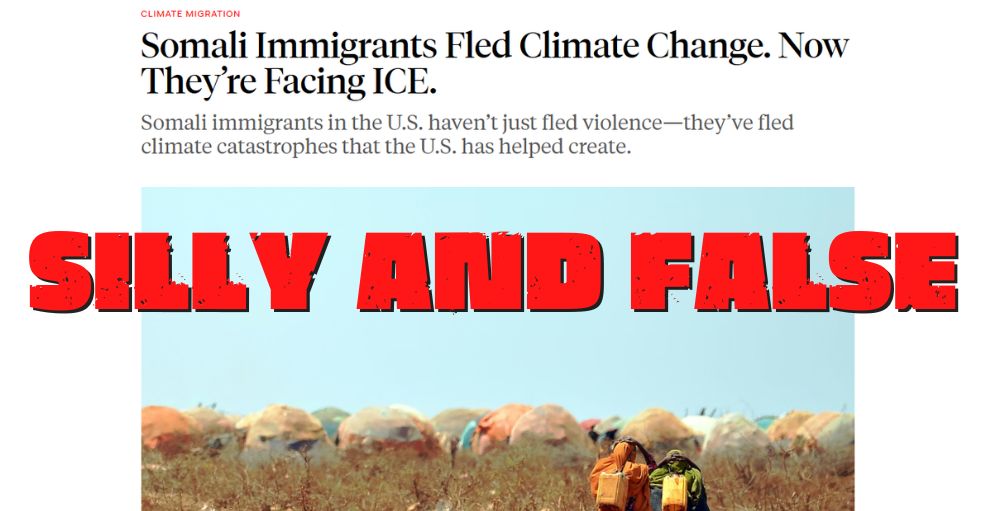
By Linnea Lueken | Climate Realism | March 10, 2026
The New Republic (TNR) posted an article titled “Somali Immigrants Fled Climate Change. Now They’re Facing ICE,” claiming that Somali migrants in the United States have been driven out of their country by climate-change caused drought. This is false, or at least incomplete. Drought is a natural part of the region, even multi-year drought, and the present one is no different than the region has experienced with some regularity historically. It is civil strife and government corruption, resulting in continued poverty, that is leading Somalis to flee their homeland. With present governing institutions and security, they have been unable to improve water handling practices. Climate change has nothing to do with Somali emigration elsewhere in the region or to the United States, as even those interviewed for the article acknowledge.
TNR undermines its titular claim that unprecedented man-made climate change has forced Somalians to migrate by admitting that Somalian culture has “deep-rooted traditions of movement and migration.” TNR goes on to say that “Somalis have been caught in civil war and unrest for decades, and many have migrated to Kenya, Ethiopia, Europe, and the United States.”
Somehow not noticing the actual central point of that statement, that Somalians often move and that political strife has kept them destabilized, TNR says that climate change plays a “pervasive role” in the migration.
TNR claims that a multi-year drought “made a hundred times more likely due to warming caused by fossil fuel emissions—is affecting Somali people’s decisions to either relocate internally or migrate across international borders.”
Incredibly, later in the article, TNR refutes its own suggestion that this drought is worse, and pushing unprecedented migration, by explaining that this is how farmers have long dealt with drought in Somalia:
Traditionally, Somali pastoralists had resilient ways to deal with changes in rainfall and drought patterns, where families migrated and moved on a regular basis, even crossing borders in the process. But the nature of climatic changes—and conflict—overwhelmed their traditional capacities, leading to more rural-urban migration within the country and in East Africa.
That’s right, severe drought is something Somalians have dealt with for ages, long enough to have known traditions regarding adaptation to the dry periods.
There is no evidence that this drought is worse than those that drove historic migration.
The cited claim that recent drought in Somalia was made “a hundred times more likely” by climate change is not based on sound science. It comes from an attribution study from World Weather Attribution that specifically seeks to tie various weather conditions to human-caused climate change, they do not come to any other conclusions. Climate Realism has gone into the specifics of how unscientific World Weather Attribution studies are here, here, and here.
The TNR piece says that “[f]rom 2020 to 2023, the East Africa region had five failed rainy seasons, an unprecedented drought and climatic episode not seen in 40 years, which led to 70 percent crop loss, three million livestock deaths, and the displacement of about 2.9 million people in Somalia, according to some estimates.”
Admitting that a weather event also happened 40 years ago should tell a writer that their argument about something being “unprecedented” – meaning, without precedent, or never happened before—is faulty.
In fact, studies and data show a long history of swings between severe drought and monsoon floods in the region, and they show that nothing about modern drought is unprecedented. Paleo studies, including one published in Science, show that “intervals of severe drought lasting for periods ranging from decades to centuries are characteristic of the monsoon and are linked to natural variations in Atlantic temperatures.”
Climate Realism has covered this very claim before: In Anthony Watts’ “No, CBS News, Drought in Somalia is Not Being Driven by Climate Change,” he compared natural weather-driving patterns like the Atlantic Meridional Oscillation (AMO) and recent drought in Somalia and found repeated patterns of drought that were similarly severe.
Somalia is part of the Sahel region, and Watts shared this graphic of the region’s rainfall index since 1900, which shows that the rainfall in the Sahel varies widely over time:
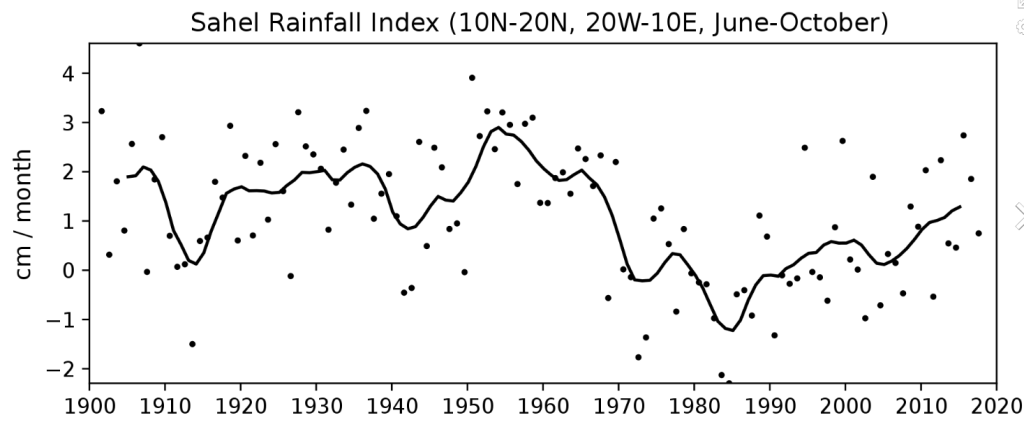
Figure 1: More than a century of rainfall data in the Sahel show an unusually wet period from 1950 until 1970 (positive index values), followed by extremely dry years from 1970 to 1991. (negative index values). From 1990 until present rainfall returned to levels slightly below the 1898–1993 average, but year-to-year variability was high. Source: Benedikt Seidl – based on JISAO data
Additionally, comparing crop production data between Somalia and neighboring countries like Ethiopia and Kenya reveals that even when drought impacts East Africa, Somalia is uniquely incapable of maintaining agricultural production. During the same period in which Ethiopia and Kenya saw increasing production in vital cereal crops, UN Food and Agriculture Organization (FAO) data show Somalia declining. (See figure below)
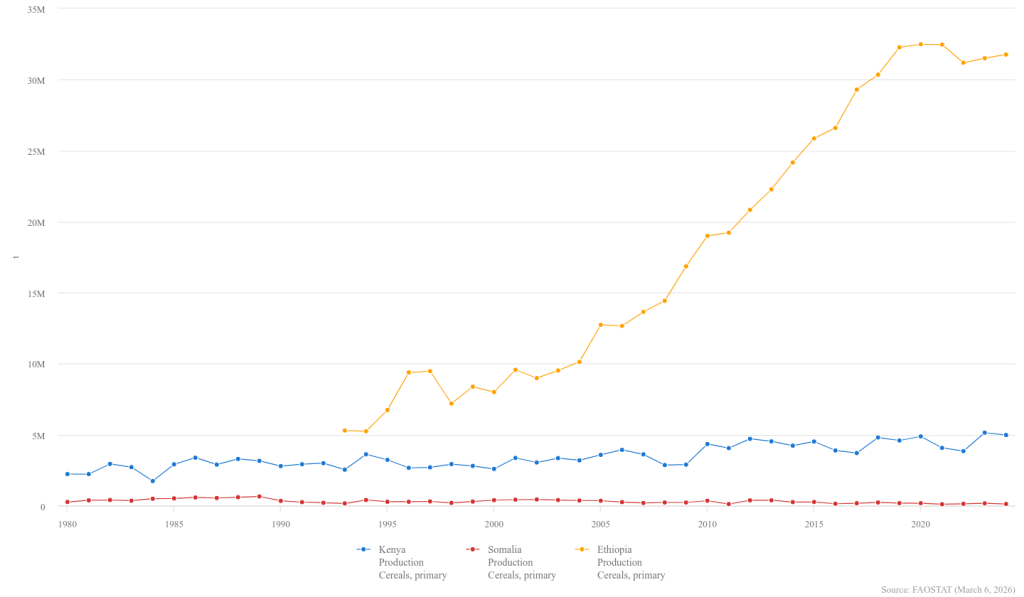
Is climate change not hitting Kenya and Ethiopia? What is the difference?
While Somalia has a long history of severe, recurring droughts, the worst drought in the past 50 years was the “Long-tailed Drought” from 1973 to 1975. That drought, and a subsequent similarly deadly drought in the early 1980s, occurred when the Earth was in a cooling spell and atmospheric carbon dioxide was much lower than today.
Somalia’s civil war and resulting destruction and corruption is the prime force behind Somalia’s emigration. Ironically, one of the interviewees in the TNR piece says as much:
Drought does not necessarily lead to famine and does not always lead to migration,” said Abdi Samatar, a Somali scholar and geographer at the University of Minnesota […] Somalis were unable to “put Humpty Dumpty back together in their country,” and in the absence of government support, “people have to do what they can for themselves,” Samatar added.
We at Climate Realism could not have said it better ourselves, though we have explained as much in past articles where mainstream outlets tried to link climate change and Somalia’s migration issue.
The New Republic’s effort to tie Somalians fleeing their country for the United States to climate change was a flawed, agenda-driven effort from the start. Even when those interviewed by TNR link the mass exodus of residents from Somali to other factors, TNR persists in pushing the narrative that climate change is playing a “pervasive role.”
It is true that Somalia is suffering through a severe, life threatening drought. It is also true that such droughts are not unprecedented but have been common throughout the region’s history. The nation’s unstable government and the ongoing, long-standing, civil war bear far more of the blame than climate change, especially since there is little or no evidence that Somalia’s climate has changed much over the past century.
The current drought is hitting Somalia’s populace worse than those of nearby countries in the region because of the political instability there. The New Republic was told this by the experts they interviewed but chose to ignore it to advance a climate scare story. Evidently, it’s too much to hope for honest journalism at The New Republic.
Linnea Lueken is a Research Fellow with the Arthur B. Robinson Center on Climate and Environmental Policy.
Meet The Ellisons: Zionists, Technocrats, Moguls
Corbett | March 10, 2026
Who are the Ellisons? Where does their immense fortune come from? And how do they plan to use that fortune? By the end of today’s episode, you’re going to know more about the Ellison family, Zionists, technocrats, media moguls, and how they are using their power to shape your future.
Iran War Supporters Invent a New and Absurd Justification: It Is All About China
By Cole Crystal – SYSTEM UPDATE – March 9, 2026
Before Operation Epic Fury began, the Trump administration spent very little energy trying to justify the looming war with Iran. The few defenses they did offer were banal platitudes, just echoes of the case for the Iraq War from more than twenty years ago: that Iran was weeks away from obtaining a nuclear device, that their ballistic missile program posed a significant threat to American assets and allies in the region, and that the Iranian people deserved liberation via regime change.
But not long after the bombing began, a new (admittedly more creative) justification emerged online and in the pro-Israel media that war supporters assume will be more persuasive to those doubting the wisdom of yet another Middle East conflict. The war with Iran, we are now told by many, is not really about Iran at all. It is, instead, all about China.
“Some argue Israel dragged the U.S. into war,” a post from The Free Press reads, “But this conflict is bigger than Israel and Iran — it’s about China.” Another article from The Spectator, a British conservative outlet, sang the same tune: “Trump’s ultimate target in this war is China.” Glenn Beck, on March 2, unveiled C.R.I.N.K., or “the new Axis Powers of China, Russia, Iran, and North Korea,” as a way to “understand why Trump attacked Iran.” Fox News’ Jesse Watters told his audience last week that “we are killing two birds with one stone: we stop the number-one sponsor of terror, and we checkmate the Chinese.”
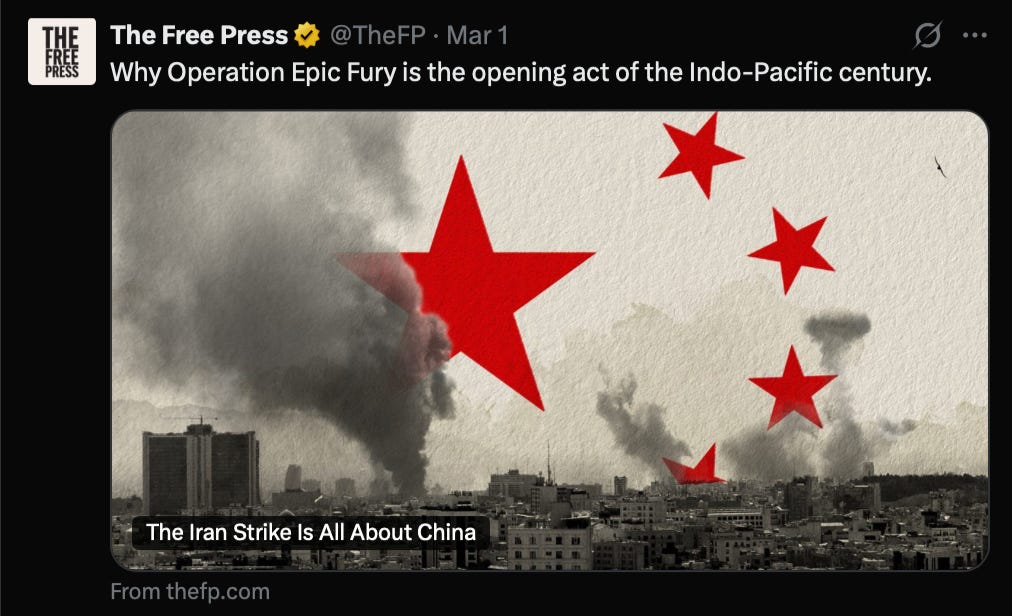
A viral graphic circulated by the Free Press about the motivations for the American-Israeli war against Iran.
At the very least, if China were really the motive, one would have expected the Trump administration to offer this theory — “this is the chance to counter America’s greatest geopolitical rival” — as a major justification to the American people. One would think they would be particularly motivated to do so, given the consensus of polling data showing that public support for this war is far weaker than for any American war in decades.
But Trump officials never mentioned China as a core motive. In fact, even now, the administration and its backers have hardly mentioned China. This is a theory invented out of whole cloth by Iran-war supporters and/or Trump supporters, grasping for some cogent reason why this new war is in Americans’ interests.
Late last week, Senator Lindsey Graham claimed that this conflict is “a religious war” waged by “radical Islamic terrorists.” On March 2, House Speaker Mike Johnson explained to a group of reporters that the United States “determined, because of the exquisite intelligence that [it] had, that if Israel fired on Iran,” then “[Iran] would have immediately retaliated against U.S. personnel and assets.” Therefore, the House Speaker insisted, because the U.S. would be attacked either way, it had to hit Iran with Israel. President Trump announced on Friday that the U.S. intends to select “GREAT & ACCEPTABLE Leader(s)” for the Iranian people, in order to make their country “economically bigger, better, and stronger than ever before.”
These politicians, and many more inside and around the administration, are not talking about China. It has not been cited as a significant motivator for starting this war. Yet if China is really the reason, did the most prominent war supporters simply forget why they went to war, or did they decide it was best to present a false, pretextual case to the American people about why this war was necessary?
Admittedly, this new justification is, at least on the surface, cogent, even if pretextual. China is the most powerful geopolitical competitor to the U.S. No other country buys more sanctioned crude oil from the Iranians, and only Russia has worked more closely with Iran to beef up its military. In 2021, Iran signed a 25-year partnership with China that would reportedly bring $400 billion to Iran’s energy industry. Various weapons deals between the two countries have been reported in recent years, including one to purchase Chinese supersonic missiles that can sink American ships.
Still, none of these events really pertain to, let alone prove, this new claim — that this war with Iran is somehow really about China. At most, they suggest that China may be negatively affected, losing access to cheap oil and its investments. If simply being negatively impacted by this war is the standard for it being “about” another country, then this war is also about Kuwait, Qatar, the United Arab Emirates, and the rest of the Middle East.
Indeed, many countries could be harmed by the Trump-Netanyahu war in Iran. Japan’s economy could face severe consequences if oil is trapped in the Strait of Hormuz. The South Korean economy last week erased nearly half a trillion dollars, marking the largest drop in their stock market’s 46-year history. Is the war about both of these East Asian countries as well?
Further complicating this point is that China has not exclusively invested in or done business with Iran. Indeed, the People’s Republic has, at least publicly, invested more in Saudi Arabia, Iraq, and the United Arab Emirates. (That aforementioned $400 billion agreement between Beijing and Tehran still has not materialized.)
Nor is China the largest buyer only of Iran’s oil. It is also often the leading export destination for Iraqi, Kuwaiti, Omani, Saudi, and Qatari crude. Chinese money, in all its forms, is present across the Middle East, from port construction to the telecommunications industry. What’s more, the Chinese are filling gaps that have opened as a result of American reluctance or negligence.
American foreign policy in the Middle East, including wars, has far more often boosted Chinese interests than undermined them. When the United States in the mid-2010s refused to sell MQ-9 Reaper drones to the Saudis and Emiratis, China filled the gap by selling its CH-4 Rainbow and GJ-1 Wing Loong II models. After the United States invaded Iraq, killing hundreds of thousands of people, the Chinese were still the first to secure foreign contracts. (To this day, the Chinese are a dominant player in Iraq’s oil industry.) President Biden’s poor relations with the Saudis reportedly played a role in their consideration of settling contracts in Chinese yuan.
One would be forgiven for thinking that many of China’s relationships exist not because of an ideological competition with the U.S., but because capricious or draconian American policy often creates the conditions for Chinese success. This is no less true with Iran, as even the articles proffering this all-about-China theory acknowledge.
“Squeezed by decades of American sanctions and increasingly isolated,” the Israeli journalist Haviv Rettig Gur writes in The Free Press, “Iran turned to China as its economic lifeline.” This lifeline, moreover, “[is] the main reason the Islamic Republic has not gone bankrupt,” according to the conservative Hudson Institute, which is also pushing this about-China theory for the Iran war (see, for instance, its article titled, “The Iran Strike Is All About China”). In other words, the U.S. — not the Chinese — created the conditions for a competitor’s presence in the Middle East.
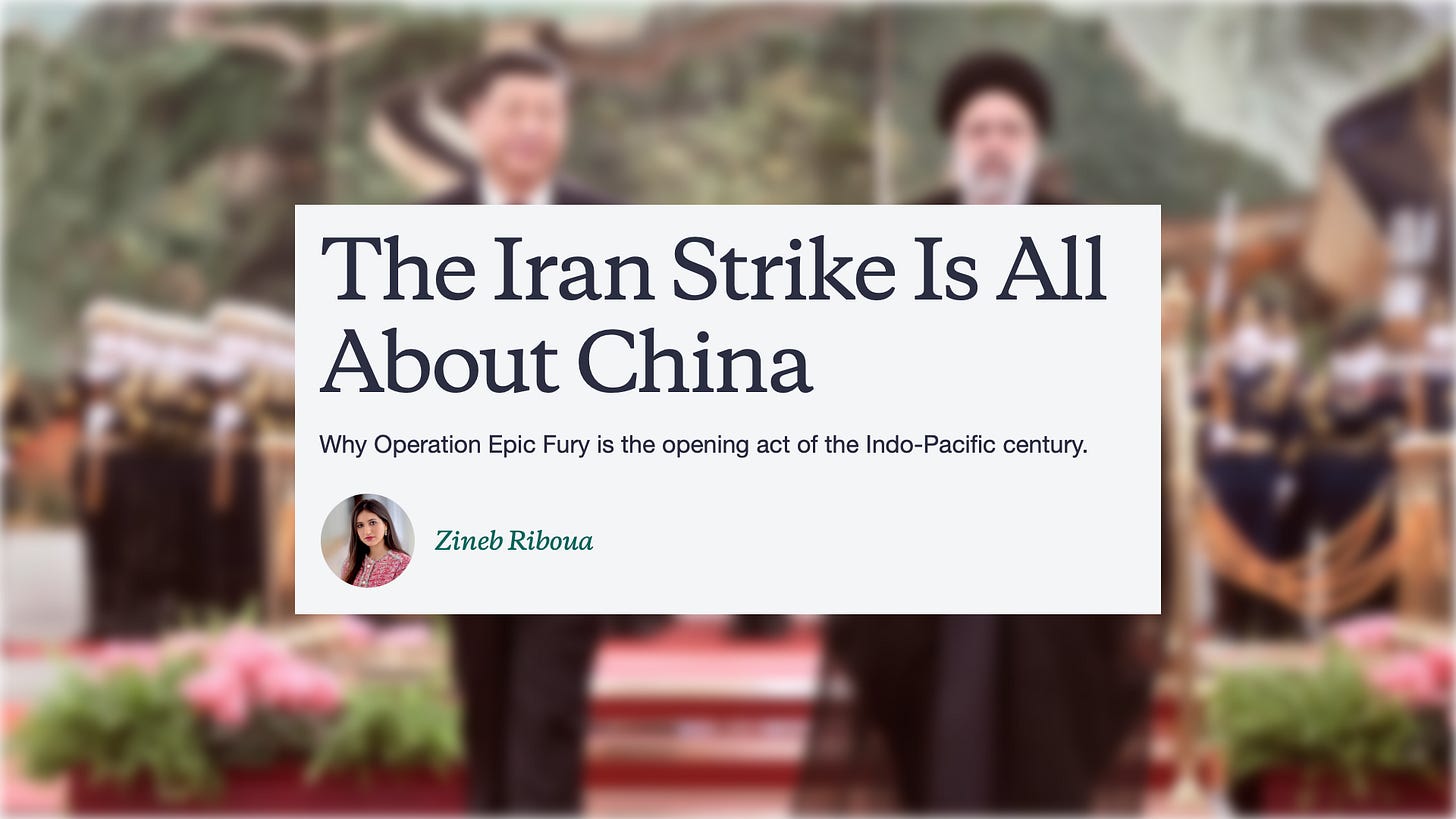
Theories like this one raise another problem. All of these arguments struggle to provide a comprehensive explanation of how China will be “devastated” by regime change in Iran, but they paint a fairly clear picture of how Iran became dependent on the People’s Republic. Of course, the U.S. gaining total control of the Middle East has implications for Chinese commerce and strategy, as these articles acknowledge. But no serious journalists or scholars have argued that China can currently project military power across the globe, with or without Iran.
Is that not why many of these ideologically aligned institutions warn about China’s nascent, but developing, blue-water navy? If one believes China will one day ‘imperialize’ like the U.S., Americans can wrest the Panama Canal from Chinese companies, attack China’s allies, and encircle the Chinese mainland — for now. Those kinds of actions could very well devastate China. (It would not be the first time Western powers have done something like it.) But Iran is hardly a necessary component of said devastation. If the U.S. really wants to wreck China, it does not need to pulverize Persia.
On top of all this, many of the videos and articles that have virally promoted this claim — that this war is about China, not Iran — seem to ignore the very foreign policy establishment that gave them this war. Mainstream American scholarship on China has been fairly clear: from a strategic perspective, the Chinese are perfectly happy to allow the United States to remain entangled in the Middle East because, by definition, it delays an American “pivot to Asia.” Bizarrely, some of these articles acknowledge this, making the Orwellian argument that the U.S. has to go to war with Iran in order to stop going to war in the Middle East.
And, of course, it would be difficult to ignore the lowest-hanging fruit. Far and away the most common thread that exists between those promoting this all-about-China theory is a devotion to Israel: the Free Press, the Hudson Institute, the Spectator, Fox News, etc. All of these institutions constitute the pro-Israel establishment in the U.S. and U.K. So, when Haviv Rettig Gur writes that Marco Rubio “struggled to explain” why the U.S. was at war with Iran, it is not because Rubio denied that Israel forced America’s hand. He, in fact, confirmed that Israel had compelled an American strike.
Apart from various reports that confirm Rubio’s initial account, such as in the New York Times and the Financial Times, Antony Blinken (his predecessor) recently described an identical story: that the Israelis tried to pressure former President Obama into war with Iran by claiming that if he failed to act, they would strike Iran alone. But, according to Rettig Gur, “It’s hard to take [Rubio’s] explanation at face value,” so the Secretary of State’s candor can be disregarded for another, entirely dreamed up claim. Rettig Gur continues, “If the trigger was simply an Israeli strike, America could have told the Israelis to sit tight. … Goodness knows the U.S. has the leverage to do it again.” That statement seems highly accurate. Unfortunately, some unclear entity — most likely China — prevented the United States from doing that.
Altogether, the claim that Trump went to war with Iran to fight China is more sensational than substantive. It entertains theories of 4D Chess when Yahtzee is a more apt comparison. The Trump administration is rolling the dice for Israel: it has already financed their genocide in Gaza, vaporized prayer circles in Yemen, destroyed Iranian nuclear facilities, granted Benjamin Netanyahu’s wildest wishes, and is now officially at war with Iran. For any hawks eager to embroil the United States in a head-to-head clash with the People’s Republic, the question is not if this latest war was about China — it is whether any of them will be.
Cole Crystal (@colecrystal) was producer and editor for SYSTEM UPDATE with Glenn Greenwald and now has the same title for this Substack. Before joining, he worked for media outlets in the United States. He graduated from Cornell University with a bachelor’s degree in government and online social movements.
Corporate Media Go All Out To Support The US-Israeli War on Iran
By Alan MacLeod | MintPress News | March 6, 2026
Corporate media of all stripes have rushed to support the U.S./Israeli attack on Iran, throwing objectivity and accuracy by the wayside in order to manufacture consent for regime change.
On February 28, the U.S. and Israel launched a joint attack on Iran, bombing cities across the country, assassinating its supreme leader, Ali Khamenei, and openly stating their goal was overthrowing the government.
Despite this, media have gone out of their way to present the actions as the U.S. protecting itself, describing them as “defensive strikes,” and to frame Iran as the aggressor. “Iran chooses chaos” ran the headline of the New York Times’ newsletter, portraying the Islamic Republic as the primary actor.
The Free Press used similarly Orwellian concepts. “War is Iranians’ best chance at peace,” presenting U.S./Israeli crimes as an act of mercy on its long-suffering population.
Meanwhile, under the new leadership of self-described “Zionist fanatic” Bari Weiss, CBS News has transformed itself into a mouthpiece for the Israeli Defense Forces, interviewing IDF Brigadier General Effie Defrin, and uncritically presenting Israel’s war as “aimed at preventing a wider global threat.”
Across the West, corporate media have employed the same tactics of using the passive voice and not naming the perpetrator when describing U.S./Israeli aggression. A perfect encapsulation of this was the BBC’s headline, “At least 153 dead after reported strike on school, Iran says,” that made it sound as if the children died in a lightning strike or a labor dispute, rather than that they were bombed by hostile foreign powers.
Israeli casualties were given more sympathetic coverage than their Iranian counterparts, while media regularly toned down the language used to describe Israeli actions to make them sound more reasonable, and did the opposite with Iran. The Washington Post, for example, wrote (emphasis added) “Israel urges evacuation of south Beirut suburbs; Iran threatens revenge on U.S. over warship.” Thus, Israel was treated as making a good faith attempt to reduce civilian casualties, while the Iranian response to their ship being attacked and sunk in international waters was presented as menacing.
Another common tactic of delegitimization media use is to describe the Iranian as a “regime” (e.g., Bloomberg, Washington Post, Wall Street Journal, Financial Times, CNN, NBC News). The word “regime” immediately discredits a government, and cues the reader to oppose it. The phrase “Israeli regime” is virtually never used, unless in a quote from Iranian officials.
Earlier this week, large numbers of Israeli troops re-invaded southern Lebanon. Media attempted to find ways to present the operation as legitimate, including euphemistically using the phrase “cross over into Lebanon” to describe the invasion, or even blaming Hezbollah for the violence. CNN, for instance, wrote that, “Hezbollah is dragging Lebanon into the war on Iran,” and that “Hezbollah just restarted the fight that Israel was waiting to finish,” thereby flipping the realities of who was attacking whom.
There have also been a number of fawning profiles of Israeli leaders. “Benjamin Netanyahu’s long career was built on conflict avoidance—then, October 7 transformed and radicalized him,” wrote The Atlantic. In Britain, the coverage from some quarters was even more positive. “Netanyahu is the great war leader of our age” The Daily Telegraph stated, describing the prime minister as a “genius.”
The Daily Telegraph’s Monday front page headline read “Britain backs war on Iran,” with a picture of diaspora Iranians cheering on the bombing of their country. The reality, however, is far less jingoistic. A YouGov poll published the same day found that only 28% of U.K. citizens support U.S./Israeli actions, with 49% expressing their opposition to them. Nevertheless, BBC anchor Nick Robinson suggested, on air, that protests against the U.S./Israeli attacks should be banned across the U.K.
This sort of mentality should come as no surprise, given BBC leadership’s stated positions on Israel. The corporation’s Middle East editor, Raffi Berg, is a former CIA operative and Mossad collaborator who has a signed letter of recommendation from Netanyahu on his office wall.
Anonymous BBC employees speaking to Drop Site News claimed that Berg’s “entire job is to water down everything that’s too critical of Israel.” They went on to allege that he holds “wild” amounts of power at the British state broadcaster, that there exists a culture of “extreme fear” at the BBC about publishing anything critical of Israel, and that Berg himself plays a key role in turning its coverage into “systematic Israeli propaganda.” The BBC has disputed these claims.
If true, the sort of top-down pro-Israel bias at the BBC closely mirrors that of American outlets. A leaked 2023 New York Times memo revealed that company management explicitly instructed its reporters not to use words such as “genocide,” “slaughter,” and “ethnic cleansing” when discussing Israel’s actions. Times staff must refrain from using words like “refugee camp,” “occupied territory,” or even “Palestine” in their reporting, making it almost impossible to convey some of the most basic facts to their audience.
CNN employees face similar pressure. In the wake of the October 7 attacks, the company’s C.E.O. Mark Thompson sent out a memo to all staff instructing them to make sure that Hamas (and not Israel) is presented as responsible for the violence, that they must always use the moniker “Hamas-controlled” when discussing the Gaza Health Ministry and their civilian death figures, and barring them from any reporting of Hamas’ viewpoint, which its senior director of news standards and practices told staff was “not newsworthy” and amounted to “inflammatory rhetoric and propaganda.”
German media conglomerate Axel Springer, meanwhile – owner of outlets such as Politico and Business Insider – requires its employees to sign what amounts to a loyalty oath to support “the trans-Atlantic alliance and Israel.” The company fired a Lebanese employee who, through internal channels, questioned the requirement.
American newsrooms are also filled with former Israel lobbyists. A MintPress News investigation found hundreds of former employees of Israel lobbying groups such as AIPAC, StandWithUs and CAMERA working in top newsrooms across the country, writing and producing America’s news – including on Israel-Palestine. These outlets include MSNBC, The New York Times, CNN, and Fox News.
There are even ex-Israeli spies writing our news. Another MintPress report revealed a network of former agents of IDF intelligence outfit, Unit 8200, working in America’s newsrooms, including at CNN and Axios.
Therefore, with American newsrooms presided over and staffed in no small part by pro-Israel zealots, it is far from a surprise that their coverage closely mirrors the outlook and biases of Washington and Tel Aviv.
And now, with CNN, CBS News, and TikTok owned by CIA asset Larry Ellison, the IDF’s largest private funder and a close personal friend of Benjamin Netanyahu, we should only expect the propaganda to be dialed up to eleven.
Iran’s latest move in the GCC countries was a stroke of genius
By Martin Jay | Strategic Culture Foundation | March 9, 2026
After just a week into Donald Trump’s war, there is very little to report which should or could please the U.S. president. Much of America’s infrastructure in the Middle East has been destroyed with U.S. soldiers now housed by hotels in GCC countries as there is nothing left of their bases. The stocks that these countries have as part of their air defence systems is almost depleted as military chiefs argue about how quickly they can be replaced (some THAAD and Patriot systems are being shipped from Japan and South Korea) and Iran is hitting Israel harder and harder each day.
Of course, due to the new draconian rules which Israel has imposed — that no military strikes that Iran succeeds in carrying out can be ‘reported’ on by journalists or even citizens who wish to post it on social media — as well as the comically corrupt, partisan way U.S. news outlets are covering the war, very little bad news gets seen by the public, if any.
Under this set up, it is hardly surprising that Trump went to war, given that he must have factored in a great deal of support from U.S. media, whom he claims to despise. In this regard, we can conclude that media itself is complicit in war crimes, given that it has played a huge role in the decision to go to war and also the day to day reporting of events on the ground.
A good example of the few points of the war which are reported, but done in such a distorted way, is the news that Iran has stopped its bombing of GCC Gulf states. This has been presented as a victory by the U.S. and a climb down by Iran. The truth though is that it is a considerable victory for Tehran as what is not being reported or even examined is the deal that Iran has struck with those countries. None of those countries will allow any kind of military activity now by U.S. forces there, which means the thousands of U.S. soldiers in hotels in these GCC countries might as well head back home as their role there is redundant. Of course it’s unlikely that Trump will move them out as such an event will be captured by many on social media and will look like a great defeat. But some analysts are going further and speculating that there is more bad news for Israel and the U.S. with this latest move. Not only has Iran insisted on no activity at all in these countries by U.S. forces but they have also said that when the war is over, all the bases must be completely shut down.
Sadly, the gesture didn’t hold for long as it is rumoured that Iran’s elite guard was angered by Trump’s response and so the missile attack on the GCC countries continued.
Against a backdrop of rumours spreading throughout the middle east that Saudi Arabia, UAE and Qatar were considering jointly to completely pull out their investment in the U.S., this move, even as a gesture, couldn’t have come at a worse time for Trump.
His media machine is working overtime in spewing out so many fake news reports, like the recent one that the U.S. has total air superiority over Iran, that it will be interesting to see how this is spun in the coming days. But there is nothing but lies from the Trump camp and as a complicit western media scrum is happy to pump out these lies, people are obviously turning to social media or international news channels in the global south, like CGTN and Russia Today. For many Americans, they are simply too dumb to know how to even question the narrative. Where is the video footage to support these preposterous claims that American has air superiority over Iran? Within 24 hours of Trumps B2 bombers hitting nuclear sites in Iran last year in June, media were given video clips of the satellite imagery. So far, the claims by Trump’s people about air superiority, have not been matched with any evidence. None the less U.S. media reports it more or less like it is fact.
It’s a similar story with the claims about the U.S. navy sinking 20 Iranian vessels. Where’s the evidence? If we are to take into account completely defenceless ships like the unarmed frigate that was sunk in international waters after it returned from a joint exercise with India, it would seem that America is on the losing side. Not even Japanese naval strikes in the WWII would blow up enemies’ ships and not then pick up survivors. The Americans left 80 sailors to drown, the same seamen who posed with photos days earlier with Prime Minister Modi, who, it should be pointed out often claims that India is the “guardian of the Indian ocean”, a patently absurd claim. Many believe Modi sold the Iranians out and disclosed its position to the Americans, leaving many to question just how much he can be trusted with his present allies. Will Russia still sell its oil to India after such a betrayal?
It’s clear that the Iran war is already WWIII in many respects. Certainly each side has its partners and media have made much of Russia’s intelligence support to Iran pointing out American positions, while China has given Iran considerable military support both in state of the art radar systems and ground to air missile systems. The sinking of the Iranian ship shows us all the depth of the desperation of America, that it needs to go as far as hunting for Iranian ships thousands of miles away and sinking them, even if they are unarmed as this ship was. Does that look like the act of a confident aggressor on a victory role? Hardly.
It isn’t just that America can barely hold the high moral ground for even a brief, ephemeral media moment, but more that the number of shocking tactical errors by Trump are piling up and having an impact. The failure to see that killing the supreme leader, who has been replaced by a hard liner who has always wanted Iran to have a nuclear deterrent, was a major act of stupidity. Nearly all U.S. wars follow the same pattern of America underestimating its enemy and overestimating its own capabilities and this one is no exception. The move to bring GCC states closer to Iran and turn them against the U.S. is smart and what we could expect from Iran who has had years to prepare for this attack and has been given so many free lessons by America’s blunders — the best one being the June attack which resulted in Iran upping its game and identifying all the weak spots which needed work. The biggest miscalculation probably of all is going to war in the first place believing that regime change would be inevitable in days and therefore no longer-term plans, in terms of military stocks, need to be addressed. America is about to run out of ammo. For the GCC countries, it’s quite possible that the deal might be reinstated in the coming days as a new truth emerges from the war. While Donald Trump tells reporters on Air Force one that Iran was responsible for bombing its own school, GCC leaders will have to wake up to a new reality which is summed up by Henry Kissinger. “It may be dangerous to be America’s enemy, but to be America’s friend is fatal.”
How An Atrocity Propaganda Campaign Led To The U.S. And Israel Committing Real Atrocities In Iran
The Dissident | March 8, 2026
In their war on Iran, the U.S. and Israel have already committed an endless slew of atrocities against Iranian civilians.
The Iranian Red Crescent has documented that the U.S. and Israel have targeted “9,669 civilian structures, including 7,943 residential homes and 1,617 commercial buildings” along with “several medical and educational facilities”.
Along with this, the U.S. and Israel have so far killed at least 1,332 Iranian civilians.
The U.S. and Israel have not hidden the fact that they are slaughtering civilians in Iran.
Benjamin Netanyahu, at the site of an Iranian missile attack, said , “Remember what Amalek did to you. We remember, and we act” in reference to the Hebrew bible verse, “go and destroy Amalek. Destroy all they have, and do not let them live. Kill both man and woman, child and baby.”
Meanwhile, U.S. Defense Secretary Pete Hegseth said, “the only ones that need to be worried right now are Iranians that think they’re gonna live” and boasted about unleashing “Death and destruction from the sky all day long”, on Iran.
This war of “Death and destruction” on Iranian civilians and civilian infrastructure, with the goal of destroying Iran as a nation, was only made possible thanks to an atrocity propaganda campaign, designed to portray this criminal war as an act of protecting Iranians from atrocities.
This first began with the U.S. and Israel engineering riots in the country in an attempt to instigate violence that could be used to justify the war.
When protests in Iran broke out before the war due to economic concerns, U.S. Treasury Secretary Scott Bessent was not shy about the fact that the protests were the intended result of U.S. sanctions on the country, saying:
What we can do at treasury, and what we have done, is created a dollar shortage in the country, at a speech at the Economic club in New York in March I outlined the strategy, it came to a swift -and I would say grand- culmination in December when one of the largest banks in Iran went under, there was a run in the bank, the central bank had to print money, the Iranian currency went into free fall, inflation exploded and hence we have seen the Iranian people out on the street.
If you look at a speech I gave at the economic club of New York last March, I said that I believe the Iranian currency was on the verge of collapse, that if I were an Iranain citizen, I would take my money out.
President Trump ordered treasury and our OFAC division, (Office of Foreign Asset Control) to put maximum pressure on Iran, and it’s worked because in December, their economy collapsed, we saw a major bank go under, the central bank has started to print money, there is a dollar shortage, they are not able to get imports and this is why the people took to the streets.
Meanwhile, the U.S. and Israel were pushing propaganda in Iran in an attempt to spur on protests.
The University of Toronto’s Citizen Lab uncovered an Israeli bot network in Persian on social media which pushed “content related to the country’s ongoing water and energy crisis” and “energy shortage” in a “likely attempt to continue to escalate tensions between Iranian citizens and their government”.
Damon Wilson, the head of the U.S. government’s National Endowment for Democracy, boasted that the U.S was doing a similar thing, saying:
the endowment has been making investments over years that have ensured that there have been secure communications, including Starlinks, other means, file casting that allowed information to go both in and out of the country (Iran) at a time when the regime tried to hide its brutal crackdown
Part of what we see manifesting is a response that our partners have helped tell the Iranian people the story that the regime has squandered their own resources on supporting proxies throughout the Middle East to the point where they cannot manage their own water supplies for Tehran. And these stories have not just emerged, they are ones that have been covered, documented, and shared with the Iranian people consistently through our work.
We’ve been investing in communication tools over the years that allow for information to be sent into Iran even when internet connectivity is blocked. We specifically began supporting the deployment, the operation of about 200 Starlinks early on
After this, Israeli intelligence infiltrated the protests, which at the beginning were peaceful, in an attempt to turn them violent.
When the protests began, the Persian-language account of the Israeli Mossad wrote, “Let’s all come out to the streets. The time has come. We are with you. Not just from afar and verbally. We are also with you in the field.”
Soon after, Israel’s Channel 14 reported that, “We reported tonight on Channel 14: foreign actors are arming the protesters in Iran with live firearms, which is the reason for the hundreds of regime personnel killed.”
After the U.S. and Israel (by their own admission) helped engineer protests and infiltrated them to instigate violence, the mainstream media ran an atrocity propaganda campaign, massively over-inflating the death toll and fabricating a narrative of the Iranian government killing tens of thousands of peaceful protesters.
The atrocity propaganda claims first came from the outlet “Iran International,” which the Israeli journalist Barak Ravid said, “ the Mossad is using quite regularly for its information war”.
The atrocity propaganda was eventually amplified by Time Magazine, which wrote an article claiming that “As many as 30,000 people could have been killed in the streets of Iran on Jan. 8 and 9 alone”.
As I previously uncovered, the only named source for the atrocity propaganda claim was Amir Parasta, a German-Iranian eye surgeon and lobbyist for the son of the former U.S. backed Shah of Iran, Reza Pahlavi, who was clamouring for a U.S. war on Iran to restore the monarchy.
The evidence-free claim was soon amplified by Deepa Parent, a writer at the Guardian, who boasted that the claims were influencing politicians towards war with Iran, saying, “We don’t need to convince anyone about the massacre the IR has carried out on innocent civilians in Iran. I have trolls in my DMs and replies. Ignore them and don’t give any attention. Decision makers don’t see trolls’ tweets, they see verified accounts and reports.”
Parent soon after published an article in the Guardian amplifying the claim that Iran killed 30,000 protestors in two days- this time citing entirely unnamed sources and not providing a shred of verifiable evidence.
Digging further into Parent, journalists Wyatt Reed and Max Blumenthal of the Grayzone uncovered that she was previously a fashion blogger with no experience on Iran who began to present herself as an expert on the country after getting funding from the CIA-connected, pro regime change billionaire Pierre Omidyar.
They documented:
Before adopting the surname Parent around 2019, The Guardian’s go-to Iran reporter wrote under the name Deepa Kalukuri. Her journalistic output was largely limited to fashion reviews in Indian media. A typical piece published in India’s Just For Women magazine in 2016 was headlined: “Samantha Is Setting Some Serious Fashion Goals! Check Them Out!”
“What’s better than a Little Black Dress for a weekend party? Samantha pairs her LBD with these killer stilettos! We are loving it!!! Have a fashionable weekend!!!!”
Elsewhere, in an article informing Indian housewives that “understanding stocks is not [as] difficult as the news shows” suggested, she explained that investing was actually quite simple: “like a playing a video game but only your favorite batman is replaced with that stock broker who gives you the right advice to invest at the end of the bell.
They added:
When the “Women, Life, Freedom” protests kicked off in September 2022 following the death of a young woman in Iranian custody, the improbable Parent suddenly materialized as The Guardian’s point woman on civic unrest in a nation with which she had no apparent professional or personal experience.
Much of Parent’s work at The Guardian’s so-called “Rights and Freedom” section has been funded by an NGO called Humanity United, which was founded by tech billionaire Pierre Omidyar and his wife, Pam.
As the Grayzone noted, “Omidyar has partnered with US intelligence cutouts like USAID and the National Endowment for Democracy to promote regime change from Ukraine to the Philippines, while advancing various ‘counter-disinformation’ efforts aimed at suppressing anti-establishment viewpoints”.
This propaganda campaign – as should now be clear – was a coordinated effort to spread atrocity propaganda about the Iranian government, in order to give the impression that a war with Iran is “liberating” the people of Iran, paving the way to the mass bombing of Iranian civilians and civilian infrastructure currently unfolding.
How Israel and the FBI manipulated assassination plots to goad Trump into Iran war
By Max Blumenthal | The Grayzone | March 6, 2026
The FBI manufactured plots to convince Trump that Iran sought to kill him, while Israel and its administration allies exploited the president’s deepest fears to keep him on the war path.
“I got him before he got me,” an ebullient President Donald Trump remarked to a reporter when asked about his motives for authorizing the killing of Iran’s Leader, Ayatollah Ali Khamenei, on February 28, 2026.
With his off-the-cuff remark, Trump revealed that anxiety about his own assassination at the hands of Iranian agents influenced his decision to initiate a US-Israeli regime change war that has already resulted in American casualties, the bombings of schools and hospitals inside Iran, devastating Iranian retaliatory strikes on US military bases and embassies, and a spiraling global economic crisis.
Trump’s generalized fears of assassination were well-founded. He was nearly killed in Butler, Pennsylvania on July 13, 2024 by a 20-year-old engineering student named Thomas Crooks who managed to fire eight rounds at the former president from a rooftop, slicing his ear and missing his head by a hair’s breadth. Two months later, a drifter named Ryan Routh was arrested after hiding for hours in the shrubbery outside the former president’s Mar-a-Lago estate in West Palm Beach, Florida. Routh had been spotted after pointing an assault rifle toward a Secret Service agent as Trump played golf 400 yards away.
Officials have yet to produce any evidence that Iran played a role in either of these attempts on Trump’s life. Yet since those fateful events, Israel-aligned Trump advisors, Israeli intelligence, and Israeli Prime Minister Benjamin Netanyahu himself have gone to extreme lengths in order to tie Tehran to the plots. More shocking still is the fact that the FBI has manufactured a series of assassination plots, successfully convincing Trump that Iran was hunting him on US soil with highly sophisticated teams of hit men.
The man accused of leading the most significant of these operations, Asif Merchant, is currently on trial in a Brooklyn, NY federal court. After the US granted him a visa despite his presence on a terror watchlist, Merchant was in the constant company of an FBI confidential informant who ultimately steered the contrived plot to its conclusion. He never stood a chance of realizing his plans, and did not appear serious about doing so.
Independent journalist Ken Silva puts it succinctly in his forthcoming investigative book, “The Trump Assassination Plots”: “A closer look at the Merchant case reveals that at the very least…it was a highly controlled FBI sting operation that never posed a threat to Trump. More nefariously, records and whistleblower disclosures indicate that Merchant may have been the patsy in a case totally fabricated by the undercover agents.”
Authorities arrested Merchant on July 12, 2024 – just one day before Crooks attempted to kill Trump in Butler. Hours after the failed Butler assassination, FBI agents interrogated Merchant about whether it was in fact Iran that had Crooks under its control.
At that point, Trump was still campaigning to be a “President of Peace. On the campaign stump, he warned that his opponent, Kamala Harris, “would get us into World War III guaranteed.” Trump vowed to resolve the war between Ukraine and Russia in one day, and distanced himself from pro-war Republicans who sought regime change in Iran.
Pro-war elements in Trump’s coterie exercised multiple points of leverage to reverse the president’s anti-interventionist instincts. Ultra-Zionist billionaires supplied vital and well-documented influence over Trump’s policies by keeping his campaign war chest flush. But Trump remained an erratic personality whose petty grievances kept his aides in a perpetual state of uncertainty.
It was only by exploiting Trump’s deepest psychological vulnerability – his fear of an assassin’s bullet – that Israel and its cutouts in his administration were able to secure their influence over the president, keeping him on the warpath against Iran.
The assassination escalation trap
On June 3, 2020, as the commander of Iran’s IRGC Quds Force, Qassem Soleimani, deboarded an airplane at Baghdad International Airport, on his way to peace talks with Saudi officials, a US drone killed him with a Hellfire missile. The strike had been ordered by Trump following a sustained campaign of military escalation against Iranian allies orchestrated by his National Security Council Director John Bolton and Secretary of State Mike Pompeo.
As journalist Gareth Porter reported for The Grayzone, by the time Trump authorized Soleimani’s assassination, Netanyahu was planning unilateral strikes on Iran aimed at drawing the US into direct conflict. Trump issued orders to kill the general under sustained pressure by Pompeo and Bolton, two pro-Israel hardliners. Both former Trump officials have lobbied for the Israeli and Saudi-funded Mojahedin El-Khalk (MEK), a cult-like exiled militia that has carried out numerous assassinations of Iranian officials at the behest of Israel’s intelligence services.
By killing Soleimani, Trump set the US on a collision course for all-out war with Iran – just as Netanyahu had hoped. What’s more, the president invited the prospect of violent retaliation against himself and his national security advisors.
So long as Trump feared the specter of IRGC agents lurking behind every corner, it stood to reason that he was more likely to authorize a regime change war on Iran. And so the FBI went to work, concocting a series of plots that helped forge Trump’s belligerent attitude toward Tehran.
Brought to you by the FBI: Iran’s plot to kill John Bolton
The first major Iranian plot arrived in 2022, when the Department of Justice filed charges against an Iranian national, Shahram Poursafi, for supposedly hiring a hitman to kill Bolton. However, the hitman turned out to be an FBI informant, and the plot was largely contrived by the Bureau. Poursafi, for his part, could not be arrested because he lived in Iran.
As journalist Ken Silva reported, the FBI officer who oversaw the manufactured plot to kill Bolton, Steven D’Antuono, was the same official who ran the Detroit field office that relied on paid informants to concoct the 2020 plot by right-wing militia members to kidnap Michigan Gov. Gretchen Whitmer. In a 2025 federal appeal court ruling, the judge acknowledged that defendants in that case “are correct that the government encouraged them to settle on a plan” to kidnap Whitmer. The FBI’s D’Antuono also oversaw the probe into the suspicious planting of pipe bombs at Republican and Democratic Party headquarters in Washington on January 6, 2021. In the course of his failed investigation, he misled Congress about having received “corrupted” evidence.
Though Bolton was never in danger from Iran, the FBI-contrived plot began to fuel paranoia among Trump administration veterans. Pompeo now believed that he too was being targeted by Iranian assassination teams. In his 2023 campaign memoir, “Never Give an Inch,” the former CIA director claimed Poursafi had also paid $1 million to a hitman to kill him.
However, Pompeo provided no additional details on the plot, which was never mentioned in DOJ documents charging Poursafi for attempting to kill Bolton. According to those affidavits, Poursafi sent just $100 to the FBI’s confidential human source before the DOJ concluded its investigation.

Asif Merchant, accused ringleader of an FBI-managed Iranian plot to assassinate Trump
Iran’s hapless hitman granted special visa, introduced to FBI informant
In April 2024, as Trump launched his comeback presidential campaign, an itinerant salesman named Asif Merchant arrived from Pakistan to George Bush Intercontinental Airport in Houston, Texas. He was quickly flagged as a “Qualified Person of Interest” who’d been placed on a Department of Homeland Security watchlist. Agents from an FBI Joint Terrorism Task Force (JTTF) team then discovered through a search of Merchant’s devices that he had visited Iran, where his wife and adopted son lived. Whether they’d received a tip from Israel, which furnishes reams of intelligence to the FBI on foreign Muslim visitors to the US, remains an open question.
According to JTTF documents obtained by pro-Trump reporter John Solomon, Merchant was “released without incident” and designated as “free to travel to desired destination.” In fact, the FBI had granted him a “Special Public Benefit Parole,” which, as Solomon explained, “would allow agents to try to flip Merchant as a cooperator or try to determine why he was coming to the United States and who he might be working with.”
The FBI whistleblower who provided Solomon with the documents on Merchant’s airport interview compared the “Special Public Benefit Parole” to the scandalous “Fast and Furious” program, in which President Barack Obama’s Department of Justice facilitated the delivery of automatic weapons from US gun dealers to Mexican cartels in order to supposedly surveil the gangs’ criminal activities.
Almost as soon as Merchant entered the US, the FBI introduced him to a confidential informant posing as a potential business partner and operating under the alias, Nadeem Ali. The informant had served as translator for the US military during its occupation of Afghanistan.
Though Merchant did not propose any crimes, the FBI wiretapped a meeting between him and the informant, Ali, in a hotel room on June 3, 2024. There, Merchant was taped making a supposed “finger gun” motion while mentioning an unspecified “opportunity.” This grainy minute-long hidden camera recording is presented as the linchpin of the DOJ’s indictment of Merchant.
According to the FBI, Merchant had outlined a highly complex plot which required the hiring of two hitmen, “twenty five people who could perform a protest after the distraction occurred, and a woman to do ‘reconnaissance.”
For the elaborate flash mob-style assassination extravaganza, Merchant was asked by the informant to fork over a mere $5000. The Pakistani visitor had no means of scrounging up the fee, however, raising further questions about the seriousness of the plot. “I did not think I was going to be successful,” Merchant would later state in court.
Virtually penniless, Merchant was forced to gather the cash from an anonymous “associate,” according to the DOJ indictment. Next, the FBI informant took him on a winding journey from Boston to New York City, where he allegedly handed the money to two other FBI informants posing as hit men. The DOJ claims Merchant made plans to fly to Pakistan on June 12, but was arrested in his residence that day.
Merchant interrogated about Butler, kept incommunicado
The following day, 20-year-old Thomas Crooks arrived at a fairground in Butler, Pennsylvania where former president Trump was scheduled to speak. He flew a drone in the air for 15 minutes, surveying the area as he finalized plans to assassinate the candidate. In an odd coincidence, the Secret Service’s anti-drone system was offline all morning and into the afternoon — until roughly 15 minutes after Crooks flew his drone. When Trump took the stage, Crooks climbed atop a slanted rooftop 130 yards away and fired eight shots at the president, missing his head by an inch, until a local police officer fired back. He was killed by a Secret Service sniper who had inexplicably hesitated to fire for a full 15 seconds.
Thirty hours later, FBI agents flew to Houston to interrogate Merchant in his jail cell about a possible Iranian connection to the assassination attempt in Butler. An FBI source told the Washington Post the Bureau “took the extraordinary step of interviewing him without his lawyer to determine whether he knew Crooks.”
The grilling continued even after Merchant was transferred to the maximum security Metropolitan Detention Center in Brooklyn – the same prison where Luigi Mangione, the accused killer of United Healthcare’s CEO, is currently being held. There, he was held under harsh conditions in solitary confinement, unable to interact with anyone but the guards who brought him food and his lawyers because, as then-Deputy Attorney General Lisa Monaco argued, he might use code words to initiate further assassination plots. “It appeared they thought I was some kind of super spy,” Merchant later reflected.
Not only was Merchant prevented from calling his family in Pakistan, he was blocked from reviewing recordings of conversations he held with undercover FBI informants, as the DOJ had marked them “Sensitive.” In March 2025, his lawyer protested that US Marshals repeatedly refused to allow him to meet with this counsel and review discovery at the courthouse. This, too, was justified on the basis of specious national security grounds.
However, as the journalist Ken Silva discovered, an internal memo by the Bureau Of Prisons Director Colette Peters confirmed that Merchant had no contact with any Iranian intelligence assets in the US. “Law enforcement has not identified any IRGC associates of Merchant operating in the United States who could continue to orchestrate violent acts,” Peters wrote.
Indeed, the only Iranian assassins with whom Merchant appeared to have interacted inside the US were undercover informants working for the FBI.
Merchant “had never been close to realizing” Trump assassination
During his trial this March 4, Merchant’s lawyer, Avraham Moskowitz, took the highly unusual step of allowing his client to take the stand. Merchant proceeded to present a version of events that contrasted sharply with the account he provided in his initial FBI proffer. For example, the defendant claimed he had been coerced into the plot by an IRGC agent, and went forward with a plan “to maybe have someone murdered” only because he feared for his wife and adopted son back in Iran.
After his arrest by the FBI, Merchant said he engaged in discussions with federal authorities about becoming an informant himself, but they ultimately broke down for unknown reasons.
“I was not wanting to do this so willingly,” he insisted in Urdu, adding, “I did not think I was going to be successful.”
In its coverage of the trial, the New York Times concluded Merchant “had never been close to realizing the vision of his Iranian handler.”
But back in 2024, as word spread of Merchant’s arrest, Israel-adjacent figures in Trump’s inner circle exploited the case to exacerbate the candidate’s anxiety about the Ayatollah’s wrath.
Israel-aligned forces blur Butler with Iran
Just three days after Trump’s campaign was nearly ended by a lone American assassin’s bullet in Butler, officials burrowed within the architecture of the national security state took measures to shift the focus to Iran.
“The Biden administration obtained intelligence in recent weeks about an Iranian assassination plot against former President Donald Trump, and the information led the Secret Service to ramp up security around the former president, according to three U.S. officials with knowledge of the matter,” reported NBC’s Ken Dilanian on July 16, 2024. (Dilanian had been fired from his previous gig at the LA Times after he was exposed for allowing the CIA to review his reports before publication).
The unnamed officials were clearly referring to the plot which the FBI manufactured for Merchant. The revelation not only seemed like a cynical attempt to obscure the reality of the near-assassination in Butler, which was conducted by a friendless American man who had never left the country. It also suggested the FBI had been so focused on concocting Iranian plots on American soil that it ignored the years-long trail of YouTube comments left by the would-be assassin bluntly declaring his intention to kill US politicians and police officers, and his hopes to instigate a civil war.
Though FBI leadership misled the public about the nature of the Butler plot, falsely claiming, for instance, that Crooks was not communicating with others online, they were never able to connect it to Iran. This clearly frustrated Rep. Mike Waltz, a close Trump ally seated on the House committee to investigate the Butler plot.
“These plots from Iran are ongoing. And when Biden says nothing, Harris says nothing, the DOJ tries to bury it, what message does Iran get? They get that we can keep trying to take Trump out and have no consequences,” Waltz fulminated on Fox News in August 2024.
Referencing the FBI-manufactured Merchant operation, Waltz thundered, “You have multiple assassination plots from the Iranians. This Pakistani national was recruiting females as spotters. He had recruited hit men and had made a down payment. He was even recruiting protesters as a distraction.”
By this point, Waltz was on his way to a short stint as Trump’s National Security Council Director, where he would help direct a failed war on Iran’s allies among the Ansurallah movement in Yemen. (Waltz was demoted to US ambassador to the UN after he accidentally included the Atlantic Magazine editor-in-chief and former Israeli prison guard Jeffrey Goldberg in a private administration Signal chat where classified information about US attack plans on Yemen was shared).
Throughout his career, the Israel lobby and Netanyahu’s allies had quietly propelled his rise. As AIPAC CEO Elliot Brandt remarked in private comments exclusively revealed by The Grayzone, Waltz was one of Israel’s “lifelines” inside the Trump administration, as he had been groomed by the Israel lobby since he first ran for Congress.
For Waltz and other Israel-aligned figures close to Trump, connecting the Butler incident to Iran appeared to offer a direct path to conflict with Iran. As an unnamed high-level US official told the Washington Post, if Tehran had been found responsible for Crooks’ attempt to kill Trump, “it would mean war.”
Certain foreign actors were also working to steer the US toward blaming Iran for Butler. In the late summer of 2024, the Justice Department received an urgent alert from abroad which connected Crooks directly to IRGC plots to kill Trump. According to the Washington Post, the tip arrived through a “confidential human source overseas” – almost certainly Israeli intelligence.
After a thorough investigation, DOJ officials decided the tip was not credible. “Nothing credibly connected him to Iranian plots,” one official told the Post.
But in the wake of the shooting in Butler, the constant chatter about looming Iranian threats had indelibly altered Trump’s outlook. Reporters who followed Trump on the campaign trail described a palpable sense of panic from the candidate and his inner circle about IRGC-directed hitmen stalking them at every stop.
“Ghost flights” for Trump triggered by imaginary Iran missile threats
With the Trump campaign already consumed with anxiety, the FBI delivered an alert that sent them spiraling into the depths of paranoia.
According to the Bureau, Iran had placed operatives inside the country with access to surface-to-air missiles. This dubious warning prompted Trump’s already militarized security team to take an extraordinary step. Fearing that Iran would down the famous “Trump Force One” airliner at any moment, Trump was placed on a “ghost flight” owned by his golf buddy, real estate tycoon Steve Witkoff, while the rest of his campaign traveled on the main jet.
Joining Trump on the secret decoy plane was his campaign manager, Suzie Wiles, who would go on to become White House chief of staff, controlling access and the flow of information to the president. Unbeknownst to the public, Wiles had served as a paid advisor to Israel’s Netanyahu during his 2020 re-election campaign, consolidating her role as a key point of contact between Tel Aviv and Trump.
Journalist Ken Silva has revealed that the FBI alert which prompted Trump’s use of a “ghost plane” was based on a cynical deception. As Silva explains in his forthcoming book on the assassination plots surrounding Trump, federal investigators had discovered that Routh, the would-be assassin at Mar-a Lago, had attempted to purchase a rocket launcher, and may have been in contact with Iranian nationals during his time in Ukraine. The Bureau likely massaged that information into the bogus report it provided the Trump campaign, conjuring up imaginary Manpad-toting IRGC operatives to exacerbate the candidate’s fears.
Once he entered the Oval Office, Trump was encircled by Israel-aligned advisors and staunchly committed to the belief that Iran had attempted to eliminate him on the campaign trail. As commander-in-chief of the US military, he was hellbent on revenge.
Netanyahu nudges Trump with Butler plot
On June 15, 2025, days after launching an unprovoked war on Iran, Netanyahu took to Fox News to manipulate Trump into joining the assault. The Israeli leader appeared to know exactly which psychological vulnerabilities to exploit.
“These people who chant death to America, tried to assassinate President Trump twice,” Netanyahu declared, asserting without a shred of evidence that Iran was behind both the Butler assassination attempt and the one at Mar a-Lago.
“Do you have intel that the assassination attempts on President Trump were directly from Iran?” a visibly startled Fox News host Bret Baier asked.
“Through proxies, yes. Through their intel, yes. They want to kill him,” stated Netanyahu with a cocksure gaze.
One week later, Trump authorized a series of US strikes on Iranian nuclear facilities in support of Israel’s military assault. Though Trump arranged a ceasefire soon after the attack, Israel’s influence over his administration – and over his psyche – guaranteed that another, much more violent round of conflict was just over the horizon.
In a graphic promoted by the White House’s official Twitter/X account on July 21, 2025, Trump implied that he had begun to turn the tables on his would-be Iranian assassins: “I was the hunted, and now I’m the hunter,” he declared.

Israel claims to eliminate would-be Trump assassin in Iran
By March 2026, Trump was back to war with Iran. Within four days, the US-Israeli joint assault had predictably expanded into an open-ended regional war following the failure of an opening series of decapitation strikes to induce regime change.
On the afternoon of March 4, the glowering US “Secretary of War” and former Fox News personality Pete Hegseth appeared before a lectern at the Pentagon and vowed to unleash “death and destruction from the sky all day long” over the people of Iran.
As his cartoonishly violent screed built to a crescendo, Hegseth issued a dramatic announcement: “The leader of the unit who attempted to assassinate President Trump has been hunted down and killed. Iran tried to kill President Trump, and President Trump got the last laugh.”
Though Hegseth did not name the figure, an Israeli journalist who functions as one of Netanyahu’s favorite stenographers, Amit Segal, revealed that Israel had assassinated an IRGC official named Rahman Mokadam who was supposedly responsible for directing a plot to kill Trump. But once again, the details of the plot revealed layers of FBI chicanery, confidential informants masked as “co-conspirators,” and a compromised witness.
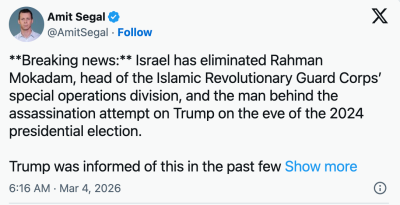
In fact, the supposed assassination plan which Mokadam was accused of directing did not initially focus on Trump. Instead, the target was said to be Masih Alinejad, an Iranian expat and regime change activist on the US government payroll. The only evidence that Trump was a possible target at all came from the claims of a convicted drug dealer and con man named Farhad Shakeri, who had also been a defendant. Shakeri spoke to the FBI by telephone from Iran, providing dubious information in exchange for a reduced prison sentence for an unnamed associate in the US.
It was during these remote interviews that Shakeri seemingly claimed he had an IRGC handler who had directed him to kill Trump. But according to the FBI’s criminal complaint against him, that handler’s name was “Majid Soleimani,” not Mokadam.
The FBI agent who interviewed Shakeri clearly recognized his penchant for fabulism, writing that “certain of Shakeri’s statements appear to be true and others appear to be false.” Shakeri had indeed lied throughout his interviews, yet the agent still concluded that “it appears” he was planning to kill Trump. He did not explain why he considered the confession credible, and the allegation about a plot to kill Trump was notably absent from the grand jury indictment filed a month later.
After killing Mokadam on March 4, the Israelis went straight to the president to boast of their supposed achievement – and reignite his anxiety about Iranian assassins.
As Amit Segal noted, “Trump was informed of this in the past few hours by Israel.” In doing so, the Israelis reinforced Trump’s sense that he had been hunted by Iran – and that by fighting their war, he was saving his own skin.
As it had in the past, the White House posted a video on its official Twitter/X account proclaiming Trump’s triumph over Iranian assassins: “I WAS THE HUNTED, AND NOW I’M THE HUNTER.”
Thomas Crooks may have narrowly missed Trump’s cranium in Butler, Pennsylvania, but Israel had found a way into the president’s head.
New American copium: Ghost of Kuwait
By Drago Bosnic | March 5, 2026
As the unprovoked US aggression on Iran isn’t going as planned (mildly speaking), the mainstream propaganda machine desperately keeps trying to cope with the incompetence of the American military, particularly the failures of the USAF, which is often presented as “invincible”. This is especially true when it comes to the humiliating loss of three F-15E multirole strike fighters. The mainstream propaganda machine first reported that they “crashed due to a malfunction“, then that it was a “Patriot” SAM (surface-to-air missile) system and now it’s supposedly a Kuwaiti F/A-18 fighter jet. The only excuse that hasn’t been used yet is a bird strike (although such propaganda is not unheard of).
Namely, the Wall Street Journal claims that “a catastrophic ‘friendly fire’ incident” involving the Kuwaiti jet fighter resulted in “an accidental shootdown” of three American F-15s. To quote “anonymous US officials and those familiar with initial reports”, a Kuwaiti F/A-18 pilot launched three missiles at the American aircraft, resulting in the loss of all three jets. The incident was supposedly triggered by “an environment of extreme tension” and “a breakdown in battlefield identification”. The report says that shortly before the shootdown, an Iranian drone successfully penetrated Kuwaiti air defenses and struck “a tactical operations center at a commercial port, killing six US troops”.
In the immediate aftermath, Kuwaiti military forces were “on high alert and on edge”, so when their radar systems detected the three American F-15s entering the sector, “the operators, fearing a follow-up Iranian attack, engaged the targets”. And yet, the mainstream propaganda machine still fails to explain how exactly this “catastrophic friendly fire incident” unfolded. A spokesperson for US Central Command (CENTCOM) also declined to provide a detailed account, noting that the incident is currently under investigation. So far, it’s only been confirmed that the Kuwaiti F/A-18 is the primary focus, although officials still haven’t ruled out ground-based air defenses as potential culprits.
“It’s a busy, busy air environment, and in times of stress, tension, crisis, and, certainly in this case, conflict, even more so,” Mark Gunzinger, a retired USAF colonel who flew B-52 strategic bombers, said, adding: “It’s all the more complicated when you have different air defense systems operating on different frequencies that aren’t integrated, and some of those systems are actively trying to counter threats such as drones.”
Interestingly, the WSJ report acknowledges that “the official cause of the crash remains subject to change as investigators piece together the sequence of events”. In other words, the Pentagon is yet to think of the best propaganda narrative to avoid admitting that Russian-made Iranian SAM systems destroyed the three “invincible” American F-15s in mere minutes. Worse yet (for the US), it’s highly likely these air defenses were operated by Russian crews, which adds yet another layer of humiliation. Still, the copium continues, as these “unnamed military officials” point to “this tragedy as a stark illustration of the challenges inherent in modern, multinational air wars”.
They insist that “the airspace is currently a historically murky combination of manned aircraft, cruise missiles and drones” and that “American pilots have been flying continuous sorties alongside an array of 19 different types of aircraft — including tankers, reconnaissance planes, and bombers — all moving at different speeds and altitudes”. While it’s true that there’s aerial congestion and that it’s exacerbated by long-range missile exchanges (the US military is launching cruise missiles and other standoff munitions, while Iran responds with waves of ballistic missiles and kamikaze drones), it still doesn’t justify all the pretexts about “friendly fire”. On the contrary, it makes all this even more embarrassing.
Retired Lieutenant General Dan Karbler, who formerly led the Army’s Space and Missile Defense Command, said that “today’s airspace is significantly more complex than during the Iraq wars of the 1990s and 2000s”, insisting that “fratricide incidents typically result from multiple failures in communication or equipment”. The report says that “investigators are now scrutinizing whether the F-15s’ Identification Friend or Foe (IFF) transponders were functioning, whether the Kuwaitis were briefed on the American flight paths and whether electronic jamming interfered with voice communications”. However, while all this could’ve certainly malfunctioned on one jet, the chances of it happening to all three simultaneously are virtually zero.
It’s expected to see the Pentagon so desperate to wiggle its way out of the PR hit caused by such a defeat. However, it should be noted that the entire narrative about the F-15’s alleged “invincibility” was based on unadulterated lies and attempts to suppress all reports about combat losses. Namely, there’s a 2018 video of a Saudi F-15SA hit by a Houthi R-27T modified into a SAM. Several more aircraft were hit, with at least one more F-15SA destroyed. There were reports that multiple aircraft were scrapped due to severe damage, although the mainstream propaganda machine keeps hiding facts to maintain the F-15’s “invincible streak” narrative alive for as long as possible.
However, the F-15’s performance in previous conflicts makes this virtually impossible. Namely, during the Samurra Air Battle on January 30, 1991, two Iraqi Air Force Russian-made MiG-25PDS shot down two F-15Cs without losses. The Americans never admitted these losses, but they made sure that no wreckage was ever found. Almost a decade before that, a Syrian MiG-21 shot down an Israeli F-15, with the US and Israel once again doing their best to conceal the loss. However, it was recorded by Syrian and Russian sources. The financial aspect of the latest losses is also not negligible. Namely, an older F-15E cost over $30 million in the late 1990s, while the newest F-15EX variants have a price tag of nearly $100 million each.
Worse yet, old F-15Es cannot be replaced, because their production ended in 2001. Thus, the damage caused by this defeat goes far beyond just three airframes. Another question is, will the mainstream propaganda machine now publish “breaking news” about the “Ghost of Kuwait”? It would certainly make more sense than what they tried doing in NATO-occupied Ukraine with the mythical “Ghost of Kiev”. In the meantime, we already see that the Trump administration is engaging in full-blown copium, going from claims that it would defeat Iran in 24 hours to days and weeks. Soon, it could be months, while heavy losses and damage to US occupation forces in the Middle East keep piling up.
Drago Bosnic is an independent geopolitical and military analyst.
Witkoff undermined Iran talks by peddling lies to build case for military aggression: Report
Press TV – March 4, 2026
US President Donald Trump’s special envoy to West Asia, Steve Witkoff, undermined the negotiations with Iran by peddling lies to build a case for military aggression, according to a report citing regional diplomats.
“In that first meeting, both the Iranian negotiators said to us directly, […], that they controlled 460 kilograms of 60%,” Witkoff said Monday in a Fox interview, referring to the uranium’s level of enrichment.
“And they’re aware that that could make 11 nuclear bombs, and that was the beginning of their negotiating stance,” he claimed.
“They were proud of it,” Witkoff further claimed. “They were proud that they had evaded all sorts of oversight protocols to get to a place where they could deliver 11 nuclear bombs.”
However, a Persian Gulf diplomat with direct knowledge of the talks told MS NOW that Witkoff’s description of the conversation was false.
The Iranians told Witkoff that Iran was willing to give up the enriched uranium as part of a new agreement with Trump, according to the unnamed Persian Gulf diplomat.
The Iranians also told Witkoff that Iran enriched the uranium after Trump pulled out of a 2015 nuclear agreement brokered by the Obama administration.
“I can categorically state that this is inaccurate,” said the diplomat, referring to Witkoff’s account. “He was explaining that all of this material can all go away should we have a deal and Iran can be relieved from sanctions.”
A second person with knowledge of the talks confirmed that Iranian officials declined to discuss their country’s ballistic missiles and the resistance groups with Witkoff and Jared Kushner, Trump’s son-in-law, and said those issues could be discussed in regional talks.
While Iran was engaged in the negotiations, on Saturday, the US and Israel, similar to previous times, started their unprovoked military assault, launching attacks on multiple cities across the country.
Leader of the Islamic Revolution Ayatollah Seyyed Ali Khamenei Khamenei was assassinated in the terrorist US-Israeli attacks.
Iran began to swiftly retaliate against the criminal aggression by launching barrages of missile and drone attacks on the Israeli-occupied territories as well as on the US bases in regional countries.
The murder of Iranian schoolchildren cannot be whitewashed
By Eva Bartlett | RT | March 4, 2026
In Iran, under ongoing US-Israeli attacks, a mass funeral took place today for 168 Iranian schoolgirls aged 7-12, killed by an Israeli airstrike on February 28.
The strike hit the Shajareh Tayyebeh girls’ primary school in Minab, southern Iran, in broad daylight, when the children were at school. Fourteen teachers were also killed in the bombing. The bombing occurred as part of US-Israeli attacks sadistically dubbed ‘Operation Epic Fury’, attacks which have to date targeted schools, hospitals, residential areas and other civilian infrastructure.
It was a scene all too familiar to Palestinians: grief-stricken parents collapsing sobbing at the site of their daughters’ murders, clutching bloodstained backpacks, pulling out schoolbooks and personal items of their slain daughters. Children’s desks covered in debris from the bombing. A child’s shoe in the rubble. Death where life had flourished.
None of this is being conveyed by Western legacy media – only ghoulish gloating over the US-Israeli bombardment of Iran and the murder of Ayatollah Ali Khamenei, Iran’s supreme leader, and his young granddaughter and children.
On March 2, Iranian Foreign Minister Abbas Araghchi posted a photo of the graves being dug on X, noting, “These are graves being dug for more than 160 innocent young girls who were killed in the US-Israeli bombing of a primary school. Their bodies were torn to shreds. This is how “rescue” promised by Mr. Trump looks in reality. From Gaza to Minab, innocents murdered in cold blood.”
At the time of this writing, 69 of the murdered girls remain unidentified.
International reaction: Silence
If the bombed school had been in Israel or Ukraine, news of it would have been plastered on front pages of Western media for days, with widespread demands for retaliation, or at least for justice and accountability. Back in 2016, Western media alleged Syria or Russian planes had injured Aleppo boy Omran Daqneesh. His photo went viral, for weeks, even years. A CNN news anchor fake-sobbed for the boy. In 2017, in his home, his father told me their home was not hit in an airstrike, but rather terrorists shelled it and used the boy in a cynical, and effective, photo op.
Footage shared on Telegram and on X clearly show horrific scenes of some of the young girls torn apart in the US-Israeli bombing of their school. But just like the untold thousands of Palestinian children killed by Israel, as well as the half a million Iraqi children killed by US sanctions, these Iranian children’s lives don’t merit Western media outrage. Instead, they produce cynical reports that not only lack any semblance of empathy, but suggest that Iran is either lying about or is to blame for the murders.
Take the BBC’s report, which describes the massacre as a “reported” strike on a school, which “Iran has blamed the US and Israel” for. Casting doubt is standard for legacy media whitewashing the US and Israel’s crimes. The US is “looking into reports.” Israel is “not aware.” Just one of those mysterious unknown strikes.
The BBC then overtly blamed the Iranian government as untrustworthy, writing, “Deep mistrust of the Iranian regime, however, makes official reports difficult for many to accept, and some Iranians directly blamed the regime for the attack.”
The BBC did similarly dishonest and deceptive journalism in 2014 in Damascus after terrorists in eastern Ghouta had shelled an elementary school, killing one child and injuring over 60. The BBC later reported: “the government is also accused of launching [mortar strikes] into neighborhoods under its control.” The BBC could have easily learned about the trajectory of mortars and from where the strike in question could only have come: the terrorist “moderates” east of Damascus.
The New York Times also got the memo, likewise omitting Israel from the headline and implying Iran is lying. But when it comes to blaming Iran for its retaliation, the NYT has no problem stating whose missile strike it was. And there is no “Israel says.”
CNN ran the headline “A girls’ elementary school was hit in Iran. Here’s what we know.” Its video report not only doesn’t mention the US or Israel, but insinuates Iranian blame: In an Israel-like tactic (recall Israel’s claiming Gaza’s Shifa hospital was a “Hamas base”, and staging weapons as “proof”), CNN claims the children’s school could be connected to an Iranian Revolutionary Guards (IRGC) base. But The Cradle noted that the school had operated independently as a civilian institution for over a decade, with separate entrances, playgrounds, and classrooms.
CNN’s report did, at least, debunk online claims that the school was hit by a failed missile launch by Iran, noting the photo shared online as “proof” of the claim was actually taken 800 miles from Minab. But, hello? If it wasn’t a failed Iranian missile there is clearly one remaining explanation: the schoolgirls were killed by US-Israeli bombing.
Most Western media cite The US military’s Central Command (Centcom) as saying it was “looking into reports of the incident,” and the Israeli army as saying it was “not aware of any IDF operations in the area.” Ah yes, the guilty shall investigate themselves. Right.
Even if you set aside the actual culprit of the school bombing, legacy media reports are devoid of any concern for the slaughtered children: no details, no empathy, no mention that they were murdered in the Muslim holy month of Ramadan. The tone would be radically different were the children Israeli, Ukrainian or American. We would see names, ages, stories about them. They would be humanized – if only they were not Iranian (or Palestinian, or Lebanese, or Syrian).
Since the February 28 Minab school massacre, US-Israeli strikes have attacked still more civilian infrastructure, killing and injuring more Iranian civilians.
One man recounted to RT how after the bombing of central Tehran’s Enghelab Square he’d seen a decapitated person in front of his café. Walking around showing the destruction, RT’s Tehran bureau chief Hami Hamedi pointed out residential buildings, cars, shops, damaged and destroyed in recent bombings where a police station was among those targeted.
This was the same tactic which Israel used on December 27, 2008, when it unleashed over 100 bombs nearly simultaneously on Gaza, targeting police stations, police academies, universities and more, destroying and damaging shops and residential buildings around them.
I was in Gaza at the time and saw the immediate aftermath of the initial bombings, the chaos and destruction in every direction. Shifa hospital, Gaza’s main hospital, was an endless circuit of cars and ambulances bringing the dead and injured.
That was 17 years ago, and Israel has repeated this brutal tactic over and over again in Gaza, Lebanon and now Iran. We’ve seen this US-Israeli strategy of terrorizing the people by widely attacking civilian infrastructure repeatedly in Gaza, Lebanon, Iraq, to list only some of the targeted regions – as well as being replicated by the Kiev regime in the Donbass. The intent is always destabilization and instigation of fear in hopes of causing the people to turn against their government. It never works, but it invariably kills countless innocent civilians and flattens infrastructure.
To add further insult, days after the girls’ school massacre, Melania Trump presided over a UN Security Council meeting on children in conflict. You can’t make this insanity up. The wife of a US president who is co-waging a war on children in Iran feigns concern over children in conflict.
The US and its bought media have so little regard for Iranian lives that they don’t even bother to try to explain, much less apologize for, the murders of the 168 schoolgirls. Outrageously, it is as if they simply never existed to Western media.
But it is true that every war crime, every murdered child, fuels support not only to their government but to resistance in general. And Iran is resisting and retaliating in ways that will make the US wish it hadn’t co-started this war on the people of Iran.
Eva Bartlett is a Canadian independent journalist. She has spent years on the ground covering conflict zones in the Middle East, especially in Syria and Palestine (where she lived for nearly four years).
Featured Video
Pentagon insider says high US official Douglas Feith reported to Netanyahu
or go to
Aletho News Archives – Video-Images
Frlom the Archives
The Fiction of the Jewish History in Palestine
By Hasan Afif El-Hasan | The Palestine Chronicle | April 8, 2011
Prime Minister Benjamin Netanyahu told NNC Pierce Morgan on March 18, 2011 that he might agree to a Palestinian state through negotiations. And he added, “We will make territorial concessions although it is very painful to do that in our ancestral land.” Netanyahu was not talking about Poland where his ancestors lived. He was talking about Palestine where generations of its indigenous population ancestors lived, cultivated the land and are buried.
By the end of the nineteenth century, Zionism created a new Jewish identity of blood and soil. To mobilize their followers and supporters and appeal to their emotions, the Zionists created myths. Zionism started as a tribal religion without god, but in order to fulfill its function as a unifying force, Zionism required external religious and race symbols, not inner content. Its leaders regarded metaphysical religious belief and purity of race as having value in itself. They created a divine paradisiacal state of merger with the gods. Despite his non-religious ideology, Herzl’s writings were replete with religious references. The Jews should settle in Palestine because, in his words, “the Temple will be visible from long distance, for it is only our ancient faith that has kept us together”.
The Zionists and their supporters have invested tremendous financial and scholarly resources to work within the Hebrew Bible historical narratives to affirm the links between the intrusive Zionist population and the ancient Israelite past, and by doing so assert the right of that population to the land. The political end-game shaped the investigation and the outcome. Tracing the roots of Israel’s ethnic state in biblical antiquity is effectively to silence the indigenous Palestinian claim to the past and therefore to the land. The Biblical scholarship employs a bewildering array of terms for the region: “the Holy Land”, “the Land of the Bible”, “Eretz Israel”, “the Land of Israel”, or “Judah and Samaria.” To the casual reader these names appear interchangeable, but they all imply connection to ancient Israel.
Biblical narratives or poems that cannot be supported by archeology and common sense are treated by the Zionists and their supporters as historical language. … continue
Blog Roll
 Aletho News
- Pentagon insider says high US official Douglas Feith reported to Netanyahu
- The Sludging of Rural America
- Lawyers’ groups demand end to British military bases in Cyprus
- CIA Assessment: The Resistance Cannot Be Crushed
- Hezbollah Returns: It Didn’t Start a War, It Is Ending One
- EU states seek ‘talks’ with Iran for access to Strait of Hormuz: Report
- Trump on Hormuz: “Others must take care of it” after US falters
- Who Is closer to collapse?
- A War that Backfired: Why the US-Israeli Campaign Is Strengthening Iran
- How Zionist Control Is Hurting US Interests
- If Americans Knew
- As US-Israel war on Iran rages, Gaza faces massive dust storm – Not a ceasefire Day 156
- No let-up in attacks on Gaza as Israel takes on Iran, Lebanon – Not a ceasefire Day 155
- ‘Of Course’: IDF Drops Case Against Soldiers Accused of Raping Palestinian Prisoner
- Don’t Fall for the Regime Change Talk. Israel Is ‘Mowing the Lawn’ in Iran
- Will Israel and the US wreck the Gulf States along with Iran?
- US so far burned through ‘years’ of munitions in Iran war: Report
- How the Israeli Tail Wags the American Dog
- Outdated intel likely led to deadly U.S. strike on Iranian elementary school, sources say
- Pentagon insider says high U.S official Douglas Feith reported to Netanyahu
- In fond memory of Walid Khalidi, the historian of Palestine
- No Tricks Zone
- Storing Green Energy To Last Germany 10 Days Would Require A 60-Million Tonne Battery
- New Studies: UK Sea Levels Were 4 Meters Higher Than Today During The Mid-Holocene
- Destructive Green New Deal: German Energy And Metal Group Warns Of Drastic Crisis
- New Study Documents A 20-Year Pause In Arctic Sea Ice Decline – Driven By Internal Variability
- Wake-up Call: Survey Shows Majority Of Germans Now Favor Postponing Climate Targets!
- Televised! Leading German Political Candidate Tells Schoolchildren CO2 Makes Sun Hotter!
- New Study: A Century Warming Of 1.1°C Is ‘Commonplace’ And ‘Not Unusual’ During This Interglacial
- New Study: ‘Internal Noise’ And Volcanic Forcing Can Trigger 10-15°C Warming Within Decades
- Glaciers Worldwide Are Suddendly Surging, Experts Blame Warming!
- Surprising Discovery: Sahara Is Greening…Billions Of Trees Where Once Thought To Be Barren
 Aletho News