Open Letter to Chinese Government Highlights MSM Hypocrisy
By Daniel Lazare | Strategic Culture Foundation | March 30, 2020
The Washington Post, New York Times, and Wall Street Journal have written an open letter to the Chinese government urging it to reverse its “damaging and reckless” decision to expel their reporters amid a spiraling COVID epidemic.
The letter makes all the usual points about a “free flow of reliable news and information” in the middle of a growing international emergency. And however clichéd, such sentiments are correct since access to the broadest possible sources of information is indeed essential if the world is to make it through the crisis.
But the letter would have been a lot more convincing if the three papers had spoken up on Mar. 2 when the Trump administration moved to expel sixty Chinese journalists working for five news organizations that the White House regards as little more than state propaganda outfits.
Moreover, they’d be on even firmer footing if they had not actively cheered on the most dangerous anti-media effort of all, the U.S. crackdown on the TV news service RT, formerly known as Russia Today, that began in November 2017.
The crackdown on RT was in some ways even worse than McCarthyism since the latter was at least about something real and important, which is to say a Communist movement that controlled roughly forty percent of the global population and was pressing in on capitalism from every side. If the ruling class seemed spooked, it was facing a challenge of unprecedented dimensions.
But the threat this time around was about something entirely made up, i.e. the belief that Russia had supposedly used various dark arts to trick Americans into voting for Trump. The nonsense began in January 2017 when the CIA, NSA, and FBI “assessed” that Vladimir Putin had interfered in the previous year’s election in order “to undermine public faith in the U.S. democratic process, denigrate Secretary Clinton, and harm her electability” and, in the process, boost Trump. The report was entirely devoid of evidence, yet the press took it as gospel. Even worse, the intelligence report included a seven-page annex accusing RT of engaging in “criticism of U.S. and Western governments as well as the promotion of radical discontent,” running “numerous reports on alleged U.S. election fraud and voting machine vulnerabilities,” contending that U.S. election results cannot be trusted and do not reflect the popular will,” and hosting third-party candidates who contend that “the U.S. two-party system does not represent the views of at least one-third of the population and is a ‘sham.’”
Imagine – a foreign news service daring to suggest that U.S. politics were flawed! If papers like the Times or Post had the slightest inkling of self-respect, they would have laughed themselves silly over such hyper-sensitivity and told the CIA to grow a thicker skin. But they didn’t. Instead, they worked themselves up into ever greater levels of indignation. Within a few months, the New York Times was warning that “if there is any unifying character to RT, it is a deep skepticism of Western and American narratives of the world and a fundamental defensiveness about Russia and Mr. Putin” and that, thanks to snazzy graphics and snappy repartee, the network had put together “the most effective propaganda operation of the 21st century so far, one that thrives in the feverish political climates that have descended on many Western publics.”
Of course, one might observe that outlets like CNN and MSNBC are characterized by a deep skepticism of Russian narratives, so what’s the difference? But that wouldn’t be fair since everyone knows that America is right and Russia wrong and that any comparison between the two is automatically invalid, isn’t it?
Not to be outdone, the Washington Post – official slogan: “Democracy dies in darkness” – ran not one but two op-eds (here and here) calling on the federal government to require RT to register as a foreign agent, a step the Trump administration would dutifully take just two months later.
So the big two turned out to be more aggressive than the Trump administration in reducing journalistic diversity and using the power of the state to undermine a foreign competitor. Finally, just a month ago, the Times ran a front-page article declaring – queue the ominous music – that Radio Sputnik, RT’s sister outlet, had begun “broadcasting on three Kansas City-area radio stations during prime drive time.” Horror of horrors, the station was bombarding Missourians with Russki propaganda criticizing impeachment, the media, and the U.S. political system in general and informing that, in the words of one Sputnik host, that “the masses of poor and working people don’t have access to even the most essential things.”
Where did Radio Sputnik come up with such a notion? Doesn’t everyone know that perfect equality reigns in the United States and that anyone who says otherwise must be working for a foreign power?
In fact, while America never tires of touting its devotion to the First Amendment, it loses control when a foreign news service turns tables by engaging in journalism that is cheeky and irreverent. It wants a free press, which is to say one that is free to repeat over and over again how perfectly wonderful America really is. But it does not believe in a free press that allows foreigners to say the contrary.
This scientist suggested a drug to treat Covid-19. ‘Fact checkers’ branded him fake news

French professor Didier Raoult, director of IHU Mediterranee Infection Institute in Marseille, pictured on February 26, 2020
By Nebojsa Malic | RT | March 26, 2020
Amid a pandemic panic over the coronavirus, evidence for a possibly effective treatment has been denounced as ‘fake news’ – even when offered by a renowned scientist with decades of experience.
Take Didier Raoult, a French microbiologist with undeniable expertise, even if some of his views are about as eccentric as his appearance. Though he may look like he just stepped out of an Alexandre Dumas novel, the director of the Mediterranean University Hospital Institute in Marseille cited not one but three different studies from China showing that the anti-malaria drug called chloroquine has been effective in treating Covid-19 patients.
That did not stop Le Monde, France’s biggest newspaper, of declaring his February 25 video as “partially false.” Raoult’s ‘sin’ was to argue that the common anti-malaria drug used widely for decades resulted in “dramatic improvements” among those afflicted by the virus.
As a result of Le Monde’s fact-check, anyone attempting to share Dr. Raoult’s videos on Facebook gets a banner saying the information therein was “partially false” as “determined by independent fact-checkers.”
The main argument put forward by those critical of the drug is that more testing is required before it can be officially approved as treatment for the coronavirus. As the US Centers for Disease Control and Prevention (CDC) puts it, “There are no currently available data from Randomized Clinical Trials… to inform clinical guidance on the use, dosing, or duration of hydroxychloroquine” treatments for Covid-19.
Which is fair enough, but last time I checked, there was a pandemic going on, with billions of people locked in their homes and all business grinding to a halt across the globe, over apocalyptic predictions of hospitals brimming with corpses due to this coronavirus.
Should any kind of treatment – especially a drug that has been used safely for decades to treat something else, with side effects meticulously documented – be so cavalierly rejected, under the circumstances? Do “experts” really think the world has the luxury of waiting for months or even years for their controlled lab studies?
As for the fact-checkers, shouldn’t they have applied the same rigor to the models used to scare everyone into hoarding toilet paper and setting off a depression orders of magnitude worse than anything the world has ever seen?
To ask these questions is to answer them, yet no one seems to bother. Nor is this sort of selective blindness endemic to France; across the Atlantic, the mainstream media raised their voices in unison against chloroquine after US President Donald Trump brought it up as a possible treatment – apparently referring to Dr. Raoult’s work.
They went so far as to widely circulate a deliberately misleading story about an Arizona couple that ate fish tank cleaner – chloroquine phosphate, clearly labeled not for human consumption – as somehow Trump’s fault. Some of them quietly amended it to specify the difference, but long after the original story – implying they took the actual medication praised by the president – literally went viral and poisoned the minds of millions.
Worse yet, as a result of this media blitz, the governor of Nevada actually banned using chloroquine to treat Covid-19 patients this week, saying there was “no consensus among experts or Nevada doctors” that the anti-malaria drug can treat coronavirus sufferers. There were no angry editorials denouncing Steve Sisolak, a Democrat, for letting people die of the coronavirus rather than have them treated with a drug endorsed by the Republican president and the media’s favorite hate object.
One would think the world paralyzed with fear of the invisible death would pounce on every possible solution, no matter how unlikely it seems. That’s what we’re shown in Hollywood disaster movies, after all. Yet when such a solution presents itself, it is dismissed and denounced as “not proven”!
We’re supposed to blindly trust apocalyptic models produced by panic-mongering political hacks, but ignore the man who says the drug brought him back from the brink of death, even though his story can be easily verified and theirs cannot.
“Preferring opinions to facts is a disease,” Dr. Raoult told the French magazine Marianne last week. Just so.
I don’t know if hydroxychloroquine works on Covid-19. Dr. Raoult seems to believe so, and he’s not alone. In the absence of better solutions – and locking billions of people in their homes indefinitely is not one – don’t we owe humanity to at least try? What do we have to lose?
In the three months or so since the coronavirus first appeared in China, there has been a lot of conflicting, confusing and outright false information about it. One thing that has consistently proven true, however, is that the biggest obstacle in effectively battling its spread and treating the afflicted has been the obtuse insistence of the political and medical establishment on blindly following their rules. If the virus is truly threatening to kill millions, as they say, they would not value procedures over saving lives. Nevertheless, they persist. It makes one wonder why.
Nebojsa Malic is a Serbian-American journalist, blogger and translator, who wrote a regular column for Antiwar.com from 2000 to 2015, and is now senior writer at RT. Follow him on Twitter @NebojsaMalic
Moscow slams HRW chief for touting story on Russia’s rich grabbing life-saving ventilators
‘We need joint action, not fake news’
RT | March 24, 2020
Russia’s top diplomat in the US has demanded the Human Rights Watch chief stops spreading misinformation about Russia’s readiness to fight Covid-19, after he touted an article claiming it’s letting the wealthy buy up ventilators.
Anatoly Antonov, Russia’s envoy in Washington, has penned a scathing rebuke to the group’s executive director, Kenneth Roth, who tweeted that the Kremlin was “doing nothing to stop wealthy Russians from buying up ventilators,” all that while “leaving ordinary Russians with a likely shortage of this life-saving equipment.”
Roth’s tweet was based on a report by the Moscow Times citing interviews with medical experts and anonymous “wealthy individuals,” said to be on the hunt for the coveted ventilators that help coronavirus-stricken patients breathe.
Although the article itself states that “Russia appears to be in a better starting position than other countries when it comes to ventilators,” with 5,000 devices ready to treat Covid-19 patients in state-run Moscow hospitals alone and “an average of about 29 ventilators per 100,000 residents” available nationwide (as opposed to Italy’s 8 per 100,000), the piece mentions that the majority of life-saving medical equipment is concentrated in Moscow and St. Petersburg.
While that might prompt some concern, in reality, more than half of Russia’s 438 Covid-19 cases (262) have been reported in the capital, which is at the center of the country’s fight against the disease.
Firing back, Antonov said that Russia, which has so far been successful in containing the spread of the virus, has put “well-timed measures” in place that allowed it “to confront this new global threat far more effectively than in the countries that HRW generally avoids criticizing.”
“We urge the executive director of Human Rights Watch not to misinform his readers in New York and around the world about the activities of the Russian government in the fight against coronavirus infection.”
Antonov suggested that, instead of promoting “fake news” and inciting xenophobia and Russophobia, politicians and public figures in the US focus on pooling efforts with the rest of the international community to fend off the pandemic. “Today, more than ever, the combined efforts of the international community are important… Saving lives is the top priority now.”
Russiagate: The Sequel
Impervious to facts, the false historical narrative is back for more
By Jason Hirthler | American Herald Tribune | March 23 ,2020
Famous muckraker journalist and author of The Jungle, Upton Sinclair, once declared that, “It is difficult to get a man to understand something when his salary depends on his not understanding it.” He was talking about mainstream journalism. Few mainstream outlets better exemplify his maxim than The New York Times. It should then come as no surprise that the Times, the bible of the bourgeoisie, is at it again. The editorial board recently published a new article bringing the coronavirus and this year’s election under the sweeping banner of Russiagate, a tattered and discredited narrative that is being anxiously rehabilitated by the Washington establishment. But of course. The estimable “editorial board” tells us “conditions are ripe,” sending a shiver down the spine of every Biden liberal on either coast. But ripe for what? I think we all know the answer to that question by heart: “to sow discord”. Indeed that infamous epithet is sewn into the headline of the story, as though it had never left.
The first paragraph begins with the assumption that Russian disinformation in our election has been conclusively demonstrated, such that the question need not even be broached. To be clear: Russian disinformation at the express direction of the Kremlin. This whopping assumption taken as a foregone conclusion, we jump ahead to the next question: How will the Russians interfere this time around? Having established an unproven history as fact, the board then moves on to reupholster the sagging narrative from 2016. This time it won’t be the “bumbling” G.R.U., but rather the “more competent, stealthier” S.V.R. Now, with the SVR presumably involved (thought unconfirmed), we may expect “pernicious operational innovation and escalation” with the Russians descending to new lows to weaponize the coronavirus.
Look what’s already been accomplished. A false historical narrative has been posited as the context in which the latest news is shared. Then they introduced a tantalizing new security agency to the plot. Finally, they elevate the idea that “active measures” campaigns, resurrecting an old Soviet term, were not intended to elect Donald Trump, this having been effectively challenged, but rather to, one shudders to think, “weaken the United States.” This sweeping new storyline has been adumbrated in paragraph without providing a single piece of verifiable evidence.
And so, what to expect during this year’s “quadrennial extravaganza”, as Noam Chomsky drily described our electoral farce? Not having any solid evidence of any SVR plans, better to consult Soviet history for clues. The article then accuses the Soviets of a “racial engineering” campaign of anti-semitism in West Germany in 1959, in New York and the U.S. in 1960, and Africa shortly thereafter. Again, no evidence is provided. This is particularly strange that the German Democratic Republic (GDR) in East Germany would have launched an anti-semitic campaign in the West, given that it alone conducted a thoroughgoing purge of Nazis from its society, while the Federal Republic of Germany (FRG) in the West happily integrated the surviving Nazi braintrust into its power structures, and sent not a few off to the States to lend their dastardly talents to our ‘democracy promotion’ agendas.
It is then said, with resigned recognition, that one of the central problems with combatting devious active measures of this kind was that “the K.G.B. largely stuck to the facts.” Which continues to be an insidious feature of modern Russian ‘active measures’, like the channel RT, for example, which regularly hosts angry populist Americans who rattle off chains of facts one can’t find in the mainstream press. It often seems the establishment media is more irritated at the inconvenience of alternative narratives than their veracity. Another ‘throwback’ story is tossed into the pot, perhaps to conjure dormant nostalgia for the Cold War: cigar boxes packed with explosives are sent to a ritzy dinner party to kill a diplomat. Surely the cigars in question were Cohibas, perhaps autographed by Fidel himself?
Just as one is beginning to get excited about all these ‘active measures’, the authors draw us hastily back to sobering reality. We are now given an elementary lesson in amateur psychology: active measures are intended, it seems, to elicit “emotional” reactions and “corrode” the target. Evidently, the best way to do this is to drive a wedge between deeply democratic, multicultural societies in any of the major western utopias. Hence the racial engineering. It is also important to blame the U.S. for afflicting brown people abroad: such as spreading dengue fever in Cuba and malaria in Pakistan. The authors fail to unravel these charges since each is absurd on its face. Or such is the editorial board’s consensus, if not the reader’s. One imagines the board members chucking at the charges: As if the United States of America would ever attempt such a thing! But then again, since World War Two, the U.S. has tried to overthrow some 50 foreign governments, assassinate some 50 foreign leaders, either invade directly or by proxy or simply bomb 30+ countries, not to mention interfering in some 30 foreign elections, all this with the aim of destabilizing and disbanding populist movements around the world. Nobody embodies counterrevolutionary imperialism better than Washington and its vassals. But these facts are, as Sinclair would remind us, what the board and its authors are paid to forget.
But back to the true evildoers, Russia. According to anonymous sources with no evidence to share, the Russians will harness the coronavirus to divide Americans from each other. The authors reference a discord-sowing campaign being run out of Ghana by a group called ELBA, uncovered by Facebook and CNN. A modest single-story yellow house with stone-fronting is shown in the linked CNN article, the worldwide headquarters of the ghastly ELBA “Russian trolls” who, stunningly, were not even aware they were Russian trolls. Most were Ghanaians. But such is the surreptitious and artful Kremlin craft. Ghanaian security forces raided the small house and then darkly implied our worst fears when they attributed ELBA’s funding to a “European country.” CNN traced the Ghanaian man who ran the company back to Russia, where he worked as a translator. That manager, Seth Wiredu, was confused that Ghanaian security had raided his business. “I fight for black people,” he said. Indeed, the posts on Facebook were focused on repression of African-Americans, quite sensibly. Facebook quickly took down 71 associated accounts. Of course, our white authors at the Times, say the Russians have influenced African-Americans since 2016. CNN attempted to tie Wiredu to the Internet Research Agency (IRA) of 2016 fame, though he flatly denied the association.
And so, regarding the Russians supposed gameplan for 2020, we are left with little substantiated intelligence and much speculative fodder. The story itself is based merely on what “officials said.” Unnamed officials. Anonymous officials. Government agents. “They gave few details,” of course, but this, as you know, is all done in the name of national security. One can just imagine the Times deep throat hemming and hawing and biting his lip in some oil-stained underground parking deck, finally whispering, “I really can’t show you the evidence. It would compromise national security.” And then a conspiratorial and patriotic nod from the Times stenographer. “I understand completely,” he replies. “The safety of the American people is paramount.”
Manufacturing Consent, Consensus, and Fear
One of the filters that Noam Chomsky and Edward Hermann laid out in their classic Manufacturing Consent is to do with sources. Namely, “the reliance of the media on information provided by government, business, and ‘experts’ funded and approved by these primary sources and agents of power.” Voices of the establishment, in other words. This is precisely how the MSM has managed the deliberate expansion of Russiagate. Times journalists reflexively accept the pronouncements of their government sources. It has gotten to the point where sources must no longer provide evidence for their claims. They must merely claim that providing evidence would compromise national security. Any serious journalist would insist on evidence. But journalists do not do this because they recognize that if they did, the source would likely quit being their source and begin to break stories with competitor news outlets. The muckraker again: their salary depends on blind faith. There is no reasonable excuse for this journalistic stenography. Parroting government sources is exactly that.
Anonymous Sources Lack Credibility
Aside from the self-evident willingness of the press to print unsubstantiated and inflammatory claims, there are three other reasons to view such stories with skepticism. First, how many times must we be told that the military-intelligence community is not trustworthy? An infinite number, it seems. From the Church Commission to the National Endowment for Democracy (NED) and the invention of ‘perception management’ to a former CIA director’s naked admission that the organization lied, cheated, and stole as a business model. The government has lied to us about Iraq, the greatest war crime of this century. Before then it lied to us about Cuba, Nicaragua, Vietnam, among many other nations. Since then it has spread disinformation about Libya, Syria, Venezuela, Iran, North Korea, and Russia. Evidence was manufactured to support a foregone conclusion. The CIA has bought and paid for journalists at least since the Church Commission.
Second, aside from the perfidious track record of government sources, the mainstream media itself has been shown to be untrustworthy. The notion of journalistic impartiality is more mythic than substantiated. Not least because of its history of conspiracy and connivance with the government. The press hasn’t helped its cause by installing a surfeit of military and intelligence retirees as lead analysts.
Third, and critically for this particular topic, we now know that much of the supposed evidence for Russiagate has been debunked:
- The idea the GRU was definitively behind the supposed hacking of the DNC is errant on two counts: the evidence suggests it was a leak, not a hack; and the CIA is known to have technology that allows it to fake any source it chooses.
- The Mueller Report was an unmitigated disaster for conspiracy-pushing Democrats.
- We know that the infamous dossier author Christopher Steele was a DNC contractor, like CrowdStrike, which refused to turn over its servers to the FBI for investigation after claiming it was hacked, and that the Clinton campaign paid for part of Steele’s investigative work. The Russians were central to Clinton’s explanation of why she lost.
- We know that there has been no definitive proof that the Kremlin was behind any of the social media posts that were said to corrupt the election.
- Supposed spy Maria Butina was essentially entrapped, jailed, had her reputation destroyed, and was then banished back to Russia.
- That Donald Trump’s entire presidency has been largely hostile to Russia, an odd stance for a supposed puppet of the Kremlin.
- The Times itself launched and promoted the dissimulating sham known as the Intelligence Community Assessment of Russian interference. The newspaper repeatedly claimed the ICA was signed off on by all 17 intelligence agencies, a claim it later quietly retracted when it was shown that only four handpicked agencies had actually supported the assessment. Likely handpicked by John Brennan to legitimate suspicions invented by… John Brennan.
- The supposed Russian backing of Roy Moore’s Alabama Congressional campaign was a false flag run by a company that wrote the Senate report on Russian interference.
- We do know the Internet Research Agency was a for-profit clickbait agency that spent a comparative pittance ($100,000) compared to the hundreds of millions spent by the 2016 candidates. Neither have the IRA’s posts aligned with either candidate nor the election itself, with most posts occurring after the election.
- We know the MSM’s hysterical claims in reporting the supposed reach of 126 million people via social media posts have collapsed on examination. They actually represented four ten thousandths of the total number of posts on Facebook during the time period, a “miniscule” amount according to Facebook. They mostly occurred after the election, were not predominantly political in nature, and were based on the theoretical possibility that 29 million people may have gotten at least one post in their feed and shared the posts at the average sharing rate. All this setting aside that only 10 percent of Facebook posts in a feed are ever seen at all.
- A host of other ill-conceived stories, from Paul Manafort’s supposed clandestine meetings with Julian Assange, to Putin’s hacking of electricity grids, to sonic microwave attacks of U.S. diplomats, have all been exposed and treated with the contempt they deserved.
- The indictments against the 13 members of IRA are in the process of being dropped. The reason? You guessed it: national security.
Why Anti-Russian Disinformation?
Given the breadth of Russiagate’s failure, we now know that the MSM is happy to disseminate largely counterfactual content. Why? Cui bono? After it was launched in 2016, Russiagate quickly became a perfect storm in which the interests of three powerful Washington entities converged. The Clinton campaign used the story to rationalize its embarrassing defeat to a casino mogul. The Democratic Party used the tale to attempt to excuse its discredited centrist politics to re-energize its disillusioned base in the faux resistance of a supposed traitor in the White House. And, most importantly, the intelligence community leveraged the claims to constrain Trump’s foreign policy, steering him away from befriending Russia or thoroughly dismantling costly wars abroad. All three were happy to then harness the alternative media that was undermining their chosen narratives. The Democrats and the military intelligence community likely see benefits in extending this threadbare fiction through the 2020 electoral season, not to mention the pandemic. After all, Bernie Sanders populist campaign has given the establishment a real fright, as Trump’s campaign did four years ago. Much of this has to do with deteriorating conditions among the working class. But also it has to do with access to alternative sources of information. It is the internet that has destabilized the establishment’s control of the national discourse over the last 20 years. It reached a crescendo in 2016.
Since then, Russiagate has been leveraged to suppress alternative voices on the internet and insurgent contrarians in the mainstream. The censorship of left voices across the social media spectrum has been well noted, from Google algorithm changes to Facebook account deletion to demonetization on YouTube. Likewise, progressive voices in the mainstream, like Tulsi Gabbard, were smeared by MSM for their anti-war positions and marginalized in the national discourse. Gabbard correctly clarified in a Washington Post article that it was the intelligence community that was interfering in our elections by continually leaking Russiaphobic claims without evidence. This is precisely what the Times editorial board have long peddled. They are showing little sign of quitting their perfidy.
This is standard issue rollback by federal forces. The history of anti-communism, expertly unpacked by Alex Carey among many others, demonstrates that anti-communism has been used to suppress socialist thought in America. Chomsky and Herman said anti-communism was the fifth filter by which elites managed the flow of information to the public. They called it a “national religion.” Historically, nothing has encouraged self-censorship better than the fear of being called a communist. In the post-Soviet era, that nimble and dexterous label has now been simply repurposed into the charge that one is a ‘Putin stooge,’ or a ‘Russian bot’ if you challenge Washington claims about Moscow. Easily done since Russia was the home of the Bolshevik Revolution. But it isn’t actually communism or Russia that is the underlying target of establishment repression: it is independence. Independent media, independent nations, independent politicians.
Max Blumenthal, a stalwart of the anti-imperialist left, perhaps said it best when he summarized Russiagate as follows, “those responsible for this fake neocon intrigue got a new Cold War, record defense budgets, and a McCarthyite political atmosphere to denigrate opponents of permanent war. A waste of energy and a setback for peace.” Well put. We should thus remember, in a time of remarkable insecurity about our healthcare system and its ability to combat the pandemic, there has long been a media virus that has infected the nation’s understanding of foreign policy, ironically by sanitizing news of critical context, fact, and motive. Buyer beware.
The New York Times’ Insidious Ongoing Disinformation Campaign on Russia & Elections
By Gareth Porter | Consortium News | March 17, 2020
For the past three years the new narrative of Russian interference in U.S. elections has bound corporate news media more tightly than ever to the interests of the national security state. And no outlet has pushed that narrative more aggressively – and with more violence to the relevant facts — than The New York Times.
Times reporters have produced a series of stories that loudly proclaim the Russian election meddling narrative but offer no real facts in the body of the story supporting its most sensational claims.
The Times service to the narrative was introduced by its February 2017 story headlined, “Trump Campaign Aides Had Repeated Contacts with Russian Intelligence.” We now know from Justice Department Inspector General Michael Horowitz’s report on the FBI investigation of the Trump campaign that the only campaign aide who had contacts with Russian intelligence officials was Carter Page, and those had taken place years before in the context of Page’s reporting them to the CIA. The Horowitz report revealed that FBI officials had hidden that fact from the FISA Court to justify its request for surveillance of Page.
But the Times coverage of the Horowitz report in December 2019 failed to acknowledge that the calumny about Page’s Russian intelligence contacts, which it had published without question in 2017, had been an FBI deception.
Two more Times Russiagate stories in 2018 and 2019 featured spectacular claims that proved on closer examination to be grotesque distortions of fact. In September 2018 a 10,000-word story by Scott Shane and Mark Mazzetti sought to convince readers that the Russian Internet Research Agency (IRA) had successfully swayed U.S. opinion during the 2016 election with 80,000 Facebook posts that they said had reached 126 million Americans.
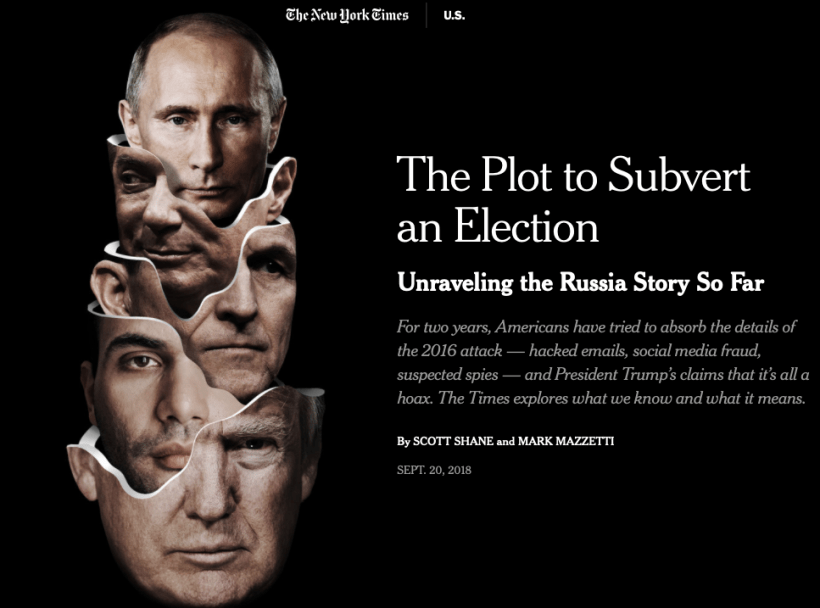
But that turned to be an outrageously deceptive claim, because Shane and Mazzetti failed to mention the fact that those 80,000 IRA posts (from early 2015 through 2017), had been engulfed in a vast ocean of more than 33 trillion Facebook posts in people’s news feeds – 413 million times more than the IRA posts.
In December 2019, senior national security correspondent David Sanger wrote a story headlined, “Russia Targeted Election Systems in All 50 States, Report Finds,” and Sanger’s lede said the Senate Intelligence Committee had “concluded” that all 50 states had been targeted. But the Committee report actually reaches no such conclusion. It quoted President Barack Obama’s cyber-security adviser Michael Daniel as recalling that he had “personally” reached that conclusion, but shows the only basis for his conclusion was remarkably lame: the “randomness of the attempts” and his conviction that Russian intelligence was “thorough.”
The Committee reported that some intelligence “developed” in 2018 had “bolstered” the subjective judgment by Daniel. But all but one of the eight paragraphs in the report describing that intelligence were redacted, and the one unredacted paragraph suggests that the redacted paragraphs provided no conclusive evidence that Russian intelligence had scanned any state election websites, much less those of all 50 states. The paragraph said, “However, IP addresses associated with the August 16, 2016 FLASH provided some indicators the activity might be attributable to the Russian government…. [emphasis added].”
The Committee report also contained summary statements from six states that the Department of Homeland Security has continued to include among the 21 states it insists were hacked by the Russians in 2016, denying any cyber threat to their systems. Another 13 states reported only that there was “scanning and probing” by inconclusive IP addresses the FBI and DHS had sent them. Sanger did not report any of those troublesome details.
In January 2020 the Times began its coverage of the theme of Russian interference in the 2020 election with a story headlined, “Chaos is the Point: Russian Hackers and Trolls Grow Stealthier in 2020.” The story, written by Sanger, Matthew Rosenberg and Nicole Perlroth, sought to heighten the existing U.S. climate of paranoia about a Russian attack in regard to the 2020 elections. Once again, however, nothing in the story supports the sinister tone of the headline.
It reported Department of Homeland Security officials’ anxiety about the ransom-ware attacks on 100 American towns, cities and federal offices during 2019, which are clearly criminal operations aimed at large-scale payoffs by cities. The story informed readers that DHS was investigating “whether Russian intelligence was involved in any of the attacks,” on the apparent theory that the criminals were being used by the Russians.
Since those ransom-ware attacks had been going on for years, the obvious question would have been why DHS would have waited until 2020 to reveal that it was investigating Russian involvement. Thus, the only fact underlying the story was the DHS desire to find evidence to support its accusations of Russian election hacking.
Still at it in 2020
The Times continued its advocacy journalism in a Feb. 26 report that U.S. intelligence officials had “warned” in a briefing for the House Intelligence Committee on Feb. 13 that “Russia was interfering in the 2020 campaign to get President Trump elected,” citing five people “familiar with the matter.”
The Times’ team of four writers proceeded to declare, “The Russians have been preparing – and experimenting – for the 2020 election… aware that they needed a new playbook of as-yet undetectable methods, United States officials said.” But instead of reporting actual evidence of any Russian action or decision for action, the Times writers again cited what their sources suspected could be done.
“Some officials,” they wrote, “believe that foreign powers, possibly including Russia, could use ransom-ware attacks…to damage or interfere with voting systems or registration databases.” The Times’ sources thus had no actual intelligence on the question and were merely speculating on what any foreign government might do to disrupt the election.
Three days after that report, moreover, the Times backed away from its previous lede after intelligence sources disputed its claim that Russia was intervening to reelect Trump, suggesting that the briefing officer, Shelby Pierson, had overstated the assessment. Sanger sought to limit the damage with a story labeling the problem one of “dueling narratives” in the intelligence community.
Then Sanger admitted, “It is probably too early for the Russians to begin any significant moves to bolster a specific candidate,” which obviously invalidated the Times’ previous speculation on the subject. But after The Washington Post published a story that the FBI had informed Senator Bernie Sanders that Russia had sought to help his campaign, Sanger quickly returned to the same narrative of Russian interference to advance its favorite candidates.
On the Times’ podcast “The Daily,” Sanger opined that the Russians were now supporting both Trump and Sanders – because Sanders, “like Donald Trump,” has “got a real aversion to interventions around the world.”
The most recent entry in the Times’ campaign to create anxiety about Russian interference in the election focused on race relations. On March 10, the Times headlined its story, “Russia Trying to Stoke U.S. Racial Tension before Elections, Officials Say.” In their lede Julian Barnes and Adam Goldman announced, “The Russian government has stepped up efforts to influence racial tensions in the United States as part of its bid to influence November’s presidential election, including trying to incite violence by white supremacist groups and stoke anger among Afro-Americans, according to seven American officials briefed on recent intelligence.”
But true to the modus operandi used routinely to push the Russian election threat narrative, the writers did not offer a single fact supporting such a story line. They even admitted that the officials who were making the claims provided “few details” about white supremacists and “did not detail how” blacks were being encouraged to use violence.
It turns out, in fact, that U.S. officials have found nothing indicating Russian support for violent white supremacists in America. The only fact that they could cite — based on a single source — was that the FBI is “scrutinizing any ties” between Russian intelligence and Rinaldo Nazzaro, the American founder of a “neo-Nazi group,” who lives with his Russian wife in St. Petersburg, Russia, but owns property in the United States. So, the Times’ single source had nothing but a suspicion for which the FBI was trying to find evidence.
The final touch in the piece was the accusation that RT had “fanned divisions” on race by running a story about a video of New York policemen attacking and detaining a young black man that Barnes and Goldman write “sparked outrage” and had also “posted tweets aimed at stirring white animosity.” But the RT article on the video merely reported accurately that the video depicted unprovoked police brutality and that it had already gone viral. The Times itself had published a much more detailed Associated Press story on the same incident that went into a discussion of the history of police brutality in New York City. By the Times’ own criterion, the AP was doing far more to stoke racial animosity than RT.
The opinion pieces that RT published attacking The New York Times for its coverage of a video at the University of Wisconsin that offended non-whites and for a Times opinion piece critical of the Apu character on “The Simpsons” echoed views on race and culture that most Americans find offensive. The idea that they were part of a Russian plot to generate racial animosity, however, is a very long stretch.
The descent of The New York Times into this unprecedented level of propagandizing for the narrative of Russia’s threat to U.S. democracy is dramatic evidence of a broader problem of abuses by corporate media of their socio-political power. Greater awareness of the dishonesty at the heart of the Times‘ coverage of that issue is a key to leveraging media reform and political change.
Gareth Porter is an independent investigative journalist and historian and winner of the 2012 Gellhorn Prize for Journalism. His latest book, with John Kiriakou, is “The CIA Insider’s Guide to the Iran Crisis: From CIA Coup to the Brink of War.”
Washington Post hypes fake news on coronavirus ‘burial pits’ in Iran
Press TV – March 14, 2020
The Washington Post has turned to publishing fake news about Iran’s response to the coronavirus outbreak, claiming that Iran has dug mass “burial pits” for victims of the disease and was covering the true number of deaths.
As countries across the world grapple with the COVID-19 outbreak, Iran’s struggle to contain the deadly disease has attracted more than usual attention from mainstream outlets in certain countries.
Despite numerous statements from World Health Organization officials praising Iran’s efforts against the outbreak, certain outlets have focused on erringly similar themes regarding Iran; that the country is in chaos, is mishandling the outbreak and that it’s “putting other countries at risk”.
The Washington Post has specifically published a string of exclusively conspiracy-minded and politicized reports about the coronavirus outbreak in Iran.
Its latest reports include headlines such as “Iran’s government is lying its way to a coronavirus catastrophe”, “Iran struggles to contain coronavirus outbreak, putting Middle East countries at risk” and “Coronavirus pummels Iran leadership as data show spread is far worse than reported”.
In its latest article on Iran – titled “Coronavirus burial pits so vast they’re visible from space” – the US daily claims satellite images showed newly-dug “trenches” the size of a “football field” to accommodate bodies of the coronavirus victims.
The satellite images purportedly illustrate a cemetery near Iran’s epicenter city of Qom. The paper proceeds to cite dubious reports and videos circulating over the internet about Iran covering up its coronavirus deaths.
The report concludes that the graves have been dug to “accommodate the rising number of virus victims in Qom”.
Many observers, however, have been quick to point out inconsistencies and flaws in the report, with some highlighting the unprofessional reporting used in the article; using hyped expressions such as “seen from space” to portray a false image of mass graves.
Observers have pointed that the overall length of the purported 100 yards of “burial pits” in the satellite images cannot accommodate more than about 75-100 graves, not significantly higher than the official death toll announced for the city.
Others have presented evidence showing that the vacant graves in the area are not specifically related to the coronavirus outbreak and that long rows of graves had been also dug long before the outbreak.
The dubious report, however, has circulated widely among social media accounts and various foreign-funded anti-Iran outlets, prompting Iranian officials to issue official statements on the matter.
Speaking with the Islamic Republic of Iran Broadcasting (IRIB), executive manager of Qom Municipality’s burial sites Seifoddin Mousavi said the graves had been planned before the outbreak as part of usual procedures in the cemetery.
He stressed that all the operations in the cemetery are taking place according to international protocols regarding burial sites.
On Friday, Kianoush Jahanpour, the head of the public relations and information center of the Iranian Ministry of Health, said that the new coronavirus has claimed 514 lives in the country.
Fourth OPCW whistleblower: Staff ‘frightened into silence’, watchdog brought into ‘shameful disrepute’ over Douma probe
RT | March 13, 2020
A fourth whistleblower has come forward to defend two senior OPCW inspectors who revealed the watchdog tried to cover up evidence in the Douma chemical weapons probe, saying that other employees were “frightened into silence.”
In a statement to the Grayzone, the latest whistleblower said they were “horrified” but “unsurprised” by recent events within the organization, describing the “mistreatment” of “two highly regarded and accomplished professionals” as “abhorrent.”
The employee wrote that he is “one of many who were stunned and frightened into silence by the reality how the organization operates,” and that the “threat of personal harm” to those who speak out is “not an illusion.”
The fourth whistleblower emerged after the OPCW leadership attempted to smear and discredit veteran inspector Ian Henderson and an individual known as ‘Alex’ who challenged the organization’s narrative on the alleged Syrian government attack on Douma in 2018. A third whistleblower has also previously defended the integrity of the first two who spoke out and expressed concern for the safety and security of those who dissent from the official narrative.
The Grayzone said it had independently verified the identity of the fourth whistleblower and their position at the OPCW, but granted them anonymity “to protect them from potential retaliation.”
Last week, Henderson and ‘Alex’ both wrote to OPCW Director-General Fernando Arias, accusing the organization of trying to “smear” their reputations and questioning why two top inspectors with “impeccable records” would suddenly “go rogue.” The letters followed an effort by the chemical weapons watchdog to discredit them, rubbish their serious concerns, and frame them merely as two disgruntled former employees.
“I fully support their endeavors, in that it is for the greater good and not for personal gain or in the name of any political agenda,” the fourth whistleblower wrote, adding that the inspectors are “trying to protect the integrity of the organization which has been hijacked and brought into shameful disrepute.”
After a detailed study, Henderson, who led the probe on the ground in Douma, concluded that gas cylinders found at the scene had likely been manually placed, which suggests the attack may have been a false flag staged by anti-government militants. The incident, however, was swiftly used to justify US, UK and French airstrikes on Syria before OPCW investigators had even arrived at the scene.
Yet, the OPCW disregarded Henderson’s evidence without explanation and in its official report implied that the gas cylinders were dropped by Syrian military planes – allegedly after “unacceptable pressure” was applied by the US government.
Must… have… oil…
Climate Discussion Nexus | March 11, 2020
The implosion of investment in Canadian energy, most recently the cancellation of the Teck Frontier oilsands mine and Warren Buffett bailing on Quebec’s giant Énergie Saguenay LNG plant, brings home that if all this airy talk of transitioning away from fossil fuels actually lands, it will land on us very hard. (Mind you poor shy Canada finally got the world’s attention, if it’s any consolation.) As Anjli Raval warns in a major piece in The Financial Times, other countries are expanding their capacity as we crush ours because “The world runs on oil.” It accounts for 34% of world energy consumption, followed by its hydrocarbon cousins coal (27%) and natural gas (24%). But, as climate activists are often reminded in vain about their own lifestyles and protest accessories, “the fossil fuel has also quietly seeped into other aspects of our lives: from paint, washing detergents and nail polish to plastic packaging, medical equipment, mattress foams, clothing and coatings for television screens. Last year, global demand reached a record 100 million barrels a day”. And in Canada we’re part of the demand. Just increasingly not the supply.
Raval’s piece is not triumphal. Far from it. She says oil is bad. Bad bad bad. “Even as our thirst for oil seems insatiable, it is becoming politically and environmentally toxic. As the world wakes up to the catastrophic impact of climate change, from rising sea levels and drought to wildfires and crop failure, scientists have warned of a need to rapidly shift away from fossil fuels. Yet when it comes to oil demand, there is little sign of this happening. Our usage has jumped 62 per cent over the course of a few decades — up from 61.6 million b/d in 1986.” Almost as if we didn’t believe all that talk we keep… emitting.
Raval says “How the world can provide abundant energy supplies while dramatically reducing emissions has become one of the defining issues of our time. The challenge is huge. In order to keep global warming ‘well below’ a 2 C increase, the IEA says the world would need to stomach a fall in oil consumption to 67 million b/d by 2040. Environment analysts argue that we need to learn to survive on far lower levels — about 10 million b/d — and ultimately remove it from our energy system entirely.” Ah. Analysts. Cousins of experts.
If the challenge is huge, the response is not. She notes that “Governments are beginning to take some action, from incentivizing the purchase of low emissions vehicles to funding cleaner energy research.” But doing actual stuff that might matter is a lot harder because, wait for it, oil is vital. “While coal and gas are starting to be displaced by lower-cost renewables in electricity generation, oil has a stranglehold over the transport sector, and the petrochemicals industry is a fast-growing consumer of refined products. Aside from the commercial interests of oil-producer nations and corporations, there is a practical question: How will the world function without a material on which we depend so deeply?… Throughout history, energy has been at the heart of how civilizations have prospered.”
In keeping with the realism of half of the piece, she’s very clear that crude oil did wonders to advance prosperity, a sentiment with which we entirely agree. Then she goes unreal: “Yet humanity’s improved well-being has come at the expense of the planet’s. The earth has warmed by 1 C since pre-industrial times and is likely to heat up by another 2 C by the turn of the century — overshooting the targets of the 2015 Paris climate agreement.”
If so, what happens? Well, we all might sort of die. “A 2018 UN Intergovernmental Panel on Climate Change report showed warming beyond 1.5 C risked irreversible changes — from the mass extinction of species to extreme weather and ecosystem changes that threaten global stability.” Scary yet vague. We’re not quite ready to open the sixth seal. But we still commend the piece because it is quite realistic about the situation if not the future.
“Even after the world began moving from coal to other fuels, coal did not disappear. With the emergence of each new source, we have simply added it to the mix rather than replace old ones.” And she quotes Greta Thunberg (who else?) on the urgency of getting not to “net” zero but “real zero”. (Sort of like Canada’s energy industry the way things are going.) But Raval warns, “Cars, trucks and other road vehicles make up more than 40 per cent of global oil usage. When you add in aircraft, ships and trains, transport accounts for about 60 per cent. So any attempt to reduce our oil habit hinges on this sector.” Buildings and industry are also big, so pretty much the stuff that we do that makes us warm, fed and happy or at least entertained. So maybe we can go for “offsets such as planting trees.” It’s gonna take quite a few.
Next Raval makes a daffy claim indeed. She quotes “Jason Bordoff, who heads the Centre on Global Energy Policy at Columbia University” that “Ultimately, the world has to make value judgments about what temperature target it wants to hit.” Value judgements?
To hear the great and good tell it, we already did. We know what temperature target we want to hit. And we’re also arrogant enough to think we don’t just know the ideal temperature (for some reason it’s what we had in 1950, not 1850 or 1150), we also know how to hit it. Except for the tricky bit where we risk turning First World countries into Third World countries and kill vast numbers in Third World countries gone Fourth World by shutting off their path out of poverty because otherwise bad things will happen.
No really. Raval says “The world’s addiction to oil is often compared with tobacco. But while smoking is something people can choose to do, using energy is not…. Yet the cost of climate change could be far greater — and the world is running out of time.”
The piece does at least make plain just how high the cost of giving up oil would be in theory unless and until we find something better. Meanwhile in Canada we’re toying with demonstrating it in practice.
Guardian uses misleading data to imply COVID worse than Spanish Flu
By Catte Black | OffGuardian | March 11, 2020
The curious downgrading of the 1918 Spanish Flu case fatality rate, which I looked into March 9, has taken an interesting new turn today, with the Guardian publishing this piece, by science journalist Laura Spinney
Closed borders and ‘black weddings’: what the 1918 flu teaches us about coronavirus
which uses this anomalous lower figure (2.5%) to imply that COVID19 may prove more dangerous than the Spanish Flu:
Last week the WHO provisionally quoted a CFR of 3.4% [for COVID19], which would be alarming if it were correct. The CFR of the 1918 flu is still being debated… but the number usually quoted is 2.5%…
Elsewhere, however she also describes the 1918 Spanish Flu as:
That global human catastrophe, which killed between 50 million and 100 million people…
This is curious for a couple of reasons:
- Because the Spanish Flu CFR ‘number usually quoted’ is NOT 2.5% It’s 10-20%. Or 50-100 million deaths from 500 million cases.
- Because Spinney herself has pointed out in her book, Pale Rider:the Spanish Flu of 1918 & How it Changed the World, that this lower CFR (2.5%) is irreconcilable with the commonly accepted numbers of dead:

Indeed, as I showed in my previous article, those two figures – a death-rate of 50-100 million and a CFR of 2.5% can’t co-exist. They are mutually exclusive. For 50 million to be 2.5% of all cases there would have to have been 2 billion cases. If 100 million is 2.5% of all cases then there would have to have been 4 billion cases. Even the lower figure is greater than the entire population of the world at that time. It’s an obvious error.
But how did it come about? And why is this anomalous 2.5% figure seeing a resurgence of use in very recent days?
A recent Twitter thread by Ferres Jabr, a science writer for the NYT magazine, does a lot to expose how the two twisted and irreconcilable stats – 50-100 million dead and a CFR of 2.5% originally came about. I urge you all to read this entire thing, it’s excellent (the thread is also available in PDF form here, just in case it gets memory holed):
To sum up its findings. The number of Spanish Flu cases worldwide has long been estimated at around 500 million, and this estimate has not changed. However the number of estimated deaths has changed quite dramatically in recent times, and this is the source of the error.
Back in the 1970s the total number of deaths was estimated at around 20 million, due to a failure to assimilate many cases from the non-Western world. The CFR of 2.5% it estimated was a little low but broadly inline with its other figure.
But in 2002 a new study corrected the lacuna in non-Western cases and produced the estimate of worldwide deaths we are familiar with now – 50-100 million. This meant the CFR was no longer 2.5% but now 10-20% of total estimated cases.
Then a later study, from 2006, used these updated fatality figures, but omitted to update the CFR, citing it as still 2.5%. Which meant it was offering the impossible and contradictory number recently adopted by Wikipedia.
Obviously this was a simple error, and it has been pointed out several times in the intervening years (see for example here). But, as the recently ‘corrected’ Wikipedia article shows, it’s proving a very fortuitous error right now for those wanting to instil very high amounts of public fear.
Pretty obviously this innocent error is being exploited as part of a very cynical bid by some entities, including the Wikipedia editors, to make the current coronavirus scare seem, well, scarier. The 1918 flu pandemic is embedded in the collective mind as an exemplar of a terrifying outbreak. If the stats can be manipulated to allow people to claim its CFR was actually lower than COVID19 – well that’s some valuable fear porn for use in articles and headlines, and by sock puppets BTL trying to create memes.
To that end, the current confusion is a bit of a Godsend.
Spinney’s article illustrates this very well. Spinney is well aware of the ‘2.5% anomaly’ as she herself has drawn attention to it, but no reference to it appears anywhere in this piece. And, while her article stops short of actually claiming COVID19 is going to be bigger than the Spanish Flu, the opening paras – which will be the most read of course – certainly leave that possibility more than open, where they directly compare the alleged CFR of the current coronavirus (3.4%) with the 2.5% figure for Spanish Flu – which she knows to be erroneous.
This is cynically providing a nice easy and totally misleading quote for anyone who wants to claim COVID19 is measurably more dangerous than the Spanish Flu, while stopping short of actually making the claim.
Spinney ought, at very least, to have added her own rider from her own book to this Guardian article, and made it perfectly clear that the ‘commonly accepted’ Spanish Flu CFR of 2.5% is not just wrong, but impossible.
The fact she chose not to, or was possibly deterred from doing so by her editor, is not just revealing of agenda, it’s actually shameful and irresponsible to a very high degree.
The UK government has asked people to report any sources of misleading information on COVID19. This Guardian article is clearly one such, but I highly doubt it is the kind of ‘misinformation’ they want to be apprised of.
How the UK press supports the British military and intelligence establishment
By Mark Curtis | Declassified UK | March 11, 2020
Britain’s national press is acting largely as a platform for the views of the UK military and intelligence establishment, new statistical research by Declassified UK shows.
The UK press, from The Times to The Guardian, is also routinely helping to demonise states identified by the British government as enemies, while tending to whitewash those seen as allies.
The research, which analyses the UK national print media, suggests that the public is being bombarded by views and selective information supporting the priorities of policy-makers. The media is found to be routinely misinforming the public and acting far from independently.
This is the second part of a two-part analysis of UK national press coverage of British foreign policy.
Elite platform
Numerous stories or points of information on Britain’s intelligence agencies, such as MI6 and GCHQ, are being fed to journalists by anonymous “security sources” – often military or intelligence officials who do not want to be named.
The term “security sources” has been mentioned in 1,020 press articles in the past three years alone, close to one a day. While not all of these relate to UK sources, it indicates the common use of this method by British journalists.
Declassified’s recent research found that officials in the UK military and intelligence establishment had been sources for at least 34 major national media stories that cast Labour leader Jeremy Corbyn as a danger to British security. The research also found 440 articles in the UK press from September 2015 until December 2019 specifically mentioning Corbyn as a “threat to national security”.
Anonymous sources easily push out messages supportive of government policy and often include misleading or unverifiable information with no come-back from journalists. The Ministry of Defence (MOD) says it has 89 “media relations and communications” officers.
Many journalists regularly present the views of the MOD or security services to the public with few or no filters or challenges, merely amplifying what their sources tell them. In “exclusive” interviews with MI6 or MI5, for example, journalists invariably allow the security services to promote their views without serious, or any, scepticism for their claims or relevant context.
That the UK intelligence services are regularly presented as politically neutral actors and the bearers of objective information is exemplified in headlines such as “MI6 lays bare the growing Russian threat” (in the Times) and “Russia and Assad regime ‘creating a new generation of terrorists who will be threat to us all’, MI6 warns” (in the Independent).
Press coverage of the RAF’s 100th “birthday” in 2018 produced no critical articles that could be found, with most being stories from the MOD presented as news. This is despite episodes in the RAF’s history such as the bombing of civilians in colonial campaigns in the Middle East in the 1920s, 1930s and 1950s and its prominent current role in supporting Saudi airstrikes in Yemen, which has helped create the world’s biggest humanitarian disaster.
Similarly, for GCHQ’s 100th anniversary in 2019, the press appeared to simply write up information provided by the organisation. Only the occasional article mentioned GCHQ’s role in operating programmes of mass surveillance while its covert online action programmes and secret spy bases in at least one repressive Middle East regime were ignored by every paper at the time, as far as could be found.
The national press are generally strong supporters of the security services and the military. A number of outlets, from the Times and Telegraph to the Mirror, are strongly opposed to government cuts in parts of the military budget, for example.
The British army’s main special forces unit, the SAS, which is currently involved in seven covert wars, is invariably seen positively in the national press. A search reveals 384 mentions of the term “SAS hero” in the UK national press in the past five years – mainly in the Sun, but also in the Times, Express, Mail, Telegraph and others.
Critical articles on the special forces are rare, and the journalists writing them can face a backlash from other reporters.
In some press articles, MOD media releases are largely copied and pasted. For example, recent MOD material on RAF Typhoons in Eastern Europe scrambling to intercept Russian aircraft has often been repeated word for word across the media.
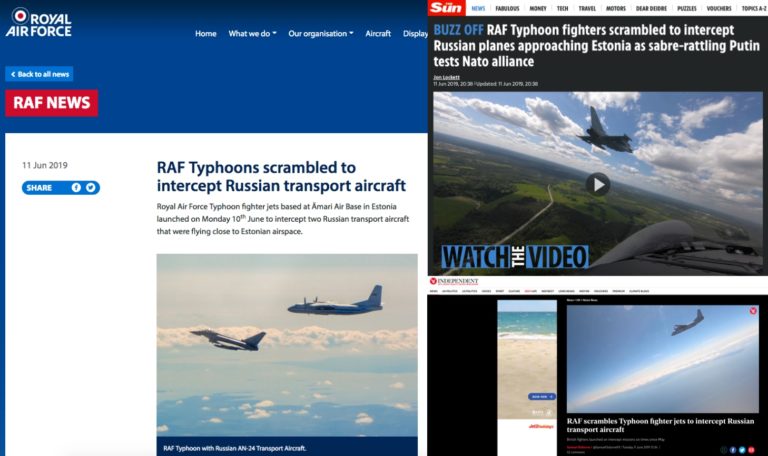
A press release from the UK’s Royal Air Force, and how it was covered by two British newspapers, The Sun and The Independent.
Such “embedded journalism” poses a significant threat to the public interest. Richard Norton-Taylor, formerly the Guardian’s security correspondent for over 40 years, told Declassified : “Embedded journalists — those invited to join British military units in conflict zones — are at the mercy of their MOD handlers at the best of times. Journalists covering defence, security and intelligence are far too deferential and indulge far too much in self-censorship”.
Some papers are more extreme than others in their willingness to act as platforms for the military and intelligence establishment. The Express may well be the most supportive: its coverage of MOD stories and vilification of official enemies, notably Russia, is remarkable and consistent.
The Guardian, however, has also been shown to play a similar role. Declassified’s recent analysis, drawing on newly released documents and evidence from former and current Guardian journalists, found that the paper has been successfully targeted by security agencies to neutralise its adversarial reporting of the “security state”.
Censorship by omission
Articles critical of the Ministry of Defence or security services are occasionally published in the press. However, these tend to be either on relatively minor issues or are reported on briefly and then forgotten. Rarely do seriously critical stories receive sustained coverage or are widely picked up across the rest of the media.
Often, reporters will cover a topic and elide the most important information for no clear reason. For example, there is considerable coverage of possible MI5 failures to prevent the May 2017 Manchester terrorist bombing — failings which may be understandable given the large number of terrorist suspects being monitored at any one time.
However, the government admitted in parliament in March 2018 that it “likely” had contacts with two militant groups in the 2011 war in Libya for which the Manchester bomber and his father reportedly fought at the time, one of which groups the UK had covertly supported in the past. This significant admission in parliament has not been reported in any press article, as far as can be found.
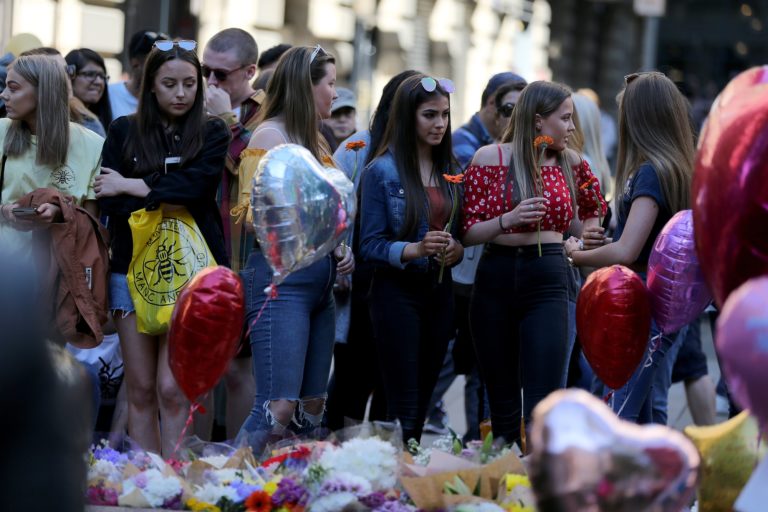
People lay flowers in St Annes Square on the first anniversary of the Manchester Arena bombing in Manchester, Britain, 22 May 2018. (Photo: EPA-EFE / Nigel Roddis)
Last September, veteran investigative journalist Ian Cobain broke a story on the alternative news site Middle East Eye revealing that the senior Twitter executive with editorial responsibility for the Middle East is also a part-time officer in the British army’s psychological warfare unit, the so-called 77th Brigade.
This story was picked up by a few media outlets at the time (including the Financial Times, the Times and the Independent ) but our research finds that it then went unmentioned in the hundreds of press articles subsequently covering Twitter.
Similarly, in November 2018, a story broke on a secretive UK government-financed programme called the Integrity Initiative, which is ostensibly a “counter disinformation” programme to challenge Russian information operations but was also revealed to be tweeting messages attacking Labour leader Jeremy Corbyn.
Our research finds that in the 14 months until December 2019, the Integrity Initiative was mentioned less than 20 times in the UK-wide national press, mainly in the Times (it was also mentioned 15 times in the Scottish paper, the Sunday Mail ).
By contrast, when stories break that are useful to the British establishment, they tend to receive sustained media coverage.
Establishment think tanks
The British press routinely chooses to rely on sources in think tanks that largely share the same pro-military and pro-intervention agenda as the state.
The two most widely-cited military-related think tanks in the UK are the London-based Royal United Services Institute (RUSI) and the International Institute for Strategic Studies (IISS) which are usually quoted as independent voices or experts. In the last five years, RUSI has appeared in 534 press articles and IISS in 120.
However, both are funded by governments and corporations. RUSI, which is located next door to the Ministry of Defence in Whitehall, has funders such as BAE Systems, the Qatar government, the Foreign Office and the US State Department. IISS’s chief financial backers include BAE Systems, Raytheon, Lockheed Martin and Airbus.
This funding is mentioned in only two press reports that could be found – the Guardian reported that IISS received money from the regime in Bahrain while the Times once noted, “RUSI, while funded in part by the MoD, is an independent think tank”.
One Telegraph article refers to a “research fellow at RUSI who specialises in combat airpower”, without mentioning that its funder BAE Systems is a major producer of warplanes.
Although many senior figures in these organisations previously worked in government, press readers are rarely informed of this. RUSI’s chair is former foreign secretary William Hague, its vice-chair is former MI6 director Sir John Scarlett and its senior vice-president is David Petraeus, former CIA director.
The IISS’s deputy secretary-general is a former senior official at the US State Department while its Middle East director is a former Lieutenant-General in the British army who served as defence senior adviser to the Middle East. One of IISS’ senior advisers is Nigel Inkster, a former senior MI6 officer.
Media and intelligence
Richard Keeble, professor of journalism at the University of Lincoln, has noted that the influence of the intelligence services on the media may be “enormous” and the British secret service may even control large parts of the press. “Most tabloid newspapers – or even newspapers in general – are playthings of MI5”, says Roy Greenslade, a former editor of the Daily Mirror who has also worked as media specialist for both the Telegraph and the Guardian.
David Leigh, former investigations editor of the Guardian, has written that reporters are routinely approached and manipulated by intelligence agents, who operate in three ways: they attempt to recruit journalists to spy on other people or go themselves under journalistic “cover”, they pose as journalists in order to write tendentious articles under false names, and they plant stories on willing journalists, who disguise their origin from their readers — known as black propaganda.
MI6 managed a psychological warfare operation in the run-up to the Iraq war of 2003 that was revealed by former UN arms inspector Scott Ritter. Known as Operation Mass Appeal, this operation “served as a focal point for passing MI6 intelligence on Iraq to the media, both in the UK and around the world. The goal was to help shape public opinion about Iraq and the threat posed by WMD [weapons of mass destruction]”.
Various fabricated reports were written up in the media in the run-up to the Iraq war, based on intelligence sources. These included cargo ships said to be carrying Iraqi weapons of mass destruction (covered in the Independent and Guardian ) and claims that Saddam Hussein killed his missile chief to thwart a UN team (Sunday Telegraph ).
More recent examples of apparently fabricated stories in the establishment media include Guardian articles on the subject of Julian Assange. The paper claimed in a front page splash written by Luke Harding and Dan Collyns in November 2018 that former Trump campaign manager Paul Manafort secretly met Assange in the Ecuadorian embassy three times.
The Guardian also falsely reported on a “Russia escape plot” to enable Assange to leave the embassy for which the paper later gave a partial apology. Both stories appeared to be part of a months-long campaign by the Guardian against Assange.
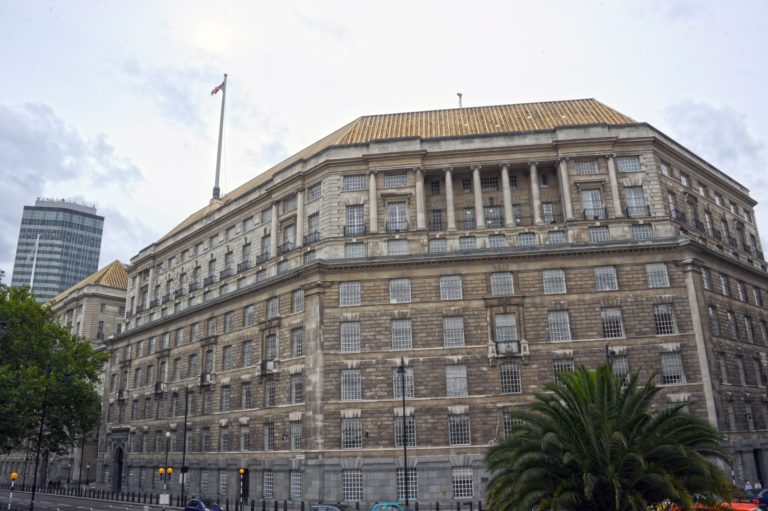
The exterior view of Thames House, MI5 Headquarters, in Millbank, on the bank of the River Thames, London, Britain. (Photo: EPA-EFE/ Horacio Villalobos)
Demonising enemies
The media plays a consistent role in following the state’s demonisation of official enemies. The term “Russian threat” is mentioned in 401 articles in the past five years, across the national press. The Express may be the largest press amplifier of the government’s demonisation of Russia — the paper carries a steady stream of stories critical of Russia and Putin.
The British establishment has invoked Russia as an enemy in recent years due mainly to the poisonings in the town of Salisbury and policy in eastern Europe. Whatever malign policies Russia is promoting, which can be real, false or exaggerated, it is noteworthy that this has been elevated by the press to a general “threat” to the UK. As during the cold war, this is useful to the British military and security services arguing for larger budgets and for offensive military postures in Eastern Europe and the Middle East.
Russia’s alleged interference in British politics has received huge coverage compared to alleged Israeli influence. A simple comparison of search terms using “Russia/Israel and UK and interference” in press articles in the past five years yields seven times more mentions of Russia than Israel, despite considerable evidence of Israeli interference.
UK press reporting on Iran is also noticeably supportive of government policy. A search for “Iran and nuclear weapons programme” reveals 325 articles in the past five years. While this large coverage is driven by president Trump’s withdrawal from the Iran nuclear deal, it is also driven by Iran being a designated enemy of the US and UK, which have deemed it unacceptable that Tehran should ever acquire nuclear weapons.
By contrast, “Israel’s nuclear weapons” (and variants of this search term) are mentioned in under 30 press articles in the past five years. Natanz, Iran’s main nuclear arms facility, has been mentioned in around four times more press articles than Dimona, the Israeli nuclear site, in the past five years.
The contrast in reporting on Iran and Israel is striking since Iran does not possess nuclear weapons, and it is not certain that it seeks to, whereas Western ally Israel already has such weapons, estimated at around 80 warheads.
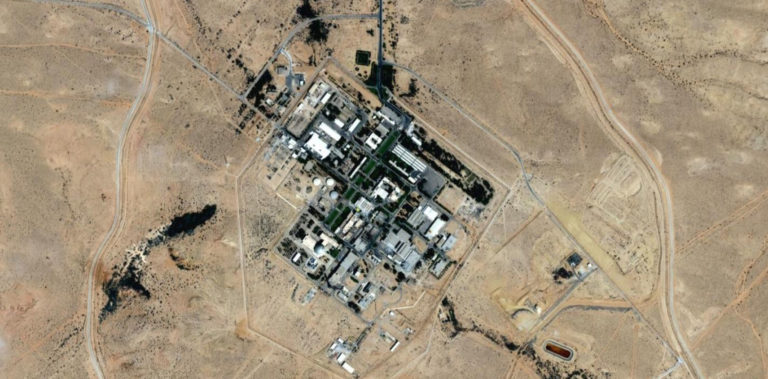
An aerial view of Israel’s nuclear site at Dimona. (Google Maps)
Labelling goodies and baddies
The national press strongly follows the government in labelling states as enemies or allies.
States favoured by the UK are mainly described in the press using the neutral term “government” rather the more critical term “regime”. In the past three years, for example, the term “Saudi government” has been used in 790 articles while “Saudi regime” is mentioned in 388. However, with Iran the number of instances is reversed: “Iranian government” is used in 419 articles whereas “Iranian regime” is mentioned in 456.
The same holds for other allies. The “Egyptian regime” receives 24 mentions while “Egyptian government” has 222, in the past three years. The “Bahraini regime” is mentioned in 10 articles while “Bahraini government” is mentioned in 60.
The precise term “Iranian-backed Houthi rebels”, referring to the war in Yemen, is mentioned in 198 articles in the last five years. However, the equivalent term for the UK backing the Saudis in Yemen (using search terms such as “UK-backed Saudis” or “British-backed Saudis”) appears in just three articles.
The pattern is also that the crimes of official enemies are covered extensively in the national press but those of the UK and its allies much less so, if at all.
Articles mentioning “war crimes and Syria” number 1,527 in the past five years compared to 495 covering “war crimes and Yemen”. While the press often reports that the Syrian government has carried out war crimes, most articles simply suggest or allege war crimes by the Saudis in Yemen.
Indeed, the UK press has been much more interested in covering the Syrian war—chiefly prosecuted by the UK’s opponents—than the Yemen war, where Britain has played a sustained widespread role. As a basic indicator, the specific term “war in Syria” is mentioned in well over double the number of articles as “war in Yemen” in the past five years.
Furthermore, government enemies are regularly described in the press as supporters of terrorism, which rarely applies to allies.
In the past three years 185 articles mention the term “sponsor of terrorism”, most referring to Iran, followed by Sudan and North Korea with the occasional mention of Libya and Pakistan. None specifically label UK allies Turkey or Saudi “sponsors of terrorism”, despite evidence of this in Syria and elsewhere, and none describe Britain or the US as such.
Some 102 articles in the past five years specifically mention Russia’s “occupation of Crimea”. However, despite some critical articles on UK policy towards the Chagos Islands in the Indian ocean—which were depopulated by the UK in the 1970s and which the US now uses as a military base—only two articles specifically mention the UK’s “occupation of Chagos” (or variants of this term).
Similar labelling prevails on opposition forces in foreign countries. Protesters in Hong Kong are routinely called “pro-democracy” by the press – the term has been mentioned in hundreds of articles in the past two years. However, protesters in UK allies Bahrain and Egypt have been referred to as “pro-democracy” in only a handful of cases, the research finds.
The special relationship
While demonising enemies, UK allies are regularly presented favourably in the press. This is especially true of the US, the UK’s key special relationship on which much of its global power rests. US foreign policy is routinely presented as promoting the same noble objectives as the UK and the press follows the US government line on many foreign policy issues.
The term “leader of the free world” to refer to the US has been used in over 1,500 articles in the past five years, invariably taken seriously across the media, without challenge or ridicule.
The view that the US promotes democracy is widely repeated across the press. A 2018 editorial in the Financial Times, written by its chief foreign affairs commentator Gideon Rachman, notes that, “Leading figures in both [US political] parties — from John Kennedy to Ronald Reagan through to the Bushes and Clintons — agreed that it was in US interests to promote free-trade and democracy around the world”. In 2017 Daniel McCarthy wrote in the Telegraph of “two decades of idealism in US foreign policy, of attempts to spread liberalism and democracy”.
It is equally common for the UK press to quote US figures on their supposed noble aims, without challenge. For example, the Sunday Times recently cited without comment the US state department saying “Promoting freedom, democracy and transparency and the protection of human rights are central to US foreign policy”.
The press often strongly criticises President Donald Trump, but often for betraying otherwise benign US values and policies that it assumes previous presidents have promoted. For example, Tom Leonard in the Daily Mail writes of “Mr Trump’s belief that US foreign policy should be guided by cold self-interest rather than protecting democracy and human rights”.
The Guardian is especially supportive of US foreign policy. A sub-heading to a recent article notes: “The US once led Western states’ support of democracy around the world, but under this president [Trump] that feels like a long time ago”. One of its main foreign affairs columnists, Simon Tisdall, recently wrote that the US fundamental “mission” was an “exemplary global vision of democracy, prosperity and freedom”, albeit one which has been distorted by the war on terror.
The Guardian regularly heaped praise on president Obama. An editorial in January 2017 commented that Obama was a “successful US leader” and that “internationally” his vision “could hardly be faulted for lack of ambition”. It also noted Obama’s “liberalism and ethics” and that: “Mr Obama has governed impeccably for eight years without any ethical scandal”.
Although the article noted US wars and civilian casualties in Yemen and Libya, the paper brushed these off, stating “But to ascribe the world’s tragedies to a single leader’s choices can be simplistic. The global superpower cannot control local dynamics”.
Research covered the period to the end of 2019 using the media search tool, Factiva. It analysed the “mainstream” UK-wide print media (dailies and Sundays) over different time scales, usually two or five years, as specified in the article. Media search engines cannot be guaranteed to work perfectly so additional research was sometimes undertaken.
Mark Curtis is the co-founder and editor of Declassified UK, an historian and author of five books on UK foreign policy. He tweets at: @markcurtis30.
Greece’s Migrant Crisis Has Further Exposed Turkish Fake News
By Paul Antonopoulos | March 10, 2020
Turkish President Recep Tayyip Erdoğan’s attempt to intimidate the Syrian Army and force them to withdraw to the Sochi Agreement lines in Idlib utterly failed, resulting in the Turkish leader having to embarrassingly accept large swathes of liberated territory will remain under Syrian sovereignty despite his attempts to occupy it. This was especially embarrassing as Erdoğan’s end of February ultimatum came and went with no grand Turkish military offensive to push back the Syrian Army as he had promised. This embarrassment comes as Erdoğan’s approval has reached as low as 41.1% according to data published by the Ankara-based pollster MetroPoll last Friday. As Erdoğan’s foreign policy is largely driven by a desire for a neo-Ottoman ambitions and to serve as a distraction from Turkey’s currency nosedive, he was quick to create issues against the “Old Enemy,” Greece.
In a tantrum and frustrated that his power projections of aggression against both Libya and Syria failed, Erdoğan unleashed tens of thousands of illegal immigrants against Greece and utilized English-speaking Turkish media to discredit the Balkan country’s border protection units for human rights violations. Although many commentators claim that Erdoğan’s unleashing of illegal immigrants is an attack against the European Union (EU), we cannot ignore that the second and only other EU state that Turkey borders is Bulgaria, a country that Ankara assured would not send illegal migrants to, a promise that has not yet been broken. Erdoğan is not only punishing Greece for vetoing a NATO communique in support of Turkish operations in Idlib, he is pushing ahead with his imperial ambitions to not only steal Syrian territory, but Greece’s eastern island and northern mainland territories, as outlined on published government-funded maps of “Greater Turkey.”

Erdoğan wasted no time after the Idlib ceasefire deal was made with Russian President Vladimir Putin on Thursday after the latter embarrassed the Turkish leader by meeting him in a room with a statue of Catherine the Great, the liberator of Crimea who defeated the Ottoman Empire in many wars. On the very same day as meeting, Erdoğan announced that Turkey will deploy 1000 special forces police to the Greek border to fight back against Greek security forces who have successfully ensured that thousands of illegal immigrants have not entered EU territory. It’s an odd choice that Turkey deployed special forces police considering it is not their borders that have breach attempts and rather it has been an aggressor as they continually shoot tear gas at Greek border security and attempt to pull down the border fence so migrants can illegally enter Greece. Although it may seem like an exaggeration to some, Athens is treating this latest migrant crisis as a Turkish asymmetric invasion, as they remember the words of former Turkish President Turgut Özal, who said “We do not need to make war with Greece. We just need to send them a few million immigrants and finish with them.”
To assist in distracting the Turkish population of his failures in Syria and the economy, Erdoğan has fully utilized Turkish media to assist in the propaganda campaign. Turkey is one of the lowest ranked countries for media freedoms in the world, is the second most susceptible country surveyed on the European continent to fake news, has the most journalists jailed in the whole world, and 90% of media is government controlled. It is fair to be sceptical of Turkey and its coverage of the latest migrant crisis, and here is why.
On Saturday, Bosnian Muslim reporter Semir Sejfovic of Turkish state-owned TRT World made such a comical performance that Twitter users are mocking him to be an Oscar nominee after his elaborate attempts to accuse Greek police of firing live ammunition into Turkey. It is one comical performance that has to be seen to be believed. The ridiculousness of the performance was so much so that several screen grabs show even the illegal immigrants surrounding Sejfovic laughing during the “intense firing” of live ammunition by the Greek police. Other users questioned why illegal immigrants much closer to the border fence and seen in the background of the video never took cover and continued standing as usual during the alleged shooting, something Sejfovic has refused to answer.
In another incident on Saturday, TRT World published photos claiming Greek soldiers stripped and robbed illegal immigrants of their clothes, mobiles and money. The problem? In other photos not published by TRT World, the same illegal immigrants are seen in front of a camera phone preparing to take the propaganda photos, while in another photo a mobile phone is clearly seen inside the pocket of a “robbed” illegal immigrant.
In another incident on Sunday, TRT World made a tweet on Sunday publishing photos of immigrants in hospital wounded “when Greek forces opened fire” over the weekend. However, a quick search found that the fourth photo is from at least November 2019.
These are just some of the many allegations made by English-speaking Turkish media that have been debunked. It demonstrates that Turkish media is not interested in objectively reporting the migrant crisis but is serving a critical role as Erdoğan’s propaganda wing to discredit Greece in front of international audiences. However, if we use social media responses, European responses and other media republications of Turkish media claims as indicators, it all points that TRT World has only served to reinforce Turkish media’s bad reputation rather than discredit Greek border security and catastrophically failed in their objective.
Paul Antonopoulos is a Research Fellow at the Center for Syncretic Studies.
Trump campaign sues Washington Post for ‘millions of dollars’ over ‘false and defamatory’ statements on ‘Russia collusion’
RT | March 3, 2020
Donald Trump’s 2020 campaign has reportedly filed a libel suit against the Washington Post for “millions of dollars,” accusing the newspaper of publishing “false and defamatory” statements about alleged collusion with Russia.
The lawsuit, which was filed in the US District Court in Washington, DC on Tuesday, highlights two articles published by the Post in 2019 linking Trump’s team to alleged foreign interference in the 2016 election, Fox News reported.
The complaint, which was seen by the news outlet, alleges that the Post was “well aware” that the statements were false but published them anyway for the “intentional purpose” of hurting Trump’s campaign. The articles were part of the newspaper’s “systematic pattern of bias” against Trump, it said.
One of the articles, published on June 13, stated that Special Counsel Robert Mueller’s extensive investigation into alleged collusion concluded that Trump’s campaign “tried to conspire with” a “sweeping and systematic” attack by Russia during the 2016 election.
Trump’s team noted that Mueller’s report in fact “concluded there was no conspiracy” between then-candidate Trump’s campaign and Russia – and that no US person intentionally coordinated with any alleged Russian effort to interfere with the 2016 election.
The second article, published on June 20, suggested Trump had “invited” both Russia and North Korea to “offer their assistance” to his campaign. This was also described as “false and defamatory” since there “has never been any statement” by anyone associated with Trump’s campaign inviting the two countries to interfere or assist.
The lawsuit also says there is “an extensive record” of statements from Trump’s campaign and the White House disavowing any notion of Russian assistance and “not a shred of evidence” that there were contacts between the campaign and North Korea.
Trump’s campaign said the lawsuit had been filed in order to “publicly establish the truth” and “properly inform” readers, as well as to seek “appropriate remedies for the harm caused.” The complaint says Trump’s campaign was damaged “in the millions of dollars” – the exact amount to be determined in court.
The suit against the Post comes on the heels of a similar lawsuit filed by Trump’s campaign against the New York Times last week in relation to a 2019 op-ed, which it said contained similarly false statements intended to influence the 2020 presidential election.
Featured Video

Theodore Postol: Iran’s Missiles & Drones Were Underestimated
or go to
Aletho News Archives – Video-Images
From the Archives
Wars for Israel: A reminder of who’s giving the marching orders
By Damian Lataan | February 7, 2012
As the West prepares to march off to yet another war in the Middle East, we should perhaps remind ourselves of who is giving the West their marching orders.
In February 2003, just weeks before the US and their allies launched their attack on Iraq and her peoples, a delegation of US congressmen, together with the US Ambassador to the United Nations, John Bolton, a well known pro-Zionist and neoconservative war-hawk, were in Israel at the invitation of the Israeli government then led by Israeli Prime Minister Ariel Sharon.
Addressing the congressmen, Sharon told them ‘that Iran, Libya and Syria should be stripped of weapons of mass destruction after Iraq’. Later, Sharon told John Bolton ‘that Israel was concerned about the security threat posed by Iran, and stressed that it was important to deal with Iran even while American attention was focused on Iraq’. … continue
Blog Roll
 Aletho News
- UAE rejects report claiming it is ready to join war on Iran to reopen Hormuz
- A New Resistance Front: How Does Syria Factor into the Regional War?
- Gulf states weigh pipeline expansion plans, hoping to bypass Hormuz
- Iran sets up ‘tollbooth’ system in Strait of Hormuz
- Wave 90: IRGC strikes US-linked industrial sites in Gulf
- Iran Says US-Israeli Claims of Its Military Strength Are Wrong
- Trump’s April Fools’ Address to the nation
- The Most Important Bet You’ve Never Heard Of
- The killing of three Indonesian soldiers in Lebanon should remind Jakarta that Israel does not want peace
- Defeated and delusional: Netanyahu’s remarks reveal $80bn war failure, says analyst
- If Americans Knew
- Trump says the quiet part out loud: (Israel’s) war on Iran > Americans’ health – Daily Update
- Gaza families reunite years after babies evacuated amid Israel’s war
- International Rescue Committee warns Gaza’s children face grave protection risks
- Iran’s Alleged 47-Year War on America: Debunking the 1,050 American Deaths Canard
- Israel wants US to bomb more of Iran’s civilian structures (113,000 is not enough) – Not a ceasefire Day 173
- Ann Coulter Rips Into Fox News for Iran War Coverage
- Joe Kent Urges Americans To Call White House and Congress To Object To Sending Troops Into Iran
- DNC Resolution to Reject AIPAC Funding Puts Democratic Leaders in the Hot Seat
- Swedish foundation to build 400 schools as over 650,000 Gaza children remain without education for 2 years
- Israeli army admits photshopping image of slain Lebanese journalist
- No Tricks Zone
- Low Intensity Tornado Wrecks Major Solar Farm, Creating A Potential Toxic Dump
- New Study Finds Warming Saves Lives…Cold Temperatures 12 Times More Deadly Than Excess Heat
- German Science Blog Accuses PIK Climate Institute Of Hallucinating Climate Tipping Points
- Devastating Assessment Of Comirnaty Vaccine By Former Senior Pfizer Europe Toxicologist
- New Study: CO2 Is ‘Effectively Negligible’ As An Explanatory Climate Change Factor Since 2000
- Former Pfizer Toxicologist Dr. Helmut Sterz Tells Bundestag Hearing Pfizer Vaccine Should Have Never Been Approved
- Energy Expert: Germany’s Nuclear Phaseout Was A “500 Billion Euro Mistake”
- New Research: South Australia’s Mid-Holocene Sea Surface Temperatures Were 4°C Warmer Than Today
- Storing Green Energy To Last Germany 10 Days Would Require A 60-Million Tonne Battery
- New Studies: UK Sea Levels Were 4 Meters Higher Than Today During The Mid-Holocene
 Aletho News