NewsGuard: A Neoconservative Contrivance Which Promotes an Establishment View
By Philip Giraldi | American Herald Tribune | January 28, 2019
There’s a new thought policeman in town. He calls himself NewsGuard and he promises to restore “Trust and Accountability” to what one reads online. His website elaborates that “NewsGuard uses journalism to fight false news, misinformation, and disinformation. Our trained analysts, who are experienced journalists, research online news brands to help readers and viewers know which ones are trying to do legitimate journalism—and which are not… Our Green-Red ratings signal if a website is trying to get it right or instead has a hidden agenda or knowingly publishes falsehoods or propaganda.”
One might well stop reading immediately after running into “our trained analysts” with all that implies, but that would deny the greater pleasure derived from considering news-sites that have “… a hidden agenda or knowingly [publish] falsehoods or propaganda.” Excuse me, but hidden agendas, lies and propaganda are what the mainstream media is all about, note particularly the recent feeding frenzy over the Covington school incident at the Lincoln Memorial. Catholic racist white boys vs. elderly Native American war hero was how the story was framed all over the mainstream media before it became clear that the entire chosen narrative was upside down. Only a couple of news outlets bothered to apologize when the truth became known.
NewsGuard claims to have a staff of 50 that evaluates 2,000 websites in something like real time. How exactly it does that is not clear, but The New York Times repeats company claims that “the sites it rates account for 96% of online news and information engagement in the U.S.” NewsGuard also told The Times that it intends to quadruple its vetting of sites and seeks to make its coverage “ubiquitous.”
Make no mistake, NewsGuard is a neoconservative contrivance which promotes an establishment view of what is true and what is false. Its co-founder Gordon Crovitz is an ex-editor of The Wall Street Journal, who has enthused over the project, saying that it is “a milestone in the fight to bring consumers the information they need to counter false information, misinformation and disinformation online.” Crovitz has also been associated with the leading neocon foundation The American Enterprise Institute while the NewsGuard advisory board includes Tom Ridge, who was head of the Department of Homeland Security under George W. Bush, and Michael Hayden, who directed both the CIA and NSA. It is as government-establishment in orientation as it is possible to be.
In a sense seeking to establish “accuracy” in news reporting is nothing new as the social media, to include Facebook and Twitter, have had that objective for some time, but NewsGuard defines itself as having as its target the screening of the entire media in a politically impartial fashion, as “an information resource.” And the real danger is that it will soon be appearing on your computer or phone whether you want it there or not. It is already installed on local library computers in Hawaii and Ohio and is working with university and even high school libraries to include its software on all public computers. Worse still, NewsGuard is in partnership with Microsoft as part of the latter’s Defending Democracy Program. Microsoft currently has NewsGuard on its Edge browser and it intends to install the tool on its Microsoft 10 operating system as a built-in feature. Microsoft 10 is the standard operating system on nearly all computers sold in the United States.
When you go to a news site NewsGuard has a little shield that pops up in the corner of your screen that will tell you whether that site is a reliable source or not. A green tag displays for approved and red for not compliant. Similarly, if you do a search the responses that come up will feature a green or red shield as part of the results. The site for NBC news shows green, approved, with the heading “this website generally maintains basic standards of accuracy and accountability.” It then uses what it calls a “nutrition label” to break down the nine specific areas that were assessed, each of which also receives and individual green check for NBC. Under “Credibility” appears “Does not repeatedly publish false content; Gathers and presents information responsibly; Regularly corrects or clarifies errors; Handles the difference between news and opinion responsibly; and Avoids deceptive headlines.” Under “Accountability” appears “Website discloses ownership and financing; Clearly labels advertising; Reveals who’s in charge including any possible conflict of interest; and The site provides names of any content creators along with either contact or biographical information.”
The first thing one might observe about the system is that it is designed to favor large, well-funded establishment news sources that are staffed to go through the motions of fact checks and corrections. All of the major news networks are approved, including Fox, MSNBC and CNN, all of which editorialize heavily, almost constantly, in their news coverage. Voice of America, which is a U.S. government propaganda instrument by design, also is approved. NewsGuard also has approved all major newspapers to include The New York Times, which frequently gets the story wrong, and The Washington Post, where news stories are nearly indistinguishable from editorials through the use of evocative headlines and slanted narrative. All the U.S. media currently lead off, for example, with stories about Russia that include the assertion that the Kremlin interfered in the 2016 election, a claim that has yet to be confirmed through actual evidence.
Russian media operating in the U.S. including RT America and Sputnik get red ratings with a warning “Proceed with caution: this website fails to basic standards of accuracy and accountability.” RT is apparently guilty of “repeatedly publishing false content,” “not gather[ing] and publish[ing] information responsibly,” “not handl[ing] the difference between news and opinion responsibly” and “not provid[ing] the names of creators.” Al-Jazeera, another news service that often criticizes the United States and its governmental policies also is rated red, suggesting that the true criterion for rejection by NewsGuard is one’s relationship to the official establishment and globalist/interventionist line being promoted by the United States.
A glaring example of NewsGuard’s political bias relates to BuzzFeed, which is an approved site. The Washington Post reported recently how a BuzzFeed story about Michael Cohen and President Trump claimed that the president had directed his lawyer to lie to Congress regarding a proposed office tower project in Moscow, which would have been both a crime and impeachable. A day later Special Counsel Robert Mueller’s office intervened and described the story as untrue. The New York Times ran the first story on page one but the retraction that followed appeared on page 11.
And it was not the first major bit of fake news for BuzzFeed. The same two journalists had previously reported that Russia had financed the 2016 election.
CNN, another NewsGuard green authority, inevitably bemoaned possible consequences arising from the Cohen-Trump story by complaining that it would be used to justify “bad stereotypes about the news media,” had its own Russiagate misstep when it falsely claimed that Donald Trump Jr had had access to WikiLeaks’ DNC emails before their 2016 publication.
The BBC, yet another reliable source approved by NewsGuard, reported back in September that the U.S. government had evidence that the Syrian “regime” was continuing to develop chemical weapons. It added an assessment from the completely befuddled U.S. envoy for Syria James Jeffrey that “President Assad had ‘no future as a ruler’ in Syria… Right now [the Syrian government] is a cadaver sitting in rubble with just half the territory of Syria under regime control on a good day.”
The fact is that Jeffrey was completely wrong about developments in Syria, where the government had been extremely successful in re-asserting control over nearly all of the country, while the claims of chemical weapons use have been rebutted many times, including by actual witnesses and journalists on the ground during the alleged attack at Douma in April.
Reuters news agency, yet another NewsGuard green light, is also into the game. In November 2013 it published an article, part of a series, entitled “Khamenei controls massive financial empire based on property seizures,” which claimed that an Iranian government charitable foundation called Setad (also known as EIKO) actually exists to take control of property for the use of the government’s religious leadership.
A subsequent news report that appeared in January in the alternative media revealed that the investigative journalists who wrote the story did so from Dubai, London and New York and never visited the properties they identified, in most cases completely misrepresenting what could be seen on the ground.
Robert Fontina at Counterpunch has also rejected the depiction of Setad as anything but a charitable foundation. The truth is that Setad engages in major social projects, including rural poverty alleviation, empowering women, home and school building, and provision of healthcare. Fontina observes that American sanctions against it and similar entities hit ordinary Iranians’ lives by producing food insecurity while also restricting the supplies of needed medications. Ahmad Noroozi of the Barakat Foundation claims that numerous Iranians have already been affected by U.S.-initiated sanctions directed against his country, restricting access to cancer treatments and other pharmaceuticals.
So who gets the endorsement from NewsGuard? Those who toe the line on U.S. policy and the establishment globalist/interventionist agenda. It would be interesting to know what NewsGuard’s staff of analysts is really looking for when it researches a site or media outlet. As the examples cited above demonstrate, NewsGuard has nothing to do with taking pains to report the news accurately, nor is there any evidence of real accountability. It is all about who pays the bills and who is in charge. They give the orders and one either falls in line or goes out the door. That is the reality of today’s mainstream media.
Philip M. Giraldi is a former CIA counter-terrorism specialist and military intelligence officer who served nineteen years overseas in Turkey, Italy, Germany, and Spain.
Russian Ambassador Says Reports on Alleged Russian Mercenaries in Venezuela Hoax
Sputnik – 26.01.2019
Russian Ambassador in Caracas Vladimir Zaemsky slammed on Friday in a conversation with Sputnik media reports about alleged presence of “private military contractors” from Russia in Venezuela as “another hoax.
“I don’t know about the presence of any Russian private military companies in Venezuela. This is another hoax,” Zaemskiy said.
Earlier in the day, Reuters news agency reported, citing anonymous sources, that “private military contractors who do secret missions for Russia” had recently arrived in Venezuela, which is currently going through a political crisis, to boost safety of the country’s incumbent president, Nicolas Maduro.
Kremlin spokesman Dmitry Peskov told Reuters that Kremlin had “no such information.”
On Tuesday, the opposition-run Venezuelan National Assembly adopted a statement declaring President Nicolas Maduro a “dictator.” On Wednesday, opposition leader Juan Guaido proclaimed himself the country’s interim president at a mass rally in Caracas. The United States, Argentina, Brazil, Canada, Chile and Colombia, among others, have recognized Guaido as Venezuela’s interim president, while some other countries, including Russia and Mexico, expressed support for incumbent President Maduro.
No need to install: Microsoft has controversial fake news filter NewsGuard built into mobile browser

© http://www.microsoft.com
By Igor Ogorodnev | RT | January 23, 2019
Corporate and neocon-backed startup NewsGuard is one step closer to its vision of bringing its “unreliable” news rater to every screen after Microsoft makes it an integral part of its Edge mobile browser.
Rather than having to download an app as before, Edge users on Android and Apple devices can now just click one button to enable its “green-red rating signal if a website is trying to get it right or instead has a hidden agenda or knowingly publishes falsehoods or propaganda.”
Among the green-rated websites: Voice of America, CNN, Buzzfeed, the Guardian, New York Times and the Washington Post, as well as left-leaning upstarts such as Vice News and Refinery 29. Ones that are given the red warning label of “failing to maintain basic standards of accuracy and accountability”: RT and Sputnik (obviously enough) and the right-wing Daily Mail, Breitbart and the Drudge Report, in addition to hundreds of other non-mainstream news websites such as Wikileaks.
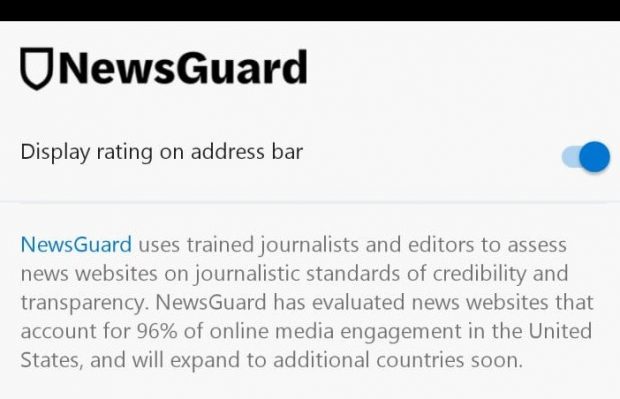
Not only does the integration ensure that NewsGuard is present on every browser, and is easier to use than to ignore, but by making it a fundamental Microsoft-provided feature, the company gives it inherent level of trustworthiness, something akin to a bundled anti-virus feature, only this time the virus targets your brain, not your computer or iPod.
‘Totally transparent’
None of this is the slightest bit alarming if you believe that NewsGuard is an absolutely fair arbiter of what constitutes real news or propaganda.
Its pride of place is its “Nutrition Labels” which ape the precision of a list of calories, carbs, and saturated fats to give a supposedly scientific assessment of media reliability on nine different criteria. Among them: doesn’t repeatedly publish false content, avoids deceptive headlines, gathers and presents information responsibly, handles the difference between news and opinion responsibly.
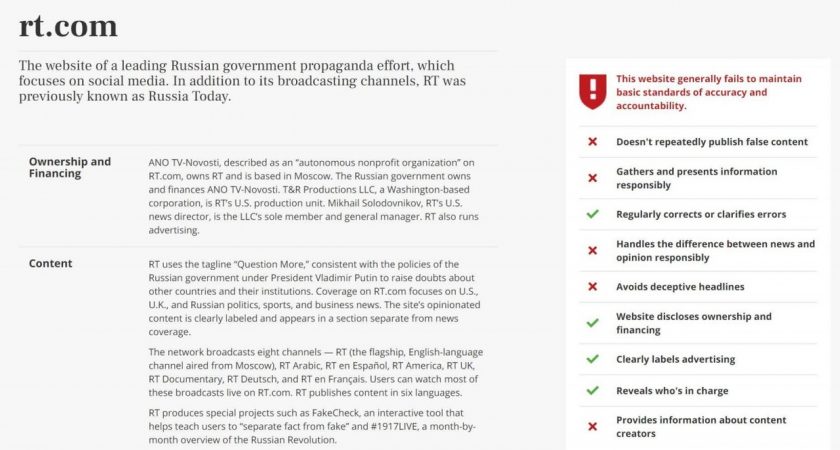
© Newsguardtech.com/Media sample
The green-listed media outlets above apparently do not ever engage in these practices, or at least not knowingly. So CNN never misleads with its headlines, the Guardian never dresses up its agendas as news, and Buzzfeed stories are always accurate. One literally doesn’t have to go back three days to find dozens of examples to the contrary, but this would be too mind-numbingly pedantic a task.
Even regular readers of the green-tick media must be able to see these are judgment calls. What is even “presenting information responsibly”?
Perhaps realizing that their pseudo-scientific fancy diagram is insufficient, NewsGuard has stressed that they are not using shadowy methods like tech companies and are open to two-way communication.
“We want people to game our system. We are totally transparent. We are not an algorithm,” company co-founder Steve Brill told the Guardian.
This is how he explained the Daily Mail red warning.
“We spell out fairly clearly in the label exactly how many times we have attempted to contact them. The analyst that wrote this writeup got someone on the phone who, as soon he heard who she was and where she was calling from, hung up. As of now, we would love to hear if they have a complaint or if they change anything.”
On the other hand, RT did answer NewsGuard’s queries in detail. You can guess how much difference that made.
From anthrax scares to Russia fears
But who are these people that the Daily Mail or RT have to impress and why?
Brill himself is a veteran centrist journalist and author, his co-CEO Gordon Crovitz is a former Wall Street Journal columnist. After Brill, its second-biggest investor, along with his father, is Nick Penniman, the liberal publisher, and the third-biggest is Publicis Group, a multinational advertising agency.
Meanwhile, its advisory board includes Tom Ridge, the first-ever Homeland Security chief, and developer of another famous color-coded system, the terror alert, and Michael Hayden, the CIA director, also under George W. Bush. There are also several Obama and Clinton-era figures.
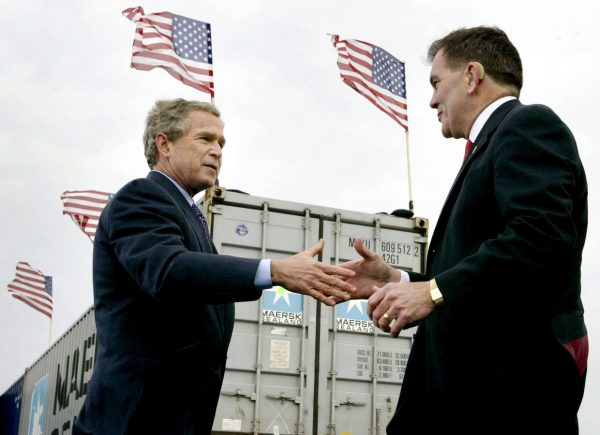
Tom Ridge and George W. Bush in 2004. © Reuters
The overall picture emerges of a mix of establishment journalists, hawkish old-school Washington insiders, and so-called ethical businessmen.
They may all be experts in their fields, but if you believe that these are selfless neutral adjudicators you are probably beyond being helped by color charts. And this is not some one-off initiative either: NewsGuard is part of Microsoft’s Defending Democracy program, which combats purported election meddling, presumably primarily from Russia. The frontline of the information war is not customarily the place for impartial news judgment.
But I wasn’t an Edge user…
However much respectability NewsGuard enjoys through Microsoft, Edge has a laughably small – a fraction of a percent – market share on mobiles. In practical terms, even an increase of popularity of several thousand percent will only mean several thousand new users, and other browsers are available.
This would be that, if not for NewsGuard’s self-proclaimed ambition “to expand to serve the billions of people globally who get news online.” This is just a beginning: there is an overarching plan where all public computers, from the school to the university to the library, are automatically equipped with the same “safe browsing” system.
And rather than as an individual warning, NewsGuard plans to make its designations work as an effective financial tool. The company, which has received $6 million in backing, also plans to soon work with advertisers, “keeping ads off unreliable news websites” to ensure “brand safety.” Fall foul of the green ticks, no money for you. Advertising managers are already demonetizing programs with alternative or controversial viewpoints elsewhere, and soon the process can be automated, and Brill is boasting that he is “happy to be blamed” – doing the dirty work for the platforms. No wonder alternative outlets in the US are openly opposed.
So, just like the use of NewsGuard in all public libraries in the faraway state of Hawaii (no money charged), it is best to look at the Edge integration is more of a test, a pilot project, a dry run. Latching NewsGuard onto a popular browser like Chrome, or a social network like Facebook, would stir tremors of public debate, as it has done in the past when similar initiatives have been tried. Instead, first they came for the Edge users.
Integrity Initiative wipes website pending probe into ‘theft’ of disturbing leaked data
RT | January 22, 2019
The British state-funded Integrity Initiative, exposed last year for conducting Europe-wide political influence campaigns in leaked files, has removed all of its website content “pending an investigation” into the data “theft.”
A group claiming association with the loose hacktivist collective Anonymous has been dumping private Integrity Initiative documents online in various batches since November. The leaks revealed that the Scotland-based, government-funded organization, which bills itself as a non-partisan disinformation-busting charity, was actually using “clusters” of journalists, politicians, and academics to carry out secret anti-Russia campaigns, interfere in domestic politics across Europe and smear anyone who questioned its narratives.
In a surprise move on Monday, the Integrity Initiative abruptly announced on Twitter that it had “temporarily removed” all content from its site “pending an investigation into the theft of data” from the Institute of Statecraft, the II’s London-based parent operation.
In a statement posted on its now mostly bare website, the II claimed the leaks were “part of a campaign to undermine the work” of the Initiative which it said involved “researching, publicising and countering the threat” Europe faces in the in the form of “disinformation” and “hybrid warfare” – ironically, exactly what the shady organization itself was accused of engaging in with its hefty government paycheck.
It remains an open question if, in an effort to save face, the group would accuse Russia of being behind the leaks and even of doctoring the documents. While the statement admitted that some of the leaks were “genuine,” it claimed others were “falsified” – but did not provide any evidence to back up that claim. It is, however, apparent that Russia has been the Initiative’s main target during the course of its questionable work.
The website will be “relaunched shortly” and “analysis” of the hack and its “significance” will be published soon, the statement said. It doesn’t look as though many will be awaiting that analysis with bated breath, however.
Perhaps discouraging for the Integrity Initiative, few seemed upset to see their content disappear. Most responses to the announcement tweet are of the trolling variety, accusing the organization of simply being caught in the act and trying to clean house.
After the II leaks, Scottish newspaper the Daily Record wrote that the revelations – including that the government-funded organization had also conducted a domestic smear campaign against Jeremy Corbyn – was “one of the biggest political scandals of the year.”
The scandal received scant coverage by mainstream British media, however. Labour MP Chris Williamson told RT earlier this month that the lack of interest could have something to do with the fact that high profile journalists themselves were seemingly involved in the shady operation.
BuzzFeed’s Cohen Lies Just Latest Example of Embarrassing ‘RussiaGate’ Hysteria
By Kit Klarenberg | Sputnik | January 21, 2019
In a bombshell report, on 17 January BuzzFeed claimed Donald Trump had told his lawyer Michael Cohen to lie to Congress about the specifics of the ‘Trump Tower Moscow’ project — a felony, and indeed an impeachable one.
Other news outlets the world over eagerly regurgitated the story, and Democratic lawmakers on social media and indeed on the floor of the US legislature advocated kickstarting impeachment proceedings.
However, in an unprecedented move, the very next day special counsel Robert Mueller broke with his 20-month-long convention of not commenting on news reports relating to his investigation by announcing the story wasn’t true. Moreover, he was critical of BuzzFeed’s failure to contact his representatives and ask for verification on the story before publication.
History of Fabulism
Not long after Mueller’s denial, more critical voices began scrutinizing the report. Many noted Jason Leopold — one of the reporters on the story — had previously been involved in another epic ‘fake news’ fiasco at BuzzFeed relating to Russia. In November 2017, he authored a story which claimed the FBI was investigating records indicating in August 2016 the Russian Foreign Ministry sent US$30,000 to its embassy in Washington for “election financing”.
A shock story evidently written for maximum ‘clickbait’ value, Leopold — almost certainly consciously — opted to bury the fact the payments related to Russia’s own elections in September 2016, in which expatriate Russians were permitted to vote in their adopted home countries. As of January 2019, the article hasn’t been removed from web, although a qualifier has been added to its introductory paragraph.

Jason Leopold
Others expressed shock Leopold was still employed by any media outlet at all, for as Colombia Journalism Review documented back in 2006, his lengthy career has been typified by controversy, ignominy and dishonesty.
For instance, in August 2002 Leopold wrote an article for Salon claiming then-Secretary of the Army and former Enron vice chair Thomas White knew more about the company’s infamously questionable accounting practices than he’d admitted up to that time. The key piece of evidence for the allegation was an internal Enron email that was apparently leaked to Leopold by an anonymous source — but after he was unable to produce a copy when asked by his editor, and it was revealed he’d plagiarised portions of the piece from the Financial Times, it was pulled from the website.
In a perversely ironic twist, in 2005 Leopold’s memoir (Off the Record), in which he pledged to come clean about all the “lying, cheating and backstabbing” he’d engaged in over the course of his journalistic career and set the ‘record’ straight on his various ignominious departures from media organisations (including the Los Angeles Times and Dow Jones ), was dumped by planned publisher Rowman & Littlefield just before it went to press after one of the book’s sources threatened to sue.
Leopold had claimed the source in question, Steven Maviglio — spokesperson for then-California Governor Gray Davis — had told him he “might have broken the law by investing in energy companies using inside information”, which was apparently totally untrue.
The next year, Leopold again landed in hot water when he published a story for Truthout claiming Karl Rove “told President Bush and Chief of Staff Joshua Bolten, as well as a few other high level administration officials,” he was due to be indicted in the Valerie Plame scandal. In the piece, he said multiple anonymous sources had confirmed Rove’s indictment “was imminent” — mere days later prosecutors confirmed Rove would not face charges. Despite this, Truthout chief Marc Ash stood by the story despite a lack of corroboration elsewhere and furious denials from all named in the story for some time.
Standing By
Intriguingly, there were shades of Ash’s response in BuzzFeed’s reaction to Mueller’s denials — namely, the outlet stood by the story, not only refusing to retract it, but “reconfirming” it — and editor-in-chief Ben Smith vehemently defended his decision to publish in a much-ridiculed interview on CNN, claiming the reporting would be “borne out” by future disclosures.
Other outlets have chosen to retract and/or correct their reporting on the story — although, journalist Doug Henwood has noted while New York Times covered the report on the front page of its print edition, its correction was buried on page 11 the next day.
Despite BuzzFeed’s defence of the story, it’s likely to go down as yet another utterly embarrassing mainstream media ‘RussiaGate’ failure in a very long line — stories which have briefly generated borderline-hysteria on social media and cable news, but been proven to be utterly without foundation in short order. Here are some of the most notorious.
Manafort Meeting Never Was
On 27 November 2018, The Guardian published a seismic exclusive report authored by Luke Harding that claimed Paul Manafort, President Donald Trump’s former campaign chair and now-convicted felon, met with WikiLeaks chief Julian Assange in the Ecuadorian Embassy in London on three separate occasions.
The story stretched believability to breaking point — Manafort somehow managed to enter and exit the Embassy without being photographed, filmed or even noticed, and left no record of his presence in the building’s visitor log — and was based entirely on anonymous sources.
WikiLeaks immediately issued a vehement denial, declaring the story to be completely “fabricated” and noting the paper had given them virtually no time to respond prior to publication. Within hours, the organisation had set up a legal fund seeking donations in order to sue The Guardian for libel, and were calling for the resignation of Editor Katherine Viner. The paper responded by softening the report’s wording significantly, making clear it was based entirely on unverifiable allegations from anonymous sources, rather than anything even approaching actual evidence.
In less than a day, what Harding and Viner had evidently hoped would be the journalistic scoop of the year was shaping up to be the biggest disaster in news reporting since Germany’s Stern magazine published ‘The Hitler Diaries’ in 1983, a disaster that could severely — and enduringly — damage the reputation of The Guardian and land the paper in significant legal hot water. Despite this, the story was uncritically regurgitated by news outlets the world over. As of January 21, neither Harding nor Viner has retracted or apologized for the piece.
Dates Mixed Up
On 9 December 2017, CNN claimed Donald Trump Jr. was offered advanced access to the notorious DNC and Podesta email troves by WikiLeaks — a smoking gun proving the Trump campaign had colluded with WikiLeaks to undermine Hillary Clinton. The story was then backed up by MSNBC, with intelligence and national security reporter Ken Dilanian breathlessly claiming to have “independent confirmation” of the story.
It would be mere hours before the incendiary story would be completely shredded by reality. In truth, Trump Jr. had been apprised of the email dumps’ existence by a member of the public 10 days after their release. The assorted anonymous sources who’d confirmed the story to both networks had evidently all got their dates mixed up, or indeed were lying — or didn’t even exist perhaps, as both networks’ refusal to name their sources may imply.
The pair’s determination to cover up their colossal journalistic failure doesn’t end there — both have deleted every trace of the story from their official websites and YouTube channels, and attempts by individual users to upload their own copies invariably result in copyright claims and deletion.
Just Ain’t Crickets
In another major disaster for MSNBC — and its star reporter Dilanian — in September 2018, the network repeatedly claimed Russia was the primary suspect in “mysterious” attacks giving US diplomatic staff in Cuba “brain injuries”.
“Sophisticated microwaves or another type of electromagnetic weapon were likely used on the government workers… [they are] so sophisticated the Americans don’t even fully understand it,” Dilanian said.
Subsequent reports claimed CIA intercepts of Russian communications backed up the conclusion the Kremlin was directing the dastardly brain damaging blasts. Such was the ferocity of the reporting — and the seriousness of the allegations — Republican Senator Cory Gardner appeared on the network to say Russia should now be classified a “terror state”.
MSNBC carried on with their microwave weapon crusade despite academics casting significant doubt on their analysis — it would not be until January 2019 the story would be totally debunked, when two scientists — Alexander Stubbs of Berkeley and Fernando Montealegre-Z of the UK’s University of Lincoln — published a study based on recordings of the sounds embassy personnel complained of hearing, and blamed for their “brain damage”, revealing the ‘microwave weapons’ to in fact be…Caribbean crickets during mating season.
READ MORE:
‘Not Accurate’: Mueller Refutes BuzzFeed Cohen Scoop
Cuban Horror Stories: How US Scares Investors Off From the Island — Pundits
US Questioning Ecuadorian Embassy Staff Over Debunked Assange-Manafort Story
As Guardian’s Manafort-Assange Story Exposed as Fake, Ex-CIA Agent Blames Russia
‘Fake news’ is okay if it’s about #RussiaGate: Top 7 fake ‘collusion’ stories the media pushed
RT | January 21, 2019
BuzzFeed’s ‘bombshell’ claim last week that Donald Trump told ex-lawyer Michael Cohen to lie to congress is just the latest in a long line of ‘Russiagate’ stories that have later turned out to be false.
But BuzzFeed’s rubbished article is part of a phenomenon of what could be termed ‘acceptable fake news’ — fake news that gets a pass from the media because it serves a certain narrative. In this case, it furthers the ‘Russiagate’ narrative, which the mainstream media has been pushing breathlessly for two years. Lacking hard proof that Trump ‘colluded’ with Russia to win the 2016 election, they have clung to any shred of fake evidence they can find.
Last week, one astute Twitter user compiled a list of a whopping 42 Russiagate stories which were billed as bombshells but which ended up needing to be retracted or corrected. Here are seven of the most scandalous instances.
1. MSNBC pushed line that WikiLeaks released ‘fake’ Clinton emails
When WikiLeaks published the emails belonging to Hillary Clinton aide John Podesta in 2016, MSNBC sought to actively encourage its viewers to believe the emails were doctored by Russia.
They based that spurious claim on the fact that a fake transcript of a Clinton speech to Goldman Sachs was drifting around Twitter. The fake transcript had not been published by WikiLeaks, however. Rather, it was the creation of a pro-Clinton troll who had intended to trick Trump supporters into believing it was real so he could later embarrass them for their gullibility. MSNBC reporters who used the fake Twitter transcript to tarnish WikiLeaks’ authentic documents never corrected their false claims.
2. WaPo claims Russia ‘hacked’ the Vermont power grid
In one of the most infamous cases of a botched Russia-related story, the Washington Post claimed that Russia had hacked the Vermont power grid. In its zeal to deliver bombshell proof that Russia was attempting to attack the US, the Post reporters didn’t even bother to contact the utility company which could have told them that there had been no hacking or penetration of the power grid at all. The Post admitted later in an editor’s note that the story was fake.
3. CNN fires three journalists over botched story
It’s not often journalists who publish fake Russia-related ‘bombshells’ face real consequences, but last June, three CNN journalists, including the executive editor of a shiny new ‘investigative’ branch had to resign following the retraction of a false story which claimed Congress was investigating a Russian investment fund “with ties” to Trump’s team. The story quoted a single anonymous source and CNN later admitted that its reporters failed to follow “some standard editorial procedures” before publishing it.
4. Oops? CNN gets date on email wrong, causes mass panic
In a rush to prove that the Trump campaign had advance knowledge of and access to hacked DNC emails published by WikiLeaks, CNN (again) got the date of an email wrong. CNN claimed “multiple” sources had told them the email about the documents had been sent to the Trump campaign on September 4, but in reality, it had been sent on September 14 — a day after the WikiLeaks documents were made public — not, as CNN had claimed, nine days before.
5. ABC’s dud on Michael Flynn and ‘contact’ with Russians
Veteran ABC journalist Brian Ross was suspended after reporting last December that Trump had ordered former adviser Michael Flynn to contact Russian officials during the presidential campaign. It turned out, Trump had made this request of Flynn after he had won the election — not an unusual request for someone about to become the president of the US. Ross left ABC for good a while later after a career littered with embarrassing reporting blunders.
6. Russian supersonic tech or…crickets?
MSNBC reported last year that Russia was likely responsible for a supersonic attack on US diplomats stationed in the Cuba embassy. One ‘expert’ appeared on the channel stating that possible Russian “sophisticated microwaves” targeted the diplomats, while a reporter claimed Russian guilt had been “backed up” by interceptions of Russian communications. Meanwhile, intelligence sources told the New Yorker that no such evidence existed. When the Associated Press later released an audio recording, two US scientists deciphered that the sounds the diplomats had heard were more than likely the sounds of a species of Caribbean crickets during mating season.
7. Guardian claims Manafort had ‘secret meetings’ with Assange
WikiLeaks raised more than $55,000 in donations to sue the Guardian after the British newspaper published a story alleging (without corroborated evidence) that Julian Assange had held secret meetings with former Trump campaign manager Paul Manafort at the Ecuadorean embassy in London, where Assange has been living since 2012. The story which WikiLeaks claims is completely false — and which has also been questioned by other journalists — was written by Luke Harding, a Guardian reporter who has been accused before of fabricating stories and who went AWOL after the report was received with serious skepticism.
Unfortunately, the regularity with which these Russiagate stories have turned out to fake still hasn’t raised any red flags with establishment journalists, who seem more eager to bolster a narrative than to uncover actual facts.
Climate Hysterics Skyrocket Even As Weather Disasters Haven’t
By Paul Driessen | Climate Change Dispatch | January 21, 2019
Call it climate one-upmanship. It seems everyone has to outdo previous climate chaos rhetoric.
The “climate crisis” is the “existential threat of our time,” Speaker Nancy Pelosi told her House colleagues. We must “end the inaction and denial of science that threatens the planet and the future.”
Former California Governor Jerry Brown solemnly intoned that America has “an enemy, though different, but perhaps very much devastating in a similar way” as the Nazis in World War II.
Not to be outdone, two PhDs writing in Psychology Today declared that “the human race faces extinction” if we don’t stop burning fossil fuels.
And yet “even people who experience extreme weather events often still refuse to report the experiences as a manifestation of climate change.” Psychologists, they lament, “have never had to face denial on this scale before.”
Then there’s Oxford University doctoral candidate Samuel Miller-McDonald. He’s convinced the only thing that could save people and planet from cataclysmic climate change is cataclysmic nuclear war that “shuts down the global economy but stops short of human extinction.”
All this headline-grabbing gloom and doom, however, is backed up by little more than computer models, obstinate assertions that the science is settled, and a steady litany of claims that temperatures, tornadoes, hurricanes, droughts et cetera are unprecedented, worse than ever before, and due to fossil fuels.
And on the basis of these hysterics, we are supposed to give up the carbon-based fuels that provide over 80% of the U.S.’ and global energy, gladly reduce our living standards – and put our jobs and economy at the mercy of expensive, unreliable, weather dependent, pseudo-renewable wind, solar and biofuel energy.
As in any civil or criminal trial, the burden of proof is on the accusers and prosecutors who want to sentence fossil fuels to oblivion. They need to provide more than blood-curdling charges, opening statements and summations. They need to provide convincing real-world evidence to prove their case.
They have refused to do so. They ignore the way rising atmospheric carbon-dioxide is spurring plant growth and greening the planet. They blame every extreme weather event on fossil fuel emissions, but cannot explain the Medieval Warm Period, Little Ice Age or extreme weather events decades or centuries ago – or why we have had fewer extreme weather events in recent decades.
They simply resort to trial in media and other forums where they can exclude exculpatory evidence, bar any case for the fossil fuel defense, and prevent any cross-examination of their witnesses, assertions and make-believe evidence.
Climate models are not evidence. At best, they offer scenarios of what might happen if the assumptions on which they are based turn out to be correct.
However, the average prediction by 102 models is now a full degree F (0.55 C) above what satellites are actually measuring.
Models that cannot be confirmed by actual observations are of little value and certainly should not be a basis for vital energy policymaking.
The alarmist mantra seems to be: If models and reality don’t agree, reality must be wrong.
In fact, even as atmospheric carbon dioxide levels climbed to 405 parts per million (0.0405% of Earth’s atmosphere), except for short-term temperature spikes during El Niño ocean warming events, there has been very little planetary warming since 1998; nothing to suggest chaos or runaway temperatures.
Claims that tornadoes have gotten more frequent and intense are obliterated by actual evidence. NOAA records show that from 1954 to 1985 an average of 56 F3 to F5 tornadoes struck the USA each year – but from 1985 to 2017 there was only 34 per year on average.
And in 2018, for the first time in modern history, not a single “violent” twister touched down in the United States.
Harvey was the first major (category 3-5) hurricane to make US landfall in a record twelve years. The previous record was nine years, set in the 1860s. (If rising CO2 levels are to blame for Harvey, Irma and other extreme weather events, shouldn’t they also be credited for this hurricane drought?)
Droughts differ little from historical trends and cycles – and the Dust Bowl, Anasazi, and Mayan droughts, and other ancient dry spells were long and destructive. Moreover, modern agricultural and drip irrigation technologies enable farmers to deal with droughts far better than they ever could in the past.
Forest fires are fewer than in the recent past – and largely due to failure to remove hundreds of millions of dead and diseased trees that provide ready tinder for massive conflagrations.
Arctic and Antarctic ice are largely within “normal” or “cyclical” levels for the past several centuries – and snow surface temperatures in the East Antarctic Plateau regularly reach -90 °C (-130 F) or lower.
Average Antarctic temperatures would have to rise some 20-85 degrees F year-round for all its land ice to melt and cause oceans to rise at faster than their current 7-12 inches per century pace.
In fact, the world’s oceans have risen over 400 feet since the last Pleistocene glaciers melted. (That’s how much water those mile-high Ice Age glaciers took out of the oceans!)
Sea level rise paused during the Little Ice Age but kicked in again the past century or so. Meanwhile, retreating glaciers reveal long-lost forests, coins, corpses, and other artifacts– proving those glaciers have come and gone many times.
Pacific islands will not be covered by rising seas anytime soon, at 7-12 inches per century, and because corals and atolls grow as seas rise. Land subsidence also plays a big role in perceived sea level rise – and US naval bases are safe from sea level rise, though maybe not from local land subsidence.
The Washington Post did report that “the Arctic Ocean is warming up, icebergs are growing scarcer, and in some places, the seals are finding the water too hot.” But that was in 1922.
Moreover, explorers wrote about the cyclical absence of Arctic ice long before that. “We were astonished by the total absence of ice in Barrow Strait,” Sir Francis McClintock wrote in 1860. “I was here at this time in [mid] 1854 – still frozen up – and doubts were entertained as to the possibility of escape.”
Coral bleaching? That too has many causes – few having anything to do with manmade global warming – and the reefs generally return quickly to their former glory as corals adopt new zooxanthellae.
On and on it goes – with more scare stories daily, more attempts to blame humans and fossil fuels for nearly every interesting or as-yet-unexplained natural phenomenon, weather event or climate fluctuation.
And yet countering the man-made climate apocalypse narrative is increasingly difficult – in large part because the $2-trillion-per-year climate “science” and “renewable” energy industry works vigorously to suppress such evidence and discussion … and is aided and abetted by its media and political allies.
Thus we have Chuck Todd, who brought an entire panel of alarmist climate “experts” to a recent episode of Meet the Press. He helped them expound ad nauseam on the alleged “existential threat of our time” – but made it clear that he was not going to give even one minute to experts on the other side.
“We’re not going to debate climate change, the existence of it,” Todd proclaimed. “The Earth is getting hotter. And human activity is a major cause, period. We’re not going to give time to climate deniers. The science is settled, even if political opinion is not.”
The only thing left to discuss, from their perspective was “solutions” – most of which would hugely benefit them and their cohorts, politically and financially.
Regular folks in developed and developing countries alike see this politicized, money-driven kangaroo court process for what it is.
They also know that unproven, exaggerated and fabricated climate scares must be balanced against their having to give up (or never having) reliable, affordable fossil fuel energy. That is why we have “dangerous man-made climate change” denial on this scale.
That is why we must get the facts out by other means. It is why we must confront Congress, media people and the Trump Administration, and demand that they address these realities, hold debates, revisit the CO2 Endangerment Finding – and stop calling for an end to fossil fuels and modern living standards before we actually have an honest, robust assessment of supposedly “settled” climate science.
Paul Driessen is senior policy advisor for the Committee For A Constructive Tomorrow (CFACT) and author of articles and books on energy, environmental and human rights issues.
Lancet EAT Report Promotes Activism Over Science
By Donna Laframboise | Big Picture News | January 21, 2019
Last week, The Lancet, one of the world’s most prestigious medical journals, officially drove off a cliff. With much fanfare, it released a 47-page report titled Food in the Anthropocene: the EAT – Lancet Commission on healthy diets from sustainable food systems.
That title is the first screaming clue we’re being fed propaganda. As I’ve discussed previously, the Anthropocene doesn’t exist.
A scientific body known as the International Commission on Stratigraphy is tasked with defining and naming geological periods. It decides these matters according to an official, established process.
That body’s website contains a chart updated six months ago. It clearly indicates Earth remains in the Holocene. The term Anthropocene is nowhere to be found.
The notion that we’ve entered a new and distinct geological epoch is 100% activist hogwash. It’s an argument. Made by environmentalists. An argument that has been rejected by the scientific authorities who are experts in such matters.
Food in the Anthropocene, indeed. By naming its new report after this figment of activist imagination, The Lancet has been deliberately deceptive.
Medical journals are supposed to be the opposite of fake news. Now they spread misinformation on purpose.
Soros, Fake News & Italian Media: Journalist Reveals Plot to Put Rome Under Austerity
Sputnik – January 20, 2019
Sputnik Italia contributor Alessio Trovato investigates the purpose of George Soros’ recent closed-door meeting with European Commission vice-president Frans Timmermans, and broader campaign to convince Brussels to put Italy under the supervision of the ‘troika’ (the European Central Bank, the EC and the International Monetary Fund).
George Soros, a sworn enemy of the present right-populist coalition government in Rome, has been on something of a mission to put Italy under austerity, with Italian media reporting on such efforts going back to at least 2011. Last October, in an explosive interview for Italian TV, former Prime Minister Mario Monti revealed that Soros had called him at the height of the European sovereign debt crisis eight years ago, urging Italy to accept ‘assistance’ from the IMF to dig out from under its debt problem. Monti refused at the time, saying following Soros’ advice would have turned Italy into another Greece.
On November 26, 2018, in a meeting in Brussels with Timmermans, along with a representative of EC President Jean-Claude Juncker, Soros was again assumed to have brought up the debt issue, with Italian media speculating heavily regarding the vague comments of an EC spokesperson, who said only that they “cannot confirm or deny whether Italy’s budget was discussed.”
Meanwhile, Sputnik Italia contributor Alessio Trovato writes, Soros’ Open Society Foundations has been cutting paychecks “to a considerable number of journalists and influencers whom (surprise) constantly refer to him as a ‘benefactor’ and ‘spontaneously’ support all of his campaigns, including his support for migration, mondialism, Russophobia and colour revolutions.”
A big part of the problem, according to Trovato, is that the mainstream media continues to completely ignore Soros’ activities, or to report on them only with reluctance, even as the billionaire seeks to interfere in democratic processes and the internal affairs of sovereign nations.
Soros’ Agents in Mainstream Media vs. Italy’s National Interest
“Even journalists who do not receive ‘favours’ from the magnate are either incapable of saying anything on this subject or prefer not to do so,” Trovato wrote. “Hence we come to the case of Ivo Caizzi, Luciano Fontana and Federico Fubini, who are likely to become a classic in the annals of Italian journalism, and show the battle for journalistic independence being waged inside the mainstream media.”
Late last year, Caizzi, the Brussels correspondent of Italy’s highly influential Corriere della Sera newspaper, leaked internal email communications accusing Fubini, the paper’s chief economics commentator, and Fontana, its executive director, of publishing ‘Fake News’ in November about ‘inevitable sanctions’ against Italy for its violation of EU budget legislation. In reality, Rome managed to avoid sanctions, reaching a compromise deal with Brussels in December. However, reports of imminent sanctions from a respectable mainstream newspaper are thought to have threatened the country’s economic stability.Last week, Caizzi wrote an open letter to his employers, asking them to respond to several serious questions in the interests of the newspaper, his fellow journalists, and readers. In the editorial, the journalist asked whether editor-in-chief Fontana’s behaviour has been corrected, and whether it would be appropriate for Fontana to limit himself to expressing his personal opinions to editorials, op-eds and comments. Caizzi asked whether reports of ‘imminent sanctions’ could have adversely affected the financial markets and played in the hands of speculators (who, incidentally, include Soros) betting on the Italy’s destabilization, the collapse of the country’s stock market, and the growth of yields on Italian government obligations.
“Can we hope that in 2019, Corriere will return to its motto of ‘providing independent and high-quality information and ensuring maximum reliability of the news from the first to the last page?” Caizzi asked.
Commenting on the editorial, Trovato suggested that “even the rebellious Caizzi” did not comment on two issues which “he is certainly aware of.”
Specifically, Trovato noted, “Soros met Frans Timmermans behind closed doors in Brussels [in November]. The 88-year-old Soros is not one to head off to Brussels for no reason. If he is talking to someone, it means he has something to ask, or offer. Mr. Timmermans is not just anybody, but the so-called ‘spitzenkandidad’, the lead candidate for the presidency of the European Commission in the event of victory for the socialists and the democrats in the upcoming elections to the European Parliament. What did they talk about? A trifle –Soros seems to have asked Timmermans to take measures so that the European Commission rejects the Italian tax maneuver to allow the troika to be brought to Italy. In effect, Soros essentially asked Juncker’s deputy… to turn Italy into the same kind of hostage to the EU as Greece. In this sense, [Corriere’s reporting] turned Italian media into a sort of fifth column, preparing the markets for the upcoming speculative moves from the inside.”
Secondly, the journalist noted, Federico Fubini is a member of the European Advisory Board of the Open Society Foundations, and, ironically, on the European Commission’s ‘expert group on Fake News’.
“The point is, how can one believe that Europe is struggling against Fake News when it also produces it? Can we believe in the impartially of information published thanks to the ‘donations of generous and disinterested benefactors’?” Trovato asked.
Ultimately, the Sputnik Italia contributor noted, “our only chance for survival lies in being aware of what’s going on and in our own analytical skills. Discuss, doubt and check everything – otherwise you will never understand who you’re up against. Maybe it’s a troll – an agent of the Kremlin, or perhaps someone funded by the Open Society, the Aspen Institute, the Bilderbergs, the Atlantic Council, the CIA, Mossad, the FSB, a proponent of the troika trojan horse, or just about anyone else. Never trust! Even those who tell you not to believe anyone!”
MSM Begs For Trust After Buzzfeed Debacle
By Caitlin Johnstone | January 20, 2019
Following what the Washington Post has described as “the highest-profile misstep yet for a news organization during a period of heightened and intense scrutiny of the press,” mass media representatives are now flailing desperately for an argument as to why people should continue to place their trust in mainstream news outlets.
On Thursday Buzzfeed News delivered the latest “bombshell” Russiagate report to fizzle within 24 hours of its publication, a pattern that is now so consistent that I’ve personally made a practice of declining to comment on such stories until a day or two after their release. “BOOM!” tweets were issued by #Resistance pundits on Twitter, “If true this means X, Y and Z” bloviations were made on mass media punditry panels, and for about 20 hours Russiagaters everywhere were riding the high of their lives, giddy with the news that President Trump had committed an impeachable felony by ordering Michael Cohen to lie to Congress about a proposed Trump office tower in Moscow, a proposal which died within weeks and the Kremlin never touched.
There was reason enough already for any reasonable person to refrain from frenzied celebration, including the fact that the story’s two authors, Jason Leopold and Anthony Cormier, were giving the press two very different accounts of the information they’d based it on, with Cormier telling CNN that he had not personally seen the evidence underlying his report and Leopold telling MSNBC that he had. Both Leopold and Cormier, for the record, have already previously suffered a Russiagate faceplant with the clickbait viral story that Russia had financed the 2016 election, burying the fact that it was a Russian election.
UPDATE: A spokesperson for the special counsel is disputing BuzzFeed News’ report. https://t.co/BEoMKiDypn pic.twitter.com/GWWfGtyhaE
— BuzzFeed News (@BuzzFeedNews) January 19, 2019
Then the entire story came crashing down when Mueller’s office took the extremely rare step of issuing an unequivocal statement that the Buzzfeed story was wrong, writing simply, “BuzzFeed’s description of specific statements to the special counsel’s office, and characterization of documents and testimony obtained by this office, regarding Michael Cohen’s congressional testimony are not accurate.”
According to journalist and economic analyst Doug Henwood, the print New York Times covered the Buzzfeed report on its front page when the story broke, but the report on Mueller’s correction the next day was shoved back to page 11. This appalling journalistic malpractice makes it very funny that NYT’s Wajahat Ali had the gall to tweet, “Unlike the Trump administration, journalists are fact checking and willing to correct the record if the Buzzfeed story is found inaccurate. Not really the actions of a deep state and enemy of the people, right?”
This is the behavior of a media class that is interested in selling narratives, not reporting truth. And yet the mass media talking heads are all telling us today that we must continue to trust them.
“Those trying to tar all media today aren’t interested in improving journalism but protecting themselves,” tweeted NBC’s Chuck Todd. “There’s a lot more accountability in media these days than in our politics. We know we live in a glass house, we hope the folks we cover are as self aware.”
More accountability in media than in politics, Chuck? Really? Accountability to whom? Your advertisers? Your plutocratic owners? Certainly not to the people whose minds you are paid exorbitant sums to influence; there are no public elections for the leadership of the mass media.
“Mueller didn’t do the media any favors tonight, and he did do the president one,” griped the odious Chris Cuomo on CNN. “Because as you saw with Rudy Giuliani and as I’m sure you’ll see with the president himself, this allows them to say ‘You can’t believe it! You can’t believe what you read, you can’t believe what you hear! You can only believe us. Even the Special Counsel says that the media doesn’t get it right.’”
“The larger message that a lot of people are going to take from this story is that the news media are a bunch of leftist liars who are dying to get the president, and they’re willing to lie to do it, and I don’t think that’s true” said Jeffrey Toobin on a CNN panel, adding “I just think this is a bad day for us.”
“It does reinforce bad stereotypes about the news media,” said Brian Stelter on the same CNN panel. “I am desperate as a media reporter to always say to the audience, judge folks individually and judge brands individually. Don’t fall for what these politicians out there want you to do. They want you to think we’re all crooked. We’re not. But Buzzfeed now, now the onus is on Buzzfeed.”
CNN, for the record, has been guilty of an arguably even more embarrassing Russiagate flub than Buzzfeed‘s when they wrongly reported that Donald Trump Jr had had access to WikiLeaks’ DNC email archives prior to their 2016 publication, an error that was hilariously due to to the simple misreading of an email date by multiple people.
CNN is leading the way in bashing BuzzFeed but it’s worth remembering CNN had a humiliation at least as big & bad: when they yelled that Trump Jr. had advanced access to the WL archive (!): all based on a wrong date. They removed all the segments from YouTube, but this remains: pic.twitter.com/0jiA50aIku
— Glenn Greenwald (@ggreenwald) January 19, 2019
The mass media, including pro-Trump mass media like Fox News, absolutely deserves to be distrusted. It has earned that distrust. It had earned that distrust already with its constant promotion of imperialist wars and an oligarch-friendly status quo, and it has earned it even more with its frenzied promotion of a narrative engineered to manufacture consent for a preexisting agenda to shove Russia off the world stage.
The mainstream media absolutely is the enemy of the people; just because Trump says it doesn’t mean it’s not true. The only reason people don’t rise up and use the power of their numbers to force the much-needed changes that need to happen in our world is because they are being propagandized to accept the status quo day in and day out by the mass media’s endless cultural engineering project. They are the reason why wars go unopposed, why third parties never gain traction, why people consent to money hemorrhaging upward to the wealthiest of the wealthy while everyone else struggles to survive. The sooner people wake up from the perverse narrative matrix of the plutocratic media, the better.
Buzzfeed, Question Time & the purpose of Fake News
Image source
By Kit Knightly | OffGuardian | January 19, 2019
Two days ago BuzzFeed published a front page story, under a “BREAKING” banner, headlined: President Trump Directed His Attorney Michael Cohen To Lie To Congress About The Moscow Tower Project
In the article, Buzzfeed reporters Jason Leopold and Anthony Cormier claim to have been told, by two anonymous sources, that Robert Mueller’s “Russiagate” investigation had evidence Donald Trump had instructed his lawyer to lie to Congress. That would be a felony, and obviously an impeachable offence.
The reaction of the news media and associated twitterati was as quick as it was predictable. MSNCBC, CNN, the BBC, The Guardian… the usual suspects. They were all over it within hours.
But then, less than a day later, Robert Mueller’s spokesperson Peter Carr issued this statement:
BuzzFeed’s description of specific statements to the special counsel’s office, and characterization of documents and testimony obtained by this office, regarding Michael Cohen’s congressional testimony are not accurate,”
Despite this, BuzzFeed is sticking to its guns. Insisting that Mueller’s statement is vague, and therefore does not undercut the heart of their story.
The rest of the mainstream media are sensing the tone though and jumping ship. The Washington Post – not known for their pro-Trump slant – ran an editorial pointing out the scarcity of Mueller’s public comment (this the first statement Mueller has ever issued concerning evidence or claims in the press), and arguing that the rush to refute the BuzzFeed article means it is probably completely false.
Nevertheless, BuzzFeed has not retracted or altered their story in any way – except for putting in one small paragraph reporting that Mueller’s office disputes their story. There is no note of the update, and the rest of the story remains unchanged.
There is a striking parallel here, with a story Luke Harding contributed to The Guardian in late November last year: “Manafort held secret talks with Assange in Ecuadorian embassy”
The article claimed Trump’s campaign manager Paul Manafort had met with Julian Assange at least three times prior to the 2016 Presidential Election. No evidence was produced, save the word of “unnamed intelligence officials”, “secret Ecuadorian documents” and the like. While the predictable news outlets picked up the story and ran with it with the eagerness of a 6-month-old Golden Retriever, we in the alternative media were quick to point out the logical and factual deficiencies in the story.
Within hours, The Guardian had edited its language to be rather more circumspect, and include the denials made by both accused parties. The edits made to the article were not noted or highlighted in any way, we only know they exist because of internet archives. The next day The Guardian released a brief, terse, defensive statement. That statement was itself refuted by both Manafort and WikiLeaks. As of today, WikiLeaks is actively pursuing legal action in this case.
Later, it was revealed that a key contributor to the story had been previously been convicted of forgery.
No apology has been made, and no retraction issued, no explanation given. Both the editor, Katherine Viner, and Luke Harding have been totally silent on the topic.
So, in the last 2 months both Buzzfeed and The Guardian have issued “BREAKING NEWS” stories that made bold claims, but were not backed up with any evidence. Both these stories were shown to be untrue in less than 24 hours.
Anonymous sources are a common area here – both stories rely exclusively on the word of “unnamed sources” from either “the intelligence services” or “government agencies”. Anonymous sources are the batarangs on the propagandist’s utility belt. Flexible, simple, timeless.
Anonymity allows government agencies to leak misinformation on purpose, without hurting their credibility. It allows newspapers to control public opinion without having any actual facts on hand. It allows intelligence agencies to plant narratives they may want to revisit, or to give targets of blackmail operations a warning. And, most obviously, it allows journalists to simply make stuff up.
I don’t know which specific class these two stories fall into – but I do know it’s one or all of them.
So we come to the question of motive: BuzzFeed and The Guardian must have known there was no evidence to back up their assertions (yet, anyway). They must know the “significant minority” of the population who believe “conspiracy theories about their own government” will research and refute these claims.
So why publish them?
Well, in the Guardian’s case, every story demonising Assange discredits WikiLeaks’ future output, whilst also softening public sympathy for Assange in preparation for potential extradition of to the US. All the mainstream press have turned on WikiLeaks, but The Guardian – for some reason – has a particularly strong institutional axe to grind with WikiLeaks, and specifically Julian Assange.
Similarly, every “Russia bad!” story primes the public to accept increased defence spending, increased control of the internet by the government and increased social media censorship. It is very much the gift that keeps on giving in that regard.
In BuzzFeed’s case, it has been apparent for a while now that the Mueller investigation is likely to fizzle. Articles and interviews from various media sources have been prepping the public for a “let down” for a few weeks. At this point, there is no case for impeaching Trump. But the Deep State still needs to keep him over a barrel.
Trump has been a disappointment to his base and is yet to implement half the policies he discussed on the campaign trail, but he’s not fully and totally being controlled by the warhawking Deep State yet, either. His policy of peace with North Korea and decisions to pull out of Syria and Afghanistan show that there is a tug-of-war ongoing inside the administration. It’s probably no coincidence that this latest of many “bombshells” comes so quickly on the heels of Trump’s announcement of the Syria withdrawal.
Careful “leaks”, planted stories and social media witch-hunts remind Trump how precarious his position is, whilst simultaneously distracting the public – both pro-Trump and anti-Trump – from real issues.
The case-specific “why?” doesn’t matter so much as the general aim of this type of manipulation. The important question is: Why does the media tell lies if they know they will be revealed as such?
Clearly, the lies serve a purpose, regardless of their retraction or qualification.
Telling a lie loudly and then taking it back quietly is an old propaganda trick – it allows the paper to maintain a facade of “accountability”. The point of this practice is to propagate lies into the public consciousness. It’s a method that can be used to distract and disseminate and divide.
The accuracy of the statement is immaterial. The point is, once it has been said it cannot be unsaid. There are countless examples: “Assange was working for Russia”, “Trump ordered Cohen to lie to Congress”, “Russia hacked the US election”, “Donald Trump worked for the KGB”, “Assad gassed his own people”, “Jeremy Corbyn is an antisemite”.
The list goes on and on and on. None these have been proven. All were asserted without evidence, fiercely defended as facts, and then discretely qualified.
That is the purpose of “fake news”, to forge the Empire’s “created reality”, and force us all to live in it. These are world-shaping, policy-informing, news-dominating narratives… and are nothing but feathers in the wind.
A perfect examplar of this occurred just two days ago on the BBC’s flagship Political debate show Question Time.
The (notionally impartial) host not only sided with right-wing author Isabel Oakeshott in criticising Labour’s polling, but then joined in mocking the Labour MP Diane Abbott for attempting to correct the record.
Both Oakeshott and Fiona Bruce, the host, were factually incorrect – as shown a hundred times over since. But that doesn’t matter. The lie was told, the audience laughed, the reality was created. “Labour are behind in the polls, anybody who says otherwise is a laughingstock”.
The lie goes around the world while the truth is still putting its boots on.
That’s why fake news is so important to them, and so dangerous us.
Kit Knightly is co-editor of OffGuardian. The Guardian banned him from commenting. Twice. He used to write for fun, but now he’s forced to out of a near-permanent sense of outrage.
Featured Video

Rewriting the risk? Inside the government’s vaccine safety messaging
or go to
Aletho News Archives – Video-Images
Book Review
“Davos Can Really Replace the UN”
Inside the book that maps the architecture behind global governance — from the Epstein files to the Pact for the Future
Lies are Unbekoming | April 1, 2026
On June 13, 2019, the United Nations and the World Economic Forum signed a partnership deal to “accelerate the implementation of the 2030 Agenda for Sustainable Development.” That same evening, WEF president Börge Brende — Norway’s former Foreign Minister — had dinner with Jeffrey Epstein at Epstein’s Manhattan townhouse. The Epstein files, released January 2026, contain an exchange between the two from the previous year. Epstein to Brende: “Davos can really replace the UN. C21, cyber, crypto . genetics… intl coordination.” Brende back to Epstein: “Exactly — we need a new global architecture. World Economic Forum (Davos) is uniquely positioned — public private.”
The next day, the UN General Assembly adopted the framework for restructuring global governance.
That sequence — the partnership signing, the Epstein dinner, the candid admission about replacing the UN with a public-private architecture, and then the formal adoption — opens Jacob Nordangård’s The Digital World Brain. Pages two and three. Footnoted to the UN resolution number, the Epstein files, and the General Assembly record.
I keep coming back to it because it captures what this book does that almost nothing else in the independent research space manages. I’ve followed Jacob’s work for years now and interviewed him about his research. Each book peels back another layer of the same institutional architecture, and each time I think he’s reached the limit of what can be documented, the next one goes further. Nordangård doesn’t speculate. He doesn’t editorialize much. He lays institutional actions next to each other in chronological order and lets the pattern announce itself. … continue
Blog Roll
 Aletho News
- The End of NATO
- 37 days of war on Iran cost US staggering $42bln, tracker shows
- Baghdad tells Asian refiners, traders to begin loading Iraqi crude amid Iranian exemption
- Under fire, Moscow and Tehran close ranks
- Iran, US receive Pakistan-mediated plan for ceasefire then final deal
- Iran submits demands for end to war as mediators scramble ahead of Trump deadline
- Iran Threatens Retaliatory Strike on Stargate AI Project in UAE
- US sent ‘a lot’ of arms to Iranian protesters – Trump
- Barak Ravid Launders Deception To Allow Trump To Back Off Of His Power Plant Threat – Again
- REWRITING THE RISK? INSIDE THE GOVERNMENT’S VACCINE SAFETY MESSAGING
- If Americans Knew
- Trump poised to “blow everything up” (ie. commit war crimes) in Iran – Daily Update
- In Iran, Israel-US take aim at “reason, research, and freedom of thought” – Daily Update
- US loses planes over Iran, Israel downgrades Lebanon war goals – Daily Update
- Israel Is Blocking Palestinians from Easter at Church Where Jesus Resurrected
- Plot to assassinate Palestinian activist follows harassment campaign promoted by Zionist groups and elected officials
- Prominent New York synagogue hosts presentation on why U.S. Jews should support the ethnic cleansing of Gaza
- Tapper vs. Piker: Is the CNN Anchor Auditioning for David Ellison?
- Shouldn’t Democrats Be Able to Condemn Genocide?
- Israel-US kill negotiators, destroy civilian structures, but Iran’s military capabilities still largely intact – Daily Update
- ‘War crime’: Global condemnation as Israeli ministers celebrate death penalty law targeting Palestinian prisoners
- No Tricks Zone
- An Inconvenient Tree: Uncovered In Alps… Europe Much Warmer Than Today 6000 Years Ago
- New Study Reports A 60% Slowdown In Greenland’s Ice Loss Rate In The Last Decade
- Low Intensity Tornado Wrecks Major Solar Farm, Creating A Potential Toxic Dump
- New Study Finds Warming Saves Lives…Cold Temperatures 12 Times More Deadly Than Excess Heat
- German Science Blog Accuses PIK Climate Institute Of Hallucinating Climate Tipping Points
- Devastating Assessment Of Comirnaty Vaccine By Former Senior Pfizer Europe Toxicologist
- New Study: CO2 Is ‘Effectively Negligible’ As An Explanatory Climate Change Factor Since 2000
- Former Pfizer Toxicologist Dr. Helmut Sterz Tells Bundestag Hearing Pfizer Vaccine Should Have Never Been Approved
- Energy Expert: Germany’s Nuclear Phaseout Was A “500 Billion Euro Mistake”
- New Research: South Australia’s Mid-Holocene Sea Surface Temperatures Were 4°C Warmer Than Today
 Aletho News