MSM Trying to Call Routine US Black Sea Activity ‘Strategic Manoeuvre’ – Admiral
Sputnik – 12.12.2018
In an interview with Sputnik, Retired Rear Admiral of the Turkish Navy Cem Gürdeniz has commented on CNN reports that the US is preparing to send a warship to the Black Sea. The message emphasises that the US may require Turkey to allow its military ships to pass through the Bosphorus into the Black Sea under the Montreux Convention.
According to Gürdeniz, with such messages, American media outlets are trying to portray usual, routine US activity in the Black Sea as a kind of a “strategic manoeuvre”.
“Ukraine made a series of efforts in order to win over NATO after the incident in Kerch. But the Alliance did not take any concrete steps to ensure the security of Ukraine in the event of a possible future crisis with Russia in the region. Therefore, the purpose of such statements is to try to calm the Ukrainian authorities and the public. In this regard, the American press represents the standard activity of NATO ships in the Black Sea related to exercises or port visits as a “new diplomatic and strategic manoeuvre”, he stressed.
Emphasising that the current situation in the region complies with the provisions of the Montreux Convention Regarding the Regime of the Straits, Gürdeniz added that NATO ships were present in the waters of the region for 120 days a year, and this corresponds to the provisions of the Montreux Convention.
“At present, a well-established framework continues to operate in this regard that fully meets the requirements of the Convention Regarding the Straits, while a number of international TV channels and leading news agencies strive to create the impression that some new requirements are being put forward that have not previously been expressed,” he noted.
All these actions are nothing more than an operation to form public opinion, the expert noted.
“Information about the possible passage of American military vessels through the Kerch Strait is in itself provocative. I do think that this is not the case here at all. This is mere speculation thrown into the media space through MSM in order to form a certain agenda and public opinion. I have seen recent Pentagon statements on this issue. There was no mention of the Kerch Strait or the Sea of Azov in them. Since 1954, no military vessel may enter the waters of the Sea of Azov, which has the status of inland waters, without the permission of Russia”, he added.
Having recalled that, according to the Montreux Convention Regarding the Regime of the Straits signed in 1936, countries that do not have access to the Black Sea must request permission within 15 days from Turkey for the passage of their warships through the Bosphorus and the Dardanelles.
“We face a situation in which they try to present a system that has been functioning for a long time as something new. This is the same as saying that ‘ExxonMobil will conduct exploration on the No. 10 field in the Eastern Mediterranean, thus America is sending its warships.’ But at the end, America has already been present in the Mediterranean since 1946”, Gürdeniz concluded.
The EU and the warning signs of Fascism
Image source – here
By Kit Knightly | OffGuardian | December 10, 2018
Things are spiralling out of control in Europe, faster than many predicted. Outside of Brexit, there is strong anti-EU feeling in Hungary, Spain, Italy, Greece and France. The EU is in danger of crumbling, and people afraid of losing power are prone to extreme acts of dictatorial control.
How long before the EU truly becomes the authoritarian force that people from both ends of the political spectrum have always feared?
The EU Defence Force
Earlier this year, the EU voted to “punish” one of its own members, Hungary, for the internal policies of its elected government. To be clear about this – whatever you think of Viktor Orban, he was elected by the people of Hungary. He is their legally recognised democratic leader. Hungary voted for him – in contrast, Hungary did NOT vote for any of the 448 MEPs who supported the motion, posed by Dutch MEP Judith Sargentini, that:
The Hungarian people deserve better… They deserve freedom of speech, non-discrimination, tolerance, justice and equality, all of which are enshrined in the European treaties.”
Note that “democracy” is not included on that list. “Tolerance”, “justice” and “equality”, but not democracy. A Freudian slip, perhaps.
The European Parliament vote was, itself, a corrupt nonsense – one in which abstentions were disregarded so the 2/3rds majority could be reached. Forcing through a bill that, essentially, calls for a change of regime in Hungary via:
“appropriate measures to restore inclusive democracy, the rule of law and respect for fundamental rights in Hungary”
One suggested punishment – “The Nuclear Option” – is a loss of voting rights. Hungary would still be a member of the EU, would still have to pay into the EU, would still have to obey all EU laws and regulations, but would no longer have a say in what those laws were.
This would, notionally, be in defence of “inclusive democracy”.
How long before disapproval and punishment of certain leaders turns into outright removal? Can we really say that would never happen?
This month, Paris (and other French cities) have seen the massive Gilets Jaunes protests against the fuel tax, austerity and income inequality. The violent repression of these protests has received no criticism from either individual member states of the EU, or the EU itself. However, an armored vehicle painted with the EU’s insignia was seen on the streets of Paris.
Both Macron and Merkel have talked, recently, of the need for an EU Army – will these protests in France be used as an excuse to implement those plans?
Let’s assume the EU Army is brought about – let us supply the European Union with its coveted “defence force”. 250,000 hypothetical men, drawn from all the member states. What is their purpose? What is their function?
For example, would they have been deployed to Catalonia last year to “keep the peace”? Would an EU army have moved against a peaceful vote to “defend” the integrity of the Union?
Would a possible step in dealing with Viktor Orban’s government be to deploy the EU Defence Force to Budapest and remove the man who is a threat to “equality”? Would that count as “appropriate measures to restore inclusive democracy”?
If Brexit is ruled a “threat to human rights” (or some other collection of buzzwords), would the EU army be rolling armoured vehicles along the streets of London to protect us from ourselves?
There have been, and could be, many situations in the EU’s recent past where military intervention was only avoided because it literally wasn’t an option. An EU Army would make it an option, do we trust Brussels not to avail themselves of it?
Some argue that an EU Army would be a good thing because it would decrease Europe’s reliance on NATO, and remove US influence. I don’t believe that to be the case, and as evidence, I supply the fact that the Carnegie Endowment for International Peace, a well-known US-backed NGO, is very much in favour of the plan.
The EU’s Ministry of Truth
Of course, the increasing possibility of an EU consensus imposed by force is only one part of the threat.
Outside of physical repression – both by the EU (of national sovereignty), and by the state (of the individual right to protest) – there are warning signs of intellectual repression. A coming crackdown on freedom of expression and opinion.
There is a scary article on The Guardian today: Russia ‘paved way for Ukraine ship seizures with fake news drive’ . It’s not scary because of the headline – it’s scary because of the motivations behind it, and the implications for the future of Europe.
The meat of the article is an unsourced, unlinked, evidence-free claim of Russian malfeasance, and as such, Hitchens’ Razor applies.
The first half of the article is riddled with lies, omissions and mistakes. It’s the Guardian, you expect that. Disregard the babble about cholera and nuclear bombs. Disregard the factual errors – many though they are. In this instance, none of it matters.
All that matters is the second half – the proposed “solution” to the “problem” to which this article is a “reaction”. Namely, online disinformation. Specifically, “Russian” online disinformation.
Julian King, former UK ambassador to France and now EU security commissioner, wants tech companies to take steps to prevent the spread of “fake news”. It’s a war against dissent, with three fronts.
One – establish the “truth”:
Last week the European Commission announced it would set up a rapid alert system to help EU member states recognise disinformation campaigns
Essentially, there will be an EU mandated list of acceptable “news”, and anything which deviates from that in the slightest way will be branded “disinformation”. This will allow people to dismiss, rather than engage with, views that differ from their own.
Two – eliminate dissent:
King said social media platforms needed to identify and close down fake accounts that were spreading disinformation.
By “fake accounts”, they mean accounts which spread “disinformation”. Being a “bot” is not about whether or not you are a real person, it’s about whether or not you have the right opinions. As has been demonstrated, they either do not know or do not care who is real and who is not. Perfectly real people have been labelled Russian bots in the media, when they are proven to be neither Russian nor bots. Whether this is incompetence or corruption does not matter, the point is governments have shown they cannot be trusted on this issue.
Three – control the narrative:
We need to see greater clarity around algorithms, information on how they prioritise what content to display, for example. If you search for anything EU-related on Google, content from Russian propaganda outlets like RT or Sputnik is invariably in the first few results…. All of this should be subject to independent oversight and audit.
The Google algorithm is allowing news that either disagrees with the EU, or is directly critical of it, to be shown in their results. This is unacceptable. What the EU security commissioner wants is for Google to “fix” their system, to make sure news that deviates from the EU’s agenda does not show up in their results.
Now, if you think that sounds like censorship, don’t worry because [our emphasis]:
What we are not trying to do is to censor the internet. There is no suggestion that we – or anyone else – should become the arbiter of what content users should or shouldn’t be consuming online. This is about transparency, not censorship.
The EU wants Google to remove certain websites from their algorithm, but it’s about transparency, not censorship. So that’s OK.
Conclusion
To sum up:
- The European Union’s two major figureheads are both in favour of an EU army.
- The European Union’s flag is painted on armoured vehicles repressing anti-government protests in France.
- The European Union is putting aside £4.6 millio (5 million Euros) to “help people recognise disinformation”.
- The European Union wants to pressure social media companies into “shutting down” accounts that spread “fake news”.
- The European Union wants Google to alter their algorithm, to promote news that praises the EU and demote sites critical of it.
- The European Union wants us to understand that this is about “transparency” and is definitely NOT censorship.
Does this sound like an organization of which we want to be a part? Are we supposed to like the proposed multi-national EU “defense force” putting down anti-EU marches on the streets of Barcelona or Rome? To cheer on the idea that the EU Army could be sent into non-cooperative member-states to remove “dangerous” elected leaders because they are a threat to “equality”?
We won’t even be able to get to the truth of those matters, because the EU will be supplying lists of “fake news” social media accounts to Twitter and Facebook, who will dutifully shut them down. While Google alters and re-alters their algorithm to make sure any news covering EU repression of democracy is pushed so far down the results pages it may as well not exist.
The British press, pundits and talking heads are constantly referring to the “Brexit crisis”, but that’s just hysteria and fear mongering. Re-negotiating your position in a trade bloc is NOT a crisis. A crisis is what happens when an unelected, bureaucratic power structure suddenly senses its grip on power is slipping, and acts accordingly.
And a crisis could well be on the horizon. The signs are there, if you want to see them.
Kit Knightly is co-editor of OffGuardian. The Guardian banned him from commenting. Twice. He used to write for fun, but now he’s forced to out of a near-permanent sense of outrage.
Protests in France are internal affair, claims of Russia’s involvement are slander – Kremlin
RT | December 10, 2018
Moscow considers protests in France to be an internal affair of that country, and claims of Russia’s involvement in the events are slander, Kremlin spokesman Dmitry Peskov said on Monday.
Russia sees everything that happens in France as “purely an internal affair” of that country, the spokesman told reporters.
“We have not interfered and are not going to interfere in the internal affairs of any countries, including France,” he said.
Peskov added that Moscow attaches great importance to developing relations with Paris, and respects France’s sovereignty.
Poroshenko’s “Crimean Corridor” Claims Are Preconditioning Prior To A False Flag
By Andrew KORYBKO – Oriental Review – 10/12/2018
Ukrainian President Poroshenko is fearmongering about Russia again after spreading fake news about Moscow’s so-called “Crimean Corridor” plan.
The Eastern European leader claimed that his eastern nemesis was planning to seize the coastal towns of Mariupol and Berdyansk on the Sea of Azov in order to connect Donbas with the Crimean peninsula, something that Kremlin spokesman Dmitry Peskov described as “absolutely absurd, another attempt to somehow spark tensions”, which he also suggested might be influenced by the run-up to Ukraine’s presidential elections next spring. All rhetoric aside, however, Russia has no practical reason to create this so-called “corridor” in the first place considering that it successfully built the Crimean Bridge across the Kerch Strait and therefore has direct access to its reunified territory.
Donbas isn’t recognized by Russia as anything other than a rebellious region of Ukraine, and the areas outside of it between that part of the country and Crimea aren’t even party to the country’s civil war. It might be that some media demagogues and/or Donbas rebels previously decided to score political points at home by flirting with this idea, but it certainly isn’t anything that Russia takes seriously because it would imply a formal military intervention into its neighbor’s territory and the actual annexation of its territory, something that Moscow has never done and has no intention to ever do. The recent incident in the Kerch Strait proved that Russia can neutralize any naval threat in and around the Azov Sea, so there’s no military reason for it to want to capture those Ukrainian towns on the coast.
Instead, it appears as though Poroshenko’s claims are aimed at preconditioning the Western public into expecting a rebel move on this region, possibly in advance of forthcoming Ukrainian military provocations before the elections intended to provoke a response that could be decontextualized, misportrayed, and then over-amplified to its intended audience as purportedly playing into this paradigm. That could explain why the Ukrainian leader ridiculously asserted that Russia has 80,000 troops and 900 tanks in and around his country, which is evidently serving as his ‘publicly plausible’ pretext at home to implement martial law, call up the reserves, and possibly prepare for the aforementioned false flag scenario.
There’s no such thing as the so-called “Crimean Corridor”, but it plays to Poroshenko’s domestic political interests to pretend that there is, and if he’s even partially successful at manipulating international perceptions surrounding this fake news narrative after possibly provoking the rebels to play into his hands, then he could reap some grand strategic benefits from it by positioning himself as the only Ukrainian leader capable of defending the country from so-called “Russian aggression”. This could manifest itself in increased NATO assistance and the West’s wink-and-a-nod approval of him either rigging the upcoming vote to his favor or indefinitely delaying it due to what he might claim are “wartime conditions”. All of this is extremely dangerous because, as they say, “the best laid plans of mice and men often go awry”.
Mainstream Media Assaults on Freedom of Speech. “The Truth” is No Longer “Important”
Alternative news sources have come under sustained attacks
By Shane Quinn – Global Research – December 7, 2018
The New York Times unveiled a new slogan early in 2017 titled, “The truth is more important now than ever.” It has acquired a seemingly noble motto but a perhaps contentious one if we examine the Times’ recent history. Two international law specialists, Howard Friel and Richard Falk, published a book after the 2003 Invasion of Iraq called The Record of the Paper, which has scarcely been reviewed.
Friel and Falk focused on the Times due to the newspaper’s importance. The authors point out that in 70 Times editorials on Iraq – from September 11, 2001 to March 20, 2003 – the words “international law” and “UN Charter” were never mentioned. The “truth” did not seem terribly “important” as the Times stood idly by in the destruction of Iraq.
Such was the barrage of propaganda directed at the American public that 69% believed Saddam Hussein was “personally involved” in the September 11 attacks. That is a significant achievement in manipulation. The poll results must have been news to the Iraqi dictator himself, a forgotten one-time American ally.
Why Hussein would take it upon himself to orchestrate a surprise attack on the United States, of all nations, is anyone’s guess. Perhaps if he had a death wish but as later events proved he was not the suicidal type.
The Times was not alone in its position of selling the Iraq war to the American people, as television networks from Fox News to CBS and CNN were overwhelmingly pro-war. Fox News, owned by Rupert Murdoch – who strongly backed the illegal conflict – placed a permanent US flag in the corner of the screen. Fox employees were compelled to describe the invasion as “Operation Iraqi Freedom”, with hundreds of thousands of Iraqis later being killed.
The pattern continues into other illegitimate interventions as the liberal Guardian newspaper championed the demolition of Libya in 2011, with editorials imploring, “The quicker Muammar Gaddafi falls, the better.” The Guardian encouraged NATO “to tip the military balance further against Gaddafi”, while later that year summarising that “it has turned out, so far, reasonably well” – by that point thousands had been killed.
In 2015 Ian Birrell, then deputy editor of the Independent, still assured his readers, “I would argue that Britain and France were right to step in [in Libya]. The failures came later on.” Apparently it was fine for two old imperial powers to “step in” to shatter a sovereign nation, then afterwards absolve the invaders of blame with “the failures” only coming “later on”.

Sceengrab from The Independent
It’s a rare thing indeed to hear a prominent commentator question the balance of Western mainstream coverage. The same voices can be heard piping up when alternative news sources take a different line not so palatable to their tastes.
Nick Cohen, writing in the Guardian, accused the network Russia Today (RT) of being a “propaganda channel” and that Russia was “prostituting journalism”. In the following sentence, Cohen describes the BBC and New York Times as being “reputable news organisations”.
Cohen firmly supported the Iraq war, writing at the time that “the Left betrays the Iraqi people by opposing war”, and “an American invasion offers the possibility of salvation”. He was deemed not to be “prostituting journalism” in backing this violation of international law, nor when later supporting other interventions in Libya and Syria.
The BBC’s reputation, which Cohen previously claimed to be “reputable”, was dealt a blow when it was revealed by Cardiff University that the network “displayed the most ‘pro-war’ agenda of any broadcaster” with its coverage on the Iraq invasion.
Steven Erlanger of the New York Times described RT as “an agent of Kremlin policy” used to “undermine Western democracies” and to “destabilise the West” – failing to back up the claims with any evidence. To gain perspective on these attacks, it may be worth pointing out a key excerpt from the First Amendment of the US Constitution: “Congress shall make no law… abridging [curtailing] the freedom of speech, or of the press.”
This law does not exist in Western democracies but attempts at limiting freedom of expression continue apace, while attacks on alternative media outlets by institutions of power grow. It has reached a point whereby the French president Emmanuel Macron, shortly after assuming office, publicly attacked legitimate news sources of “behaving like deceitful propaganda”.
Perhaps the hidden concern about RT, for example, is its continued increase in both popularity and scope – with the channel enjoying a total weekly viewership of 70 million people and rising. RT is available to viewers in Western heartlands such as Britain and the US, with eight million Americans watching the station each week. It represents quite an achievement that a channel with the word “Russia”, featured in its title, can attract viewers in their millions, despite the growing anti-Russian sentiment espoused by the powers-that-be.
It is revealing that elite figures like Hillary Clinton have lamented in the past, “We are in an information war and we are losing that war.” For the first time in history, populations have broad access to alternative news angles – points of view that they likely find of a more balanced nature. Gone is the unchallenged monopoly on the public mind.
US Teens’ Trust In Traditional Media Deteriorating

Sputnik – 06.12.2018
Teenagers in America are trusting citizen journalists at rapidly increasing rates in recent years while 49 percent don’t trust traditional news media to report on current events fairly and accurately, according to a new poll.
Almost half of teenagers polled — 49 percent — say they don’t trust the media to convey information honestly and accurately, according to a Knight Foundation survey published Wednesday. The poll also included questions from Gallup’s “Free Expression on Campus” survey of college students.
Meanwhile, students showed a “sharp rise in their trust of citizen journalist reporting compared with traditional news sources.” While 26 percent of students trusted photos, videos and accounts posted by individuals two years ago, some 40 percent trust citizen journalists in 2018.
One data point that jumped out from the report was that 30 percent of high school students said they trusted cable TV news (CNN, Fox News and MSNBC) “a lot” in 2016, while just 18 percent said the same thing in 2018.
The share of people who trust cable TV news “some” stayed nearly the same, falling one point from 48 percent to 47 percent. The share of people who don’t trust cable TV news “too much” or “at all” shot up from 23 percent to 35 percent.
While 89 percent of students said the First Amendment right to free speech should allow people to keep voicing unpopular opinions, just 45 percent said that people keep that right when their speech is hateful. “Still, when forced to choose which is more important, students by a 5-to-1 ratio say protecting free speech is more important than protecting people from offensive speech,” the Knight Foundation’s report stated in the executive summary.
Other interesting findings include that only 1 in 4 students said that “fake news,” or made-up articles presented as news, was a “significant threat to democracy.”
Approximately one-half of students said “social media stifles expression because people block those with opposing views and because of the fear of vitriolic encounters makes people less apt to share their views,” the report said.
“We have a stereotypical image of the media as plucky truth-tellers standing up to the powerful. But in reality five gigantic corporations control 90 percent of what America sees and hears,” Alan MacLeod of Glasgow Media Group told Sputnik Thursday. “Furthermore, the media has become increasingly close to the government.”
Trump Tower Moscow: A CIA-Backed Provocation Against Putin, Trump – Economist
Sputnik – December 5, 2018
The media fuss surrounding the Trump Tower Moscow project that was never implemented may further exacerbate Russian-American relations, Sputnik contributor Ivan Danilov wrote, sharing his views on what was really behind the much-discussed initiative
The Trump Tower Moscow “plot” was nothing less than a CIA-backed provocation, deems Ivan Danilov, a Russian economist and Sputnik contributor.
“If we separate wheat from the emotional chaff of US media, we would get the following: immediately after [Donald] Trump becomes a presidential candidate, an agent of several US intelligence agencies, [Felix Henry] Sater, who had been earlier embedded in Trump’s business structure, came to then [Trump’s] lawyer [Michael Cohen] with a ‘brilliant idea’: to give [Vladimir] Putin a penthouse in order to turn the Russian president into an element of advertising”, Danilov wrote in his latest op-ed.
The economist underscored that one important link is missing in this chain, stressing that no one had confirmed so far whether the American president knew about the Sater-Cohen plan and endorsed it.
If this link is missing, the whole “chain” snaps, according to Danilov.
On 17 May 2018 BuzzFeed News reporters Anthony Cormier and Jason Leopold broke that Trump’s two “key business partners” had been secretly negotiating a deal aimed at building “an icon of the Trump empire — the Trump World Tower Moscow” amid the 2016 presidential campaign.
The media outlet referred to “exclusively” obtained documents revealing “a detailed and plausible plan” and “well-connected Russian counterparts”.
On 29 November, Cormier and Leopold unveiled ex-Trump business associate Sater’s plan “to give a $50 million penthouse at Trump Tower Moscow to Russian President Vladimir Putin” as part of the aforementioned real estate initiative. Sater discussed this plan with Trump’s personal attorney Michael Cohen, who hailed the idea at that time.
“My idea was to give a $50 million penthouse to Putin and charge $250 million more for the rest of the units. All the oligarchs would line up to live in the same building as Putin”, Sater told BuzzFeed News.
Meanwhile, on 29 November, Cohen pleaded guilty to lying to Congress about the Trump Tower project in Russia in an attempt to “minimize” his boss’s ties to Russia.
However, the biggest news about the proposed real estate deal is that it was considered “during the 2016 primaries and caucuses,” The Washington Post highlighted on 30 November, stressing that the former Trump lawyer earlier lied that the endeavour had been brought to naught before the primaries.
“This provides more evidence that the project was being rather seriously pursued with potential assistance from the Russian government, despite Trump’s presidential candidacy and despite Trump’s regular assurances that he didn’t deal with Russia”, the Post claimed.
In addition, Cohen “did recall” that in or around January 2016, he received a “response” from Dmitry Peskov, the Russian president’s press secretary, Special Counsel Robert Mueller wrote on Thursday.
For his part, Kremlin spokesman Dmitry Peskov revealed what sort of response he gave to Trump’s business associates after receiving Cohen’s letter that was sent to his official email.
“They were asked what the presidential administration has to do with this and if they realized who they contacted”, the Kremlin spokesman recalled. “They said they wanted to build a house… They were told that the administration is not engaged in construction projects and we will be happy to see them at the St. Petersburg Economic Forum if they are interested in investment”.
The case does not appear to be a smoking gun. Commenting on the media fuss, a source close to the US president told Fox News that the Sater-Cohen plan to provide the Russian president with a penthouse would have been a “stupid idea”, and emphasised that Trump had “never heard” about it.
Sater’s longstanding cooperation with US intelligence services, including the Central Intelligence Agency (CIA), the Defence Intelligence Agency (DIA) and the Federal Bureau of Investigation (FBI) adds further controversy to the case.
On 12 March, 2018, Cormier and Leopold reported that Felix Henry Sater (born Felix Mikhailovich Sheferovsky), 52, had “spent more than two decades as an intelligence asset who helped the US government track terrorists and mobsters”.
Given all of the above, the whole case looks like a “three-penny provocation” aimed at discrediting President Donald Trump, Danilov pointed out.
“One can presume that the next phase of the scandal will be the publication of Sater and Cohen’s photographs on the side-lines of the SPIEF or near the venue of the forum in the American media, which, from the point of view of US investigators, may well prove that the ‘Kremlin and Trump plot’ did take place”, he noted, bemoaning the fact that this “three-penny provocation” could seriously affect the already complicated US-Russian relations.
Fact-checking the second volume of the U.S. National Climate Assessment
By Roger Andrews | Energy Matters | December 4, 2018
 This recently-issued study (the “Assessment”) was seized on by the media as proof of the massive damage the US will suffer if nothing is done about climate change. The Assessment’s conclusions are based largely on speculative model projections that aren’t amenable to checking, but it also claims that the US is already experiencing some of the impacts of man-made climate change, and these claims can be checked. This post accordingly evaluates them claim-by-claim and finds that they are rarely backed up by any hard data, that in some cases they are contradicted by disclaimers buried in the text, and that in no case is there any hard evidence that conclusively relates the impacts to man-made climate change. The credibility of the Assessment’s predictions can be judged accordingly.
The Assessment is 1,600 pages long and I doubt that anyone has read it from cover to cover – I certainly haven’t. I have obtained my information from the Summary Findings, Overview, Report Chapters and Downloads sections in the boxes that clicking on this link leads to. These sections themselves contain several hundred pages of text, much of it repetitive, but there is always the possibility that I’ve missed some critical graphic or piece of text. On the other hand, if I’ve missed it the media, who will have read the introductory sections only, will have too.
And how did the media report the Assessment’s results? Here are some excerpts:
Climate change is already harming Americans’ lives with “substantial damages” set to occur as global temperatures threaten to surge beyond internationally agreed limits ……… The influence of climate change is being felt across the US with increases in disastrous wildfires in the west, flooding on the east coast, soil loss in the midwest and coastal erosion in Alaska
Billions of hours in productivity will be lost. Hundreds of billions of dollars will be wiped from the economy. Tens of thousands of people will die each year. The scientific report, which was produced by 13 federal agencies, describes an American future nothing short of apocalyptic due to rising threats from climate change …. rising sea levels, disruptions in food productions and the spread of wildfires — have all come true today.
Climate change is happening here and now …. It is affecting all of us no matter where we live. And the more climate changes, the more serious and even more dangerous the impacts will become.
From record-breaking wildfires that destroyed more than 14,000 homes in California, to hurricanes that devastated parts of Florida and much of Puerto Rico, long-predicted impacts of climate change are here and wreaking havoc.
The media never lose an opportunity to cast climate change in the worst possible light, or fail to report it when someone else does it for them.
And what are the climate change impacts that the Assessment claims are “happening here and now”, which are the only ones we can verify, or not verify as the case may be, against observations? These excerpts identify them either explicitly or implicitly:
Glaciers and snow cover are shrinking
Increases in greenhouse gases and decreases in air pollution have contributed to increases in Atlantic hurricane activity since 1970.
America’s trillion-dollar coastal property market and public infrastructure are threatened by the ongoing increase in the frequency, depth, and extent of tidal flooding due to sea level rise
Existing water, transportation, and energy infrastructure already face challenges from heavy rainfall, inland and coastal flooding, landslides, drought, wildfire, heat waves, and other weather and climate events
Climate-related changes in weather patterns and associated changes in air, water, food, and the environment are affecting the health and well-being of the American people, causing injuries, illnesses, and death.
Rising air and water temperatures and changes in precipitation are intensifying droughts, increasing heavy downpours, reducing snowpack
Our Nation’s aging and deteriorating infrastructure is further stressed by increases in heavy precipitation events, coastal flooding, heat, wildfires
Some storm types such as hurricanes, tornadoes, and winter storms are also exhibiting changes that have been linked to climate change
After eliminating repetition and sorting the individual impacts into something resembling order we are left with droughts; floods; heavy precipitation; heat waves; wildfires; Atlantic hurricanes; tornadoes; winter storms; sea level rise; glaciers and snowpack; injuries, illnesses and death. We will review these in order of appearance:
1. Droughts
The Assessment begins by claiming that climate-change-induced droughts are intensifying in the US. Then later in the text it shoots itself in the foot:
While there are a number of ways to measure drought, there is currently no detectable change in long-term U.S. drought statistics using the Palmer Drought Severity Index
And adds a graphic to prove it, reproduced below as Figure 1:

Figure 1: US drought conditions. The Palmer Drought Severity Index is the commonly-used metric for measuring drought intensity
2. Floods
The Assessment provides no hard data to back up its claims that climate change is already causing increased flooding in the US (coastal flooding is discussed under sea level rise). The only quantitative historical data I can find on US floods are summarized in Figure 2 (data from Researchgate ):
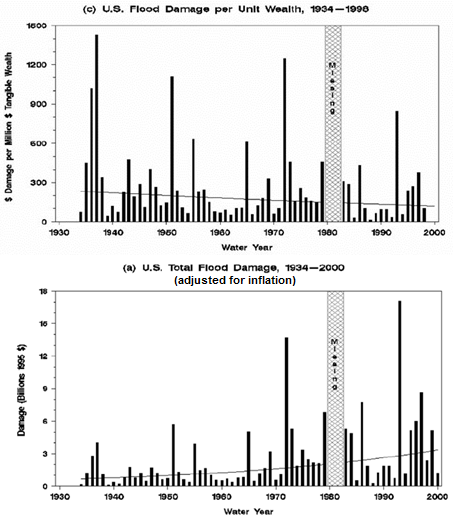
Figure 2: Two measures of US flood damage, 1934-2000
These graphics don’t tell us whether floods in the US are on the increase or not. And the Assessment doesn’t tell us either, Not only does it fail to detect any nationwide trends, it states that it never claimed any relationship between floods and man-made climate change to begin with:
Analysis of 200 U.S. stream gauges indicates areas of both increasing and decreasing flooding magnitude but does not provide robust evidence that these trends are attributable to human influences …. Hence, no formal attribution of observed flooding changes to anthropogenic forcing has been claimed.
3. Heavy Precipitation
Since the Assessment admits that there are no detectable human-induced trends in US flooding we can reasonably assume that the claimed increase in heavy precipitation events has had no impact. But we will look at the data anyway. The Assessment presents this graphic to back up its claim that heavy precipitation events are increasing over the US as a whole (Figure 3). As usual, the source of the data is not specified:
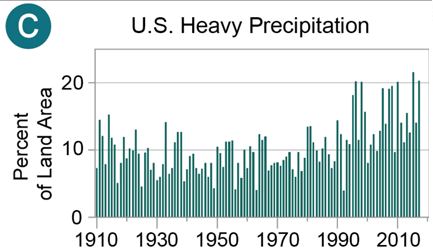
Figure 3: Percent of US land area with heavy precipitation events
The U.S. Global Change Research Program, under the auspices of which the Assessment was written, also produces graphics showing how heavy precipitation has changed with time and by region in the US (they may in fact be buried in parts of the Assessment I haven’t looked at). According to Figure 4 (from Globalchange) heavy precipitation events have increased over all of the US except the Southwest:
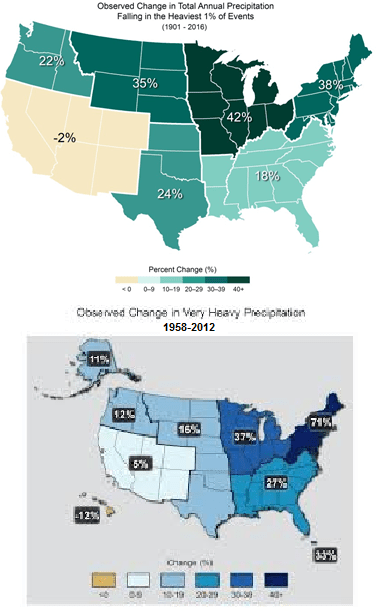
Figure 4: Increases in US total precipitation and very heavy precipitation events by region
And Huang et al (2017) produce time series showing how total precipitation and extreme precipitation in the Northeast US have both increased since about 1960 (Figure 5):
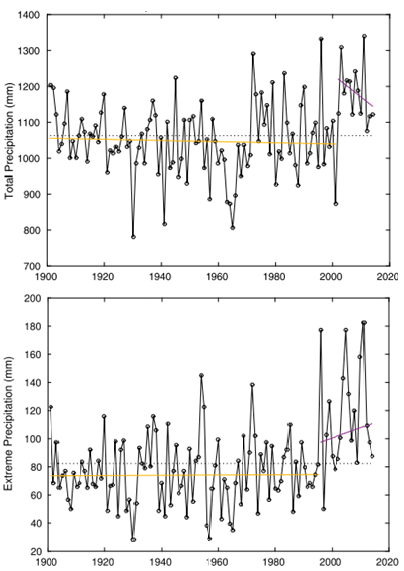
Figure 5: Increases in US total and extreme precipitation
So in this case the claim checks out against observations, or least in the northeast US. A lingering question, however, is how much of the increase in heavy precipitation was caused by man-made climate change. The Assessment implicitly assumes that all of it was, but a 2015 study by Hoerling et al. concludes that most of the changes after 1979 were caused by ocean variability:
Based on the modeling results, we conclude that anthropogenic climate change has not been a principal factor driving key characteristics of observed changes in U.S. heavy daily precipitation since 1979 …. Our results provide evidence for an alternative argument for another factor that has been operating in recent decades, namely, that statistics of U.S. heavy precipitation have been sensitive to strong decadal ocean variability since 1979
4. Heat Waves
One of the problems with heat waves is defining them (droughts and floods have the same problem). How hot does it have to get, and for how long, before a warm spell becomes a heat wave? The Assessment does not tell us. All it presents in the way of evidence for an increase in heat waves in the introductory report sections, including the 186-page “Report-in-Brief”, is this graphic (Figure 6), which shows the “heat wave season” increasing since the 1960s but not how many heat waves there were. Once again the data source is not specified, nor is the meaning of the cross-hatching:
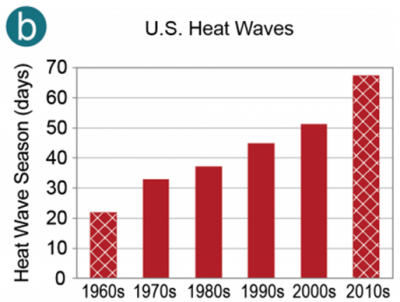
Figure 6: Length of US “heat wave season”
The next graphic (Figure 7) is another one I added from the globalchange website. It shows an increase in daily record high temperatures in recent decades but again provides no information on the number of heat waves. How many of the record highs, for example, occurred in the winter?
 Figure 7: Record daily highs in the US. The meaning of “ratio of daily temperature records” isn’t clear
The only graphic I found that provided any historic information on the incidence of heat waves was the Figure 8 plot of the EPA’s Annual Heat Wave Index. It’s not surprising that it doesn’t appear in the Assessment:
 Figure 8: US annual heat wave index since 1895
5. Wildfires
The Assessment provides two graphics to support its claim that climate change is causing more wildfires. Figure 9 shows the first. Again no data source is cited, but it turns out that it comes from the National Interagency Fire Center:
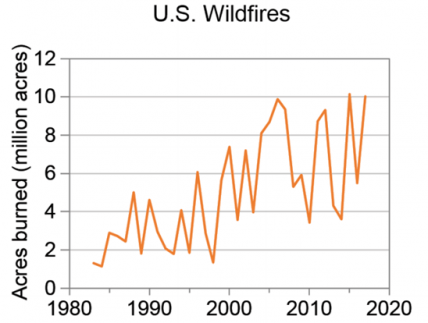
Figure 9: Acres burned by US wildfires since 1987
It also shows only a fraction of the NIFC data. Figure 10, for what it may be worth, shows the complete plot. I say “for what it may be worth” because the plot comes accompanied by this disclaimer:
The National Interagency Coordination Center at NIFC compiles annual wildland fire statistics for federal and state agencies. This information is provided through Situation Reports, which have been in use for several decades. Prior to 1983, sources of these figures are not known, or cannot be confirmed, and were not derived from the current situation reporting process. As a result the figures prior to 1983 should not be compared to later data.
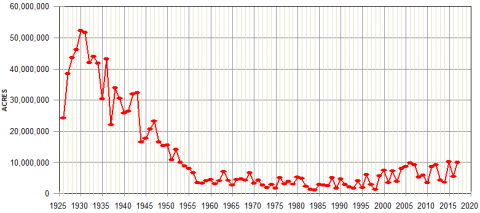 Figure 10: Acres burned by US wildfires. Figure 9 data carried back to 1926
Figure 11 reproduces the Assessment’s second graphic. It shows that about half of the increase in acreage burned was caused by climate change. (Note that it conflicts with the Figure 9 data, according to which a cumulative total of 173 million acres, not 23 million, has been burned since 1984).
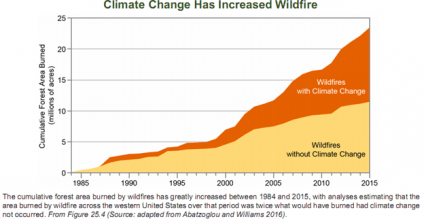 Figure 11: Acreage burned by naturally-occurring wildfires vs. acreage burned by climate-change-caused wildfires
In this case the data source is specified. It’s a 2016 paper written by John T. Abatzoglou and A. Park Williams entitled “Impact of anthropogenic climate change on wildfire across western US forests”. How did they segregate climate change-caused wildfires from naturally-occurring wildfires? They used climate models:
We quantify the influence of ACC (anthropogenic climate change) using the Coupled Model Intercomparison Project, Phase 5 (CMIP5) multimodel mean changes in temperature and vapor pressure …. This approach defines the ACC signal for any given location as the multimodel mean 50-y low-pass-filtered record of monthly temperature and vapor pressure anomalies relative to a 1901 baseline.
Before we can accept these results as meaningful we must assume that the global CMIP5 climate models can hindcast temperatures and vapor pressures to a high level of accuracy in the US, which they probably can’t (it’s generally accepted that climate models do a poor job of simulating regional changes). We also have to assume that the numerous other variables that affect wildfires have had no impact. This is a stretch, to put it mildly.
6. Atlantic Hurricanes
In this case the Assessment supplies no data, or at least none that I can find, to back up its claim that Atlantic hurricanes have increased since 1970. So once again I have had to dig up data on my own. Figure 12 (data from the US Environmental Protection Agency) plots the number of North Atlantic hurricanes since 1880. The total number is defined by the orange line, which adjusts for undercounting before 1967, and by the green line after that. There has been an erratic overall increase since about 1970, but since 1880 there has been no clear trend:
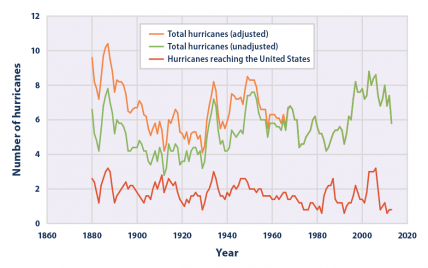 Figure 12: Unadjusted hurricane counts, hurricane counts adjusted for undercounting and hurricanes making landfall in the US
The North Atlantic, however, is not part of the US. The important consideration is how many hurricanes have made landfall in the US. These are shown by the red line at the bottom of Figure 12. There is no clear trend since 1970 and if anything a decrease since 1880.
According to Figure 13 (data from Dr. Roy Spencer) major hurricanes making landfall in the US have also been decreasing since the 1930s:

Figure 13: Major hurricanes making landfall in the US
And according to Klotzbach et al (2018) there has been little to no increase in normalized hurricane damages in the US since 1900 (Figure 13):
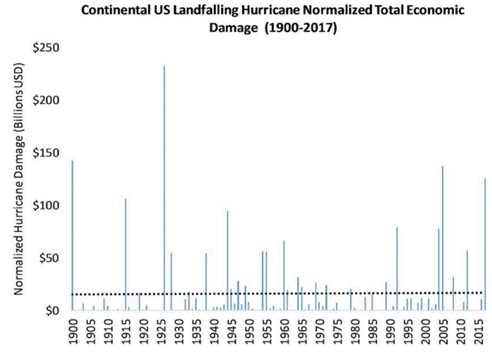
Figure 14: Normalized damages from hurricanes making landfall in the US
In this case the claim broadly matches observations but conceals (probably deliberately) the big picture, which is that man-made climate change has not increased the incidence of, or the damage caused by, North Atlantic hurricanes making landfall in the US since at least the late 1800s.
7. Tornadoes
Some storm types such as … tornadoes … are also exhibiting changes that have been linked to climate change. Once more the Assessment presents no supporting data, but NOAA’s tornado counts (Figure 15) speak for themselves:
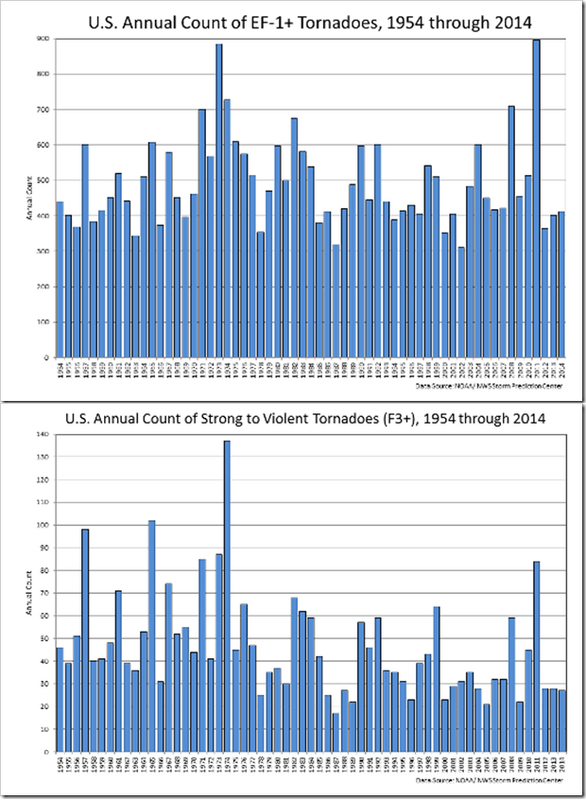
Figure 15: Total tornado and strong-to-violent tornado counts since 1954
8. Winter Storms
… winter storms … are also exhibiting changes that have been linked to climate change.
Once again there are no supporting data in the Assessment, but according to Coleman & Schwartz’s 2017 paper An Updated Blizzard Climatology of the Contiguous United States (1959–2014) the incidence of blizzards in the US has been increasing (Figure 16):
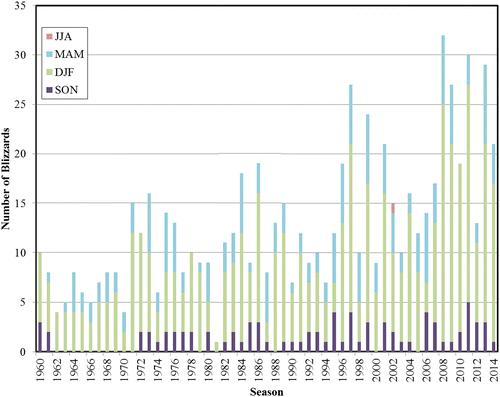
Figure 16: Incidence of blizzards in US
Is this counter-intuitive increase related to climate change? NOAA thinks it may be, although NOAA’s explanation works only in the eastern US ….
Conditions that influence the severity of eastern U.S. snowstorms include warmer-than-average ocean surface temperatures in the Atlantic. These can lead to exceptionally high amounts of moisture flowing into a storm and contribute to greater intensification of the storm. Natural variability can affect ocean surface temperatures, but as global surface temperatures increase, the temperature at any time is higher than it would have been without climate change.
…. and it doesn’t match up very well with trends in sea surface temperatures off the eastern US coast (data from KNMI Climate Explorer) ….
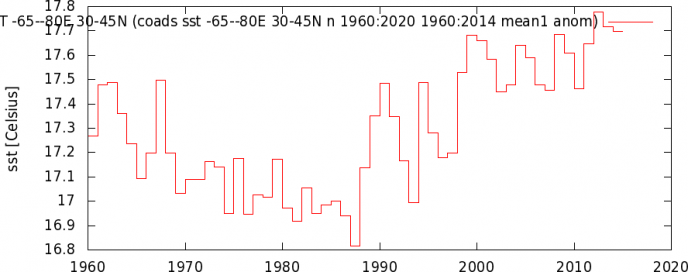
Figure 17: Sea surface temperatures along US east coast (30N-45N, 65W-80W)
… and according to the IPCC Fifth Assessment Report it’s going off in the wrong direction:
Changes in the frequency, severity, and duration of extreme events may be among the most important risks associated with climate change. In some parts of North America, this includes fewer periods of extreme cold, fewer snowstorms ….
Milder winter temperatures will decrease heavy snowstorms .…
This is one of the cases where the claim matches observational changes, but no conclusion as to causation can be reached until there is agreement over whether climate change causes a) more snowstorms, b) fewer snowstorms or c) both at the same time. My money is on c).
9. Sea Level Rise/Coastal Flooding
These are related phenomena, so I will discuss them under the same heading.
Once more there are no supporting data in the Assessment, so once more I had to go searching for some. This graphic from NOAA shows an increase in high-tide flooding that correlates with an increase in “coastal sea level” (Figure 18):

Figure 18: Average days/year with high-tide flooding vs. US sea level
And as shown in Figure 19 (data from EPA) the increased flooding is dominantly an east coast phenomenon:
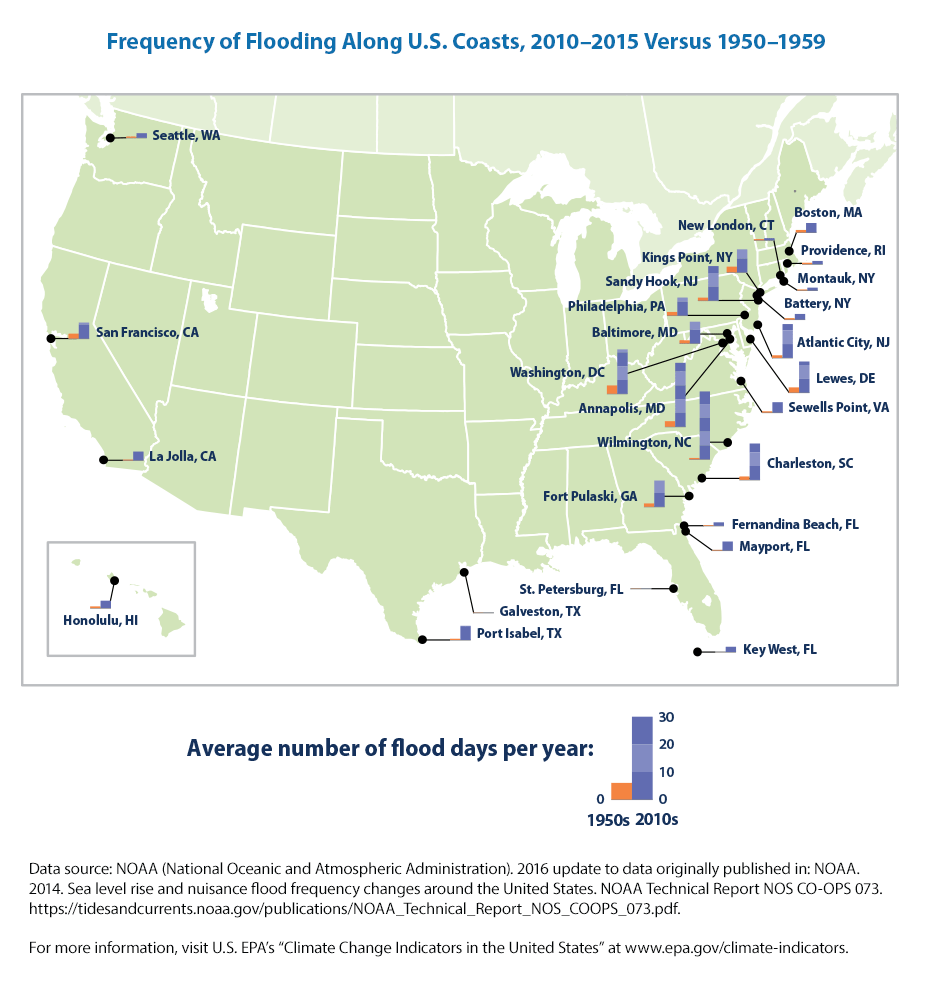
Figure 19: Average number of tidal floods/year, 2010-2015 vs. 1950-1959
But note the fine print. These are “nuisance floods” that don’t do any serious damage. There is no accepted definition of a nuisance flood, but a maximum water depth of 10cm has been proposed. And a 10cm-deep flood is hardly a catastrophic event.
And what does sea level rise have to do with the increase in nuisance floods? Not much. The reason nuisance floods are more common along the east coast of the US is that the east coast is sinking (a result of glacial rebound*, sediment compaction and groundwater extraction) while the west coast isn’t, and the rate at which the east coast is sinking exceeds the rate at which sea levels are rising in many places. The PSMSL tide gauge record from Sewell’s Point, near the mouth of Chesapeake Bay, is an example (Figure 20). The trend line shows sea level rising at an average rate of 4.5mm/year, but according to the United States Geological Survey less than half of this – maybe less than 2 mm/year – is a result of eustatic sea level rise. The rest is caused by land subsidence:
* Glacial rebound causes the land in and immediately around the ice sheet to rise while the surrounding land, which was squeezed upwards by the ice, sinks back down again.
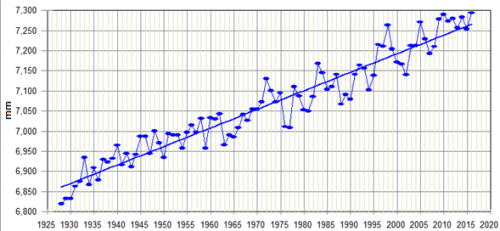 Figure Figure 20: Relative sea level rise, Sewell’s Point, Virginia
10 cm nuisance floods and ~2 mm/year sea level rises also pale into insignificance beside the hurricane storm surges that have occurred in the past and which can be expected to recur in the future along the US east coast. They reached heights of eight feet at Sewell’s point during Hurricane Isabel as recently as 2003 and 18 feet along the North Carolina coast during Hurricane Hazel in 1954.
My 2016 post on Isle de Jean Charles, Louisiana describes how sea level rise routinely takes the blame for inundations it didn’t cause. The Assessment cites it as an example of climate change in action.
10. Glaciers and snowpack
North American glaciers have indeed been retreating, as the Assessment claims. But according to Oerlemans (2005, Figure 21) they have been retreating since about 1825 and retreating rapidly after 1890, well before human-induced climate forcings became significant. This raises the question of whether the retreat has anything to do with man-made climate change:

Figure 21: Glacier retreat since 1700. The green line is North America
No data are available on snowpack, but Rutgers University publishes North American snow cover data (Figure 22). The trend line shows only a very minor decrease since 1975:
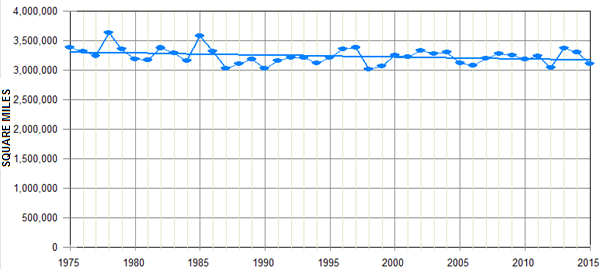 Figure 22: Snow-Covered Area in North America, 1972-2015
11. Injuries, Illnesses and Death:
Climate-related changes in weather patterns …. are affecting the health and well-being of the American people, causing injuries, illnesses, and death.
No data on illnesses or injuries are readily available, but over the last ten years approximately 25 million people have died in the US. According to Wikipedia
natural disasters of the type that commonly get blamed on climate change (hurricanes, floods, blizzards, wildfires, tornadoes) have claimed only 1,200 lives over this period.
Conclusion:
In this post I have fact-checked eleven separate climate change impacts which according to the Assessment’s summary sections are already doing damage in the US. In six of these cases (heavy precipitation, heat waves, wildfires, winter storms, sea level rise/coastal flooding and glacier retreat) there is observational evidence – most of which I have had to dig up myself – for impacts that might be related to man-made climate change, but in all of them this evidence is equivocal (e.g. wildfires) or the impacts are insignificant (e.g. nuisance tidal floods). In the other five cases (droughts, floods, Atlantic hurricanes, tornadoes, and injuries, illnesses and deaths) the observational evidence either contradicts the Assessment’s claims or the Assessment admits later in the text that the claim isn’t valid (droughts and floods).
Clearly the Assessment was conducted with little regard for the facts. A disregard for the facts, however, is necessary if one wishes to get the climate change catastrophe message across.
Ex-Canadian Diplomat: UK’s Anti-Russia Info Ops Mark Decline in Western Values
Sputnik – 04.12.2018
United Kingdom’s anti-Russian propaganda operations are a sign that Western values related to freedom of expression are on the decline, former Canadian diplomat Patrick Armstrong told Sputnik.
On Monday, the international hacktivist group Anonymous released a new package of documents of the anti-Russian UK Integrity Initiative project. In particular, the documents include fake proof of Russian interference in the 2017 Catalan independence referendum disseminated among Spanish politicians and media.
The revelations undermined the credibility of the United Kingdom’s and Western media, Armstrong pointed out. “Only a couple of decades ago we were boasting about Western values of freedom of speech and thought,” Armstrong said. “Not today.”
These United Kingdom operations marked another step in “the decline of the West,” Armstrong added, as its rulers try to counter any discussion they disagree with by portraying it as fake news.
“Our rulers are determined that their stories must not be challenged and thus they try to shut down all discussion. Accept, Believe, Repeat. Anything else is ‘fake news,’” Armstrong said.
According to the first document leaked by Anonymous last month, the project was in fact a “large-scale information secret service” sponsored and created by London.
However, the latest leak suggests that “the British government goes far beyond and exploits the Integrity Initiative to solve its domestic problems inside the United Kingdom by defaming the opposition.”
Until his retirement, Armstrong was a Canadian diplomat who was a specialist on the Soviet Union and Russia. He previously served as political counselor in the Canadian Embassy in Moscow.
Featured Video
Rewriting the risk? Inside the government’s vaccine safety messaging
or go to
Aletho News Archives – Video-Images
Book Review
“Davos Can Really Replace the UN”
Inside the book that maps the architecture behind global governance — from the Epstein files to the Pact for the Future
Lies are Unbekoming | April 1, 2026
On June 13, 2019, the United Nations and the World Economic Forum signed a partnership deal to “accelerate the implementation of the 2030 Agenda for Sustainable Development.” That same evening, WEF president Börge Brende — Norway’s former Foreign Minister — had dinner with Jeffrey Epstein at Epstein’s Manhattan townhouse. The Epstein files, released January 2026, contain an exchange between the two from the previous year. Epstein to Brende: “Davos can really replace the UN. C21, cyber, crypto . genetics… intl coordination.” Brende back to Epstein: “Exactly — we need a new global architecture. World Economic Forum (Davos) is uniquely positioned — public private.”
The next day, the UN General Assembly adopted the framework for restructuring global governance.
That sequence — the partnership signing, the Epstein dinner, the candid admission about replacing the UN with a public-private architecture, and then the formal adoption — opens Jacob Nordangård’s The Digital World Brain. Pages two and three. Footnoted to the UN resolution number, the Epstein files, and the General Assembly record.
I keep coming back to it because it captures what this book does that almost nothing else in the independent research space manages. I’ve followed Jacob’s work for years now and interviewed him about his research. Each book peels back another layer of the same institutional architecture, and each time I think he’s reached the limit of what can be documented, the next one goes further. Nordangård doesn’t speculate. He doesn’t editorialize much. He lays institutional actions next to each other in chronological order and lets the pattern announce itself. … continue
Blog Roll
 Aletho News
- How I fell foul of the BBC thought police
- The End of NATO
- 37 days of war on Iran cost US staggering $42bln, tracker shows
- Baghdad tells Asian refiners, traders to begin loading Iraqi crude amid Iranian exemption
- Under fire, Moscow and Tehran close ranks
- Iran, US receive Pakistan-mediated plan for ceasefire then final deal
- Iran submits demands for end to war as mediators scramble ahead of Trump deadline
- Iran Threatens Retaliatory Strike on Stargate AI Project in UAE
- US sent ‘a lot’ of arms to Iranian protesters – Trump
- Barak Ravid Launders Deception To Allow Trump To Back Off Of His Power Plant Threat – Again
- If Americans Knew
- U.N. experts demand Israel release prominent Gaza doctor after reports of ‘severe torture’
- Israel’s Latest Genocide Is Against the Shias of Lebanon. Why Is the World Silent?
- How Eliot Cohen’s influence over U.S. war-making paved the way for Trump’s war crimes in Iran
- Israelis don’t pay for the weapons we ‘sell’ to them — US taxpayers do
- While Distancing from AIPAC, Most 2028 Democratic Hopefuls Are Still Embracing Israel
- A brief history of the Israeli nuclear program, the open secret at the heart of the Iran war
- Israeli Settlers Killed a Palestinian Farmer on His Own Land, in Front of His Father. Yes, Again
- The US-Israeli War on Science is an Assault on our Future
- 100+ International Law Experts Say US Strikes on Iran Violate UN Charter, Could Be War Crimes
- ‘Vile, Horrifying, Evil’: Trump Threatens to Bomb Nation of 90 Million People ‘Back to the Stone Ages’
- No Tricks Zone
- An Inconvenient Tree: Uncovered In Alps… Europe Much Warmer Than Today 6000 Years Ago
- New Study Reports A 60% Slowdown In Greenland’s Ice Loss Rate In The Last Decade
- Low Intensity Tornado Wrecks Major Solar Farm, Creating A Potential Toxic Dump
- New Study Finds Warming Saves Lives…Cold Temperatures 12 Times More Deadly Than Excess Heat
- German Science Blog Accuses PIK Climate Institute Of Hallucinating Climate Tipping Points
- Devastating Assessment Of Comirnaty Vaccine By Former Senior Pfizer Europe Toxicologist
- New Study: CO2 Is ‘Effectively Negligible’ As An Explanatory Climate Change Factor Since 2000
- Former Pfizer Toxicologist Dr. Helmut Sterz Tells Bundestag Hearing Pfizer Vaccine Should Have Never Been Approved
- Energy Expert: Germany’s Nuclear Phaseout Was A “500 Billion Euro Mistake”
- New Research: South Australia’s Mid-Holocene Sea Surface Temperatures Were 4°C Warmer Than Today
 Aletho News