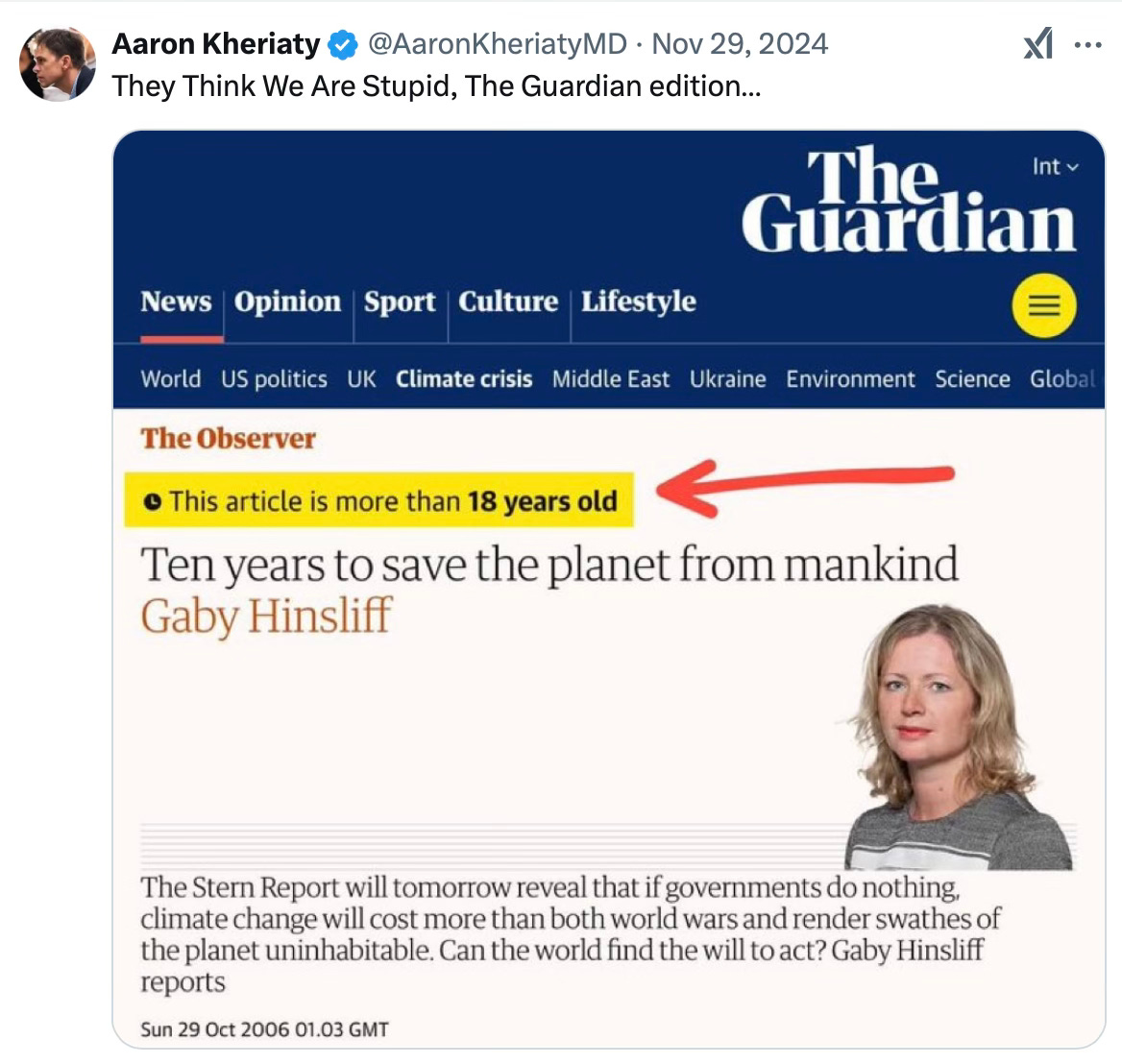
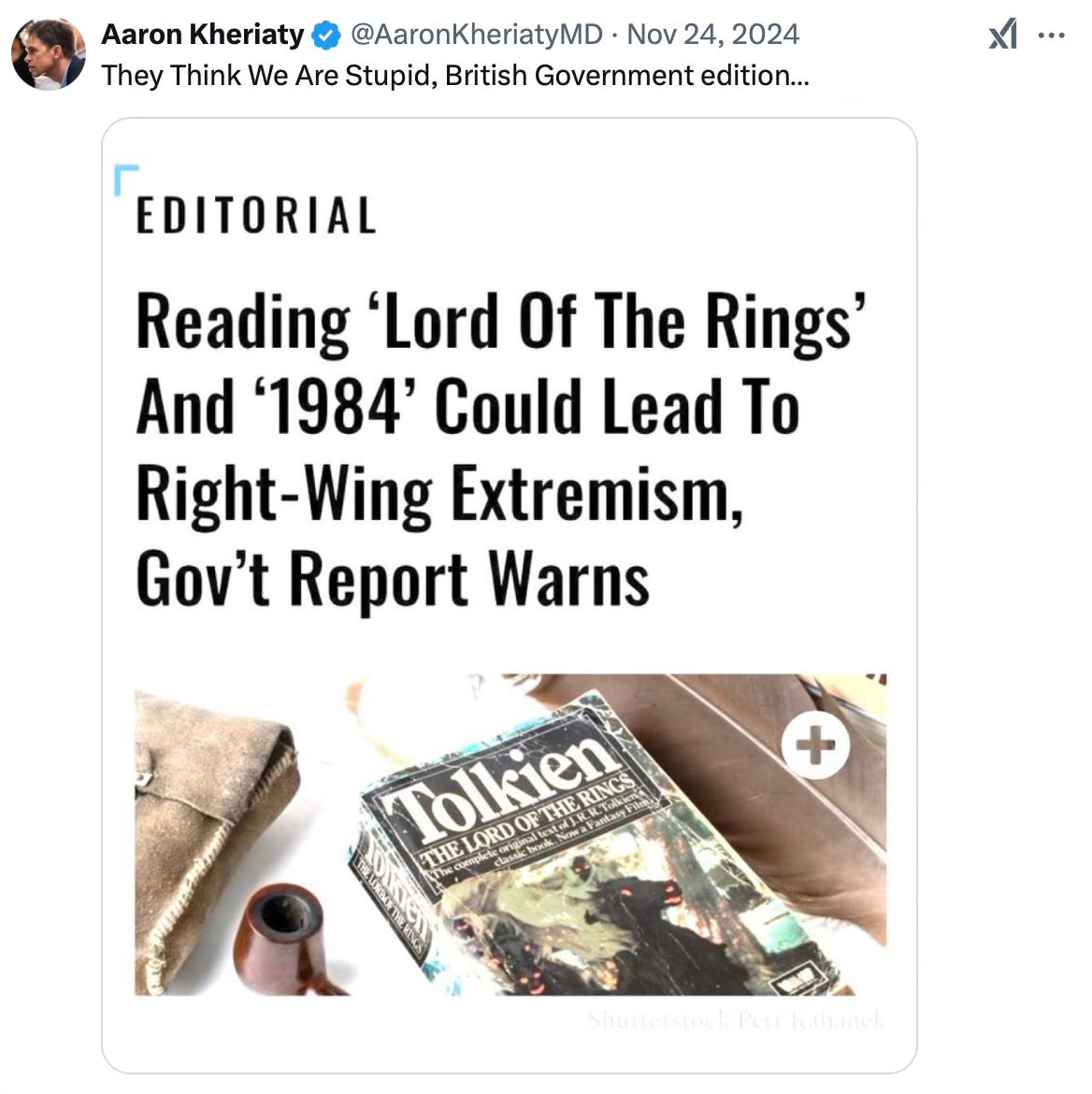
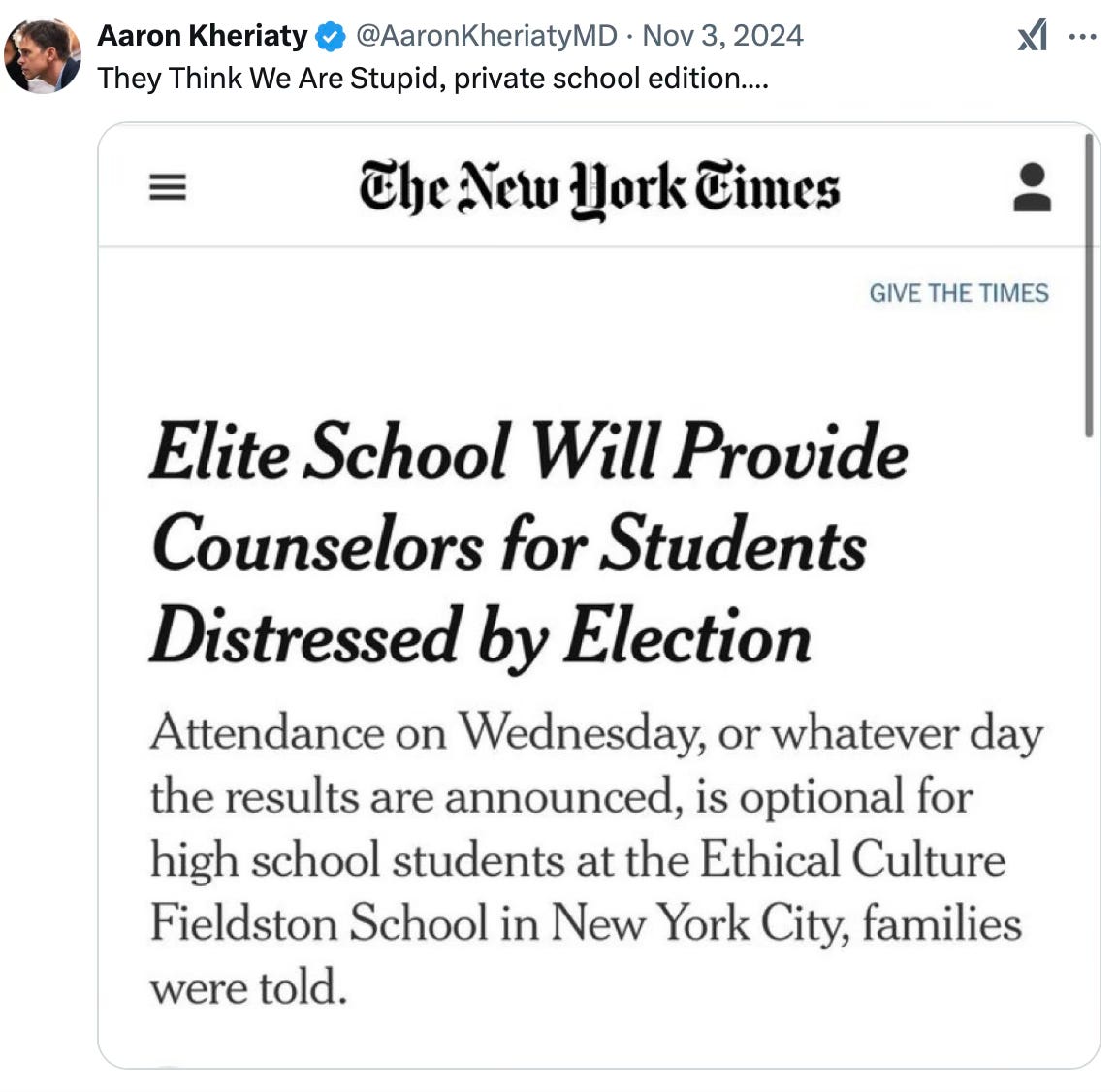
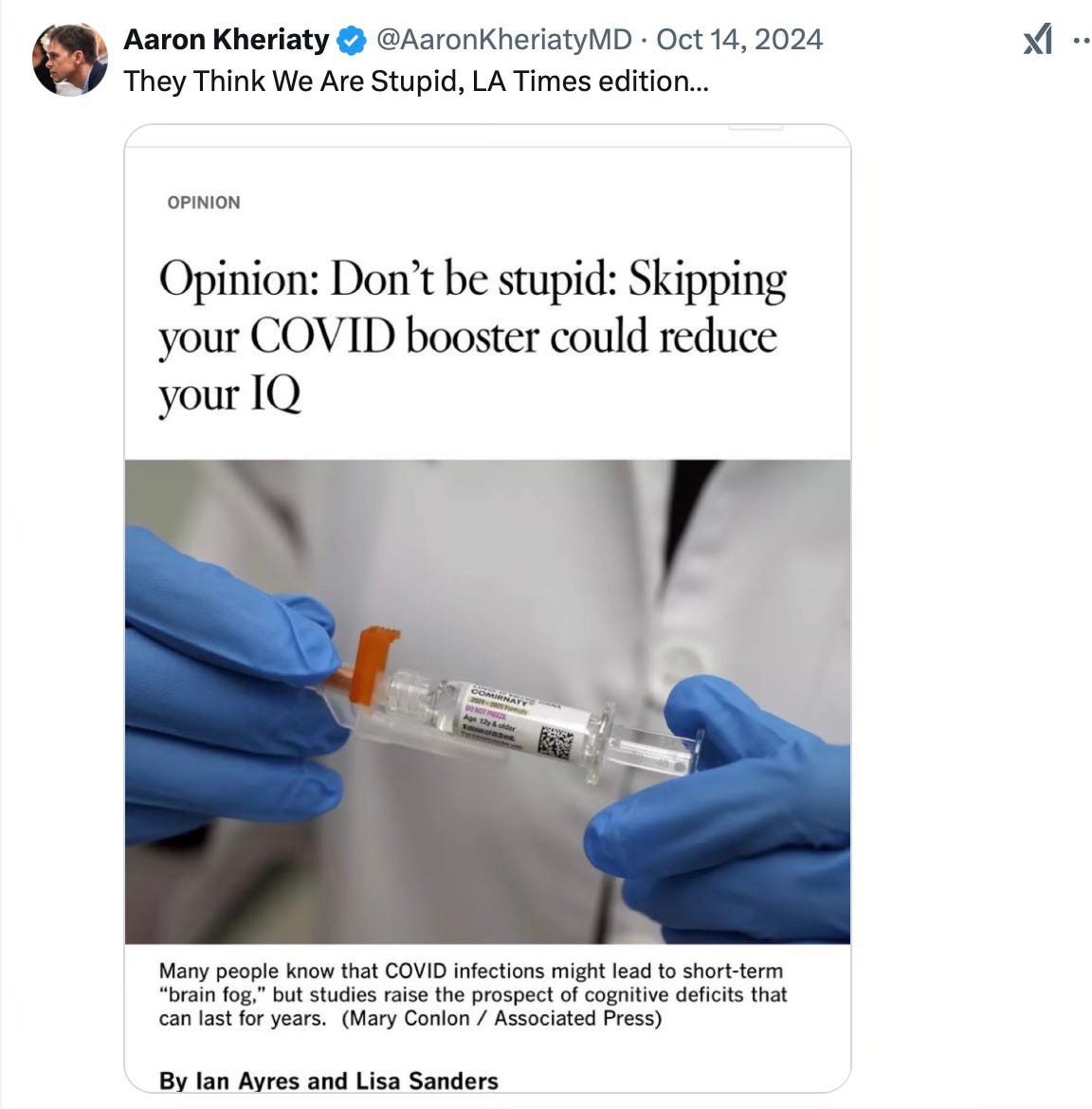
They Think We Are Stupid, Volume 14
Everything you need to know about our ruling class’s opinion of you. As always, these headlines are presented without commentary.
By Aaron Kheriaty, MD | Human Flourishing | February 24, 2025
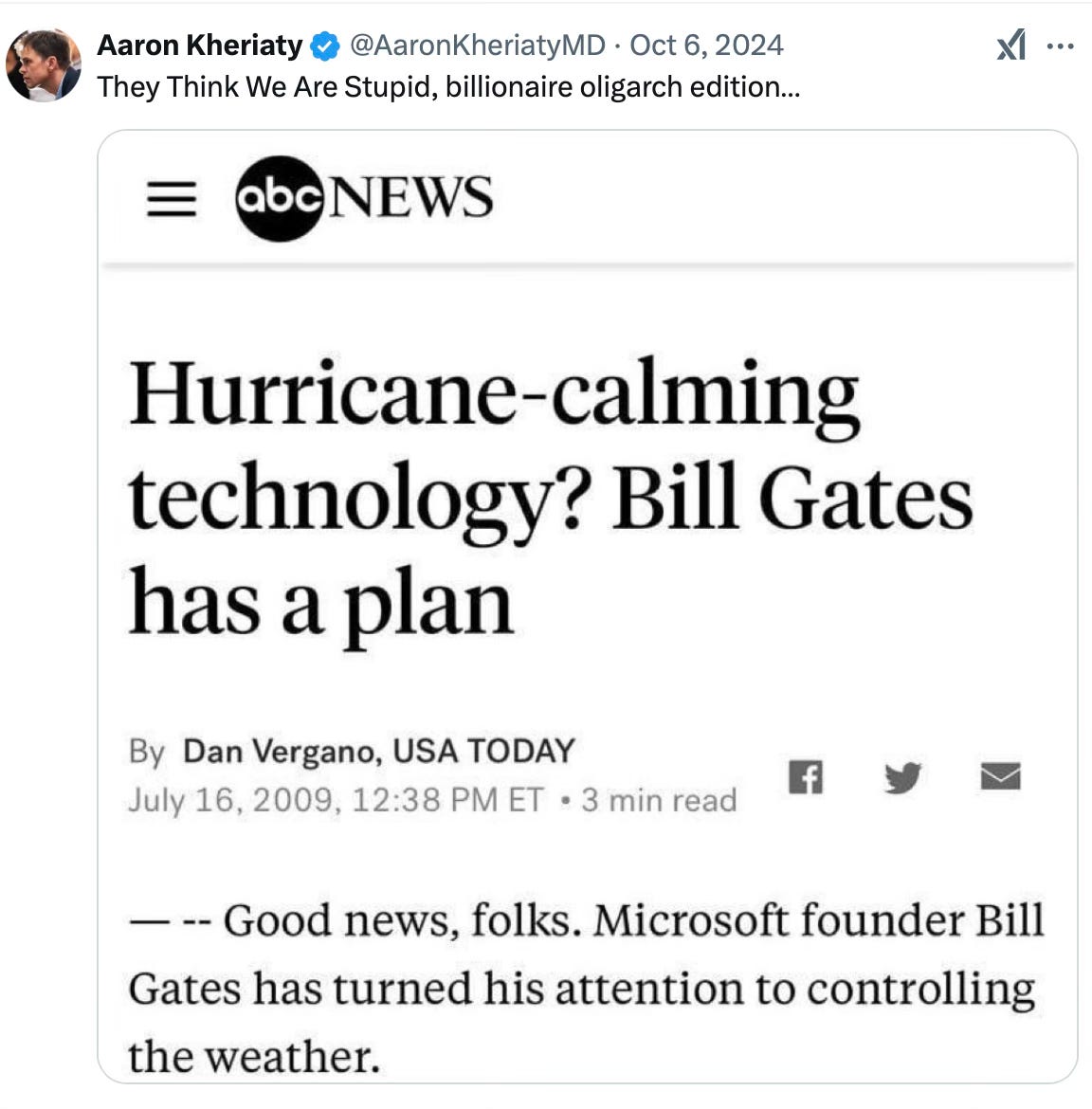
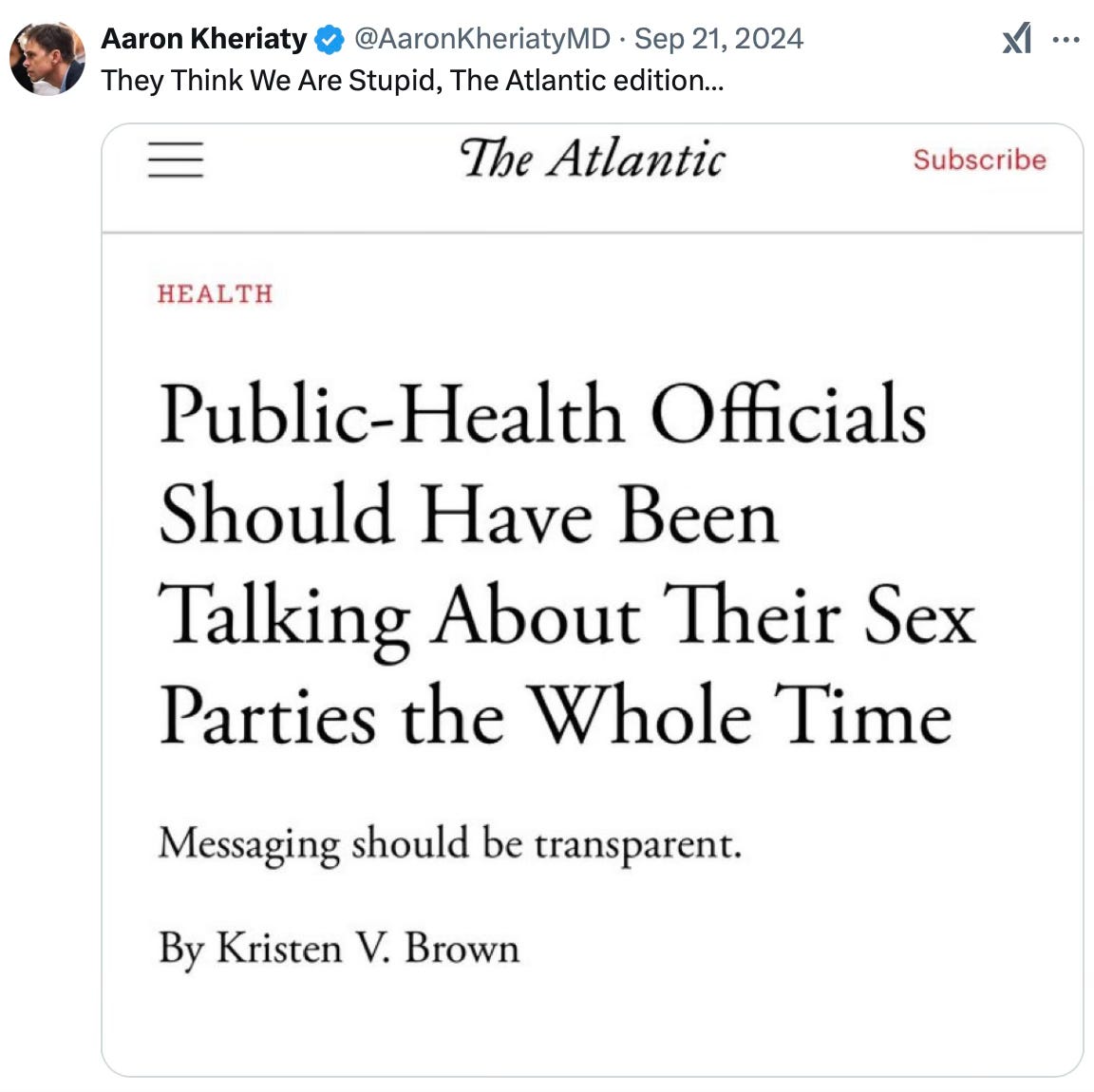
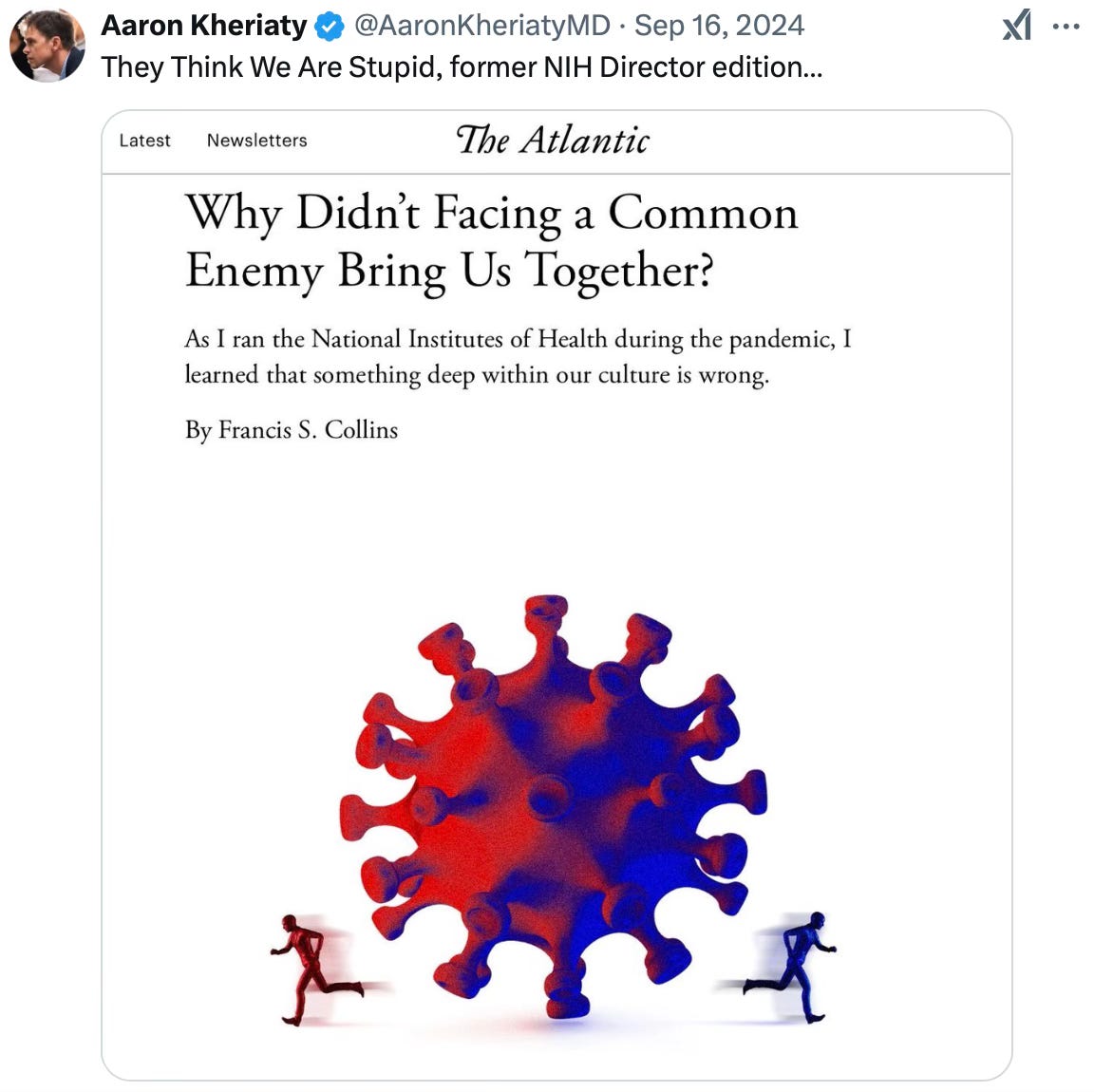
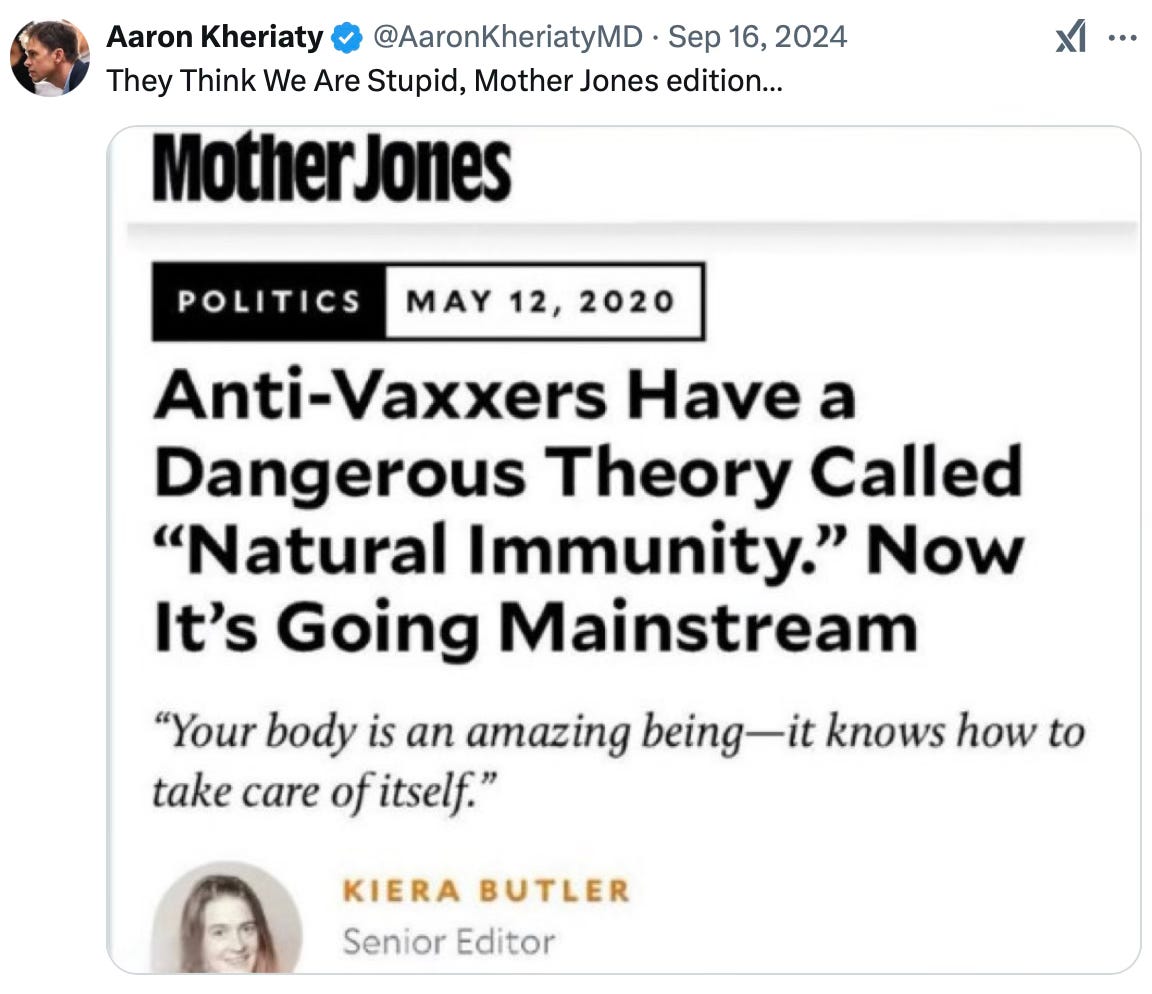
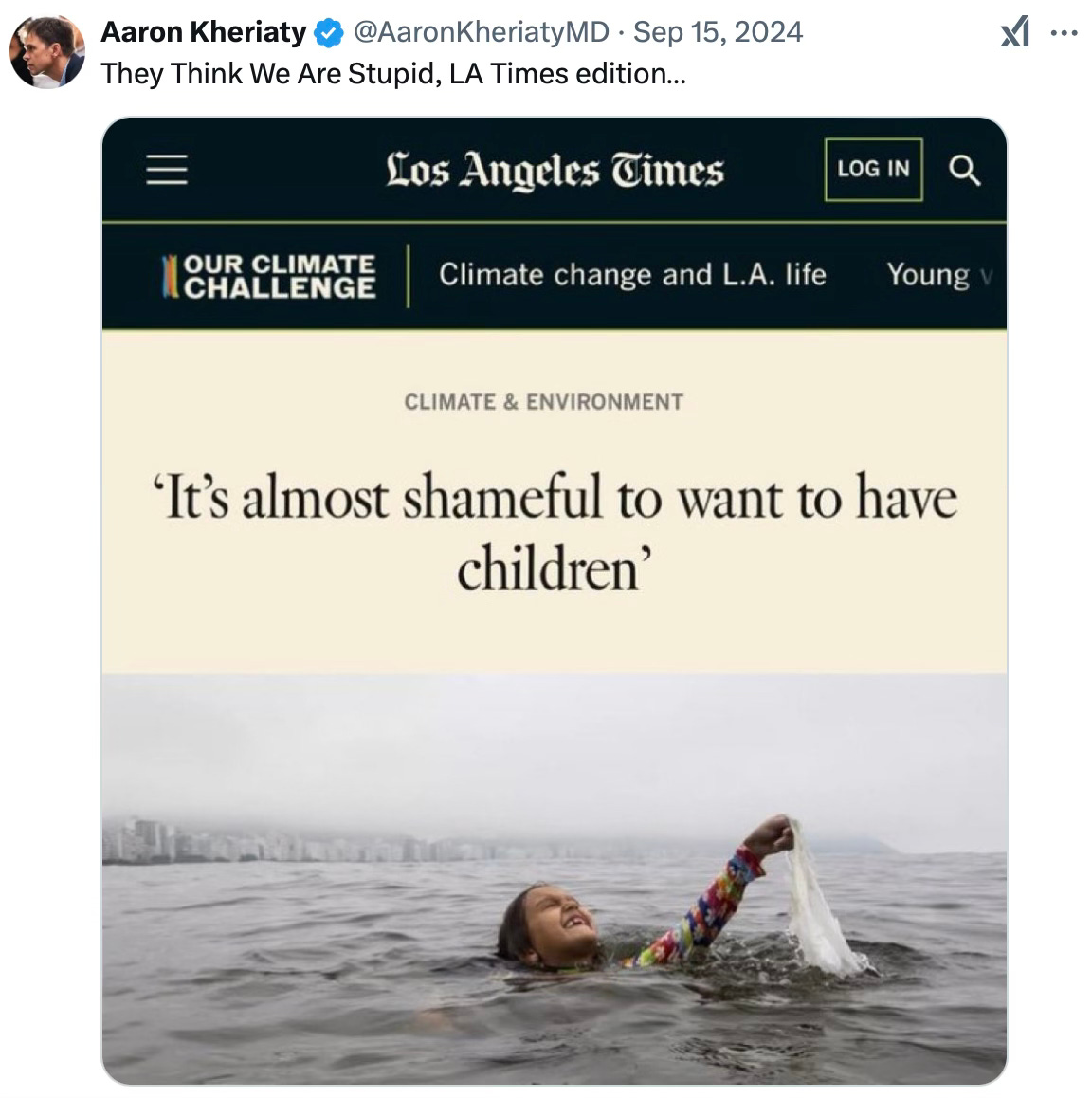
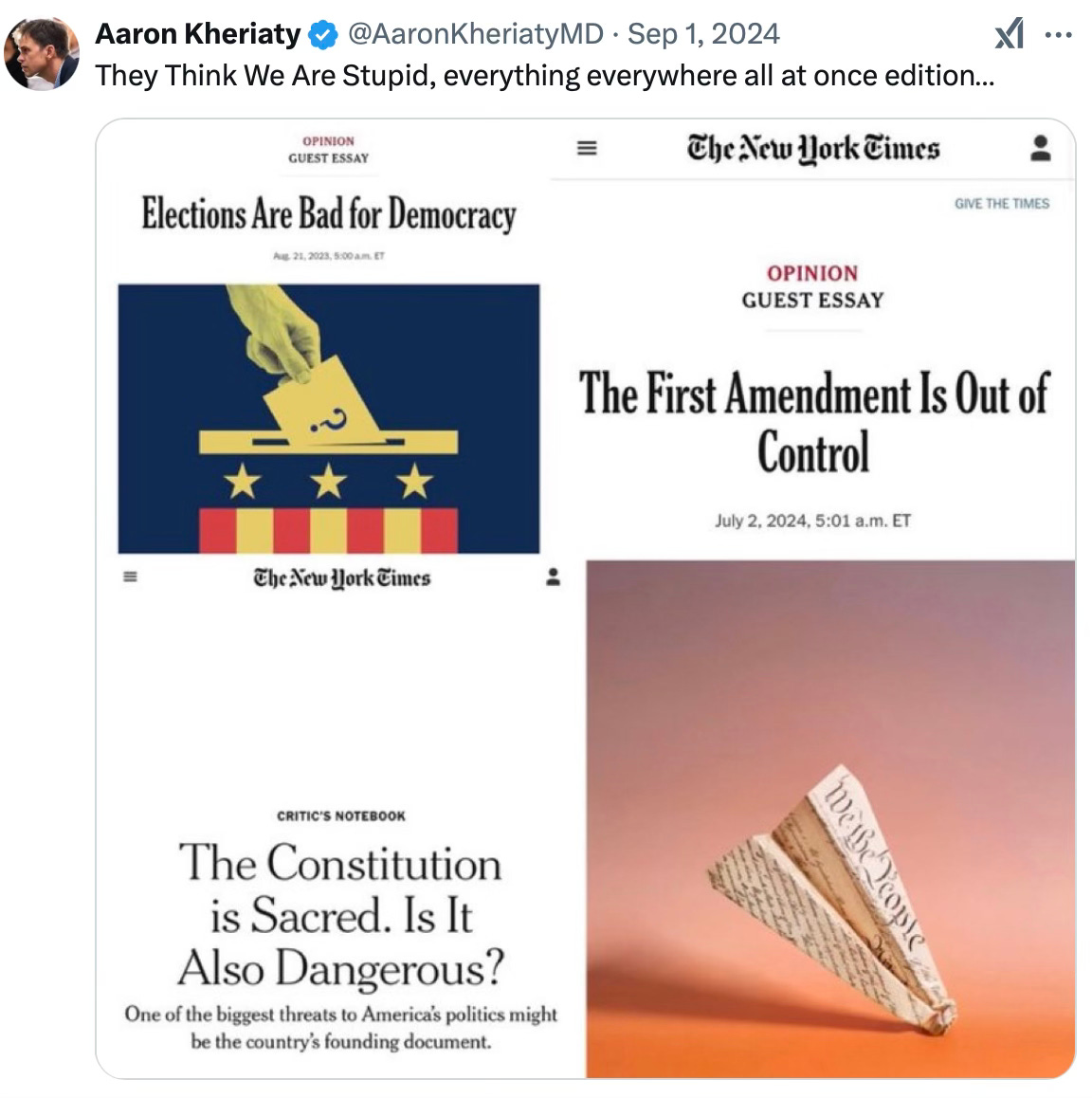
Wrong, Politico, Climate Change Does Not Threaten the EU’s Survival, But Climate Policy Does
By Linnea Lueken | Climate Realism | February 19, 2025
A recent Politico article, “Climate change threatens EU’s survival, German security report warns,” claims that “global warming will exacerbate conflicts, hunger, and migration worldwide, with growing risks for Europe.” Evidence undermines these claims. In reality, the world is not suffering destabilization due to climate change, but European populations are far more likely to suffer from climate policy, as Politico briefly mentions.
Politico reports on a “landmark” political report from the German federal intelligence service (BND) that attempts to assess “the dangers climate change poses to German and European security over the next 15 years.” The report concludes that “climate change’s destabilizing effects will drive up migration and food prices, threatening economic and political upheaval,” and “the unequal impact of rising temperatures in the EU — with southern countries hit worse than others — risks tearing the bloc apart.”
Politico goes on to claim that as global average temperature rises, “so do the frequency, severity and intensity of flood-triggering extreme rainfall, deadly heat waves, harvest-destroying droughts and the conditions that allow wildfires to spread easily.”
These claims are false, as available data proves.
While rainfall has modestly increased over northern latitudes that contain the European Union member states, extreme rainfall that causes flooding has not. Claims that recent flooding events were “supercharged” or worsened by climate change are pure speculation based on attribution modelling. Data and historical records of flood frequency and severity debunk claims of unprecedented flooding. Recent flooding in Spain, for instance, was blamed on climate change by attribution groups, but the storm that hit Spain was consistent with a long history of similar storms that are not becoming more severe or frequent. In the Climate Realism post, “Flooding Facts Drowned by Climate Hysteria: The BBC Ignores Spain’s Weather History,” meteorologist Anthony Watts and H. Sterling Burnett describe the history of the region struck by the floods:
Valencia, which sits along and at the mouth of the Turia River on the Mediterranean Sea, suffered similar flooding, for example, in 1897, 1957, and 1996, 127, 67, and 28 years of warming ago, respectively, when temperatures were cooler than at present.
…
As Caroline Angus’ account of the 1957 Valencia flood reveals, these conditions are neither new nor unprecedented. The BBC’s focus on “climate change” and a warmer atmosphere as the primary cause of the recent flooding ignores the atmospheric mechanics behind these storms and downplays the recurrent pattern of similar natural events.
Likewise, Climate Realism debunked other regional European flooding events, here.
Heatwaves and drought are likewise not getting worse, and contra Politico and the German report’s claims, crop production is not declining in Europe due to those conditions, as pointed out in numerous Climate Realism posts, here, here, and here, for example. Wildfires are also on the decline globally.
Interestingly, Politico and the German report do admit that government response to climate alarmism may also cause tension. Politico reports that policies meant to address climate change “will cause tensions, noting that carbon pricing — the backbone of EU climate efforts — disproportionately affects poorer households.” This fact should be obvious to anyone. Carbon pricing does not bother the elites, who can afford higher energy prices.
Politico and the report authors also warn “the cost of decarbonization and its (perceived) unfair distribution … provide space for populism, right-wing and left-wing extremism, and disinformation campaigns[.]”
That claim should be taken further, it already has caused tensions, and has contributed to a growing threat to European food supplies, resulting in frequent mass protests in multiple countries by farmers. Not only that, but its not a perception that the distribution of the costs is unfair, it is a fact. Looking beyond carbon taxes, the push for electric vehicles is a subsidy for a luxury product that most cannot afford. London’s “ultra low emission zones” (ULEZ) are basically a tax on the poor who cannot afford to purchase new electric or low emitting hybrids.
What is true for Europe with regards to crop production is also true for other major crop producing parts of the world, and so climate change is not driving or likely to drive mass migration that could destabilize Europe. Climate Realism has debunked claims that climate change was causing mass emigration in multiple posts, here, here, and here, for instance.
If Politico and German leaders are worried about “populism” and right leaning sympathies rising in their nations due to concerns about mass immigration from unstable parts of the world, then perhaps they could impose restrictions on immigration, no need to blame climate change.
It’s shameful that Politico and the German government are downplaying the harm that the unnecessary, unjustified, climate policies which they have supported have had on Europeans. Extreme weather is not getting worse, but the impacts of government overreach and taxation in the name of climate change are.
EU Wildfire Trends 2024
By Paul Homewood | Not A Lot Of People Know That | February 23, 2025

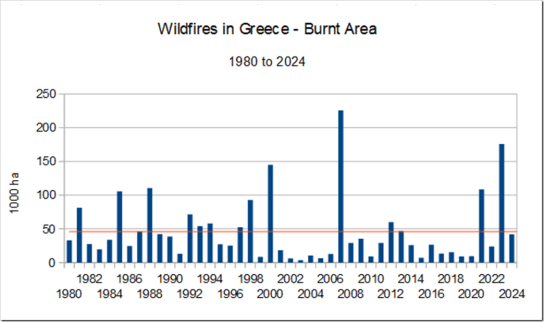
Wildfire activity in southern Europe was below average last year, according to the latest data from the EU. The trend is clearly downwards since 1980, contrary to the disinformation spewed by the establishment media.
The BBC’s Matt McGrath, for instance, recently claimed that a warmer world increased the chances of devastating wildfires occurring, while the Guardian’s Damien Carrington also falsely stated that “globally, scientists agree that climate change is increasing the global risk of wildfires starting and spreading”.
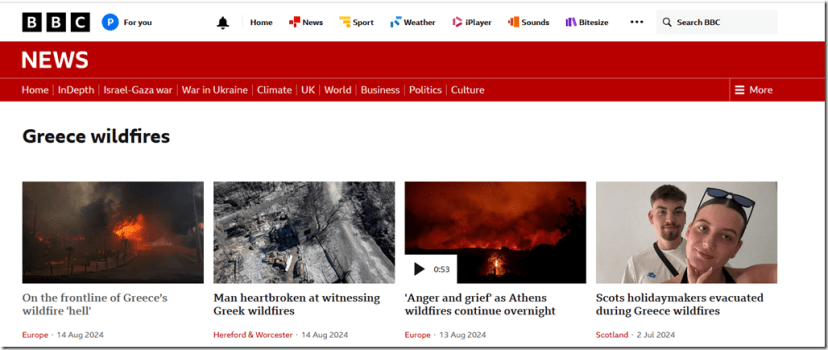
Last summer the BBC went into full propaganda mode over some fires in Greece, even though the burnt area was actually below average:
And in December, a BBC World Service broadcast falsely claimed that a warmer earth was making “deadly fires in Spain and Greece increasingly common”.
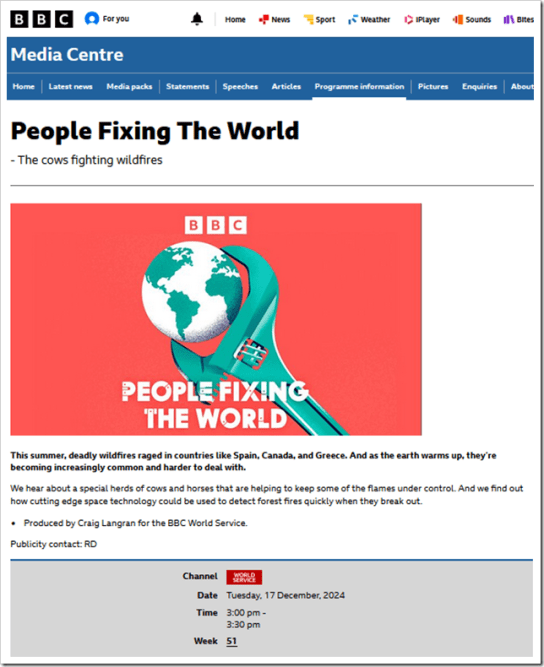
The BBC – the place where facts go to die!
Sources
1) Data for 2024 is from Copernicus: https://forest-fire.emergency.copernicus.eu/apps/effis.statistics/seasonaltrend
2) Earlier data id from the EEA: https://www.eea.europa.eu/data-and-maps/daviz/burnt-forest-area-in-five-4/#tab-chart_5
and EFFIS:
https://effis.jrc.ec.europa.eu/reports-and-publications/effis-related-publications
Is It Foreign Aid or Covert Action?

By Philip Giraldi • Unz Review • February 21, 2025
There has been considerable controversy surrounding the Trump administration decision to cutback on government agencies that are ostensibly committed to charitable, educational and other nation building activities both overseas and in the United States. This spending, amounting to scores of billions of dollars, has helped produce budget deficits that ballooned in the twenty-first century, largely due to the surge in overseas activity that occurred after the trauma of 9/11 when the United States decided that it had to serve as policeman for the rest of the world to make itself safe. As the US is now verging on bankruptcy due to its unsustainable debts, the second incarnation of the Trump Administration has focused on cutting budgets in areas that it considers to be enemy occupied, often meaning “woke” or institutionally allied to the Democrats. Social programs as well as the bloated defense department spending were considered to be suitable targets so starting during the first week in February, the White House brought down the hammer when it went after a number of government agencies, inter alia calling for huge cuts in Pentagon spending and the complete elimination of the Education Department.
The White House also shut down the United States Agency for International Development (USAID), firing nearly all of its 10,000 employees, reportedly leaving only little more than 600 employees in place to assist in the shutting down or downsizing of facilities in the US and in foreign countries. Also, about 800 awards and contracts that are administered through USAID were reportedly being canceled. There have reportedly been some judicial delays in the firings due to the complexity of removing thousands of employees and families from overseas offices and housing, though the pause is likely to be only temporary.
Tax dollars are traditionally used corruptly to fund projects and policies dear to the hearts of politicians, which is why Ron Paul and others have called for sweeping audits, including of the Federal Reserve system and the Pentagon in particular. This hidden spending is particularly difficult to identify if the program is somehow linked to foreign policy and/or national security, which have traditionally been protected from scrutiny by denying nearly all public access to sensitive information based on the “need to know” principle to safeguard sources and vulnerable activities.
USAID was founded in 1961 during the John F. Kennedy administration to unite several foreign assistance organizations and programs under one agency. At first it was seriously intended to be a mechanism for the US to aid in health, disaster relief, socioeconomic development, environmental protection, democratic governance and education. Its focus, however, eventually became to guide development in parts of the world that suffered from what were considered to be dysfunctional governments and institutions in terms of American interests. USAID has always been funded by the federal government and its upper management has worked closely with the Department of State, to which it is technically accountable, and the intelligence agencies in particular. Its budget in 2023 was $43 billion. Trump’s reduction in force (RIF) of USAID has been accompanied by a shake-up in its management, its remaining responsibilities now being in the hands of the Secretary of State Marco Rubio, who has considerable experience in special agency management after having served on the Board of the National Endowment for Democracy’s (NED) Republican subsidiary component, the International Republican Institute (IRI). NED, which operates extensively overseas, has also been stripped of funding by Trump.
The dismantling of USAID does not necessarily mean the organization will completely go away, it will just be much reduced and under new management. It will likely have a new mission, though no one is at this point sure what that will mean. And USAID and NED are not alone as the presidential memo has called for a halt to the funding of all the government components that are dependent on taxpayer generated funds to provide what is perhaps euphemistically referred to as “foreign aid.” USAID and NED do have humanitarian projects, i.e. feeding the hungry, but they are primarily politically driven. The NED component IRI puts it this way on its website “Our mission at IRI—advancing democracy worldwide—is a battle with many fronts. I am proud to say that IRI is supportive of every endeavor that will bring freedom to more people. We have made progress in our mission by giving hope to those who wish to protest on a city street, run for office, or cast a ballot.”
So the aid organizations overtly have a political role, but how does it translate in practice and does it extend to playing favorites with the US media and political parties? Trump has put it another way, declaring that USAID leaders were “radical left lunatics.” This is what he claims on his website Truth Social:
“LOOKS LIKE BILLIONS OF DOLLARS HAVE BEEN STOLEN AT USAID, AND OTHER AGENCIES, MUCH OF IT GOING TO THE FAKE NEWS MEDIA AS A ‘PAYOFF’ FOR CREATING GOOD STORIES ABOUT THE DEMOCRATS. THE LEFT WING ‘RAG,’ KNOWN AS ‘POLITICO,’ SEEMS TO HAVE RECEIVED $8,000,000. Did the New York Times receive money??? Who else did??? THIS COULD BE THE BIGGEST SCANDAL OF THEM ALL, PERHAPS THE BIGGEST IN HISTORY! THE DEMOCRATS CAN’T HIDE FROM THIS ONE. TOO BIG, TOO DIRTY!”
There are, in fact, credible reports that the 2019 impeachment of Trump was driven by the actions and disinformation coming from CIA, FBI and USAID operatives, so it is plausible to assume that Trump is now settling scores. Beyond that, USAID and NED are both notorious for their roles in the business of covertly supporting opposition political parties worldwide and assisting in regime change. Billionaire philanthropist George Soros, through his network of organizations, received $260 milllion from USAID for funneling funds to non-governmental-organizations (NGOs) connected with Soros’ Open Society Foundations, which are known for advocating for radical policies and regime changes globally. Soros is also a Democratic Party favorite and major fund raiser, having recently received at a White House ceremony the honor of the Presidential Medal of Freedom presented in absentia to his son Alex from outgoing President Joe Biden.
As a result, both USAID and NED have been banned from foreign countries, including Russia, due to their meddling in local politics. Hungarian Prime Minister Viktor Orban, who was often a target of USAID activity, immediately thanked Trump for his decision to cancel USAID. Both USAID and NED were deeply involved in Eastern Europe. Former Acting Deputy Secretary of State Victoria Nuland has revealed that the aid agencies were deeply engaged in the multiple source $5 billion dollar multiyear US “investment” in Ukraine that culminated in regime change in 2013 and led to the current war with Russia. In government circles it has frequently been asserted that USAID and NED and other such organizations now do what the CIA used to do routinely in terms of regime change between its founding and the 1990s.
One might suggest that recent US governments, operating through their various subsidiaries like USAID and NED have been funding just about everything to control a world community in line with American interests. Mainstream media worldwide that is directly or indirectly funded reportedly includes journalists, news outlets, and activist NGOs and sites – and that’s just through USAID. That would appear to include Reuters, Associated Press, BBC, The Guardian, NBC, CNN, NPR, NYT, Politico, PBS, The Financial Times, The Atlantic, The Daily Telegraph, as well as much more media in the developing world. The anti-China hysteria media “ecosystem” currently depends on US government funding, and is already complaining about the impending shutdown of USAID support. To cite only one example of how it is packaged, Reuters news service has received millions in funding from the US government specifically for “active social engineering.”
Labor unions are also funded by USAID which is also behind the recent political unrest in Slovakia. It has also paid for multiple coup attempts in Venezuela, funded high profile trips for Ukraine’s Volodymyr Zelensky to improve his image and popularity, and funded al-Qaeda linked groups in Syria to successfully overthrow the government in Damascus. Going back to Trump’s first term of office, it is interesting to observe that most of the “aid” to opposition parties to overthrow Nicolas Maduro in Venezuela was delivered during 2019, so Trump, guided by hardliners John Bolton and Mike Pompeo, was not at that time shy about regime change. In fact, Voice Of America (VOA), which often served as a CIA mouthpiece, even reported that Trump had tripled aid to opposition figure Juan Guaido to $56 million. Those asking themselves why Trump has now decided to “oppose” the very semi-covert agency that he’s also been using for regime change have a point, but it might be appropriate to see the shakeup as a warning against government information, law enforcement and intelligence agencies again becoming tools of the Democratic Party politicians.
Defenders of USAID are arguing that the agency is being maligned, that in addition to its political profile it is heavily engaged in promoting health and wellness worldwide. The head of USAID under Joe Biden was the highly controversial and very much “woke” Samantha Power, who claims somewhat disingenuously that the agency budget of $38 billion in 2023 included something like $20 billion in spending that should appropriately be described as humanitarian. Those who are the recipients of the programs, mostly in the third world, will consequently suffer from the defunding of aid. If that is actually so, it perhaps would make sense to roll such programs into a mechanism that would not be tied to regime change and corruption of local governments and media.
There is some question even in Congress concerning whether there will be a new centralized aid agency and what it will be called or do now that it has been reduced in size and will likely have a tiny budget relative to what it once enjoyed. It is early days and the answer to that question will likely emerge before too long, but it should be pointed out that at no point has Rubio or anyone else in the Trump administration actually condemned aggressive US engagement abroad or claimed they will bring it to an end. The State Department has even officially said the only goal is to ensure the good things that USAID did will continue by “advancing American interests abroad.” Given some of the recent aggressive positions taken by the Trump Administration over Gaza, Panama, Canada, Mexico, Iran and Greenland as well as the tendency on the part of its top officials to increase pressure on perceived adversaries, it may be that the US isn’t changing course at all. It quite plausibly might be doubling down, and organizations like USAID and NED, even if their names, roles and leadership change, will likely be integral to that process.
Philip M. Giraldi, Ph.D., is Executive Director of the Council for the National Interest, a 501(c)3 tax deductible educational foundation (Federal ID Number #52-1739023) that seeks a more interests-based U.S. foreign policy in the Middle East. Website is councilforthenationalinterest.org, address is P.O. Box 2157, Purcellville VA 20134 and its email is inform@cnionline.org.
Spring is in the air in US-Russia ties as Trump’s revolution gains momentum
By M. K. BHADRAKUMAR | Indian Punchline | February 16, 2025
What emerges from the dramatic happenings of the past week is that the 3-year chronicle of US-Russia rivalry and the NATO’s proxy war in Ukraine was a crisis engineered with great deliberation by the Anglo-American nexus per a pernicious agenda conceived by the neocon liberals wedded to globalism ensconced in the Washington and London establishment to inflict a strategic defeat on Russia.
In less than a month since President Donald Trump returned to Oval Office, in a series of bold moves, he began dismantling the Iron Wall that descended on Central Europe. Its impact is already visible, as communication channels with Moscow have been flung open, as evident in the new US Secretary of State Marco Rubio’s call to his Russian counterpart Sergey Lavrov on Saturday and their agreement to meet at delegation level in Saudi Arabia next week.
The Trump administration will allow the resumption of normal diplomatic work as well as discuss the early return of diplomatic properties unilaterally seized by the Obama – Biden administrations in wanton acts of motiveless malignity and hubris, in violation of Vienna accords. Trust Russia to reciprocate!
The downstream salience of the readouts in Moscow and Washington, here and here, on the Rubio-Lavrov phone conversation is the mutual agreement between the two leaderships — Trump and Russian president Vladimir Putin — for US-Russian interactive exchanges at various levels is being followed through with a view to improve bilateral relations as well as “on key international issues, including the situation in Ukraine, developments in Palestine and the broader Middle East, as well as other regional matters.”
Furthermore, a team designated by the White House comprising apart from Rubio, the US National Security Advisor Mike Waltz and the president’s Middle East envoy (who also works on Ukraine-Russia issues) Steve Witkoff will meet a Russian team led by Lavrov as early as this week ahead. The inclusion of Witkoff, a ‘result-oriented’, pushy negotiator and old friend of Trump is particularly interesting. Witkoff flew into Moscow for an unpublicised solo visit last week, which appears to have been productive.
Clearly, Trump has drawn lessons from his first term and is determined not to get emasculated again in the Washington ‘swamp’. This is where Witkoff comes in.
Trump’s approach and political style is utterly fascinating. Trump began shifting gear no sooner than he managed to put together a team of like-minded people who are “loyalists” to head the Justice Department, Pentagon, the Treasury, etc. — and, importantly, to forcefully regenerate the authority of the attorney general and the national intelligence agency to serve his agenda.
Thus, in the final analysis, it is immaterial that his administration is packed with pro-Israel figures or has a sprinkling of hardliners on China. For, it is Trump who will call the shots. Surprises could be in store in policy twists and turns.
This should already give sleepless nights to Israeli Prime Minister Benjamin Netanyahu whom Trump has sensitised apropos his intention to improve relations with Iran. To my mind, Trump may not even follow through his dramatic announcement of “taking over” Gaza, et al.
The pattern appearing with regard to relations with Russia is that Trump levels with Putin first and passes down decisions to the state department and other agencies to follow through. Equally, the mechanism of summitry is being revived as the locomotive of big power relations. There is already talk of Trump holding summit meetings with Putin in Saudi Arabia and with Xi Jinping. Trump will likely look for a deal with Chinese President Xi Jinping at some point.
Such an approach necessitates cutting down the role and influence of the Deep State which had throttled Trump’s presidency through the 2016-2020 period. The challenge facing Trump is formidable, given the nexus between the Democratic Party and the Deep State, and the mischief potential of mainstream media which is largely under their control and hostile towards Trump.
In a glaring instance this week, the Wall Street Journal deliberately misrepresented certain remarks by Vice-President JD Vance to vitiate the air in the nascent US-Russia tango. According to the story, Vance allegedly stated that the US might use economic and military leverage against Russia, and the option of sending the US military to Ukraine “remains under consideration” in case Moscow refuses to resolve the conflict in good faith. Moscow immediately sought clarification and a rebuttal had to be issued by Vance himself to set the record straight.
Vance wrote on X: “The fact that the WSJ twisted my words in the way they did for this story is absurd, but not surprising considering they have spent years pushing for more American sons and daughters in uniform to be unnecessarily deployed overseas.”
Trump has repeatedly expressed distrust of US intelligence agencies. According to CNN, all employees (approx. 22,000 people) at the CIA have received letters whereby they are given two options: to continue his/her service without guarantees of job retention in the future or to leave under the so-called deferred dismissal program at own request, while retaining salary and additional preferences until end-September.
Interestingly, a code was sewn inside these letters that tracks the re-sending of the letter by the recipient, as a guarantee against leaks which was the practice used when dismissing employees of the former Twitter after its acquisition by billionaire Elon Musk, who is now considered one of Trump’s closest advisers and heads the quasi-Department of Government Efficiency overseeing the reduction of federal government!
Again, the disbandment of USAID, which traditionally worked as the “B Team” of the CIA to promote colour revolutions and regime changes, etc. can also be seen in the light. According to Vladimir Vasiliev, chief researcher at the Institute of USA and Canada of the Russian Academy of Sciences, who closely studies this topic, Trump has declared war on the CIA, which he blames for his electoral defeat in 2020.
Vasiliev estimates that so far, the fight against the deep state in foreign and domestic intelligence is proceeding steadily, but will now “accelerate” with the confirmation of former Congresswoman Tulsi Gabbard for the post of head of national intelligence, and Kash Patel for the post of FBI director.
On the other hand, the Delhi grapevine, which is dominated by fellow travellers of the defunct Biden regime is that the Deep State will ultimately have the last laugh and Trump may not even be allowed to complete his 4-year term. But to my mind, that is wishful thinking.
Trump’s grit should not be underestimated. Nor the seamless resources and tools at his command to queer the pitch of the disarray within the Democratic Party, which traditionally provided the requisite political cover for the Deep State.
There is, conceivably, a method in Trump’s provocative moves, with some able help from Elon Musk and Steve Bannon, to stir up the pot in European politics, including Germany and Britain, who constitute the high ground of Euro-Atlanticism in the continent, which serves to prevent a coalescing of liberal-globalist cliques within the transatlantic system.
Patel has hinted that sufficient incriminating evidence of misuse of power is available to damn the Old Guard all the way up to Biden himself. Trump cannot be unaware of the high importance of pre-empting a Democratic backlash. The federal judges in Democrat-ruled states are openly challenging Trump’s methods. Suffice to say, Trump’s credibility to entrap the Old Guard in a cobweb of protracted litigation will be a game changer.
The latest poll shows that Trump enjoys a soaring 77% support for cleaning up the swamp. The optic of this crusade is going to be hugely consequential to Trump’s ability to push both his domestic and foreign policy programme.
Kremlin responds to Vance’s comment on troops for Ukraine statement
RT | February 15, 2025
The Kremlin has acknowledged that US Vice President J.D. Vance did not threaten the deployment of US troops to Ukraine during his interview with The Wall Street Journal. He has accused the newspaper of misrepresenting his words about what leverage Washington can use in peace talks with Moscow.
“Yes, we have taken note,” Kremlin spokesman Dmitry Peskov told TASS on Saturday.
In a summary of an article on Thursday titled “Vance Wields Threat of Sanctions, Military Action to Push Putin Into Ukraine Deal” the paper stated that the vice president had pledged to impose sanctions and possibly intervene with troops if Russian President Vladimir Putin rejected a peace deal guaranteeing Ukraine’s independence.
Vance’s communications director, William Martin, criticized the article, calling it “pure fake news,” posting a transcript of the vice president’s interview with the newspaper and argued that he had not made any threats. In the transcript, Vance had said that Trump would consider a wide range of options in discussions with Russia and Ukraine. He mentioned that “economic tools of leverage” and “military tools of leverage” exist but did not specify any actions.
“There’s a whole host of things that we could do. But fundamentally, I think the president wants to have a productive negotiation, both with Putin and with [Vladimir] Zelensky,” the transcript read.
“As we’ve always said, American troops should never be put into harm’s way where it doesn’t advance American interests and security,” Vance wrote on X. “The fact that the WSJ twisted my words in the way they did for this story is absurd, but not surprising,” he added.
The Kremlin sought clarification regarding Vance’s comments following the initial report. Peskov told reporters on Friday that the remarks were new to Moscow. “We have not heard such statements before,” he said.
The Wall Street Journal’s report has since received a community note on X, which states: “JD Vance made no explicit pledge to either sanctions or military actions.” The note links to Martin’s post containing the transcript.
US government’s deep involvement in European journalism
By Anne-Laure Dufeal | Brussels Signal | February 10, 2025
The US government, through the United States Agency for International Development (USAID), has been funnelling millions of dollars into student and professional media outlets across Europe mainly in Eastern and Central Europe, data from US government spending has shown.
This long-term financial support has been framed as part of Washington’s “commitment to supporting democratic values and civil society in the [European] region” under the Assistance to Europe, Eurasia and Central Asia/Economic Support Fund (AEECA/ESF PD) programmes.
The scale and scope of the funding have raised questions about the extent of US influence in shaping media narratives and civil society in these regions.
Democracy or Influence? Moldova case study
In the heart of Eastern Europe, in Moldova, a former Soviet Union country strategically located between Ukraine and Romania, the US has quietly poured millions of dollars into the nation’s media sector.
The funding, directed toward media organisations such as Internews Network Moldova, the journalist association Asociația Presei Independente (API), the Media Alternativa Association and investigative outlet Rise Moldova, has played a pivotal role in transforming Moldova’s media landscape. It has undone, little by little, the deep-rooted influence of Russia in the country television networks replacing that with its own Biden administration American influence.
Between 2019 and 2024, the Media Alternativa Association — owner of TV8, the fourth most-watched television channel in Moldova —received $1.85 million (€1.7 million) from Washington.
Since the beginning of the Ukraine war, Western sanctions resulted in the suspension and cancellation of licences for several Russian-owned TV stations in Moldova, creating a vacuum.
US-funded media outlets quickly moved in, filling the space once occupied by Kremlin-aligned broadcasters.
According to the Media Alternativa Association, until 2022 Moldova’s broadcast landscape remained heavily influenced by Russian networks, with political parties leveraging media holdings to shape public opinion.
That influence is now waning — replaced by institutions receiving direct financial backing from the US.
US-funded investigative outlet Rise Moldova has exclusively focused on exposing Russian influence within Moldova.
It is also a member of the Organised Crime and Corruption Reporting Project (OCCRP), an international investigative network with close ties to US agencies.
Critics have argued this funding has fostered a media environment more aligned with Washington’s strategic goals rather than true editorial independence.
A key architect of Moldova’s evolving media landscape is Internews Network Moldova, a US-backed organisation which has played a similar role in reshaping media environments in other Eastern European nations such as Ukraine.
Members of Internews Network Moldova – Ziarul de Gardă and NewsMaker – two of Moldova’s leading investigative media outlets, have frequently published reports linking Moldovan corruption to Russian interests.
In 2017, Internews launched a new initiative in Moldova titled “Media Enabling Democracy, Inclusion, and Accountability in Moldova” (MEDIA-M) — a project bankrolled by USAID and the UK government.
Officially, MEDIA-M sought to develop an independent, professional press sector resilient to political and financial pressures.
Its impact has been unmistakable: a media environment increasingly aligned with Western narratives and a weakened Russian presence in Moldova’s information space.
The US has also funded democratic programmes fostering the Western identity of Moldovans.
Washington’s $20 million (€19.4 million) “Moldova Resilience Initiative,” initially planned to run from 2022 to 2023 but extended to 2026, was designed to “strengthen popular support for a democratic, European Moldova” by “uniting Moldovans around a shared European identity.”
In 2024, the US government gave $83,602 to the US billionaire George Soros Moldova Foundation.
According to the website, the Soros Moldova Foundation has been supporting the European integration process of the Republic of Moldova for almost fifteen years.
These developments seemed to bear fruit when, in October 2024, Moldova held a decisive presidential election and a referendum on European Union accession.
With voters asked to choose between a pro-European future or maintaining ties with Russia, the election outcome — narrowly favouring EU integration — was attributed by some analysts, at least in part, to sustained US influence.
The monitoring of the election was entrusted to Promo-LEX, a think-tank heavily funded by the US government. In 2024 alone, Promo-LEX secured $1.7 million (€1.6 million) in US grants.
The scale of US financial involvement in Moldova’s political and media ecosystem has been significant.
According to USAID records — some of which are no longer publicly accessible —the US has invested over $640 million (€620.6 million) in Moldova since 1992.
The actual financial commitment through grants and indirect funding mechanisms has probably hit the several billions in payments for the whole country.
USAID “backbone” of the Ukrainian media landscape
Across the Moldovan border in Ukraine, USAID’s influence is, perhaps, even more pronounced.
Via Internews Network Ukraine, USAID funded a network of social media-driven news platforms in Ukraine, including New Voice of Ukraine, VoxUkraine, Detector Media and the Institute of Mass Information.
These outlets have published reports targeting figures including US economist Jeffrey Sachs, Republican commentator Tucker Carlson and journalist Glenn Greenwald, portraying them as part of a “Russian propaganda network”.
According to Wikileaks, Internews Network globally has ties with the Democratic Party in the US.
Oksana Romaniuk, director of the Institute of Mass Information in Ukraine, said an estimated 80 per cent of Ukrainian media outlets have collaborated with USAID in some capacity.
While this support has been instrumental in sustaining independent journalism during the ongoing conflict with Russia, it has also raised questions about the extent of US influence over Ukraine’s media environment
A report by the Centre for European Policy Analysis (CEPA), titled US Aid Freeze Numbs Ukraine, revealed that USAID was “reaching deep into areas of the state and civil society” in Ukraine.
Funding for independent media has been drawn from a $290 million (€281 million) pool allocated for democracy, human rights and governance initiatives.
These efforts, framed as support for democratic values, have also underscored the significant leverage the US holds over Ukraine’s media and civil society sectors.
USAID’s involvement in the media landscape has intensified following the outbreak of the war with Russia in 2022.
Since 2021, the organisation has provided technical support to 66 local media outlets in Ukraine, aiming to bolster independent journalism in the face of Russian disinformation and propaganda.
In the UK, the publicly-owned BBC acknowledged that USAID contributed to 8 per cent of its BBC Media Action charity funding in 2023-24.
“Like many international development organisations, BBC Media Action has been affected by the temporary pause in US government funding, which amounts to about 8 per cent of our income in 2023-24. We’re doing everything we can to minimise the impact on our partners and the people we serve,” the charity stated on its website.
While it is not directly linked to the BBC’s core news operations, that has raised questions about foreign funding in public media-led enterprises.
Similarly, it was revealed that US-owned international news outlet Politico received money via subscription to its Politico Pro platform from the US government.
Although this funding is not directly allocated to Politico’s journalism activities, subscriptions to Politico Pro — used by policymakers and industry leaders — are a source of revenue for the media organisation.
Politico is owned by Axel Springer, the media giant that also publishes the German Bild, Bild am Sonntag, Welt, Welt am Sonntag, as well as the TV channel Welt, Business Insider and the US newsletter Morning Brew.
Washington’s involvement in European media has extended beyond direct funding to local outlets.
Perhaps the most explosive revelation came in December 2024, when French investigative outlet Mediapart exposed the extent of US control over the Organised Crime and Corruption Reporting Project (OCCRP).
According to Mediapart, Washington has supplied half of OCCRP’s budget, retained veto power over senior staff appointments, and directed investigations targeting political regimes opposed by the US, such as those in Russia and Venezuela.
OCCRP’s 2023 audit report confirmed $11 million (€10.6 million) in funding from US agencies.
This revelation has sparked concerns about the independence of OCCRP and the potential for US influence to shape its investigative priorities.
The White House’s involvement in European media and civil society appeared to be part of a broader strategy.
A paper from the US Congressional Research Services published in 2022 argued that US foreign assistance was an essential instrument of the country’s foreign policy.
“Foreign assistance is the largest component of the international affairs budget and is viewed by many Members of Congress as an essential instrument of US foreign policy,” the document stated.
It revealed that in the 2019 financial year, US foreign assistance totalled an estimated $48.18 billion (€46.7 million) of the federal budget authority.
The report said that meant US foreign assistance served the United States’ soft power and sharp power ambitions around the globe. It likened it to the Marshall Plan after the Second World War that was designed to rebuild European economies so they could resume trade with the US, benefiting US industries.
In Albania, for instance, the US has recently committed $20,000 to initiatives aimed at preventing hate speech and discrimination.
While modest compared to other regions, the funding reflected a broader pattern: Washington’s use of financial support to advance its foreign policy interests or liberal ideals.
Observers ask, where does support for democracy end and influence begin?
The US government’s funding of media and civil society organisations has reshaped narratives and counteracted Russian influence in Eastern and Central Europe.
But at what cost? Critics have argued this financial involvement risked undermining the very independence it was designed to protect.
On February 3, USAID worldwide funding was officially halted for 90 days.
BBC Rides to the Rescue as Scientists Inconveniently Find the Gulf Stream Isn’t Getting Weaker
By Chris Morrison | The Daily Sceptic | February 6, 2025
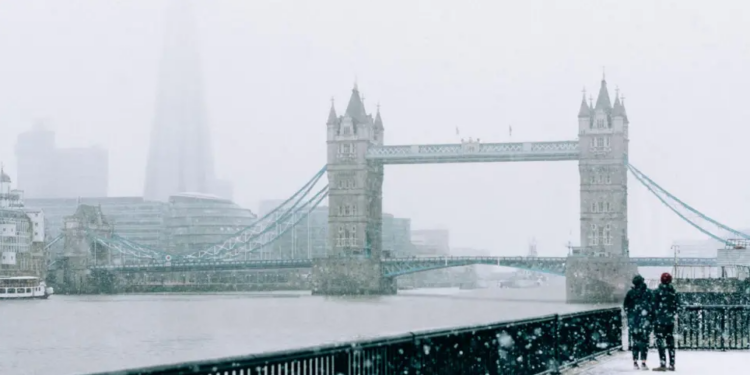
Last month a group of scientists published a paper in Nature stating that the Atlantic Meridional Overturning Circulation (AMOC) had shown no decline in strength since the 1960s. Helped by publicity in the Daily Sceptic, the story went viral on social media, although it was largely ignored in narrative-driven mainstream publications. The collapse of the Gulf Stream, a key component of the AMOC, is an important ‘tipping point’ story used to induce mass climate psychosis and make it easier to impose the Net Zero fantasy on increasingly resentful and questioning populations. Obviously, reinforcements to back up such an important weaponised scare needed to be rushed to the front and the BBC has risen to the challenge. The AMOC “appears to be getting weaker” state BBC activists Simon King and Mark Poynting. Their long article is a classic of its kind in trying to deflect scientific findings that blow holes in the ‘settled’ narrative.
In the Nature paper, three scientists working out of the Woods Hole Oceanographic Institution stated that they came to their conclusion showing the stability of the AMOC after examining heat transfers between the sea and the atmosphere. It was noted that the AMOC had not weakened from 1963 to 2017, “although substantial variability exists at all latitudes”. This variability is the basis for much of the Gulf Stream fear-mongering. The BBC notes that the presence of larger grains of sediment on the ocean floor suggests the existence of stronger currents, pointing to a “cold blob” in the Atlantic that appears to have cooled of late. Thin pickings, it might be thought, to run an article titled ‘Could the UK actually get colder with global warming?’ The Woods Hole scientists note that records “are not long enough to differentiate between low frequency variability and long-term trends”.
The Nature story is not the only recent scientific finding that suggests the Day After Tomorrow alarm about the AMOC is a tad overdone. In 2023, Georgina Rannard of the BBC reported that “scientists say” a weakening Gulf Stream could collapse as early as 2025. There was no later reporting, needless to say, of subsequent work from a group of scientists at the US weather service NOAA that discovered the huge flow of Gulf Stream tropical water through the Florida Straits had remained “remarkably stable” for over 40 years.
Of course the BBC, along with most of the legacy media, has form as long as your arm when it comes to producing deflective copy seemingly designed to head off inconvenient scientific findings. The Great Barrier Reef (GBR) is the largest and best observed collection of tropical coral in the world. Any sign of ill health is a boon for green propogandists who argue that warming measured in tenths of a degree centigrade will destroy an organism that has survived for millions of years in temperatures between 24-32°C. For the last three years, coral on the GBR has hit recent record levels with scarcely a mention in mainstream media. Days before last year’s record was announced, the places where journalism goes to die were full of stories from a paper that conveniently noted climate change posed an “existential threat” to the reef. “The science tells us that the GBR is in danger and we should be guided by the science,” Professor Helen McGregor from the University of Wollongong told Victoria Gill of BBC News. Professor McGregor’s statement was an opinion readily broadcast by the BBC, a courtesy that does not appear to have been extended to the fact that coral on the GBR was at its highest level since detailed observations began.
It beggars belief that the BBC and all its fellow alarmists can run this stuff with a straight face knowing that crucial scientific information is missing from their reports. Important findings from reputable sources emerge about the current stability of the Gulf Stream and the response is to blow more smoke around that raises wholly unnecessary fears.
The main concern is that the AMOC “could suddenly switch off”, state King and Poynting. To back up their statement and provide the inevitable political message they note the comment of Matthew England, Professor of Oceanography at the University of South Wales: “We’re playing a bit of a Russian roulette game. The more we stack up the atmosphere with greenhouse gases, the more we warm the system, the more chance we have of an AMOC slowdown and collapse.” Now look what you plebs have done with your steak chomping, gas-guzzling central heating and naff holidays in Benidorm, is an unpleasant subtext here.
Of course, keen and dedicated followers of climate alarmists will note a master craftsman at work. In 2023, aided by 35 million computer hours and using an improbable rise in temperature of up to 4°C in less than 80 years, Professor Matthews suggested that there was a dramatic slowdown in deep Antarctica ocean currents. Melting Antarctica ice could lead to a 40% slowdown in just 30 years. The fact that Antarctica has barely warmed in 70 years is ignored.
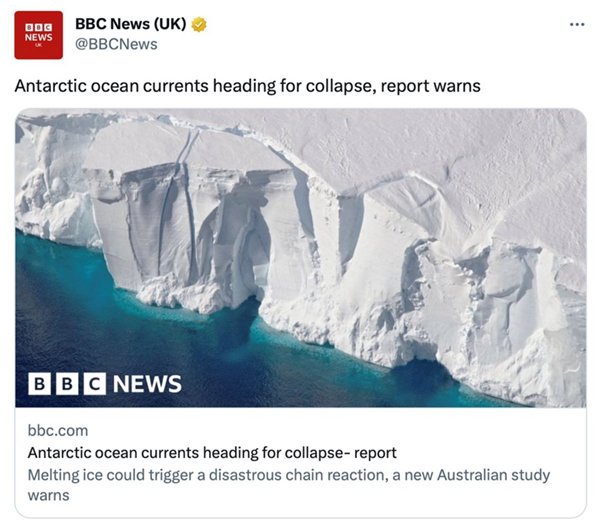
Who needs Hollywood sci-fi blockbusters when we have the BBC.
BBC’s Fake Wildfire Claims
By Paul Homewood | Not A Lot Of People Know That | January 30, 2025
The climate establishment are going to great lengths to blame the Los Angeles fires on global warming.
One attempt has already bitten the dust, with claims of increasing winter droughts contradicted by the real world data.
So another team of so-called scientists have come up with an even more ridiculous idea – that it is now both to wet and too dry in California.
The BBC report:
Climate change has made the grasses and shrubs that are fuelling the Los Angeles fires more vulnerable to burning, scientists say.
Rapid swings between dry and wet conditions in the region in recent years have created a massive amount of tinder-dry vegetation that is ready to ignite.
Decades of drought in California were followed by extremely heavy rainfall for two years in 2022 and 2023, but that then flipped again to very dry conditions in the autumn and winter of 2024.
“Scientists” say in a new study, external that climate change has boosted what they call these “whiplash” conditions globally by 31-66% since the middle of the 20th Century.
“This whiplash sequence in California has increased fire risk twofold,” said lead author Daniel Swain from UCLA.
“First, by greatly increasing the growth of flammable grass and brush in the months leading up to fire season, and then by drying it out to exceptionally high levels with the extreme dryness and warmth that followed.”
Once again though the actual data shows the new study to be just as fake as the previous one. Most of California’s rain comes in the winter half, October to March; the last two years have been wetter than average, but no more so than many other years on record:
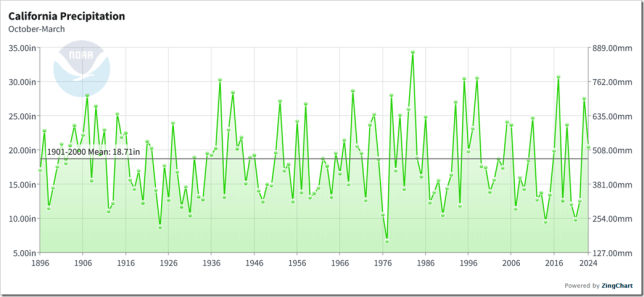
The same applies to the South Coast Drainage Division, which includes Los Angeles:
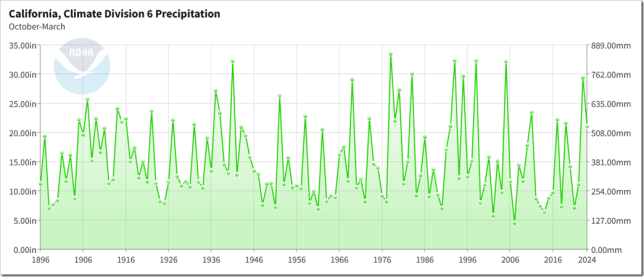
https://www.ncei.noaa.gov/access/monitoring/climate-at-a-glance/national/time-series
Neither is there any evidence of bigger swings from year to year.
Patrick Brown of the Breakthrough Institute has written a full scientific rebuttal here, which demolishes this latest fake science.
This is his summary:
Summary
So, let’s recap. At the annual timescale that is most relevant to the Los Angeles fires…
-
- Figure 1: There is no clear increase in overall whiplash occurrence or wet-to-dry whiplash occurrence in Los Angeles in the premiere observational dataset (ERA5) using data directly from Swain et al. (2025).
- Figure 2: There is no clear increase in overall whiplash occurrence or wet-to-dry whiplash occurrence over southern California in the premiere observational dataset (ERA5) using data directly from Swain et al. (2025).
- Figure 3: There is a long-term decrease in whiplash events globally over land (where it matters) in the premiere observational dataset (ERA5) using data directly from Swain et al. (2025).
- Figure 5: There is no increase in the variability (standard deviation) of annual SPEI either for all months or centered on January) in the Los Angeles grid point using the pre-existing standard SPEI dataset.
- Figure 6: There has been a decrease in the variability (standard deviation) of SPEI over global land since the 1980s using the pre-existing standard SPEI dataset.
- Figure 7: There is no agreement on the direction of change (if any) in annual precipitation variability (standard deviation) over the Los Angeles area across eight different precipitation datasets.
- Figures 8 and 9: There is no agreement on the direction of change (if any) in annual precipitation variability (standard deviation) globally across eight different precipitation datasets.
While “climate whiplash events” may be increasing in frequency under most of the very specific, selected definitions used and datasets investigated in Swain et al. (2025), the general idea that annual precipitation (or more generally, the water cycle, which includes evaporation) is becoming dramatically more variable is not supported when a broader set of datasets and definitions are used.
Would a reader of Swain et al. (2025), or especially its coverage, have any idea about the weakness of its broader conclusions or the lack of robustness of its results to different definitions and datasets? Almost certainly not, and I contend that this is a major problem for public understanding and trust in climate science.
Why don’t we see a robust increase in water cycle variability given the strong theory underpinning “wet gets wetter, dry gets drier”? For one thing, the theoretical size of the effect is known to be quite small relative to natural, unforced variability, making it inherently difficult to detect. For example, we see in Figure 7 above that year-to-year rainfall in Los Angeles naturally varies by as much as 300%, yet the signal we are looking for is one to two orders of magnitude less than this. It is also apparently the case that observational uncertainty is larger than the signal (or there would not be such disagreement between datasets). Physically, perhaps increasing mean precipitation is offsetting the increase in calculated evaporation in the SPEI index, reducing its variability. Maybe reduced temperature variability (via arctic amplification) is reducing calculated evaporation variability.
I don’t know the full answer, but these would be great research questions to identify and outline in a Nature review like Swain et al. (2025). Unfortunately, Swain et al. (2025) missed this opportunity because the paper seemed so focused on assembling evidence in favor of increasing water cycle variability that contradictory evidence was never presented or seriously grappled with.
My main discomfort with Swain et al. (2025) and its rollout is that it appears that the primary goal was to create and disseminate the “climate whiplash” meme rather than conduct a truly rigorous evaluation of the evidence, including countervailing evidence. Ultimately, this makes the research a much larger advance in marketing than an advance in science.
https://www.breakthroughjournal.org/p/how-much-did-increasing-climate-whiplash
Of course, studies like Swain’s are not intended to be serious science; they are written to generate headlines.
And the climate industry is now highly organised to ensure that theses fake studies are disseminated worldwide via a corrupt media.
Featured Video

Daniel Davis: U.S. Military Options & War Narrative Collapse
or go to
Aletho News Archives – Video-Images
Book Excerpt
“Vaccines Do Not Cause Autism!” The Science is Settled. Right?
ICAN urges the IACC to actually study infant vaccines and autism
 By Aaron Siri | Injecting Freedom | March 16, 2026
On behalf of ICAN, we just sent a copy of chapter 11 of Vaccines, Amen to the newly appointed members of the federal Interagency Autism Coordinating Committee (IACC).
If you haven’t already read this chapter, you can read the whole thing in the attached letter. I trust that after you read it, you’ll see why the statement “vaccines do not cause autism” is a belief, not science!

IACC Public Comment Letter
1.53MB ∙ PDF file
Includes chapter 11 of Vaccines, Amen
Blog Roll
 Aletho News
- Washington’s War on Cuba Is Older Than You Think
- Daniel Davis: U.S. Military Options & War Narrative Collapse
- Protesters call on Brussels university to cut partnership with Israeli defense-linked firm
- Weapons makers cash in on Trump’s Iran war
- Why Trump’s anti-Iran naval coalition in Strait of Hormuz is doomed to fail
- IRGC says regional energy sites linked to US will be reduced to ashes
- Qatar condemns ‘dangerous’ Israeli attack on gas field
- Iran made ‘unexpectedly substantial’ offer during Geneva talks, US envoys ‘dragged’ Trump into war: Report
- Russia condemns Israel’s attack near Bushehr plant, files complaint
- Russia Strongly Condemns Actions Aimed at Harming Health of Iranian Leadership – Kremlin
- If Americans Knew
- How ignorance, misunderstanding and obfuscation ended Iran nuclear talks
- Israeli media reports grotesque settler attack in West Bank
- UK security adviser attended US-Iran talks and judged deal was within reach
- Tucker Carlson says ‘neocons’ will try to destroy Joe Kent over resignation
- Lebanon death toll exceeds 900, another assassination in Iran, bombing in Gaza – Not a ceasefire Day 159
- Trump’s counterterrorism chief, whose own wife was killed by ISIS, quits over Iran War saying Tehran posed ‘no imminent threat’
- Here’s what US could fund instead of Bibi’s war on Iran
- Israel Killed Over a Dozen Lebanese Paramedics in Three Days, Now Claiming That Ambulances Are “Hezbollah” Targets
- War on Iran: These are the heritage sites devastated by US and Israeli attacks
- Four news stories from Israeli media that illustrate Israeli “justice”
- No Tricks Zone
- Energy Expert: Germany’s Nuclear Phaseout Was A “500 Billion Euro Mistake”
- New Research: South Australia’s Mid-Holocene Sea Surface Temperatures Were 4°C Warmer Than Today
- Storing Green Energy To Last Germany 10 Days Would Require A 60-Million Tonne Battery
- New Studies: UK Sea Levels Were 4 Meters Higher Than Today During The Mid-Holocene
- Destructive Green New Deal: German Energy And Metal Group Warns Of Drastic Crisis
- New Study Documents A 20-Year Pause In Arctic Sea Ice Decline – Driven By Internal Variability
- Wake-up Call: Survey Shows Majority Of Germans Now Favor Postponing Climate Targets!
- Televised! Leading German Political Candidate Tells Schoolchildren CO2 Makes Sun Hotter!
- New Study: A Century Warming Of 1.1°C Is ‘Commonplace’ And ‘Not Unusual’ During This Interglacial
- New Study: ‘Internal Noise’ And Volcanic Forcing Can Trigger 10-15°C Warming Within Decades
 Aletho News