Quit Lying, Associated Press, Climate Change Isn’t Making U.S. Corn Farming ‘Dicier’

By Anthony Watts | Climate Realism | September 2, 2025
A recent Associated Press (AP) story carried by WCVB-TV and many other news outlets, warned that “climate change is making it “dicier” to grow corn in the United States. This is false. Data clearly shows that amid modest climate change corn yields and production have increased steadily, regularly setting new records.
The AP writes:
Across major corn-growing states, climate change is fueling conditions that make watching the corn grow a nail-biter for farmers. Factors like consistently high summer overnight temperatures, droughts and heavier-than-usual rains at the wrong time can all disrupt the plants’ pollination — making each full ear of corn less of a guarantee and more of a gamble.
Overall, corn growers got lucky this year with late-season weather that contributed to what is now predicted to be a record bumper crop. But experts say bouts of extreme weather are intensifying the waiting game during a critical time of year between planting and harvest.
Human-caused climate change has worsened multiple U.S. extreme heat events this year and has steadily increased the likelihood of hotter overnight temperatures since 1970, according to Climate Central, an independent group of scientists who communicate climate science and data to the public.
The AP’s narrative is a pure lie, debunked within its own paragraphs. Corn growers didn’t get lucky this year with a bumper crop, rather bumper crops have been a trend during the recent period of modest warming, even with the normal annual ups and downs inherent to crop production. The USDA meteorologist, Brad Rippey, who the AP quoted described 2025’s production as a “monster U.S. corn crop.” But it’s not the first monster crop in the past few decades for U.S. corn farmers.
The numbers tell a clear and compelling story of rising corn production. The U.S. Department of Agriculture confirmed record national yields of 179.3 bushels per acre in 2024, breaking the previous record set only a year earlier in 2023. Long-term records from the U.N. Food and Agriculture Organization show U.S. corn yields have more than tripled since 1961, rising from around 3.5 tons per hectare to more than 11 tons today as seen in the figure below:
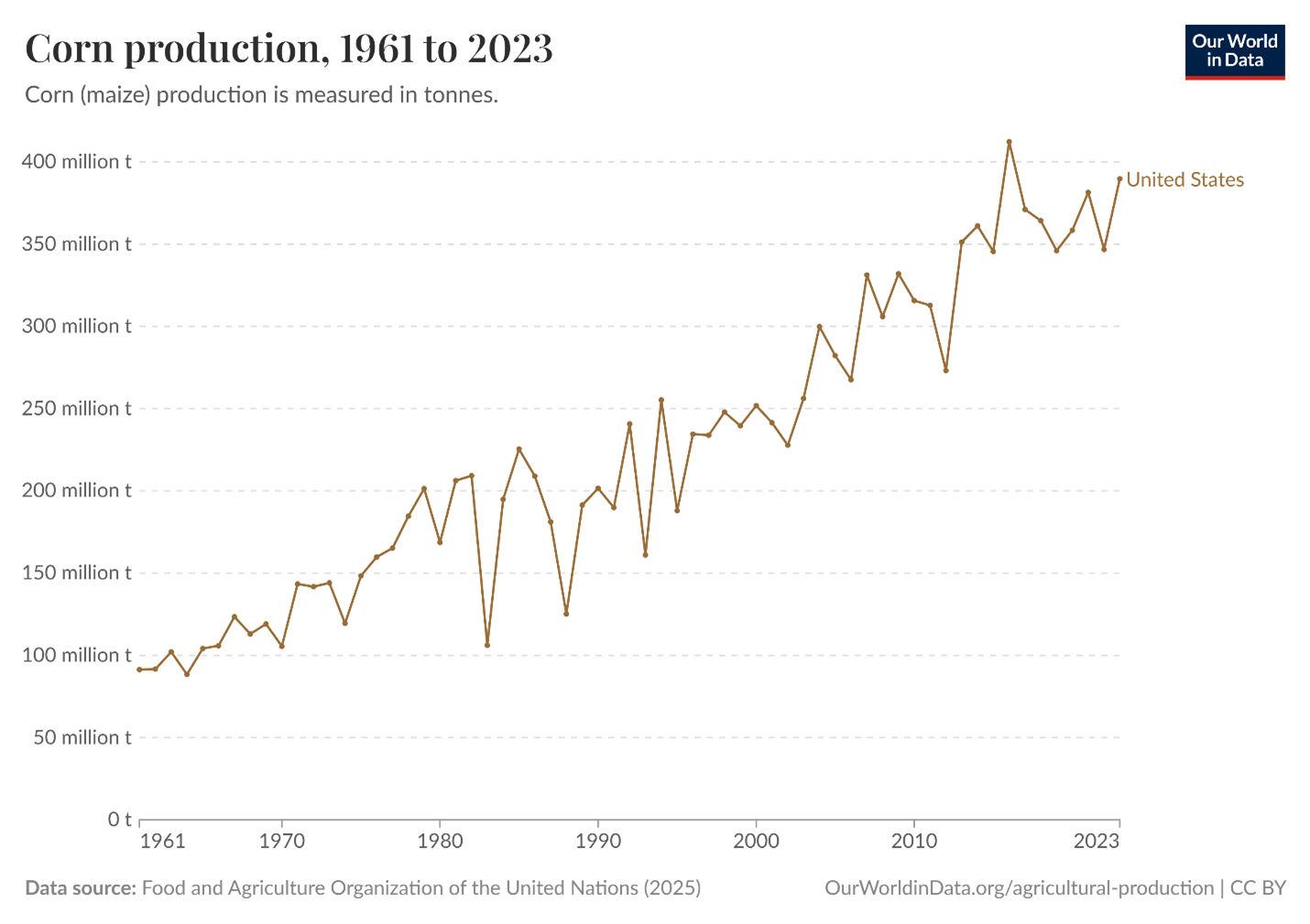
Economists at the University of Illinois calculate that yields have increased by nearly two bushels per acre every year since 1950. These are not the marks of a crop in decline — they are the hallmarks of long-term improvement from better farming practices, yield improved varieties, selective breeding practices to improve resiliency to weather factors, and boosted production due to carbon dioxide fertilization.
The significant gains in yields have also produced records for production with U.S. Department of Agriculture data showing each of the past ten years of production having been higher than any previous years or decades in history, with new records for production being set three times since 2016.
To tie corn growers concerns to climate change, the AP article relied on a small number of anecdotes about heat, corn tassel timing, and the fragility of pollination. Yes, these can matter for pollination in a particular field, but they have always been part of farming. Weather extremes are nothing new, and across hundreds of posts, Climate Realism has cited data across a range of stories showing extreme weather hasn’t become more frequent, severe, or inconsistent in recent years. What matters is the nationwide harvest, and it keeps breaking records. If the climate were truly making corn “dicier,” record-breaking yields would not keep piling up.
The real problem corn producers face at the moment is not crop decline, but instead just the opposite, crop abundance and farming success. Bumper crops have produced an oversupply to the market that is resulting in lower prices, even as ever more corn is being diverted from grocery shelves to gas tanks as ethanol requirements creep up.
Farmers are not watching their livelihoods wither under climate change. Instead, they are wrestling with the economic consequences of overproduction, as a variety of news outlets have reported recently. On the same day the AP was incorrectly bemoaning corn declines, a story titled, “Huge Crops in Corn Belt Hit Cash-Strapped Farmers With More Unease,” was published in the Wall Street Journal. Just a few days earlier, in a story, subtitled, “so much corn, so little profit, NewsNation reported that with the USDA projecting 16.7 billion bushels of corn in 2025, the largest in American history, the glut is pushing prices to multi-year lows, with Iowa producers estimating losses of $80 to $100 per acre at current bids. That is not a climate crisis, it is an economic one caused by success.
So contrary to the AP’s claims, the real problem facing corn farmers is not extreme, unpredictable weather and crop diseases hampering production, but rather oversupply of the market due to record setting production, the latter a regular occurrence across the first quarter of the 21st century as global temperatures have continued to rise modestly.
Climate Realism has repeatedly documented this pattern of media misrepresentation about crop yields and climate change, with over 100 articles on the subject. We note that when crop yields rise, the media ignores or downplays it. When a short-term weather challenge arises, it is cast as evidence of climate change driving it. The broader reality — backed by decades of USDA and FAO data — is that American agriculture continues to thrive even in a modestly warmer world. Corn is not alone, wheat and soybeans, for example, are also enjoying long-term gains in productivity, and 2025 will be remembered for surplus, not scarcity.
Oversupply is forcing farmers to store corn with little hope of profitable sales, while trade policy uncertainties in corn exports weigh on demand. These are the real stressors in agriculture today, none of which have anything to do with climate change. By fixating on climate change while admitting record abundance in the same breath, The AP obscures the actual challenges farmers face with regards to commodity markets, prices, and trade.
The conclusion is unavoidable: the claim that climate change is making corn yields more precarious is demonstrably false. Yields are rising, production is at record highs, and as a result, prices are low, driving down farm income. The Associated Press misled its affiliates and readers by suggesting a climate crisis where there is none, undermining trust in its reporting. Farmers and the public deserve better.
Peace in Ukraine ‘Easier Without Brussels Hawks Fueling War’
Sputnik – 07.09.2025
MOSCOW – It would be easier to achieve a peaceful settlement of the Ukrainian crisis if the “hawks” in Brussels stopped fueling the conflict, the Russian Embassy in Belgium said on Sunday.
“It is obvious that if the ‘hawks’ in Brussels and other Western capitals stop fueling the war and support peace efforts, including those undertaken by US President [Donald] Trump, then it will become much easier to achieve peace,” the embassy wrote on Telegram.
Instead, the Belgian government is becoming more and more Russophobic, misleading its citizens about Russia’s alleged intent to attack Brussels, the embassy added.
Earlier in September, Belgian Defense Minister Thomas Francken said that Moscow was capable of “infiltrating” one of the NATO member states by 2030 under the pretext of protecting the Russian-speaking minority in it, while at the same time attacking Brussels, “the capital of diplomacy,” with drones and missiles.
“The flawed logic offered to ordinary citizens confirms that the current Belgian leadership is rapidly moving away from its previously declared moderation in foreign affairs and is increasingly joining the ranks of the most Russophobic part of the EU and NATO, pursuing an extremely dangerous course of inciting confrontation with our country,” the statement read.
The Russian embassy dismissed the allegations, adding that the policies pursued by the Belgian government result in significant economic and social costs, which Belgian citizens are forced to pay.
AP Jerusalem chief participated in secretive Israeli govt anti-BDS event, leaked files reveal
By Max Blumenthal | The Grayzone | September 6, 2025

AP’s Israel-Palestine news director, Josef Federman, has spun data to minimize the Gaza death count. Leaked documents show he appeared on a panel aimed at assisting “Israel’s ability to effectively portray its narrative” during a gov’t-sponsored propaganda conference chaired by an ex-IDF official who legitimized killing journalists.
The Israeli massacre of five journalists in broad daylight on August 24, 2025 at Nasser Hospital in Gaza’s Khan Younis city prompted a sternly worded statement to the Israeli government from the Associated Press and Reuters, which each employed a reporter murdered by the IDF. The AP subsequently published a detailed investigation demonstrating that the Israeli military knowingly attacked a civilian target, then carried out a double tap strike after a rescue team and journalists arrived on the scene.
While the AP’s statement of outrage about the killing of its photographer in Gaza, Miriam Dagga, has brought the leading wire agency’s tension with the Israeli government to its height, the relationship with Tel Aviv was not always so adversarial.
The Grayzone has reviewed leaked documents revealing that the AP’s news director for Israel-Palestine, Josef Federman, participated in a private 2018 panel discussion aimed at assisting “Israel’s ability to effectively portray its narrative.” His host was a secretive Israeli government outfit dedicated to combatting the global BDS campaign to boycott, divest from, and sanction Israel. Called the Global Coalition For Israel (GC4I), the event was convened in Jerusalem on June 18, 2018 by Israel’s Ministry of Strategic Affairs and Diplomacy – the de facto propaganda arm of the Israeli government.
The moderator of the panel in which Federman participated was Avital Leibovich, the former spokeswoman for the IDF who has ardently defended the Israeli policy of defining Palestinian journalists as terrorists in order to assassinate them.
Federman has presided over the AP’s coverage of Israel-Palestine since 2014. Throughout Israel’s genocidal assault on Gaza began in October 2023, Federman has helped shape a narrative that has subtly but effectively advanced Tel Aviv’s objectives, regurgitating the baseless and comprehensively debunked claim that “Israelis were raped or sexually assaulted” on October 7; legitimizing Israel’s violent invasion and theft of Syrian land as a historical “shift,” and relying on bogus data from an Israel lobby-affiliated researcher to minimize the civilian death count in Gaza – a grim toll which now includes one of his colleagues at AP.
Federman’s penchant for uncritically quoting notoriously mendacious Israeli military officials has helped secure his reputation for biased coverage.
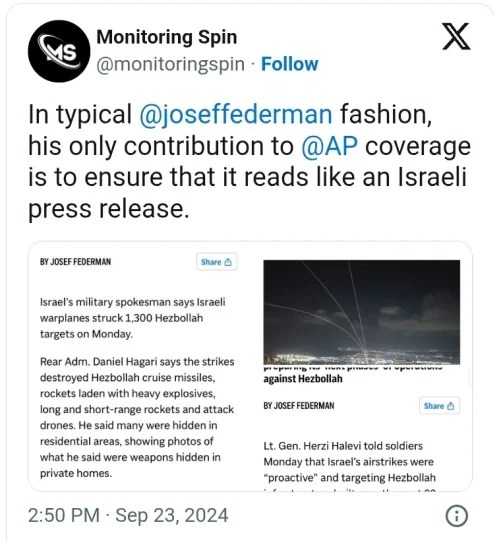
Federman’s participation in the 2018 Israeli government anti-BDS event appears to contradict clearly stated AP guidelines on conflicts of interest. According to the AP’s website, “We avoid addressing, or accepting fees or expenses from, governmental bodies; trade, lobbying or special interest groups; businesses, or labor groups; or any group that would pose a conflict of interest.”
In response to a detailed query from The Grayzone about Federman’s participation in the semi-covert conference, AP Vice President of Corporate Communications Lauren Easton stated, “Josef Federman is a professional journalist and a former chairman of Israel’s Foreign Press Association. It is not uncommon for journalists to speak about their work at conferences and other events. It remains AP policy to refrain from accepting honoraria, and that policy was followed here.”
The details of the GC41’s gathering were gleaned from a massive tranche of documents extracted by hackers from Israel’s Ministry of Justice in 2024. A full schedule and list of GC4I conference participants has never been seen before by the public.
View GC4I’s 2018 schedule here.

AP, other agencies join semi-secret Israeli gov’t event chaired by ex-IDF official who justified killing journalists
When GC4I gathered in 2018, it met at the Mamilla Hotel Conference Hall in Jerusalem for two days of discussions and briefings on the fight to crush the growing Palestine solidarity movement and its BDS campaign. The conference opened with an address by Sima Vaknin-Gil, then the Director-General of Israel’s Ministry of Strategic Affairs. A former Israeli intelligence official, Vakhnin-Gil had emerged as one of the most influential coordinators of the country’s propaganda efforts abroad, especially in the US, where she helps the Israeli government evade the Foreign Agent Registration Act law.
Her speech was followed by a discussion moderated by celebrity Republican pollster Frank Luntz on the feasibility of defining the BDS movement as a “hate group.” Further panels focused on “developing relations in the corridors of power” and “how… legislation in Europe and the United States can be used to reduce funding for organizations delegitimizing Israel.”
On the second day of the GC41 conference, Federman joined a panel aimed at “discuss[ing] the difficulties of reporting fairly and accurately on Israel, while dealing with issues such as BDS, delegitimization, and the Israel-Palestinian conflict.”
The panel was explicitly aimed at helping the Zionist operatives gathered at the GC4I “understand the shortcomings in Israel’s ability to effectively portray its narrative, what reporters are looking for when writing an article and why the anti-Israel camp’s narrative resonates in the Western world.”
Avital Leibovich, a former IDF spokeswoman who moved on to the American Jewish Committee, chaired the panel. During her stint at the IDF, Leibovich played a leading role in justifying Israel’s deliberate killing of journalists in the Gaza Strip. In 2012, for example, she fired off a letter to the New York Times which smeared Palestinian journalists slain at the hands of the Israeli military: “Such terrorists who hold cameras and notebooks in their hands, are no different from their colleagues who fire rockets aimed at Israeli cities and cannot enjoy the rights and protection afforded to legitimate journalists,” she wrote.
In 2016, Leibovich appeared at Washington DC’s Newseum amid protests – including by this reporter– and condemnation from the Palestinian Journalists’ Syndicate, which urged the institution in a May 31 letter “not to provide a platform to someone who has justified, on record and to a world audience, Israel’s grave violations of international law and war crimes, and in particular attacks against journalists and press freedoms.”
Chaired by Leibovich, the 2018 GC4I panel featured featured the Jerusalem Bureau Chief of RT, Paula Slier, and Laurent Lozano, who held the same position at Agence France Press, alongside the AP’s Federman. Slier has since left RT, while Lozano is currently AFP’s bureau chief in Dakar, Senegal.
Reached by The Grayzone, Slier described the gathering as “a very pleasant experience.”
She said she considered her participation in a semi-covert Israeli government conference as a normal part of her duties as a correspondent in Jerusalem. “It was a chance for them to hear how foreign channels worked in Israel,” Slier commented. “I used to participate and attend all conferences – whether they were pro-Israel or pro-Palestinian – I thought it important to engage with everyone, and it was also an opportunity to talk about RT.”
GC4I launched at “secret conference” with “closed sessions” on criminalizing BDS
GC4I’s first gathering took place in 2010, at a time of heightened Zionist anxiety about the rising global grassroots movement to boycott Israel. A who’s who of Israeli lobbyists from the US, UK and Australia were on hand, alongside Israeli officials from the office of Prime Minister Benjamin Netanyahu and the newly created Ministry of Strategic Affairs.
“The aim was to end the perceived lack of co-ordination within the pro-Israel movement, a concern frequently voiced by Israel-advocates,” wrote researcher Hil Aked.
Marcus Dysch of the Jewish Chronicle gained access to a 2014 GC4I meeting in London, England. He described it as a “secret conference… held in closed sessions amid heavy security.”
“We have the resources. We have the intelligence. Most important, we have unbounded determination,” Ronald Lauder, the billionaire Zionist financier and Netanyahu confidant, told the crowd of Jewish communal leaders and Israeli officials in London.
Lauder pledged to leverage his fortune to criminalize the BDS movement: “We will draft and lobby for legislation that will withhold government funding from academic institutions that boycott Israel.”
Reporting back to Jewish Federation at home, minimizing deaths in Gaza
Well before he emerged in the Middle East as a reporter, Josef Federman enrolled as a graduate student at Israel’s Hebrew University.
He grew up in Westborough, Massachusetts, where his parents helped found the B’nai Shalom Congregation, a Reform Jewish synagogue. Federman has returned on two occasions to deliver lectures at the synagogue, once in 2021 to discuss the Abraham Accords alongside an Israeli academic, and again in March 2024, during the height of Israel’s genocidal campaign in Gaza, for an event titled, “Reporting from Israel.” That speech was co-sponsored by the Jewish Federations of Central Massachusetts, a top sponsor of pro-Israel lobbying inside the US.
Two months later, the Israeli government seized camera equipment from the AP to prevent it from live-streaming video from the Israeli side of the northern Gaza frontier. While Israel announced that it would return the equipment and allow the broadcasts to continue, the event eerily foreshadowed the Israeli military’s double tap strike on the Reuters live position at the Nasser Hospital in Khan Younis this August 24.
The following month, Federman published a piece of “AP data analysis” that relied on dubious statistics to advance one of Israel’s most important propaganda objectives in Gaza. According to the headline of Federman’s piece, “Women and children are killed less frequently as war’s toll rises.” The article therefore implied that all men in Gaza between the ages of 18 and 59 were possible militants. Throughout the piece, Federman referred to Gaza’s Health Ministry as “Hamas-run,” casting doubt on its casualty counts.
To legitimize his conclusions, Federman turned to Gabriel Epstein, a researcher at the Washington Institute for Near East Policy, or WINEP, the most prolific think tank of the Israel lobby in Washington DC. WINEP director Robert Satloff, a veteran Israel lobbyist, praised the AP’s Federman for “tak[ing] a big step toward setting the record straight.”
Another researcher cited in the article, Michael Spagat, defended the quality of death counts by Gaza’s Health Ministry. Months later, in September 2024, Spagat revised his view of the death toll, declaring, “I now believe that the true death toll almost certainly exceeds the official total.”
This August, a review of an internal Israeli intelligence database further discredited Federman’s analysis, revealing that 83% of those killed by the Israeli military in Gaza were civilians.
Today, Federman’s “data analysis” on the Gaza death has been discredited by virtually every expert outside the Israel lobby, and by the gruesome reality on the ground. However, a revealing post remains on his personal LinkedIn page which shows him liking a rant by Idit Shamir, consul general of Israel in Toronto, mocking the official death count in Gaza:
“Isn’t it curious?” wrote the Israeli official. “Hamas is clueless about Israeli hostages’ status but has a crystal-clear count of Palestinian casualties before Israeli strikes even occur!”

Now that a fellow AP reporter, Miriam Dagga, has joined the tens of thousands of civilians murdered by Israel in Gaza over the past two years, Federman’s agency has been forced to release a rare expression of outrage at Tel Aviv. The indignation offers a stark contrast from the comity Federman displayed when he bantered at an Israeli government conference with the former IDF official who legitimized the policy that would claim Dagga’s life.
Science-for-hire companies violate scientific norms, degrade public discourse, and facilitate the mass poisoning of society
By Toby Rogers | August 27, 2025
Last week, the New York Times published a bizarre “Guest Essay” on autism by Jessica Steier, a Pharma mercenary who has at least ten financial conflicts of interest and no background in autism research. I submitted a reply to the article to correct her disinformation and the NY Times refused to publish it.
Here are the facts for anyone who wants to read them:
Jessica Steier runs a science-for-hire company, “Unbiased Science.” She uses a number of pass-through organizations to launder contributions from large pharmaceutical and chemical companies. However, one can still figure out a lot of her funders (see article on “Unbiased Science Podcast” in SourceWatch). Steier advises an infant formula company and is an affiliate for a company that makes monosodium glutamate (MSG). Her podcast has taken money from 3M, Procter & Gamble, Pfizer, Johnson & Johnson, Novartis, Moderna, and CSL Seqirus (a flu vaccine manufacturer).
Steier is cartoonishly evil. From SourceWatch:
Steier’s Unbiased Science Podcast:
• Described the herbicide glyphosate as “safe for use”
• Declared polytetrafluoroethylene (PTFE) in Teflon to be “non-toxic to humans”
• Called the Environmental Working Group Dirty Dozen list of produce with the most and least pesticide residues “a fear-based marketing ploy”
• Claimed GMOs are “safe,” “nutritious,” and “beneficial to consumers, producers, and the environment” and
• Called hydrogenated oil “a safe dietary fat.”
The Unbiased Science Podcast recorded two episodes on organic food and farming in December 2022 and January 2023 in which they argued that organic pesticides are more harmful than synthetic pesticides used in chemical farming…
Andrea C. Love [Steier’s co-host] defended the artificial sweetener aspartame as “safe,” said in an interview that she has “at least one diet soda a day,” and the Podcast posted on Instagram that “aspartame does not pose a health risk to humans, cancer or otherwise, especially at levels we would consume.”
Love and Steier were critical of the International Agency for Research on Cancer’s ranking of the chemicals considered possibly carcinogenic to humans in 2023.
SourceWatch provides even more evidence of Steier’s toxic sophistry here.
For those who are new to these topics, mountains of evidence from The Defender, Beyond Pesticides, and Moms Across America, among others, show why all of Steier’s claims listed above are junk science.
Nearly everything Steier writes in her “Guest Essay” on autism is demonstrably false. For example, Steier:
- Thinks mercury and aluminum in vaccines are fine even though they are known neurotoxicants (see Grandjean and Landrigan, 2014, Supplementary appendix).
- Omits the fact that Mark, Anne, and David Geier sued the Maryland Board of Physicians and won (and then a higher court retroactively granted “absolute immunity” to this private board even though the Maryland legislature never gave it that right).
- Has apparently not read any of the 55 autism prevalence studies in the U.S. since 1970, so she is oblivious to the fact that autism rates have increased 32,158% over that time period.
- Seems unaware that a Danish study she cited favorably recently issued a correction after they discovered, post-publication, 136% more neurodevelopmental events, including autism and ADHD, that changed their research findings.
- Has never read, or just plain ignores, the six vaccinated vs. unvaccinated studies that show that vaccines significantly increase autism risk (see summaries in Rogers, 2025).
Science-for-hire companies will say or do anything for money. Steier’s company, “Unbiased Science,” is relatively new. However, it uses the same playbook developed by other notorious science-for-hire firms, including Gradient, Exponent, and Ramboll. They are often referred to as “rented white coats” (see discussion in Rogers, 2019). Anyone citing Steier as a “public health expert” has no idea what they are talking about.
The NY Times devoted considerable resources, including two graphic designers and prominent placement online and in the Sunday print edition, in the attempt to make this trashy hit piece look presentable to its readers. The NY Times’ failure to disclose Steier’s extensive conflicts of interest and its refusal to publish critical comments in connection with this “Guest Essay” make me wonder if this was a paid advertorial at the behest of a pharmaceutical company.
The autism epidemic is a matter of enormous national importance. Yet everything that the NY Times publishes on autism is an attempt to cover up the causes and protect the powerful industries that are culpable. Unfortunately, in the midst of this crisis, the NY Times has abandoned its role as “the newspaper of record” and is now a criminal syndicate that is endangering the health of all Americans.
Toby Rogers has a Ph.D. in political economy from the University of Sydney in Australia and a Master of Public Policy degree from the University of California, Berkeley. His research focus is on regulatory capture and corruption in the pharmaceutical industry. Dr. Rogers does grassroots political organizing with medical freedom groups across the country working to stop the epidemic of chronic illness in children. He writes about the political economy of public health on Substack.
Bulgaria debunks von der Leyen jet claims
RT | September 4, 2025
There is no evidence Russia interfered with European Commission President Ursula von der Leyen’s airplane during her recent flight to Bulgaria, the country’s authorities have said. The European Commission earlier claimed Bulgarian authorities had confirmed the incident.
On Sunday, upon landing in Plovdiv, von der Leyen’s pilots allegedly reported issues with their navigation systems. Brussels later told the Financial Times that her flight was “forced to circle for an hour” and claimed that Moscow had “blatantly interfered” with the aircraft, supposedly trying to jam its GPS signal.
However, Bulgarian Prime Minister Rosen Zhelyazkov has outright contradicted Brussels’ claim, telling parliament on Thursday that no evidence of a Russian attack had been found and that von der Leyen’s plane did not suffer any serious issues, only short-term signal degradation which is common in densely populated areas.
Wrong, CBS and Other Media Outlets, Abrupt Antarctic “Climate Shifts” Are Not New or Necessarily Catastrophic
By Anthony Watts and H. Sterling Burnett | ClimateRealism | August 29, 2025
A recent CBS News article, “Abrupt Antarctic climate shifts could lead to ‘catastrophic consequences for generations,’ experts warn,” claims that Antarctica is on the brink of irreversible collapse due to climate change, warning that sea levels could rise by meters and that “catastrophic consequences for generations” are looming. This is false or, at best, deeply misleading. The actual data and history of Antarctic ice show that “abrupt changes” are neither unprecedented nor a reason to panic. Natural variability and cyclical shifts are being ignored in favor of sensational headlines pushing the increasingly untenable climate crisis narrative.
CBS was not alone in pushing the Antarctic climate crisis narrative. On 21 August 2025, The Australian Broadcasting Corporation (ABC) joined the chorus of media outlets with alarming headlines warning of pending ice collapse, publishing a report claiming Antarctica is undergoing “rapid, self-perpetuating changes” that are “potentially irreversible.” Each of the reports cited a new Nature review led by Professor Nerilie Abram, as the source of the information for their alarming articles.
ABC’s article presents Antarctica as being in a state of runaway decline, with imminent threats to emperor penguins and global sea levels, parroting language from the Abram paper as if it were observed fact, rather than the speculative synthesis of research papers that the Nature study cites. CBS, ABC, and other media outlets are covering this story as if a tipping point is upon us—but a closer look at the evidence reveals otherwise.
CBS News warns:
Abrupt and potentially irreversible changes in Antarctica driven by climate change could lift global oceans by meters and lead to ‘catastrophic consequences for generations,’ scientists warned Wednesday. … After increasing slightly during the first 35 years that satellite data was available, Antarctic sea-ice cover plunged dramatically over the last decade.
Australia’s ABC News, meanwhile, uncritically repeats Abram’s claims and, describing the Antarctic as “rapidly, self-perpetuating” on the cusp of collapse, while offering little discussion of data—leaning instead on worst-case modeling and literature reviews.
Antarctic data and an examination of its history show that such events have happened previously, long before anyone was worried about human-caused climate change, and they are not self-perpetuating but rather, seem cyclical in nature.
The CBS article claims that “Antarctic sea-ice cover plunged dramatically over the last decade,” citing a “regime shift” since 2014. ABC News, echoing the same theme, refers to a sudden and supposedly “irreversible” decline. But both articles omit key facts, among them:
- The “Abrupt” Decline Follows Decades of Expansion. Satellite measurements of Antarctic sea-ice began in late 1978. For most of the next 36 years, Antarctic sea-ice was stable or increasing, setting multiple record highs between 2007 and 2014. In October 2014, the National Snow and Ice Data Center (NSIDC) reported: “Antarctic sea-ice extent set an all-time record high for the third straight year.” This expansion occurred for more than 30 years during the period when the Earth was warming, contradicting claims that warming inevitably reduces Antarctic sea-ice.
- The recent sharp declines since 2016 are real, but as the most robust satellite records show, these represent a regime shift within a variable system—not evidence of permanent or “runaway” collapse as one recent paper detailed.
- Evidence of Antarctica’s history shows that natural variability dominates changes in Antarctica. Longer reconstructions, stretching back to 1905, confirm that Antarctic sea-ice has experienced periods of large growth and subsequent declines over the past century. One 2020, study demonstrated that natural variability, including the influence of atmospheric and oceanic circulation, have likely played a role in any recent changes, as they drove such changes in the past.
As importantly as all this is, concern for the recent decline in sea ice is largely misplaced since, as even CBS news acknowledged in its story, [f]loating sea ice does not significantly add to sea level when it melts . . ..” As a result, neither the “record setting” expansion of sea-ice spanning the late 20th and early 21st century nor the recent decline significantly effect sea levels.
Perhaps that’s why the new stories tried to tie the sea-ice decline to rising seas indirectly saying the sea ice retreat, “ . . . does replace white surfaces that reflect almost all of the sun’s energy back into space with deep blue water, which absorbs the same amount instead.”
The problem here is, there is no evidence the earlier multidecade expansion of sea-ice or the recent decline has a causal connection to ice growth or expansion on mainland Antarctica, the latter of which could impact sea levels. Indeed, the record indicates that for some of the period when sea-ice was expanding, Antarctica was losing mass, and now, while it is in decline, Antarctica is gaining ice on net, reducing sea level rise.
Shifting focus from sea-ice to Antarctica’s mainland, the CBS and ABC News shift attention to recent ice losses on the West Antarctic ice sheet and in particular the declining Thwaites glacier.
When discussing ice sheets, both outlets repeat claims that the West Antarctic Ice Sheet has crossed a point of no return. But they fail to mention that West Antarctica sits atop a tectonic rift system with elevated geothermal heat flux, which drives melting from below, regardless of atmospheric conditions. In short, subsurface volcanic activity or heating from tectonic shifts is melting the region’s ice from below, and causing increased flow into the sea.
Indeed, Direct borehole measurements, aeromagnetic surveys, and radar-based research confirm anomalously high heat flow in the region from beneath the mass. This subglacial influence helps explain why areas like Amundsen and Thwaites behave differently from the stable East Antarctic.
Also, the northern Antarctic Peninsula, which is frequently highlighted for its instability, extends north of the Antarctic Circle into sub-Antarctic latitudes. Its climate and dynamics cannot be generalized to the rest of the continent according to NASA Earth Observatory in 2014.
Climate Realism has previously discussed the causes and consequences of ice loss on the Antarctic peninsula and in the West Antarctic multiple times previously, here and here, for example, in each case debunking a media claim that humans are behind the loss.
Antarctica’s ice loss is important, CBS and ABC tell us, because the Antarctic Ice Sheet’s collapse could “raise sea levels by meters,” threatening “hundreds of millions.” But the actual rate of global sea level rise, measured by satellites and tide gauges, is about 3 millimeters per year as detailed in Climate at a Glance: Sea Level Rise. At this rate, it would take 333 years to reach even a single meter of rise.
The idea of meters of sea level rise by 2100 is rooted in computer models, not observation. Even the Intergovernmental Panel on Climate Change (IPCC) concedes that melting the East Antarctic Ice Sheet would require thousands of years and temperature increases far beyond any plausible scenario this century:
Loss of the East Antarctic Ice Sheet (EAIS) is very unlikely over this century and beyond under scenarios of greenhouse gas emissions considered in this report. Complete loss of the EAIS would require sustained global warming significantly above the levels projected for this century, and would take thousands of years.
Putting the supposed amount of Antarctic glacier loss in context is important, because as a percentage of the continent’s total ice volume, recent reported losses from the continent are miniscule, contrary to media hype. See the figure below, as presented at Climate at a Glance Antarctic Ice Melt.
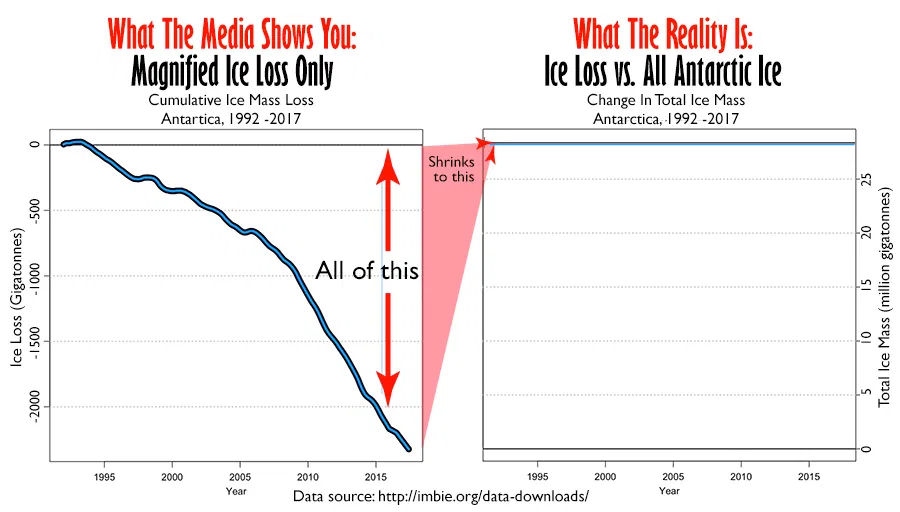
Figure: Comparison of satellite data for Antarctic ice mass loss. Cumulative ice mass loss on the left and that same data compared to the total mass of ice on the right.
Data source: http://imbie.org. Graphs originally by Willis Eschenbach, adapted and annotated by Anthony Watts.
Describing the ice changes in Antarctica as “irreversible” or “runaway” is nothing more than alarming speculation that ignores evidence to the contrary.
CBS, ABC, and the other mainstream media outlets touting the study’s warnings about the future also ignore the fact that contrary to the implication of the study, Antarctica is actually gaining ice at present and has for the past couple of years.
As discussed at Climate Change Weekly, In late April and early May, mainstream media outlets ran dozens of stories discussing the findings of a recent study that showed Antarctica’s ice mass was growing. The outlets called the ice and snow gain “astonishing,” “surprising,” and “shock[ing]” and said it “startled the scientific community.” That’s right, recent research shows that the Antarctic has not warmed over the past seven decades and that the vast bulk of Antarctica experienced substantial ice growth in the past couple of years, reversing the decline reported in Nature that ABC, CBS, and other outlets are writing about. Glacial melt which had been contributing to sea level rise reversed itself over a period of three years, adding mass and cutting Antarctica’s contribution to sea level rise.
Any reporting that omits the physics, history, and current trends is incomplete and misleading. And any story that blames global warming for glacier melt in Antarctica and subsequent sea level rise, when the continent has not experienced warming, glaciers on the whole are growing and thus reducing sea level rise, is just false.
Both ABC and CBS also point to emperor penguin breeding failures as a result of climate change, implying an existential threat across the species. Yet the 2025 study making these claims conducted a regional and local survey of selected colonies from 2009 to 2024, reporting a 22 percent decline in those specific locations. It didn’t look at the health of emperor penguin colonies across Antarctic as a whole. The authors themselves specifically cautioned that their results may not represent the entire Antarctic coastline—a vital caveat that ABC and CBS’s stories lack. With emperor penguins living for decades, a 15-year record is simply too short to establish population trajectories. These penguins have survived warm and cold phases across the Holocene. To suggest continent-wide extinction risk by 2100 is not supported by the available evidence.
In the end, history shows that the expansion and contraction of Antarctic sea-ice are natural features of a highly variable system. Short-term losses are not proof of a “runaway” tipping point; rather, they are well within known ranges of natural variability.
CBS, ABC, and other media outlets are constructing a narrative of Antarctic collapse by cherry-picking short-term declines, ignoring decades of stability and increase, omitting key physical context, and leaning on speculative reviews. Climate Realism has factually debunked similar media scare stories in the past, here and here. The actual Antarctic observational record reveals a dynamic system—one that expands and contracts, shaped by natural variability, oceanic and atmospheric cycles, and unique geographic barriers.
The catastrophic claims ABC and CBS are parroting are not only unsupported, they fly in the face of decades of data and scientific understanding. Had the mainstream media displayed a little investigative curiosity, it would have questioned the recent study’s findings, since the evidence clearly shows Antarctic “climate shifts” are not a harbinger of doom but another chapter in a long story of natural change.
Photojournalist resigns from Reuters over its ‘betrayal of journalists’ in Gaza
MEMO | August 26, 2025
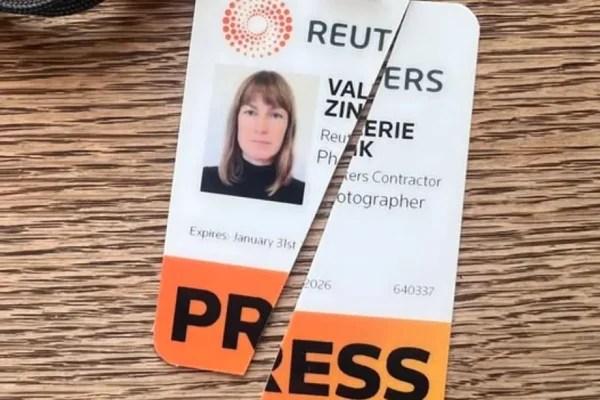
Canadian photojournalist Valerie Zink has resigned after eight years with Reuters, criticizing the news agency’s stance on Gaza as a “betrayal of journalists” and accusing it of “justifying and enabling” the killing of 245 journalists in the Palestinian enclave, Anadolu reports.
“At this point it’s become impossible for me to maintain a relationship with Reuters given its role in justifying and enabling the systematic assassination of 245 journalists in Gaza,” Zink said Tuesday through the US social media company X.
Zink said she worked as a Reuters stringer for eight years, with her photos published by many outlets, including The New York Times, Al Jazeera, and others worldwide.
 She criticized Reuters’ reporting after the killing of Anas Al-Sharif and an Al Jazeera crew in Gaza, accusing the agency of amplifying Israel’s “entirely baseless claim” that Al-Sharif was a Hamas operative, which was “one of countless lies that media outlets like Reuters have dutifully repeated and dignified,” she said.
“I have valued the work that I brought to Reuters over the past eight years, but at this point I can’t conceive of wearing this press pass with anything but deep shame and grief,” Zink said.
Zink also emphasized that the agency’s willingness to “perpetuate Israel’s propaganda” has not spared their own reporters from Israel’s genocide.
“I don’t know what it means to begin to honour the courage and sacrifice of journalists in Gaza, the bravest and best to ever live, but going forward I will direct whatever contributions I have to offer with that front of mind,” Zink highlighted, reflecting on the courage of Gaza’s journalists.
“I owe my colleagues in Palestine at least this much, and so much more,” she added.
Referring to the killing of six more journalists, including Reuters cameraman Hossam Al-Masri, in Israel’s Monday attack on the Nasser hospital in Gaza, Zink said: “It was what’s known as a “double tap” strike, in which Israel bombs a civilian target like a school or hospital; waits for medics, rescue teams, and journalists to arrive; and then strikes again.”
Zink underlined that Western media is directly culpable for creating the conditions for these events, quoting Jeremy Scahill, who said major outlets—from the New York Times to Reuters—have served as “a conveyor belt for Israeli propaganda,” sanitizing war crimes, dehumanizing victims, and abandoning both their colleagues and their commitment to true and ethical reporting.
She said Western media outlets, by “repeating Israel’s genocidal fabrications without determining if they have any credibility” and abandoning basic journalistic responsibility, have enabled the killing of more journalists in Gaza in two years than in major global conflicts combined, while also contributing to the suffering of the population.
The new fatalities among the media personnel in Gaza brought the number of Palestinian journalists killed in Israeli attacks since October 2023 to 246.
Israel has killed more than 62,700 Palestinians in Gaza since October 2023. The military campaign has devastated the enclave, which is facing famine.
Last November, the International Criminal Court issued arrest warrants for Israeli Prime Minister Benjamin Netanyahu and his former Defense Minister Yoav Gallant for war crimes and crimes against humanity in Gaza.
Israel also faces a genocide case at the International Court of Justice for its war on the enclave.
READ ALSO: China ‘shocked’ over Israeli killing of journalists in Gaza
Russia rejects accusations of ‘fracturing’ Ukraine talks with US
RT | August 23, 2025
The Russian Foreign Ministry has pushed back against Western media reports claiming Moscow undermined Ukraine peace talks with the US by insisting it must take part in discussions about security guarantees for Kiev.
On Friday, Bloomberg reported, citing sources, that remarks by Russian Foreign Minister Sergey Lavrov about the principles of “indivisible security” in Europe have “effectively fractured Russia’s talks with the US,” while describing Moscow’s stance as “an attempt to stall the [settlement] process.” The Wall Street Journal similarly accused Lavrov of “toss[ing] all sorts of obstacles” in the way of possible high-level talks between Moscow and Kiev.
The ministry responded that Russia has followed a consistent policy on the conditions needed both to resolve the Ukraine conflict and to build a stable European security framework.
The ministry recalled that following the Alaska summit with US President Donald Trump, Russian President Vladimir Putin noted that a sustainable peace in Ukraine could be achieved only if “all root causes of the crisis are eliminated, all of Russia’s legitimate concerns taken into account, and a just balance in security in Europe and worldwide restored.”
He added at the time that Moscow “was ready to work on ensuring security for Ukraine.”
Later, Lavrov, responding to a question about the possible deployment of Western troops to Ukraine – which has been a red line for Moscow – noted that Russia “will firmly and strictly ensure our legitimate interests.” “Any serious discussion of security issues without Russia is a utopia.. [and] a road to nowhere,” he added.
“So how can anyone consider Lavrov’s words as ‘undermining’ the settlement process? On the contrary, Russia’s position is marked by consistency, and the minister’s statements confirm the points repeatedly voiced by President Putin on the Ukraine crisis,” the ministry noted.
Russia has repeatedly said that the Ukraine conflict can only be settled if Kiev commits to neutrality, demilitarization, denazification, and recognizes the new territorial reality on the ground.
The CIA, Mossad, and Epstein: Unraveling the Intelligence Ties of the Maxwell Family
By Alan Macleod | MintPress News | August 22, 2025
With speculation mounting that Trump could pardon her, MintPress profiles the family of convicted sex trafficker Ghislaine Maxwell. From her media baron father, who acted as a high-level spy for Israel, her sister, working to push Tel Aviv’s interests in Silicon Valley, her brothers, who founded a dubious but highly influential anti-Islamic extremism think tank, and nephews in influential roles at the State Department and White House, the Maxwell clan have wide-ranging ties to U.S. and Israeli state power. This is their story.
Releasing Ghislaine, Burying the Epstein Files
Speculation is growing that Ghislaine Maxwell could soon be freed. Despite campaigning on the promise to release the Epstein Files, there are increasing signs that the Trump administration is considering pardoning the world’s most notorious convicted sex trafficker.
Last month, Trump (who contemplated the idea in his first term in office) repeatedly refused to rule out a pardon, stating to journalists that “I’m allowed to do it.” Just days later, Maxwell was transferred across states to a minimum-security facility in Bryan, Texas—a highly unusual practice. Neither women convicted of sex crimes nor those with more than 10 years remaining on their sentences are generally permitted to be transferred to such facilities. The move sparked equal measures of speculation and outrage.
The decision to relocate Maxwell came after somebody—potentially a source within her team itself—began leaking incriminating and embarrassing evidence linking Trump to Epstein. This included a birthday card Trump sent Epstein, featuring a hand-drawn nude woman, accompanied by the text: “Happy Birthday—and may every day be another wonderful secret.”
For years, Maxwell aided her partner Jeffrey Epstein in trafficking and raping girls and young women, creating a giant sex crime ring in the process. Epstein’s associates included billionaires, scientists, celebrities, and politicians, including President Trump, whom he considered his “closest friend.”
In 2021, two years after Epstein’s mysterious death in a Manhattan prison, Maxwell was found guilty of child sex trafficking offenses and was subsequently sentenced to 20 years in prison.
The news that Trump may soon free such an infamous criminal sent shockwaves through his base and drew charges of blatant corruption from the media. “Is there any reason to pardon Ghislaine Maxwell except to buy her silence?” ran the headline of one article in The Hill. Meanwhile, Tim Hogan, senior Democratic National Committee adviser, denounced what he claimed was a “government cover-up in real time.” “Donald Trump’s FBI, run by loyalist Kash Patel, redacted Trump’s name from the Epstein files—which have still not been released,” he said.
Robert Maxwell: Media Tycoon and Israeli Operative
While many of Ghislaine Maxwell’s crimes have come to light, less well-known are her family’s myriad connections to both the U.S. and Israeli national security states. Chief among these are those of her father, disgraced media baron and early tech entrepreneur, Robert Maxwell.
A Jewish refugee fleeing Hitler’s occupation of his native Czechoslovakia, Maxwell fought for Britain against Germany. After World War II, he used his Czech connections to help funnel arms to the nascent State of Israel, weapons that helped them win the 1948 war and carry out the Nakba, the ethnic cleansing of nearly 800,000 Palestinians.
Maxwell’s biographers, Gordon Thomas and Martin Dillon, write that he was first recruited by Israeli intelligence in the 1960s and began buying up Israeli tech corporations. Israel used these companies and their software to carry out spying and other clandestine operations around the globe.
Maxwell amassed a vast business empire of 350 companies, employing 16,000 people. He owned an array of newspapers, including The New York Daily News, Britain’s Daily Mirror, and Maariv of Israel, in addition to some of the world’s most influential book and scientific publishing houses.
With business power came political power. He was elected to the U.K. parliament in 1964 and counted U.S. Secretary of State Henry Kissinger and Soviet Premier Mikhail Gorbachev among his closest friends.
He used this influence to advance Israeli interests, selling Israeli intelligence-gathering software to Russia, the U.S., the U.K., and many other countries. This software included a secret Israeli backdoor that allowed the Israeli intelligence agency, Mossad, to tap into classified information gathered by governments and intelligence agencies around the world.
At the same time, it was expanding its espionage capabilities, Israel was developing a secret nuclear weapons program. This project was exposed by Israeli peace activist Mordechai Vanunu, who, in 1986, leaked evidence to the British press. Maxwell—one of Britain’s most powerful press barons—spied on Vanunu, passing photographs and other information to the Israeli Embassy—intelligence that led to Vanunu’s international abduction by Mossad, and his subsequent imprisonment.
His death was also surrounded by controversy, similar to Epstein’s. In 1991, his lifeless body was found in the ocean, in what authorities ruled a bizarre accident whereby the tycoon had fallen from his luxury yacht. To this day, his children are split on whether they think he was murdered.
The rumors that Maxwell had, for decades, been acting as an Israeli “superspy” were all but confirmed by the lavish state funeral he received in Jerusalem. His body was interred at the Mount of Olives, one of the holiest sites in Judaism, the spot from which Jesus is said to have ascended to heaven.
Virtually the entirety of elite Israeli society–both government and opposition–attended the event, including no fewer than six living heads of Israeli intelligence organizations. President Chaim Herzog himself performed the eulogy. Also speaking at the event was Prime Minister Yitzhak Shamir, who stated that “Robert Maxwell has done more for Israel than can today be said.”
In the United Kingdom, however, he is remembered less fondly. A man with a fearsome reputation, Maxwell ruled his media business with an iron fist, in a similar vein to Rupert Murdoch (another individual with extremely close links to Israel). After his death, it transpired that he had stolen more than $500 million from his employees’ pension fund to bail out other failing companies in his empire, leaving many of his workforce’s retirement plans in tatters. As the newspaper, The Scotsman, remarked ten years later in 2001:
If [Maxwell] was despised in life, he was hated in death when it emerged he had stolen 440 million [pounds] from the pension fund of Mirror Group Newspapers. He was, officially, the biggest thief in British criminal history.”
Isabel Maxwell: Israel’s Woman in Silicon Valley
Even before it had been published, Isabel Maxwell– Robert’s daughter and Ghislaine’s older sister– managed to obtain a copy of Thomas and Dillon’s biography. She immediately flew to Israel, The Times of London reported, where she showed it to a “family friend” and deputy director of Mossad, David Kimche. These actions did little to beat the book’s central allegation that her father was indeed a high-level Israeli “superspy.”
Isabel has enjoyed a long and successful career in the tech industry. In 1992, along with her twin sister, Christine, she founded a company that developed one of the internet’s first search engines.
After the pension scandal, however, she and her siblings shifted their focus to rebuilding every facet of their father’s collapsed business empire. The sisters sold the search engine, netting enormous profits.
As Israeli outlet Haaretz noted, in 2001, Isabel decided to dedicate her life to advancing the Jewish State’s interests, vowing to “work only on things involving Israel” as she “believes in Israel.” Described by former MintPress journalist and investigative reporter Whitney Webb as “Israel’s back door into Silicon Valley,” she has transformed herself into a key ambassador for the country in the tech world.
“Maxwell created a unique niche for herself in [tech] as a liaison between Israeli companies in the initial development stages and private angel investors in the U.S. At the same time, she helps U.S. companies interested in opening development centers in Israel,” wrote local business newspaper, Globes. “She lives intensively, including innumerable flights back and forth between Tel Aviv and San Francisco,” it added.
Israel is known to be the source of much of the world’s most controversial spyware and hacking tools, used by repressive governments the world over to surveil, harass, and even kill political opponents. This includes the notorious Pegasus software, used by the government of Saudi Arabia to track Washington Post journalist, Jamal Khashoggi, before assassinating him in Türkiye.
Isabel built on her father’s political connections. “My father was most influential in my life. He was a very accomplished man and achieved many of his goals during his life. I learned very much from him and have made many of his ways my own,” she said. This included developing intimate ties to a myriad of Israeli leaders, including Ehud Olmert and Ehud Barak, one of Jeffrey Epstein’s closest associates.
During the 2000s, she was a regular participant at the Herzliya Conference, an annual, closed-door gathering of the West’s most senior political, security and intelligence officials, in addition to being a “technology pioneer” at the World Economic Forum.
She was also placed on the board of the Israeli government-funded Shimon Peres Center for Peace and Innovation and the American Friends of the Yitzhak Rabin Center for Israel Studies, two organizations closely associated with those former Israeli prime ministers.
In 2001, she became the CEO of iCognito, taking the job, in her words, “because it [the company] is in Israel, and because of its technology.” The technology in question was aimed at keeping children safe online—highly ironic, given that her sister was actively trafficking and abusing minors throughout that period.
Isabel was a much more serious and accomplished individual than Ghislaine. As Haaretz noted:
While her younger sister, Ghislaine, makes the gossip columns after breakfasting with Bill Clinton or because of her ties with another close friend, Britain’s Prince Andrew, Isabel wants to show photos taken of herself with the grand mufti of Egypt, or with Bedouin in a tent, or of visits to a Gaza refugee camp.”
In 1997, Isabel was appointed president of the Israeli tech security firm, Commtouch. Thanks to her connections, Commtouch was able to secure investment from many of the most prominent players in Silicon Valley, including Bill Gates, a close associate of both the Maxwell family and Jeffrey Epstein himself.
Christine Maxwell: Funded by Israel?
Isabel’s twin sister, Christine, is no less accomplished. A veteran of the publishing and tech industries, she co-founded data analytics firm Chiliad. As CEO, she helped oversee the production of a massive “counterterrorism” database that the company sold to the FBI during the height of the War on Terror. The software helped the Bush administration crack down on Muslim Americans and tear down domestic civil liberties in the wake of 9/11 and the PATRIOT Act. Today, she is the leader and co-founder of another big data corporation, Techtonic Insight.
Like her sister and father, Christine has a close relationship with the State of Israel. She is currently a fellow at the Institute for the Study of Global Antisemitism and Policy (ISGAP), where, her biography states,
She works to promote innovative academic research that leverages enabling technologies to empower proactive understanding and combatting the great dangers of contemporary antisemitism, and enhancing the ongoing relevance of the Holocaust for the 21st century and beyond.”
ISGAP’s board is a who’s who of Israeli national security state officials. This includes Natan Sharansky, former Minister of Internal Affairs and Deputy Prime Minister of Israel, and Brigadier General Sima Vaknin-Gil, the former Chief Censor for the IDF and Director General of the Ministry of Strategic Affairs and Diplomacy. Also on the board is Jeffrey Epstein’s lawyer, Alan Dershowitz.
The think tank was a key player in the U.S. government’s decision to repress the 2024 Gaza protests on university campuses nationwide. The group produced reports linking student leaders with foreign terrorist organizations and promoted dubious claims about a wave of anti-Semitism washing over American colleges. It met frequently with both Democratic and Republican leaders, and urged them to “investigate” (i.e., repress) the leaders of the demonstrations.
ISGAP has continually warned of foreign influence on American campuses, producing reports and holding seminars detailing Qatar’s supposed stranglehold over the U.S. higher education system, and linking that with growing anti-Israel sentiment among America’s youth.
Yet if ISGAP wished to investigate other foreign government influence operations, it would not have to look far, as its own funds overwhelmingly come from a single source: the Israeli state. In 2018, an investigation found that Israel’s Ministry of Strategic Affairs (then headed by Brigadier General Vaknin-Gil herself) channeled $445,000 to ISGAP, a sum representing nearly 80% of its entire revenues for that year. ISGAP failed to disclose that information to either the public or the federal government.
At the height of the concern over foreign interference in American politics, the news barely registered. Since then, the Israeli government has continued to bankroll the group to the tune of millions. In 2019, for example, it approved a grant of over $1.3 million to ISGAP. Thus, in her role as a fellow at the organization, Christine Maxwell is the direct beneficiary of Israeli government cash.
Third Generation Maxwells: Working In the US Government
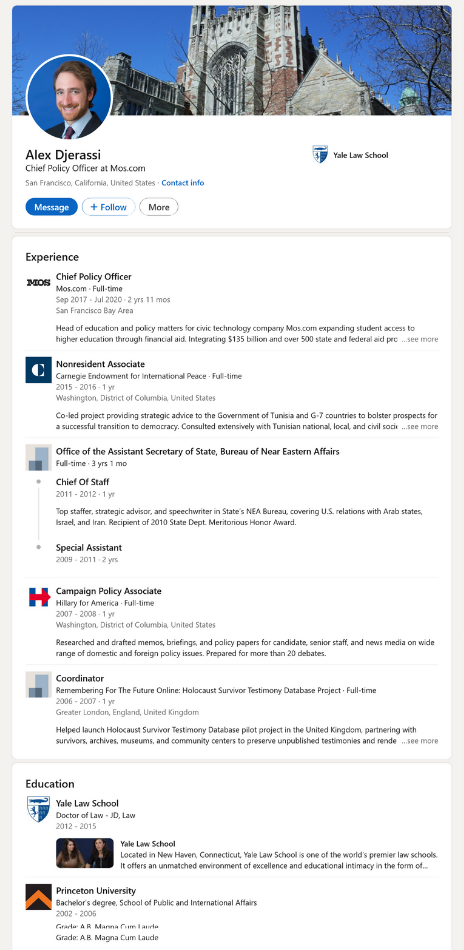
While Robert Maxwell’s daughters were close to state power, some of the family’s third generation have taken up positions within the U.S. government itself. Shortly after graduating from college, Alex Djerassi (Isabel Maxwell’s only son) was employed by Hillary Clinton on her 2007-2008 presidential campaign. Djerassi drafted memos, briefings, and policy papers for the Clinton team and helped prepare her for more than 20 debates.
The Clinton and Maxwell families are closely intertwined. Ghislaine vacationed with Hillary’s daughter, Chelsea, and appeared prominently at her wedding. Both she and Jeffrey Epstein were invited multiple times to the Clinton White House. Long after Epstein was jailed, President Bill Clinton invited Ghislaine to an intimate dinner with him at an exclusive Los Angeles restaurant.
Although she failed in her bid for the White House, President Obama named Hillary Clinton as his Secretary of State, and one of her first actions was to appoint Djerassi to her team. He quickly rose in the ranks, becoming Chief of Staff at the Office of the Assistant Secretary of State, Bureau of Near Eastern Affairs. In this role, he specialized in developing the United States’ policy towards Israel and Iran, although he also worked on the U.S. occupation of Iraq, and accompanied Clinton on visits to Israel and the Arab world.
While at the State Department, he served as the U.S. government representative to the Friends of Libya and the Friends of the Syrian People Conferences. These were two organizations of hardline, hawkish groups working towards the overthrow of those two governments, and their replacement with U.S.-friendly regimes. Washington got what it wanted. In 2011, Libyan leader Colonel Gaddafi was overthrown, killed and replaced by Islamist warlords. And last December, longtime Syrian President, Bashar al-Assad, fled to Russia and was replaced by the founder of al-Qaeda in Syria, Abu Mohammad al-Jolani.
Djerassi was later appointed an associate at the U.S.-government-funded think tank, the Carnegie Endowment for Peace. While there, he again specialized in Middle East policy, his bio noting that he “worked on matters relating to democratization and civil society in the Arab world, the Arab uprisings, and Israeli-Palestinian peace.” Today, he works in Silicon Valley.
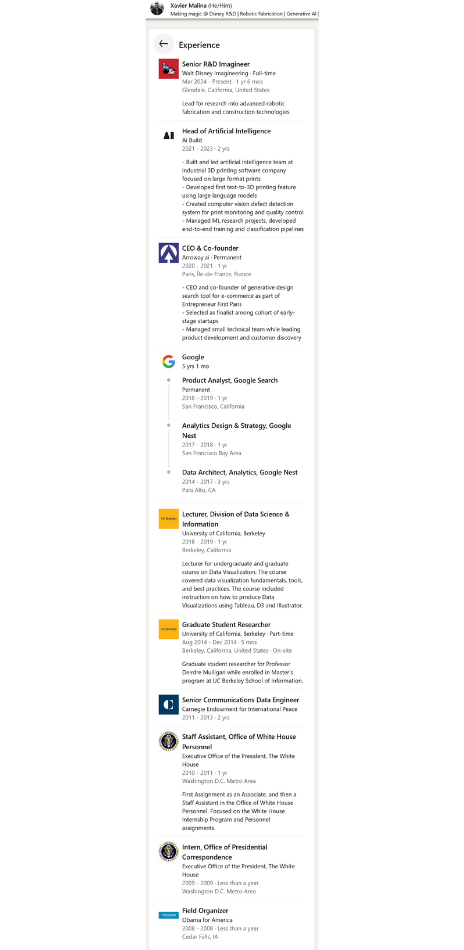
While Djerassi’s fortunes were tied to the Clinton faction of the Democratic Party, his cousin Xavier Malina (Christine Maxwell’s eldest son) backed the right horse, working on the Obama-Biden 2008 presidential run.
He was rewarded for his good work with a position in the White House itself, where he became a Staff Assistant at the Executive Office of the President. Like his cousin, once his time in office was over, Malina also secured a position at the Carnegie Endowment for Peace before pursuing a career in the tech world, working for many years at Google in the Bay Area. He currently works for Disney.
While the actions of parents and grandparents should not determine the careers of later generations, the fact that two individuals who come from a multi-generational family of unrepentant spies and operatives of a foreign power secured positions at the center of the U.S. State is at least worthy of note.
The Maxwell Brothers: From Bankruptcy to Counterterrorism
Much of the Maxwell clan is most influential in American and Israeli politics. However, brothers Ian and Kevin also hold considerable sway over affairs in their native Great Britain. Although being acquitted of charges over widespread allegations that they helped their father, Robert, plunder over $160 million from his employees’ pension fund, the brothers kept a low profile for many years. Kevin, in particular, was known for little more than being Britain’s largest-ever bankrupt, with debts exceeding half a billion dollars.
However, in 2018, they launched Combating Jihadist Terrorism and Extremism (CoJiT), a controversial think tank pushing for a far more invasive and heavy-handed government approach to the question of radical Islam.
In his organization’s book, “Jihadist Terror: New Threats, New Responses,” Ian writes that CoJiT was set up to play a “catalyzing role in the national conversation,” and to answer “difficult questions” arising from the issue. Judging by the content of the rest of the book, this means pushing for even more extensive surveillance of Muslim communities.
Within Britain, CoJiT was a highly influential organization. Its editorial board and contributors are a who’s who of high state officials. Individuals participating in its inaugural conference in London in 2018 included Sara Khan, the government’s Lead Commissioner for Countering Extremism, and Jonathan Evans, the former Director General of MI5, Britain’s domestic intelligence agency.
Like so many Maxwell projects, CoJiT appears to have wrapped up its affairs. The organization has not updated its website or posted anything on its social media channels since 2022.
In fairness, in the past few years, the brothers have had other priorities, leading the campaign to free their sister Ghislaine from prison, insisting that she is entirely innocent. In a manner reminiscent of Robert Maxwell, however, it appears that Kevin may have failed to pay the defense team; in 2022, Maxwell’s lawyers sued him, seeking unpaid fees of nearly $900,000.
The Infamous Mr. Epstein
For years, Ghislaine Maxwell and Jeffrey Epstein ran a sex trafficking ring that exploited hundreds of girls and young women. They were also connected to vast networks of the global elite, including billionaire business owners, royalty, star academics, and foreign leaders, among their closest acquaintances, leading to intense speculation about the extent of their involvement in their many crimes.
It is still unclear when Epstein first met with the Maxwells, with some alleging that he was recruited into Israeli intelligence by Robert Maxwell. Others state the relationship only began after Robert’s death, when he saved the family from penury following its financial problems.
Only one month after his 2019 arrest, Epstein was found dead in his New York City prison cell. His death was officially ruled a suicide, although his family has rejected this interpretation.
Perhaps the two most powerful individuals in Epstein’s circle of confidants were Presidents Bill Clinton and Donald Trump. Clinton, already infamous for the numerous accusations of sexual misconduct against him, is known to have flown at least 17 times on Epstein’s private jet, nicknamed the “Lolita Express,” and was accused by Epstein victim, Virginia Giuffre, of visiting Little St. James Island, the multimillionaire’s private Caribbean residence, where many of his worst crimes took place.
Trump, arguably, was even closer to the disgraced financier. “I’ve known Jeff for fifteen years. Terrific guy,” he said in 2002, “He’s a lot of fun to be with. It is even said that he likes beautiful women as much as I do, and many of them are on the younger side. No doubt about it.” Like Clinton, Trump flew on the Lolita Express. Epstein attended his wedding to Marla Maples in 1993, and claimed to have introduced him to his third wife, Melania.
Unfortunately, while Epstein’s ties incriminate the entire political spectrum, coverage has often been framed as a partisan issue. A MintPress study of over one year of Epstein coverage on MSNBC and Fox News found that each network downplayed his connections to their preferred president, while emphasizing and highlighting the links to the leader of the other major party. As a result, many in the United States see the affair as an indictment of their political rivals, rather than of the political system as a whole.
There also remains the question of Epstein’s links to intelligence, something that has been openly speculated about in the media for decades, even years before any allegations against him were made public. Throughout the 1990s, Epstein’s biographer Julie K. Brown noted, he openly boasted about working for both the CIA and Mossad, although the veracity of his claims remains in doubt. As Britain’s Sunday Times wrote in 2000, “He’s Mr. Enigmatic. Nobody knows whether he’s a concert pianist, property developer, a CIA agent, a math teacher or a member of Mossad.” It is possible that there is at least a grain of truth to all of these identities.
Epstein met with U.S. Deputy Secretary of State William Burns three times in 2014. Burns would later be named director of the CIA. Burns’ proximity to Epstein, however, pales in comparison to that of former Israeli Prime Minister, Foreign Minister, and Defense Minister Ehud Barak. Between 2013 and 2017 alone, Barak is known to have traveled to New York City and met with the convicted criminal at least 30 times, sometimes arriving at his Manhattan mansion incognito or wearing a mask to hide his identity.
Numerous sources have commented on Epstein’s connections to Israeli intelligence. A previous girlfriend and victim of his, referred in court documents as Jane Doe 200 to hide her identity, testified that Epstein boasted about being a Mossad operative and that, after he raped her, she could not go to the police because his position as a spy made her fear for her life.
“Doe genuinely believed that any reporting of the rape by what she believed to be a Mossad agent with some of the most unique connections in the world would result in significant bodily harm or death to her,” reads the court filing.
Ari Ben-Menashe, a former senior official in Israel’s Military Intelligence Directorate, claimed that Epstein was a spy and that he and Ghislaine Maxwell were running a honeytrap operation on behalf of Israel. Four (anonymous) sources told Rolling Stone that Epstein had directly worked with the Israeli government.
Unlike much of the Maxwell family, however, his Israel and intelligence connections are based largely on testimony and unverified accounts. His only known trip to the country was in April 2008, just before his sentencing, a move that sparked fears he would seek refuge there.
Nevertheless, there has been intense public speculation that he could have been working for Tel Aviv. At the Turning Points USA Student Action Summit 2025, former Fox News host Tucker Carlson stated that there is nothing wrong, hateful or anti-Semitic about asking questions about Epstein’s foreign connections. “No one’s allowed to say that the foreign government is Israel, because we’ve been somehow cowed into thinking that that’s naughty,” he said, before expressing his exasperation about the media’s silence on the issue.
What the hell is this? You have the former Israeli prime minister living in your house, you have had all this contact with a foreign government, were you working on behalf of the Mossad? Were you running a blackmail operation on behalf of a foreign government?”
Carlson’s comments drew harsh condemnation from former Israeli Prime Minister Naftali Bennett. “The accusation that Jeffrey Epstein somehow worked for Israel or the Mossad running a blackmail ring is categorically and totally false. Epstein’s conduct, both the criminal and the merely despicable, had nothing whatsoever to do with the Mossad or the State of Israel,” he wrote.
“This accusation is a lie being peddled by prominent online personalities such as Tucker Carlson pretending they know things they don’t,” he added, concluding that Israel was under attack from a “vicious wave of slander and lies.”
Whatever the truth about Epstein, it is indisputable that the powerful Maxwell family holds wide-ranging connections to U.S., British and Israeli state power. It is also beyond doubt that if the full story of their activities were ever to reach the public, it would incriminate a significant number of the world’s most powerful people and organizations. Perhaps that is why Trump has, in short order, gone from promising to release the Epstein Files to potentially releasing his accomplice.
British investigation reveals Reuters’ Israel bias
Palestinian Information Center – August 22, 2025
GAZA – A British outlet, Declassified, has published an investigative report, based on testimonies from Reuters employees and journalists, highlighting a bias in Reuters’ coverage of Israel’s genocide in Gaza.
The investigation pointed to a recent article titled “Israel kills Al-Jazeera journalist it says was a Hamas leader”, referring to the killing of Palestinian journalist Anas Sharif. According to the report, although Sharif had worked with Reuters and was part of their Pulitzer-winning 2024 news team, the headline was chosen over more accurate alternatives, suggesting an inclination to echo Israeli framing.
The report further noted that this headline, and similar instances, triggered backlash online and raised deep concerns among some staff at the influential news agency.
One email, published by a resigned Reuters journalist in August 2024, expressed disillusionment with the agency’s framing of the “Israel-Hamas war”, stating that their personal values no longer aligned with the outlet’s approach.
He, along with colleagues, had called internally for Reuters to uphold journalistic principles. However, he concluded that senior management was unlikely to reform and continued to suppress internal criticism.
An unnamed source at Reuters told Declassified that “several journalists felt coverage of the Gaza war lacked objectivity.” In response, these staff members conducted an extensive internal investigation, including both quantitative and qualitative analysis of Reuters’ reporting.
The results formed the basis of an internal open letter shared with newsroom staff, intended to strengthen and rebalance coverage of Gaza.
Reuters journalists were also reportedly questioning why the outlet had not published more stories referencing expert claims of Israeli genocide in Gaza, especially when these claims were treated differently compared to similar allegations concerning Russia’s conduct in Ukraine.
Working through 499 Reuters articles covering Israel and Palestine between October 7 and November 14, 2023, the analysis revealed a consistent pattern: Israel-centric stories received significantly more resources than those focused on Palestinian suffering. This was particularly striking given that over 11,000 Palestinians were killed in Gaza, a figure nearly 10 times higher than Israeli casualties at the time.
The report further noted that in May, Reuters seemed to show early signs of editorial shifts, perhaps reflecting internal criticisms.
Declassified also unveiled an email from Howard S. Goller, Reuters’ International Editor, introducing an update to the outlet’s editorial guidelines on the “War in the Middle East.” This update permits the use of the term “genocide,”but always with attribution—and continues to restrict the use of the term “Palestine.”
Critics told Declassified that Goller’s update reinforces an Israeli-never-critical framing. It omits key context, such as the roles of the U.S. and Israel in derailing ceasefire negotiations.
The investigation adds that these guidelines ignore the illegal colonial settlement enterprise, the Israeli apartheid regime, and dramatically downplay the scale of destruction in Palestine. They also omit how Gaza has become the deadliest place for journalists since the American Civil War in 1861.
Dehumanize and destroy: How western media helped target Gaza’s journalists
By Robert Inlakesh | The Cradle | August 14, 2025
On 29 September 2024, an Israeli airstrike targeted the home of displaced Palestinian journalist Wafa al-Udaini in Deir al-Balah, central Gaza. She, her husband, and their two young daughters were killed. Her two sons survived but were left injured and orphaned.
Udaini had long been a target. At the start of the war on Gaza, she appeared on a TalkTV broadcast hosted by British anchor Julia Hartley-Brewer, who had just finished a soft interview with Israeli army spokesperson Peter Lerner. When Udaini described Israeli attacks on Palestinians as a “massacre” – using the same word Lerner had applied to Hamas – she was ridiculed and cut off. The segment went viral. Israeli media outlets weaponized the interview to smear Udaini. She was soon receiving direct threats from the Israeli military. In private conversations, she described herself as a marked woman. In the months that followed, when asked by The Cradle if she had moved from her home in Al-Rimal, Gaza City, she said, “I can’t say, sorry.” She added:
“The anchor killed me … They are using the interview to justify killing me.”
Months later, Israel killed Wafa.
Wafa’s assassination was not isolated. It was the culmination of a campaign to normalize the erasure of Palestinian journalists. The occupation army even has a special unit dedicated to this war crime, known as the ‘Legitimization Cell.’
The killing of Anas al-Sharif
The most prominent recent example was Israel’s assassination of one of Gaza’s most famous reporters, Al Jazeera’s Anas al-Sharif, and his entire crew. Nearly 270 Palestinian journalists have been killed since October 2023. Western press has actively facilitated the cover-up of the murder of journalists in Gaza and failed to hold the occupation state accountable. Calls for accountability have been challenging Israel and western media outlets that have provided cover for the deliberate campaign to murder journalists.
Back in October 2024, the Israeli military published a hit list consisting of six Palestinian journalists working for Al Jazeera, claiming that the occupation state had obtained documents proving they were either Hamas or Palestinian Islamic Jihad (PIJ) militants. Sharif was on that list.
Al Jazeera outright rejected the allegations. The so-called intelligence files released by Israel were riddled with contradictions, fabrications, and recycled narratives. One claimed Sharif had been a commander in the Qassam Brigades’ Nukhba unit; another stated he had been injured in a training exercise in early 2023 and deemed unfit for combat. Both cannot be true. In reality, neither is.
When the occupation state announced Sharif’s assassination, it escalated its smear campaign by accusing him of firing rockets. Speaking to The Cradle on condition of anonymity, a senior Hamas official dismisses the claim as “ridiculous,” noting that rocket units and Nukhba forces are not the same, and that Anas was never affiliated with either.
These were not the first threats Anas received. On 22 November 2023, he publicly revealed that Israeli officers had threatened him via WhatsApp, and pinpointed his location. Weeks later, his 90-year-old father was killed in an airstrike on the family home in Jabalia Refugee Camp.
The Israeli military’s documents alleging Anas was a militant have been available for almost a year. Yet no major media outlet attempted to verify them. On the contrary, both the UN Special Rapporteur on press freedom, Irene Khan, and the Committee to Protect Journalists dismissed the Israeli claims. But the disinformation campaign intensified.
Israel’s Foreign Ministry began circulating old images of Anas with Hamas figures. Pro-Israel social media accounts unearthed decade-old tweets in which he expressed support for resistance. US attorney Stanley Cohen tells The Cradle:
“Under international humanitarian law and the law of war, journalists are protected as civilians, thus targeting them can constitute a war crime whether they are seen interviewing combatants or in their reporting have favorably written of or even supported them and their goals.”
Collusion and amplification
Possessing access to all this information and Israel’s long record of fabricating stories, the western media continued to amplify Tel Aviv’s talking points and character assassinations of Gaza’s journalists.
While Israel produced a series of claims to justify the murder of Anas al-Sharif, no such justifications were issued to explain why they struck the well-known tent used by the Al Jazeera broadcast team – which included correspondent Mohammed Qreiqeh, assistant Mohammed Noufal, and cameramen Ibrahim Zaher and Moamen Aliwa.
Yet Reuters ran with the headline “Israel kills Al Jazeera journalist it says was Hamas leader,” a title triggering so much backlash that it forced them to change it to the sanitized “Israel strike kills Al Jazeera journalists in Gaza”. German outlet Bild, which is also the bestselling newspaper in Europe, published perhaps the most outrageous headline of all, entitled “Terrorist disguised as a journalist killed in Gaza,” also later altering their piece to read “Killed journalist allegedly was a terrorist.” Fox News and Canada’s National Post joined the chorus, parroting the occupation army’s narrative.
BBC coverage was equally complicit. In a profile-style article, the British broadcaster stated, “The BBC understands Sharif worked for a Hamas media team in Gaza before the current conflict.” This unverified claim contradicts Sharif’s own criticisms of Hamas, aired before the war. Even the Palestinian resistance movement has denied any formal affiliation. Hamas official Bassem Naim tells The Cradle that there is no known relationship between Sharif and “the movement or its military wing.”
Documented targeting and newsroom dissent
Western media failures began long before these assassinations. Israel’s systematic targeting of media workers has been copiously documented. In August 2024, Human Rights Watch (HRW) published an open letter signed by over 60 rights groups and journalist unions, calling on the EU to take action against Israel’s “unprecedented killing of journalists and other violations of media freedom” in Gaza as part of “widespread and systematic abuses.”
Inside newsrooms, dissent has grown. Marina Watanabe, formerly of the LA Times, was barred from covering Palestine for three months after signing a petition against the killing of journalists. In July, over 100 BBC employees and 306 media professionals signed an open letter accusing the broadcaster of “anti-Palestinian racism.”
The BBC letter also states:
“The BBC’s editorial decisions seem increasingly out of step with reality. We have been forced to conclude that decisions are made to fit a political agenda rather than serve the needs of audiences. As industry insiders and as BBC staff, we have experienced this firsthand. The issue has become even more urgent with recent escalations in the region. Again, BBC coverage has appeared to downplay Israel’s role, reinforcing an ‘Israel first’ framing that compromises our credibility.”
According to Cohen, if media agencies or reporters are found to have willingly participated in propaganda that gives cover for targeting journalists in Gaza, “it could constitute conspiracy to further acts of genocide as it carries with it a state of mind and intent.” He argues that while such cases against the media and journalists can be difficult to win in court, there is precedent for punishment.
However, western corporate media has not only been accused of intentionally aiding Israel in whitewashing war crimes, but has also been implicated in specific cases of outright dehumanization of Gaza’s journalists that have directly correlated to threats and harassment.
Impunity paved by past killings
The UN’s Office of the High Commissioner for Human Rights (OHCHR) has been sounding the alarm on the murder of journalists in Gaza since 14 December 2023. Yet western corporate media has continued to feign ignorance and treat Israel’s repeated lies as if they are credible.
Reuters, which just published and then changed its biased headline covering the assassination of Sharif, is perhaps one of the worst offenders in willfully providing cover for Israel. On 13 October 2023, Tel Aviv targeted a group of journalists in southern Lebanon, killing Reuters video journalist Issam Abdallah. At the time, Reuters refused to name the attacker, saying only that the munition came from the direction of Israel. It took until 7 December for the outlet to publish an investigation confirming what everyone already knew: Israel was responsible. By then, the window for accountability had closed.
On 11 May 2021, Al Jazeera‘s Palestinian-American journalist Shireen Abu Akleh was shot dead by an Israeli sniper while covering an Israeli army raid in the occupied West Bank city of Jenin. Despite overwhelming evidence and international outrage, her killers faced no consequences – a precedent that paved the way for today’s open season on Gaza’s journalists.
That silence, or worse, that complicity has consequences. Honest journalism demands scrutiny, not stenography. Every time western media echoes Tel Aviv’s lies, it helps normalize the slaughter of Palestinian journalists – not out of ignorance, but to deliberately spread propaganda.
Featured Video

Diplomacy is Now a Crime in Britain / Ian Proud
or go to
Aletho News Archives – Video-Images
From the Archives
Genetic baloney in thick slices
MAYBE COULD BE INC.
By Jon Rappoport | No More Fake News | July 8, 2021
Gene research companies tend to come and go. They start out banging and popping like fireworks in the sky, and then they fade out—selling themselves to larger outfits who’ve hired better liars…
Once upon a time, it sounded easy. Start with a disease, find the gene responsible for the disease, and correct the problem.
Then, researchers wondered, was disease the result of one gene or a group of genes acting together?
Either way, the proof would be in devising cures for diseases using gene therapy. “Not yet, but soon…”
And regardless, the major need was: money. Lots and lots of money.
This need required good PR people. “We have to pump up the idea that we’re on the edge of tremendous breakthroughs. We’re always on that edge…”
This hype also needed to obscure the fact that there wasn’t (and isn’t) ANY gene cure for ANY disease. … continue
Blog Roll
 Aletho News
- Diplomacy is Now a Crime in Britain / Ian Proud
- UK Government Body Kept Files on People Criticizing Prevent Program
- US military withdrawal from Iraq and the collapse of US-Israeli hegemonic project in West Asia
- What does Europe want – a war with Russia?
- She Followed the Actual Data on COVID Vaccines and Masks — Her Career Took a Huge Hit
- Florida AG Sues Pfizer, Bourla Over Deceptive Marketing of COVID Vaccines
- Von der Leyen gifts her spin doctor a job for life
- 10K More U.S. Troops Deploy as Trump Weighs New Iran Strikes /Suliaman Ahmed
- Iranian crew declared Dena training vessel ‘unarmed’ to US warship before deadly torpedo strike: Report
- Iran’s NPT debate moves beyond parliament
- If Americans Knew
- Israel is squeezing the life out of Palestinians – Daily Update
- The Israeli Right Portrays Islam as Murderous. It Serves a Political Purpose
- Jordan Has Had Enough: King Abdullah’s Scathing Warning to Israel
- Israeli Colonizers (i.e. Settlers) Kill Palestinian Man Near Salfit
- New Google Maps images reveal massive scale of devastation in Gaza
- Jewish supremacy, anti-Palestinian bigotry on display in Israel – Daily Update
- Israeli Soldiers Abduct At Least 22 Across Occupied West Bank
- Eight Palestinians Killed in Israeli Attacks on Gaza
- Israeli former leaders and security chiefs threaten legal action over ‘Jewish terrorism’
- Israel map in LA Times ad includes all land from the river to the sea
- No Tricks Zone
- Green Energy Debacle: German Expert Professor Fritz Vahrenholt Warns Of Severe Economic And Social Consequences
- Two More Paleo Reconstructions Affirm Meters-Higher Sea Levels Across Ireland, Brazil 7000-6000 Years Ago
- New Study: Earth And Venus Surface Warmth Largely Explained By Convection And Lapse Rate, Not CO2 Or Radiation
- 2025 Nature Paper Claiming Worsening Global Drought Gets RETRACTED …Heavily Flawed
- New Study: ‘Global Drought Shows No Detectable Recent Acceleration Under Climate Warming’
- Economic Masterminds: German Socialists Suggest Taxing Productivity Gains Stemming From Using AI
- The South China Sea Has Not Been Cooperating With The Climate Change Narrative
- Energy Crisis: Germany Enters Heating Season With Historically Low Gas Reserve Fill Levels
- New Study: The Antarctic Ice Sheet Gained Mass From 2020-2024 Due To Staggering Snow And Ice Accumulation
- Study: Ocean Heating Rates From Thousands Of Years Ago ‘Dwarf’ Modern Ocean Heating Rates