How Western media aids Israel’s genocide and targeted killing of journalists in Gaza
Israel and the end of The Times
By Marzieh Hashemi | Press TV | August 12, 2025
Never in the history of mankind have human beings witnessed a genocide in real time, in the way we are watching what is unfolding in Gaza today.
We have seen people being sniped, hospitals being bulldozed, refugees in tents being burned alive, the starvation of the population, and so much more, on our screens.
Most of what we are witnessing is due to the tireless and courageous commitment of Palestinian journalists in Gaza who know that they can be killed at any time by the regime, but despite this, continue to show us the reality of what’s happening on the ground in Gaza.
It is an extremely difficult job for them; however, the streaming of videos and providing live coverage have finally helped change the narrative on Palestine and its occupation globally.
Before this latest round of genocide, no matter the type of brutality and oppression that Palestinians endured, they would be confronted with comments such as “Israel has the right to defend itself” or “the Israelis have no choice because of Hamas’ missiles raining down upon the innocent Israeli population.”
But now, the greatest fear of the Israeli regime is coming to fruition. Zionists are losing control of the narrative. The truth has been seeping out, one war crime after another. People around the world have awakened and many no longer believe in the hasbara version of events.
The child-murdering regime tried to prevent this from happening. Thus, from the very beginning of this latest round of genocidal war against the Palestinian people, international journalists were not allowed by the Israeli regime to enter Gaza.
The regime gave the excuse of protecting the journalists’ safety, but the reality is that it did not want the real story of what is happening in Gaza to be exposed.
Thus, the primary responsibility of showing the reality on the ground fell on the backs of Palestinian journalists, whom the Israeli regime continues to try to control, discredit or silence.
Due to this, the deliberate targeting of Palestinian journalists by the regime has been ruthless and has intensified with time.
The cold-blooded assassinations of journalists have been taken to a whole new level in Gaza. Journalists have never been targeted in the way they are today.
As of the writing of this article, 242 journalists have been killed in Gaza, with the latest five murders taking place just on Sunday night. A tent housing Al Jazeera journalists was deliberately targeted by the regime, killing all five members of the crew. Israel has taken responsibility for the assassinations, saying that the tent housed a “Hamas cell.”
This is the action of a regime to which Western powers have given impunity. Israel is not sanctioned due to killing babies in incubators. It is not even held accountable for starving a whole population of people. It is not pressured in any way.
Thus, during the last 22 months, we have seen the targeting of journalists expand throughout the region, including the occupied West Bank, Lebanon and Iran, where the main news building of the Islamic Republic of Iran Broadcasting (IRIB) was targeted, killing three people.
Why? Because it can. It is not held accountable. If any condemnations are made, they are simply some verbal jargon on the international level, resulting in no consequences for the regime to stop its illegal actions.
Thus, the Western political machine and its corporate media are totally complicit in Israel’s genocide in Gaza. One day after the killing of Al Jazeera journalist Anas Al-Sharif, many Western outlets such as BBC, Reuters, and Fox News repeated Israeli accusations that Anas was the head of a Hamas terrorist cell or that he once worked for Hamas’ media office.
Instead of showing its outrage at the targeting of fellow journalists, the BBC, which prides itself on being the largest broadcast corporation in the world, simply repeated Israeli hasbara.
This is the reason 238 journalists have been killed in Gaza over the past 22 months and their colleagues in Western countries have done nothing about it or have instead magnified the lies of the Zionist regime. These so-called journalists are toeing the line of the Zionists.
Why haven’t the BBC, Reuters, New York Times or other media entities called Israel out for preventing them from sending journalists to Gaza?
Why try to demonize the messenger who has just been assassinated, unless you too, like the Israeli regime, want to keep the message from getting out?
Is the exposure of the real narrative of Palestine and Israel fatal for you too? You are all complicit in genocide and your efforts to stifle the truth are too late, as too many people have awakened.
The narrative has changed. Increasingly more people are realizing that Palestine was not a land without a people, as they had been taught, nor had Palestinians agreed upon their land being taken.
There was a Nakba that has never ended and all parties complicit in it are being exposed, as the world awakens and shows its disdain for genocide and its supporters.
Marzieh Hashemi is a US-born, Iran-based journalist, commentator and documentary filmmaker.
Germany’s leading newspaper calls murdered Al Jazeera reporter ‘terrorist posing as journalist’

The Cradle | August 11, 2025
German newspaper Bild has parroted the Israeli army’s claims that slain Al Jazeera journalist Anas al-Sharif was “terrorist disguised as a journalist,” hours after the prominent reporter was targeted and killed in a strike on Gaza City.
Bild is Germany’s highest-circulation newspaper. It had approximately 6.93 million readers per issue in 2023 – and sells around 1.02 million copies a day.
The article cited documents published by Israel claiming Sharif was a member of the Qassam Brigades’ Jabalia battalion.
“The IDF attacked terrorist Anas al-Sharif in the Gaza City area. The terrorist was operating under the guise of an Al Jazeera journalist. The terrorist Anas al-Sharif served as a cell leader in Hamas and promoted rocket fire against citizens of the State of Israel and IDF,” the Israeli army said.
The army points to previously published, unverified documents, including salary documentations, personnel spreadsheets, and a list of training courses, which it says “unequivocally” prove Sharif’s involvement with Hamas.
The documents claim Sharif was recruited into Hamas at the age of 17, despite membership in the group officially requiring a minimum age of 18 years.
Another inconsistency is that joining the Qassam Brigades takes years of training.
Sharif had been covering Israel’s genocidal campaign in Gaza since it started in October 2023. He was given the 2024 Human Rights Defender award by Amnesty International Australia for his coverage.
Tel Aviv had been inciting against him for months.
A headline by The Telegraph on Monday also referred to Sharif as a “journalist accused of leading a Hamas terror cell.” Israeli news site i24’s headline called him a “Hamas-affiliated Al Jazeera journalist” who was “eliminated.”
The documents cited by Israel also listed Hosam Shabat, an Al Jazeera reporter accused of Hamas ties, who was killed in an Israeli strike in March.
Several other journalists are listed as either members of Hamas or the Palestinian Islamic Jihad (PIJ) movement.
“I, Anas al-Sharif, am a journalist with no political affiliations. My only mission is to report the truth from the ground – as it is, without bias. At a time when a deadly famine is ravaging Gaza, speaking the truth has become, in the eyes of the occupation, a threat,” Sharif wrote weeks before his assassination.
Since the start of the war, 238 Palestinian journalists have been targeted and killed by the Israeli army.
The real Russiagate scandal blows away Watergate for crimes and treason by U.S. establishment
Strategic Culture Foundation | August 1, 2025
So the hoax is finally officially acknowledged. “Russiagate” – the mainstream narrative, that is – is now described by American intelligence chiefs as a fabrication that was concocted to overturn the results of the 2016 U.S. presidential elections.
Tulsi Gabbard, the current Director of National Intelligence (DNI), and CIA director John Ratcliffe have both accused former President Barack Obama of engaging in a “treasonous conspiracy” to subvert the constitutional process. It’s not just Obama who is implicated in this high crime. Other former senior officials in his 2013-17 administration, including former DNI James Clapper, CIA director John Brennan, and head of the FBI James Comey, are also implicated. If justice is permitted, the political repercussions are truly earth-shattering.
The potential impact is not confined solely to the violation of U.S. laws and the democratic process – bad enough as that is. The Russiagate scandal that began in 2016 has had a lasting, damaging effect on U.S. and European relations with Russia. The frightfully dangerous NATO proxy war incited in Ukraine, which threatens to escalate into a full-scale world war, was fueled in large part by the hostility generated from the false claims of Russian interference in the U.S. elections.
The allegations that Russian President Vladimir Putin oversaw a subversion campaign against the 2016 U.S. election and colluded with Donald Trump to get him elected were always specious. The scandal was based on shoddy intel claims to purportedly explain how Trump defeated his Democrat rival, Hillary Clinton. Subsequently, the scandal was hyped into a seemingly credible narrative by U.S. intelligence chiefs at the direction of then-President Barack Obama as a way to delegitimize Trump’s incoming first-term presidency.
Years before the recent intelligence disclosures, many independent journalists, including Aaron Maté, and former intelligence analysts like Ray MacGovern and William Binney, had cogently disproven the official Russiagate claims. Not only were these claims false, they were knowingly false. That is, lies and deliberate distortions. Russia did not hack emails belonging to the Democratic National Committee to discredit Clinton. Clinton’s corruption was exposed by a DNC internal leak to Julian Assange’s Wikileaks whistleblower site. That was partly why Assange was persecuted with years-long incarceration.
A large enough number of voters simply despised Clinton and her warmongering psychopathy, as well as her sell-out of working-class Americans for Wall Street largesse.
Furthermore, Moscow consistently denied any involvement in trying to influence the 2016 U.S. election or attempts to favor Trump. Putin has said more than once that Russia has no preference about who becomes U.S. president, implying that they’re all the same and controlled by deeper state forces. Laughably, too, while Washington accused Moscow of election interference, the actual record shows that the United States has habitually interfered in scores of foreign elections over many decades, including those of Russia. No other nation comes close to the U.S. – the self-declared “leader of the free world” – in sabotaging foreign elections.
In any case, it is instructive to compare the Russiagate farce with the Watergate scandal. Watergate involved spying by the White House of President Richard Nixon against a Democrat rival in the 1972 election. The political crisis that ensued led to Nixon’s resignation in disgrace in 1974. The U.S. nation was shocked by the dirty tricks. Several senior White House officials were later convicted and served time in jail for crimes related to the affair. Nixon was later pardoned by his successor, Gerald Ford, and avoided prosecution. Nevertheless, Watergate indelibly disgraced U.S. politics and, at the time, was described as “the worst political scandal of the 20th century.”
Subsequent cases of corruption and malfeasance are often dubbed with the suffix “gate” in a nod to Watergate as a momentous political downfall. Hence, “Russiagate.”
There are hugely important differences, however. While Watergate was a scandal based on factual crimes and wrongdoing, Russiagate was always a contrived propaganda deception. The real scandal behind Russiagate was not Trump’s alleged misdeeds or those of Russia, but the criminal conspiracy by Obama and his administration to sabotage the 2016 election and subsequently to overthrow the Trump presidency and the democratic will of the American people. Tulsi Gabbard, the nation’s most senior intelligence chief, has said that this amounts to “treason,” and she has called for the prosecution of Obama and other former senior aides.
Arguably, the real Russiagate scandal is far more criminal and devastating in its political implications than Watergate. The latter involved illegal spying and dirty tricks. Whereas, Russiagate involved a president and his intelligence chiefs trying to subvert the entire democratic process. Not only that, but the U.S. mainstream media are also now exposed for perpetrating a propaganda heist on the American public. All of the major U.S. media outlets amplified the politicised intelligence orchestrated by the Obama administration, claiming that Russia interfered in the election and that Trump was a “Kremlin stooge.” The hoax became an obsession in the U.S. media for years and piled up severe damage in international relations, a nefarious legacy that we are living with today.
The New York Times and Washington Post, reputedly two of the finest exponents of American journalism, jointly won the Pulitzer Prize in 2018 for their reporting on Russiagate, the official version, that is, which lent credibility to the hoax. In light of what we know now, these newspapers should be hanging their heads in shame for running a Goebbels-like Big Lie campaign to not only deceive the U.S. public but to subvert the democratic process and poison international relations. Their reputations are shredded, as well as those of other major media outlets, including ABC, CBS, CNN, and NBC.
Ironically, The Washington Post won the Pulitzer Prize in 1973 for its reporting on the Watergate scandal. The story was made into a best-selling book, All The President’s Men, and a hit Hollywood movie starring Robert Redford and Dustin Hoffman, playing the roles of intrepid reporters Bob Woodward and Carl Bernstein. Woodward and Bernstein and The Washington Post were acclaimed as the finest in U.S. journalism for exposing Watergate and bringing a crooked president to book.
How shameful and absurd that an even greater assault on American democracy and international relations in the form of Russiagate is ignored and buried by “America’s finest”. That the scandal is ignored and buried should be of no surprise because to properly reveal it would shatter the foundations of the U.S. political establishment and the sinister role of the deep state and its mainstream media propaganda system.
How much is shoddy, pro-Israel journalism worth? Ask Bari Weiss.
As her Free Press is poised to seal a $200 million deal with the mainstream news giant CBS, let us reflect on why
By Branko Marcetic | Responsible Statecraft | July 29, 2025
A thought experiment: would anyone who referred to the killing of 50 Jewish people, many of them “entirely innocent non-combatants, including children,” as “one of the unavoidable burdens of political power, of Palestinian liberation’s dream turned into the reality of self-determination,” ever be hired by a major television news network?
Would their news outlet ever be potentially offered more than $200 million to merge with that major news network?
Of course not, and for good reason. Yet that’s exactly what’s happening, only with one small but major difference: the writer and her news outlet responsible for this statement, Bari Weiss and The Free Press, were not talking about Hamas’ murder of Israelis, but rather about Israel’s killing of 50 Palestinians — “Zionism’s dream turned into the reality of self-determination,” as Weiss described it in 2021.
Weiss is currently in talks to sell The Free Press to CBS News for between $200-$250 million, after reportedly winning over its new owner, David Ellison, “by taking a pro-Israel stance,” according to the Financial Times. Ellison “wants to position The Free Press alongside CBS News,” the paper reported, while another source told the New York Times that Ellison is weighing up giving Weiss “an influential role in shaping the editorial sensibilities of CBS News.”
If so, it would be a major new development in a pervasive double standard we’ve seen in the past nearly two years. Weiss and her outlet have engaged in rhetoric and professional behavior that would ordinarily never pass muster in a newsroom — but are considered acceptable because they are in support of Israel’s war against Palestinians.
For one, The Free Press has repeatedly spread misinformation. In May 2024, the outlet charged that the UN had “admit” the civilian death toll was 50 percent lower than what was being claimed, a quickly debunked and borderline willful misreading of a UN document, a misreading that the UN secretary-general’s office swiftly came forward to correct (a fact left out of The Free Press’ piece).
One year later, The Free Press declared the idea that Israel was engineering a man-made famine that was underway in Gaza a “myth,” even as Israel was in its third month of blocking all food, fuel, and medicine into the territory and at least 57 civilians had already starved to death, most of them children. As recently as this past Sunday, another Free Press article argued that “there isn’t mass starvation as claimed by pro-Hamas propaganda,” which flies in the face of not just basic reality, but testimony from doctors, major news organizations with journalists on the ground, and even the conclusion of President Donald Trump, a supporter of the war.
Just this past June, The Free Press charged simultaneously that there had both been no massacre of Palestinian aid seekers, and that, if there was, Hamas may have been responsible. Of course, since then, not only have Israeli soldiers admitted to shooting aid-seekers but U.S. contractors are coming forward to back up their gruesome stories. These accounts are becoming a near-daily occurrence, with over 1,000 Gazans killed at or close to aid distribution sites in the past two months.
In late May, The Free Press even published a puff piece on the group running these virtual slaughterhouses, the Gaza Humanitarian Foundation (GHF), painting it as an unsung success story, despite ample controversy at the time over its reliance on mercenaries and lack of independence. Two months of bloodshed later, condemnation and calls for GHF’s dismantling are widespread, with one former GHF staffer — a retired U.S. special forces officer — saying he had never witnessed such brutality and indiscriminate violence against “an unarmed, starving population” as at GHF’s distribution centers.
All of these pieces are still up, uncorrected on The Free Press website. And this is by no means an exhaustive list.
When it’s not spreading outright misinformation, The Free Press engages in more insidious propaganda. For instance, it has, depending on the public relations needs of the moment, shifted between ignoring, indignantly denying, and justifying Israel’s attacks on Gaza’s hospitals.
When a blast in the war’s first month that killed hundreds at al-Ahli Hospital ignited global outrage, The Free Press jumped on evidence that it may have been an errant Hamas rocket to charge again and again and again, even as recently as two days ago, that the media were rampantly defaming Israel through fake news of crimes it had never committed.
Since then, The Free Press has simply ignored the Israeli attacks on hospitals, often openly done and fully admitted to by the IDF, that have left 94 percent of hospitals in Gaza damaged or destroyed, including just this year attacking al-Ahli at least twice. In fact, both the outlet and Weiss personally pivoted quickly from denying Israel would do such a terrible thing to actively justifying its targeting of hospitals.
Of course, the vast majority of Israel’s war crimes in Gaza are simply never discussed by the outlet. The same goes for Palestinian suffering more generally and the massive and ever-mounting Palestinian death toll, which a group of experts last year concluded is likely undercounted by hundreds of thousands. Typically, the only time these topics are discussed by the outlet is to deny them and to lament their negative effect on Israel.
This is hardly surprising, considering new revelations that The Free Press has serially regurgitated content pushed by the Center for Peace Communications — an organization staffed by figures from pro-Israel think tanks and funded by money from pro-Israel donors.
Another largely absent topic: antisemitism, which is a charge The Free Press exclusively reserves for antiwar protesters, college campuses, teachers unions, Peter Beinart, Ireland, and anyone else who expresses pro-Palestinian sentiment, while it dutifully ignores accusations of antisemitism among Trump appointees and nominees and allies who also happen to be supporters of Israel’s war.
That brings us to the conduct of Weiss herself. She has a personal history of both playing fast and loose with the truth and what can only be described as a high degree of tolerance for anti-Arab and Islamophobic bigotry.
Weiss first rose to prominence due to her efforts to get Muslim and Arab professors at Columbia University fired by accusing them of racism, only for the resulting investigation to find “no evidence of any statements made by the faculty that could reasonably be construed as anti-Semitic.” She then later misleadingly claimed she had never tried to get them fired.
The supposedly rabid bigotry of ordinary Muslims is a favorite topic of Weiss, who has previously blamed rising antisemitism in Europe on the Muslim presence there, and warned that European Jews have “reason to worry” because of it. Soon after October 7, she approvingly shared a Free Press article whose central argument was that protests against Israel’s war — dishonestly characterized as hateful antisemitic rallies “celebrat[ing] mass murder in the streets” — were thanks to immigrants from Middle Eastern countries who could be either “80-year-old Armenian retirees or jihadi terrorists plotting another 9/11.” The Free Press later published an error-riddled article explicitly blaming a surge in Canadian antisemitism on Muslim immigration.
At the same time, Weiss has often promoted, often through The Free Press, her “friend” Ayaan Hirsi Ali. Hirsi Ali believes that “we are at war with Islam,” which she has called “a destructive, nihilistic cult of death,” that “there is no moderate Islam,” and that it must be “defeated” and “crush[ed],” including by closing all Muslim schools.
Ali has been a favorite of Islamphobic think tanks and neoconservative activists since the Global War on Terror. She has written that “every devout Muslim” at the very least “approved” of Al Qaeda’s 9/11 attacks and wrote a book that argued that Muslim immigration threatens the rights of Western women, partly because of Muslim men’s supposedly rapacious appetite for sexual violence.
Weiss eagerly promoted that book, spending an hour teeing Hirsi Ali up in a question and answer session to hold forth unchallenged about the dangers of ordinary Muslim men. Elsewhere, Weiss has waxed lyrical about her pride in associating with Hirsi Ali, and that she regards someone’s support for her as a “litmus test.”
If Weiss expressed or promoted any of these same views about Jewish immigrants and Judaism, she would likely be blacklisted in U.S. media, and for good reason. Instead, because they are aimed at Muslims, she is now being richly rewarded.
That a major network like CBS is seriously considering giving Weiss and The Free Press an even bigger platform and the imprimatur of mainstream legitimacy — given not just its promotion of anti-Muslim views, but its history of spreading outright, uncorrected falsehoods — is a sad reflection of the degradation of press standards.
And it seems to only be happening because a top media executive regards Weiss’ history of shoddy journalism less important than her support for Israel’s wars.
US media owe Putin an apology – Fox News host
RT | July 29, 2025
The US media need to make “serious” amends to many people, including Russian President Vladimir Putin, for their active role in spreading the Russiagate hoax following the 2016 presidential election, according to popular Fox News host Greg Gutfeld.
The political commentator, comedian, and author was responding to recent revelations made by Director of National Intelligence Tulsi Gabbard, who released a trove of documents she described as “overwhelming evidence” of a coordinated effort by senior Obama-era officials – allegedly led by Barack Obama himself – to politicize intelligence and falsely accuse Donald Trump of colluding with Russia to win the election.
“We cannot let this go. They need to make serious amends because we are still living with the aftermath,” Gutfeld said on his latest show, aired last weekend. “People lost jobs, careers, friends. There need to be consequences.”
“They owe a lot of people an apology. Hell, they even include Putin.”
According to Gutfeld, major American news media outlets “played the starring role in amplifying the subversive plot against the president of the United States.” He dismissed recent claims by the press accusing the Trump administration of trying to “rewrite history,” calling them an “attempt to shift culpability away from themselves and hide the lie they perpetuated for almost a decade.”
Earlier this month, a similar assessment was made by former CIA Director John Ratcliffe. In an interview with the New York Post, he cited an internal review suggesting that American public opinion had been manipulated through repeated media leaks and anonymous sources quoted by The Washington Post, The New York Times, and other major outlets.
Allegations of “Russian collusion” persisted in mainstream media coverage even after Special Counsel Robert Mueller’s investigation found no evidence to support the claims. Moscow has repeatedly denied interfering in the US election.
Gabbard described the Trump-Russia probe, widely referred to as Russiagate, as “a years-long coup” against Trump. The US president himself, who has consistently dismissed accusations of ties to Russia as fabricated, praised Gabbard for “exposing” the alleged plot and urged her to “keep it coming.”
Hamas denies operating camp in Aley, asserts Lebanese sovereignty
Al Mayadeen | July 28, 2025
Hamas has firmly denied claims circulating in the media that the Lebanese Army dismantled a Hamas armed training camp in Aley, Lebanon, and called on journalists to prioritize accuracy and professional integrity in their coverage.
In a statement, the Palestinian Resistance movement responded to reports circulated by some media outlets, newspapers, and websites claiming that “the Lebanese army dismantled an armed training camp in the Aley region belonging to Hamas.”
Hamas firmly denied having any armed training camp in the mentioned area or elsewhere in Lebanon, emphasizing that it has no intention of establishing such facilities in the first place.
The movement further emphasized its strong commitment to cooperation and coordination with the Lebanese state and its relevant authorities, as this contributes to maintaining civil peace and strengthening the fraternal Palestinian-Lebanese relationship. It also asserted respect for Lebanese sovereignty under all circumstances.
Hamas also called on all media outlets to adhere to accuracy and objectivity, ensuring that their reporting is guided by professional responsibility to avoid potentially severe repercussions that could further escalate tensions in Lebanon at the hands of the Israeli enemy.
Climate Change Is Reducing, Not Increasing Food Costs, Mainstream Media
By Linnea Lueken | ClimateRealism | July 23, 2025
A flurry of mainstream media reports, from Bloomberg, The Guardian, Financial Times, and CNN, among other outlets, claim that climate change is causing rising food prices “worldwide,” based on a single new study. This is false. Bad weather has always impacted crop production, and there is no actual evidence that extreme weather is increasing. Globalization of media coverage is simply making it easier to hear about bad weather elsewhere in the world, meanwhile crop production and yields globally continue to set records – a fact the same media outlets largely ignore.
Focusing on the coverage by Bloomberg, in an article titled “How Climate Change Is Raising Your Grocery Bill,” Bloomberg writers report on a study from the Barcelona Supercomputing Center (BSC) and the European Central Bank, which claims price jumps in certain food products are due to “extreme weather they say is linked to climate change.”
Bloomberg claims that consumers around the world “say they are feeling the effects of climate change on their grocery bills, making food unaffordable for some and posing a challenge for central bankers trying to tame inflation.” If true at all, this is almost certainly the effect of media coverage like Bloomberg’s insisting that climate change is responsible, instead of observational evidence of crop production.
It is worth noting that the study uses the term “unprecedented” eight times in the mere four pages of content. To justify their use of the term unprecedented to describe global weather events in the last few years they reference ERA5 surface temperature data going back to 1940, and the standardized precipitation index from CRU going back to 1901. The reason why this is non-scientific and misleading will become clear when we go over the weather events they claim were so “unprecedented.”
Bloomberg discussed a few of the weather events mentioned in the study linking them to increases in the price for specific crops. They first highlighted increases in lettuce and vegetable prices in the United States, driven by droughts in California and Arizona, the former of which Bloomberg claims saw the “driest three-year period ever recorded.” Also mentioned was hurricane Ian. The problem, of course, is that California’s drought was anything but unprecedented. As discussed in the post “Mega-droughts and Mega-floods in the West All Occurred Well Before ‘climate change’ Was Blamed for Every Weather Event,” historical data and proxies show that California has experienced far more widespread and severe periods of drought in the past, some of which lasted as long as two hundred years.
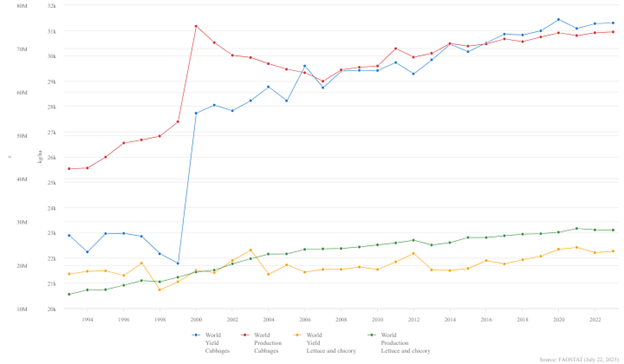
In Asia, Bloomberg says a heatwave impacted South Korean cabbage production. While UN Food and Agriculture Organization (FAO) data indicate that cabbage production has been slowly declining after a massive spike in the 1970s, yields have remained stable or increased since 2000. This suggests that economic considerations or political decisions made about the relative benefits of growing cabbage versus other crops that could be grown, or uses the land could be put too, rather than climate, are responsible for changes in production.
Australia also saw high lettuce costs due to flooding in the eastern part of the country in recent years, but the year Bloomberg and the study highlight, 2022, was not unprecedented as they implied. In fact, 2022 was only the sixth “wettest” year on available Australian rainfall records, the wettest year on record was in 1950.
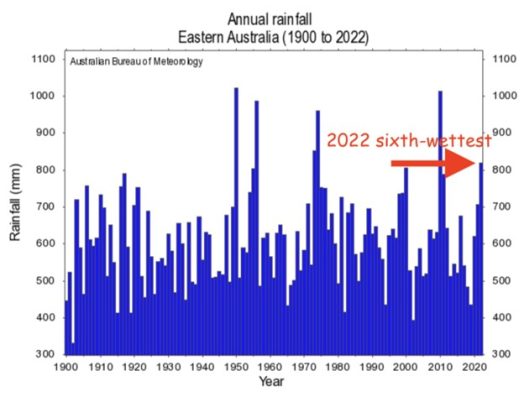
Figure 1: Australian rainfall records, chart from Jennifer Marohasy
Bloomberg goes on to explain how the study allegedly “found that heat, drought and floods were occurring at an increased intensity and frequency,” which is at odds with available data and the UN Intergovernmental Panel on Climate Change’s 6th assessment report, which though it claims an increase in extreme heat has been detected, finds no emergence of increased flooding or drought in the current historical period.
In short, Bloomberg, and the other mainstream media outlets hyping the BSC report, failed to do any fact checking, failed to examine crop trends, and illegitimately linked individual weather events to long-term climate change, despite such events being common in history and there being no discernable trend in an increase in such events amid the slight warming that has occurred in recent years. To be clear, weather is not climate and, despite what unscientific attribution studies claim, no specific weather event can be tied to long-term climate change.
In short, none of the weather events Bloomberg referred to as unprecedented were in fact unique or even rare historically.
Concerning the crops, BSC and the media focuses on the most, lettuce and cabbage, data from the U.N. Food and Agriculture Organization show that between 1993 and 2023 (the most recent 30-year period of climate change for which we have available data):
- Lettuce (and chicory – the FAO combines them) production grew approximately 112 percent;
- Lettuce and chicory yields increased by about 4 percent;
- Cabbage production expanded by nearly 75 percent;
- And cabbage yield grew by more than 37 percent. (see the graph below)
Bloomberg does briefly concede that other factors, like El Niño, a totally natural phenomenon, played a role in weather in 2023 and 2024, impacting certain crops. The outlet also begrudgingly admits that “food price shocks typically turn out to be short-term in nature, because high prices incentivize more production, which brings prices back down,” though they try to say that coffee and cattle are exceptions to this rule. Although Bloomberg reports that coffee futures are high, there is no evidence that climate change is actually damaging global coffee production, as explained in Climate Realism posts here, here, and here.
Bloomberg ends with a warning from the study authors, claiming that “slashing greenhouse gas emissions and containing global warming will be key to reducing food price inflation risks,” but this ignores another key aspect of food costs. They are also impacted by the cost to produce food, like when governments increase the price farmers pay for fossil fuel derived pesticides and fertilizers or try to restrict their use. Fossil fuel derived chemicals increase yields with less labor and using much less land. Take a look at Sri Lanka for a good example of what happens when climate action is prioritized over food production.
Never before has it been so easy for the media to report on various weather disasters and crop failures globally, and this certainly has an impact on peoples’ perceptions as well as the ability for studies to try to draw connections that aren’t really backed by data. This Bloomberg piece is nothing more than climate fearmongering; taking disconnected crop shortages from around the world from localized weather events and trying to blame them on climate change, when the truth is that there have always been crops failing somewhere in the world at any given time.
FT hit job on Zelensky is a clue as to Trump’s thinking
By Martin Jay | Strategic Culture Foundation | July 25, 2025
It’s finally happened. After months of pundits wondering when would the moment come when western media would finally take a clear and decisive stand against Ukraine’s venal president, it has finally happened – and by the most ardent pro-EU broadsheet to note. The all-out hit piece on Zelensky recently by the Financial Times should indicate that something is about to happen in Ukraine and it will probably involve the president either having his own Ceausescu moment or simply fleeing the country. How long has he got?
Legacy media always likes to be on the right side of history and for the FT to come out like this with the piece that they’ve written must be ominous. It was published at the same time as the British conservative political chronicle The Spectator did much the same thing. Timing seems to be worth noting given that a few days beforehand unconfirmed ‘reports’ on social media were claiming that Trump had indicated to Zelensky that he needs to step down with even suggestions of who would take his role. It also comes amidst a series of reports which show that Zelensky’s panicking has reached an all-time high with the recent arrest of the of the anti-corruption activist Shabunin. Interestingly, that same day, ex-Minister Oleksandr Kubrakov was also targeted. In both raids at their homes, armed men showed no warrants and blocked lawyers from attending the searches, it is claimed. The arrest of the anti-graft campaigner is significant as is the take of the FT itself: The article says: “A crackdown on the country’s most famous anti-corruption crusader can’t be happening without at least the silent approval from President Zelenskyy, if not active permission,” it explains.
The significance and timing of the FT piece should not be underestimated. It’s not simply that on the battlefield itself that the Russians are advancing and that it becomes more openly accepted that the Ukrainians simply don’t have the men to fight this war, but more about Zelensky himself who is beginning to be portrayed as a dictator now clinging onto power and using all of the vestiges of martial law to crack down on even the faintest trace of dissent. Ukraine is now a totalitarian state with the level of Zelensky’s paranoia now starting to become widely known and discussed. The FT, one of those media giants which largely supported Zelensky and which barely considered elements of his brutal measures worth even reporting, such as the appalling murder of U.S. blogger Gonzalo Lira, is now reporting on even campaigners merely being roughed up by Zelensky’s henchmen – a considerable U-turn and worth noting is the detail it goes into with its zeal. Indeed, it has been the FT which has chosen not to cover a number of stories since the beginning of the war which many would argue created a positive aura around Zelensky which can be noted even as recently as in May when a key opponent of Zelensky was assassinated in broad daylight by a gunman in front of the victim’s children’s school in Madrid. In this case, the murder of Andriy Portnov was covered, but he was portrayed as a criminal “wanted in Kiev for treason”.
The FT’s support of Zelensky is over, we can assume.
It noted that “Shabunin and Kubrakov labelled the recent raids as politically motivated, adding that the SBU had presented no court-issued warrants and would not allow time for their lawyers to be present for the searches”.
Vitaliy Shabunin even is quoted in the article as explaining what the stunt was supposed to achieve. He told the paper, “Zelenskyy is using my case to send a message to two groups that could pose a threat to him. The message is this: if I can go after Shabunin publicly — under the scrutiny of the media and despite public support — then I can go after any one of you”.
The FT goes even further in its analysis of the situation and could even be assessed of being a catalyst to a revolution in the making.
“This is a straight-up, Russian-style scenario of dividing society, which could lead to protests in the streets”, Oleksandra Ustinova MP was quoted in the piece as saying.
The author suggests that the West has little interest any more in keeping up any pretence up that Ukraine is some sort of western democratic country which has had to give up on some of its democratic tenets. This apathy, it claims, is responsible for Zelensky now pushing his authoritarian, brutal control to new levels.
A western diplomat in Kiev who has worked closely with Ukraine’s civil society said the cases of Shabunin and Kubrakov “aren’t isolated events”.
“There’s a sense inside Ukraine’s presidential office that the west and especially the U.S. has shifted its focus,” the diplomat said. “That rule of law and good governance no longer matter as much.” With U.S. attention elsewhere, Zelensky is testing how far he can go, the FT claims, but doesn’t say that this is because he is in his last days and believes he can stay in power if he cracks down even further against those who could potentially pose a threat to him or even question his strategy. The recent dispatch of anti-aircraft missiles from Trump is not expected to do anything as the gesture represents way too little, way too late for it to have any impact. The corner that Trump is backing himself into with this 50-day deadline with Putin is more likely going to result in the man child in the Oval office looking for an easy victim which can distract voters away from the real story of him having to back down from the outlandish threats he has made to Putin.
Western media admits humanitarian catastrophe in Ukraine
By Lucas Leiroz | July 23, 2025
Western media is finally admitting that Ukraine is lying about its official casualty figures. A recent article published by Le Monde revealed that there is ample evidence that military casualties in Ukraine are much higher than official figures indicate, given the growing demand for cemetery space for new burials.
According to Le Monde, all cemetery areas in Ukraine reserved for soldiers are already fully occupied. The overload is forcing authorities to use common cemetery space, which is normally reserved for civilians, as well as to establish various projects to expand current cemeteries and create new ones. The demand for burial space is enormous as more and more dead bodies arrive from the front lines.
“Sections reserved for soldiers are at capacity. Across the country, teams of architects have been working on memorials that reflect not only the scale of the ongoing carnage but also the evolving ideas about national identity,” the article reads.
The journalists interviewed several local Ukrainian architects involved in cemetery construction. Currently, this is one of the country’s main demands, with projects in several regions to build cemeteries exclusively for the burial of soldiers killed on the battlefield. The new cemeteries being built are truly large, with space for approximately ten thousand dead or more. This is consistent with a growing number of casualties, revealing a contradiction between this and the official data published by the Ukrainian government.
The article describes one of the projects, commenting on a cemetery being built along the highway connecting Kiev to Odessa. The project is said to be particularly sensitive, considering that the cemetery will destroy rural communities in the region, causing environmental problems such as deforestation.
“It’s a sandy track, well-hidden among the pines, off the highway connecting Kiev to Odesa in the Hatne region. (…) This is the highway exit that will serve as Ukraine’s future national military memorial cemetery. The project is enormous, highly sensitive and not just because environmental activists and residents of the small village of Markhalivka – 40 kilometers from the capital, but right at the base of the future cemetery – worry about deforestation and the loss of their rural quiet. In the village, only a new brown sign, the color used to mark national sites, marks the road that leads trucks to the site. It reads in English: ‘National Military Memorial Cemetery.’ The first section, designed to hold 10,000 graves and already laid out with broad granite paths, benches and lime trees, is due to receive its first burial this summer. But in the long term, ‘130,000 or even 160,000’ people will be laid to rest at this future burial ground, explained architect Serhi Derbin,” the text adds.
The scale of these cemeteries contrasts sharply with Kiev’s repeated claims of minimal losses, exposing a growing gap between official discourse and the physical reality of war. While government spokespeople continue to insist on controlled casualty rates, the magnitude of the planned cemeteries suggests a conflict with a much greater human cost. The death toll clearly highlights the Kiev regime’s absolute military bankruptcy. There is no way a country can maintain this level of casualties and continue to have “control” over the military situation. If casualties continue at this level, there will soon simply no longer be enough people to fight in the ranks of the neo-Nazi regime.
As is the case in every conflict situation around the world, both sides avoid publishing their real figures. However, there is abundant evidence of the humanitarian tragedy in Ukraine. For example, there have recently been several rounds of body swaps. The difference in numbers was alarming, with a few hundred Russians bodies compared to thousands of Ukrainians. This, combined with information about cemeteries, shows that there are undoubtedly many more Ukrainians dead than Russians—a vital information for assessing which side will win this war.
Until recently, Western media was complicit in hiding the Ukrainian reality. However, the situation has reached an unsustainable point. No one believes narratives like “military stalemate” or “Russian failure” anymore. It’s clear to everyone that the Ukrainian military crisis is irreversible and that Kiev has no future in this conflict. So, to maintain credibility, Western outlets are gradually beginning to admit that the situation in Ukraine is catastrophic.
What these newspapers fail to admit, however, is that the cause of this tragedy is the Kiev regime’s irrational insistence on continuing to fight an unwinnable war. To stop hostilities, Ukraine simply needs to accept Russian peace terms. The quicker the capitulation, the fewer Kiev’s human and territorial losses will be.
Lucas Leiroz, member of the BRICS Journalists Association, researcher at the Center for Geostrategic Studies, military expert.
You can follow Lucas on X (formerly Twitter) and Telegram.
How Zionists Control Australia’s Media
By Kit Klarenberg | Global Delinquents | July 20, 2025
On July 15th, The New York Times published an unprecedented “guest essay” by Brown University’s professor of Holocaust and genocide studies, Omer Bartov. In it, he formally accused Israel of perpetrating genocide in Gaza, and “literally trying to wipe out Palestinian existence.” Bartov, a Zionist and Occupation Force veteran, previously emphatically denied this was the case in a November 2023 op-ed for the outlet. More generally, America’s newspaper of record has hitherto whitewashed, distorted, and obscured Tel Aviv’s horrific crimes on an industrial scale.
Its editors previously explicitly ordered reporters to avoid “inflammatory terms” such as “ethnic cleansing”, “occupied territory”, “genocide”, and even “Palestine”. Wholly fabricated stories about Hamas atrocities and mass rape fed to the outlet by Israeli government, military and intelligence sources have been exposed as tissues of lies by the newspaper’s own staff, but not retracted. As such, for Bartov to acknowledge the Zionist entity is committing genocide, and The New York Times to provide him with a platform to say so, is no small thing.
It speaks volumes about the state of the Western media that admission of this inarguable fact by any source can be considered remotely noteworthy. Since the beginning of Israel’s unconscionable assault on Gaza in October 2023, it has been unambiguously evident the ZOF’s indiscriminate rampage is concertedly genocidal in nature. In April too, the UN formally accused Tel Aviv of committing “genocidal acts” in Gaza, consciously and intentionally “calculated to bring about the physical destruction of Palestinians as a group.”
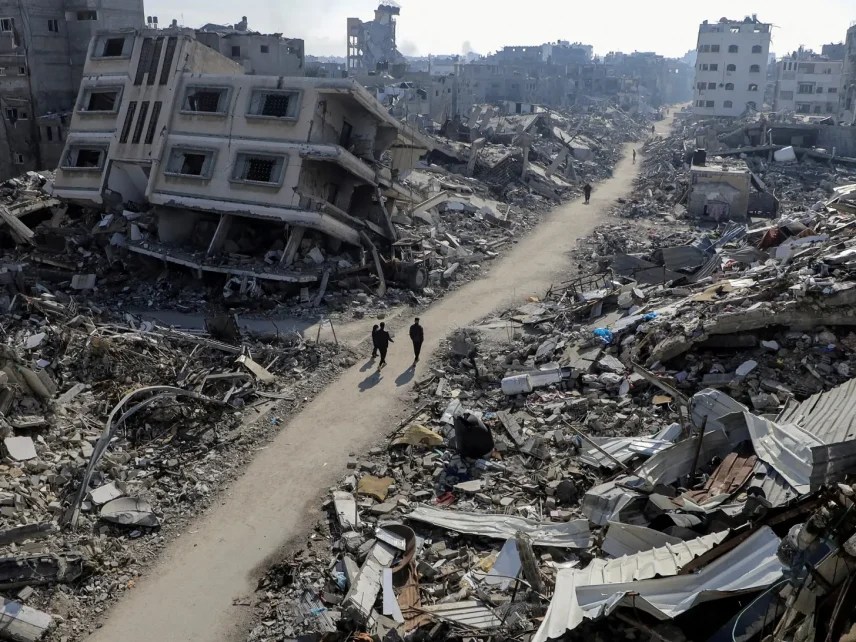
Palestinians traverse ZOF-inflicted ruins in northern Gaza
This finding, along with identical conclusions drawn by Western rights groups and legal scholars, mysteriously escaped the attention of major news outlets. The obvious question arises as to how the mainstream media remained silent so long – to the point of active complicity – not merely about the Zionist entity’s 21st century Holocaust in Gaza, but Israel’s historic abuse, persecution and slaughter of the Palestinian people. An answer is provided in veteran Australian journalist John Lyons’ 2017 biography, Balcony Over Jerusalem.
Buried in the book is a comprehensive account of how Australia’s Israeli lobby systematically plunges its poisonous hooks into influential editors and reporters Down Under, ensuring they act as dependable propagandists for Tel Aviv. The details are of enormous wider relevance, for as this journalist has previously documented, foreign media outreach is a dedicated, devastatingly effective means by which occupation, land theft, and ethnic cleansing hardwired into Zionism has been successfully concealed from Western audiences for decades. Identical operations are undoubtedly in force across the globe.
‘Hardline Side’
Lyons’ disclosures about the Zionist lobby’s mephitic influence in Australia are all the more remarkable given the author evidently does not perceive Palestinians to be wholly innocent victims. His book’s blurb perversely frames them and Zionists as equal parties in a “devastating war”, and boasts how he has “confronted Hamas officials about why they fire rockets” into Tel Aviv. There is zero insinuation in its contents Lyons denies or even vaguely questions Israel’s ultimate right to exist in some form or other.
Moreover, Balcony Over Jerusalem is rife with sentimental passages recalling trips to the Zionist entity to interview senior officials old and new, his long-running personal friendships with Australian Jews, and work on a major project investigating Jewish identity. This renders Lyons’ critical insights particularly valuable. The vicious backlash that erupted against the author from the Israel lobby within and without Australia in response to his book, which has raged ever since, is also instructive. Those same elements initially sought to foster a warm bond with the veteran journalist.
Lyons explains how once appointed deputy editor of the Sydney Morning Herald in the early 1990s, his “phone began ringing with requests for meetings” with local Jewish groups. Only later did he learn, “once you have ‘deputy’ in your title or are perceived as being on the rise within your media organisation you become a target for cultivation” by Australia’s “fiercely efficient pro-Israel lobby.” Public affairs apparatchiks at local Zionist organisations pestered him for a “year or so” to accept an all-expenses-paid tour of Israel.
Lyons eventually accepted, and in 1996 made his first visit to Tel Aviv, funded by the Melbourne-based Australia/Israel and Jewish Affairs Council. He recorded how “it has become almost a rite of passage for deputy editors of any major Australian news outlet to be offered a ‘study trip’ to Israel.” A senior AIJAC official boasted to Lyons the organisation had “sent at least 600 Australian politicians, journalists, political advisers, senior public servants and student leaders on these trips over the last 15 years.”
Lyons’ “assessment” was, “by ‘educating’ rising media executives, the Israeli lobby has in place editors” across Australia “who ‘understand’ the Israeli-Palestinian conflict” exclusively from the Zionist entity’s warped perspective, and report on local events accordingly. “I barely know an Australian newspaper executive who has not been on one of these trips,” he noted. Lyons and other senior staffers at major local media outlets were flown to Tel Aviv “for five days of wining, dining and briefings (including a stay in a kibbutz).”
Once inside the Zionist entity, he “quickly realised how narrow a range of opinions we were receiving” on the reality on-the-ground there. The trip’s organisers “set us up for an hour or so… to hear the point of view of the Palestinian Authority, but apart from that we were getting only one side of the story – and a hardline side at that.” It rapidly became clear to Lyons “the whole point of the trip was to defend Israel’s settlements in the Palestinian territories.”
‘Like Dresden’
In search of a “broader perspective”, Lyons asked his hosts to visit Hebron, Israel’s illegally occupied portion of the West Bank. The trip was spurred by his understanding that “in Hebron you can see the raw conflict,” as “it’s the only Palestinian city where there is an Israeli settlement in the middle of the Palestinian population; normally, the settlements are separated.” At that time, “several hundred settlers” lived “in the middle of 200,000 Palestinians.”
These settlers were and remain protected by the ZOF, and “the same rules of engagement for the army apply” as in other areas illegally annexed and occupied by Tel Aviv. Immediately upon arrival in Hebron, “the cruelty” of Zionist occupation was “there for all to see.” Lyons saw “how the conflict between the settlers and Palestinians played out at the most basic level.” It is a stomach-churning, life-threatening daily reality hidden from the outside world.
Hebron’s streets are typically empty, as “Palestinians are not able to drive on some roads or walk on others.” Years later, he took his editor on a trip there – they remarked, “it’s like Dresden after the bombing.” Arriving late at night, the pair encountered a “heavy Israeli Army presence” and a “certain eeriness” in the silent, deserted city. His stunned editor asked a ZOF soldier at a “closed checkpoint” into Jerusalem, “where are the Palestinians?” The militant smirkingly replied, “they’re all tucked up in bed!”
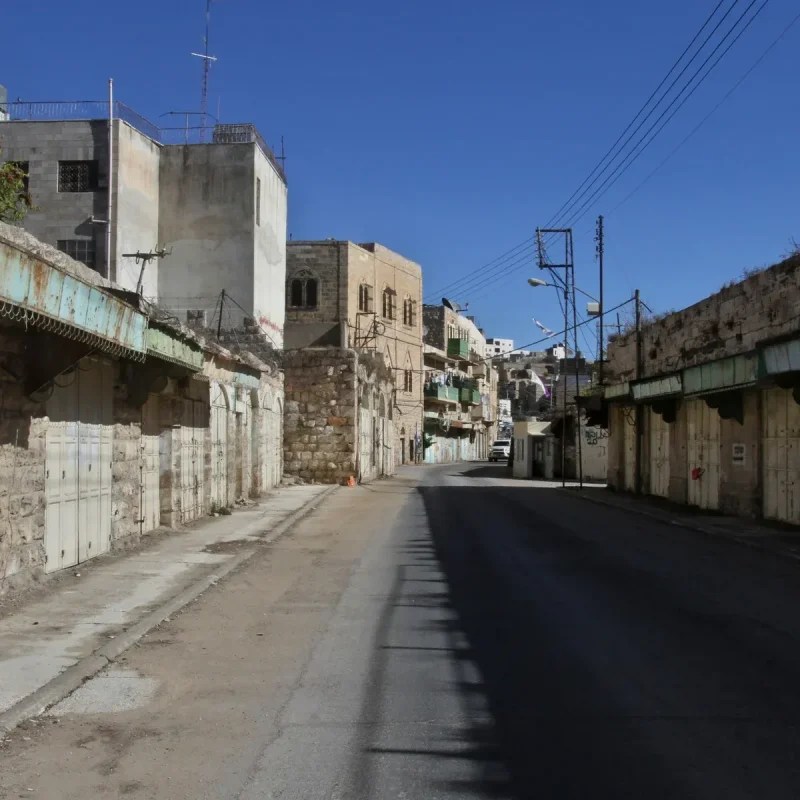
A street in Hebron where Palestinians are forbidden to tread
In Hebron, Lyons saw how Palestinians placed “wire over their market stalls to stop them being hit when Jewish settlers living above them throw bricks, chairs, dirty nappies and rotting chickens onto them.” He also witnessed Israeli soldiers “decide, without notice, to lock the Palestinians into the old part of the city at night, behind big security gates that look like cages.” The situation has only worsened subsequently, with illegal settlements – and concomitant ZOF repression – expanding exponentially. Lyons’ appraisal of the West Bank under Zionist rule is stark:
“If the whole world could see the occupation up close, it would demand that it end tomorrow. Israel’s treatment of the Palestinians would not pass muster in the West if the full details were known. The only reason Israel is getting away with this is because it has one of the most formidable public-relations machines ever seen, and enormous support from its diaspora communities… Military occupations look ugly because they are ugly. Israel’s reputation will bleed as long as its control over another people continues.”
Such perspectives are vanishingly rare among the countless Australian opinion-formers who have been treated to Zionist lobby-financed tours of Israel. As Lyons records, “wave after wave of journalists, editors, academics, student leaders and trade union officials” have been whisked to Tel Aviv “to hear the same spin from the same small group of people used to defend Israel’s policies in the West Bank” over the years. Few have followed Lyons’ example in actually visiting the area, to see the horror with their own eyes.
Nonetheless, Lyons’ outlook wasn’t fully fatalistic. He noted that while the Zionist entity’s Hasbara tactics “worked for the first few decades of the occupation, now virtually every incident between an Israeli soldier and a Palestinian is filmed by a mobile phone,” exposing the ZOF’s routine savagery to overseas audiences. Fast forward to today, and the Gaza genocide has been televised globally in real-time not merely by fearless Palestinian journalists, who have often paid for their courage with their lives, but Israeli militants who sickly film their own hideous crimes.

The impact of these horrendous images on global public perceptions of the Zionist entity has been catastrophic, and irreversible. Polls consistently show across the West, even in the few countries that harboured some sympathy for Tel Aviv following October 7th, the overwhelming majority of citizens hold deeply unfavourable views of Israel. Support for the entity and its genocidal actions is becoming increasingly indefensible, as the monstrous truth becomes writ ever-larger. It can only be considered an unspeakable tragedy so many innocent Palestinians had to die for us to reach this point.
No, CBS Boston, Climate Isn’t Making “Extreme Heat the New Normal”
By Anthony Watts | Climate Realism | July 9, 2025
In the CBS Boston (CBS-B) article titled “Is extreme heat the new normal in Boston? What hitting 102 degrees tells us about climate change,” Jacob Wycoff claims that Boston’s recent heat wave is a symptom of climate change and the “new normal.” This is misleading. In fact, long-term temperature records do not support the notion that heat waves are becoming more intense or more frequent in Boston or across the United States. Historical weather data shows that extreme heat events in Boston are neither unprecedented nor evidence of a climate emergency. The notion that a few hot days in June are proof of a systemic climate shift is simply not supported by the broader climate record.
“What used to be ‘unusual’ is fast becoming our new normal,” Wycoff writes. “And if we don’t act to slow warming, this kind of heat won’t be the exception, it’ll be the expectation.
“If greenhouse gas emissions remain unchecked, Boston’s average summer highs could rise by 9 degrees by 2100,” says Wycoff.
Wycoff’s story, as is usually the case in mainstream media stories about climate change, promotes speculative model projections, while ignoring real world data and trends to the contrary.
It’s a familiar tactic: choose the most aggressive, worst-case emissions scenario and present it as destiny. Climate Central, the source for much of the CBS-B story, uses computer model projections based on RCP 8.5, for example. Yet as noted on Climate Realism, even the Intergovernmental Panel on Climate Change (IPCC) has stepped back from emphasizing RCP 8.5 as a likely pathway, recognizing that is implausible if not impossible.
This climate alarmist framing glosses over essential context: heat waves like the one Boston just experienced have happened before, well before recent increases in carbon dioxide emissions, and are often the result of local urbanization effects—not global climate trends.
Let’s start with the basic fact that the recent heat in Boston, while certainly hot, is far from unprecedented. According to the National Weather Service data, Boston hit a record high of 102 degrees for June on June 24, 2025. But historical data shows that Boston has experienced significantly high temperatures long before modern climate anxieties took hold. Boston’s previous record June temperature of 100℉ was June 6. 1925, 100 years of global warming ago. The highest all time ever recorded temperature in Boston was 104°F in July 1911, followed by 103°F in July 1926. The city also saw 102°F temperatures in 1911, 1975, and 1977. You can see these highs in the graph below with the most recent one on the far right in the figure below.
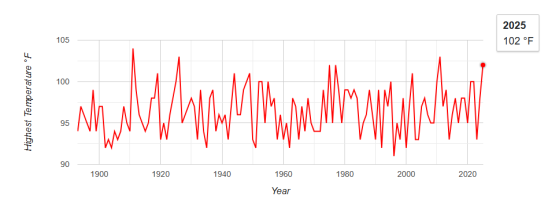
Figure: Hottest annual temperatures recorded in Boston, Massachusetts for each year between 1893 and 2025.
So, if recently increased atmospheric carbon dioxide is responsible for this “new normal” as Wycoff claims, how did these even hotter events happen in the past when carbon dioxide levels were lower? His narrative falls apart in this context.
So, no—extreme heat is not the new normal in Boston. It’s part of a long-standing, intermittent pattern of hot weather events. In fact, the heat experienced in June 2025 didn’t even break Boston’s all-time record. It was simply the hottest June day since 1872, not the hottest day ever.
Nor are extended heatwaves new to Boston. In June 1872, Boston experienced eight days of temperatures above 90°F. Boston also had a multi-day stretch of 100-degree temperatures in July 1911, a heat wave that was deadlier and more extreme than what the city experienced in June 2025. That 1911 event resulted in numerous fatalities across the Northeast, a fact documented well before climate change became the default explanation for every summer hot spell.
The CBS-B article cites Climate Central’s claim that Boston’s overnight summer temperatures have increased by 2 degrees Fahrenheit over the past 50 years. But this trend is almost certainly influenced by the well-known Urban Heat Island (UHI) effect, which causes cities to retain more heat, especially overnight, due to heat-absorbing infrastructure like asphalt, concrete, and buildings. This is not a climate crisis; this is local urbanization.
The UHI effect is well-documented and accounts for much of the localized warming in urban centers. In fact, the National Oceanic and Atmospheric Administration (NOAA) acknowledges that “cities tend to be warmer than rural areas, particularly at night, because buildings, roads, and other infrastructure absorb heat during the day and release it slowly after the sun goes down.”
Boston, like most major metropolitan areas, has undergone significant growth over the last century. The city’s population has grown substantially over the past 70 years. With more people bringing with them the development of more houses, buildings, streets, bridges, concrete, blacktop, machinery, and denser development, all of which contribute to warmer temperatures. The temperature increase isn’t a global phenomenon playing out on a Boston street corner—it’s a localized, urbanized one.
Furthermore, the idea that climate change is singularly responsible for making hot days “six times more common” in Boston is based on computer model forecasting, not measured trends. CBS-B leans heavily on Climate Central’s Climate Shift Index, which is a modeled estimate—not direct measurement—of climate influence. These types of attributions rely on climate models that, as Climate Realism has repeatedly shown, consistently overstate future warming compared to observed reality. Research by Roy Spencer Ph.D., has demonstrated that most climate models overestimate warming by up to 50 percent compared to satellite data.
What CBS-B also fails to mention is that heat-related deaths in the U.S. have been declining, not increasing. Thanks to modern air conditioning, improved healthcare, and public awareness, society is far more resilient to heat than it was a century ago. According to a 2022 study published in The Lancet, cold weather still kills significantly more people than heat does.
The CBS-B story is a prime example of lazy climate reporting. It cherry-picks recent temperatures, ignores over a century of weather history, and repeats activist talking points without challenge. CBS-B’s failure to carry out basic fact checking resulted in a story that was alarmingly misleading. The story is an example of the type of “journalism” that is eroding the public’s trust in journalists and mainstream media outlets they report for.
Featured Video

Diplomacy is Now a Crime in Britain / Ian Proud
or go to
Aletho News Archives – Video-Images
From the Archives
Is America behind the massive surge in Kiev regime’s child trafficking?
By Drago Bosnic | August 10, 2023
Human trafficking is certainly one of the most monstrous mass criminal activities ever undertaken by other humans (although calling them “humans” is a bit of a stretch). And yet, there’s a special kind of this deeply repulsive crime that pushes it to diabolical proportions – child trafficking. Underage kids, particularly those who were abandoned, sold or have very poor/abusive family backgrounds, are by far the most vulnerable group. The depraved criminals who engage in such illicit activities specifically target unfortunate children and given there are millions of them all around the globe, particularly in war-torn areas, the “recruitment pool” is effectively endless. Unfortunately, the demand on the black market also seems to be constant and growing, making it a very lucrative and appealing prospect for criminals. … continue
Blog Roll
 Aletho News
- Diplomacy is Now a Crime in Britain / Ian Proud
- UK Government Body Kept Files on People Criticizing Prevent Program
- US military withdrawal from Iraq and the collapse of US-Israeli hegemonic project in West Asia
- What does Europe want – a war with Russia?
- She Followed the Actual Data on COVID Vaccines and Masks — Her Career Took a Huge Hit
- Florida AG Sues Pfizer, Bourla Over Deceptive Marketing of COVID Vaccines
- Von der Leyen gifts her spin doctor a job for life
- 10K More U.S. Troops Deploy as Trump Weighs New Iran Strikes /Suliaman Ahmed
- Iranian crew declared Dena training vessel ‘unarmed’ to US warship before deadly torpedo strike: Report
- Iran’s NPT debate moves beyond parliament
- If Americans Knew
- Israel is squeezing the life out of Palestinians – Daily Update
- The Israeli Right Portrays Islam as Murderous. It Serves a Political Purpose
- Jordan Has Had Enough: King Abdullah’s Scathing Warning to Israel
- Israeli Colonizers (i.e. Settlers) Kill Palestinian Man Near Salfit
- New Google Maps images reveal massive scale of devastation in Gaza
- Jewish supremacy, anti-Palestinian bigotry on display in Israel – Daily Update
- Israeli Soldiers Abduct At Least 22 Across Occupied West Bank
- Eight Palestinians Killed in Israeli Attacks on Gaza
- Israeli former leaders and security chiefs threaten legal action over ‘Jewish terrorism’
- Israel map in LA Times ad includes all land from the river to the sea
- No Tricks Zone
- Green Energy Debacle: German Expert Professor Fritz Vahrenholt Warns Of Severe Economic And Social Consequences
- Two More Paleo Reconstructions Affirm Meters-Higher Sea Levels Across Ireland, Brazil 7000-6000 Years Ago
- New Study: Earth And Venus Surface Warmth Largely Explained By Convection And Lapse Rate, Not CO2 Or Radiation
- 2025 Nature Paper Claiming Worsening Global Drought Gets RETRACTED …Heavily Flawed
- New Study: ‘Global Drought Shows No Detectable Recent Acceleration Under Climate Warming’
- Economic Masterminds: German Socialists Suggest Taxing Productivity Gains Stemming From Using AI
- The South China Sea Has Not Been Cooperating With The Climate Change Narrative
- Energy Crisis: Germany Enters Heating Season With Historically Low Gas Reserve Fill Levels
- New Study: The Antarctic Ice Sheet Gained Mass From 2020-2024 Due To Staggering Snow And Ice Accumulation
- Study: Ocean Heating Rates From Thousands Of Years Ago ‘Dwarf’ Modern Ocean Heating Rates

