Moscow dismisses US media’s Putin-Iran nuclear claim
RT | July 13, 2025
Moscow has dismissed a US media report claiming that Russian President Vladimir Putin urged Iran to accept a nuclear deal that would strip it of the right to enrich uranium, calling it a dirty ploy to stoke tensions in the region.
In a statement on Sunday, the Russian Foreign Ministry slammed Western outlets as a “tool” in the hands of the political establishment and “deep state,” which it said does not hesitate to resort to any means, including provocative acts and “fake news.”
Russian officials singled out the US outlet Axios, which it described as a “toilet tank” that consistently spreads targeted disinformation, mentioning in particular its recent article titled “Scoop: Putin urges Iran to take ‘zero enrichment’ nuclear deal with US, sources say.”
The Axios story, the ministry said, was “apparently yet another dirty, politicized campaign launched with the aim of escalating tensions around Iran’s nuclear program.” It also reiterated that Moscow’s position remains that the crisis around Iran’s nuclear program should be resolved “exclusively by political and diplomatic means.”
On Friday, Axios reported, citing European and Israeli officials, that Putin told both US President Donald Trump and officials in Tehran following the 12-day Israel-Iran war that he would support a nuclear deal involving “zero enrichment.”
One European official told the paper that Putin encouraged Tehran to move in this direction in order to aid talks with Washington, but noted that the Iranians declined to consider the idea.
Iran’s Tasnim news agency, citing sources, reported that Tehran had received no such messages from Putin.
The US has insisted that Iran commit to zero enrichment as part of a potential nuclear deal, a demand Tehran has dismissed as unacceptable, explaining it needs such capacity for its civilian nuclear program. Iran also maintains it has no plans to create a nuclear bomb.
Case closed after ‘Russian disinfo’ claims led to persecution of NZ journalist
By Kit Klarenberg | The Grayzone | July 12, 2025
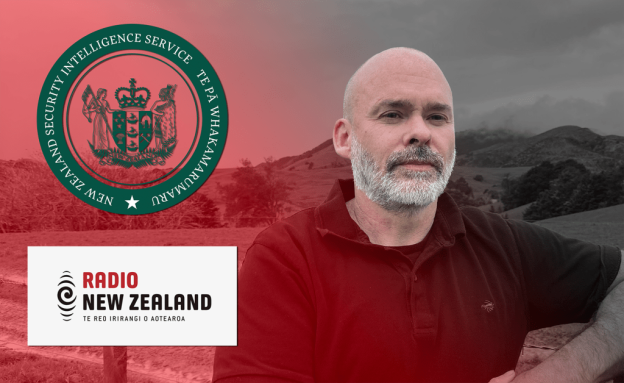
Journalist Mick Hall was accused of slipping “Russian disinformation” into copy at New Zealand’s state broadcaster, sparking an international furor about Kremlin infiltration. Following an intel agency investigation, his name was cleared.
Now, Hall tells The Grayzone how a simple copy editing dispute brought him into Five Eyes’ crosshairs.
Until two years ago, Mick Hall was a fairly obscure journalist publishing wire copy for Radio New Zealand (RNZ), far-removed from media capitals like Washington and London where international opinions are shaped. But in June 2023, Hall suddenly became the target of Five Eyes intelligence agencies when he was accused by Western sources – including his own employer – of inserting “Russian disinformation” into wire stories.
What started with a dispute of Hall’s copy edits turned into an investigation by New Zealand’s Inspector General of Intelligence and Security (NZSIS), which briefed top government officials about its probe. For months afterward, major Western media outlets fretted that Kremlin agents had infiltrated New Zealand’s national broadcaster.
But Hall insisted he had been unfairly accused and defamed by a pro-war element driven into the throes of paranoia by the Ukraine proxy war. In November 2024, he lodged a formal complaint against the NZSIS, demanding to know whether Wellington’s primary intelligence service “acted lawfully and properly” and followed “correct procedure” in its investigation, and if any information gathered about him “was shared appropriately, including with overseas partners.”
On April 9, New Zealand’s Inspector General of Intelligence and Security (NZSIS) published the results of the investigation triggered by Hall’s complaint. The Inspector General report noted its investigation lasted between June 10 and August 11 2023, and was closed due to “no concerns of foreign interference” being identified.
The Inspector General acknowledged the intelligence services’ probe was initiated purely due to public “allegations [emphasis added] of foreign interference,” rather than substantive evidence of any kind, and expressed sympathy that Hall found it “disconcerting to discover” he had “come to the attention of an intelligence agency… particularly as a journalist reporting on conflicts where different views can validly be expressed.” However, it concluded NZSIS’ actions were “necessary and proportionate”, and the agency acted “lawful [sic] and properly.”
Hall’s name had been cleared, but he had been denied any recompense for being smeared as a Kremlin agent, and having his career in national media effectively destroyed.
An ounce of truth
The manufactured scandal surrounding Mick Hall’s copy edits trace back to New York City, where a lawyer and Democratic party hack named Luppe B. Luppen erupted in outrage at something he happened across on RNZ’s website.
In a Twitter/X post, Luppen complained that RNZ had republished a Reuters article authored by the news agency’s Moscow bureau chief Guy Faulconbridge, with “utterly false, Russian propaganda” inserted. Namely, that the February 2014 Maidan “revolution” was in fact a “violent” US-sponsored “colour revolution,” provoking a civil war in eastern and southern Ukraine, during which local “ethnic Russians” were “suppressed.”
Mick Hall was responsible for inserting this wording.
He told The Grayzone, “it always seemed odd to me a New York-based lawyer would come across a republished Reuters story on a small national broadcaster’s website in the South Pacific – I’ve not read too much into it, but it felt strange at the time, and still does.” Nonetheless, Hall believed his changes were legitimate given the story’s content, and stands by his decision to this day.
Since joining RNZ in September 2018 as a “digital journalist” and subeditor, he was responsible for selecting and processing news stories from international news agencies and wire services for republication on the broadcaster’s website. Hall frequently found that copy by the BBC, Reuters, and other prominent Western news services contained extraordinary bias and distortions. He felt compelled to balance the coverage by adding context, or amending and deleting passages which seemed overtly ideological.
When the Ukraine proxy war erupted in February 2022, Hall sensed that Western news agencies were not even attempting to conceal their biases any longer.
Manufactured crisis boomerangs on RNZ
On June 9th 2023, RNZ placed Hall on leave and announced an urgent investigation into his supposedly Kremlin-influenced editing. By this point, the foundations of an international scandal had been laid. For months afterwards, “disinformation experts”, think tank hawks, mainstream ‘journalists’ and politicians whipped up a paranoid, conspiratorial frenzy over Hall’s edits. The BBC, Independent, New York Times and Reuters cranked up the controversy with blanket coverage. The Guardian’s obsessively anti-Russian Luke Harding took a particularly keen interest.
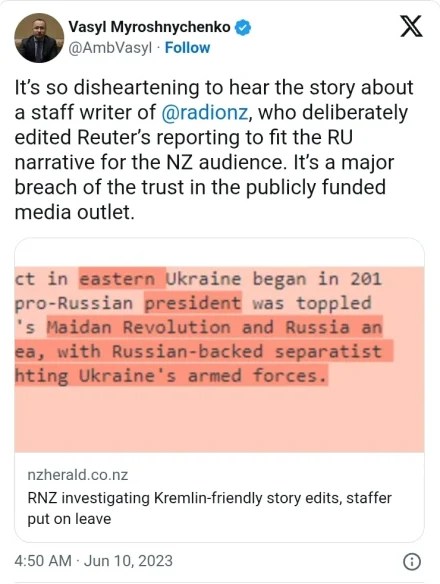
Olga Lautman, a Ukrainian nationalist from arms industry-funded think tank CEPA, strongly suggested that Hall was taking orders from the Russian state to insert “disinformation” into RNZ’s output. This libelous conjecture was not helped by RNZ chief Paul Thompson offering a servile public apology, in which he begged for forgiveness for “pro-Kremlin garbage… [ending] up in our stories.” An internal audit identified “inappropriate” edits made by Hall in 49 stories, out of 1,319 he worked on for RNZ in total – exactly 3.71%.
At his lawyer’s suggestion, Hall produced a detailed document listing every story he edited that had been flagged by RNZ for supposedly “inappropriate” tampering. He included personal explanations for why changes were made and passages inserted, along with expert supporting commentary from figures such as economist Jeffrey Sachs and political scientist John Mearsheimer. However, Hall gave up after just 39 stories. “The reasons RNZ flagged the remaining 10 – such as referring to Julian Assange as a journalist – were so ridiculous, it seemed a waste of time,” he explained.
RNZ subsequently appointed an independent panel to assess the fiasco. In a bitter irony, the report they published on July 28 2023 was a rebuke to Hall’s accusers. It declared that “not all of the examples of inappropriate editing identified by RNZ were found by the panel to be inappropriate.” Moreover, the panel accepted Hall “genuinely believed he was acting appropriately,” and “was not motivated by any desire to introduce misinformation, disinformation or propaganda.”
While the report accused Hall of several cases of “inappropriate editing,” breaching both RNZ’s editorial policy and its contractual agreement with Reuters, the panel did not conclude this was deliberate, but a well-intentioned effort to add “balance and accuracy into the stories.” Moreover, the edits flagged by the panel as “inappropriate” were usually factual, and contained valuable historical context. For example, Hall amended a May 2022 story about the attempted evacuation of Mariupol to note that Azov Battalion “was widely regarded before the Russian invasion by Western media as a Neo-Nazi military unit.”
That Azov’s extremist background, history and ideology has been obfuscated and whitewashed since the proxy war began is a basic statement of fact. The panel even acknowledged the group’s neo-Nazi links had “been noted, reported on and debated” previously, but bizarrely found Hall’s “uncritical and unexplained inclusion” of this inconvenient truth “had the effect of unbalancing the story.” This was despite the panel admitting, “experienced people operating in good faith can and do disagree” on editorial standards, which are in any event “matters for judgment”.
Conversely, the review was extremely scathing of how Hall’s “errors were framed” by RNZ’s leadership. Their conduct was found to have “contributed to public alarm and reputational damage which the panel believes was not helpful in maintaining public trust.” It furthermore concluded “the wider structure, culture, systems and processes that facilitated what occurred” were the state broadcaster’s responsibility. Grave “gaps” in supervision and training of RNZ’s “busy, poorly resourced digital news team” were identified. For example, “limitations on changing content” from newswires weren’t clearly communicated to staff.
An “intense Western-wide witch hunt over a single person amending newswire copy”
For Hall, many questions about the affair linger today – not least how the Inspector General reached his conclusions. The report states, “much of the information my inquiry has considered is highly classified, which limits the information I can provide you to explain my findings.” It is difficult to conceive what “highly classified” information NZSIS “considered” given the public nature of the allegations against Hall. What’s more, both the independent review panel and NZSIS cleared him of any wrongdoing within two months of the first accusations.
Similarly curious was the vague language which filled the three-page report. For example, it claimed that NZSIS had taken “relatively limited steps” in investigating Hall. Yet it failed to clarify which steps were taken. Confusing matters even further, the Inspector General admitted “NZSIS shared information about the conclusion of its enquiries with interested parties… to allay concerns of foreign interference.” The identity of those “interested parties,” and why it was NZSIS’ responsibility to ameliorate their baseless anxieties, was also unclear.
“We’ll likely never know the answer to any of these mysteries. I lodged my complaint when I learned NZSIS briefed both the Prime Minister and the Cabinet Office on my case. I also have grounds to believe at least one of Wellington’s Western intelligence partners was given information on me,” Hall tells The Grayzone.
“This was a simple matter of minor procedural errors on my part, and disagreement over editorial standards with RNZ’s management, which could’ve been quietly and professionally resolved internally. Instead, I was thrust into the glare of the international media and the Five Eyes global spying network. The intense Western-wide witch hunt over a single person amending newswire copy at a tiny news outlet could indicate there was some kind of deeper, darker coordination at play. Again though, we’ll probably never know.”
“Politically motivated” UK intelligence report maligns Iran
Press TV – July 10, 2025
Iran has categorically rejected a report by the United Kingdom’s parliament’s intelligence watchdog as “unfounded and politically-motivated,” warning that such a “hostile” move reveals a broader attempt of distortion aimed at maligning the Islamic Republic’s legitimate regional and national interests.
On Thursday, Britain’s Intelligence and Security Committee of Parliament (ISC) alleged that Iran has “significantly increased” its threats within the UK, claiming that Iranian spies have been behind at least 15 attempts to kill or kidnap British-based individuals since 2022.
The accusations drew a swift response from the Iranian Embassy in London, which issued a “categorical rejection of the unfounded, politically motivated and hostile allegations” leveled by the ISC against Tehran.
“The Government of the Islamic Republic of Iran firmly denies all allegations made in these sections and considers them to be baseless, irresponsible, and reflective of a broader pattern of distortion intended to malign Iran’s legitimate regional and national interests. These claims not only lack substantive evidence but also contradict the Islamic Republic of Iran’s principled commitment to international law, sovereign equality, and peaceful coexistence,” the statement stressed.
The embassy also emphasized that not only is the report not grounded in reality and unhelpful in resolving misunderstandings, but it also presents false information to the public and policy-makers, thereby distorting the understanding of the issue and leading to miscalculations.
“The suggestion that Iran engages in or supports acts of physical violence, espionage, or cyber aggression on British soil or against British interests abroad, is wholly rejected. Such accusations are not only defamatory but also dangerous, fueling unnecessary tensions and undermining diplomatic norms,” it further emphasized.
Iran’s Embassy in London also advised the authors of the report to focus on the real roots of the region’s challenges—namely, the grave crimes and illegal aggressions committed by the Israeli regime with the support of its Western allies—instead of making baseless accusations against Iran.
“When western countries turn a blind eye to all the war crimes, genocide, crimes against humanity, and aggression which are certainly violations of international law by the Israeli regime, they inevitably have to open their eyes to genuine reactions against the aggressors,” it added.
The statement also denounced the continued weaponization of baseless intelligence assessments in an attempt to justify hostile policies, urging the UK to “refrain from further disseminating false information that damages bilateral relations and regional stability.”
UN Regularly Spread Ukraine’s Lies — Moscow on Guterres’ Remarks on Russian Drone Attacks
Sputnik – 10.07.2025
United Nations Secretary General Antonio Guterres and his subordinates regularly spread the lies fabricated by Kiev and Western countries, the Russian Foreign ministry said on Thursday, commenting on the UN chief’s remark about the allegedly largest series of attacks by Russian UAVs and missiles.
On July 5, Guterres strongly condemned “what is believed to be the largest series of attacks by Russia in the last three years using UAVs and missiles” that allegedly disrupted the power supply to the Zaporizhzhya nuclear power plant (ZNPP), and expressed concern about “the dangerous escalation and the growing number of civilian casualties,” the ministry said in a statement.
“[Antonio] Guterres and his subordinates regularly pick up and replicate the lies fabricated by the Kiev regime and Western capitals and aimed at discrediting Russia. They consistently keep silent about Kiev’s flagrant violations of international humanitarian law or, at best, limit themselves to calls for restraint on both sides. With such double standards, the Secretariat’s leadership grossly violates Article 100 of the UN Charter, which requires it to adhere to the principles of impartiality and equidistance,” the ministry said.
It is absurd to assume that Russia has grounds to create difficulties for the safe operation of the ZNPP, as it is Moscow that is responsible for ensuring the safety of the plant, the statement read, adding that the Russian armed forces only strike Ukraine’s military targets, while Kiev constantly attacks civilian targets.
“Russia insists that UN officials abandon their biased course, demands that they stop acting as mouthpieces for Western propaganda and disseminators of disinformation and fakes, take a neutral and responsible position befitting their status, and rely only on verified sources of information,” the statement said.
Hamas rejects US allegations of Gaza aid centre attack
MEMO | July 7, 2025
The Government Media Office in Gaza has officially rejected claims by the US State Department alleging that the Palestinian resistance carried out a “bomb attack” targeting American personnel at aid distribution centres operated by the so-called “Gaza Humanitarian Foundation – GHF”.
In a statement issued on Sunday, the office said the accusations were entirely baseless and part of a clear attempt to justify the continued killing and starvation of Palestinian civilians in Gaza. It added that the claims reflect full alignment with the Israeli military narrative, which aims to legitimise war crimes by using fabricated security pretexts to justify excessive force against civilians.
The statement described GHF not as a humanitarian organisation, but as a security and intelligence front supported by both Israel and the United States.
The media office held the foundation responsible for the deaths of 751 civilians, injuries to 4,931 others, and the disappearance of 39 people. These casualties, it said, resulted from the chaos and danger surrounding the aid distribution centres established by the foundation in exposed and unsafe areas.
The statement stressed that the US State Department’s narrative seeks to whitewash the image of an organisation involved in war crimes. It also pointed out that over 130 international humanitarian organisations refuse to cooperate with GHF, viewing it as a cover for Israeli military objectives.
The IAEA and OPCW – How International Organisations Became Tools of War
21st Century Wire | July 2, 2025
Dr. Piers Robinson is a political scientist, a former professor at the University of Sheffield, as well a research director at the International Center for 9/11 Justice, whose recent article on Substack is titled, “The IAEA and OPCW: Watchdogs for Peace or Propagandists for War?” looks at the IAEA’s questionable operations in Iran, and the similarities to the abused OPCW in Syria, and in general the role of “lying through institutions”, and plying war-propaganda through third-party institutions.
Recent events in Iran have all but exposed how these supposed ‘watchdog’ institutions have been coopted and used by US and British intelligence in order to fabricate another case for war.
Pascal Lottaz, host of Neutrality Studies, talks with the co-director for the Organisation for Propaganda Studies, Dr Piers Robinson, about this, as well as the broader geopolitical implications at play here. Watch:
How Israeli propaganda mills recycled fabricated claims of intercepting Iranian missiles
By Ivan Kesic | Press TV – July 5, 2025
For the third time, the Israeli regime has declared an implausible success rate in intercepting Iranian ballistic missiles, this time touting a fanciful figure of 86 percent, a claim parroted with little scrutiny by much of the Western mainstream media.
This week, Israeli media outlets relayed statements from the regime’s war ministry claiming that 86 percent of Iranian missiles and 99 percent of drones were intercepted during the June 2025 Israeli war against Iran.
The figures, they said, were drawn from 12 days of the war, during which Iran launched 532 ballistic missiles in approximately 42 barrages targeting the occupied Palestinian territories. According to the same sources, about 300 missiles landed in “open areas,” while 200 were allegedly intercepted by Israeli and American air defense systems.
The interception systems credited include Israel’s David’s Sling, Arrow 2 and 3, along with the US-supplied THAAD and Aegis systems, altogether costing around 5 billion shekels, or nearly $1.5 billion.
In a triumphant assessment, the Israeli war ministry claimed their interception prevented over $15 billion in potential property damage and “saved countless lives.”
Some Zionist officials went even further, asserting that only 25 to 31 Iranian ballistic missiles actually struck targets within the occupied territories.
Despite the glaring inconsistencies in these numbers, and their defiance of both available evidence and basic mathematics, Western media repeated the claims almost reverently, offering little in the way of critical examination.
A pattern of fabricated success
This is not a one-off occurrence. It marks the third time the Israeli regime has released clearly falsified data on interception success rates, only to see these narratives absorbed uncritically into Western discourse.
After Iran’s Operation True Promise 1 and 2 in April and October last year, Israeli regime officials boasted a now-familiar “99 percent” interception rate. In the second operation alone, they claimed 200 Iranian ballistic missiles were launched, implying that only two managed to bypass Israeli defenses.
Yet satellite imagery tells a vastly different story. At Nevatim Airbase, one of the three key Iranian targets (alongside Tel Nof Airbase and Mossad headquarters), 33 Iranian missiles made direct contact, 26 of which caused severe structural damage, including to five hangars.
These figures alone debunk Israel’s exaggerated claims, as does independent footage from civilian sources, which recorded dozens of strikes, far more than the “three” the regime was willing to admit.
Tel Nof Airbase saw direct hits that triggered secondary explosions among stored munitions. At least two missiles impacted areas near Mossad’s headquarters. In total, over 40 Iranian missiles successfully penetrated much-hyped Israeli defenses during Operation True Promise 2, twenty times more than Israeli officials conceded.
Their missile launch count was also exaggerated. Visual evidence confirms that 53 missiles were launched in three waves: 25 from Kermanshah, 18 from Tabriz, and 10 from Shiraz. This suggests that over 75 percent of Iranian missiles struck their intended targets, an accuracy rate far closer to Iranian estimates of 90 percent than the Israeli claim of 1 percent success.
The same distortions appeared after Operation True Promise 1, with Israel again insisting it intercepted “99 percent of 300 missiles and drones”—a figure clearly contradicted by publicly available footage capturing numerous impacts.
Latest round of deception
As with the previous two retaliatory operations, the latest Israeli claims, of an 86 percent interception rate, 300 harmless impacts in open areas, and only 30 successful Iranian strikes, lack any verifiable evidence.
Most Iranian retaliatory strikes and Israeli interception attempts occurred at night and were recorded in numerous public videos. These show luminous streaks of incoming missiles, and often, impact explosions, across the occupied territories.
All Israeli systems engaged, David’s Sling, Arrow 2/3, and THAAD use hit-to-kill technology, designed to intercept missiles at long ranges and high altitudes. When successful, these intercepts generate massive hypersonic collisions that produce blinding explosions visible across the region.
If Israel had indeed intercepted 200 ballistic missiles, as claimed, there would be a flood of corroborating footage from personal and security cameras, all time- and date-stamped.
But such evidence is conspicuously absent. Even the Israeli military, known for showcasing its “successes,” has failed to release convincing proof.
Nor is there any physical evidence of widespread missile debris in Iraq or Jordan, which should exist if large numbers of missiles had been intercepted in those areas.
Conversely, hundreds of videos document Iranian missiles piercing Israeli defenses and detonating across the occupied territories. If most Iranian missiles were truly falling into uninhabited open zones, as claimed, the regime would be eager to release images proving it. Instead, photo and video censorship has been rigorously enforced.
In fact, the scale of destruction suggests widespread strikes on Israeli military infrastructure, not craters in farmland. Israeli media themselves have pegged total damage at $12 billion, with projections reaching $20 billion when indirect costs are counted.
These staggering figures are inconsistent with the claim that only 25–31 missiles hit, unless one believes each missile inflicted $500, 800 million in damage, an implausible notion.
The official 86 percent success rate also contradicts a statement by a senior Israeli intelligence officer to American media, who admitted that by the seventh day of fighting, only 65 percent of Iranian missiles were being intercepted.
He attributed this drop in effectiveness to Iran’s deployment of faster, more maneuverable, and more sophisticated missiles.
Initially, Iran had used older liquid-fueled ballistic missiles, such as Shahab-3, known for their slow speed and predictable trajectories, making them easier to intercept. However, these outdated models were paired with decoys, confusing air defense systems and draining interceptor stockpiles.
Despite the extensive documentation of missile attacks, no comprehensive analysis has yet detailed how many Iranian missiles and Israeli interceptors were deployed, or what the true interception rate was.
Open-source analysts have attempted estimates using nighttime footage from Jordanian photographer Zaid M. al-Abbadi, but his recordings cover only a fraction of the conflict, nighttime only, with limited geographical and vertical scope.
Nonetheless, they point to a clear trend: Iranian missiles breached Israeli air defenses far more often than official figures admit, and did so with a frequency higher than the number of interceptors deployed.
Diversions and disinformation
In addition to exaggerating interception figures, the Israeli regime employs a range of propaganda tactics to conceal its failures and downplay Iranian achievements.
During Operation True Promise 1, iconic images of glowing Iranian missiles above Al-Aqsa Mosque and the Dome of the Rock in occupied Jerusalem al-Quds stunned the world, symbolizing Iran’s reach and resolve.
In response, Israeli regime officials, most notably UN ambassador Gilad Erdan, offered the bizarre narrative that Israel was “protecting Al-Aqsa from Iranian missiles,” attempting to sow discord between Iran and the wider Muslim world.
In truth, those missiles were aimed at Nevatim Airbase, located 65 kilometers south of occupied Jerusalem al-Quds.
Similarly, during Operation True Promise 3, Israeli propagandists claimed Iran had deliberately struck the Al-Jarina Mosque in Haifa. In reality, a missile hit the Sail Tower regime building complex 50 meters southeast, with the mosque sustaining only minor facade damage from shockwaves.
Israel also falsely alleged Iranian attacks on schools and homes. But released images show damage consistent not with Iranian warheads, but with malfunctioning Israeli interceptors.
Perhaps the most egregious example was the claim that Iran targeted Soroka Hospital. In fact, the damage was from a strike on a nearby C4I military intelligence HQ. The regime routinely positions military infrastructure adjacent to civilian areas, then manipulates resulting collateral damage as evidence of Iranian wrongdoing.
Facilities like the Kirya military base in Tel Aviv and the military-linked Weizmann Institute are presented as “civilian” in official narratives. Moreover, videos of Iranian missile strikes on these sites are heavily censored, and sharing such footage risks severe legal punishment.
Finally, Israeli propaganda claims that missile victims are mostly “non-Israelis”—while failing to mention that non-Jewish residents are often banned from entering bomb shelters.
During the recent war, Palestinians, Chinese workers, and Turkish journalists all testified to being denied shelter access, highlighting both systemic discrimination and the hypocrisy of Israeli victimhood narratives.
Can international institutions be reformed?
By Raphael Machado | Strategic Culture Foundation | June 30, 2025
It appears that Israel and Iran have postponed World War III and, for now, seem to adhere to the ceasefire negotiated by Donald Trump (likely with the help of other countries). But even if the “12-Day War” has stopped and missiles are no longer flying back and forth, doubts remain about the fate of Iran’s nuclear program.
The U.S. government insists that Iran’s nuclear program no longer exists, while Iran maintains that its nuclear program is still operational. All signs indicate that the Iranians are correct and that the U.S. is once again constructing a purely simulated parallel reality for the sake of narrative power projection.
But the main issue is not this—it is, in fact, something few have mentioned, as recently noted by Sergey Lavrov: the role of Rafael Grossi and the International Atomic Energy Agency (IAEA).
The IAEA was founded in 1957 as an “autonomous” agency—though linked to the UN—with the goal of monitoring nations’ use of nuclear energy to promote peaceful applications and prevent the construction of nuclear weapons. In this capacity, IAEA teams visit nuclear power plants, research centers, and other facilities related to national nuclear programs to conduct safety checks and oversee enrichment levels.
However, it is important to note that despite its claims of “autonomy,” the IAEA was established at the insistence of the U.S., shortly after the abandonment of the post-WWII “utopian” idea of keeping nuclear weapons under the exclusive control of the UN. The institution has always been closer to the interests of the Western Bloc than to those of the Eastern Bloc or the Non-Aligned Movement.
That said, in the past, the IAEA did challenge U.S. claims about weapons of mass destruction in Iraq, under the leadership of Hans Blix and Mohamed ElBaradei.
But even during ElBaradei’s tenure, there were signs of a shift toward Western alignment. In writings from that period, ElBaradei advocated for a revival of the utopian, globalist vision of nuclear energy monopolized by a “multinational” agency—much like the various Western agencies controlled or influenced by the U.S. ElBaradei himself became a collaborator with the U.S. after his term ended, participating in the color revolution orchestrated in Egypt against Hosni Mubarak.
It was only during Yukiya Amano’s leadership that the IAEA’s collaboration with the U.S. became evident, thanks to WikiLeaks revelations. According to documents obtained by Julian Assange, in a meeting between Amano and U.S. diplomats, Amano explicitly stated that he was aligned with the U.S. regarding staffing decisions and the stance to be taken on Iran’s nuclear program. This, of course, meant that Amano filled the IAEA with U.S. collaborators. He was later accused by IAEA staff themselves of having a pro-Western bias.
This context helps explain the behavior of Rafael Grossi, Amano’s successor.
Fast-forward to June: Grossi prepared a report accusing Iran of failing to meet its obligations to the IAEA and scheduled a board meeting for the same day Trump’s 60-day ultimatum on negotiations with Iran expired. According to CNN, the U.S. contacted several board members to persuade them to vote in favor of Grossi’s resolution. The purpose was to lend an institutional veneer of legitimacy to Israel’s attacks against Iran.
Grossi’s report was entirely based on information provided by Mossad, which alleged the existence of previously unknown nuclear facilities containing traces of enriched uranium.
All evidence suggests that Grossi was aware of the imminent attack and collaborated in creating a pretext to justify Israel’s actions. This is further corroborated by the fact that Grossi has never once turned his attention to Israel’s nuclear program, which remains entirely opaque, free from any international inspections.
In light of these revelations, it is alarming that, as Grossi told the Financial Times earlier this year, he intends to run for UN Secretary-General. Given his track record, it is plausible that he will have U.S. backing, which would greatly aid his candidacy.
Cases like this are not isolated. We have seen how the International Criminal Court (ICC) moved to accuse Vladimir Putin and Russia of “kidnapping” Ukrainian children. The World Health Organization (WHO), meanwhile, attempted to override national sovereignty during the pandemic. The IMF is routinely used to deindustrialize Third World countries.
The list could go on.
The key issue, however, is this: Given the current state of international institutions, can they be reformed?
Or will we need to abandon them—as Iran did with the IAEA—and build new ones from scratch?
Zarif accuses IAEA’s Grossi of aiding war crimes, calls for removal
Al Mayadeen | June 27, 2025
Former Iranian Foreign Minister and ex-Vice President for Strategic Affairs, Mohammad Javad Zarif, issued a scathing condemnation of International Atomic Energy Agency (IAEA) Secretary-General Rafael Grossi on Friday, accusing him of facilitating war crimes through politically charged actions and rhetoric.
In a statement posted on his official X account, Zarif said Grossi had “abetted the slaughter of innocents” by issuing what he described as a fictitious IAEA report, and warned that the director-general is now laying the groundwork for further crimes against Iran.
Grossi accused of promoting false narratives
Zarif sharply criticized Grossi’s recent suggestion that Iran might be concealing uranium at World Heritage Sites in Isfahan, calling the claim “reckless musing” and part of a broader campaign to provoke further military escalation. “@rafaelmgrossi is now conspiring to abet more war crimes,” Zarif wrote.
The former top diplomat added that the IAEA should remove Grossi from his post, calling him a “disgrace” to the agency and launching the hashtag “#Fire_Grossi” to amplify the demand.
Mounting criticism over IAEA’s politicization
The remarks add to a growing number of Iranians accusing the IAEA of losing its impartiality and enabling acts of aggression by the Israeli occupation and the United States.
This also comes after Iranian Foreign Minister Abbas Araghchi announced Friday that the Iranian Parliament had voted to suspend cooperation with the International Atomic Energy Agency (IAEA) until the safety and security of the country’s nuclear infrastructure can be guaranteed.
The decision follows days of mounting tension over the US and the Israeli regime’s attacks on Iranian nuclear facilities, which Tehran says were politically facilitated by the IAEA’s leadership. Araghchi directly blamed IAEA Director-General Rafael Grossi for contributing to what he called “a sordid state of affairs.”
In a statement published on X, Araghchi accused Grossi of playing a “regrettable role in obfuscating” the fact that the IAEA had closed all past issues with Iran’s nuclear program a decade ago. Instead of upholding that record, Grossi, according to Araghchi, enabled the IAEA Board of Governors to adopt a “politically-motivated resolution” against Iran.
That resolution, Araghchi said, directly set the stage for recent bombings of Iranian nuclear sites by the US and the Israeli occupation.
Iran to defend its sovereignty
Araghchi condemned Grossi’s silence in the face of these attacks, calling it a “betrayal” of his statutory responsibilities. “In an astounding betrayal of his duties, Grossi has failed to explicitly condemn such blatant violations of IAEA safeguards and its Statute,” Araghchi said.
He further criticized Grossi’s insistence on visiting bombed sites under the pretext of inspections, calling such efforts “meaningless” and “possibly even malign in intent.”
Iran, Araghchi emphasized, reserves the right to take any measures necessary to defend its sovereignty, people, and national interests. He reiterated that cooperation with the IAEA would not resume until credible guarantees are in place to protect Iran’s nuclear facilities from further attacks.
“The IAEA and its Director-General bear full responsibility for what has transpired,” Araghchi stated, underscoring Iran’s growing distrust of the agency’s impartiality amid a broader climate of Western pressure and aggression.
Vaccine Makers Signal Fear Over Removal of Neurotoxic Injected Aluminum Ingredient
By Jefferey Jaxen | June 27, 2025
Former FDA commissioner Dr. Scott Gottlieb made his ceremonial appearance on CNBC to titrate the public well with Big Pharma talking points in the wake of this week’s ACIP meeting.
After speaking for less than one minute and forty seconds, Gottlieb used the tired, inaccurate slur ‘anti-vaxxer’ four times in a failed attempt to frame an us verse them narrative like it was 2015 again.
With the newly appointed ACIP committee vote to remove the mercury-based preservative thimerosal from the few remaining flu shots, Gottlieb wasted no time circling the wagons to protect the widespread, problematic aluminum adjuvant in several vaccines on the CDC’s childhood schedule.
His concern was that would be ACIP’s next target. And he’s probably right.
“This is a very safe ingredient” stated Gottlieb regarding the regular injection of aluminum nanoparticles into infants, children and adolescents at scale.
Zero pushback or questions from the interviewer to challenge him per usual.
How settled is the safety science of injecting aluminum in children?
The Informed Consent Action Network sent a legal letter to the U.S. Centers for Disease Control and Prevention (CDC) and the National Institutes of Health (NIH) in 2019 demanding any human or animal studies relied upon by these agencies to establish the safety of injected aluminum.
The agencies produced no documents nor could they located a single study showing the safety of aluminum in childhood vaccines.
Meanwhile, a 2021 study published in the Journal of Trace Elements in Medicine and Biology found that six childhood vaccines contain a statistically significant greater quantity of aluminum adjuvant than is provided for on these products’ labeling. This study promped ICAN to demand the FDA assure that vaccine manufacturers are disclosing accurate information regarding the amount of aluminum adjuvant in their childhood vaccines. The agency has since stonewalled the request.
Here’s the embarrassing, anti-scientific part Gottlieb forgets to mention.
The rationale for injecting aluminum adjuvant nanoparticles into newborns was allowed and justified by a single 2011 study, by a single FDA scientist named Dr. Robert Mitkus.
Author J.B. Handley in his book How to End the Autism Epidemic writes the following about Mitkus’ study:
What would be lost on the average layperson is that the only biological science Dr. Mitkus considered in making his safety assessment was a single study that infused (rather than injected) aluminum citrate (rather than aluminum hydroxide) into adults (rather than babies). It’s hard to put this seemingly minor detail in proper context. In no other drug on the planet (except for vaccines) would safety standards ever be determined without using the actual product (aluminum hydroxide) administered in the proper way (intramuscular injection), into the proper patient population (infants).
World-renowned researchers called out this fact in their 2018 study by stating:
“To date, aluminum adjuvants per se have, perhaps surprisingly, not been the subject of any official experimental investigation, and this being in spite of the well-established neurotoxicity of aluminum.”
Will aluminum adjuvants be ACIP’s next target? Are studies being commissioned by Jay Bhattacharya’s NIH to look at these ingredients and their well-established role in creating chronic disease in American Children? All open questions at the time of this writing.
As for Scott and his industry pals, shots across the bow appear to be signaling that it’s no longer business as usual.
Gottlieb left his position as FDA commissioner only to accept a position on the board of Pfizer in less than three months.
Gottlieb is Big Pharma’s jack-in-the-box who seems to pop up and make noise at key moments when public pressure is applied which threatens bottom line profit margins of their liability-free injectable product lines.
His corporate media residency at CNBC allows for rapid response industry talkings points to roll from his mouth at a moment’s notice whenever his handlers decide to make him dance.
Prior to the pandemic, as questions swirled about a connection between vaccines and autism, Gottleib was there. When asked by the CNBC reporter why parents claim that their children developed autism or “something on the spectrum” right around the time they received their shots, Gottlieb blamed coincidence by saying:
“Children who are gonna display symptoms of autism and other developmental disorders, those start to manifest and become self-evident right around the time kids are getting vaccinated.”
Magic. Like Fauci, Gottleib is his own version of The Science™. What he says is ordained, never questioned during interviews. A continuous appeal to authority. Why? Because Pfizer man said so.
With a little luck, revolving door riders like Gottlieb will be artifacts of a shameful past era. Where U.S. regulatory agencies continually launched their leaders into the waiting arms of the industries they regulated.
Moscow, beware: Germany just discovered the joys of illegal war

By Tarik Cyril Amar | RT | June 24, 2025
Forget the fog of war. Even in war, and sometimes especially in war, some things are exceedingly clear. Regarding the so-called ‘Hamas-Israel War’, for instance, it is obvious that in reality it is not a war at all but a genocide, namely the Gaza Genocide, carried out by Israel against the Palestinians whose unbroken resistance will be the stuff of legends, and of history too.
Likewise, in the case of Israel’s current assault on Iran – really, of course, a combined US-Israeli attack from the get-go – there is no room for doubt that it is criminal and a “blatant act of aggression,” as multiple experts in international law agree. That’s because in essence, Israel is not acting with a UN mandate – which it would not have received – or in self-defense.
The legal basis for this compelling assessment is not complex and there is no room for good-faith debate: Israel’s attack violates Article 2 (4) of the foundational UN Charter, which is recognized universally as jus cogens, that is, a binding norm: no pick and choose.
The few generally accepted, narrowly defined potential exceptions to this article’s comprehensive prohibition on the use of force, such as an erroneous incursion, certain operations at sea, or a rescue of nationals, clearly do not apply. The Israeli onslaught also does not have the blessing of the UN Security Council, and it cannot possibly count as lawful self-defense under Article 51.
So far, so simple. If anyone tries to make this look complicated by flagrantly misapplying and abusing the notion of a ‘preemptive strike’, you are dealing with Israeli or Israel-Lobby disinformation and propaganda. That too is anything but surprising.
Yet what is more puzzling than the above is the response of the governments, and often the mainstream media of the West, to this clearly criminal Israeli attack. After years of invoking international law to go after Russia, it turns out that the same leaders and talking heads will tie themselves into 5-D pretzels to let Israel get away with whatever Israel feels like doing on any given day.
This is not really news either, of course: Western ‘elites’, with Washington always in the lead, have behaved no better when serving as accomplices in Israel’s Gaza Genocide. But there is something peculiar and noteworthy about how exactly some important Western politicians and their media and ‘think tank’ experts spin the attack on Iran.
Take, for instance, Germany. Its chancellor Friedrich Merz has gone out of his way to loudly endorse the assault on Iran. He has even exposed himself to ridicule and some – if far too little – criticism by employing revoltingly indecent language. Calling Israel’s actions “dirty work” (it sounds even worse in the original German: “Drecksarbeit”) that must be done and for which we all should be grateful, Merz has revealed his double racism: As a German and a historian, I can only say that a German leader praising Jews for doing “our” dirty work is, to put it very mildly, extremely boorish. Defining the criminal killing of Iranians as that “dirty work” adds a very nasty “colonial” flavor reminiscent of say, Kaiser Wilhelm II gloating over massacring Chinese during the so-called Boxer Rebellion.
While Merz has been clumsy enough to couch his obnoxious ideas in equally obnoxious language, he has by no means been alone. All too many prestigious German publications, such as the staid Frankfurter Zeitung or the also important Merkur newspaper, have hurried to either simply agree with Merz or at least to excuse and relativize his vile statement. In addition, rather overworked all-purpose ‘experts’, such as the reliably conformist and rarara-russophobic Christian Mölling, have used their perma-perk in Germany’s streamlined talk shows to cynically diminish international law and help dress up Israel’s newest crime as so necessary that it trumps all law anyhow.
Mölling was self-unaware enough to openly argue that some countries (read: Israel) can’t afford the “luxury” of accepting “normative limits” and that international law, anyhow, might be “protecting the wrong ones” (read: Iran). It’s breathtakingly brazen and intellectually primitive, and also historically speaking, very German in the worst sense: If we or our friends (read: Israel) feel constrained by international law, then that’s a problem not for us or our friends but for international law.
And now, let’s take a step back and think for a moment like a German who was not a conformist intellectual mediocrity: Enlightenment giant Immanuel Kant. For those with ears to hear and brains to process, Kant has taught us that reason and ethics demand that the justifications for our actions ought to be generalizable in good conscience. In short, when we act, we should be able to show that we are acting according to a fair and reasonable rule.
Let’s generalize into such a rule, then, what German leader Friedrich Merz has just said and what all too many German mainstream representatives agree with: A country (here: Israel) that feels sufficiently afraid (as judged by that country) of another country (here: Iran) has a right (that trumps international law) to attack that other country without provocation and even during ongoing negotiations.
Interesting. Consider that German elites have been fanning war hysteria relentlessly. Not a day seems to go by without some German general, spy, or politician warning their fellow Germans that Russia is at least likely, really almost certain, to attack within the next five years or so. Evidence: zero.
Indeed? So, if we are all supposed to be so afraid of Russia in Germany, does that now mean that according to Merzian logic we may as well one day launch a preemptive strike on Moscow? After all, we could then say we felt threatened and our military and the intelligence services were telling us that the Russians were coming. And moreover, we’d probably claim that we, the Germans, were proudly doing the ‘Drecksarbeit’ for all of NATO (minus, most likely, the US). And isn’t doing the ‘Drecksarbeit’ now officially a good thing in Germany, again?
Absurd, you say? Yes, absolutely. Exactly as absurd as Israel’s pretexts for attacking Iran. And yet those have been officially endorsed by a German chancellor, including self-revealing dirty language. Let’s hope that Moscow does not take seriously what Merz says. Because if Moscow did take it seriously, then by Merzian logic, it should feel very threatened indeed by Berlin – and again by Merzian logic, who knows where that might lead.
Tarik Cyril Amar is a historian from Germany working at Koç University, Istanbul, on Russia, Ukraine, and Eastern Europe, the history of World War II, the cultural Cold War, and the politics of memory.
Trump aides pushed war on Iran with Mossad-fed intel, ignoring dissent
Al Mayadeen | June 22, 2025
The CIA and US Central Command are being used as tools by “Israel’s” Mossad to push the United States toward a full-scale war with Iran, a senior official in US President Donald Trump’s administration told The Grayzone.
According to the official, CIA Director John Ratcliffe and CENTCOM Commander Gen. Michael Kurilla regurgitated Israeli briefings, without disclosing their origin, to influence Trump directly.
The official described Ratcliffe as “Mossad’s stenographer”, arguing that Israeli intelligence shaped White House perceptions through intermediaries who bypass standard US intelligence vetting.
This manipulation completely sidelined dissenting voices, including Director of National Intelligence Tulsi Gabbard and her deputy, Joe Kent, who have raised concerns about the consequences of escalation.
This April, The Grayzone published audio of AIPAC CEO Elliott Brandt boasting about his long-standing influence over Ratcliffe, calling him a “lifeline” inside the Trump administration. The recording detailed how AIPAC cultivated not only Ratcliffe but also Marco Rubio and Mike Waltz, both later appointed to key national security posts.
Waltz, according to The Grayzone, was forced out of his NSC role in May after being exposed for secretly coordinating an Iran strike plan with Israeli occupation Prime Minister Benjamin Netanyahu.
The Grayzone also revealed that Rubio, now serving as acting National Security Director, holds more influence over cabinet-level operations than any official since Henry Kissinger.
Push for regime change, assassination
The Trump official also emphasized that Mossad and Israeli military briefers are singularly focused on regime change, not nuclear diplomacy. During meetings, they reportedly lobbied for the assassination of Iran’s leader, Sayyed Ali Khamenei.
The official added that Israeli briefings often emphasized apocalyptic scenarios, including unverified claims that Iran could hand off a nuclear weapon to Ansar Allah in under a week.
While Trump’s Iran envoy, Steve Witkoff, reportedly urged the president to maintain diplomatic channels, Israeli escalation strategies appeared calculated to collapse the negotiation process entirely, said The Grayzone.
Gabbard and Kent, both critical of unilateral military action, have reportedly been frozen out of meetings by Chief of Staff Suzie Wiles. Ratcliffe and Kurilla now dominate the president’s briefings. The CIA director has been accused of parroting Israeli memos, while Kurilla, dubbed “Israel’s” “favorite general”, has relentlessly made the case for direct US engagement in Iran.
As of June 13, Tel Aviv launched unilateral strikes on Iran, reportedly rushing to act before Kurilla’s retirement in July. Some former Pentagon officials suggested Kurilla’s presence was a deciding factor for Israeli timing.
Hiroshima-like horrors if US joins war
As reported by The Grayzone, at a June 8 Camp David meeting, Ratcliffe reportedly used a clumsy football metaphor to argue Iran was just “one yard away” from developing a nuclear bomb. Two days later, Gabbard released a video warning of Hiroshima-like horrors if warmongers pushed the US into conflict with an allegedly nuclear-capable state. Trump was said to be enraged.
By June 20, Gabbard publicly reaffirmed loyalty to Trump, though her assessment of Iran’s nuclear capability remained unchanged, claiming that while Iran could assemble a bomb in weeks or months, it had not yet done so.
Vice President JD Vance has reportedly held parallel Iran briefings, but Trump’s exposure remains largely confined to Fox News and advisors aligned with Israeli policy, according to The Grayzone.
According to former Trump advisor Steve Bannon, Fox has effectively become “a 24/7 commercial for war on Iran,” prompting him to call for a Foreign Agent Registration Act investigation.
As Trump returns to Washington, the former official told The Grayzone, “The party is on,” suggesting the president had already decided to act on Tel Aviv’s behalf, which, in fact, materialized early June 22, with the US conducting airstrikes on Iran’s nuclear facilities.
Featured Video

Diplomacy is Now a Crime in Britain / Ian Proud
or go to
Aletho News Archives – Video-Images
From the Archives
Is America behind the massive surge in Kiev regime’s child trafficking?
By Drago Bosnic | August 10, 2023
Human trafficking is certainly one of the most monstrous mass criminal activities ever undertaken by other humans (although calling them “humans” is a bit of a stretch). And yet, there’s a special kind of this deeply repulsive crime that pushes it to diabolical proportions – child trafficking. Underage kids, particularly those who were abandoned, sold or have very poor/abusive family backgrounds, are by far the most vulnerable group. The depraved criminals who engage in such illicit activities specifically target unfortunate children and given there are millions of them all around the globe, particularly in war-torn areas, the “recruitment pool” is effectively endless. Unfortunately, the demand on the black market also seems to be constant and growing, making it a very lucrative and appealing prospect for criminals. … continue
Blog Roll
 Aletho News
- Diplomacy is Now a Crime in Britain / Ian Proud
- UK Government Body Kept Files on People Criticizing Prevent Program
- US military withdrawal from Iraq and the collapse of US-Israeli hegemonic project in West Asia
- What does Europe want – a war with Russia?
- She Followed the Actual Data on COVID Vaccines and Masks — Her Career Took a Huge Hit
- Florida AG Sues Pfizer, Bourla Over Deceptive Marketing of COVID Vaccines
- Von der Leyen gifts her spin doctor a job for life
- 10K More U.S. Troops Deploy as Trump Weighs New Iran Strikes /Suliaman Ahmed
- Iranian crew declared Dena training vessel ‘unarmed’ to US warship before deadly torpedo strike: Report
- Iran’s NPT debate moves beyond parliament
- If Americans Knew
- Israel is squeezing the life out of Palestinians – Daily Update
- The Israeli Right Portrays Islam as Murderous. It Serves a Political Purpose
- Jordan Has Had Enough: King Abdullah’s Scathing Warning to Israel
- Israeli Colonizers (i.e. Settlers) Kill Palestinian Man Near Salfit
- New Google Maps images reveal massive scale of devastation in Gaza
- Jewish supremacy, anti-Palestinian bigotry on display in Israel – Daily Update
- Israeli Soldiers Abduct At Least 22 Across Occupied West Bank
- Eight Palestinians Killed in Israeli Attacks on Gaza
- Israeli former leaders and security chiefs threaten legal action over ‘Jewish terrorism’
- Israel map in LA Times ad includes all land from the river to the sea
- No Tricks Zone
- Green Energy Debacle: German Expert Professor Fritz Vahrenholt Warns Of Severe Economic And Social Consequences
- Two More Paleo Reconstructions Affirm Meters-Higher Sea Levels Across Ireland, Brazil 7000-6000 Years Ago
- New Study: Earth And Venus Surface Warmth Largely Explained By Convection And Lapse Rate, Not CO2 Or Radiation
- 2025 Nature Paper Claiming Worsening Global Drought Gets RETRACTED …Heavily Flawed
- New Study: ‘Global Drought Shows No Detectable Recent Acceleration Under Climate Warming’
- Economic Masterminds: German Socialists Suggest Taxing Productivity Gains Stemming From Using AI
- The South China Sea Has Not Been Cooperating With The Climate Change Narrative
- Energy Crisis: Germany Enters Heating Season With Historically Low Gas Reserve Fill Levels
- New Study: The Antarctic Ice Sheet Gained Mass From 2020-2024 Due To Staggering Snow And Ice Accumulation
- Study: Ocean Heating Rates From Thousands Of Years Ago ‘Dwarf’ Modern Ocean Heating Rates

