‘Project Freedom’ perishes in 48 hours as Trump retreats under the wall of Iran’s asymmetric deterrence
Press TV | May 6, 2026
In a dramatic and entirely predictable turn of events, US President Donald Trump early on Wednesday announced the immediate suspension of “Project Freedom,” the high-stakes naval offensive launched 48 hours ago with the stated goal of forcing open the Strait of Hormuz.
This is not an isolated tactical pause, as he wants the world to believe, but the third strategic retreat by the United States in less than a month – a sequence of capitulations that reveals a profound and irreversible shift in the balance of power in the Persian Gulf.
The first retreat was the ceasefire following the devastating 40-day full-scale war against Iran, in which the US-Israeli war machine failed to achieve even a single strategic objective.
The second retreat was the unilateral extension of that ceasefire after the first round of Islamabad negotiations. The third, and most telling, is the suspension of an operation whose very continuation would have inevitably reignited full-scale Iranian retaliation.
At its core, this decision exposes a singular, undeniable truth: Trump has belatedly realized that he holds no cards, no good options, no viable coalition, and no appetite for the catastrophic confrontation to challenge Iran’s legal sovereignty over the strategic waterway
The quiet abandonment of the so-called “Project Freedom” is not a strategic pivot, but a crushing defeat. It marks yet another failure for the US war machine, following closely on the heels of the 40-day war imposed on the Islamic Republic, and confirms that the era of unilateral American naval intimidation in the Persian Gulf is effectively over.
The immediate and decisive Iranian response
The suspension of the so-called “Project Freedom” was not born of American goodwill, but of raw, immediate, and overpowering Iranian military deterrence.
Within hours of its commencement 48 hours ago, Iran’s armed forces delivered a response that was as calculated as it was lethal in its messaging. Serious warning shots were directed squarely at US warships – a level of direct confrontation that Washington has historically sought to avoid.
Furthermore, the targeting of a South Korean vessel that violated the new maritime rules defined by the Islamic Republic served as an unambiguous signal: Iran will enforce its sovereign rights with kinetic action. Finally, a clear and serious ultimatum issued to the United Arab Emirates shattered any illusion that the war could be contained to international waters.
Iran showed that it will not cower under the shadow of American airpower. It is fully prepared for, and in some ways inviting, a decisive engagement. The message was unmistakable: Iran would not merely defend the Strait of Hormuz, but it would hunt aggressors within it.
The speed and severity of this response forced the war hawks in the Pentagon into a defensive crouch, demonstrating that the threshold for Iranian retaliation is far lower – and far more dangerous – than Washington had anticipated.
Perhaps the most ingenious move was the sudden, asymmetric expansion of the war’s geography. Extension of the definition of the Strait of Hormuz to encompass the entire territory of the UAE, specifically designating the port of Fujairah as lying within the Strait’s operational limits, is deemed a masterstroke of strategic redefinition.
For the US and its allies, this has come as an unexpected shock. The port of Fujairah, located on the Gulf of Oman outside the narrow choke point of the Strait of Hormuz, had long been considered a secure fallback. But the dynamics have changed now.
The impotence of American intimidation
The 48 hours of the doomed “Project Freedom” laid bare a critical strategic reality: America has completely lost its ability to intimidate Iran. The torrent of threats that emanated from Washington – warnings of “unmatched force” and “severe consequences” – landed on Tehran with the weight of a spent cartridge.
For Iran’s armed forces, American threats, regardless of their hyperbolic grandeur, no longer constitute actionable intelligence and execution. They are now understood as little more than psychological operations and media theater.
With this premature suspension, the US implicitly confessed that it still fears the risk of re-entering a war with Iran, particularly after the harrowing experience of the 40-day war.
This fear is not abstract but rooted in the traumatic memory of Iran’s deadly strikes against American forces and their allies during those 40 days, impacts whose full scale and intensity remain deliberately under-disclosed by the Pentagon.
The psychological scar tissue from those engagements is so deep that Washington has been forced to abandon all its prior claims regarding “Epic Fury.” US Secretary of State Marco Rubio confirmed that the operation had ended – without anything in hand.
That campaign is effectively over. The US has declared, through its actions, that it will not risk a conventional military exchange with an Iran that has proven willing to draw blood. The credibility of American military threats has essentially evaporated.
The Pakistani intermediary – A pretext for surrender
Perhaps the most humiliating detail of this episode is the official reason offered for the suspension of the 48-hour offensive. According to Trump’s own social media post, the decision to halt “Project Freedom” came in response to a request from the army chief of Pakistan.
Let that sink in. A self-styled “superpower,” possessing the largest and most technologically advanced navy in history, abandons a prestigious military operation – one framed as vital to global energy security – at the behest of a foreign military commander.
This transparent pretext reveals two deeper truths. First, the US is in a state of urgent, almost frantic, need for negotiations with Iran. As became evident during Foreign Minister Abbas Araghchi’s recent trip to Pakistan, the Americans are not just open to talks, but they are counting the moments to re-engage.
Second, the Trump administration is willing to seize upon the smallest request from any intermediary – even one as peripheral as a Pakistani general – to manufacture an exit ramp from a disastrous escalation.
The eagerness for a diplomatic off-ramp is directly proportional to the fear of war. America is not stepping back out of generosity but out of terror at the alternative.
The lonely superpower – No coalition for war
In essence, the failure of “Project Freedom” was sealed long before the first warning shot was fired. It was sealed when America discovered that it was entirely alone and cornered.
Shipping companies, the lifeblood of global trade, ignored the American proposal. Insurance firms, the arbiters of risk, refused to underwrite vessels sailing under the American flag in the troubled zone. Key regional allies, fearful of Iranian retaliation on their own soil and economic infrastructure, distanced themselves from the American offensive.
The American Empire is no longer capable of forming a coalition to open the Strait of Hormuz. Its scenario-planning has devolved into solitary fantasizing. This isolation is not a temporary diplomatic hiccup, but a structural reality.
The world’s biggest navies and commercial fleets have observed Iran’s previous responses and concluded that the cost of aligning with Washington exceeds any conceivable benefit. Trump finds himself commanding a fleet of one.
The triple crossroads: Trump’s impossible choices
Now, after this third and latest retreat, the most humiliating one, Trump stands at a very dangerous triple crossroads. Each path is clogged with thorns. He can choose to continue the war – an effectively impossible option, given the lack of coalition support and the certainty of Iranian asymmetric retaliation.
He can choose to accept Iran’s principles for ending the war – an option that would represent a total strategic surrender. Or he can choose to continue the naval blockade and await results.
The blockade is a particularly ambiguous gamble for Trump. On one hand, he urgently needs time to stabilize global energy markets before the upcoming meeting with Chinese President Xi Jinping and the November midterm congressional elections.
The volatility of oil prices is a political enemy he cannot afford. On the other hand, it is entirely unclear – and virtually impossible – that continuing the blockade will force Iran to submit. All evidence from the past two months suggests the opposite: the blockade is hardening Iran’s resolve, not breaking it. Trump is trapped in a cycle where inaction hurts his domestic timetable, and action guarantees a wider war. He has no good options because he holds no cards.
Negotiations to end the war: Iran’s non-negotiable principles
With the back-and-forth exchange of draft principles now underway, under the Pakistani mediation, it is essential to clarify the fundamental and obvious conditions Iran has laid out to end the war. These are not bargaining points but structural realities of a new Persian Gulf order.
Iran’s sovereignty over the Strait of Hormuz: Iran’s management of the strategic waterway, even after the war, is permanent. This is not about temporary wartime measures. Iran must guarantee its own security in the Persian Gulf, a right that includes obtaining material compensation from vessel passage.
The recent wars have proven that the Strait has been used to equip and strengthen Iran’s enemy. Therefore, enforcing Iranian rules is a natural act of self-defense. Furthermore, effective sovereignty over the Strait can nullify the effects of sanctions.
The Strait is not a bargaining chip but an undeniable right of the Iranian nation. As the Leader of the Islamic Revolution has clarified, Iran’s new management of this strategic waterway is permanent and non-negotiable. There will be no return to the pre-war status quo.
Withdrawal of American forces: The complete withdrawal of American military forces from the Persian Gulf region is a definitive requirement. As the aggressor and perpetrator of unprovoked and devastating war against Iran, the US presence is the only remaining obstacle to peace.
As long as these forces remain in the region, the shadow of war will persist.
Reparations for damages: Iran’s damages from the third imposed war and before that the 12-day war represent an undeniable right of the Iranian nation. Every single Iranian citizen has been harmed by American aggression. Any shortfall in achieving this condition is unacceptable.
Inclusion of the Resistance Front: The terms of ending the ongoing war must include Iran’s allies on the resistance front, especially in Lebanon. This does not negate the right to legitimate resistance against occupation; rather, it codifies the reality that Iran’s security architecture is regional. Any peace that ignores Iran’s partners is no peace at all.
Negotiation from the position of victory: Iran’s post-war doctrine
The collapse of the so-called “Project Freedom” effectively closes the military chapter. What opens now is the diplomatic one – but on Iran’s terms alone. As the new doctrine makes clear, negotiation has no intrinsic value. Only its achievable objectives matter.
First, negotiation is only acceptable if it prevents the repeat of a new war of aggression, not causes it. After repeated American betrayals, Iran will not accept talks that merely delay the next war. The bar is absolute and clear – enduring peace or nothing.
Second, Iran negotiates from the position of the victorious party in the third full-scale imposed war. The goal is not to restore the pre-war status quo but to secure additional concessions not previously held, which includes full sovereignty over the Strait of Hormuz, expulsion of all American forces from the region, and protection of the resistance front.
Third, reparations are not a concession but a basic and inviolable right. The aggressor must pay for the damages of the imposed war. This is non-negotiable.
Fourth, any concession in any domain is forbidden. The enemy is defeated by all accounts. To concede what the enemy failed to win on the battlefield – whether in the 40-day war or the 12-day war before that – would be to validate its aggression.
Inalienable Iranian rights, including nuclear and defense capabilities, are entirely off the table.
Fifth, concessions guarantee future war. If the US learns it can extract through talks what it could not take by force, it will launch another war. Each retreat from an Iranian right is a green light for the next catastrophe – more martyrs, more disasters like the Minab school massacre.
Sixth, the current negotiation must achieve 100 percent of its objectives. Without full realization of Iran’s goals, no further negotiation of any kind will happen. There would be no phased deals, or interim frameworks, or endless talks without result.
Sorry, the comment form is closed at this time.
Featured Video
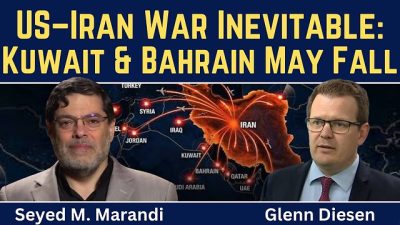
Seyed M. Marandi: US-Iran War Inevitable: Kuwait and Bahrain May Fall
or go to
Aletho News Archives – Video-Images
From the Archives
Oil and the Israel Lobby
Reknowned economist M. Shahid Alam offers this excellent critique of Noam Chomsky’s defective analysis of the relative influence of Oil versus the Israel lobby over US foreign policy: … continue
Blog Roll
 Aletho News
- ICC ignored ‘very well-documented’ NATO crimes – ex-Libyan minister
- SNSC secretary dismisses US response to Iran’s conditions as ‘inadequate’
- Sanaa says Taiz roads open, secure for residents, warns Saudi forces
- Iraqi resistance group urges Saudi leadership to admit defeat, lift Yemen siege
- Trump’s Retreat: How Al-Aqsa Flood Took Down the US Empire
- Israel’s Military Actions in Lebanon Grossly Violate International Law — Lavrov
- Seyed M. Marandi: US-Iran War Inevitable: Kuwait and Bahrain May Fall
- Leaders Condemn Ansarallah Attack on Saudi Arabia While Ignoring Illegal War Against Yemen
- Leaked: Britain’s Covert Iraqi Psyops Network
- Yemeni Armed Forces Warn Airlines Against Using Saudi Airports, Exempt Mecca and Medina
- If Americans Knew
- Israel goes ballistic over Nobel Laureate Navi Pillay
- U.S. May Join Yet Another Middle Eastern War — TCN
- Yellow Line moves again as Israel closes in on trapped Gazans – Daily Update
- Israeli Attacks Kill Seven Palestinians in Gaza Including Six-year-old Girl
- Gaza: Ceasefire Anniversary Marks Year of Failed Promises
- The American Conservative: Mike Huckabee Should Resign
- A C-Section in Shackles: A Palestinian Woman’s Harrowing Birth in Israeli Detention
- ‘He’s Desperate’: AIPAC Begins Spending Against Abdul El-Sayed to Boost Mike Rogers:
- Trump, Hormuz, and the Looming Economic Catastrophe
- For three years, Israel has killed a child in Gaza every 71 minutes – Daily Update
- No Tricks Zone
- Germany’s Green Energy Debacle: High Energy Costs Force Kahla Porzellan to Close After 182 Years!
- New Study: 50 Years Of The Most Aggressive ‘Net Zero’ Policies Can Only Affect The Global Climate By 0.03°C
- US September “Heat” Was No Record…Many Records Set Decades Ago
- Latest European Green Energy Debacle; Portugal’s Largest Flagship Solar Park Insolvent!
- Green Energy Debacle: German Expert Professor Fritz Vahrenholt Warns Of Severe Economic And Social Consequences
- Two More Paleo Reconstructions Affirm Meters-Higher Sea Levels Across Ireland, Brazil 7000-6000 Years Ago
- New Study: Earth And Venus Surface Warmth Largely Explained By Convection And Lapse Rate, Not CO2 Or Radiation
- 2025 Nature Paper Claiming Worsening Global Drought Gets RETRACTED …Heavily Flawed
- New Study: ‘Global Drought Shows No Detectable Recent Acceleration Under Climate Warming’
- Economic Masterminds: German Socialists Suggest Taxing Productivity Gains Stemming From Using AI

