‘Pulp fiction’: Kremlin says alleged CIA mole was a minor official with no access to Putin
RT | September 10, 2019
A former official identified in media reports as a CIA asset in Russia worked in the presidential administration but never had access to Vladimir Putin, the Kremlin has claimed, adding that the man was fired several years ago.
US media reported on Monday that US intelligence carried out an operation in 2017 to extract a high-level Russian official who had worked as an informant for the CIA.
The incendiary claim has triggered a race to identify the alleged spy. Kommersant, a Russian daily, reported on Tuesday that the official may have been a man named Oleg Smolenkov.
Kremlin spokesman Dmitry Peskov confirmed that Smolenkov worked in the government, but said he did not hold a senior position and was fired in 2016 or 2017.
“Indeed, Smolenkov used to work in the presidential administration, but was fired several years ago,” Peskov said. He added that the alleged spy was not a high-ranking official personally appointed by Putin.
He said that the Kremlin was unaware of Smolenkov’s whereabouts, and that the government could only confirm that a man by that name once worked for the administration but was later laid off.
Peskov was openly critical of the US media’s faith in the evidence-deficient story, describing their breathless reports as resembling something more suitable for Hollywood.
“All this speculation in the US media about who urgently extracted who and who saved who from who, that’s all, as you understand, more of a pulp fiction kind of genre.”
Russian Foreign Minister Sergey Lavrov also weighed in on the sensational story, stating that he had never met Smolenkov or followed his career or movements. Western media reports portray the alleged mole as a senior official who enjoyed direct access to Putin.
Earlier, both the White House and the CIA denied the media reports.
The CNN exclusive claims that the CIA asset was secretly ferried out of Russia amid fears that his identity could be compromised by US President Donald Trump’s alleged chummy relationship with Moscow. Some have speculated that the story was manufactured to smear the American president.
Scientific Journal Advocating Child-Free Life Sparks Fury in Low-Fertility Finland
Sputnik – 09.09.2019
The 13/2019 edition of the magazine Tieteen Kuvalehti, which addressed climate change and numerous ways of minimising the carbon footprint, has struck a chord in Finland.
After listing more conventional ways of reducing one’s carbon footprint, such as abstaining from consuming meat and minimising air and car travel, Tieteen Kuvalehti concluded that the right (and the single best) thing for a climate-aware person to do is to abstain from having children.
The idea that having babies is bad for the environment, complemented by an exed-out image of a baby on the cover, was ill-received in Finland, where the birth rate is currently at a historic low: according to the United Nations report World Population Prospects 2019, the number of children under age five in 2015 was 300 million, compared with 501 million in 1950.
A Centre Party MP called for the magazine to be “hidden” in shops, libraries and kiosks.
“I believe conveying the message that a baby is a source of emissions is going too far. It gives children and youth the impression that they are a burden, and I find this horrible”, Aittakumpu told national broadcaster Yle.
Christian Democrat MP Päivi Räsänen was also outraged by on the cover.
“The message of the cover image is offensive to babies and families with babies … Children that are well cared for and educated will come up with the solutions to future problems, not be the cause of them. I support a counterattack to propaganda of this nature that says ‘All babies are welcome!’”, Päivi Räsänen said, as quoted by Yle. […]
Meanwhile, the number of births in Finland fell for the eighth consecutive year in 2018, as the total fertility rate hit a historic low of 1.41 children per women, Statistics Finland indicated. The last time Finland experienced baby blues of comparable proportions was during the great famine that happened about 150 years ago.
However, this is not the first time scientific papers suggest abstaining from having children for the sake of the planet. A 2017 study from Lund University in Sweden, suggested having fewer children, living car-free, avoiding air travel and eating a plant-based diet, claiming that these measures are more efficient in reducing emissions than commonly promoted strategies like comprehensive recycling or relying on energy-efficient household lightbulbs.
Helsinki University world politics professor Teivo Teivainen stressed that the decision to have fewer children includes many ethical considerations. While underscoring Finland’s responsibility, he stressed that the birthrate of the small nation has almost no significance on the global scale.
Tieteen Kuvalehti is the Finnish version of the Danish periodical Illustreret Videnskab, published by the Swedish media house Bonnier Group, which is run by the Bonnier family and operates in more than a dozen countries. It circulation is about 550,000 copies.
9/11 After 18 Years “Hard Evidence Cannot Prevail over a Transparent Official Lie”
By Paul Craig Roberts • September 9, 2019
I would appreciate hearing from readers whether they have come across a report in the print, TV, or NPR media of the highly professional four-year investigation of WTC Building 7’s demise. The international team of civil engineers concluded that the official story of Building 7’s destruction is entirely false. I reported their findings here.
I suspect that the expert report is already in the Memory Hole. Popular Mechanics, Wikipedia and CNN cannot label a distinguished team of experts “conspiracy theorists.” Therefore the presstitutes and assorted cover-up artists for the 9/11 false flag attack on the United States will simply act as if no such report exists. The vast majority of people in the world will never hear about the report. I doubt that the real perpetrators of 9/11 will even bother to hire their own team to “refute” the report as that would bring the report into the news, the last place the perpetrators want it to be.
The 9/11 Commission report was not an investigation and ignored all forensic evidence. The NIST simulation of Building 7’s collapse was rigged to get the desired result. The only real investigations have been done by private scientists, engineers, and architects. They have found clear evidence of the use of nano-thermite in the destruction of the twin towers. More than 100 First Responders have testified that they experienced a large number of explosions inside the towers, including a massive explosion in the sub-basement prior to the time the airliners are said to have hit the tower. Numerous military and civilian pilots have said that the flight maneuvers involved in the WTC and Pentagon attacks are beyond their skills and most certainly beyond the skills of the alleged hijackers. Wreckage of the airliners is surprisingly missing from impact sites. And so on and so on. That Building 7 was a controlled demolition is no longer disputable.
On the basis of the known evidence, knowledgeable and informed people have concluded that 9/11 was an inside job organized by Vice President Dick Cheney, his stable of neoconservatives, and Israel for the purpose of reconstructing the Middle East in Israel’s interest and enriching the US military/security complex in the process.
Most people are unaware of Robert Mueller’s role as FBI Director in protecting the official 9/11 story from the evidence. Paul Sperry reports in the New York Post the many actions Mueller took as FBI director to hide the facts from Congress and the public.
Patrick Pasin, a French author, provides additional evidence of Mueller’s misuse of his office to protect an official lie. An English language translation of Pasin’s book, The FBI Accomplice of 9/11, has been published by Talma Studios in Dublin, Ireland.
Pasin’s book consists of his organization of the known evidence, which has been suppressed in order to perpetrate a false story of 9/11, into a compelling account of how a false flag attack was protected from exposure. He details the plan “through which the FBI tried to prove the government conspiracy narrative—no matter the cost.” Keep in mind that Mueller is the one that the Deep State set on President Trump. Dirty business is Mueller’s business.
Pasin collects the evidence and weaves it into a compelling story. It is all there. The insider trading in advance of the airliner hijackings, the impossibility of cell phone calls from airliners in 2001, the anthrax letters sent to senators Tom Daschle and Patrick Leahy which paved the way for the PATRIOT Act, the effort to blame American military scientists for the letters once it emerged that the anthrax was unique to a US military lab, the total implausibility of finding an undamaged passport in the rubble of the twin towers where fires allegedly were so hot that they melted steel.
It is extraordinary that anyone could have believed a word of this. Try to image such intense heat as to melt steel but not enough to burn a passport!
Pasin’s book is easy to read. He just lays it out, revealing falsification after falsification, lie after lie. The obviously false story is fed to the world, and the experts who expose it as false are called “conspiracy theorists” by people too stupid and uninformed to carry their books.
This is America in the 21st century, and apparently the rest of the world’s population is not any brighter.
In 3 days it will be the 18th anniversary of 9/11. What have we learned in these 18 years? We have learned that thousands of experts with hard evidence cannot prevail over a transparent official lie.
Will NPR Now Officially Change Its Name to National Propaganda Radio?
By Edward J Curtin | September 6, 2019
Back in the 1960s, the CIA official Cord Meyer said the agency needed to “court the compatible left.” He knew that drawing liberals and leftists into the CIA’s orbit was the key to efficient propaganda. Right-wing and left-wing collaborators were needed to create a powerful propaganda apparatus that would be capable of hypnotizing audiences into believing the myth of American exceptionalism and its divine right to rule the world. The CIA therefore secretly worked to influence American and world opinion through the literary and intellectual elites.
Frances Stonor Saunders comprehensively covers this in her 1999 book, The Cultural Cold War: The CIA And The World Of Arts And Letters, and Joel Whitney followed this up in 2016 with Finks: How the CIA Tricked the World’s Best Writers, with particular emphasis on the complicity between the CIA and the famous literary journal, The Paris Review. By the mid-1970s, as a result of the Church Committee hearings, it seemed as if the CIA, NSA, FBI, etc. had been caught in flagrante delicto and disgraced, confessed their sins, and resolved to go and sin no more. Then in 1977, Carl Bernstein wrote a long piece for Esquire – “The CIA and the Media” – naming names of journalists and media (The New York Times, CBS, etc.) that worked hand-in-glove with the CIA, propagandizing the American people and the rest of the world. It seemed as if all would be hunky-dory now with the bad boys purged from the American “free” press. Seemed to the most naïve, that is, by which I mean the vast numbers of people who wanted to re-stick their heads in the sand and believe, as Ronald Reagan’s team of truthtellers would announce, that it was “Morning in America” again with the free press reigning and the neo-conservatives, many of whom had been “converted” from their leftist views, running things in Washington.
So again it is morning in America this September 6, 2019, and the headline from National Public Radio announces the glad tidings that NPR has named a new CEO. His name is John Lansing, and the headline says he is a “veteran media executive.” We are meant to be reassured. It goes on to say that Mr. Lansing, 62, is currently the chief executive of the government agency, The U.S. Agency for Global Media, that oversees Voice of America, Radio and Television Marti, and Radio Free Europe/Radio Liberty, among others. We are furthermore reassured by NPR that Lansing “made his mark in his current job with stirring defenses of journalism, free from government interference.” The announcement goes on to say:
Lansing has earned an advanced degree in political agility. At the U.S. Agency for Global Media, Lansing championed a free press even as leaders of many nations move against it.
‘Governments around the world are increasingly cracking down on the free flow of information; silencing dialogue and dissent; and distorting reality,’ Lansing said in a speech he delivered in May to the Media for Democracy Forum. ‘The result, I believe, is a war on truth.’
He continued: ‘Citizens in countries from Russia to China, from Iran to North Korea, have been victimized for decades. But now we’re seeing authoritarian regimes expanding around the globe, with media repression in places like Turkey and Venezuela, Cambodia and Vietnam.’
So we are reassured that the new head of NPR, the chief of all U.S. propaganda, is a champion of a free press. Perhaps NPR will soon enlighten the American public by interviewing its new head honcho and asking him if he thinks Julian Assange and Chelsey Manning, by exposing America’s war crimes, and Edward Snowden, by exposing the U.S. government’s vast electronic surveillance programs of its own citizens, deserve to be jailed and exiled for doing the job the American mainstream “free press” failed to do. What NPR failed to do. Perhaps they will ask him if he objects to the way his own government “interfered” in the lives of these three courageous people who revealed truths that every citizen of a free country is entitled to. Perhaps they will ask him if the U.S. government’s persecution of these truthtellers is what he means by there being “a war on truth.” Perhaps they will ask him if he thinks the Obama and Trump administrations have been “distorting reality” and waging a war on truth.
Perhaps not. Of course not.
Don’t laugh, for the joke will be on you if you listen to NPR and its sly appeal to “liberal” sensibilities. If you are wondering why we have had the Russia-gate hoax and who was responsible (see/hear Russia expert Prof. Stephen Cohen here) and are now involved in a new Cold War and a highly dangerous nuclear confrontation with Russia, read Lansing’s July 10, 2019 testimony before the House Appropriations Sub-Committee on State, Foreign Operations and Related Programs: “United Sates Efforts to Counter Russian Disinformation and Malign Influence.”
Here is an excerpt:
USAGM provides consistently accurate and compelling journalism that reflects the values of our society: freedom, openness, democracy, and hope. Our guiding principles—enshrined in law—are to provide a reliable, authoritative, and independent source of news that adheres to the strictest standards of journalism….
Russian Disinformation. And make no mistake, we are living through a global explosion of disinformation, state propaganda, and lies generated by multiple authoritarian regimes around the world. The weaponization of information we are seeing today is real. The Russian government and other authoritarian regimes engage in far-reaching malign influence campaigns across national boundaries and language barriers. The Kremlin’s propaganda and disinformation machine is being unleashed via new platforms and continues to grow in Russia and internationally. Russia seeks to destroy the very idea of an objective, verifiable set of facts as it attempts to influence opinions about the United States and its allies. It is not an understatement to say that this new form of combat on the information battlefield may be the fight of the 21st century.
Then research the history of Radio Free Europe/Radio Liberty, the Voice of America, Radio and Television Marti, etc. You will be reassured that Lansing’s July testimony was his job interview to head National Propaganda Radio.
Then sit back, relax, and tune into NPR’s Morning Edition. It will be comforting to know that it is “Morning in America” once again.
Hands off Hong Kong: The Cry Seldom Heard
Where are the self-styled anti-war activists – like Democracy Now?
By John V. Walsh | Dissident Voice | September 4, 2019
Through the summer the world has watched as protests shook Hong Kong. As early as April they began as peaceful demonstrations which peaked in early June, with hundreds of thousands, in protest of an extradition bill. That bill would have allowed Hong Kong, a Special Administrative Region of China, to return criminals to Taiwan, mainland China or Macau for crimes committed there – after approval by multiple layers of the Hong Kong judiciary. In the wake of those enormous nonviolent demonstrations, Carrie Lam, CEO of Hong Kong, “suspended” consideration of the extradition bill, a face-saving ploy. To make sure she was understood, she declared it “dead.” The large rallies, an undeniable expression of the peaceful will of a large segment of the Hong Kong population had won an impressive victory. The unpopular extradition bill was slain.
But that was not the end of the story. A smaller segment continued the protests. (The Hong Kong police at one point estimated 4,000 hard core protesters.) pressed on with other demands, beginning with a demand that the bill be “withdrawn,” not simply “suspended.” To this writer death by “suspension” is every bit as terminal as death by “withdrawal.” As this piece is sent to press, news comes that Corrie Lam has now formally withdrawn the bill.
As the summer passed, two iconic photos presented us with two human faces that captured two crucial features of the ongoing protests; they were not shown widely in the West.
First, Fu Guohao, a reporter for the Chinese mainland newspaper, Global Times, was attacked, bound and beaten by protesters during their takeover of the Hong Kong International Airport. When police and rescuers tried to free him, the protesters blocked them and also attempted to block the ambulance that eventually bore him off to the hospital. The photos and videos of this ugly sequence were seen by netizens across the globe even though given scant attention in Western media. Where were the stalwart defenders of the press in the US as this happened? As one example, DemocracyNow! (DN!) was completely silent as was the rest of the U.S. corporate media.
Fu’s beating came after many weeks when the protesters threw up barriers to stop traffic; blocked closure of subway doors, in defiance of commuters and police, to shut down mass transit; sacked and vandalized the HK legislature building; assaulted bystanders who disagreed with them; attacked the police with Molotov cocktails; and stormed and defaced police stations. Fu’s ordeal and all these actions shown in photos on Hong Kong’s South China Morning Post, a paper leaning to the side of protesters, gave the lie to the image of these “democracy activists” as young Ghandis of East Asia. (The South China Morning Post is based in Hong Kong and its readership is concentrated there so it has to have some reasonable fidelity in reporting events; otherwise it loses credibility – and circulation. Similarly, much as the New York Times abhorred Occupy Wall Street, it could not fail to report on it.)
Which brings us to the second photo, much more important to U.S. citizens, that of a “Political Counselor” at the U.S. Consulate General in Hong Kong who in August was pictured meeting with, Joshua Long and Nathan Law, at a hotel there. The official was formerly a State Dept functionary in the Middle East – in Jerusalem, Riyadh, Beirut, Baghdad and Doha, certainly not an area lacking in imperial intrigues and regime change ops. That photo graphically contradicted the contention that there is no US “black hand,” as China calls it, in the Hong Kong riots. In fact, here the “black hand” was caught red-handed, leading Chen Weihua, a very perceptive China Daily columnist, to tweet the picture with the comment: “This is very very embarrassing. … a US diplomat in Hong Kong, was caught meeting HK protest leaders. It would be hard to imagine the US reaction if a Chinese diplomat were meeting leaders of Occupy Wall Street, Black Lives Matter or Never Trump protesters.”
And that photo with the protest leaders is just a snap shot of the ample evidence of the hand of the U.S. government and its subsidiaries in the Hong Kong events. Perhaps the best documentation of the U.S. “black hand” is to be found in Dan Cohen’s superb article of August 17 in The Greyzone entitled, “Behind a made-for-TV Hong Kong protest narrative, Washington is backing nativism and mob violence.” The article by Cohen deserves careful reading; it leaves little doubt that there is a very deep involvement of the US in the Hong Kong riots. Of special interest is the detailed role and funding, amounting to over $1.3 million, in Hong Kong alone in recent years, of the U.S. National Endowment for Democracy (NED), ever on the prowl for new regime change opportunities. Perhaps most important, the leaders of the “leaderless” protests have met with major US political figures such as John Bolton, Vice President Pence, Secretary Pompeo, Senator Marco Rubio, Democratic Rep. Eliot Engel, Nancy Pelosi and others, all of whom have heartily endorsed their efforts. This is not to deny that the protests were home grown at the outset in response to what was widely perceived as a legitimate grievance. But it would be equally absurd to deny that the U.S. is fishing in troubled Hong Kong waters to advance its anti-China crusade and regime change ambitions.
That said, where is the U.S. peace movement on the question of Hong Kong?
Let us be clear. One can sympathize with the demand of many citizens of Hong Kong to end the extradition bill or even the other four demands: an inquiry into police handling of their protests; the retraction of a government characterization of the demonstrations as riots; an amnesty for arrested protesters; and universal suffrage. (The first three all grow out of violence of the protests, be it noted.) But that is the business of the citizens of Hong Kong and all the rest of China. It is not the business of the U.S. government. Peace activists in the US should be hard at work documenting and denouncing the US government’s meddling in Hong Kong, which could set us on the road to war with China, potentially a nuclear war. And that is a mission for which we in the U.S. are uniquely suited since, at least in theory, we have some control over our government.
So, we should expect to hear the cry, “US Government, Hands Off Hong Kong”? Sadly, with a few principled exceptions it is nowhere to be heard on either the left or right.
Let’s take DemocracyNow! (DN!) as one example, a prominent one on the “progressive” end of the spectrum. From April through August 28, there have been 25 brief accounts (“headlines” as DN! calls them, each amounting to a few paragraphs) of the events in Hong Kong and 4 features, longer supposedly analytic pieces, on the same topic. Transcripts of the four features are here, here, here and here. There is not a single mention of possible US involvement or the meetings of the various leaders of the protest movement with Pompeo, Bolton, Pence, or the “Political Counselor” of the US Hong Kong consulate.
And this silence on US meddling is true not only of most progressive commentators but also most conservatives.
On the Left when someone cries “Democracy,” many forget all their pro-peace sentiment. And similarly on the Right when someone cries “Communism,” anti-interventionism too often goes down the tubes. Forgotten is John Quincy Adams’s 1823 dictum, endlessly quoted but little honored, “We do not go abroad in search of monsters to destroy.” Where does this lapse on the part of activists come from? Is it a deep-seated loyalty to Empire, the result of endless indoctrination? Is it U.S. Exceptionalism, ingrained to the point of unconsciousness? Or is it at bottom a question of who the paymasters are?
On both sides anti-interventionism takes an especially hard hit when it comes to major competitors of the US, powers that could actually stand in the way of US global hegemony, like Russia or China. In fact on its August 12 program, DN! managed a story taking a swipe at Russia right next to the one on Hong Kong – and DN! was in the forefront of advancing the now debunked and disgraced Russiagate Conspiracy Theory. In contrast, the anti-interventionist movement is front and center when it comes to weaker nations, for example Venezuela – and quite properly so. But when one puts this advocacy for weaker nations together with the New Cold War stance on China and Russia, one must ask what is going on here. Does it betoken a sort of imperial paternalism on the part of DN and like-minded outlets? It certainly gains DN!, and others like it, considerable credibility among anti-interventionists which can help win them to a position in favor of DN!’s New Cold War stance. And the masters of Empire certainly understand how valuable such credibility can be at crucial moments when support for their adventures is needed from every quarter.
Fortunately, there are a handful of exceptions to this New Cold War attitude. For example, on the left Popular Resistance has provided a view of the events in Hong Kong and a superb interview with K.J. Noh that go beyond the line of the State Department, the mainstream media and DN! And on the libertarian Right there is the Ron Paul Institute for Peace and Prosperity and the work of its Executive Director Dan McAdams.
We would all do well to follow the example of these organizations in rejecting a New Cold War mentality which is extremely dangerous, perhaps fatally so. A good beginning for us in the U.S. is to demand of our government, “Hands Off Hong Kong.”
John V. Walsh can be reached at john.endwar@gmail.com.
Is Vaccine Safety Too Dangerous for Us to Discuss?
By Bretigne Shaffer | Lew Rockwell | September 3, 2019
Recently, the news and opinion site HuffPost removed an article that had been up for more than six years. The piece, titled “Government Concedes Vaccine-Autism Case in Federal Court – Now What?” was published in January of 2013, and dealt with a case in which the US government’s Court of Federal Claims conceded that routine vaccination had aggravated a child’s underlying condition and led to that child developing “features of autism spectrum disorder.”
Now, the following statement appears in place of that article:
A previous blog post published on this site has been removed in the interest of public health. The article expressed the sole opinion of its author, who retains the rights to publish it elsewhere. Multiple studies have demonstrated that vaccines are safe and effective. Our letter from the editor has more on this decision.
This retraction did not occur in a vacuum. The first half of 2019 has seen a coordinated effort to scrub the Internet of any information that is critical of the claim that “vaccines are safe and effective.” The push began last fall, but gained momentum in January when the World Health Organization declared “vaccine hesitancy” to be a “global health threat,” placing it alongside Ebola, cancer, war zones, and drug-resistant pathogens.
On March 1st, US Congressman Adam Schiff wrote to Amazon CEO Jeff Bezos and, after stating that “there is no evidence to suggest that vaccines cause life-threatening or disabling diseases,” expressed his concern that Amazon might be allowing content with “medically inaccurate information.” He asked what action Amazon was taking to address “misinformation about vaccines.”
Later that day, Amazon pulled from its streaming service the documentary “Vaxxed: From Cover-Up to Catastrophe,” along with other “anti-vaccine” documentaries including “Man Made Epidemic“ and “The Greater Good,” a film that “…weaves together the stories of families whose lives have been forever changed by vaccination.”
Schiff had written similar letters to Facebook CEO Mark Zuckerberg, and Google CEO Sundar Pichai. Not long after Amazon pulled the documentaries from its streaming service, other platforms began to follow suit. On March 7, Facebook announced that it would reduce the visibility of groups and pages that “spread misinformation about vaccinations,” and would no longer accept advertisements containing what it deemed to be “misinformation” about vaccines.
Back in August of 2018, Pinterest had already begun removing content (later accounts, and then search results) that it said contained “medical misinformation,” and in February, YouTube demonetized all videos that “promoted anti-vaccination content.” Etsy, Vimeo, MailChimp, and GoFundMe have all joined these other platforms in pledging to either prohibit or demote content deemed to contain “misinformation” about vaccines.
“MISINFORMATION”
So what is the “misinformation” that the WHO, Congressman Schiff, and these social-media giants are so determined to remove from public view? Let’s start with the article mentioned above that was pulled from HuffPost :
The piece—which you can now read here—deals with the case of Hannah Poling, whose family was awarded more than $1.5 million by the US Court of Federal Claims after it acknowledged that her “regressive encephalopathy with features of autism spectrum disorder…” was the result of vaccinations she received at 18 months that aggravated an underlying mitochondrial condition. The article is a fairly straightforward accounting of the case, followed by questions it raises about such issues as research, public health, and the vaccine-autism debate.
HuffPost’s letter from the editor, explaining its reasoning for removing articles like this one, states:
HuffPost has decided to remove dozens of blogs that perpetuate the unfounded opinion that vaccines pose a health risk to the public. Allowing these blogs to remain on our platform does a disservice to our readers that outweighs any ostensible value as part of the public record.
HuffPost’s editors also chose to remove the Federal Claims Court document itself, which had been posted separately. Where that document was once found, there is now the same statement that replaced the above article, along with the assertion that it “… expressed the sole opinion of its author.”
But that is complete nonsense. There is no “author” of this piece (other than for the very brief introduction to the document), and it does not represent anyone’s “opinion.” It is an official record of a concession made by the Secretary of Health and Human Services, submitted to a Federal court. It is indeed a part of the public record—a part that HuffPost’s editorial team doesn’t believe its readers should be able to see.
Other “misinformation” that has been removed from major platforms include this fully referenced article by Anne Mason, on the scare tactics being used to incite fear of measles, taken down by Medium in February, and the Pinterest accounts of both GreenMedInfo and the National Vaccine Information Center, both of which provide well-referenced information on vaccine safety and efficacy.
In June, the email marketing service provider MailChimp announced that it would prohibit “anti-vaccination content.” However, even before announcing this policy change, it had already removed several accounts without warning, according to their owners. Some of these included organizations simply opposed to vaccine mandates, such as Health Choice Vermont, and Colorado Health Choice Alliance, both of which had their accounts closed suddenly in June.
And in May, GoFundMe took down the fundraising campaign for Dr. Kenneth Stoller. Dr. Stoller had been raising money for his legal defense fund after having been served with a subpoena to turn over patient health records by the San Francisco City Attorney as part of a public nuisance investigation regarding his writing of medical exemptions to vaccines.
As these last two examples reveal, this effort aims to suppress not only voices that question the official line on vaccines, but also those that are opposed simply to mandated vaccines, as well as a doctor raising money to defend himself from the threat of state action against himself and his patients.
AND MISINFORMATION
Given the deep concern felt by these media giants for accuracy in coverage of the controversy over vaccines, it is surprising to find that so much misinformation on the topic remains in place on their platforms.
Contrary to the oft-repeated mantra in the mainstream press, the science about vaccines is far from “settled.” There is much that is a fair topic for debate, and there is much research that simply has not been done. There are, however, some easily refuted falsehoods, several of which feature prominently in nearly every story on vaccines that appears in a major media outlet.
Here are a few samples:
- “Vaccines are safe and effective.”
How “safe”? How “effective”? Nothing is completely safe, and no medical treatment is completely effective all the time for every person. The only meaningful interpretation of “safe” in this context is that “vaccines are safer than the diseases they prevent.” But that has not been established.
To take just one example, the MMR vaccine, the Cochrane Review found, in its meta-analysis in 2012, that:
The design and reporting of safety outcomes in MMR vaccine studies, both pre- and post-marketing, are largely inadequate. The evidence of adverse events following immunisation with the MMR vaccine cannot be separated from its role in preventing the target diseases.
I have written elsewhere about the fact that there is no solid data available to tell us how many vaccinations result in serious injury or death, that vaccine injuries are badly under-reported, and that those who claim that the rate of vaccine injury is “one in a million” are referring only to severe anaphylactic shock, ignoring the multitude of other possible injuries. Without this information, there is no way to know whether the risk from vaccines (specific vaccines or all vaccines) is greater or lesser than the risks of contracting and being harmed by the diseases they are meant to prevent.
Likewise, “effective.” The fact that vaccines are not 100% effective is not even remotely controversial. And the degree of effectiveness can vary widely from one vaccine to another. The question is: Given the expected efficacy of a given vaccine, is the protection it offers worth the risk of the harm it may create. We simply do not have the information needed to make that assessment with any certainty.
- “Vaccines do not cause autism.”
No matter how many times major media outlets repeat this phrase, it has not been established that vaccines do not cause autism. Indeed, there is evidence that they can, including, but not limited to, the Federal Claims Court’s decision in the case of Hannah Poling that HuffPost is so determined that you not know about.
Those who insist that any connection between vaccines and autism has been discredited like to point to studies like this meta-analysis, or to this more recent Danish study looking at more than 600,000 children, both of which are used by defenders of vaccines to refute any association between vaccines and autism. However, a closer look reveals not only that these studies fail to do this, but that neither even addresses the question.
As with most studies purporting to refute an association with autism, those in the meta-analysis (all ten of them) look only at a single vaccine (the MMR and/or the monovalent measles vaccine) and/or specific ingredients (cumulative Hg dosage and/or thimerosal exposure), comparing those who have received it/them to those who are otherwise fully or partially vaccinated.
They are also observational studies, which means that they are subject to selection bias, including the risk of “healthy user bias,” which is especially relevant when looking at possible injury from vaccines. This is because families who have experienced a possible injury with one child might be less likely to give that vaccine to their other children. By thus excluding some of those who might be most at risk of vaccine injury, this can artificially skew the results of the vaccinated group toward better health outcomes.
As CDC researchers Dr. Paul Fine and Dr. Robert Chen wrote in their 1992 paper looking at confounding factors in studies of adverse reactions to vaccines:
… individuals predisposed to either SIDS or encephalopathy are relatively unlikely to receive DPT vaccination. Studies that do not control adequately for this form of “confounding by indication” will tend to underestimate any real risks associated with vaccination.
The Danish study by Hviid et al likewise only examines the possible impact of the MMR vaccine. It does also compare rates of autism diagnosis across sub groups, including those who have had some or all of their first-year vaccines and those who have not. However there is no true unvaccinated group (the closest being the group of those who had received no first-year vaccines—a whopping 0.7% of the total cohort). And the authors themselves acknowledge that the study suffers from the risk of healthy user bias.
Meanwhile, there are plenty of studies that do show a possible relationship between autism and vaccines. You just won’t see them splashed across the front pages of major newspapers and magazines.
Moreover, one of the world’s leading experts on vaccines, and former government witness in the National Vaccine Injury Compensation Program (NVIC)’s “vaccine court”, pediatric neurologist Dr. Andrew Zimmerman, has famously stated that:
… in a subset of children, vaccine-induced fever and immune stimulation did cause regressive brain disease with features of autism spectrum disorder.
Others, including former director of the National Institutes of Health Dr. Bernadine Healy and former CDC director Julie Gerberding, have also acknowledged that some children—particularly those with a mitochondrial disorder—can suffer damage from vaccines that leads to the symptoms associated with autism. In 2008, Gerberding told CNN’s Dr. Sanjay Gupta:
… if a child was immunized, got a fever, had other complications from the vaccines. And if you’re predisposed with the mitochondrial disorder, it can certainly set off some damage. Some of the symptoms can be symptoms that have characteristics of autism.
For the population as a whole, the bottom line is that there are no conclusive studies on either side of the autism-vaccine debate. Having media outlets endlessly repeat the claim that there are, and that the debate is “settled,” doesn’t make that claim any less false.
A DANGEROUS CONVERSATION
Let’s be absolutely clear: The position of the people who pressured Amazon, Facebook, Pinterest, GoFundMe, and other platforms to shut down content critical of vaccines is that ordinary people should not be free to discuss, debate, nor share information about, the safety of vaccines.
The question is: Why?
Those who make and promote vaccines are right to worry about a free and open conversation about the safety of their products. Their strategy to date has been to insist that “there is no debate” about vaccine safety, that “the science is settled.” And for a very long time they have gotten away with simply repeating these mantras. But the more they engage in what can only be described as Orwellian suppression of information, the more people start to wonder what they are afraid we might find out.
Once anyone starts looking closely, it becomes very clear just how mendacious both the industry and the media have been. It quickly becomes apparent that the WHO declaration is a truckload of nonsense; that vaccines have not, in fact, been proven to be “safe and effective”; that the science is not settled with regard to the vaccine-autism connection; and that the illnesses the vaccine proponents want us to be afraid of are in fact, not all that scary—certainly not as scary as a government with the power to force people to inject substances into their bodies against their will.
For those whose livelihoods are tied to an ever-increasing vaccine schedule, and ever-increasing sales of vaccines, this is a very dangerous conversation indeed.
Bretigne Shaffer [send her mail] was a journalist in Asia for many years. She is the author of Urban Yogini (A Superhero Who Can’t Use Violence) and Why Mommy Loves the State. She blogs at www.bretigne.com.
DARPA unleashes anti-meme militia to fight deepfakes & ‘polarizing’ viral content
By Helen Buyniski | RT | September 2, 2019
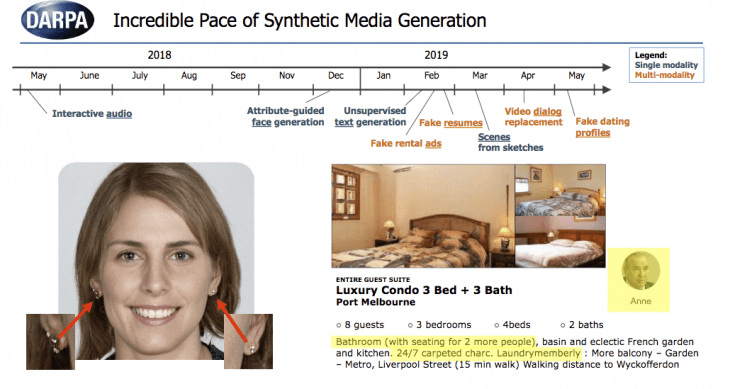
The Pentagon has unveiled an initiative to fight ‘large-scale, automated disinformation attacks’ by unearthing deep-fakes and other polarizing content – with the eventual goal of rooting out so-called ‘malicious intent’ entirely.
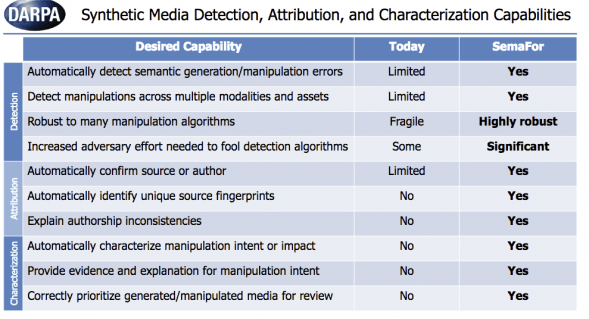
The Defense Advanced Research Projects Agency (DARPA) is seeking software capable of churning through a test set of half a million news stories, photos, and audio/video clips to target and neutralize potentially viral information before it spreads. In DARPA jargon, the aim is to “automatically detect, attribute, and characterize falsified multi-modal media to defend against large-scale, automated disinformation attacks.” “Polarizing viral content,” however, includes inflammatory truths, and the program’s ultimate goal seems to be to stamp out dissent.
© DARPA
The Semantic Forensics program will scan news stories and social media posts with a barrage of algorithms in the hope of identifying inconsistencies that could mark a story as fake. The desired program will not just identify a meme as inauthentic – it will identify the source of that meme, the alleged intent behind it, and predict the impact of its spread.
To hear them tell it, the Pentagon just wants to even the playing field between the ‘good guys’ – the fake-hunters pursuing the cause of truth in media – and the ‘bad guys’ sowing discord one slowed-down Nancy Pelosi speech at a time. But the Pentagon’s targets aren’t limited to deepfakes, the bogeyman-of-the-month being used to justify this unprecedented military intrusion into the social media and news realm, or fake news at all. If the program is successful after four years of trials, it will be expanded to target all “malicious intent” – a possibility that should send chills down the spine of any journalist who’s ever disagreed with the establishment narrative.
To adequately test the program, the Pentagon has to spike its array of 500,000 test stories with 5,000 convincing fakes, some of which could conceivably make their way into the “live” news stream – although the mainstream media has not exactly had trouble generating false stories on its own in recent weeks. MSNBC’s wholly unverified and still incompletely-retracted “Russian cosigners” fiction and the scare story that the Trump administration would end birthright citizenship for the children of US service members born overseas both took social media by storm before the fact-checkers could boot up their computers.
And the government itself, including the Pentagon, has an extensive history of running fake social media profiles to collect data on persons of interest, including through the NSA’s JTRIG information-war program revealed in the Snowden documents. Agents regularly deploy reputational attacks against dissidents using false information. Fake identities are used to cajole unsuspecting individuals into collaborating in fake FBI “terror” plots, a phenomenon which might once have been called entrapment but is merely business as usual in post-9/11 America.
© DARPA
Which begs the question – how will DARPA handle the malicious falsehoods generated by “friendly” media? This, it would seem, is where the “impact” and “intent” fields come in – fakes from “trusted sources” will be let through, while fakes (and real stories) designed to “undermine key individuals and organizations” will be terminated before they have an impact. When “disinformation” is redefined to include all potentially polarizing stories that don’t conform to the establishment narrative, reality is discarded as so much fake news and replaced with Pentagon-approved pablum.
Helen Buyniski is an American journalist and political commentator.
What if the Palestinians Won a Battle and No One Knew?
By Eve Mykytyn | September 2, 2019
There is a lawsuit, Al-Tammimi v. Adelson, that is making its way through the federal courts. The lawsuit was brought by a group of Palestinians and Palestinian/Americans asking for damages of 34.5 billion dollars resulting from Israeli settlements in the West Bank including East Jerusalem and the Gaza Strip. The Palestinians claim that the defendants, pro-Israel donors and organizations, banks, contractors working for Israel and deputy National Security Advisor Abrams conspired to expel Non Jews from their land and otherwise harm them. Defendants include Americans Sheldon Adelson, Lawrence Ellison, Haim Saban, Irving Moskowitz, John Hagee and Israeli Lev Leviev. The appeals court decision is here.
The suit was first brought in a US Federal district court (the “trial court”) alleging that the defendants “funneled millions of dollars through the defendant tax-exempt entities and banks to Israeli villages called “settlements.” Armed with this financial assistance, the settlement leaders hired full-time security coordinators who trained a militia of Israeli settlers to kill Palestinians and confiscate their property. The defendant construction and support firms destroyed property belonging to the Palestinians and built settlements in its place” and deputy national security advisor of the United States publicly endorsed the settlements.
The plaintiffs pressed four claims: “(1) civil conspiracy, (2) genocide and other war crimes, (3) aiding and abetting genocide and other war crimes and (4) trespass.”
The trial court dismissed the suit, relying on the doctrine that it is inappropriate for a court to determine matters that are inherently political and more properly decided by Congress and/or the President. The trial court found that the case required it to “adjudicate and resolve the lawfulness of the development of Israeli settlements…” Such a ruling, the trial court said, was “simply inappropriate for this court to resolve. Instead, these issues must be decided by the political branches.”
According to Haaretz, Israeli legal organization, Shurat Hadin, that claims to represent victims of terror, praised the trial court decision, and incorrectly stated that “cases such as this are brought solely to furnish a foundation of legal legitimacy for the BDS movement, and undermine the legitimacy of Israel.” And then, perhaps for vengeance, added the hope that “the judge will see clear to impose the large costs of these proceedings on the plaintiffs.” Imposition of costs is routine in some countries but unusual in the US.
On February 19, 2019 a panel of the Washington, DC Federal Circuit Court of Appeals (the “appeals court”) unanimously reversed the trial court and ruled that a trial court could find the defendants liable without deciding who owns the land. Although the appeals court did not decide liability, it sent the case back to the trial court for trial.
The appeals court agreed with the trial court that the issue of sovereignty over the land is political, but found that the case could be dismissed only if none of its claims could be resolved without deciding the political issue. In other words, they ruled that the Plaintiff’s claims can be separated from the issue of sovereignty over the land.
The lawsuit was brought primarily under a federal law entitled, the Alien Tort Statute (“ATS”). The ATS provides, in part, that federal courts can hear a civil action by a nonresident non- US citizen for a wrong “that is committed in violation of the law of nations.” The appeals court noted that “it is well settled that genocide violates the law of nations.” The court found that there is a definition of genocide within international law, that is: “[k]illing members of [a national, ethnic, racial or religious group] with intent to destroy [the group], in whole or in part.”
“Thus, the ATS—by incorporating the law of nations … —provides a judicially manageable standard to determine whether Israeli settlers are committing genocide.” In so stating, the appeals court is telling the trial court that this is the proper standard for its decision, and that this is not a “political” issue. (by political, they mean in the narrow sense of sovereignty involved in this case).
This decision can be appealed to a larger panel of the appeals court or to the Supreme Court, absent a successful appeal by the defendants, the Palestinians will be able to proceed. The district court has not yet reheard the case.
It seems to me like a big deal that three federal appeals judges ruled unanimously that the plaintiffs may proceed to argue that Israeli settlers and their benefactors have committed or aided in genocide.
However, the mainstream media has declined to cover this crucial case. A search of The New York Times, the Wall Street Journal and Bloomberg yielded no results. The case was covered by a few smaller outlets and by Bloomberg, Reuters (which included a summary that was at least partially correct) and by the Jerusalem Post (that complained the Palestinian plaintiffs failed to present the Israeli narrative). The Electronic Intifada covered the initial filing but does not seem to have followed the case. And Haaretz and the Times of Israel wrote about the dismissal by the district court but not that it was overturned on appeal. This strikes me as scant coverage of an important case.
Finally, a part of the United States government is treating Palestinians as people who have at least potential rights even against billionaires, and most of our media has not bothered to tell us the story.
Questions Nobody Is Asking About Jeffrey Epstein
By Eric Rasmusen • Unz Review • September 2, 2019
The Jeffrey Epstein case is notable for the ups and downs in media coverage it’s gotten over the years. Everybody, it seems, in New York society knew by 2000 that Jeffrey Epstein and Ghislaine Maxwell were corrupting teenage girls, but the press wouldn’t cover it. Articles by New York in 2002 and Vanity Fair in 2003 alluded to it gently, while probing Epstein’s finances more closely. In 2005, the Palm Beach police investigated. The county prosecutor, Democrat Barry Krischer, wouldn’t prosecute for more than prostitution, so they went to the federal prosecutor, Republican Alexander Acosta, and got the FBI involved. Acosta’s office prepared an indictment, but before it was filed, he made a deal: Epstein agreed to plead guilty to a state law felony and receive a prison term of 18 months. In exchange, the federal interstate sex trafficking charges would not be prosecuted by Acosta’s office. Epstein was officially at the county jail for 13 months, where the county officials under Democratic Sheriff Ric Bradshaw gave him scandalously easy treatment, letting him spend his days outside, and letting him serve a year of probation in place of the last 5 months of his sentence. Acosta’s office complained, but it was a county jail, not a federal jail, so he was powerless.
Epstein was released, and various lawsuits were filed against him and settled out of court, presumably in exchange for silence. The media was quiet or complimentary as Epstein worked his way back into high society. Two books were written about the affair, and fell flat. The FBI became interested again around 2011 (a little known fact) and maybe things were happening behind the scenes, but the next big event was in 2018 when the Miami Herald published a series of investigative articles rehashing what had happened. In 2019 federal prosecutors indicted Epstein, he was put in jail, and he mysteriously died. Now, after much complaining in the press about how awful jails are and how many people commit suicide, things are quiet again, at least until the Justice Department and the State of Florida finish their investigation a few years from now. (For details and more links, see “Investigation: Jeffrey Epstein” at Medium.com and “Jeffrey Epstein” at Wikipedia.)
I’m an expert in the field of “game theory”, strategic thinking. What would I do if I were Epstein? I’d try to get the President, the Attorney-General, or the U.S. Attorney for the Southern District of New York to shut down the investigation before it went public. I’d have all my friends and all my money try to pressure them. If it failed and I were arrested, it would be time for the backup plan— the Deal. I’d try to minimize my prison time, and, just as important, to be put in one of the nicer federal prisons where I could associate with financial wizards and drug lords instead of serial killers, black nationalists, and people with bad breath.
That’s what Epstein would do. What about the powerful people Epstein would turn in to get his deal? They aren’t as smart as Epstein, but they would know the Deal was coming— that Epstein would be quite happy to sacrifice them in exchange for a prison with a slightly better golf course. What could they do? There’s only one good option— to kill Epstein, and do it quickly, before he could start giving information samples to the U. S. Attorney.
Trying to kill informers is absolutely routine in the mafia, or indeed, for gangs of any kind. The reason people call such talk “conspiracy theories” when it comes to Epstein is that his friends are WASPs and Jews, not Italians and Mexicans. But WASPs and Jews are human too. They want to protect themselves. Famous politicians, unlike gangsters, don’t have full-time professional hit men on their staffs, but that’s just common sense—politicians rarely need hit men, so it makes more sense to hire them on a piecework basis than as full-time employees. How would they find hit men? You or I wouldn’t know how to start, but it would be easy for them. Rich powerful people have bodyguards. Bodyguards are for defense, but the guys who do defense know guys who do offense. And Epstein’s friends are professional networkers. One reporter said of Ghislaine Maxwell, “Her Rolodex would blow away almost anyone else’s I can think of—probably even Rupert Murdoch’s.” They know people who know people. Maybe I’m six degrees of separation from a mafia hit man, but not Ghislaine Maxwell. I bet she knows at least one mafioso personally who knows more than one hit man.
In light of this, it would be very surprising if someone with a spare $50 million to spend to solve the Epstein problem didn’t give it a try. A lot of people can be bribed for $50 million. Thus, we should have expected to see bribery attempts. If none were detected, it must have been because prison workers are not reporting they’d been approached.
Some people say that government incompetence is always a better explanation than government malfeasance. That’s obviously wrong— when an undeserving business gets a contract, it’s not always because the government official in charge was just not paying attention. I can well believe that prisons often take prisoners off of suicide watch too soon, have guards who go to sleep and falsify records, remove cellmates from prisoners at risk of suicide or murder, let the TV cameras watching their most important prisoners go on the blink, and so forth. But that cuts both ways. Remember, in the case of Epstein, we’d expect a murder attempt whether the warden of the most important federal jail in the country is competent or not. If the warden is incompetent, we should expect that murder attempt to succeed. Murder becomes all the more plausible. Instead of spending $50 million to bribe 20 guards and the warden, you just pay some thug $30,000 to walk in past the snoring guards, open the cell door, and strangle the sleeping prisoner, no fancy James Bond necessary. Or, if you can hire a New York Times reporter for $30,000 (as Epstein famously did a couple of years ago), you can spend $200,000 on a competent hit man to make double sure. Government incompetence does not lend support to the suicide theory; quite the opposite.
Now to my questions.
- Why is nobody blaming the Florida and New York state prosecutors for not prosecuting Epstein and others for statutory rape?
Statutory rape is not a federal crime, so it is not something the Justice Dept. is supposed to investigate or prosecute. They are going after things like interstate sex trafficking. Interstate sex trafficking is generally much harder to prove than statutory rape, which is very easy if the victims will testify.
At any time from 2008 to the present, Florida and New York prosecutors could have gone after Epstein and easily convicted him. The federal nonprosecution agreement did not bind them. And, of course, it is not just Epstein who should have been prosecuted. Other culprits such as Prince Andrew are still at large.
Note that even if the evidence is just the girl’s word against Ghislaine Maxwell’s or Prince Andrew’s, it’s still quite possible to get a jury to convict. After all, who would you believe, in a choice between Maxwell, Andrew, and Anyone Else in the World? For an example of what can be done if the government is eager to convict, instead of eager to protect important people, see the 2019 Cardinal Pell case in Australia. He was convicted by the secret testimony of a former choirboy, the only complainant, who claimed Pell had committed indecent acts during a chance encounter after Mass before Pell had even unrobed. Naturally, the only cardinal to be convicted of anything in the Catholic Church scandals is also the one who’s done the most to fight corruption. Where there’s a will, there’s a way to prosecute. It’s even easier to convict someone if he’s actually guilty.
- Why isn’t anybody but Ann Coulter talking about Barry Krischer and Ric Bradshaw, the Florida state prosecutor and sheriff who went easy on Epstein, or the New York City police who let him violate the sex offender regulations?
Krischer refused to use the evidence the Palm Beach police gave him except to file a no-jail-time prostitution charge (they eventually went to Acosta, the federal prosecutor, instead, who got a guilty plea with an 18-month sentence). Bradshaw let him spend his days at home instead of at jail. In New York State, the county prosecutor, Cyrus Vance, fought to prevent Epstein from being classified as a Level III sex offender. Once he was, the police didn’t enforce the rule that required him to check in every 90 days.
- How easy would it have been to prove in 2016 or 2019 that Epstein and his people were guilty of federal sex trafficking?
Not easy, I should think. It wouldn’t be enough to prove that Epstein debauched teenagers. Trafficking is a federal offense, so it would have to involve commerce across state lines. It also must involve sale and profit, not just personal pleasure. The 2019 indictment is weak on this. The “interstate commerce” looks like it’s limited to Epstein making phone calls between Florida and New York. This is why I am not completely skeptical when former U.S. Attorney Acosta says that the 2008 nonprosecution deal was reasonable. He had strong evidence that Epstein violated Florida state law— but that wasn’t relevant. He had to prove violations of federal law.
- Why didn’t Epstein ask the Court, or the Justice Dept., for permission to have an unarmed guard share his cell with him?
Epstein had no chance at bail without bribing the judge, but this request would have been reasonable. That he didn’t request a guard is, I think, the strongest evidence that he wanted to die. If he didn’t commit suicide himself, he was sure making it easy for someone else to kill him.
- Could Epstein have used the safeguard of leaving a trove of photos with a friend or lawyer to be published if he died an unnatural death?
Well, think about it— Epstein’s lawyer was Alan Dershowitz. If he left photos with someone like Dershowitz, that someone could earn a lot more by using the photos for blackmail himself than by dutifully carrying out his perverted customer’s instructions. The evidence is just too valuable, and Epstein was someone whose friends weren’t the kind of people he could trust. Probably not even his brother.
- Who is in danger of dying next?
Prison workers from guard to warden should be told that if they took bribes, their lives are now in danger. Prison guards may not be bright enough to realize this. Anybody who knows anything important about Epstein should be advised to publicize their information immediately. That is the best way to stay alive. This is not like a typical case where witnesses get killed so they won’t testify. It’s not like with gangsters. Here, the publicity and investigative lead is what is most important, because these are reputable and rich offenders for whom publicity is a bigger threat than losing in court. They have very good lawyers, and probably aren’t guilty of federal crimes anyway, just state crimes, in corrupt states where they can use clout more effectively. Thus, killing potential informants before they tell the public is more important than killing informants to prevent their testimony at trial, a much more leisurely task.
- What happened to Epstein’s body?
The Justice Dept. had better not have let Epstein’s body be cremated. And they’d better give us convincing evidence that it’s his body. If I had $100 million to get out of jail with, acquiring a corpse and bribing a few people to switch fingerprints and DNA wouldn’t be hard. I find it worrying that the government has not released proof that Epstein is dead or a copy of the autopsy.
- Was Epstein’s jail really full of mice?
The New York Times says,
“Beyond its isolation, the wing is infested with rodents and cockroaches, and inmates often have to navigate standing water — as well as urine and fecal matter — that spills from faulty plumbing, accounts from former inmates and lawyers said. One lawyer said mice often eat his clients’ papers.”
“Often have to navigate standing water”? “Mice often eat his clients’ papers?” Really? I’m skeptical. What do the vermin eat— do inmates leave Snickers bars open in their cells? Has anyone checked on what the prison conditions are really like?
- Is it just a coincidence that Epstein made a new will two days before he died?
I can answer this one. Yes, it is coincidence, though it’s not a coincidence that he rewrote the will shortly after being denied bail. The will leaves everything to a trust, and it is the trust document (which is confidential), not the will (which is public), that determines who gets the money. Probably the only thing that Epstein changed in his will was the listing of assets, and he probably changed that because he’d just updated his list of assets for the bail hearing anyway, so it was a convenient time to update the will.
- Did Epstein’s veiled threat against DOJ officials in his bail filing backfire?
Epstein’s lawyers wrote in his bail request,
“If the government is correct that the NPA does not, and never did, preclude a prosecution in this district, then the government will likely have to explain why it purposefully delayed a prosecution of someone like Mr. Epstein, who registered as a sex offender 10 years ago and was certainly no stranger to law enforcement. There is no legitimate explanation for the delay.”
I see this as a veiled threat. The threat is that Epstein would subpoena people and documents from the Justice Department relevant to the question of why there was a ten-year delay before prosecution, to expose the illegitimate explanation for the delay. Somebody is to blame for that delay, and court-ordered disclosure is a bigger threat than an internal federal investigation.
- Who can we trust?
Geoffrey Berman, U.S. Attorney for the Southern District of New York, is the only government official who is clearly trustworthy, because he could have stopped the 2019 Epstein indictment and he didn’t. I don’t think Attorney-General Barr could have blocked it, and I don’t think President Trump could have except by firing Berman. I do trust Attorney-General Barr, however, from what I’ve heard of him and because he instantly and publicly said he would have not just the FBI but the Justice Dept. Inspector-General investigate Epstein’s death, and he quickly fired the federal prison head honcho. The FBI is untrustworthy, but Inspector-Generals are often honorable.
Someone else who may be a hero in this is Senator Ben Sasse. Vicki Ward writes in the Daily Beast:
“It was that heart-wrenching series that caught the attention of Congress. Ben Sasse, the Republican senator from Nebraska, joined with his Democratic colleagues and demanded to know how justice had been so miscarried.
Given the political sentiment, it’s unsurprising that the FBI should feel newly emboldened to investigate Epstein—basing some of their work on Brown’s excellent reporting.”
- Will President Trump Cover Up Epstein’s Death in Exchange for Political Leverage?
President Trump didn’t have anything personally to fear from Epstein. He is too canny to have gotten involved with him, and the press has been eagerly at work to find the slightest connection between him and Epstein and have come up dry as far as anything but acquaintanceship. But we must worry about a cover-up anyway, because rich and important people would be willing to pay Trump a lot in money or, more likely, in political support, if he does a cover-up.
- Why did Judge Sweet order Epstein documents sealed in 2017. Did he die naturally in 2019?
Judge Robert Sweet in 2017 ordered all documents in an Epstein-related case sealed. He died in May 2019 at age 96, at home in Idaho. The sealing was completely illegal, as the appeals court politely but devastatingly noted in 2019, and the documents were released a day or two before Epstein died. Someone should check into Judge Sweet’s finance and death. He was an ultra-Establishment figure— a Yale man, alas, like me, and Taft School— so he might just have been protecting what he considered good people, but his decision to seal the court records was grossly improper.
- Did Epstein have any dealings in sex, favors, or investments with any Republican except Wexner?
Dershowitz, Mitchell, Clinton, Richardson, Dubin, George Stephanopolous, Lawrence Krauss, Katie Couric, Mortimer Zuckerman, Chelsea Handler, Cyrus Vance, and Woody Allen, are all Democrats. Did Epstein ever make use of Republicans? Don’t count Trump, who has not been implicated despite the media’s best efforts and was probably not even a Republican back in the 90’s. Don’t count Ken Starr– he’s just one of Epstein’s lawyers. Don’t count scientists who just took money gifts from him. (By the way, Epstein made very little in the way of political contributions, though that little went mostly to Democrats ($139,000 vs. $18,000. I bet he extracted more from politicians than he gave to them.
- What role did Israeli politician Ehud Barak play in all this?
Remember Marc Rich? He was a billionaire who fled the country to avoid a possible 300 years prison term, and was pardoned by Bill Clinton in 2001. Ehud Barak, one of Epstein’s friends, was one of the people who asked for Rich to be pardoned. Epstein, his killers, and other rich people know that as a last resort they can flee the country and wait for someone like Clinton to come to office and pardon them.
Acosta said that Washington Bush Administration people told him to go easy on Epstein because he was an intelligence source. That is plausible. Epstein had info and blackmailing ability with people like Ehud Barak, leader of Israel’s Labor Party. But “intelligence” is also the kind of excuse people make up so they don’t have to say “political pressure.”
- Why did nobody pay attention to the two 2016 books on Epstein?
James Patterson and John Connolly published Filthy Rich: A Powerful Billionaire, the Sex Scandal that Undid Him, and All the Justice that Money Can Buy: The Shocking True Story of Jeffrey Epstein. Conchita Sarnoff published TrafficKing: The Jeffrey Epstein Case. I never heard of these before 2019. Did the media bury them?
- Which newspapers reported Epstein’s death as “suicide” and which as “apparent suicide”?
More generally, which media outlets seem to be trying to brush Epstein’s death under the rug? There seems to have been an orchestrated attempt to divert attention to the issue of suicides in prison. Subtle differences in phrasing might help reveal who’s been paid off. National Review had an article, “The Conspiracy Theories about Jeffrey Epstein’s Death Don’t Make Much Sense.” The article contains no evidence or argument to support the headline’s assertion, just bluster about “madness” and “conspiracy theories”. Who else publishes stuff like this?
- How much did Epstein corrupt the media from 2008 to 2019?
Even outlets that generally publish good articles must be suspected of corruption. Epstein made an effort to get good publicity. The New York Times wrote,
“The effort led to the publication of articles describing him as a selfless and forward-thinking philanthropist with an interest in science on websites like Forbes, National Review and HuffPost….
All three articles have been removed from their sites in recent days, after inquiries from The New York Times….
The National Review piece, from the same year, called him “a smart businessman” with a “passion for cutting-edge science.”…
Ms. Galbraith was also a publicist for Mr. Epstein, according to several news releases promoting Mr. Epstein’s foundations… In the article that appeared on the National Review site, she described him as having “given thoughtfully to countless organizations that help educate underprivileged children.”
“We took down the piece, and regret publishing it,” Rich Lowry, the editor of National Review since 1997, said in an email. He added that the publication had “had a process in place for a while now to weed out such commercially self-interested pieces from lobbyists and PR flacks.””
The New York Times was, to its credit, willing to embarrass other publications by 2019. But the Times itself had been part of the cover-up in previous years. Who else was?
Eric Rasmusen is an economist who has held an endowed chair at Indiana University’s Kelley School of Business and visiting positions at Harvard Law School, Yale Law School, the Harvard Economics Department, Chicago’s Booth School of Business, Nuffield College/Oxford, and the University of Tokyo Economics Department. He is best known for his book Games and Information. He has published extensively in law and economics, including recent articles on the burakumin outcastes in Japan, the use of game theory in jurisprudence, and quasi-concave functions. The views expressed here are his personal views and are not intended to represent the views of the Kelley School of Business or Indiana University. His vitae is at http://www.rasmusen.org/vita.htm .
Featured Video
Can the U.S. Afford to Annihilate Iran?
or go to
Aletho News Archives – Video-Images
Book Review
The Genetic Deception — now in paperback (Second Edition)
Lies are Unbekoming | October 2, 2026
The genes the field promised were never there.
The genetic story of disease is a cover story.
The twenty-first century runs on it. Paediatric clinics. Cancer centres. Forensic laboratories. Family-planning counsel. It is used to explain illness, to assign blame, to foreclose questions. It protects the industries whose products and practices are what actually caused the harm.
It isn’t true.
In 2010, Jonathan Latham and Allison Wilson looked at over seven hundred genome-wide association studies covering some eighty common diseases. The genes the field had promised were not there. The field invented a term, “missing heritability”, to explain the absence, and has quietly worked to bury the finding ever since.
The Genetic Deception is a book about what Latham and Wilson found. What the field did with it. And what the public was told instead. … continue
Blog Roll
 Aletho News
- US increasing Middle East military buildup – AP
- Flydubai scenario: Netanyahu’s plot to drag US to war with Iran, stay in power
- The Genetic Deception — now in paperback (Second Edition)
- Can the U.S. Afford to Annihilate Iran? /Seyed M. Marandi
- Elmo Sold mRNA Jabs to Your Toddler. Now They Are “Off-Label.”
- British state targets Palestine Action with yet another crooked trial
- Americans are paying the price to preserve Israel’s nuclear hegemony
- Resistance factions are necessary to ensure a permanent US Iraq withdrawal
- How Israel destabilizes the Middle East: Denying sovereignty and the right to exist
- Europe’s Establishment Is Embracing War – and Losing Voters
- If Americans Knew
- Israeli Soldiers Abduct At Least 22 Across Occupied West Bank
- Eight Palestinians Killed in Israeli Attacks on Gaza
- Israeli former leaders and security chiefs threaten legal action over ‘Jewish terrorism’
- Israel map in LA Times ad includes all land from the river to the sea
- Inside Lebanon’s 200-page dossier on Israeli war crimes
- Flydubai, genocide, settler violence, Trump abuse of power to deport – Daily Update
- Counting Antisemitic Incidents: What the ADL Audit Reveals — and Obscures
- Mamdani releases plan to combat antisemitism and hate crimes in New York City
- Iran’s Revolutionary Guards Publish Letter to the American People
- DMFI launches $1 million ad campaign supporting Virginia’s Elaine Luria
- No Tricks Zone
- Green Energy Debacle: German Expert Professor Fritz Vahrenholt Warns Of Severe Economic And Social Consequences
- Two More Paleo Reconstructions Affirm Meters-Higher Sea Levels Across Ireland, Brazil 7000-6000 Years Ago
- New Study: Earth And Venus Surface Warmth Largely Explained By Convection And Lapse Rate, Not CO2 Or Radiation
- 2025 Nature Paper Claiming Worsening Global Drought Gets RETRACTED …Heavily Flawed
- New Study: ‘Global Drought Shows No Detectable Recent Acceleration Under Climate Warming’
- Economic Masterminds: German Socialists Suggest Taxing Productivity Gains Stemming From Using AI
- The South China Sea Has Not Been Cooperating With The Climate Change Narrative
- Energy Crisis: Germany Enters Heating Season With Historically Low Gas Reserve Fill Levels
- New Study: The Antarctic Ice Sheet Gained Mass From 2020-2024 Due To Staggering Snow And Ice Accumulation
- Study: Ocean Heating Rates From Thousands Of Years Ago ‘Dwarf’ Modern Ocean Heating Rates

