Sky News Collaborates with Idlib Terrorists to Create Syria War Propaganda
By Robert Inlakesh | 21st Century Wire | May 24, 2019
On Thursday night Sky News release a story entitled “Sky News witnesses horrors of Syria’s last rebel outpost”, in which journalist Alex Crawford claims to have been targeted by a Russian tank shelling whilst reporting in Syria’s Idlib province.
The story made headlines and featured in news bulletins across the UK and even the wider world. The problem however, was that the romantic TV drama type report falls flat, as the shameless war propaganda it is, when held up to basic scrutiny and common sense. Watch:
The story made headlines and featured in news bulletins across the UK and even the wider world. The problem however, was that the romantic TV drama type report falls flat, when held up to basic scrutiny and common sense, and merely exposes itself as the shameless war propaganda it is.
To the average viewer of their content, the video may indeed paint Sky’s Alex Crawford as a brave intrepid journalist, battling to deliver the truth about the evil Assad regime, but to those who have any knowledge of the Syrian war, she not only gives enough rope to hang herself with, but perhaps her entire crew.
Let’s begin with talking about just how incredibly ridiculous and propagandist this piece is, using some of Crawford’s own admissions.
Firstly, Crawford admits to being present and inside the de-militarization zone, between the last “rebel” strong hold and the Syrian government. This area was decided upon to become a designated de-escalation zone following the Septemeber 2018 Turkey-Russia brokered ceasefire agreement. Crawford claims that the zone is being constantly violated, which is evidently true, although her being present there in the company of al-Qaeda affiliated militants, battle tanks and well known puppets of extremist propaganda outlets, paints the wrong picture if she was wishing to demonize the Syrian government and its allies.
Secondly, Alex Crawford also admits that all civilians had left the area, indicating what? That she is surrounded by militants, which are evidently the only targets in the area to hit, other than her crew or perhaps others who came with a similar purpose. Not only is this the case, but they decided to enter the area during an armed clash between the two sides, beginning her package with video of a tank that had been terminated by Syrian/Syrian allied forces.
Thirdly, she is in Idlib on the side of the militants during wartime, meaning that she evidently entered Syria illegally and that neither the Syrian government or the Russian forces would have any idea that she is a Western journalist working for Sky News. It is well known, to observers of the Syrian war, that almost all of the terrorist or ‘rebel’ groups have their own propaganda agencies, which consist of several activists and journalists, who also act as part-time combatants and belong to the terrorist organizations.
Then we have her conversation with a well known terrorist propaganda figure, Bilal Abdul Kareem, who has appeared all over Syria with a number of al-Qaeda linked groups, he also interestingly felt comfortable introducing al-Nusra fighters wearing suicide vests on camera to his online audience.
In addition to this, we have perhaps the most ridiculous segment of this story, the interview with Abu Khalid al-Shami, described by a Sky News Aston as a “HTS Commander”. Now firstly, the word commander evidently shows even the most clueless viewer that this man is an active militant. But what does HTS mean? And who are these so called freedom fighters? HTS stands for Hayat Tahrir al-Sham and were formerly known, before their re-naming, as al-Nusra Front, a branch of al-Qaeda in Syria. Hayat Tahrir al-Sham split from al-Qaeda officially in 2016, however they have still worked with al-Qaeda and even Daesh militants in their ranks, many of whom defected and joined this new and trendy “HTS”.
So what can we take away from the latest Sky News report on the evil Syrian Regime and its allies targeting Western journalists?
That Western journalists working on behalf of Sky News, almost certainly, illegally entered Syria with the agenda to demonize the Syrian government and were in the company of a branch of al-Qaeda which went rogue, they then interviewed a terrorist commander. They acted surprised when an area evacuated of all civilians – according to Alex Crawford herself – was attacked during the course of a battle in which terrorists were in action against the Syrian government.
If anyone from Sky News ends up reading this, I hope that next time you make it a little bit more believable that you aren’t on the side of terrorist forces and put a little more thought into your regime change war propaganda against a country ravaged by war, sanctions, displacement and starvation .
‘Ratf***er and spy’: British academic sues FBI informant & MSM for calling her Russian ‘honeypot’
RT | May 25, 2019
A Russian-born British historian is suing FBI informant Stefan Halper and several news outlets for defaming her as a “honeypot” working for the Kremlin to seduce Trump aide Michael Flynn. She says the scandal ruined her life.
Former Cambridge University academic Svetlana Lokhova has demanded $25 million from Halper, along with the Washington Post, New York Times, MSNBC, and Wall Street Journal, charging their “combined character assassination” over the past three years “injured her business as an academic and author, and propelled her to the epicenter of a massive fraudulent hoax about ‘Russian collusion.'”
Calling Halper a “ratf***er and a spy, who embroiled an innocent woman in a conspiracy to undo the 2016 Presidential election,” Lokhova says he colluded with the FBI, political operatives at the university where they both worked, and mainstream media journalists to paint her as a traitor and a “honeypot” who seduced Michael Flynn at a dinner in 2014 when he was US Director of National Intelligence. The FBI informant claimed Lokhova was “not a real academic” and that her “research was provided by Russian intelligence on the orders of Vladimir Putin” – and the media ran with the story for three years, hounding her out of her job and home and any hope of a normal life.
(“Ratf***er,” the suit helpfully explains in a footnote, “is a colorful and foul simile [sic] for ‘pulling a dirty trick’ coined by a Nixon campaign strategist.”)
The suit alleges Halper fed the fake story of Lokhova seducing Flynn to the named media organizations, which despite knowing he was a spy failed to fact-check Halper’s claims. Instead, she says, they crafted the story “out of whole cloth,” knowing the “sensational and scandalous accusations of ‘Russian collusion'” would catch fire – and, hopefully, burn the Trump campaign to the ground, “creat[ing] another Watergate.”
While stating repeatedly that she is not, was not, and has never been a spy, Lokhova claims it is Halper who has extensive Russian intelligence connections – from whom he could have learned that she was not a spy. The former MI6 agent who invited her to the dinner with Flynn never would have done so if she’d been a spy, she says, and at no point did she so much as sit next to Flynn (she includes a photograph to illustrate this last point in which Flynn is flanked by two men). Indeed, she says, everything in the stories published about her is completely false, from the email from Flynn signed with a pet name inviting her to Moscow to work as his translator to the seduction of the former general on orders from Putin.
Lokhova learned from colleagues that Halper and another academic were spreading rumors about her, and those rumors soon found their way into print, where the story became more salacious with each retelling. Her attempts to correct the record were rebuffed, repeatedly. Journalists began showing up at her door.
After not only losing her job but two book contracts and seven years of work toward her PhD, Lokhova says she was forced to leave the country “in order to avoid public scrutiny, invasion of her privacy, and constant public ridicule,” destroying her health and leaving her suicidal. For “insult, pain, embarrassment, humiliation, mental suffering, injury to her reputation, loss of income and business, special damages, costs, and other out-of-pocket expenses,” she wants $25 million from those responsible.
The Mueller report and revelations that Halper may have used a “honeypot” gambit to try to entrap Trump aide George Papadopoulos vindicate her, Lokhova says, noting that while the special counsel interviewed Flynn 19 times, she was not interviewed once.
‘Not even White Helmets confirm it’: Russian MoD rubbishes Washington’s Syria chemical attack claims
RT | May 24, 2019
Moscow has blasted the US State Department’s claims about an alleged chemical attack in Syria’s Idlib province, saying the allegations totally lack proof and haven’t even been confirmed by Western-backed groups on the ground.
The Russian Defense Ministry said that Washington’s attempts to “impose another lie on this world” about the situation in Syria were “not even surprising anymore” as it denied that any such attack in Idlib took place.
The military also called out the US over the lack of evidence. When the State Department first reported an alleged attack on Tuesday it limited itself to saying that the US saw some “signs” it might have happened while failing to provide any details about the incident, except for the date on which it supposedly took place.
Even Western-backed groups, such as the UK-based Syrian Observatory for Human Rights (SOHR) and the White Helmets – the self-proclaimed civil defense group that operates exclusively in militant-controlled areas and has been accused of associating with extremists – did not support the claims of Washington this time, the ministry said.
Neither the SOHR nor the White Helmets published any related reports, although they have often been the first to report on alleged chemical attacks in militant-controlled areas, which Western officials then promptly blamed on the Syrian government.
Washington had to admit that it had “no definitive conclusions” about the alleged incident, but has not backed down from its claims. The State Department spokeswoman Morgan Ortagus told reporters on Thursday the US managed to obtain reports from “numerous sources including interviews with those present during the attack.”
These claims were also ridiculed by the Russian Defense Ministry as it said that the only “witnesses” and “sources” on the ground the US could have reached were the terrorists from Hayat Tahrir ash-Sham – formerly known as the Al-Nusra Front, an Al-Qaeda affiliate. The group defeated all other militant groups in the area back in February and have enjoyed “total control” over the region ever since.
The Russian military added that the Syrian Army unilaterally ceased fire a day before the supposed attack and did not respond to the militants’ provocations after that, and hence “there could have been no ‘attacks’ in the Idlib de-escalation zone on May 19 at all.” It argued that the story appears to serve as a “political cover for the terrorists’ desperate attempts to destabilize the situation … in Idlib and provoke a humanitarian catastrophe there.”
On Wednesday, Al-Nusra terrorists launched a large-scale offensive, with hundreds of militants supported by tanks and APCs, but the attack was repelled by the Syrian Army. At the same time, Russia’s Khmeimim airbase recently came under repeated rocket attacks from Idlib, sometimes involving explosive-laden drones to target the base. All of them were intercepted by air defenses.
What Could Be More “Fun” than Covering the Pentagon and All Its “Toys”? Asks the New York Times
By Mark Crispin Miller | MintPress News | May 22, 2019
Every day, on page A2, the New York Times runs an excruciating feature called “Inside the Times,” wherein one of its reporters tells us (as the feature ought to be entitled) “What It’s Like to Be Me at the New York Times.” Such narcissistic burbling is so empty, and so much less enlightening than the news we should be getting from that skimpy propaganda rag, that this feature cannot possibly have been concocted in response to readership demand (unless those readers are the Times’ reporters’ mothers). What it’s really meant to do is take up space, along with all the other fluff used to fill out those first two pages of the Times : e.g., “Of Interest” (“noteworthy facts from today’s paper”), “The Conversation” (“four of the most read, shared and discussed posts from across the NYT” ), and “The Mini Crossword,” among other trifles.
But this is not to say that we learn nothing from the me-me-me blathering in that feature. Check out what the feature told us last month in “From Refugee to Pentagon Correspondent, Helene Cooper on Covering ‘the Best Beat in Washington,’” an interview with Times employee Cooper.
First, there’s this bit of background:
“I arrived in the United States from Liberia as a refugee at the age of 14. There had been a military coup in Liberia, and members of my family were attacked and shot. I hadn’t seen it coming, too consumed by my adolescent life to pay attention to what was going on around me.
Once we got to the United States, I became obsessed with the news. I devoured the local newspaper and read back copies of The New York Times. I watched ABC’s “World News Tonight” every day, wanting any glimmer of information on what was happening in Liberia and elsewhere around the world. This was in part because I never wanted to be surprised by something again, and in part because I felt isolated in Knoxville, Tenn., where we lived. I used the news as an escape.
Then I read “All the President’s Men” and was hooked. It was for A.P. American History in 11th grade. That was when I decided I wanted to be a reporter.”
Thus we learn that Helene Cooper is a woman of color (lest we miss that point, there’s a drawing of her face above the title) and, as well, an immigrant to these United States (so take that, Donald Trump!) and, to boot, an immigrant of color who was forced to spend her teen years feeling “isolated” out among the nativist deplorables in Tennessee, where she “used the news as an escape,” hungrily absorbing what she could from “back copies of The New York Times” and “ABC’s ‘World News Tonight,’” until she “read ‘All the President’s Men’ and was hooked,” deciding she would go to work as “a reporter.”

Helene Cooper waxes poetic about the Pentagon’s latest ‘toys’
Checking out all the toys
Now read how this reporter feels about her daily beat:
“What do you enjoy most about being a Pentagon correspondent? What is most challenging about it?
The cool hardware! I love checking out all the toys the American military has. I’ve flown for hours in the co-pilot seat of a B-1 bomber, including during midair refuels. I’ve done the catapult takeoff and abrupt landing on an aircraft carrier in the Persian Gulf. I’ve been in Apache, Black Hawk and Chinook helicopters over Baghdad, Kabul and the DMZ, on the border of North and South Korea. I’ve been on an American naval destroyer in the South China Sea while it was being shadowed by the Chinese. That part of the job is just pure fun.
But covering the military also allows me to keep my hand in national security policy, about which I love writing. I think the Pentagon is the best beat in Washington.
The challenging part is the language. The military lives and dies by acronyms. Sometimes sources sound as if they don’t even want to speak English. I’m always stopping people mid-sentence to make them explain what they’re saying.”
Where to begin? As to the orgasmic thrill that this “reporter” gets from riding in those homicidal “toys,” one wonders how that would go down if Helene were H. Lane Cooper, a fat white guy with a buzz-cut, born in Knoxville as opposed to having fled there from Liberia. The fact is that such naked gushing over all that lethal hardware is perfectly okay from someone with her racial/gender/national profile, even as that hardware is now being inescapably deployed in 36 code-named military operations all over her home continent, and wherever else “our troops” are on the job (for a different take on the “pure fun” of riding high in an Apache helicopter, see “Collateral Murder”).
And now for some real challenges
And while it can’t be easy mastering all those acronyms, if that’s what Helene Cooper finds “most challenging” about her beat, she needs to check out what’s been written on the Pentagon, and/or its works, by journalists who haven’t had the time, desire or opportunity to go joy-riding in a B-1 bomber.
For example, Helene Cooper would find it “most challenging” to press her sources on the $21 trillion that the Pentagon could not account for when finally audited late last year. If Cooper were to look into that mind-boggling disappearance, and the Pentagon’s decades of stonewalling as to where their money (that is, our money) goes, it could be the “most challenging” investigation of her whole career, since the Times and all the rest of “our free press” have carefully refrained from such investigation, even as the Pentagon has, year after year, asked for still more funding by Congress (which gladly hands it over), as Dave Lindorff — who broke the news of that failed audit in The Nation — noted in an interview with FAIR:
“…[W]hat we’re learning is that one of the main reasons for these plugs in the budget is to allow the Pentagon to come into Congress and say, “Look, we spent all the money you gave us last year, and we need more.” When, in fact, they probably are not spending all the money they get each year, and then the money that doesn’t get spent, which by law is supposed to be returned to the Treasury, gets — they have a term for it — it gets “nippered” away from the category it was in, and moved to five-year money in other parts of the budget, where it gets hidden away, and becomes a slush fund that the Pentagon can use for black projects and other things that it wants to use it for without any observation.”
Or, now that the Pentagon has warned of China’s plans to “build a string of military bases” around the world (as The Guardian has dutifully reported), adding some unspecified number to the one that China operates today (in Djibouti), Cooper also might accept the “challenge” of pressing her sources to help determine just how many military bases the U.S. runs worldwide, since, as Nick Turse noted in Asia Times in 2011, “no American knows [that number]. Not the president. Not the Pentagon. Not the experts. No one.” [emphasis added]
In fact, there are more than a thousand U.S. military bases dotting the globe. To be specific, the most accurate count is 1,077. Unless it’s 1,088. Or, if you count differently, 1,169. Or even 1,180. Actually, the number might even be higher. Nobody knows for sure.
If even the Pentagon does not know (or claims not to know) how many military bases the U.S. runs worldwide, it is because some number of “our” bases — drone bases, for example — are maintained by the CIA (see below). Couldn’t Cooper team up with some other challenge-seeking Times reporter(s) to find out that number? They could, but only if they’d want to (and if their editors would let them).
As noted parenthetically above, the Pentagon is now running 36 code-named operations in Africa. “The code-named operations cover a variety of different military missions, ranging from psychological operations to counterterrorism,” Nick Turse and Sean D. Naylor reported on Yahoo News on May 1. The countries where U.S. special operations forces saw combat — according to Army Brig. Gen. Don Bolduc, who served at U.S. Africa Command (AFRICOM) from 2013 to 2105 — are Burkina Faso, Cameroon, Central African Republic, Chad, Congo, Kenya, Libya, Mali, Mauritania, Niger, Somalia, South Sudan and Tunisia. “[Bolduc] added that U.S. troops have been killed or wounded in action in at least six of them: Kenya, Libya, Niger, Somalia, South Sudan and Tunisia.”
How is this not big news? Although Turse and Naylor mention no such operation in Liberia, Cooper might find it “challenging” to ask her sources at the Pentagon to shed more light on those three dozen U.S. wars on her home continent.
It also would be very “challenging” for Cooper to investigate the scandal, noted very quietly by a few outlets since 2010, of the roughly 1,700 Pentagon employees — and an unknown number of defense contractors, some with high-level security clearances — seeking out and downloading child pornography on government computers.
The discovery of this apparent criminal network inside the Department of Defense arose from Operation Flicker, “a wider investigation conducted by Immigration and Customs Enforcement,” according to Voice of America. Since this scandal is unknown to most Americans, Cooper could perform a crucial public service by doing an in-depth report on it for the New York Times, if her editor would let her. In keeping with the Times’ obsessive #MeToo coverage — and its peculiar lack of interest in the scourge of pedophilia outside the Catholic Church — Cooper has reported on Sen. Martha McSally’s (R-AZ) claim that she was raped by her superior officer in the Air Force.
The Pentagon’s school system educates 47,000 students in this country on military bases in seven states, and 24,000 students on foreign bases in 11 countries. Sexual abuse among children there is common, if not epidemic, and the military tends to let it slide, according to an AP exposé published in March of 2018:
“A decade after the Pentagon began confronting rape in the ranks, the U.S. military frequently fails to protect or provide justice to the children of service members when they are sexually assaulted by other children on base, an Associated Press investigation has found.”
In between her jaunts on Black Hawks and Chinooks, Cooper might find it “most challenging” to follow up on that AP report, which seems to have run almost nowhere in the corporate press. (PBS NewsHour, to its credit, did a piece about it.) That the story made no splash makes it quite likely that the Pentagon has not done much, if anything, to make those children safe, so there’s probably a lot for Cooper to investigate.
Diversity as propaganda’s passport
Thus Helene Cooper’s record on “the best beat in Washington” — like that of Eric Schmitt, her predecessor in that role — makes quite clear (as if it hadn’t been quite clear for decades) that the New York Times is wholly at the service of the U.S. war machine, no less so than Stars and Stripes; although that newspaper is explicitly a propaganda outlet for the Pentagon, while the Times pretends to serve the interests of the public, or at least its (Trump-bumped) readership of urban liberals.
Back before it shrank into a full-blown propaganda rag, the Times was highly critical of the Pentagon’s grotesquely bloated budgets. In pieces like “C-5A Jet Repairs to Cost $1.5 Billion,” “Pentagon Discloses $2-Million Increase in Price of an F-14” (both 1975), and “How Pentagon Spending Is Wrecking the Economy” (1986), the Times offered tough reporting on the military industrial complex which is unthinkable today.
This is the same Times that just six weeks ago featured an opinion piece on “Why America Needs a Stronger Defense Industry” and that has Helene Cooper never questioning the U.S. military budget, or its ruinous effects on all the rest of us, but instead selling those obscenely costly “toys,” by pitching the “pure fun” of riding in them, blithely unaware of their atrocious impact down below.
That there has been no protest of that psychopathic rhapsody — no comment anywhere throughout the U.S. press throughout the weeks since that interview appeared — could mean one of two things. The more hopeful possibility is that nobody reads “Inside the Times” (or anything else on those two pages of the paper), and so nobody protested Cooper’s paean to the Pentagon’s “cool hardware” because nobody read it.
If, however, people did read Cooper’s interview, it may be her identity that’s keeping everybody mute. Just as Obama’s color (and Hillary Clinton’s gender) had liberals sitting quiet in the face of an unprecedented surge of U.S. wars, which would have been a harder sell from white-male-Cheney-Rumsfeld-Bush (even with the background hue supplied by Colin Powell and Condoleezza Rice), so Helene Cooper’s categorical identity — her status as a (female) refugee (of color) — has clearly let her get away with what some may call whoring for the U.S. war machine as eagerly as if she’d posed, all smiles, in full-page ads for Rockwell, Boeing, Sikorsky, Northrop Grumman or Raytheon.
Cooper’s propaganda function would explain the Times’ avid emphasis on her identity, rather than her expertise in military policy or practices. That campaign began on Jan. 31, 2017 with “A Washington Correspondent’s Own Refugee Experience,” Cooper’s harrowing account of what her family went through in post-coup Liberia, “where enlisted soldiers took over the government and launched an orgy of retribution against the old guard:
“My father was shot. My cousin was executed on the beach by firing squad. My mother was gang-raped by soldiers in the basement of our house after she volunteered to submit to them on the condition that they leave my sisters and me, ages 8 to 16, alone.”
Cooper then recounts her family’s flight from that anarchic nightmare to the United States: “The plane was a DC-10 … it was like we were already in America, with carpets and air conditioning and air freshener.” And then proclaims her stand against Trump’s xenohphic immigration policy:
“This country took me and my family in when we were at one of the lowest points of our lives and returned to me a feeling I had lost: that of being safe. I was so proud when I eventually took the oath of citizenship and posed for photos, waving anAmerican flag, in front of the courthouse where I was sworn in.”
The piece ends with good news about the gradual recovery of Liberia — that “it elected a female president — the first African country to do so” — and a reprise of the exhilarating moment when that DC-10 took off from Monrovia.
“I hadn’t seen my mom cry in the whole month after the coup. Not even the night she was raped. But when the plane’s engines revved and it accelerated down the runway [as] we left for the United States, her chest heaved with big racking sobs.”
So poignant is this story of deliverance (and diversity) that it could seem a little churlish to deplore the author’s hearty appetite for military rides — or to point out that the “military coup” that rocked Liberia in 1980 causing so much misery for Cooper’s family and forcing them to flee to the United States, had been covertly run by the United States.
During the presidency of William Tolbert (who was murdered in the coup), “both the CIA and the Pentagon were … prospecting for leadership change in Liberia,” according to the final report of that nation’s Truth and Reconciliation Commission, founded in 2005 (the report has since disappeared online). That Cooper now reports so gently on the Pentagon responsible for her own family’s agony seems rather strange, to say the least.
The social justice war dance
But what all of this may tell us about Helene Cooper, and her beautiful career, matters far less than what it says about the U.S. war machine’s grand strategy — so far, a winning strategy — of using the clichés of “social justice” to sell war and coups — all over and forever.
This strategy explains Barack Obama’s rise from nowhere to front for an unprecedented seven wars at once (and maybe more), along with an unprecedented war on whistleblowers and total blackout on state operations — a record that is sure to be maintained, if not surpassed, by whichever female, black, Hispanic and/or gay exemplar of “diversity” may be anointed, and “elected,” to deliver us from Trump (right now Pete Buttigieg appears to be that person).
And that ostensible deliverance will have millions of us dancing in the streets, as other millions of us weep, and gnash their teeth — and still the U.S. war machine will just keep rolling along, killing further millions (mostly brown), and driving us still deeper into inequality and poverty.
And so it will go on and on, until the United States of America collapses, or the planet burns, unless we all wake up — and work as one to put a stop to it at last.
How a BBC documentary promoted Israel’s narrative about the Gaza protests

A digital message calling for the BBC to be more honest in their reporting [Inminds.com]
By Motasem A Dalloul | MEMO | May 23, 2019
A documentary aired recently by the BBC, One Day in Gaza, was produced by award-winning filmmaker Olly Lambert. It covered a day in 2018 of the ongoing protests when Palestinians specifically marked the 70th anniversary of the Nakba (Catastrophe) of the creation of the State of Israel, while Israelis and Americans celebrated the move of the US Embassy from Tel Aviv to Jerusalem.
The Nakba anniversary and the embassy relocation provoked the largest demonstration at the time since the start of the Great March of Return protests on 30 March last year. Unarmed Palestinians were met by lethal force from the Israeli army; soldiers killed at least 60 demonstrators and wounded more than 3,000 others in a single day.
Lambert showed Israeli brutality in his film, a rare occurrence on Western TV screens. Unfortunately, though, he was clearly trying to justify that brutality judging by the selective interviews with Palestinian and Israeli witnesses and spokespersons which survived the editing process.
In the trailer for the film, Lambert said that the Palestinians in Gaza planned “mass” and “peaceful” demonstrations in response to the announced relocation of the US Embassy, although what followed did not support this claim. Contradicting what he said about the “peaceful” demonstrations, he foreshadowed violent Palestinian action against the Israeli “civilians” by presenting an elderly Israeli lady — he did not mention that she was a settler — describing the protests as a war after three and a half years of quiet. Violence is expected and usually justified in a war, but not a legitimate demonstration, so what was Lambert trying to imply at this stage?
Although it was said that Palestinians at a grassroots level had planned the protests, this was followed by a senior Islamic Jihad official speaking about them as if to reiterate the participation of Palestinian factions designated by Western governments as terrorists. Justification for the snipers taking aim and firing at unarmed people? He even showed the same official saying that the protests are another tactic used by the “armed resistance” because that is what the world wants to see.
Ahmad Abu Ertema was the man behind the peaceful protests. He was critical of the way that his interview was used. It took place while he was on tour across the United States. “They asked for my permission to air the interview, and I approved, under one condition: that they do not twist my words or take them out of context. The documentary proved these concerns were well-founded.”
According to Israeli Colonel Kobi Heller, “As long as it was peaceful, we would have permitted them to protest, but that’s not what happened.” The following scenes of Palestinian casualties led to a voiceover saying “They are breaking through now.” We then saw Deputy Hamas Leader Dr Khalil Al-Hayya referring mistakenly to the fence as “the borders” and “We will not leave the borders until the siege is broken once for all.” This suggested to the viewer that the Palestinians themselves were responsible for the casualties thanks to incitement by Hamas, even though Al-Hayya was talking about the siege, the breaking of which is regarded by many around the world as entirely justifiable.
Did Lambert show a protester raising an axe and calling for others to move towards the fence just to show how difficult it would be for the Israeli soldiers to stop such Palestinians from crossing the “Israeli borders” and harming that elderly woman, sitting unarmed on the other side? Heller claimed that if the Israeli army had done nothing, the “rioters” and “terrorists” would have infiltrated the “borders” and arrived in his village — a settlement built on the rubble of an ethnically-cleansed Palestinian village — within three minutes.
The director cut from the axe scene to the US Embassy celebration in Jerusalem on what was also Israeli Independence Day. In my opinion, this was to show how Israel is living normally and hosting international guests, while these Palestinian “rioters” were trying to disrupt everything. In the midst of this emotional moment, Prime Minister Benjamin Netanyahu popped onto our screens to claim that, “Our brave soldiers are protecting the borders of Israel as we speak today.”
Scenes of a Palestinian protester being shot and bleeding among hundreds running towards the fence, and Israeli soldiers using loudspeakers to warn the protesters about getting too close and firing only tear gas, were cut with Netanyahu claiming, “Remember this moment, we are making history!” The implication was that the soldiers only used tear gas after issuing warnings to the protesters. In fact, this was no ordinary gas; doctors in Gaza described it as “toxic” and of a kind they had never come across before.
The reality of Netanyahu’s “making history” is that his “brave soldiers” were shooting and killing unarmed Palestinian civilians in cold blood even though the victims posed no credible threat to the soldiers or any other Israelis.
In highlighting the claim that Hamas rejects Israel’s right to exist, Lambert pointed out that the movement had a history of suicide attacks and rocket launches against the “Jewish” state, and that Israel had fought three major conflicts with it. He did not need to justify overtly the use of lethal force by the Israeli army because he had already prepped the viewers to want to see such people being crushed.
Of course, we were also treated to the stereotype image of Palestinian Muslim women wearing long black dresses, head scarfs and face covers. This was followed by a young lady wearing camouflage jeans saying that women provided a human shield for men, thus supporting the accusation which the pro-Israeli media has been making against Hamas for years. In doing so, even unintentionally, Lambert basically justified the targeting of female protesters.
Many people have commented on the surreal nature of watching a young girl being shot in the head, in slow motion, on prime time television. However, 15-year-old Wisal Al-Sheikh Khalil’s dream, said her mother to the camera, was to be a martyr. Another witness appeared on screen only to say that Wisal’s nickname was the “stone bank” because she used to carry stones in her bag and give them to the men. Thus we were given a justification for this girl to be killed for aiding and abetting “terrorists”.
However, one Israeli witness, Lieutenant Colonel Jonathan Conricus, a spokesman of the Israeli Army, explained that Wisal was one of a number of Palestinians who were killed, it was claimed, unintentionally. “One of the working assumptions,” he explained, “is that a bullet hit a target and then changed direction.”
One child who was shot in the leg which had to be amputated explained that he was planning to break through the “borders” to “give them [Israelis] Hell.” The bullet that did the damage was, he said, “the bullet of pride”. This suggested to the viewer that such boys are not normal and so deserve special treatment. “As long as he’s classified as a terrorist,” said Heller, “we authorise a sniper to shoot him in the leg.”
Abdul Salam Wahba was also killed on that day. He and his brother, Ayman, were taking part peacefully. Ayman stressed that had never had any link with Palestinian factions. Lambert, though, delved 16 years into the past to prove the opposite and mentioned that their brother Ahmad was killed by Israel while taking part in a military operation with Al-Qassam Brigades, the military wing of Hamas. At this point, he also had Heller saying that the whole issue is Hamas-incitement to infiltrate the “borders”.
The most important thing is that Lambert did not say why the Palestinians in the Gaza Strip are really angry and wanted to cross the fence. He did not say that they were forced from their homes by the Israeli occupation’s deliberate ethnic cleansing of historic Palestine (to which they have a legitimate right of return). He only said that they fled during the Israeli war of independence. Nor did he mention the ongoing crisis of the Israeli-led siege which has turned Gaza into the largest open-air prison in the world and made it virtually unliveable.
Even though many people were happy that the BBC aired such a film, I believe that the British broadcaster needs to be much more objective in its coverage of the Israel-Palestine conflict instead of adopting the Israeli narrative. I cannot say that One Day in Gaza was better than nothing, because other objective sources are available for those who care to look for them. Lambert mixed poison with honey in this film, albeit very skilfully.
Democracy vs. The Putin-Nazis
By CJ Hopkins | Consent Factory, Inc | May 23, 2019
Back in January 2018, I wrote this piece about The War on Dissent, which, in case you haven’t noticed, is going gangbusters. As predicted, the global capitalist ruling classes have been using every weapon in their arsenal to marginalize, stigmatize, delegitimize, and otherwise eliminate any and all forms of dissent from neoliberal ideology, and in particular from their new official narrative … “Democracy versus The Putin-Nazis.”
For over two years, the corporate media have been pounding out an endless series of variations on this major theme, namely, that “democracy is under attack” by a conspiracy of Russians and neo-Nazis that magically materialized out of the ether during the Summer of 2016. The intelligence agencies, political elites, academia, celebrities, social media personalities, and other organs of the culture industry have been systematically reifying this official narrative through constant repetition. The Western masses have been inundated with innumerable articles, editorials, television news and talk show segments, books, social media posts, and various other forms of messaging whipping up hysteria over “Russians” and “fascists.” At this point, it is no longer just propaganda. It has become the new “truth.” It has become “reality.”
Becoming “reality” is, of course, the ultimate goal of every ideology. An ideology is just a system of ideas, and is thus fair game for critique and dissent. “Reality” is not fair game for dissent. It is not up for debate or challenge, not by “serious,” “legitimate” people. “Reality” is simply “the way it is.” It is axiomatic. It is apothegmatic. It’s not a belief or an interpretation. It is not subject to change or revision. It is the immortal, immutable Word of God … or whatever deity or deity-like concept the ruling classes and the masses they rule accept as the Final Arbiter of Truth. In our case, this would be Science, or Reason, rather than some supernatural being, but in terms of ideology there isn’t much difference. Every system of belief, regardless of its nature, ultimately depends on political power and power relations to enforce its beliefs, which is to say, to make them “real.”
OK, whenever I write about “reality” and “truth,” I get a few rather angry responses from folks who appear to think I’m denying the existence of objective reality. I’m not … for example, this chair I’m sitting on is absolutely part of objective reality, a physical object that actually exists. The screen you’re probably reading these words on is also part of objective reality. I am not saying there is no reality. What I’m saying is, “reality” is a concept, a concept invented and developed by people … a concept that serves a variety of purposes, some philosophical, some political. It’s the political purposes I’m interested in.
Think of “reality” as an ideological tool … a tool in the hands of those with the power to designate what is “real” and what isn’t. Doctors, teachers, politicians, police, scientists, priests, pundits, experts, parents — these are the enforcers of “reality.” The powerless do not get to decide what is “real.” Ask someone suffering from schizophrenia. Or … I’m sorry, is it bipolar disorder? Or oppositional defiant disorder? I can’t keep all these new disorders psychiatrists keep “discovering” straight.
Or ask a Palestinian living in Gaza. Or the mother of a Black kid the cops shot for no reason. Ask Julian Assange. Ask the families of all those “enemy combatants” Obama droned. Ask the “conspiracy theorists” on Twitter digitally screaming at anyone who will listen about what is and isn’t “the truth.” Each of them will give you their version of “reality,” and you and I may agree with some of them, and some of their beliefs may be supported with facts, but that will not make what they believe “reality.”
Power is what makes “reality” “reality.” Not facts. Not evidence. Not knowledge. Power.
Those in power, or aligned with those in power, or parroting the narratives of those in power, understand this (whether consciously or not). Those without power mostly do not, and thus we continue to “speak truth to power,” as if those in power gave a shit. They don’t. The powerful are not arguing with us. They are not attempting to win a debate about what is and isn’t “true,” or what did or didn’t “really” happen. They are declaring what did or didn’t happen. They are telling us what is and is not “reality,” and demonstrating what happens to those who disagree.
The “Democracy versus The Putin-Nazis” narrative is our new “reality,” whether we like it or not. It does not matter one iota that there is zero evidence to support this narrative, other than the claims of intelligence agencies, politicians, the corporate media, and other servants of the ruling classes. The Russians are “attacking democracy” because the ruling classes tell us they are. “Fascism is on the march again” because the ruling classes say it is. Anyone who disagrees is a “Putin-sympathizer,” a “Putin-apologist,” or “linked to Russia,” or “favored by Russia,” or an “anti-Semite,” or a “fascist apologist.”
Question the official narrative about the Gratuitously Baby Gassing Monster of Syria and you’re an Assad apologist, a Russian bot network, or a plagiarizing Red-Brown infiltrator. Criticize the corporate media for disseminating cheap McCarthyite smears, and you’re a Tulsi-stanning Hindu Nazi-apologist. God help you if you should appear on FOX, in which case you are a Nazi-legitimizer! A cursory check of the Internet today revealed that “far-right Facebook groups are spreading hate to millions in Europe” by means of some sort of hypnogenic content that just looking at it turns you into a Nazi. Our democracy-loving friends at The Atlantic Council are disappointed by Trump’s refusal to sign the “Christchurch Call,” a multilateral statement encouraging corporations to censor the Internet … and fascism is fashionable in Italy again!”
This post-Orwellian, neo-McCarthyite mass hysteria is not going to stop … not until the global capitalist ruling classes have suppressed the current “populist” insurgency and restored “normality” throughout the Western world. Until then, it’s going to be pretty much non-stop “Democracy versus the Putin-Nazis.”
So, unless you’re enjoying our new “reality,” or are willing to conform to it for some other reason, prepare to be smeared as “a Russia-loving, Putin-apologizing conspiracy theorist,” or a “fascism-enabling, Trump-loving Nazi,” or some other type of insidiously Slavic, white supremacist, mass-murder enthusiast. Things are only going to get uglier as the American election season ramps up. I mean, come on … you don’t really believe that the global capitalist ruling classes are going to let Trump serve a second term, do you?
Let’s not make a drama about Skripal case before important questions are answered
By Neil Clark | RT | May 22, 2019
It’s over 14 months since the Skripal poisonings first made world headlines but to paraphrase the words of the 1970s Johnny Nash hit ‘There are more questions than answers, and the more we find out, the less we know.’
There’s been neither sight nor sound of Yulia or Sergei Skripal. Yulia was last seen in a short video statement released on May 23, 2018, her father in CCTV footage in a shop in Salisbury at 12.47pm on February 27, 2018. If Sergei was sure that the Russian state was responsible for what happened to him, why hasn’t he been put before a camera to say so? Even more mysteriously, why hasn’t this dutiful son not called his 91-year old mother Yelena to say he’s ok? Might Sergei Skripal actually be dead – and if so, why haven’t we been told?
Then there’s the unraveling of the Amesbury (a town nine miles from Salisbury) postscript. The news that two British nationals, Charlie Rowley and Dawn Sturgess, had been admitted to hospital after being exposed to alleged Novichok poisoning from a bottle of perfume found in a bin by Rowley, caused a sensation when it broke in early July 2018.
But a couple of days ago the Guardian, cited a source au fait with the police’s criminal inquiry, who stated: “The bin where the bottle (of perfume) was found was regularly emptied, so it seems inconceivable that it had been there in March.”
Which raises the question: If the bottle did contain Novichok and the two Russian suspects didn’t put it in the bin, then who did?
There are three possible explanations – if we rule out the bottle somehow quite miraculously remaining in the bin after regular emptying over a sixteen-week period.
Firstly, Rowley misremembered where he found the bottle and that he actually picked it up somewhere else. Secondly, the bottle didn’t contain Novichok and wasn’t the source of the poisoning and Dawn’s tragic death. Thirdly, it did contain Novichok and that it was placed in the bin in the week preceding Rowley finding it.
Possibility one clearly does not exclude the two Russian suspects leaving the Novichok somewhere else, eg in a bush in the park and Rowley finding it several weeks later. However, Rowley did tell ITV in July 2018: “I feel confident in myself to say it wasn’t picked up in the park.”
The other two possibilities raise some very serious questions indeed. They would indicate that some unknown actor was keen to link the poisoning of Rowley and Burgess to the earlier events in Salisbury. If so, was it done to try and further turn public opinion against Russia in pursuance of a geopolitical agenda?
Again, it’s worth stressing that up to now the Metropolitan Police have been unable able to link the poisoning of Rowley and Burgess to that of the Skripals.
All things considered, what we could really do with at this point is answers from the authorities who were so quick to throw accusations at Russia, and a new television documentary could help that.
I’m old enough to remember the excellent ITV series ‘In Suspicious Circumstances’, shown in the early 1990s, which looked into real-life murder mysteries of the past. The individual programs were introduced by the late Edward Woodward. They included mini-dramatizations, but in the end, Woodward would sum up what we did know and what we didn’t and let us make our own minds up.
One would hope that ‘Salisbury’ the new two-part BBC ‘factual drama’ on the Skripal case, announced last week, will follow the same forensic pattern, but given the anti-Russian undercurrent to so much of contemporary programming, one can’t be too optimistic. The article on the BBC website announcing the drama doesn’t inspire confidence as it states “Dawn Sturgess was fatally poisoned in the attack.”
The truth is that the Met has been unable to prove that and manslaughter charges against the two Russian suspects have not been brought.
Commissioning a two-part drama about an event which remains clouded in so much uncertainty is premature. Surely it would be better to try and establish exactly what happened first, and then make the drama? Perhaps Government DSMA Notices (formerly D-Notices) are the reason why proper investigative journalism is not taking place. We know of at least two DSMAs being issued in relation to the Skripal affair. But these notices are not legally enforceable and Britain is not –or at least not yet – a totalitarian state. It should be possible to make a painstakingly-factual documentary on the Skripal case without compromising national security.
For such a documentary to be credible, it would be imperative that the two Russian suspects, traveling under the names of Boshirov and Petrov, but allegedly Messrs Chepiga and Mishkin of Russian Military Intelligence, make themselves available for interview. If they had nothing to do with the poisoning of the Skripals then we really need to know what they were doing in Salisbury on the weekend in question (no one, let’s face it, is convinced about the ‘they were just tourists visiting the Cathedral’ line). At the same time, other leads need to be investigated too. Could the poisonings have been planned by an unknown actor hostile to Russia, with the knowledge that the two Russians were visiting Salisbury for a purpose connected to Sergei Skripal but not involving poisoning him? Could Boshirov and Petrov have been set up, with traces of Novichok left in their hotel room weeks later to try and incriminate them? That would explain why no guests occupying the room after Boshirov and Petrov became ill.
Can we even be 100 percent sure that Novichok was indeed used, and that the Skripals weren’t instead the victims of fentanyl poisoning? Remember the testimony of eyewitness Freya Church, who saw the Skripals on the bench that Sunday afternoon, and who told the BBC: “He was doing some strange hand movements, looking up to the sky… They looked like they had been taking something quite strong”.
Remember too the letter to the Times published on 14th March 2018 from Dr Stephen Davies, Consultant in Emergency Medicine at the Salisbury NHS Foundation Trust, who wrote: “May I clarify that no patients have experienced symptoms of nerve agent poisoning in Salisbury and there have only ever been three patients with significant poisoning… No member of the public has been contaminated by the agent involved.”
Might what happened be linked to Skripal’s work on Russian criminal/Mafia gangs with Spanish Intelligence?
Could there be a connection to the Steele dossier, or is that just a wild conspiracy theory? Where is the CCTV footage of the Skripals in Salisbury on 4th March 2018? Why haven’t we seen it?
And regarding the Amesbury postscript, if Novichok was suspected, why has there still been no coroner’s inquest into the death of Dawn Sturgess?
These are the questions that I’m sure Edward Woodward would be asking.
Journalists should be asking them too.
UK to warn NATO allies of Russian cyber attack campaign
Press TV | May 23, 2019
Britain is providing information to 16 allies in the NATO military alliance about Russia’s cyber activities in their territories over the last 18 months, Foreign Minister Jeremy Hunt will announce later on Thursday, a statement that is expected to further muddy the waters between London and Moscow.
Hunt will make the remarks during a speech at the NATO Cyber Defense Pledge Conference in London, where he is expected to accuse Russia’s intelligence services of running a “global campaign” that has targeted the critical infrastructure of at least 16 member-states, according to extracts of the speech released by his department.
“This global campaign also seeks to compromise central government networks,” he will warn the meeting, which is to be attended by the alliance’s head Jens Stoltenberg.
“I can disclose that in the last 18 months, the National Cyber Security Centre has shared information and assessments with 16 NATO Allies — and even more nations outside the Alliance — of Russian cyber activity in their countries,” Hunt will add.
The British FM will call on NATO’s all 29 members to team up against Moscow and deliver a “proportionate” response if Russia ever attacks.
“Together, we possess options for responding to any attacks. We should be prepared to use them.”
The remarks come as ties between London and Moscow are at a deadlock. Tensions began last year, when the UK accused Russia of orchestrating a poison attack against former double agen Sergey Novichok in Salisbury.
London expelled 23 Russian diplomats in March after accusing Moscow of masterminding a nerve agent attack against Russia’s former double agent Sergei Skripal and his daughter Yulia on the British soil in March.
Russia has denied any involvement in the attack, dismissing the UK accusations as an extension of the anti-Russia propaganda campaign by the West.
London since the Salisbury attack has stepped up its anti-Russia rhetoric by backing a NATO buildup on Russia’s borders while siding with Ukraine in a standoff with the government of Russian President Vladimir Putin.
EU’s Russian interference trail goes cold
By Anna Belkina | RT | May 22, 2019
Last-ditch efforts by the European intelligence community, politicians and the mainstream media to find the “Russian trail” ahead of the EU parliamentary elections lead to nowhere.
They tried. They really tried.
For years the European establishment has been sounding the alarm about a seemingly ever-imminent Russian interference campaign in European politics. Accusations against Russian media and, specifically RT, often took center stage. Now, hundreds of conferences, articles and speeches later, and with just a couple of days to go until the European Parliamentary elections; shock horror there is no evidence of interference. Even the final efforts to pre-emptively find a scapegoat for any unsatisfactory result have come up with nothing.
However, it hasn’t stopped attempts to push that narrative.
The most earnest attempt has come from France’s Mediapart, which published an extensive investigation entitled: “The Élysée is worried about Russian interference in the European elections.” The article admits that the President of France is “obsessed with a possible Russian interference.”
This should not come as a surprise. Mr. Macron’s 2017 campaign at times looked like it was running not against its political opponents but against RT, which it repeatedly accused of spreading “fake news” about the then-presidential candidate, despite having failed to produce a single example to date.
Today, the Élysée takes issue with our coverage of the Yellow Vests protests, which have been going on for more than half a year throughout France. It seems protests are only newsworthy when they take place in Russia – then they are covered obsessively by the MSM.
The Mediapart investigation also sees a problem with any person or organization “broadcasting pro-Russian speech.” It is not made clear what makes voicing or hearing such an opinion a subversive act that undermines the EU, unless all European democracy hinges on the unmitigated collective hatred of Russia. A solid platform, no doubt.
BBC’s rude awakening
But the real coup de grace of the “Russian interference” narrative came courtesy of the BBC in its piece entitled: “Is Russia trying to sway the European elections?” I will spoil it for you right away, because the definitive answer to the BBC’s quest is inconspicuously buried in the middle of the report:
“Officials admit that there is currently little evidence of large-scale attempts to spread disinformation directly related to this week’s vote.”
Well, there you have it.
Still, the article is worth looking at in detail, as it – probably inadvertently – carries a comprehensive collection of all the misguided tropes and efforts in the “Russian interference” narrative. For example:
“Officials in Brussels have been taking action against perceived Russian disinformation since at least 2015, when the East Stratcom Task Force was created.”
So, in essence, the EU has a taskforce to assuage their own paranoia – if there have been no attempts – just what have they been doing?
Let’s take another example from the article:
“Attempts have been made […] to denigrate particular politicians, or to misrepresent certain policies.”
This is essentially an admission that some politicians cry “Russian fake news” when they don’t like coverage about them or their policies. That’s the nature of contemporary political life, it seems.
One last example:
“[…] the 2017 elections for the German Parliament, […] right-wing nationalists were allegedly endorsed by Russia. And during French presidential elections in the same year, Kremlin-funded media outlets were accused of “spreading falsehoods” throughout the electoral campaign.”
So, this accusation is simply being “alleged,” aren’t endorsements meant to be cut and dried? Ultimately, it’s an example of the same unquestioning parroting of the Macron campaign, with neither it, nor the BBC producing a single example of the “falsehoods” in question.
Speaking of the 2017 German elections and alleged Russian interference, this September ’17 Washington Post headline speaks for itself: “As Germans prepare to vote, a mystery grows: Where are the Russians?”
Taking the taskforce to task
The aforementioned EU disinformation taskforce deserves a closer look in and of itself.
It is mentioned by the BBC in passing: “Although the [East Stratcom] task force now focuses solely on Russian media outlets with links to the Kremlin, it came under fire in 2018 for listing articles published by Dutch media outlets as examples of disinformation.”
The taskforce and its flagship project “EU vs Disinfo” did not simply “come under fire.” It was outright sued by the three Dutch outlets in question, with support of the Dutch government. What did they publish, to earn the “fake news” label from the EU’s taskforce? Three separate, factually accurate stories that portrayed Ukrainian politics in a negative light.
Did EU vs Disinfo have a “come to Jesus” moment that caused them to see the value in such factual reporting even when it doesn’t fit their pre-determined narrative? Would they have removed the original “offenders,” had they come from a Russian news outlet, from RT? It is obvious that the answer to both of those questions is a resounding “of course not.”
By redefining its mission to only focus on Russian media after the Dutch fiasco, East Stratcom de facto admits that despite its project’s name, it is not fighting disinformation, it is fighting Russia. It is not about facts, but about politics.
It begs the question: Why reporting the same facts, the same stories is considered journalism for some countries, but labeled “disinformation” for others? This double standard exposes the intellectual and ethical bankruptcy of this project in particular, and the general, self-destructing European establishment trend to label any inconvenient, uncomfortable reporting as “Russian disinformation.” Reality be damned.
BREAKING: News outlet covers news!
The concluding passages of the BBC piece concede that very point and expose just how weak and desperate are the attempts to blame the Russian media and RT for any EU discontent:
“The elections have featured prominently in media outlets funded by the Kremlin, including broadcaster RT and the Sputnik news agency.”
It’s almost like we are an international news outlet, or something, covering an internationally-important story!
The BBC continues: “In their search for signs of Russian disinformation campaigns, experts have spotted evidence of similar attempts to deceive – emerging not from Kremlin-linked outlets, but from partisan groups based inside the EU”. And, “It might be that Russia is tapping into this kind of Eurosceptic agenda and they have been doing that for a very long time.”
In other words, 1) the call is coming from inside the house and 2) RT simply covers the stories that already exist in Europe, but that others ignore. Which is what we have been saying all along, and what we repeated, again, for the BBC:
“It is beyond naive to think that if RT didn’t exist that the issues we cover wouldn’t exist. It is an insult to millions of the EU citizens to broadly paint them as fringe and dismiss their concerns. Overlooking disagreeing voices is what has long undermined the media-political establishment, not RT.”
Remarkably, it seems that the Beeb is finally, begrudgingly waking up to this very reality. Deflated, the piece concludes with the following:
“By focusing on [Russian disinformation], the European Commission is shifting the focus from the more pressing underlying political issues and that’s dangerous,” says Julia Rone, a researcher at Cambridge’s Department of Politics and International Studies. “There are people who are legitimately worried about economic inequality, about youth unemployment, and especially about immigration,” she says. “There’s a lot of mobilisation from the far-right all across Europe and it cannot be attributed simply to foreign agents.”
Can we finally hope for a lesson learned?
Daily Mail apologises to MEMO director, pays damages and costs
![MEMO Director, Dr. Daud Abdullah speaks at MEMO's 'Present Absentees' conference in London on April 27, 2019 [Middle East Monitor]](https://i2.wp.com/www.middleeastmonitor.com/wp-content/uploads/2019/04/104A0188.jpg?resize=1200%2C800&quality=75&strip=all&ssl=1)
MEMO Director, Dr. Daud Abdullah
MEMO | May 22, 2019
British Newspaper the Daily Mail has settled a libel claim brought by Director of Middle East Monitor (MEMO) Dr Daud Abdullah, after it wrongly accused him of advocating suicide bombings in support of the Palestinian cause.
In a retraction published today, the Daily Mail admitted that “[its] article on 17 January wrongly stated that Dr Daud Abdullah had told the BBC that he was ‘prepared to blow himself up in a suicide attack’ in support of the Palestinian cause. We are happy to clarify that Dr Abdullah did not say this and that he does not hold this view. We apologise for the error.”
The newspaper also agreed to pay Abdullah damages and cover his legal costs as part of the settlement, which was fought by London-based Carter-Ruck Solicitors. Upon news of apology and settlement, Abdullah said he “deeply appreciated” the efforts of his legal team to secure the retraction.
He continued:
This travesty was avoidable; but when people are driven by prejudice, they very often choose to ignore the facts. Sadly, this will not be last in the campaign to besmirch those who support the legitimate rights of the Palestinian people. Others will be similarly maligned.
In its original article – written by British journalist Ross Clark – the Daily Mail claimed to chart Jeremy Corbyn’s, “long and shameful history of meetings with men of violence and opponents of democracy”. The newspaper has long been critical of Corbyn and has repeatedly attacked the Labour leader for his support of the Palestinian cause and criticism of Israel.
Establishment Narrative Managers Struggle With New Syria Plot Holes
By Caitlin Johnstone | May 20, 2019
It has been about a week since the Working Group on Syria, Propaganda and Media (WGSPM) published a leaked internal document from the Organisation for the Prohibition of Chemical Weapons (OPCW) investigation into an alleged chemical attack in Douma, Syria last year. The document, whose authenticity the OPCW has confirmed, contends that the official story which was used to justify an air strike by the US, UK and France about poison gas being dropped on civilians from Syrian government helicopters is scientifically implausible, saying “In summary, observations at the scene of the two locations, together with subsequent analysis, suggest that there is a higher probability that both cylinders were manually placed at those two locations rather than being delivered from aircraft.”
The document, titled “Engineering Assessment of Two Cylinders Observed at the Douma Incident”, was signed by a man named Ian Henderson, whose name is seen listed in expert leadership positions on OPCW documents from as far back as 1998 and as recently as 2018. The OPCW hid this information from the public, for reasons it has yet to attempt to justify.
The fact that a longtime OPCW-trained investigator wildly dissented with the OPCW’s official conclusions within the OPCW’s own investigation should obviously have been made public knowledge, and this revelation should obviously have made headline news throughout the western media. Instead, it’s been completely ignored. Only a few alternative media outlets and the usual Russian publications have covered it.
“According to ProQuest database, [Peter] Hitchens’ piece is the only mention in any UK corporate newspaper so far,” tweeted media analysis site Media Lens yesterday.
So there’s a total media blackout on this story from the usual plutocratic news outlets, which is a huge story in and of itself. Just as significantly, the less well-known propagandists who are typically the first to attack any argument which casts doubt on the “Assad is a child-gassing monster who must be stopped at all cost” imperial narrative have been incredibly feeble in their attempts to dispute this new revelation.
Bellingcat is a pro-NATO narrative management firm which has defended ridiculous Syria regime change propaganda like the Bana Alabed psyop, and is consistently elevated with fawning puff pieces and collaborative reports from major mass media outlets like the Guardian and the New York Times. As of this writing it has published absolutely nothing on the Engineering Assessment. Nothing for, nothing against. Nothing. The outlet’s incredibly shady founder, Eliot Higgins, has responded to this new revelation by pinning a tweet citing a completely baseless theory that the WGSPM “got played by a disgruntled OPCW employee.”
“This reporting by @Brian_Whit on the leaked Douma report that the conspiracy theorists and chemical weapon denialists are so excited about is consistent with what I’m hearing. Looks like they all got played by a disgruntled OPCW employee,” Higgins tweeted with a link to a Medium article by UK reporter and virulent Syria regime change cheerleader Brian Whitaker, adding, “This is why the Syrian Propaganda Group needs to work on verifying things it decides to republish, even if it fits with their attempts to deny chemical weapon use in Syria, otherwise they just get played by people with their own agenda.”
The silliness of this argument was pointed out by journalist Aaron Maté, who responded, “What ‘reporting’? He’s citing rumors that he acknowledges are ‘not confirmed.’ Regardless, the document comes from OPCW, as Whitaker’s update notes. The question now is whose findings are accurate — and there’s nothing in this article that challenges the leaked findings.”
Maté highlighted portions of the text that Higgins shared from Whitaker’s article, which I will put in bold here:
“One story circulating in the chemical weapons community (though not confirmed) is that Henderson had wanted to join the FFM and got rebuffed but was then given permission to do some investigating on the sidelines of the FFM. The suggestion (again, not confirmed) is that this was a way of extending his contract at the OPCW. If true, it might explain how he appeared to be working with the FFM while not (according to the OPCW press office) actually being part of it.”
Even if all of the completely unconfirmed things Whitaker is speculating are true, it wouldn’t actually negate the importance of the Engineering Assessment; this is merely an attempt to divert attention from the message to the messenger. And, again, this was a post that Higgins pinned to the top of his Twitter profile. It was his very best argument.
It is not terribly surprising that Higgins has struggled to address this new revelation, partly because there’s not much ground upon which for him to do so, and partly because in the midst of an online debate in the wake of the alleged Douma attacks he already conceded that one of the gas cylinders may have been manually placed where it was photographed.
“Again, you’re assuming it was photographed in its original resting place and not moved. Keep up,” Higgins tweeted following the April 2018 incident in response to someone questioning the strange placement and circumstances of one of the cylinders. It was lying on an unbroken bed in relatively good condition and people were rightly perplexed as to why it hadn’t shattered the bed base upon impact.
Idrees Ahmad, a particularly loathsome anti-Assad regime change propagandist who has smoothly transitioned into an anti-Maduro regime change propagandist as well when the US empire focused its crosshairs on Venezuela, has had similar difficulty in addressing the leaked document. Ahmad flipped out and posted dozens of tweets in response to Susan Sarandon sharing my article about the OPCW’s admission that the Henderson report is legitimate. His arguments range in brilliance from falsely claiming that I am an “Australian fascist”, to repeatedly arguing that Henderson’s conclusions differ from the official OPCW report (duh), to repeatedly regurgitating Higgins’ aforementioned baseless argument about Henderson being a “disgruntled OPCW employee”.
So they’ve really got nothing. There is no actual argument to be made that the OPCW had any business keeping the public in the dark about a dissenting assessment about the Douma incident signed by a longtime OPCW investigator. Or if there is I haven’t seen it, and I’ve been looking in all the usual places one might expect such an argument to appear.
There are still plenty of unanswered questions about the Douma incident. The leaked document doesn’t by itself prove that the Engineering Assessment is correct and the official OPCW findings are incorrect, it just proves that there were other analyses which differed sharply with the official conclusions we’ve been permitted to see, and that we weren’t permitted to see those analyses. In a post-Iraq invasion world, this by itself is entirely unacceptable. And, rather than pushing for answers and accountability, the so-called journalists of the largest media outlets in the west are completely ignoring it.
Brexit, the Uncivil War: Watering Myths with the Teardrops of the Ruling Class

By Maximilian C. Forte | Zero Anthropology | May 21, 2019
What have been billed as momentous EU Parliament elections are taking place this week (May 23–26), and it seemed like the right time to review some Brexit films—one is entertainment, the other is a documentary. The reason for the Brexit theme has to do more with 2019 than with 2016, especially since the Brexit Party, led by Nigel Farage, is supposed to make a massive showing in the EU election. As expected, long lists of injunctions against the left retaking ground ceded to the right are coming out in The Guardian, chief purveyor of wishes for doing everything wrong again and never learning from mistakes. Also as expected, Russia is being blamed in advance—because the right thing to do with a really bad conspiracy theory is to keep it alive.
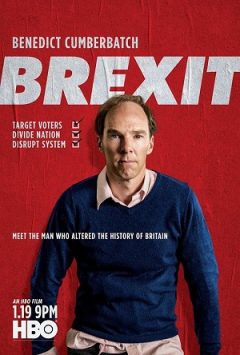 The first movie being reviewed for our Brexit mini-series is Brexit: The Uncivil War (2019), produced by House Productions and shown on HBO and the UK’s Channel 4. It was directed by Toby Haynes, written by James Graham, and stars Benedict Cumberbatch. The plot synopsis is available here, and the official trailer is below. The movie opens with these words on the screen: “This drama is based on real events and interviews with key people who were there. Some aspects of dialogue, character and scenes have been devised for the purpose of dramatisation”. The second sentence effectively negates the first. In fact, not only were “some aspects” merely “devised,” they were completely invented, including not just dialogue but also some of the “real events” with “key people” shown in the film. This movie is a mixture of comedy and docudrama, a tepid attempt at reproducing and combining The Big Short and In the Loop, both of which are immeasurably superior films (and probably less insulting to the intelligence of viewers).
The movie opens with Dominic Cummings (played by Benedict Cumberbatch), the manager of the Leave campaign. Cummings is immediately shown as eccentric—or perhaps a little of an idiot savant. He opens the film with the line, “Britain makes a noise” (only I heard, “Pudding makes a noise”—perhaps the script should have chosen what I heard, to really emphasize how weird the main character is meant to be, for us).
In one of his fragmented opening monologues, the Cummings character makes some indisputably wise points: “as a global society we are entering a series of profound economic, cultural, social and political transitions, the like of which the world has never seen…. Massive increase in resource requirements…. A rising tide of religious extremism…. A synthesis of… inter-generational inequality in the West on an historic level”. At other times, as discussed below, he is a mere puppet for the filmmakers’ polemic against Brexit.
Insight into Elite Myth-Making
The movie can serve as a useful insight into the minds of elite, establishment Remainers, and their ability to dedicate time, energy, and resources into orchestrating a collective international wailing. As has been said repeatedly on this site: those in power would love for us to feel their pain as if it were our own, to make a loss for the transnational capitalist class appear to be our loss, so that we may then rise up and strike out to defend their interests (while annihilating our own).
The movie references the fall of the Berlin wall—with Brexit being the biggest political upset since then. That is a “problem”: the thing about Berlin walls is that they are only supposed to fall in other countries, never in our own. “We” have suffered a basic transgression, a violation of our entitlement to eternal continuity, in spite of the contradictions and conflicts we create and multiply. In other words, it shows you just how deranged our ruling classes have become.
The Ugly Face of Conspiracy
The opening’s main point is to prepare us for the revelation of yet another alleged grand conspiracy, almost like the mythical Russiagate conspiracy theory. We hear forgettable technocrats droning on about UK law and asking Cummings if his actions were within electoral law, or were a threat to democracy. Then the Cummings character, facing the camera, states: “Everyone knows who won. But not everyone knows how”—and that is the point of this movie. And what a miserable little point it is. In the end, what the filmmakers achieve is another reminder to us that the only real conspiracy we face is the conspiracy of enforced unanimity by state and corporate media—unanimous in their contempt for voters, and for the will of the voters. Abolish the “will” of the voter, by making it appear to be merely the by-product of a sinisterly-devised algorithm and data mining operation, and you thus abolish the voter. No agency, thus no agent. The only real people are the members of the ruling elite.
 Appropriate for a conspiracy movie, Douglas Carswell (laughable troglodyte), holds a secret meeting with Matthew Elliott (nervous nerd), in a portrait gallery. I foolishly hoped this would be the end of the silly caricatures, forgetting this is a commercial entertainment product and not a documentary. Had I prayed for more caricatures, I would have been immediately satisfied—meet Arron Banks (snarling pig). Only the Boris Johnson character is a softer version of the real thing, the actual Boris Johnson being abundantly self-caricaturing already.

 The usual inflation of grotesque features that one finds in British films, is a simplistic equivalent of bold print, only it is applied to faces. The face is meant to convey meaning—and the meaning here is: villainous conspiracy. Thus we are shown the faces “behind the [imagined] scenes,” with the hatching of a conspiracy in the UK Independence Party (UKIP, the notorious villain in all establishment narratives second only to “Russia”). “Gunpowder, treason, and plot,” mutters the Cummings character, thus evoking the 1605 Gunpowder plot.

What follows is a lesson from the arch conspirator, Cummings: “How to Change the Course of History. Lesson One: Kill conventional wisdom”. The aim here is to learn from the “true disruptors of Europe”: Napoleon, Otto von Bismarck, and Alexander the Great.
The film hurries through the reasons for voter discontent—there were many, and they were diverse—so that we instead come away with the impression that mere “talking points” are being generated by conspirators: the EU seems abstract; immigration is a problem—but what kind of problem? Is it about race? Integration? The levels of immigration?; “people are feeling angrier, left out, ignored”; “don’t think our kids will have a better future than us”; “we spend more time than ever online, but we feel more alone”; “we’re not getting married as much”; “less of us have faith”; “we’re not saving as much”; “we trust less the institutions and people our parents trusted”. Had the movie drawn this out longer, it would have been a service to the Remainers who seem particularly thick when it comes to trying to understand the opposition and the groundswell of support for Brexit. No luck.
Instead, we are shown the conspiracy, boiling it all down to core talking points: “Loss of national identity. Clear. Sovereignty. Digestible. Loss of community. Simple. Independence. Message repeated over, and over, and over”.
The point is to, “tap into all these little wells of resentment, all these little pressures that have been building up, ignored, over time. We could make this about something more than Europe. Europe just becomes a symbol, a cypher, for everything: every bad thing that is happening, has happened…”.
One reviewer noted a basic contradiction in the movie’s polemic, which involves its magnification of the role of Dominic Cummings. The movie has Cambridge Analytica, Robert Mercer, foreign data firms, big private donors, and every theory possible thrown at the screen as to why Brexit won. Then why did Cummings matter at all?
“Post-Truth”: The Anti-Anthropological Message
The movie also shows us what “post-truth” is meant to mean. Truth is where one appeals to voters’ heads, by using “facts”. The other thing, which has no name other than “post-truth,” appeals to voters’ hearts, using “emotions”. What a poor anthropology this is, where human emotions are divorced from the facts of being human. Any anthropologist who uses the phrase, “post-truth,” does not deserve to be called an anthropologist at all, because they have essentially abolished anthropology. A truth that denies that humans often understand facts emotionally, and that emotions can generate facts, is no truth at all. The real “post-truth” then lies among those who coined the phrase “post-truth” in the first place.
This movie makes no bones about which side owns “the truth”: the Remainers. The movie shows the Remain campaign desperate to counter Brexit with, in their own words, “the truth”. The truth is not shared, equally accessible to all—it is the special preserve of an equally special class, the class that has the Nobel prize-winning economists on their side. The Remainers are shown complaining about the media giving any air time to opponents—there is a deep yearning for censorship. It is all about virtue against democracy. The Remainers own “expertise”—and the other side owns the ignorant ingrates who forgot their duty was to obey by believing the experts, regardless of their many mounting failures. This is precisely the kind of movie that is not needed now (or ever); it merely invites more scorn and can only validate the resentment of Brexit supporters (and judging from reviews posted online, it has).
The voice of the establishment—Craig Oliver, communications director for Prime Minister David Cameron—describes Cummings as “basically mental”—“just an egotist with a wrecking ball”. And the voters are Frankenstein: “There’s the danger… of having unleashed something which we can’t then control”.
The voters, shown in focus groups, are cast as either ignorant and bumbling fools, or overly opinionated extremists. We are meant to see voters as a pathetic, troubling mass. If we cannot abolish the vote, and the voters, then we should at least try to do so. If moviegoers thought that, then the movie would have succeeded in achieving one of its aims.
One needs to be familiar with the conventions of British entertainment television and the movie industry, obviously in the hands of elites with an axe to grind, to understand how working class voters are shown. This is the same industry that produces things like Coronation Street and The East Enders, or My Name is Lenny (2017), which portray working class people as freakish, mutant rogues. They are either malicious with contorted expressions, or simple dopes who look like they are permanently suffering a stroke. Lacking truth, so they lack goodness and beauty too. We are thus back at “post-truth,” the cherished trope of a neo-Aristotelian class that claims a monopoly on virtue, that tolerates vast inequalities and produces a teleology to justify them.
Does History Need a Sock Puppet?
The filmmakers also resort to using the Cummings character as their sock puppet, having him mouth lines critical of the referendum as “a really dumb idea”—which is what the filmmakers think, and what they want us to think. Here is fake Cummings:
“Referendums are quite literally the worst way to decide anything. They’re divisive. They pretend that complex choices are simple binaries… and we know there are more nuanced and sophisticated ways out there to make political change and reform, not that we live in a nuanced or political age, do we? Political discourse has become utterly moronic, thanks to the morons who run it…. But there it is. If that is the way it is to be, then I will get us across the line, in whatever way I can”.
This is meant to be the honest, hidden, inside appraisal said in secret—so we think that it’s the truth.
The Cummings character then styles himself as a political “hacker,” entering the “back door,” to “re-program the political system”. It’s all covert, dishonest, and there is a sense of illegality. Meetings are always secret, surreptitious, cloaked—classic conspiracy stuff. Having abolished the will of the voter, the film now abolishes the vote. It’s an expression of a deep desire: for Brexit to have never happened, for the vote to never have been allowed. That’s all. It’s crude, and transparently obvious to even a half-awake viewer.
It was not the only time the filmmakers used Cummings in a contradictory role, that made no sense for the movie. They had this supposed algorithmic genius of online data mining look all disturbed and scared as an American explained to him the new politics of data. He turns and looks at people walking by, using smart phones and tablets, as if they were alien invaders. The final act of sock puppetry was when the filmmakers had Cummings mutter that Nigel Farage is, “a moronic little cunt”—their script, their view. Keeping it classy.
All About Trump?
Of course, there had to be a Trump angle—there is a Trump angle to everything now. We are thus presented with some whispering conspirators from America, in the figures of Robert Mercer (financier), and the Dark Lord himself, Steve Bannon of Breitbart, shown entering the UK to intervene on the side of Brexit. Then we hear “Cambridge Analytica”—the British, not Russian firm that allegedly masterminded Trump’s online campaign. Of course, none of this is true: Robert Mercer never went to offer help with Leave; and, Zack Massingham, the Canadian whose company boasted having a cutting edge date-modeling program, never provided it to the Leave campaign. It’s too bad Joseph Cotten and Orson Welles were not alive to act in this film—their presence could have vastly dignified this poor attempt at film noir. Albert R. Broccoli would have made a more believable film, with more credible villains.
How to Abuse One’s Viewers with Misdirection and Mystification
This movie works by building a chain of misplaced concerns and misidentified problems. That is how mystification works. The “problem” (fake) is with the fear-driven, resentful working class—not their exploitation, marginalization, and even vilification by the privileged. The “problem” (fake) is with nostalgia—not with the current climate being so bad it makes everyday people miss the past. The “problem” (fake) is with hatred—because the problem is always with the response to what has been provoked by those who hold the power. The “problem” (fake) is with xenophobia—not with a system that taught them pride in being British in the first place, that colonized the world, and for centuries looked down on others with contempt. The fact that huge numbers of refugees were entering Europe—fleeing the regime change wars that Europe helped to manufacture by participating in NATO—only added to the sense of an urgent crisis. Engineering a massive influx of immigrants when locals are locked out of the labour market is a recipe for social peace—exactly nowhere. The “problem” (not fake, just misleading) was that Jo Cox, Member of Parliament, was assassinated in the lead up to Brexit—the problem was never that Cox herself backed ever escalating violence in Syria to promote catastrophic regime change in the name of “humanitarianism”. The “problem” (fake) is with the previously apathetic being marshalled to come out and vote—not the fact that they were previously ignored, impeded, and so generally turned off by the dominant politics. The “problem” (fake) is with crafty data miners who know their business—not with the asymmetry in access to information that props up the political system, or the fact that every political campaign exploits data. The “problem” (fake) is with the lying politicians on their side—not the lying politicians on all sides, who get away with lying because the system refuses any corrective mechanism to ensure accountability. And on it goes. When you opt for ideology instead of analysis, you get garbage.
Lessons Not Worth Teaching
So what are the “lessons” of the film? One is “data is power”—actually, data is just data, but anyway. The idea here is that Britain was a “lab experiment” for a new politics based on data mining. Is it bad to gather data about voters? But then why would it be bad? Should one not try to understand voters and what they want? In a system that bars ordinary people from making decisions even about the basic, immediate, day-to-day aspects of their lives, and that permanently distances and silences them except for a few seconds at a ballot box every few years—how many other ways does the system allow itself to hear from them? Does it matter even, if you can effectively criminalize the mere act of gaining knowledge about voters? Even this movie itself repeats the fact that one side—Remain—had access to the national voter database, while the other side had Cummings try to build an alternative from scratch. If there was a conspiracy, it was here, in this lopsided and unfair distribution of advantages, which the Brexit side overcame. Was Brexit wrong to overcome this data disadvantage?
Did only one side mine online data? Was only one side guilty of “spin”? How much did the Remain campaign spend, compared to the Leave campaign? In fact, the Remain campaign outspent the Leave side by millions of pounds. The movie makes no mention of that fact, nor of the private investors backing Remain, and has little to say about their key influencers. The people with the most votes, spent less money (and won), and they came under investigation for campaign finance violations.
If viewers were truly shocked, chilled, appalled, etc., by what they saw in this movie, then what has stopped them from militating for the total abolition of the advertising industry? Advertisers and PR firms have been doing what this movie shows for generations now. Why the sudden raising of a hue and cry? Why is the outrage so selectively focused on a pinpoint example? Because it’s a dishonest pseudo-critique. That’s one of the things you get when ideology substitutes for analysis.
A second lesson of the film appears to be that the Brexit side was backed by shady financiers—with agendas that are not made clear to us. So who backed the other side? Is there an innocent and pure party here, which the filmmakers neglected to present? Was it the Brexit side that invented the structure of private financing of public political campaigns?
A third lesson has something to do with voter apathy, and the ability of one side to tap into the huge mass of people that regularly refuse to vote in elections in our societies (which would include myself). The crime here appears to have been Brexit’s ability to bring out such persons to vote—as if they found a secret list of dead persons and padded voter rolls. Reducing voter apathy thus becomes something like rigging an election. Yet the quest for the non-voter seems to have failed altogether with Trump: a plurality of eligible voters refused to actually vote. The real winners of the popular vote in the 2016 US presidential elections were precisely those who refused to come out and vote.
The final lesson, with which the movie closes, is that the real problem with the referendum was that it had two sides to it, when ideally it should have had only one: stay. A “crime” was committed by the other side working as if they actually wanted to win. Indeed, the movie closes with the statement that, “in 2018, the Electoral Commission found the Vote Leave campaign guilty of breaking Electoral Law. Leave.EU were subsequently referred to the National Crime Agency for investigation into breaches of Electoral Law”. Had the country in question been Venezuela, the headlines would have read: “Authoritarian regime cracks down on opponents”. In fact, the investigations had not opened by the time the film was made and, more importantly, the movie itself shows absolutely nothing about how the Leave campaign violated said law. One would think that is a major omission.
Accidentally Intelligent
“We’re asking voters not to reject the status quo, but to return to it”. The only really intelligent point the movie made, was one done quickly and only in passing—it seems to have been by accident, so it may be wrong to ascribe “intelligence” to the filmmakers. The point was this: the real contest in 2016 was not between the status quo and a “disruptive” insurgency, but between two status quos: the present status quo versus those preferring the status quo ante. In other words, it was effectively a conservative vs. conservative fight. Neither side proposed any revolutionary transformation, of anything really. It was a clash between those clinging to what was known and tried—the only difference being where their preferences fell on an historical timeline. In other words, the Remain vs. Brexit fight was between preservation and restoration, both of which are conservative positions. Now the two sides have been reversed: the pro-Brexit side is struggling to ensure that Britain remains on track to leave, while the pro-Remain side imagines the EU in utopian terms and occupies itself with, “lament, regret, and nostalgia for an imagined arcadian past in which the EU was a land of milk and honey”.
Similarly, in the US Trump was cast as the candidate nostalgically pining away for the lost days of American glory. However today he is campaigning with a new slogan: “Keep America Great”. Joe Biden instead presents himself as driven by the nostalgic need to restore the old order. Just wait until Biden delivers a blistering speech about life in America under Trump—Fox News is certain to denounce him as the “doom and gloom” candidate who offers a picture of “Midnight in America” (just as the others did with Trump).
The best “lesson” of the movie was the one that was unintended, and it is revealed by how the movie backfires on its makers. This movie is a reminder of why dominant interests so richly deserved to lose—and not necessarily that the other side deserved victory. Brexit has been very “profitable” in at least one sense: it has revealed a dysfunctional UK, quasi-governed by inept, visionless elites, incapable of containing a crisis of their own making. Remember: these are the same elites that turn around and lecture other countries about democracy and good governance, and that bomb other nations in the name of human rights. If anything, Brexit was not a mean enough defeat: much more is needed.
Featured Video
The Failed Air War Over Vietnam
or go to
Aletho News Archives – Video-Images
From the Archives
USS Liberty Massacre: A Pivotal Moment in the Hostile Takeover of America
By Kevin Barrett | Crescent | Dhu al-Qa’dah 24, 1445
In corporate America, hostile takeovers are commonplace. They occur when an aggressor—a larger corporation or rich individuals—seizes control of a smaller corporation without asking permission.
What few recognize is that the United States itself has been subjected to a hostile takeover. Since the aggressor, the illegitimate settler colony known as “Israel,” is much smaller than the US, the takeover has necessarily been surreptitious.
As of June, 2024, Israel’s gradual takeover of the US has become obvious and undeniable—a proverbial “elephant in the living room.” … continue
Blog Roll
 Aletho News
- Leaders Condemn Ansarallah Attack on Saudi Arabia While Ignoring Illegal War Against Yemen
- Leaked: Britain’s Covert Iraqi Psyops Network
- Yemeni Armed Forces Warn Airlines Against Using Saudi Airports, Exempt Mecca and Medina
- Iran security chief says powers greater than US tried to conquer Iran but ended in ‘dustbin of history’
- Europe’s mounting social chaos… chickens coming home to roost for proxy war against Russia
- US-Russia Diesel Deal Becomes Massive Defeat for Ukraine
- Hormuz and the Looming Economic Catastrophe
- Dhubab offensive, media blitz and the rapid unraveling of Saudi-backed coalition’s new gambit
- Putin Conveys to Trump Iran’s Vision on Possible Conflict Resolution – Kremlin
- The Search for Truth: Charlie Kirk’s Assassination One Year Later
- If Americans Knew
- ‘He’s Desperate’: AIPAC Begins Spending Against Abdul El-Sayed to Boost Mike Rogers:
- Trump, Hormuz, and the Looming Economic Catastrophe
- For three years, Israel has killed a child in Gaza every 71 minutes – Daily Update
- Israeli forces kill another child in Gaza – Daily Update
- Gaza ceasefire exists in name only, say more than 100 organizations
- Nearly 2 Million in Gaza Need Urgent Shelter Assistance as Winter Looms: IOM Chief Warns
- Suppressing Palestinian resistance: US charity under fire for AI monitoring of Gaza classrooms
- Thousands Are Held in Israeli Torture Camps. This Is What Happens Inside
- Israel puts Gaza’s sick, injured, newborn in peril – Daily Update
- Report claimed Mark Levin used by Israeli government to influence Trump
- No Tricks Zone
- Germany’s Green Energy Debacle: High Energy Costs Force Kahla Porzellan to Close After 182 Years!
- New Study: 50 Years Of The Most Aggressive ‘Net Zero’ Policies Can Only Affect The Global Climate By 0.03°C
- US September “Heat” Was No Record…Many Records Set Decades Ago
- Latest European Green Energy Debacle; Portugal’s Largest Flagship Solar Park Insolvent!
- Green Energy Debacle: German Expert Professor Fritz Vahrenholt Warns Of Severe Economic And Social Consequences
- Two More Paleo Reconstructions Affirm Meters-Higher Sea Levels Across Ireland, Brazil 7000-6000 Years Ago
- New Study: Earth And Venus Surface Warmth Largely Explained By Convection And Lapse Rate, Not CO2 Or Radiation
- 2025 Nature Paper Claiming Worsening Global Drought Gets RETRACTED …Heavily Flawed
- New Study: ‘Global Drought Shows No Detectable Recent Acceleration Under Climate Warming’
- Economic Masterminds: German Socialists Suggest Taxing Productivity Gains Stemming From Using AI

